Playing with Infinity

After Squaring the Circle and using Blaschke products to squeeze finitely many disks conformally into a single disk, the restless mathematician wants to put even more disks into a disk. Infinitely many, that is. What we need for this is a conformal map that maps the disk infinitely often onto itself. We will cheat a little and employ the exponential function. It maps the left half-plane to the punctured unit disk, and because it is 2π periodic. Each point except the center of the unit disk has infinitely many preimages.
Expo 1

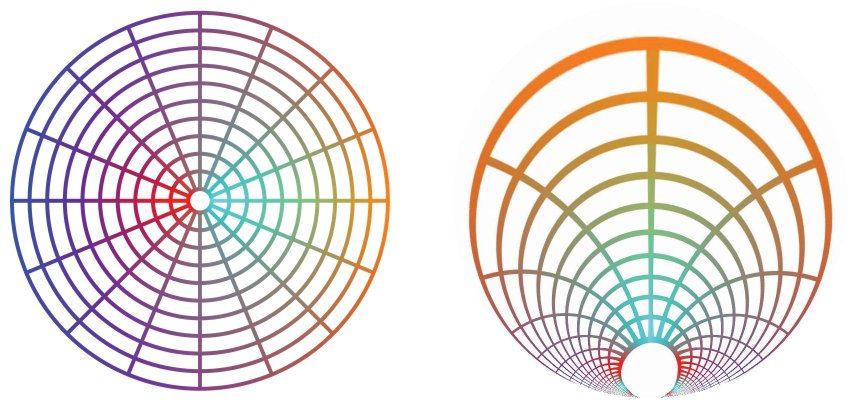
So, my first examples map the disk via a Möbius transformation to the left half plane (that is a bijection), and then via the exponential map back to the (punctured) disk. Missing one point won’t be a big deal – what is a single pixel? Pulling back the default spider web on the left replicates it infinitely often, but in a somewhat disappointing way: The circles of the original web become horocycles that are mapped periodically onto the circles. We just have an infinite hyperbolic wall paper, periodic with respect to a parabolic isometry. We can do slightly better by taking products of several such maps.

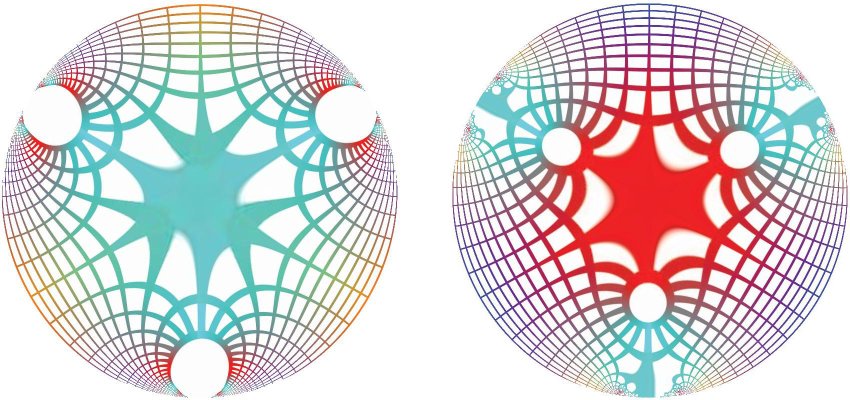
Below are products of three such Möbius-exponential maps,
Expo 3

and here the two images that use four factors. I have placed the parabolic fixed points symmetrically but played with the Möbius transformations a little.

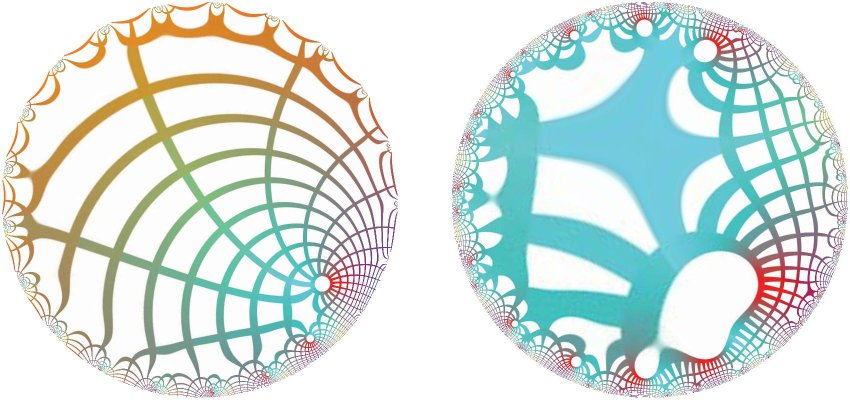
Of course one can also use infinite Black products, as long as the zeroes of the factors converge rapidly enough to the boundary circle, and as long one is patient enough to evaluate the infinite products to sufficient accuracy.
Binfinity

In the left example, the zeroes follow a spiral, while in the second example, the zeroes alternate between two spirals that turn the opposite way. The zeroes correspond to the circular holes.
Spring Cleaning I

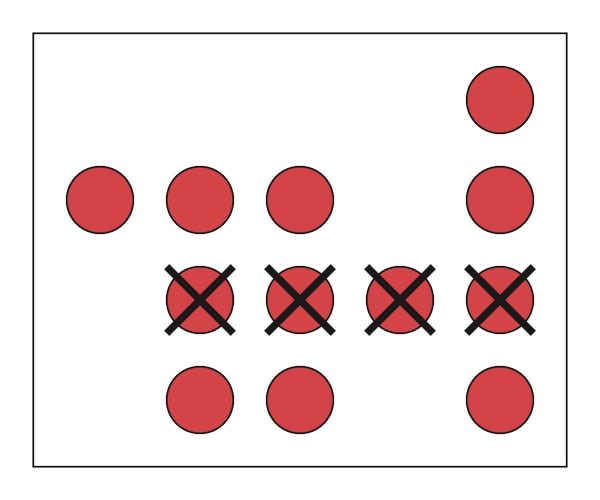
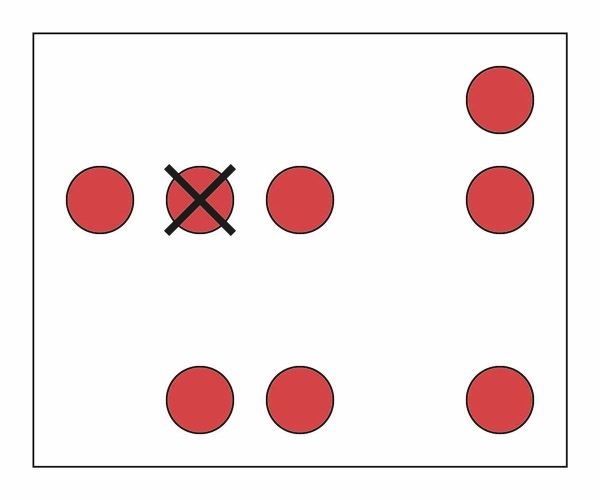
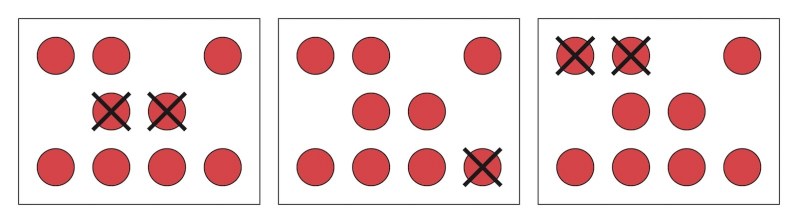
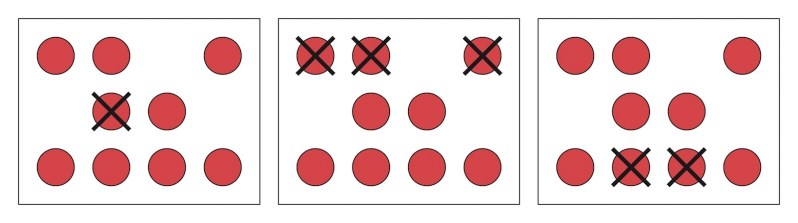
Spring Cleaning is played on a rectangular array of randomly placed dirt pieces. A sweep consists of removing a single row or column of consecutive dirt pieces.

Sweep legal

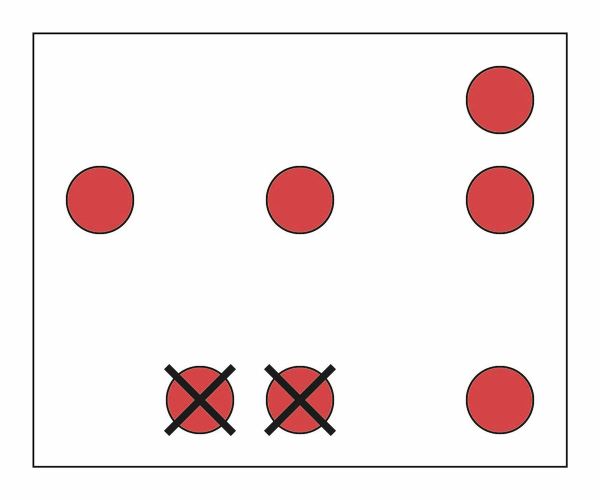
Above are some example of legal sweeps, and below are illegal sweeps.

Sweep illegal

This is a game for two players, who take turns by doing exactly one sweep. The player who sweeps the last time is the winner. This is an impartial game which means that each position is equivalent to a single game of Nim. This is usually bad news, because playing Nim well requires us to perform exclusive or additions of binary numbers in our head, for which our brains are not (yet) well equipped.

The good news here is that many simple positions are equivalent to very small Nim piles, meaning that computations are easy. I will explain this using an example. No proofs (even though they are easy, too).

Sweep win1

It’s your turn to find a winning move in the position above. You know (because I promise) that rectangles completely filled with dirt pieces are easy positions, so you will look for moves that separate the dirt pieces into such rectangles. Here is such a move:
Sweep win1 sol

After that, we are left with four separate rectangles, all completely dirty. This means that this game is equivalent to a game of Nim with four Nim piles. The question is what the pile sizes are. The answer is simple: Any rectangle both of whose dimensions are odd corresponds to a Nim pile of size 1, if both dimensions are even, the Nim pile is empty (size 0), and otherwise, the Nim pile has size 2. In our example, we have a 1×1 rectangle, a 1×3 rectangle, and two 1×2 rectangles. They correspond to Nim piles of sizes 1, 1, 2, and 2. The exclusive or sum of these numbers is 0. This is what we want, because it means that after this move, the game is equivalent to an empty Nim pile. From now on it’s easy. Suppose that our opponent performs a vertical swipe on the 1×3 rectangle. What do we do to return the game to Nim-value 0?
Sweep 3 01

We can sweep away any of the isolated dirt pieces: From then on, the game is symmetrical and we can win easily without any Nim-theory. And we better leave the two 1×2 rectangles untouched. Suppose we remove one of them completely. Then we are left with three 1×1 rectangles and a single 1×2 rectangle, which exclusive or sums up to a Nim pile of size 3, in which case our opponent can win.

Sweep 4 01

The winning move would be to reduce the remaining 1×2 rectangle to a 1×1 rectangle with a horizontal sweep.

So, if we know how to deal with Nim positions that consist of Nim piles of sizes 1 and 2, we will be able to win Spring Cleaning by dissecting a given position eventually into rectangles.

Playing with circular images

After successfully transforming rectangular images into circular ones it is time to do something with them. We have seen already that the one can deform them by shifting one point somewhere else. This is very much like rotating a globe.

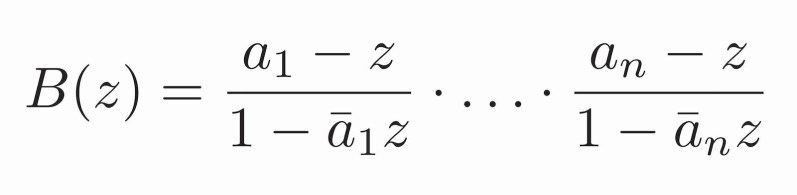
But besides these angle preserving symmetries of the disk there are other maps from the disk to itself that also preserve angles but are not anymore 1:1. These are the Blaschke products, written in complex notation as follows.

Product 01

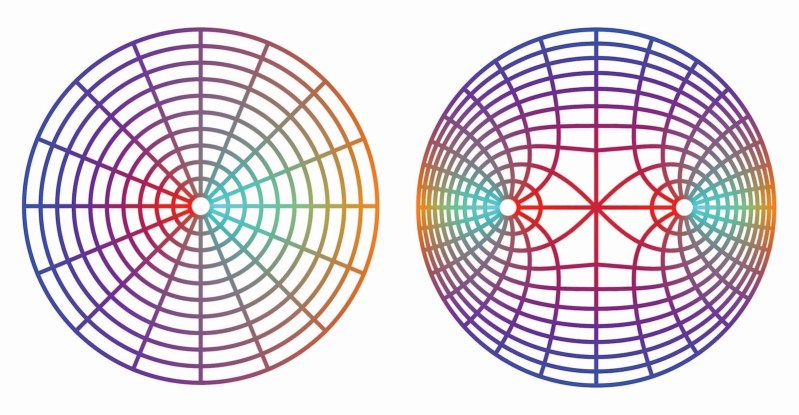
Let’s look at a simple example with just two factors, and choose the a-parameters to be 1/2 and -1/2. Then B(z) maps the double spiderweb on the right to the standard spiderweb on the left:

Blascke2 01

In other words, by taking preimages (or better, by using B(z) to pull back an image…), we can create multiple copies of a circular image within a circular image. The a-parameters designate the locations of the “centers” of the multiple spiderwebs where the strands converge.

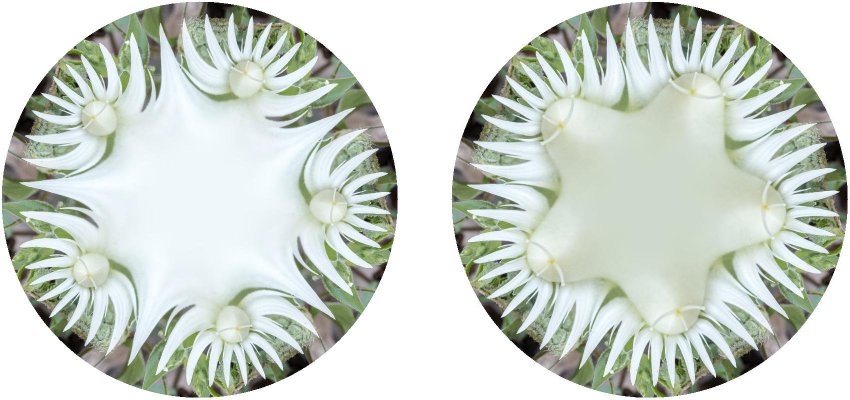
Flower1

For instance, above is a circular image of a Spring wild flower, and to the left its 3-fold mutation. Below are 5-fold mutations with two different choices for the a-parameter.

Flower2

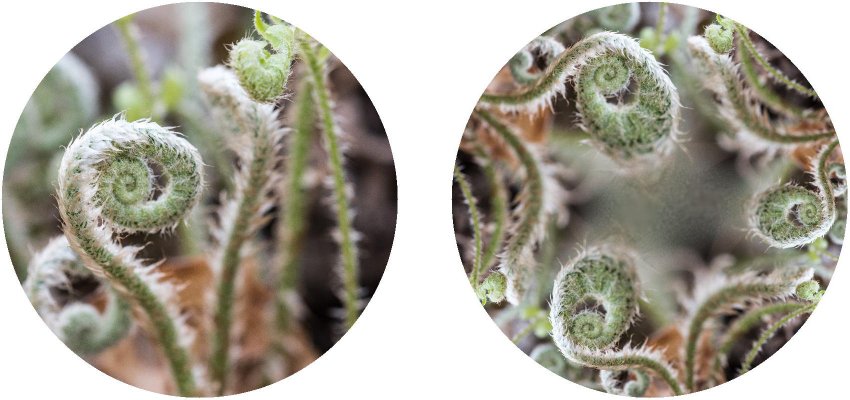
These images resemble kaleidoscopes, but are improved, because the copies of the original image fit together more evenly (smoothly, and not just by reflection). One can also make the result less symmetrical by choosing the a-parameters less symmetrical. Below the copies of the ferns are places at 120 degree angles but differently far out,

Ferns

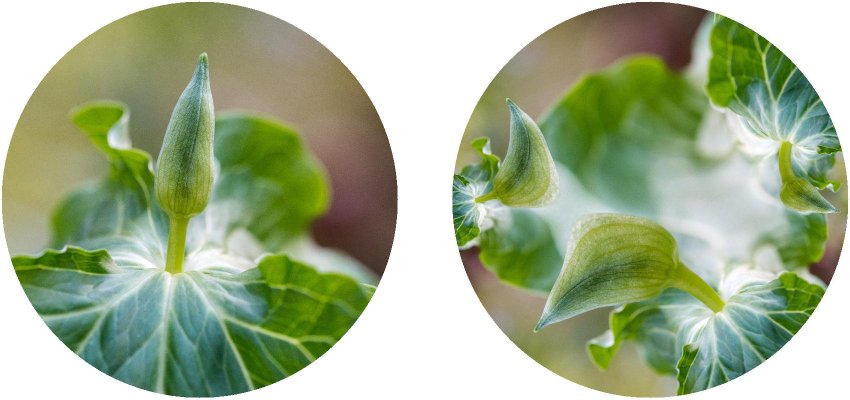
and here we have a large copy of the original budding trillium at the bottom with two smaller copies to the left and right.

Flower3

Now I need to find somebody who writes an app that implements all this…

A Room With Two Views (Five Squares IV)

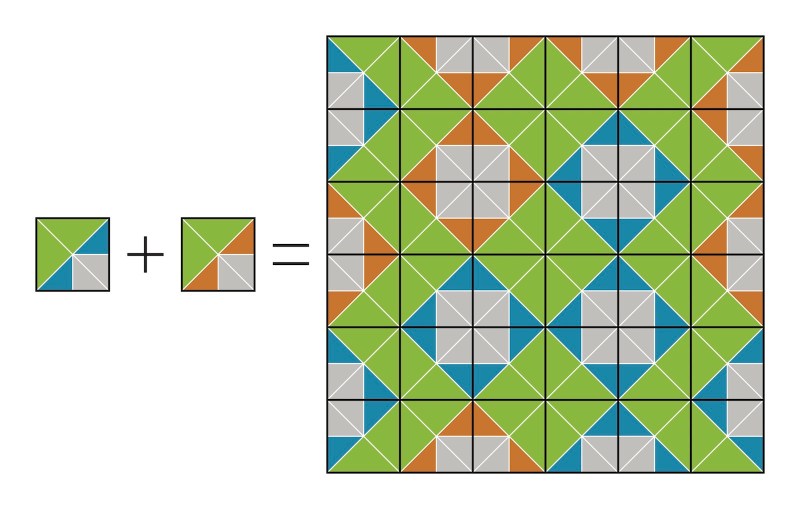
Today we look at tilings that utilize just the four other squares. The first step in classifying these is again a simplification, making the split corner squares uniformly green. This leaves us with two tiles:

Four

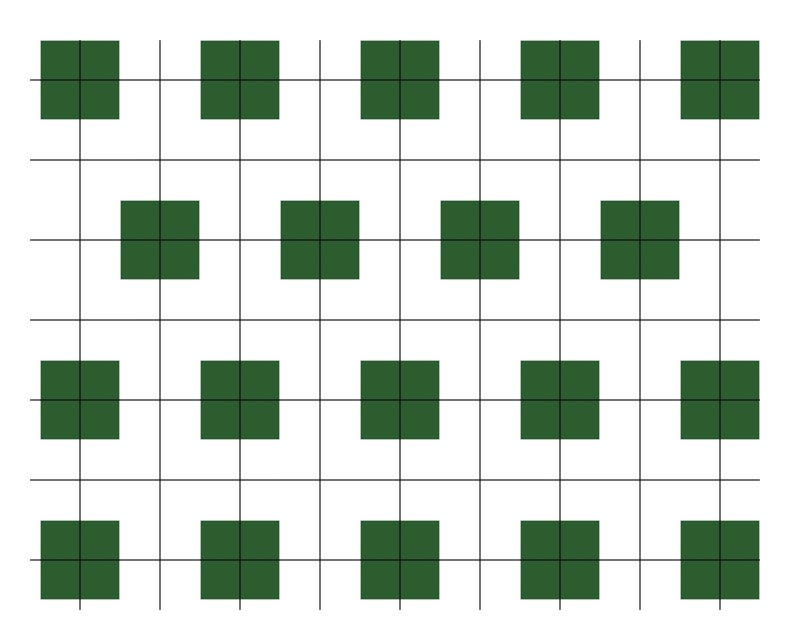
Ignoring the pink triangles for the moemnt, we recognize the problem we solved last time: The green squares need to occur in shifted rows or columns, like in the example below. Here we have four rows of green squares. Rows 1 and 2 are shifted, as are rows 2 and 3, but rows 3 and 4 are alined.

Green

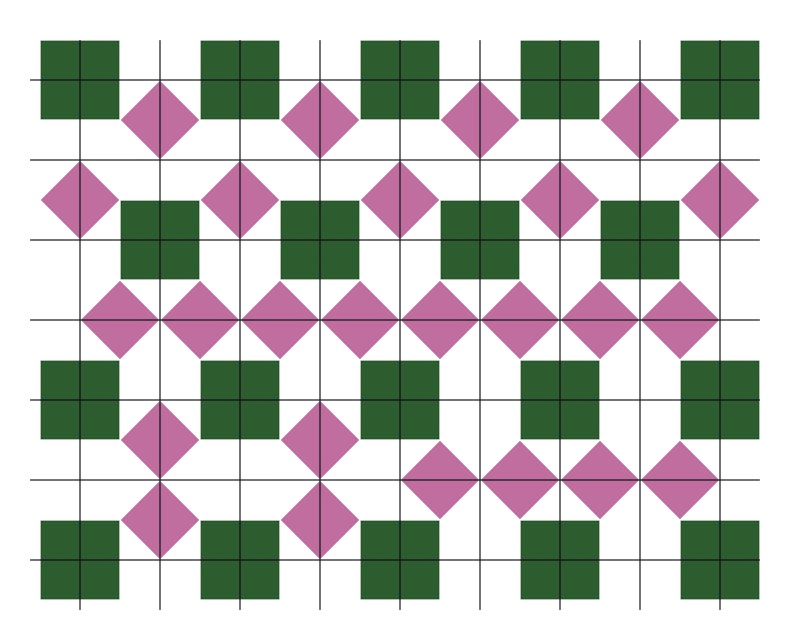
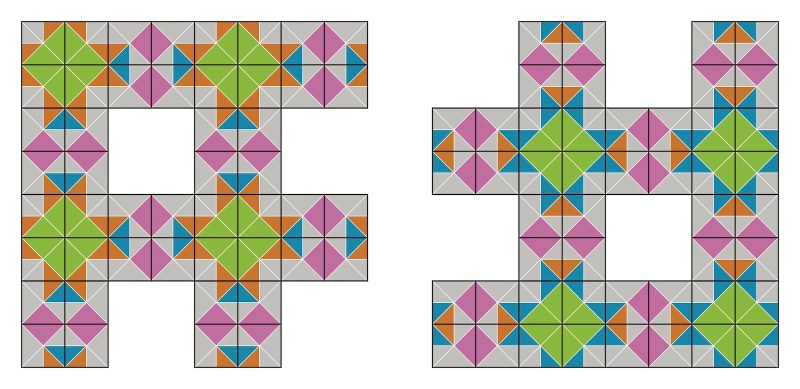
To add the pink triangles, note that two pink triangles fit together to a pink diamond, and each grid cell needs to have one of those, but we can only use those edges that are not already adorned with a green square. This leaved us with the following possibilities: If two consecutive rows of squares are aligned, we have place two diamonds in the square space between four squares, and we can do this horizontally or vertically. This can be done independently of neighboring squares, as shown between the two bottom rows below.

Purple

If the rows are shifted, we also have two possibilities to place the diamonds, but each choice affects the entire row, again as show above in the top rows.

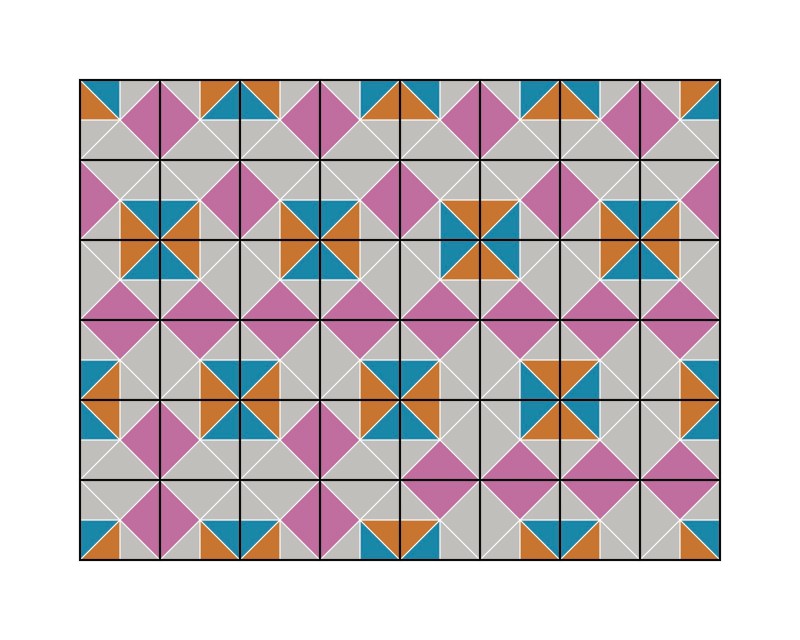
Finally, we need to undo the merging of the orange and blue triangles into green squares, and we can do so by splitting each square either way and independently.

Split

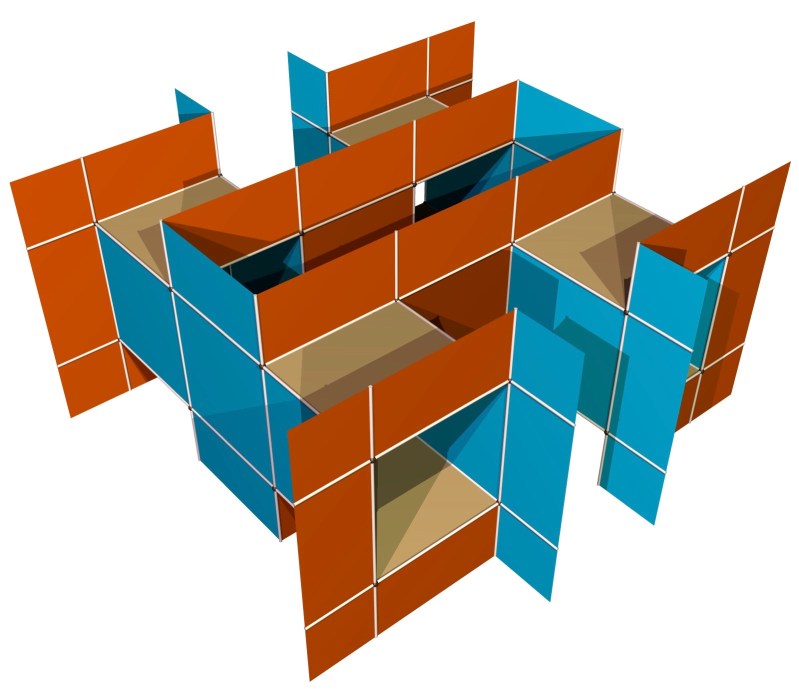
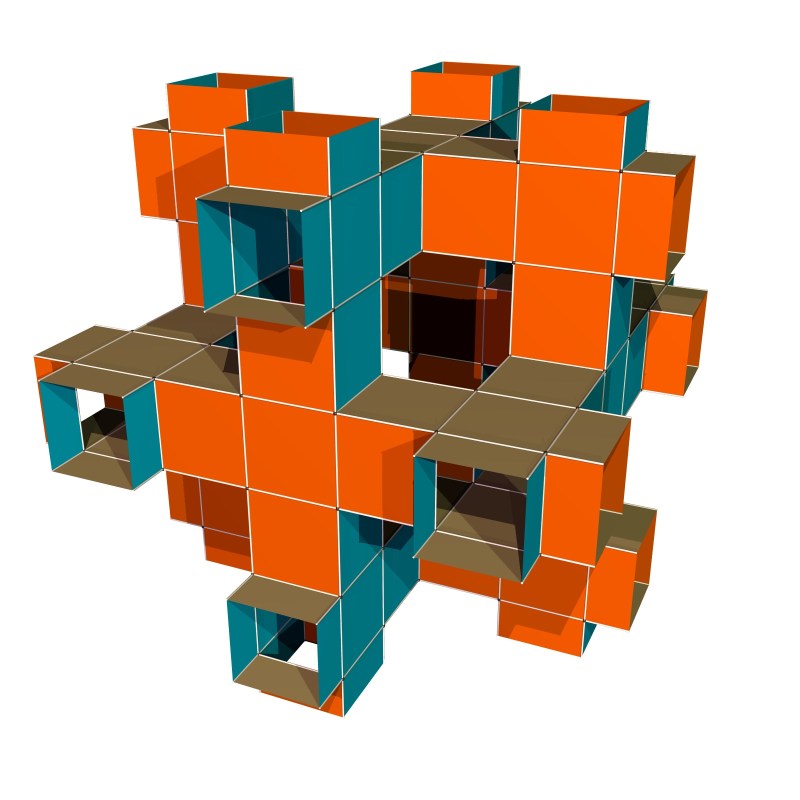
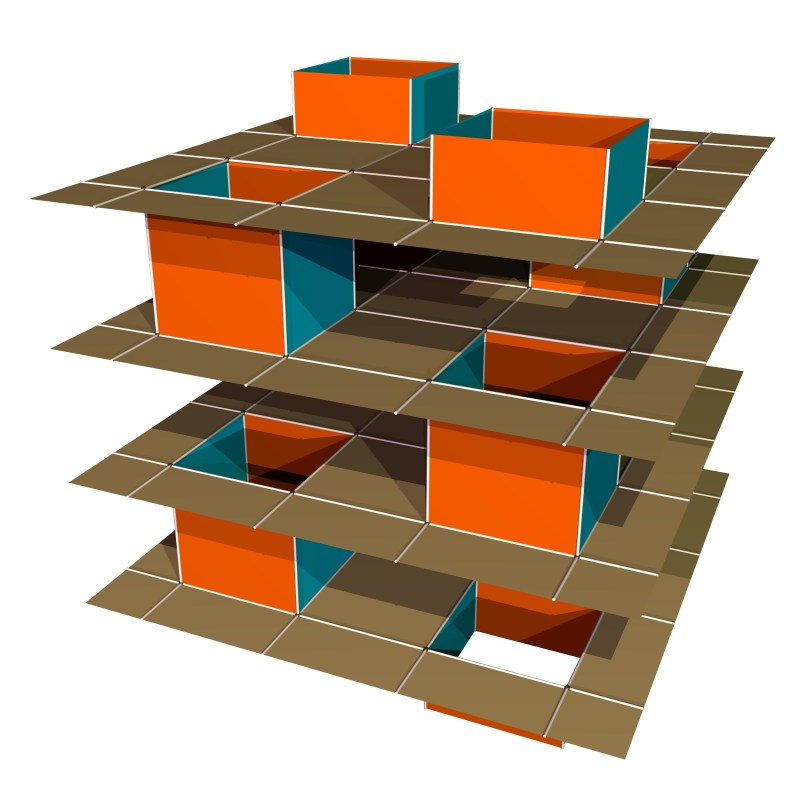
Below is an example how teh corresponding polyhedral surfaces will look like. The horizontal squares correspond to the green squares of the tiling. They are the floors and ceilings of rooms that have two opposing walls and two openings. I start seeing applications to randomly generated levels of video games here…

Nogreen

Squaring the Circle

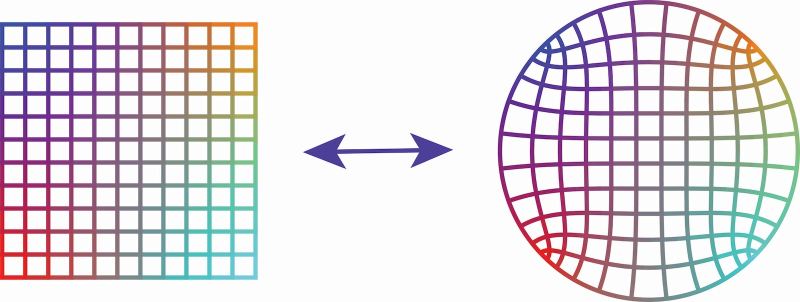
Squaring the circle is easy, you just need to know what you want to do. My personal favorite method is to use elliptic functions defined on rectangular tori to map rectangles to disks, as shown below for a square. These maps don’t preserve area (which is what the Greeks had wanted), but they preserve angles.

Circlesquare

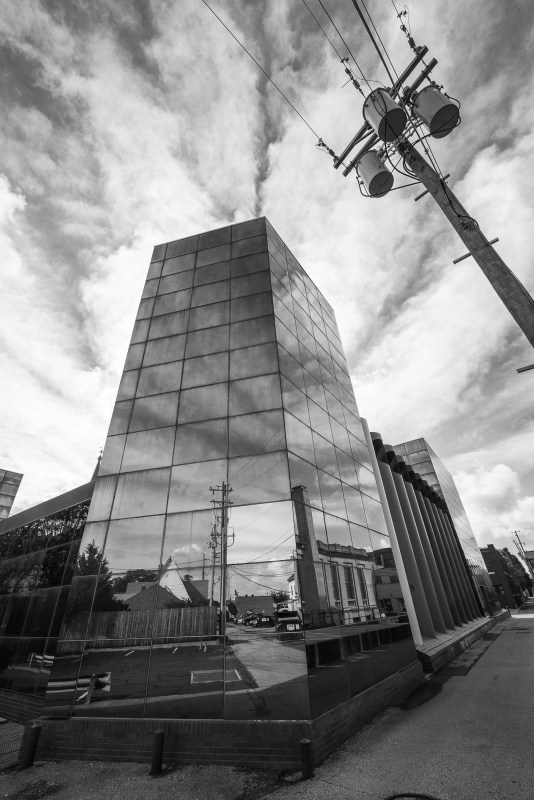
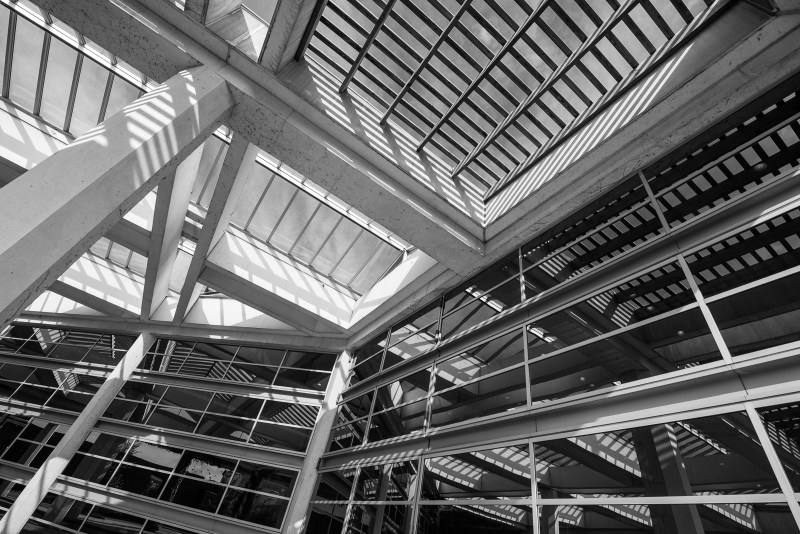
I had some leftover architecture images from Columbus and wanted to see how they look when made circular. Here, for instance, is the AT&T building

DSC 5596

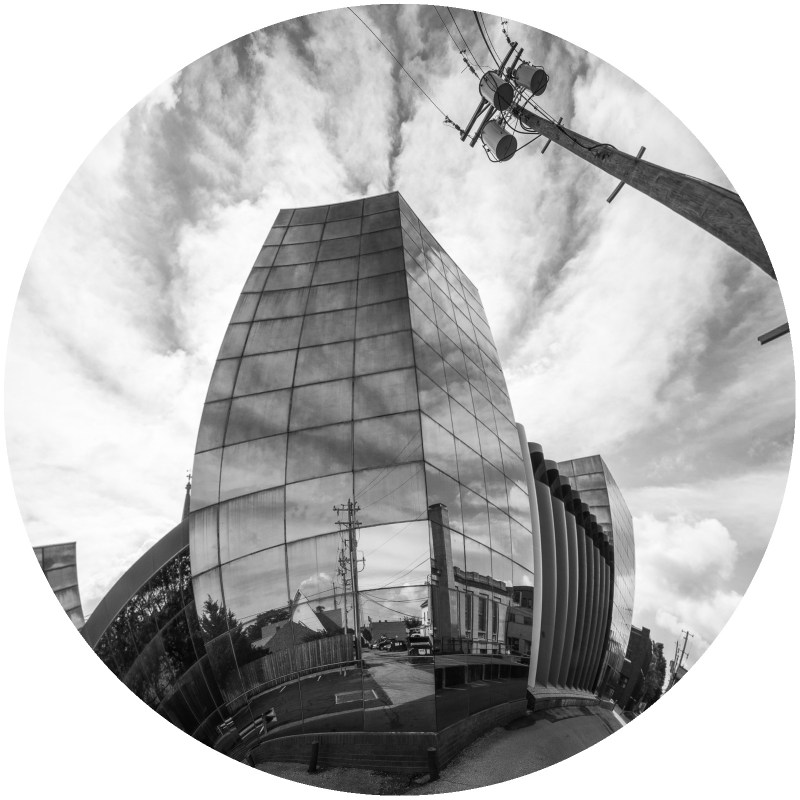
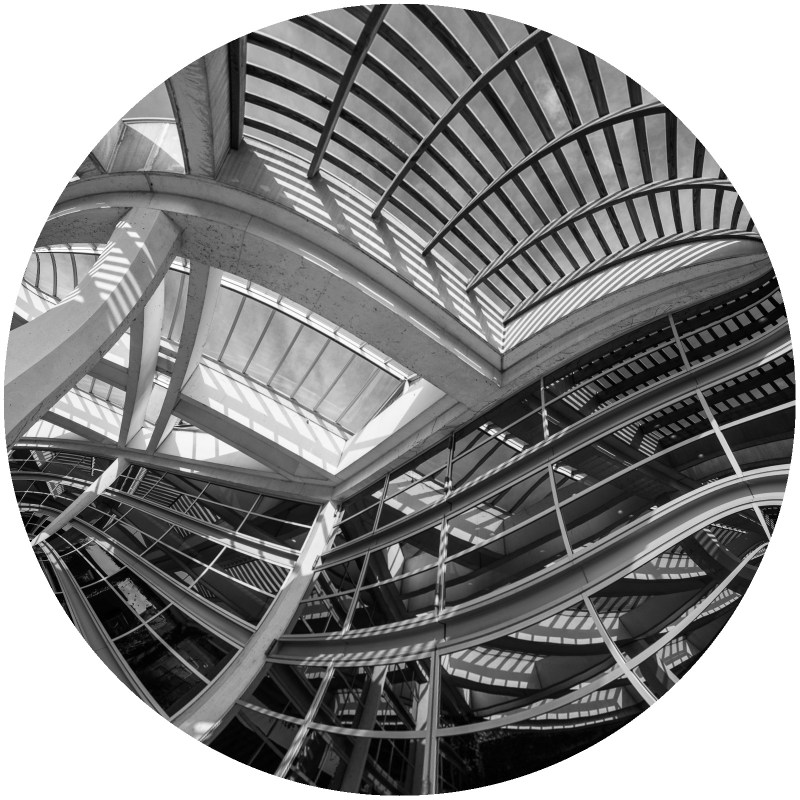
and this is a circular version:

Ex5

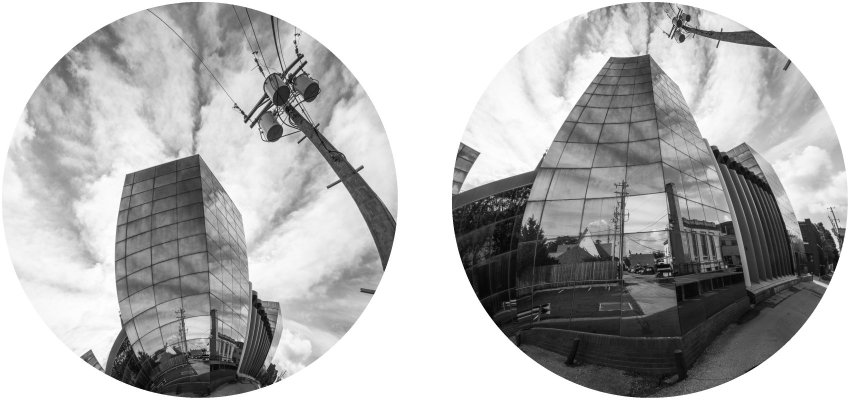
There are three degrees of freedom one can play with (the dimension of the automorphism group of the hyperbolic plane), which means that one can squeeze parts of the image towards the boundary cirle. Here are two other versions of the same image.

Att2

Another favorite of mine is the atrium of the Cummins office building with its wonderfully intricate play with straight lines and black and white.

DSC 5562

Now we only have to find architects and builders who create buildings that have these curves in reality.

Cummins

More about Decorated Squares (Five Squares III)

In order to classify surfaces that have five coordinate squares around each vertex, we were led to consider planar tilings with six different colored squares. Today we will discuss a special case of this, namely tilings that use just two of these squares. The only rule to follow is that colors of tiles need to match along edges. Here is an example:

Sample

To classify all tilings by these two squares (and their rotations), we first simplify by solely focussing  on the gray color (making it dark green), and considering the blue, orange, green as a single color, namely light green. This way we get away with just one tile. Of course we hope that understanding how this single tile can fill the plane will help us with the two tiles above.

One

We first note that placing the tile determines three of its neighbors around the dark green square. So instead of tiling the plane with copies of this squares, we can as well place dark green squares on the intersections of a line grid so that for each cell of the grid, precisely one corner is covered by a dark green square, like so:

Shiftedrows

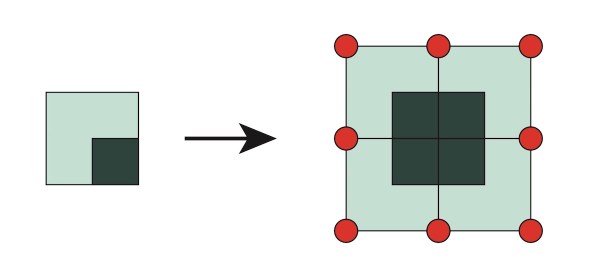
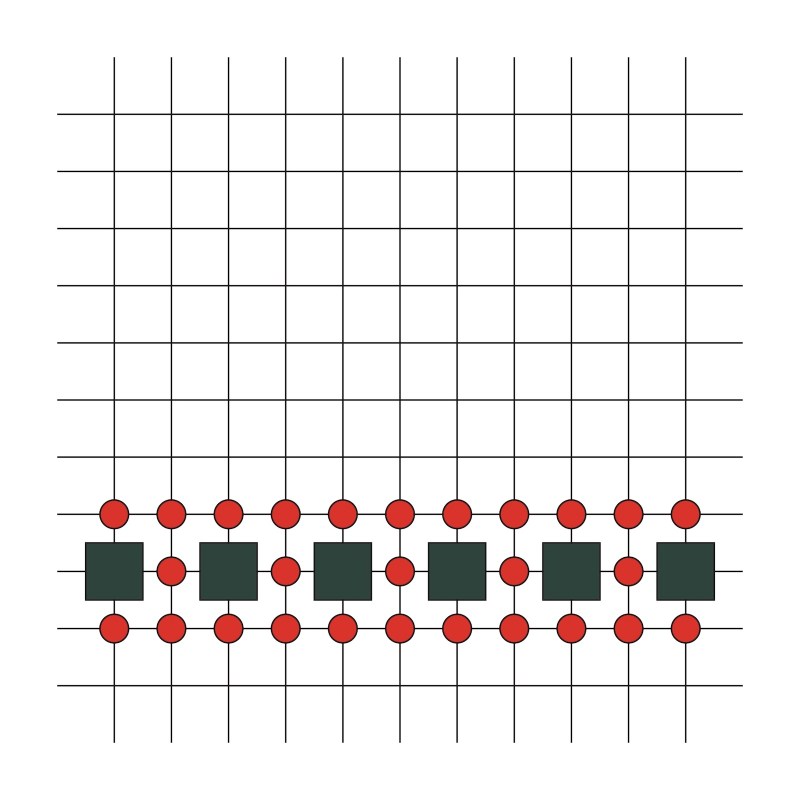
We first claim that if we do this to the complete grid, we must have a complete row of squares or a complete column of squares. Below is a complete row (given the limitations of images). The red dots indicate where we cannot place green squares anymore, because the grid squares have all their green needs covered.

Row

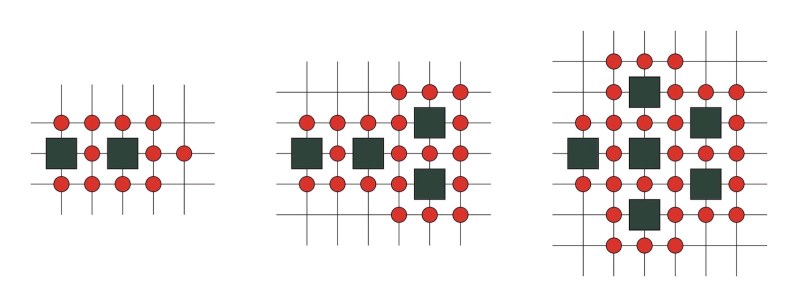
If we do not have such a row, there must be a square without left or right neighbor. Let’s say a square is missing its right neighbor, as indicated in the left figure below by the rightmost red dot.

Existence
Notice how the two grid squares to the right of the right dark square have only one free corner. We are forced to fill these with dark squares, as shown in the middle. This argument repeats, and we are forced to place consecutively more squares above and below, completing eventually two columns.

As soon as we know that we have (say) a complete horizontal row, directly above and below that row we will need to have again complete rows of squares, as in the example above. These rows can be shifted against each other, but that’s it. So any tiling of the plane by the dark/light green tile consists of complete rows or columns with arbitrary horizontal or vertical shifts, respectively.

Finally we have to address the question whether this tells us everything about tilings with the two tiles above. This is easy: Each dark green square represents a light gray square that is necessarily either surrounded by blue or orange tiles. So we can just replace each dark green square by an arbitrary choice of such a blue or orange cluster. The final image shows such a choice for the example above.

Filledrows

It is now easy to stack several such tiled planes on top of each other, thus creating infinite polyhedral surfaces that have five coordinate squares at each corner.

More Examples (Five Squares II)

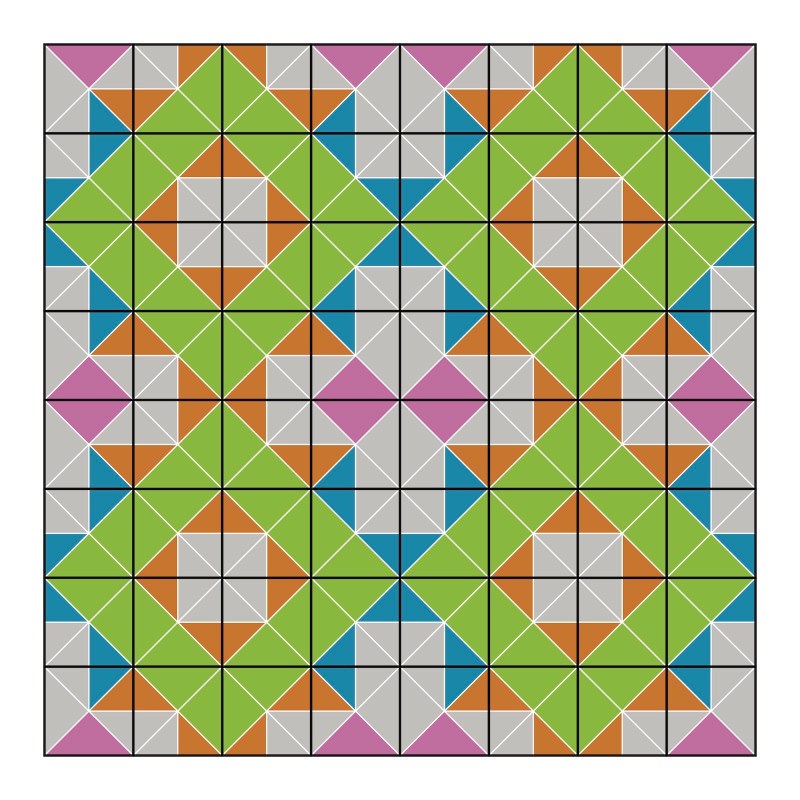
To review, let’s start with the following tiling

New 4 tile

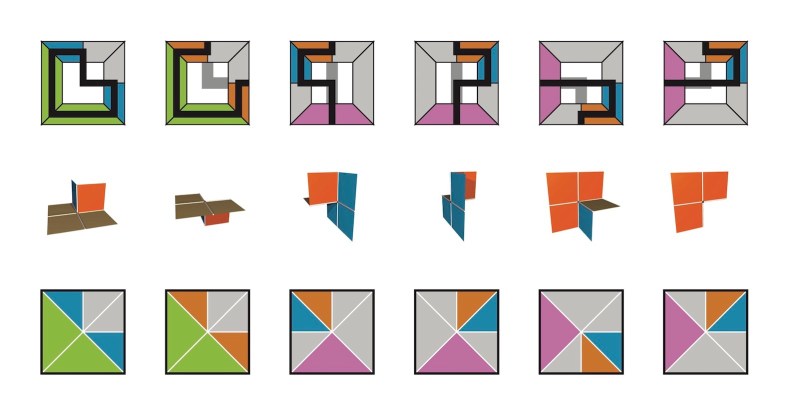
Now use the dictionary below to replace each tile by the corresponding 3-dimensional shape. Each tile from the bottom row is an abstraction of an idealized top view (top row) of a rotated version of five coordinate squares that meet around a vertex (middle row).

Dictionary

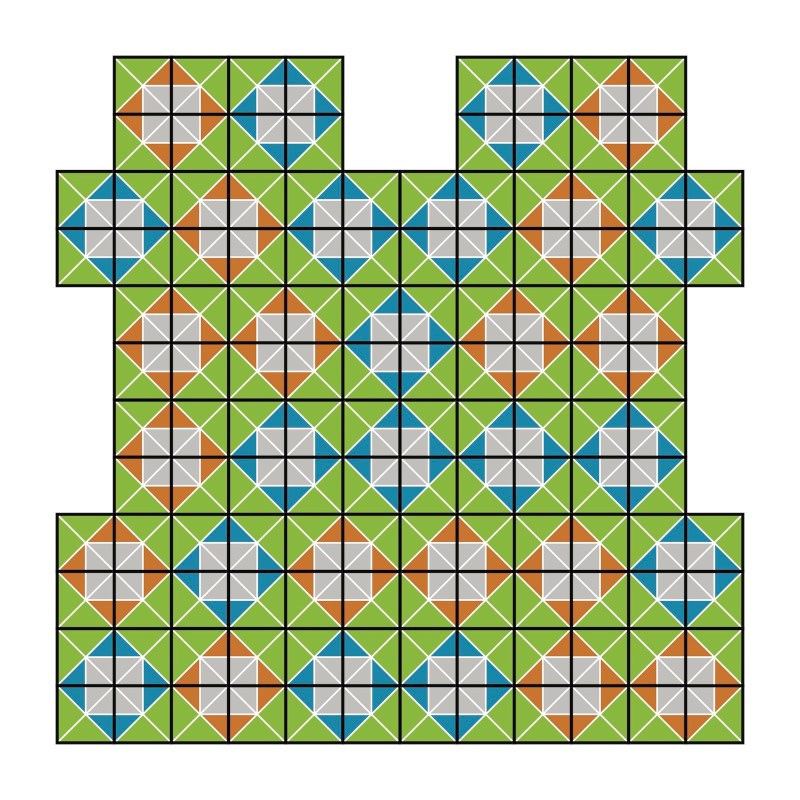
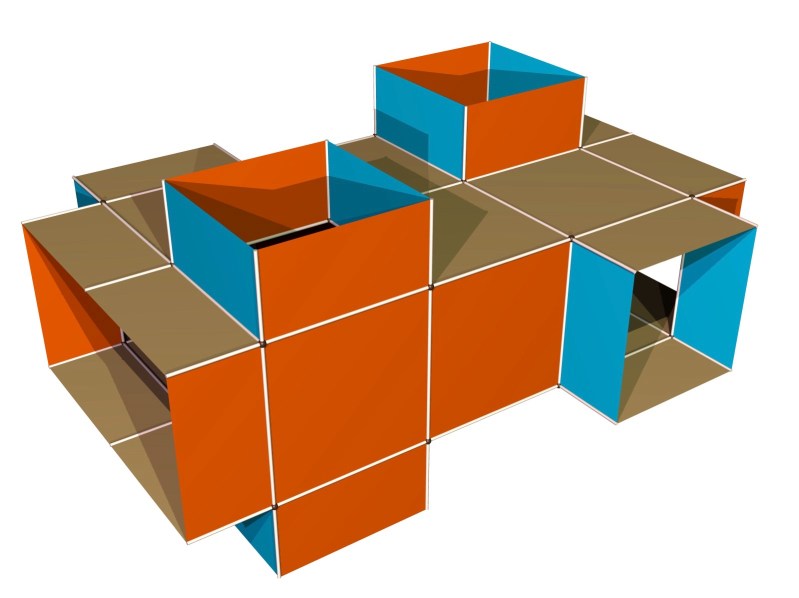
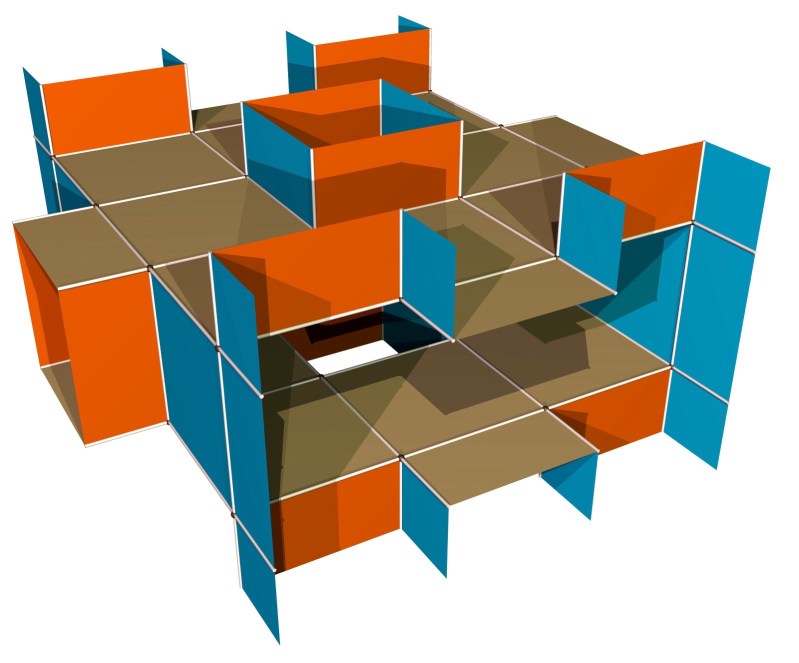
By using the top left quarter, we get the top layer of the polygonal surface below. The bottom layer uses the same pattern as above with blue and orange exchanged. This is a fundamental piece under translations, and we can see that the quotient has genus 4. This also follows from the Gauss-Bonnet formula, which says that a surface of genus g uses 8(g-1) of our tiles (12 for the top and bottom each in this case.

Genus 4

Similarly, this tiling

Genus5 tile

encodes one layer of the following surface of genus 5:

Genus 5

To make things more complicated, the next surface (of genus 4 as well)

Plus 1

needs four layers until it repeats itself. Two of them are shown below.

Pluslayers

These tilings exhibit holes bordered by gray edges which complicates matters, as we will now also have to understand partial tilings (with gray borders).

Columns

After looking at the intersections of symmetrically placed cylinders and obtaining curved polyhedra, it is tempting to straighten these intersections by looking at intersections of columns instead.

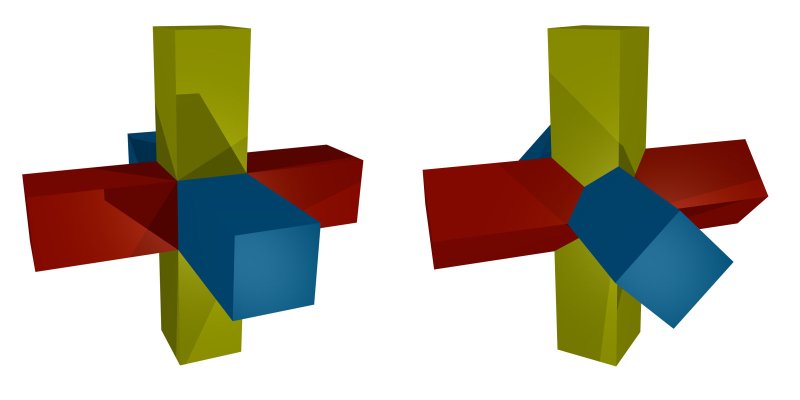
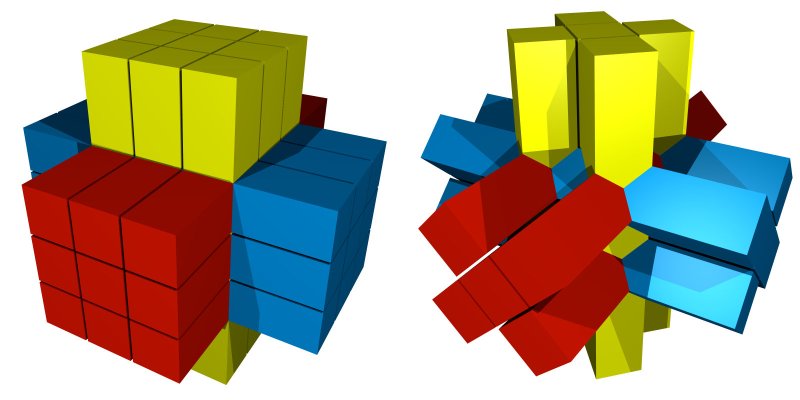
The simplest case is that of three perpendicular columns. The intersection is a cube. Fair enough. But what happens if we rotate all columns by 45 degrees about their axes?

Col 3 union

Before we look, let’s make it more interesting. In both cases, we can shift the columns so that their cross sections tile a plane with squares. Surely, every point of space will then be in the intersection of a triplet of perpendicular columns. In other words, the intersection shapes will tile space.

Col 3 shifts

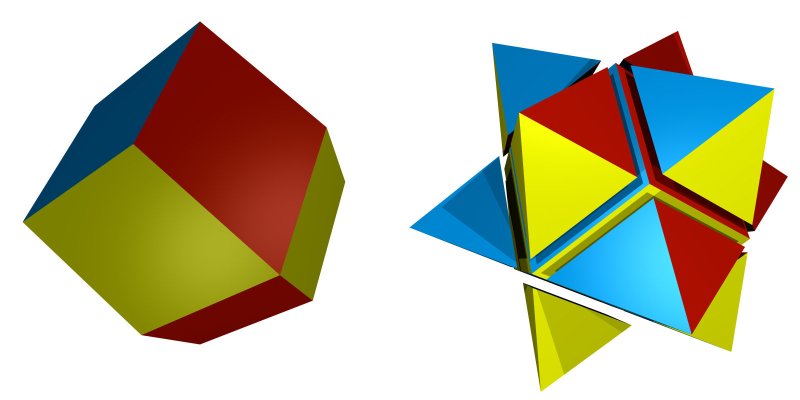
Yes, right, we knew that in the first case. I find the second case infinitely harder to visualize. Fortunately, I have seen enough symmetrical shape to guess what the intersection of the three twisted columns looks like it is a rhombic dodecahedron.

But not all triplets of columns that meet do this in such a simple way, there is a second possibility, in which case the intersection is just a twelfth, namely a pyramid over the face of the rhombic dodecahedron.

Col 3 twist

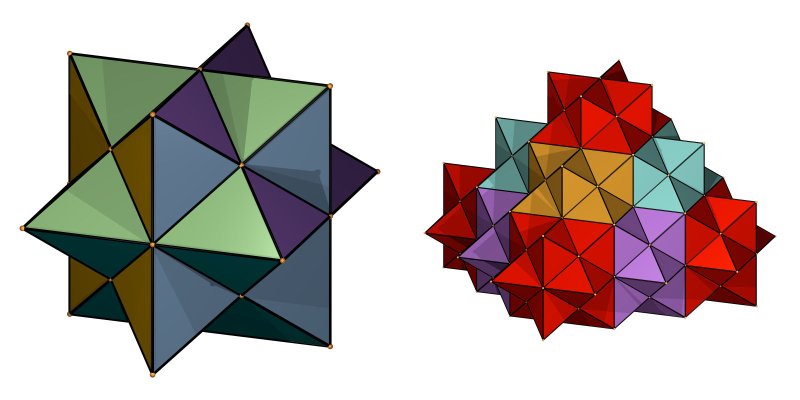
Together with the center rhombic dodecahedron they form a stellation of the rhombic dodecahedron, or the Escher Solid, of which you have made a paper model using my slidables.

Escher combo

Above you can see a first few of Escher’s solids busy tiling space.

From Space to Plane (Five Squares I)

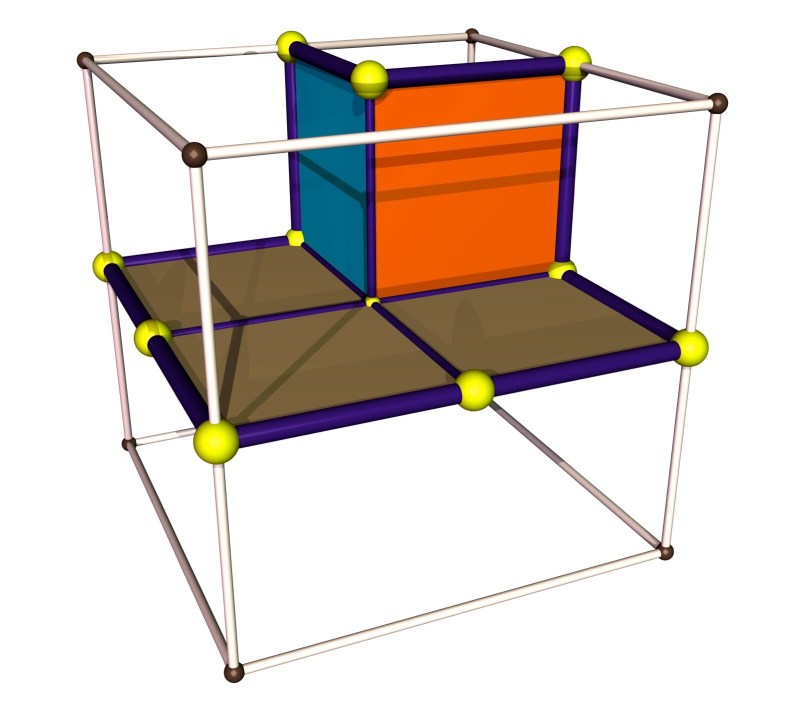
Euclid allows us to place four squares around a vertex. If we are not satisfied with that, we can either move into the hyperbolic plane, or into space. A neglected configuration is that of five squares parallel to the coordinate planes that meet at a common vertex, like so:

Pentacube3D

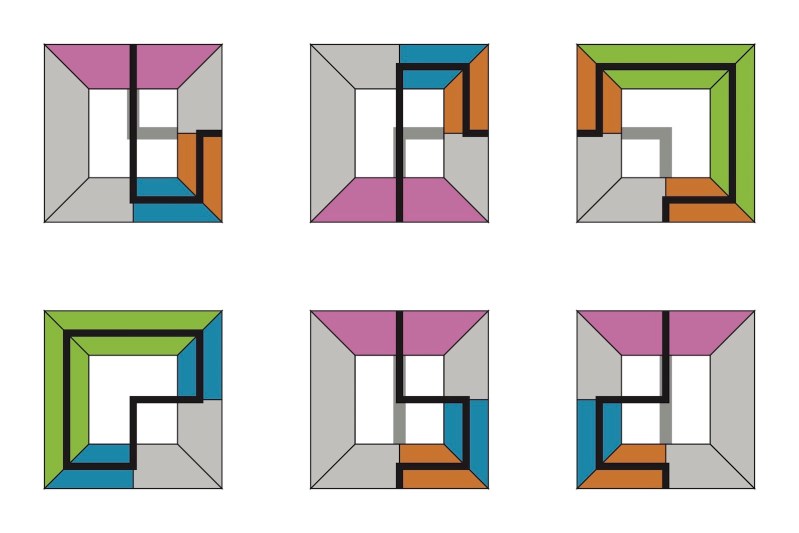
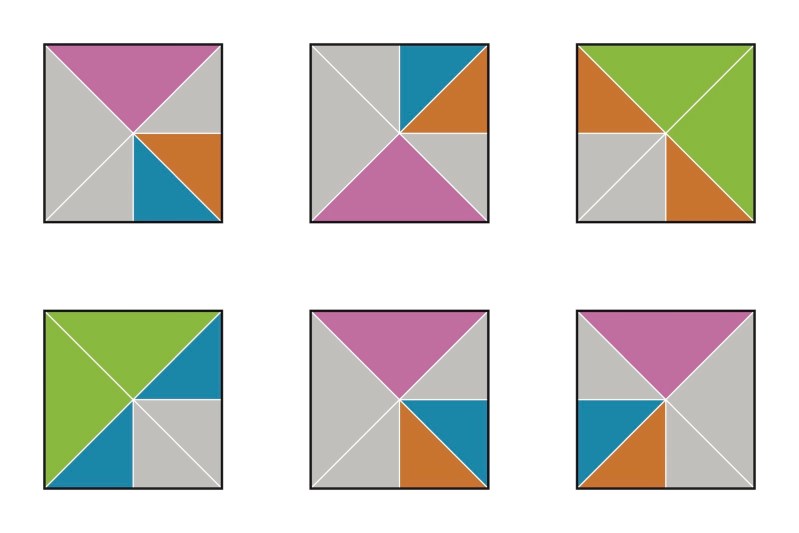
This is, as you convince yourself quickly, the only way to to this, up to 24 symmetric cases. The squares trace out a polygonal arc on the faces of the cube above, which we can interpret as a marking of the faces of the cube that contains the five squares. Two faces are marked by a straight segment (front and  left), three by an L-shaped segment (back, right, top), and one face is unmarked (bottom). As we did with the simple six color marking, we can centrally project the 24 cubes into the plane.

Paths

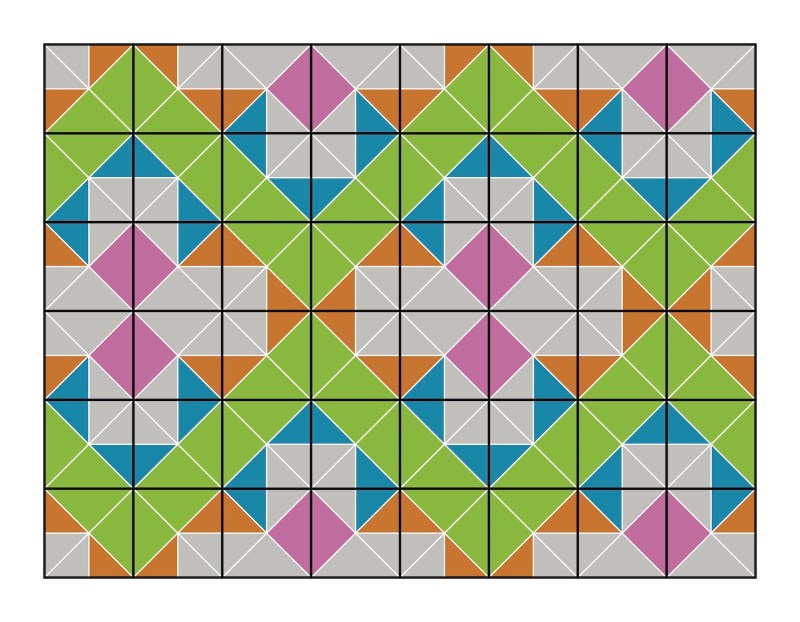
The image above shows six of these projections. The remaining ones can be obtained by 90 degree rotations. I have colored the faces of the cube to indicate what the path is doing within that face (green=go straight, blue=turn one way, orange = turn the other way, gray=don’t be there). Convince yourself that the colors suffice to reconstruct the path.

Thus we obtain a set of six tiles that allow us to explore layers of polygonal surfaces that have five squares around each vertex. For prettification, I have dropped the path and filled in the hole. No information has been lost. We are allowed to place tiles next to each other if the colors match. This is it:

Patterns

Here is a simple example of such a surface.

Schwarz

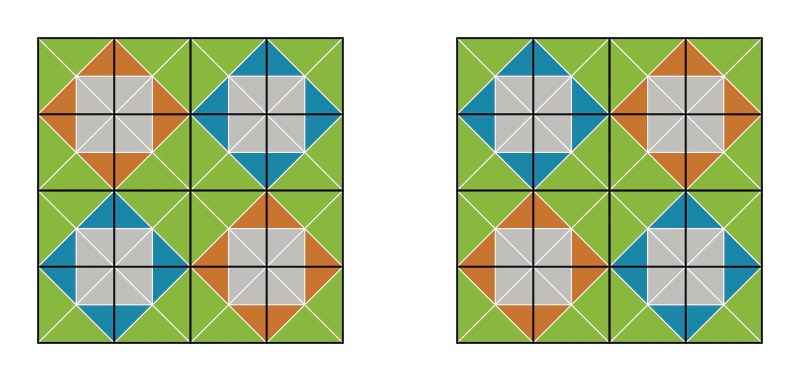
It is triply periodic and incidentally related to Schwarz P minimal surface. Two consecutive horizontal layers are represented by the two tilings below:

Schwarztile

So, we have the burning questions: Are there more polyhedra like these, do the tilings help us, and can we understand the tilings? More about it in a week or two.

Cubomino

Cubes3D

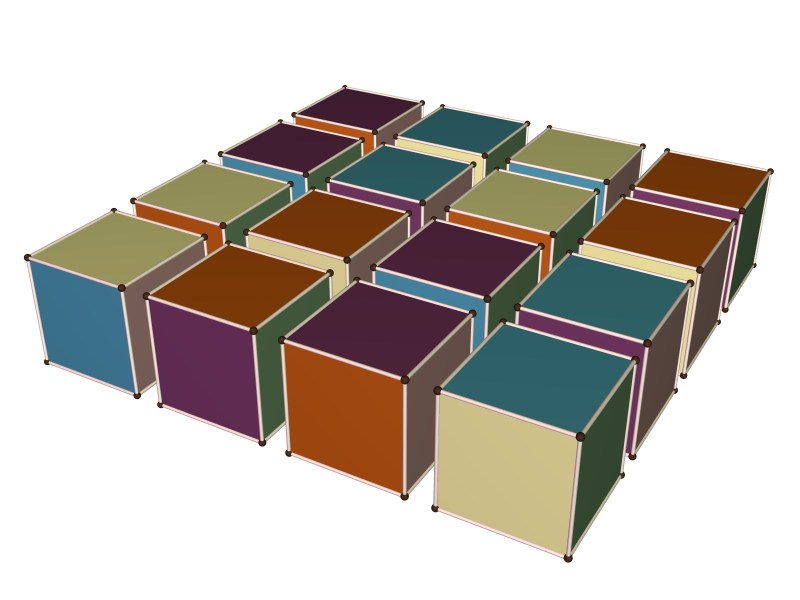
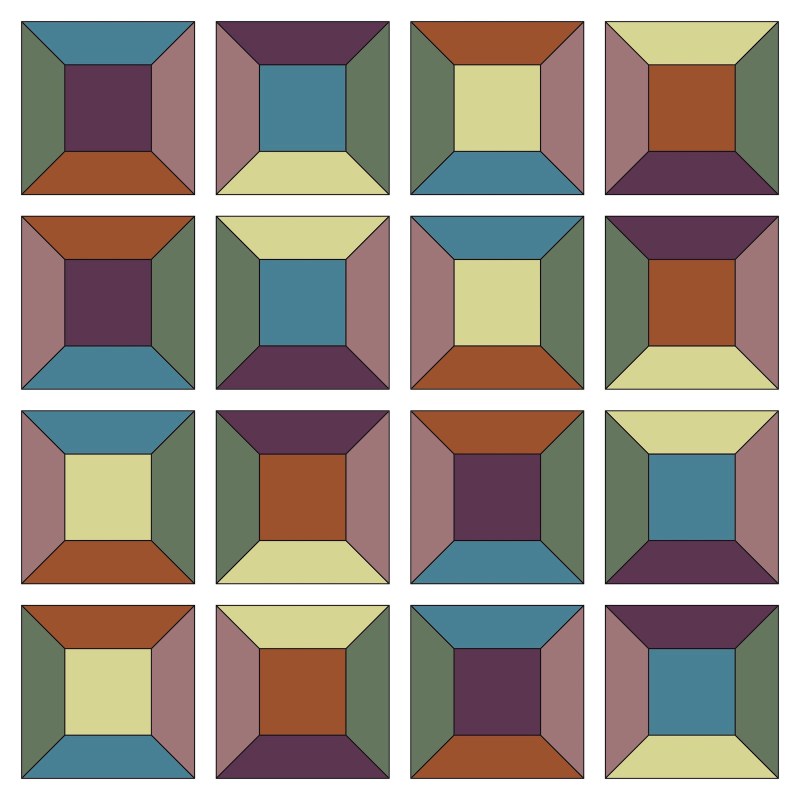
We can play domino with identical copes of a single cube by insisting that the cubes have matching colors at the faces where they touch. This is hard to convey in a perspective image like the one above that shows a 4x4x1 cubomino tiling, so I will switch to a 2D representation that shows each cube in central perspective from above. Here is the flattened version:

Tilingsample2d

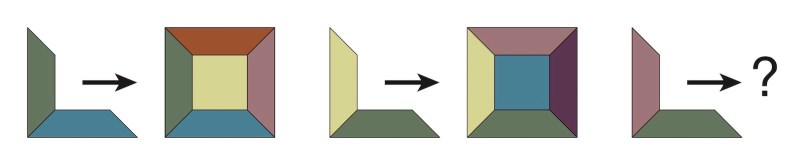
As you can see, the single 3D cubomino can be represented by six 2D cubomino squares, which may be rotated:

Cubes

These are a subset of the tiles I used for the Compass game a while ago.

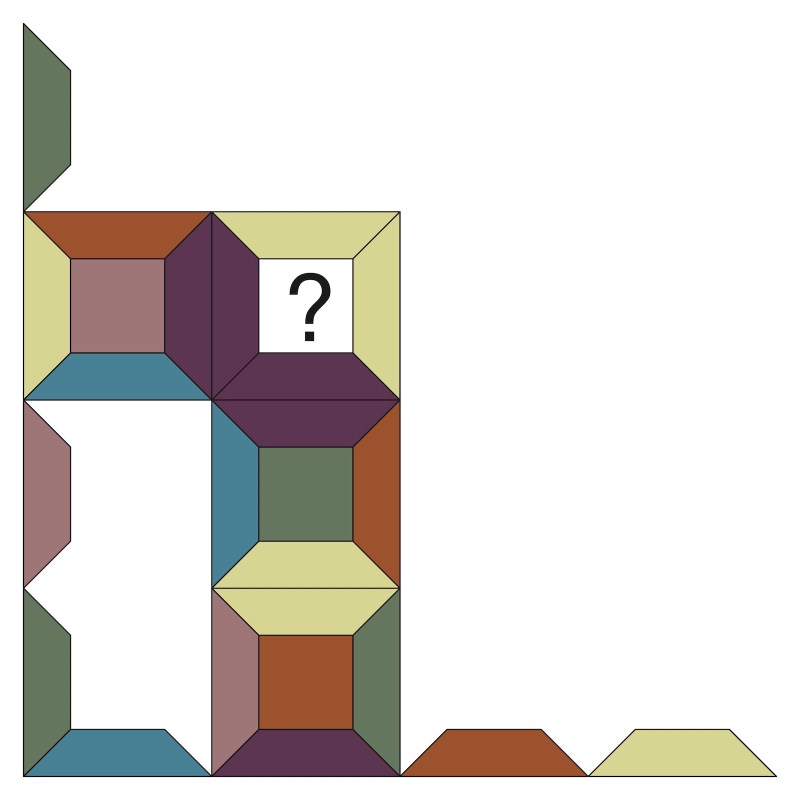
This new Cubomino puzzle is a simple example that teaches to analyze tilings by understanding them as boundary value problems. To see how this works, we first notice that to some extent the color of the lower and the left edge of a tile determines that tile and its rotation.

Boundary1

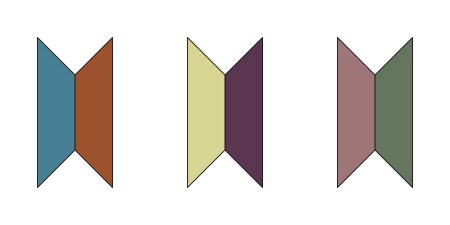
It works for most color combinations, but there are exceptions. These occur precisely when the two chosen colors for bottom and left edge are antipodal, i.e. are either equal or are one of the three pairs of colors of two opposite faces of our cube:

Antipodes

This observation extends to larger rectangles: No antipodal colors can occur both in the left edge and the bottom edge of a tiled rectangle. To see this, assume the contrary. The vertical edge on the left of the rectangle that has one of the antipodal colors (pale yellow below) determines a horizontal strip of tiles that have the antipodal colors as vertical edges, and the horizontal edge on the bottom of the rectangle with the second color from an antipodal pair (dark purple below) determines a vertical strip of tiles that have the antipodal colors as horizontal edges. These two strips meet in a tile that must have a boundary consisting just of antipodal colors, which is impossible.

Collision

On the other hand, if the left and bottom edge have no antipodal colors in common, like in the example below,
there is always a unique tiling of a rectangle that has the two edges as its lower and left edge.

Boundary

The reconstruction process is easy: Each choice of a left and bottom edge color determines a tile and its rotation uniquely. We begin by placing the only possible square into the bottom left corner of our boundary, and work our way to the right and up.