The Spider

When I was in third grade, my father brought home a beautiful 2 volume edition of Edgar Allan Poe’s short stories, illustrated by Alfred Kubin.

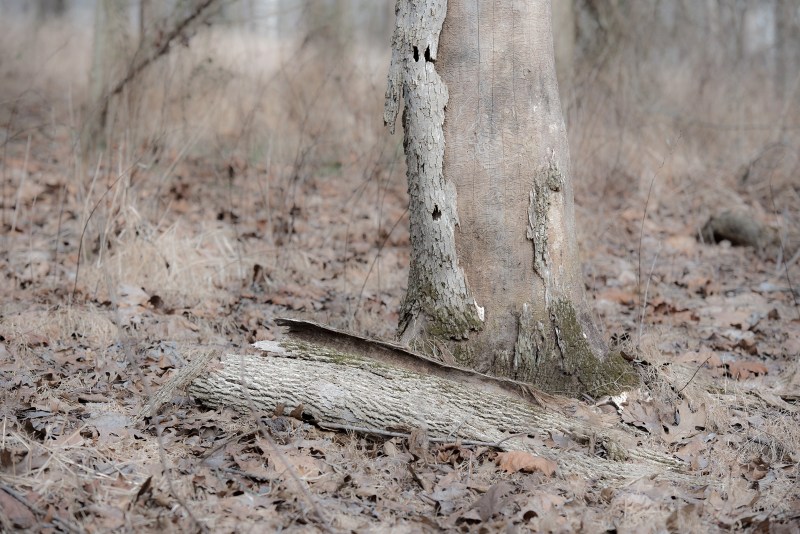
DSC 0203

The genre name Horror Story describes very unsatisfactorily what Poe accomplishes. The conventional horror story utilizes a simple scheme: It wins our trust by first presenting a plausible scenario, and then abuses this trust in order to get away with less plausible events.

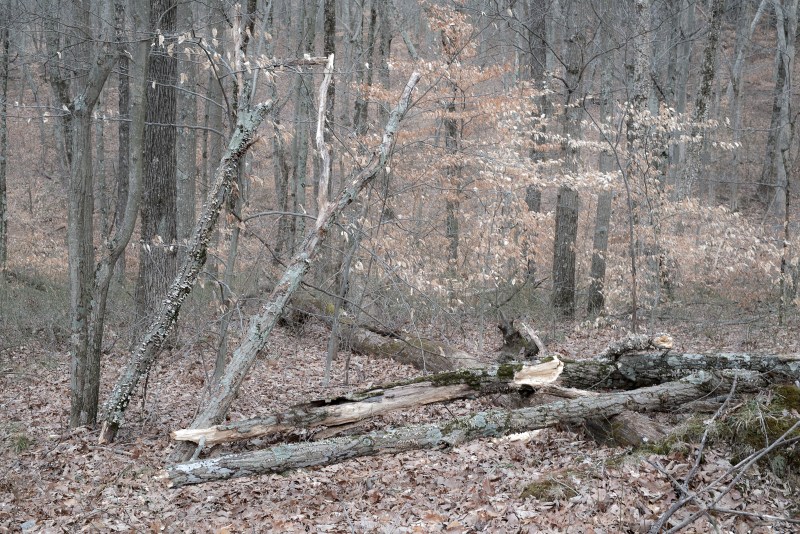
DSC 0209

In Poe’s best stories, this is not the case. The horror story is happening in the protagonist’s mind, and we become afraid that this same horror might as well infest our own brains.
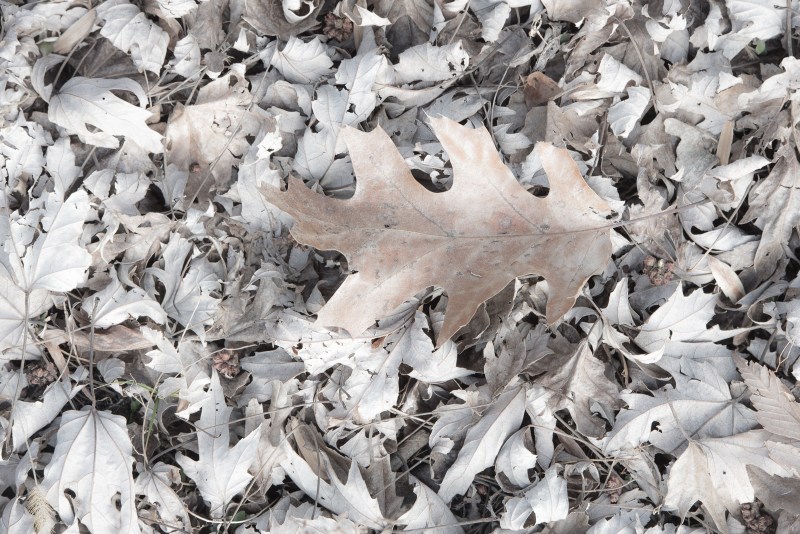
DSC 0226

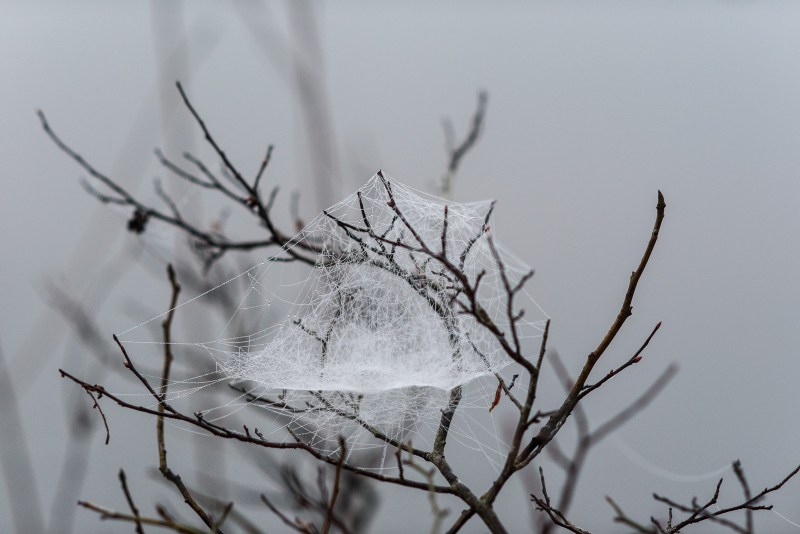
There are a few European stories that achieve the same effect, and one of them is Hanns Heinz Ewers’ story The Spider, from 1915. In it, the tenant of a small apartment starts to play a game with a woman in a window across the street: They make movements with their hands, which the other is supposed to copy. The narrator, whose diary we read, is at first surprised how quickly his neighbor can repeat his own movements, until he realizes that he is in fact, against his own will, only repeating the movements of the neighbor.

DSC 0236

This realization comes too late, obviously. No good horror story can end well. The same is true for Hanns Heinz Ewers himself, unfortunately. Despite having understood the machinations of manipulation, he fell under the spell of  a much larger spider, even though he didn’t share their racial ideology, had conflicting sexual preferences, and his books were banned.
DSC 0228

Alchemy (From the Pillowbook X)

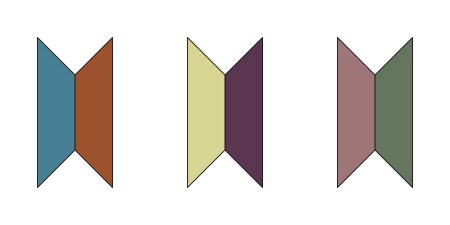
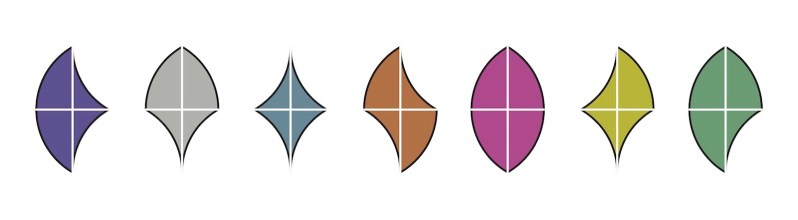
Here is a variation of the pillow theme. This time, the tiles are not based on squares as the regular pillows or on triangles as in an older post, but on 60 degree rhombi. I only use pieces with convex or concave edges, so there are seven different rhombic pillows up to symmetry, this time also not distinguishing between mirror symmetric pieces. The main diagonals of the original rhombi are marked white. For the purpose of the Alchemy game below, I call them elements.

Elements

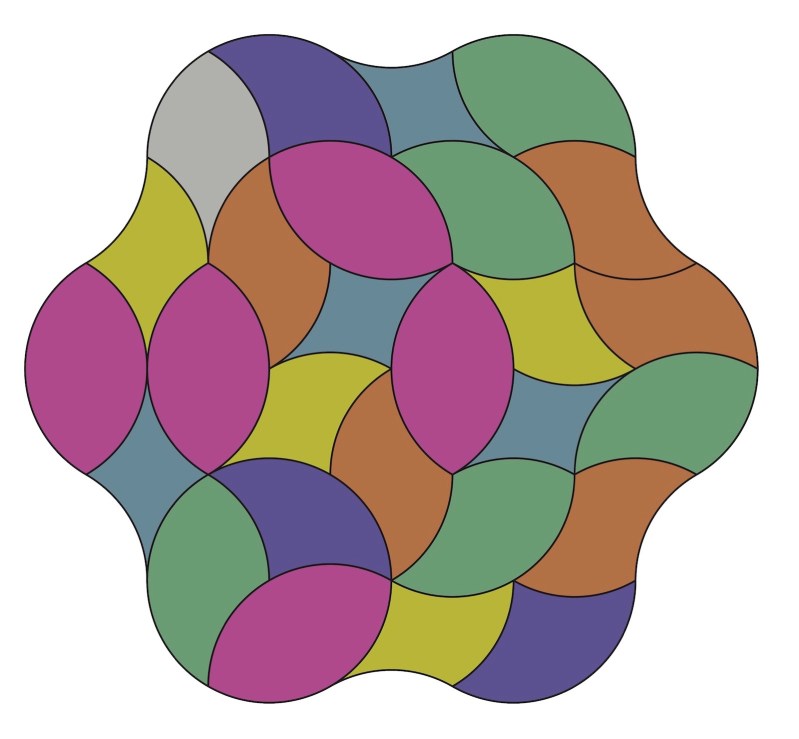
These elements can be used to tile curvy shapes like the curvy hexagon below. Again, for the purpose of the game, I call such a tiled hexagon a Philosopher’s Stone.

Stone1

I leave going through the brain yoga to discuss tileability questions to the dear reader. Instead, here is the game I designed these pieces for.

Alchemy

A Game for 2-6 Players

Purpose

To complete the Magnum Opus by crafting a Philosopher’s Stone.

Material

  • The seven elements above in seven colors, colored on both sides, at least 4 of each kind for each player;
  • One transmutation card for each player;
  • One Philosopher’s Stone outline for each player;
  • Pencils and glue sticks.

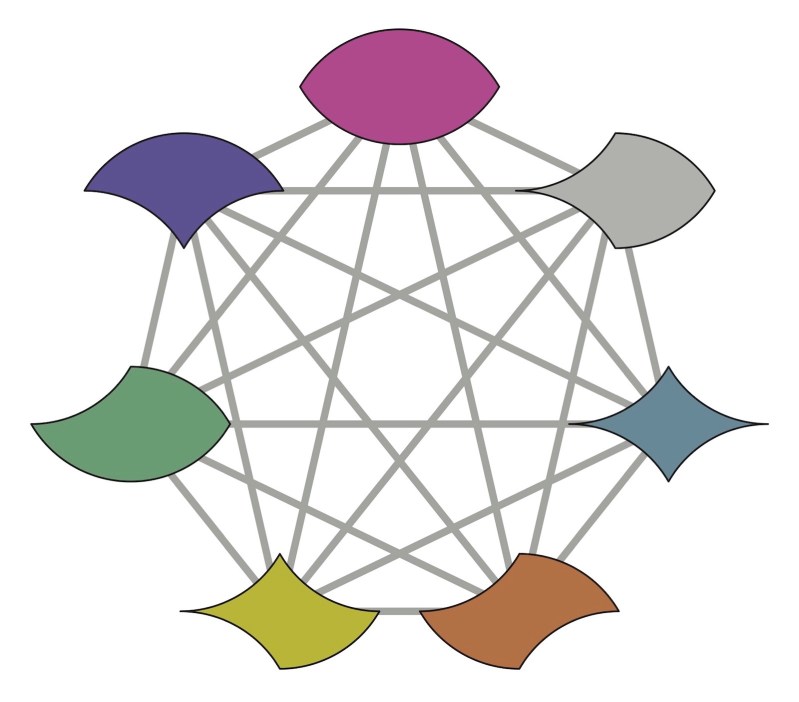
Below is a template for the transmutation card. It shows a heptagon with the elements at its vertices, and all possible connections (transmutations, that is).

Transmutations

Preparation

All elements are separated into resource piles according to color/shape. Each players takes a transfiguration card and an outline of the Philosopher’s Stone.

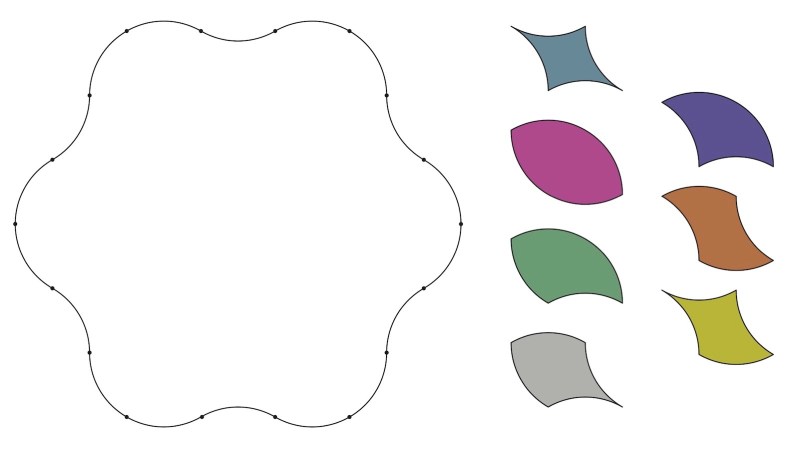
Outline

Above is an outline of the Philosophers stone, with little notches to indicate where the corners of the elements have to go. The elements are shown next to it to scale so that you get the elements in the right size.

Completing the Magnum OpusGoals

The goal of the game is to accomplish the Opus Magnum by filling the outline of the Philosopher’s Stone with elements using as few transmutations as possible. Elements must be placed so that

  • at least one corner matches a notch or a corner of another element that has already been placed;
  • elements don’t overlap and don’t leave gaps;
  • no two equal elements may share a curved edge (but they may share a vertex).

Scoring

When a player has completed a Philosopher’s Stone, he or she determins the used transmutations:
A transmutation occurs in the Philosopher’s Stone when two elements share a curved edge.

The players record a transmutation on their transmutation card by drawing a straight red edge between two elements that share a curved edge in their completed Philosopher’s Stone.

The unused edges are then drawn black. The player with the largest number of black edges becomes the master alchemist.

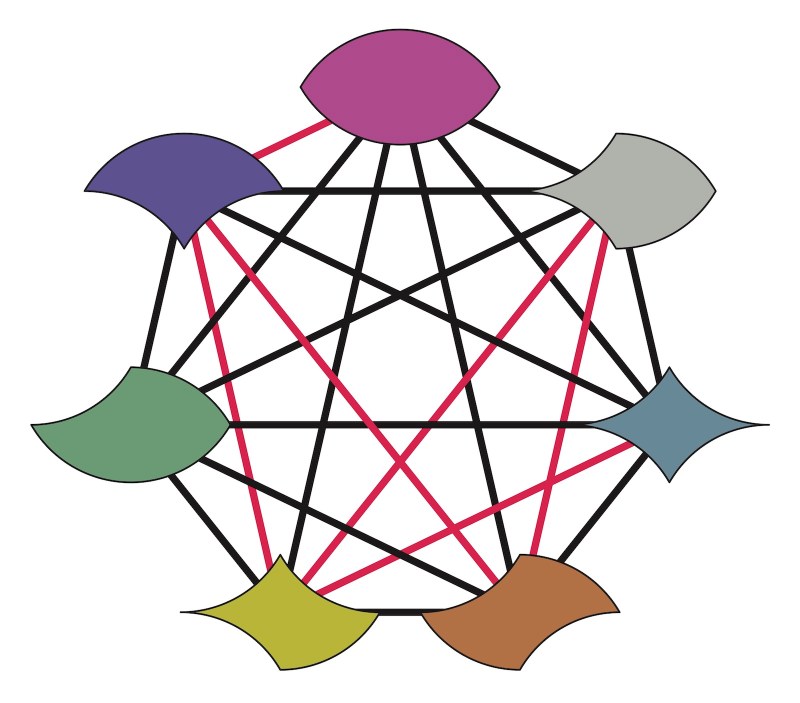
Below is the completed transmutation card for the Philosopher’s Stone at the top. This was a pretty poor job, the player used all but three of all possible transmutations.

Transmutations2

One can turn this game also into a puzzle. Can you tile the Philosopher’s Stone with the seven elements that its transmutation card is the one below?

Transmutations puzzle

Pate Hollow Trail

Here are some early morning impressions from hiking the Pate Hollow Trail north of the Painetown State Recreation Area. The mood for the hike is set right at the beginning, thanks to the Little People who built this tree house.

DSC 0142

Nothing can go wrong after seeing it. The trail takes about three hours to hike and mostly follows the ridges. You get the usual fare of broken wood, that I always find photogenic.

DSC 0136

The other highlights of the hike are the views of Lake Monroe.

DSC 0167

Nothing dramatic, but a little blue is very welcome. When the trail touches down to the lake front, you can meditate either about structural simplicity of the opposite shore

DSC 0153

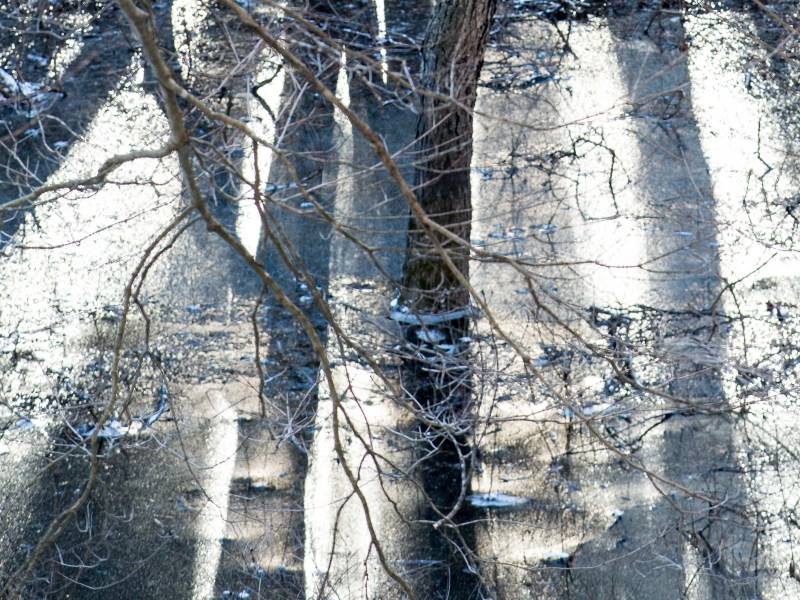
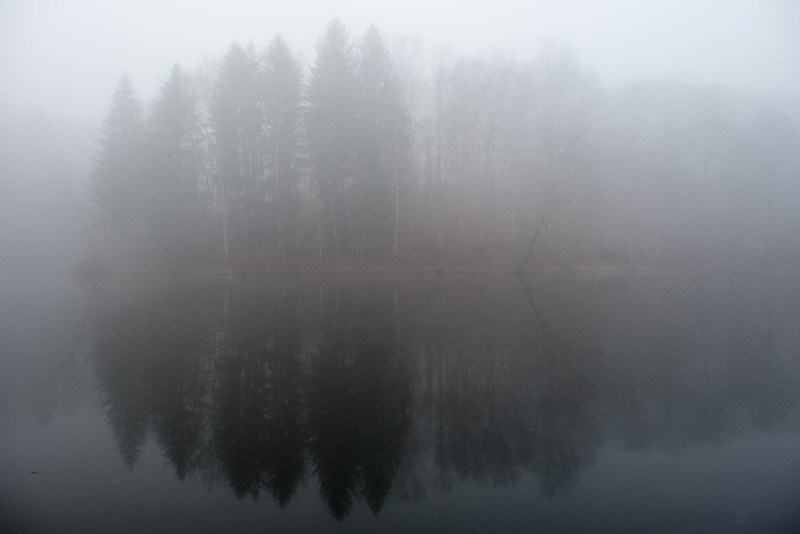
or the irritating complexity of simultaneous reflections of frozen weeds and preposterous trees. It is March, after all.

DSC 0155

From Space to Plane (Five Squares I)

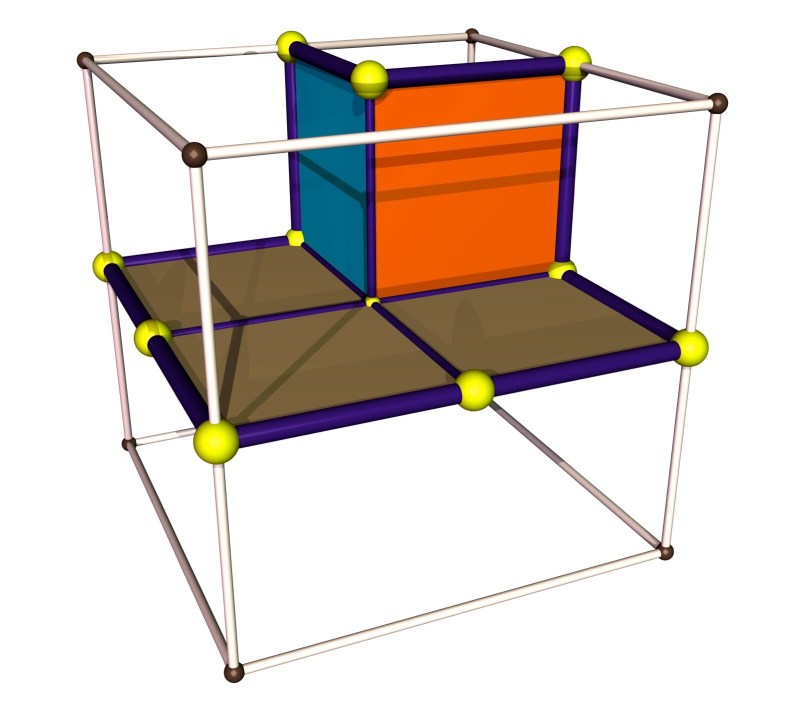
Euclid allows us to place four squares around a vertex. If we are not satisfied with that, we can either move into the hyperbolic plane, or into space. A neglected configuration is that of five squares parallel to the coordinate planes that meet at a common vertex, like so:

Pentacube3D

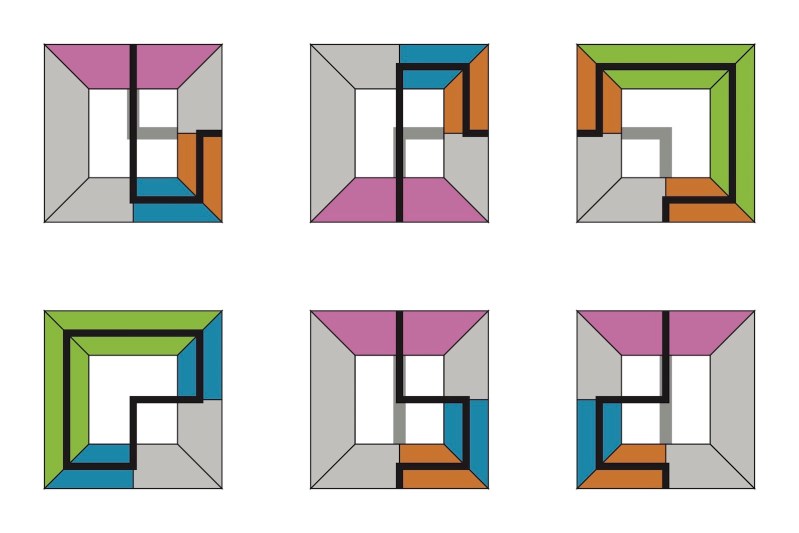
This is, as you convince yourself quickly, the only way to to this, up to 24 symmetric cases. The squares trace out a polygonal arc on the faces of the cube above, which we can interpret as a marking of the faces of the cube that contains the five squares. Two faces are marked by a straight segment (front and  left), three by an L-shaped segment (back, right, top), and one face is unmarked (bottom). As we did with the simple six color marking, we can centrally project the 24 cubes into the plane.

Paths

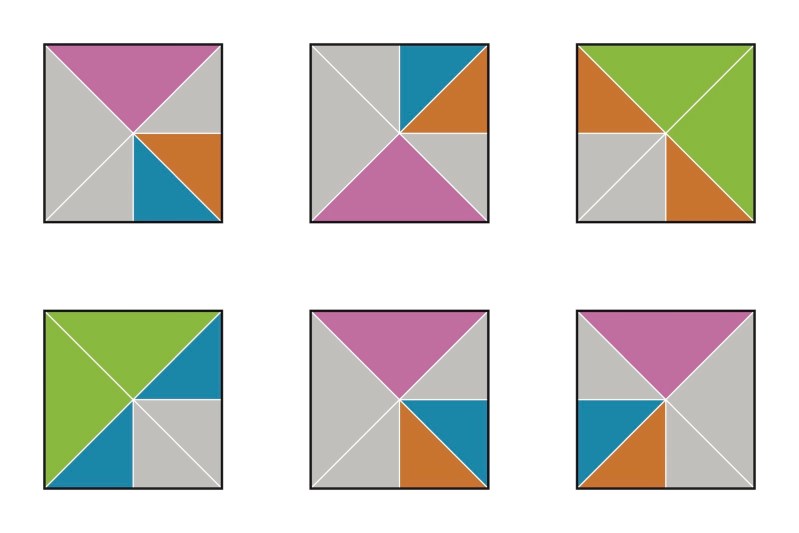
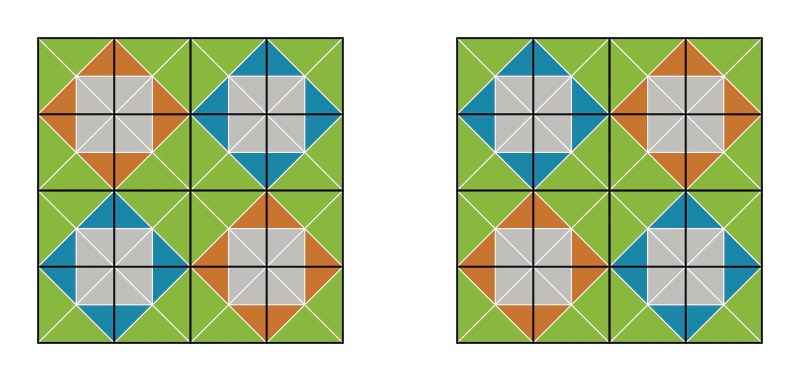
The image above shows six of these projections. The remaining ones can be obtained by 90 degree rotations. I have colored the faces of the cube to indicate what the path is doing within that face (green=go straight, blue=turn one way, orange = turn the other way, gray=don’t be there). Convince yourself that the colors suffice to reconstruct the path.

Thus we obtain a set of six tiles that allow us to explore layers of polygonal surfaces that have five squares around each vertex. For prettification, I have dropped the path and filled in the hole. No information has been lost. We are allowed to place tiles next to each other if the colors match. This is it:

Patterns

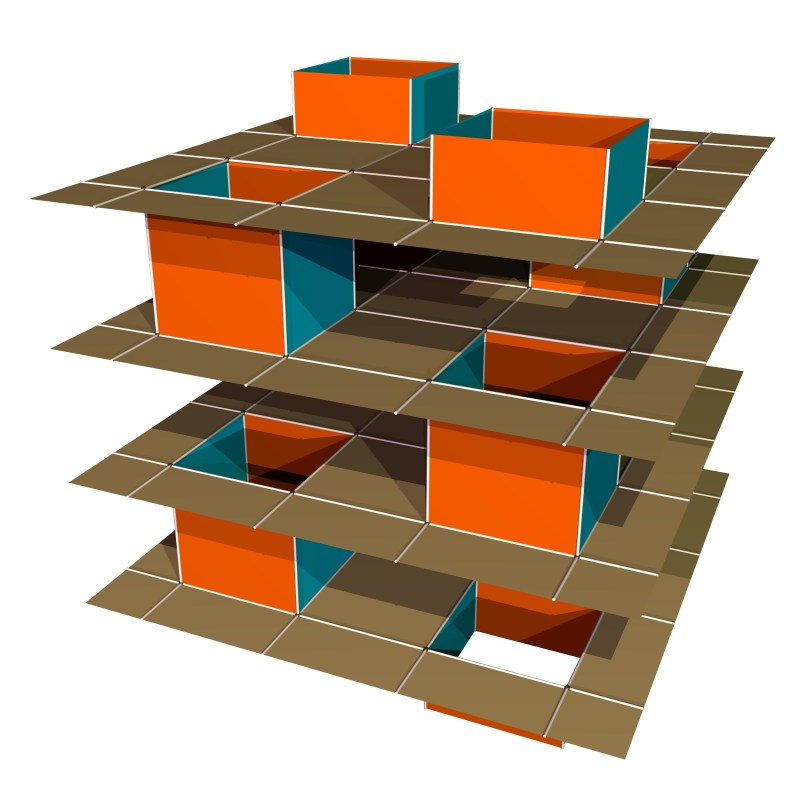
Here is a simple example of such a surface.

Schwarz

It is triply periodic and incidentally related to Schwarz P minimal surface. Two consecutive horizontal layers are represented by the two tilings below:

Schwarztile

So, we have the burning questions: Are there more polyhedra like these, do the tilings help us, and can we understand the tilings? More about it in a week or two.

Brown (Charles Deam Wilderness II)

DSC 0074

Indiana has a fifth season: A good winter brings snow, harsh light and the contrasts that blind your eyes. A good spring brings mild air, green buds, tree blossoms, and wild flowers. But in between, there is at least a month of nothingness.

DSC 0041

It is the season of decay, and its color is brown. The contrasts of winter light disorient us because they provide information conflicting with the physical landscape. It is almost as if a fourth dimension has been added which we cannot parse. Today, the low contrast of an overcast sky and the muted colors make the contours disappear and appear 2-dimensional.

DSC 0054

Still, the monotonicity has its appeal, in particular when it is interrupted by an alien intrusion.

DSC 0077

Why should we hate what we are attracted to?

DSC 0093

Cubomino

Cubes3D

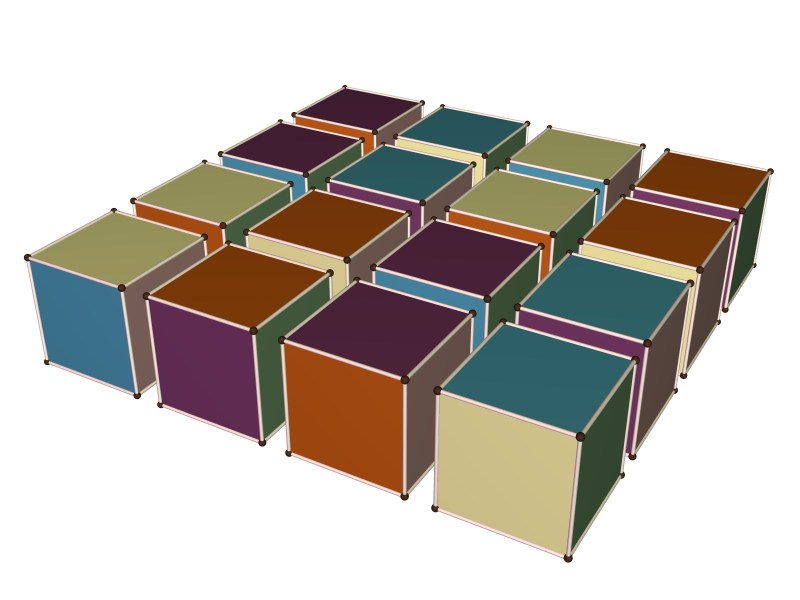
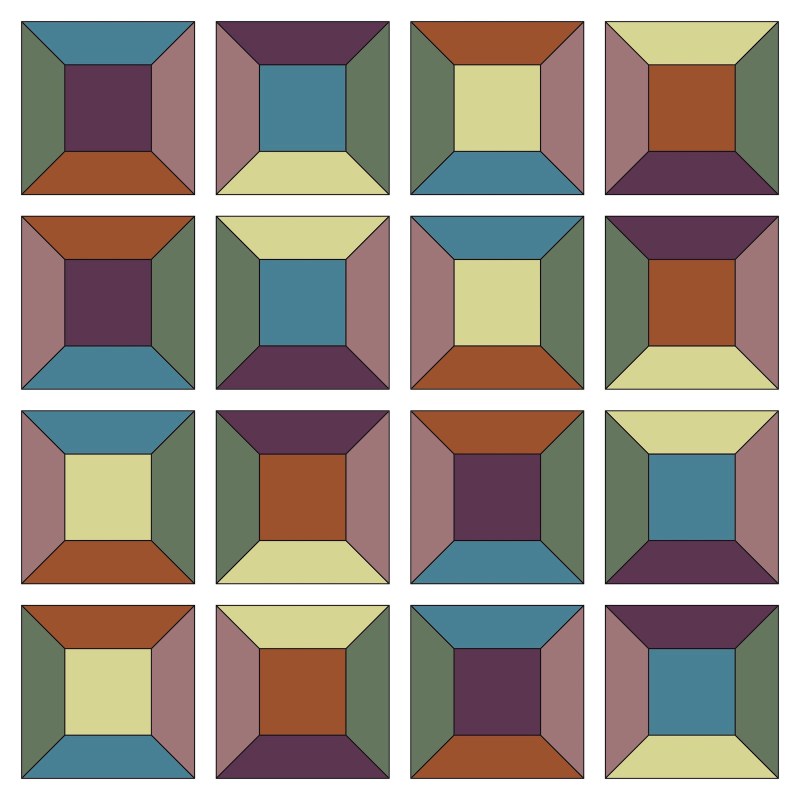
We can play domino with identical copes of a single cube by insisting that the cubes have matching colors at the faces where they touch. This is hard to convey in a perspective image like the one above that shows a 4x4x1 cubomino tiling, so I will switch to a 2D representation that shows each cube in central perspective from above. Here is the flattened version:

Tilingsample2d

As you can see, the single 3D cubomino can be represented by six 2D cubomino squares, which may be rotated:

Cubes

These are a subset of the tiles I used for the Compass game a while ago.

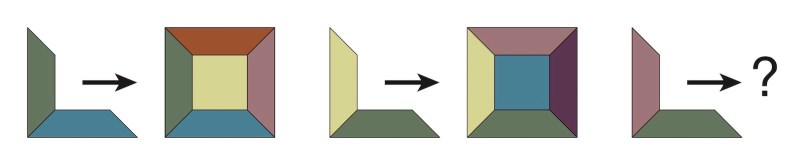
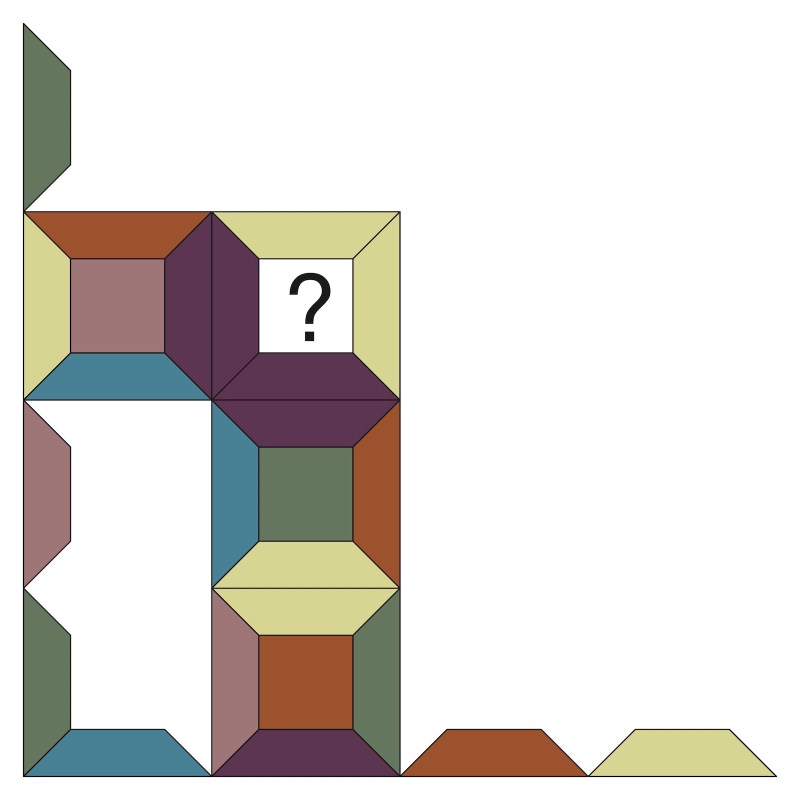
This new Cubomino puzzle is a simple example that teaches to analyze tilings by understanding them as boundary value problems. To see how this works, we first notice that to some extent the color of the lower and the left edge of a tile determines that tile and its rotation.

Boundary1

It works for most color combinations, but there are exceptions. These occur precisely when the two chosen colors for bottom and left edge are antipodal, i.e. are either equal or are one of the three pairs of colors of two opposite faces of our cube:

Antipodes

This observation extends to larger rectangles: No antipodal colors can occur both in the left edge and the bottom edge of a tiled rectangle. To see this, assume the contrary. The vertical edge on the left of the rectangle that has one of the antipodal colors (pale yellow below) determines a horizontal strip of tiles that have the antipodal colors as vertical edges, and the horizontal edge on the bottom of the rectangle with the second color from an antipodal pair (dark purple below) determines a vertical strip of tiles that have the antipodal colors as horizontal edges. These two strips meet in a tile that must have a boundary consisting just of antipodal colors, which is impossible.

Collision

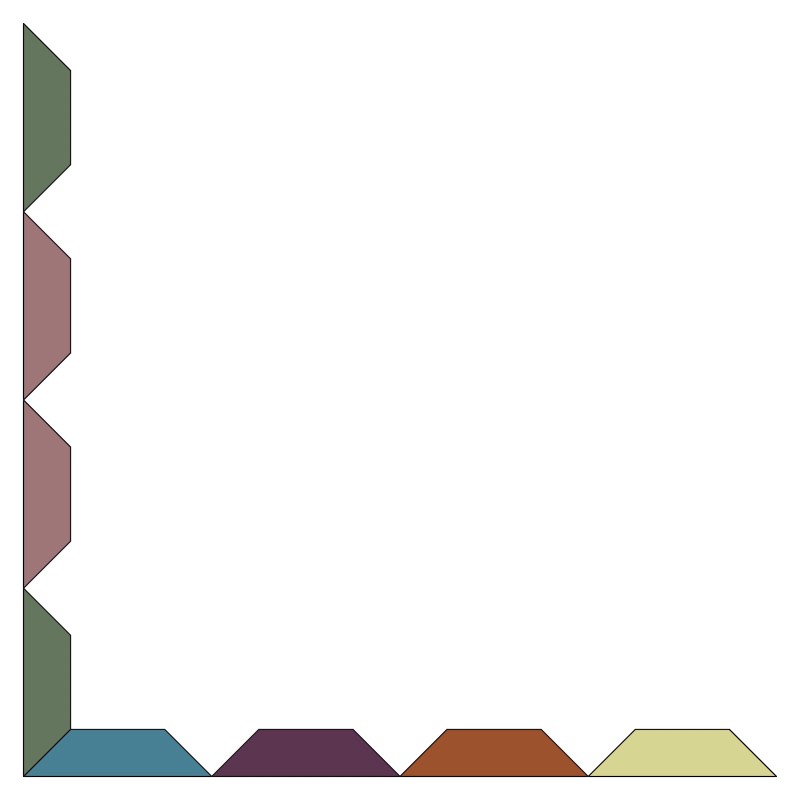
On the other hand, if the left and bottom edge have no antipodal colors in common, like in the example below,
there is always a unique tiling of a rectangle that has the two edges as its lower and left edge.

Boundary

The reconstruction process is easy: Each choice of a left and bottom edge color determines a tile and its rotation uniquely. We begin by placing the only possible square into the bottom left corner of our boundary, and work our way to the right and up.

Winter Light (Charles Deam Wilderness I)

The history of the settlement of Indiana has been a history of forest destruction.
So the first sentence of the preface to the second edition of Charles Clemon Deam’s book Trees of Indiana, from 1919.

DSC 9099

Deam was Indiana’s first state forrester, and the state’s only designated wilderness area is named after him. The Charles Deam Wilderness is located in Karst hills bordering Lake Monroe. Deforestation here is pointless, as the ground is not suitable for farming. That there are still plenty of trees in southern Indiana does not contradict the above sentence.

DSC 9102

In today’s images I have been trying to catch some of the harsh light that one can experience on cold winter mornings (This year, this has not been easy).

DSC 9103

When colors retreat and contrast is everything, even simple landscapes can become disorienting.

DSC 9116

In truth, there is nothing here but water, ice, wood, and sky.

DSC 9071

Lakes should be horizontal, and trees should grow vertical.

The Advantages of Different Viewpoints (From the Pillowbook IX)

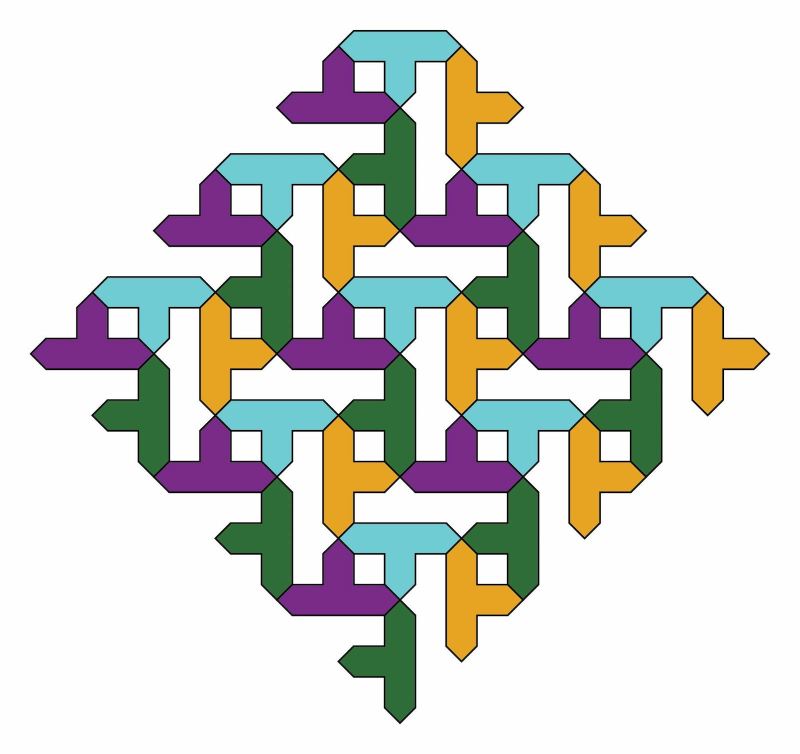
It all started with a question about polysticks: I wanted to see how to tile parts of the square grid with 3-sticks so that there are always three 3-sticks touching. A 3-stick is nothing but a T with all segments the same length: it has 3 arms that end at the hands, and are joined together at a head. By tiling I mean that the arms align with the edges of the standard square grid and don’t overlap. And, as I said, I want always three of them to hold hands. Here is an example (that you should imagine continued periodically):

Right3 01

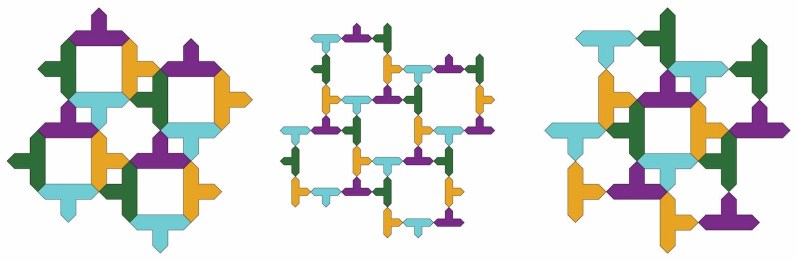
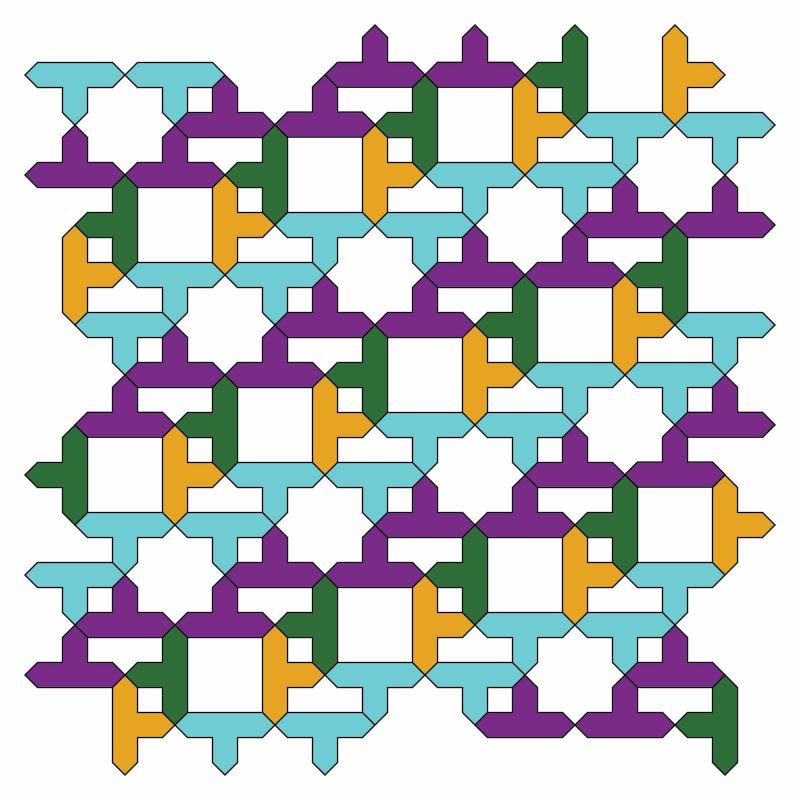
The condition about holding hands in threes means that each such tiling has a dual tiling where the new 3-sticks have their heads wherever three hands come together, the same arms, and the previous heads are replaced by three hands. This also implies that a tiling and its dual will tile the same portion of the square grid, as below to the left and right.

Merge 01

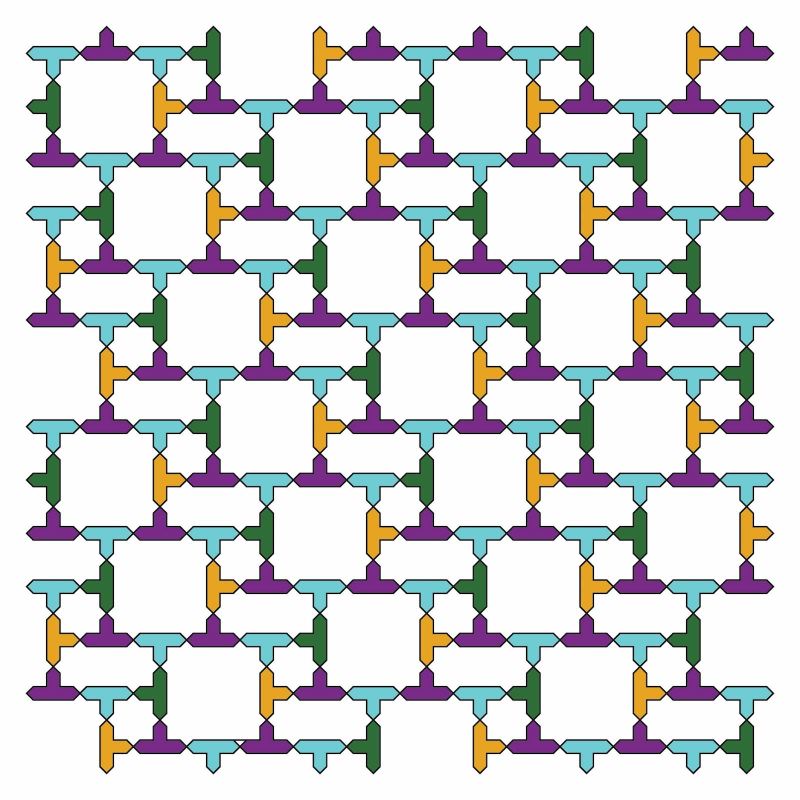
We can also combine a tiling and its dual into a single figure by centrally scaling each 3-stick by 50%, and taking the union: The gaps created by the scaling makes room for the 3-sticks from the other tiling. You can examine the result up above in the middle. The new skeleton will have all 3-sticks hold hands in pairs instead of in triples. Here is another, more complicated example. The original periodic 3-stick tiling:

Right7 01

The inflated version that combines the original with its dual:

Right7 inf 01

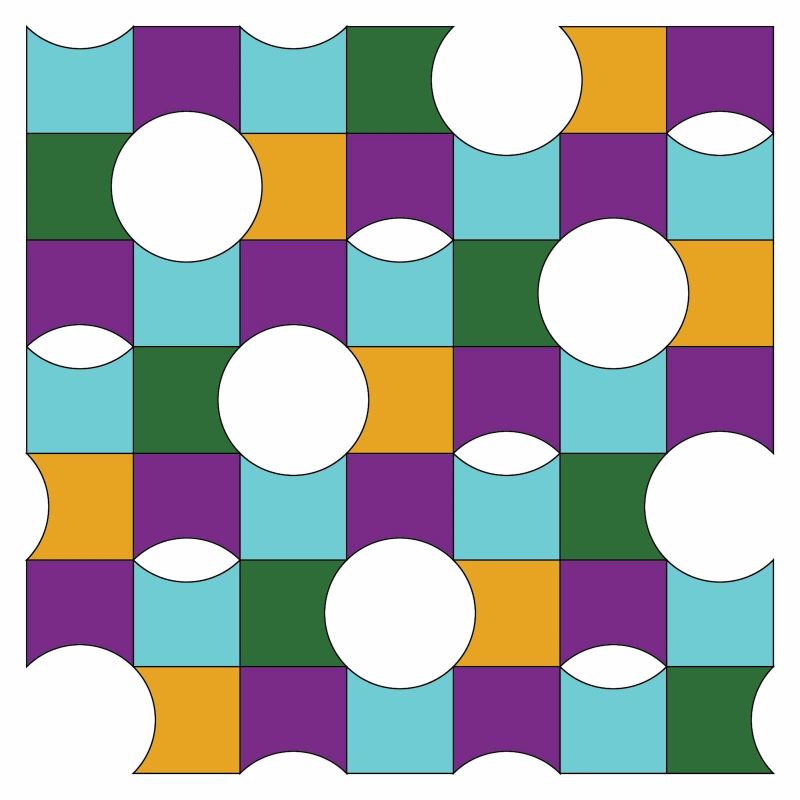
In the inflated version we can replace each 3-stick by a square so that the sides touch when the 3-sticks hold hands. The unused edge of the square is pushed inwards, turning the square into the familiar 3/4 pillow we admired the last time (the next image shows only a quarter of the previous piece. It repeats itself using horizontal and vertical translations).

Right7 p 01

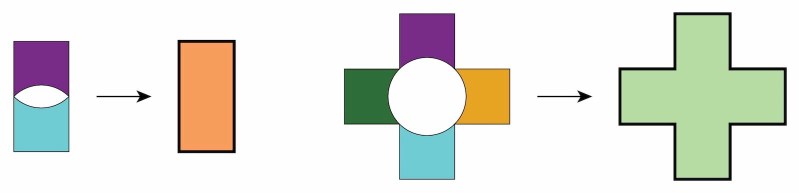
As a final simplification, we can fill in the holes as follows: We replace the 3/4 pillows that border a hole by the polyomino they cover  (thereby filling in the hole). Below are the two simplest polyominoes that surround a hole:

Polyrule 01

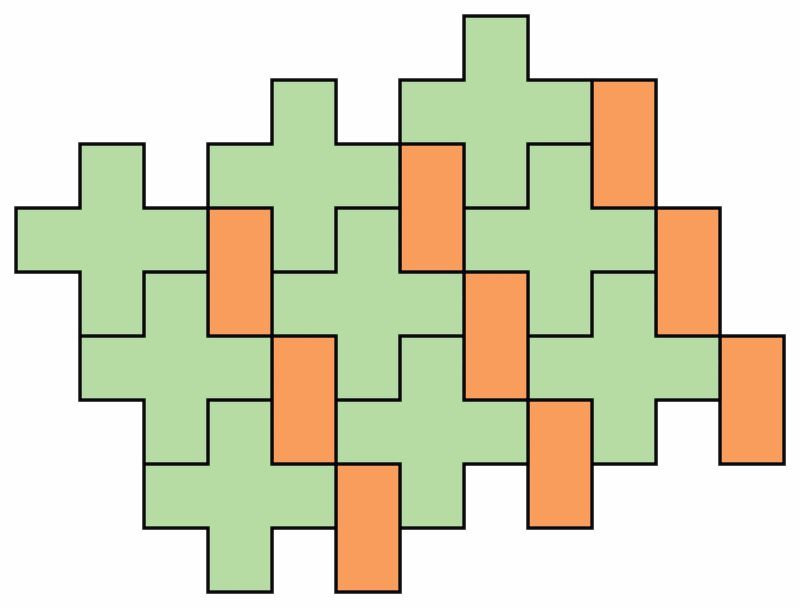
These polyominoes will tile the plane as before, because each 3/4 pillow must belong to exactly one hole. Our 3/4-pillow tiling now becomes a very simple polyomino tiling:

Polyominoes 01

Thus periodic 3-stick-tilings with triple hand holding, 3-stick tilings with hand holding in pairs, 3/4-pillow tilings with holes, and  tilings by polyominoes that surround holes are all the same thing.

You can use this to design  much more intricate patterns, with holes of any size, for instance.

Sources of Healing

Last October I went on an early morning to McCormick’s State park, not expecting to see anybody.

DSC 8907b

But there was this guy, sitting next to the little waterfall in the dark. We started chatting. He was from Florida, evacuating for the week because of Hurricane Matthew. Friends had told him to check out this place, and he was quite impressed.
DSC 8852

They had also told him of a Spring of Healing that could be found here, and he wanted to know about it.
DSC 8884

I couldn’t help.

DSC 8880

But it is true that some places are special. My virtual substitute here can only be a reminder that they still exist.

DSC 8854

They need our protection.

DSC 8875

Intersecting Cylinders

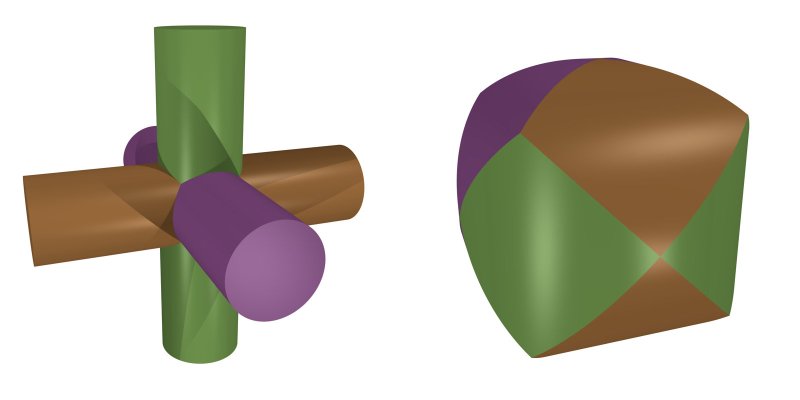
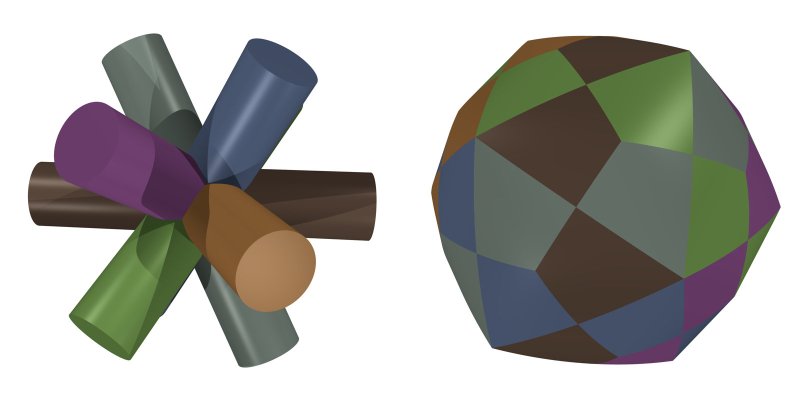
After learning how to intersect two cylinders, let’s try it with more. The next simple case are three cylinders, and the most symmetric case has them aligned along the coordinate axes. The union is on the left, and the (rescaled) intersection on the right.

Combi 3

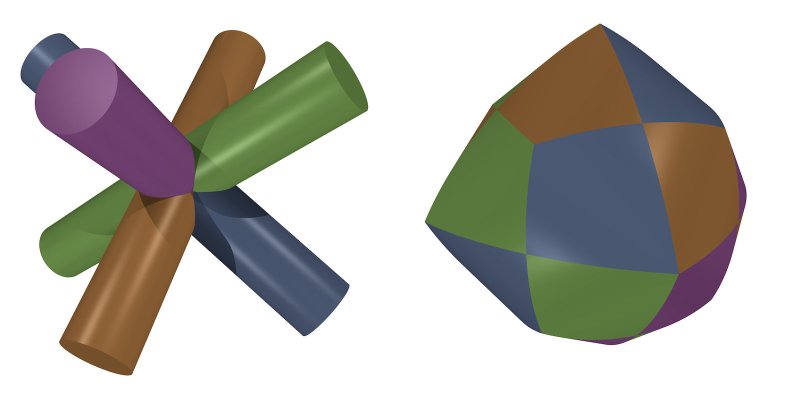
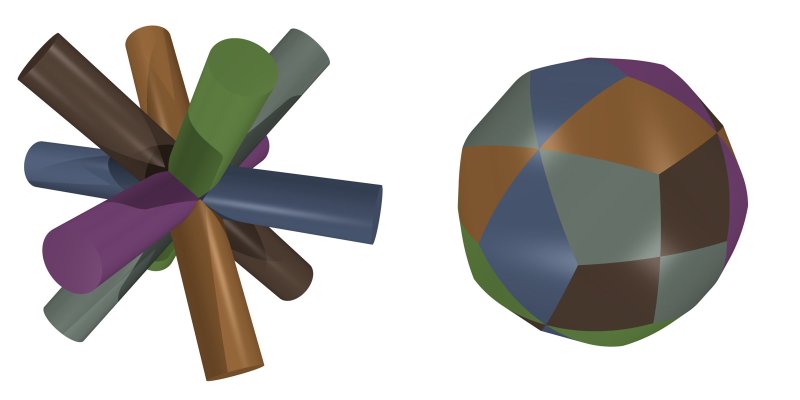
We obtain an inflated cube that has twelve cylindrical rhombi as faces, one for each edge of the cube. This is therefore a version of the rhombic dodecahedron. Using four cylinders, the most symmetric way is to align them with the diagonals of a cube. We see here (again) that each cylinder contributes a chain of cylindrical faces that touch at opposite vertices.

Combi 4

For six cylinders, there are two notable choices for the axes. The first is to use the six edges of a tetrahedron, recentered so that they all pass through the origin. Alternatively, we could use lines that connect midpoints of opposite edges of a cube.

Combi 6b

The other, even more symmetric choice is to use the diagonals of an icosahedron. Using axes related to the platonic solids creates simple patterns that can all be understood in terms of finite reflection groups acting on the sphere.

Combi 6

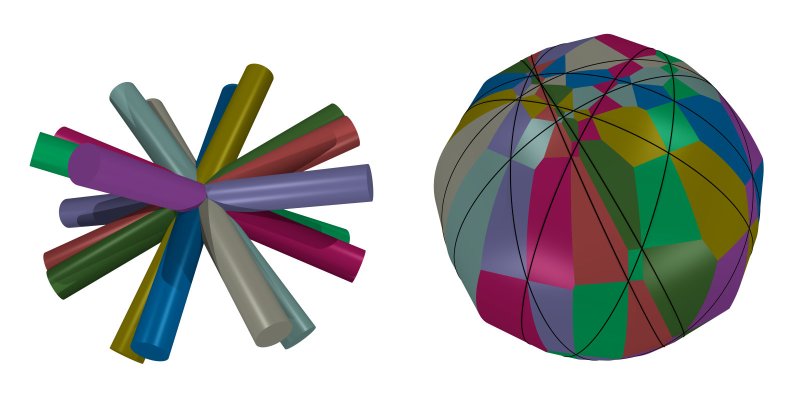
By now, I have probably created the impression that the appearance of the chains of equally colored cylindrical faces has something to do with the symmetry of the chosen axes. Not so. The next image shows a random choice of 10 cylinders of equal radius through the origin, and their intersection to the right.

Combirr 10

The black curves are the waists of the cylinders, i.e. their intersections with the sphere of equal radius centered at the origin. The waist of a cylinder must belong to the intersection, because any other cylinder will properly contain it. Thus our chains appear along these waists, and they are pinched whenever to waists meet.