Down (Arizona IV)

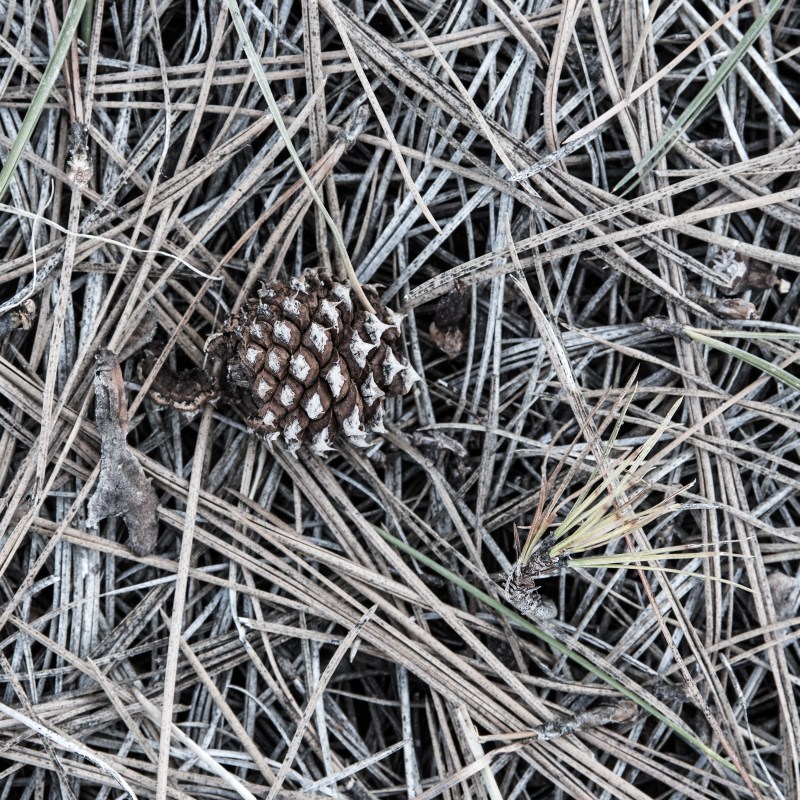
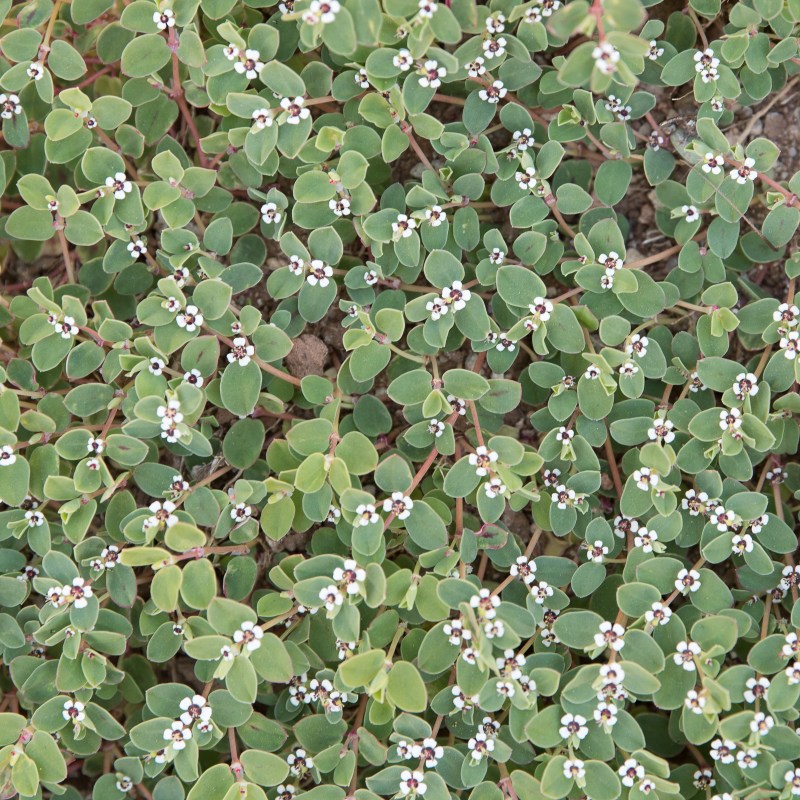
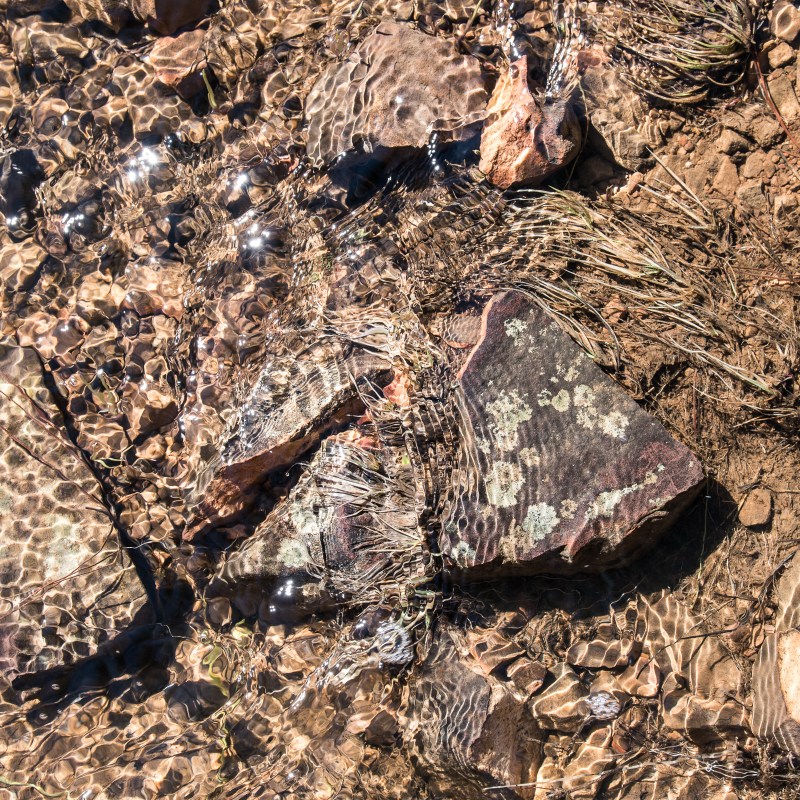
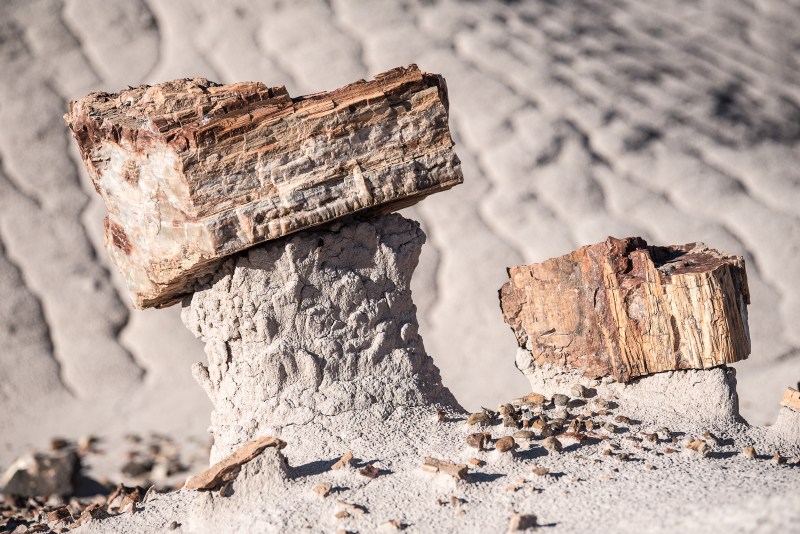
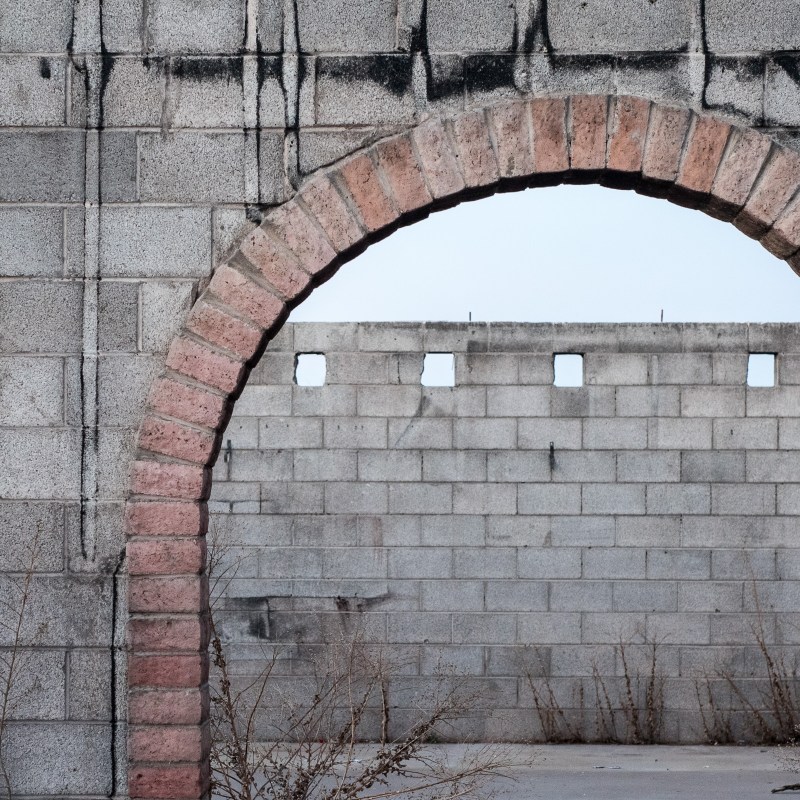
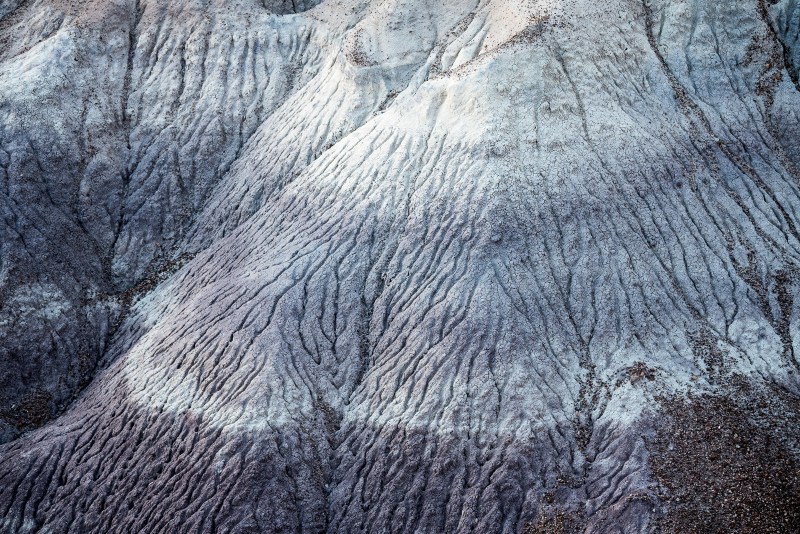
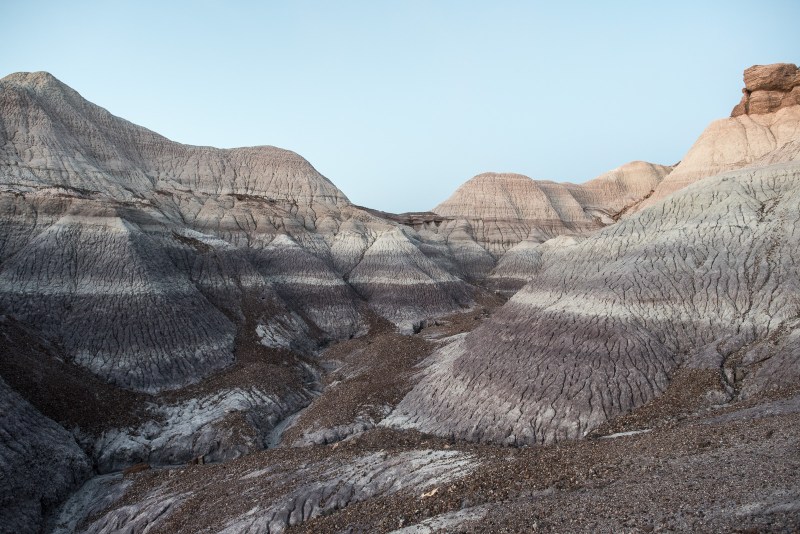
When you look down in Indiana, you see either mud or decaying leaves. This is of course exaggerating it, but the contrast to Arizona is so stark that I ended up taking a considerable number of pictures by just pointing the camera downwards.

DSC 1405

It of course always depends on where you are and what you do. I don’t envy the brave NASA scientists who have been staring for decades at red desert rocks from Mars. What will the first plant on Mars look like?

DSC 2264

Then there are the forests, smelling of pine and juniper.

DSC 1600

The proximity of decay and growth shows how fragile is what we have,

DSC 2506

and how much it depends on water.

DSC 1618

A Room With Two Views (Five Squares IV)

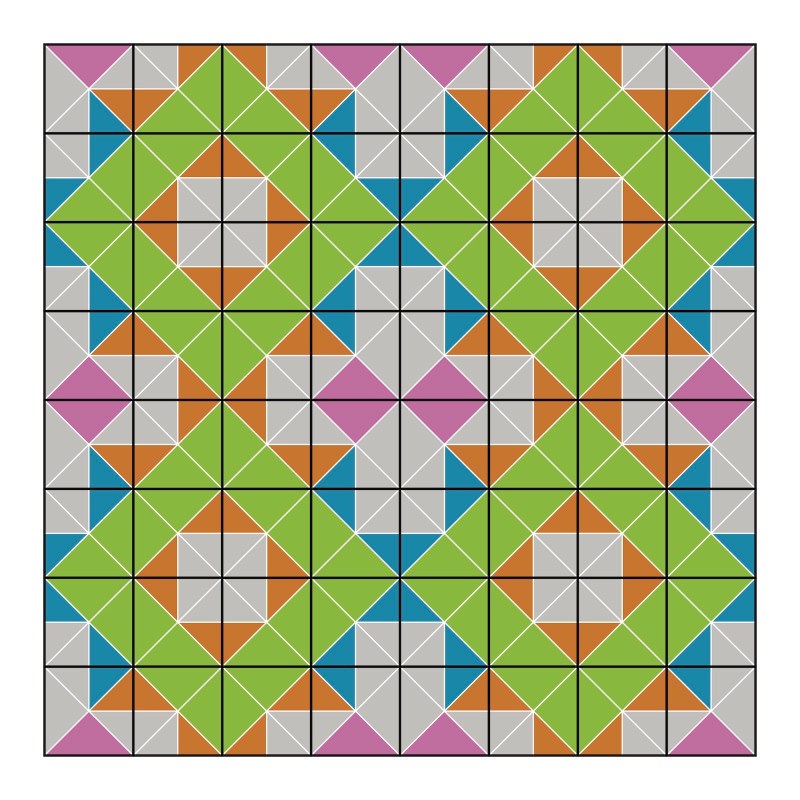
Today we look at tilings that utilize just the four other squares. The first step in classifying these is again a simplification, making the split corner squares uniformly green. This leaves us with two tiles:

Four

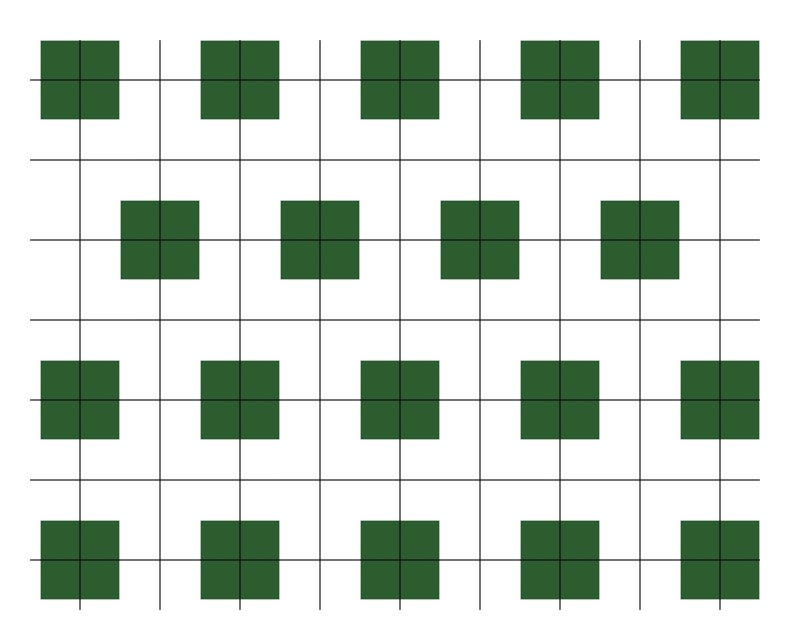
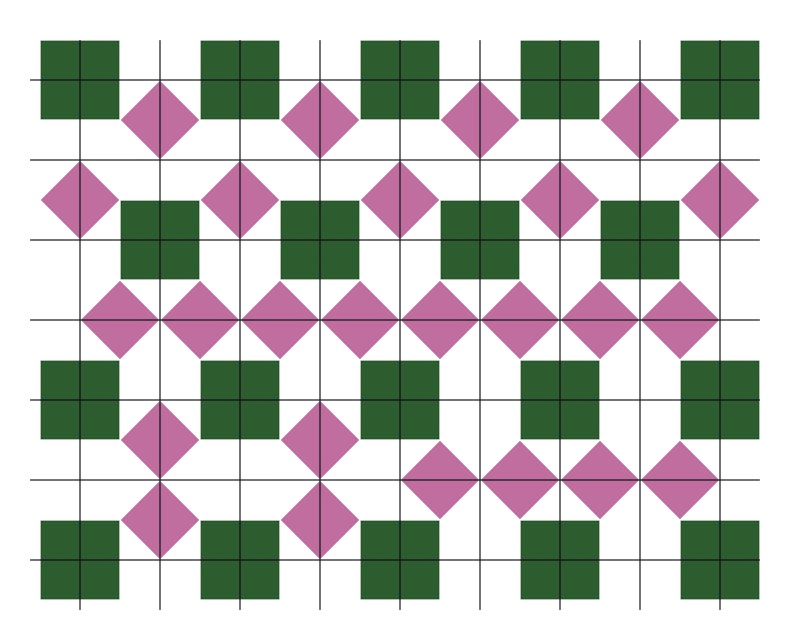
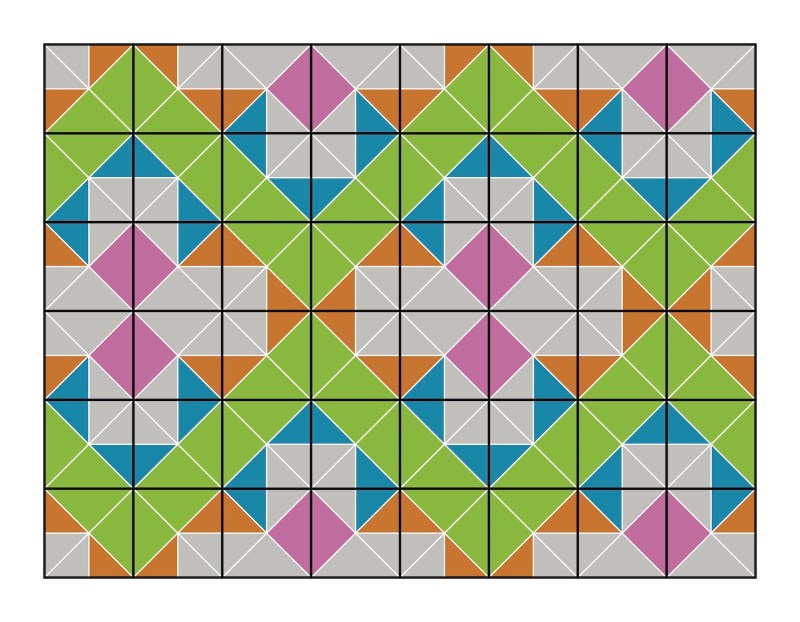
Ignoring the pink triangles for the moemnt, we recognize the problem we solved last time: The green squares need to occur in shifted rows or columns, like in the example below. Here we have four rows of green squares. Rows 1 and 2 are shifted, as are rows 2 and 3, but rows 3 and 4 are alined.

Green

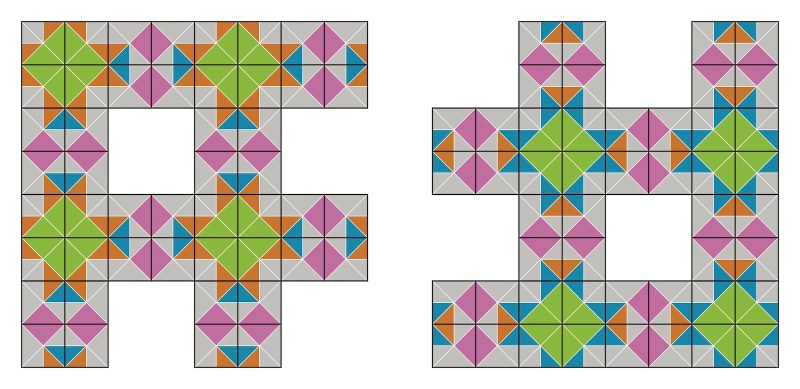
To add the pink triangles, note that two pink triangles fit together to a pink diamond, and each grid cell needs to have one of those, but we can only use those edges that are not already adorned with a green square. This leaved us with the following possibilities: If two consecutive rows of squares are aligned, we have place two diamonds in the square space between four squares, and we can do this horizontally or vertically. This can be done independently of neighboring squares, as shown between the two bottom rows below.

Purple

If the rows are shifted, we also have two possibilities to place the diamonds, but each choice affects the entire row, again as show above in the top rows.

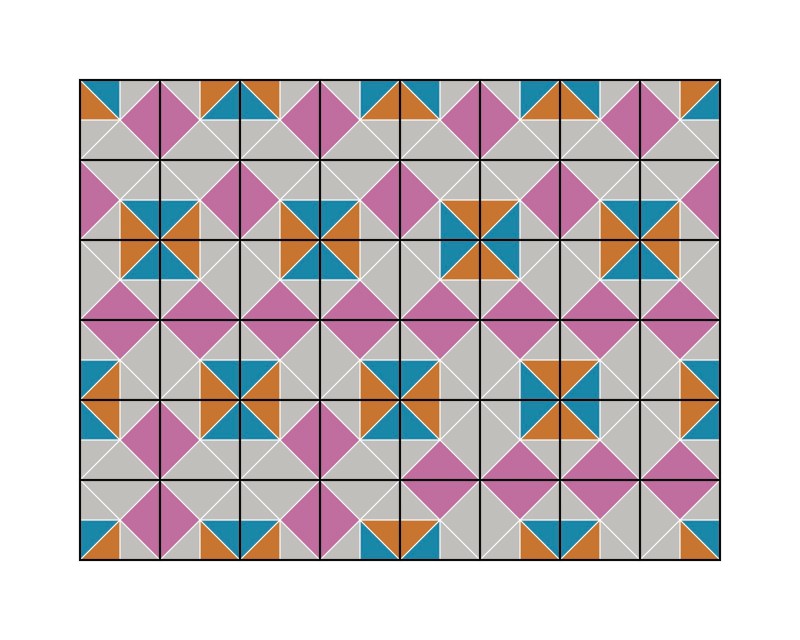
Finally, we need to undo the merging of the orange and blue triangles into green squares, and we can do so by splitting each square either way and independently.

Split

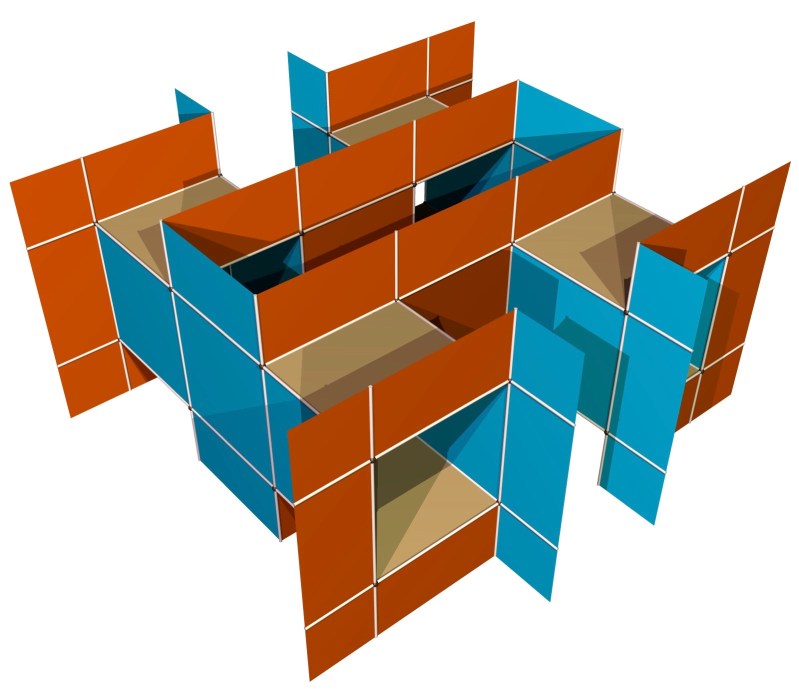
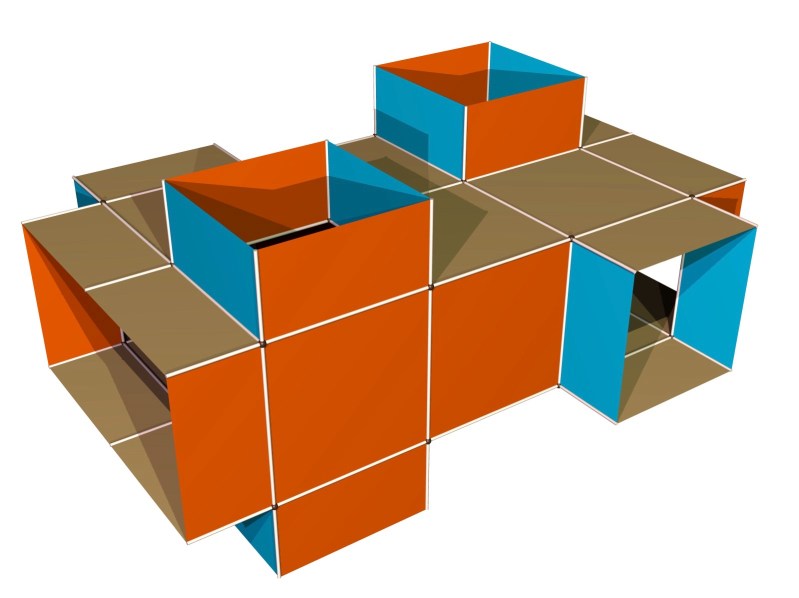
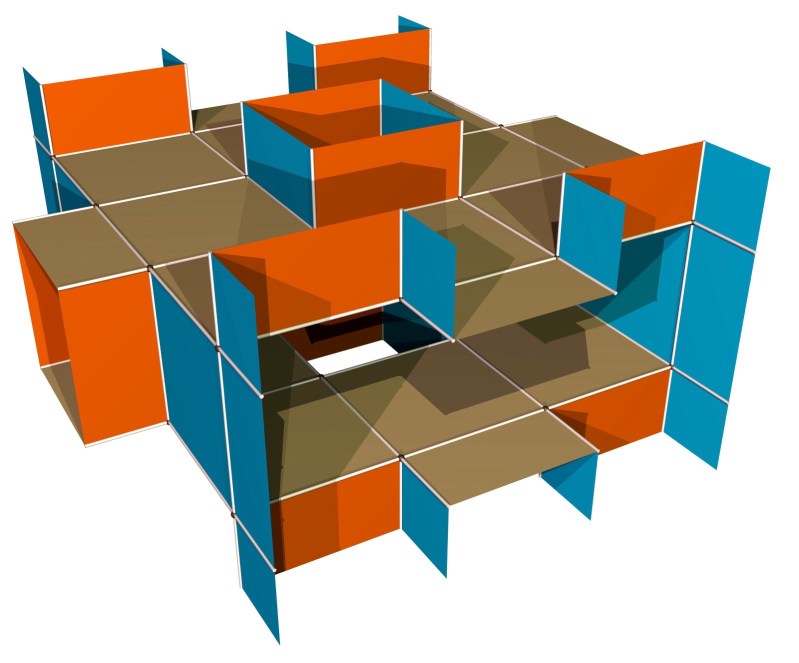
Below is an example how teh corresponding polyhedral surfaces will look like. The horizontal squares correspond to the green squares of the tiling. They are the floors and ceilings of rooms that have two opposing walls and two openings. I start seeing applications to randomly generated levels of video games here…

Nogreen

Oscillograms (Arizona III)

DSC 1415

About an hour car drive away from the desert landscape of the Petrified Forest in Arizona, one finds oneself in the large National Forests of Arizona. Change can happen quickly.

DSC 1669

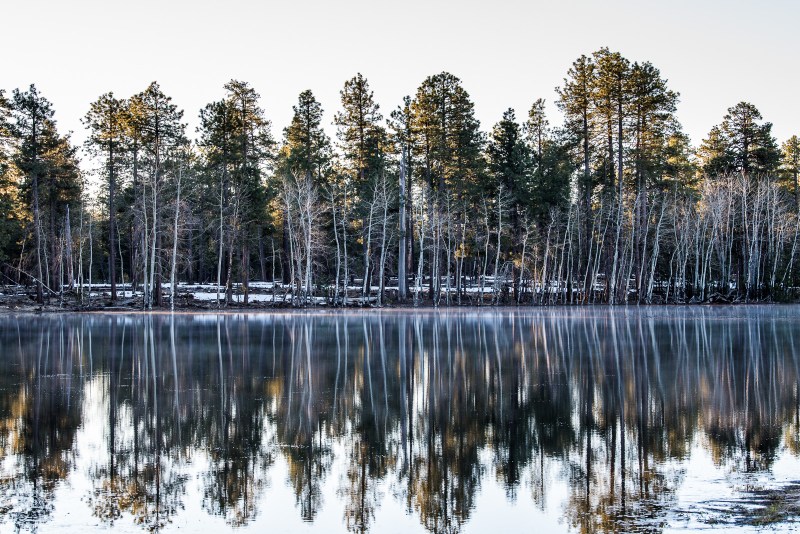
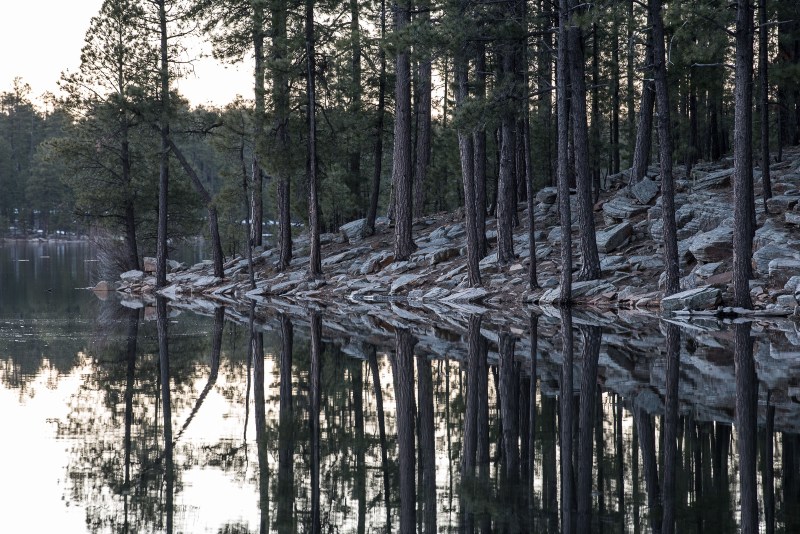
For a little while, melt water from winter snow leaves scenic lakes where tall pines try to protect the smaller birches in early morning light.

DSC 1857

Summer draughts and quickly progressing privatization threaten all this.

DSC 1871

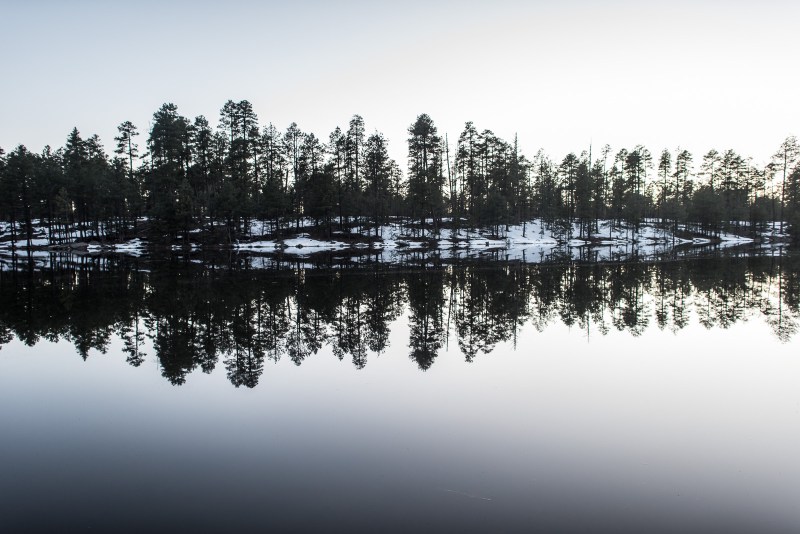
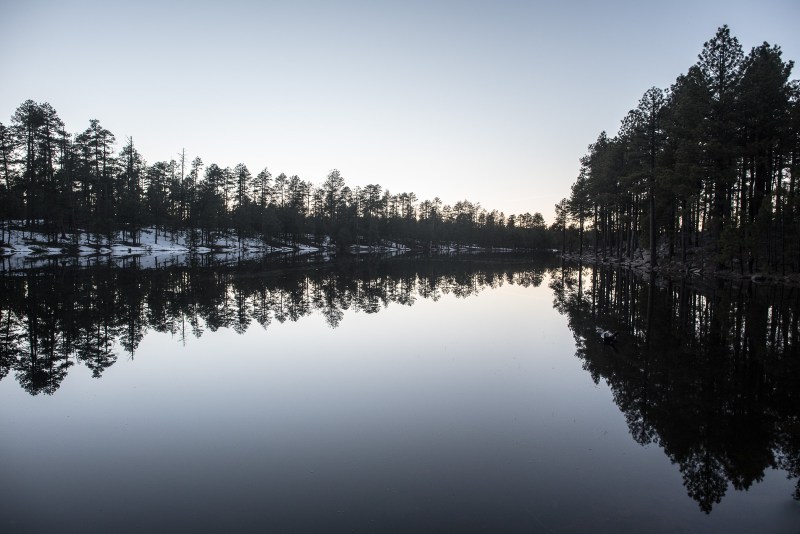
After sunset, when the few humans have retreated into their safe houses and the winds have subsided, the landscape becomes very quiet. The perfect reflections of the resting trees look like oscillograms of unheard cries.

DSC 1861

Change happens quickly.

Squaring the Circle

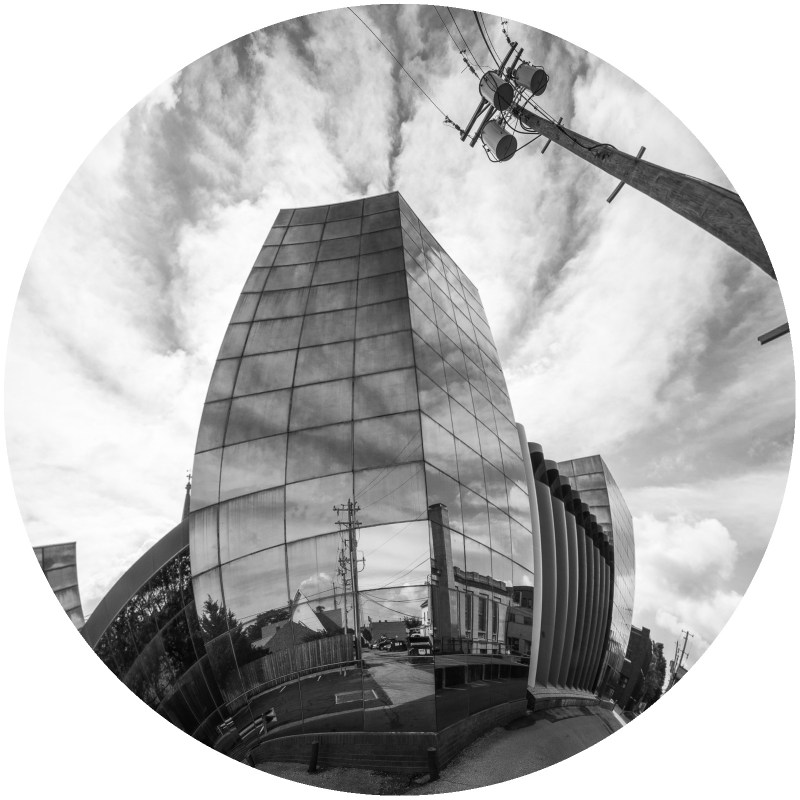
Squaring the circle is easy, you just need to know what you want to do. My personal favorite method is to use elliptic functions defined on rectangular tori to map rectangles to disks, as shown below for a square. These maps don’t preserve area (which is what the Greeks had wanted), but they preserve angles.

Circlesquare

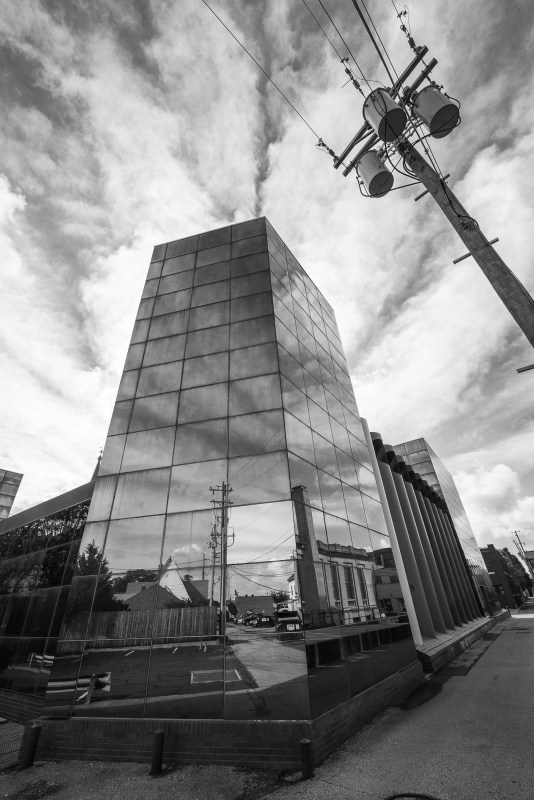
I had some leftover architecture images from Columbus and wanted to see how they look when made circular. Here, for instance, is the AT&T building

DSC 5596

and this is a circular version:

Ex5

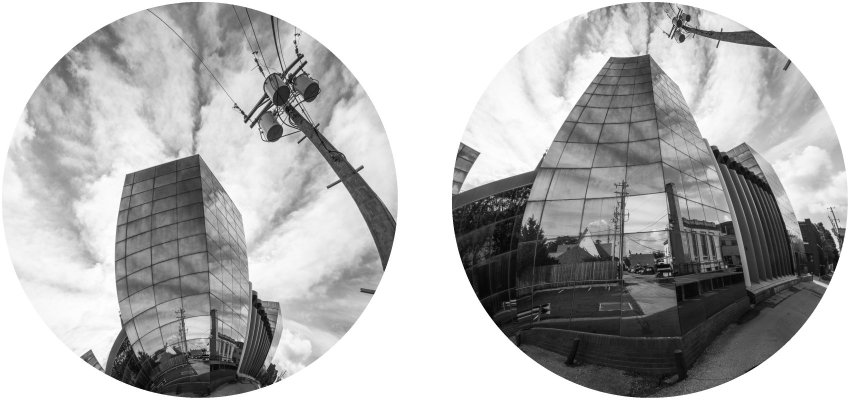
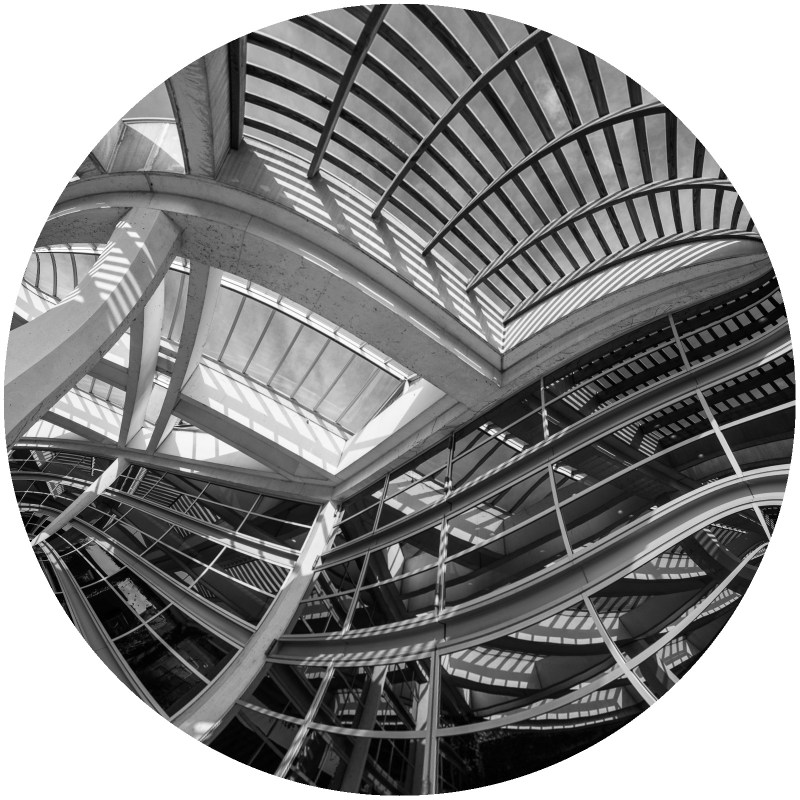
There are three degrees of freedom one can play with (the dimension of the automorphism group of the hyperbolic plane), which means that one can squeeze parts of the image towards the boundary cirle. Here are two other versions of the same image.

Att2

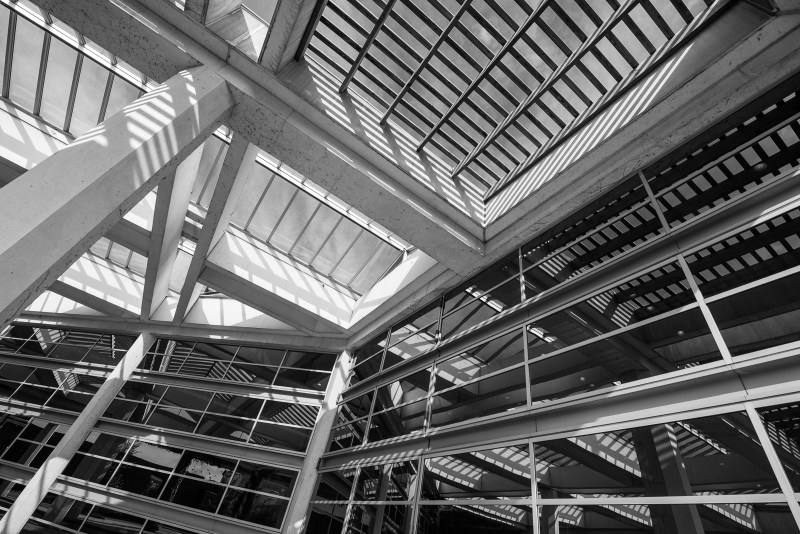
Another favorite of mine is the atrium of the Cummins office building with its wonderfully intricate play with straight lines and black and white.

DSC 5562

Now we only have to find architects and builders who create buildings that have these curves in reality.

Cummins

Bucket of Blood Street (Arizona II)

DSC 1504

The little town Holbrook in Arizona offers convenient accommodation after visiting the Petrified Forest National Park. This is not a wealthy town, but  the downtown area has its own nostalgic charm. You wonder what life was like here a hundred years ago.

DSC 1464

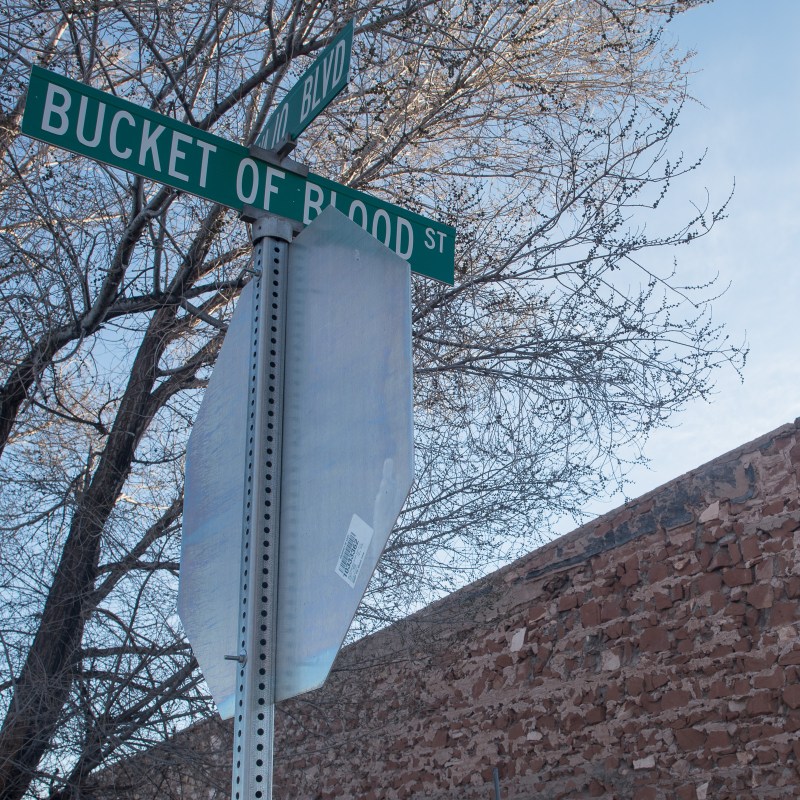
Then you come across this street sign. Choosing a name is a delicate thing. Apparently, in the good old times a saloon shooting ended in such a way that the establishment was renamed the Bucket of Blood Saloon. In the long run, this didn’t help much, and after the building fell apart, the name survived as the street name, to this day.

DSC 1507

Other local attractions allude to that bit of the town’s history in appropriate color.

DSC 1468 Edit

The moral? Appearances change, names stay. But it seems the town hasn’t quite figured out whether that name is a curse or an opportunity.

DSC 1540

More about Decorated Squares (Five Squares III)

In order to classify surfaces that have five coordinate squares around each vertex, we were led to consider planar tilings with six different colored squares. Today we will discuss a special case of this, namely tilings that use just two of these squares. The only rule to follow is that colors of tiles need to match along edges. Here is an example:
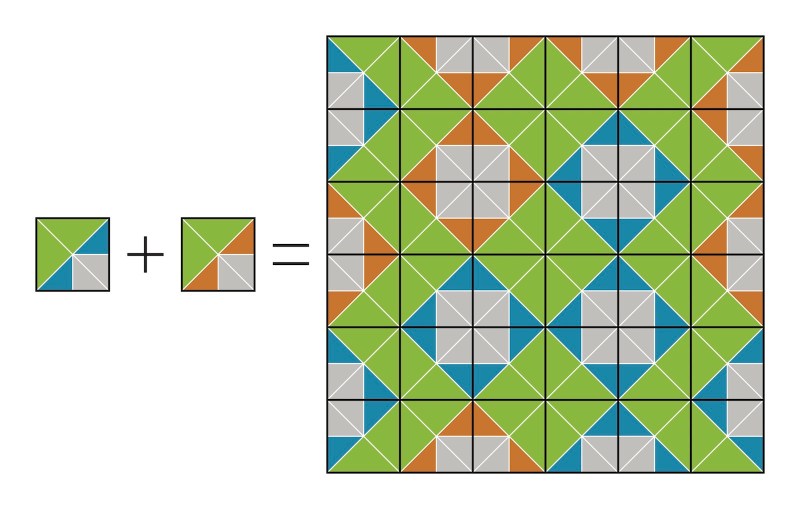
Sample

To classify all tilings by these two squares (and their rotations), we first simplify by solely focussing  on the gray color (making it dark green), and considering the blue, orange, green as a single color, namely light green. This way we get away with just one tile. Of course we hope that understanding how this single tile can fill the plane will help us with the two tiles above.
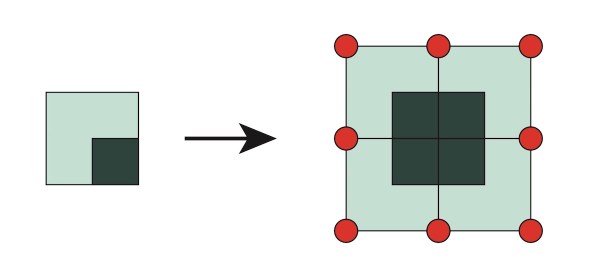
One

We first note that placing the tile determines three of its neighbors around the dark green square. So instead of tiling the plane with copies of this squares, we can as well place dark green squares on the intersections of a line grid so that for each cell of the grid, precisely one corner is covered by a dark green square, like so:

Shiftedrows

We first claim that if we do this to the complete grid, we must have a complete row of squares or a complete column of squares. Below is a complete row (given the limitations of images). The red dots indicate where we cannot place green squares anymore, because the grid squares have all their green needs covered.
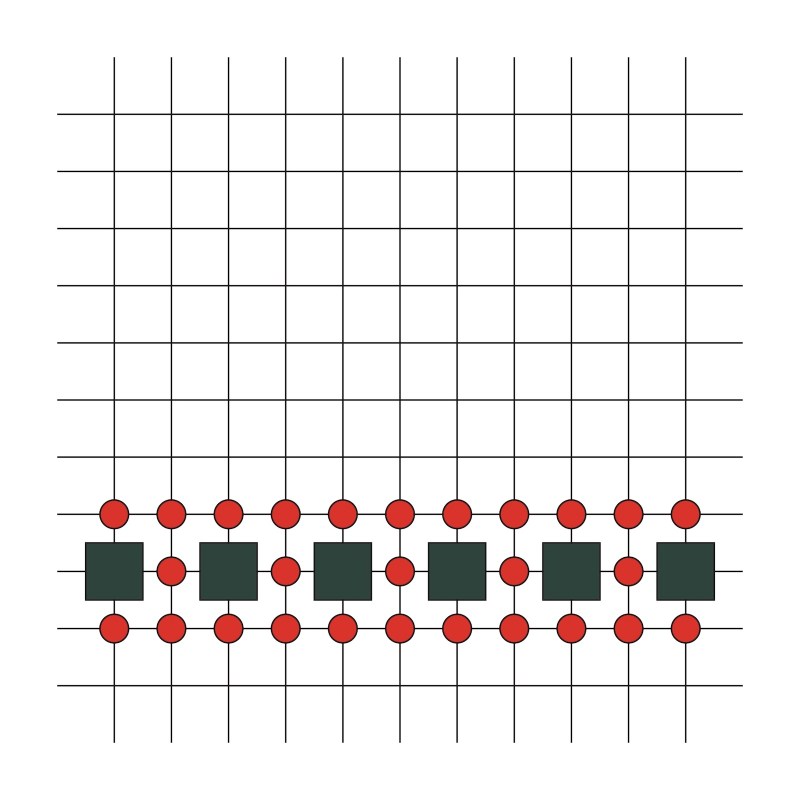
Row

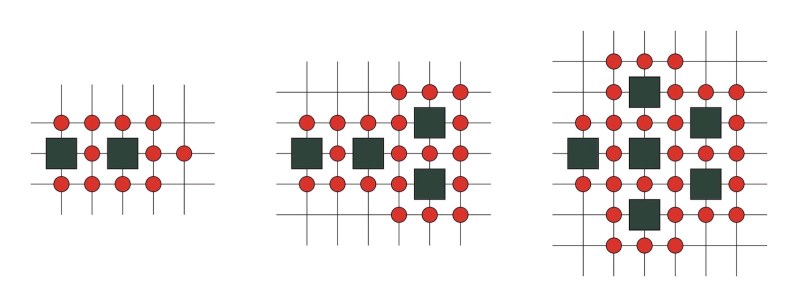
If we do not have such a row, there must be a square without left or right neighbor. Let’s say a square is missing its right neighbor, as indicated in the left figure below by the rightmost red dot.
Existence
Notice how the two grid squares to the right of the right dark square have only one free corner. We are forced to fill these with dark squares, as shown in the middle. This argument repeats, and we are forced to place consecutively more squares above and below, completing eventually two columns.

As soon as we know that we have (say) a complete horizontal row, directly above and below that row we will need to have again complete rows of squares, as in the example above. These rows can be shifted against each other, but that’s it. So any tiling of the plane by the dark/light green tile consists of complete rows or columns with arbitrary horizontal or vertical shifts, respectively.

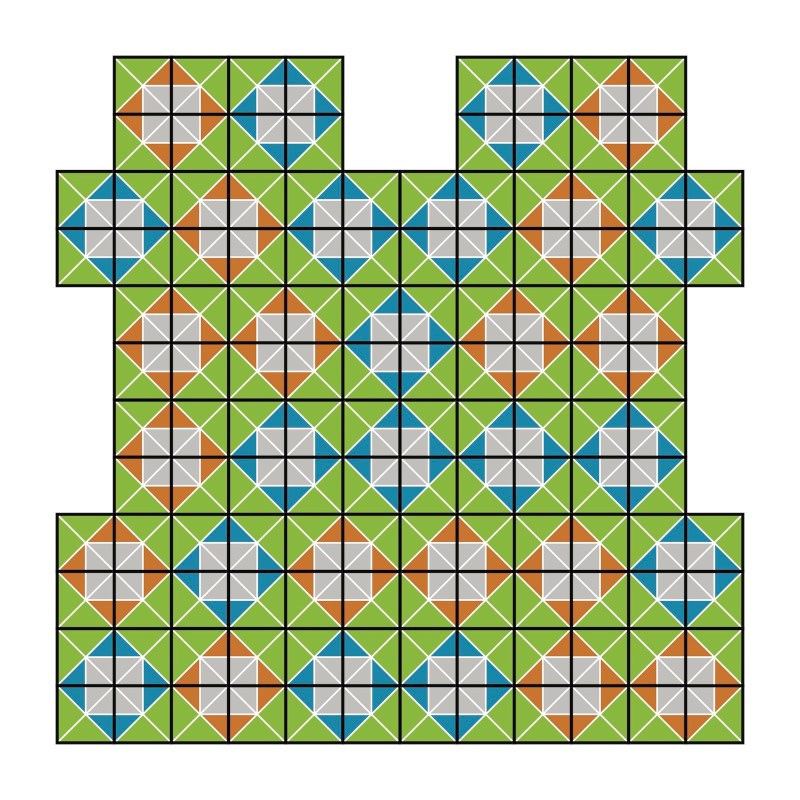
Finally we have to address the question whether this tells us everything about tilings with the two tiles above. This is easy: Each dark green square represents a light gray square that is necessarily either surrounded by blue or orange tiles. So we can just replace each dark green square by an arbitrary choice of such a blue or orange cluster. The final image shows such a choice for the example above.
Filledrows

It is now easy to stack several such tiled planes on top of each other, thus creating infinite polyhedral surfaces that have five coordinate squares at each corner.
Moonscape (Arizona I)

DSC 1272

My obsession (?) with taking pictures in moonlight is not so much due to a romantic trait of mine, but rather because of my more general fascination with alternate lighting.

DSC 1304

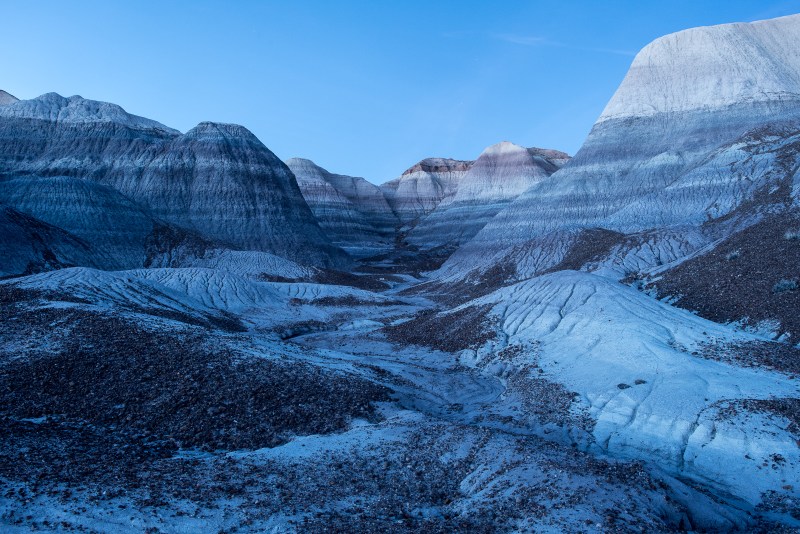
The Blue Mesa of the Petrified Forest National Park is part of the Painted Desert. The eeriness of the landscape increases in the moonlight, which brings out more blue than is really there.

DSC 1322

The pictures here were taken shortly after sunset with rapidly decreasing light and increasing exposure times.

DSC 1349

These last two pictures were taken in almost complete darkness. They show the landscape as we would see them with more sensitive eyes.

DSC 1351

My thanks go to the friendly park rangers who didn’t fine us despite staying after sunset.

More Examples (Five Squares II)

To review, let’s start with the following tiling

New 4 tile

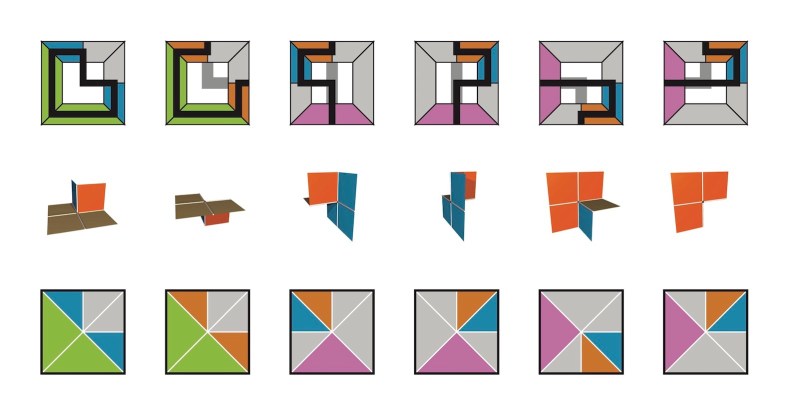
Now use the dictionary below to replace each tile by the corresponding 3-dimensional shape. Each tile from the bottom row is an abstraction of an idealized top view (top row) of a rotated version of five coordinate squares that meet around a vertex (middle row).

Dictionary

By using the top left quarter, we get the top layer of the polygonal surface below. The bottom layer uses the same pattern as above with blue and orange exchanged. This is a fundamental piece under translations, and we can see that the quotient has genus 4. This also follows from the Gauss-Bonnet formula, which says that a surface of genus g uses 8(g-1) of our tiles (12 for the top and bottom each in this case.

Genus 4

Similarly, this tiling

Genus5 tile

encodes one layer of the following surface of genus 5:

Genus 5

To make things more complicated, the next surface (of genus 4 as well)

Plus 1

needs four layers until it repeats itself. Two of them are shown below.

Pluslayers

These tilings exhibit holes bordered by gray edges which complicates matters, as we will now also have to understand partial tilings (with gray borders).

Verticality

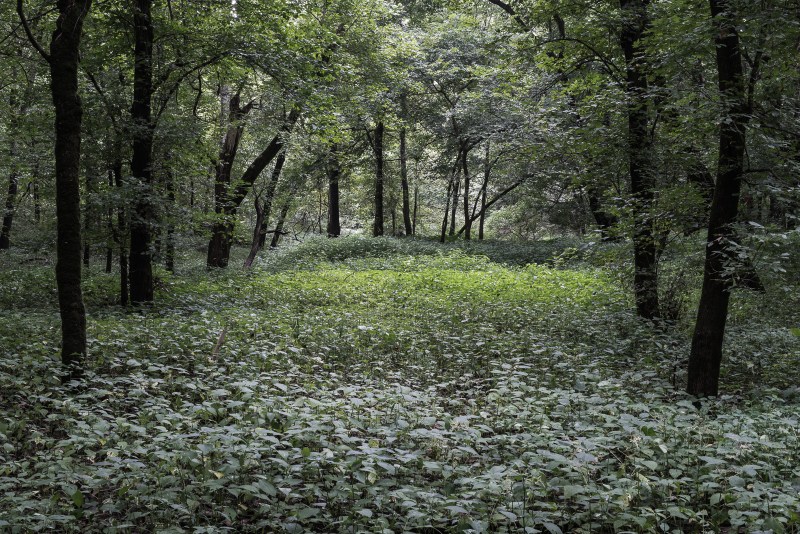
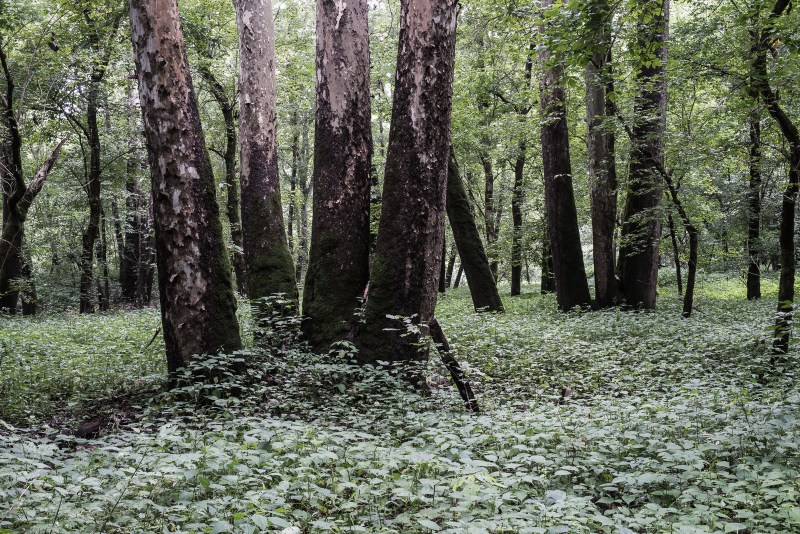
Near where McCormick’s Creek merges into the White River, the area becomes quite swampy and is often flooded. There are two views from a boardwalk trail through this swamp that have caught my attention. The first is a quadruplet of sycamore trees in the foreground.

DSC 4908

Clearly the weeds are about to conquer the world, you might think. Of course, the sycamores know better.
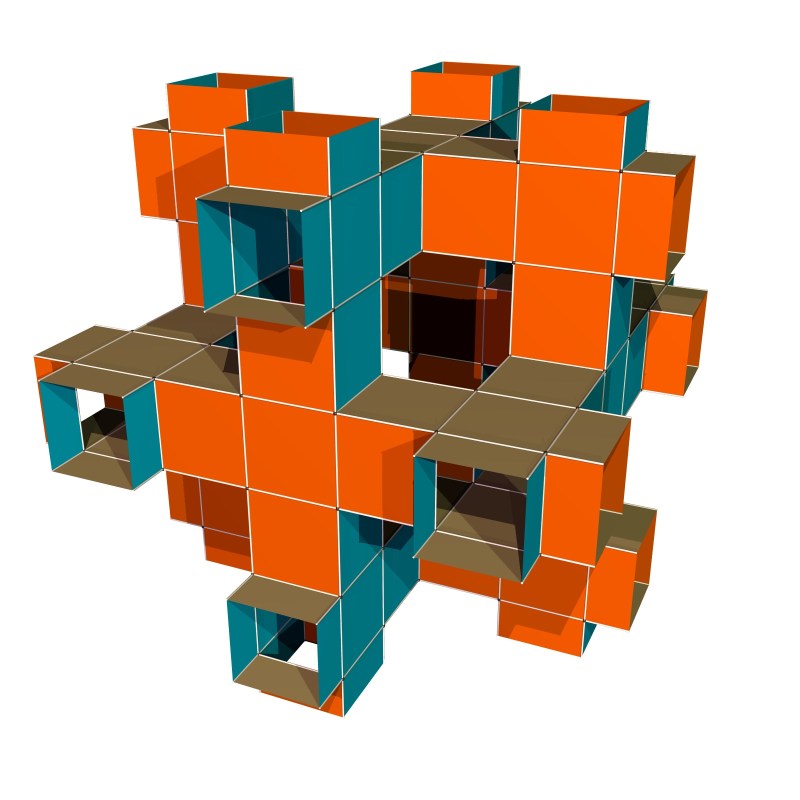
DSC 9061

The other spot is a hundred yards further down the board walk, where the view opens up into a stage like space where we wait in vain for a performance to begin.
DSC 4910

But it is us who are lacking the patience: The performance is happening, all the time, mostly without us.

DSC 9060

Columns

After looking at the intersections of symmetrically placed cylinders and obtaining curved polyhedra, it is tempting to straighten these intersections by looking at intersections of columns instead.

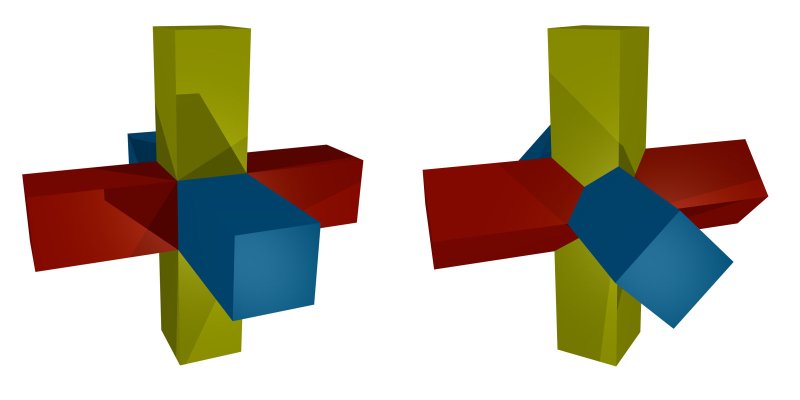
The simplest case is that of three perpendicular columns. The intersection is a cube. Fair enough. But what happens if we rotate all columns by 45 degrees about their axes?

Col 3 union

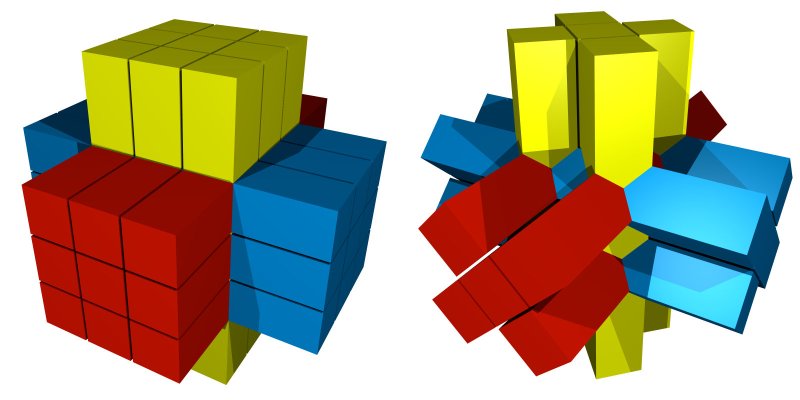
Before we look, let’s make it more interesting. In both cases, we can shift the columns so that their cross sections tile a plane with squares. Surely, every point of space will then be in the intersection of a triplet of perpendicular columns. In other words, the intersection shapes will tile space.

Col 3 shifts

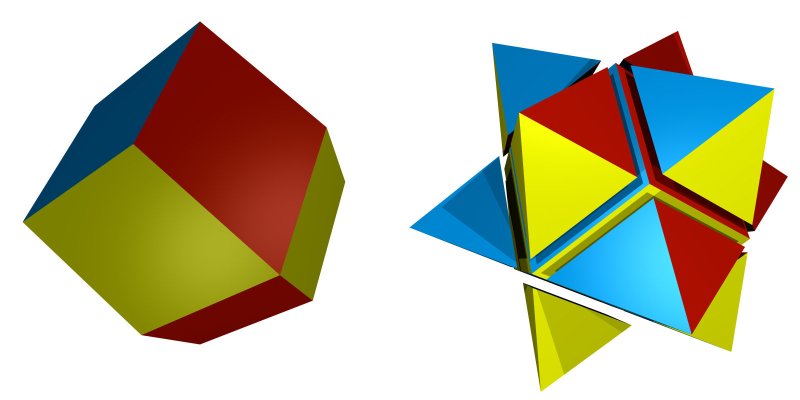
Yes, right, we knew that in the first case. I find the second case infinitely harder to visualize. Fortunately, I have seen enough symmetrical shape to guess what the intersection of the three twisted columns looks like it is a rhombic dodecahedron.

But not all triplets of columns that meet do this in such a simple way, there is a second possibility, in which case the intersection is just a twelfth, namely a pyramid over the face of the rhombic dodecahedron.

Col 3 twist

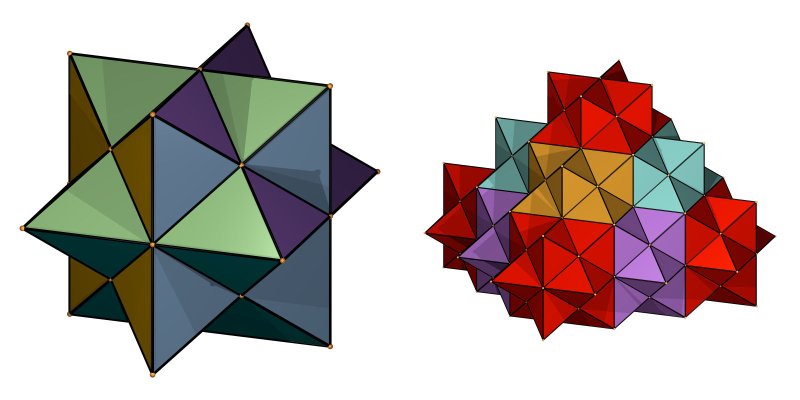
Together with the center rhombic dodecahedron they form a stellation of the rhombic dodecahedron, or the Escher Solid, of which you have made a paper model using my slidables.

Escher combo

Above you can see a first few of Escher’s solids busy tiling space.