Hunan and Yunnan

It’s this time of the year when to look back to see what has been memorable, in the good way. I discovered some wonderful teas, black teas from China. New for me were two teas from the Hunan province, both distributed in the US by reliable Harney & Sons.

DSC 1725

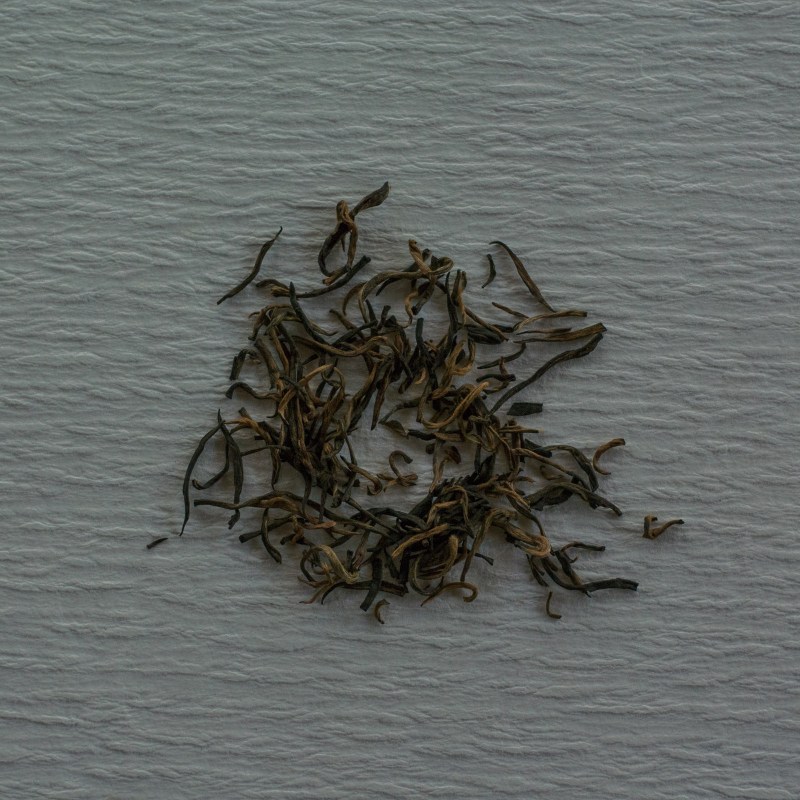
The simpler of them is the Hunan Forest Twist that comes with long leaves that slowly uncurl in the pot while the tea steeps.

DSC 1732

The taste is similar to that of a full-bodied Assam but without any bitterness.
The second tea from Hunan is the Wild Hunan Gold.

DSC 1761

The leaves have wonderful golden tips, and the cup is a wild ride through intense chocolate notes. This tea clearly deserves its name.

DSC 1767

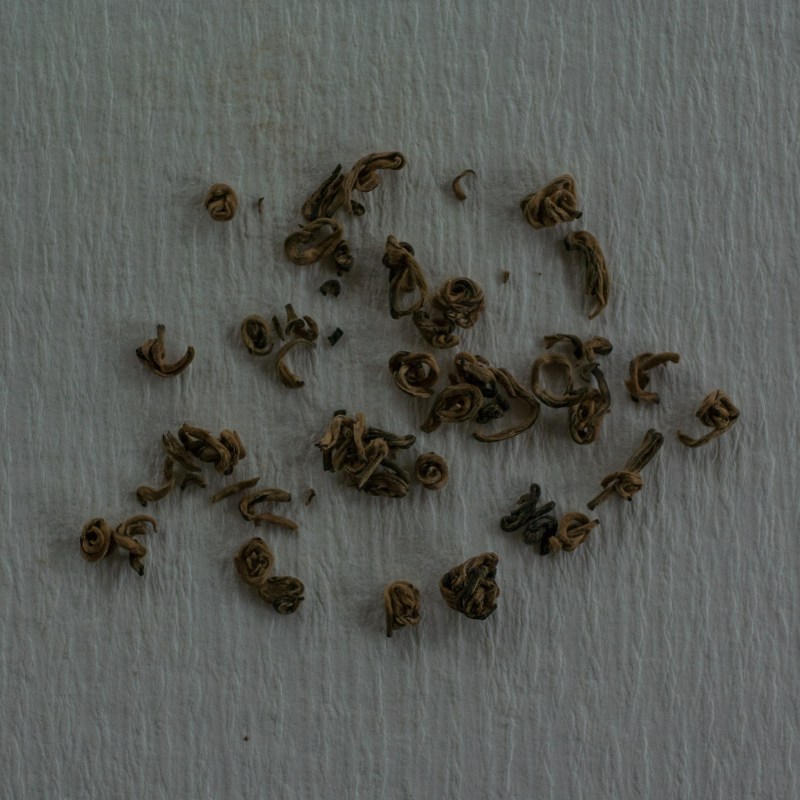
Even more golden are the leaves of the Yunnan Golden Ring tea from the Yunnan province, purchased through Imperial Tea Court. I usually have one or two good quality Yunnan teas around because I like their soft and distinctive flavor, but this tea is something else.

DSC 1751

The rolled golden leaves are amazing, and the tea, while clearly Yunnan, is more complex than the standard Yunnan, with subtle hints of chocolate.

DSC 1757

Instant Insanity

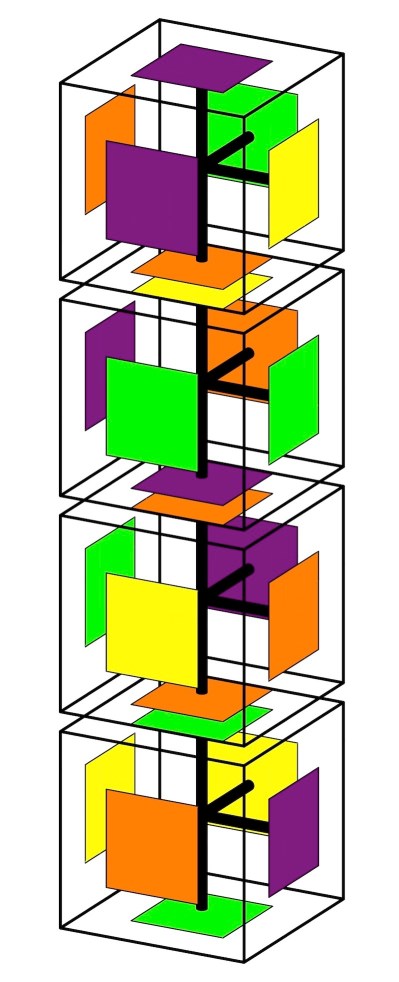
This post is about a mathematical puzzle and not the current state of daily affairs. The puzzle consists of four cubes, with faces colored in four colors:
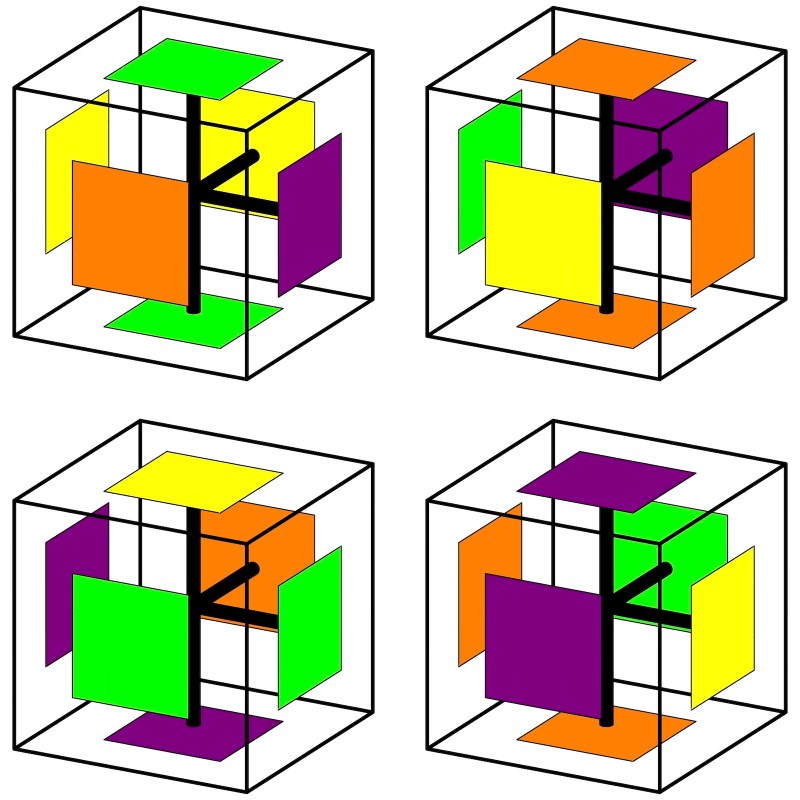
Cubes

If you want to make your own, you can print out the nets below and fold.
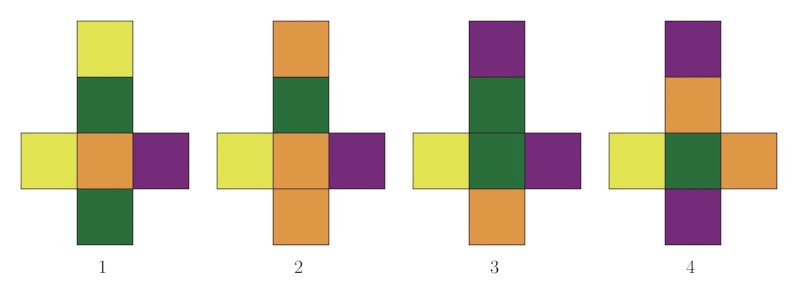
Insanenets

The goal is to stack the four cubes together so that each of the four long faces of the 4 x 1 x 1 tower show all four colors.

According to Jerry Slocum, this puzzle goes back to 1900 when Frederick A. Schossow marketed a version of it under the name Katzenjammer Puzzle. Katzenjammer is German for hangover…

It has since appeared in many variations. Its latest incarnation under the current name Instant Insanity was discovered by Frank Armbruster and has been marketed by Parker Brothers since 1967.

We will solve he puzzle using graph theory. Each cube will get encoded in a graph. To do so, we use as vertices the colors (yellow, orange, purple, and green), and connect two colors by an edge if the two colors occur on opposite faces of the cube. Thus we obtain for each colored cube a graph with four vertices (colors) and three edges (opposite faces).
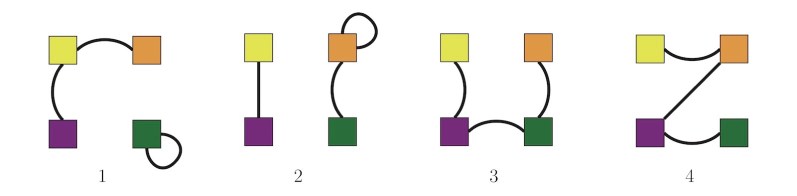
Singlenets

Before we continue, let’s see why these arbitrary looking graphs contains all the information about the cubes that is necessary to play the puzzle: If the graph of a cube is given, we know all colors of pairs of opposite faces for that cube. Using a blank cube, we can first color the front and back face with a pair of these colors. It doesn’t matter which color we pick for the front, because we could turn the cube over. Using a second edge of the graph, we then color the left and right face with the two colors of the end points of the edge. Again it doesn’t matter which color we use for the left side, because there is a rotation fixing front and back that flips left and right. Finally, there are two possibilities remaining for coloring the top and bottom face of the cube. These lead to truly differently colored cubes, but both are equivalent for solving the puzzle, as the top and bottom colors of the tower don’t matter for the puzzle.

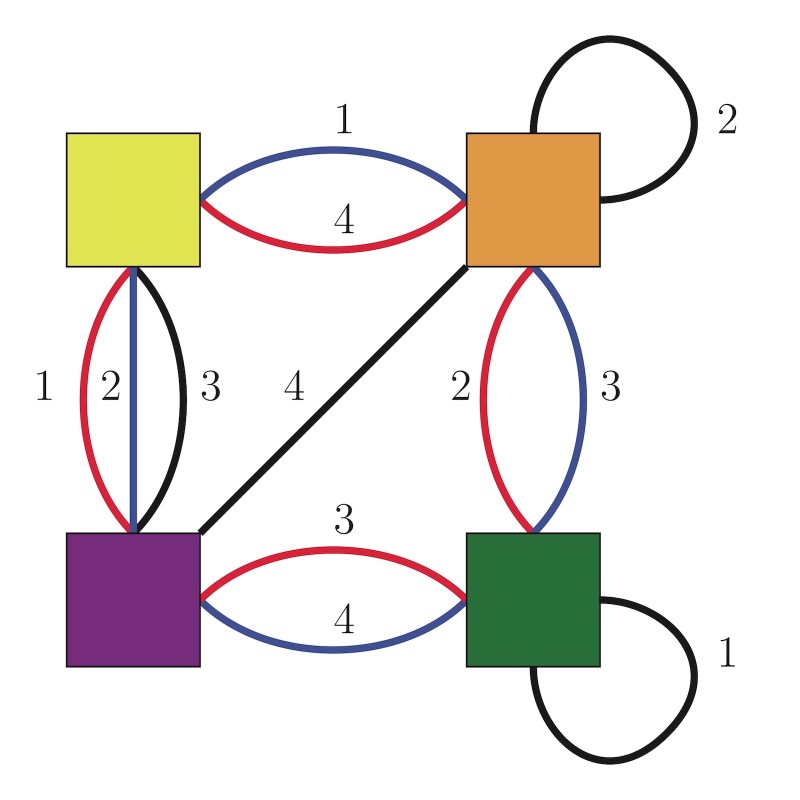
Coming back to solving the puzzle, we combine the four graphs we have created for each cube into a single graph with multiple edges. The edges are now labeled from 1 through 4 to indicate from which cube they come. How does this graph help us to solve the puzzle?
InstantInsanity

Suppose we have stacked the cubes together so that both the front and back side of the tower show all four difference colors. The four front and back sides of each cube represent each an edge in our graph, which we give a direction so that they always point to the color of the back edge. Let’s mark these edges say blue. Thus we get four blue edges that begin at four different colors and end at four different colors. As there are just four colors, each vertex has an edge ending and an edge beginning there. This means that following the blue edges, we have found a doubly Hamiltonian circuit – a cycle or collection of cycles that pass through all four vertices (colors) of the graph, and uses edges with each of the four labels (cubes).

Vice versa, any such path can be used to stack the cubes so that front and back side of the tower show all four colors.

Next we will show that any such system of circuits must go once around the square marked by the four colors.

If this were not the case, it would decompose into several components of lengths 1+3, 1+1+2, or 2+2.
While in each case there are Hamiltonian circuits, none of them are doubly Hamiltonian.

Thus we only need to look for Hamiltonian paths that go around the square, and can ignore the loops at orange and green as well as the diagonal connection from purple to orange.

Consider the top and bottom edge, which both have an edge labeled 4. As each edge label can only occur once, one of these two edges must use an edge with a label other than 4. We make a case distinction: First, let’s assume the bottom edge uses label 3. Necessarily then, the right edge then must use label 2, the left edge label 1, and the top edge label 4, and we get the Hamiltonian path marked red.

Now let’s assume that the top edge is using label 1. Thus we have to use for the left either label 2 or 3, and the other label 3 or two for the right edge. Either choice leaves us with label 4 for the bottom edge. One of the choices is the path marked blue, the other one has labels 2 and 3 exchanged in the left and right connections. Thus there are only three different possible Hamiltonian paths.
Solution

To finally solve the puzzle completely, we will need to take care of the left and right faces of our tower. By associating a directed edge for each cube from every left face to every right face, we get a second doubly Hamiltonian path in our graph.
This second path must be edge disjoint with the first, as we cannot use a pair of opposite faces of the same cube twice.

As the second and third of our three Hamiltonian paths are not disjoint, one of the paths we seek must be the red path. This uses edge 2 on the right hand side, so that the second Hamiltonian path can only be the blue one. They are indeed edge disjoint, and thus solve the puzzle.

The Unruly

One of the fascinating aspects of the DePauw Nature Park is that one can observe who takes possession of this devastated landscape.
A contender (my favorite) is the Sycamore tree.

DSC 7742

Even while still little, they make gigantic leaves.

DSC 7703

A little older, they begin to show their unruly temperament. This is not a pretty tree for an English Garden. But they show character.

DSC 7617

When mature, they become imposing. Their distinctively peeling bark makes me think of ghosts.

DSC 7658

Right now, they stand mostly isolated, or against the backdrop of the quarry walls.

DSC 7713

But hundreds of little ones are growing, hidden between the shrubs. Let them have this place. They will cause no harm.

DSC 7777

Reflections on the Letters r,s,t (Groups II)

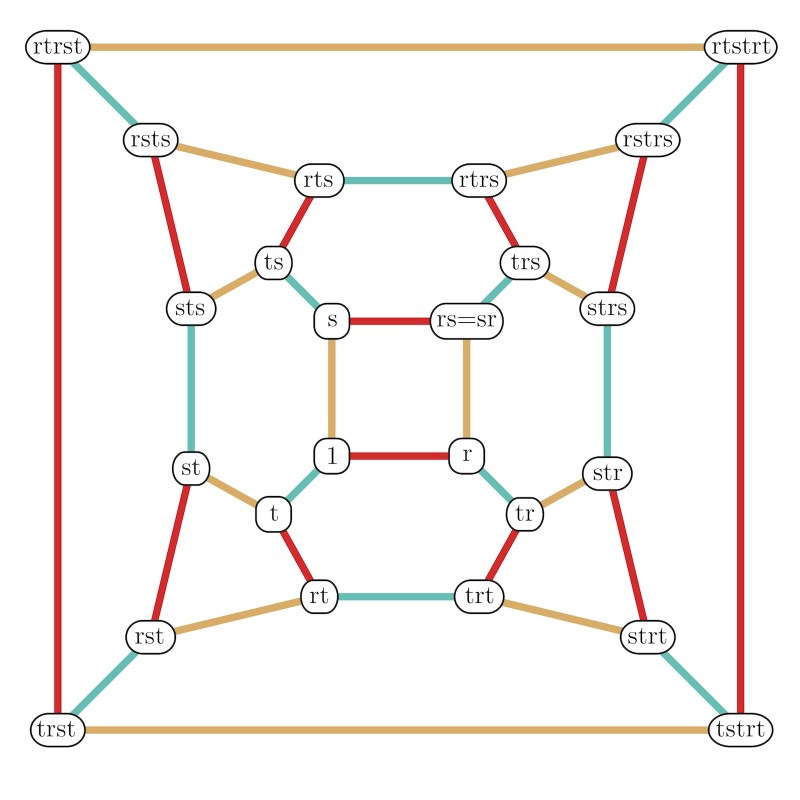
Continuing the discussion from last week, let’s consider the 3-letter alphabet {r,s,t}. We are allowed to form all possible words in these letters (and their inverses, if you want to), but we agree that rr=ss=tt=1 and (rs)^2=(st)^3=(tr)^6=1. This defines the Coxeter group G(2,3,6). Last time we saw that the very similar group G(2,3,3) is finite, today we will see that G(2,3,6) is infinite. Below is the beginning of its Cayley graph.

Cayley236 01

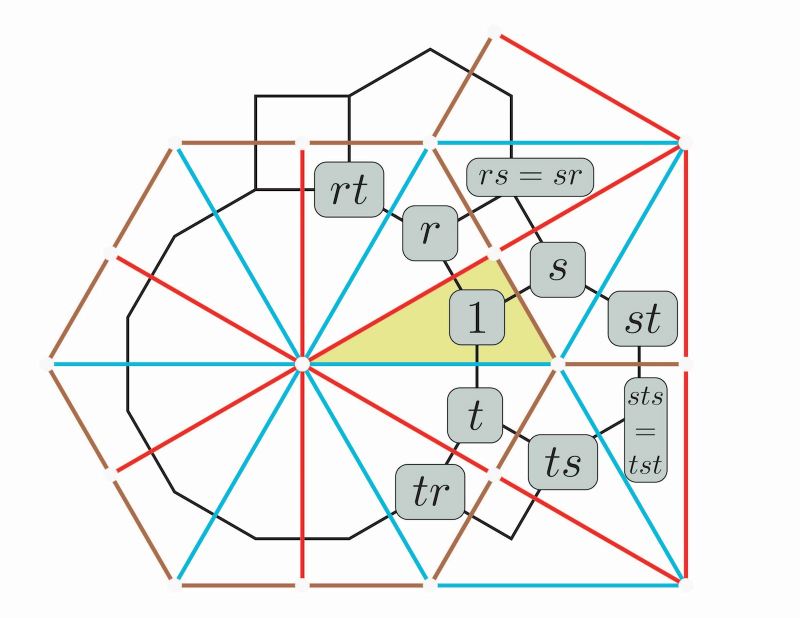
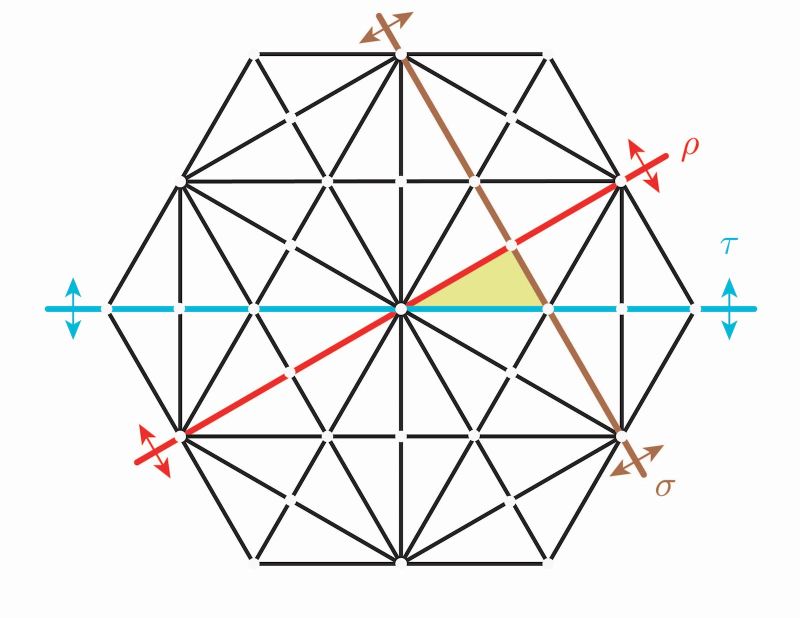
We travel from one word to the next by appending r,s, or t. This looks much more complicated than what we saw for G(2,3,3), but things become clearer when we look at another group. Consider a yellow triangle with 30, 60, 90 degree angles (writing this as π/2, π/3,π/6 makes 2-3-6 reappear), and let ρ, σ, τ be the reflections at the lines extending its edges.

Reflectiongroup 01

These three reflections generate a group Γ(2,3,6) of Euclidean symmetries which has the yellow triangle as its fundamental domain. The clue is that Γ(2,3,6) = G(2,3,6). We can easily map G(2,3,6) to Γ(2,3,6) by sending R to ρ, s to &sigma, t to τ. This works because ρ, σ, τ satisfy the same relations as r, s, t. It doesn’t work as easily the other way because ρ, σ, &tau could also satisfy other, hidden relations.

Reflpath 01

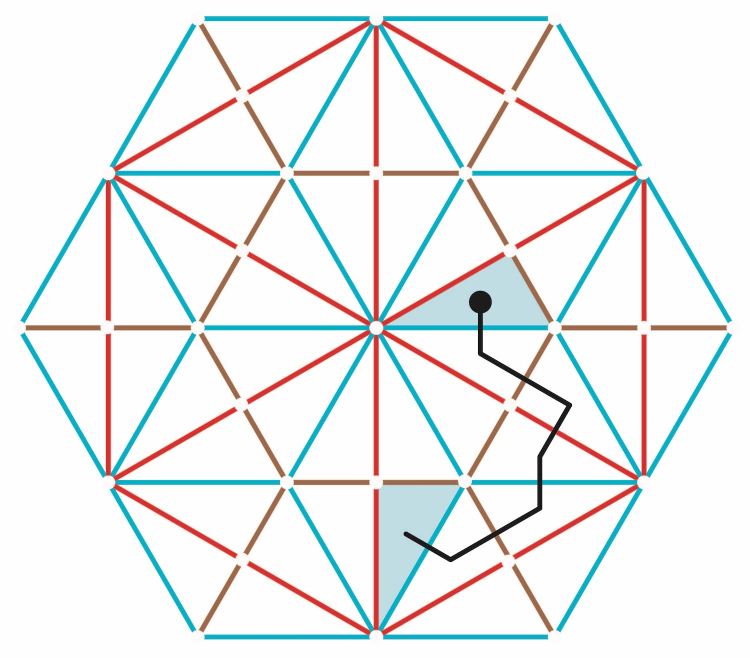
Let’s look at the word tsrtst. Reading it from left to right gives us a path on the Cayley graph from the initial triangle to a target triangle. Translating from Latin tsrtst to Greek τσρτστ gives a composition of reflections that takes the initial triangle to the same target triangle. This is not completely trivial, you prove it by induction. Remember that the composition is applied from the right to the left, so we also change reading direction.
This observation can be used to show that the translation map G(2,3,6) to Γ(2,3,6) is injective. If a word in G is the identity in $γ, its path in the Cayley graph must be a closed loop. As the Euclidean plane where the tiling lives is simply connected, we can homotope it to a constant path, using elementary operations: Backtracking an edge, or shrinking a loop around a vertex to a point. The former is the accomplished using the relations rr=ss=tt=1, the latter using the other relations. This shows that the geometric homotopy can be realized using the relations of the group, and thus we can reduce the word to the trivial word 1.

Cayley
This is essentially the proof of a famous theorem by Walther Franz Anton von Dyck: The group G(a,b,c) is finite if and only if 1/a+1/b+1/c>1. We have seen the relevant examples in the case
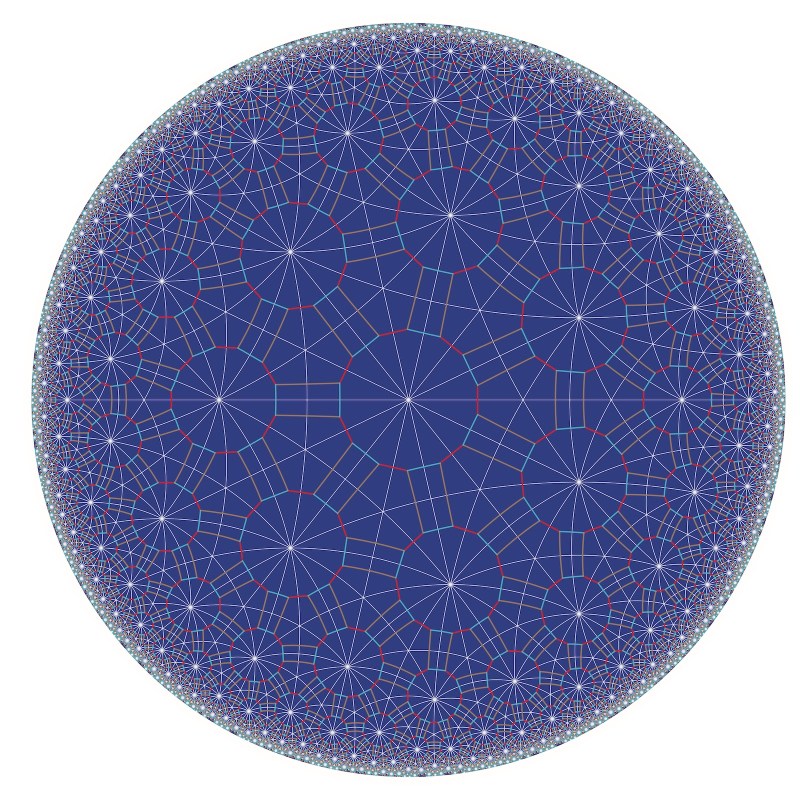
1/a+1/b+1/c>1 and 1/a+1/b+1/c=1. If 1/a+1/b+1/c <1, we need hyoperbolic geometry. Above is a picture of the Cayley graph of G(2,3,7) within the tiling of the hyperbolic plane by (π/2,π/3,π/7)-triangles.

Reflections on the Letter T

Almost a year ago, when there was still hope, I posted a few Fall themed images with the title Yellow. The third image shows a view of McCormick’s Creek with a tree trunk that looked in 2008 like this:

DSC0848

The perspective of the two images is not quite identical, but you will see that in the older image above there are two prominent trees, the right of which has become the trunk in the second image of the image of last year’s post.

DSC 1986

Above is another image, from 2009, tree still standing, again from a slightly shifted perspective. The view has always tantalized me, because it looked promising, but I could never turn it into a picture I was happy with. Below is a view from the other side, another year later.

DSC0838

Then, in 2015, this unexpected change:

DSC 0691

With the tree reduced to a stump,

DSC 7530

the place has become more balanced and serene.

DSC 7533

Sometimes it is worth the wait.

Do and Undo (Groups I)

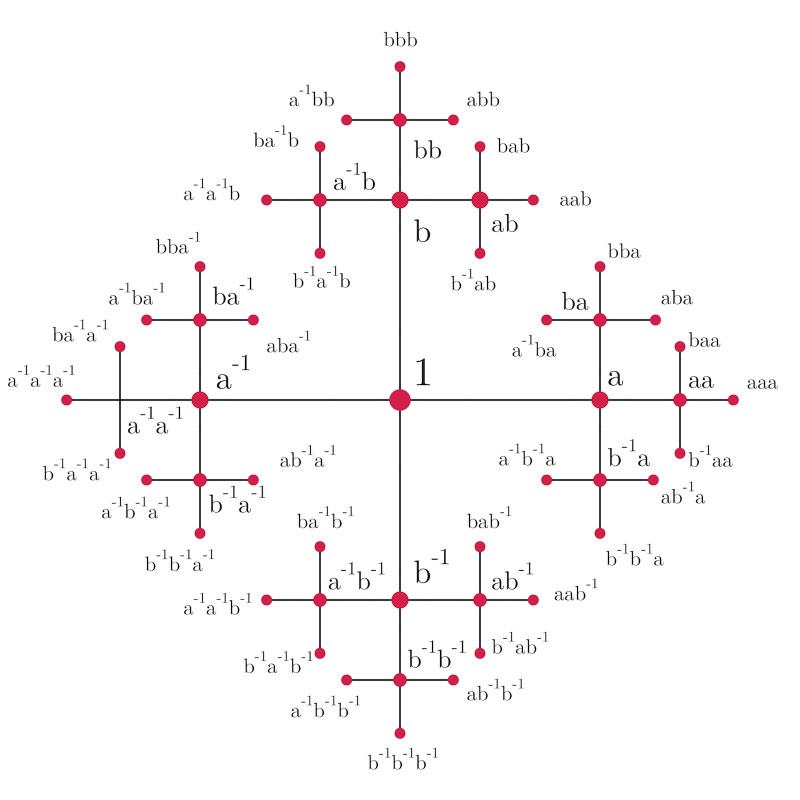
Groups are mathematical games being played with letters. In the simplest version, we use just one letter (say a), and are allowed to add it to or to remove it from a word. This is the free group of one generator, or the infinite cyclic group.

Cyclic 1 01

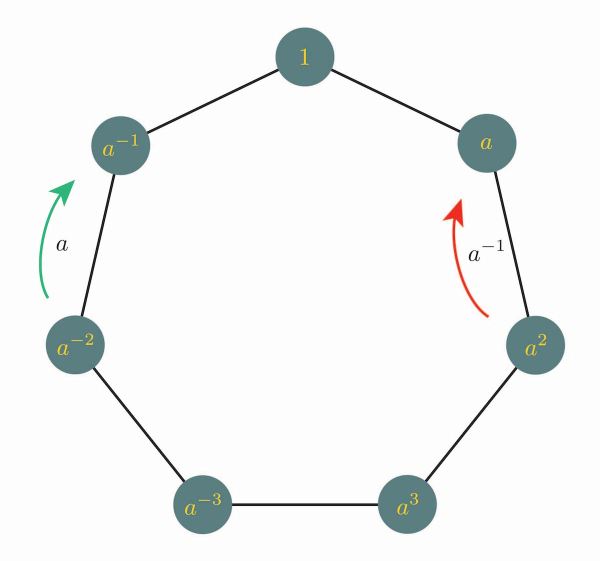
Clearly, this game of create and destroy needs more rules. A simple rule is to make it truly cyclic and finite by insisting that after using the letter a say 7 times, we are back where we started. This means aaaaaaa=1, which is a relief, but still not very interesting.

Cyclic 2 01

With two letters a and b, our game expands.

Free2

This Cayley graph is the dual graph of the tiling of the hyperbolic plane by ideal squares, and not accidentally so.

Again we can restrict the rules of the game. Let’s play with the three letters r, s, and t, and insist that rr=ss=tt=1 to avoid any repetitions, and also that rsrs=ststst=trtrtr=1. The result is the Coxeter group G(2,3,3), and after a while playing around with the words, you find its Cayley graph below, neatly laid out.

Dyck233

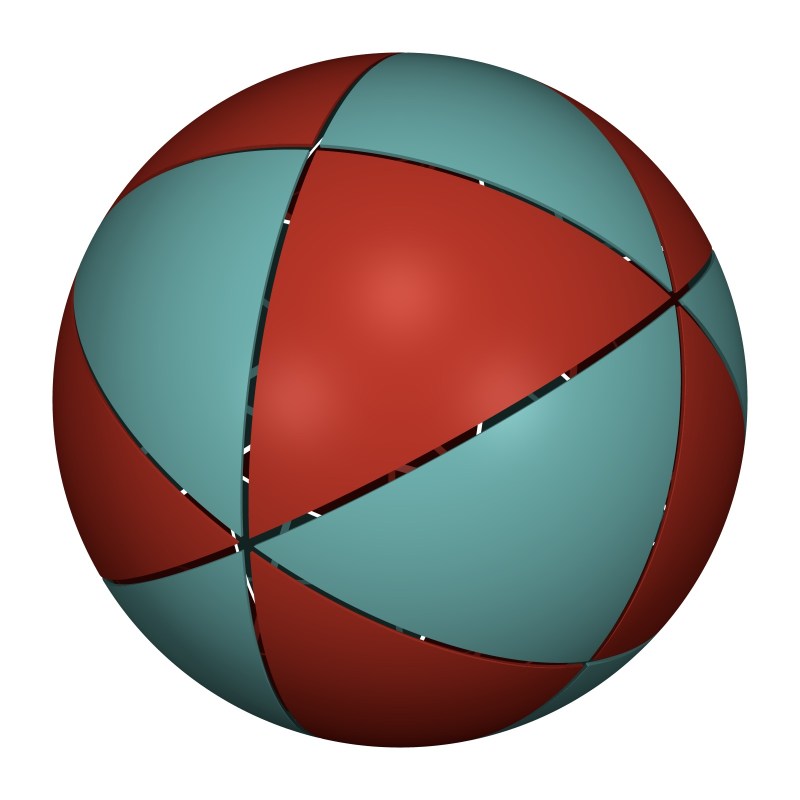
This is dual to a tiling of the sphere by spherical triangles with angles π/2,π/3,π/3, and this is also not accidentally so.
We’ll see more about this next week.

Cox233

Time to Leaf

This year, times seems to be running faster, as if everything wants it to be over.

DSC 7547 2

The freshly fallen leaves already look like they are from last year. And they don’t even read the news.

DSC 7548 2

This is the game I played, called Still Live, ironically: You walk around and take the leaves as they are. You may remove a stem or piece of dirt, but you may not add.

DSC 7549 2

So one fights against the randomness of every appearance, without creative power, only allowed to select.

DSC 7568

This makes for a nice morning walk in the woods, despite.

DSC 7572

Always or Never

Pentaponce

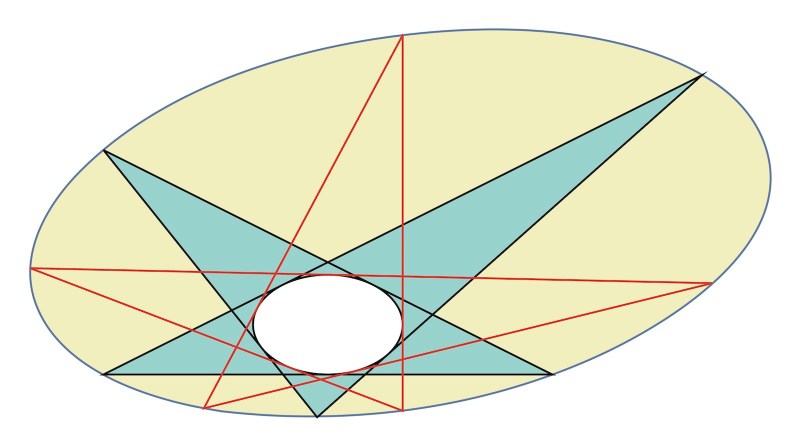
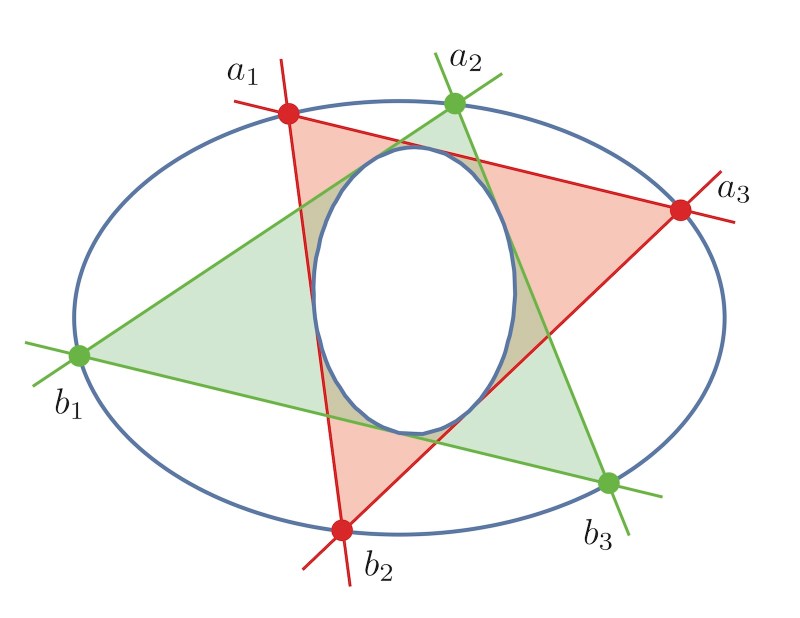
Take two ellipses, one within the other. Take a point on the outer ellipse, and draw one of the two tangents to the inner ellipse, and find its second intersection with the outer ellipse. Use this point to start the process again, and again. You will get a polygonal path in the ellipse that will most likely not close up. But in case you are lucky, something miraculous happens: If you pick any other point and repeat the game, the polygon will again close up.

This is the content of a famous theorem by Jean-Victor Poncelet.

Steiner 01

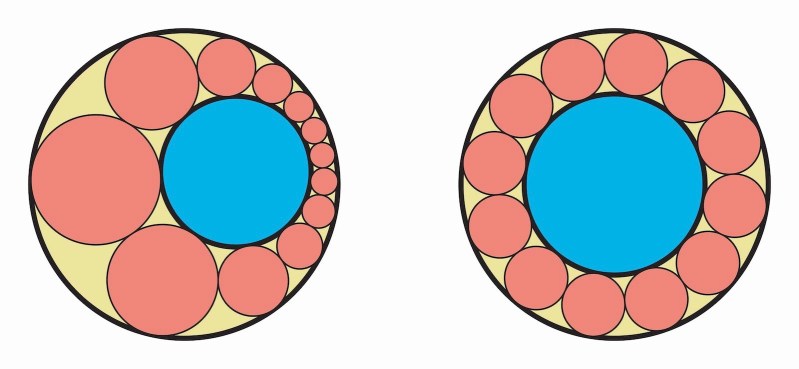
In spirit, it is similar to a theorem of Jakob Steiner that asserts that a chain of circles in an annulus bounded by two circles either always or never closes up. While Steiner’s theorem follows immediately by inverting the circles into a pair of concentric circles, such a simple proof is not available for Poncelet’s theorem. Until recently, all proofs I know of were, let’s say, advanced.

At the core of a new proof by Lorenz Halbeisen and Norbert Hungerbühler are some fundamental theorems from projective geometry.

Let’s first recall that five points, no three collinear, determine a unique conic.

Conic4points

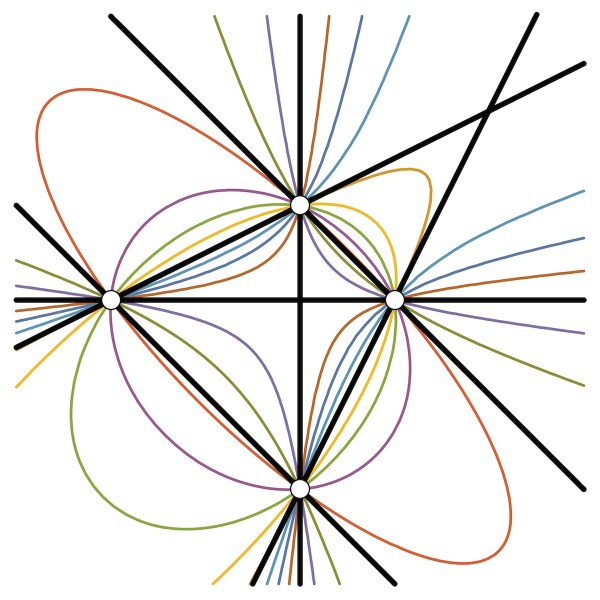
This is because through four points, you can find two different degenerate conics consisting each of a pair of lines, and by forming linear combinations, accommodate a fifth point. Below we will need the dual theorem: Given five lines, no three concurrent, there is a unique conic tangent to them.

Pascal Hyperbola 01

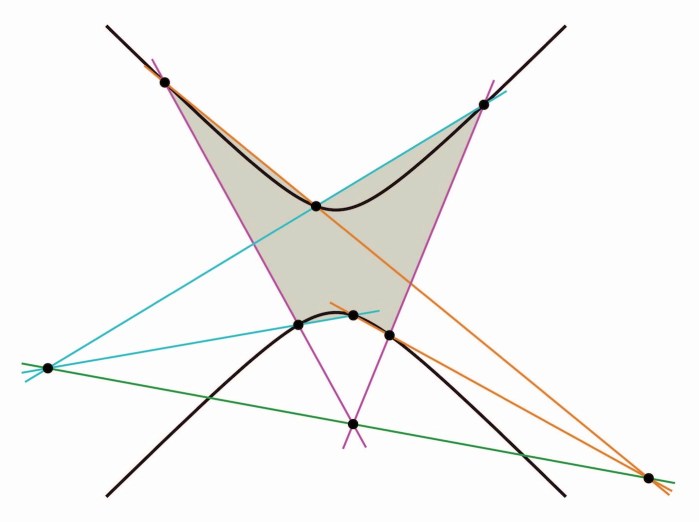
Pascal’s theorem is a condition for six points to lie on a conic: They do if and only if opposite sides intersect in collinear points. Above you see this for six points on the two branches of a hyperbola.

Brianchon 01
Dual to this is Brianchon’s theorem (illustrated above): The sides of a hexagons are tangent to a conic if and only of its diagonals are concurrent.

Ponce1

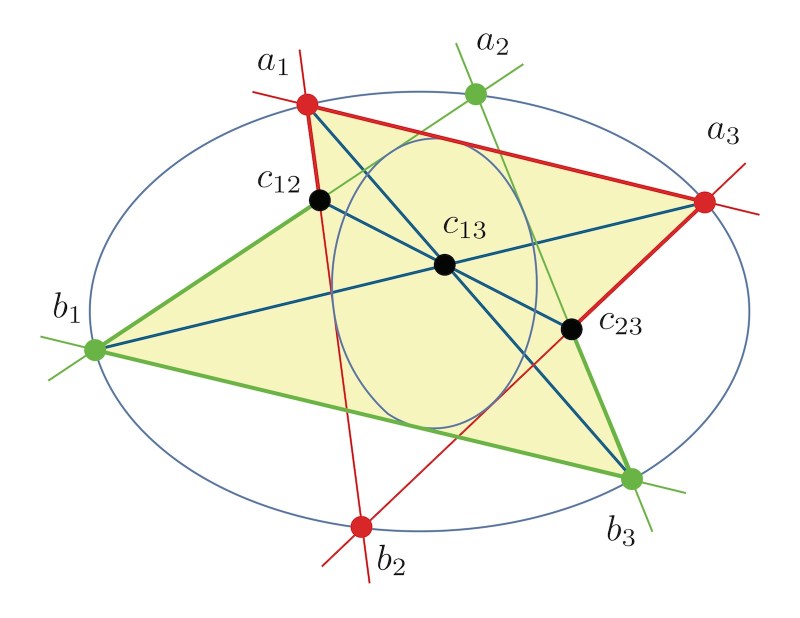
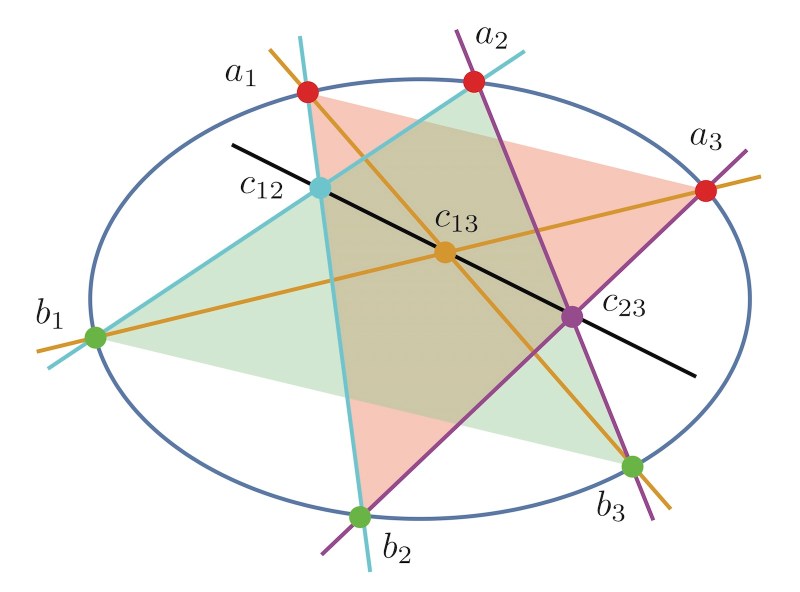
As an application, Halbeisen and Hungerbühler show: If the six vertices of two triangles a1,a2,a3 and b1,b2,b3 lie on a conic, than there is a conic tangent to the six sides of the triangles. The proof is easy: Applying Pascal to the hexagon a1,b2,a3,b1,a2,b3 gives us three collinear points c12,c13,c23.

Ponce2

Then applying Brianchon to the hexagon a1,c12,b1,b3,c23,a3 shows that it is tangent to a conic. But the sides of this hexagon are the same as the sides of the two triangles, so we are done

Ponce3

From here, we obtain Poncelet’s theorem for triangles: Suppose you have two ellipses inside each other, and a triangle whose vertices lie on the outer ellipse and whose sides are tangent to the inner. Take another point on the outer ellipse, and form a second triangle by drawing the tangents to the inner ellipse. We have to show that the third side of the triangle is also tangent to the inner ellipse.

By the theorem by Halbeisen and Hungerbühler, the two triangles have an inscribed common ellipse. The given inner ellipse touches five of the same six lines by construction. But a conic is uniquely determined by five tangent lines.

The general case follows of n-gons the same idea, but requires more bookkeeping.

Too Wide?

When I started using an SLR, I had just two lenses: A 28-85mm zoom, and a 20mm wide angle lens. That was too wide for me, back then,
and it took me a while to appreciate it.

DSC 7425

When I moved on to a DSLR, one of the first new lenses I bought was Nikon’s 14-24mm zoom. That was something else, and again it took me many years to make use of the wider end of it.

DSC 7432

This year, I decided to push myself again, and I acquired an 11mm lens.

DSC 7463

This lens works like the news these days: It shows a distorted reality. If you want the truth, look elsewhere.

DSC 7465

But, as with the news these days, the distortion is so extreme, that we are never tricked into believing it is real. It is more a provocation.

DSC 7481

The benefit? Maybe we can learn to resist to undergo this distortion ourselves. Or is the remaining path too narrow?

DSC 7412

Odd Angles

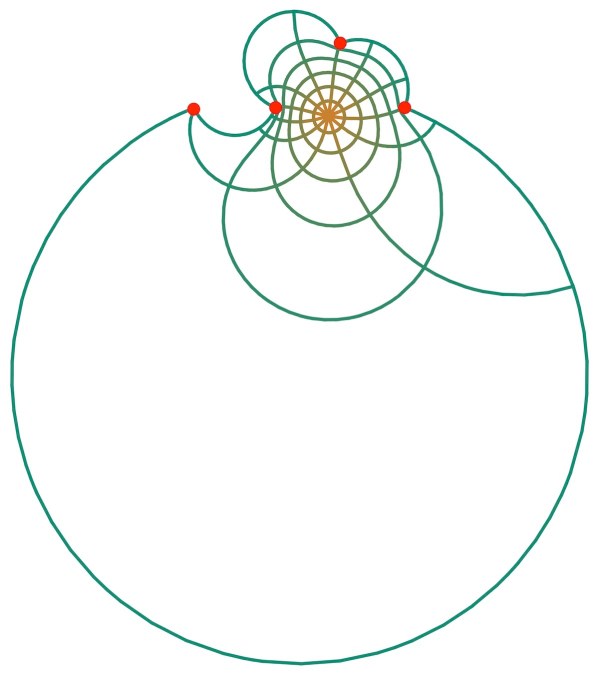
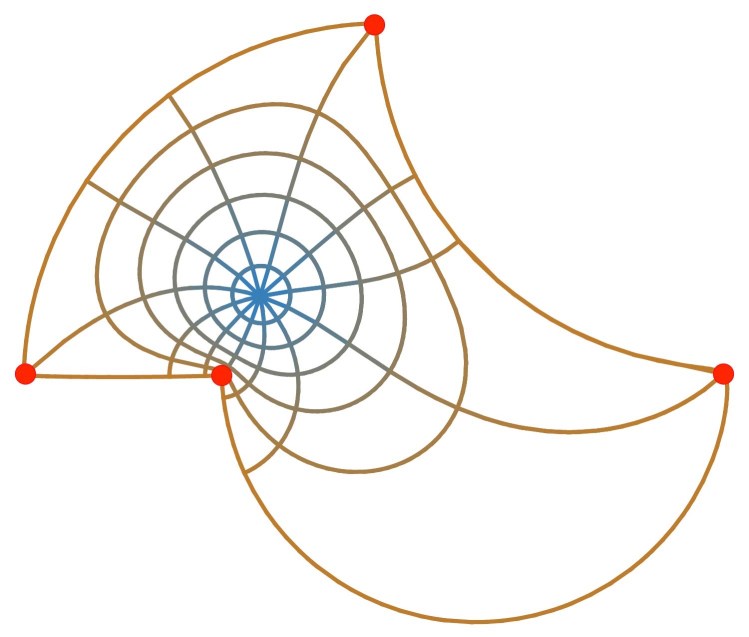
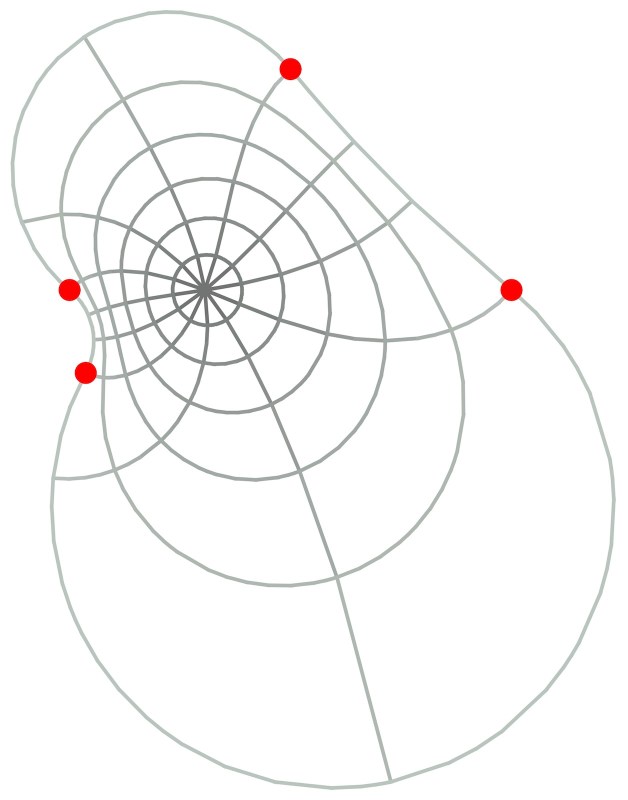
For a while, this will be my last post about conformal spiderwebs. Today, we will still look at circular quadrilaterals that are conformal images of squares, but allow the angles to be multiples of 90 degrees. Like so:

2quarter a 01

Let’s call this a square of type (1,1,3,3). Multiply the numbers by 90 and you get the angles at the vertices. I have again employed Möbius to place three corners at (1,0), (0,1), and (-1,0). The fourth vertex is again moving cautiously along the unit circle. Below is a square of type (1,3,3,3), and here the fourth vertex is on the x-axis, the second possible case we noticed for right angled circular quadrilaterals.

Mixed31b 0

Similarly, here is a square of type (1,1,1,3), also with the fourth vertex on the x-axis.

1quarter a 01

Missing are squares of type (1,3,1,3). While there are quadrilaterals of this type, all conformally correct squares I could find were only immersed (i.e. overlapping).

Then one can also have squares of type (2,2,2,2), for instance. The circle would be an example, with artificial vertices at (1,0),(0,1),(-1,0) and (0,-1), but there are also bean shaped squares like the one below.

Bean0

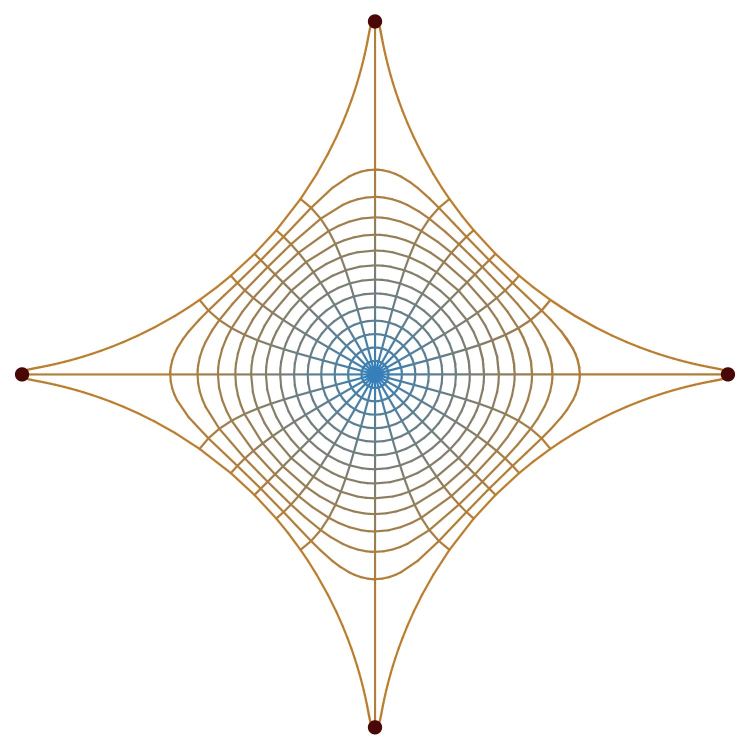
Finally, the square with zero angles, in its most regular form.

Zero 4 01