The Dark Tower (Columbia Mine Preserve II)

After looking at the mining facility near the Columbia Mine Preserve from the outside last week, now it’s time to step inside.

DSC 2182

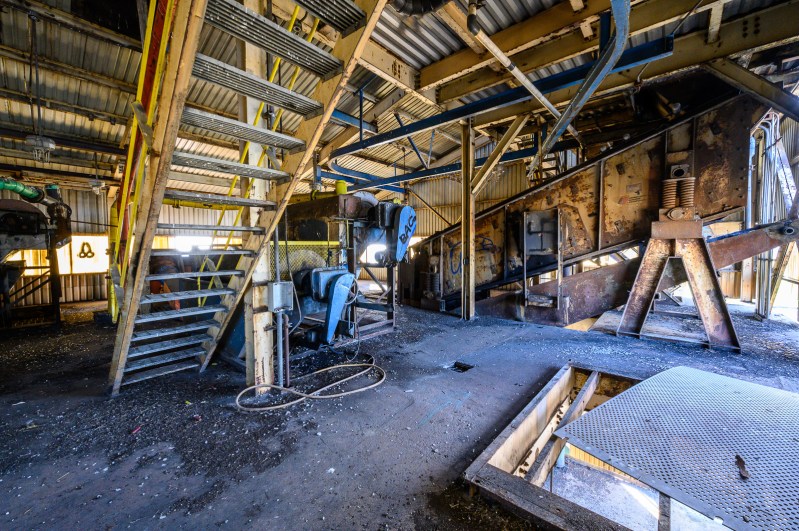
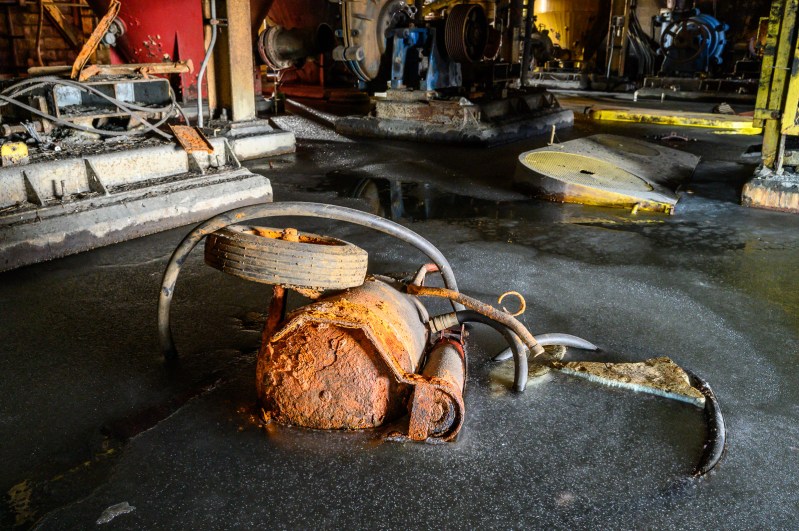
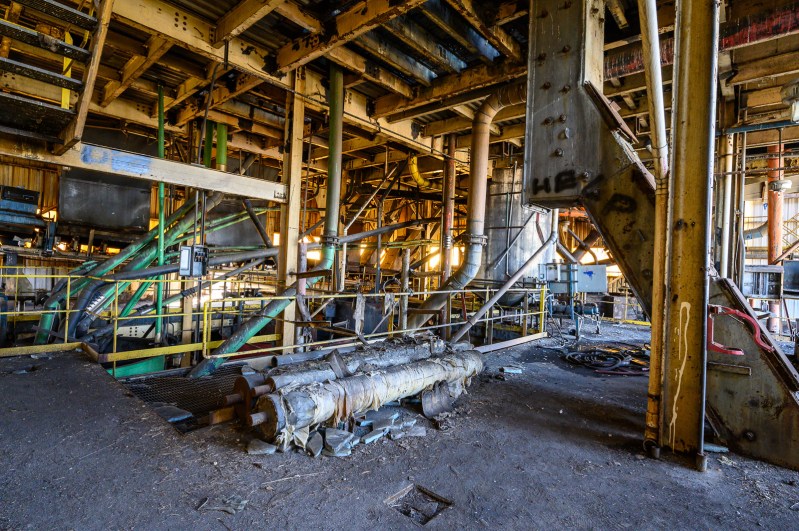
This is already the second floor, from a total of six. Thanks to the broken windows, the wind has done a decent job cleaning the place.

DSC 2191

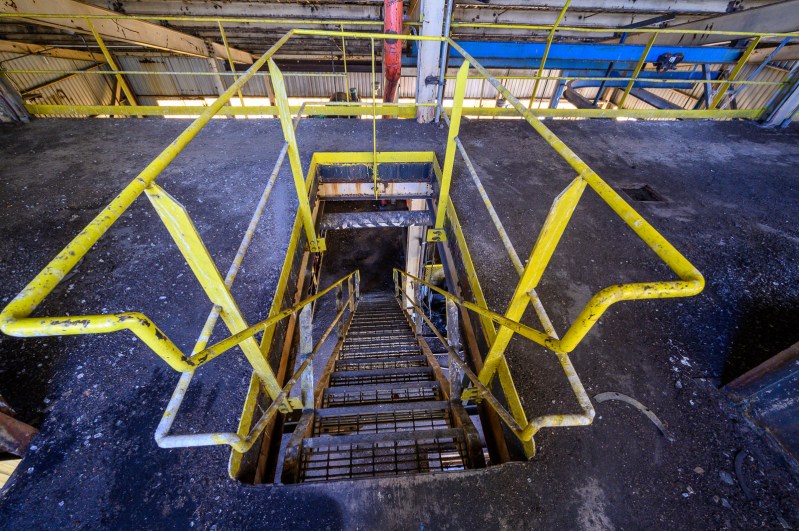
Moving up. This feels like one of these dungeon computer games where you have to deal with cute monsters on the way up (or down). I am pretty sure I know where the undead from the three (!) cemeteries I passed on the way spend their free nights.

DSC 2210

Further up. It also reminds me of Snakes and Ladders. One misstep, and you have to start climbing all over again, if you can.

DSC 2218

The eeriest part of the place is the sound. Birds have conquered it, and the sounds they make are surprisingly close to human chatter. Maybe this place is some sort of temple for them.

DSC 2219

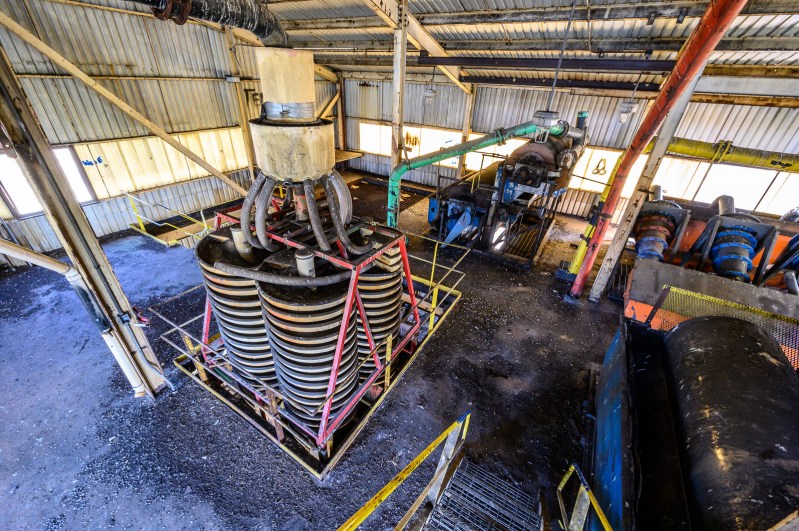
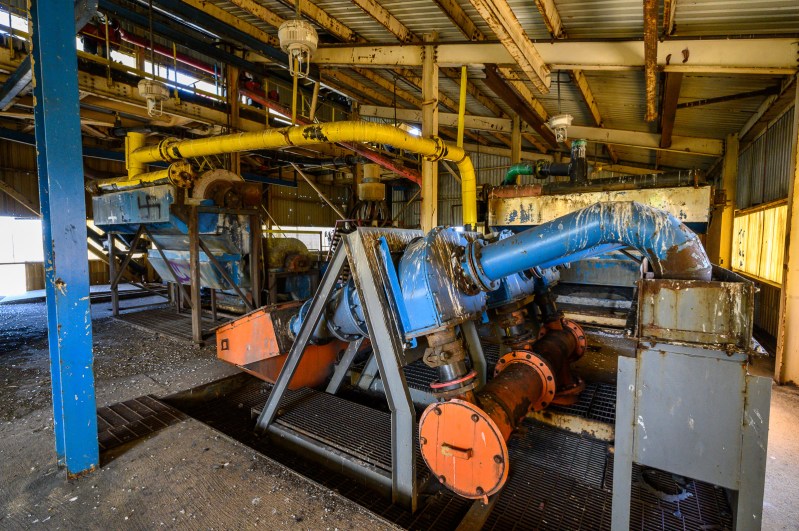
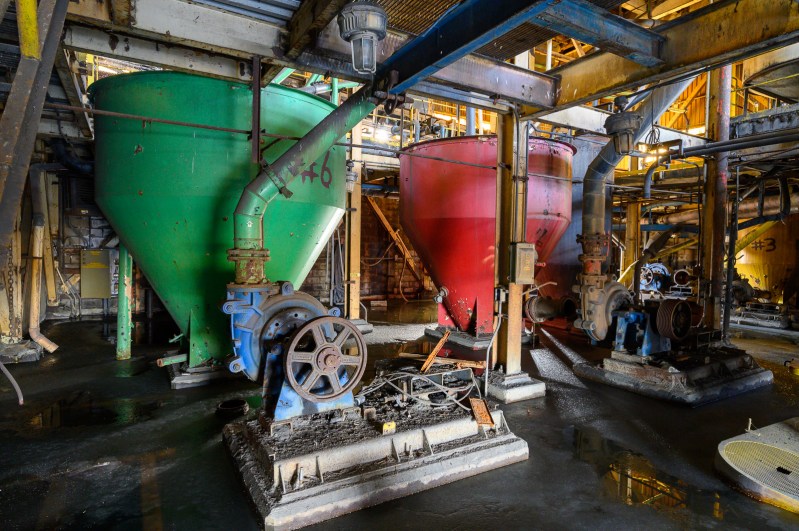
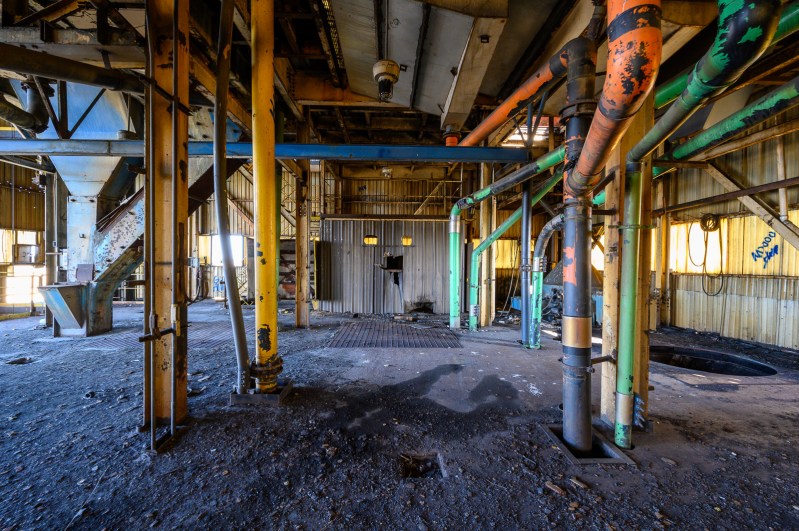
It also feels like I am an exploring some alien space ship. I have absolutely no clue what these enormous machines were used for. 

DSC 2220

Not only birds have left their stains. Monsters, undead, animals, aliens — what do we fear most?

DSC 2234

Down again, unharmed. Two decades ago, this place was busy with people who worked there. Where are they now, what are their stories?

Hyperbolic Geodesics (Geometry and Numbers II)

One of Euclid’s axioms states that lines can be extended indefinitely. If we have to be content with a finite canvas, like the rectangle below, we have to resort to a trick to keep lines going when they hit the boundary of the canvas. One such trick is to allow the line to re-enter the canvas at the corresponding position on the opposite side of the canvas. Those of us who have been exposed to asteroids in their dark past are familiar with this. Lines with rational slope will thus look like this:
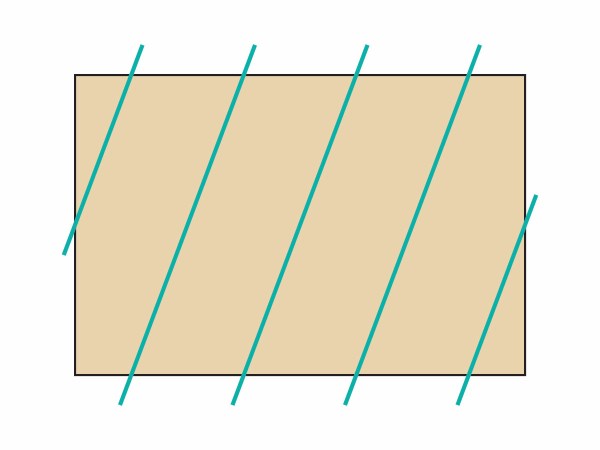
Torus 01

If the slope is irrational, they will become dense, i.e. come arbitrarily close to any given point on the canvas. In either case, all segments of a given line are parallel. This changes when we switch to hyperbolic geometry, represented by the upper half plane, where lines (now called geodesics) are half circles perpendicular to the boundary, or vertical lines.
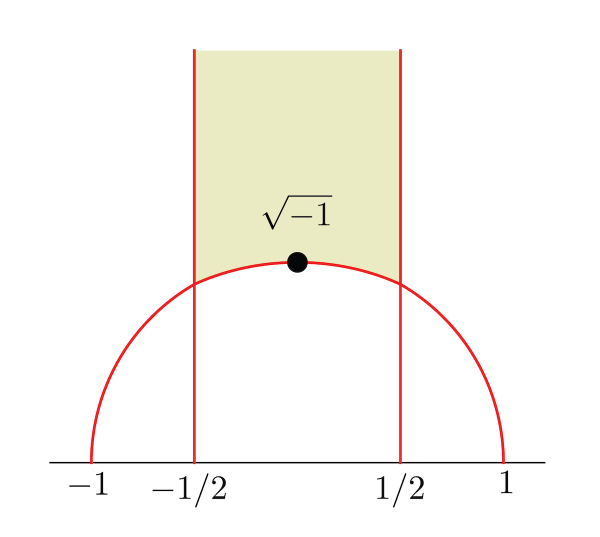
Modular 01

Above you see three such geodesics, forming the boundary of the shaded region, which will be our canvas. This canvas is the classical fundamental domain of the modular group. If we want to follow hyperbolic geodesics in this canvas, we have to explain what to do when a geodesics hits one of the sides of this infinite triangle. This is easy for the left and right vertical edges: If the green geodesics exits at the right hand side and becomes purple (due to lack of oxygen), it is translated back to the left. This translation by -1 is in fact not only a Euclidean congruence, but also a hyperbolic one.Artintrans2 01
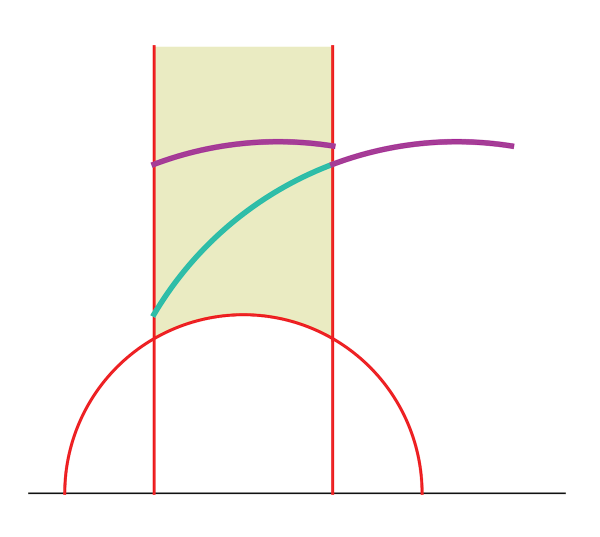
When a geodesic tries to exit at the circular bottom, it is rotated back, using a hyperbolic rotation by 180º about the point √-1, which is in complex numbers given by z↦-1/z. That’s a bit harder to visualize for our Euclidean eyes. One way to think about it is to find the point where the green geodesic becomes purple, take the corresponding point on the other side of the black dot on the bottom red half circle, and continue with a purple geodesic up into the shaded region by making the same angle as the one you made when exiting.
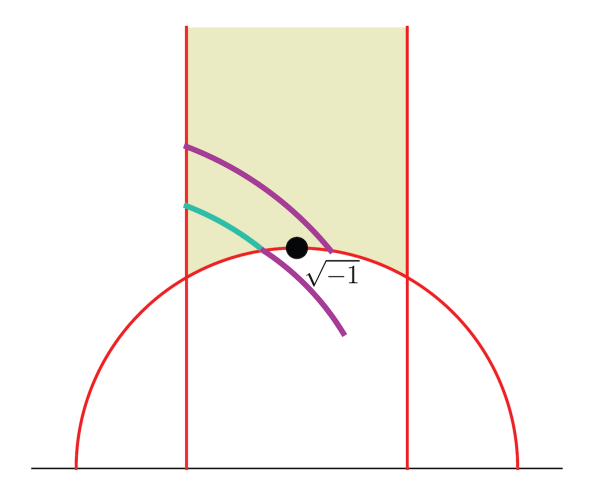
Artinrot2 01

This allows to draw hyperbolic geodesics just like we did in the rectangle with Euclidean lines. Below is a more complete picture that shows how much more complicated or chaotic this is becoming when we keep extending the geodesic. The numbers help to identify end points of segments. How complicated can this get?
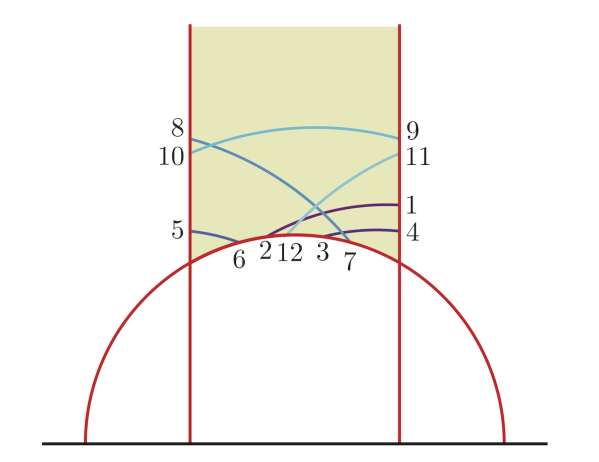
Artingeodesic

The two operations that allow us to continue a geodesic, namely z ↦z±1 and z↦-1/z are exactly the operations that we used last week to find the continued fraction expansion of a real number. This seemingly far fetched connection points to a deep link between number theory and geometry: Take a geodesic in the upper half plane, and look at its left and right end points a<b on the real axis. We will limit our attention to the case that -1<a<0 and 1<b. Write both -a and b as continued fractions, this gives two sequences of positive integers  a₁, a₂,… and b₀, b₁, b₂. We combine these into a single bi-infinite sequence …b₋₂,b₋₁,b₀,a₁, a₂,… which we denote by cᵢ.

Now it turns out that continuing the geodesic across the edges changes the sequence cᵢ either into c₋ᵢ₋₁ or into cᵢ₊₂. Either operation represents a mere shift or flip of this sequence. This leads to a remarkable theorem of Emil Artin from 1929: There is a hyperbolic geodesic on this canvas that comes any given hyperbolic segment on the canvas arbitrarily close. So this geodesic is not only dense, but dense in all directions simultaneously.

To see this (a little bit), it suffices to find a suitable bi-infinite sequence cᵢ of integers encoding that geodesic. Take as cᵢ a sequence that contains every finite positive sequence of positive integers as a subsequence. Then, for a given geodesic segment, find its bi-infinite sequence, and truncate it at both ends to get a finite sequence. By truncating further out, we obtain better and ebtter approximations of the given geodesic. As every finite sequence of positive integers is contained in our sequence  cᵢ, we will (by continuation) eventually find a segment of the encoded geodesic that is as close to the given segment as we desire.

This theorem of Artin is at the beginning of the study of both geometrical dynamical systems (the geodesic flow) and symbolic ones that are related to number theory and exhibit a chaotic behavior that is not apparent in Euclidean geometry.


Come in Without Knocking (Columbia Mine Preserve I)

DSC 2159

Spring last year, on my way back from New Harmony, I made a small detour to the Columbia Mine Preserve. The Vigo Coal Company mined the area in the 1990, then filled the holes, and let it sit. The Sycamore Land Trust acquired the area, turned it into a nature preserve, which is now part of Patoka River National Wildlife Refuge.

DSC 2169

Last year the early warm weather didn’t encourage any good pictures, so I decided to return a bit earlier, to catch the gloomy Indiana winter. When I entered Patoka River National Wildlife Refuge into my GPS, it took me to a dead end just outside the refuge, but I passed this wonderful relic on the way.

DSC 2171

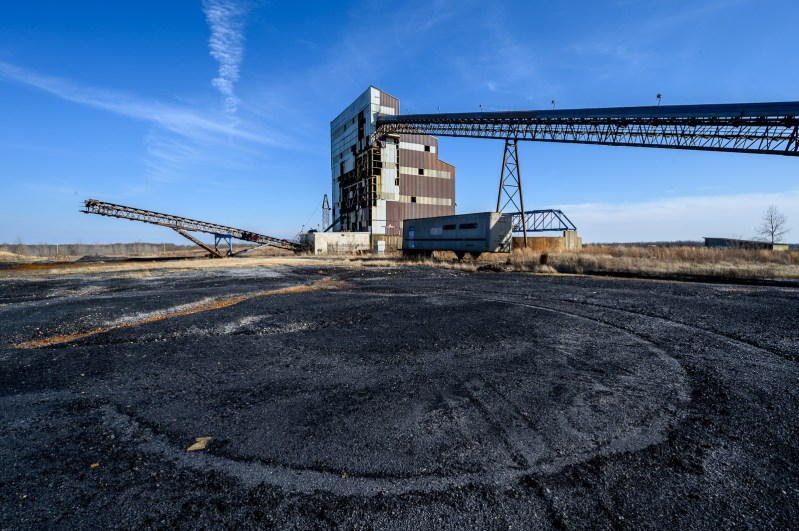
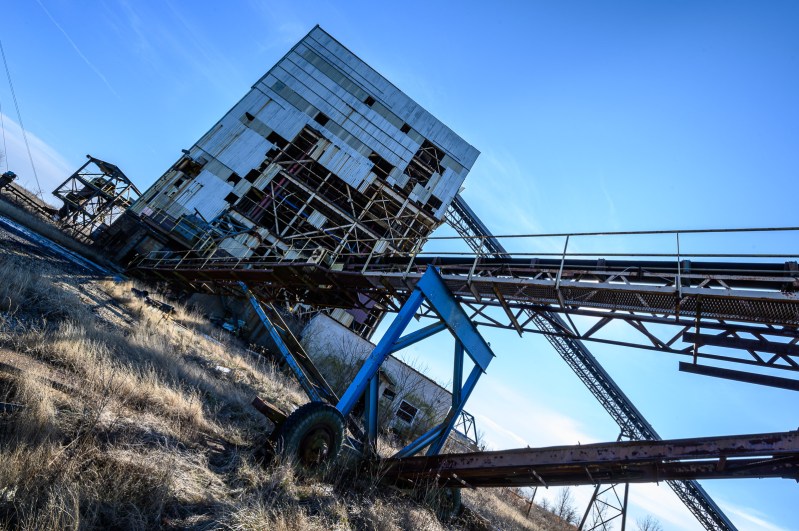
About six floors tall, this structure was apparently used to do something to the coal before it was used to enrich our atmosphere with carbon dioxide.

DSC 2238

I am also clueless about the purpose of this truck, and why it looks so unhappy.

DSC 2236

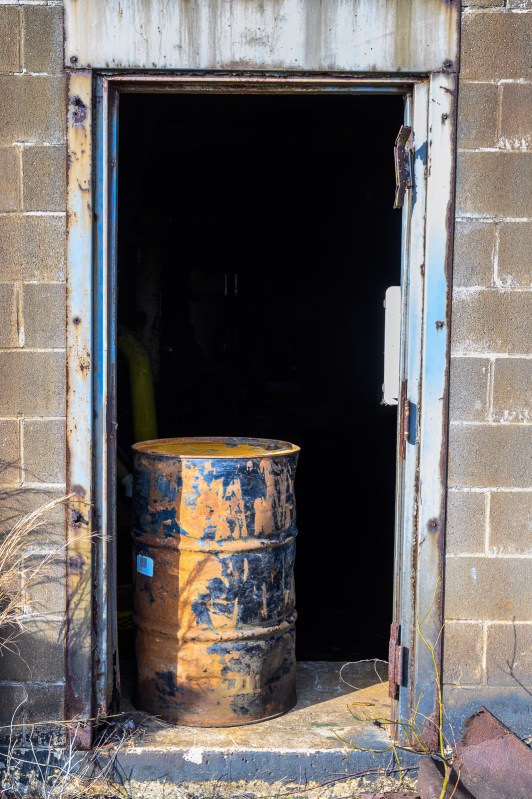
This time, the door was missing, so again I couldn’t resist the temptation. There was quite a bit to explore inside, so I leave this as a teaser for next week:

DSC 2233

What is a Number? (Geometry and Numbers I)

The moment when humans made the abstraction from a set of objects to its cardinality and thus discovered counting is lost in history. There are other moments of similar impact that we know more about. Today, we are so familiar with numbers that we often forget that they are used to measure quantities and even ignore units, confusing distances and durations.

1234

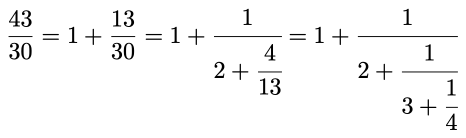
For the early pre-Aristotle Greek mathematicians, lengths were not numbers at all. Numbers occurred as proportions, as ratios of lengths (or durations). One segment could be say twice as long as another segment. More generally, the Greeks called two lengths commensurable if their ratio is, in modern terms, a rational number. They would detect this by fitting one number, like 30, as often as possible (once) into another number (43), take the remainder (13), fit that in the second number (30) as often as possible (twice), take the remainder (4) etc. etc. What emerges is the continued fraction above, terminating eventually, because the denominators get smaller and smaller.

Phi

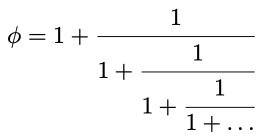
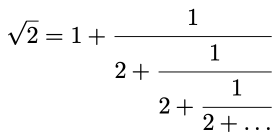
If the lengths are not commensurable, the continued fraction becomes infinite, like the one above. For the Greeks, this expression was essentially an algorithm. An infinite fraction is a mind boggling thing. How does one even compute it?

Pentagram

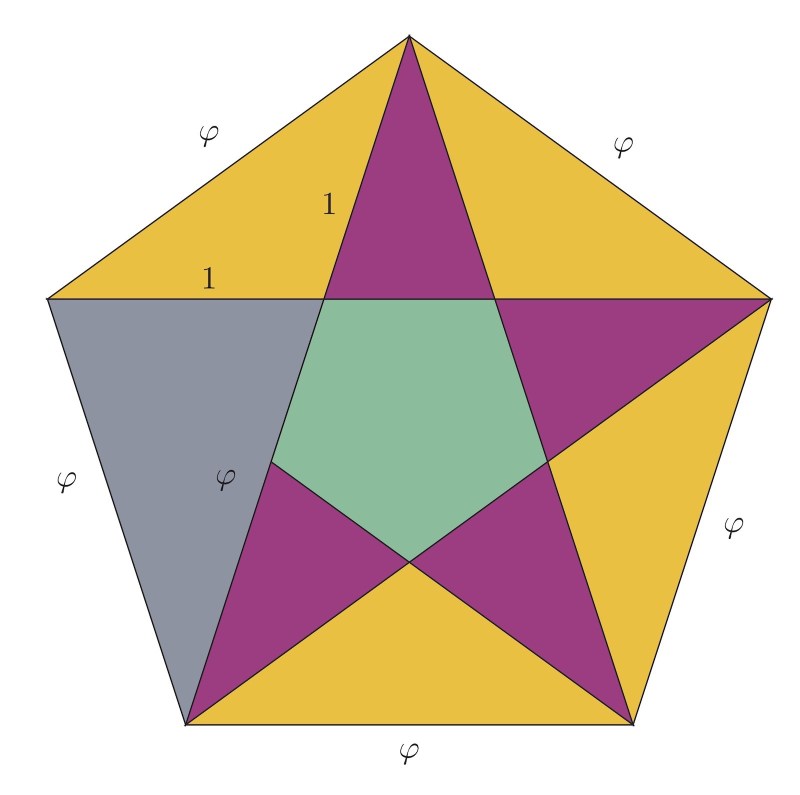
Geometrically, this can infinite continued fraction arises by comparing the side length 𝝋 of a regular pentagon to a segment of length 1 of its diagonals. Simple similarity of triangles tells us that 𝝋=1+1/𝝋. Rewriting this once leads to 𝝋=1+1/(1+1/𝝋), and if we keep going a little while longer, we arrive at the infinite continued fraction above. This reproduces how the Greeks proved that the Golden ratio 𝝋 is irrational (if it was rational, the continued fraction would be finite).

Root2b

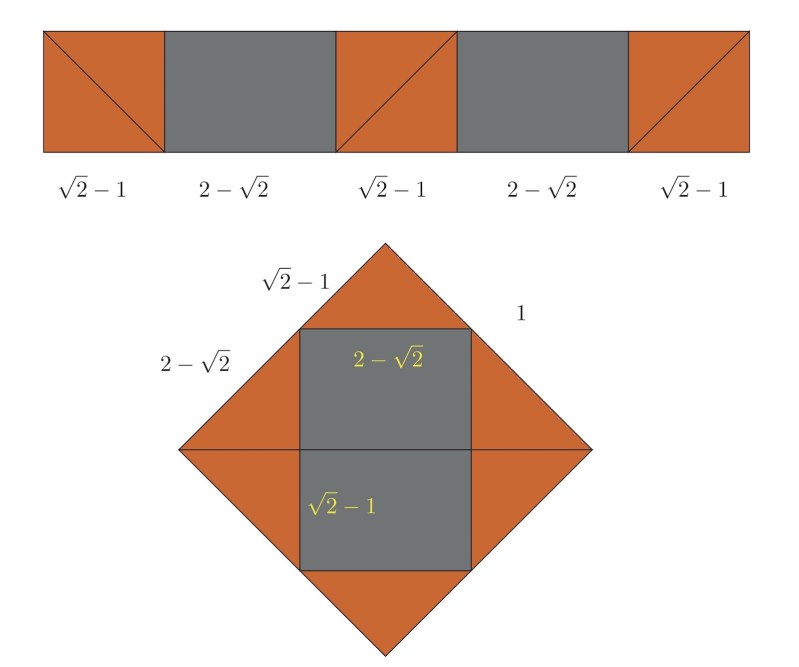
Similarly, the above dissection of a unit square into a rectangle shows that (√2-1)(√2+1)=1. This is arithmetically easy, but the concept of a root of a number didn’t make sense to the Greeks in the early days. This equation is the essential ingredient to prove the continued fraction expansion of √2 (and thus its irrationality).

Sqrt2

Of course, the standard proof by contradiction that is taught today (and which probably goes back to Aristotle) makes the cumbersome process of finding continued fractions cumbersome. We will see next week that they still serve higher purposes.

Berlin Alexanderplatz (10mm VI)

DSC 4478

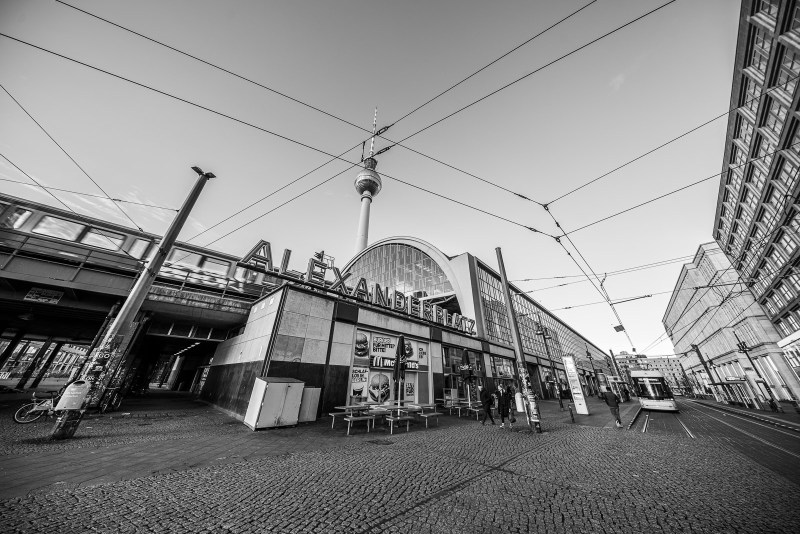
In Alfred Döblin’s novel Berlin Alexanderplatz, the place of that name is being used to dramatically convey transformation: Franz Bieberkopf  is traumatized by the changes it has  undergone while he spent years in prison, and stands for the transformations he himself will undergo.

DSC 4458

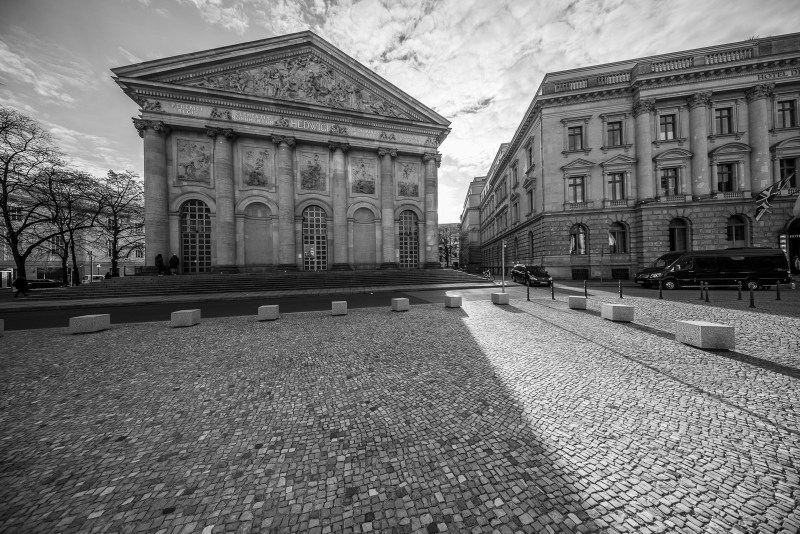
Döblin’s novel takes place in the 1920s, and Berlin has undergo dramatic changes since. After the destructions of the Second World War and the division of the city, it was no longer the single city center. The architects of the Eastern part weren’t insensitive, they kept the space open and repurposable.

DSC 4473

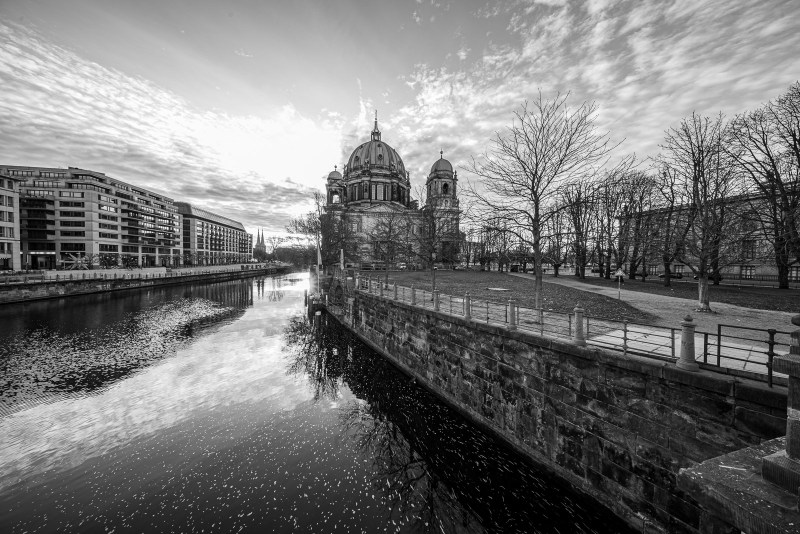
Nearby churches were renovated and allowed other change to happen, later.

DSC 4570

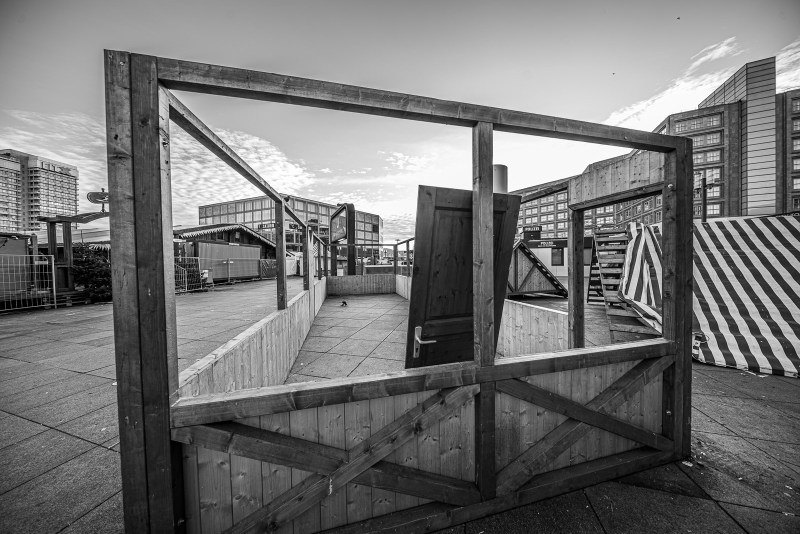
After the fall of the Berlin Wall, many of the administrative buildings were taken down. The facade of the Palace of the Republic used to annoy the people of power with distorted reflections of the nearby cathedral. Not anymore.

DSC 4446

Radically modern buildings show that transformation is still possible. This leaves hope for Franz’s children.

DSC 4432

Hyperbolic Geometry

One of the most valuable human capabilities is doubt. Education seems to contradict this, early on we are encouraged to take certain things for granted. The trust in Euclid’s axioms for geometry was certainly universal and contributed to Immanuel Kant’s confidence that time and space are given to us as a priori.

Parallel 01

The ability to draw parallel lines, for instance, seems to be a given, and that this possibility is to a great deal responsible for being able to create realistic looking perspective drawings. What we can see with our own eyes must be true.

Parallelp

The discovery of hyperbolic geometry by Bolyai, Gauß, and Lobachevsky  is credited with overthrowing all this. If we are willing to accept that lines are not what they appear, but only have to obey all the other axioms of Euclid, then the parallel axiom does not need to hold. As mind boggling as this entire business is for the mathematician and philosopher, as irrelevant does it seem to be to the everyday person. After all, what we see is still true, isn’t it?

Cayley

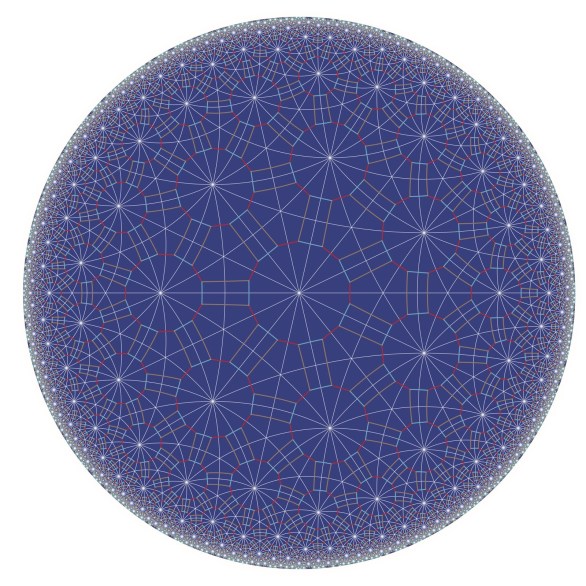
That there is a hard to explain esthetic appeal to that disk with its crazily symmetric patterns doesn’t quite justify the importance of hyperbolic geometry in contemporary mathematics either. Calculus at least is useful. That hyperbolic geometry makes its inevitable appearance whenever we study very simple things like the geometry of the circle or multiplication of 2×2 matrices, doesn’t really force us to talk about it, does it?

Diskauto

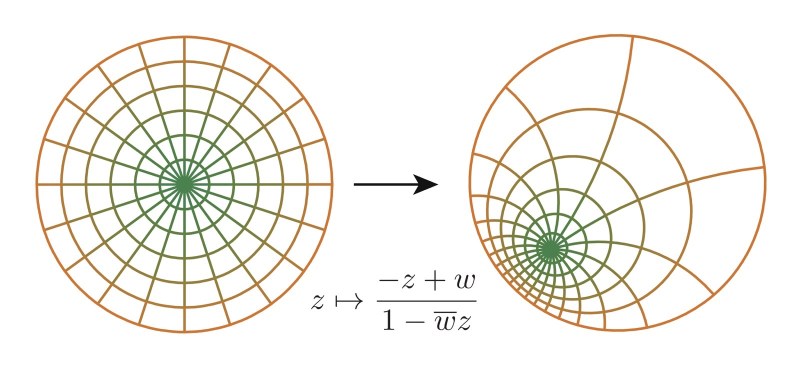
As flawed as our universal trust in the nature of space is our trust in the linearity of things. Double the income, double the happiness? Double the pain, halve the crime rate? It sounds too easy not to be true, and is often evidenced by the linearity of Euclidean geometry. Hyperbolic geometry is the simplest geometry where linearity fails and allows for dynamical systems with chaotic behavior. We have known this for over 100 years. We experience the effects on a daily basis, but prefer to ignore it.
Below are my class notes about hyperbolic geometry and incidence geometry, taught to undergraduates. Enjoy.

Notes on Hyperbolic Geometry (letter)

Notes on Hyperbolic Geometry (screen)

Notes on Incidence Geometry (letter)


Notes on Incidence Geometry (screen)

The Intimacy of Space (10 mm V)

Berlin and Bloomington have few things in common, besides their first letter B.

DSC 4416

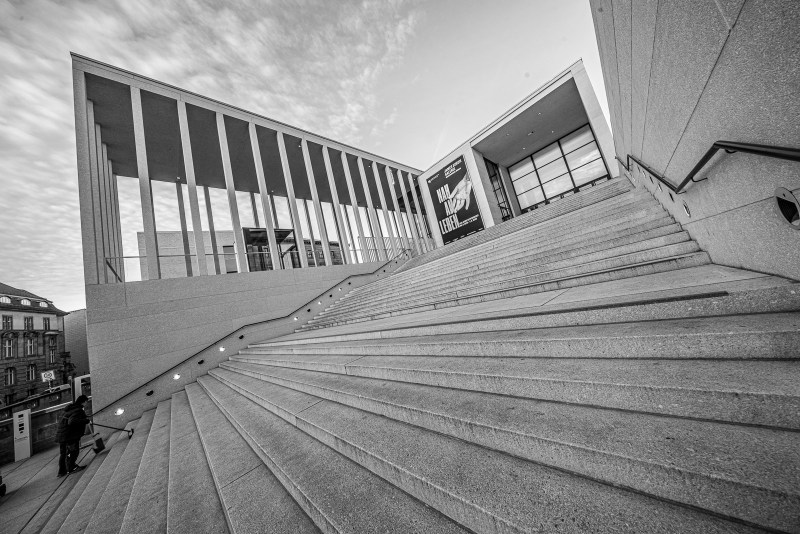
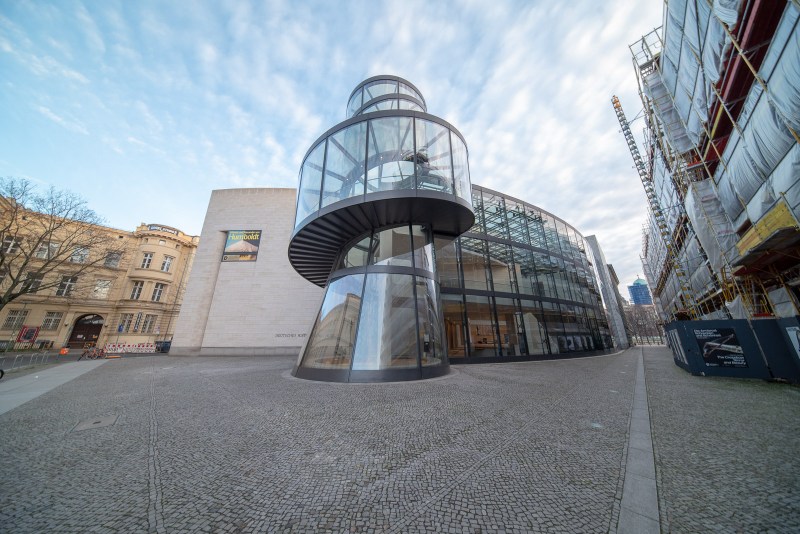
Of more general interest is probably that both cities feature a building by Chinese architect I.M. Pei. I wrote about the Art Museum in Bloomington in an earlier post. Here you see the German Historical Museum in Berlin, or rather its extension.

DSC 4527

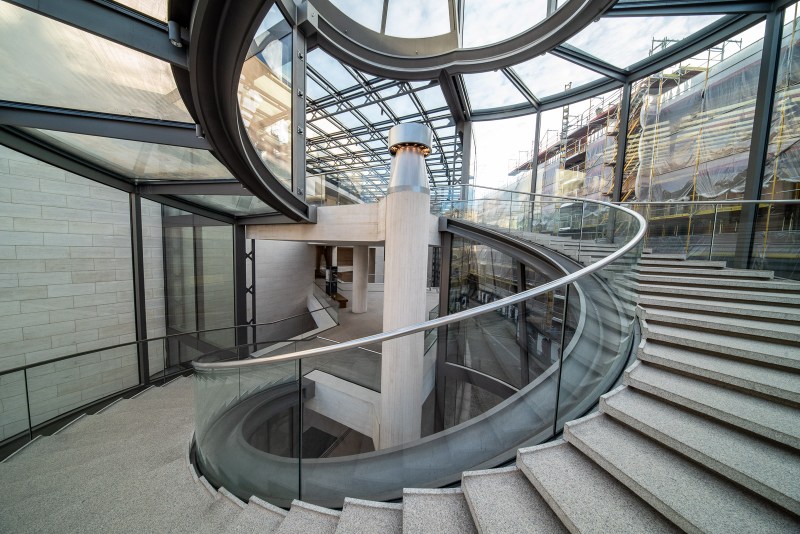
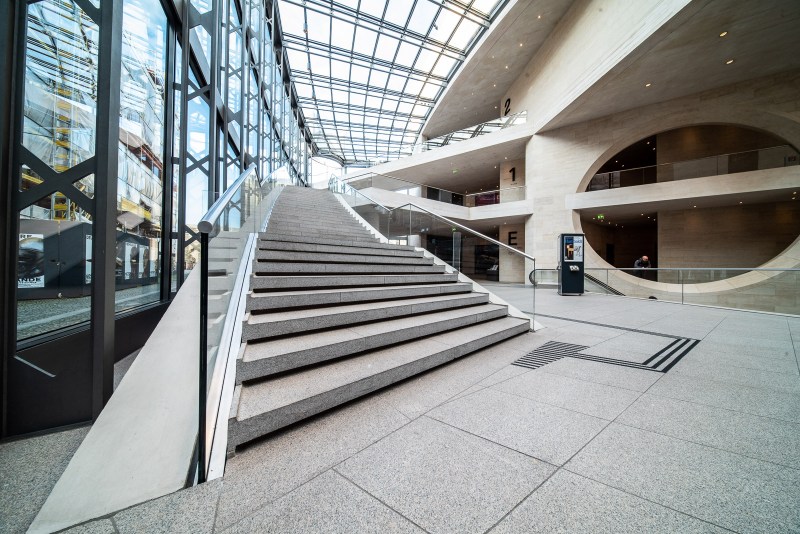
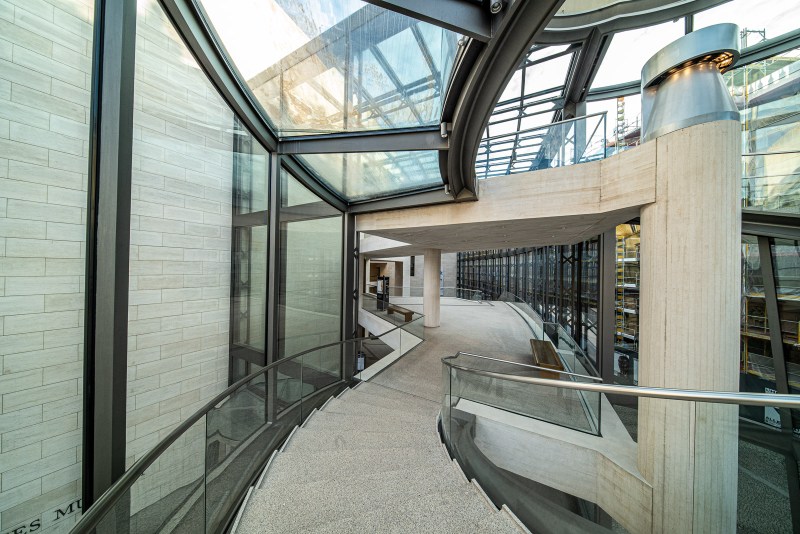
I would call this building an invitation to explore the esthetic possibilities of dysfunctional space. The helicoidal stairwell, it’s most prominent feature, connects only the second to the third floor and extends further without purpose to a non-existent fourth floor. It’s placed inconveniently at the (sharp) entrance corner of the building. Climbing these steps has as its main purpose to be climbing these steps. They are gorgeous.  

DSC 4521

The more functional connection between the ground floor and the first floor is a long ramp leading to the helix. Like everything else, it is pushed to the side, so that as much of the empty space of the building remains intact.

DSC 4540

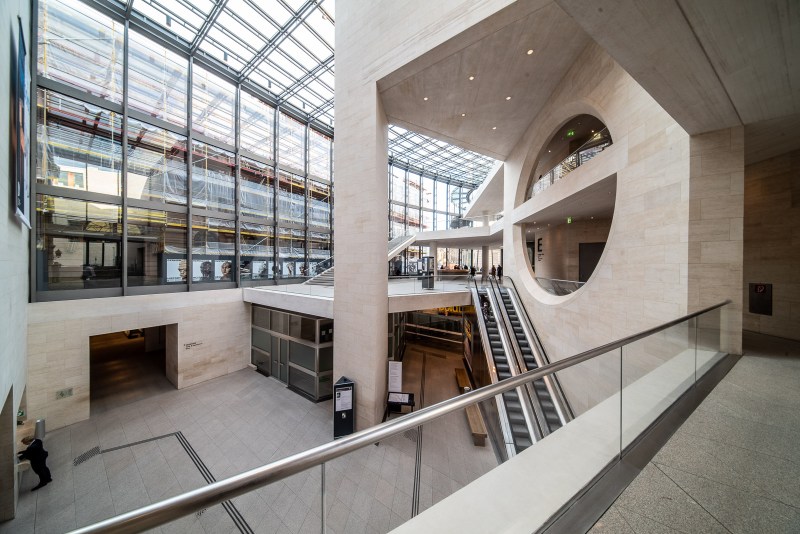
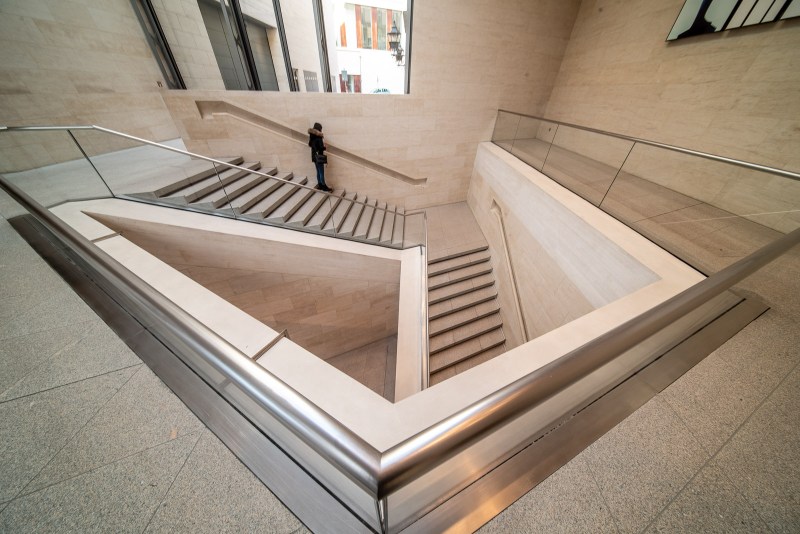
What we see while walking this building are the structural elements that connect. Above is a view down into the basement level, reachable through the escalator or an angled stairwell (at the bottom).

DSC 4552

What I found striking and inexplicable is the harmony and balance between the playful round elements like the helix or the circular opening above, and the cornered, straight-edged, almost brutal structural components.

DSC 4554

It’s tempting to call these the male and female aspects of the building. No matter, it lives from the dialogue between the two. 

Thawing

After the temperatures finally dropped to proper levels for January, it was time for another serendipity walk in the lightly frozen landscape.

DSC 4675

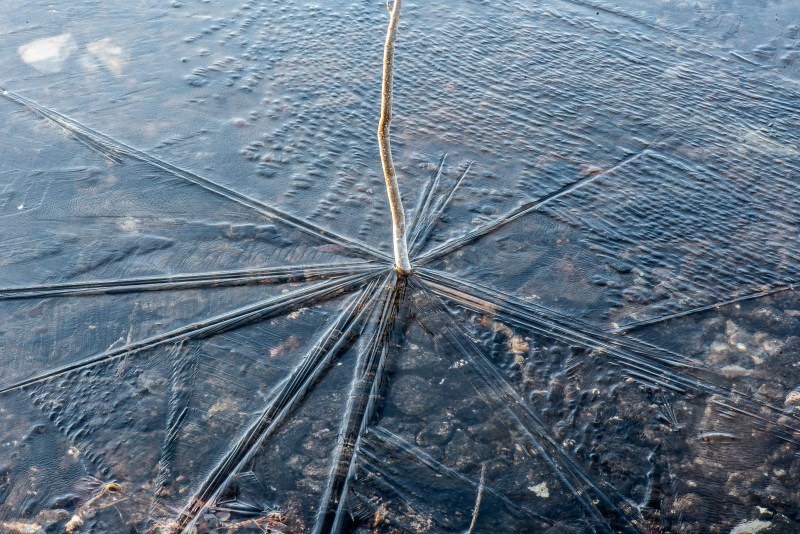
Usually I know when I have taken a decent photo. This time, I was not sure. When the warming sun came out, the reflections of the light and the doubly layered images of ice and ground beneath created unusual opportunities.

DSC 4684

Thawing is a violent process. This has never been made as visceral as in Andrei Tarkovsky’s film Solaris, in the scene where the visitor thaws.

DSC 4686

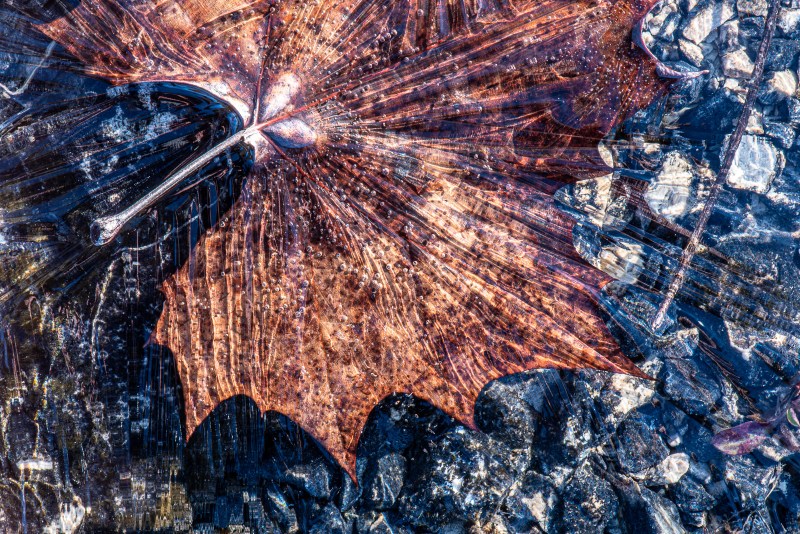
There, it’s the likeness of the alien that frightens. Here, the familiar shapes of leaves become alien when superposed with the fragile patterns of the ice that still covers them.

DSC 4689

There is a strange esthetic appeal in this violence, a desire to explode, and come to life.

Not yet. It’s January still.

DSC 4699

Marzahn mon amour

A neighbor and I exchanged books over the holidays (a forgotten art?). I gave her Christoph Ransmayr’s Arznei gegen die Sterblichkeit, and she returned the favor with Katja Oskamp’s Marzahn mon amour.

DSC 4348

Marzahn is a legendary suburb of Berlin I had never been to. The name triggered childhood memories of Frau Malzahn, the wonderful dragon in Ottfried Preußler’s even more wonderful Jim Knopf books.

DSC 4342

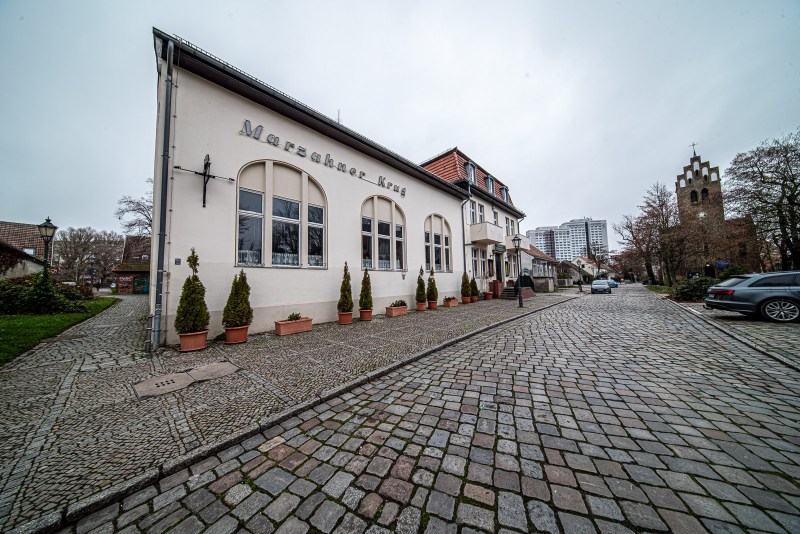
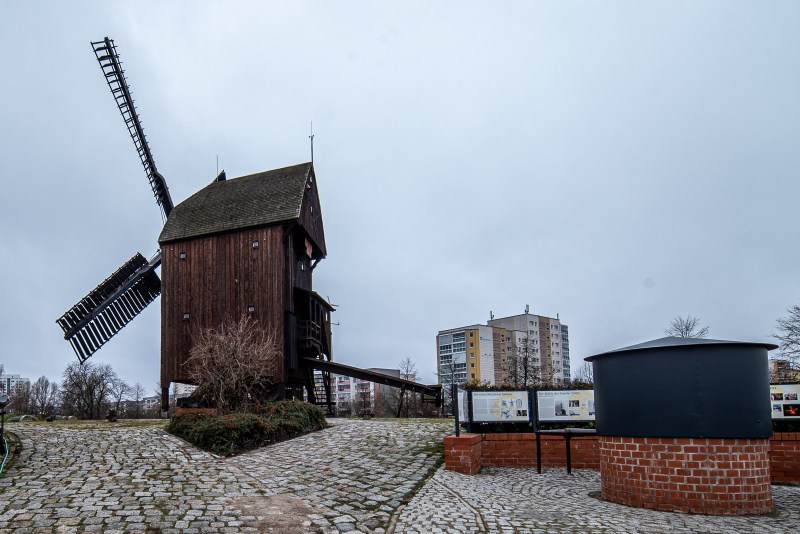
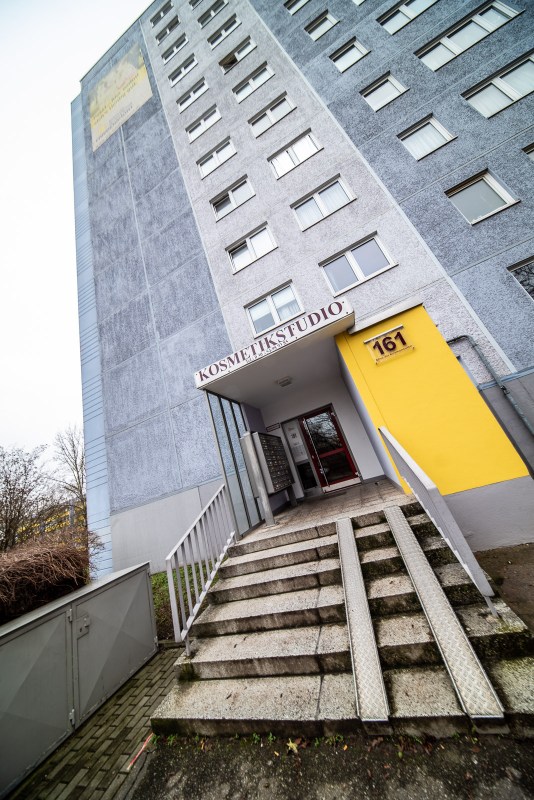
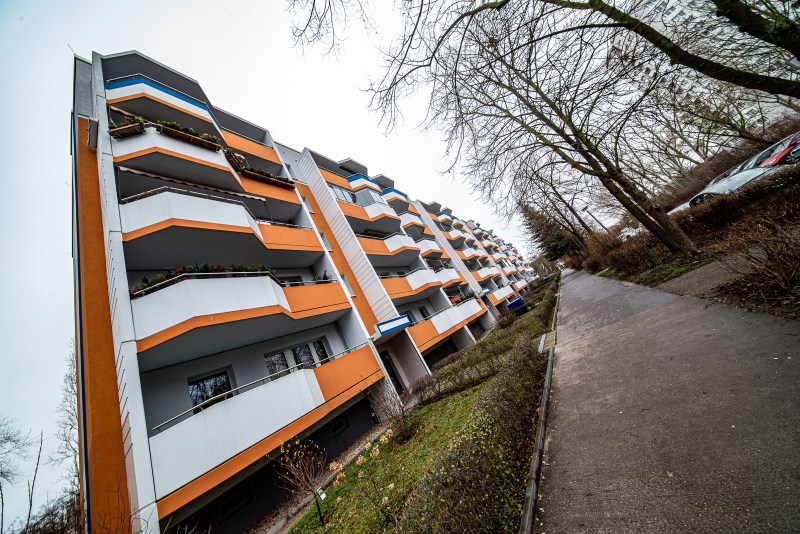
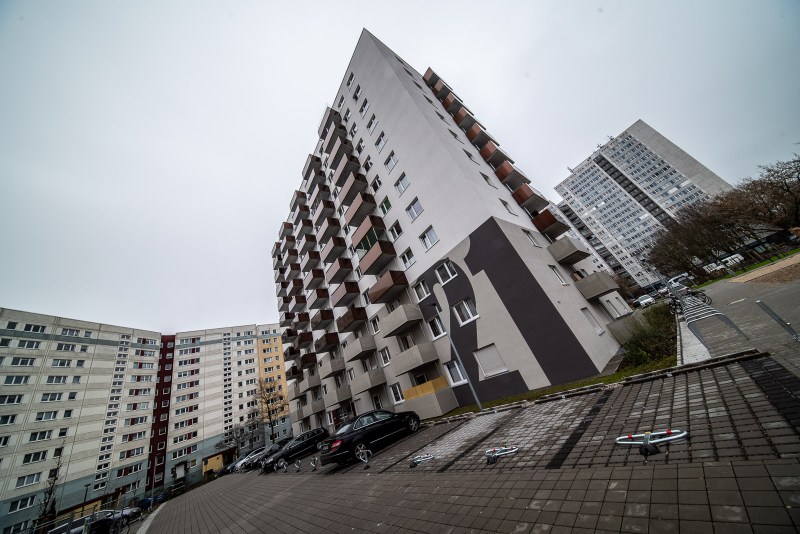
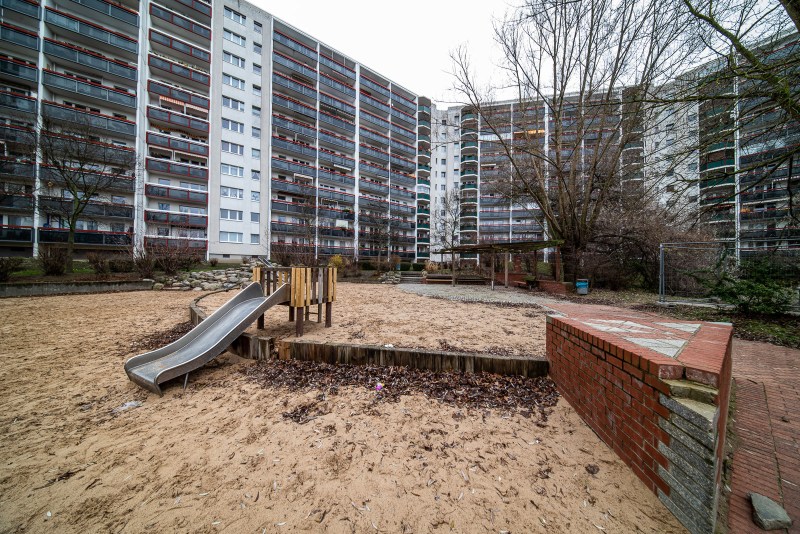
But this has nothing to do with Marzahn mon amour, nor do the pictures above, which show Alt-Marzahn, miraculously preserved among the Plattenbauten, the prefab buildings that provided a cheap solution to the growing housing problem of the former German Democratic Republic.

DSC 4385

Here is one of them, proudly announcing cosmetic studio at the entrance as if the entire building is that studio.

DSC 4365

And this is what the book is about: People living in these prefab houses, and being taken care of temporarily by the narrator, who works as a pedicurist in a cosmetic studio just like the one above (this one?).

DSC 4376

We learn to like them, the people and the buildings, maybe because they all have decided to cope with their large and small miseries by taking care of themselves, even if only symbolically.

DSC 4361

Most remarkable, however, is the insight of the narrator: That by stepping apparently down (in her case from struggling author to a pedicurist) one can in fact find happiness, and then by the way, write a charming little book. 

Acceptance

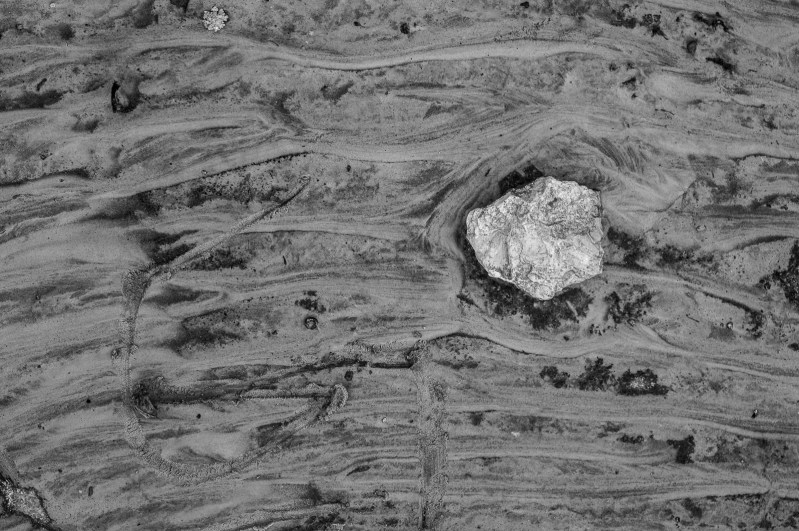
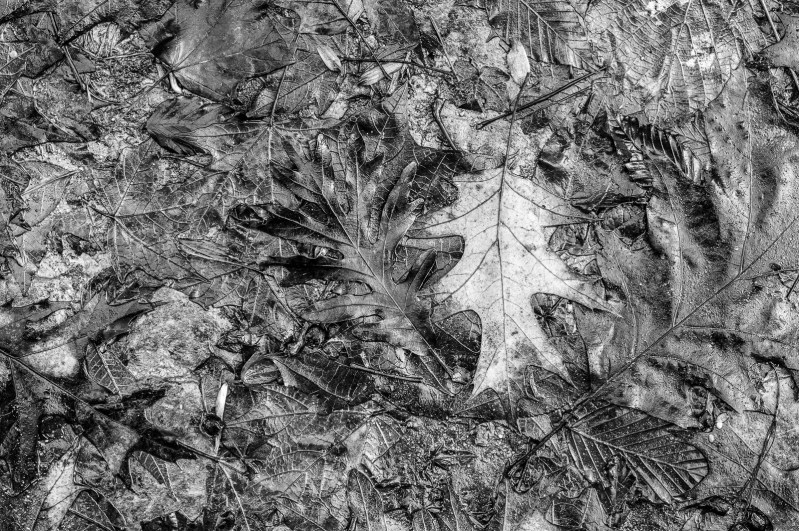
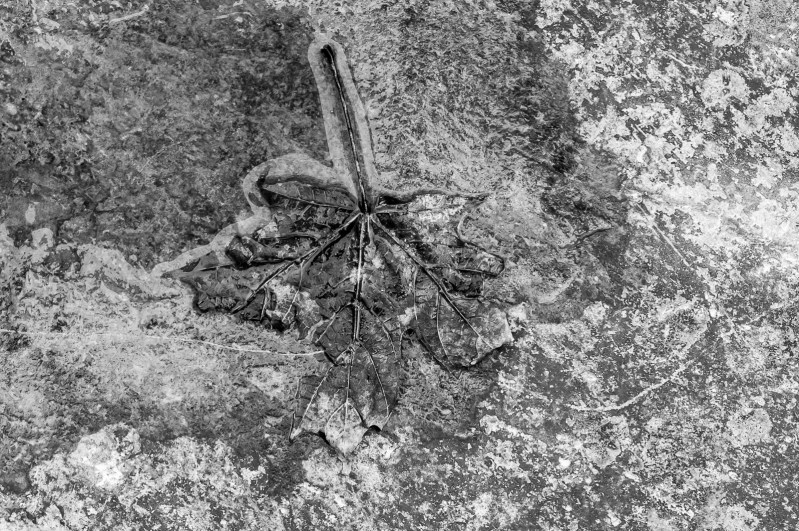
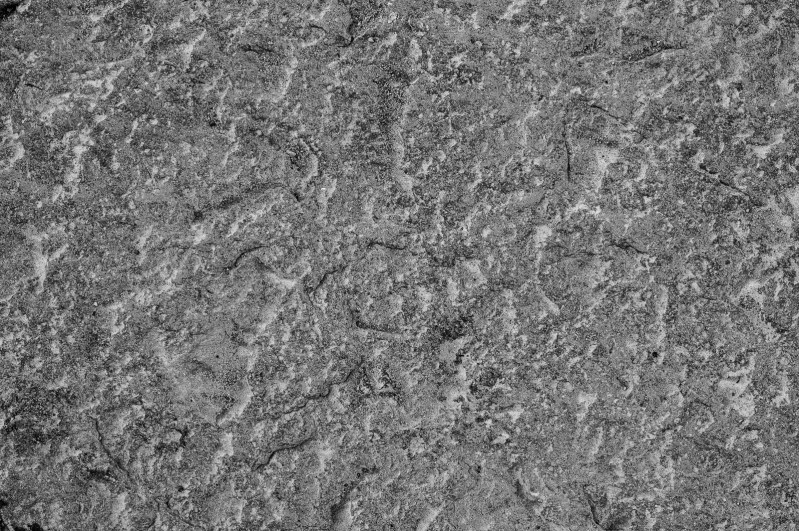
This morning I decided to replay the game Still Live that consists of walking around and taking pictures of things on the ground as they are. It is an exercise in acceptance.

DSC 2156

It was a crisp morning, nobody was out there that early on the first day of the new year.

DSC 2138

This time I made it even harder, by reducing everything to black and white, to dark and light.

DSC 2142

Maybe this modification of the concrete into something abstract is an escape to avoid comprehension.

DSC 2144

But by hiding the obvious, either the structural core becomes visible, or the underlying noise.

DSC 2145

Everything depends on what we want to see.