More Examples (Five Squares II)

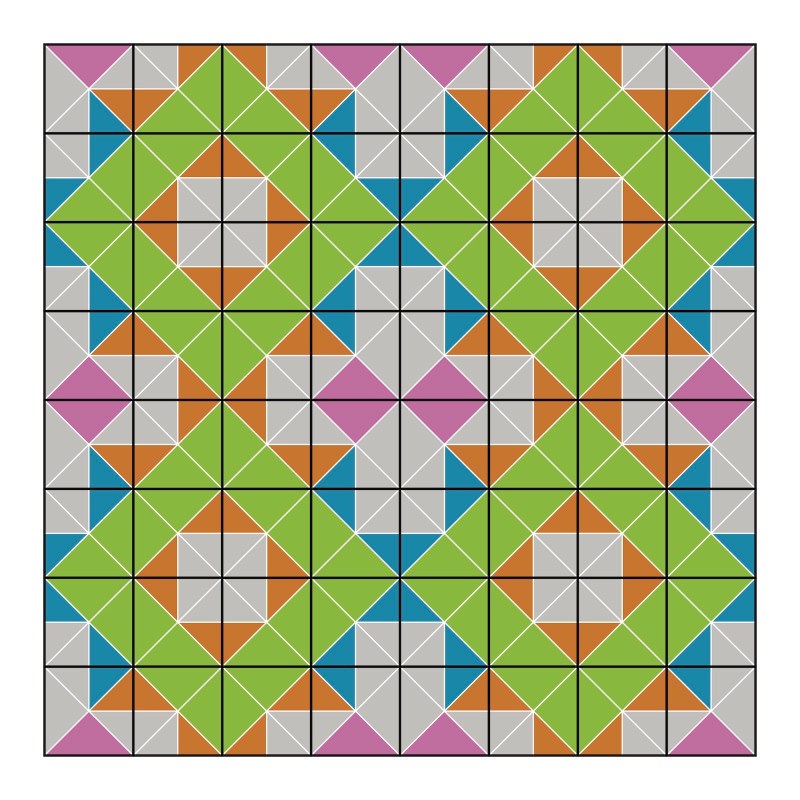
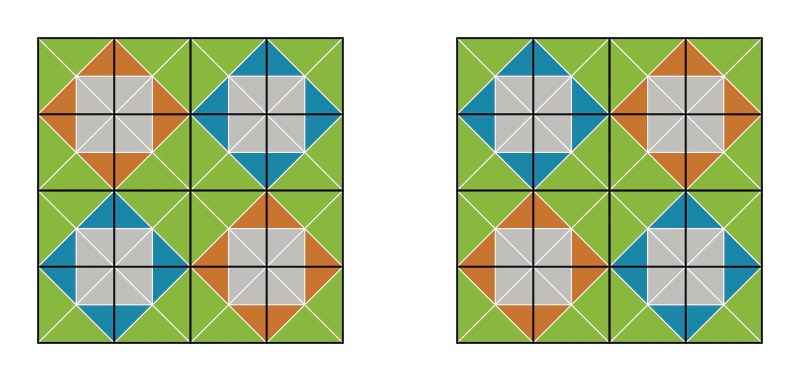
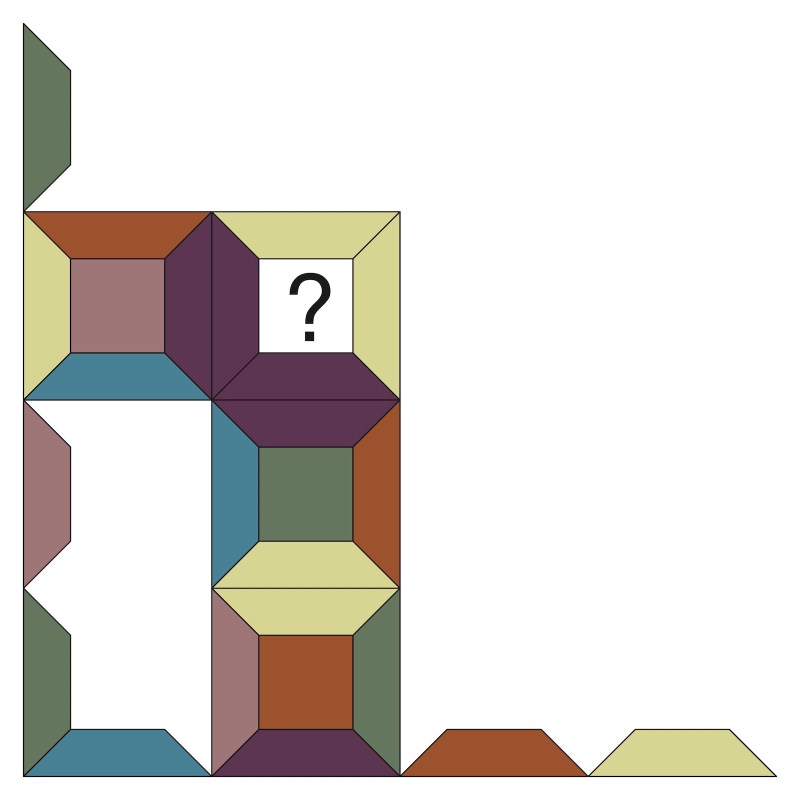
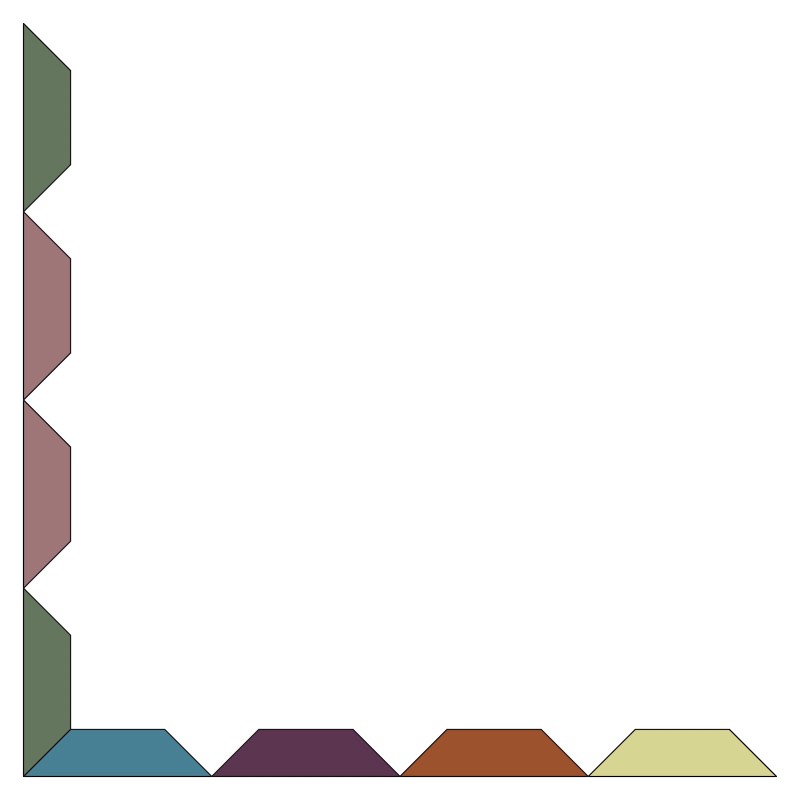
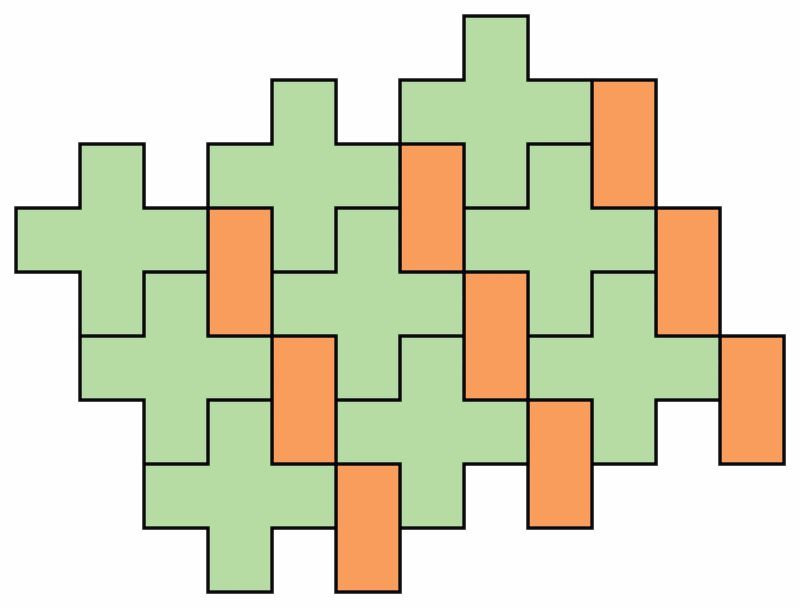
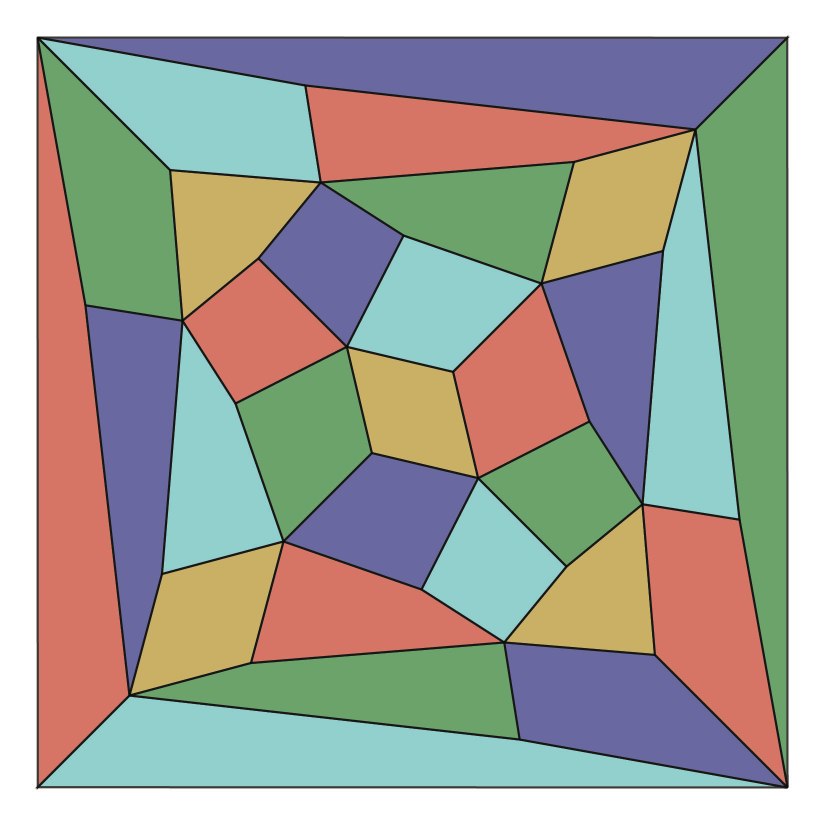
To review, let’s start with the following tiling
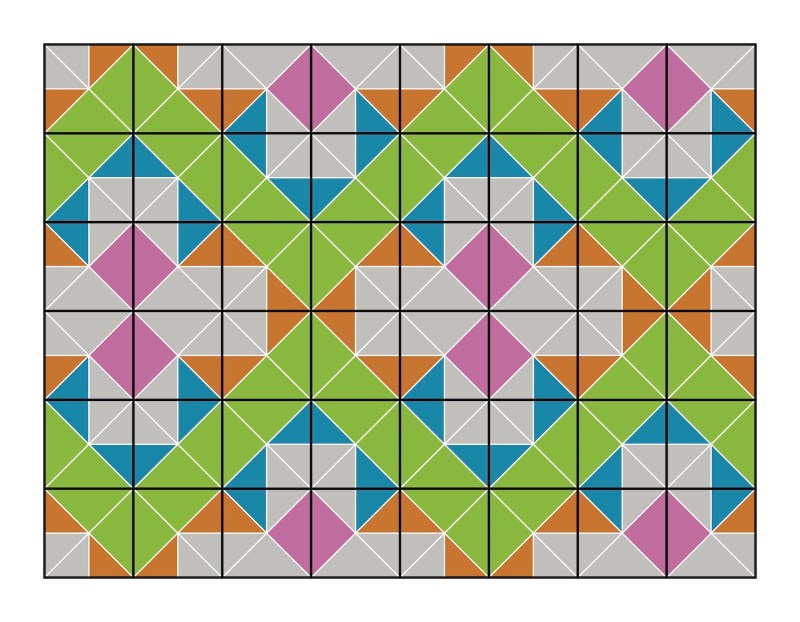
New 4 tile

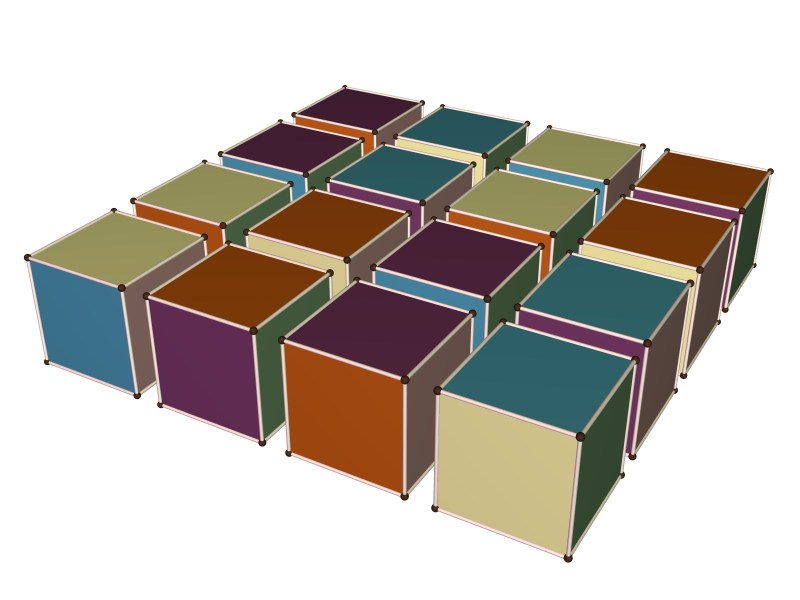
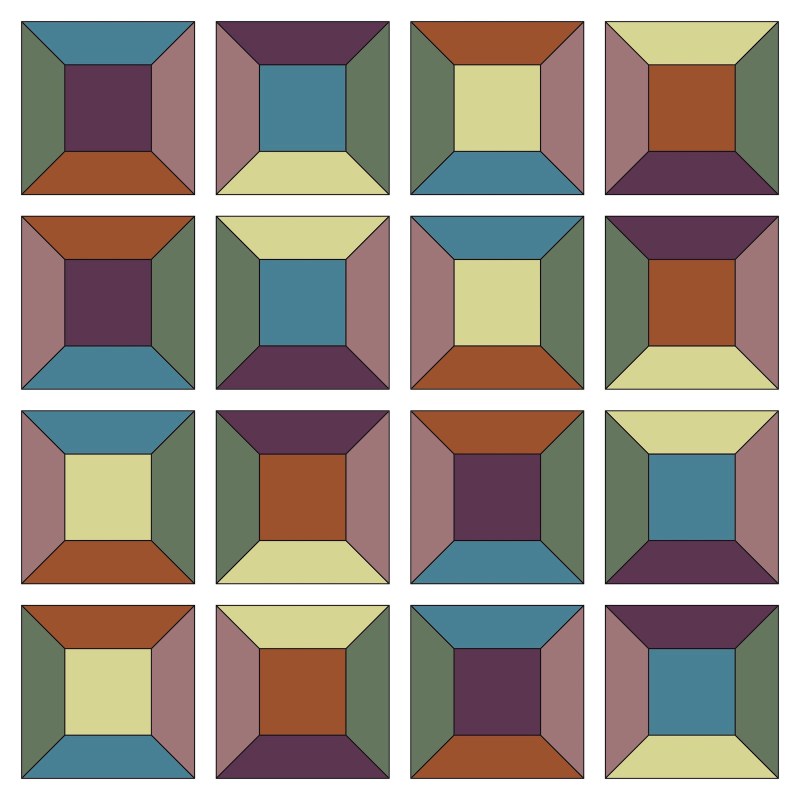
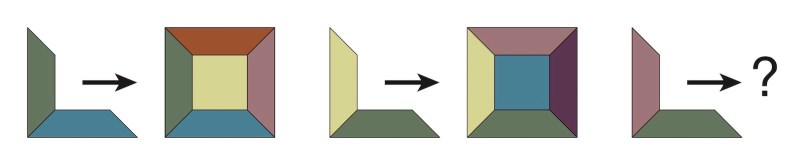
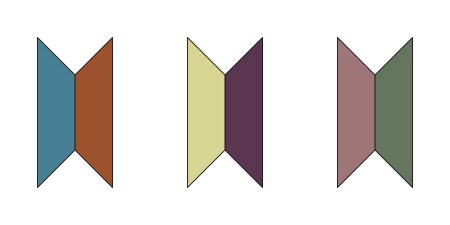
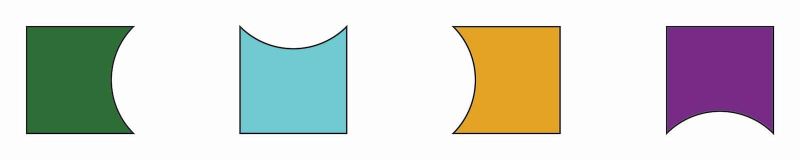
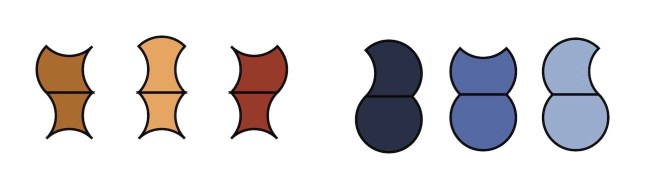
Now use the dictionary below to replace each tile by the corresponding 3-dimensional shape. Each tile from the bottom row is an abstraction of an idealized top view (top row) of a rotated version of five coordinate squares that meet around a vertex (middle row).
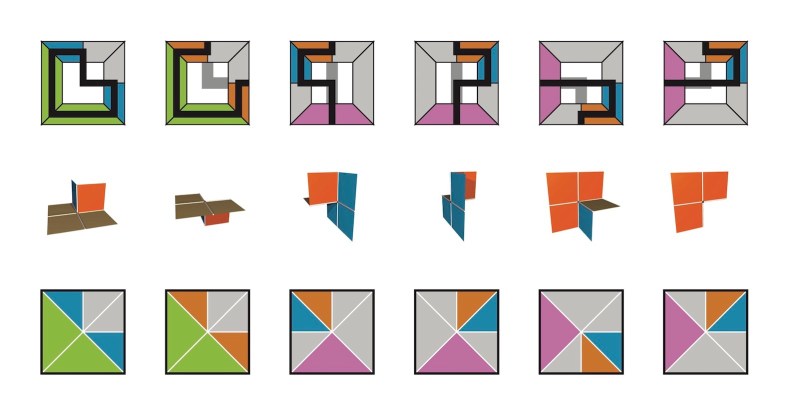
Dictionary

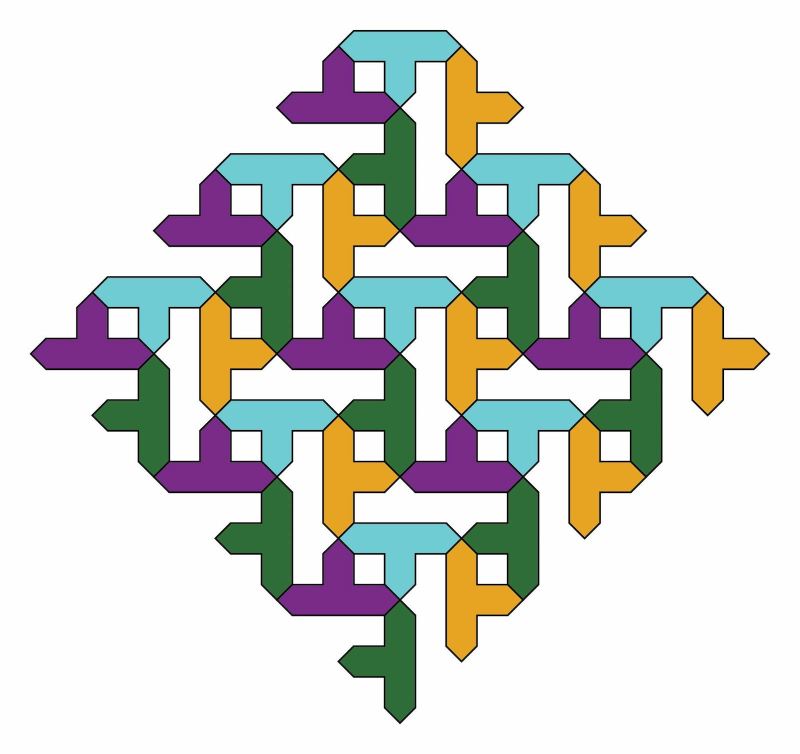
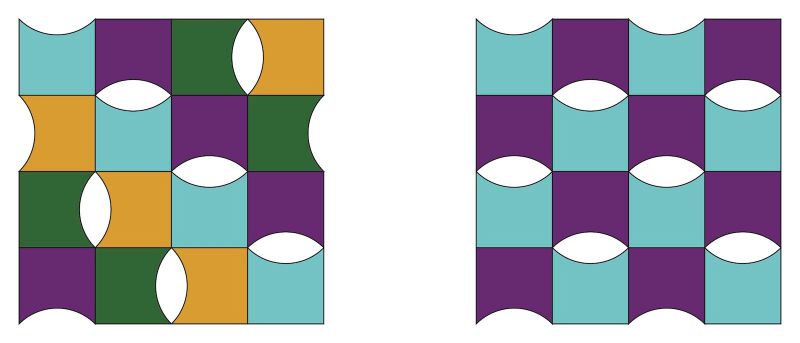
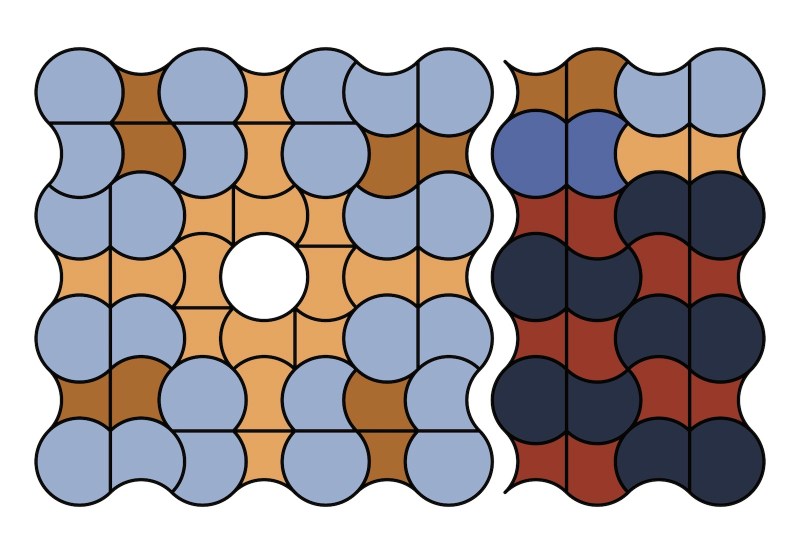
By using the top left quarter, we get the top layer of the polygonal surface below. The bottom layer uses the same pattern as above with blue and orange exchanged. This is a fundamental piece under translations, and we can see that the quotient has genus 4. This also follows from the Gauss-Bonnet formula, which says that a surface of genus g uses 8(g-1) of our tiles (12 for the top and bottom each in this case.
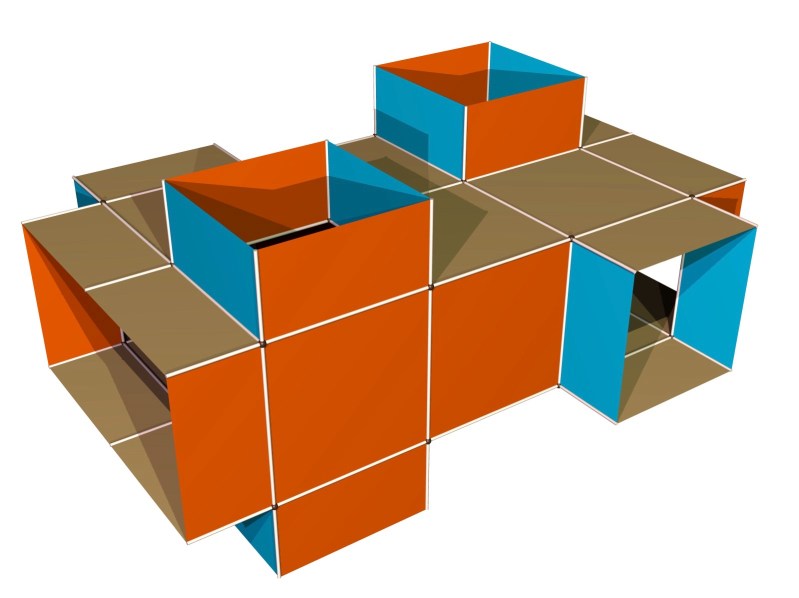
Genus 4

Similarly, this tiling

Genus5 tile

encodes one layer of the following surface of genus 5:
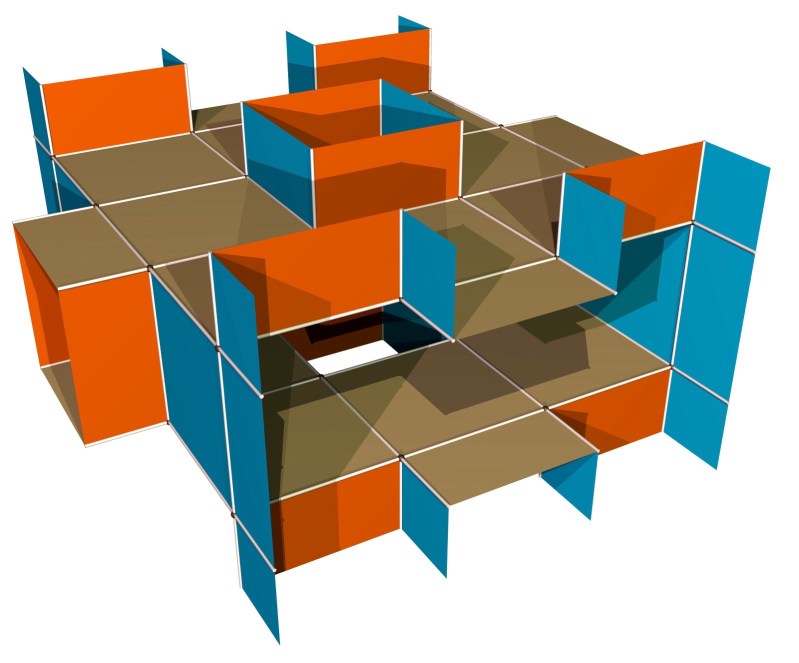
Genus 5

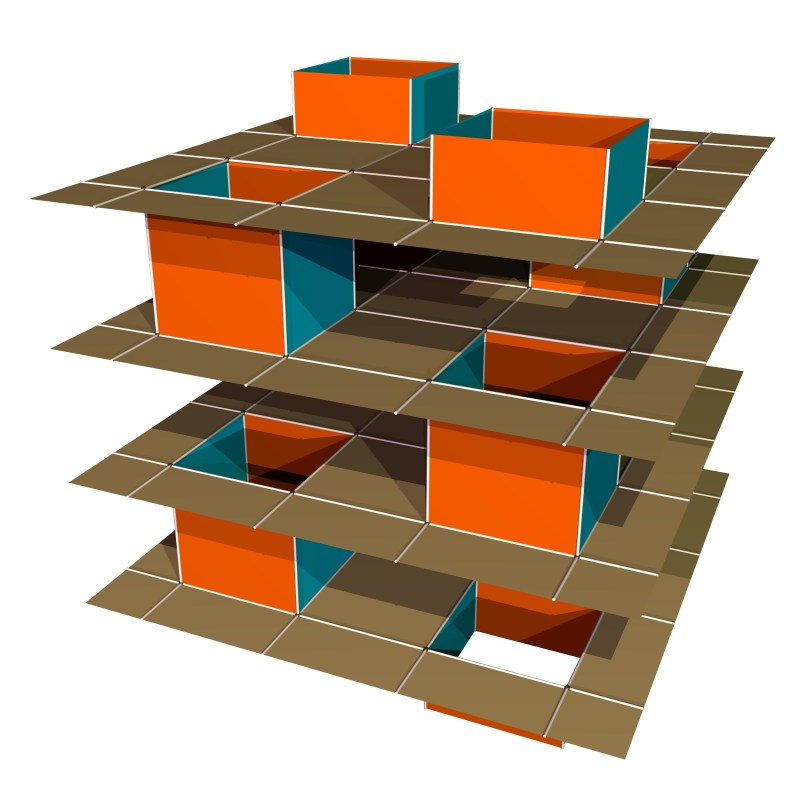
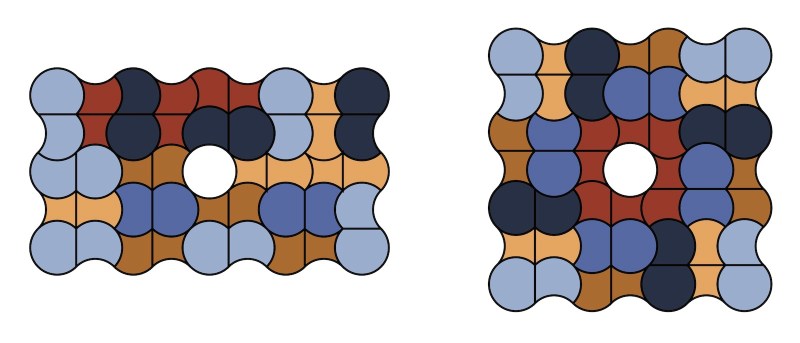
To make things more complicated, the next surface (of genus 4 as well)
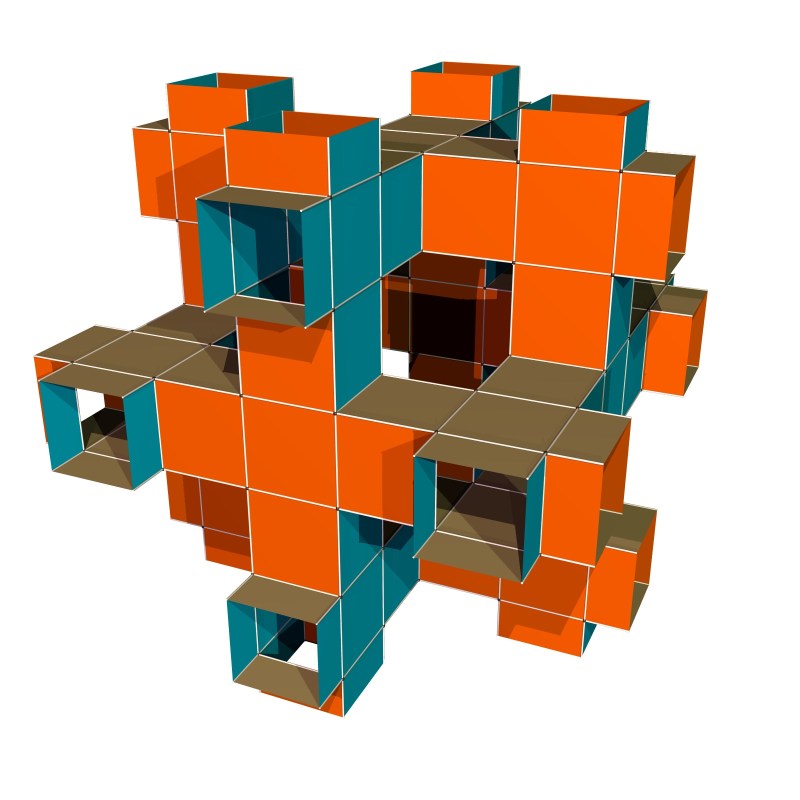
Plus 1

needs four layers until it repeats itself. Two of them are shown below.
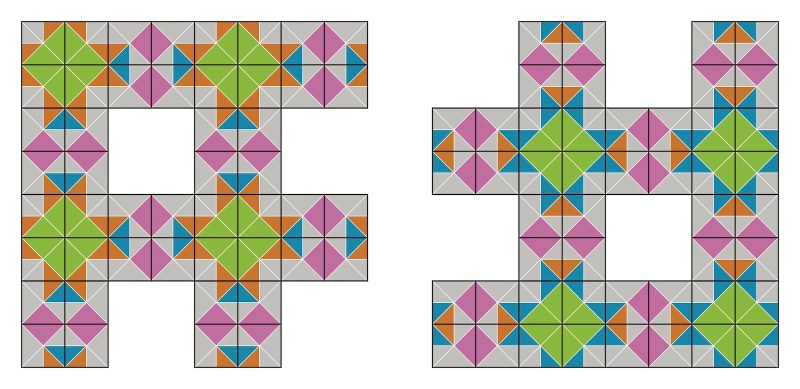
Pluslayers

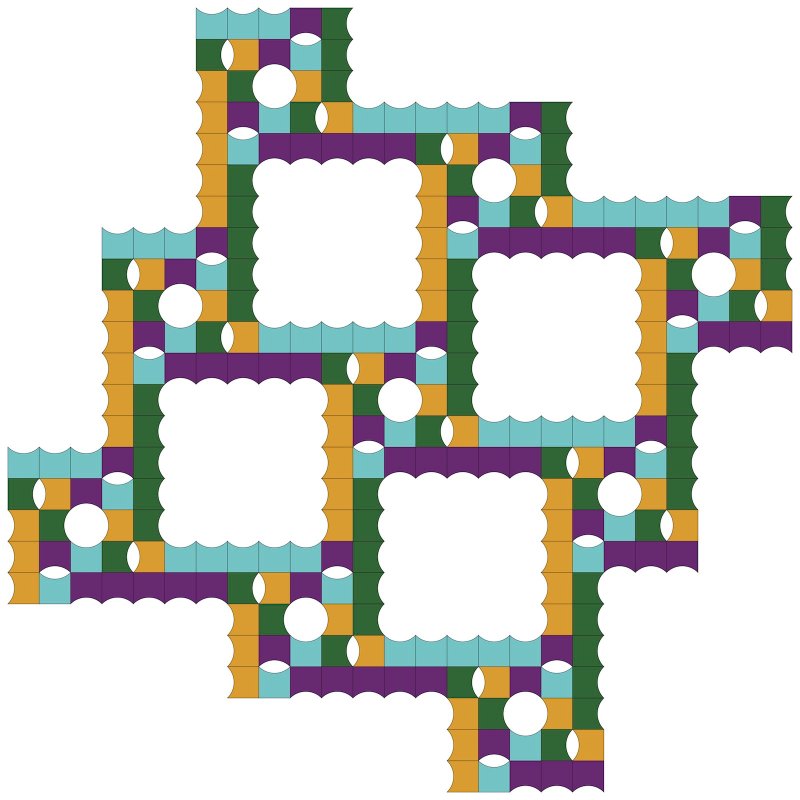
These tilings exhibit holes bordered by gray edges which complicates matters, as we will now also have to understand partial tilings (with gray borders).
Columns

After looking at the intersections of symmetrically placed cylinders and obtaining curved polyhedra, it is tempting to straighten these intersections by looking at intersections of columns instead.

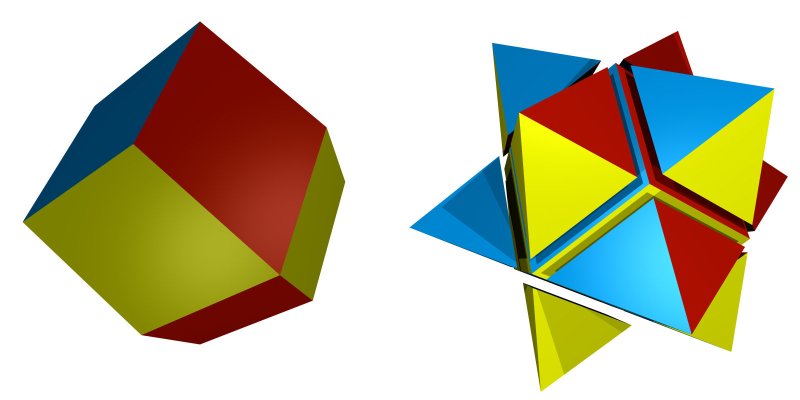
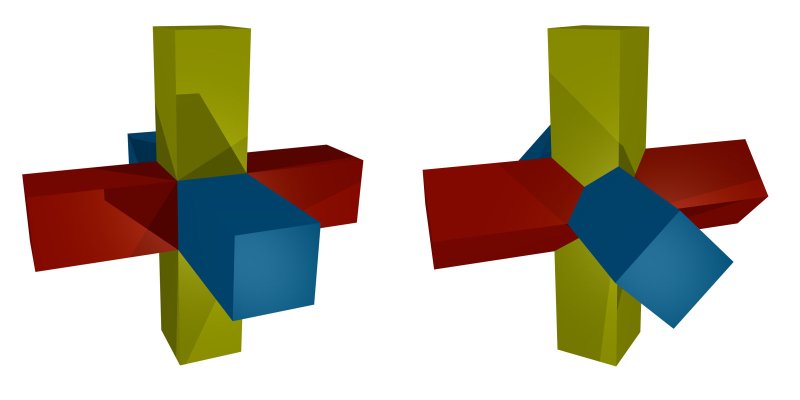
The simplest case is that of three perpendicular columns. The intersection is a cube. Fair enough. But what happens if we rotate all columns by 45 degrees about their axes?

Col 3 union

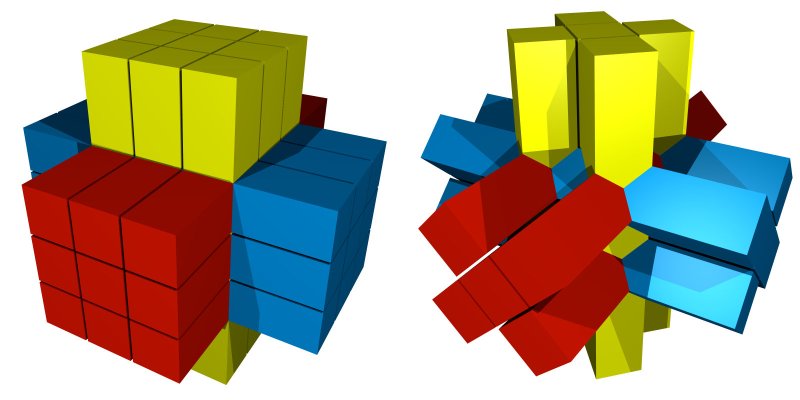
Before we look, let’s make it more interesting. In both cases, we can shift the columns so that their cross sections tile a plane with squares. Surely, every point of space will then be in the intersection of a triplet of perpendicular columns. In other words, the intersection shapes will tile space.

Col 3 shifts

Yes, right, we knew that in the first case. I find the second case infinitely harder to visualize. Fortunately, I have seen enough symmetrical shape to guess what the intersection of the three twisted columns looks like it is a rhombic dodecahedron.

But not all triplets of columns that meet do this in such a simple way, there is a second possibility, in which case the intersection is just a twelfth, namely a pyramid over the face of the rhombic dodecahedron.

Col 3 twist

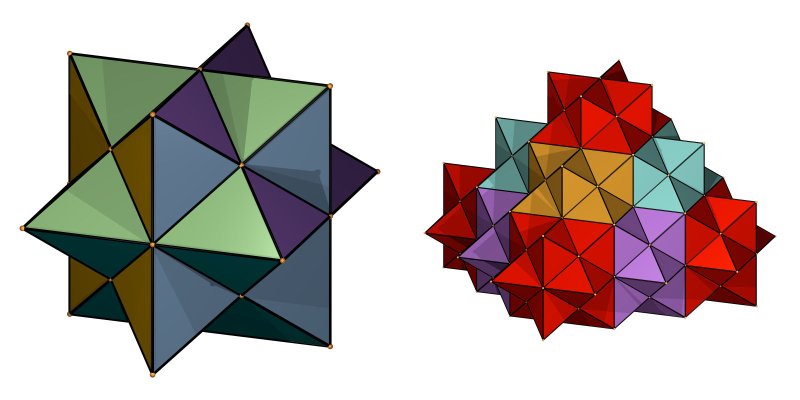
Together with the center rhombic dodecahedron they form a stellation of the rhombic dodecahedron, or the Escher Solid, of which you have made a paper model using my slidables.

Escher combo

Above you can see a first few of Escher’s solids busy tiling space.

Alchemy (From the Pillowbook X)

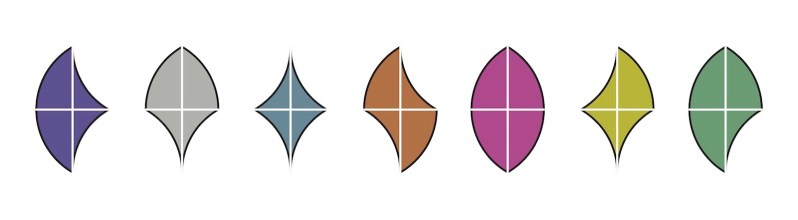
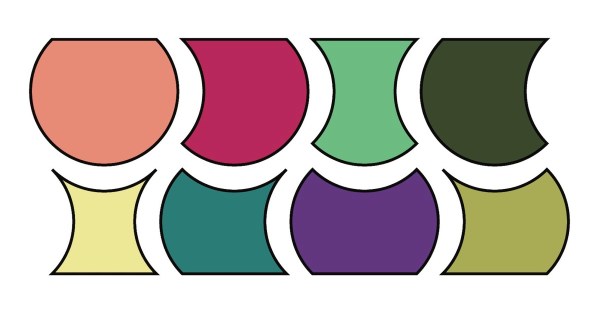
Here is a variation of the pillow theme. This time, the tiles are not based on squares as the regular pillows or on triangles as in an older post, but on 60 degree rhombi. I only use pieces with convex or concave edges, so there are seven different rhombic pillows up to symmetry, this time also not distinguishing between mirror symmetric pieces. The main diagonals of the original rhombi are marked white. For the purpose of the Alchemy game below, I call them elements.

Elements

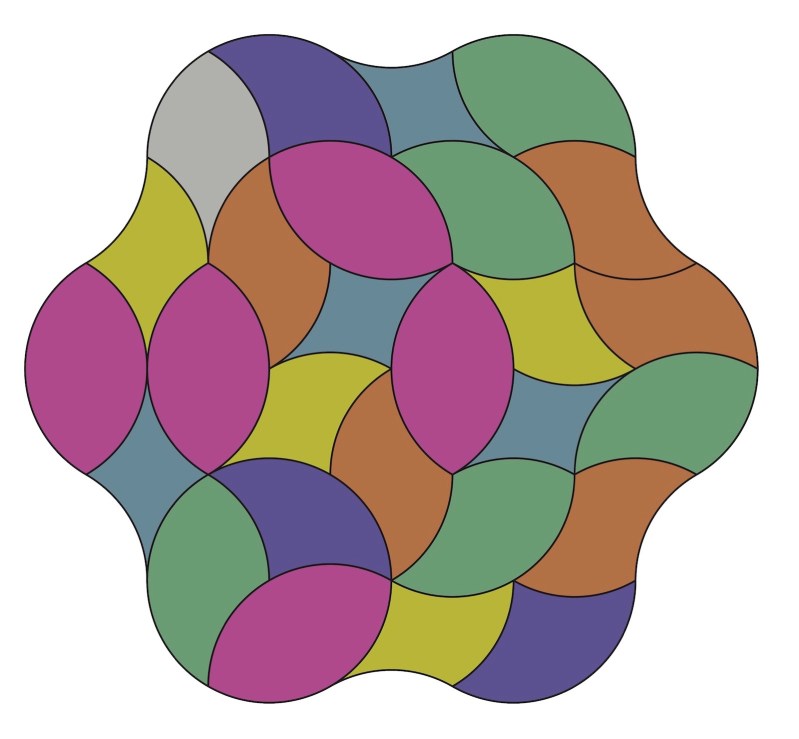
These elements can be used to tile curvy shapes like the curvy hexagon below. Again, for the purpose of the game, I call such a tiled hexagon a Philosopher’s Stone.

Stone1

I leave going through the brain yoga to discuss tileability questions to the dear reader. Instead, here is the game I designed these pieces for.

Alchemy

A Game for 2-6 Players

Purpose

To complete the Magnum Opus by crafting a Philosopher’s Stone.

Material

  • The seven elements above in seven colors, colored on both sides, at least 4 of each kind for each player;
  • One transmutation card for each player;
  • One Philosopher’s Stone outline for each player;
  • Pencils and glue sticks.

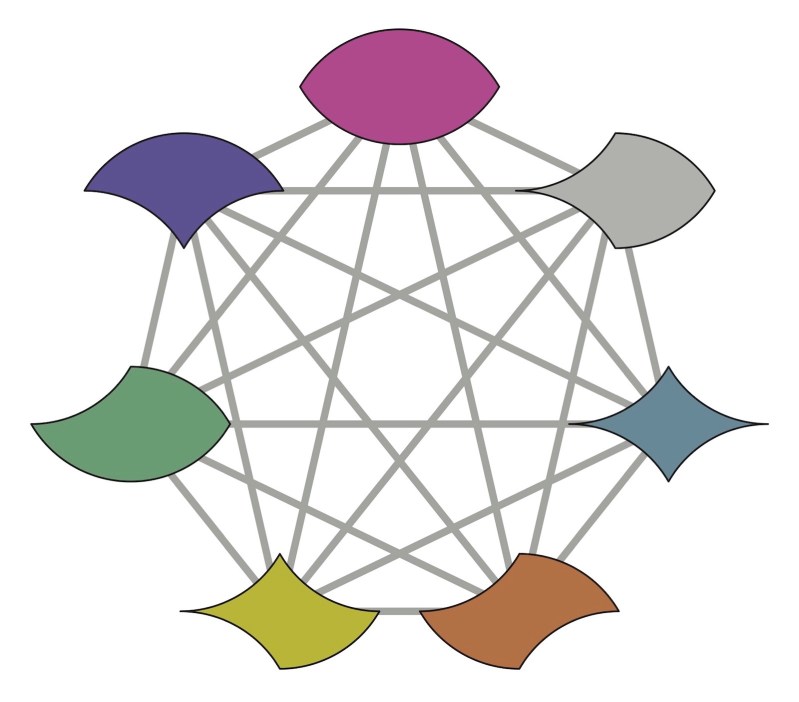
Below is a template for the transmutation card. It shows a heptagon with the elements at its vertices, and all possible connections (transmutations, that is).
Transmutations

Preparation

All elements are separated into resource piles according to color/shape. Each players takes a transfiguration card and an outline of the Philosopher’s Stone.

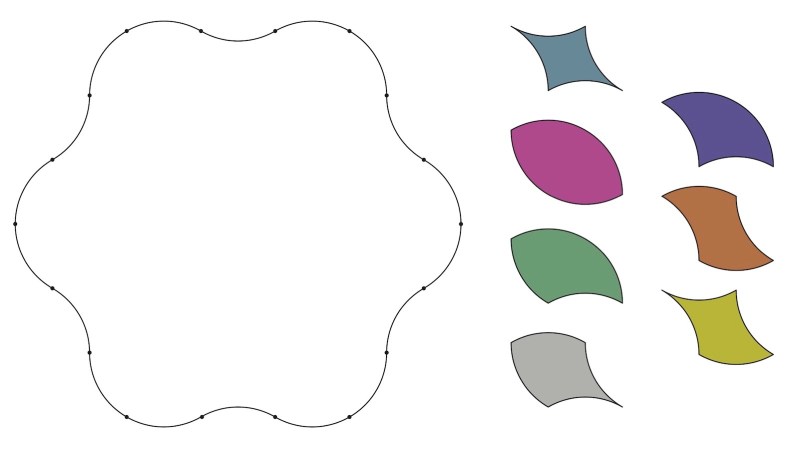
Outline

Above is an outline of the Philosophers stone, with little notches to indicate where the corners of the elements have to go. The elements are shown next to it to scale so that you get the elements in the right size.

Completing the Magnum OpusGoals

The goal of the game is to accomplish the Opus Magnum by filling the outline of the Philosopher’s Stone with elements using as few transmutations as possible. Elements must be placed so that

  • at least one corner matches a notch or a corner of another element that has already been placed;
  • elements don’t overlap and don’t leave gaps;
  • no two equal elements may share a curved edge (but they may share a vertex).
Scoring

When a player has completed a Philosopher’s Stone, he or she determins the used transmutations:
A transmutation occurs in the Philosopher’s Stone when two elements share a curved edge.
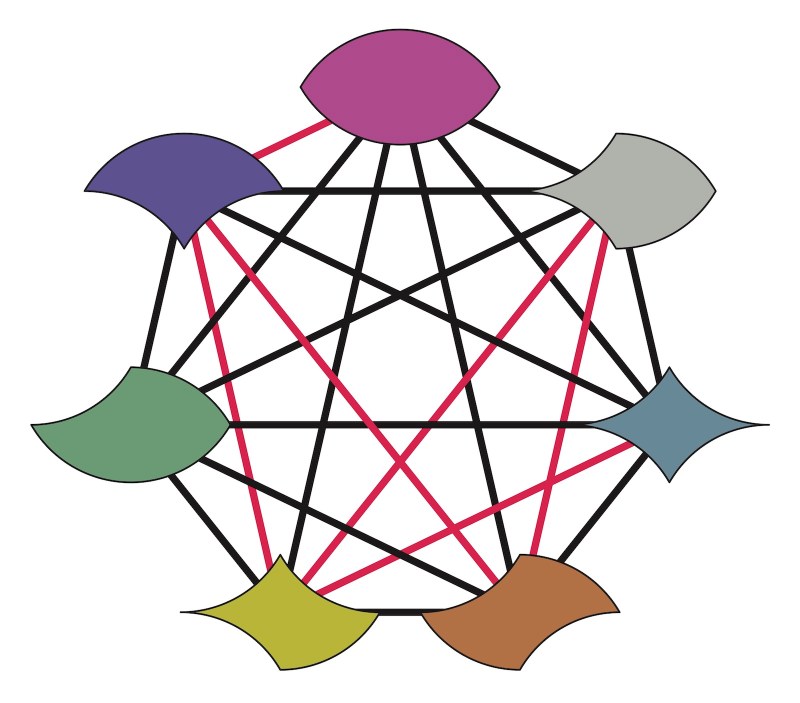
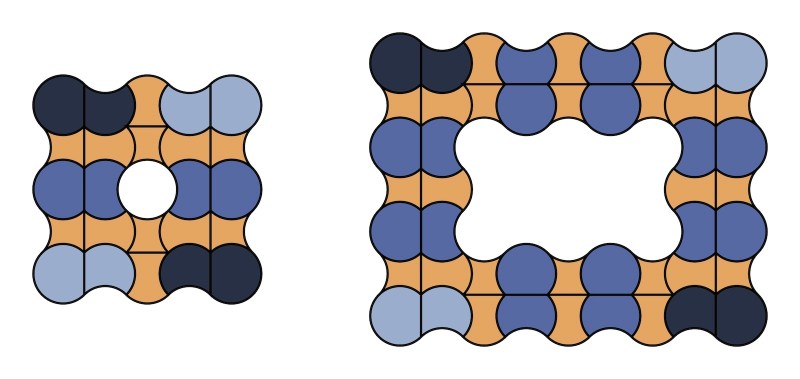
The players record a transmutation on their transmutation card by drawing a straight red edge between two elements that share a curved edge in their completed Philosopher’s Stone.

The unused edges are then drawn black. The player with the largest number of black edges becomes the master alchemist.

Below is the completed transmutation card for the Philosopher’s Stone at the top. This was a pretty poor job, the player used all but three of all possible transmutations.

Transmutations2

One can turn this game also into a puzzle. Can you tile the Philosopher’s Stone with the seven elements that its transmutation card is the one below?

Transmutations puzzle

From Space to Plane (Five Squares I)

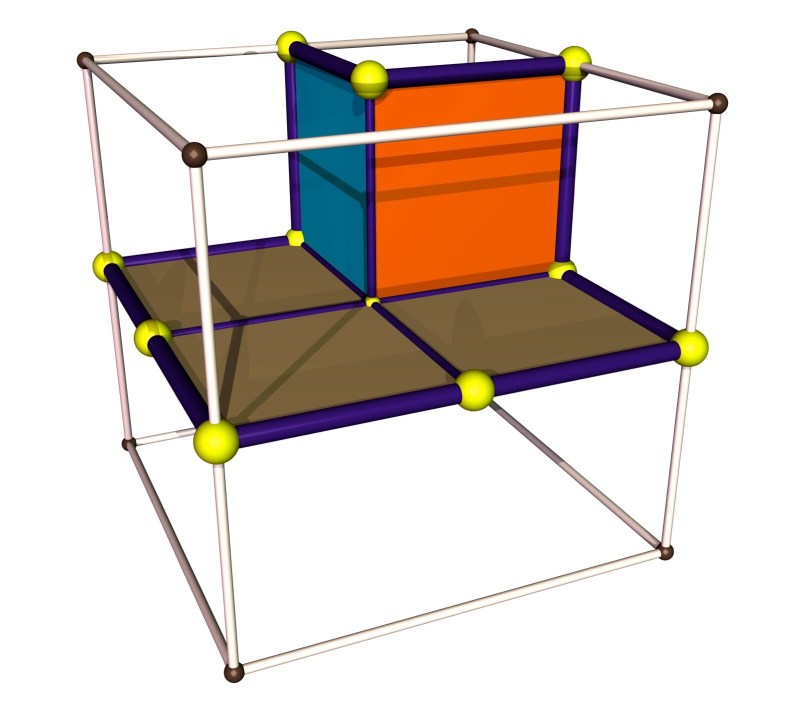
Euclid allows us to place four squares around a vertex. If we are not satisfied with that, we can either move into the hyperbolic plane, or into space. A neglected configuration is that of five squares parallel to the coordinate planes that meet at a common vertex, like so:

Pentacube3D

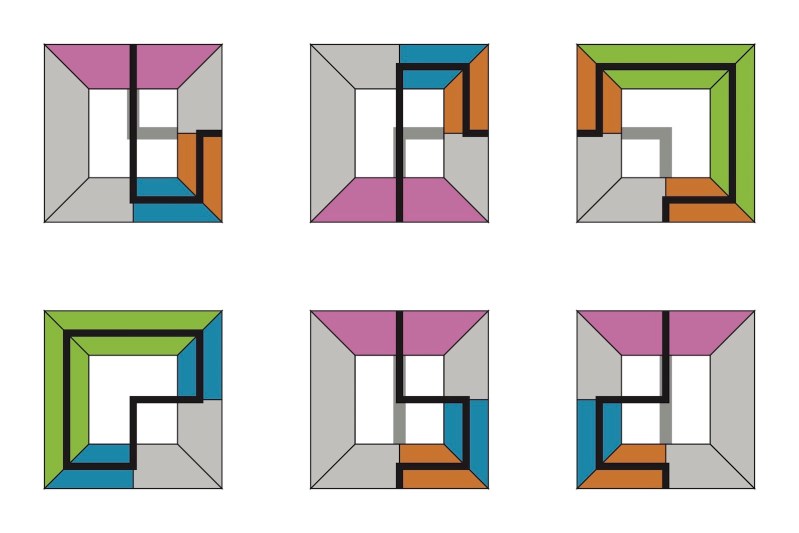
This is, as you convince yourself quickly, the only way to to this, up to 24 symmetric cases. The squares trace out a polygonal arc on the faces of the cube above, which we can interpret as a marking of the faces of the cube that contains the five squares. Two faces are marked by a straight segment (front and  left), three by an L-shaped segment (back, right, top), and one face is unmarked (bottom). As we did with the simple six color marking, we can centrally project the 24 cubes into the plane.

Paths

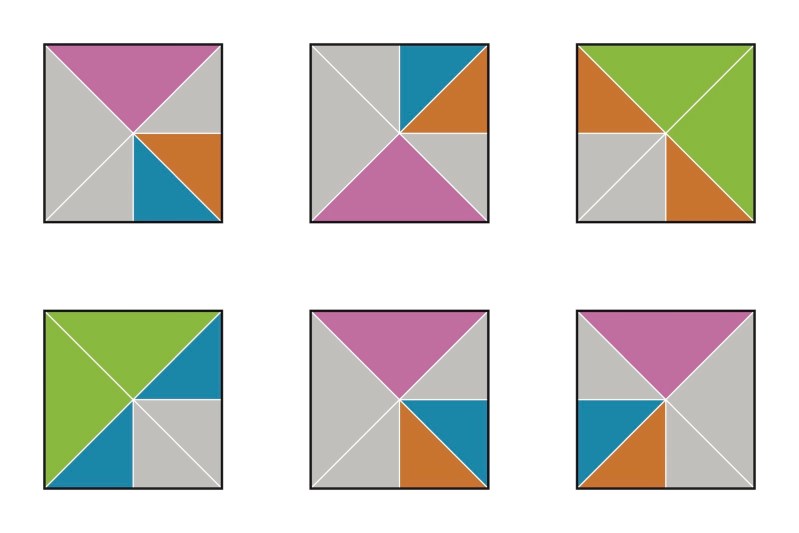
The image above shows six of these projections. The remaining ones can be obtained by 90 degree rotations. I have colored the faces of the cube to indicate what the path is doing within that face (green=go straight, blue=turn one way, orange = turn the other way, gray=don’t be there). Convince yourself that the colors suffice to reconstruct the path.

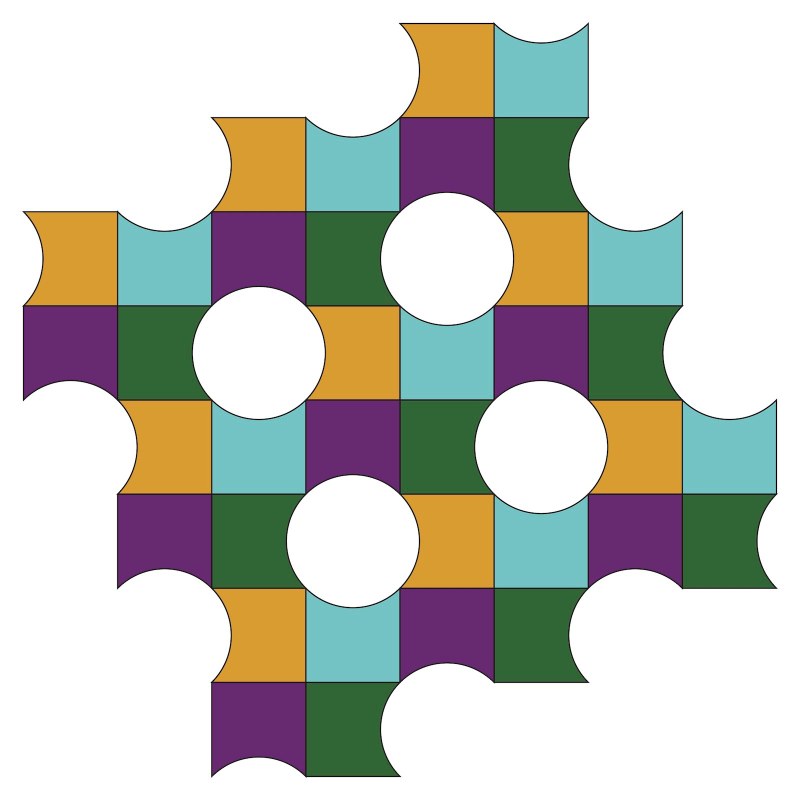
Thus we obtain a set of six tiles that allow us to explore layers of polygonal surfaces that have five squares around each vertex. For prettification, I have dropped the path and filled in the hole. No information has been lost. We are allowed to place tiles next to each other if the colors match. This is it:

Patterns

Here is a simple example of such a surface.

Schwarz

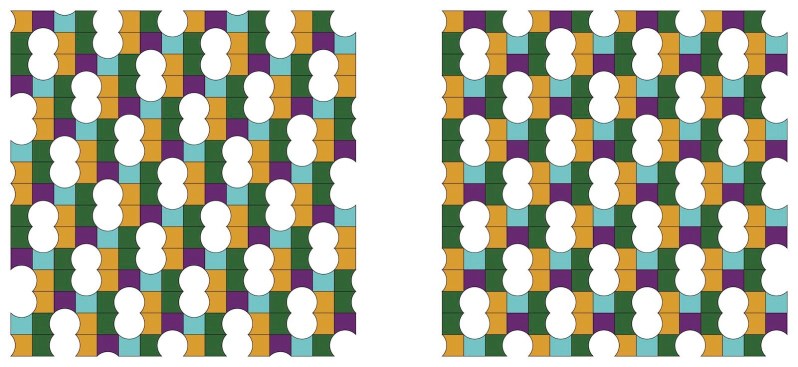
It is triply periodic and incidentally related to Schwarz P minimal surface. Two consecutive horizontal layers are represented by the two tilings below:

Schwarztile

So, we have the burning questions: Are there more polyhedra like these, do the tilings help us, and can we understand the tilings? More about it in a week or two.

Cubomino

Cubes3D

We can play domino with identical copes of a single cube by insisting that the cubes have matching colors at the faces where they touch. This is hard to convey in a perspective image like the one above that shows a 4x4x1 cubomino tiling, so I will switch to a 2D representation that shows each cube in central perspective from above. Here is the flattened version:

Tilingsample2d

As you can see, the single 3D cubomino can be represented by six 2D cubomino squares, which may be rotated:

Cubes

These are a subset of the tiles I used for the Compass game a while ago.

This new Cubomino puzzle is a simple example that teaches to analyze tilings by understanding them as boundary value problems. To see how this works, we first notice that to some extent the color of the lower and the left edge of a tile determines that tile and its rotation.

Boundary1

It works for most color combinations, but there are exceptions. These occur precisely when the two chosen colors for bottom and left edge are antipodal, i.e. are either equal or are one of the three pairs of colors of two opposite faces of our cube:

Antipodes

This observation extends to larger rectangles: No antipodal colors can occur both in the left edge and the bottom edge of a tiled rectangle. To see this, assume the contrary. The vertical edge on the left of the rectangle that has one of the antipodal colors (pale yellow below) determines a horizontal strip of tiles that have the antipodal colors as vertical edges, and the horizontal edge on the bottom of the rectangle with the second color from an antipodal pair (dark purple below) determines a vertical strip of tiles that have the antipodal colors as horizontal edges. These two strips meet in a tile that must have a boundary consisting just of antipodal colors, which is impossible.

Collision

On the other hand, if the left and bottom edge have no antipodal colors in common, like in the example below,
there is always a unique tiling of a rectangle that has the two edges as its lower and left edge.

Boundary

The reconstruction process is easy: Each choice of a left and bottom edge color determines a tile and its rotation uniquely. We begin by placing the only possible square into the bottom left corner of our boundary, and work our way to the right and up.

The Advantages of Different Viewpoints (From the Pillowbook IX)

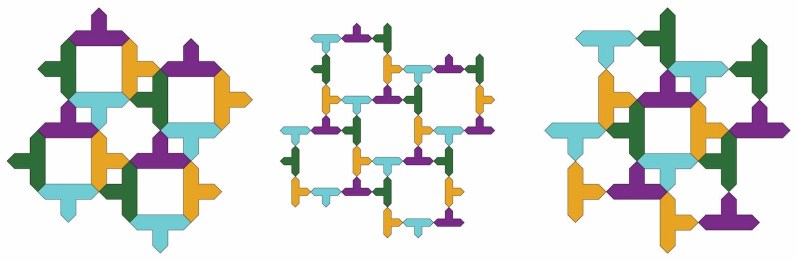
It all started with a question about polysticks: I wanted to see how to tile parts of the square grid with 3-sticks so that there are always three 3-sticks touching. A 3-stick is nothing but a T with all segments the same length: it has 3 arms that end at the hands, and are joined together at a head. By tiling I mean that the arms align with the edges of the standard square grid and don’t overlap. And, as I said, I want always three of them to hold hands. Here is an example (that you should imagine continued periodically):

Right3 01

The condition about holding hands in threes means that each such tiling has a dual tiling where the new 3-sticks have their heads wherever three hands come together, the same arms, and the previous heads are replaced by three hands. This also implies that a tiling and its dual will tile the same portion of the square grid, as below to the left and right.

Merge 01

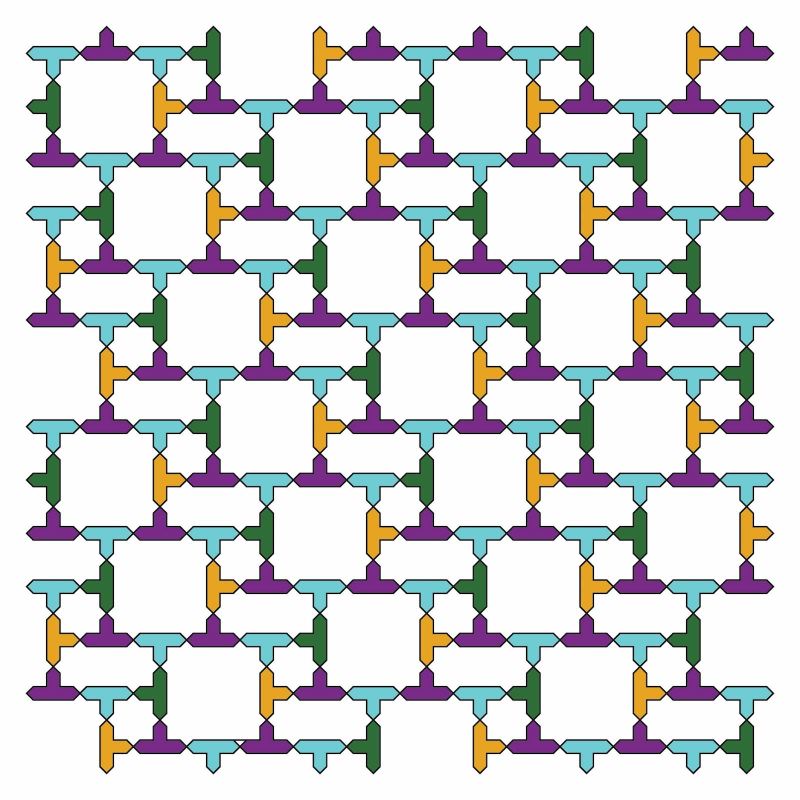
We can also combine a tiling and its dual into a single figure by centrally scaling each 3-stick by 50%, and taking the union: The gaps created by the scaling makes room for the 3-sticks from the other tiling. You can examine the result up above in the middle. The new skeleton will have all 3-sticks hold hands in pairs instead of in triples. Here is another, more complicated example. The original periodic 3-stick tiling:

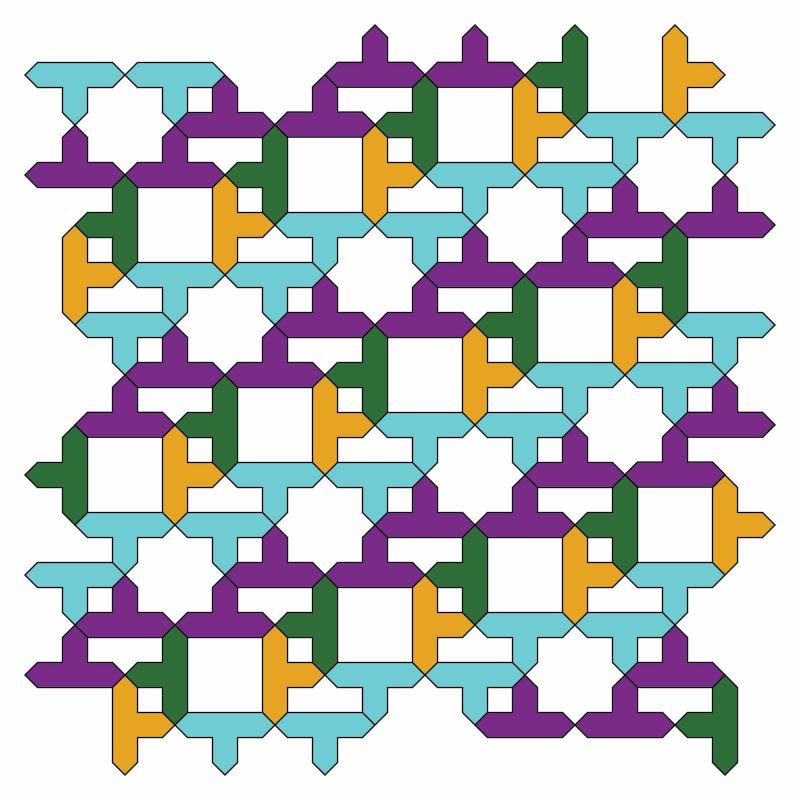
Right7 01

The inflated version that combines the original with its dual:

Right7 inf 01

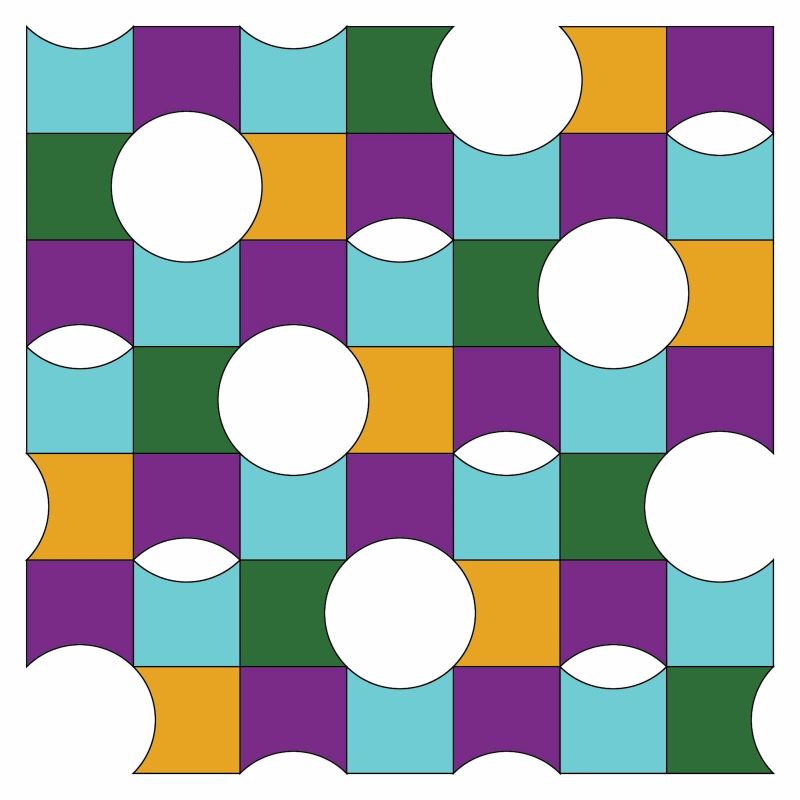
In the inflated version we can replace each 3-stick by a square so that the sides touch when the 3-sticks hold hands. The unused edge of the square is pushed inwards, turning the square into the familiar 3/4 pillow we admired the last time (the next image shows only a quarter of the previous piece. It repeats itself using horizontal and vertical translations).

Right7 p 01

As a final simplification, we can fill in the holes as follows: We replace the 3/4 pillows that border a hole by the polyomino they cover  (thereby filling in the hole). Below are the two simplest polyominoes that surround a hole:

Polyrule 01

These polyominoes will tile the plane as before, because each 3/4 pillow must belong to exactly one hole. Our 3/4-pillow tiling now becomes a very simple polyomino tiling:

Polyominoes 01

Thus periodic 3-stick-tilings with triple hand holding, 3-stick tilings with hand holding in pairs, 3/4-pillow tilings with holes, and  tilings by polyominoes that surround holes are all the same thing.

You can use this to design  much more intricate patterns, with holes of any size, for instance.

Three Quarters (From the Pillowbook VIII)

Today we will talk about a single, very neglected pillow, which I will call 3/4. To make things look pretty, we will color it depending on its orientation, as follows.

Single 01

Discriminated for centuries by the other, more curvy pillows, 3/4 only likes to hang out with other 3/4s and hide its straight edges as much as possible. Like so:

Right1 p

These two examples are portions of periodic tilings of the entire plane. This way, all straight edges are hidden, and we have periodically placed holes. This quickly becomes more interesting. Here, for instance, is the only tiling that has just circular holes (up to symmetries, of course):

Right2 p

The holes can be more complicated, like these double holes in subtly different periodic tilings.

Right5 p

Next month, we will analyze these patterns a bit. For today, we end with an example that indicates that the holes can become really big (as we will learn).

Right6 p

For today it’s enough to have learned that also the seemingly uninteresting can do pretty things.

Double Parity (From the Pillowbook VII)

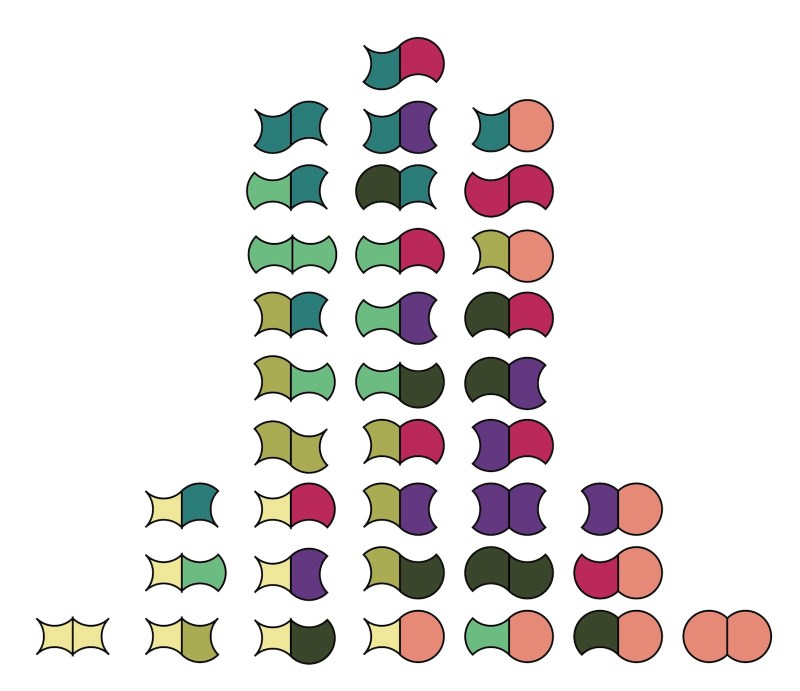
Here are the 36 pillowminoes introduced last time, arranged by their imbalance, i.e. according to how many more convex than concave edges they have. Isn’t that a pretty bell curve?

Pillowminoes weight

This time we will focus on the pillowminoes near the border of existence, namely the six ones that have all but one edge either bulging in or out. They have an imbalance of +4 or -4. Gathered and recolored, here are the marginal pillowminoes:

Margin

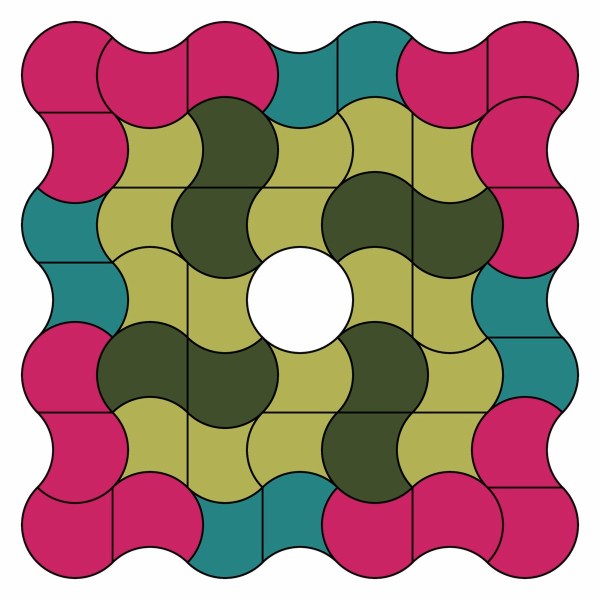
Let’s tile some curvy shapes with these. A curvy rectangle has odd dimensions, so cannot be entirely tiled by pillowminoes. If we decide to leave a round hole in order to fix that, the entire curvy shape will be balanced. This means that we will need the same number of brownish pillowminoes (with imbalance +4) as bluish ones (with imbalance -4). In particular, we will need an even number of these pillowminoes, so the total area of our shape needs to be divisible by 4. That’s our double parity argument.

The simplest example is that of a 5×5 square with a center hole (it’s easy to see that skinny rectangles with one edge of length 3 are not tilable with marginal pillowminoes).

5x5

The example to the left is the only one I could find, up to the obvious symmetries. To the right you see how one can inflate it to make frames, proving:

Theorem: If you can tile an axb holy rectangle with marginal pillows, then you can also tile a holy (a+4)x(b+4) rectangle with marginal pillows.

We have seen this trick before, talking about ragged rectangles.

The next interesting case are 7×7 squares. Here is one example that also teaches us another trick:

Theorem: If you can tile an axb holy rectangle with marginal pillows, then you can also tile a holy ax(b+4) rectangle with marginal pillows.

Add4

This second trick decenters the holes, however.

Finally, two examples that employ all six different marginals. First a 5×7 rectangle with center hole, then another 7×7 square that uses four marginals of each kind, nice and symmetrically.

Allsix

Stellated Triacontahedron

If you have mastered the Slidables from last year and had enough of the past gloomy posts, you are ready for this one.

Let’s begin with the rhombic triacontahedron, a zonohedron with 30 golden rhombi as faces. There are two types of vertices, 12 with valency 5, and 20 with valency 3. In the image below, the faces are colored with five colors, one of which is transparent.

Triacontahedron

The coloring is made a bit more explicit in the map of this polyhedron below.

Triagraph 01

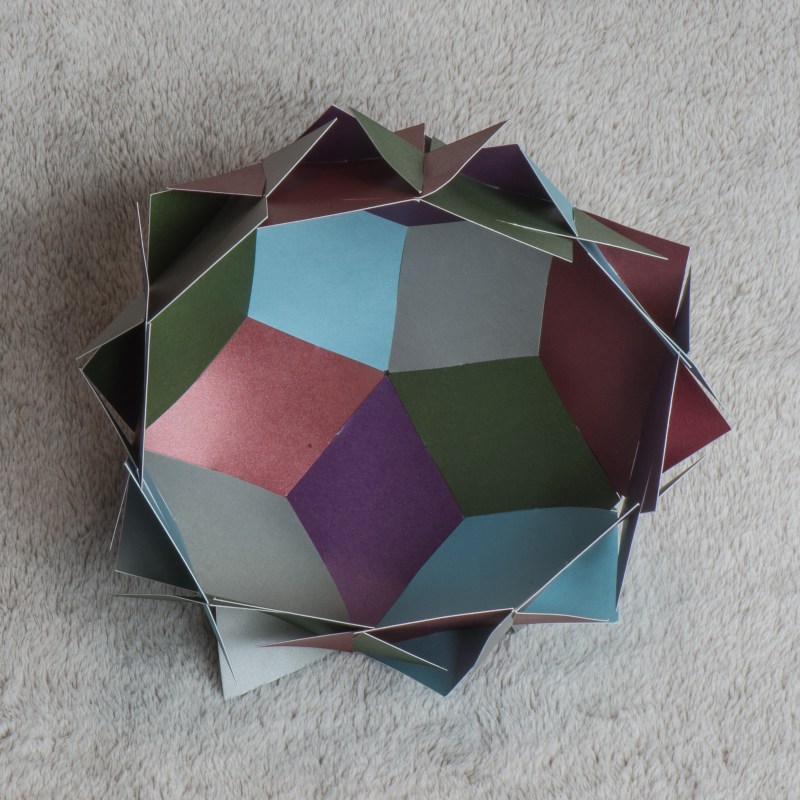
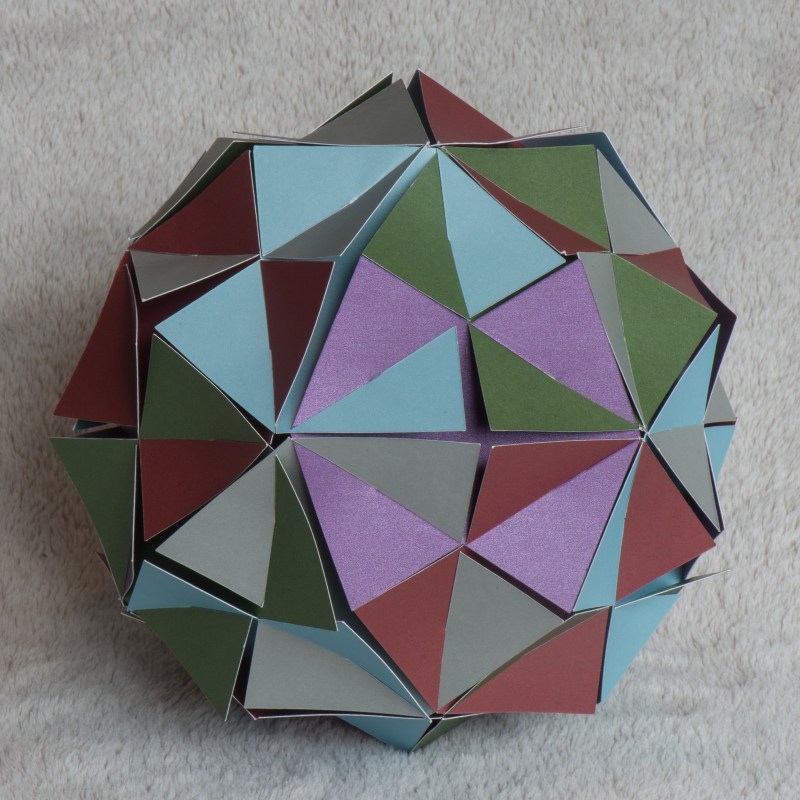
We are going to make a paper model of one of the 358,833,072 stellations of it. This number comes from George Hart’s highly inspiring Virtual Polyhedra.

Stellatriacontahedron

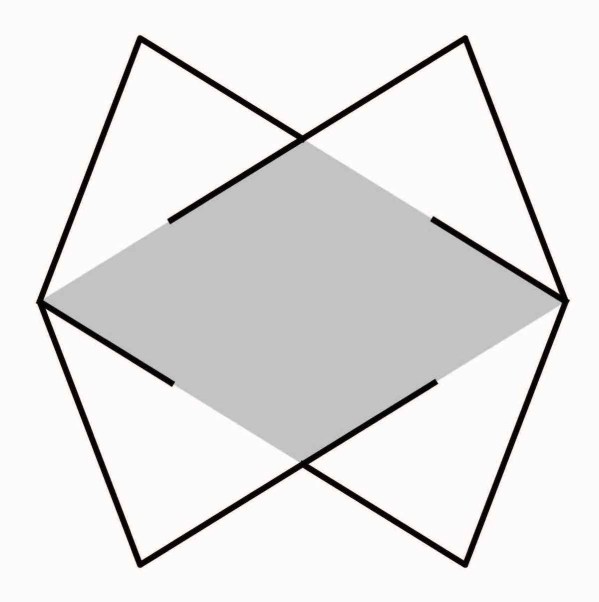
In a stellation, one replaces each face of the original polyhedron by another polygon in the same plane, making sure that the result is still a polyhedron, possibly with self intersections.

Newface 01

In our case, each golden (or rather, gray) rhombus becomes a non convex 8-gon. The picture above serves as a template. You will need 30 of them, cut along the dark black edges. The slits will allow you to assemble the stellation without glue. Print 6 of each of the five colors:

DSC 8159

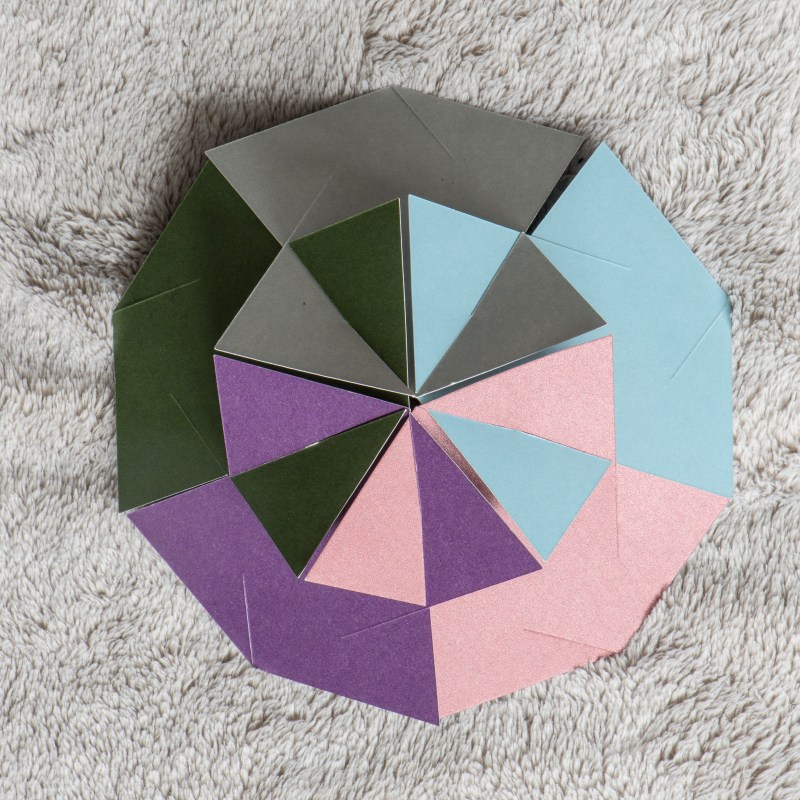
Now assemble five of them, one of each color, around a vertex. Note that there are different ways to put two together, make sure that the original golden rhombi always have acute vertices meeting acute vertices. This produces the first layer.

DSC 8161

The next layer of five templates takes care of the 3-valent vertices of the first layer. Here the coloring starts to play a role.

DSC 8162

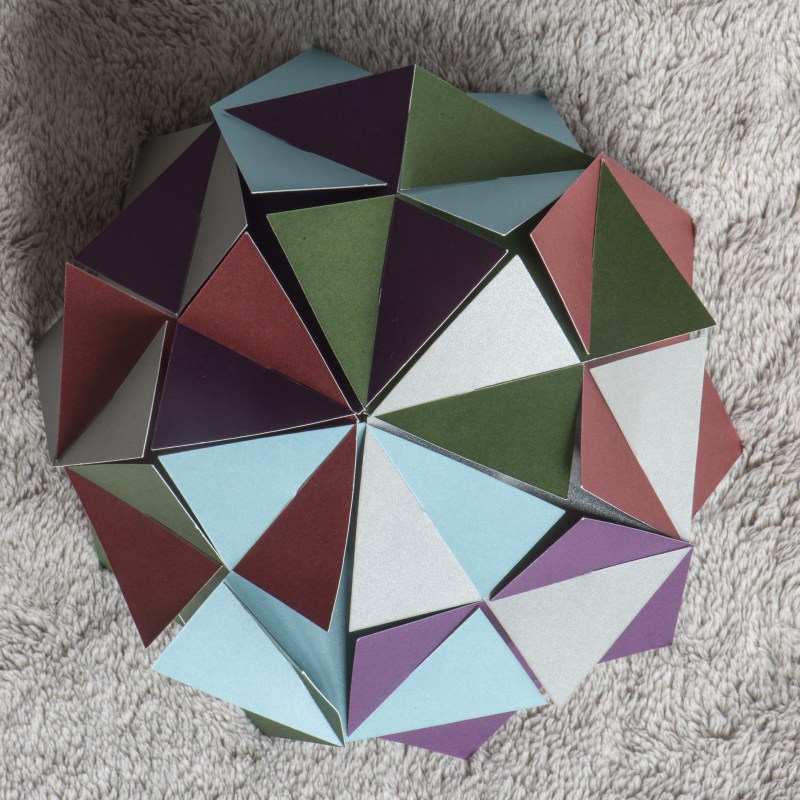
The third layer is the trickiest, because you have to add 10 templates, making vertices of valency 5 again. The next image shows how to pick the colors to maintain consistency.

DSC 8166

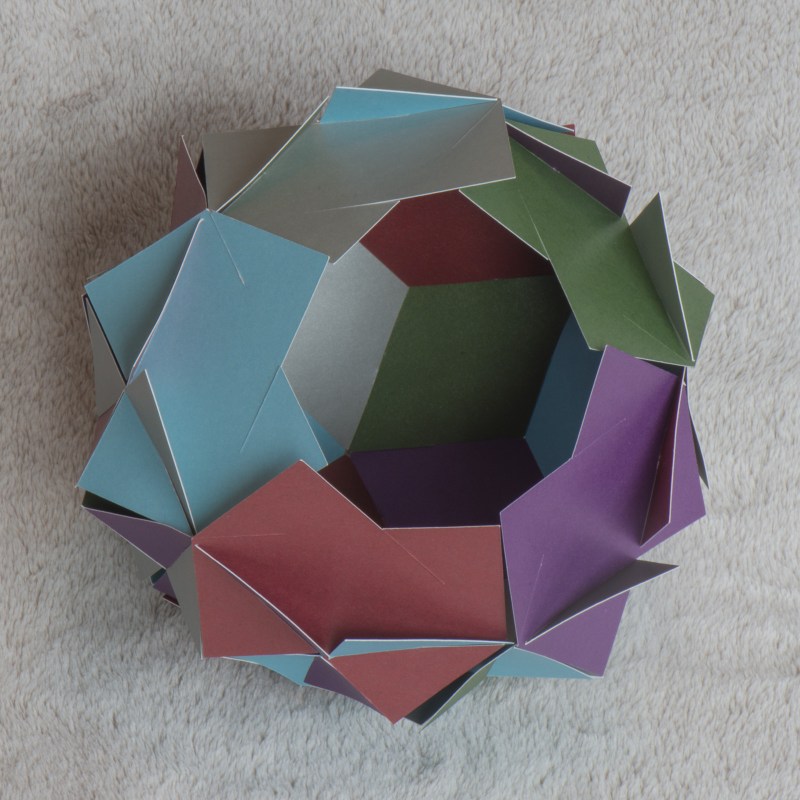
Below is the inside of the completed third layer.

DSC 8168

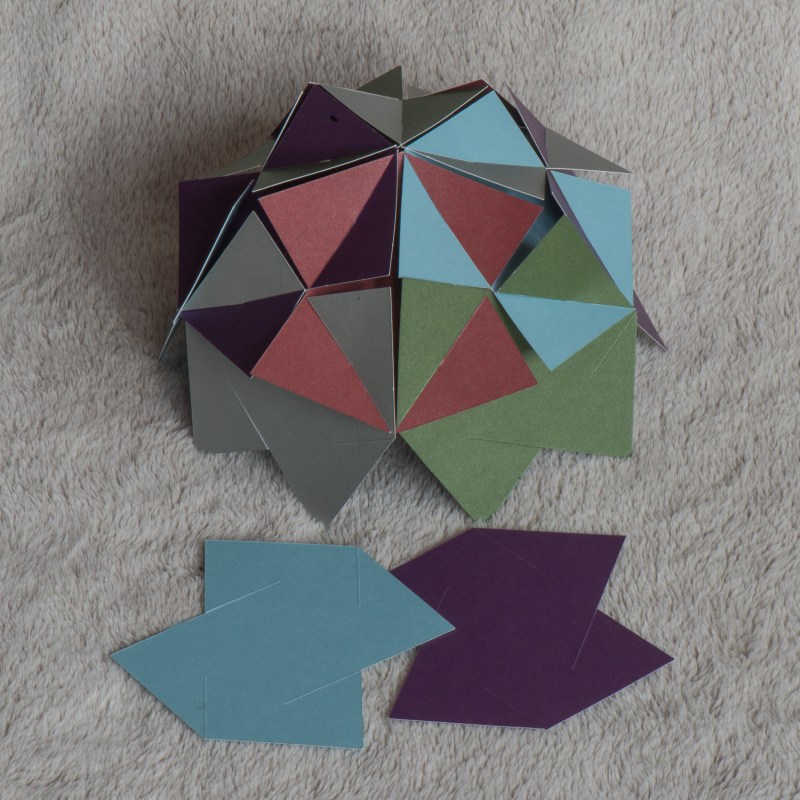
Two more to go. Layer 4 is easy:

DSC 8170

The last layer is again a bit tricky again, but just because it gets tight. Here is my finished model. It is quite stable.

DSC 8174

Pillowminoes (From the Pillowbook VI)

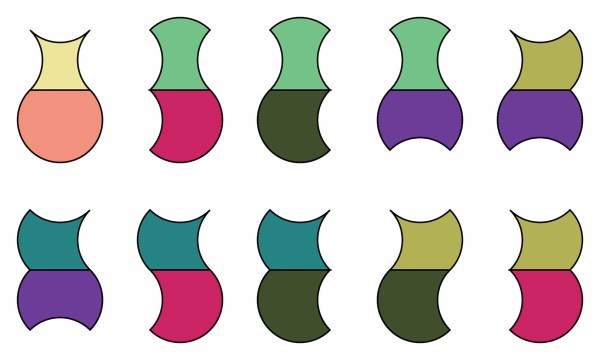
The admission of an abundance of pillows with straight edges to the zoo raises the question whether these new citizens are any good. We have employed the ones with two straight edges to form arrows and combine to Hamiltonian circuits. Today we will look at those eight pillows with a single straight edge (let’s call them the singles)

Eight 01

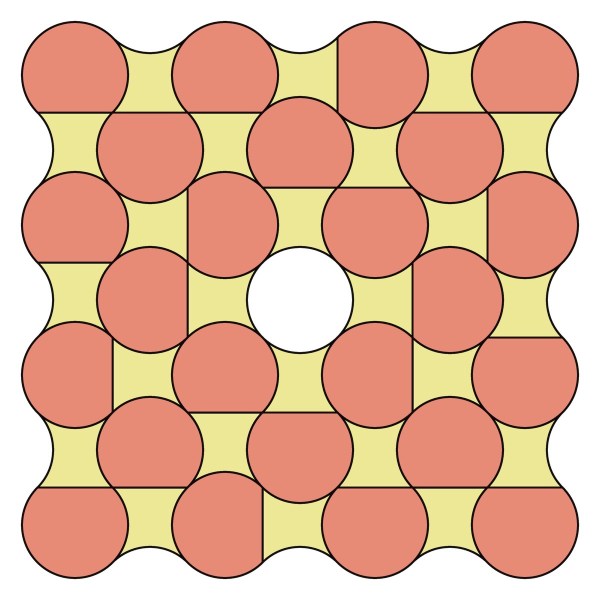
Can we use them to tile a curvy 7×7 square, say? The answer is clearly no, because the singles have to hide their straight edges by combining in pairs to pillowminoes. This means we can only tile curvy shapes with an even number of singles. Here, for instance, is a simple solution that shows how to tile a 7×7 curvy square with a gap at the center. It also shows how to tile this shape with a single pillowmino.

7x7 01

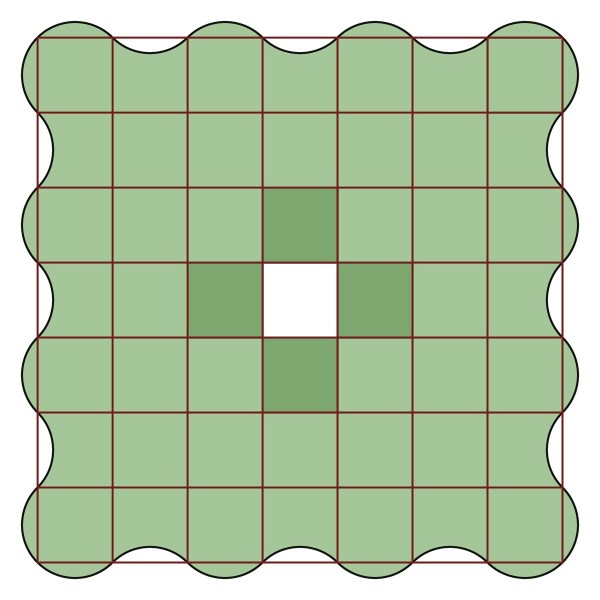
This looks too easy? Can we also tile the same curvy 7×7 square so that the missing square at the center has four straight edges?

7x7no 01

A little trial and error shows that this is not possible, but we would like to have a reason for this. We need for singles to neighbor the missing square at the center with their straight edges. I have indicated their position by a slightly darker shade of green. Thus the remaining lighter green squares will be entirely curvy, so needs to be tiled with singles that have combined into pillowminoes. That, however, is impossible: Color the squares alternatingly yellow and pink, as in the solution above. Each pillowmino will cover a pink and a yellow square, but the light green shape that needs to be tiled consists 24 pink and 20 yellow squares. This argument also shows that the missing square needs to have all edges curved.

What else can we do with the pillowminoes? There are 36 of them, and not all of them tile by themselves. If we want to tile the curvy 7×7 square with a circular gap in the middle, we will also need to balance the convex and concave edges, as explained earlier.

Here are the ten balanced pillowminoes:

Balanced 01

Surprisingly, only the top left will tile the 7×7 (or any larger) curvy square with a central gap.
Below is an example that tiles with four individually unbalanced but centrally symmetric pillowminoes.

7x7b 01

More to follow!