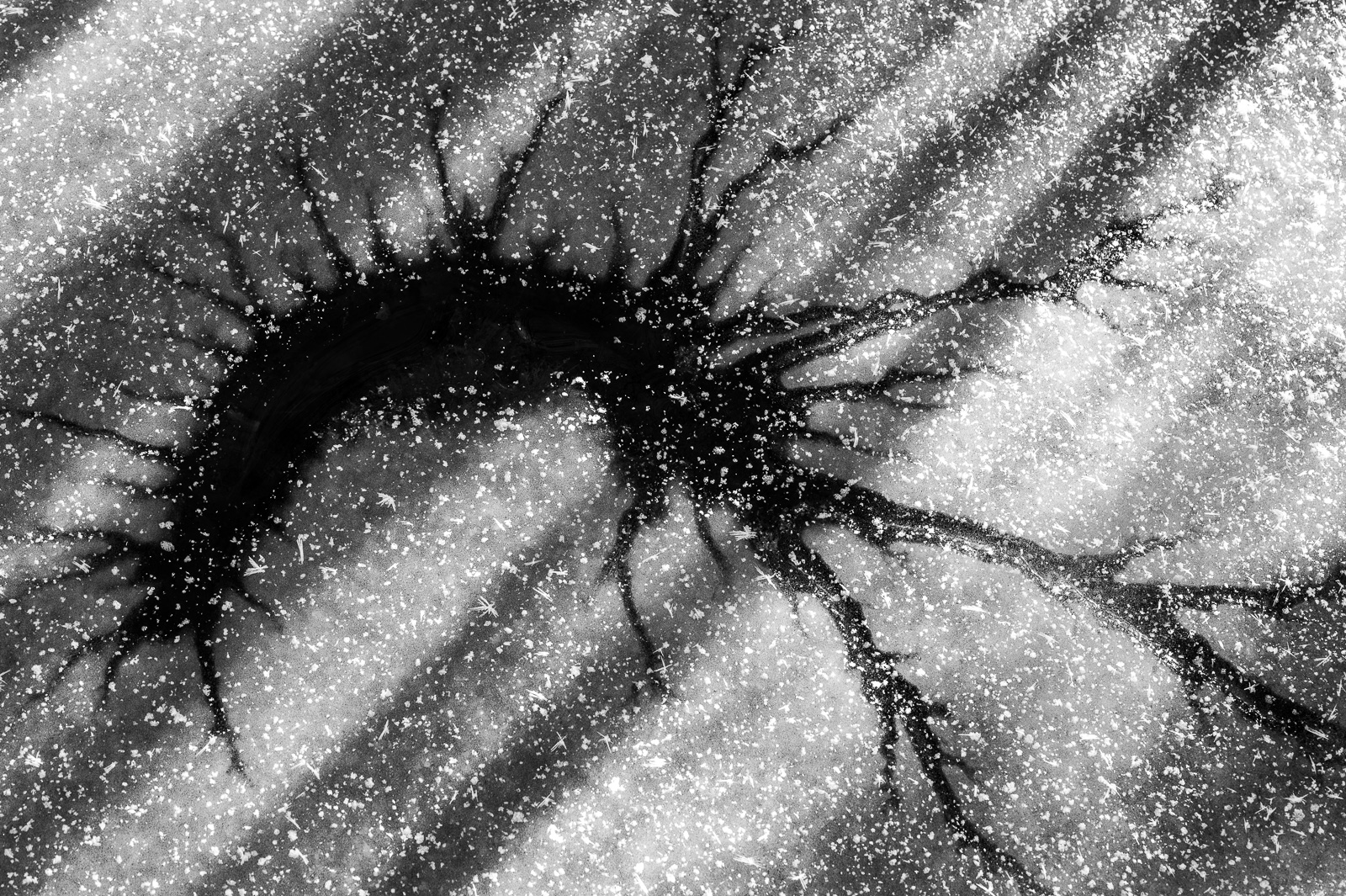





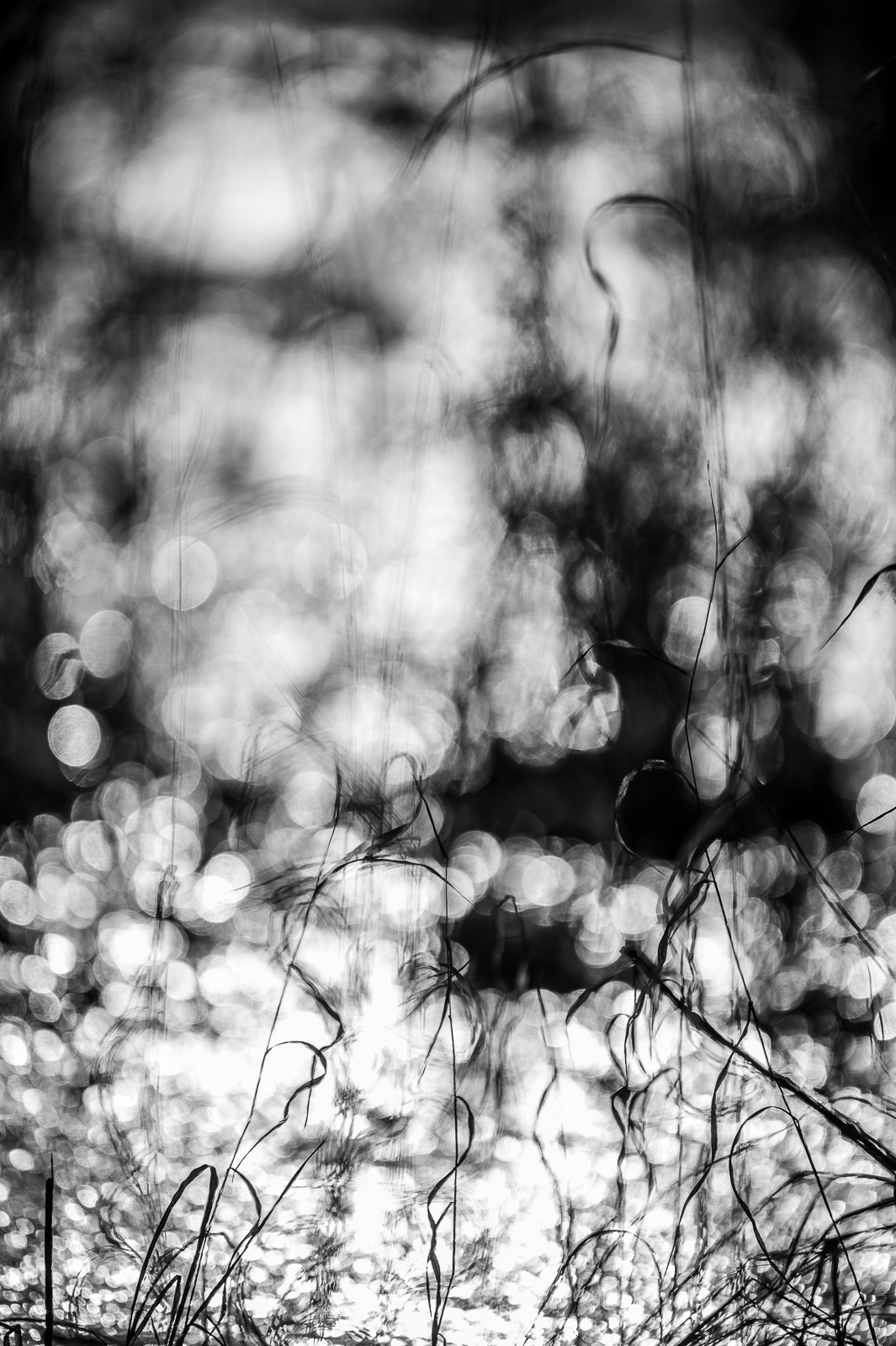





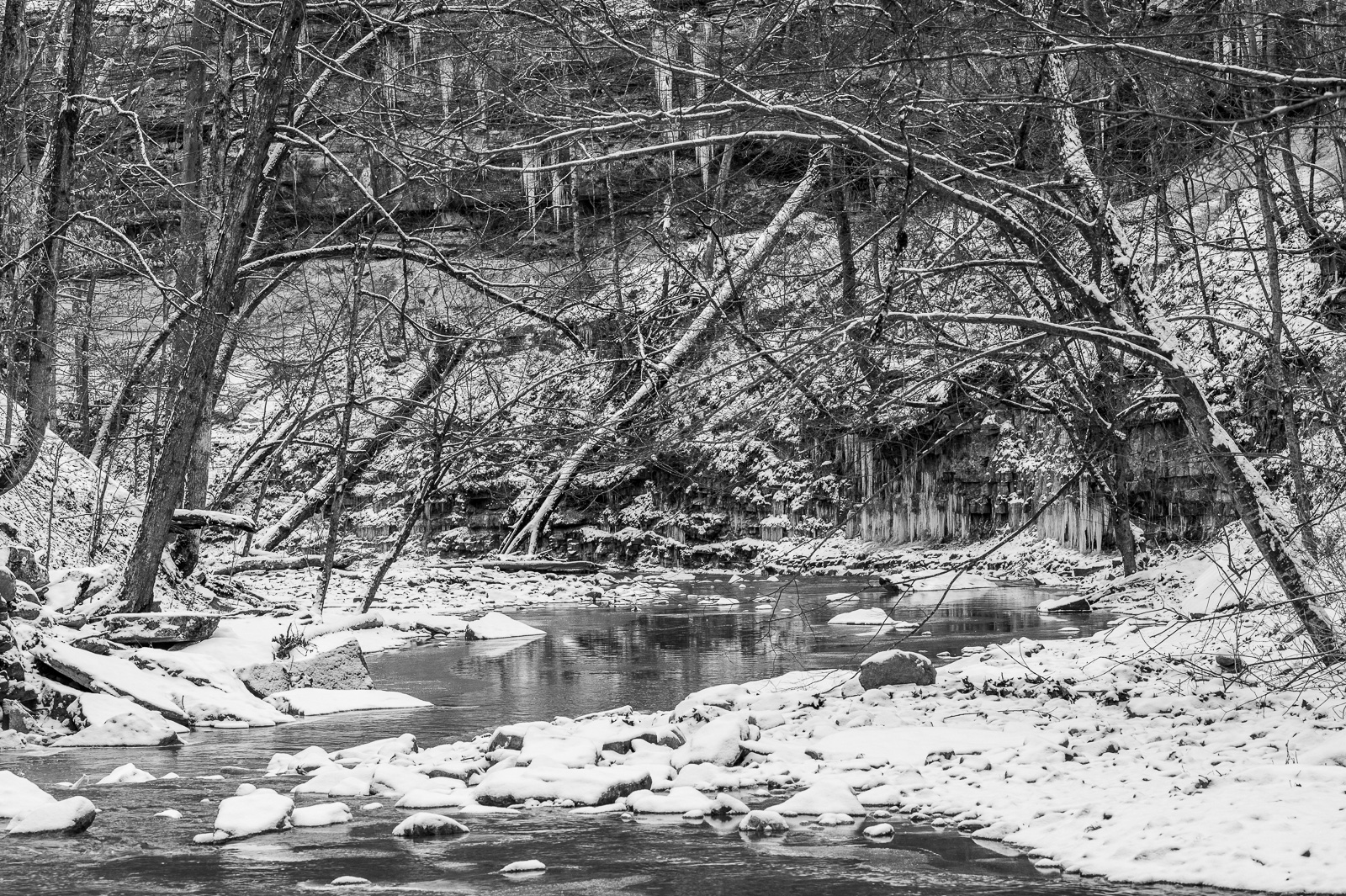
The permanent process of erosion is best visible in winter when it is suspended. The natural pull of gravity seems powerless against the tight grip of the frost.
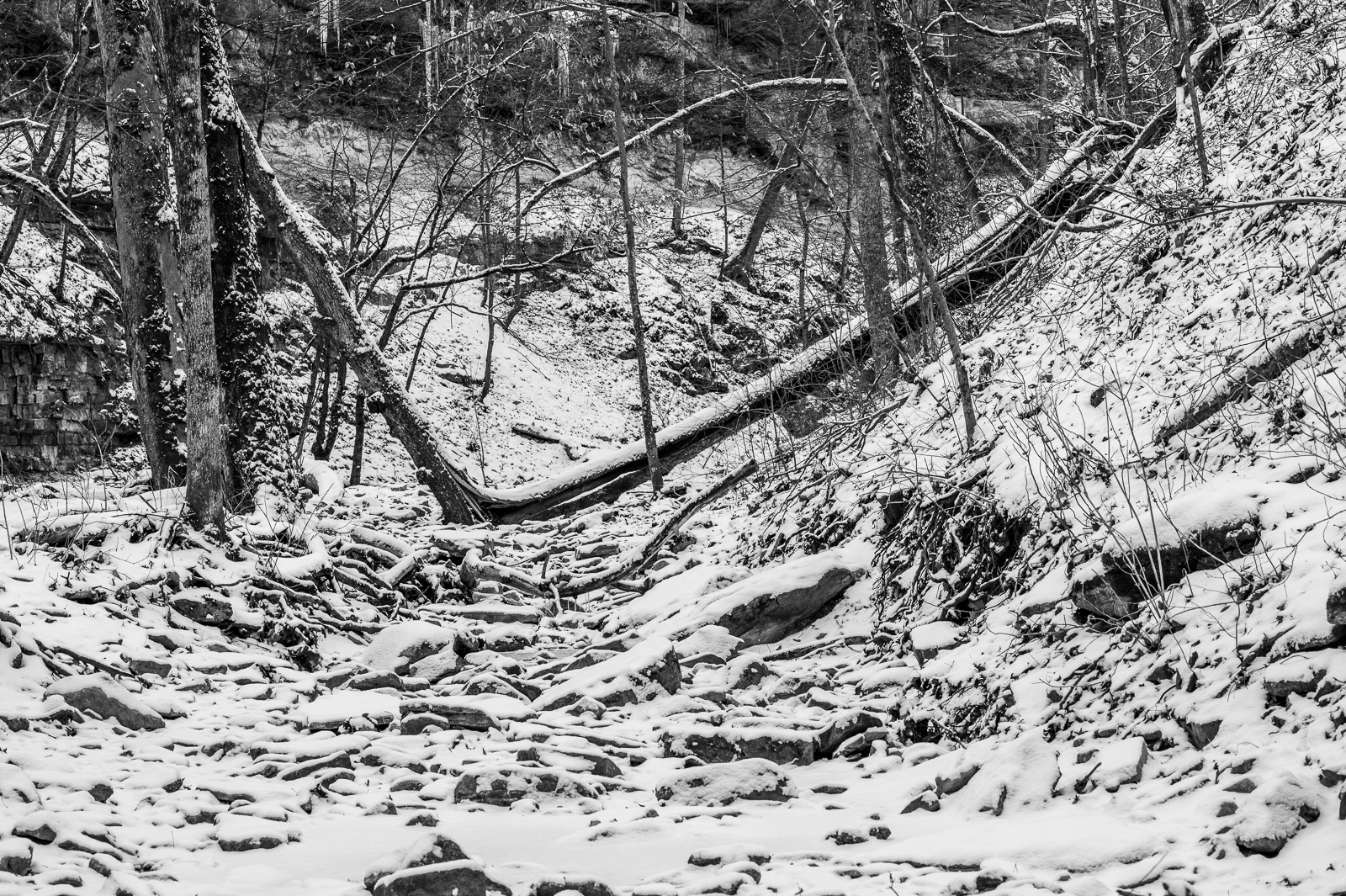
Because the trees and rocks had somehow to get there, we can be certain that warmer weather will set things dramatically in motion again.
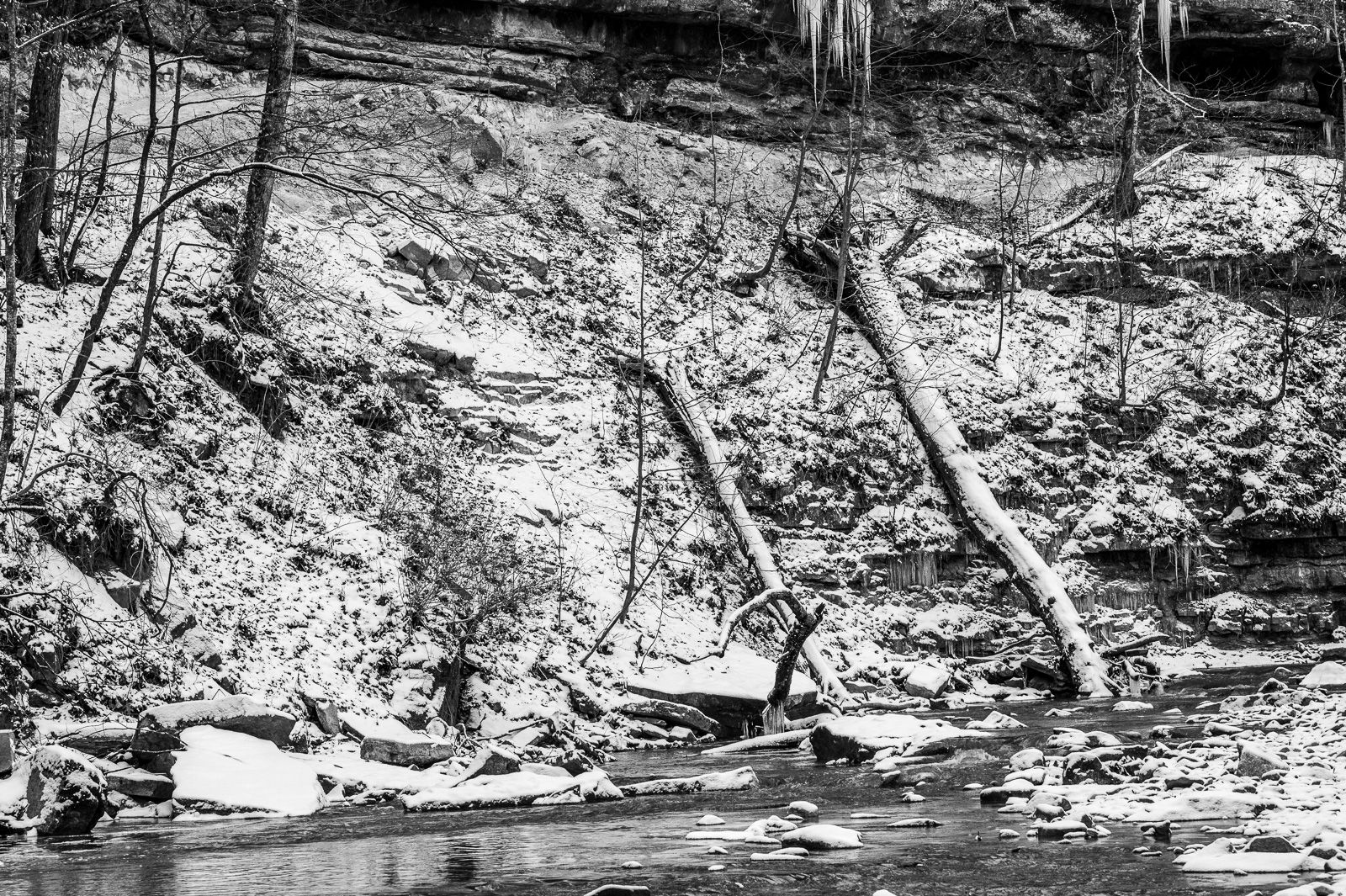
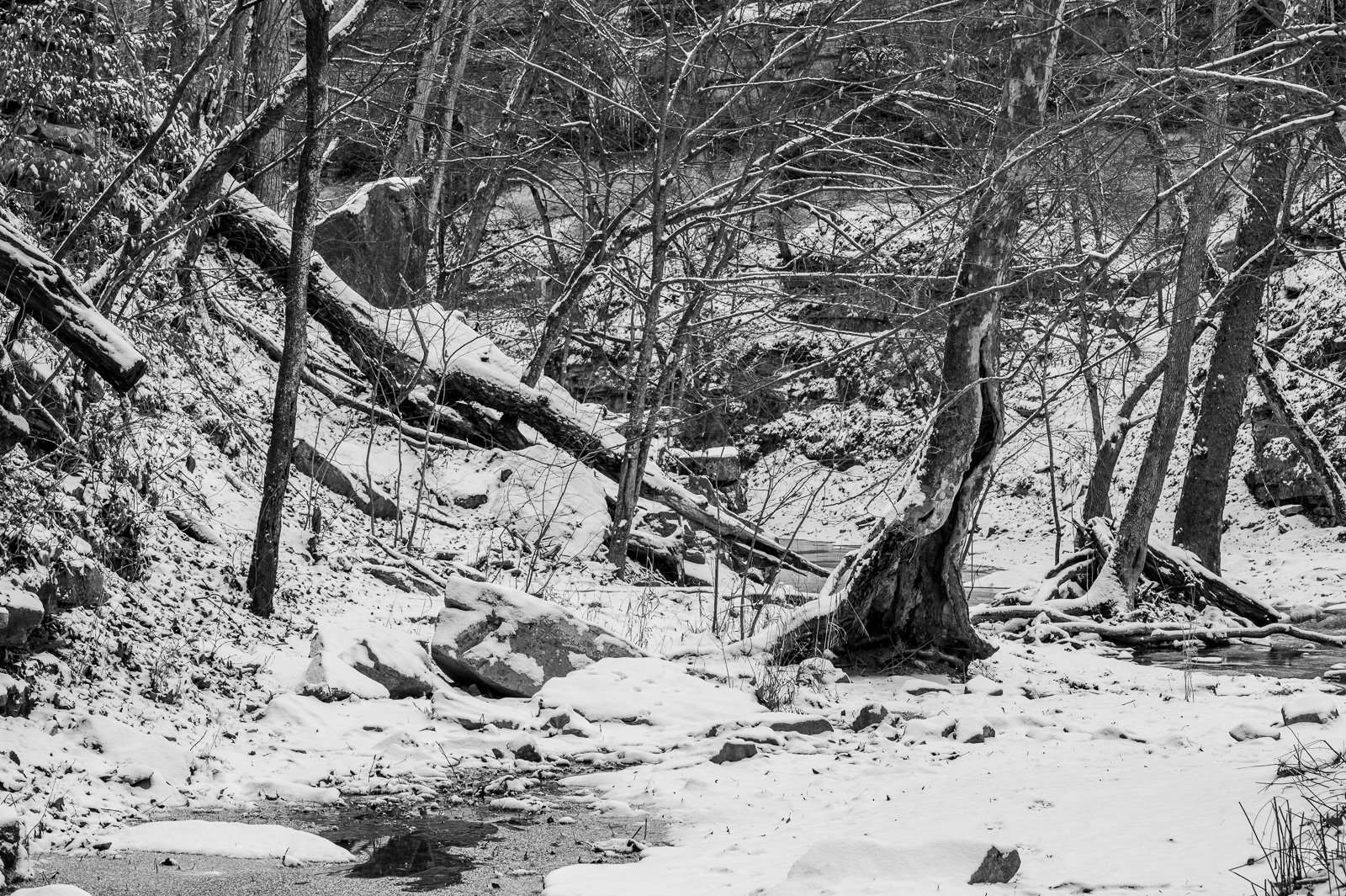
Today’s pictures were taken all at the same spot, where McCormick Creek bends slightly and the canyon is deepest. All this is a relic from the last ice age.

At the moment it looks like it is in a state of eternal permanence.
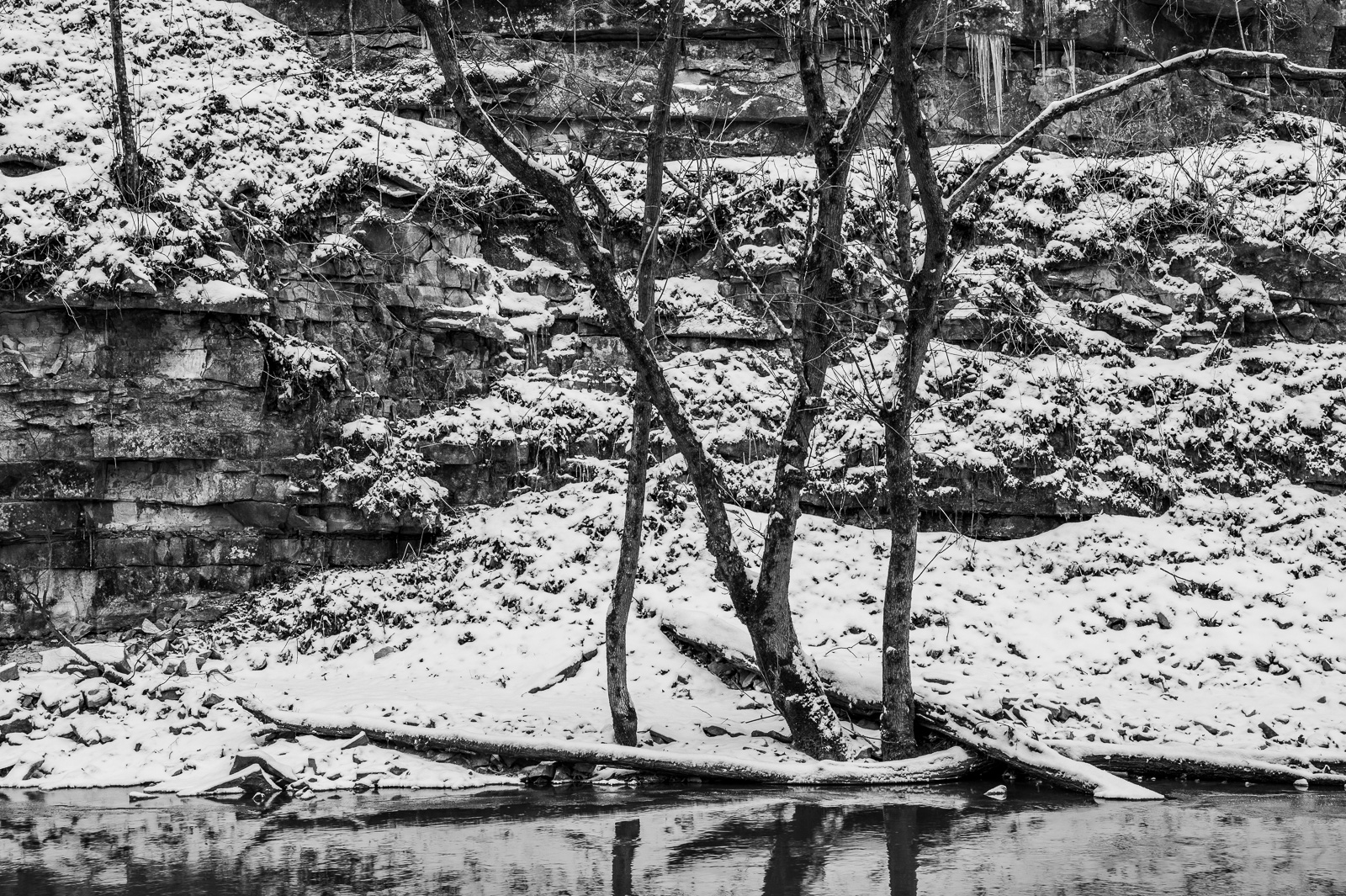
We clearly understand little about time.
We all love natural numbers. Let’s take a sequence of real numbers 0 = a0 < a1 < a2 < …and corresponding intervals An = [an, an+1]. We call an interval An lucky if it contains a natural number: Here the intervals A1, A2, A4, A5 are lucky and marked in green. We don’t want intervals to be too lucky and therefore insist that intervals are shorter than unit length. We also want each natural number to know where it belongs, so we don’t want our sequences to contain any natural numbers.
To increase happiness, we consider two such sequences an and bn shown on top of each other at height +1 and -1, respectively. Corresponding intervals An and Bn are upper and lower edges of quadrilaterals Qn. 
In this particular example the sequences are linear, namely an = n(𝛗-1) and bn= n(2-𝜑), where 𝜑 is the Golden Ratio once more. We note that either An or Bn is lucky, but never both. So each quadrilateral has precisely one lucky edge.
In order to understand how this can possibly be true, we consider more generally two increasing sequences an and bn such that an + bn = n, and such that intervals are shorter than 1. Then the average sequence is cn = (an + bn)/2 = n/2, which we include in the next figure at height 0 between the sequences an and bn.
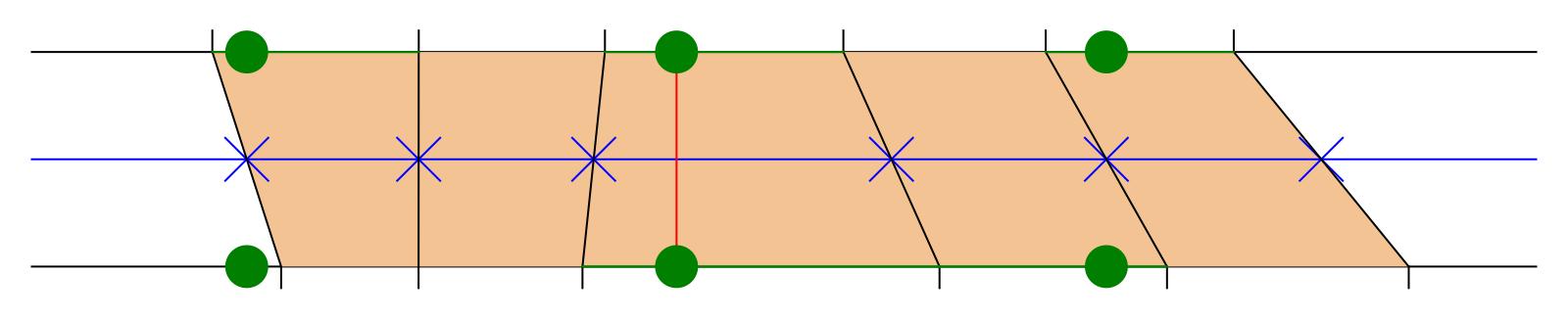
As already noted, no interval An or Bn can contain two natural numbers. If both contain a natural number, we can join them by a red segment within Qn which intersects the height 0 line in a point whose x-coordinate is of the form n/2, where n is a natural number. But all these points with half-integral coordinates are already taken by the (blue) sequence cn. So at most one of the intervals An or Bn can be lucky.
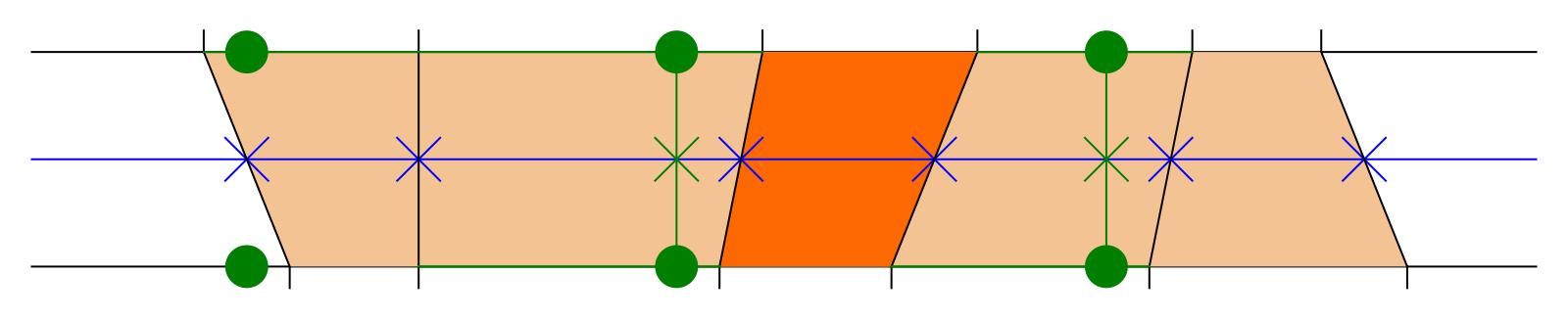
Now suppose that neither An or Bn are lucky. Then both intervals An and Bn are contained in integer intervals of length 1, marked as green dots to the left and right of the orange quadrilateral. The endpoints average to points with integral coordinates (green crosses) that are 1 unit apart and outside the orange quadrilateral. But both blue crosses on the orange quadrilateral have half integral coordinates, which can’t be. Thus either An or Bn is lucky.
As promised, this proves Raleigh’s Theorem: If irrational 𝛂, 𝛃 > 0 satisfy 1/𝛂 + 1/𝛃 = 1, then 𝛂n = [n 𝛂] and 𝛃n = [n 𝛃] are complementary, i.e. each natural number occurs in precisely one of the two sequences.
To see this, let a=1/𝛂 and b=1/𝛃, an = n a and bn= n b. Now observe that An contains a natural number k if and only if
an < k < an+1 if and only if n< k 𝛂 < n+1 if and only if n = [k 𝛂] (and likewise for Bn).
The argument in terms of intervals is a mere geometric formulation of the standard proof of Raleigh’s theorem but gives a more general result that is not so apparent in the purely algebraic version.



After 4-5 inches of snow over night, I couldn’t resist to get up early to be the first on Pate Hollow. Well, I wasn’t quite the first, as numerous animal tracks testify, but otherwise the trail was so completely virginal that it was almost invisible.
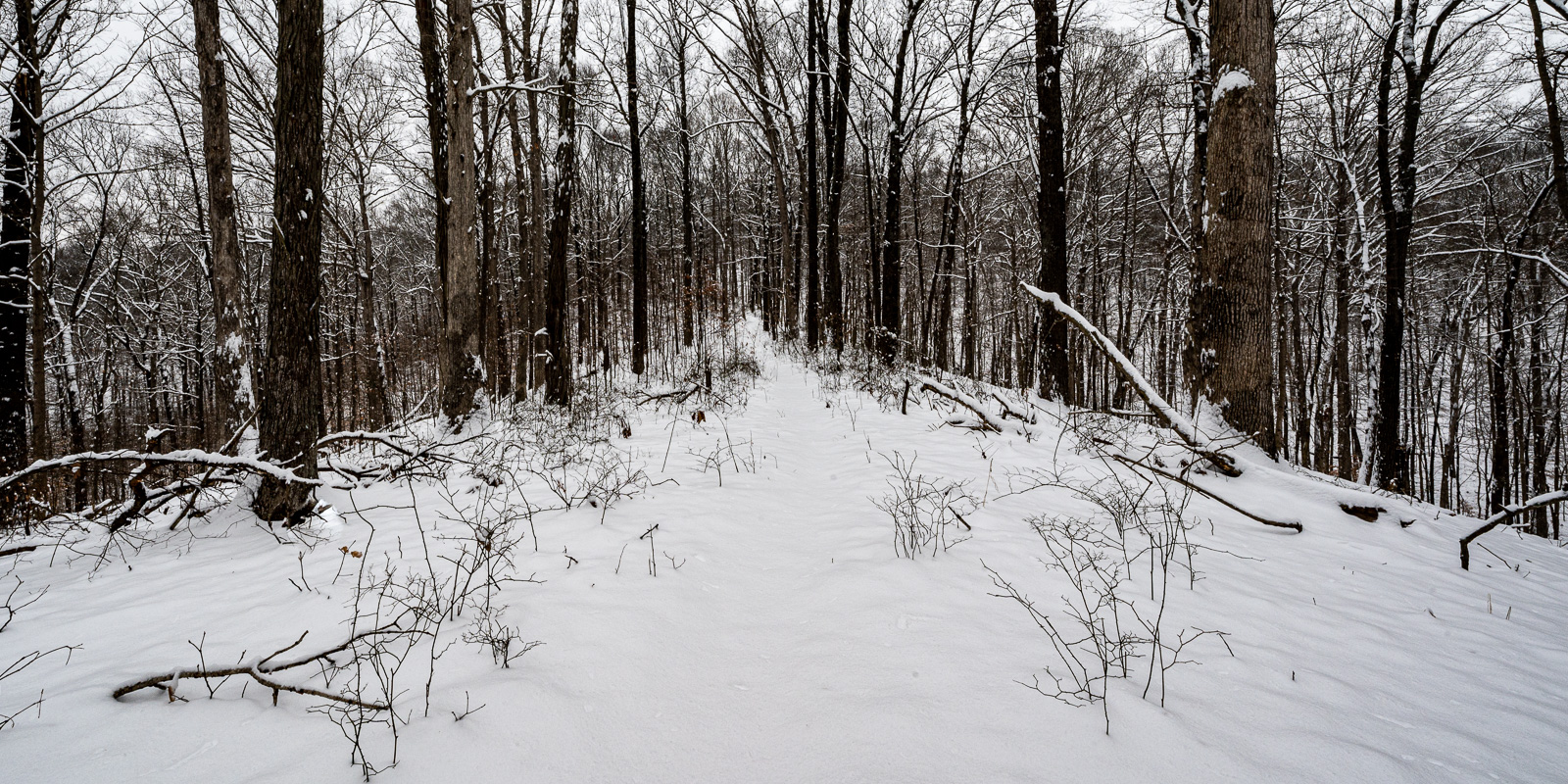
Snow increases gravity, which is why I have changed the usual aspect ratio from 3:2 to 2:1.

There is resistance against the gravity, and efforts of verticality have become more pronounced against the uniformly white backdrop.

The Black and White contrast makes it possible to spot the Baxter branch in a trail-less valley down below which we will pay a visit soon.
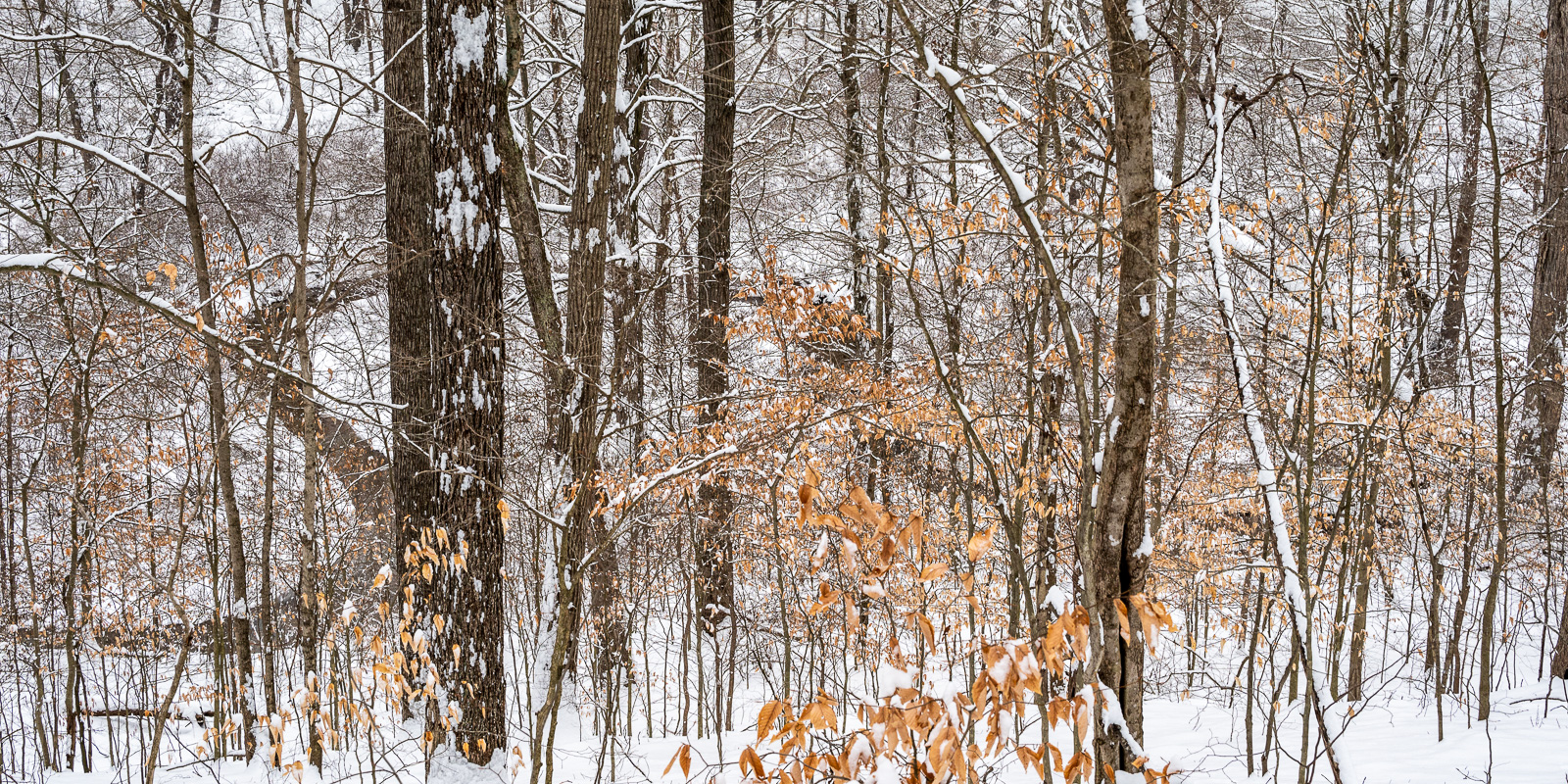
Then there is my favorite detour to the desolate peninsula.

The lake only appears to be frozen. Snow can be treacherous, too.

I return to the trail: but where is it?

As time expands (it took me three instead of the usual two hours to hike this trail today), the attempts to defy gravity become more and more futile.

But there is no giving up. Just look at these pine needles!



Can we do this, too — transform our transient stream of thoughts, worries, and hopes into something else, like frost transforms water into ice?

How do we begin? How do we get ready for it like water always is?

In Adalbert Stifter’s Rock Crystal (quotes below in the translation by Marianne Moore) the two siblings Sanna and Conrad get lost on a vast glacier in a snow storm on their way home in the Alps. Frost has transformed the landscape, and is transforming the children, too, to the absolute essential.

The boy maintains hope, despite evident hopelessness, and his little sister maintains trust.
At last they came to a tract with not a tree on it.
“I don’t see any trees,” said Sanna.
“Perhaps the road is so wide we can’t see them because of the snow,” said the lad.
“Yes, Conrad,” said the little one.

“Sanna, we cannot go over there,” said the lad.
“No,” said the little one.
“We shall just turn around and get down somewhere else.”
“Yes, Conrad.”
These dialogues continue like this, while the children spend the night on the mountain in the ice. Conrad and Sanna are becoming ice, too, Conrad refracting reality and Sanna reflecting it back to him.



Frost is usually an unpleasant experience for us, but I take the arrival of a much needed cold front here as an opportunity to look at its benefits.

There is for instance hibernation — and I don’t mean some form of revocable death, but a state of reduced activity of body and soul. Reportedly, bacteria in Antarctica have not only survived hundred of thousands of years in the ice, but stayed active repairing their DNA during the entire time.

100 Years of Solitude are nothing compared to this, and one year of covid should also be survivable, in proper hibernation.

The contemplation of beauty in the frozen landscape has become my personal way of hibernation these days.

In math, a sieve is used to divide the integers in two piles, the good ones and the bad ones. The oldest example is the Sieve of Eratosthenes, used to find the list of prime numbers: We start with the list 2, 3, 4, 5, 6,… of all integers greater than one. The first element in the list is declared good, and all multiples are declared bad. This leaves us with the list 3,5,7,9,11,13,15,17,… of all odd numbers greater than one. Again the first element in the list is declared good, and all multiples are declared bad, leaving us with 5, 7, 11, 13, 17, 19, … If we keep going like this, the good numbers become the list of all prime numbers.

A much simpler sieve proceeds as follows. We start with all positive integers. In step n, we declare the first element (say a) as good, and the element a+n as bad. So in step 1, 1 is good, 2 =1+1 is bad, and we are left with the list 3, 4, 5, 6….. In the second step, 3 becomes good while 5=3+2 goes bad, leaving us with 4, 6, 7, 8, 9, …. In the third step 4 becomes good and 7=4+3 goes bad, etc.
This separates the positive integers into the sequence a(n)=1, 3, 4, 6, 8, 9, 11, 12, 14, 16, … of good integers and the sequence b(n)=2, 5, 7, 10, 13, 15, 18, 20, 23, 26, … of bad integers.

Miraculously, there is a simple formula for these sequences. We have a(n)=[n 𝜑] and b(n)=[n (𝜑+1)], where [x] denotes the largest integer less than or equal to x, and 𝜑 = (1+√5)/2 is the Golden Ratio. Sequences of the form [n 𝛂] are called Beatty sequences, and Raleigh’s miraculous theorem states that [n 𝛂] and [n 𝛃] are complementary if and only if 1/𝛂+1/𝛃=1. Even more miraculous is that Raleigh’s theorem isn’t so difficult to prove, but this has to wait here until I find a picture proof of it. Given all this, it is not difficult to see that the good and evil sequences are indeed the Beatty sequences as claimed.

But there is more, these sequences are also relevant for a Nim-variant called Wythoff’s game. This is played with two heaps of tokens, and the two players take turns taking an arbitrary amount of tokens from either pile, or the same amount of tokens from both piles. The game ends with the winner making the last move.

If we label a position of two piles of size a and b as a point (a,b) in the first quadrant, the top picture shows all legal moves from the purple position as green positions.
The second picture shows a sample game, ending with orange losing, because they are out of moves.

How do we find a strategy? We mark (third image) all positions where the first player can win as green. The unmarked positions closest to the point (0,0) are then certain losing positions, because the first player has to move from them to green. We mark these two as orange, and again all positions from where those can be reached as green (fourth image).

This process of separating positions in winners and losers is just the sieve we used to create the a(n) and b(n) sequences — in fact, the positions (0,0), (a(n), b(n)) and (b(n), a(n)) are exactly the losing positions for Wythoff Nim. You can use the last image to contemplate this. If you are above the orange or below the cyan line on a white position, you can win by moving down or left to an orange or cyan position, because the two Beatty sequences are complementary. If you are between the two lines, you can move diagonally down-left to an orange or cyan position, because the differences b(n)-a(n)=n exhaust all integers.
I thought I’ve done all of it: Forgot the camera, leave the battery uncharged, overwrote the memory card. And not just once. So I have become pretty good at double checking my equipment.

I did check everything before I went today to take some shots of my beloved Pate Hollow trail in snow.

What I forgot was that I had set the camera to take double exposures when I took photos for Wenckheim X. Back then, I had try to compose the double exposures carefully.
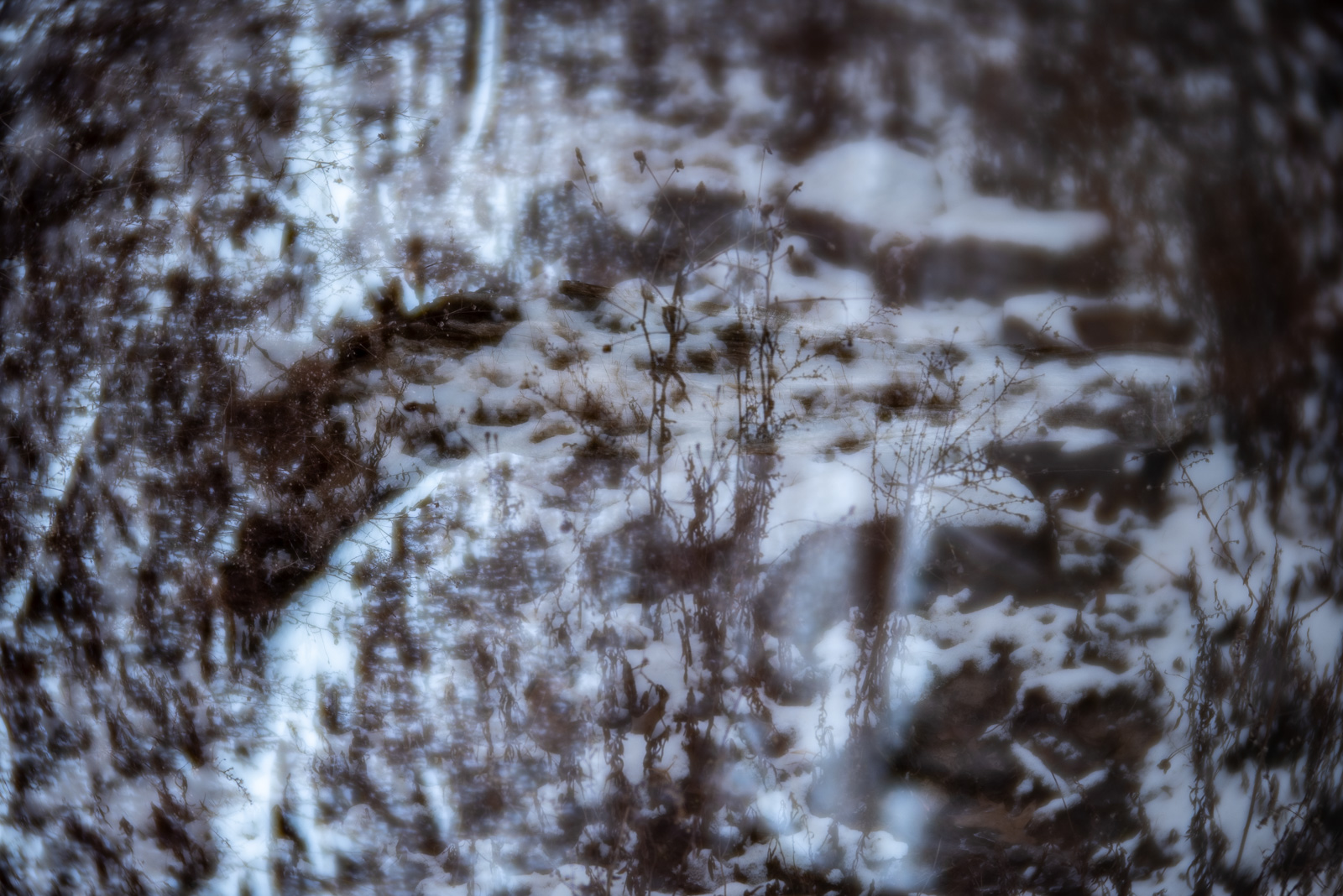
Not so here. They are completely unintended. Of course most of the pictures are just trash.

Some, however, came out nicely, when the subconscious effort to capture the atmosphere of the place superposes its actual appearance.

I see this as a unique opportunity. There is no way to make the same mistake unintentionally a second time.
We continue on to the Eastern loop of the Mogan Ridge trail, another 6 miles or so. It follows indeed mostly a ridge, with ups and downs.
Ridges are an interesting design pattern, they can serve as watersheds between light and dark, for instance.
They are — isn’t it in the word? — rigid borders, immutable, and encourage compartmentalization.
Walking a ridge means having a constant choice: Shall we go left and hide in the woods, or do we confront the alien who is beckoning strangely?

What better place for us than this lake, protected between two ridges? Don’t we want peace?

Someone has decided to stay.
The true ridge walker will avoid either choice and stay on the ridge, letting all possibilities pass.
And on we go. Stone faces are looking at us again with disdain. They didn’t have a choice.
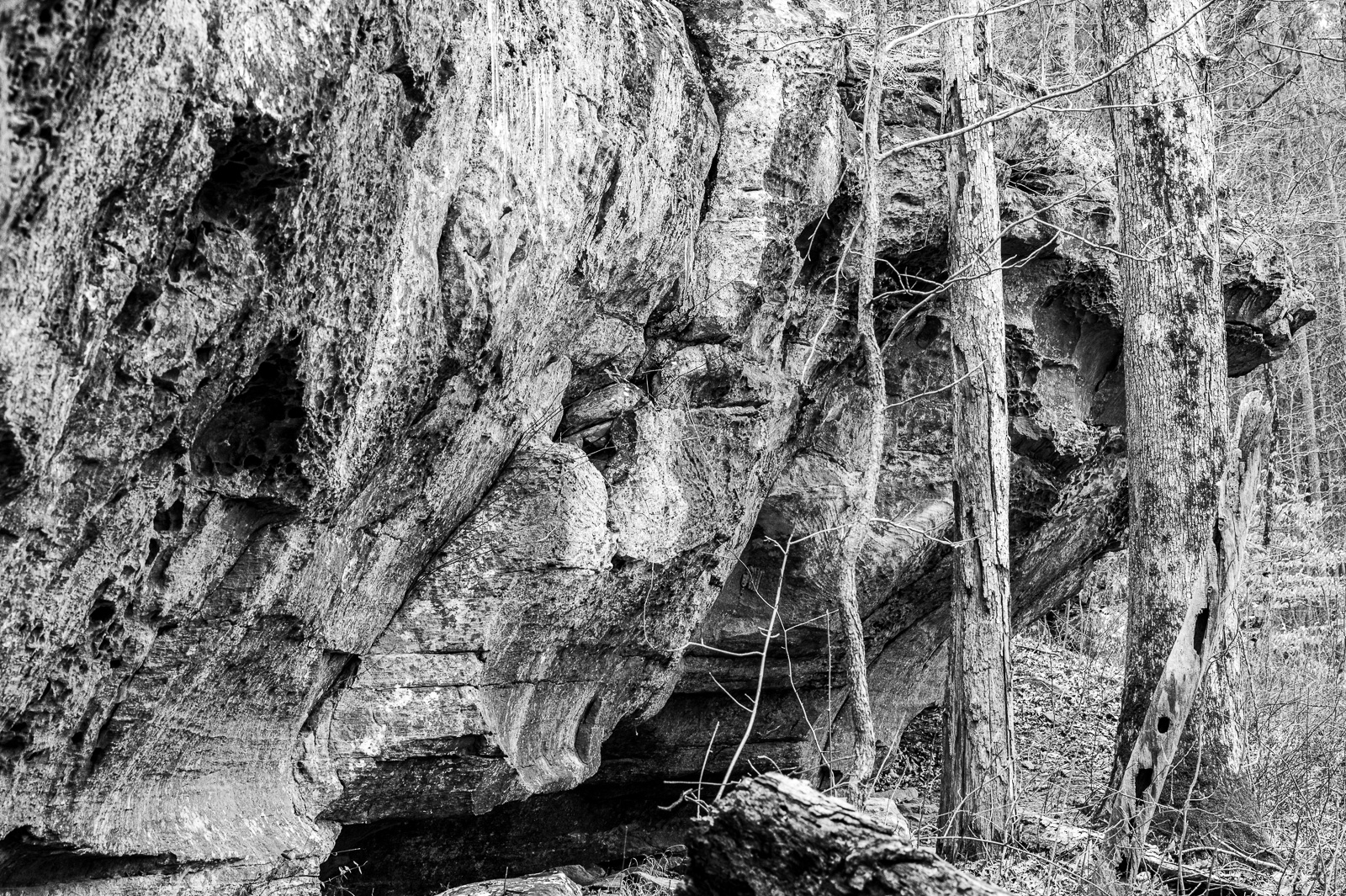
Do we have regrets? No, we’ve made our choice.
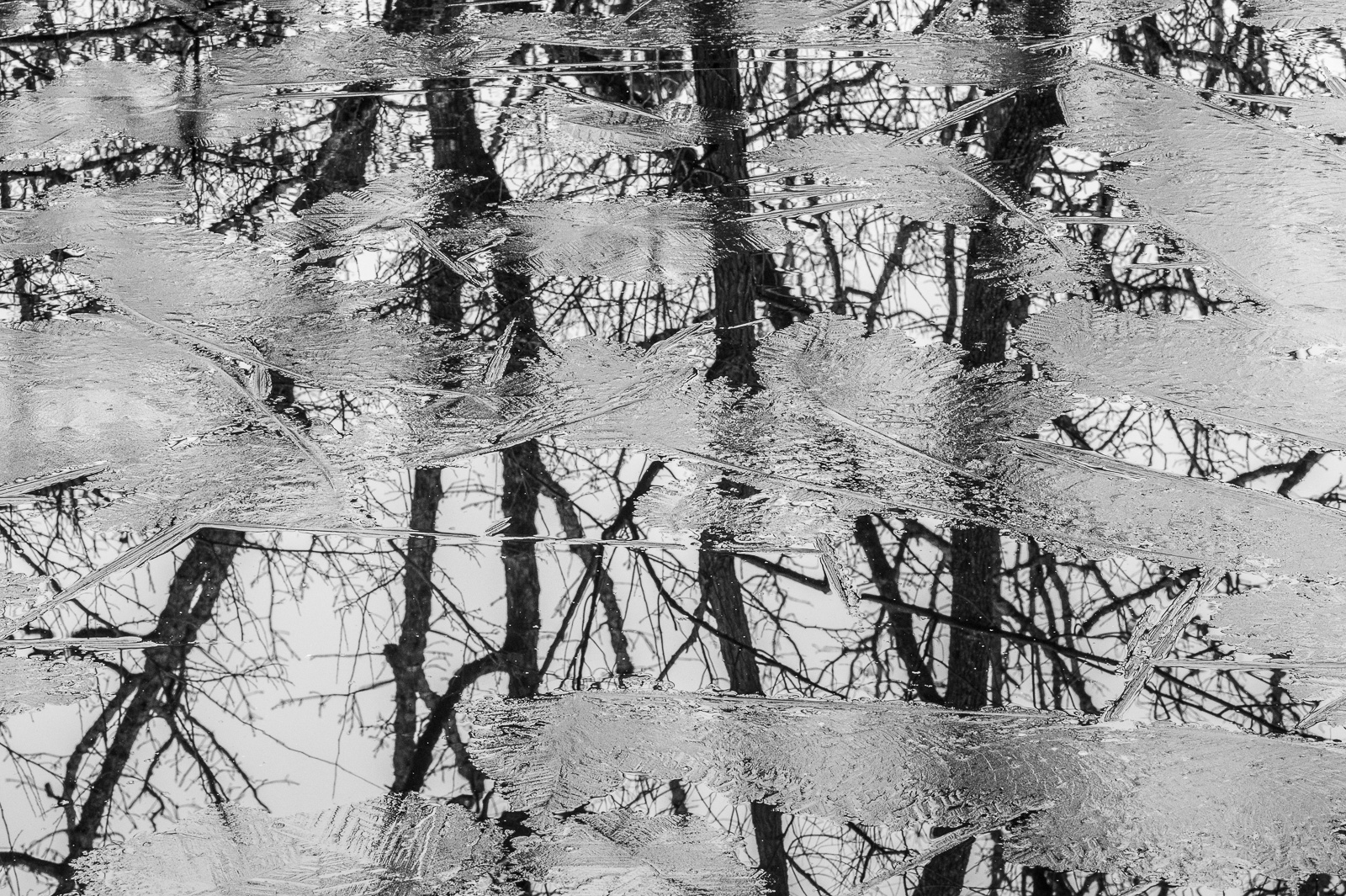
A maze usually consists of a few rooms with options to move to other rooms, and the goal is to find a way from one given room to another one. In a fractal maze, some rooms might be copies of another maze, that itself contains rooms that are copies of other mazes, again and again. Here is a simple example:
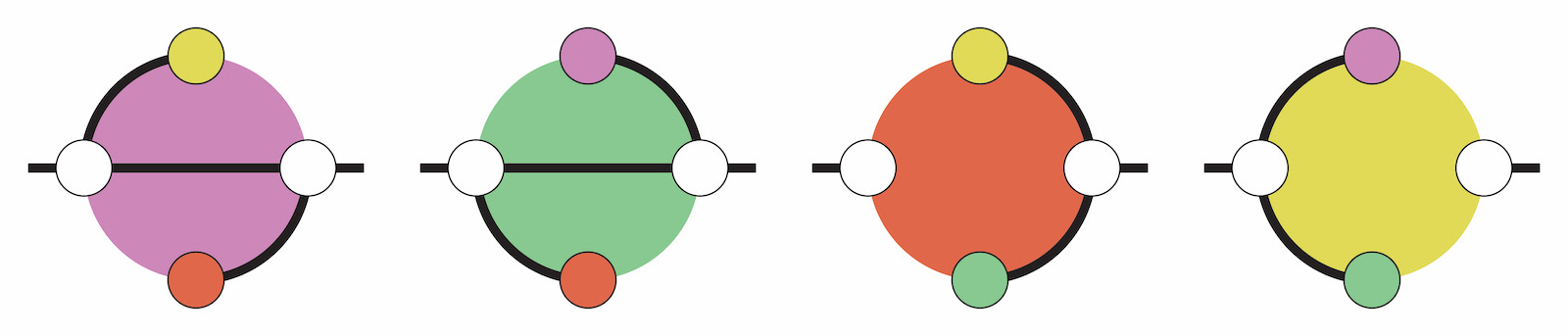
We have four mazes, each consisting of two regular rooms (in white) and two substitution rooms (colored). The thick black lines tell you where you may move. When you enter a colored room, you enter the maze with that color, like so: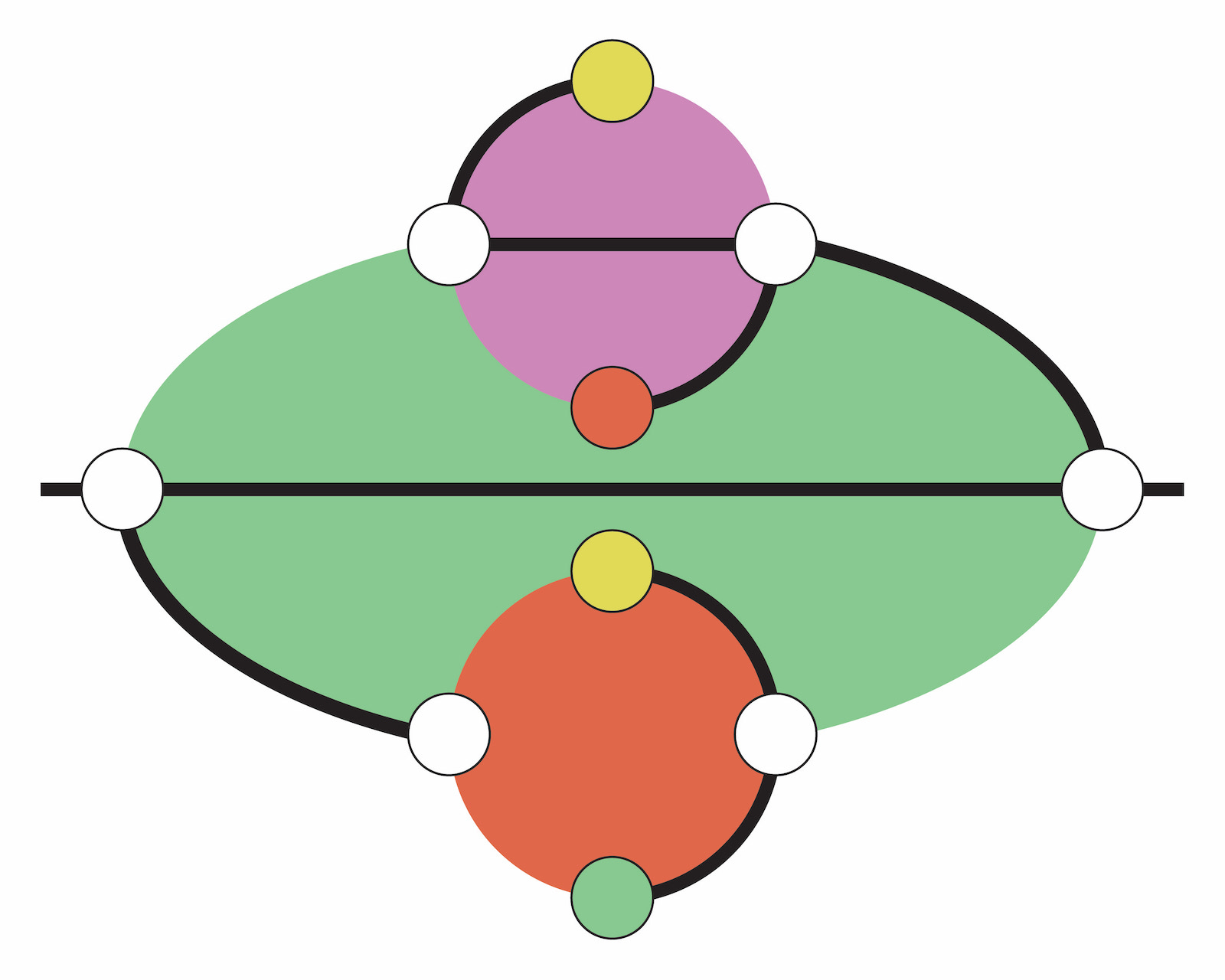
You can think about it like a dungeon where you descend to a lower level each time you enter one of these rooms. When you leave a maze to the left or right, you accordingly ascend one level back up (unless you have been eaten by a grue). Here is a sequence of rooms you can visit. The roman numerals indicate the level you are on, and the room you are in is indicated by a number.

In this example, it took 6 steps to get from the left room in the yellow maze to the left room in the purple maze, starting and ending at level I. Today’s puzzle is to get from the left room in purple to the left room in green. Below is a very simple solution, but this requires to go from level I up one level. 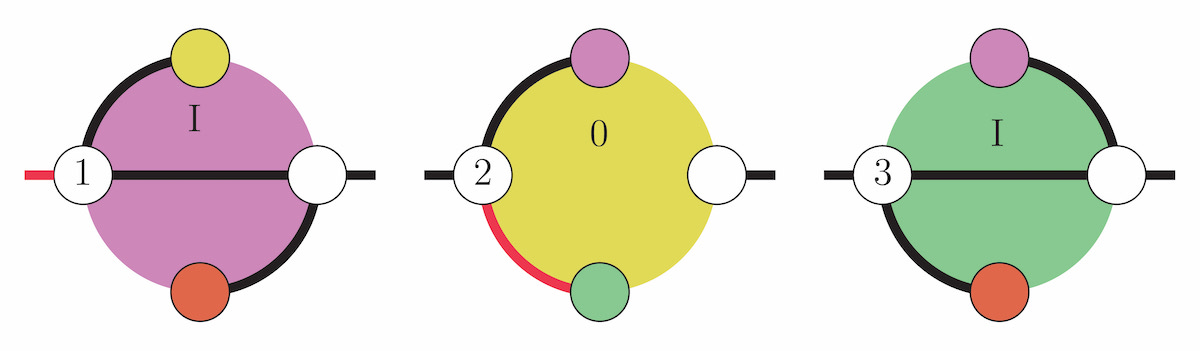
But alas, level 0 hasn’t been built. Can you nevertheless find a way?
 The Inner Frame