Periodic k-Noids (Minimal Surfaces in the Wild II)

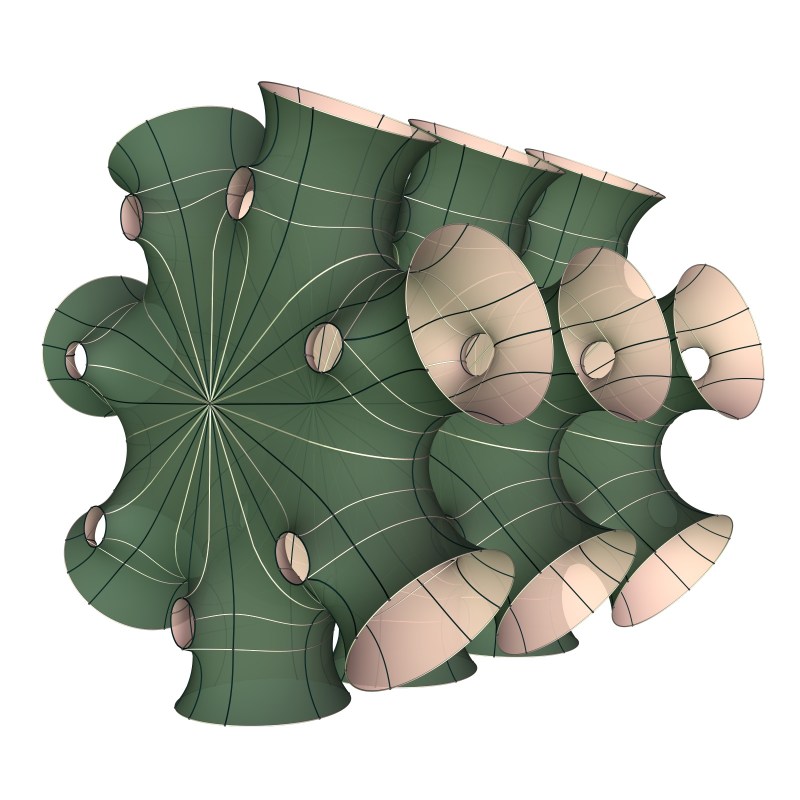
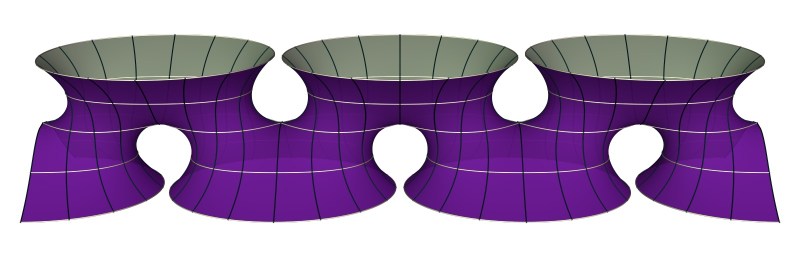
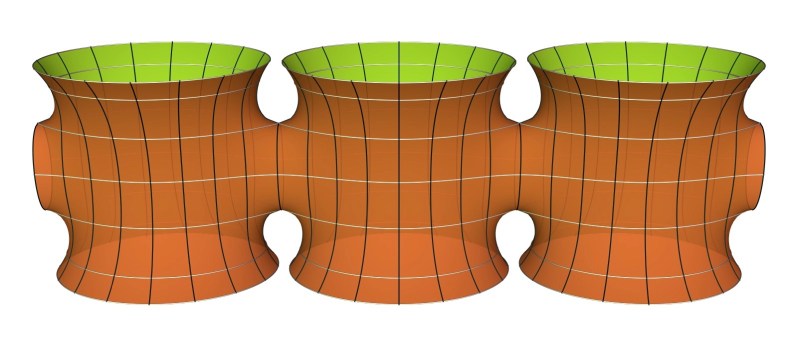
The k-Noids that Shireen built last winter will keep roaming the Swiss landscape, from May to August in Wülflingen. Maybe it is time to corral them. My suggestion is to build fences of catenoids. The most classical one looks like this:

Fence1

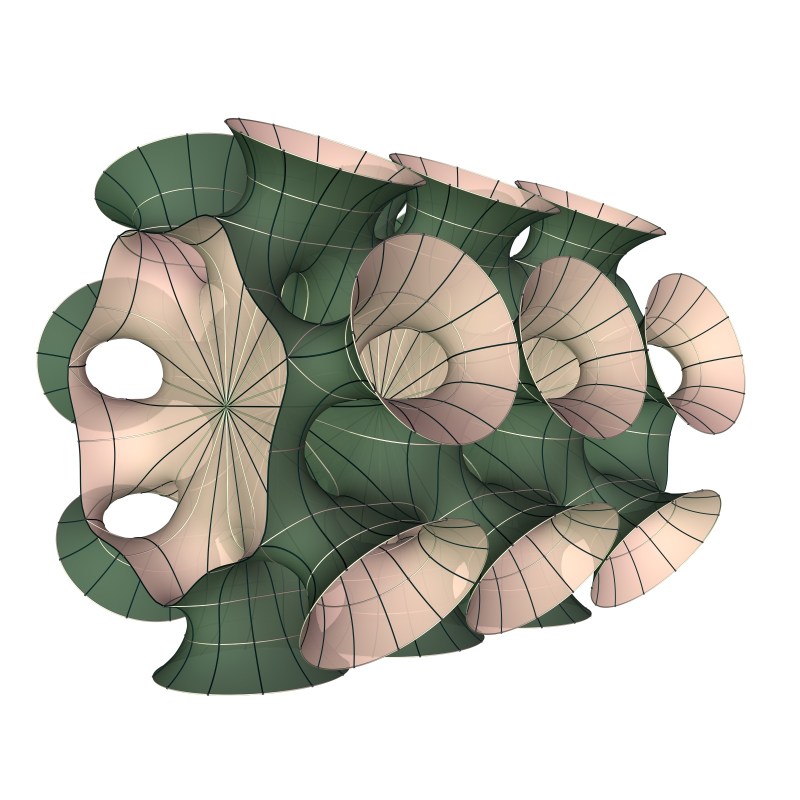
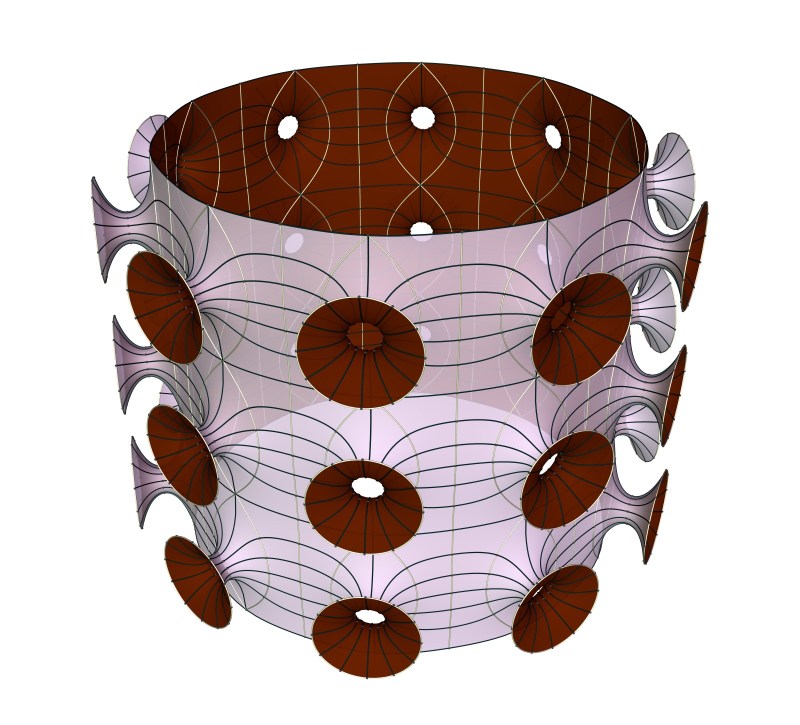
It is, technically, a translation invariant minimal surface that has two ends and genus 1 in the quotient. A simple generalization and an even simpler 90 degree rotation leeds to towers with catenoidal openings.

Fence2

If that isn’t safe enough, you can have them with double walls (i.e. with genus two in the quotient) like so

Fence3

or so:

Fence4

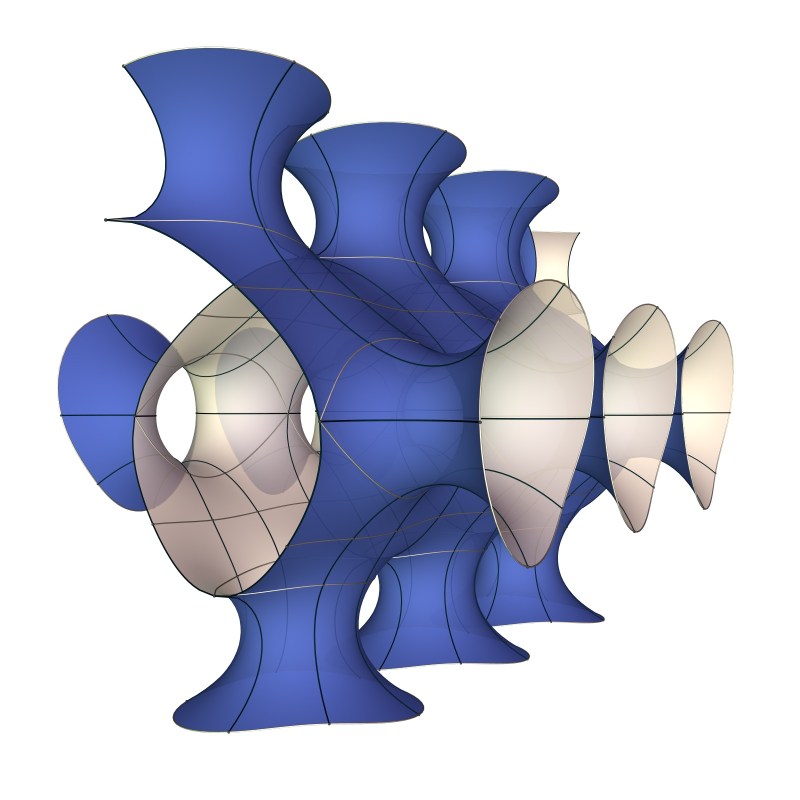
All these examples have many ends in the quotient. The surprise is that there also is the elusive Uninoid which only has one catenoidal end in the quotient, namely by a 180 degree screw motion:

Fence5

Here things get tricky. Michelle Hackman has found more complicated versions of this in her thesis. Here is a Uninoid that is invariant under a screw motion with quarter turn.

Fence6

Trillium Luteum

PICT0009

The Trillium luteum is a yellow variant of the red Trillium Sessile. Like the sessile, the flower sits right on top of the three symmetric bracts at the end of the scape.

PICT0063

These pictures were taken in 2005 and 2006 in McCormick Creek’s State Park. In April one can find there mostly the Trillium Sessile, the Snow Trillium and the drooping trillium.

PICT0011

Back then, I had just started taking pictures of the local wildflowers, and took pictures of everything that didn’t appear too common. Sadly enough, I have never seen a yellow trillium again in Indiana.

PICT0064

A Sense of Space

My first encounter with Virtual Reality was in the 1980s, when text adventures became popular on the new affordable desktop computers.
We spent countless hours trying to figure out what to do with the pocket fluff in the text adventure version of Douglas Adams’ The Hitchhiker’s Guide to the Galaxy, made by Infocom.

Many of these games shamelessly exploited the limitations of their virtual realities: Because all interactions are verbal, there is always the possibility that what reads like a visual description of a place can in no way represent a real place. This gives plenty of opportunity for devious puzzles and mazes. A few years ago, I came up with my own little nightmarish maze, called the Un-Maze. You can play it here in a web browser. It is very bare bones, but it will tell you when you have found the exit.

Maze0 01

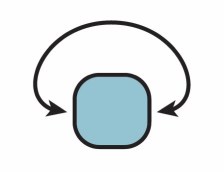
The rest of this post will explain this puzzle, so don’t read on yet of you like a challenge. Let’s make it simple, let’s imagine a maze where every room has only two exits, called left and right. We might think of this maze as an infinite sequence of rooms. If it happens so that all the rooms look alike, and we have no means of altering the appearance of a room, we could also be just in a single room whose right exit leads through a twisting passage to the right exit.

Maze1 01

My Un-Maze up above lets you decorate the rooms a little bit, because you can pick up and drop three different pebbles, and when you type “look”, the game will tell you whether there is a pebble in your current room. A basic unjustified assumption we make about such mazes is that when we exit a room to the right, we should be able to get back to that room by exiting the next room to the left. Many mazes in text adventures warn you about this, by telling you that you are entering a long winding passage.

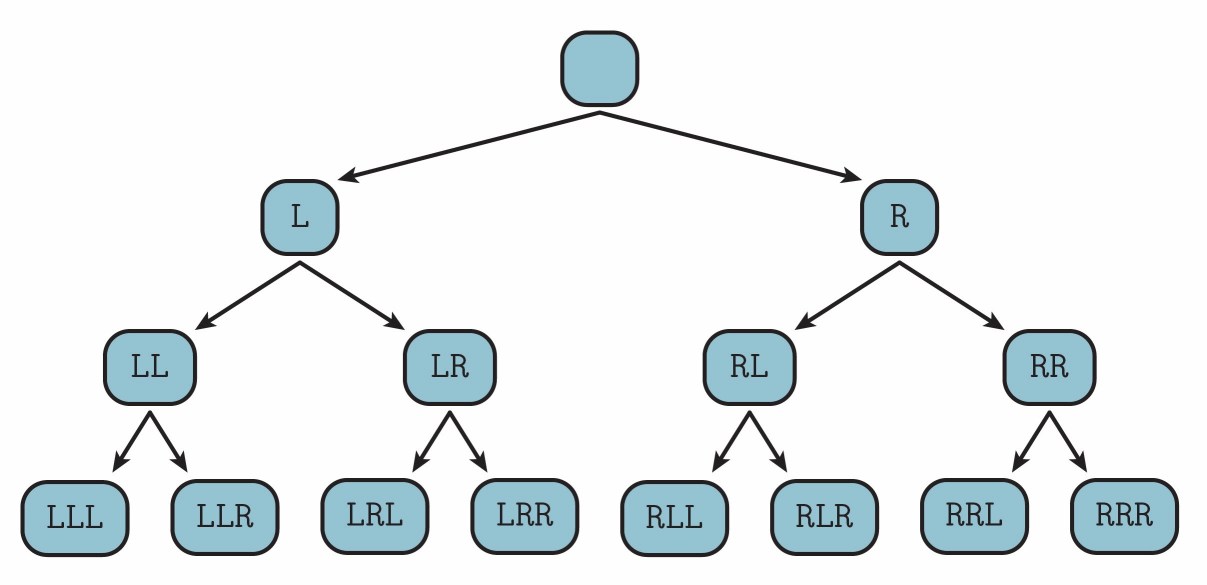
The simple idea behind the Un-Maze is that your location in space is solely determined by your previous actions. For instance, if you decided to walk left-right-right, then you are in the room left-right-right.

Unmaze0 01

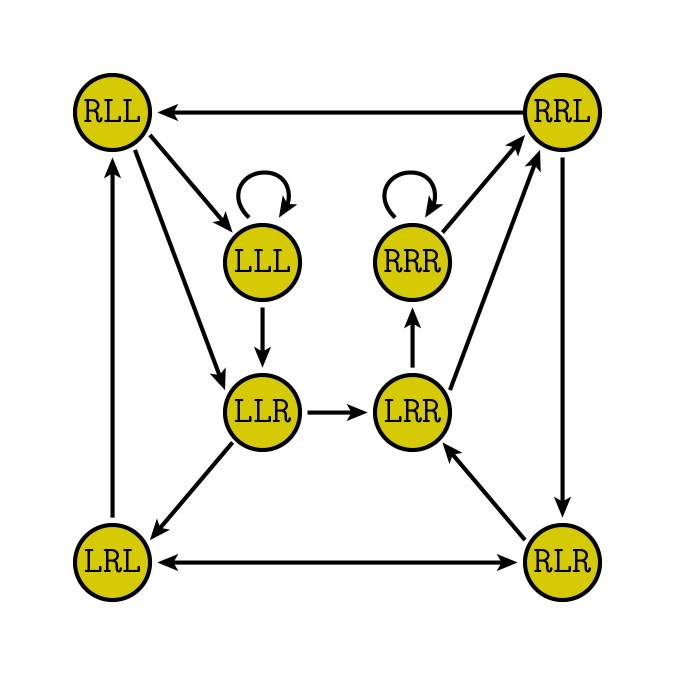
This is yet another model of a strange universe where in every room we can only move left or right. This infinite tree assumes that we have unlimited memory. What happens if we can only remember our previous three actions? Our universe would look like this:

Unmaze1 01

We change the name of a room by forgetting its first letter and appending the first letter of the action we took to get there (Left or Right) to its end.

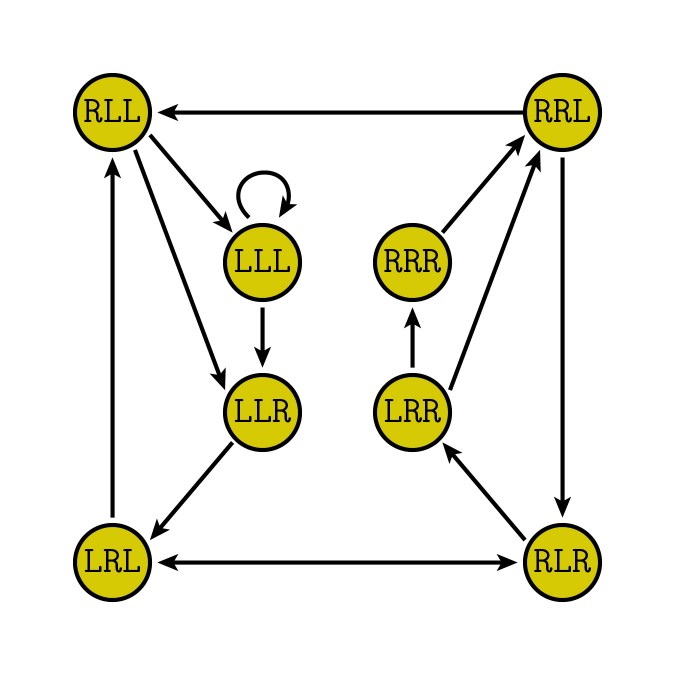
If, for instance, you knew that the exit to the maze was at room LLL, you could reach the exit from any room my going three times left. This is still a maze were all rooms look exactly the same. To change this, we can remove some exits. In the following maze, we have removed the possibility to turn right from some rooms, and now it takes five turns to get from LLL to RRR:

Unmaze2 01

The text adventure maze features four directions and the rooms are given by the memory of the last two turns. You found the exit if you manage to first go east and then north. Good luck.

Coexistence

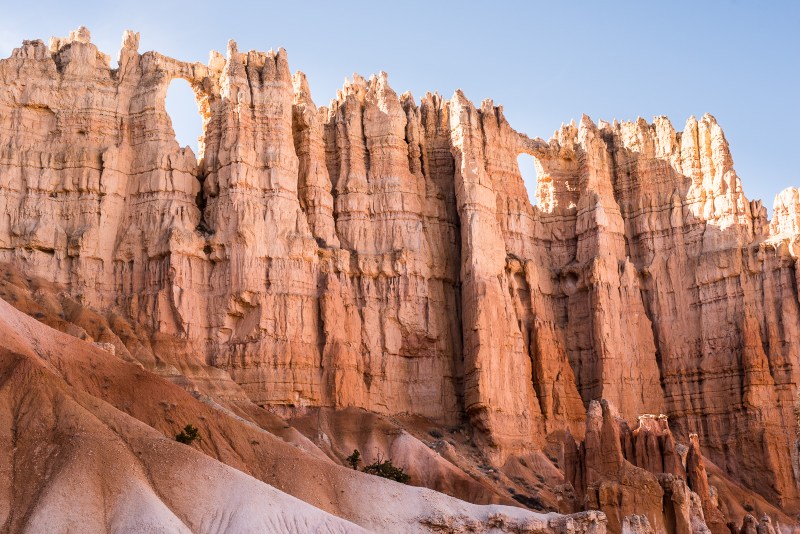
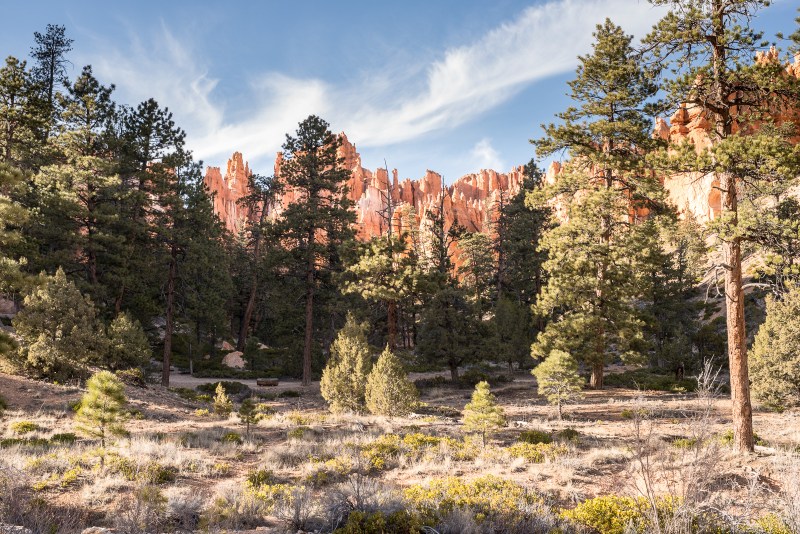
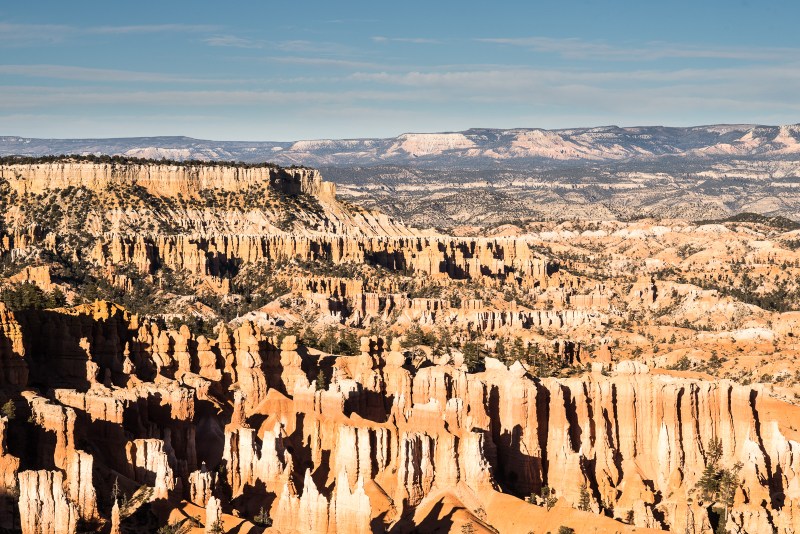
Bryce Canyon in March is a risky endeavor. Two years ago strong winds and temperatures below freezing prevented us from exploring much else than the vistas. Yes, we are wimps. This year most trails were open, but it was still cold enough to keep the crowds away.

DSC 2348

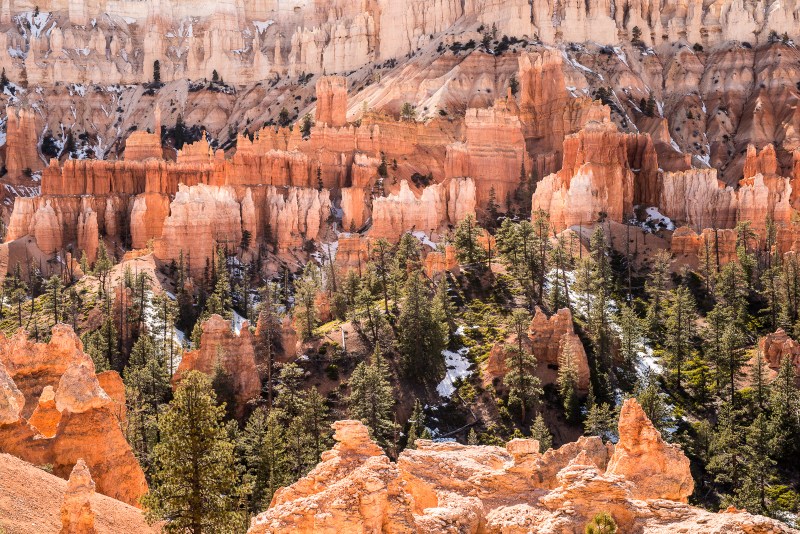
Looking at the amphitheater from above in the late afternoon light doesn’t suggest that there is a trail though this maze of hoodoos.

DSC 2148

Descending the Navajo Loop Trail from Sunset Point reveals competing inhabitants in this sloped landscape.

DSC 2159

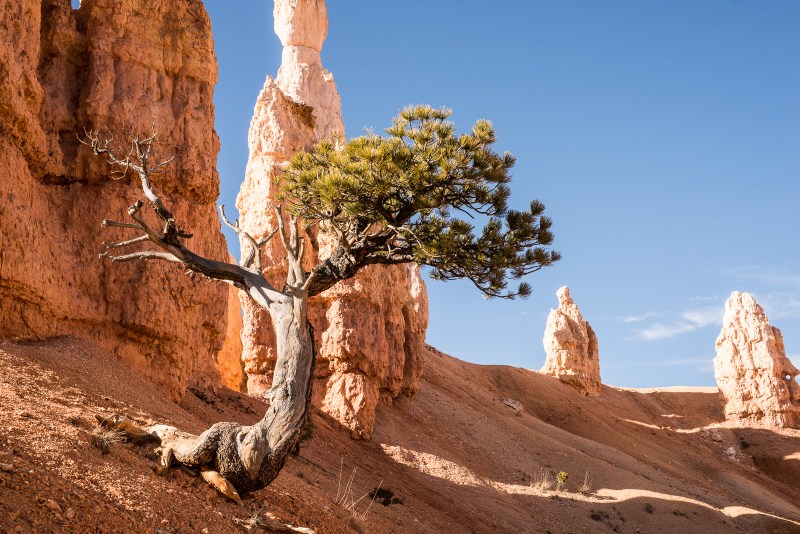
I did not expect to see forests at the bottom of this. The contrast is peculiar. Short lived trees among eternal rocks?

DSC 2220

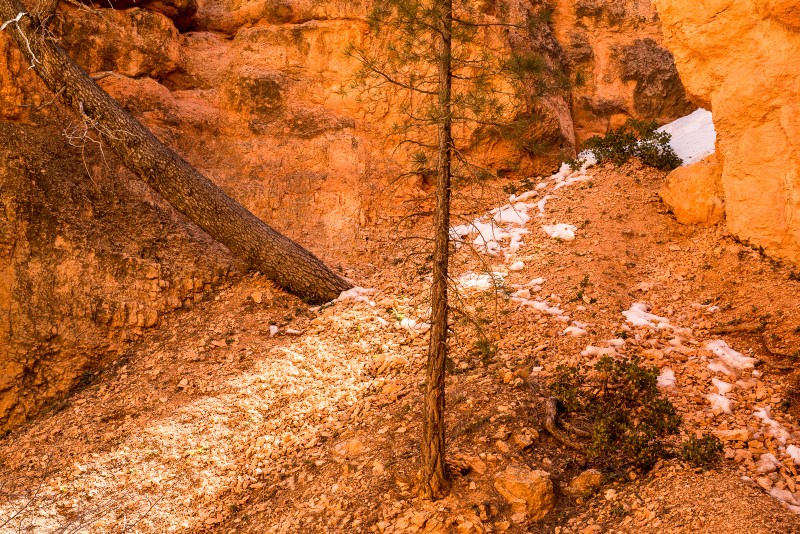
The direction of growth is different, though. Nevertheless, the hoodoos and trees protect each other from erosion and desert climate.

DSC 2270

After completing the Peekaboo Loop, we say farewell to the trees.

DSC 2294

In my next life, I want to be a hoodoo, too.

DSC 2340

Demon

Much more than playing games I like to invent games. In one of my other lives when I had more time, I then used to write a computer program for my Atari ST that could play the game better then me. This usually took three days: On day one, I would teach the program play, on day two, I would create a user interface, and on day three, implement a strategy.
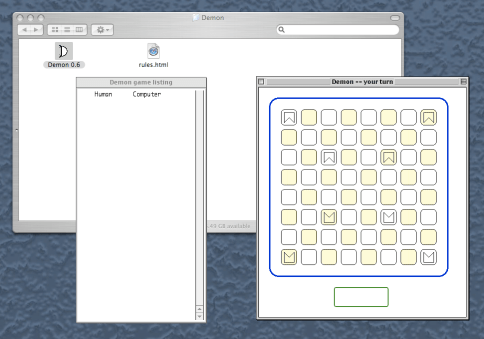
Demon1

My favorite creation back then from 1987 was Demon, that I liked so much that I ported it to a PPC Mac. Because I still have a 10 year old G4 PowerBook that can run Classic, I can still play this game, but its days are counted. I have misplaced the source code, and don’t see myself to port it from MacOS 9 to MacOS X (or anything else). Maybe in a later life.

The rules are simple:

Demon is played on a 8×8 board on which initially lie 64 tiles. These tiles are white on one side and yellow on the other. They are placed on the board such that it looks like a chessboard.

Each player owns 4 knights which are put on the fields a1, c3, f3, h1 (first player) and a8, c6, f6, h8 (second player) in chess notation. In the screen shot above, the knights are represented by stylized (??) crowns.

These knights move the same way as knights in chess, but only from a white to a yellow tile or vice versa. The tile from which the knight has just moved away is turned over and hence changes color.
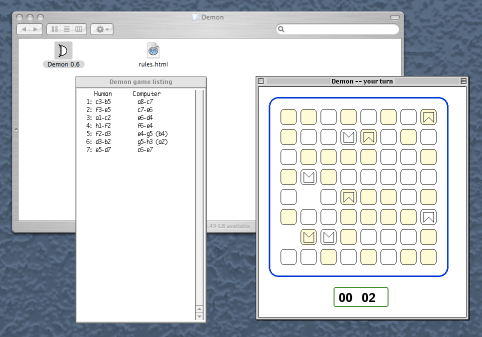
Demon2

Usually the players take turns, and each player moves only one of their own knights.

If a move creates a 2×2 square of unoccupied tiles that all have the same color (outlined below), the moving player must remove one unoccupied tile of his or her choosing from the board. This empty field can not be entered anymore. The players collect the tiles they remove for scoring.
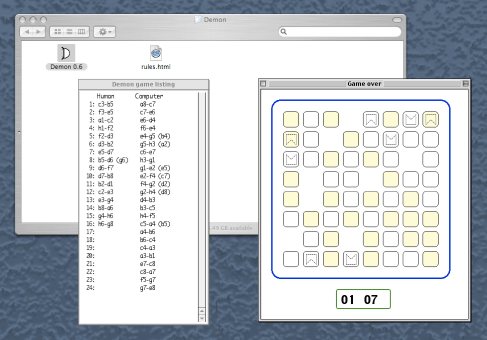
Demon5

If a player is not able to move, he or she has to skip a turn. The game is over if both player cannot move anymore or one of them dies.

The player who has collected the most tiles wins the game.

The first version on the Atari ST used a simple alpha-beta strategy, which I still could beat on the highest level (with some effort). For the Mac version, I added tree pruning. This and the faster hardware made the game essentially unbeatable for me.

In about the same time period, chess programs advanced from being beatable by mediocre amateurs (like me) to being able to beat the chess world champion. Still, I would not have expected to see Go being played at a champion level, let alone beat the world champion.
Out of Focus

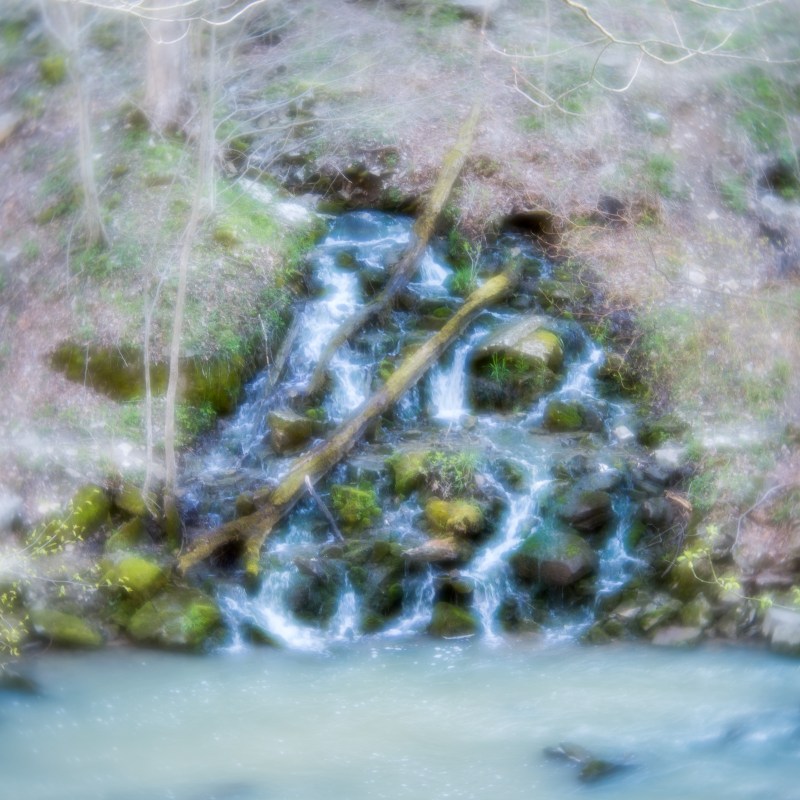
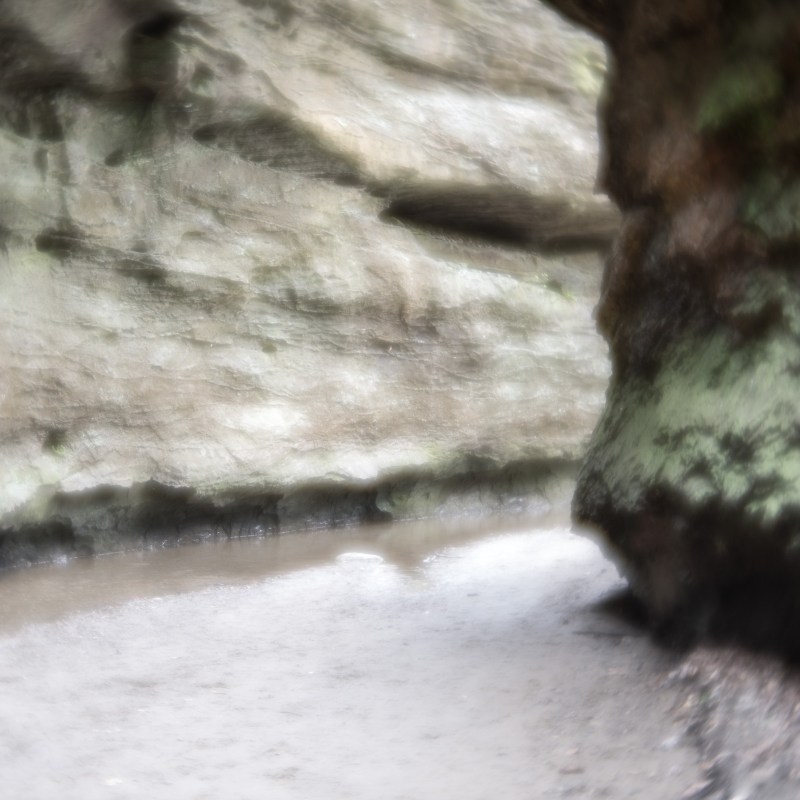
For several years, I have toyed with the idea to get one of Lensbaby’s odd experimental lenses. Against good advice, I have purchased the Velvet 56. This is a full frame 56mm lens, with maximal aperture 1.6. It is my most specialized lens by far. It excels at not being sharp.

DSC 2611

Even when stepped down, it is blurry near the edges of the frame. I decided to take it to its other extreme, and use it wide open. Then, the shallow depth of field and the radial decay of sharpness join forces. There are other artifacts, too. The glow around edges for instance is possibly caused by drastically exaggerated chromatic aberration. People have claimed that all this can easily be achieved in Photoshop.
DSC 2774

Maybe so. The images have a strange depth that might be hard to achieve. But even if somebody comes up with a Velvet 56 filter, this is not the point.

DSC 2690

For me, the most exciting aspect about photography is the moment when I take the picture. I transforms what I see and feel at this moment into a rather selective image that I hope will represent what I have seen and felt in some way. Improving the outcome in post processing is of secondary importance.

DSC 3315

The Velvet 56 is the most limiting lens I have used. No filter will make these images sharp. Some might view this as a fundamental flaw. I view this as a creative challenge. You have been warned.

DSC 3136

Domino meets Towers of Hanoi

When a neighbor and colleague of mine told me he has a blog about abstract comics, that concept fascinated me to the extent that I had to make one myself. Here it is:

Comic

This, by the way, makes a nice poster. I called it Migration, and didn’t give a clue where it came from. There are very smart people who have figured it out by just looking at it, but you can’t compete, because you have already read the title of this post.

Let’s begin with the Towers of Hanoi. This puzzle is so famous that I will not explain it here, mainly because I was traumatized as a high school student when I was forced to solve the puzzle with four disks on TV, in the German TV series Die sechs Siebeng’scheiten. I just pray that no recording has survived.

Hanoimonocards

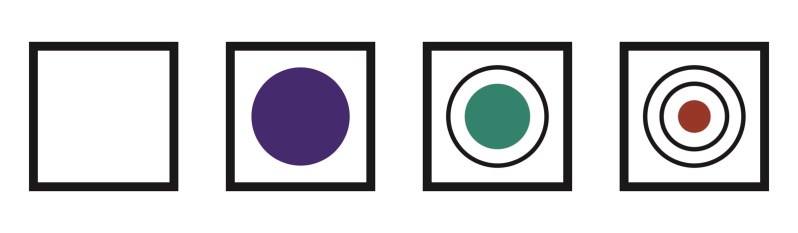
In any case, after a healthy dose of abstraction, let’s look at the Towers of Hanoi from above, and treat it as a card game.
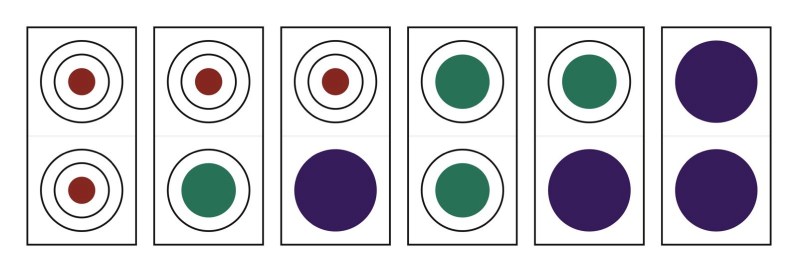
The disks are replaced with cards that have a disk symbol on it. For the three disk game, there are three different cards, showing a small, medium, or large disk. To make everything visually more appealing, we color the disks, and to emphasize size, we show empty annuli around the smaller disks, as above. Then the solution of the three disk puzzle would look like this:

Hanoi

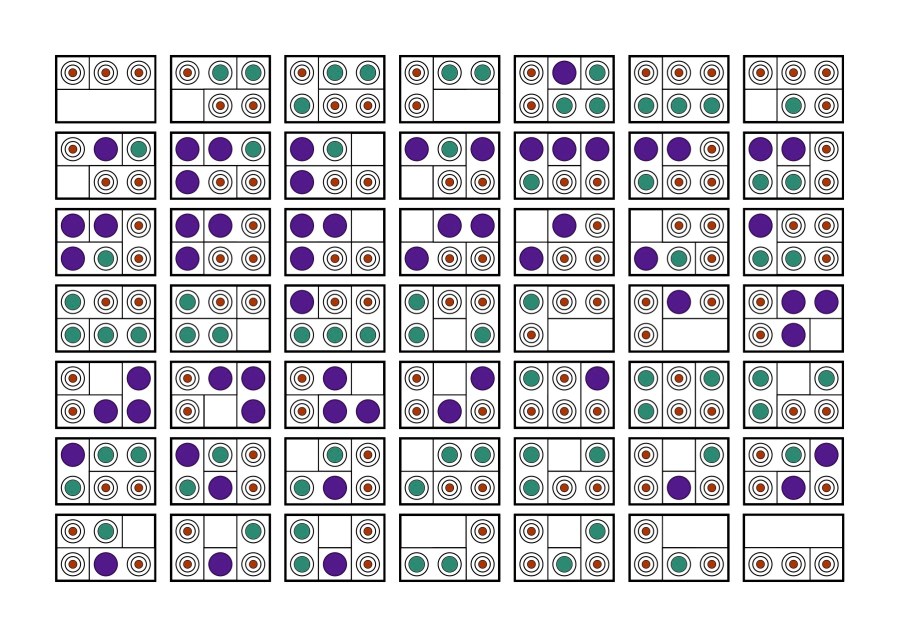
Because a card hides what is possibly underneath, a position requires context. This is one of the two ways the puzzle is mutating into a story. In the next step, we use domino shaped cards consisting of two squares instead of square cards. Here are the six hanoiomino cards:

Hanoidominocards

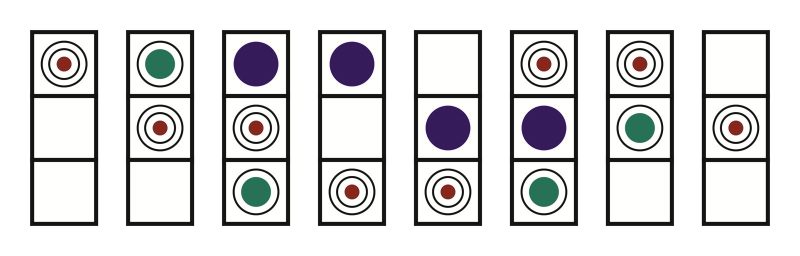
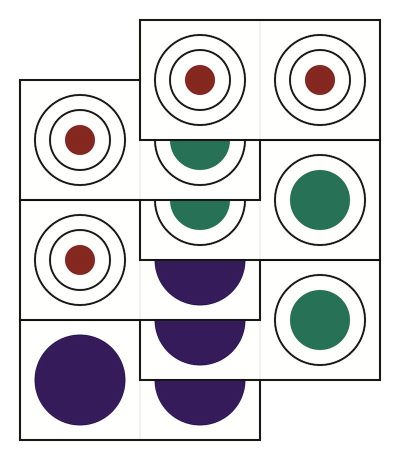
The puzzle is played on a 2 x 3 rectangle, with all six cards stacked like this in the top row:

Startdeck

Note that we have modified the Hanoi-rule: In the original version, a card can only be placed on an empty field or on a card with a larger disk. A hanoiomino must be placed so that each of the squares either covers an empty square or a square with a disk of at larger or equal size. This allows for more choice, which causes the second mutation of puzzle into story.

The migration story now tells how to move all the hanoiominos to the bottom row, to the same position, albeit reversed. It is the shortest solution, and unique as such, unless you want to count the backwards migration as a second solution.
Balance (Zion National Park)

Every symmetry needs to be broken.
DSC 1303

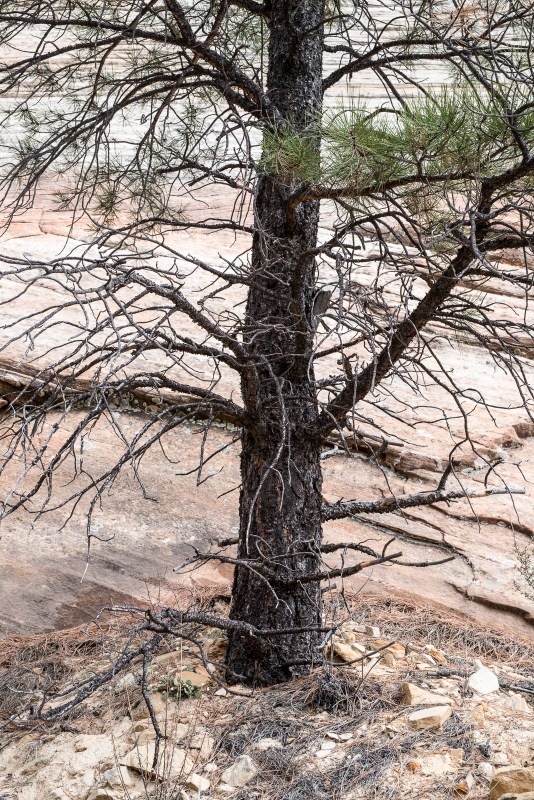
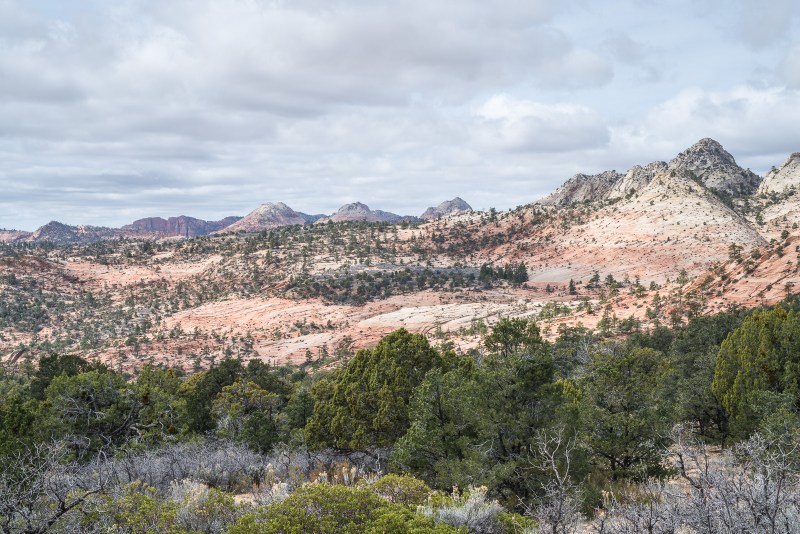
The tree up above stands on a pass that separates the Upper East Canyon in Zion National Park from the area south of it that eventually drops into Parunuweap Canyon. The casual tourist driving on route 9 will not wonder what else there is beyond the magnificent scenery that is accessible from the road. We did. The symmetric tree on the pass is not an indication what to expect.
DSC 1353

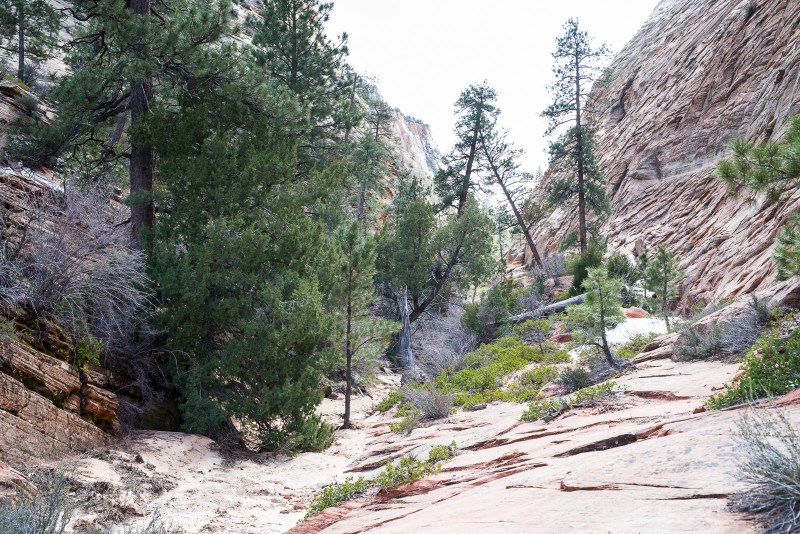
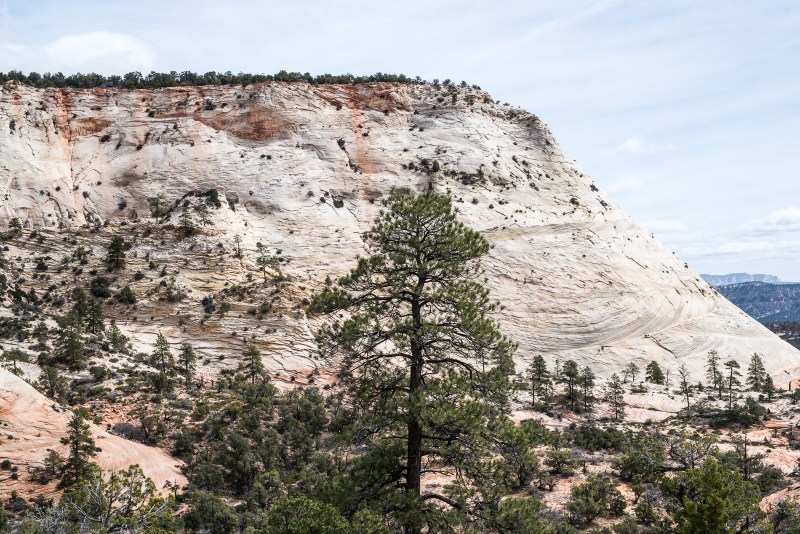
The way up through the sometimes narrow Checkerboard Mesa canyon is not difficult, and the view back from the pass is already rewarding.

DSC 1319

Turning around, the landscape opens up. We are on top of an intermediate mesa, and can stroll around, even climb some minor peaks.

DSC 1236

Few people come here, we had all this for ourselves. Still, there are regions higher up, not (yet) revealing their secrets to us.

DSC 1234

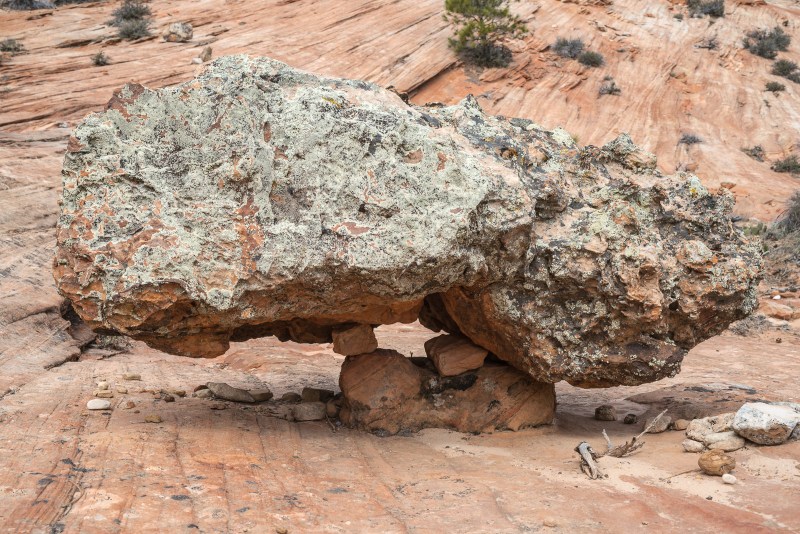
Then, this rock, put by chance upon much smaller support that did not erode away like everything else, and kept it in balance.

DSC 1229

So this is what we seek: Broken symmetry, but still balance.

Not Tangram

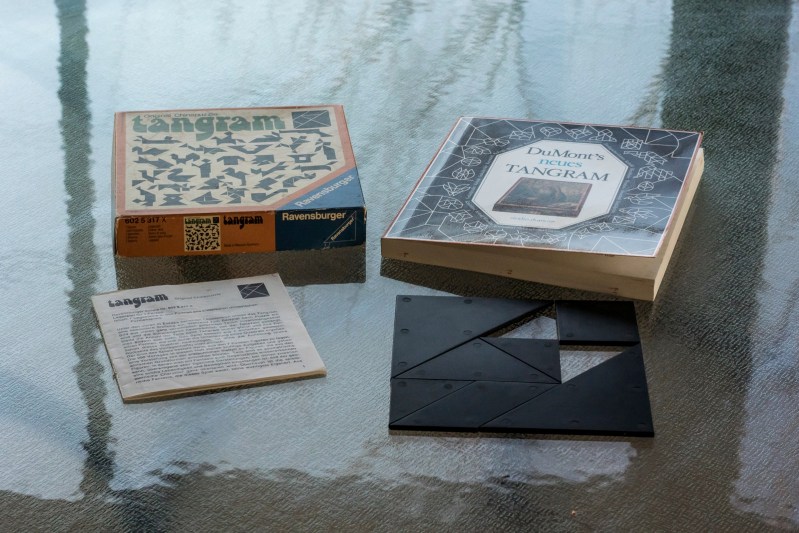
As a kid, I did like puzzles, at least until I discovered Tangram. Few things can be enjoyed on so many levels: It’s simple, reusable, facilitates abstraction and meditation. I don’t know where to stop. I have printed photos onto a tangram square and used it as a miniature puzzle. I have written two Tangram stories, i.e. picture books with few words where each illustration consist of two or three tangram puzzles.

DSC 0993

I even saved money and bought Dumont’s New Tangram, which has eight new tangram shapes and comes with beautifully designed puzzles. It was not a success with me, maybe because the pieces were cheaply made, maybe because the design of the pieces felt too arbitrary.

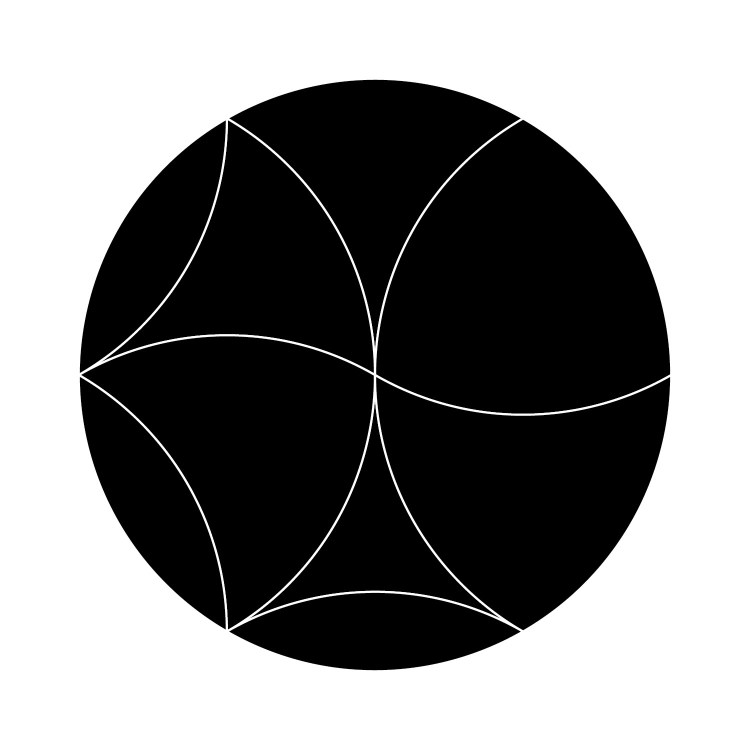
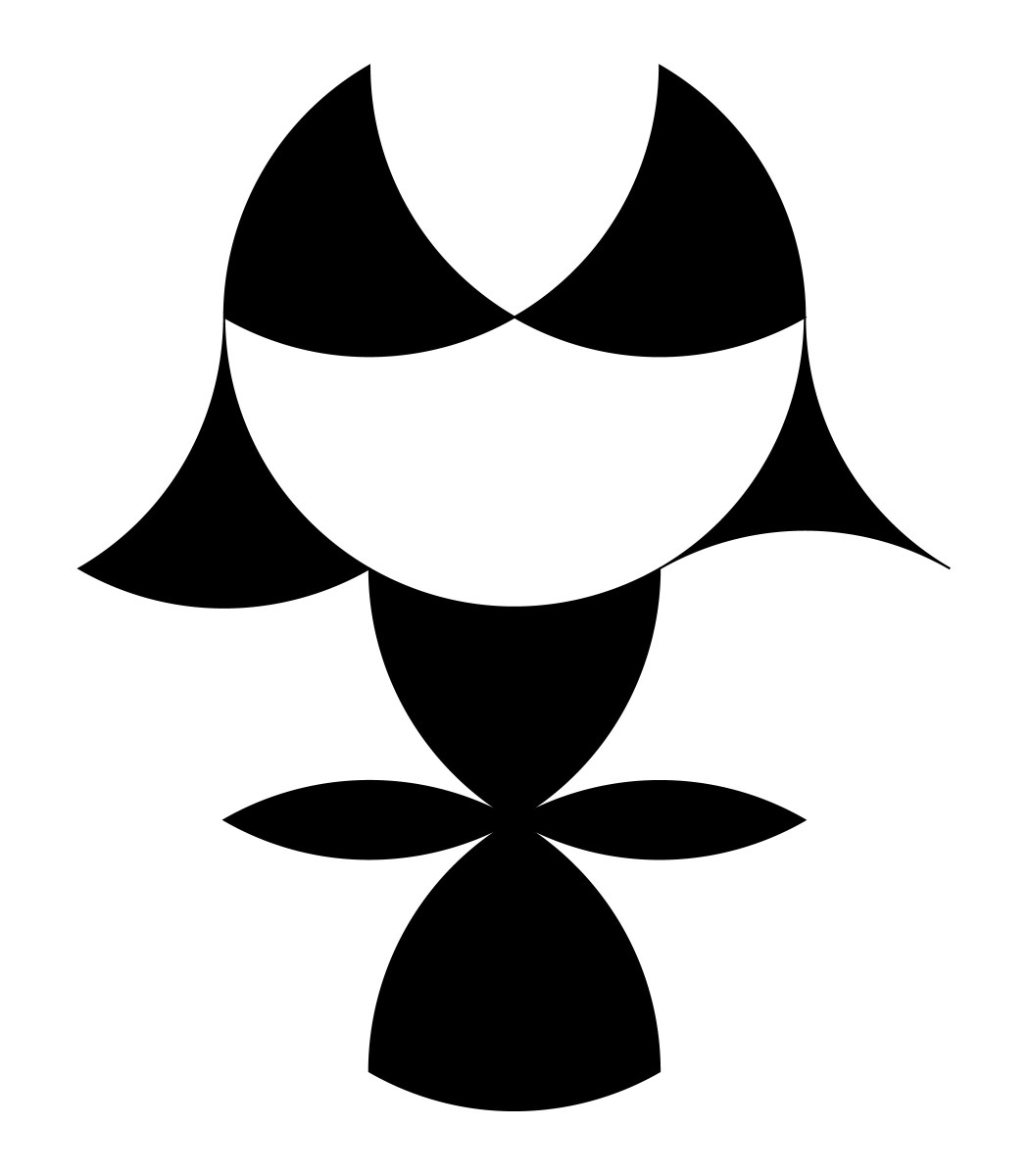
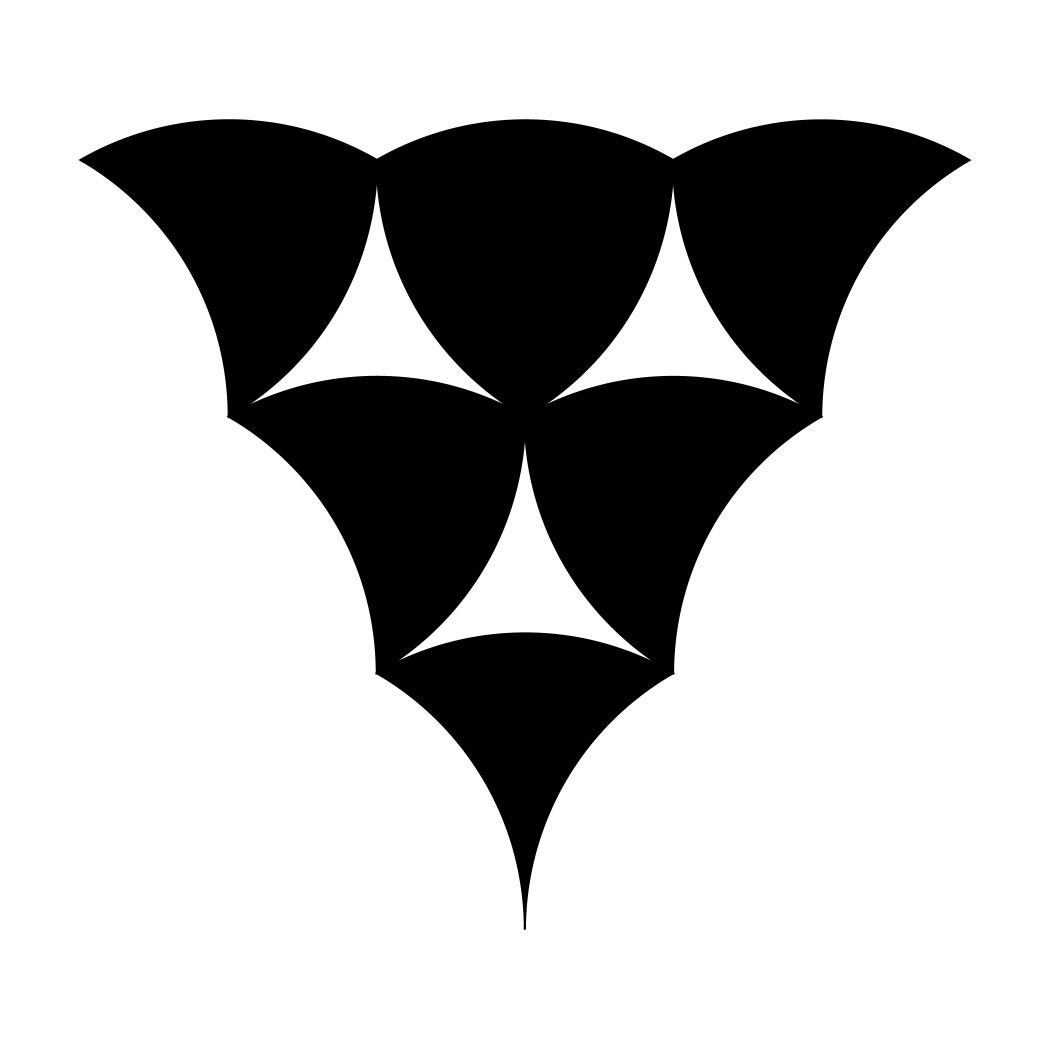
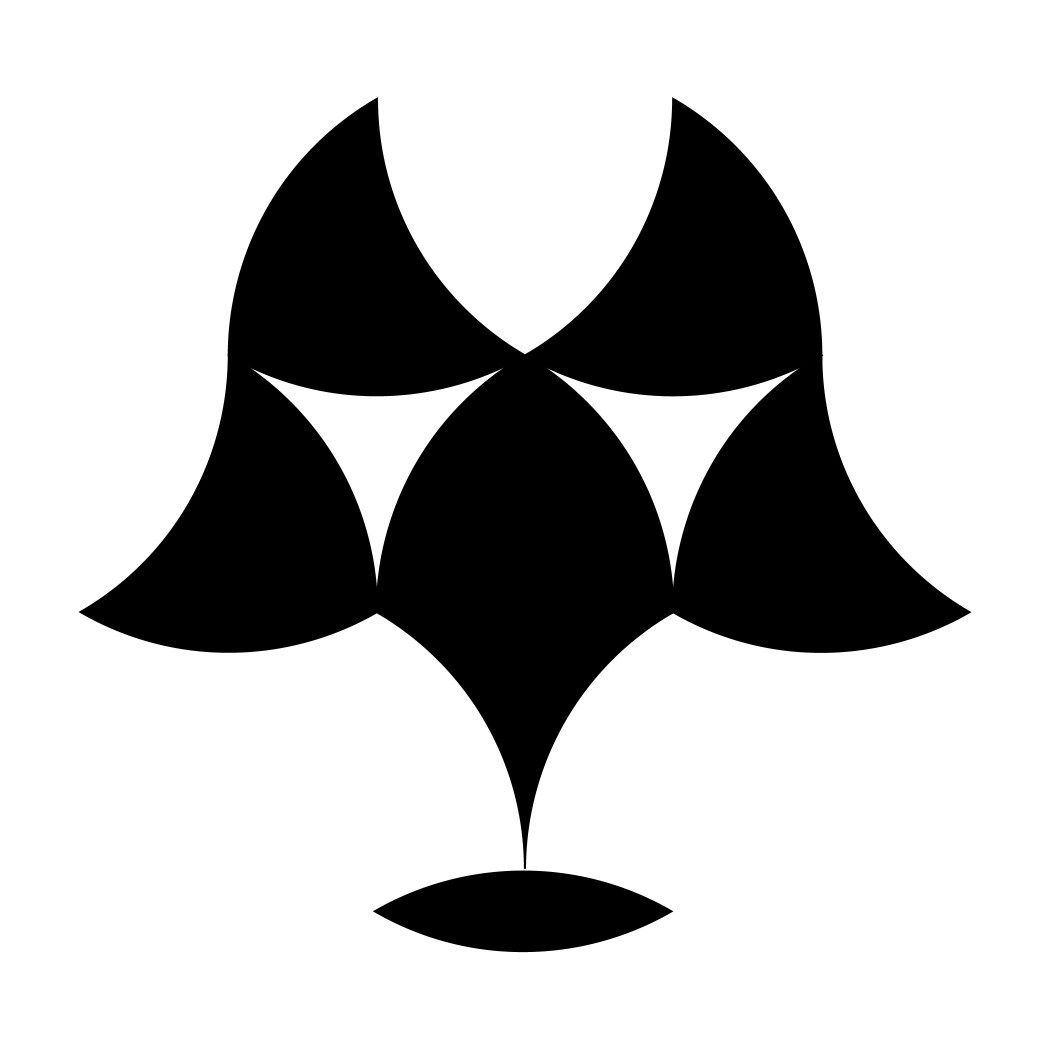
Here now is my own take on a tangram variation. There are five different pieces, for a total of eight, that fit together as a circle.

Nottangram 01

The curved pieces allow organic puzzles. Here is an easy one:

Ex1 01

Compact puzzles are a little harder, but nothing is really difficult:

Ex5 01

I think of these pieces more as of means for designs that for puzzles. Here is my favorite so far:

Ex3 01

So, go ahead, make your own designs, and write Not Tangram stories. I am done with that. For now.

Ex2 01

Red Planet (Kodachrome State Park III)

When using film, we always joked that Fuji’s films leaned towards intense greens, while Kodak favored strong reds. I wouldn’t call it a tint. I even heard the theory that Americans had a special gene that suppressed a sensitivity towards red colors.

In any case, this is about Kodachrome State Park (again), and its glorious reddishness.

DSC 1820

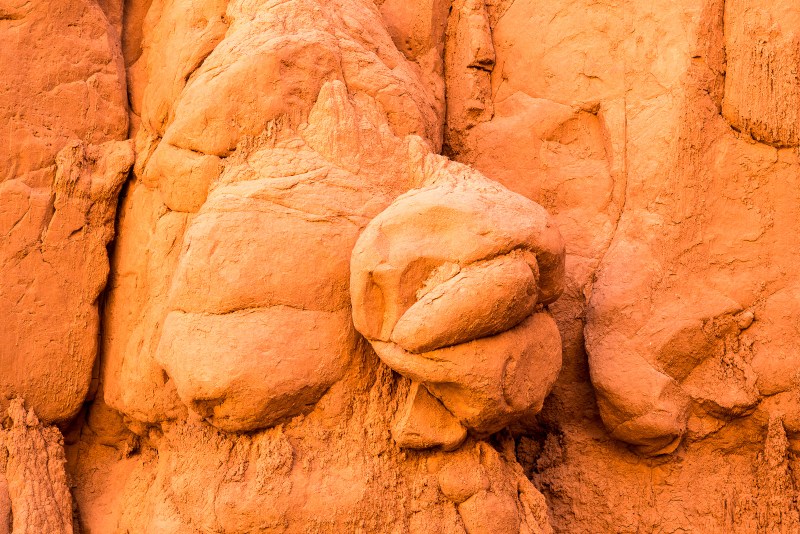
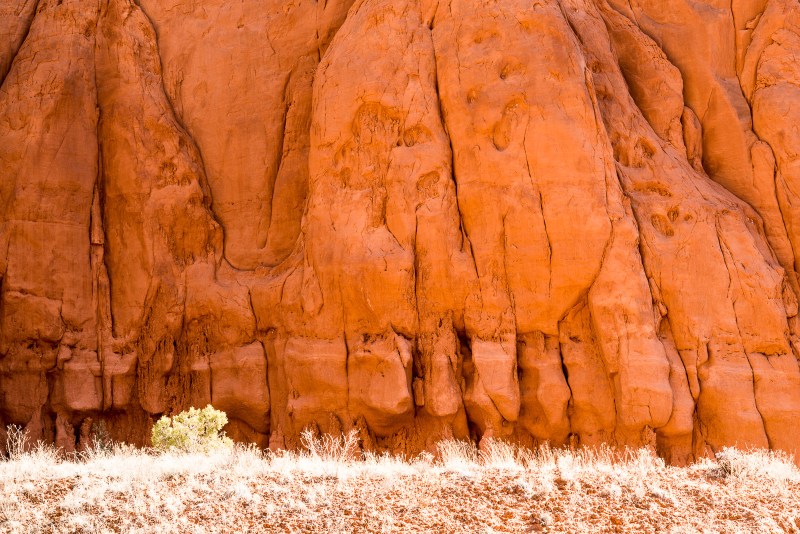
This is of course a joke, I could have tinted all the images green and called moved everything to Fujichrome State Park. What is important, though, is the overwhelmingly monochrome landscape. While painters always have complete freedom over their color palette, the (nature) photographer can exert control only within limits. What do you do when a nice rocky landscape is ruined with green weeds? This does not happen on Kodachrome Planet, so almost any view allows undistracted contemplation. Be it the sun scorched earth above, or the enormous canyons below:

DSC 1875

Clay sculptures grow on the cliffs, unsure about wha shape they want to take,
DSC 1946

and rocks in intimate embrace wait for us to leave. Was this once just one rock that split, or are these two rocks that time has shaped like this?

DSC 1971

Oh yes, there is some greenery. It reminds us that we are only tolerated, too.

DSC 1956