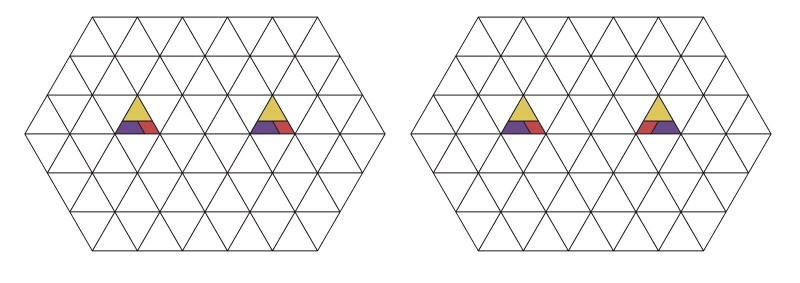
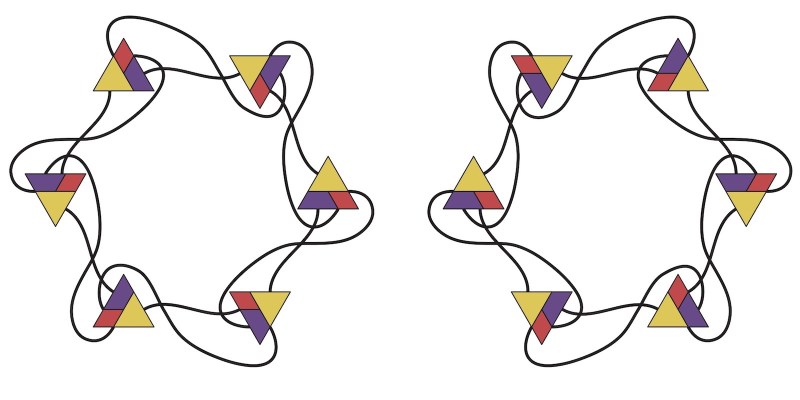
Trions (Solitaire X – From the Pillowbook X)

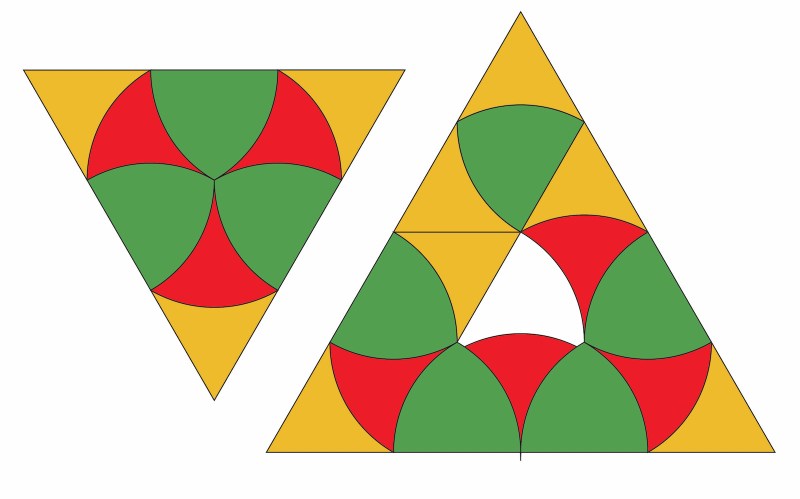
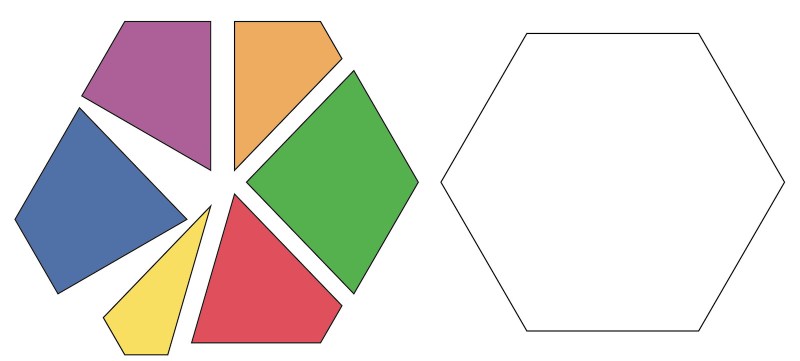
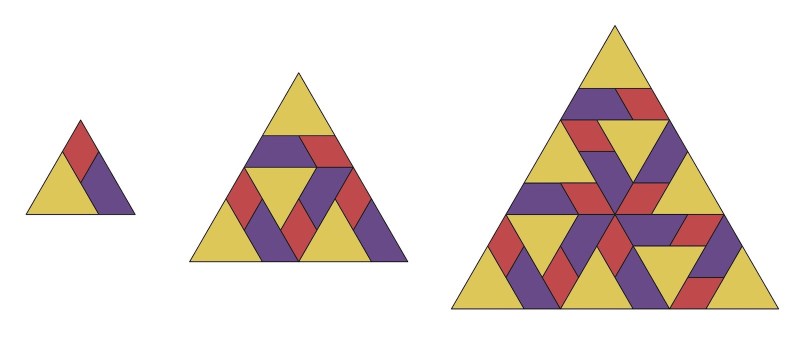
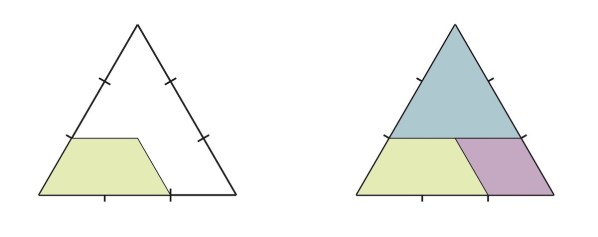
A trion is obtained by taking an equilateral triangle, dividing the edges into n segments of equal length, and cutting from the center of the triangle to two subdivision points on different edges. This will give a particular quadrilateral. If you divide the edges into just 3 segments, there are three different trions, which fit nicely into a single triangle:
Trions1

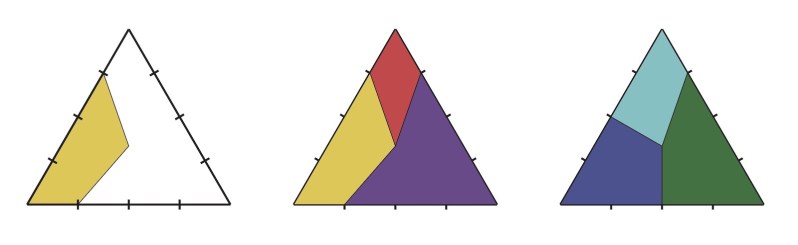
This is the single puzzle piece from a previous post. We have also seen this mechanism (explained to me by Alan Schoen) to produce what I called hexons. Today we will look what trions we get when we divide the triangle sides into four segments.
Trions2

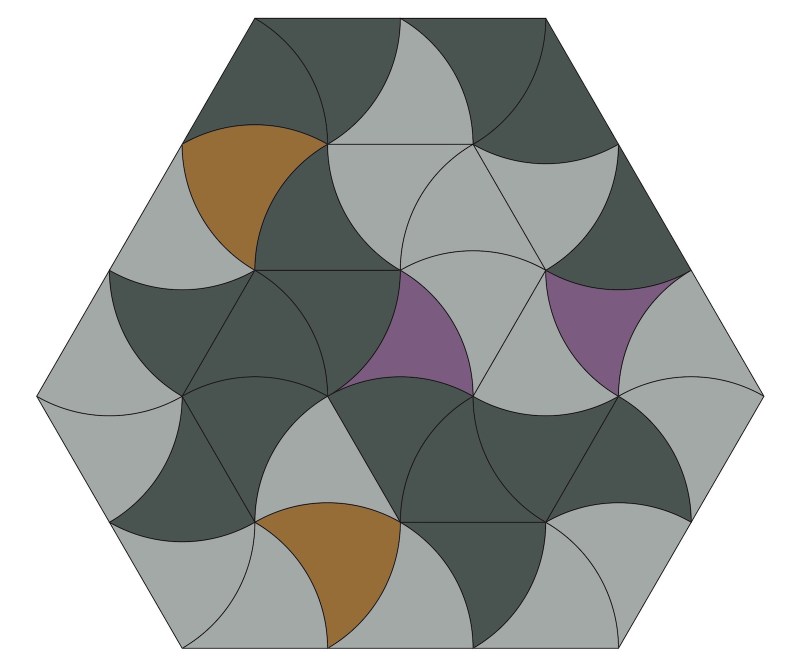
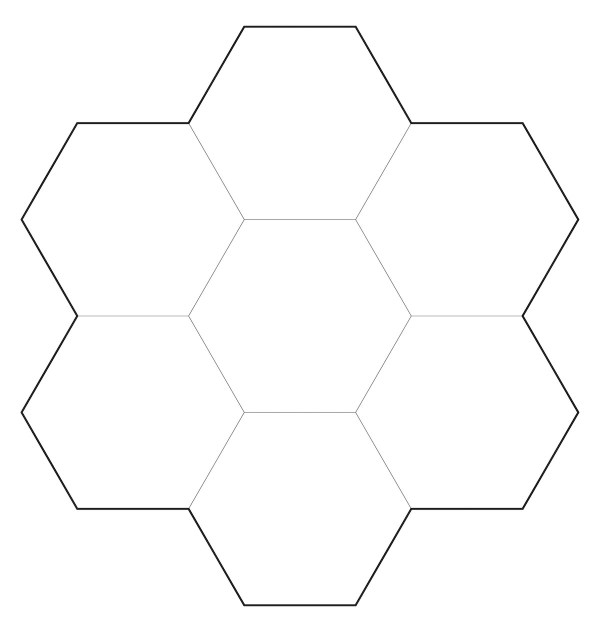
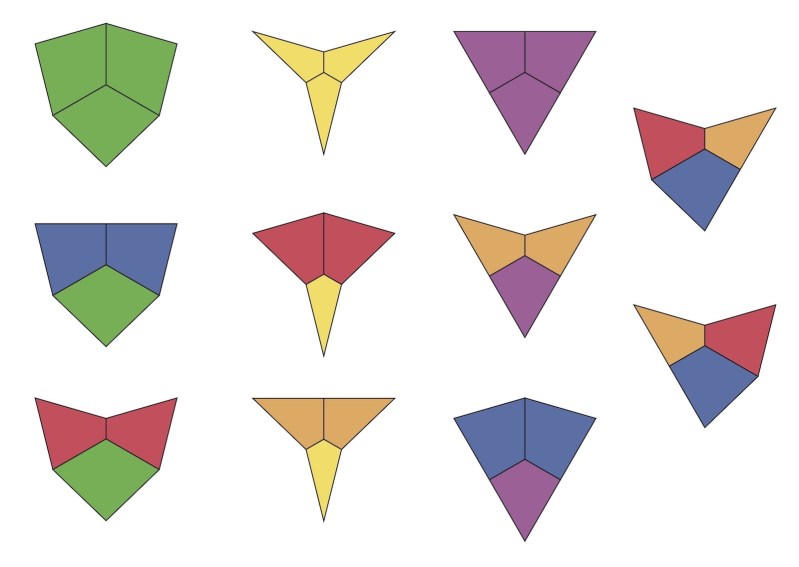
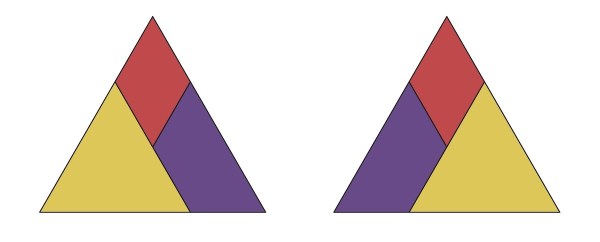
There are six such trions, which fit nicely into two triangles. They can, as we did with the hexons, also be arranged in groups of six around a (former) triangle vertex, to create hexagonal pillows, i.e. hexagons whose edges can remain straight or possess inward or outward kinks.Trions3
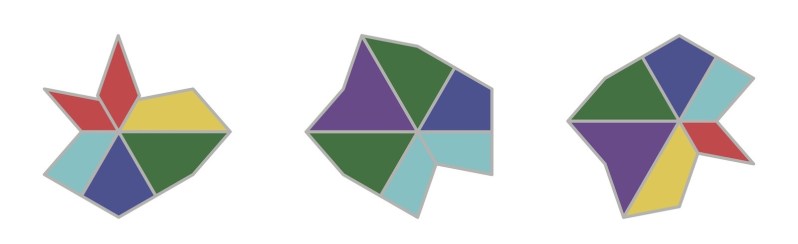
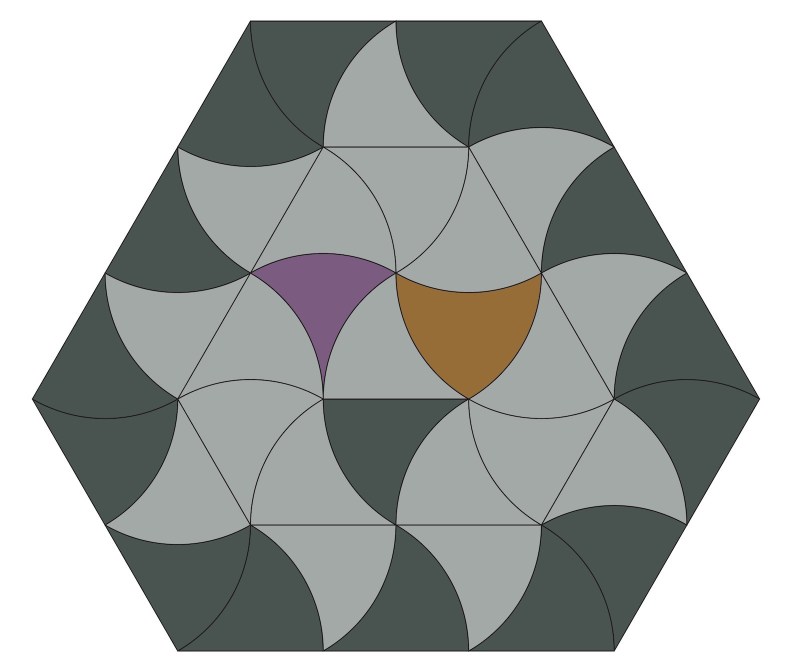
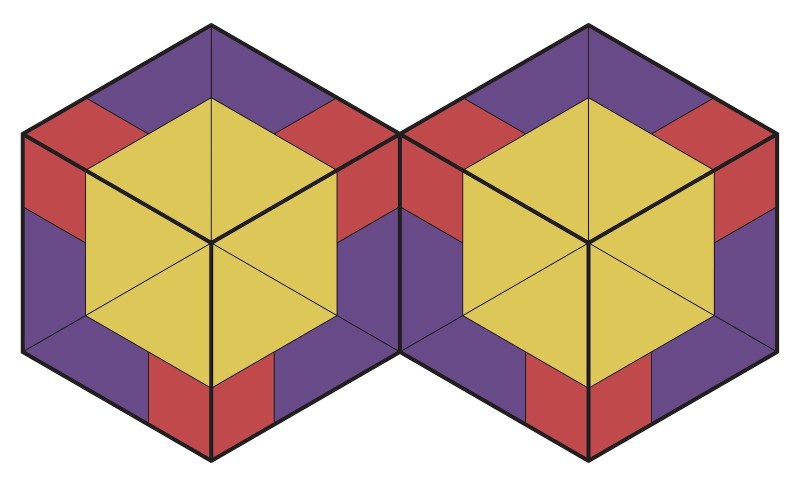
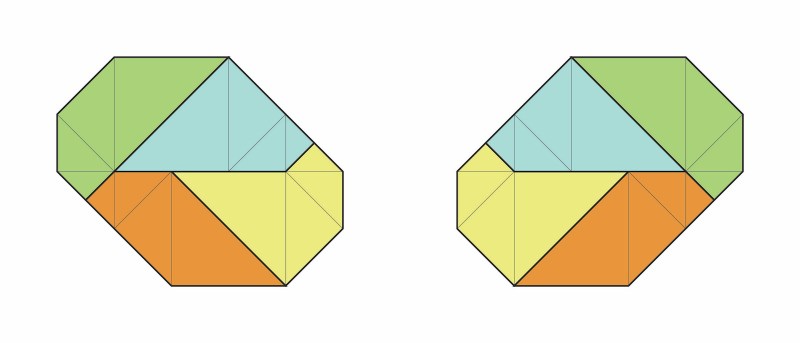
There are too many of those for my taste, but there is only one (not counting its mirror) that uses each trion exactly once, namely the  one to the right. In the spirit of perfect solitairity, this makes an engaging single puzzle piece.
Trions4

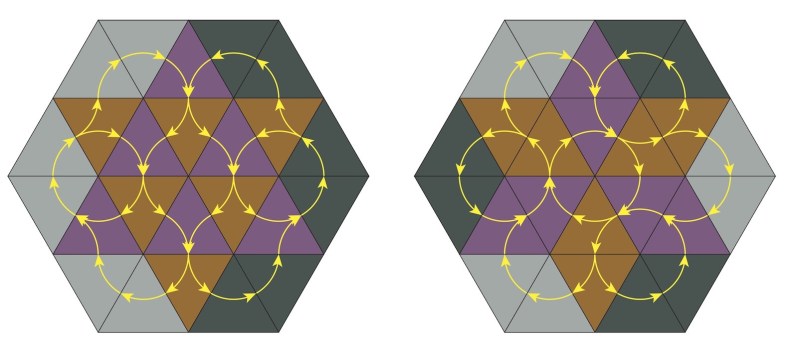
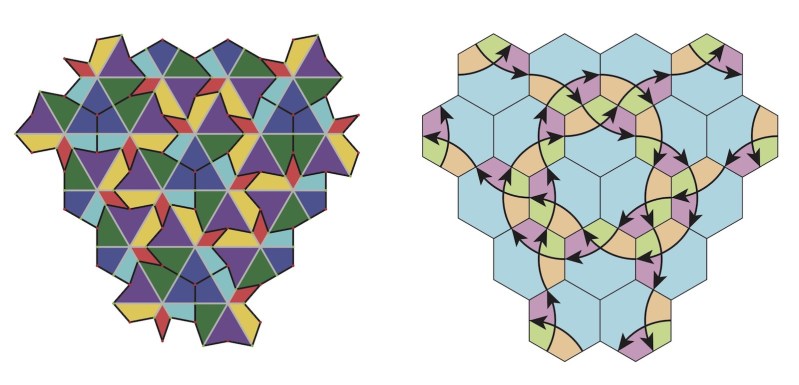
Can you extend the tiling above so that it tiles the plane? Using it as is gets a bit dizzying (but notice the triangle pattern on the left), so I have replaced it by a simpler version that contains all the essentials.
Trions5

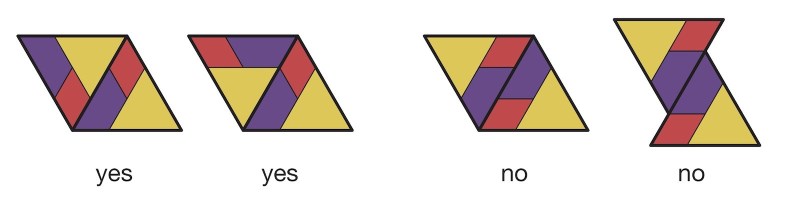
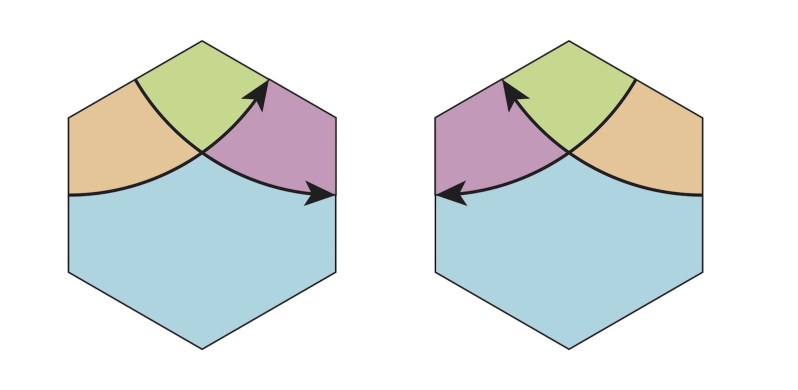
Two hexagons match along an edge if either both sides have no arrow, or you can keep following the arrow, as in the example. Below are two simple examples of periodic tilings:Trions7
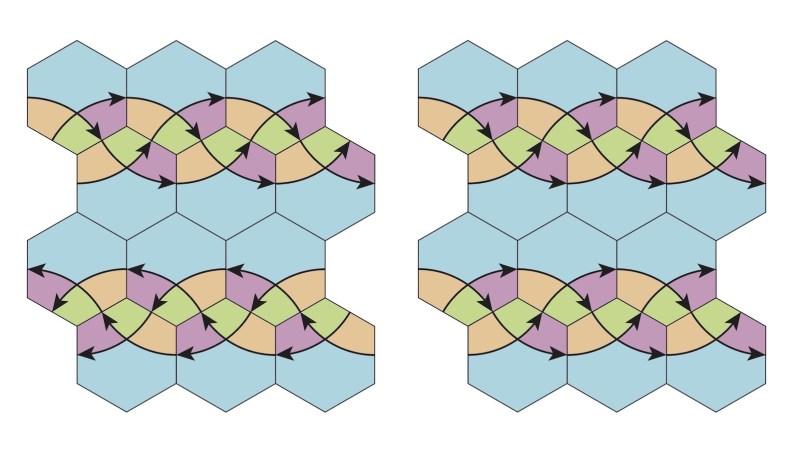
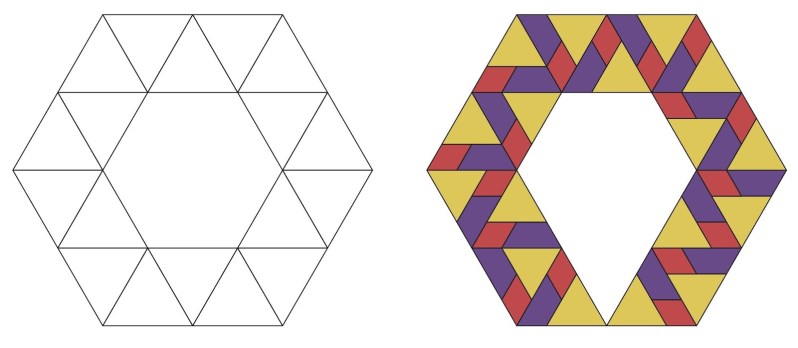
There is much more one can do with this piece, but for now let’s end with a homework puzzle: Can you fill the board below so that everything matches?
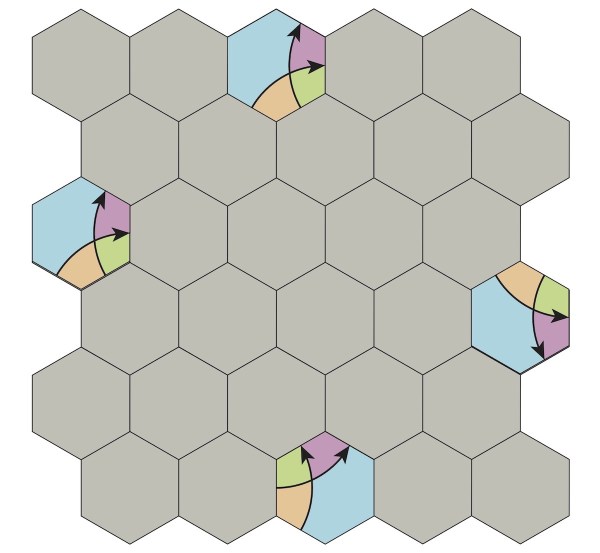
Trions8


Domilogue (Solitaire IX)

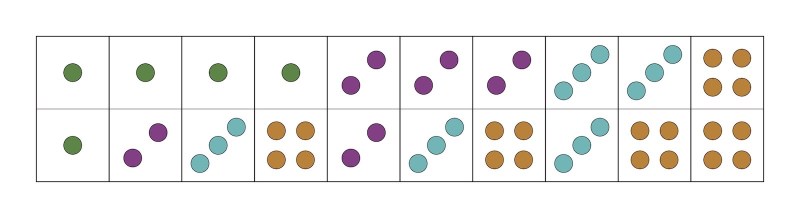
Dominoes

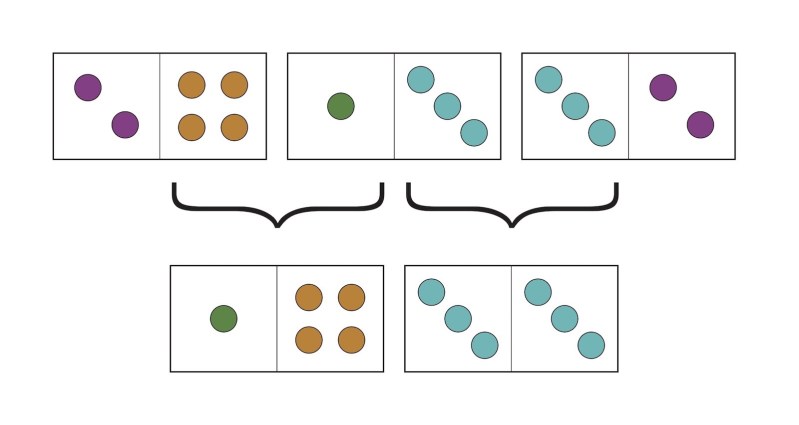
Another favorite game/puzzle of mine are domino-variations. For the moment, we will allow to lay out the dominoes only as horizontal strips, and, in contrast to traditional rules, we allow non-matching pieces to be adjacent. The two half-dominoes at a connection we call a link, and as two half dominoes can be combined to a new domino as shown in the second row below, the links become new dominoes in their own right.

Links

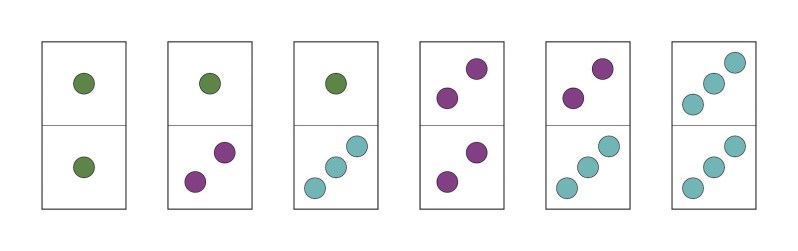
Today’s first game I call Domilogue, and it is a 2-person game. By now all practicing solitaire players will have acquired the ability to impersonate a second player, so this should not be a problem. Beginning with this game instead of with the puzzle below makes it easier to explain the mechanics. Domilogue is cooperative. Both players need one set of six dominoes containing all dominoes with one to three eyes as shown on top. The game begins with each player selecting from their set one domino that contains a 1, and placing it in front of themselves. We assume they are seated opposite each other, at distance of 6 feet, wearing masks and gloves.

Move1 2

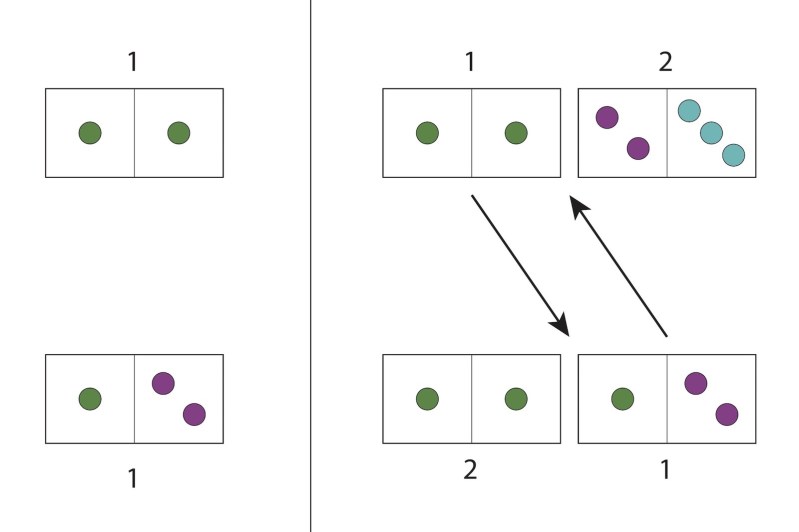
For the following moves, there is only one rule: The last played domino of one player must represent the link for the next domino the other player plays. To complete a move, they choose again a domino from their pile and add in on either side of the strip so that the link with the piece they connect to is the domino that the other player played in the previous move. Above you see the first two moves, with numbers reminding us when a domino was played, and arrows indicating which domino is responsible for which link.

I hope you find this rule sufficiently mind bending.

Stuck

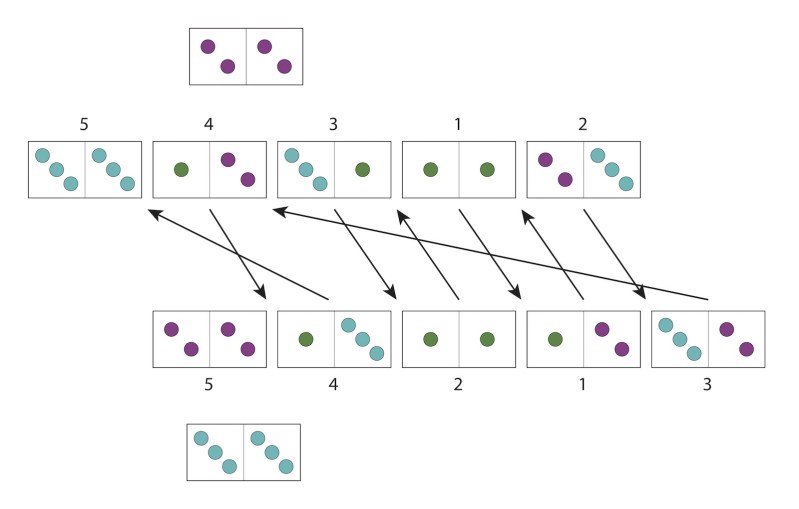
After three more moves, both players in my sample game have one domino left and are stuck. We see in these example moves that the orientation of a domino can differ from the orientation of the link it is responsible for. The goal is of course to get rid of both piles. Grab a partner or your other self, and give it a try.

Annulus

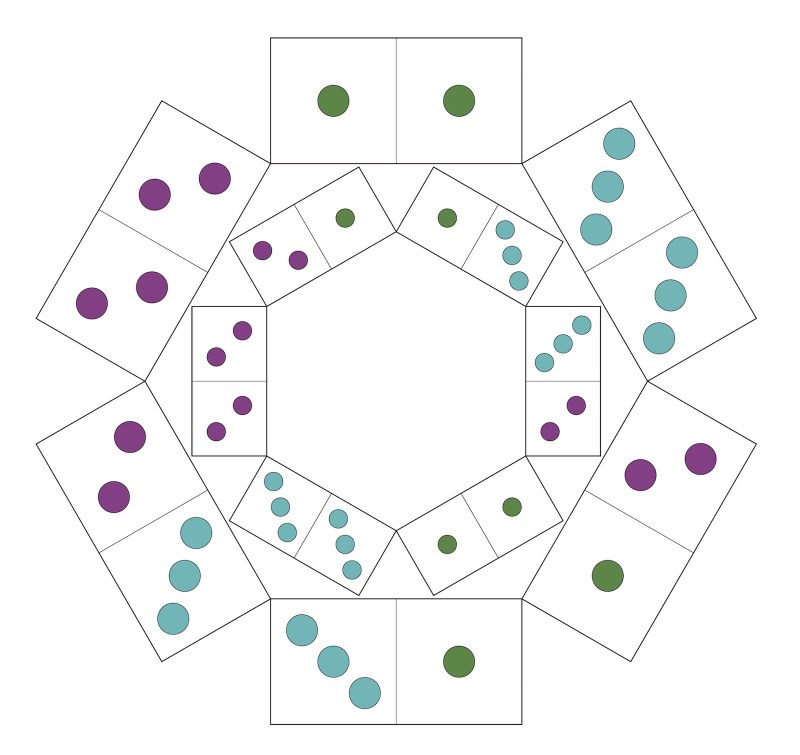
After learning the mechanics, above is a solution to a solitaire variation. In it, you are asked to arrange two sets of all six dominoes in concentric circles as above so that dominoes in the outer (inner) circle are the links for the two dominoes they touch in the inner (outer) circle. This allows for plenty of puzzles: For instance, start with one domino each in the inner and outer circle, and try to complete the circles. Or, make larger circles, either by taking two sets of the six dominoes, or one set of the 10 dominoes that also have squares with four eyes, as in the template below.

Dominoes10

Deficits (Solitaire VIII – From the Pillowbook IX)

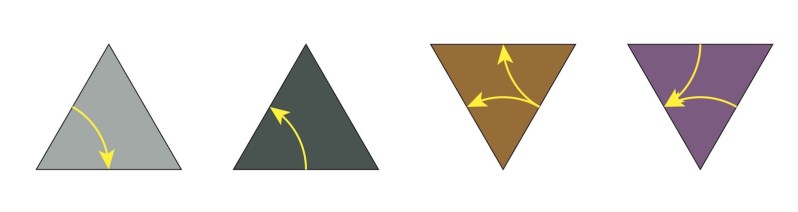
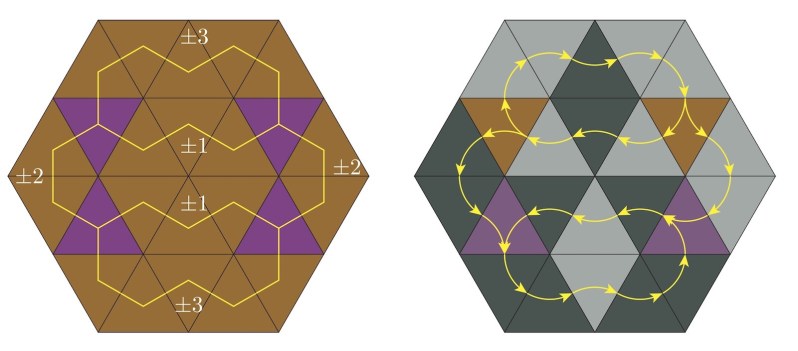
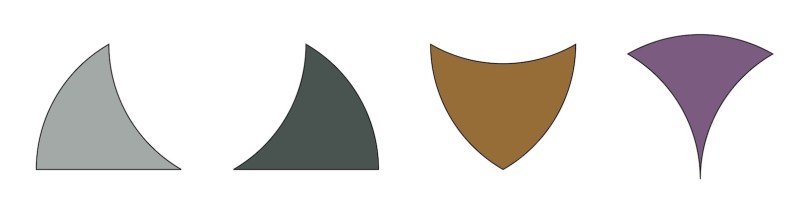
I continue last week’s discussion of tiling hexagons with the four trillows below.Triv 0

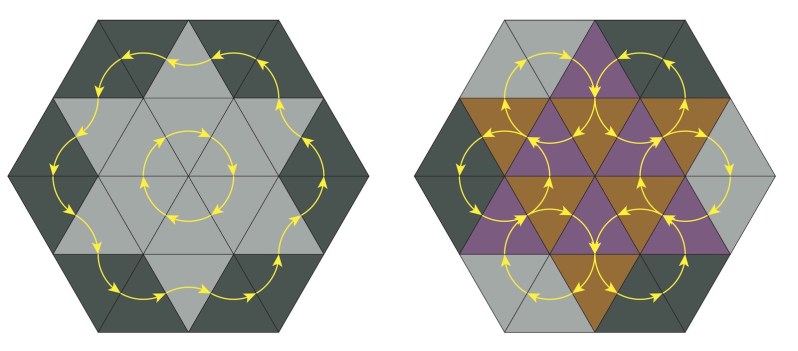
Instead of curved triangles I am using the markings with curved arrows that have to match in direction when the tiles are put together. This creates directed graphs like so.

Solve 0

Last time we saw that one can systematically solve such puzzles by first drawing the undirected graphs on the region to be tiled, and then directing the edges. Today we will use the concept of deficits to look at this more closely. The goal is to solve puzzles that tile the hexagon of edge length two with an equal number of green and gray triangles. Above we see two solutions that use 12 and 6 green and gray triangles, respectively. Let’s try it with 10 each.

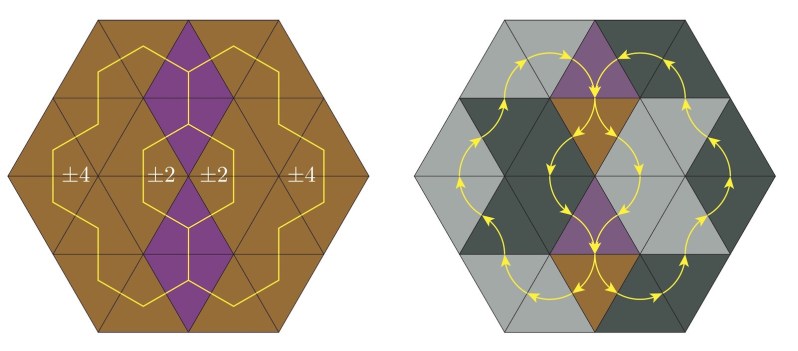
Solve 2

For this, we need to leave two purple and brown triangles. A solution is up above to the right. To the left is the undirected graph. Each edge comes with a deficit, which counts how many more left turns one takes than right turns when following that edge. This number is determined up to sign only as long as the edges aren’t oriented. The orientation needs to be chosen so that the deficits cancel, as left turns give not unexpectedly green triangles, and right turns grey ones. Below is another example with the brown purple triangles located differently.

Solve 1

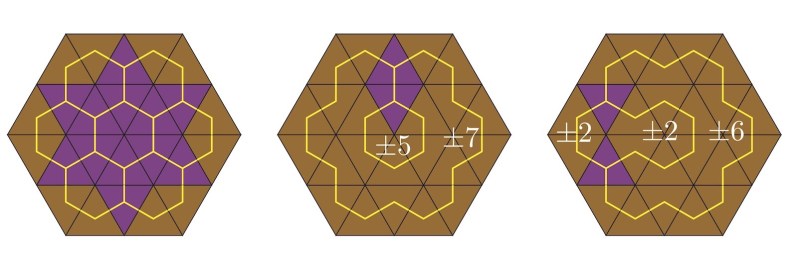
Can we do it with 11 green and gray triangles each? Below is the complete graph, from which purple diamonds have to be removed until only two purple triangles are left. There are, up to symmetry, only two possibilities, and we see that the deficits cannot be combined to give 0, Therefore this version of the puzzle has no solution. Thanks for trying.Just two

This can be continued, of course. Try it with 9 green and gray triangles each. Below are two solutions with six triangles of each kind.

Solve 3

Trivalency (Solitaire VIII – Pillowbook XIII)

Triv 0

Today we will use the special trillows above to tile the region(or similar ones) below:

Triv 2

Let’s call for the moment the grayish and greenish trillows simple, and the brown and purple ones special. Here are two puzzles as starters: Can you tile the same region just with the simple trillows? Can you do it using just one special trillow?Triv 3

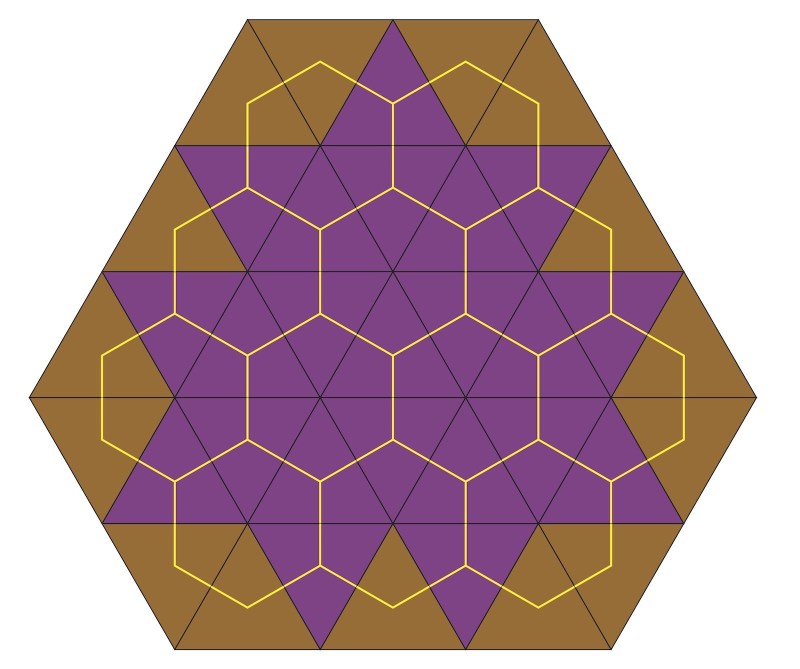
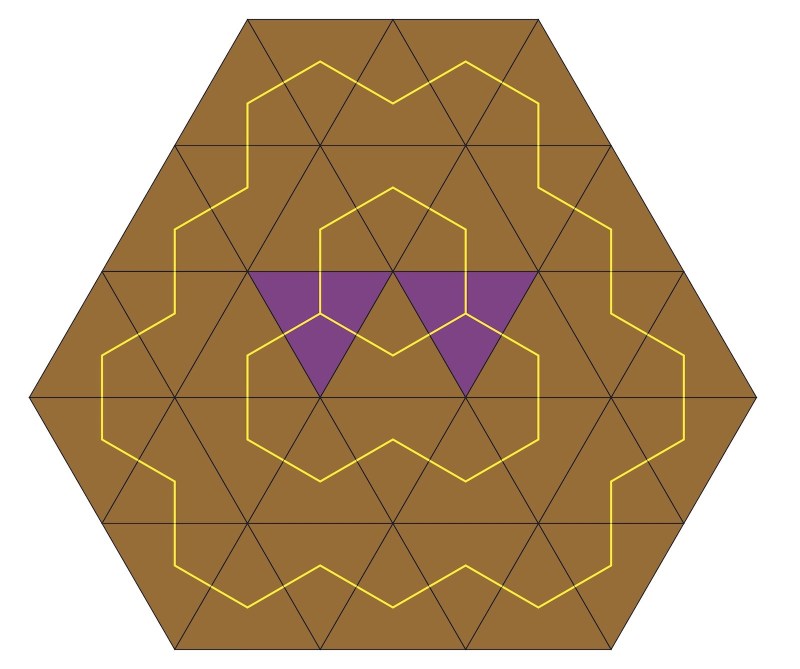
As an outline what is involved in creating and solving puzzles, let’s overlay the region we want to tile with a graph as above. The purple tiles will later correspond to special trillows, the brown ones to simple trillows. Let’s get rid of most of the purple tiles. We do so by deleting a yellow bridge between two adjacent purple tiles, and replacing them with brown tiles, keeping the remaining yellow edges. This amounts to partially tiling the purple region with diamonds. By now you should have solved the two puzzles at the beginning.

Triv 4

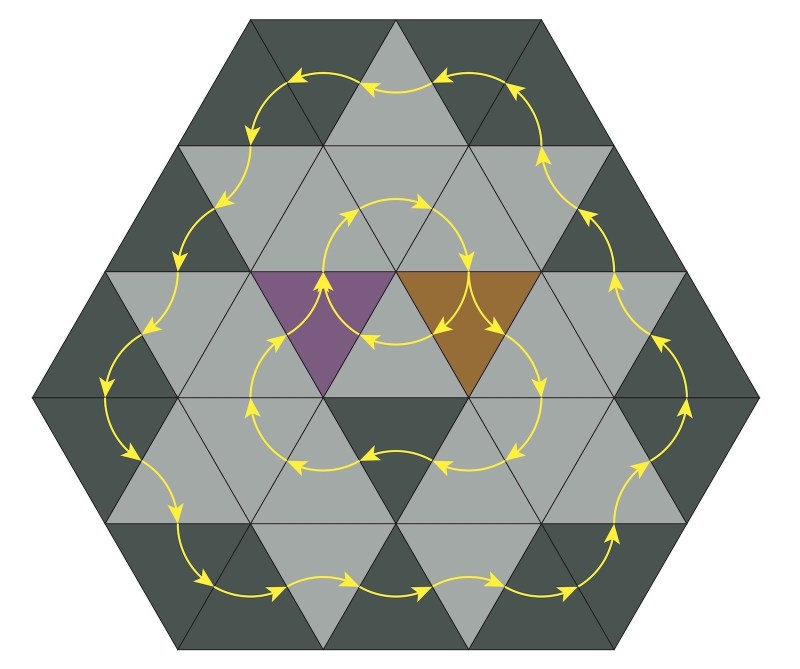
Now we orient the edges of the yellow graph. This is a bit deliberate. The outer loop we orient counterclockwise, and for the inner graph we make sure that at the two trivalent vertices the not all three edges point in the same direction.

Triv 5

Now we inflate/deflate all triangles according to the direction of the arrows, and obtain a tiling with just two special trillows.

Triv 6

We have used three more gray trillows than green trillows. Can you do it with just one more gray trillow? Or with no green trillows a all? More about this next time.

Trillows (Solitaire VII – Pillowbook XII)

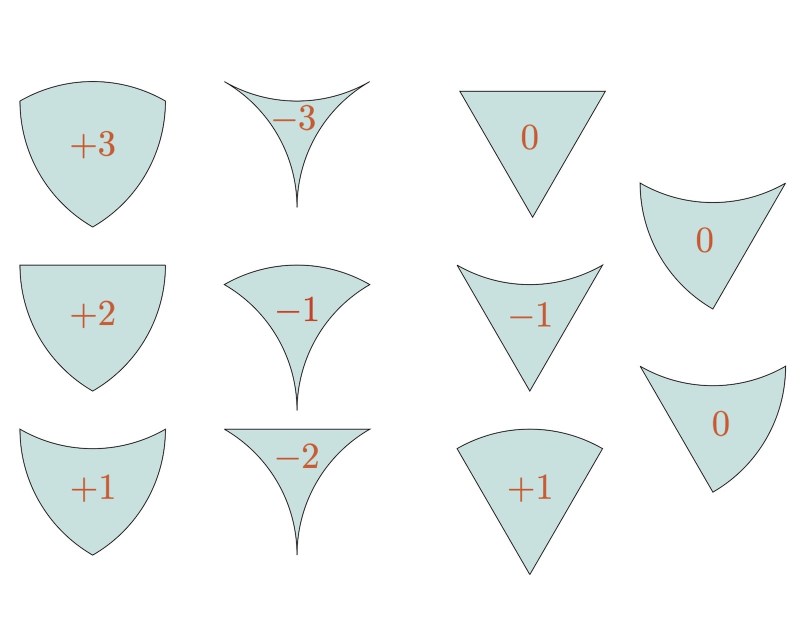
Below are the 11 possible triangular pillows, or short trillows (up to motions).

Trillows

They are obtained by replacing in an equilateral triangle some edges by circular arcs curving either inwards or outwards, The numbers indicate their defect, which is the difference between the number of convex and concave edges. This defect is additive when you tile larger regions. This means that the sum of the defects of the tiles will be equal to the defect of the entire region.

Triangles 01

For instance, suppose we want to tile a straight triangle with the three trillows above. The green one has defect +2, while the red and yellow ones have defect -1.  To see how this becomes useful, let’s suppose in such a tiling there are just  trillows with defect +2 (A many)  and  trillows with defect -1 (B many).

A triangle of edge length 3 requires 9 trillows, so A+B=9. On the other hand, the total defect gives the equation 2A-B=0, because a straight edged triangle has defect 0. Solving this shows that A=3 and B=6, as is indeed the case in the left figure. Now go ahead and try to tile a triangle of edge length 4 with the same type of tiles…

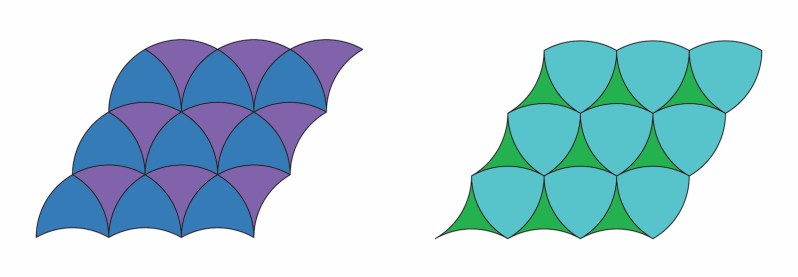
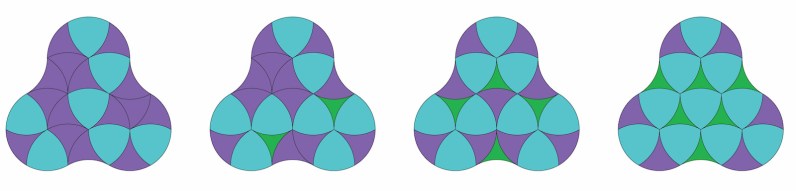
Periodic 2 01I have written about the four purely circular version briefly before. If you want to use them for a periodic tiling of the plane, the total defect of a fundamental piece must be 0. Above and below are examples that use just two trillows.
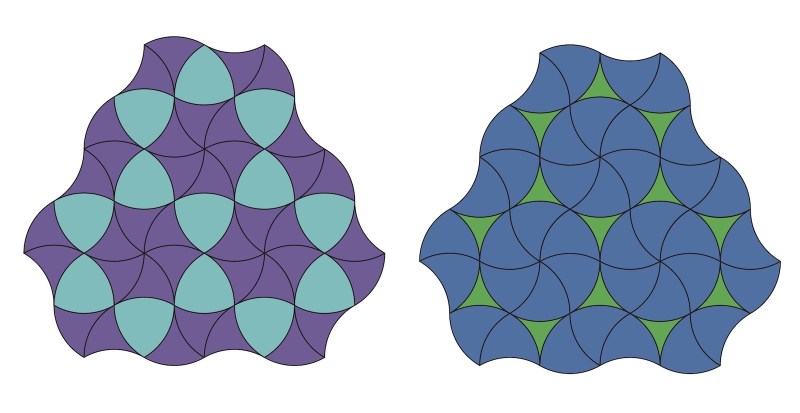
Periodic

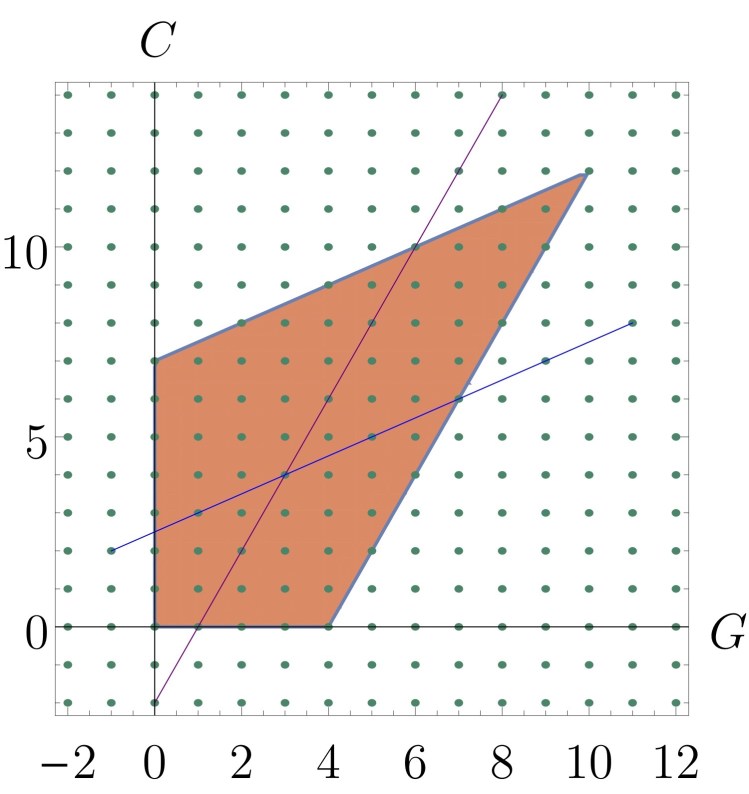
Every purely circular simply connected region has total defect +6, so if we want to tile a large circular triangle with C cyan, B blue, P purple and G green circular pillows, we have two equations to satisfy: C+B+P+G=22 for the total number of tiles, and3C+B-P-3G=6 for the total defect. Solving this for B and P gives B=14-2C+G and P=8+C-2G. Below you can see the region of values of C and G for which C,B,P,G to be nonnegative. Each dots in this regions represents a pair of integers (G,C) for which there is maybe a solution.

Curvedtriregion


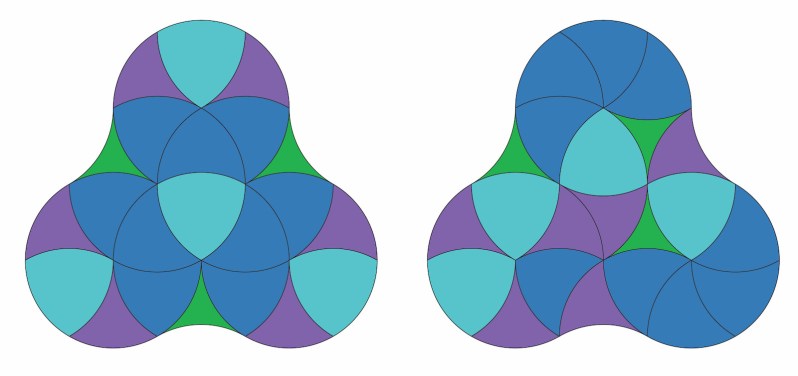
The edges correspond to solutions where only three of the tiles are used, and the vertices to those with only two tiles. The blue and purple lines are examples for which G and C are constant. At their intersection we have G=3 and C=4, which determines P=6 and B=9. Below are two different solutions with these numbers.

SolIntersect 01

For instance, if we wanted to tile this triangle without blue, the potential solutions are on the top edge. Below are actual solutions for G=0,2,4,6. Is there one for G=8 or even for G=10?

Tri0246 01

It would be interesting to find further simple obstructions to the possibility of tiling such shapes.

Hexons (Solitaire VI – Pillowbook XI)

Hexons template 01

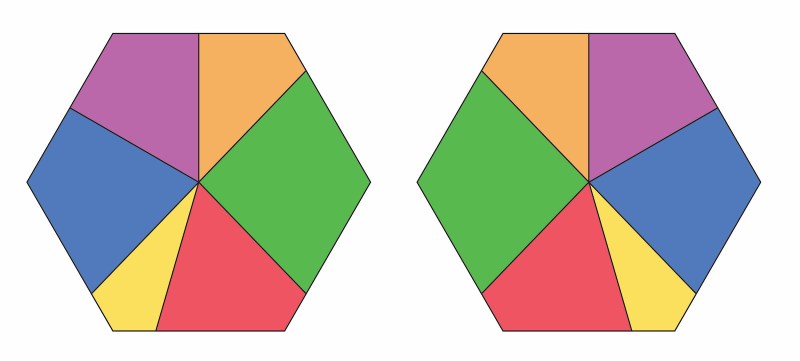
Take a regular hexagon, and mark points on each edge. Connect these points with the center of the hexagon to obtain six quadrilaterals. If we choose the marked points so that they divide an edge in one of the proportions 1:3, 2:2, or 3:1, there are exactly six such quadrilaterals (not counting mirror symmetric copies), and as you can see, they can tile a hexagon. I will call these hexons, in analogy of a puzzle by Alan Schoen that I will discuss in the near future. Above are mirror images of this solution, print & cut them out, then glue them together back to back.

Flipme 01

Here is a first puzzle: Suppose you flip one of the three pieces over (like here the blue one) that is not mirror symmetric, can you still tile the hexagon?

7Hexons 01

More complicated is the challenge to use seven hexons of each type to tile the seven hexagons above so that corners only meet corners, not just edges of neighboring hexons.


Triangle 01

Likewise, can you properly tile the above shape, so that the vertices of the tiles only meet at other vertices?

After playing with these hexons for a while, you will find it tempting and useful to group three of them together along so that they meet at their 120º-vertex. This can be done in 11 possible ways:


Triangles

You will get inflated equilateral triangles, where an edge is either straight, or has a kink inside or outside. I have discussed some of these triangles before, and the square shaped analogies (which I called pillows) in a long sequence of blog posts. Understanding how these 11 triangles can fit together will help to create and solve many more puzzles for the hexons. We will begin this next week.

In Memoriam (Solitaire V)

I just learned with sadness that John Conway has died two days ago, on April 11, of Covid-19. I am in no position to write an obituary. His playful creativity led to a synthesis of simplicity and depth that I will always gratefully admire. 

I like puzzles with few pieces, as the readers of this blog know.Pieces

Here is such a puzzle with just one puzzle piece, which comes with its mirror image. I suggest to print the template below, cut along the fat lines, and fold & glue the diamonds into triangles. This will give you six identical triangles that you can flip over to get the mirror symmetric version. I will explain later how this puzzle piece came into existence.


Template

We are going to use this tile according to timely rules: We may put two triangles together along an entire edge if the colors nowhere match along the edge:Rules

This is a strong limitation, but we can still use this puzzle piece to tile larger triangles, like so:

Triangles

Do you think you can tile even larger triangles? Try it!

Below is a more interesting puzzle. I have been trying to tile the hexagonal ring, but failed, as there is no way to place the puzzle piece into the remaining gap. Can you find a solution that closes up and doesn’t violate the rules?

Hexring


Then you can make your own challenges: Print a game board with triangles as below, and place randomly two of the puzzle pieces onto it. Can you form a chain that (legally and ethically) connects the two triangles? Below is a very simple example with solution.

Pathpuzzle1

Here are two more puzzles. At least one of them is harder than you probably like. But who knows.

Pathpuzzle2

A slightly cryptic hint about what is going on here is below. Stay safe.

Connected

Presents to Self (Solitaire IV)

A birthday in quarantine is a limited experience.

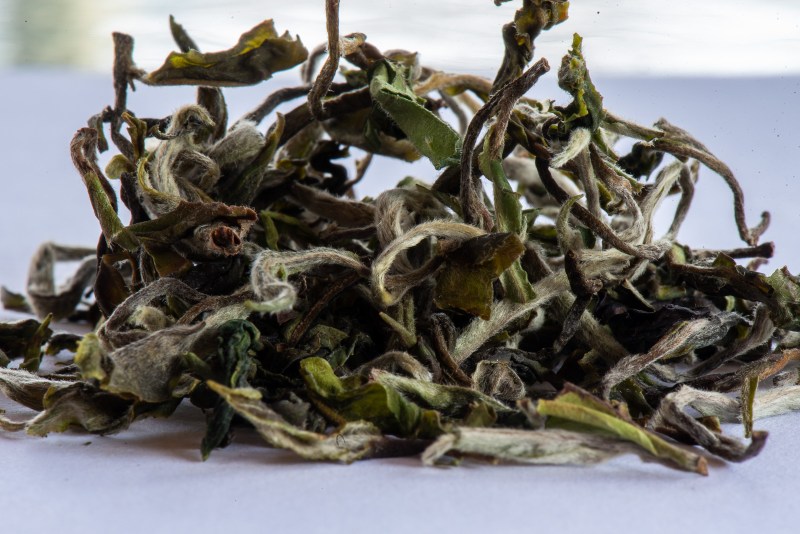
DSC 5720

Above is the 2020 Glenburn Moonshine Elite, the only Darjeeling that has made it to me this year so far. An amazing tea.

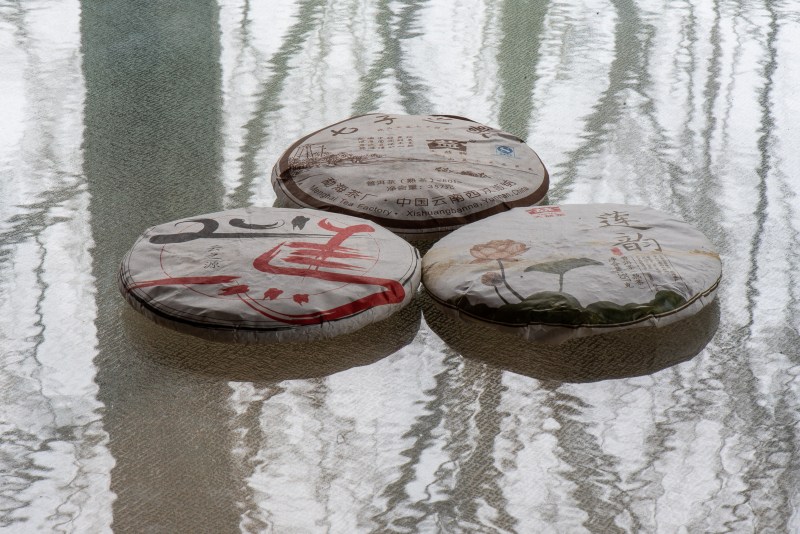
Below are some Pu-Erh cakes that will hopefully last a year.

DSC 5730

More food, for heart and brain:

DSC 2974

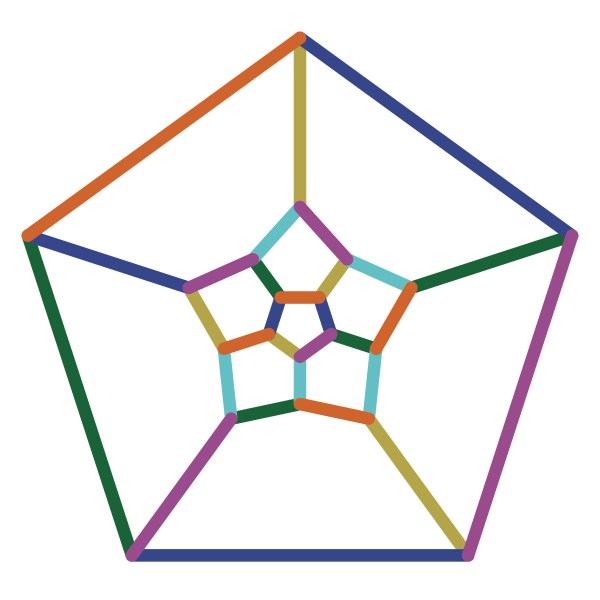
Of course there needs to be a puzzle. Let’s call it Quarantine. You have to go on an errand, visiting all twenty vertices of the map below (it will take a while to walk this, I hope).Errands 01

But there is a curfew. This means that you can only visit each of the twenty places once. If you are seen somewhere a second time, you become suspicious and will be eaten by a grue. You also need to end up where you started — sleeping in someone else’s home is suspicious.

Finally, traveling from place to place requires a special permit in the color of the edge along which you travel. So you will need to carry a few permits (being eaten by a grue is unpleasant). For instance, an orange permit will allow you to use any of the orange edges as often as you dare, but only those. There are six different colors, and hence six different permits.

Permits are expensive. What is the smallest number of permits that allows you to visit each place exactly once, returning to your starting point at the end?

AE LIVE MELBOURNE 220618

Poly-Worms (Solitaire III)

I have occasionally written about polyforms before. These are shapes obtained by putting simple shapes (like squares) together to form more complicated shapes. In the case of two squares, you ged dominoes, and more generally polyominoes. If you use other shapes, you get general polyforms.

Tiles


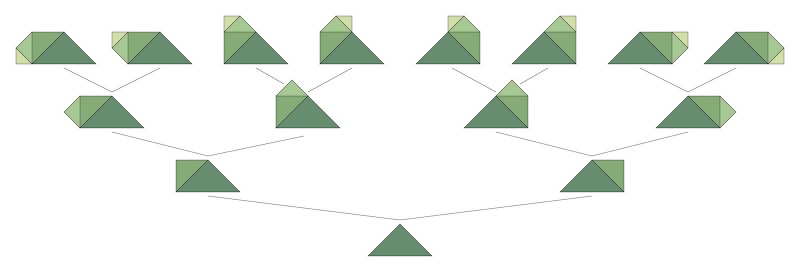
If we, in the insatiable desire for more, allow the shapes to change size, we get even more general polyforms. The ones we study today I will call poly-worms. We start with an isosceles right triangle, halve it, and attach the smaller copy to the larger, edge-to-edge. Then we keep going, halving and attaching restlessly. Above you see the first four generations, giving us eight 4-worms, which come in mirror symmetric pairs.Template 01

Above is a template that allows you to print all eight 4-worms at once. Growing the polyworms further leads to problems with self-overlapping, but also to the tantalizing possibility of having polyworms with infinitely many sides. Maybe more about this in the finite future.

Polyworms 01

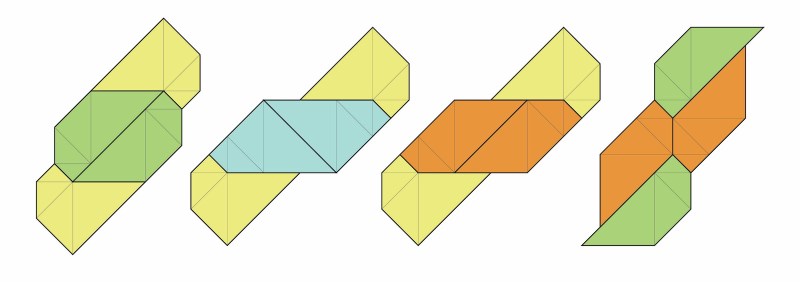
Let’s practice tiling with 4-worms. Below are combinations of 4-worms that can be used to tile the plane periodically by translating them. There are also two 4-worms that tile the plane by themselves. It should be amusing to study this for general polyworms.

TwoTiles 01

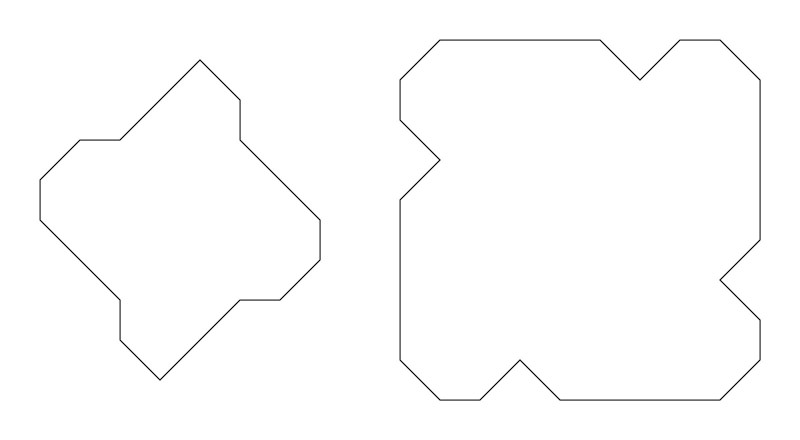
Here are two puzzles, hopefully not too easy. The goal is to tile the left one with 8 and the right one with 16 4-worms.  You will need the same number of each kind.

Puzzles0 01

The Pyramid (Solitaire II)

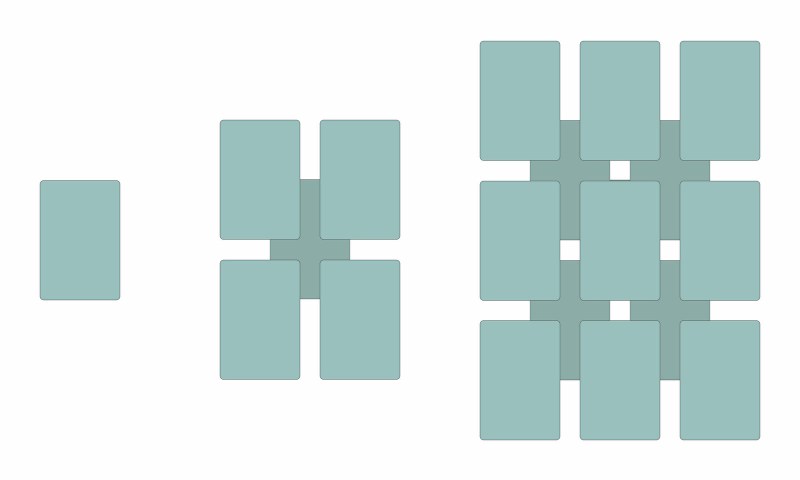
This is the first game that I remember inventing. For this patience/solitaire you will need a regular small deck of 32 cards.Setup 1 01

After shuffling, you deal out one card, on top of that four cards, and on top of that nine cards all face down, as shown above.  Then you add a layer of 16 cards face up, and put the remaining two cards face up to the side of the tableau, to begin the reserve piles:Setup 2 01

The goal is to transfer cards from this tableau to four foundation columns of the same suit, starting with the aces, and building down (Ace, King, Queen, Jack, 10, 9, 8 7). In addition, you can transfer cards regardless of suit building up to the two reserve columns at the side:Play 1 01

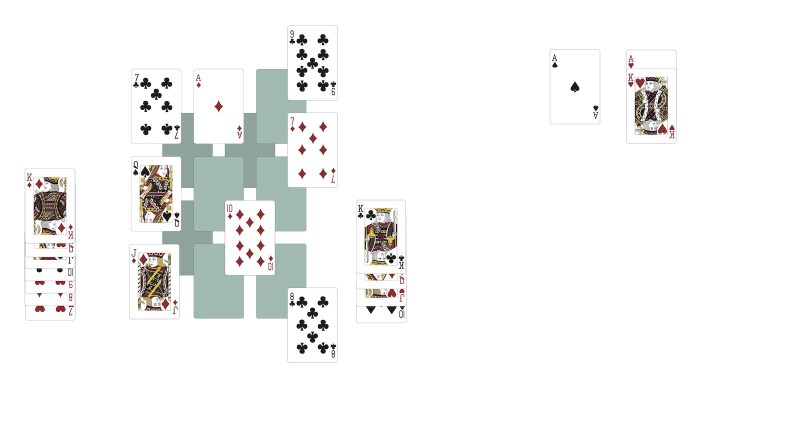
Notice that above we moved the king of clubs from the left reserve to the right to create an empty spot that we use to remove more cards from the pyramid.

As soon as one face down card becomes completely uncovered, it is turned over, and can be used as well.

Play 2 01

We were able to uncover the ace of diamonds. We use this to start a new foundation column, adding the king of diamonds right away. The queen of diamonds is hidden under the king of clubs in the right reserve column, but we can transfer the king to left, thus freeing the queen. Sigh. This allows us to remove more cards from the tableau.

Play 3

Now is a critical moment. The only thing we can do is to transfer the jack and queen to the right reserve column to free one more card. We are lucky, it is the missing ace of clubs.

Play 4

This allows to reduce the tableau and the reserve columns considerably.

Play 6

The uncovered king of spades allows to eliminate the right reserve column, which we then use for the 7 of diamonds and the 8 of hearts.

Play 7

In the final moves, we transfer all the spades, uncover the 9 of diamonds, and solve the patience by transferring the diamonds.

There are two variations:

1) To make the patience harder, one can require that the colors have to alternate when building the reserve column.

2) To make it easier, one can allow to transfer more than one card from one reserve column to the other.