Translucent Dominoes (Cooperation Games II)

Most tiling problems are strictly segregational, i.e. the tiles are not allowed to overlap. To change this, let’s consider tiles that are partially translucent, so that in order to really tile a part of the plane, one needs to cover it multiple times.

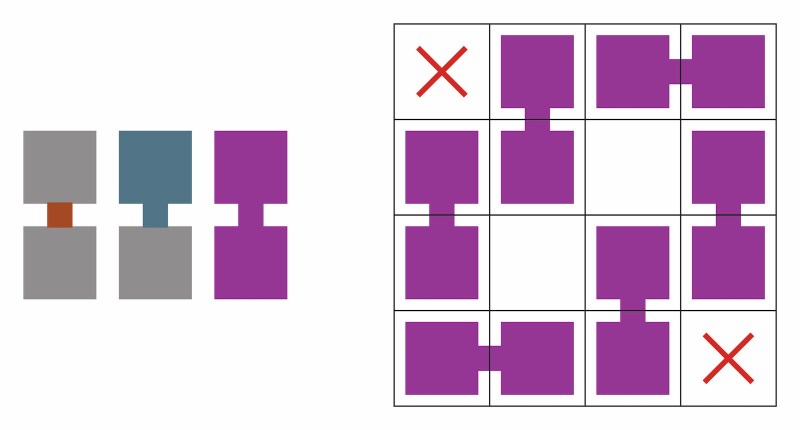
This is the first in a series of posts about partially translucent polyominoes, and we begin with translucent dominoes, of which there are three:
Dominoes 01

The purple one is a regular (non-translucent) domino, and to the right you can see my feeble attempt to tile a 4×4 square of which two opposite squares have been removed (This is of course a very classical puzzle). The other two dominoes have one or two translucent squares, which are shown as gray. This translucency means that in order to properly tile a square with dominoes, we need to cover it either with a single solid color square, or with two translucent (gray) squares, i.e. the gray portions of two dominoes must overlap, like so: Connect 01

The left image shows two fully translucent dominoes that overlap in the middle square, while the left and right squares are still only covered once. By counting the small connector squares you can see how many gray squares sit on top of each other. In the middle is a chain of four dominoes, all gray tiles are doubled. And to the right we have covered the middle gray square three times, which is illegal for now. 

If we use only the blue singly translucent domino to tile, two of them need to overlap to form a single classical (segregational) tromino, so tiling with these dominoes alone is equivalent to tiling with trominoes.

Domino tromino 01

You should try to tile the 4×4 square (with two opposite corners removed as above) with copies of either the singly or the doubly  translucent domino. In both cases, this is impossible (and impossible for larger squares as well, again with opposite corners removed. You will enjoy finding the arguments). Tiling becomes easier when you allow both types of translucent tiles, a simple solution to the 4×4 puzzle is shown below to the right. The left figure gives a hint what limitations you face when you try to tile with the doubly translucent domino alone.
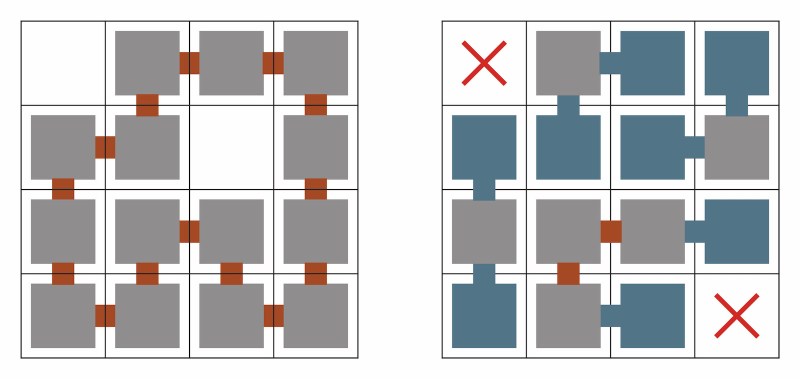
Domino4x4 01

As a cooperative game, start with a 6×6 square, mark a few tiles as forbidden, and then take turns to place translucent dominoes on the board with the goal to tile the board completely, following the translucency rule.

Weed (Cooperation Games I)

It’s time for change.

Weed is a cooperative card game for 1-4 players. There are three different types of cards, in four colors:

Types 01

They can be laid out to grow weeds, like so:

Weed 1 01

When placing the cards, there are a couple of things we shouldn’t do. We won’t:

Nonos 01

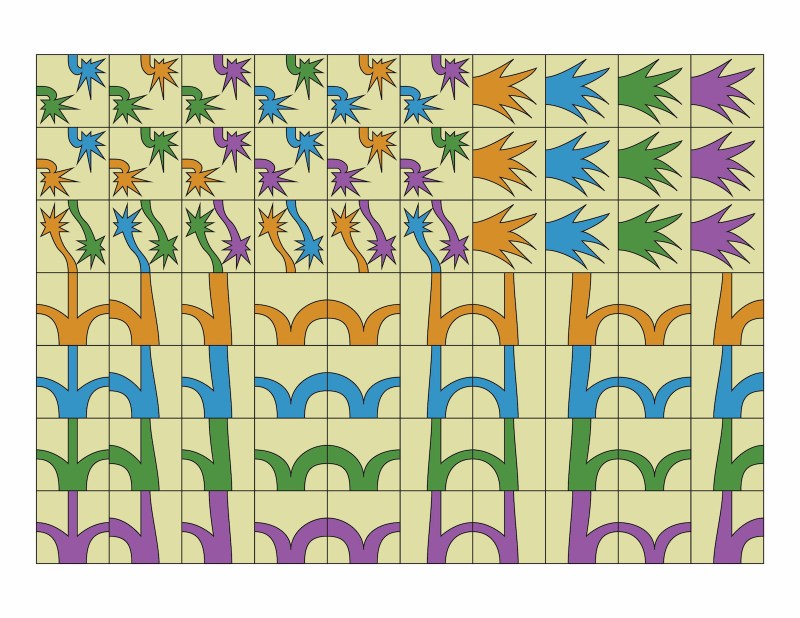
Below is a full set of cards, and here a printable pdf.

Cards 01

Now for the game: The players first agree on a board size, like a 6×6 square. As many cards as there are players are placed face down onto the board so that they don’t share an edge, not share an edge with the boundary of the board, and then turned over. The remaining cards are dealt to the players. They take turns to grow weeds, only placing cards that match previously placed cards. For every completed weed the players get one point. For each square of the board that can’t be tiled one point is being subtracted. The goal is to come out positive, of course.

Below is a perfectly completed 6×6 board. Sample 01


Enjoy, and go in peace.

Recursion – Solution (Solitaire XXVI)

To keep this week’s frustration to the necessary minimum, here is a discussion of last week’s recursion puzzle:


I first asked to assemble any of the 30 squares whose sides are colored in four distinct colors out of five from four smaller squares so that edge colors match, and we don’t use the square we start with, like so:


Rec2 1 01

As we can see, there are seven different solutions. It doesn’t matter which square you start with, permuting the colors will reduce everything to this example. Next we need to pick one of these seven solutions, and assemble each of the four sub-squares using 16 of the the remaining squares. It turns out that

  1. this is only possible for the fifth solution above;
  2. each subsquare can be assembled in two distinct ways:

Rec2 2 01

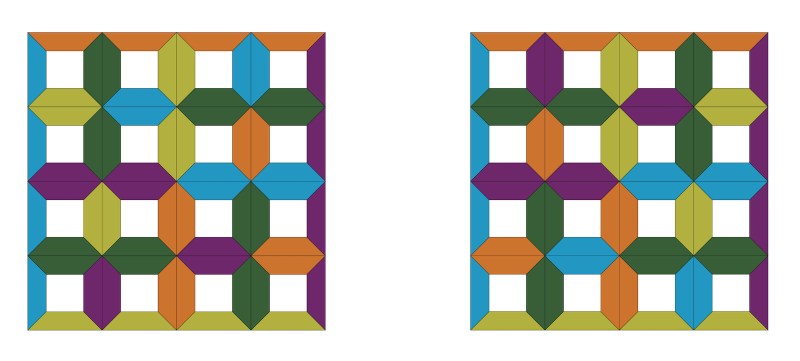
But only two of the 16 possible choices satisfies the condition that we are not allowed to reuse squares, namely these two:

Rec2 3 01

Pretty? Now the remaining squares 9 can be, in each case, assembled into a 3×3 square in exactly one way:

Rec2 4 01

Here are a few hints about this: First note that the dark green color has to occur an even number of times, the other colors an odd number each. This forces the other colors to constitute the boundary, so dark green is confined to the interior. A bit trial and error shows that the only green-free square has to be at the center, and the green edges assemble in a pattern as above.

Recursion (Solitaire XXV)

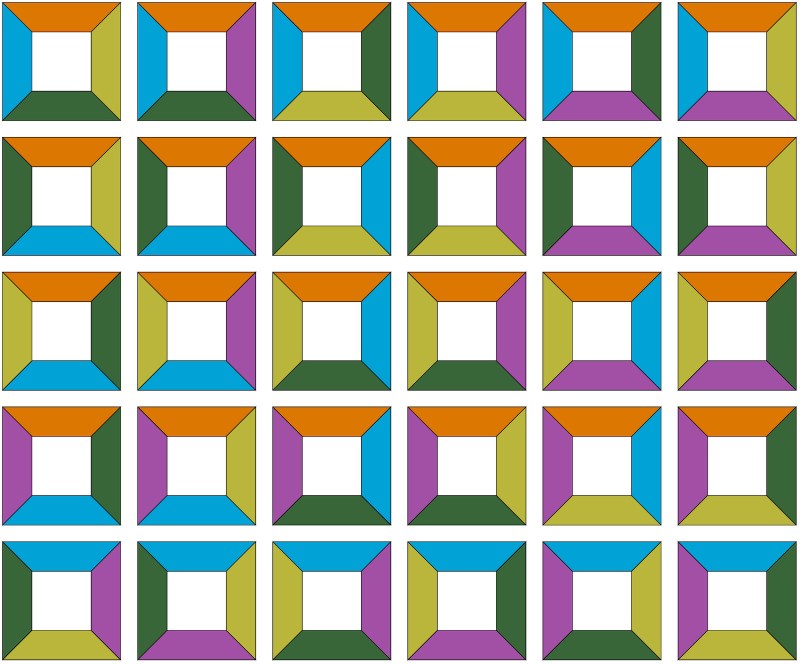
Time for another Isolation Puzzle while the days grow darker. Here are all 30 squares whose sides are colored in four different colors, chosen from five available colors. Print and cut them all out:
Fivecolors 01

Pick one of them. The first easy puzzle is to assemble it using four of the remaining 29 squares, like so, for instance:

Puzzle0 01

Notice that the border of the 2×2 square matches the border of the chosen square, and squares that touch must match along their common sides, too. The second not quite so easy puzzle is actually four puzzles, namely to assemble each of the four squares on the right using 16 of the remaining 25 squares. No duplicate usage is allowed! Below is a solution for the top left square. 

Puzzle1 01

Do this with the other three squares. The solution is by no means unique, and it is well possible that you get stuck and have to revise your choices. When done, you are left with 9 remaining squares. The final not at all easy puzzle consists of assembling them into a 3×3 square so that the sides are in one color each, and again tiles match their colors along joint sides. Like so:

3x3 01

In the above example (yours might well be very different), can you also have dark green occur on the sides of the 3×3 square? And, has this anything to do with dark green missing in the square we started with? Sometimes the past is going to haunt us…

And finally (but maybe this is impossible), can you make the 3×3 square so that its border is an enlarged version of the square we started with?

Dual pillows (Solitaire XXIV – From the Pillowbook XVIII)

Today we introduce the dual pillows:

Duality 0 01

They arise as follows: Take a tiling by pillows, and practice social distancing. The gaps between the pillows will instantly become occupied by the dual pillows, like so:

Pillowtile 01

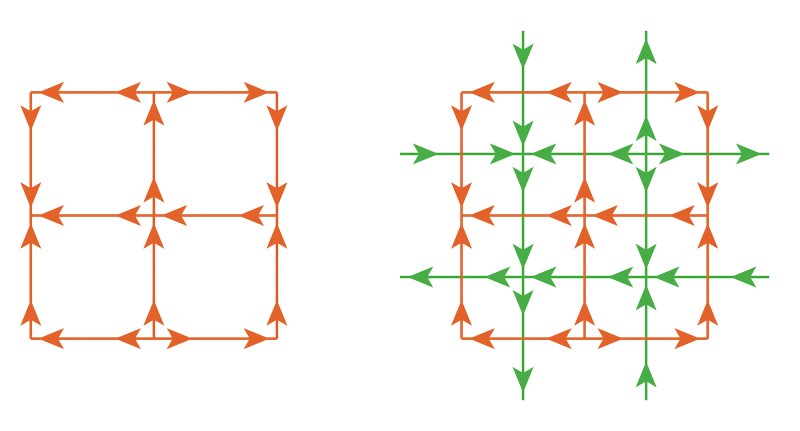
While the dual pillow don’t look anything like the standard pillows (which also don’t really look like pillows, I just wish they would), they are nothing but real pillows, which might be the quintessence of any duality. To see this in this instance, let’s switch to the arrow representation of pillows I introduced to make Alan Schoen’s cubons accessible to flatlanders:

Duality 1 01

A pillow is replaced by a cross where an arrow pointing away from (resp. towards to) the center represents a pillow bulge inwards (resp. outwards). A tiling by pillows becomes an oriented grid graph. Rotating every edge of this grid graph about the center of teh edge by 90º and changing its color from orange to green creates the oriented dual grid graph, which we can now interpret pillows or dual pillows.

Duality 3 01

Purists will suffer under the different appearance of pillows and dual pillows. So above is a more sober but completely symmetric representation of pillows and their duals. They, as well as their more baroque counterparts, can be used for puzzles and games.

Dual game 01

Above to the left is a 3×3 board game. It is easy to fill it with the abstract pillows / dual pillows so that colored squared are correspondingly covered and gray triangles never overlap. But you can do this competitively, green and red taking turns until one player can’t place a tile anymore.

Or, if you still prefer isolation, can you tile a larger 6×6 board with 6 sets of pillows and dual pillows?

Alan Schoen’s Octons (Solitaire XXIII – From the Pillowbook XVII)

After introducing the six small octons, let’s talk about the larger octons a bit, that allow to divide the octahedron edges in the proportions 1:3, 2:2, or 3:1. There are 24 of them, suggesting to assemble four octahedra with them. This is Alan Schoen’s original version. 

Arrowpillows

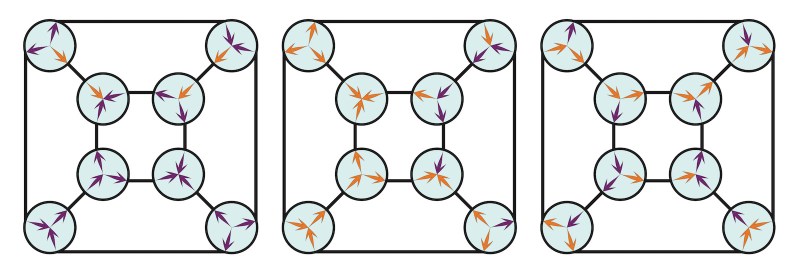
These octons can be represented as decorations of the vertices of a planar graph using the 24 coins above.

ChiralOctons 01

Above you see the octahedral graph, decorated on the left with the six chiral octons (or coins). The rule for placing them is simple: All edges must have either arrows with matching directions, are no arrows attached to them. Besides the one solution shown above for the chiral coins, there are three more, up to symmetry, which are indicated below in the octahedral subdivision:

Chiraloctons

They are not so easy to find. To avoid duplicating a solution, just place one coin exactly as in the decorated graph on the left, and complete its in a different way.

We have already seen the 10 different ways to place the six cubons without 2:2 ratio (i.e. with four arrows in a coin) the last time. What about the remaining 12 cubons? There are 12 different ways to split them into six so that one can assemble them into two octahedra. Below is an example how to split them, assembling them is another puzzle, and finding the remaining 11 ways is really hard and tedious.

Rest

One can of course also start from scratch. There are  134596 ways to select 6 octons of the 24, but only 5427 can be assembled into an octahedron. Then there are 11417 different ways to group the 24 octons into four groups of 6 that all can be assembled into four octahedrons.

Alan Schoen’s Small Octons (Solitaire XXII – From the Pillowbook XVII)

DSC 3045

Above you can see how Alan decomposes a regular octahedron into octons. The recipe is the same as for the cubons and tetrons: Divide the edges of the octahedron in suitable ratios, connect the subdivision points to the face centers and the center of the octahedron. If you allow as subdivisions the proportions (1:2) and (2:1), there are six different octons that you can get this way.Smalloctons

Up to rotations, they can be used to assemble an octahedron in 10 different ways, as indicated above. A better representation of these solutions is shown below. The octahedron is represented by its skeletal graph, and each octon becomes a vertex with arrows pointing towards or away from the vertex, indicating what proportion the edge is to be divided in (2:1 or 1:2).

Small Arrowcubons

Equivalently, we can think of these six “small” octons as the six pillows I have discussed four years ago. So we can view the puzzle to assemble the six octons into an octahedron also as the puzzle to decorate the vertices of an octahedral graph with the six pillows so that the two arrow at each edge point the same way. More generally, one can ask to decorate any quartic graph this way, with any choice of the octons/pillows. Below is the graph of the cuboctahedron, with two sets of “coins” for decoration. This suggests a game for two players (gasp): Take turns to place the coins of your color, again so that arrows along each edge are pointing the same way. The player who moves last wins. Can you find a winning strategy for one of the two players?

Cubocta game

Colored Pillows (Solitaire XXI – From the Pillowbook XVI)

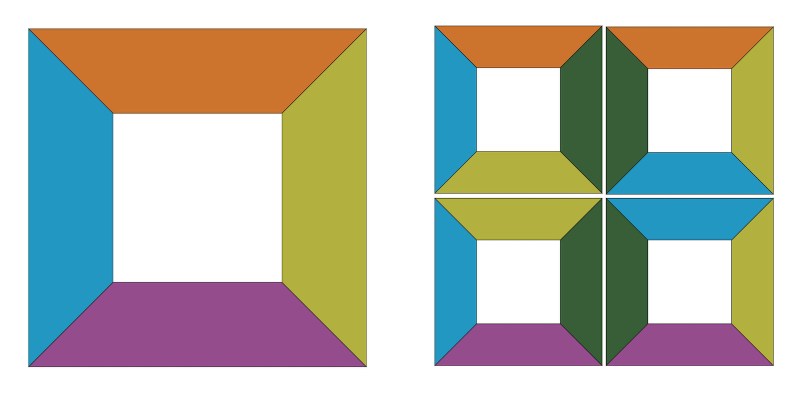
Another lonely day gave me the idea to spice up the six standard pillows into domino type puzzle pieces by coloring them like so:

ColorPillows deluxe

Below is a less pretty but easier to cut version, assembled in a 5×2 rectangle,

Boundary 1 sol

which solves what a mathematician would call a boundary value problem:

Boundary 1

Here is another puzzlable boundary contour for your solitary enjoyment. The rule is to place the puzzle pieces so that they fit & match in color when they meet:

Boundary 2

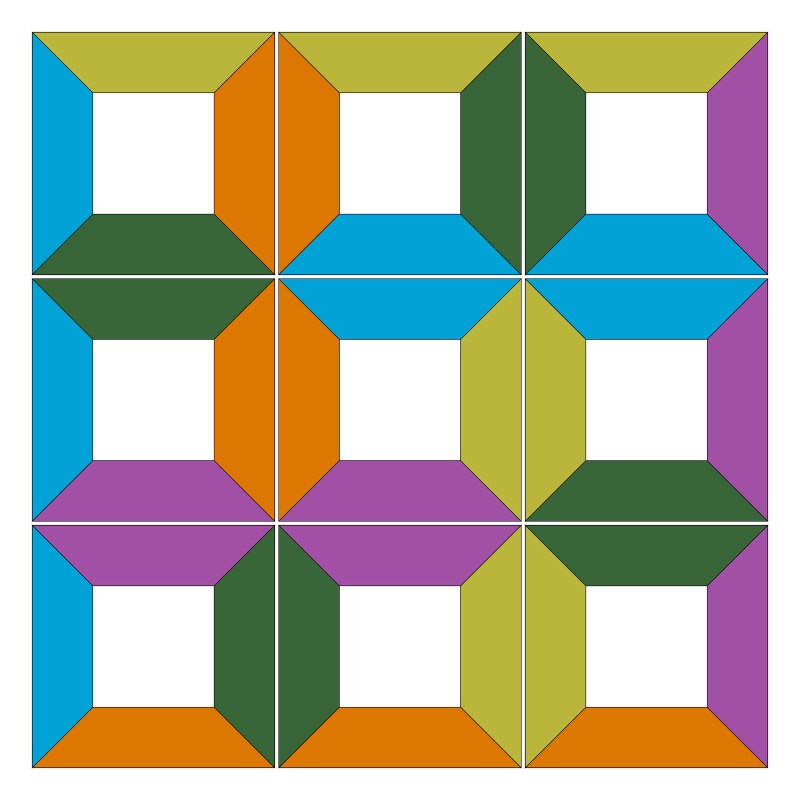
These are nice little puzzles, not too easy, not too hard, but 10 is an awkward number (why don’t we have 16 fingers, like everybody else out there?), and it is somewhat annoying to have to turn around some of the pieces by 180º to see whether they finally fit, so I decided to modify the coloring a bit, like so:

Color16

The 16 puzzle tiles above must not be rotated anymore. Equivalently, the horizontal and vertical color gradients need to match with adjacent fitting pieces. The pieces above all fit together to form a 4×4 square which periodically tiles the plane, moreover, this square is symmetric across one of its diagonals. Can you find other such square, tiled by using each of the 16 colored pillows exactly once? There are a few, but not too many.

Puzzles2

These 16 puzzle pieces would make great 2-person games, for horizontal and vertical players… Their time will come. For now, enjoy the two boundary value problems above. One of them is very very very hard.

Inflation (Solitaire XX – From the Pillowbook XV)

In order to have a planar realization of Alan Schoen’s tetrons and cubons, we need to add a few coins to our currency. Here are the 24 coins you’ll need:

Cubarrows


Below is an example how to decorate three cube skeletons with them. This doesn’t look as pretty as the 3D-cubons, but one can much more easily play with them. Coins need to be placed on the vertices of a graph so that the two arrows that share an edge have the same color and point in consistent directions.

Cubons plane 01

What other pretty cubic graphs are out there? The Foster census lists one cubic symmetric graph with 24 vertices (the Nauru-graph), and it is a challenge quite in Alan’s spirit to try to decorate it with his 24 cubon-coins. This is indeed possible:

Naura

The above representation of the Nauru graph lives in a hexagonal torus. It is also the dual graph of the Octahedral 3¹² polyhedral surface, which is the genus 4 quotient of a triply periodic polyhedron by its period lattice. Here is a picture of it. Note that this is twice a fundamental piece, as the period lattice is spanned by the half main diagonals of the cube.

Triply Naury

Octahedral 3¹² is intimately related to Alan Schoen’s I-WP surface. Everything we do at a certain depth is connected to everything else, it seems.

Decorated Maps (Solitaire XIX – From the Pillowbook XIV)

We continue decorating cubic graphs with our four coins:

4coins 01

Below is the complete bipartite graph K₃₃, realized as the edge graph of the Heawood map of the torus. Remember that opposite edges are identified.Heawood 01

Here is a little puzzle to warm up. If we order the four coins as up above, we can for each decoration of the Heawood map make a tally like 0330 which lists for each coin how often it occurs. The 0330 is the tally for the simple solution to the the left. Besides that, the following tallies are possible: 1221, 1140, 0411, 1302, 2112, 2031, 3003. Find one decoration in each case.

Möbius Kantor 01

A more interesting map is the Möbius-Kantor map on a genus 2 surface, represented by an octagon with opposite edges identified. The map consist of 6 octagonal regions. Can you decorate it so that the boundary of each octagon uses each type of coin exactly twice? Here is a hint: This map is the double cover of the cube map, branched over the centers of the faces. So you if you can first decorate the cube such that each square uses each coin once, you can lift this decoration…

Pappus 01

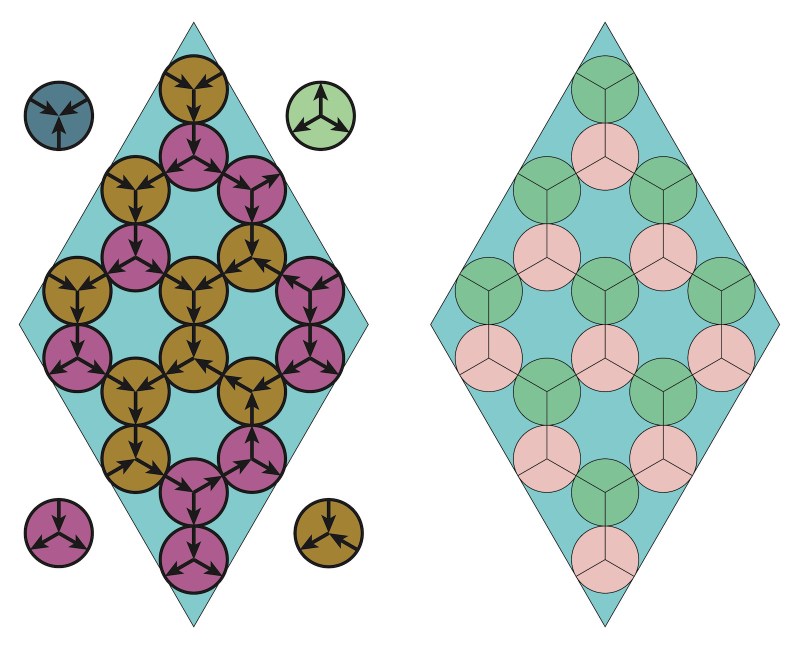
Finally for today, here is the Pappus map on a torus. Again identify opposite edges of the diamond, matching all three coins on one side with the three corresponding three coins on the other side. Can you decorate this map using one blue coin, and for the rest only use purple and brown coins? It will help to remember what we learned about deficits for pillows a long time ago.