Le Bateau Ivre (Loxodromes II)

A good way to embarrass oneself is to go to a book store in a foreign country whose language one is not fluent in, and buy a book. I did this multiple times, at least in France, Spain, and the UK.

I typically tried to get by without saying a single word as not to reveal my complete incompetence, but the punishment for that can be unexpected. During one of my first visits to Paris, I went and bought the Bibliothèque de la Pléiade edition of Arthur Rimbaud.

The catch was that the very pretty cashier tried to initiate a conversation by smiling at me and saying “Ah, J’aime Rimbaud”.
I blushed, payed, and made my way out. Embarrassing.

But it brings us to the topic, Rimbaud’s Drunken Boat.
Concept

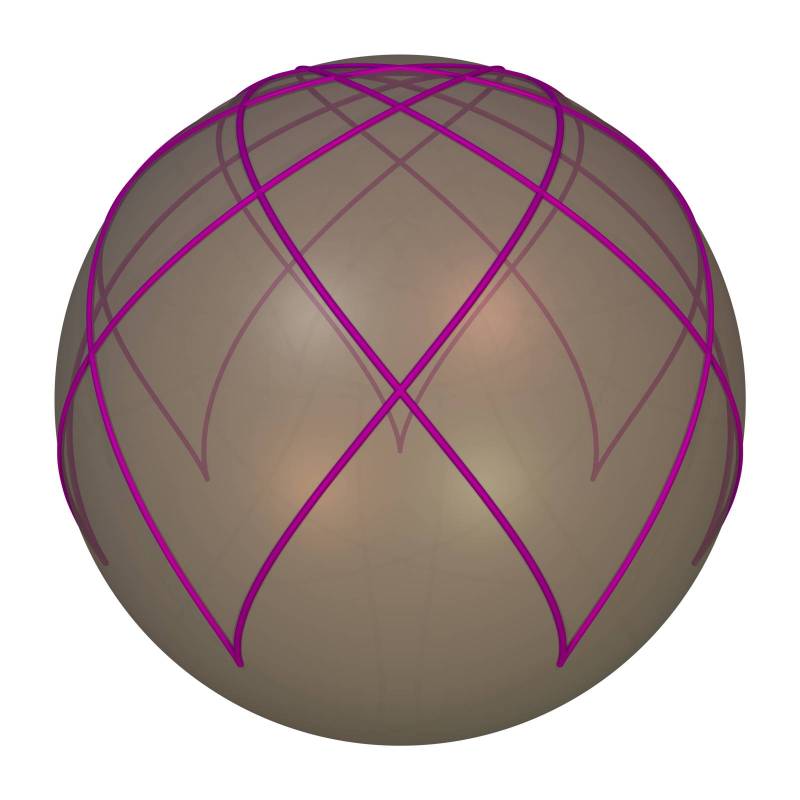
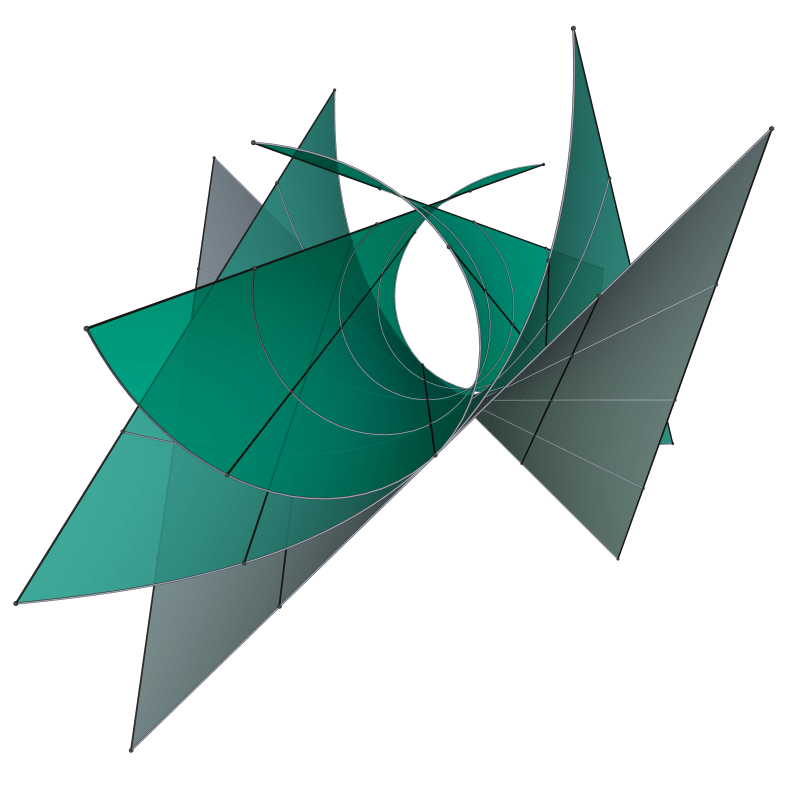
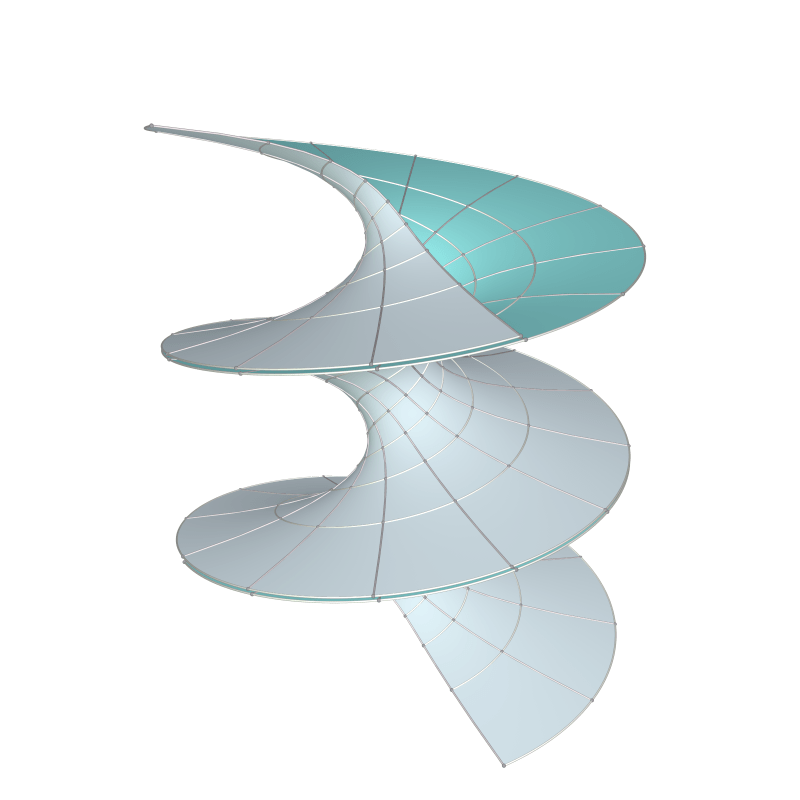
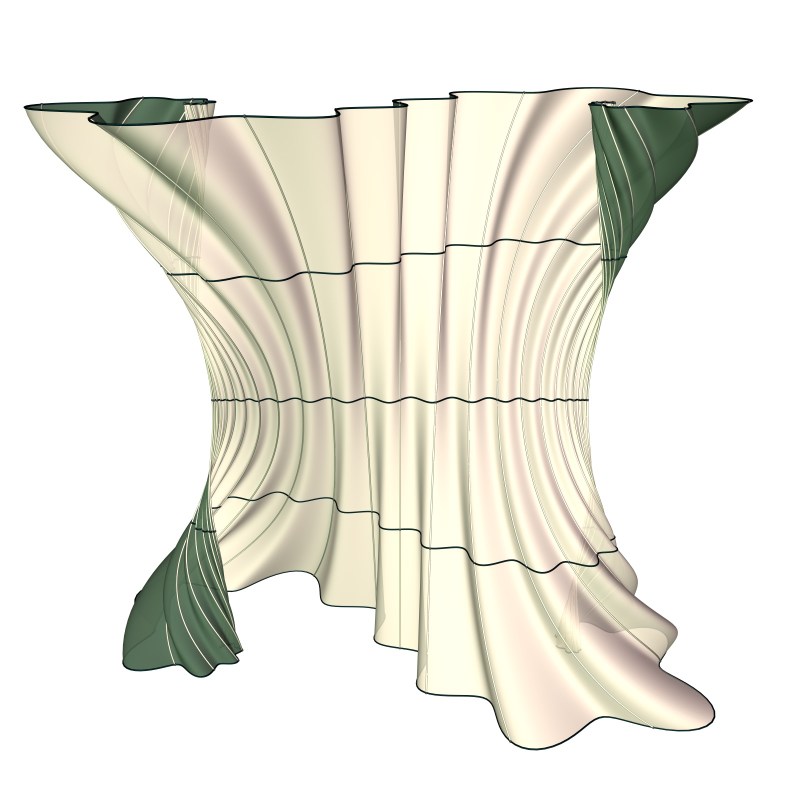
The image is this, and it does not look like a drunken boat. What we start with are the loxodromes I have talked about before. They are the curves a sober boat would trace out on the sphere when heading in a fixed compass direction. Laying down one of these loxodromic double spirals as a base using Malcolm’s clay printer looks like this:
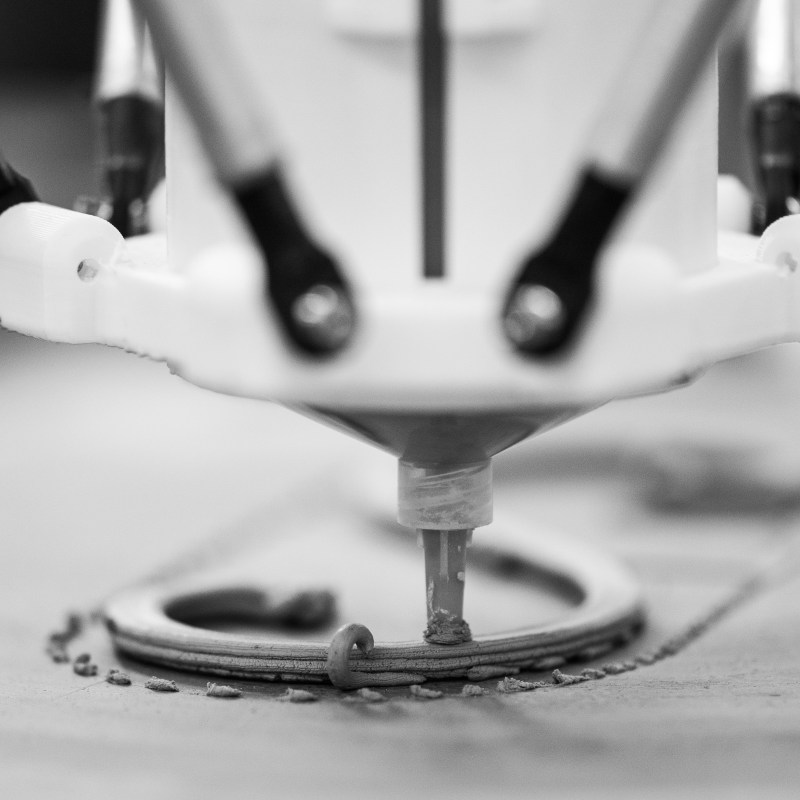
DSC 3912

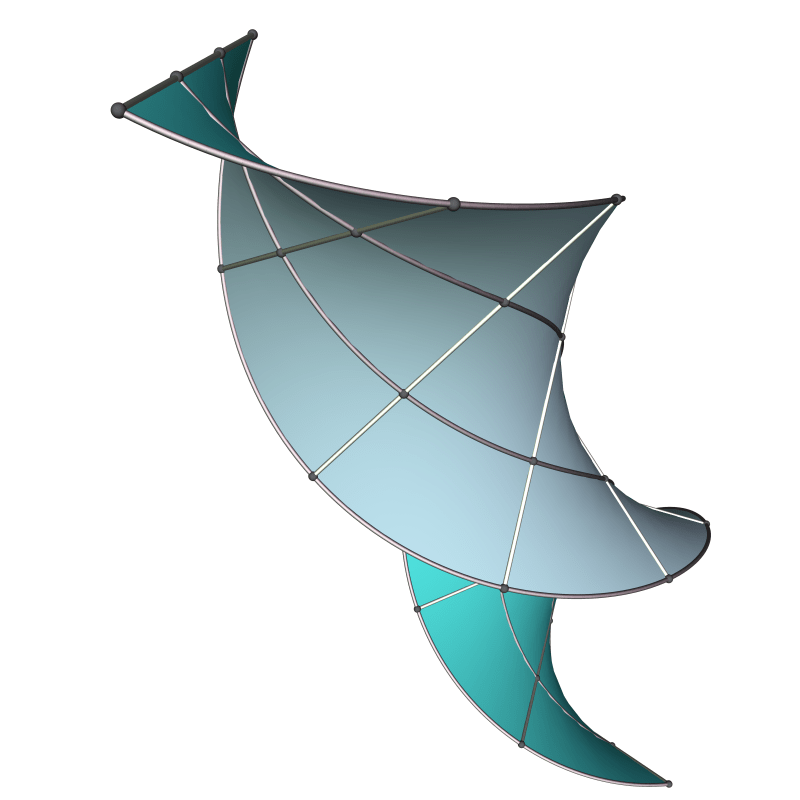
Then, moving up, we deform the loxodrome that represents say North-North-West slowly into North-West and then West, which corresponds to a meridian, and therefore a straight line in suitable stereographic projection.
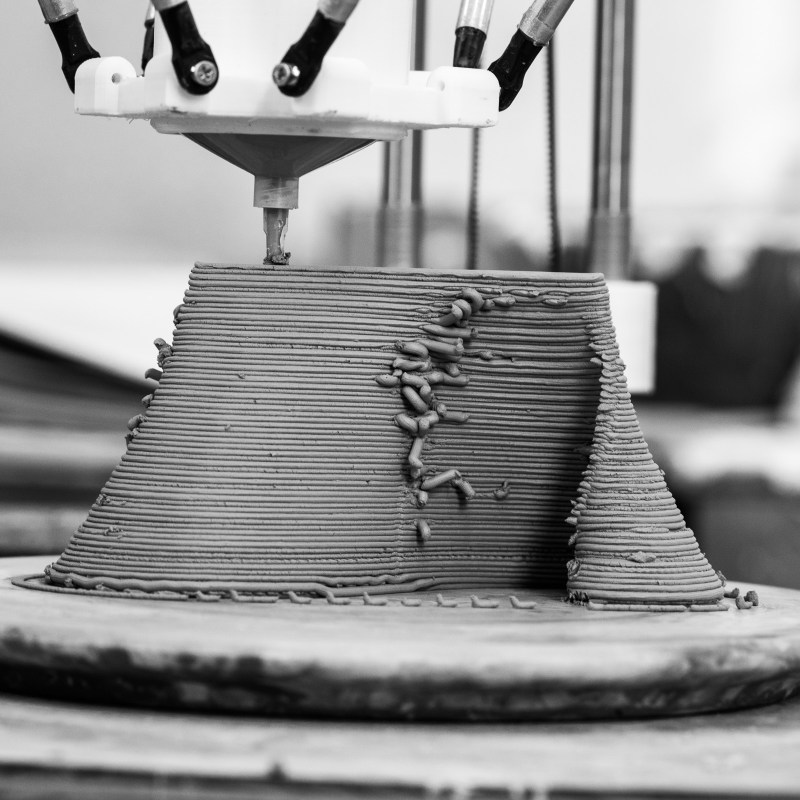
DSC 3927

Then, even higher up on the sculpture, we change course to South-West and thus reverse the direction of the spirals.
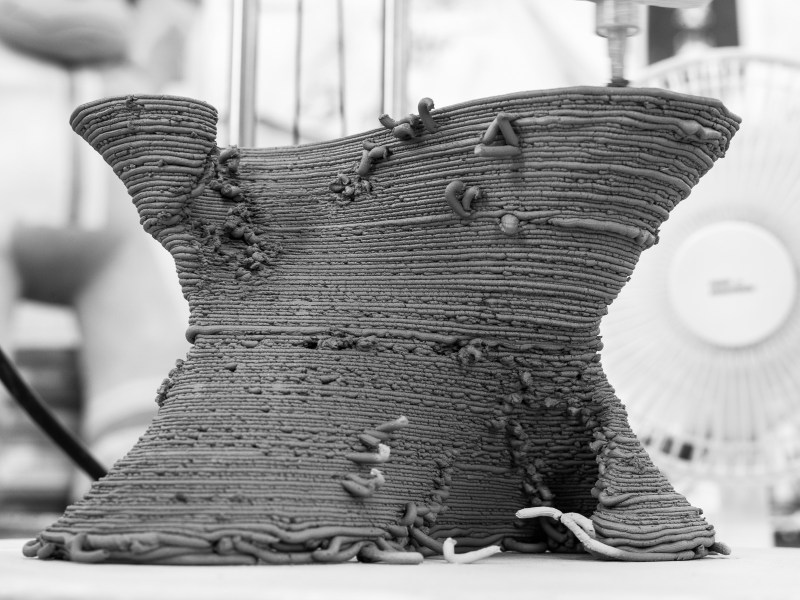
DSC 3754

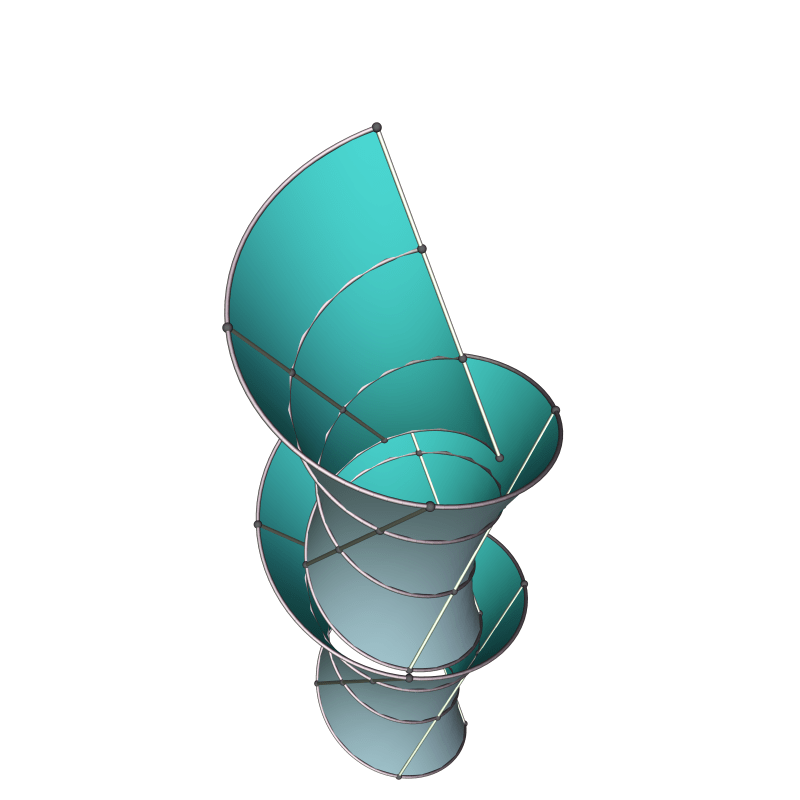
This was our first rough prototype. The next step will be to make this larger, cleaner, and slightly drunken, so that the loxodromes swerve left and right.
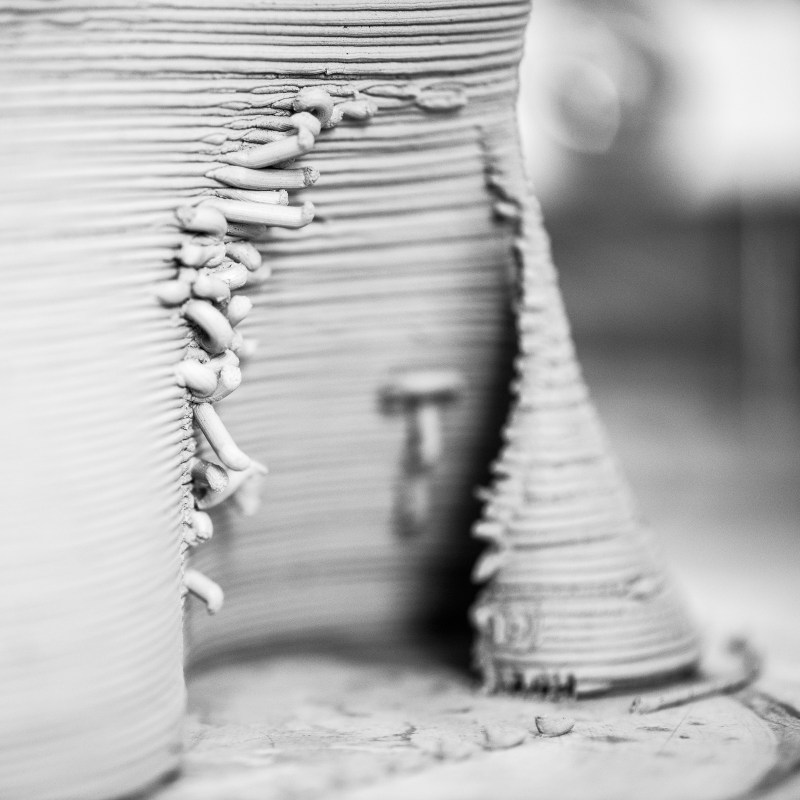
DSC 3932

We’ll see shortly where we get…
Periodic k-Noids (Minimal Surfaces in the Wild II)

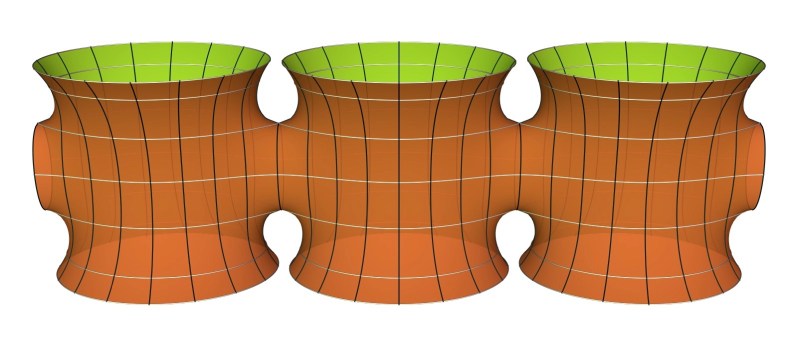
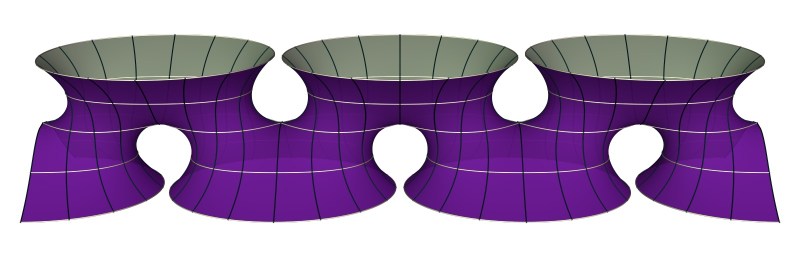
The k-Noids that Shireen built last winter will keep roaming the Swiss landscape, from May to August in Wülflingen. Maybe it is time to corral them. My suggestion is to build fences of catenoids. The most classical one looks like this:

Fence1

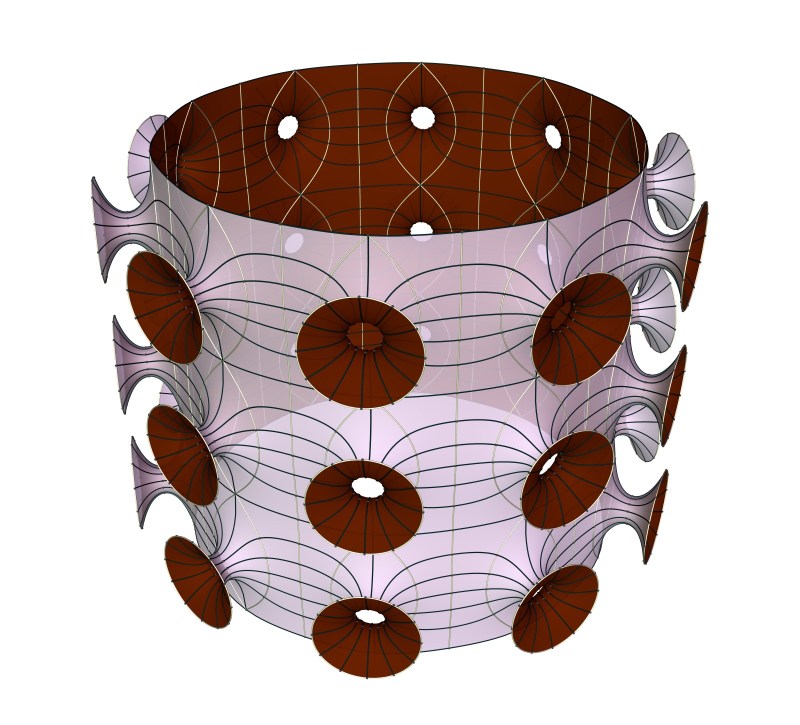
It is, technically, a translation invariant minimal surface that has two ends and genus 1 in the quotient. A simple generalization and an even simpler 90 degree rotation leeds to towers with catenoidal openings.

Fence2

If that isn’t safe enough, you can have them with double walls (i.e. with genus two in the quotient) like so

Fence3

or so:

Fence4

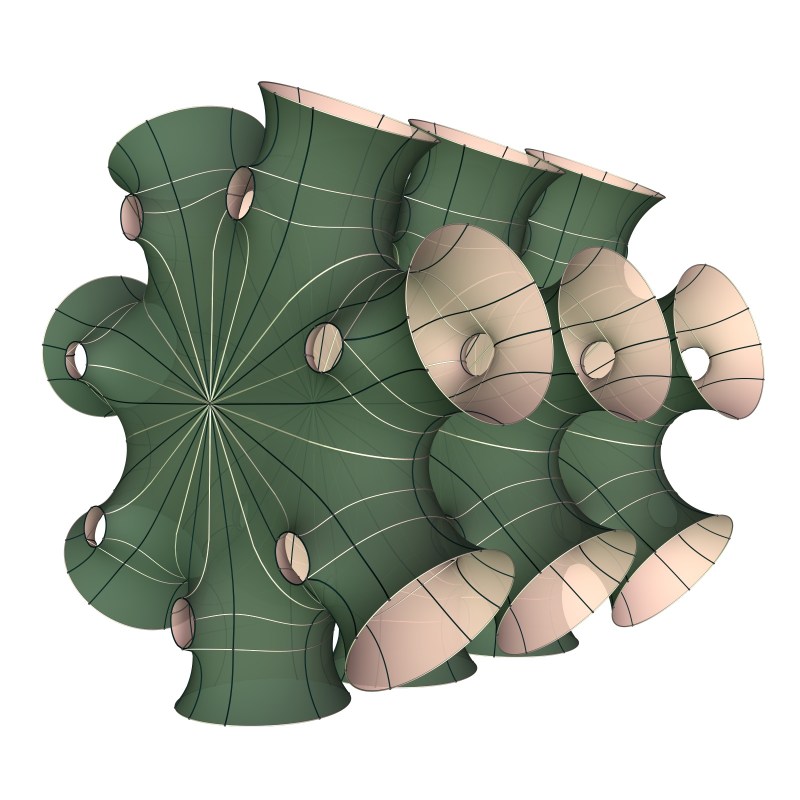
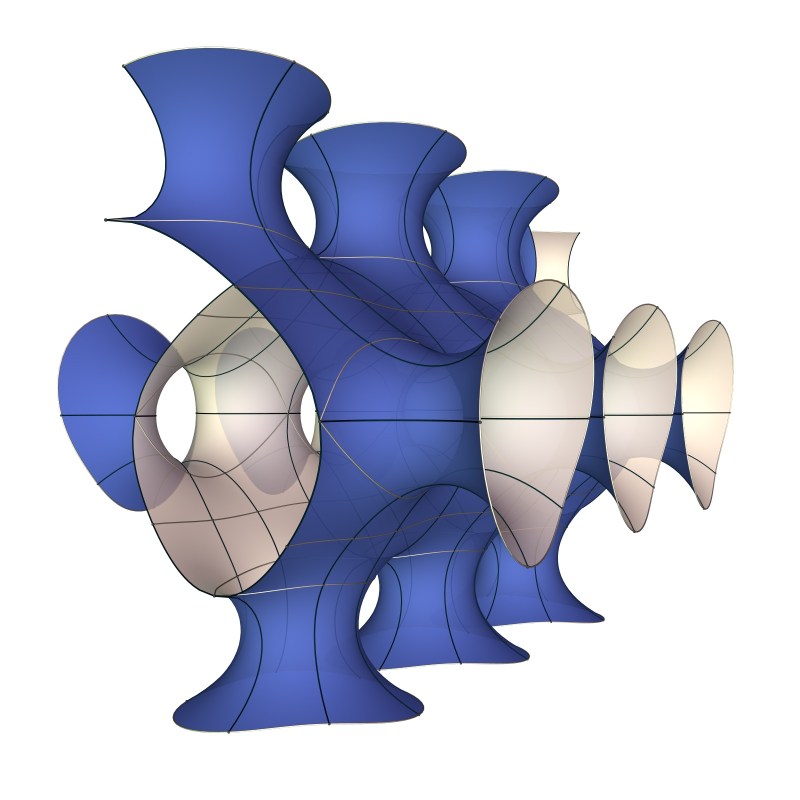
All these examples have many ends in the quotient. The surprise is that there also is the elusive Uninoid which only has one catenoidal end in the quotient, namely by a 180 degree screw motion:

Fence5

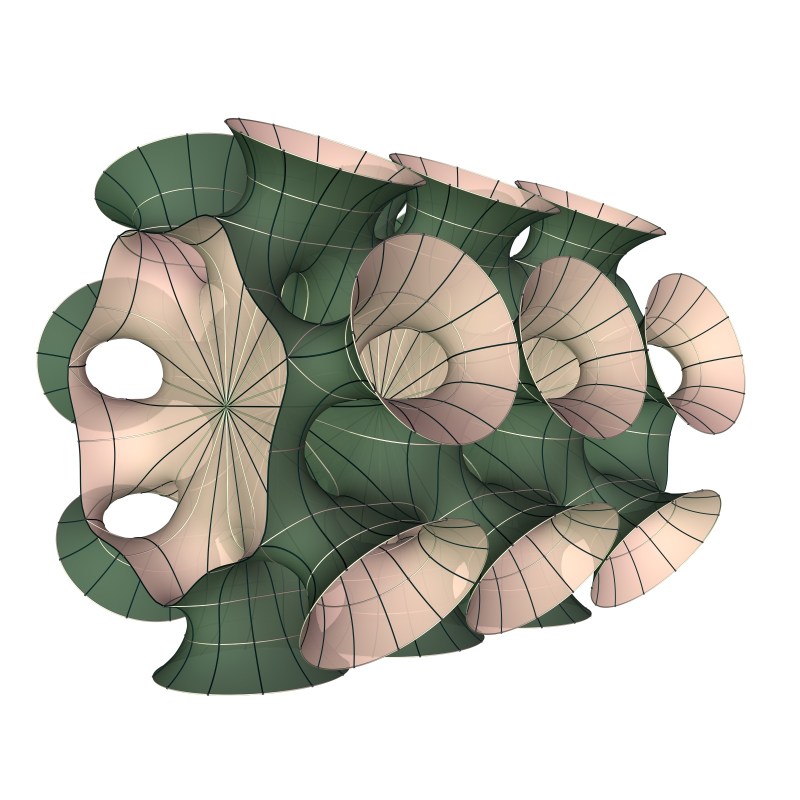
Here things get tricky. Michelle Hackman has found more complicated versions of this in her thesis. Here is a Uninoid that is invariant under a screw motion with quarter turn.

Fence6

Out of Focus

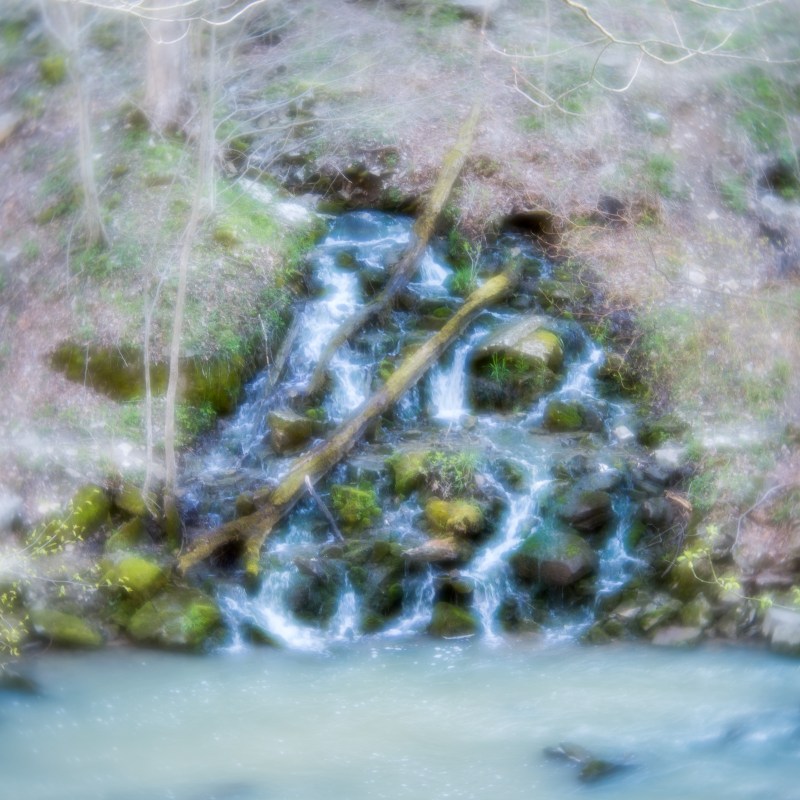
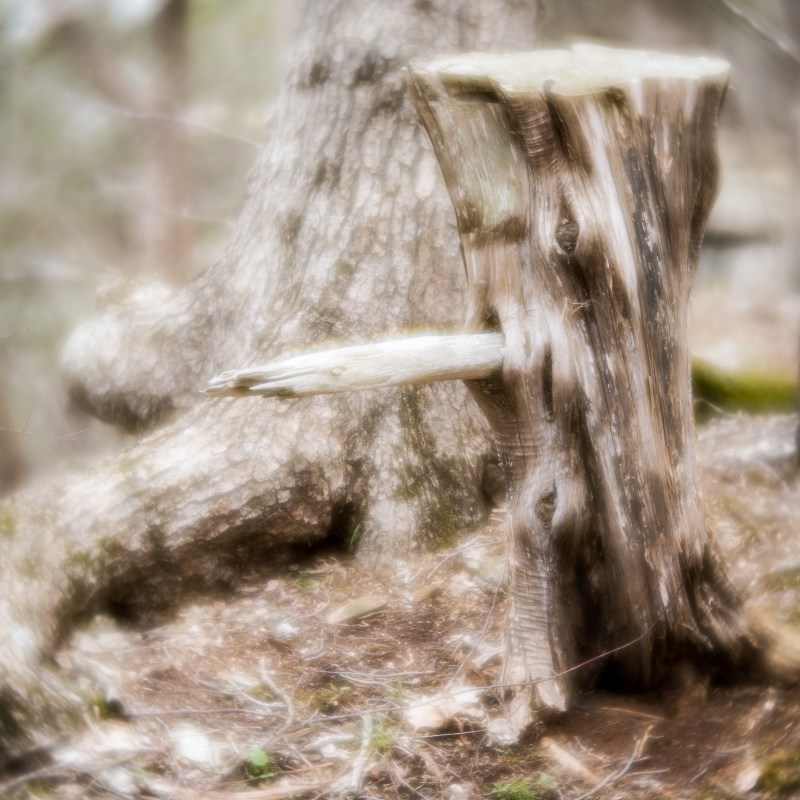
For several years, I have toyed with the idea to get one of Lensbaby’s odd experimental lenses. Against good advice, I have purchased the Velvet 56. This is a full frame 56mm lens, with maximal aperture 1.6. It is my most specialized lens by far. It excels at not being sharp.

DSC 2611

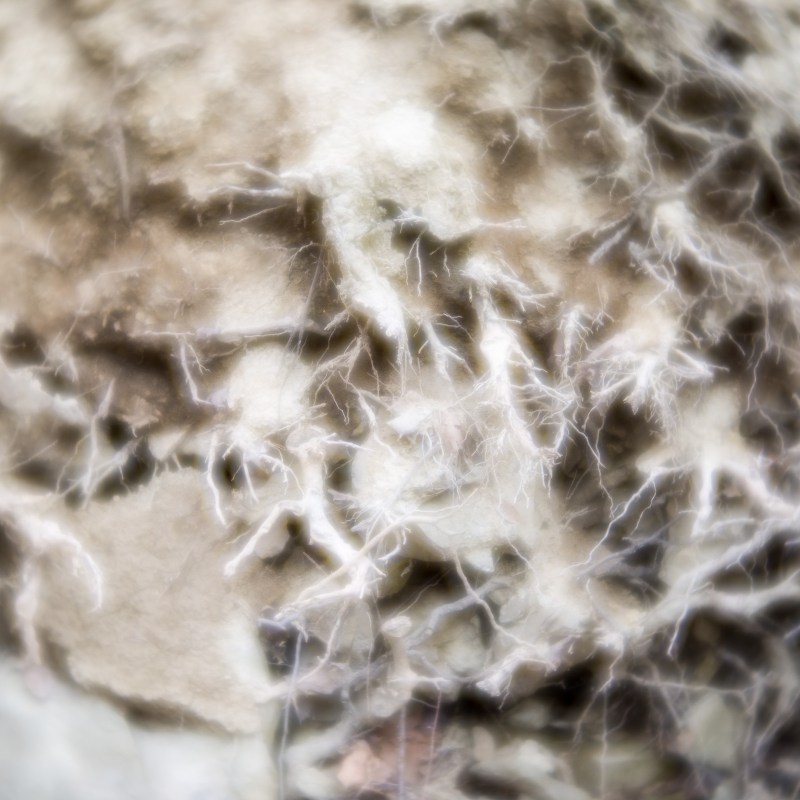
Even when stepped down, it is blurry near the edges of the frame. I decided to take it to its other extreme, and use it wide open. Then, the shallow depth of field and the radial decay of sharpness join forces. There are other artifacts, too. The glow around edges for instance is possibly caused by drastically exaggerated chromatic aberration. People have claimed that all this can easily be achieved in Photoshop.

DSC 2774

Maybe so. The images have a strange depth that might be hard to achieve. But even if somebody comes up with a Velvet 56 filter, this is not the point.

DSC 2690

For me, the most exciting aspect about photography is the moment when I take the picture. I transforms what I see and feel at this moment into a rather selective image that I hope will represent what I have seen and felt in some way. Improving the outcome in post processing is of secondary importance.

DSC 3315

The Velvet 56 is the most limiting lens I have used. No filter will make these images sharp. Some might view this as a fundamental flaw. I view this as a creative challenge. You have been warned.

DSC 3136

Domino meets Towers of Hanoi

When a neighbor and colleague of mine told me he has a blog about abstract comics, that concept fascinated me to the extent that I had to make one myself. Here it is:

Comic

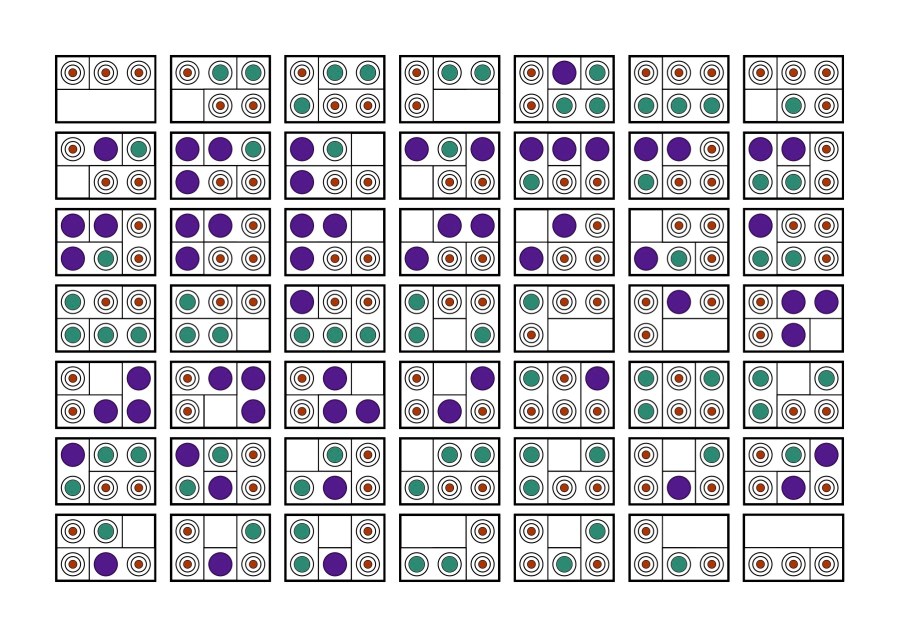
This, by the way, makes a nice poster. I called it Migration, and didn’t give a clue where it came from. There are very smart people who have figured it out by just looking at it, but you can’t compete, because you have already read the title of this post.

Let’s begin with the Towers of Hanoi. This puzzle is so famous that I will not explain it here, mainly because I was traumatized as a high school student when I was forced to solve the puzzle with four disks on TV, in the German TV series Die sechs Siebeng’scheiten. I just pray that no recording has survived.

Hanoimonocards

In any case, after a healthy dose of abstraction, let’s look at the Towers of Hanoi from above, and treat it as a card game.
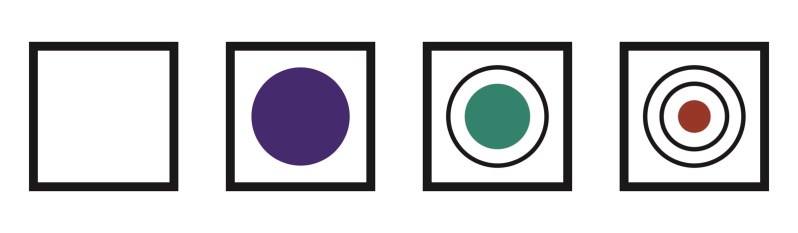
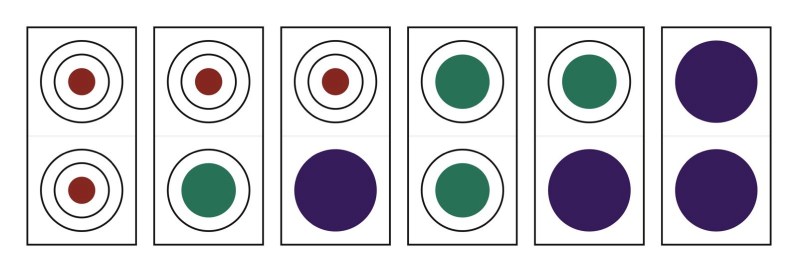
The disks are replaced with cards that have a disk symbol on it. For the three disk game, there are three different cards, showing a small, medium, or large disk. To make everything visually more appealing, we color the disks, and to emphasize size, we show empty annuli around the smaller disks, as above. Then the solution of the three disk puzzle would look like this:

Hanoi

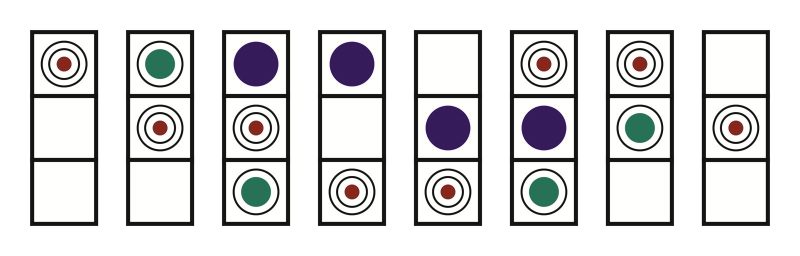
Because a card hides what is possibly underneath, a position requires context. This is one of the two ways the puzzle is mutating into a story. In the next step, we use domino shaped cards consisting of two squares instead of square cards. Here are the six hanoiomino cards:

Hanoidominocards

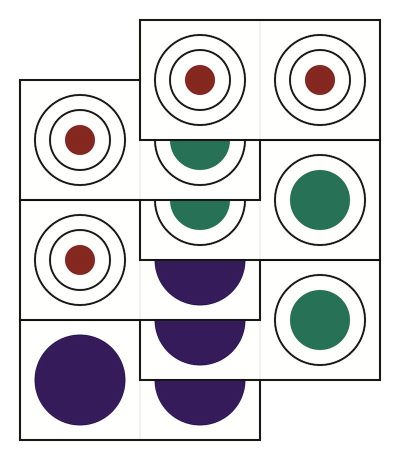
The puzzle is played on a 2 x 3 rectangle, with all six cards stacked like this in the top row:

Startdeck

Note that we have modified the Hanoi-rule: In the original version, a card can only be placed on an empty field or on a card with a larger disk. A hanoiomino must be placed so that each of the squares either covers an empty square or a square with a disk of at larger or equal size. This allows for more choice, which causes the second mutation of puzzle into story.

The migration story now tells how to move all the hanoiominos to the bottom row, to the same position, albeit reversed. It is the shortest solution, and unique as such, unless you want to count the backwards migration as a second solution.

Balance (Zion National Park)

Every symmetry needs to be broken.

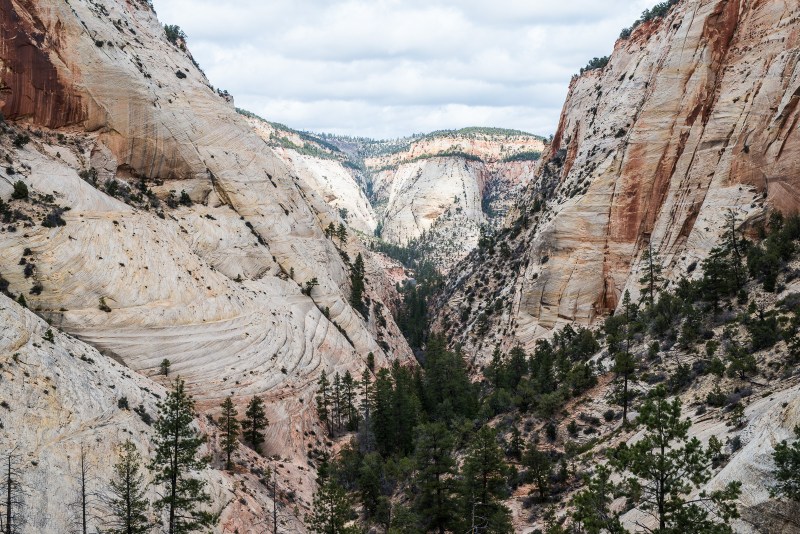
DSC 1303

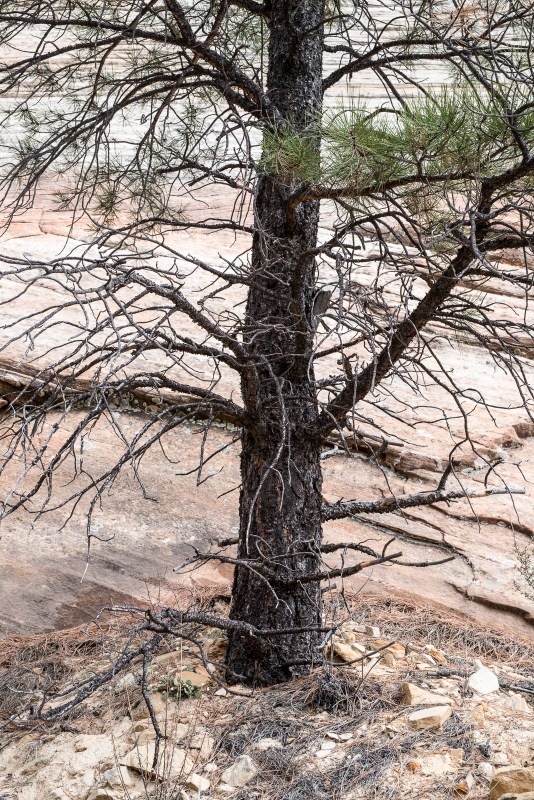
The tree up above stands on a pass that separates the Upper East Canyon in Zion National Park from the area south of it that eventually drops into Parunuweap Canyon. The casual tourist driving on route 9 will not wonder what else there is beyond the magnificent scenery that is accessible from the road. We did. The symmetric tree on the pass is not an indication what to expect.

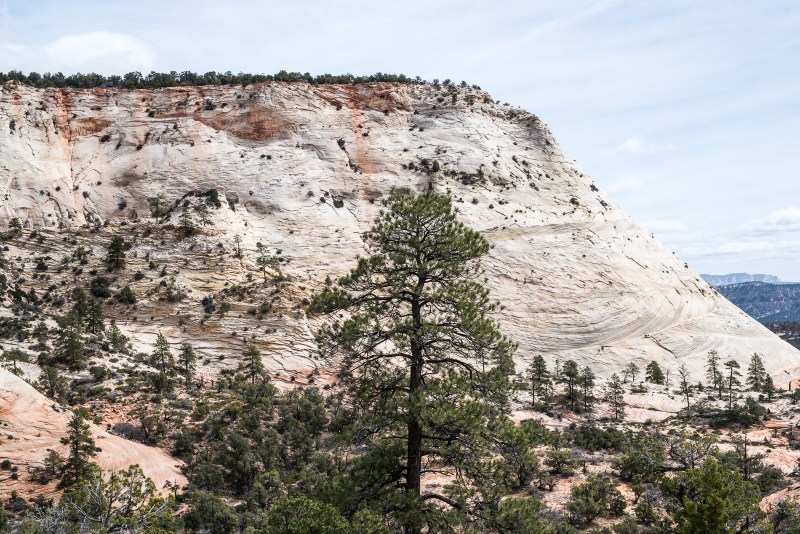
DSC 1353

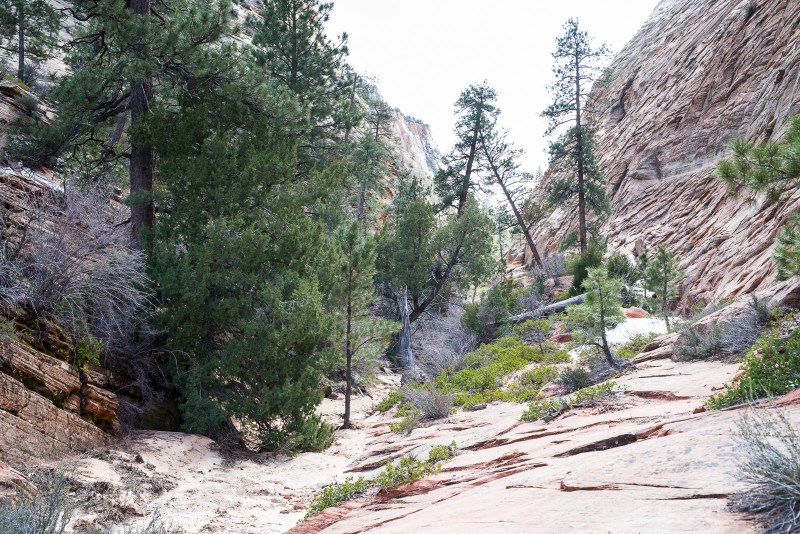
The way up through the sometimes narrow Checkerboard Mesa canyon is not difficult, and the view back from the pass is already rewarding.

DSC 1319

Turning around, the landscape opens up. We are on top of an intermediate mesa, and can stroll around, even climb some minor peaks.

DSC 1236

Few people come here, we had all this for ourselves. Still, there are regions higher up, not (yet) revealing their secrets to us.

DSC 1234

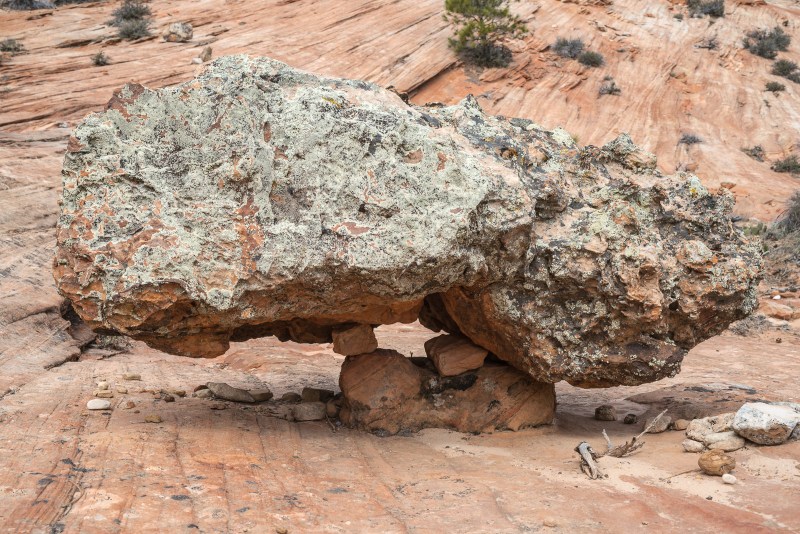
Then, this rock, put by chance upon much smaller support that did not erode away like everything else, and kept it in balance.

DSC 1229

So this is what we seek: Broken symmetry, but still balance.

The Projective Plane

DSC 0091

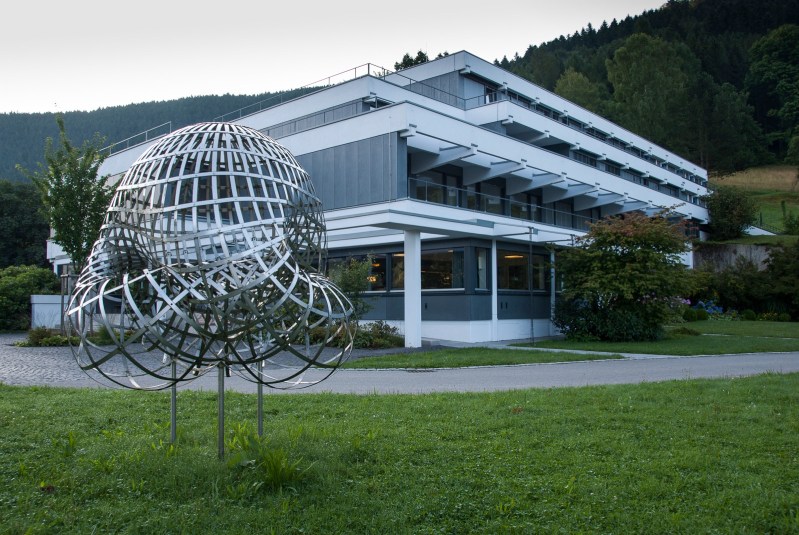
This image (a variation of which I used for many years as a desktop background) is a close-up of the large sculpture below that can be seen at the Mathematical Research Institute in Oberwolfach.

DSC 0107

It is a model of the projective plane, a construct that simultaneously extends the Euclidean plane and describes the set of lines through a fixed point in space.
The simplest way to make your own model is via the tetrahemihexahedron,

Tetrahemi3

a polyhedron that seems to take every other triangle from the octahedron and twelve right isosceles triangles to close the gaps left by the removed four equilateral triangles. That, however, is not the only way to look at it. These right isosceles triangles fit together to form three squares that intersect at the center of the former octahedron, in what is called a triple point.

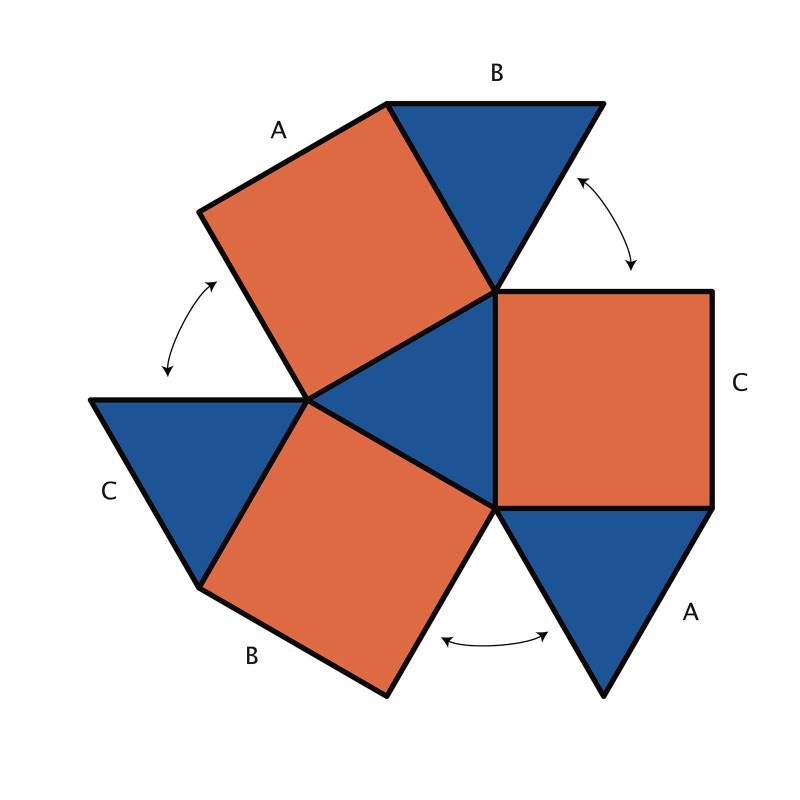
So we truly have a polyhedron with four equilateral triangles and three squares as faces which can be unfolded like so

Tetrahemiflat

where arrows and equal letters indicate to glue. From this flattened version we recognize a (topological disk) with opposite points identified, which is yet another abstract model of the projective plane. The tetrahemihexahedron suffers not only under the triple point at the center, but also under six pinch point singularities at the vertices. Maybe it was this model that made Hilbert think that an immersion of the projective plane into Euclidean space was impossible, and having his student Werner Boy work on a proof. Instead, Boy came up in 1901 with an ingenious construction of such an immersion, which has an elegant connection to minimal surfaces.

Kusner

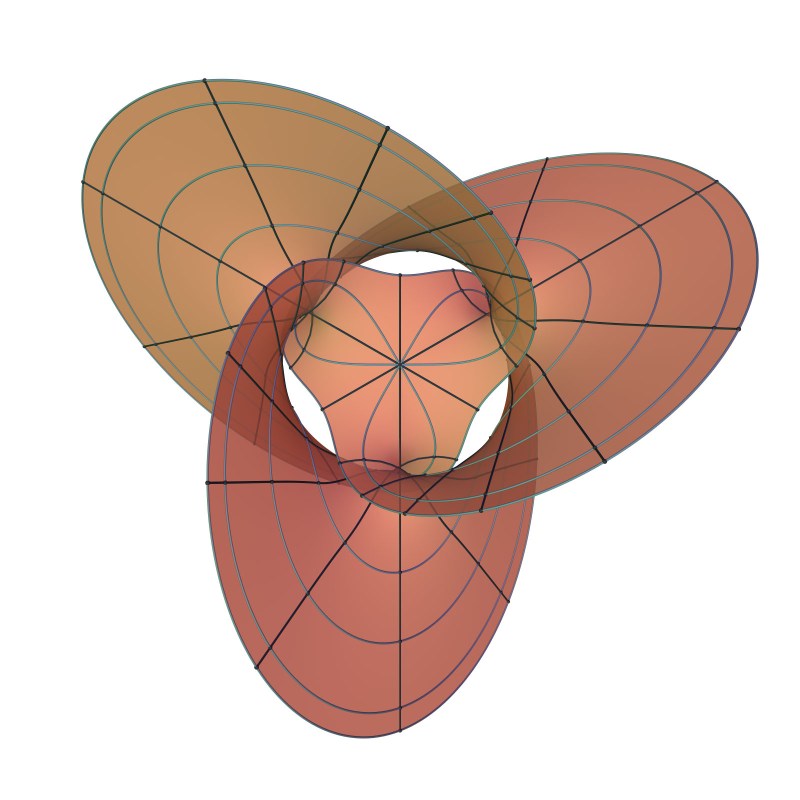
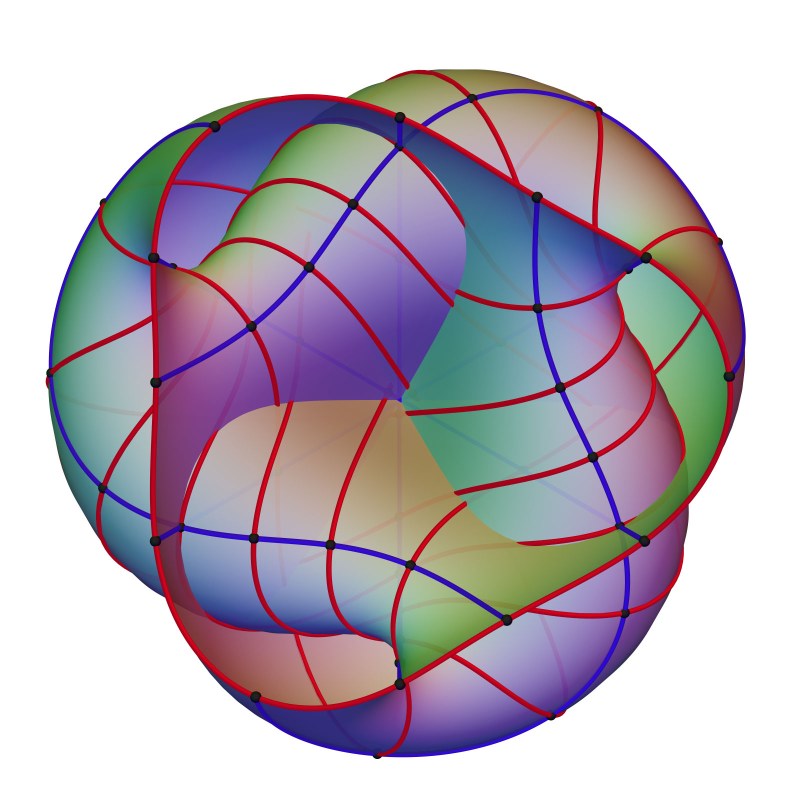
Robert Kusner constructed a minimal immersion of the thrice punctured projective plane into space, with three planar ends, that you can see above. Applying an inversion, as suggested by Robert Bryant, produces images that are very close to what Boy had in mind.

Bryant kusner

This explicit parametrization served as the basis for the model in Oberwolfach.

Spherical Cycloids

The cycloids generalize nicely to curves on the sphere. They can be physically generated by letting one movable cone roll on a fixed cone, keeping their tips together, and tracing the motion of a point in the plane of the base of the rolling cone. Like so:

Sphericalcycloidcones

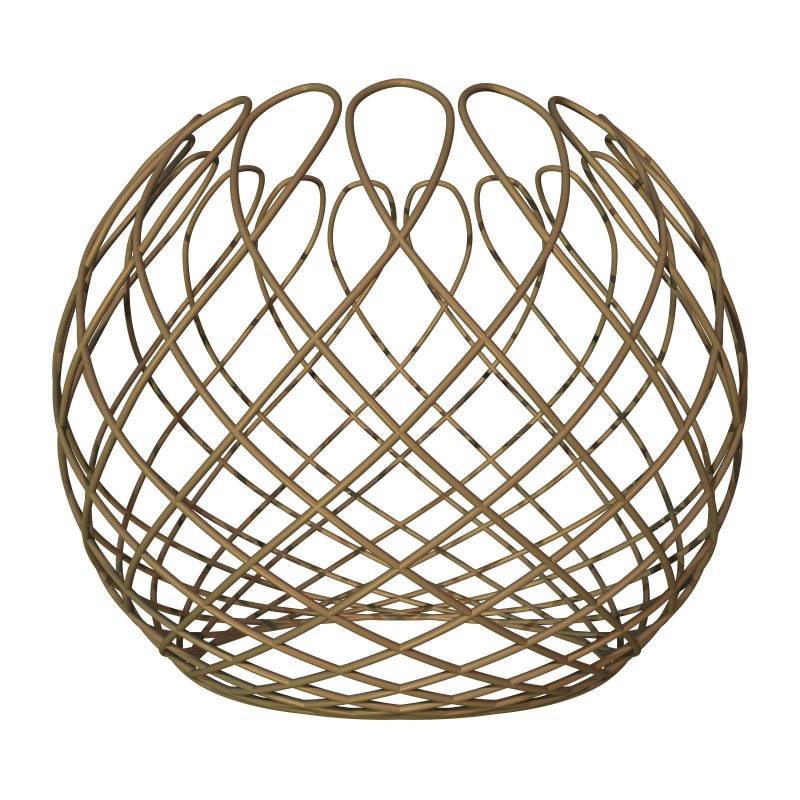
Varying the shapes of the cones will gives differently shaped cycloids, most of which will not close. When they do, they have a tremendously appeal (to me) as 3-dimensional designs, like this tent frame

Sphericalcycloiddesign1

or this candle holder:

Sphericalcycloiddesign2

In a future post I will use the following curves for another construction. Each is without self-intersection

Sphericalcycloiddesign4

and together they form a nice cage that from the side has an organic appearance.

I’d be interested to learn how such objects could be manufactured, say as pieces of jewelry. How does one bend metal tubes accurately?

The images are created using explicit formulas for the cycloids, but rendering approximations of spherical sweeps about cubic splines in PoVRay.

The Hyperbolic Paraboloid (Scrolls III)

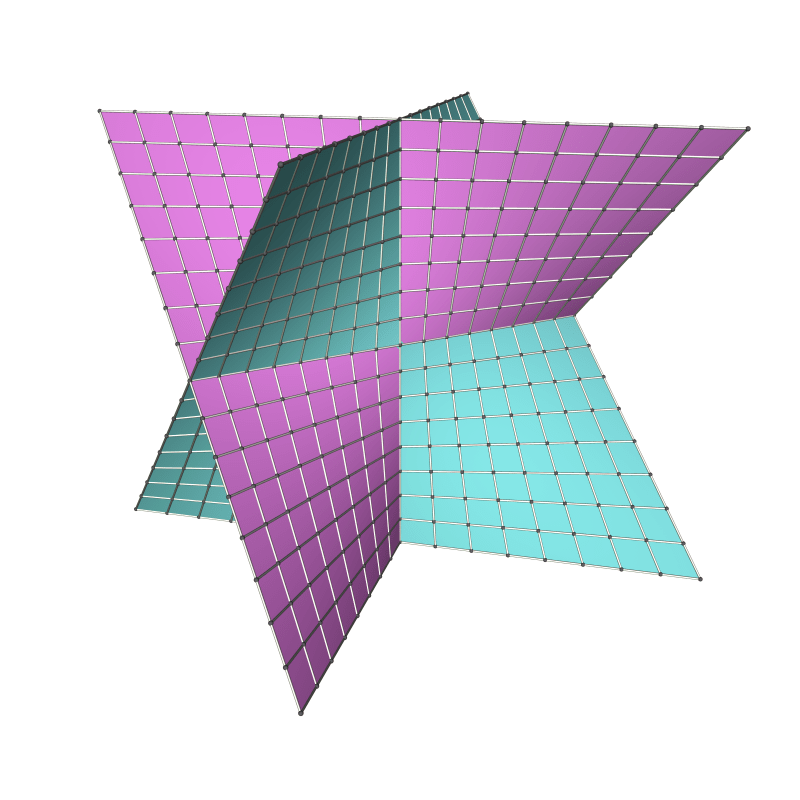
If you build a wire frame into the shape of four consecutive edges of a regular tetrahedron, dip it into soap water, and carefully pull it out again, you get a piece of the Diamond surface. If you cheat and just span wires between corresponding points of opposite edges, you get a doubly ruled surface, the hyperbolic paraboloid. Here is one such surface, together with a mirror image. The eight corners coincide now with the eight corners of a cube.

StellaOctanguloid 1

As a digression, we can fit a total of six such paraboloids into the same cube, creating a curved version of Kepler’s Stella Octangula.

StellaOctanguloid

But let’s return to paper making. The home recipes include the usage of a mold, which is a wireframe that is used to get the right amount of paper pulp into shape and, most importantly, dry. For flat paper one can just use a flat wire frame, like a window mesh screen, which is purchasable. The hope is that, using modest force, such a screen can be stretched into tetrahedral shape. We’ll work on that later.

For the moment let’s delight in previewing how the paper would bend.

Mathematica a

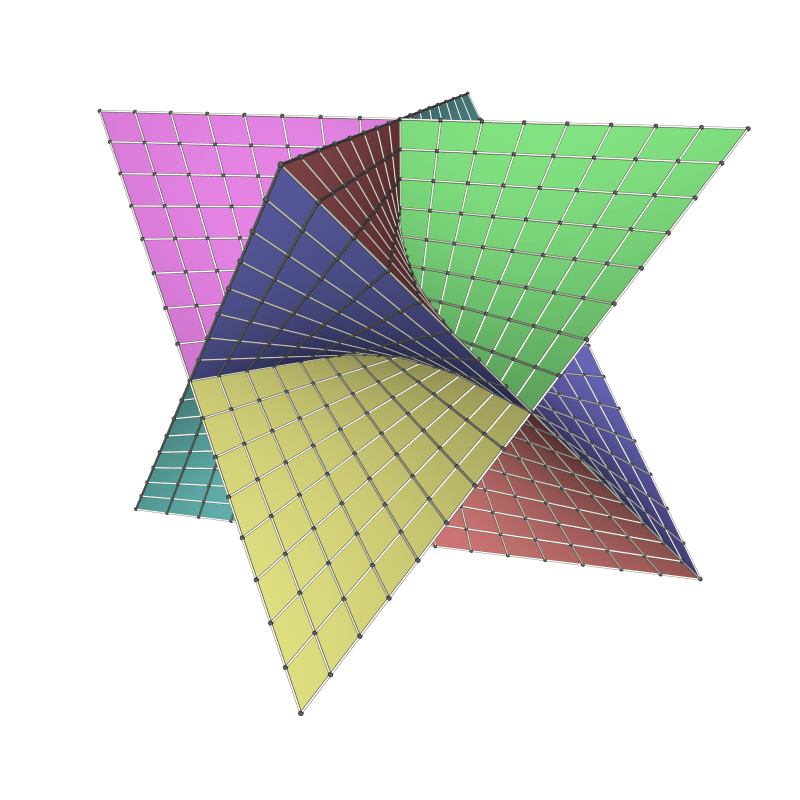
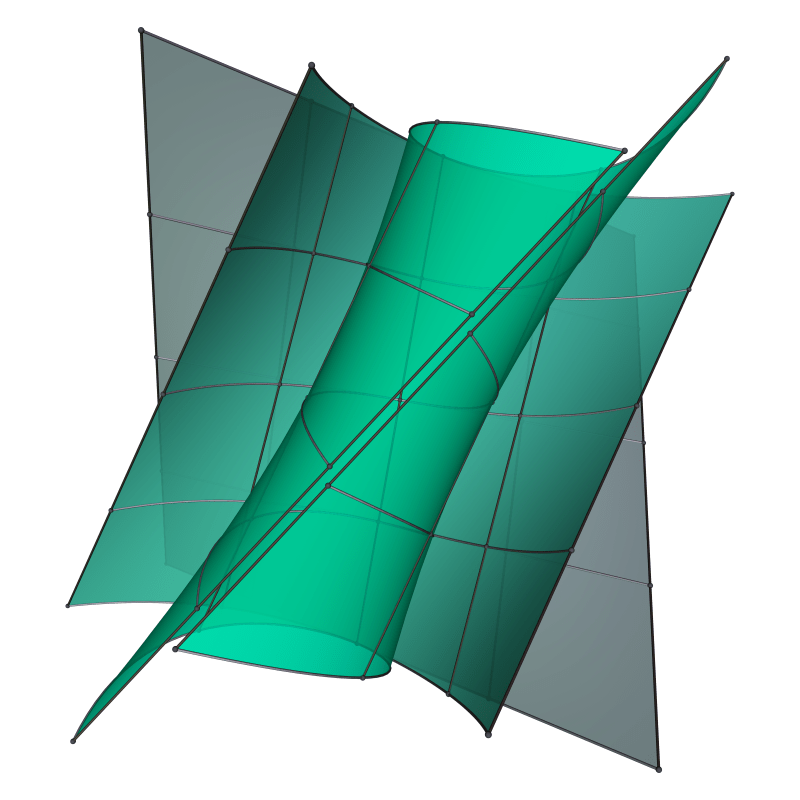
Up above you can see three sheets. The darker bottom one is the actual hyperbolic paraboloid, while the two lighter and greener ones are bent versions that are still attached to each other along the middle straight line that is pointing towards us. This will be our spine. Here is a top view:

Mathematica b

The Real Helicoid (Scrolls II)

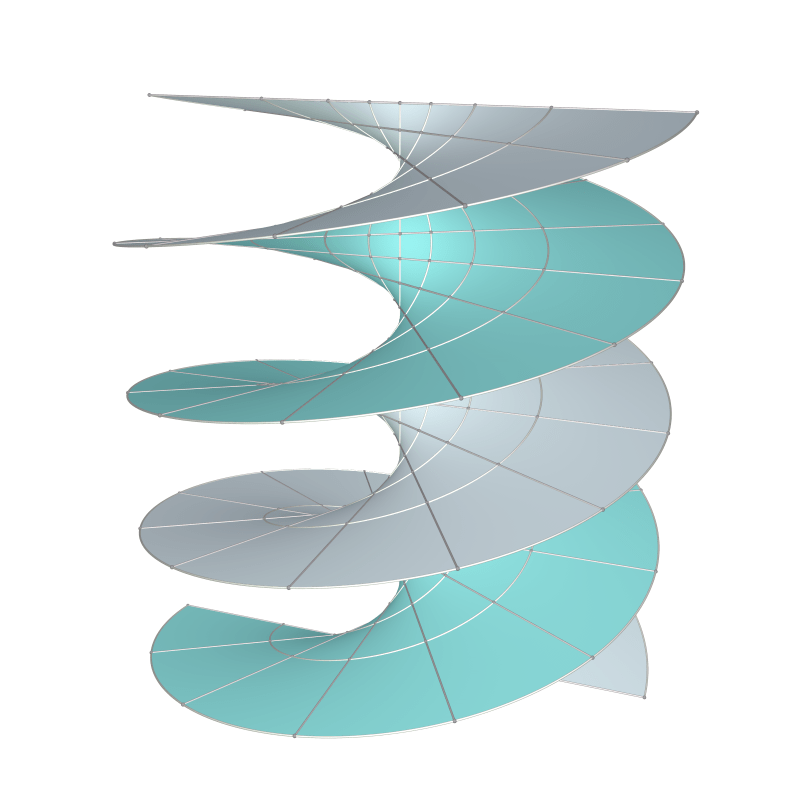
After talking about the other helicoid first, it would be impolite to ignore the real helicoid, which is of course much more famous,
mainly because it also is a minimal surface.

AssociateCatenoid2

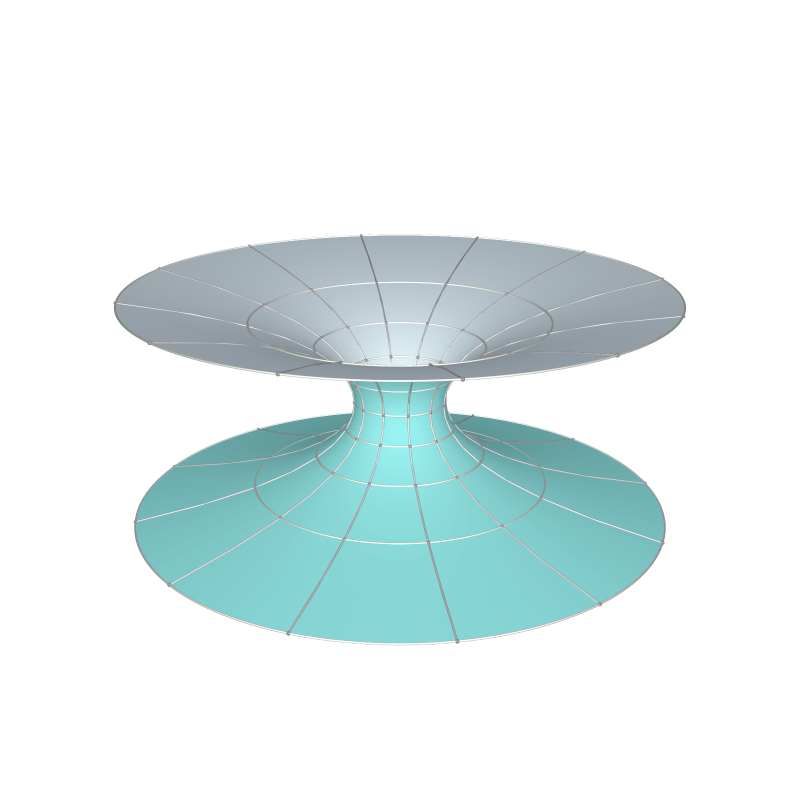
A such, it possesses a deformation into the catenoid
AssociateCatenoid3

which every textbook on the geometry of surfaces mentions at least as an exercise. Half way the helicoid will look like this:

AssociateCatenoid1

I have chosen the size of the helicoidal paper so that the two spiral edges almost touch. This deformation is, however, problematic for book making, because no curve could serve as a spine.

HeliocoidScroll2

But there are other ways to bend the helicoid, that are not anymore discussed in text books. We can keep the horizontal generators of the helicoid as straight lines, but let them slope upwards a little, like above,
or like below, with steeper lines.

HeliocoidScroll

Unbalance

I like games or puzzles that create something while being played. Here is a simple example which I call Unbalance. The single player version is played on a rectangular grid, like this one:

Board 01
A move consists of drawing a horizontal or vertical line segment of length 5 on the grid and within the box.

The first line segment can be placed arbitarily. All subsequent segments must cross exactly one already
drawn segment. Only two types of intersections between two segments allowed: They either
both divide each other both in the proportion 1:4 or both in the proportion 2:3. Contacts at an end point are
not allowed.

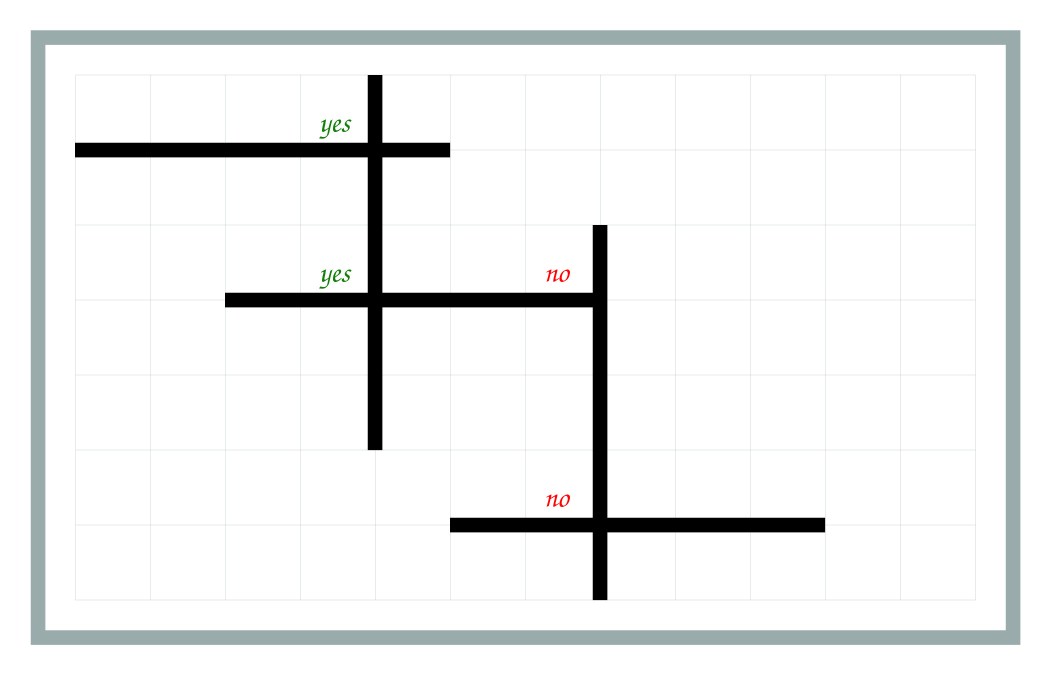
Legal 01

The last intersection not allowed because the vertical segment divides the horizontal segment in the proportion 2:3, while the horizontal segment divides the vertical segment in the proportion 1:4.

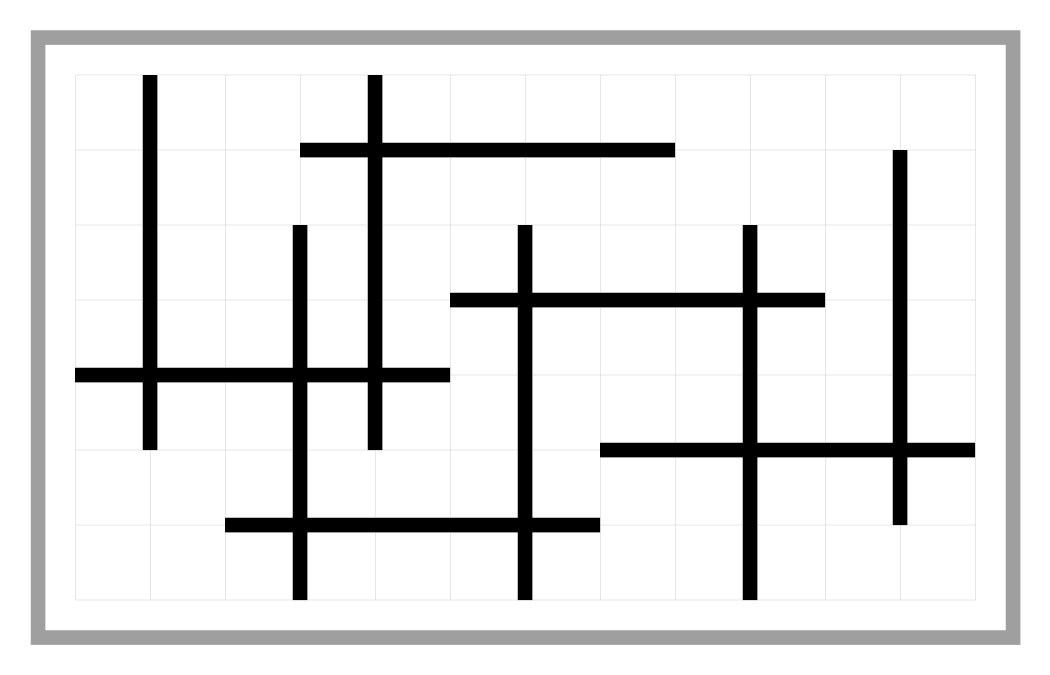
The goal is to place as many segments as possible without violating the rules. Here is an example with 11 segments.

Attempt 01

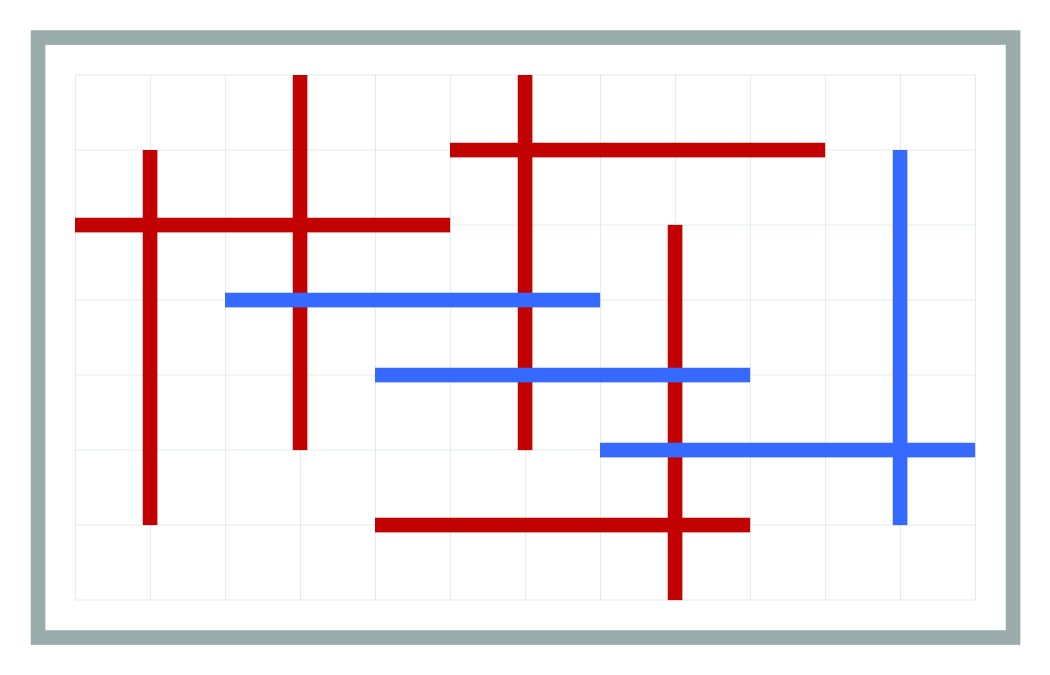
The are many variations. For instance, you can play with red and blue segments. Here it is required that segments of the same color divide each other in the same proportion, while segments of different color divide each other in different proportions.

Twocolor 01

For several players, you can start on a larger board, and each player uses their own color. The last player who can still make a move wins the game, following the rules with different colors otherwise.