Bryce 3D (An Epitaph)

In 1997, the software department of our local book store sold heavily discounted copies of the Raytracing program Bryce,
because they had accidentally ordered Mac versions and were selling only Windows software. I purchased a copy, not knowing what this
would get me into.
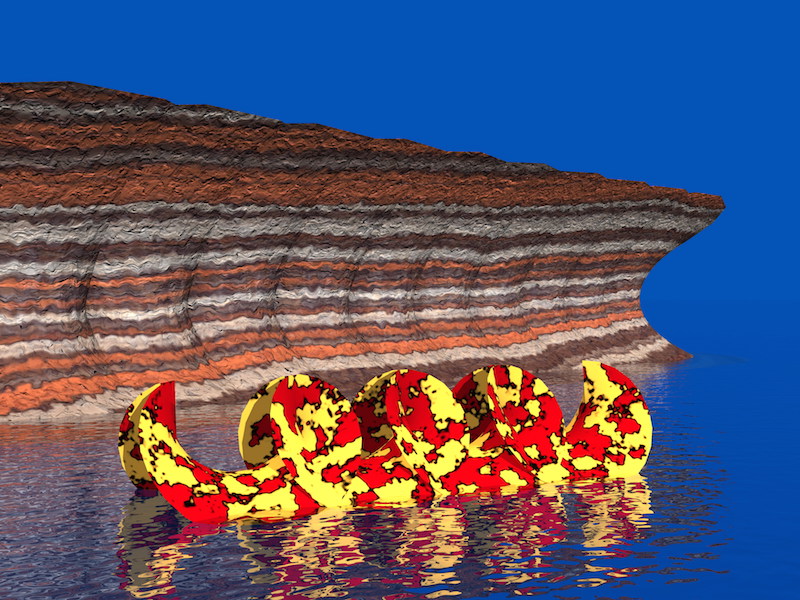
Catalan

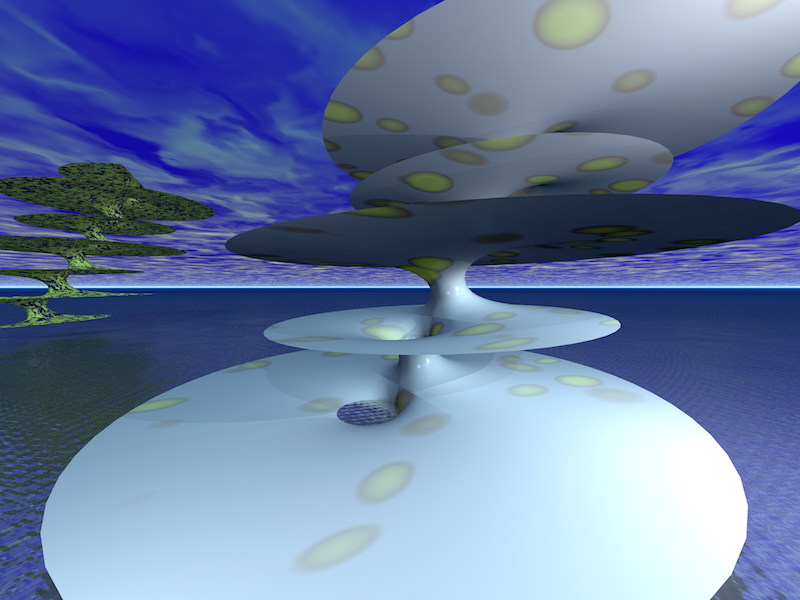
I had been making images of minimal surfaces the past year with Mathematica, and the 3D graphics of Mathematica could be first exported into Autocad DXF files, and then imported into Bryce.
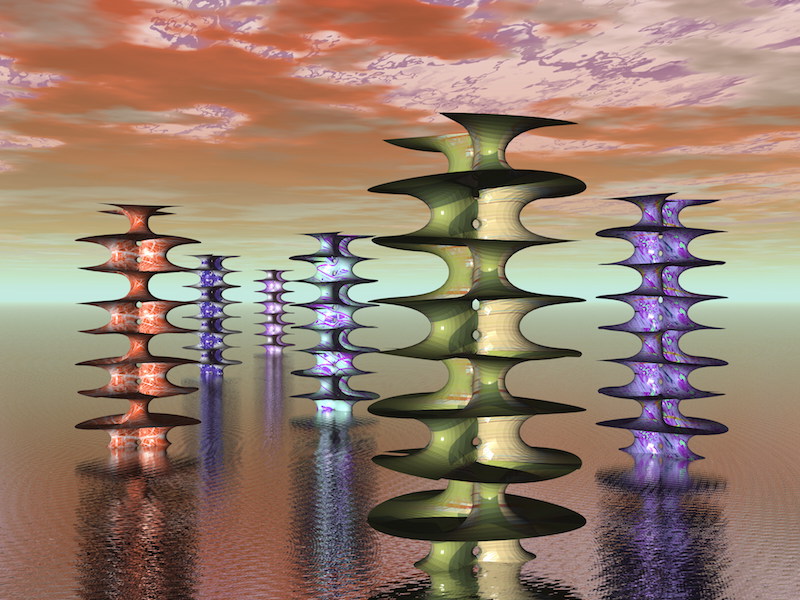
Chm

Bryce is primarily a landscape renderer. The tools let you create terrains, and it comes with a sophisticated texture editor that lets you literally compose all kinds of textures for your objects.

Having abstract mathematical shapes in (somewhat) familiar landscapes seems to stretch our minds just right.
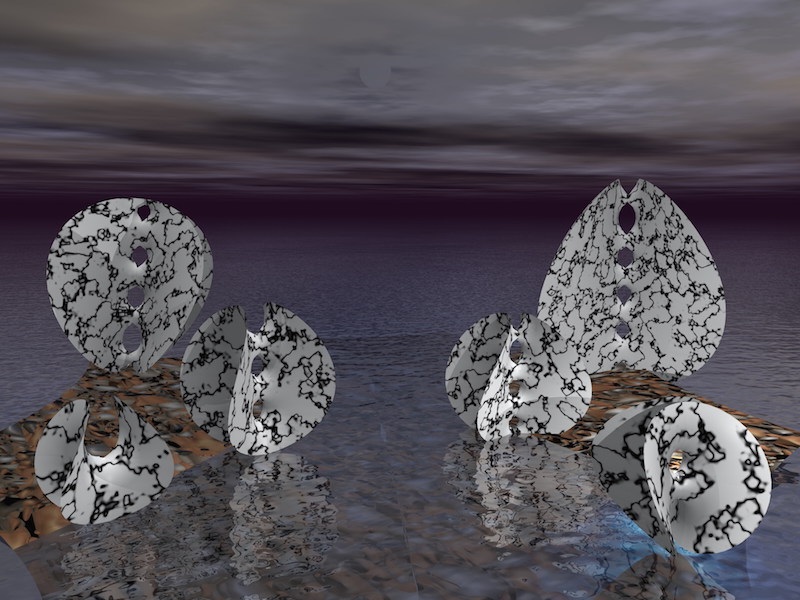
Cg

In 1997, computers were slow. Most images had to be rendered over night, to get screen filling sizes. And these were screens from 1997, too.
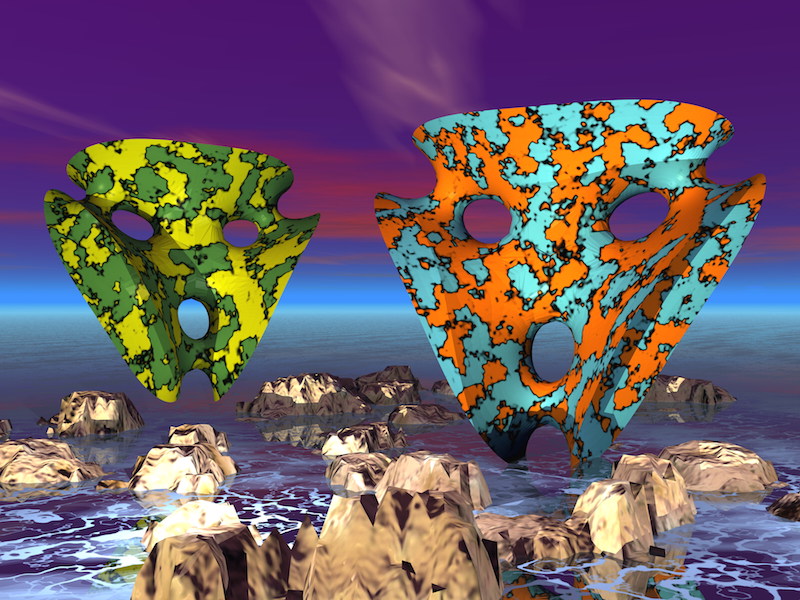
Tortor

The user interface of Bryce (by Kai Krause and Eric Wenger) was revolutionary, and still leaves not much to be desired today. In 1999, Bryce reached its high point with a a vastly improved texture editor. Then the decline began. Fist, it was sold to Corel, and then to DAZ 3D.
Riemann

The current version is Bryce 7, and does not work with recent Mac OS X versions. In runs under OS X.6, but is quite unstable, preventing me to rerender the old files to proper sizes.
Blackhandle
This has been a lot of fun.
Mount Whitney

Bk233

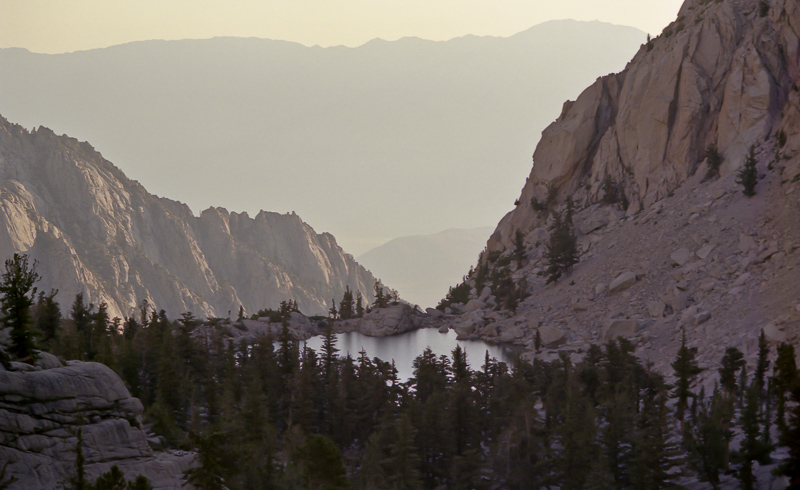
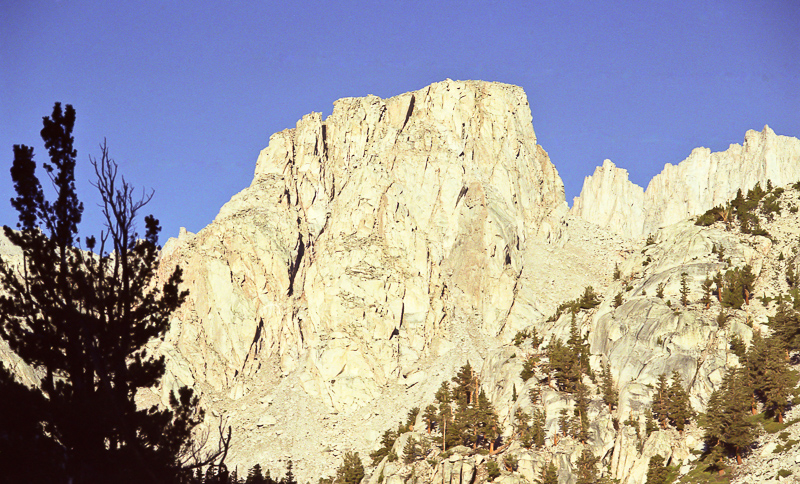
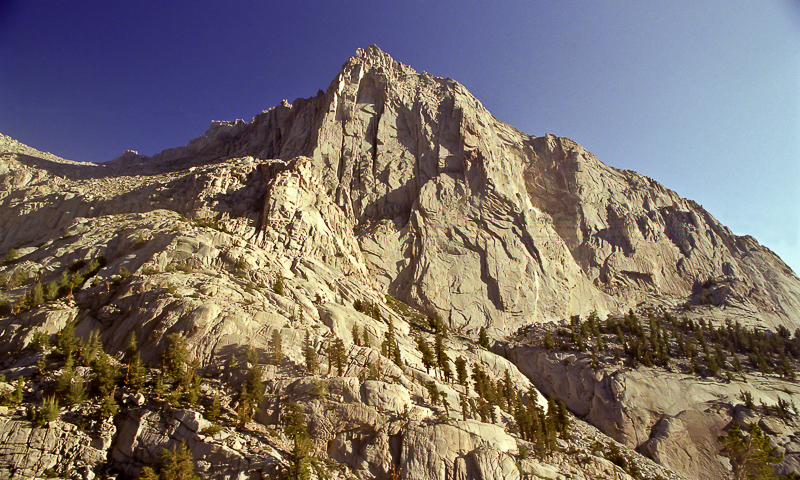
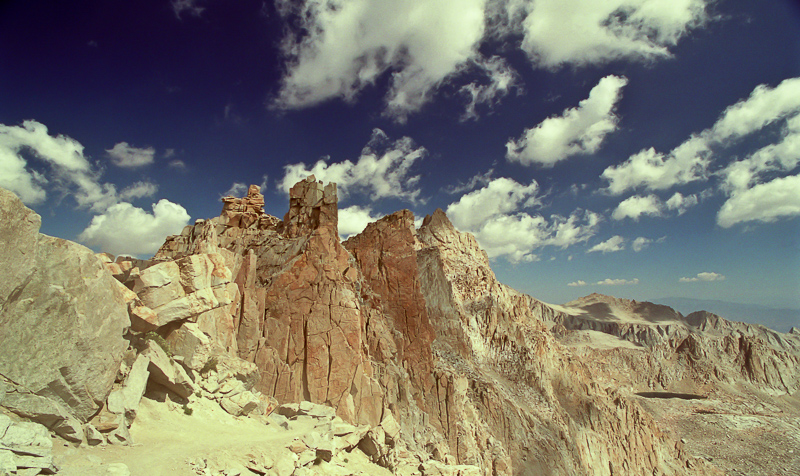
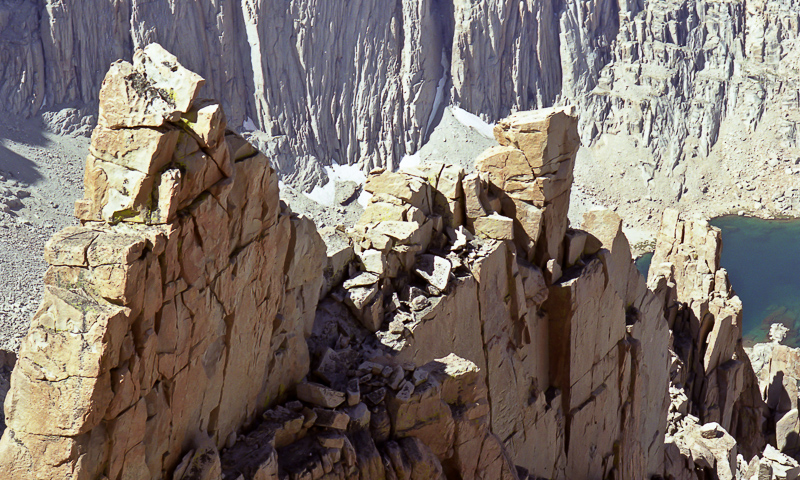
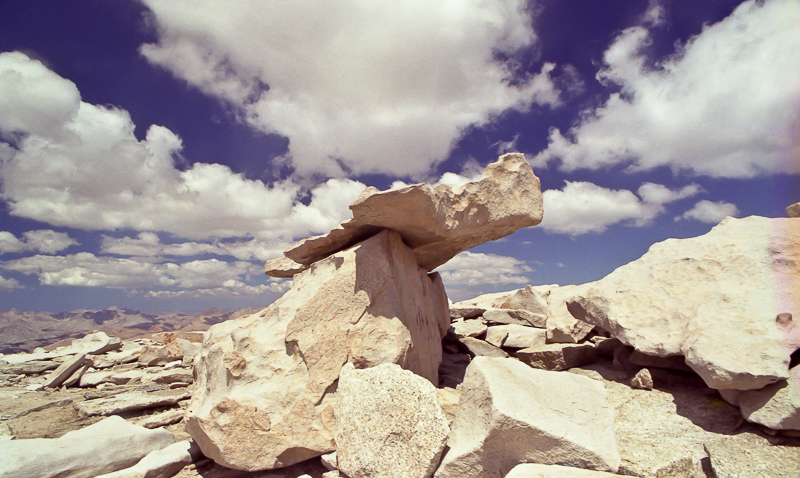
I had the opportunity and was in the physical condition to climb Mount Whitney in the Summer 1994 as a day hike, when no day use permit was required. So these are relatively ancient photos.

Bk235

The hike from the parking lot at the Whitney Portal and back took 10 hours. The 2000 meters elevation gain put a lot of stress on the muscles (uphill) and even more stress on the bones (downhill).

Bk236

At the same time I had become addicted to classical indian music, and Hariprasad Chaurasia’s rendering of the Raga Kaunsi Kanhra played back in my brain during the first hour of the hike.

Bk239

We started at 6am in the morning before sunrise, and the first two hours were pleasant hiking through wooded areas. The first challenge were the infamous 100 switchbacks, which bring you fast to high elevation and to the Mt Whitney Trail Crest.

Bk241

From then it is still a long way to reach the summit. In good weather, the hike does not pose any technical difficulties. But it is long, at high elevation, and in an alien landscape.

Bk244

Shades

My favorite State Park in Indiana is Shades State Park. The ominous name is short for Shades of Death, and possibly refers to a battle between Native American tribes. I have already written before about the Silver Cascades Waterfall in that park, but it has many other spectacular features. One is called Devil’s Punch Bowl, where in the early 20th century visitors that arrived from Chicago by train were treated to a movie night. These people had guts.

DSC2059

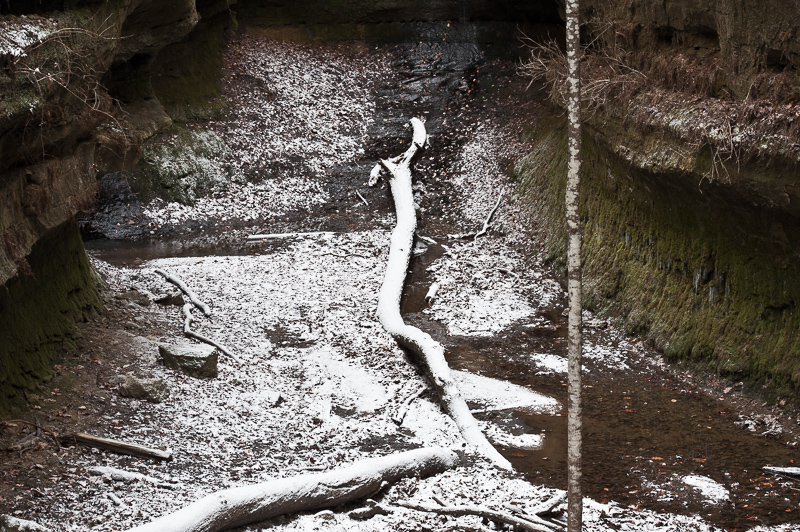
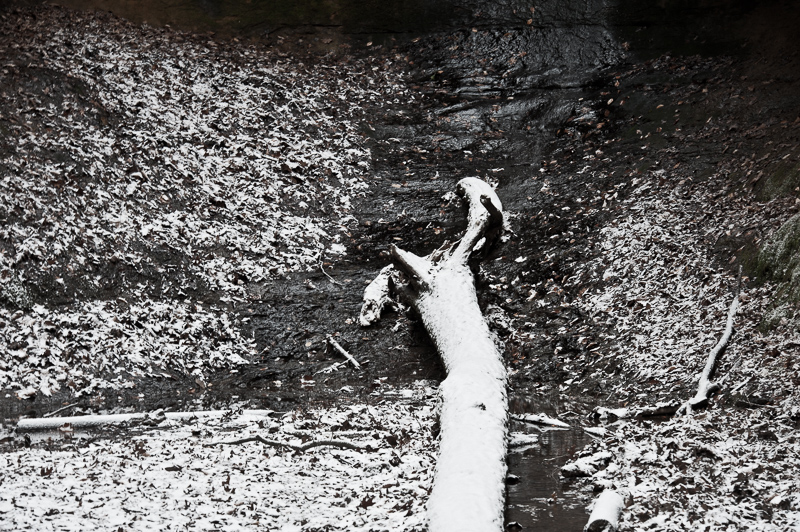
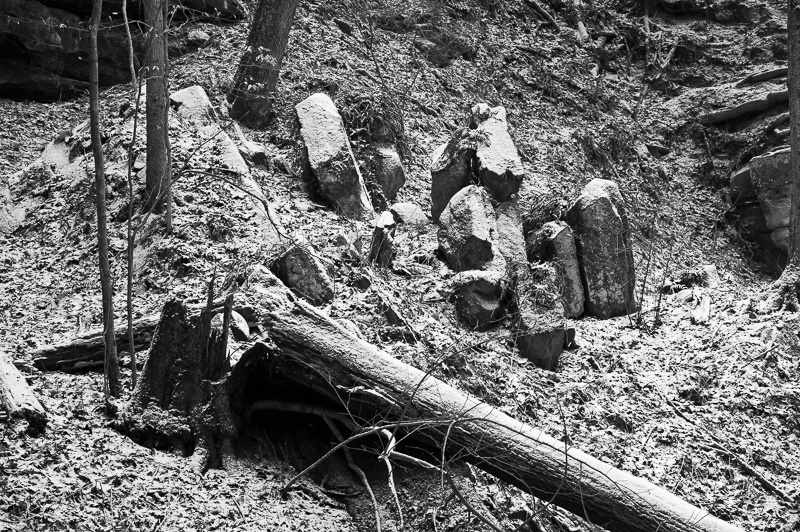
In dark winter, the punch bowl is certainly the place that justifies the park’s old name most. For some strange reason, the bare dead trees remind me of Francis Bacon’s crucifixion paintings.

DSC2065

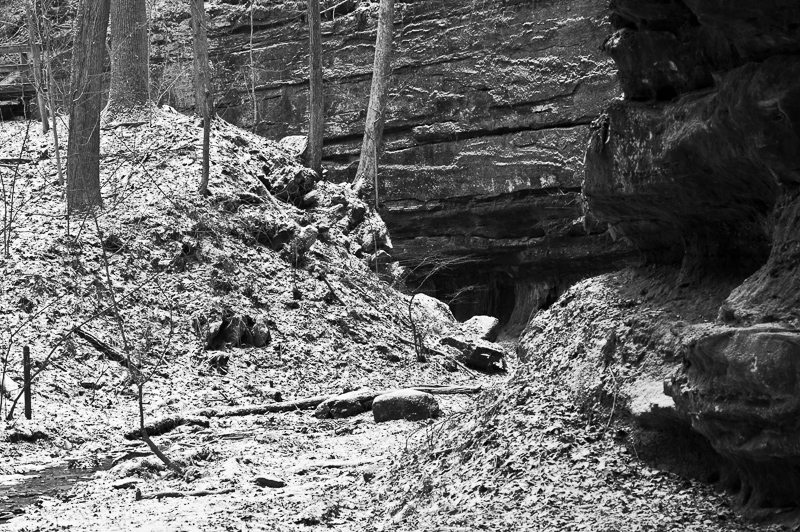
The punchbowl is the end of a short canyon that has more fallen trees.

DSC2071

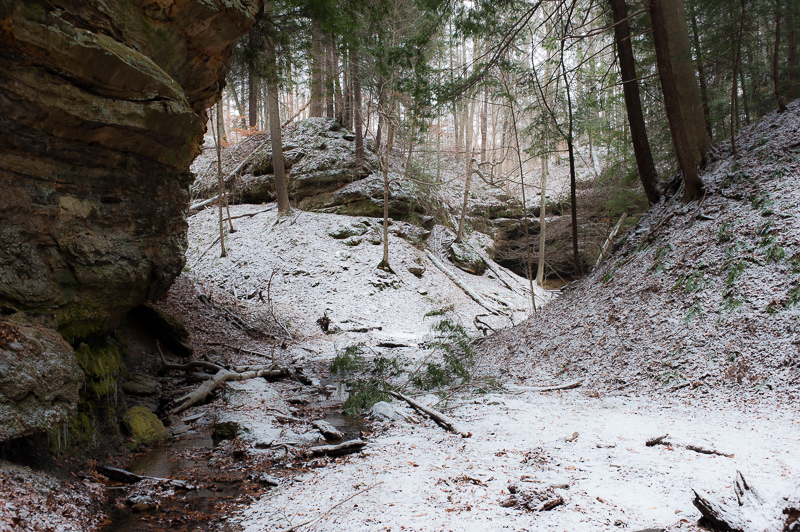
When the canyon widens, surprisingly the walls just get taller. One begins to wonder about the finale of this dramatic development.

DSC2076

Instead of a drop into the endless void, the canyon ends at the Silver Cascades Fall. That’s a counterpoint the composer of this landscape must surely be proud of.

DSC2113

Reflections (Spheres I)

DSC5479

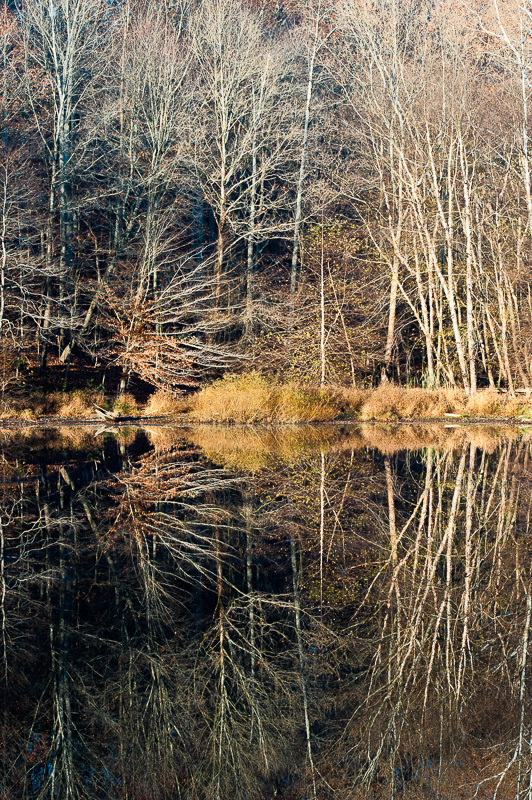
Large scale mirrors like the surface of a lake are awe inspiring. They simultaneously create complexity and
order. The order comes from the inherent symmetry, and the complexity from subtle differences between original and
mirror image.

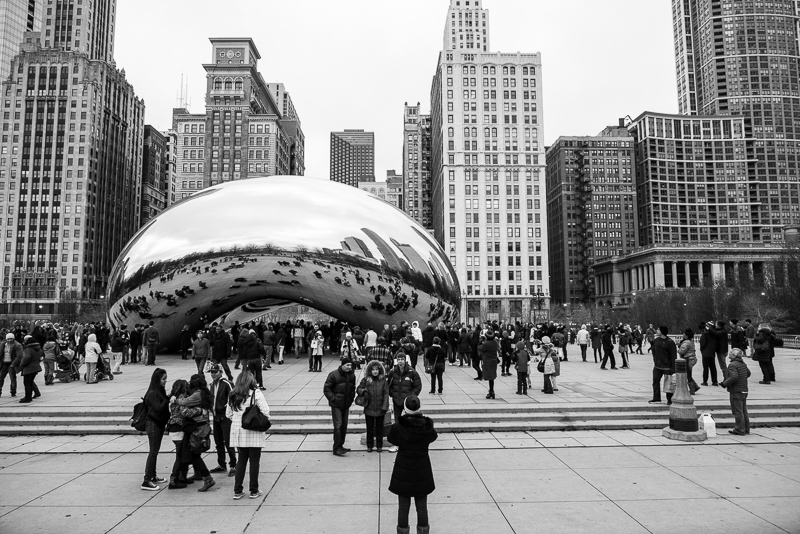
Things get considerably more complicated when the mirrors are curved. The Cloud Gate sculpture by Anish Kapoor (the Bean) in the Millennium Park in Chicago is a popular example. The multiple reflections create an immediately surprising chaotic richness of the reflection: Taking one step to the side changes the appearance of the reflection dramatically. But the sculpture also extends and therefore enriches the architecture.

DSC 6142

Motivated by this, I began to experiment with the spherical mirrors, spheres being the simplest curved shapes.
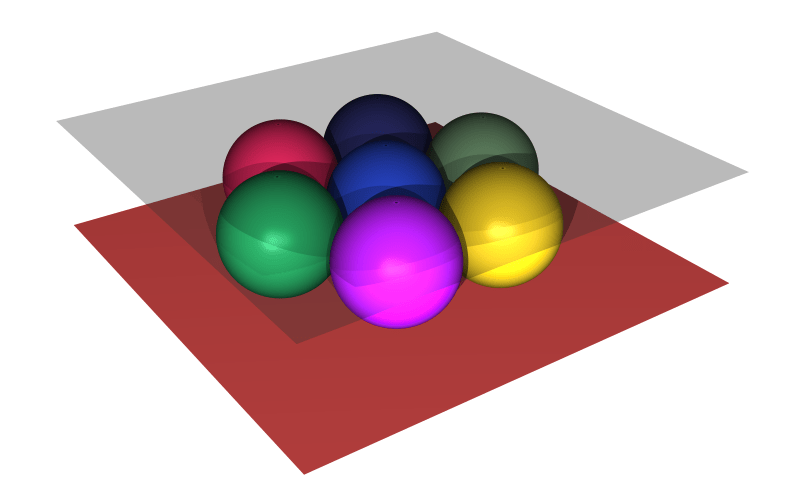
For multiple spheres touching each other there is a surprising phenomenon that is best understood when we begin with seven spheres of equal size, one at the center, and the remaining six surrounding the central sphere symmetrically. Complete this configuration by adding two planes that touch all seven spheres. Now pretend that the two planes are in fact also gigantic spheres. Than these two and the central sphere all touch the remaining six spheres, which in turn form a chain where consecutive spheres touch.

Soddysimple

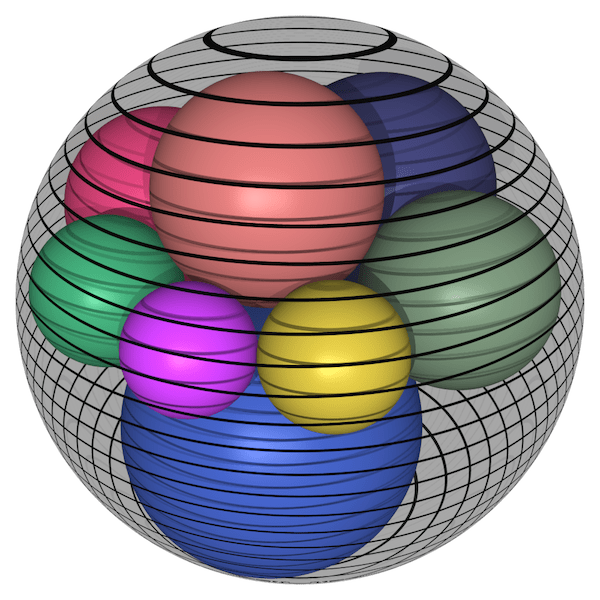
It turns out that this picture is not just an approximation that only works in the ideal situation shown above where the big spheres are planes, but in fact works for spheres of any size. This is the content of Soddy’s theorem.

Soddy2

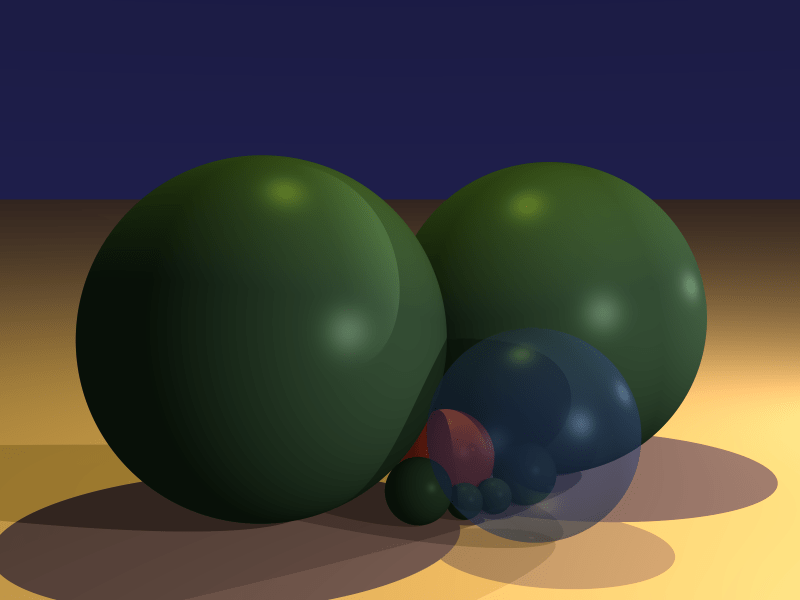
To turn this into some sort of virtual sculpture, it is best to make just one of the spheres a plane. Then place two spheres onto the plane so that they touch. If you continue placing more spheres onto the plane so that they also touch the two initial spheres and the previously placed sphere, they will form a chain of six spheres of which the last again touches the first.

Soddy0

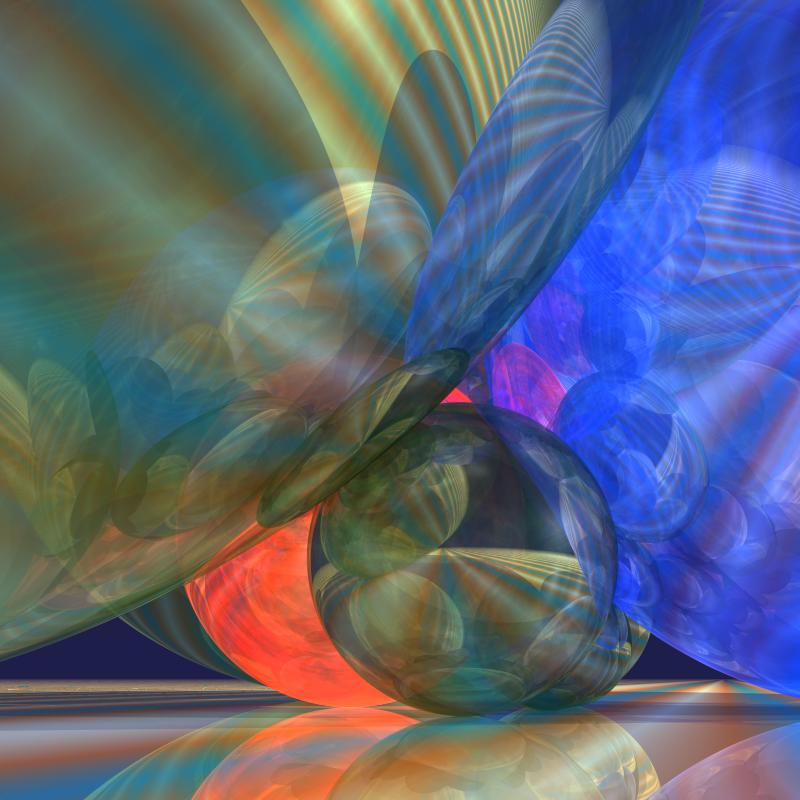
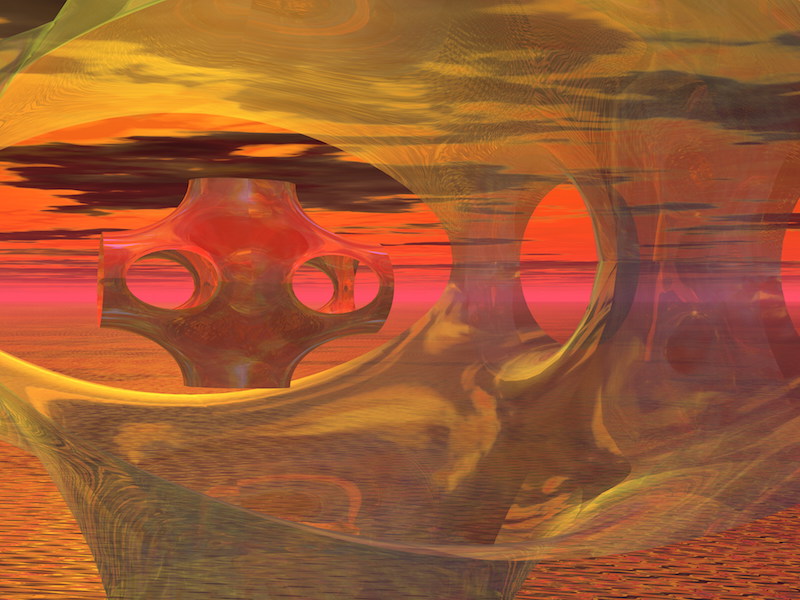
Now imagine these being really large, reflective, slightly translucent, and illuminated with colored light sources. You might see something like this:

Soddy

This is the first of a series of images featuring ray traced spheres.

Prophetstown State Park

Early in the year, Prophetstown State Park is a solemn place, and rightly so.

DSC 2616

After all, this is where in 1811 a decisive battle between a confederacy of Native Americans, led by Tecumseh’s brother Tenskwatawa (“The Prophet”), and an army of 1000 men, led by William Henry Harrison, the Governor of the Indiana Territory, took place.

DSC 2629

The battle ended with a defeat of the Native Americans, and the complete destruction of their village.

DSC 2653

Today, the park features an early pioneer village and replicas of the earlier Shawnee settlements.

DSC 2659

I found the vistas of the empty landscape more impressive. Much of its geology was formed from retreating ice, when glacial lakes broke their dams and caused devastating floods, as is visible here in the Wabash flood plane.

DSC 2664

Both the flood plane and the lost battle of Tenskwatawa should remind us that there will always be resistance, no matter how often it fails.

The Ehrbach Klamm

Germany is a rather densely populated country. I used to think that wherever you are, you can hear a car. You can find an exception in one of the least populated areas of Germany, the rural Hunsrück. This is, incidentally, the region where most of Edgar Seitz’ TV/movie series Heimat (most highly recommended) takes place. This region is bordered by three of the most famous German wine region, the Mosel, the Rheingau, and the Nahe. As a consequence of this surrounding fame, the region itself, which appears to the casual visitor as mostly flat and agricultural, is largely ignored.

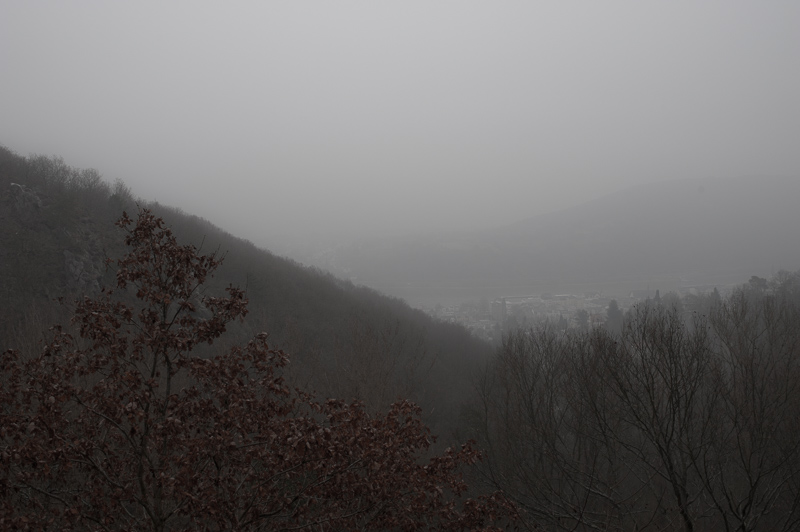
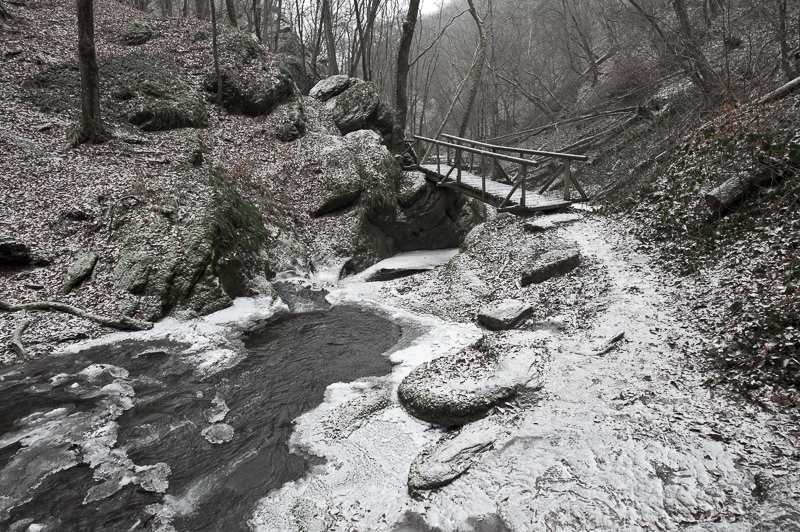
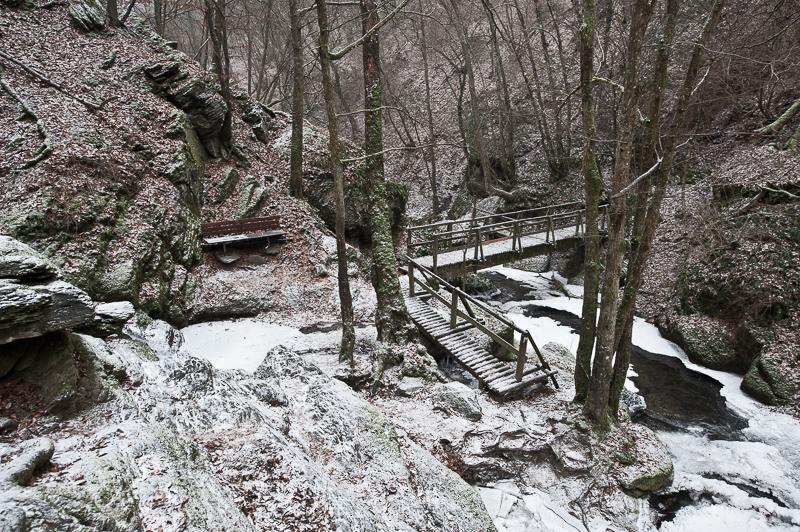
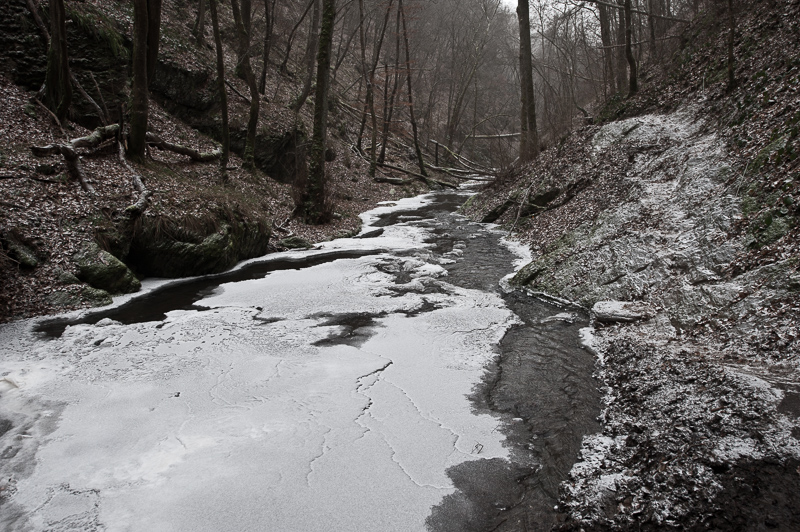
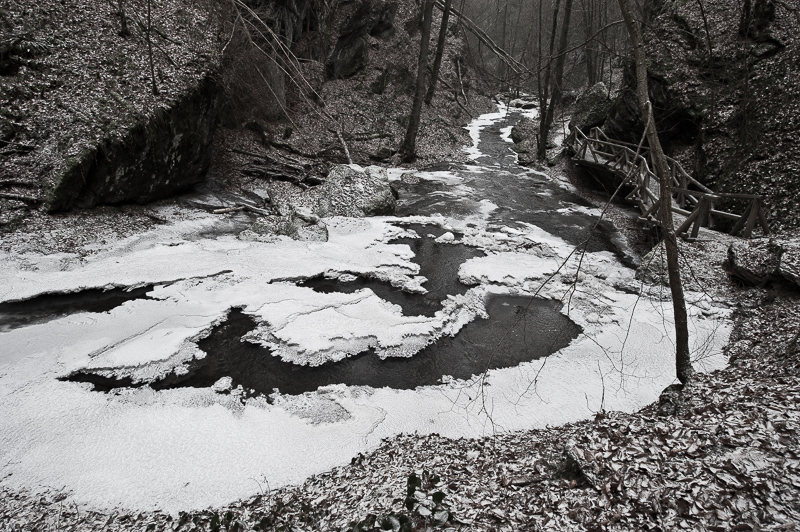
There is, however, a peculiar valley, that transports you back several centuries and lets you experience one of the wildest sceneries in Germany. This is the Ehrbach Klamm. Hiking through this valley is a popular summer excursion, so that on busy weekends it can become rather crowded. Not so in early January, when snowfall, freezing rain and low temperatures make the Klamm almost impassable.

Let’s begin by taking a train to Boppard in the Rhine valley. From there, one can either take another local train to Buchholz, or warm up and climb the steep riverside mountains. The latter allows views back that might or might not appeal, depending on weather and taste.

DSC 4397

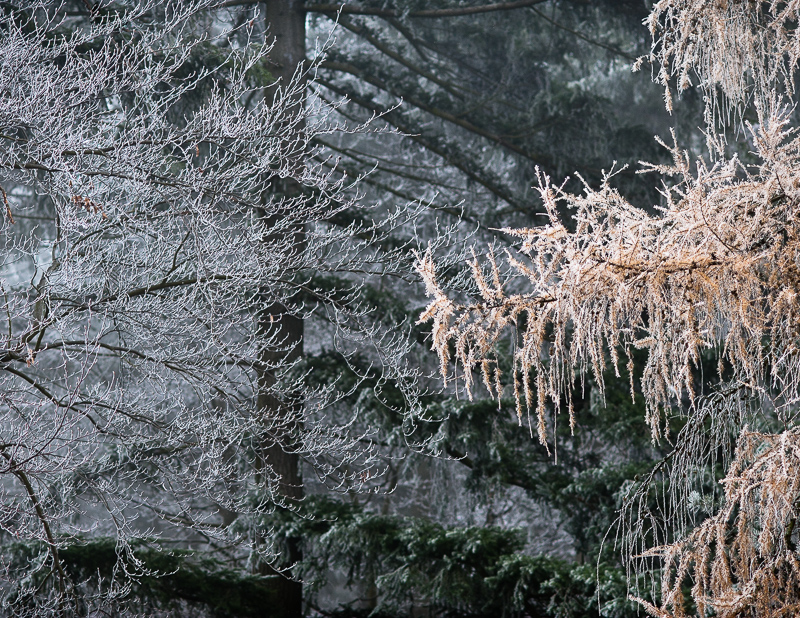
After a while the trail flattens, and the breaking sun rewards the effort with nice views of ice covered trees.

DSC 4427

After crossing a highway bridge and passing through Buchholz, the trail follows the Ehrbach, which is at the beginning a pleasant stream,
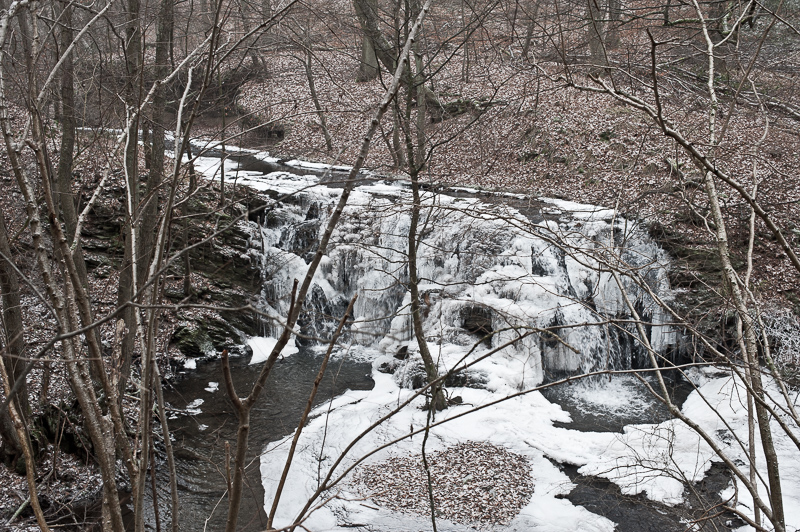
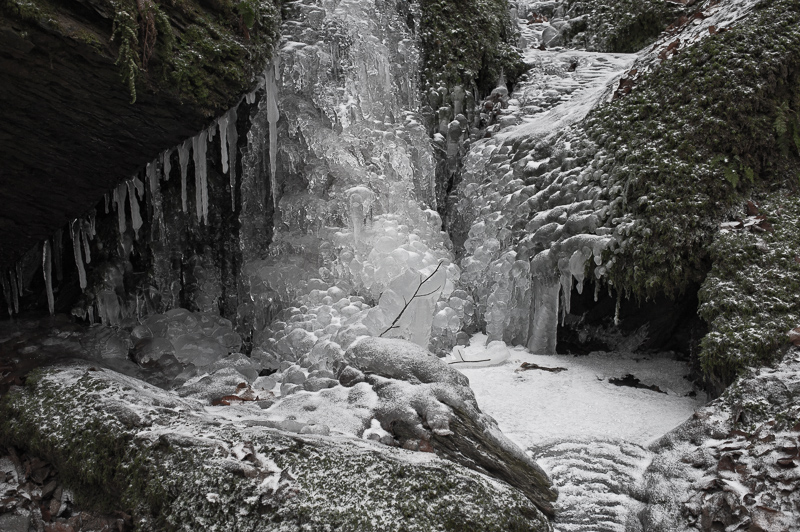
but becomes larger and wilder during the hike. Needless to say, in winter it will display countless frozen waterfalls.

DSC 4477

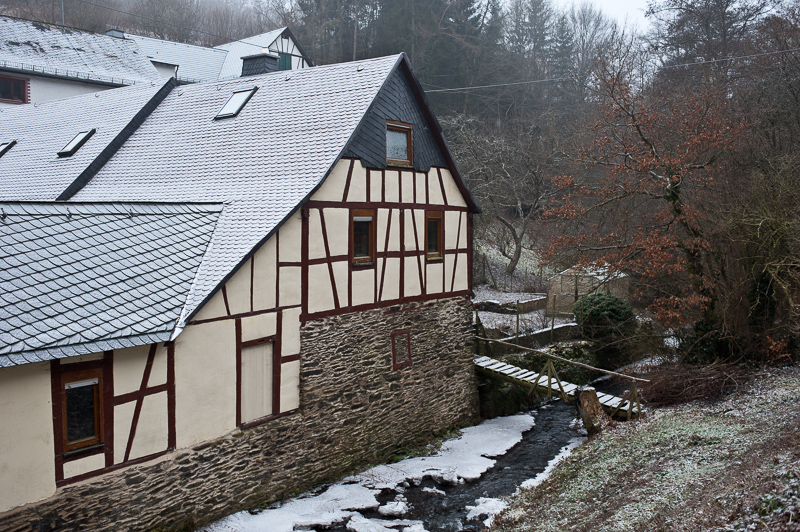
There are few settlements along the way, including a water mill and a restaurant where (during the warmer seasons) guests can rest and eat fresh trout, prepared quite traditionally.

DSC 4489

After passing the Eckmühle, the proper Ehrbachklamm begins, rather dramatically. The valley becomes narrow, and the trail is often hewn into rock and secured with ropes.

DSC 4527

Bridges sometimes help to cross the stream.

DSC 4536

Niches between rocks offer beautiful miniature frozen landscapes.

DSC 4550

Occasionally the trail becomes dangerous in winter. Be properly equipped and don’t go by yourself. I didn’t meet a single person during the 16km hike.

DSC 4573

In Summer, one can climb up to the ruins of the Rauschenburg and muse about medieval life. This detour I did not dare in winter.

DSC 4589

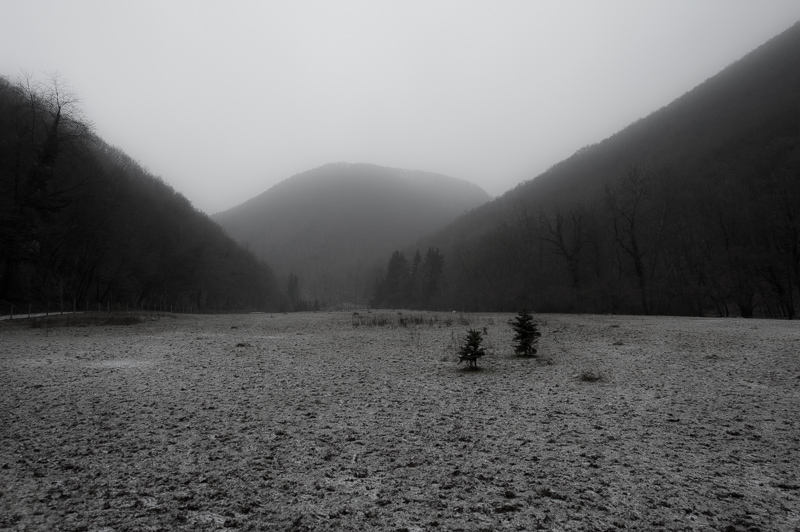
Close to the end, the gorge opens up into one of the most desolate landscapes Germany has to offer.

DSC 4632

The rest of the hike is a rather tedious descent to the Mosel village Brodenbach, where one can catch the occasional bus to the train station in Koblenz.

Woolery Limestone Mill

Large enclosed spaces are awe inspiring. Empty caves, cathedrals, or theater halls challenge our sense of proportion: We do not dare to enter a building alone that is too large. One way to safely confront large enclosed spaces is as a group of people. Albert Speer’s architecture in the 3rd Reich exploited this: Only by following the mass of people you became strong enough to bear his enormous buildings.

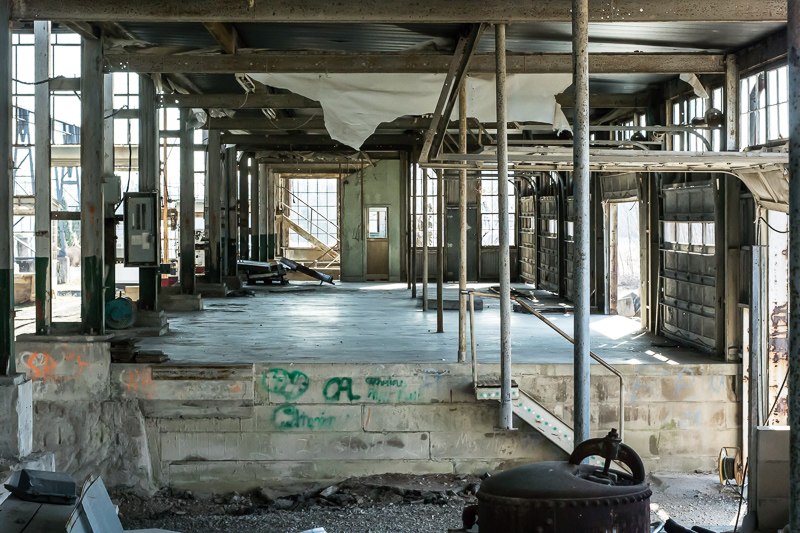
Another way is to wait until decay has lessened the overwhelming power of magnitude. Large industrial ruins have lost their threat, but have acquired a morbid charm — the stone age excitement to see a mammoth die.

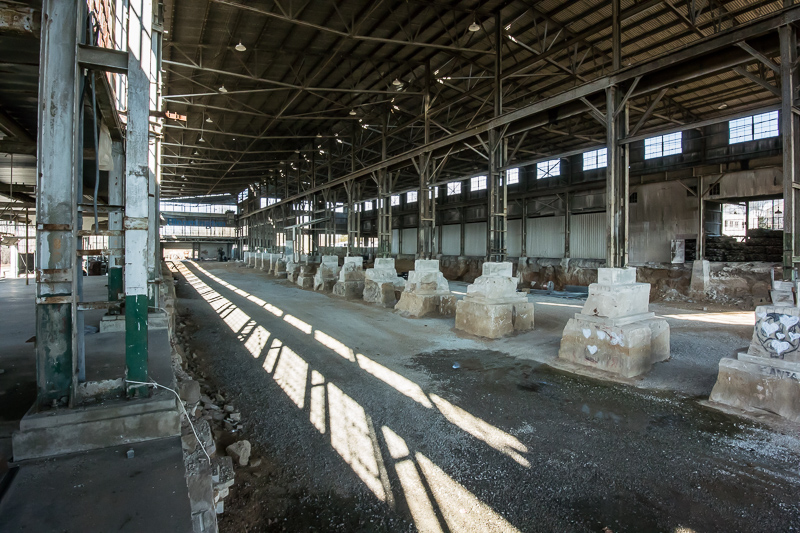
A (for me) local example of this is the Woolery Limestone Mill.

DSC 0154

It is not completely dysfunctional, recent uses include beer festivals and weddings. There is even talk about converting the historical building into a hotel or into luxury appartments.

DSC 0127

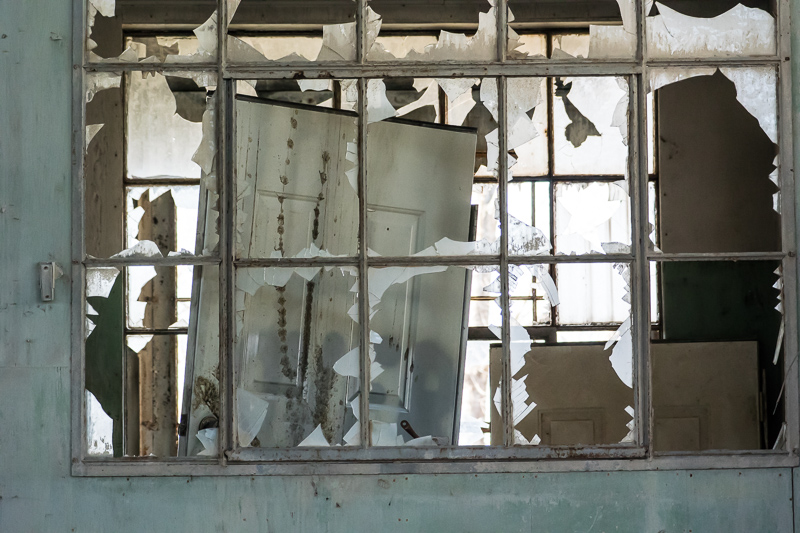
It would be an interesting challenge to build a hotel with all comfort where the rooms appear to have broken windows, the carpet looks like it is a floor full of glass shards, and the wall decorations are freshly sprayed graffiti.

DSC 0071

I am sure this would become a major attraction beyond the common midwestern taste.

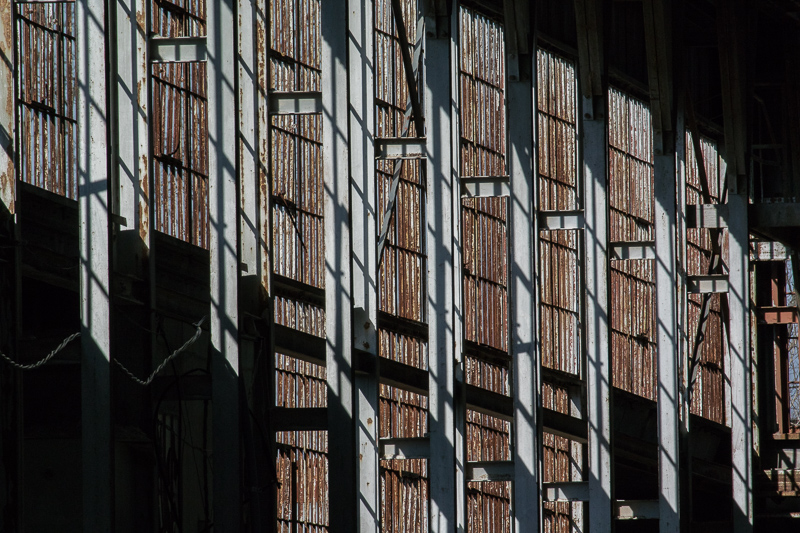
In its current state, the former mill has considerable structural attractions. The play of light and shadow on the rusty steel beams looks like the score of a contemporary composition. I would like to experience Xenakis’ Kraanerg performed here.
DSC 0164

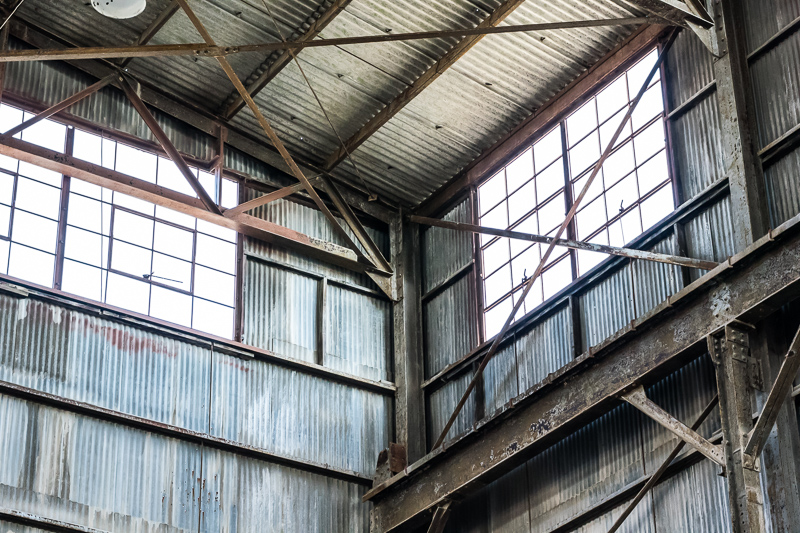
Corners at the ceiling create the illusion of an abstraction that only exists because of the simplicity of the open space.

DSC 0097

And, almost paradoxical in a building consisting entirely of straight lines, the existence of curved shadows makes one wonder about the nature of space itself.

DSC 0168

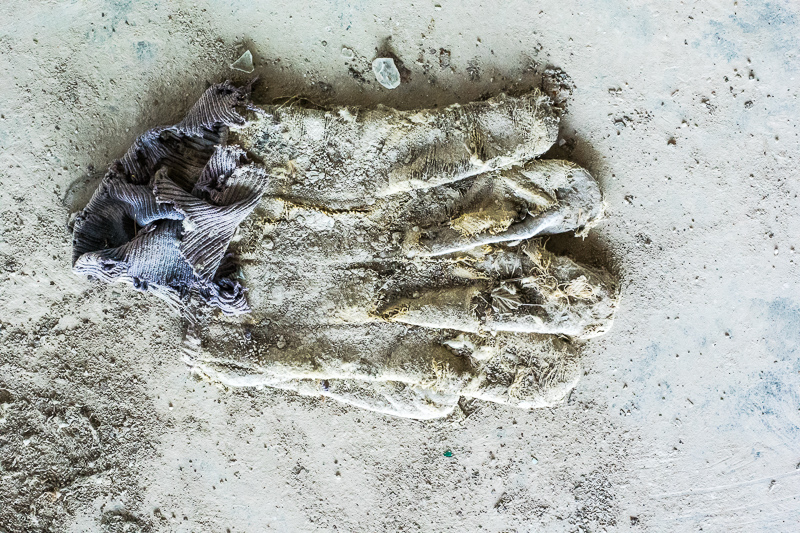
Then, of course, there are the remainders of former human occupation. Once, this glove was worn.

DSC 0126

Frost Flowers

DSC 3134

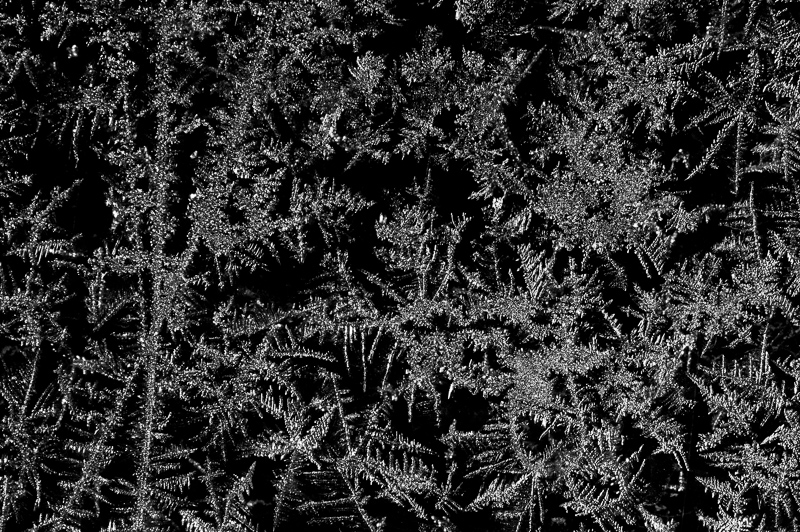
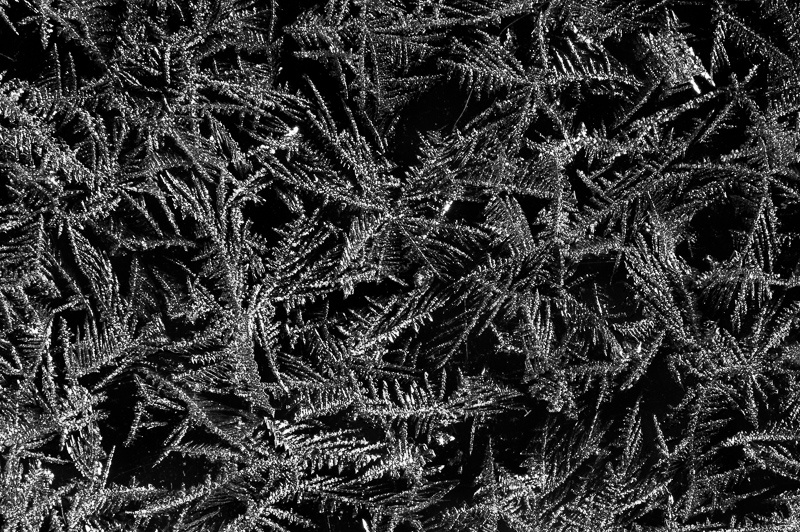
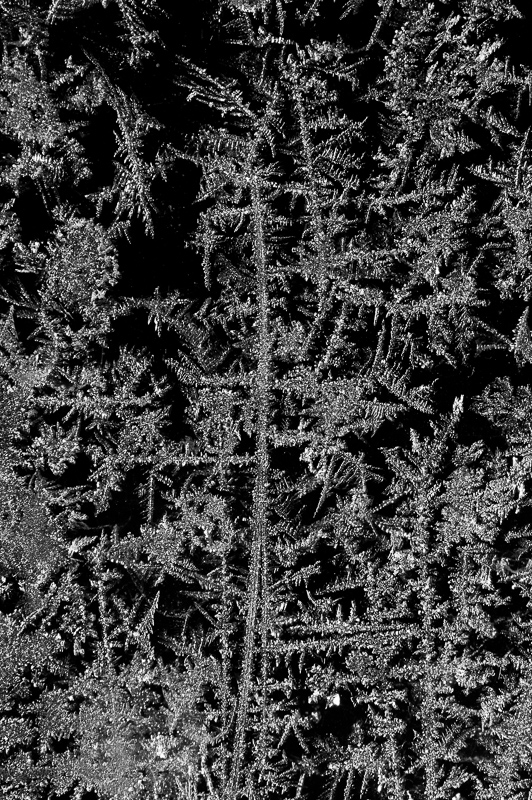
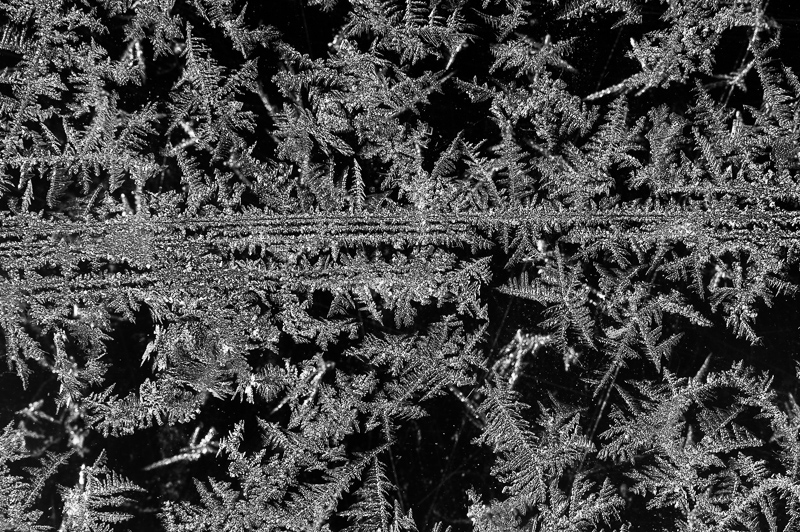
Several years ago I happened to have an empty aquarium sitting outside, and one winter morning its glass faces were covered with intricate from flowers.

DSC 3145

Using a flash from the side created beautiful highlights and eliminated distractions in the background.

DSC 3146

I have not been able to reproduce this. I would be fascinating to make a time lapse video showing how these actually form.

DSC 3150

This, however, requires more optimism and patience than I have.

DSC 3166

I wish these images here had the ability to decay like the frost flowers. Instead, they are truly digital: They are, or they are not.

Fragility

DSC 1924

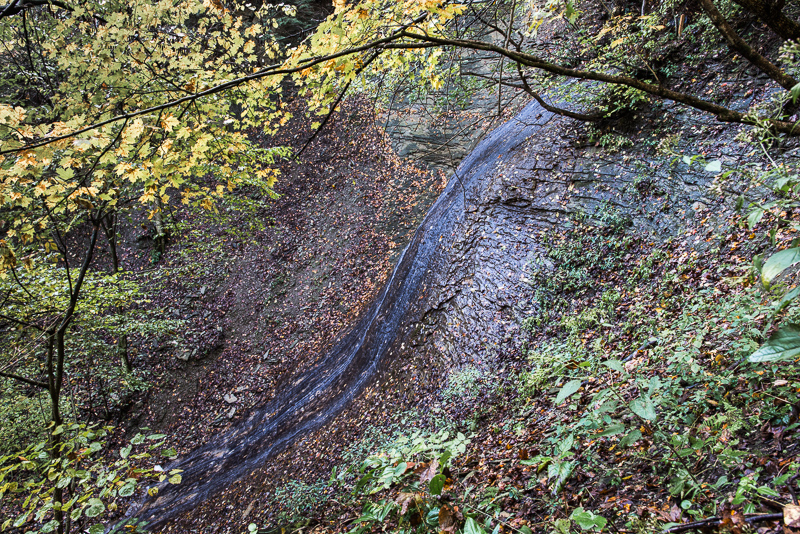
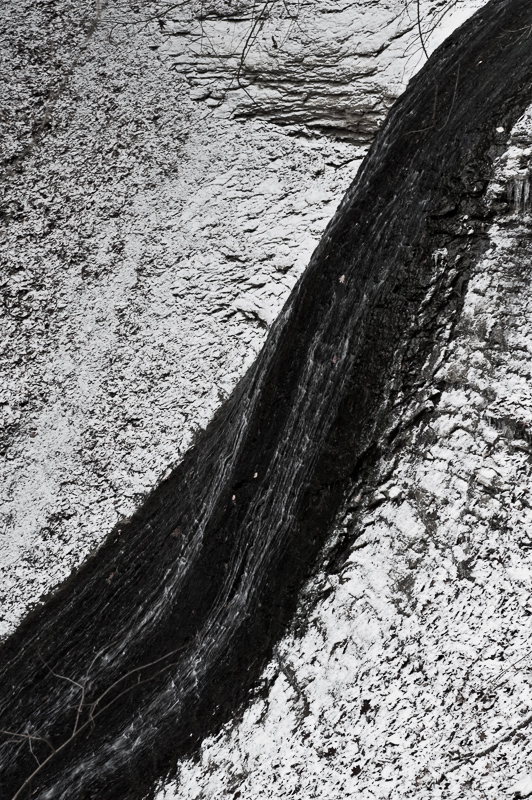
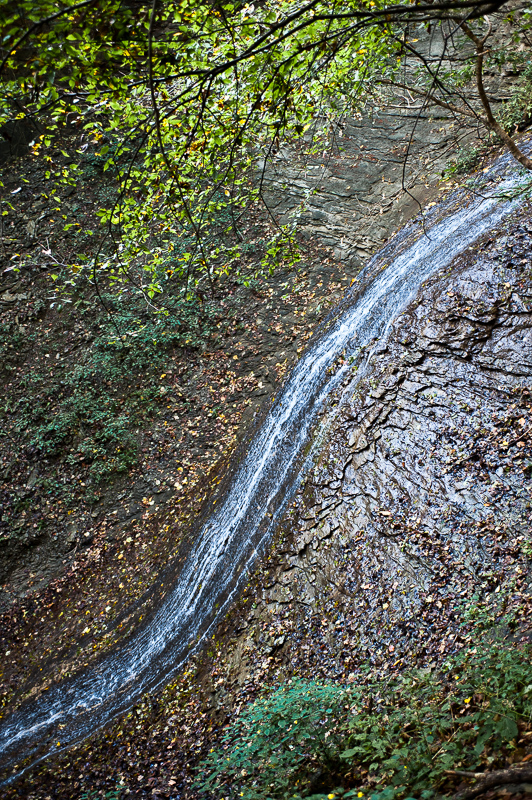
If Nature has intended to create sacred places for us, then the Silver Cascades waterfall in Shades State Park, Indiana,
is certainly one of them. Don’t expect roaring cascades. Instead, when approaching the secluded site, you will hear nothing but the quiet murmur of slowly running water.

Besides its stunning beauty, this unusual waterfall is partially convex, giving it a womb like appearance.

While frost wedging is responsible to the concave upper part, this process is less effective in the lower part, as it is less exposed.
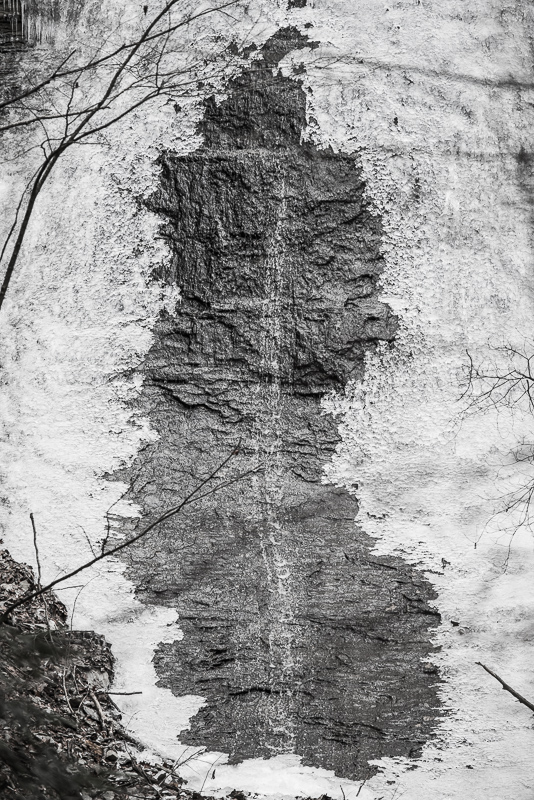
In Winter one can see how the flowing water prevents freezing.

DSC2105

The whole area is quite fragile, and the spots where the pictures here have been taken are now closed off due to rock fall. The best time to visit is during the early morning in the Fall, when it is quiet and there is no direct sunlight on the leaves yet.

DSC3206

The now inaccessible front view offers an entirely different, still irritatingly erotic, perspective.

DSC 5137

Berlin Hautbahnof

DSC0216

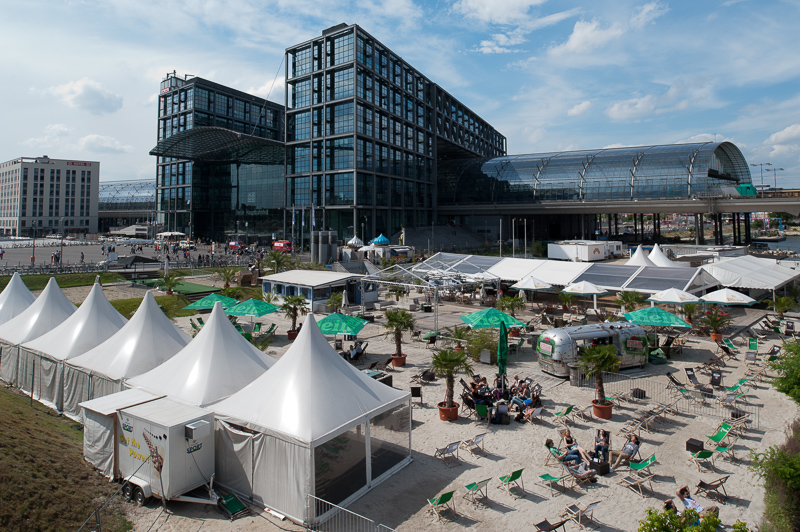
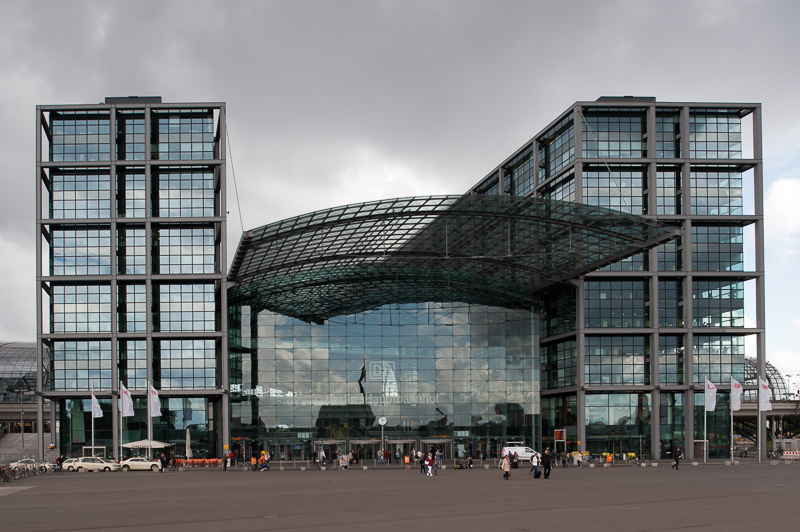
After the reunification of Germany and in particular Berlin, a new central railway station became necessary in Berlin, as the respective eastern and western main railway stations would not suffice the demands of traffic and prestige.

DSC9902

It has been built on the site of the former Lehrter Bahnhof, using a design by architect Meinhard von Gerkan.

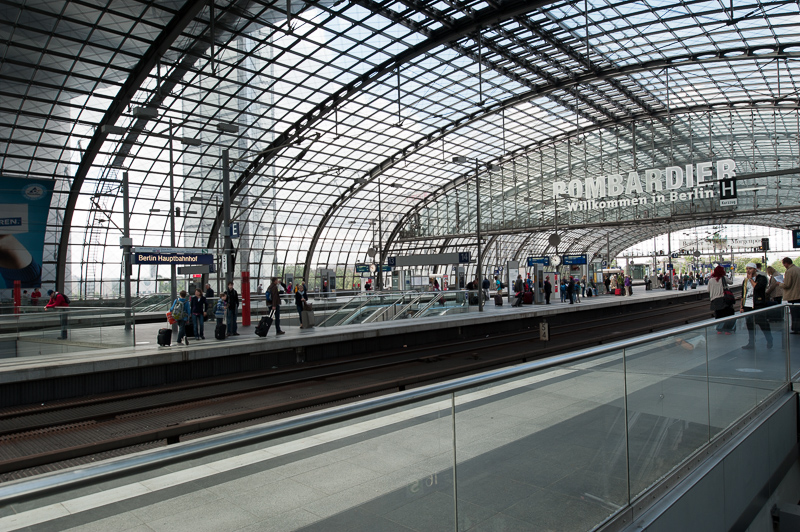
The tracks run on two different levels, meeting at a right angle. The top level has a spectacular glass roof:

DSC9858

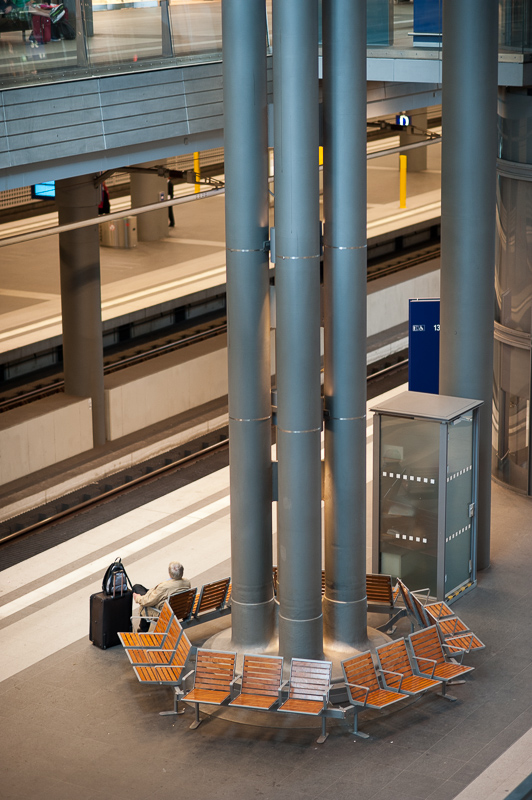
The inside is less confusing as one might expect. The open architecture allows quick orientation. Also, different functional components are clearly differentiated in the architecture, giving each area its own distinctive feel.

DSC9916

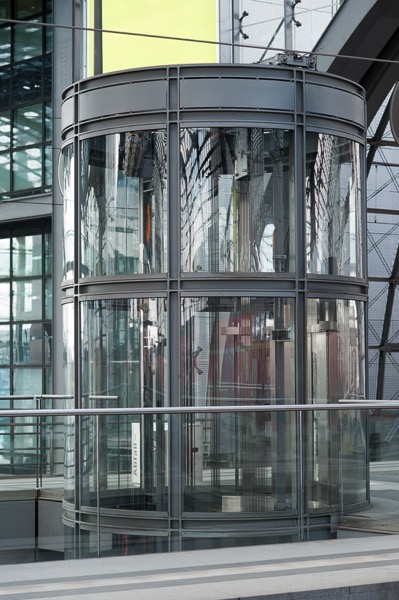
The elevators are both integrated and easily recognizable. This is function and form in perfect harmony.

DSC9955

I imagine that the nameless city in which Kazuo Ishiguro’s masterpiece The Unconsoled takes place would be full of buildings like the Hauptbahnhof. One can almost hear Mullery’s Verticality while moving through its vast, treeless spaces.

DSC9985