Steingrund unter den Händen

This continues the series of revisits of my year 1993/94 in California. Very rarely a landscape hits you with such a force that you are left with a lifelong desire to return.

Bk202

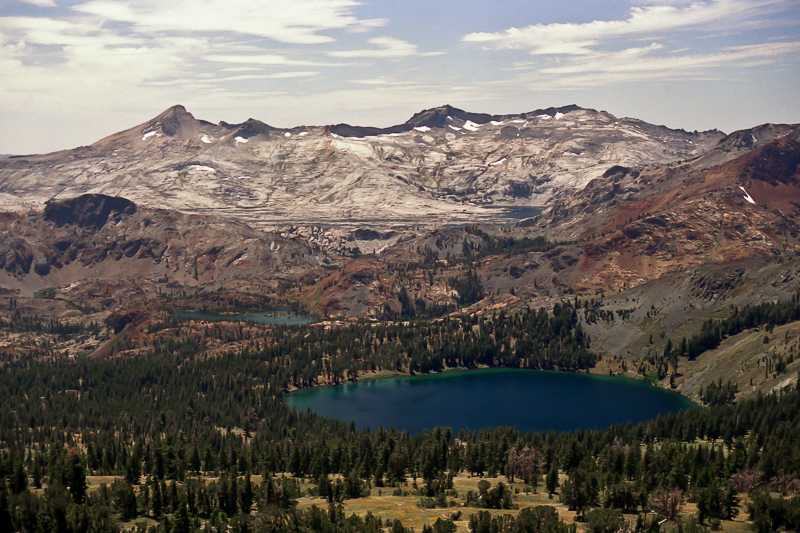
The climb from Lake Tahoe to Mount Tamrac is through lush forests, and nothing but the weathered trees prepares you for the view from the top.

Bk218

In the front is Gilmore lake where we had memorable swim, and further behind follow Susie Lake, and, already in the granite, almost invisibly, Lake Aloha.

Bk209

The landscape gradually transitions from impossibly green vegetation to gray and white granite rocks. The latter
are, however, not steep and ragged but smooth and almost plane. No invitation to hell could be sweeter.

Bk216

The heroes of this place are the trees. They struggle on without almost no soil, withstand harsh weather, and even when long dead, remain.

Bk214

The Other Side of the Spring Mills Park

On the other hand, there are some really spooky places in Spring Mills State Park, provided you come at the right time.

DSC2445

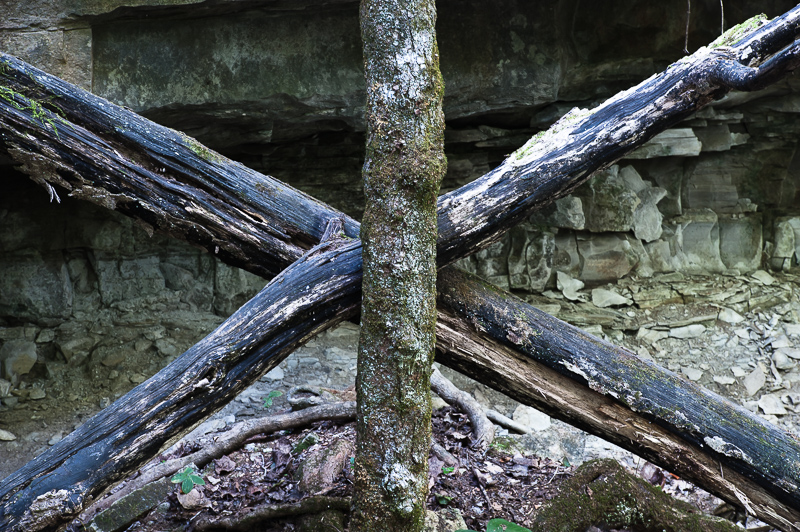
Next to Bronson cave, some fallen trees have assembled themselves in something that looks at an ancient rune.

DSC2101

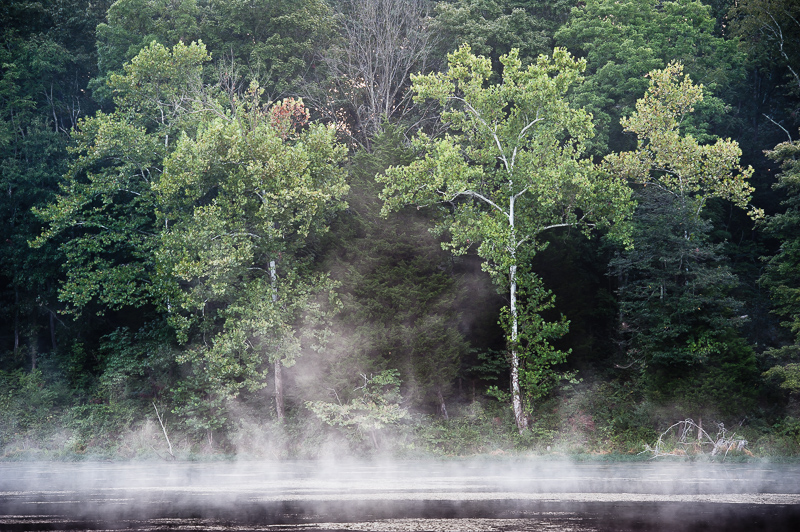
In the fall and just before sun rise, the Spring Mills lake offers the best lake shore views in Indiana.

DSC7573

For whatever reason, there is always a healthy tree among the many dead.

DSC 5211

Even without the fog, the scenery is awe inspiring.

DSC 5223

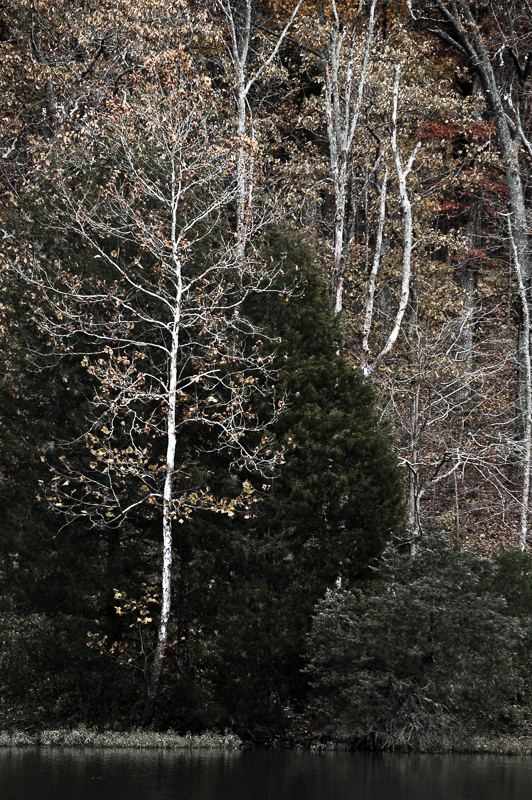
For whatever reason, there is always a photogenic dead tree among the healthy. I wonder what ghost stories the settlers told here.

The Mill

Every culture seems to have their own metaphorical approach to the mill.

DSC8855

I grew up in Germany. My early childhood was infused with fairy tails featuring increasingly spooky millers,
and of course with Wilhem Busch’s famous Max and Moritz, where the two brothers, after plenty of enjoyable mischief, end up ⎯ no, I won’t tell.

DSC2158

One of my favorite childhood books is Ottfried Preußler’s Krabat (translated as The Satanic Mill), that tells the story of a young boy becoming the apprentice of a miller, who, incidentally, also teaches sorcery. For a price. Check also out Karel Zeman’s animated movie with the same title.

DSC2180

And of course there is Schubert’s some cycle Die schöne Müllerin.

DSC 4148

Other cultures have a very different take on mills, like the Spanish with Don Quixote by Cervantes.

DSC8865

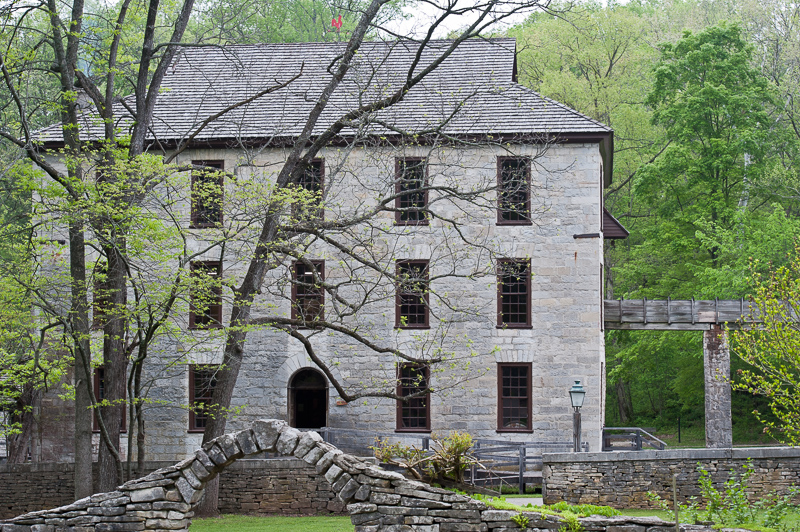
Seeing a truly impressive historic water mill (from 1817) in Spring Mills State Park made me feel quite at home.
It is still in use and produces cornmeal.

Density (Spheres VII)

There are essentially two very symmetric ways to tile the plane with circles. One can use the square tiling, of the more efficient hexagonal tiling.

Circles

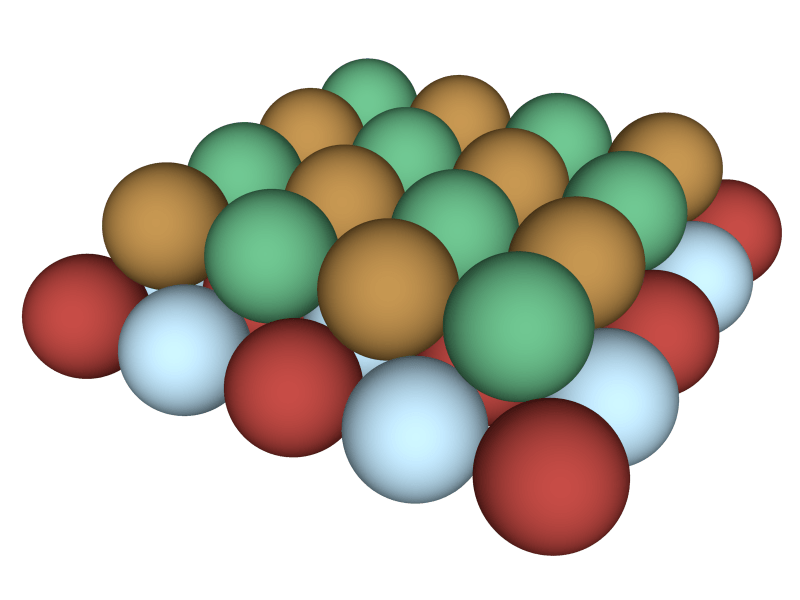
In space, we can use the cubical tiling to generalize the square tiling, as I did in Spheres V. But one can do better. On one hand, one can put down one layer of spheres in the square tiling pattern, but shift the next layer diagonally to save space:

Squaremain

Or, one can put down one layer of spheres using the hexagonal pattern, and again shift the next layer so that its spheres fit snugly into the gaps left by the spheres of the first layer, like so:

Hexmain
I hope it surprises you like it did surprise me that these two approaches lead, in fact, to the same packing of spheres:

Truncmain

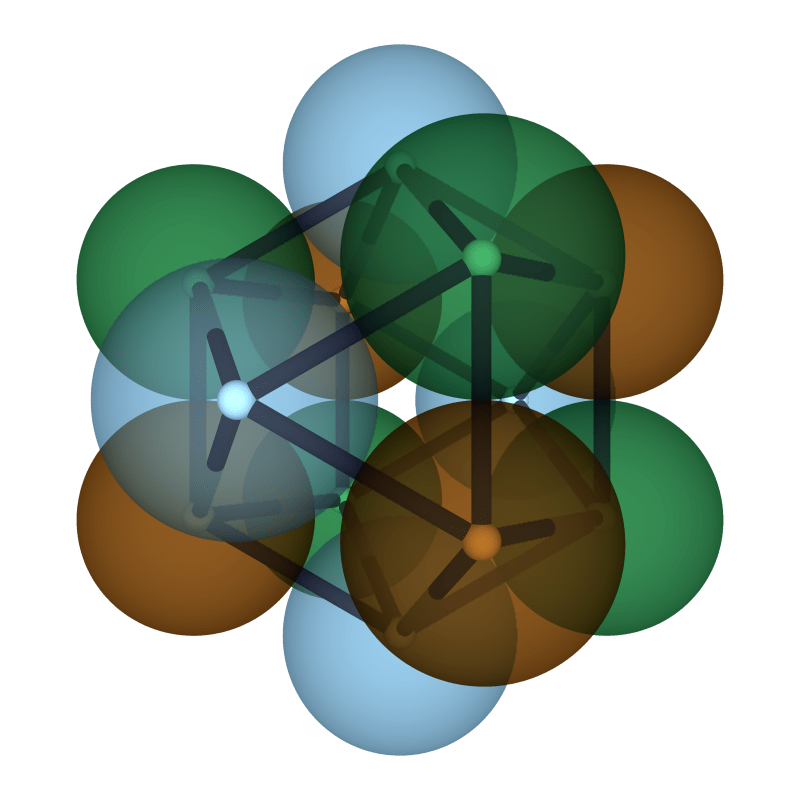
The mystery behind this is the geometry of the cuboctahedron, an Archimedean solid with both triangular and square faces:

Cuboctamain

Putting highly reflective dark blue spheres in such an arrangement within an off white cage cuboctahedral shell results in today’s sphere theme image:

Dense small

Wild Columbine

The Wild Columbine is one of the later spring wild flowers in Indiana, but one of my favorites, maybe because it is so photogenic.

DSC 8218

One usually finds her in clusters, near rocky slopes. My major difficulty with wild flowers is the depth of field. When you try to get a good shot of a trillium, for instance, you usually do this vertically down, and even with a modestly shallow depth of field, you inevitably have the muddy Indiana soil as a background, mixed with dirty brown leaves from years back. On the other hand, of the depth of field is too shallow, significant parts of the plant will be unpleasantly blurry.

DSC 7200

The Wild Columbine lends herself to side views, and her taste for location almost automatically provides beautiful backgrounds.

DSC 8274

This is all nice and pleasant, but to really appreciate the beauty of this flower, you need to get down to your knees and look at her intimately close.

DSC 8295

Maybe, in my next life, I want to be an insect. Just for one spring.

Polyhedra at an Exhibition

1

When in 1873 Victor Hartmann died, Modest Mussorgsky visited a memorial exhibition with his friend’s drawings. Deeply impressed, he wrote a suite for piano – Pictures at an Exhibition.
The Pictures are lost, but the music survived.

2

Around 1910, Wassili Kandinski painted the first abstract painting. Instead of depicting recognizable things from nature, he painted abstract shapes. He even developed a theory how emotions should relate to abstract colors and shapes.

3

This brought the visual arts closer to music, and it is maybe not a big surprise that Kandinsky ‘composed’ a ballet for abstract shapes, to be performed to Mussorgsky’s Pictures at an Exhibition.
Kandinsky’s ballet is lost, but the idea survived.

4

In the spring semester 2003, I taught the class Exploring Mathematical Ideas to undergraduates majors and minors at Indiana University in Bloomington, with the idea to recreate a modern version of the ballet, using computer graphics.

5

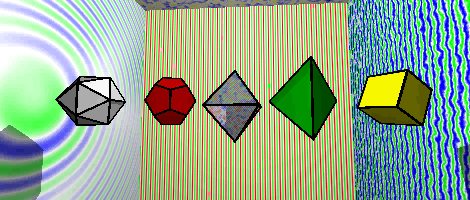
I introduced polyhedra in class early on, and used the raytracer PoVRay as an illustrational tool.

6

The students had to learn the basics of raytracing with PoVRay in the first half of the class.

7

Then we assigned one piece of the music to each student, picked a few polyhedra, created 3D models (in PoVRay), designed a few scenes, and rendered keyframes.

8

Then we turned to animations: What was a constant (a color, the coordinate of a point, the size of an object) could now suddenly depend on a time parameter.

9

This proves the concept of a variable instantly useful, and shows that being able to write down formulas for functions allows to control these geometric quantities according to the design of the scene.
10

How did we synchronize? The answer is: We didn’t. I didn’t ask my students to synch the movie to the music. In fact, it is usually easier to synch the music to the movie by employing a live player, than the other way round. Some of the students tried it nevertheless and succeeded amazingly well.
11

With some more effort, one would be able to use parameters of the music (like sound amplitude) as an input for the raytracer parameters, but our project was a zero budget project, and we didn’t have the technology.

12

In particular, this would require the ability to precisely align the video track with the sound track. Our (free) software did not even generate the video tracks to the correct duration…
13

So, instead the goal was to catch the mood of the scene, and I believe this was quite successful.

14

How to overcome copyrights? Using Mussorgsky’s music from commercial production so that you can publicly show the movie and distribute it is next to impossible. While Mussorgsky’s piano score is in the public domain, neither the various orchestrations are, nor are any recordings.

15

I was lucky to find a freely downloadable version of the orchestration by Carl Simpson, recorded by the Ithaca Symphony Orchestra under Hrant Cooper. They all and the publisher gave us permission to use the music for this class, and to show the movie. This was an interesting exercise in copyright law!

16

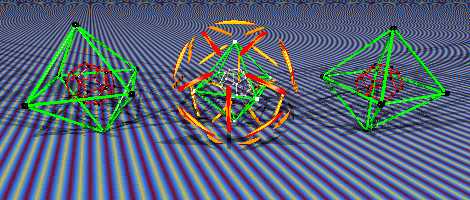
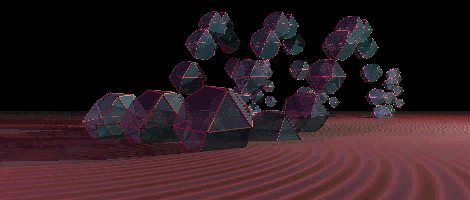
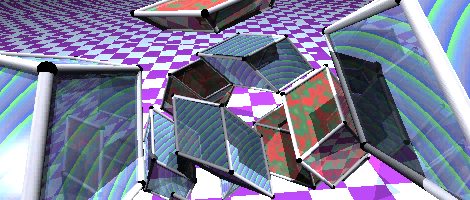
That the images on this page are so small has a reason: After a hard drive crash, the sources for the movie scenes were lost. What survives, are these images, and a low quality version of the entire 35 minute movie.