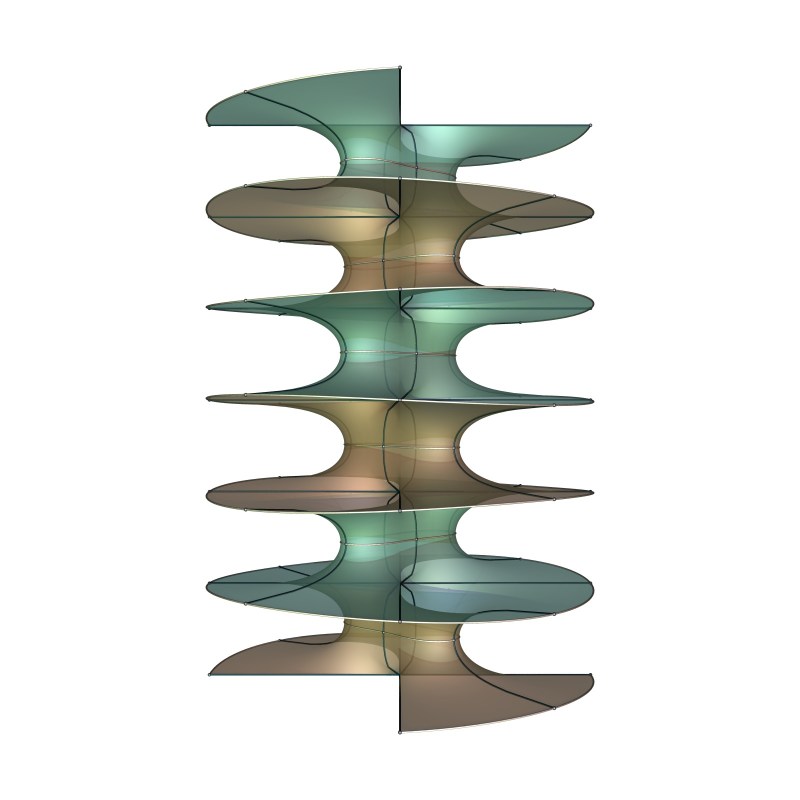
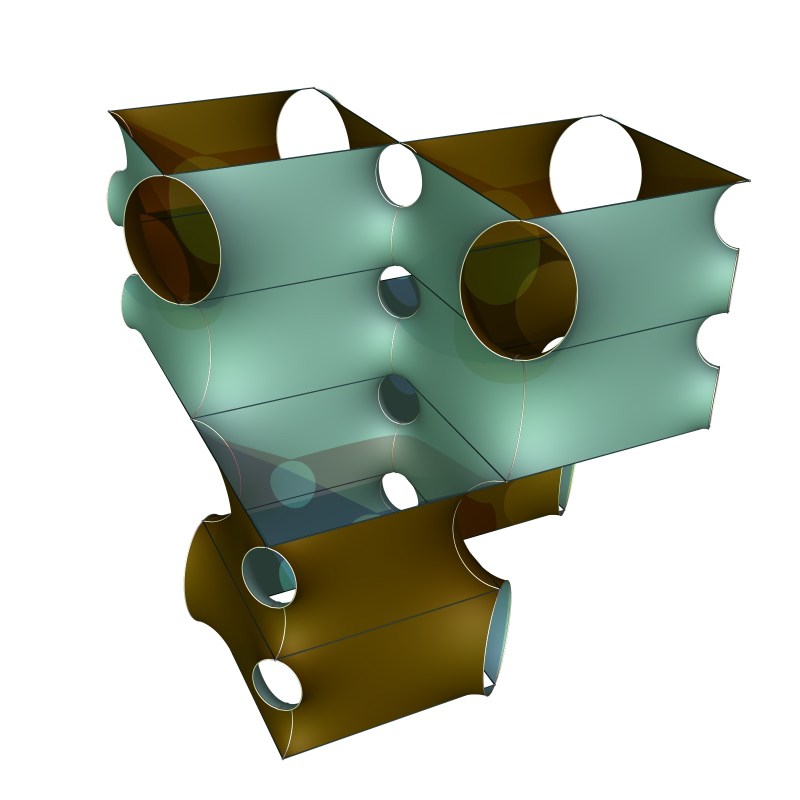
The last minimal surface that made it into Alan Schoen’s NASA report is the F-RD surface. It has genus 6 and looks fairly simple.
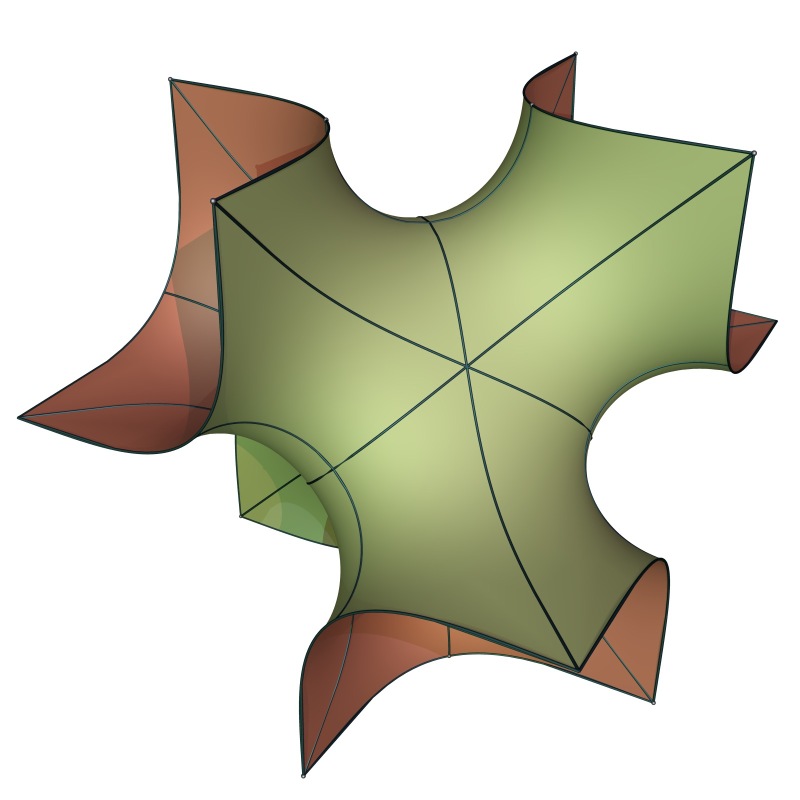
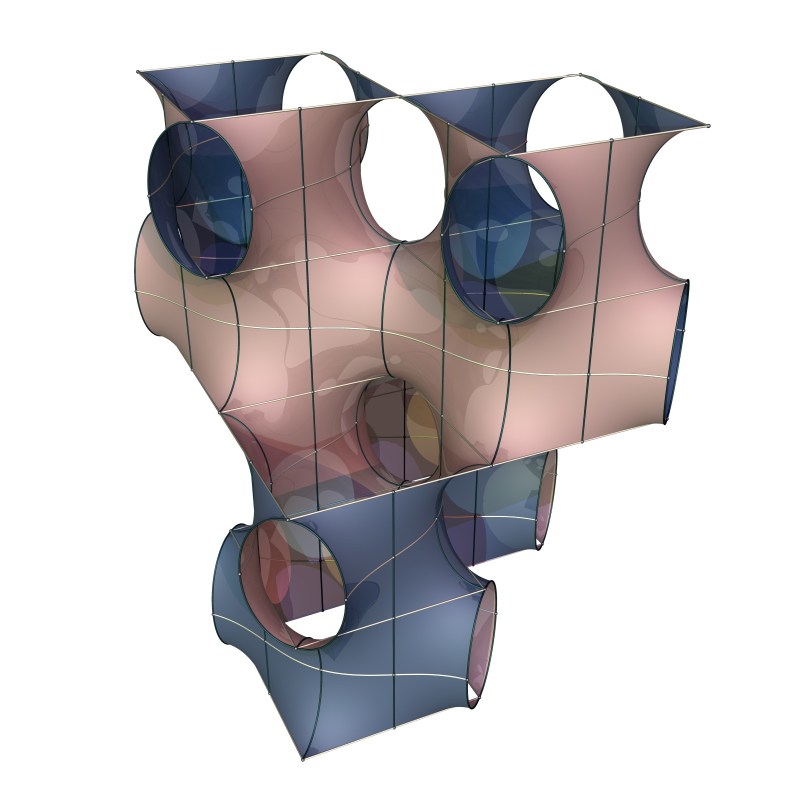
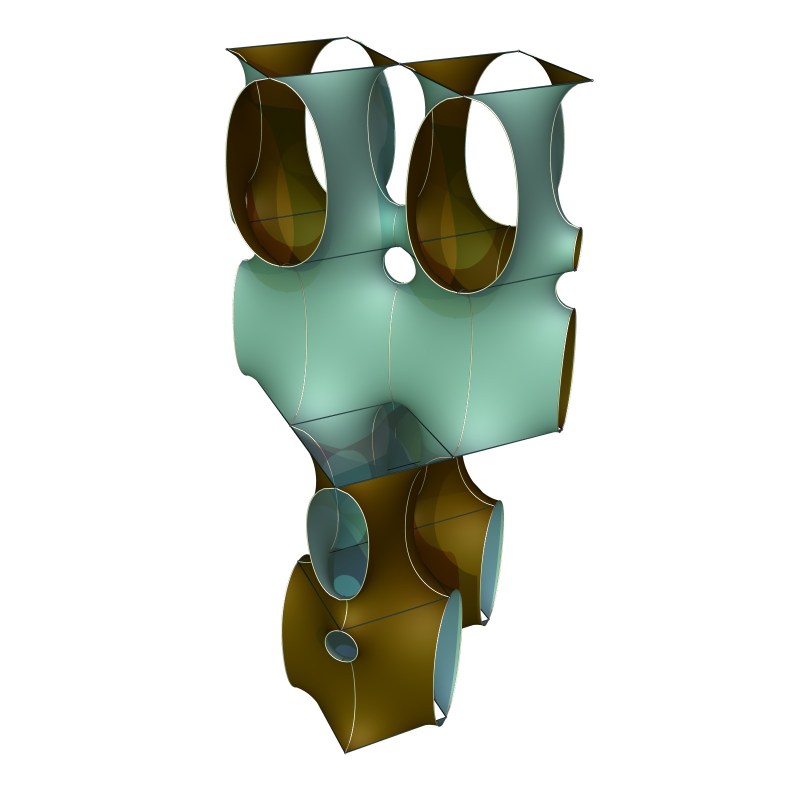
A fundamental decision one has to make these days is to choose the side one wants to live on. If, for instance, we decide on the orange side, we will have the impression to live in a network of tetrahedrally or cubically shaped rooms with connecting tunnels at the vertices of each. Not too bad, but, as things stand, we will never know what life on the other side looks like.
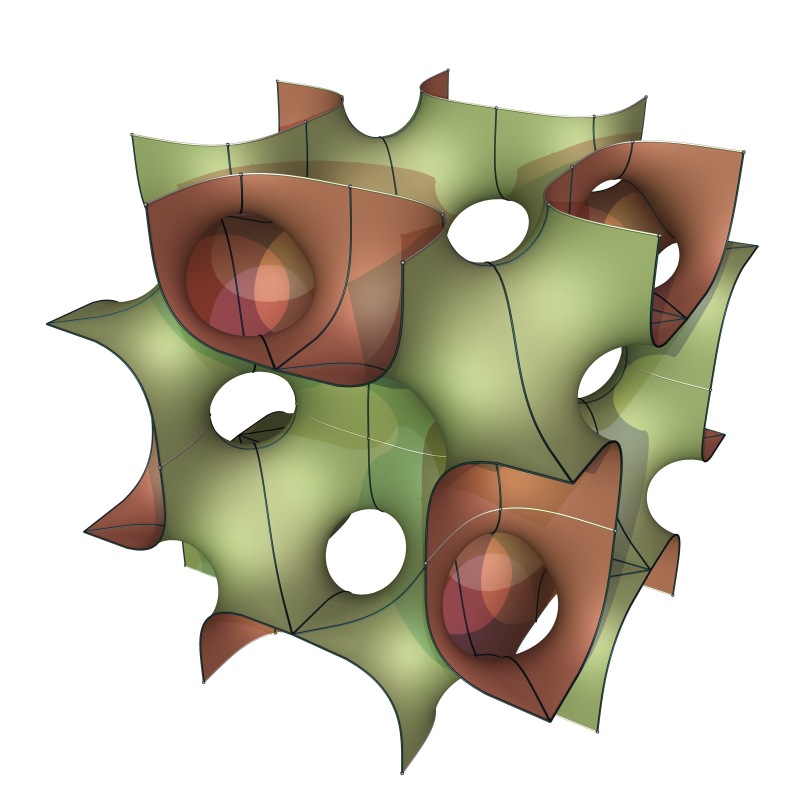
Luckily, our imagination is still free, and we can think about the other, green side. What we can hopefully see from the pictures above and below is that the rooms of the green world are all cubical, with tunnels towards the edges of each cube. Alternatively, we can also think of the rooms as rhombic dodecahedra, with tunnels towards the faces. That’s where F-RD got its name from: Faces – Rhombic Dodecahedron.
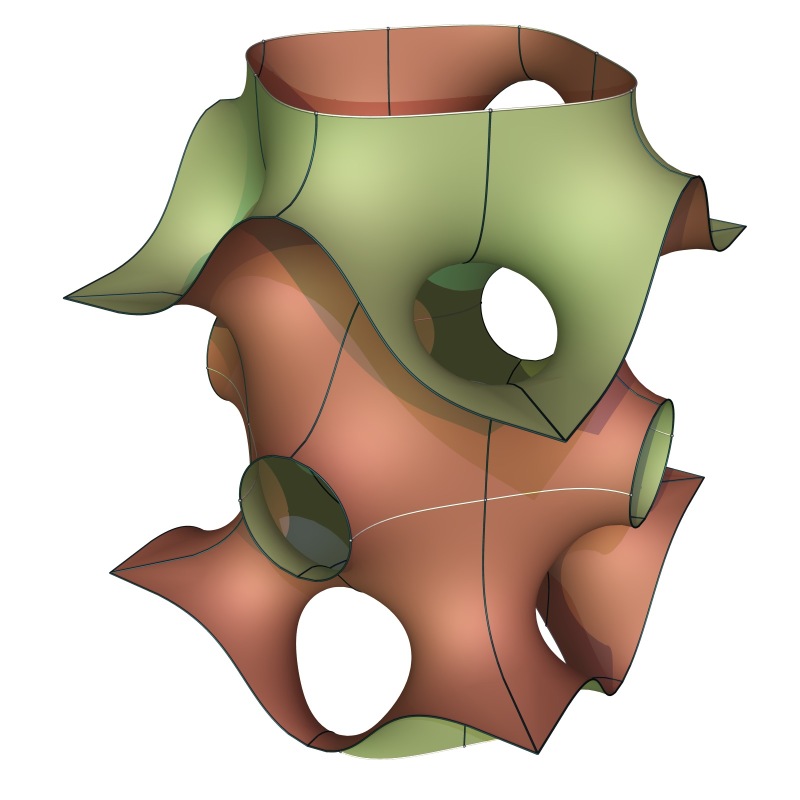
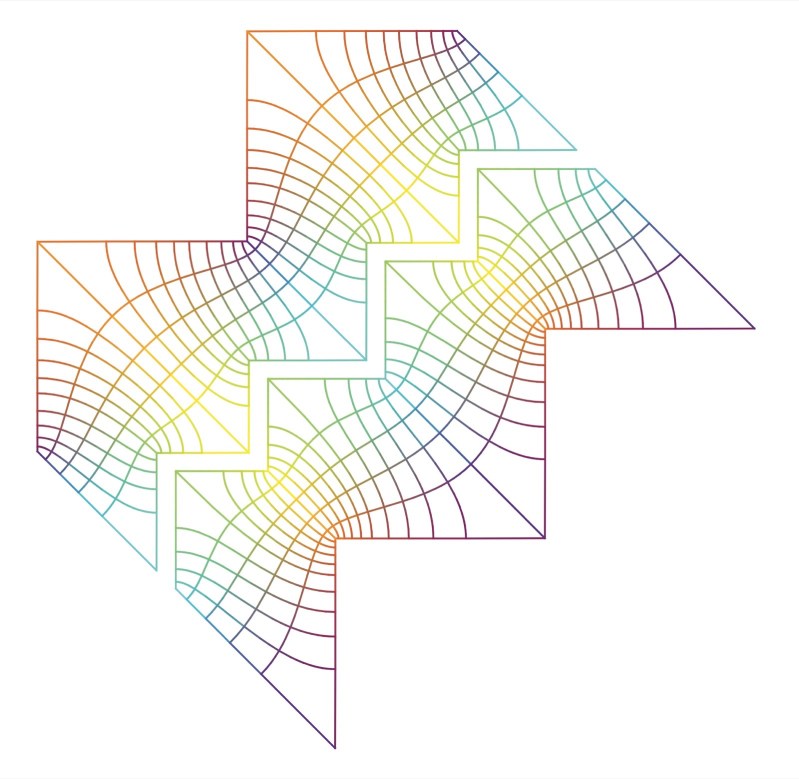
Incidentally, the conjugate of the F-RD surface is again one of those discussed by Berthold Steßmann, with the polygonal contours having been classified by Arthur Moritz Schoenfließ.
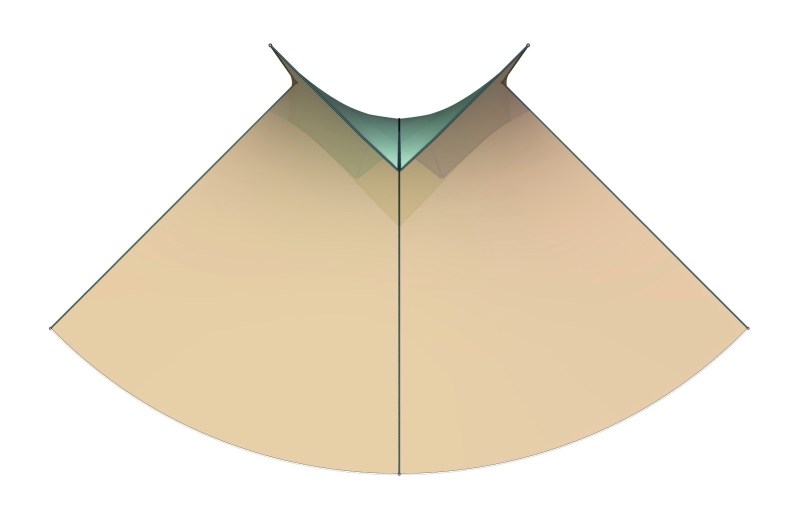
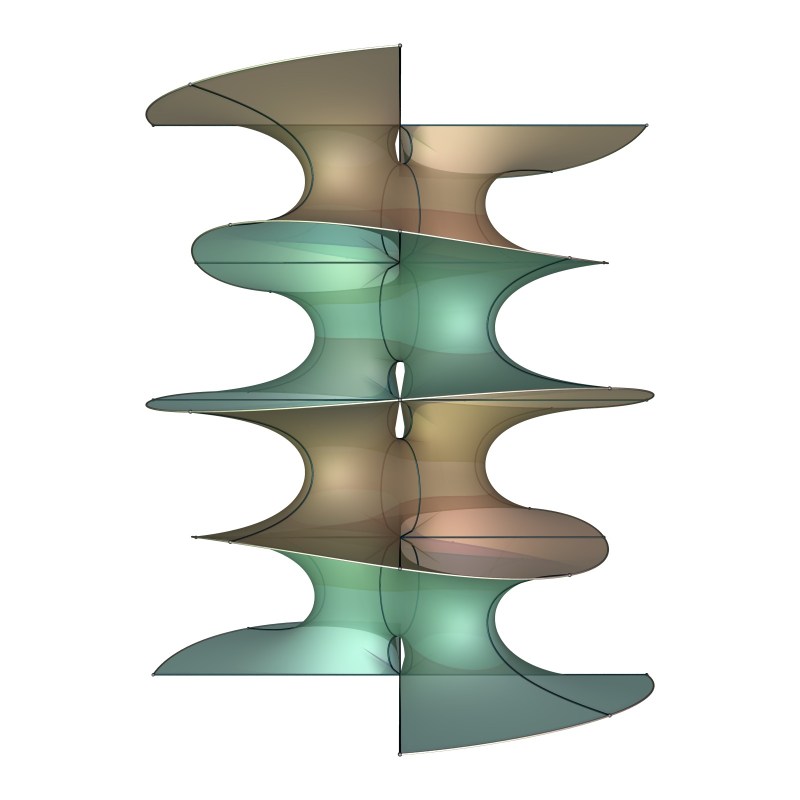
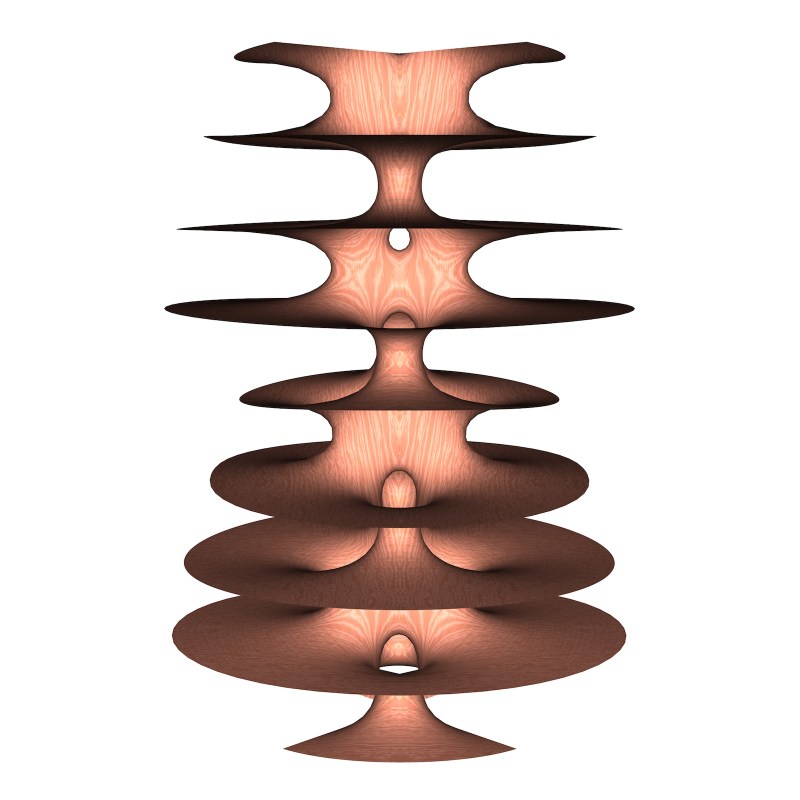
A simple deformation of F-RD maintains the reflectional symmetries of a box over a square, but allows to change the height of the box. It turns out that there are two ways to squeeze the box together.
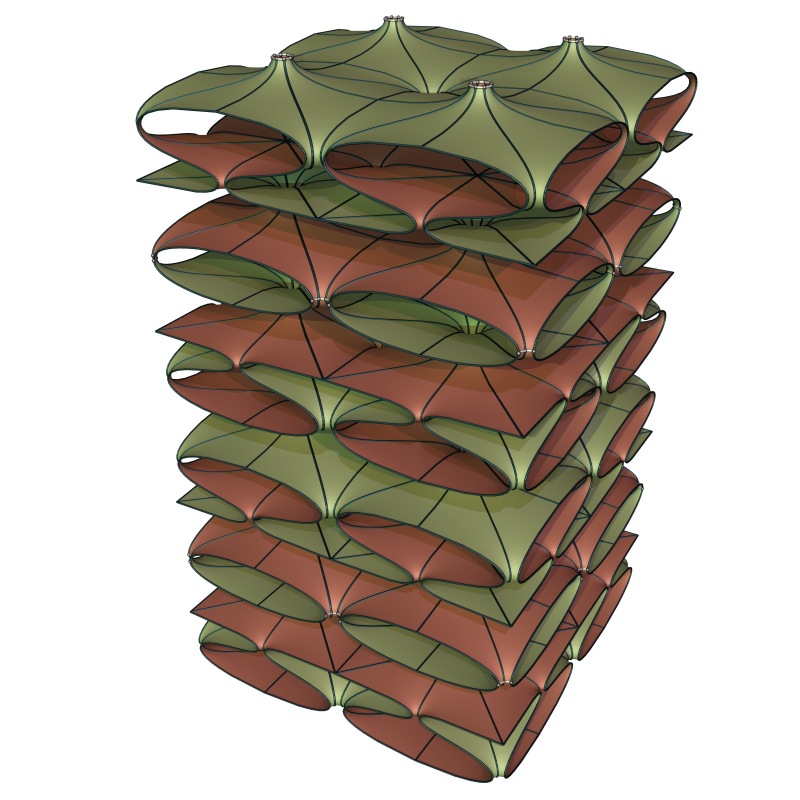
In both cases we get horizontal planes joined by catenoidal necks, but differently placed in each case.
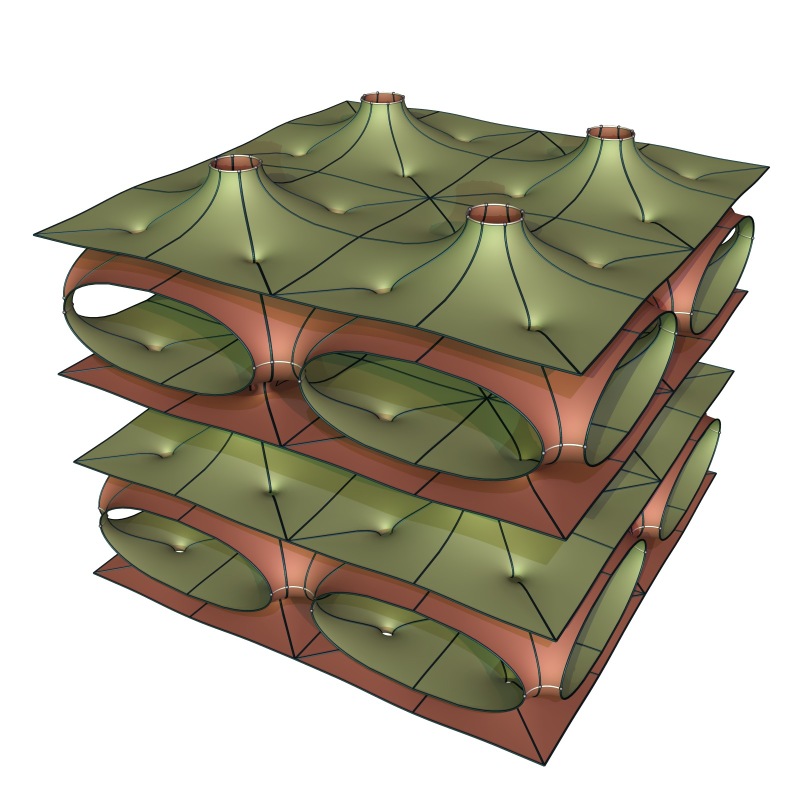





 After Alan Schoen was fired from NASA at the end of 1969, he moved back to California and continued to experiment with soap film. In October 1970, he used two identical wireframes bent into figure 8 curves consisting of two squares meeting at a vertex. When he dipped them into soapy water at a small distance from each other and pulled them out, he could poke the flat disks between the two figure 8s and create a minimal surface that looks like the top half in the picture above. It extends triply periodically to a surface of genus 5.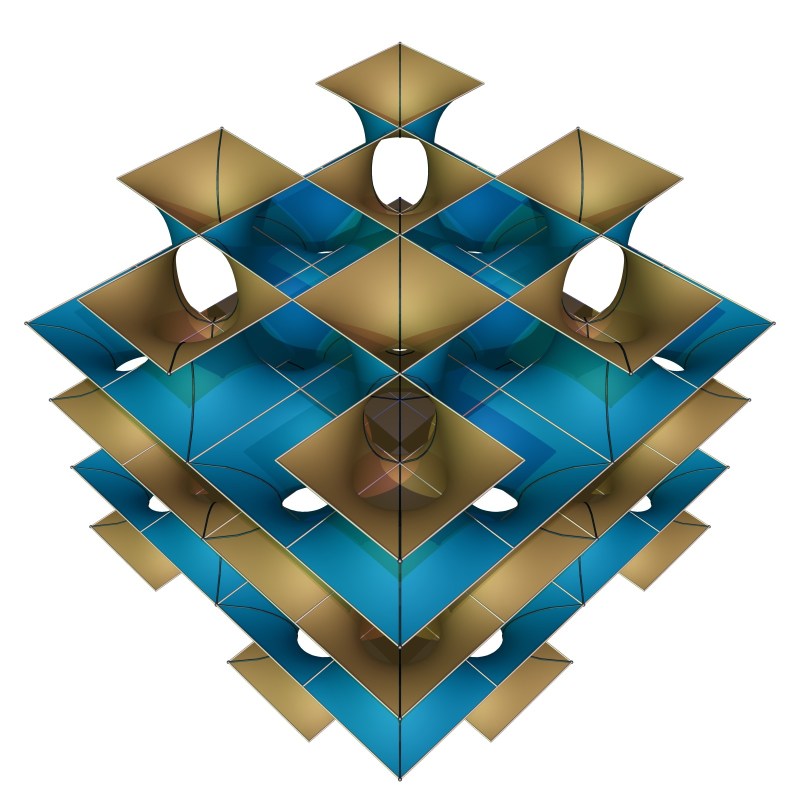












 The Inner Frame