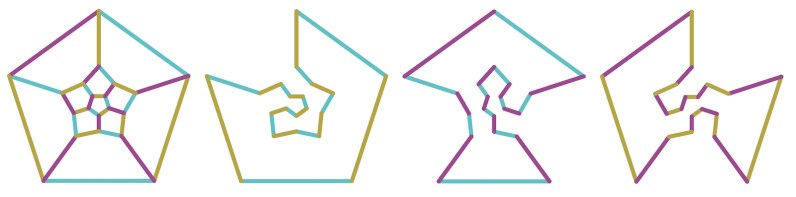
Plane and Simple (Solitaire XVIII – From the Pillowbook XIII)

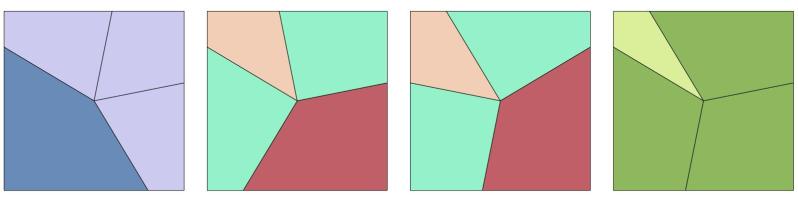
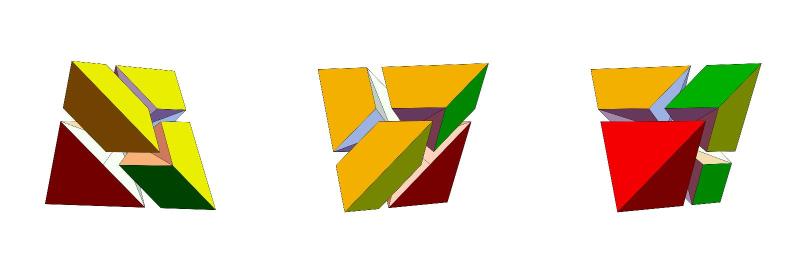
Alan Schoen’s Cubons and Tetrons make beautiful and interesting puzzles, but few people will have the patience to build them. So here is a workaround. I begin with simplified tetrons where the edges are divided either 1:2 or 2:1. There are just 4 of them, and they nicely fit together into a single tetrahedron. Here are three views of the same tetrahedron. Smalltet1111

We now represent the tetrahedron by its edge graph K₄, and each cubons becomes a disk with three arrows placed on the vertices of this graph. The graph on the left represents the tetrahedron above.Tetrahedron 01
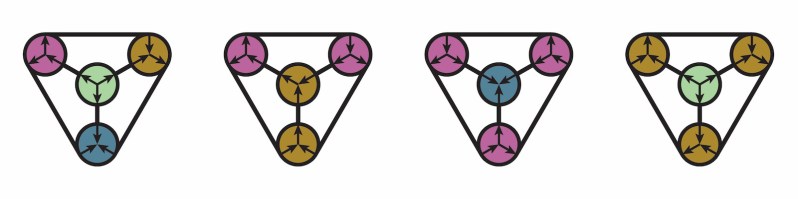
An arrow pointing away from the center of the disk means that the corresponding edge of the cubon is long, and short otherwise. So instead of elaborately assembling tetrahedra, we can just place one of the four types of coins on the vertices of the graph so that the two arrows at the end points of an edge point in the same direction. As an exercise, try to find the tetrahedron below among the four graphs above:
Smalltet0301

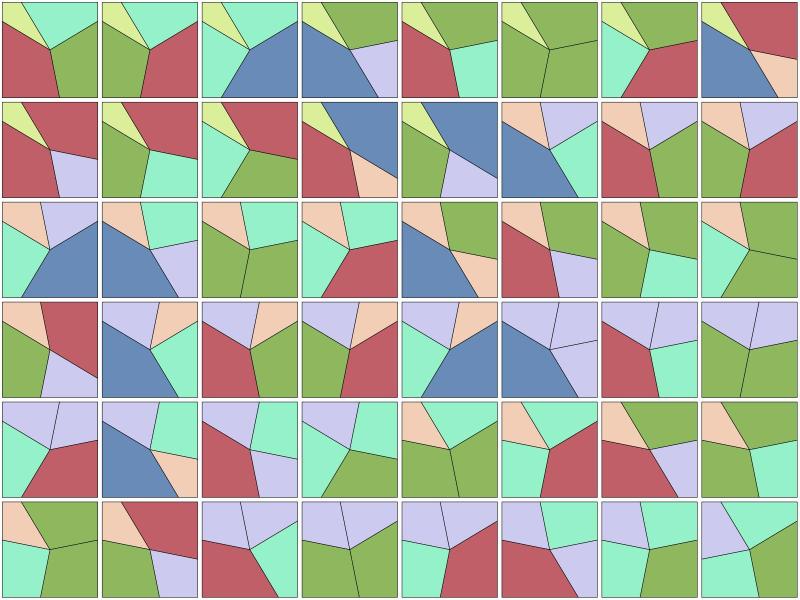
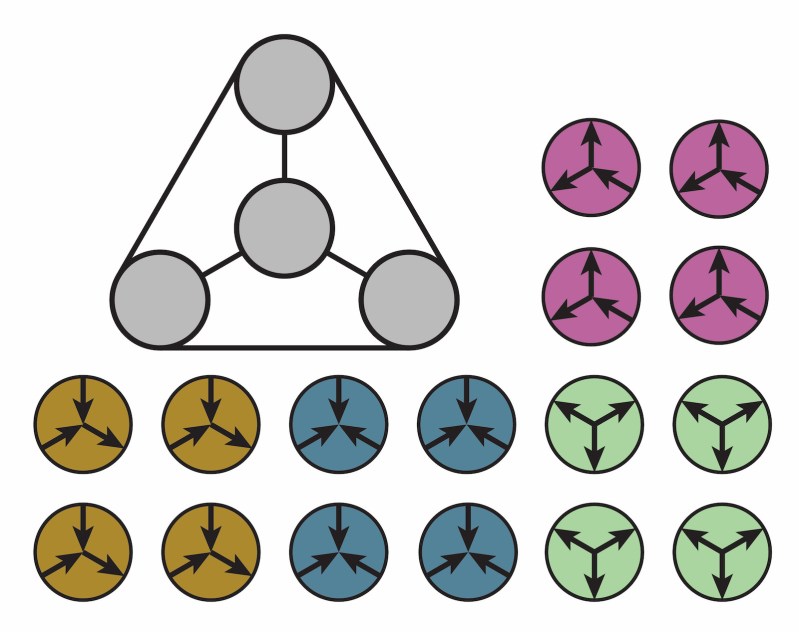
Here is a little worksheet so that you can cut out coins in our new currency. You will have realized that these four coins correspond to the four rounded trillows. In essence, we are doing nothing but decorating the vertices of cubic graphs with trillows.
Coins 01

The same procedure works for simplified cubons. There are of course again just four of them, represented by the same set of coins.
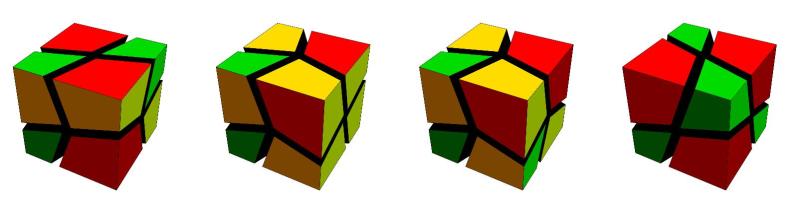
Smallcubons

Instead of trying to parse a 3D image, we decorate the edge graph of the cube with our coins. Below you see what the cube on the left above looks like. Try to find decorations of the graph that correspond to the other solutions.
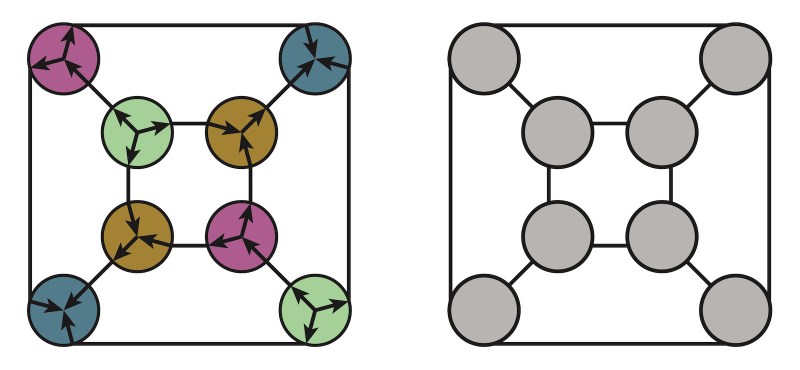
Cube2222 01

Next time we will look into decorating other cubic graphs.
Above and Below (Solitaire XVII – From the Pillowbook XII)

I wrote the first Solitaire post in March, exactly four months ago, being almost certain that after maybe two months I could safely move on to two person games. Now it looks like this will have to continue for a while. At least I can assure you that by the time I run out of topics, the pandemic will be over, one way or the other…

HeawoodMap 01

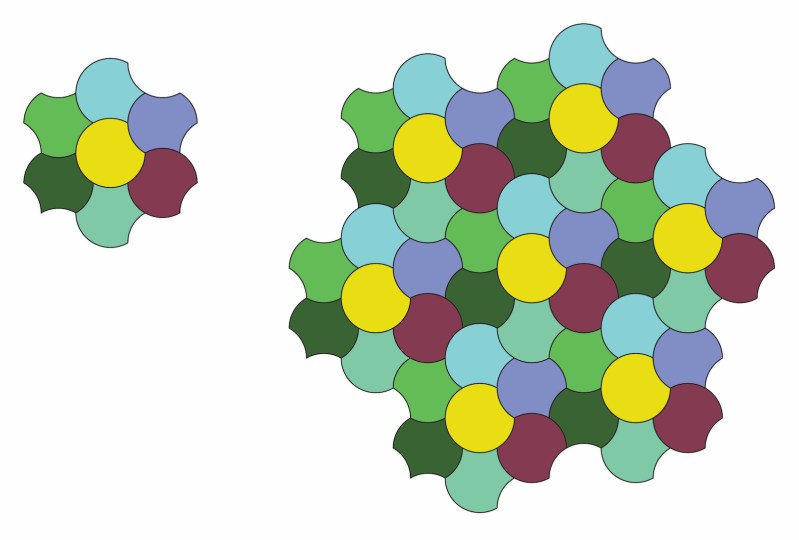
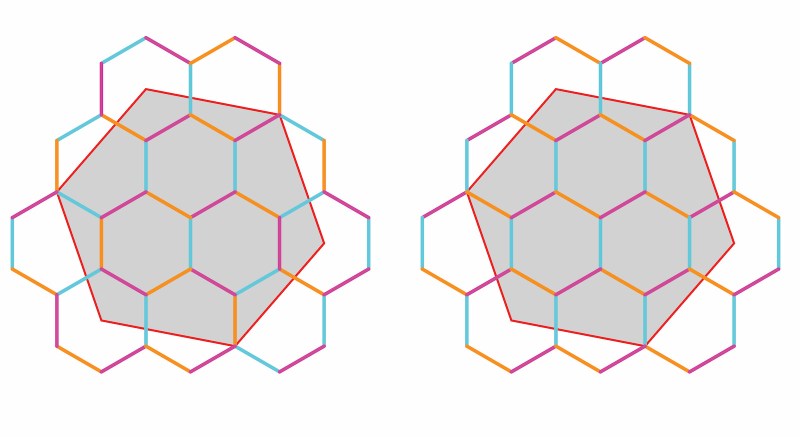
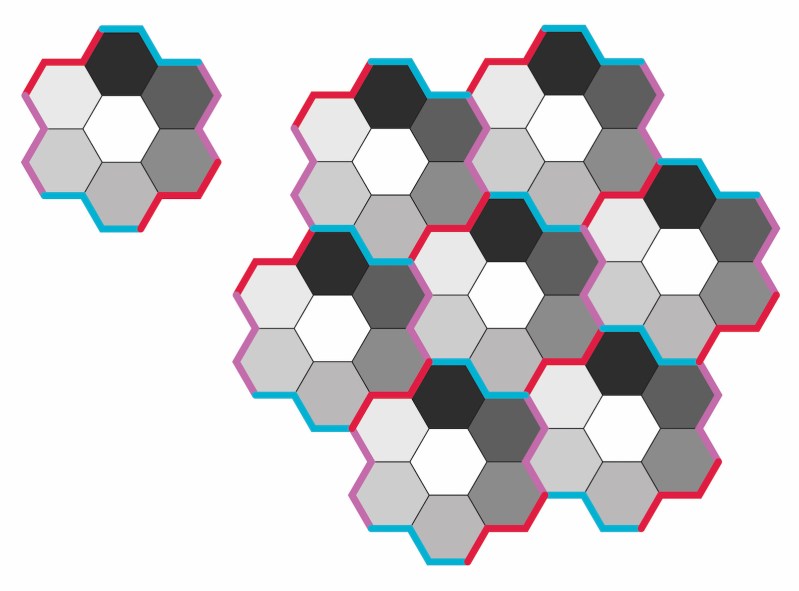
Today’s puzzle is concerned with the Heawood map. This is a map consisting of seven hexagons arranged as up above in the Heawood tile to the left, with edge-zigzags matching in pairs of equal color. This matching can be used to periodically tile the plane as to the right, or to interpret this map as a map on a torus, thus showing that one needs at least 7 shades of gray to shade a general map on a torus. (7 is indeed optimal).

Hexpillows 01

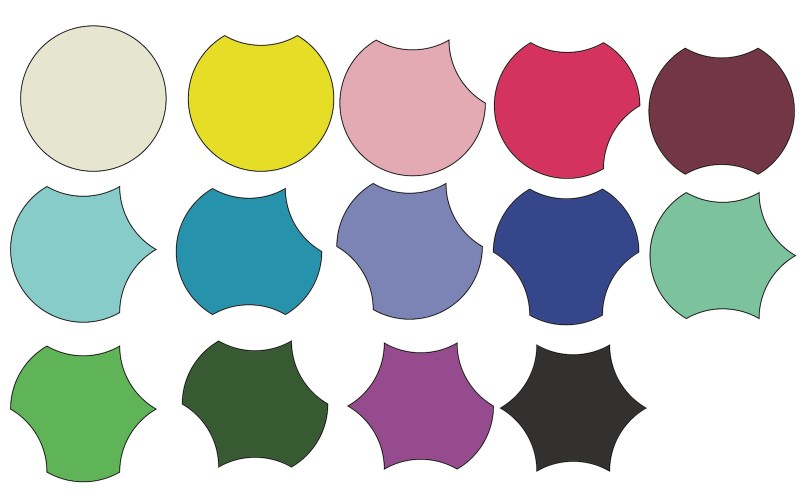
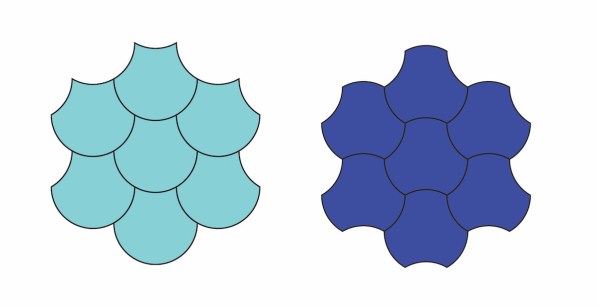
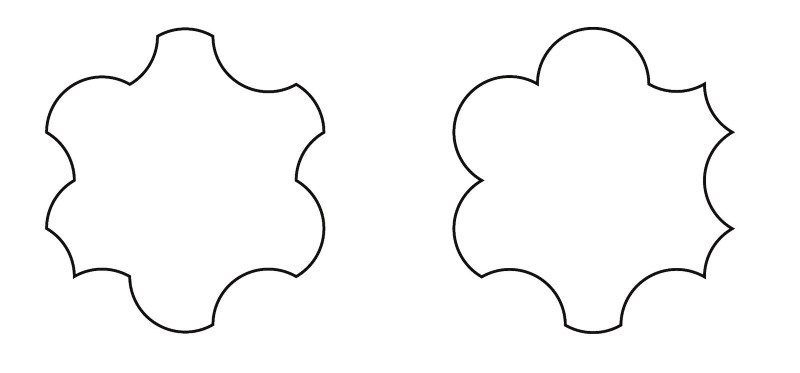
After the square pillows and triangular pillows, it is now finally time to introduce the 14 hexagonal pillows above. That’s all there is with curvy edges only — if you allow for straight edges, you get (too) many more. It is (for some of us) tempting to replace the hexagons of the Heawood tile by seven pillow tiles, so that the entire Heawood tile can be used to periodically tile the plane. If you only use one type or pillow, there are only two possibilities:

One 01

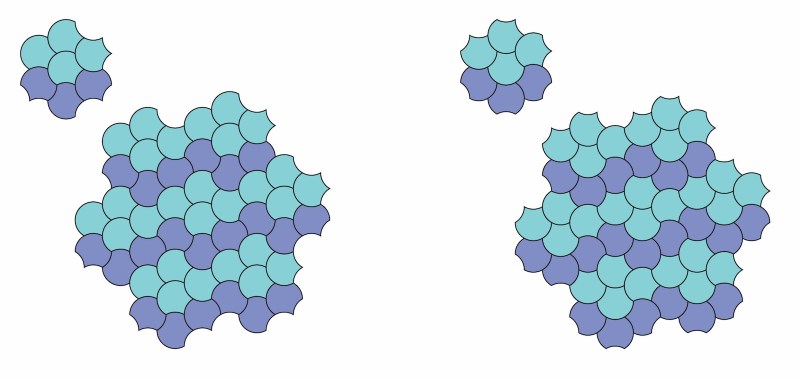
With two different pillows, it gets more interesting (and prettier). Below are two (slightly different) solutions using the same two pillows.

Two 2 01

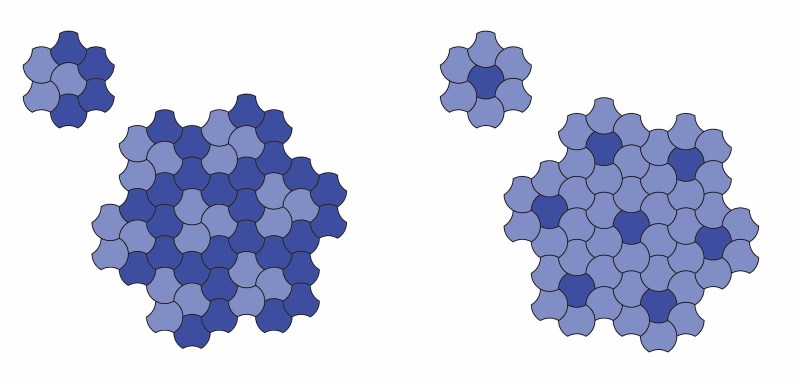
And here are two more, again using the same two pillows, which are less similar. You can find four more by reflecting all these, but that’s it with two pillows.

Two 1 01


Now let’s jump ahead and try to use seven different pillows. Here is a simple example:

Simplex 01

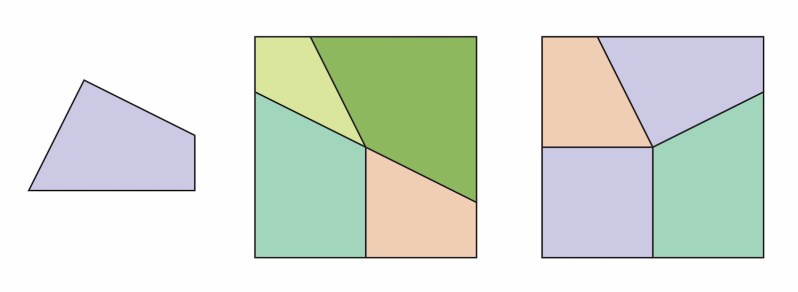
How hard is this? There are 3432 ways to select 7 different pillows from the 14, but only 380 of these choices allow you to form a Heawood tile. That’s maybe not too hard. But, of course, you (I) would want  to assemble the remaining 7 pillows also into a Heawood tile. That’s today’s challenge, and I think it’s rather difficult (there are still many different solutions). The hint below may not be that useful. It merely shows the contours of the Heawood tiles for one particular solution to this problem. But at least it now becomes a very concrete puzzle: Just tile the two regions using all of the 14 pillows exactly once.

Hint 01

Alan Schoen’s Tetrons (Cubons IV and Solitaire XVII)

After Alan’s cubons, now his tetrons. There is no end to it…

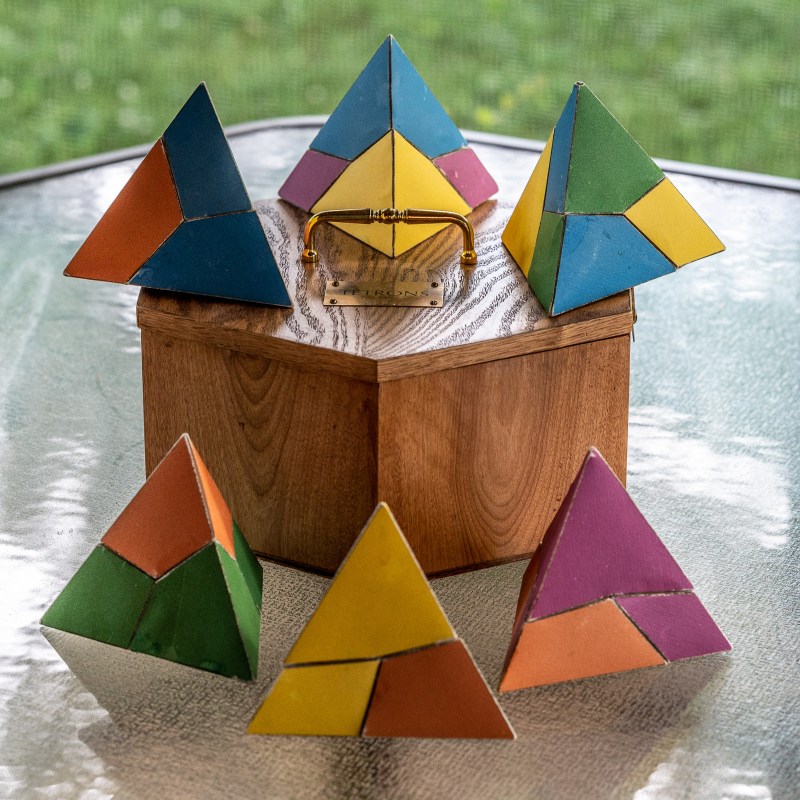
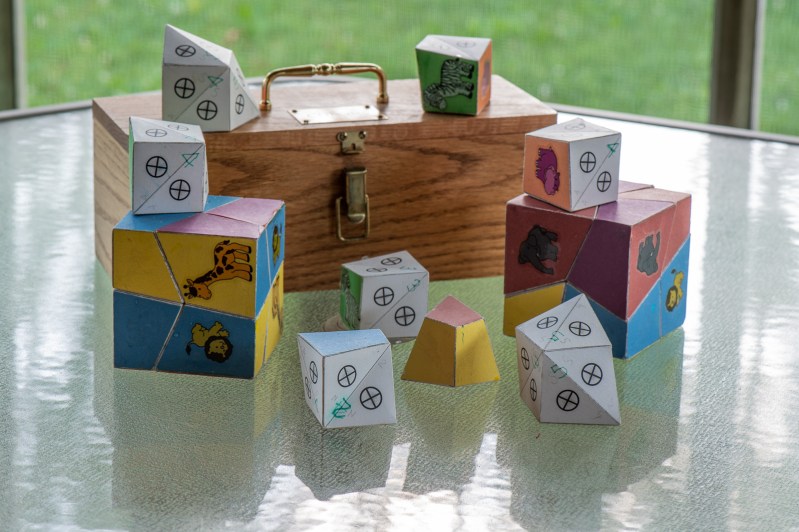
DSC 3027

They are constructed like the cubons: Take a tetrahedron, divide each edge into fifths, pick one of the four inner subdivision points on each edge, connect them to face centers and tetrahedron center to decompose the tetrahedron into four tetrons. Up to motions, each tetron is determined by the choice of three numbers from 1 to 4 (up to cyclic permutation), and, as for the cubons, there are 24 possible choices. In fact, the tetrons are just squished cubons.

Sampletetron

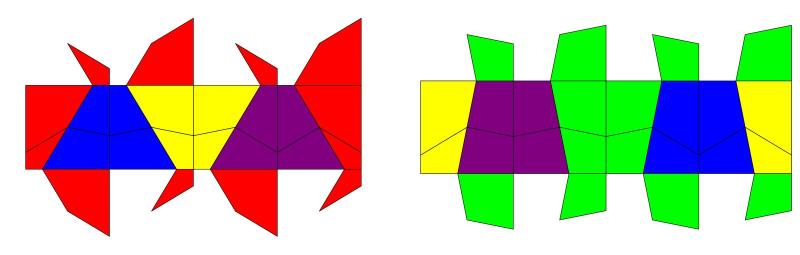
The natural question for anybody obsessed with puzzles is whether these 24 tetrons can be used to assemble six tetrahedra. The answer is yes, you can group them in 11417 different ways into six sets of four so that this is possible. Above is one of them, and it is clear that this image is lacking, so below is the same solution, unfolded into nets. You will recognize what I discussed earlier as trions (albeit there with fewer subdivision points):

Sampletetronnet The tetrons are computationally much simpler than the cubons. For instance, we can again separate the 24 tetrons into 8 chiral and 16 achiral ones. Surprisingly, the 16 achiral ones can be assembled into four tetrahedra in exactly five different ways (up to rotations). Here they are, unfolded:
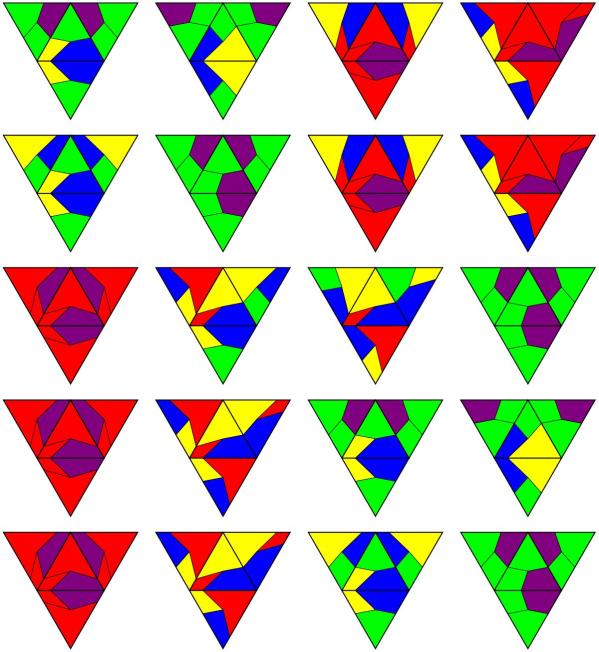
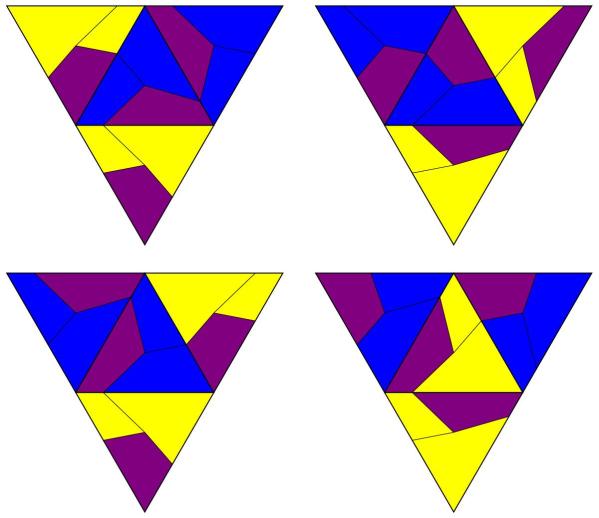
SymTetrons5

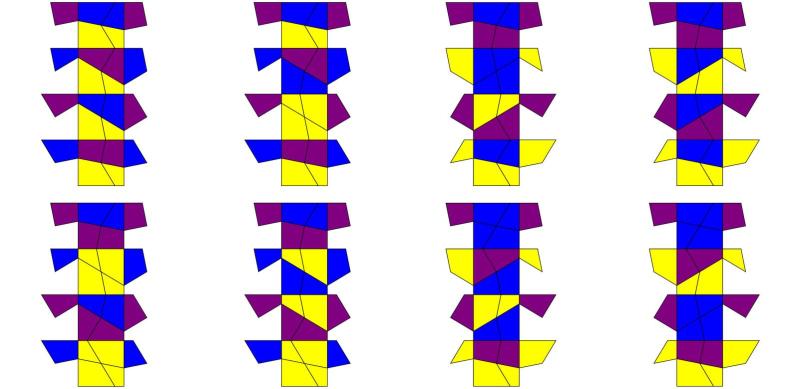
For the 8 chiral ones, the situation is a bit more complicated. There are two ways they can be grouped into two sets of 4, and in each case, there are two ways to assemble each set into tetrahedra. If we denote a single tetron by a list if three numbers that give the number of the chosen subdivision point as seen from the tetrahedron vertex of the tetron, then the partition of the 8 tetrons for the first solution can be denoted like so: {(1, 2, 3), (4, 1, 3), (2, 1, 4), (3, 2, 4)} and {(1, 2, 4), (4, 2, 3), (1, 4, 3), (3, 2, 1)}. Prettier are the nets. The first way to assemble them into tetrahedra is on the left, the second on the right.

ChiralTet1

And here is the other partition: {(1, 2, 3), (4, 2, 3), (2, 1, 3), (3, 2, 4)} and {(1, 2, 4), (4, 2, 1), (1, 4, 3), (3, 4, 1)}.

Again there are two different ways to assemble each quartet of tetrons into tetrahedra. I’ll show the solution next week.

Pillars (Cubons III and Solitaire XVI)

This (for now) last past on Alan Schoen’s Cubons is dedicated to what Alan calls pillars.

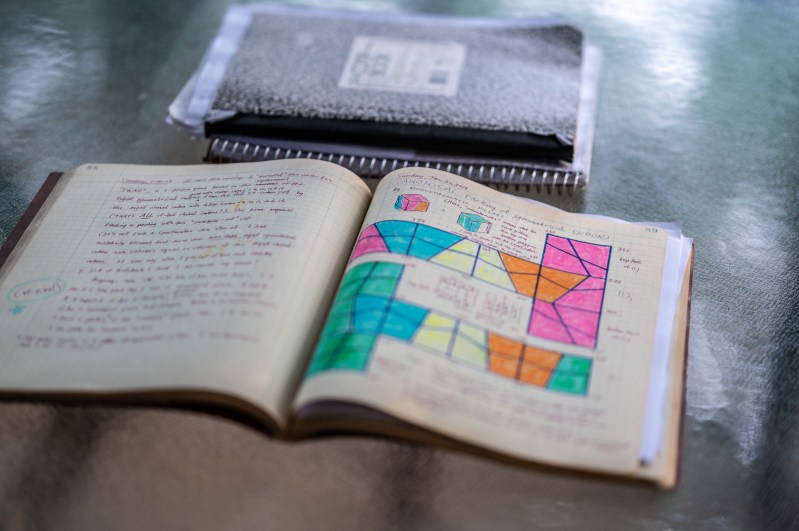
DSC 3026

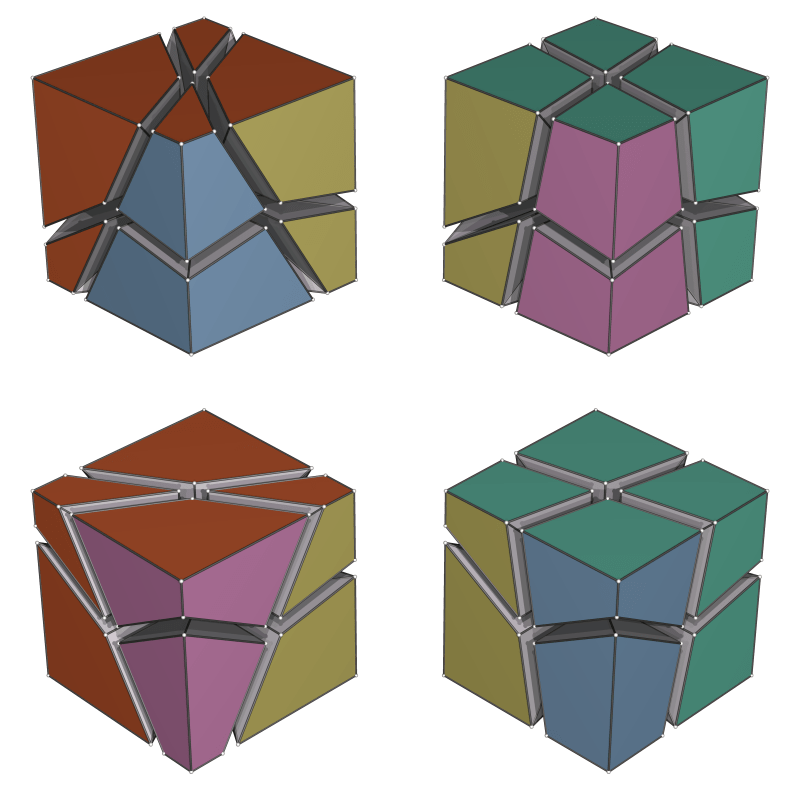
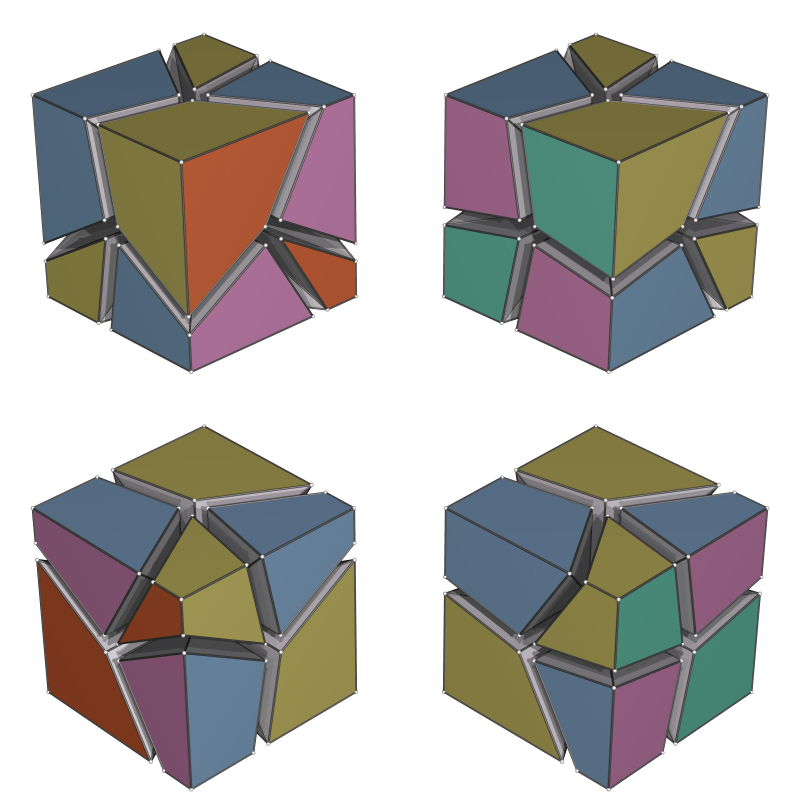
Above you see a page from one of several notebooks of Alan, introducing the pillars. A cubon solution has a pillar structure if all four horizontal faces are cut by unbroken lines. The pictures should make clear what this means. There are 456 ways to partition the 24 cubons into 3 groups of 8 so that one can assemble 3 pillar cubes.


Perfectsympillars

If we restrict our attention to those that in addition have top and bottom face each cut into unbroken lines, there is only one such pair, consisting of all 16 symmetric cubons. They are shown above, in front and back view, and below as nets.

Perfectsympillarsnet

The remaining 8 chiral pillars can also be assembled into pillar cubes, in 8 different ways (not counting symmetries):

Chiralpillarsnet

Last week I asked about polarity, which divides the set of 24 cubons into polar pairs, which use a complementary subdivision of the cube edges. It turns out that there is no solution to the problem to divide the 24 cubons into three sets of 8 so that each set can be assembled into a cube and consist of four pairs of polar cubons.

SymapolarOn the other hand, the eight achiral cubons obviously form four polar pairs (and can be assembled into a single cube). The remaining 16 symmetrical cubons can then be divided in four different ways into two sets of eight that are polar to each other, and that can both be assembled (in several different ways) into cube. Above are 3D solutions (one pair each column), and the nets are below.
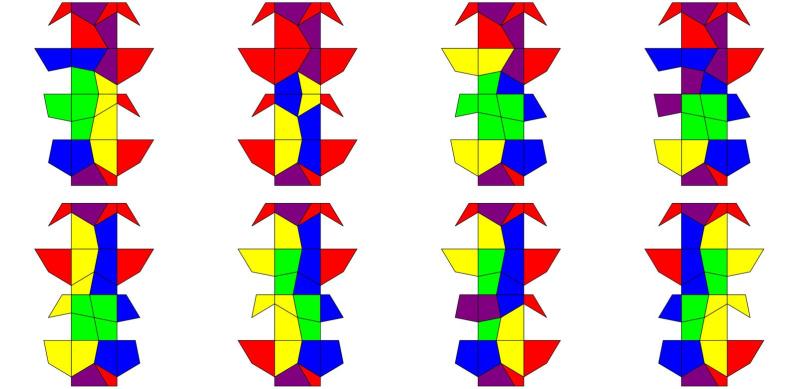
Symapolarnets


Chirality (Cubons II & Solitaire XV)

Alan Schoen’s 24 cubons possess a lot of structure. To get an idea why, let’s encode a cubon by a triple (abc) of numbers between 1 and 4 that indicate on which edge subdivision points its vertices are. For instance, the cubon below on the left would be encoded by (243). 


Cubonsample

Cyclic permutations (432) and (324) encode the same cubon, but (342) is chirally different. The cubon in the right is achiral, as can be seen from its encoding (244). This makes it easy to count: there are 8 chiral and 16 achiral cubons, suggesting that one might be able to assemble a single cube just with the chiral cubons.

Chiralfront

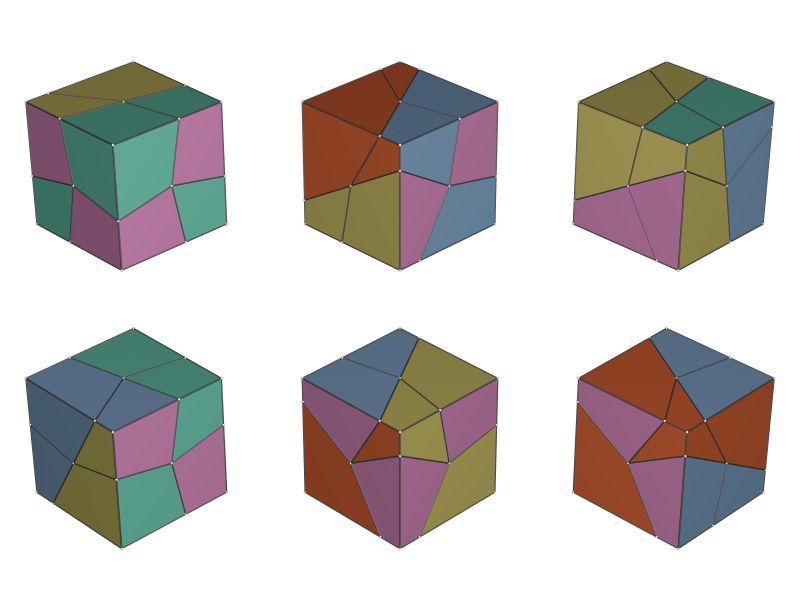
This is indeed possible, in exactly 32 essentially different ways, i.e. up to rotations. Below is a representation of the same solution set as nets:

Devchiral

Similarly, the 16 achiral cubons can be divided in 50 different ways into two groups of 8, each of which can be assembled in (several) different ways into cubes. Most of these have only few ways to be assembled but one of them has 27 essentially different ways to accomplish this for each of the two cubes. Here is one set

SymfrontA

and here the second one. Notice the striking color separation.

SymfrontB

There is more structure on the set of solutions. For instance, there is a polar “inversion” that changes the subdivision point of each edge from a to 5-a. This turns any cubon (a,b,c) into the cubon (n-a,n-b,n-c). Following Schoen, we’ll call a decomposition of a cube obtained this way from another decomposition its polar. A decomposition is self-polar if it is congruent to its polar.

Can you assemble the 24 cubons into three cubes that are self-polar, or so that one is self-polar and the second is the polar of the third?


Alan Schoen’s Cubons (Solitaire XIV)

Alan Schoen is best known for the discovery of the gyroid, but he has also invented an enormous number of puzzles. The one I will discuss today he named cubons.

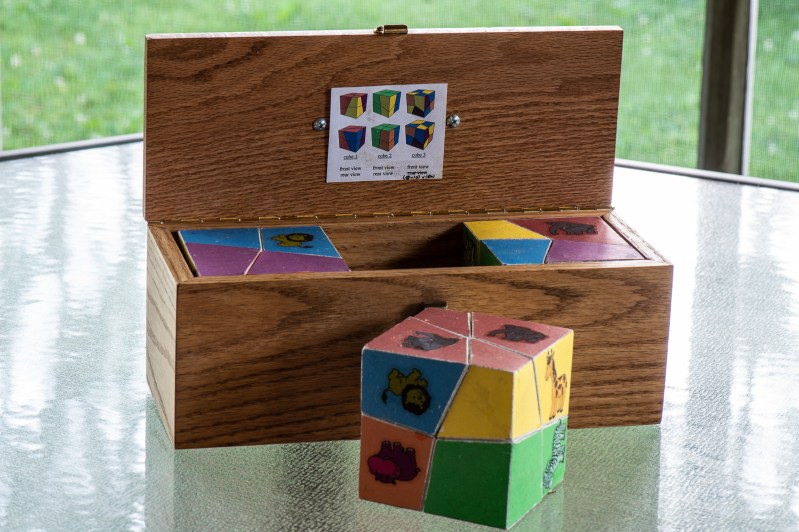
DSC 4145


Above you see his model of the 24 cubons which I currently have on loan for exploration.


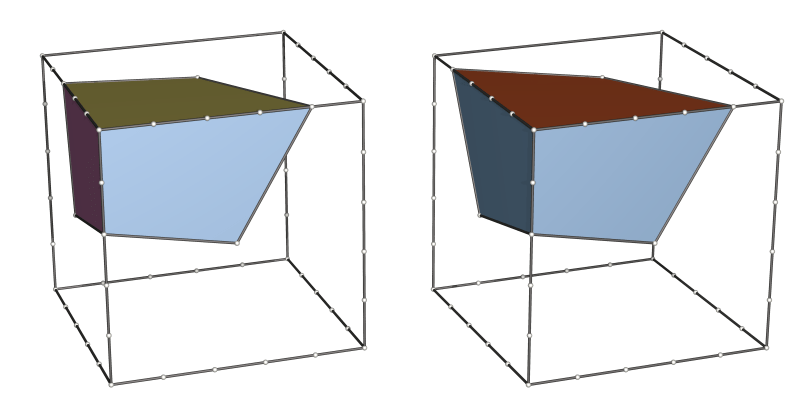
Cubons of order n are obtained from a regular cube by dividing each edge into n+1 equal segments, and choosing on each edge one of the n subdivision points. These are then joined with the vertices on the same edge, the face centers on the adjacent faces, and the center of the cube. Adding faces results in eight polyhedra that can be assembled into a cube, obviously.

DSC 4142

There are n^2+n(n-1)(n-2)/2 different cubons of order n, which gives the sequence 1, 4, 11, 24, 45, 76, … 

The 24 cubons for n=4 are particularly interesting because they might be used to assemble three cubes, using every cubon just once.  Finding a single solution is not so easy, because there are 735471 ways to select 8 from the 24 cubons, but only 18844 will allow themselves to be assembled into a cube, many of them in several different ways.

Still, there are a mind-blowing 1050759 different solutions to partition the 24 cubons into three groups of 8, each of which can be put together into a cube. One might want to put additional restrictions on the solution. For instance, one could ask that each cube has an equator, i.e. four consecutive unbroken segments.

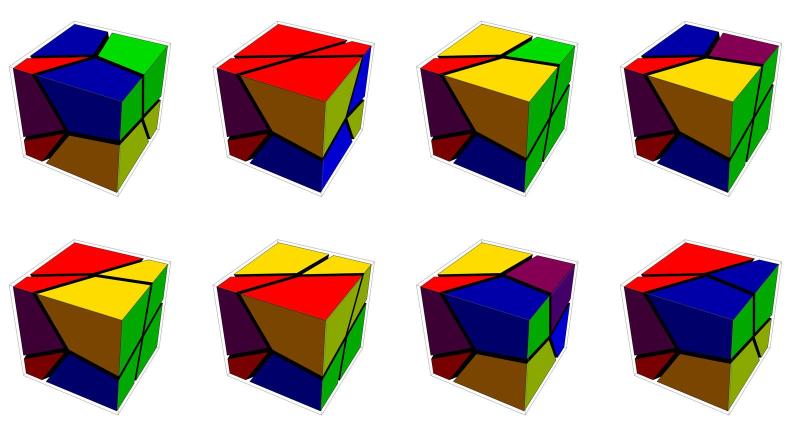
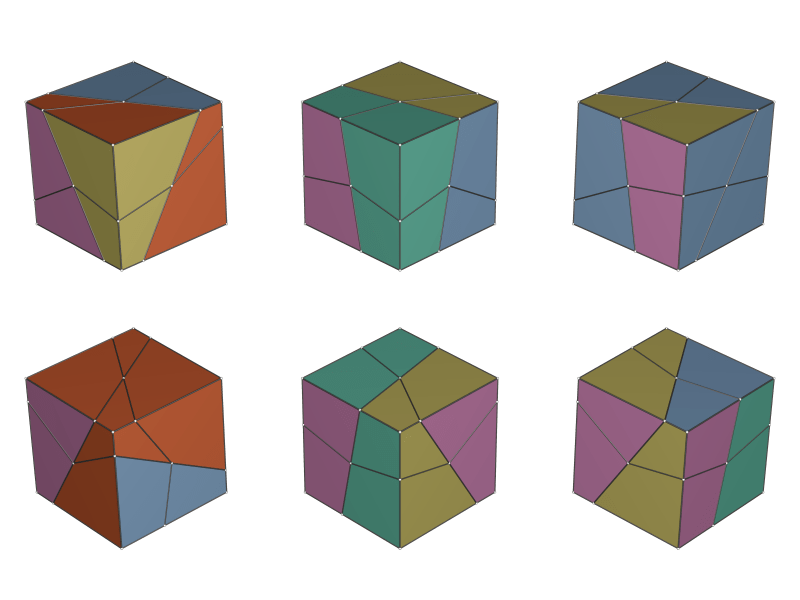
Cuboncolor straight

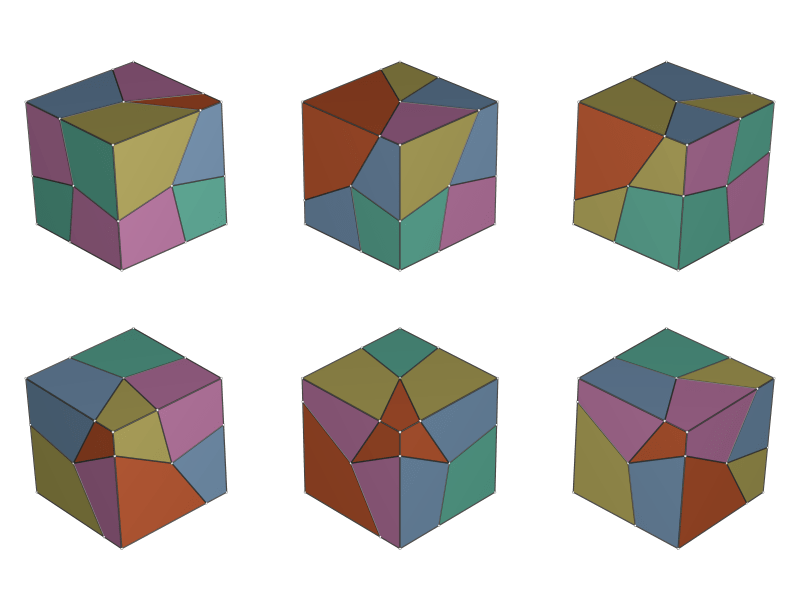
The picture shows front and back side of each cube on top of each other, the back is obtained by rotating the fron by 180º about a horizonta axis parallel the screen. There are still 1887 solutions of this case. One can also aim for the opposite, namely insisting that there is no straight dividing edge on any face. This allows 6361 many solutions.

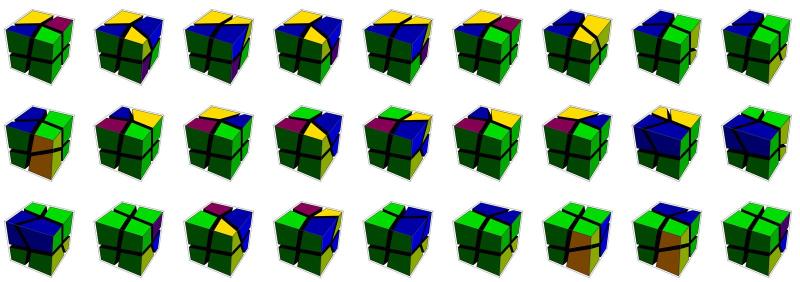
Cuboncolor broken

An esthetically pleasing limitation asks to have parallel edges being subdivided the same way. There are only two different solutions, using 16 cubons. Unfortunately, the remaining 8 cubons do not fit together.


Cuboncolor2

One can also us the color of the faces to impose restrictions. I am using here Alan’s color scheme (which employs 5 colors, one for two of the twelve possible cubon faces that are visible in a cube), but I am sure there are many possibilities.

For instance, below is a solution so that each face uses two different colors. There are 2544 of those…


Cuboncolor two


Quadrons (Solitaire XIV – From the Pillowbook XI)

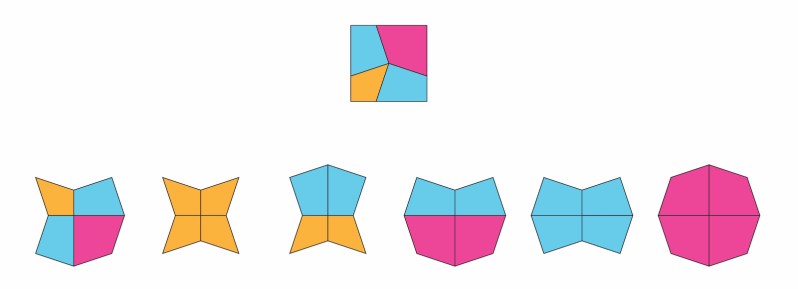
After discussing trions and hexons, it’s time for the simplest variety, the quadrons. They are obtained by cutting from a square a quadrilateral that has as its vertices the square center, a vertex, and two points on the edges adjacent to the chosen vertex. 

Quadron gen2 01

The points on the edges are chosen from the n possible points that divide the edge into n+1 equal segments. I call the number n the generation of the quadron. Above are the four generation 2 quadrons, which fit nicely into a single square, and can be regrouped to form the six square pillows I introduced a long time ago.

Quadron gen3 01

For generation 3, there are 9 quadrons, so they don’t fit together into squares. But we can leave one out, and try to assemble the remaining ones into two squares. There are 9 pairs of such squares, but not all quadrons can be left behind. Which ones can? The solution has to do something with the area (which color codes the quadrons above).

Quadrons gen4

The 16 generation 4 quadrons fit nicely into four squares as shown above. There are 48 individual squares, which will make nice cards for another puzzle…

Quadrons gen4squares

Then there are 75 eye-straining ways to select four of these 48 squares to obtain a complete set of generation 4 quadrons.

Quadrons gen4sols

Higher generation quadrons become very tedious. For generation 6, there are 36 quadrons, and 2139255 many ways to fit them into a set of 9 squares.


I promised a solution for last week’s puzzle, here it is. Now you can guess the second one yourself.

Totalsol1

Araneae 2 (Solitaire XIII)

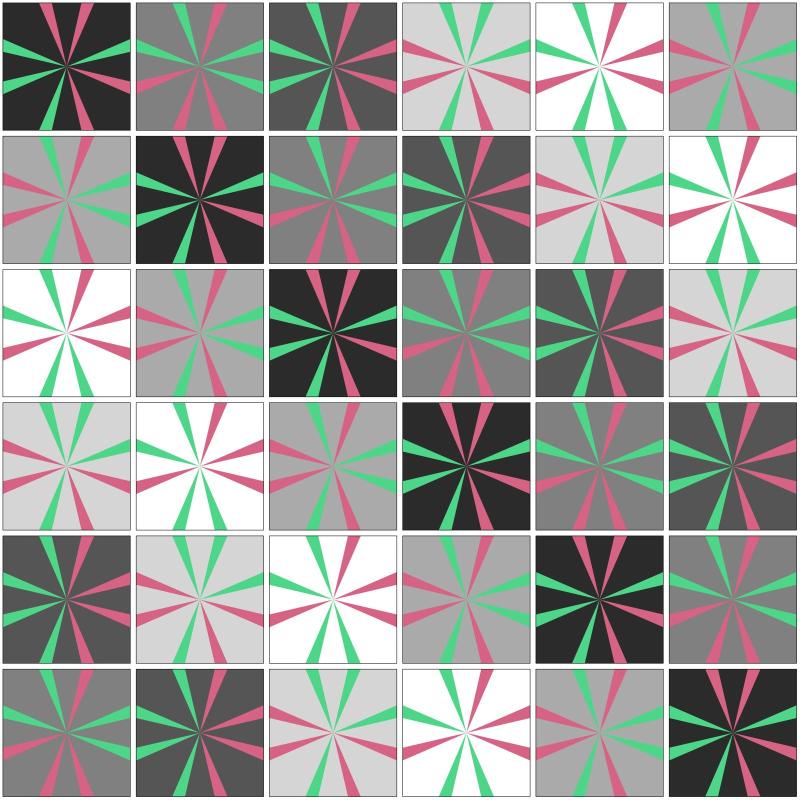
Last week I introduced the six balanced spiders which reappear below with a slightly improved design, and asked to use six of each kind to create a 6×6 spiderweb so that adjacent cards color match at the legs, and each row and column contains exactly one balanced spider of each kind.

Balanced

I got hooked on these little critters and wrote some code to hunt down solutions for me.

Balancedsol1

The solution above is perfect in the sense that also left and right (resp. top and bottom) edges match, so that we can get a toroidal spiderweb (or an infinite periodic one). There are still several hundred solutions. Not every possible first row can be extended to a perfect spiderweb, but the one below extends to a unique one. Can you find it?

Balancedprob2

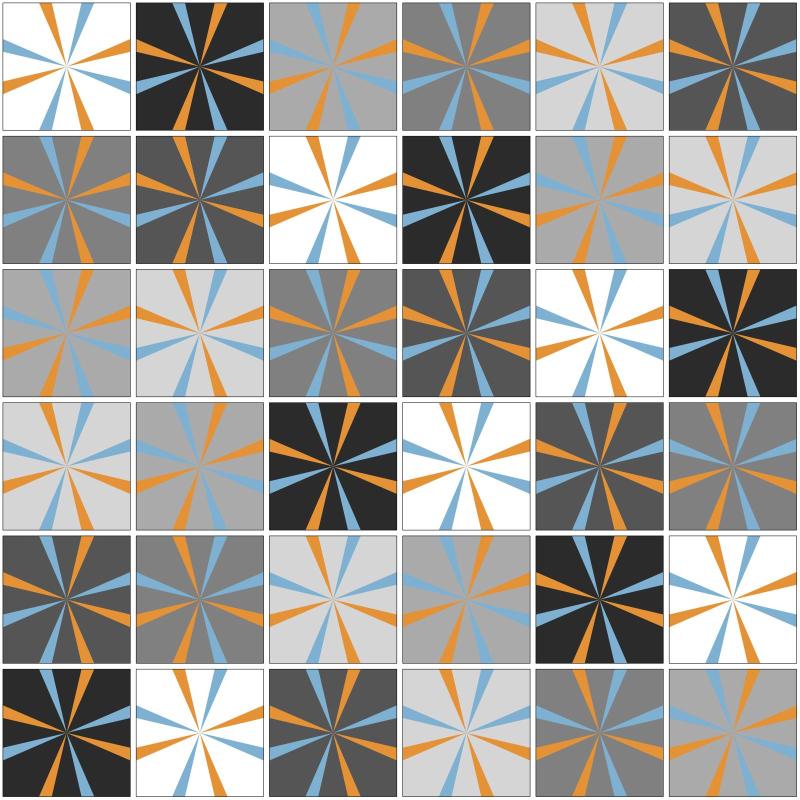
There are other subsets of the 20 possible spiders that make nice puzzle sets. For instance the following are all possible spiders that have four different side patterns, i.e. one edge has to have green legs, another one pink, the remaining two mixed colors in different order. Let’s call them mixed spiders.

Totalspiders

We can again ask for perfect 6×6 spiderwebs, now using mixed spiders. In this case, there are only two different solutions. Below is the first row of one of them:

Totalprob1

I have no idea how hard it is to find the solution by hand. When I saw it, I was a bit upset. I will post it next week…

Araneae (Solitaire XII)

Spiders are, as we know, square shapes with eight legs extending in pairs to the four sides. The legs come in two colors, and each color occurs four times. There are 20 different suborders (up to rotations), shown below. They are related to quadrons, to be discussed at a later time.Araneae 01

Today we will focus on balanced spiders that extend legs of different colors to each face. There are just six of them:Six 01

Spiders build spiderwebs by holding together along equally colored legs, as shown above. They prefer it if no two identical spiders occur in the same row, also as shown above. This single row of all six balanced spiders was easy.

Six2 01

The second row is a little harder, consisting again of all six different balanced spiders. We had to rotate some of them, they don’t mind that.

Six3 01

Adding more rows seems to be equally hard. Is this always possible? Then it should be possible to arrive at a 6×6 square of balanced spiders, each row a complete set of the six.

The dream of the spiders is to build a 6×6 spiderweb so that also all columns contain a complete set of balanced spiders. Please help them.

Trinity (Solitaire XI)

The puzzle from over a month ago is based on a curios 3-coloring of the edges of the dodecahedral graph:

Errands 01

Whenever you delete the edges of one color, the remaining edges form a Hamiltonian cycle. Incidentally, on the dodecahedral graph there are two different such paths, up to symmetries of the graph. The question arises whether there are more such graphs.

Heawood 01

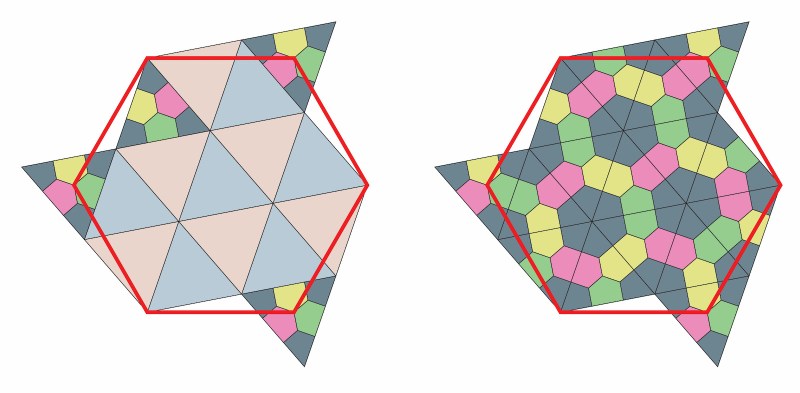
One such example is the Heawood graph drawn on a torus above (i.e. you identify opposite edges of the big shaded hexagon like in hexagonal astroids). There is a very symmetrical (and boring) edge coloring that colors all parallel edges the same way that is triply Hamiltonian, but there is a different one as well. You can think of this as living on the vertices of a map drawn inside a big hexagon, so that you can travel across a hexagon edge by continuing at the same position of the opposite edge. There are three types of roads, color coded, and each inhabitant of your country is issued two colored passes allowing them to travel on roads of those two colors only. Luckily, the colorings above allow each inhabitant to still travel everywhere, regardless of the passes they have been issued.

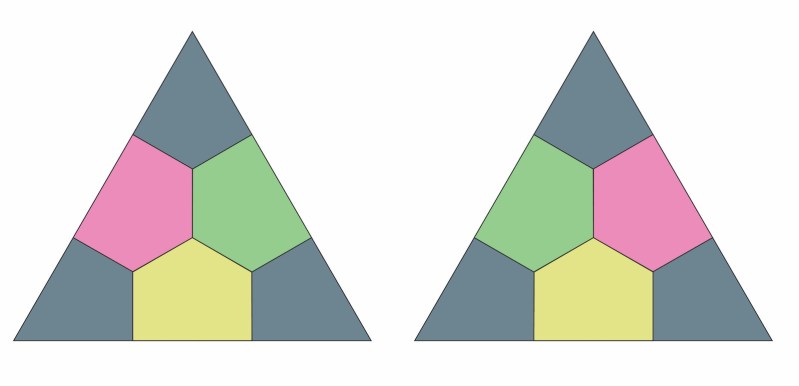
Triangles 01

To turn this into a puzzle, we use the dual tiling by triangles, that gives us a single triangular puzzle piece (and its mirror) to place on the vertices of the graphs. For instance, below we place one triangle (with its translated copies) on three of hexagon vertices, choose another triangle elsewhere, and are tasked to complete this to a triply Hamiltonian tiling. The solution on the right corresponds to the first coloring of the Heawood graph up above.

HeawoodTile 01

For a decent puzzle, the Heawood graph is a little bit too small. Now, Hamiltonian cycles on trivalent graphs have been extensively studied (partially because of Tait’s conjecture, which turned out to be incorrect), so I suspect this phenomenon is known. There is a list of small symmetric cubic graphs, the Foster census, and it is no hard to write code that searches for more examples. Below is thus today’s puzzle, on Foster26A, also a map on a larger hexagonal torus. Complete it to make it triply Hamiltonian.

Foster26A 01