This Is Not a Helicoid

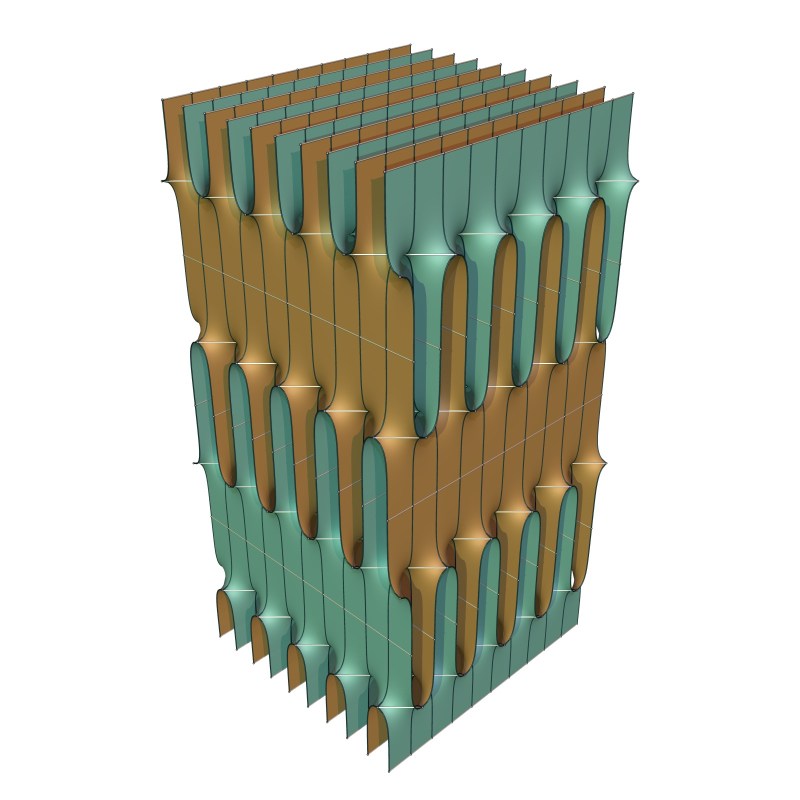
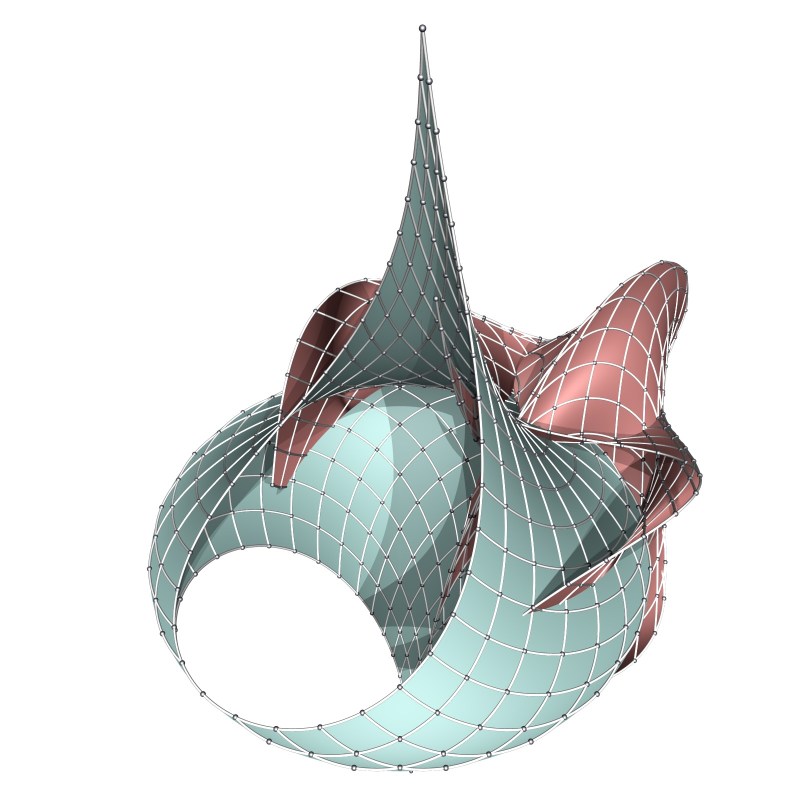
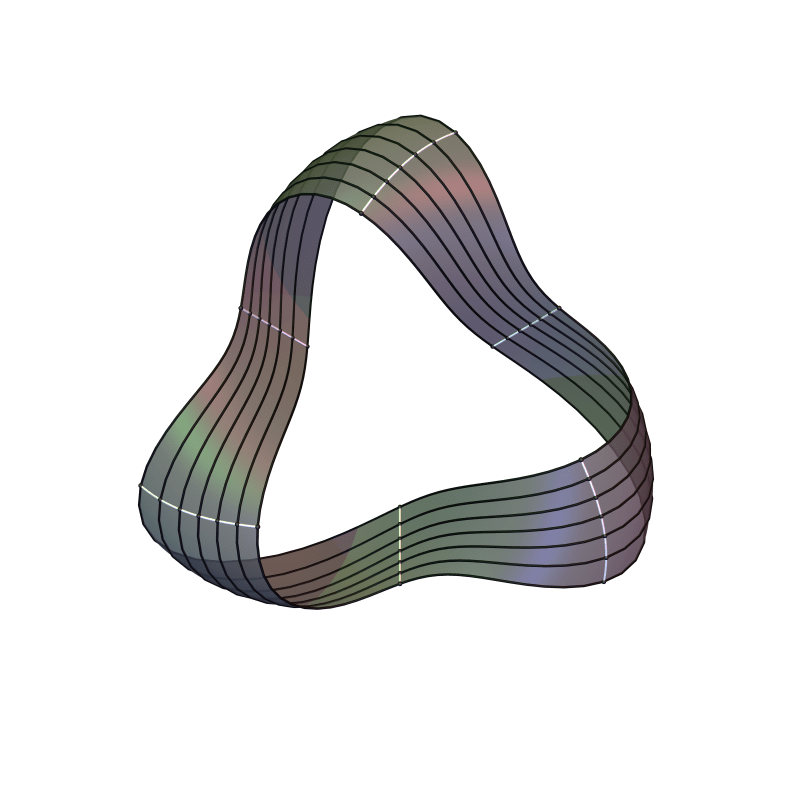
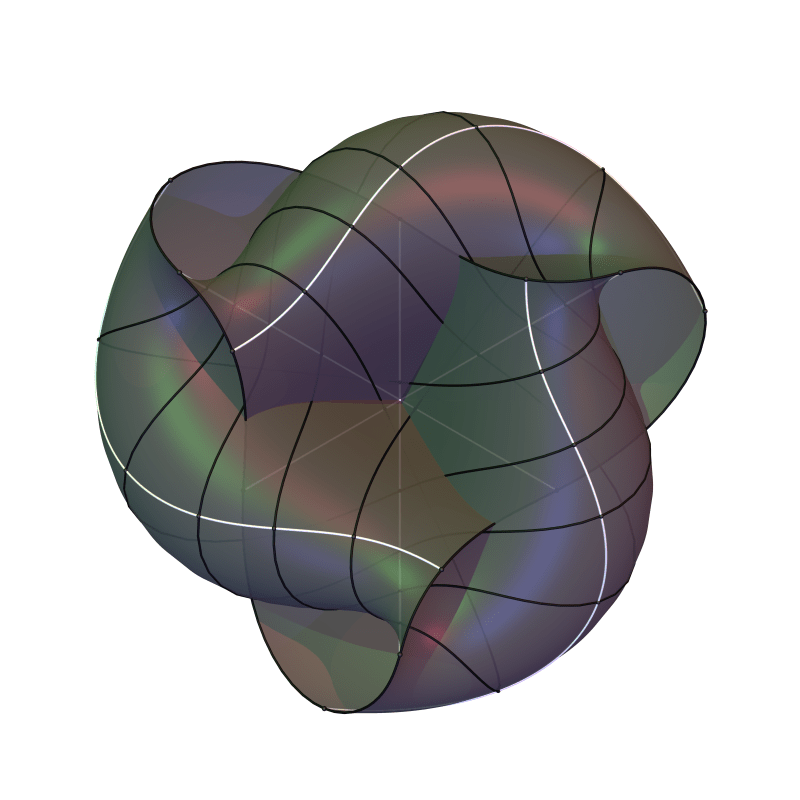
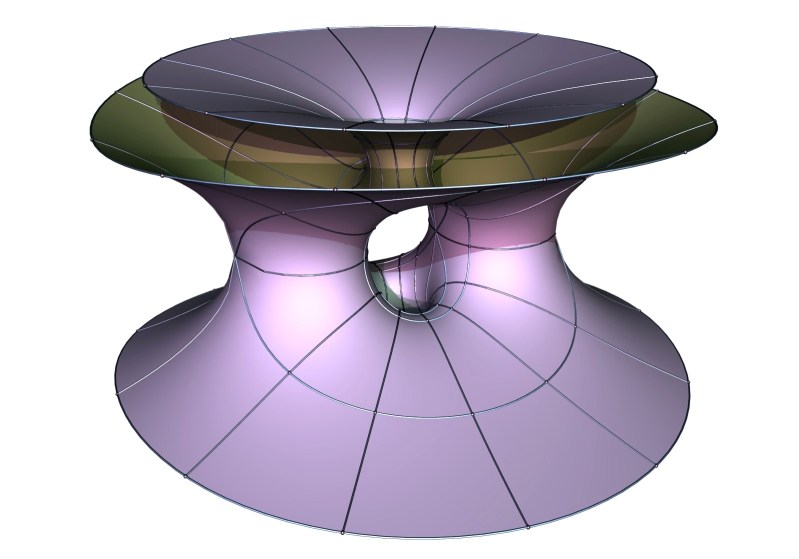
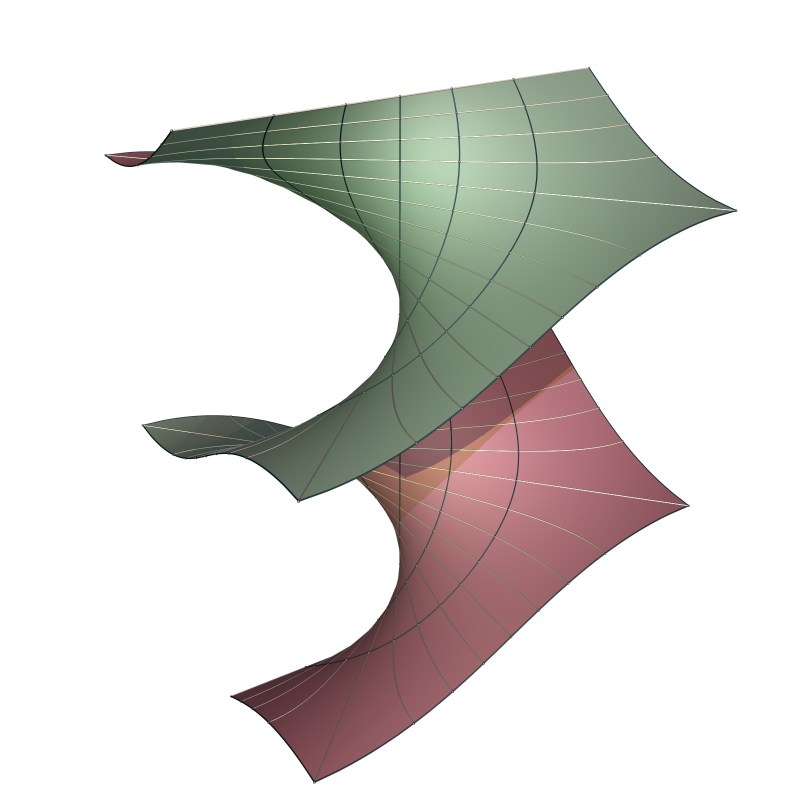
But almost. It has a vertical axis, lots of horizontal lines, and it twists.

Nothelicoid

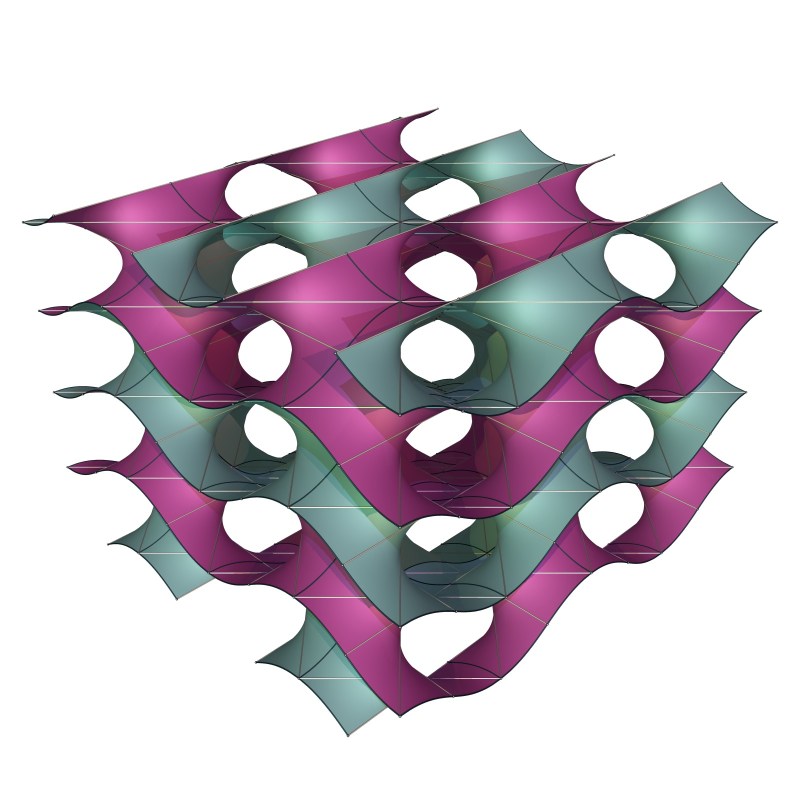
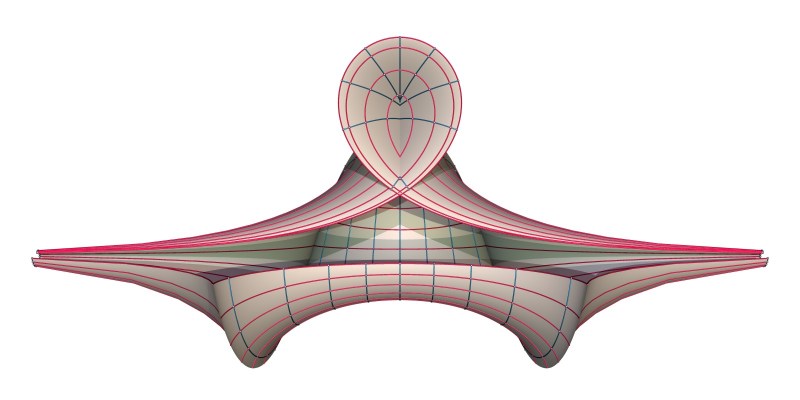
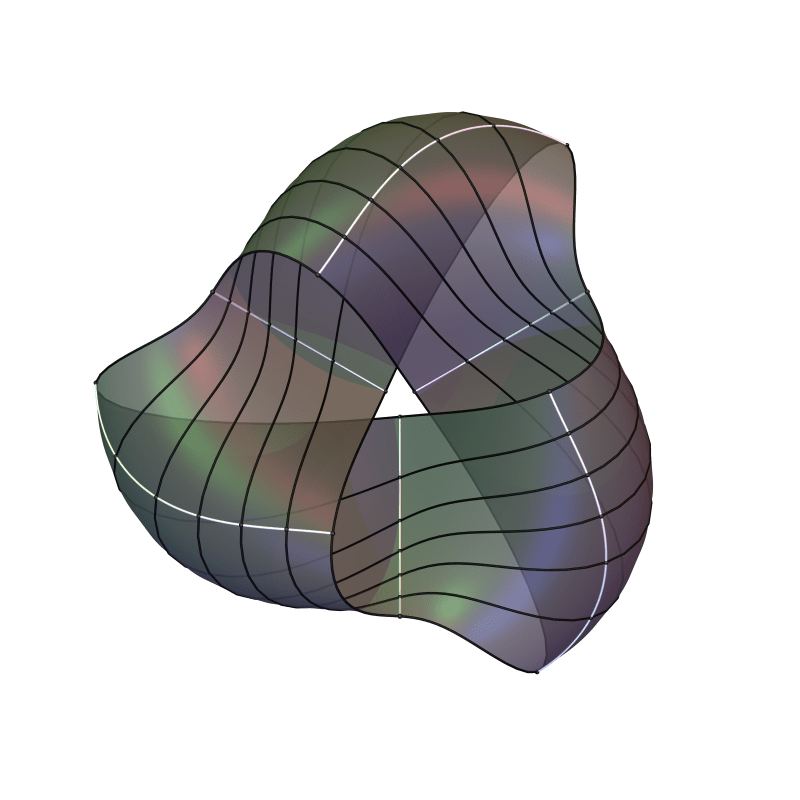
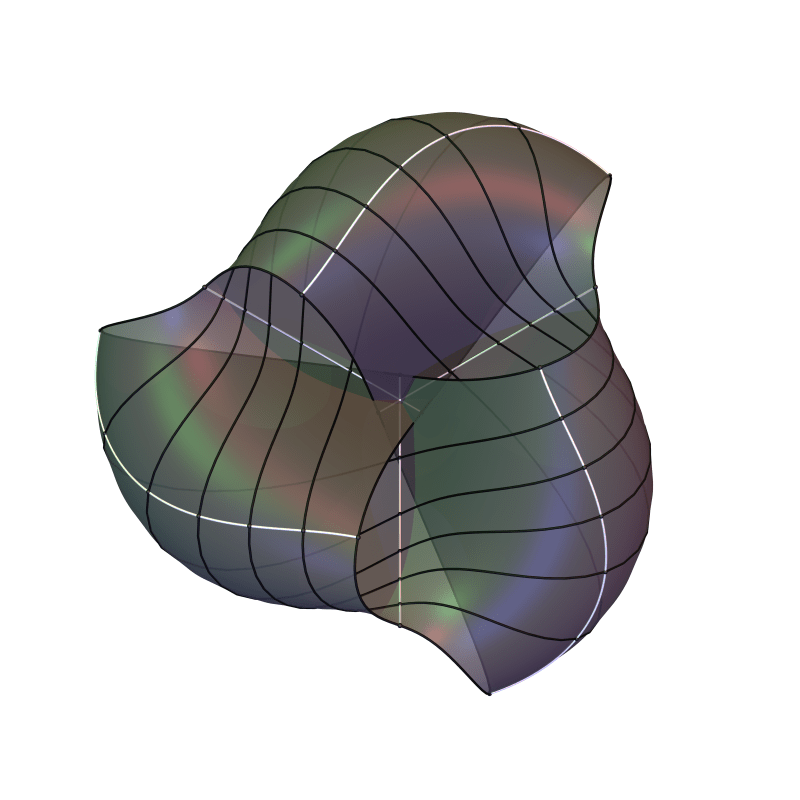
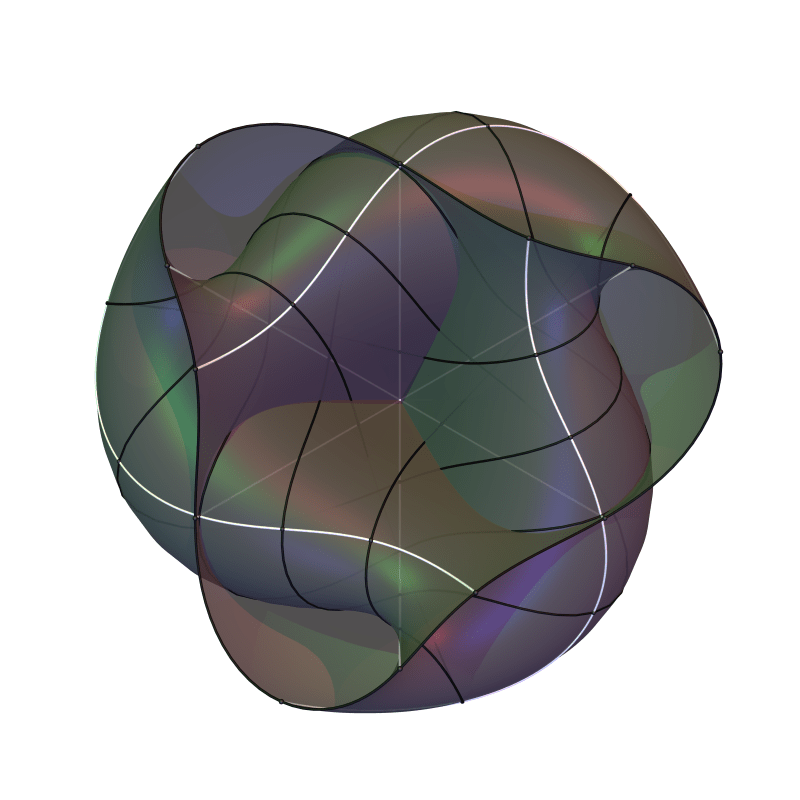
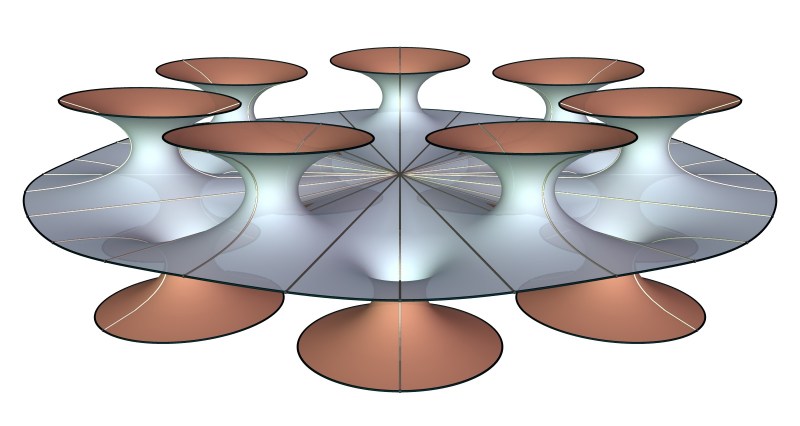
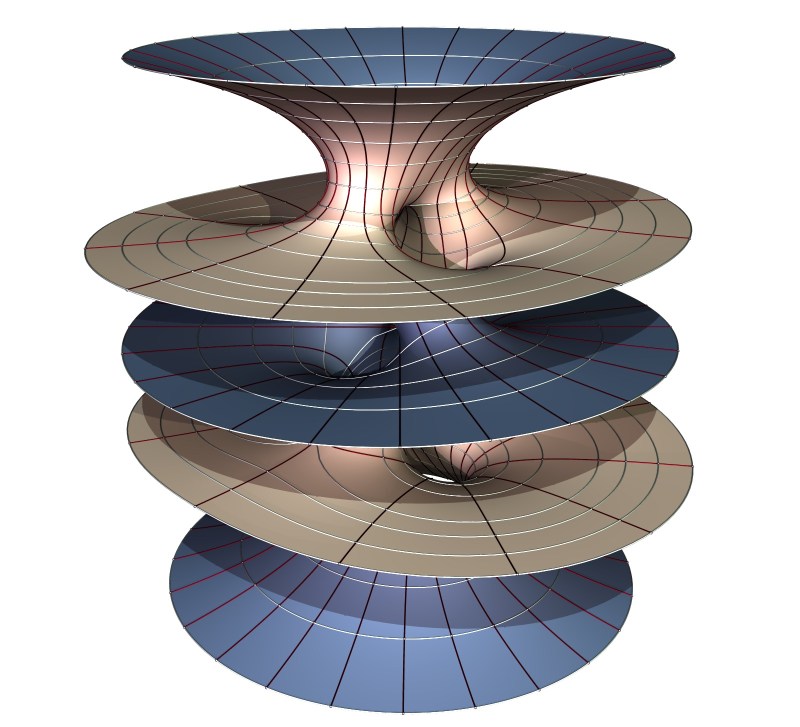
But it is part of something bigger, a triply periodic minimal surface. 32 copies of the above piece, replicated by rotations and reflections, look like this:

Nothelicoidcopies

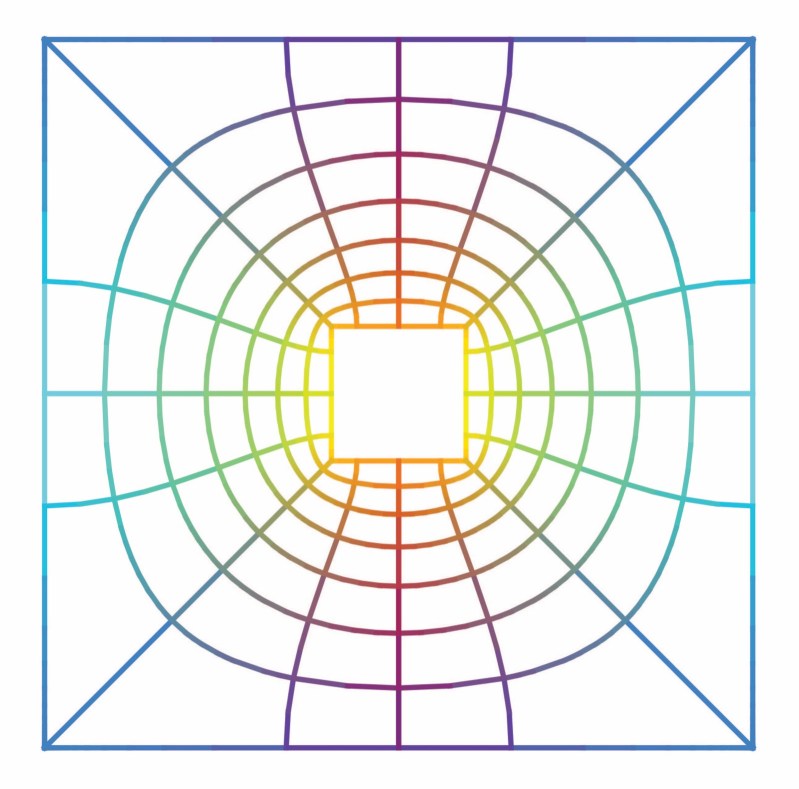
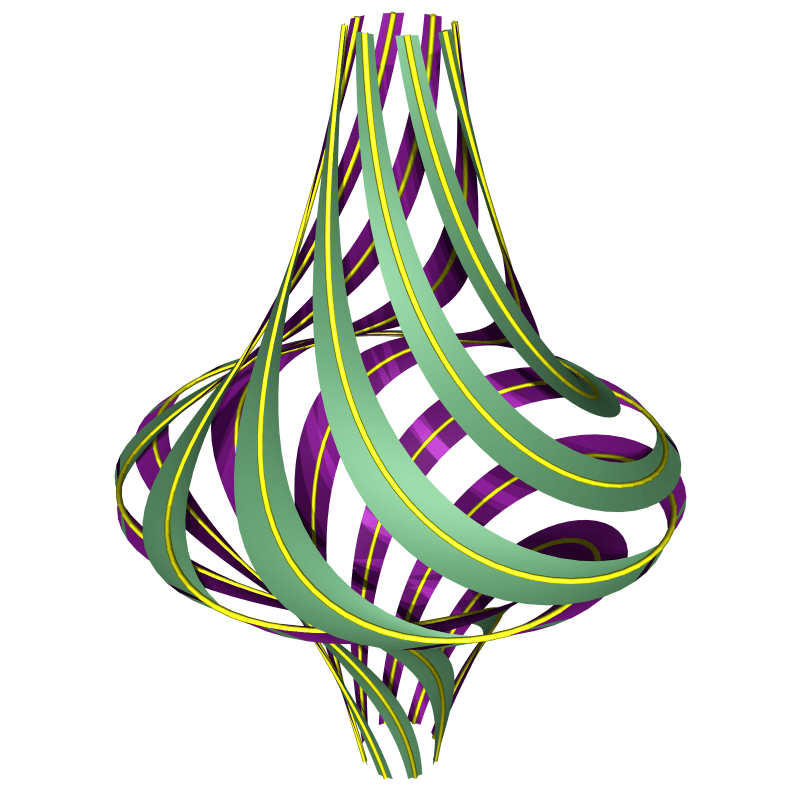
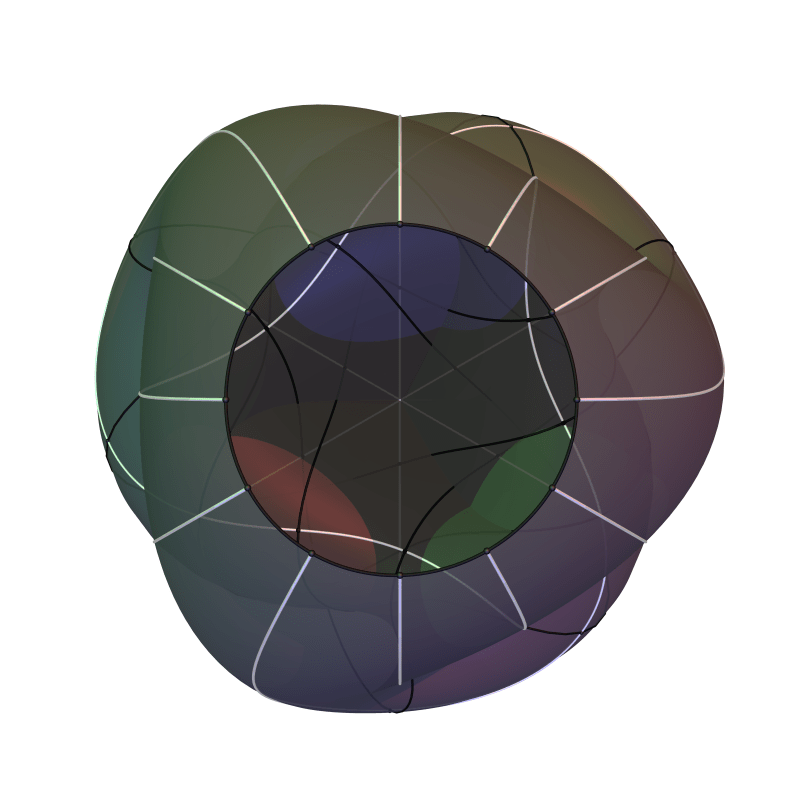
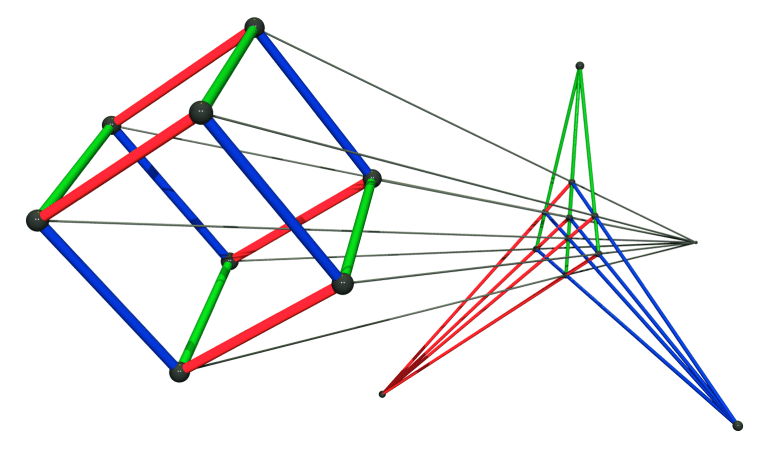
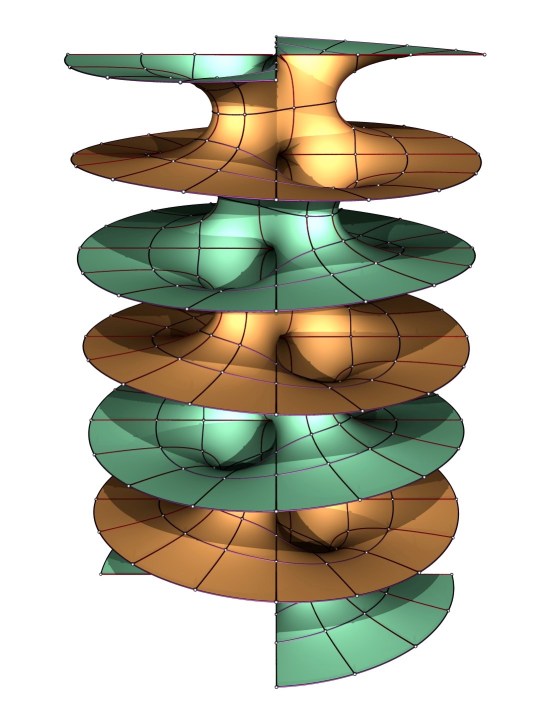
This surface sits in a rectangular box over a square. If you identify top and bottom edge of the original squarical helicoid, you get a doubly twisted annulus, which is intimately (confomally, that is) related to a hollow spiderweb:

D spider 01


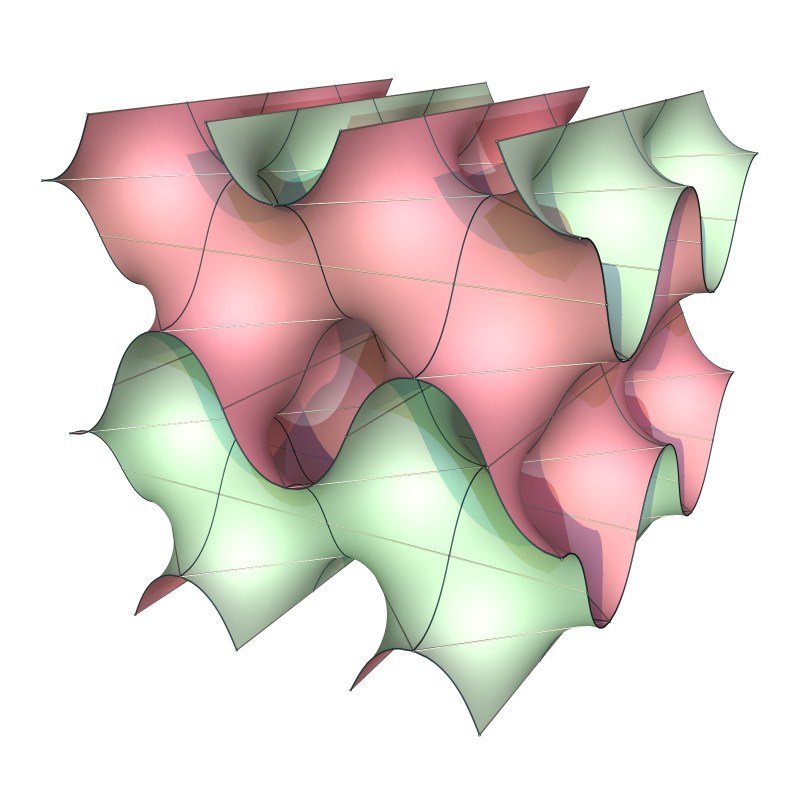
When squeezing the height down, our non-helicoids become even more helicoidal. When pulling the height up, the helicoids disappear. What we have here is a deformation of the Diamond surface of Hermann Amandus Schwarz.

When he sees this, he will probably just nod.

One

What happens when we pull a little further? We see doubly periodic Scherk surfaces emerging, stacked on top of each other.

Triplyscherk


Line Congruences (Constant Curvature II)

That revolving a simple, mechanically generated curve, the tractrix, about an axis generates the pseudosphere, a surface of constant negative curvature, seems like one of these unavoidable accidents.Tractrix 01

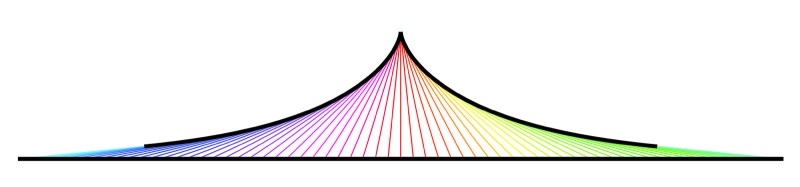
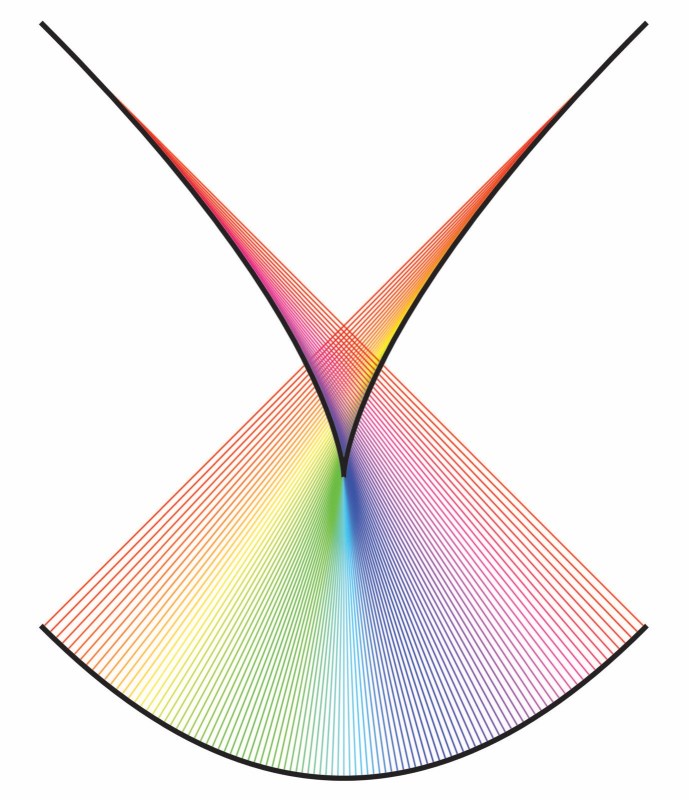
The tractrix has the feature that the endpoints of its unit tangent vectors lie on a line. Thus  dragging one endpoint of a rod of length 1 will have the other endpoint trace a tractrix. More generally, whenever you have a 1-parameter family of lines in the plane, they are typically tangent to a single special curve, the caustic of the line family. Below is the caustic of the normal lines to a parabola. Paracaustic 01

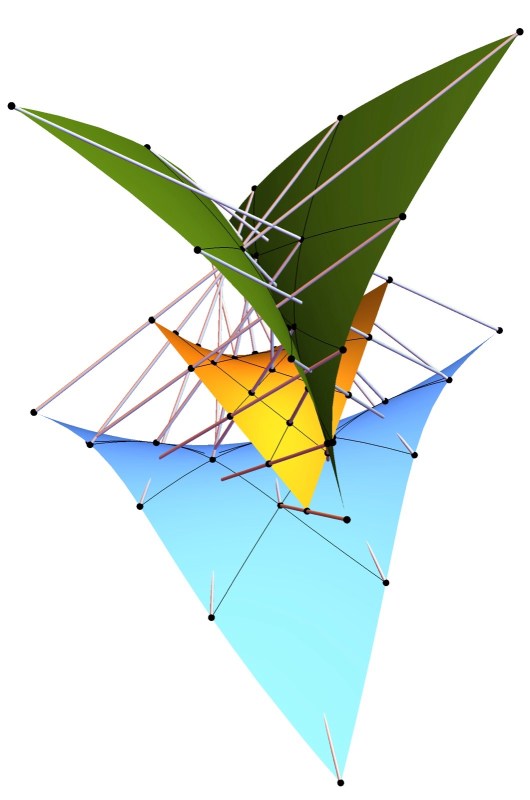
In space, things get tricky. A 2-dimensional family of lines in space is called a line congruence. They also have caustics or focal sets, i.e. surfaces that are tangent to all the lines, but finding them involves a quadratic equation, so we can expect two of them. Below are the two focal sets for a hyperbolic paraboloid. It is pretty clear that line congruences are hard to visualize.

Paraboloid

Note that some of the lines are tangent to the focal sets at some point but intersect it transversally at other points.

By rotating the lines generating the tractix, we obtain a  line congruence whose two focal sets are the pseudosphere and its rotational axis. Note that the segments of the line congruence between the two focal sets have length 1. More generally, a line congruence is called pseudospherical if the segments between the focal sets have constant length, and the surface normals at corresponding points make a constant angle. Remarkably, the focal surfaces of a pseudospherical line congruence are pseudospherical, i.e. have constant negative curvature. Even better, one can start with any pseudospherical surface, pick a point and a tangent vector at that point, and extend this vector to a pseudospherical line congruence whose first focal set is the surface one starts with. This provides a recipe to produce (essentially algebraically) new pseudospherical surfaces.


Kuen3

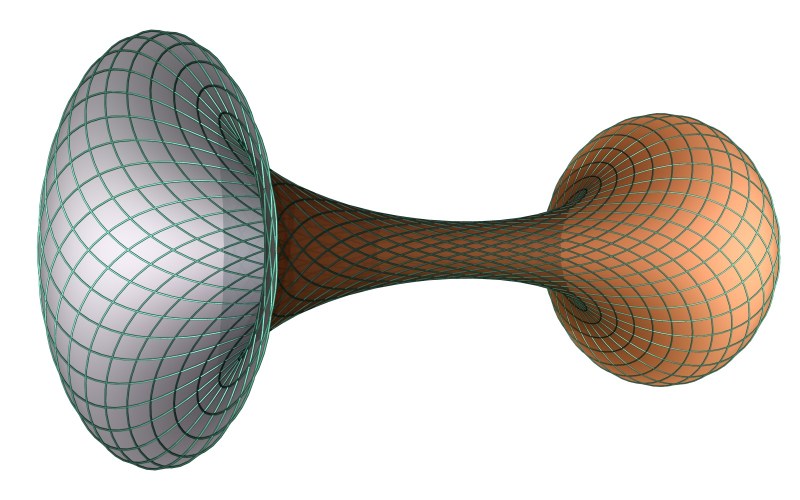
The bathtub up above is Theodor Kuehn’s pseudospherical surface from 1884. It can be obtained by a line congruence from the standard pseudosphere. Below you see a portion of the pseudosphere with asymptotic lines, and hiding behind, the corresponding portion of Kuehn’s surface.

Kuen

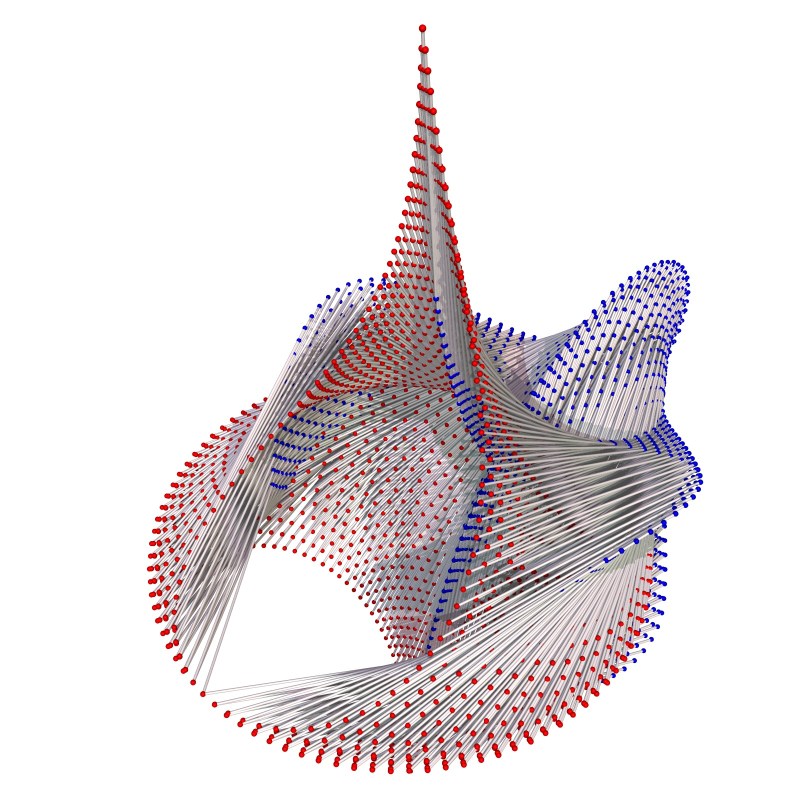
The last image shows just the lines of the line congruence that has these two surfaces as focal sets.

Kuen congruence2

Did I say this was hard to visualize?


Revolution (Constant Curvature I)

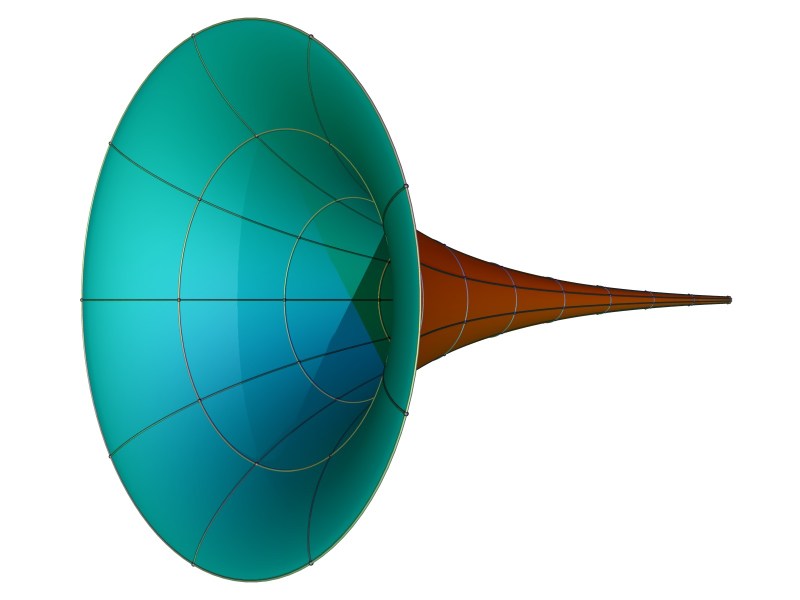
One of the standard elementary surfaces is the Pseudosphere, a surface of revolution of constant negative curvature.


Pseudosphere

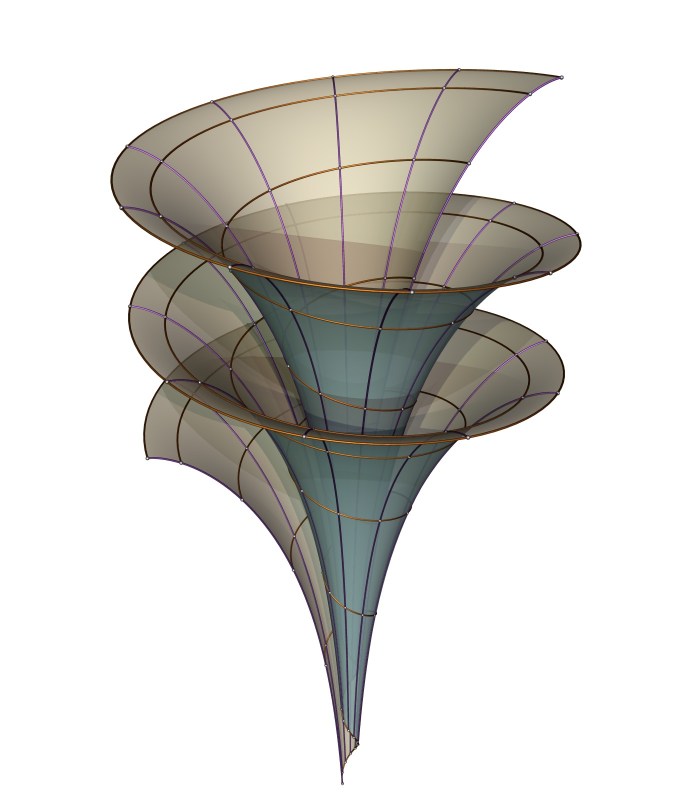
It can be parametrized using elementary function, and the profile curve is the so-called tractrix. Another elementary surface of constant negative curvature is Dini’s surface, where the tractrix is used to produce a helicoidal surface.

Dini


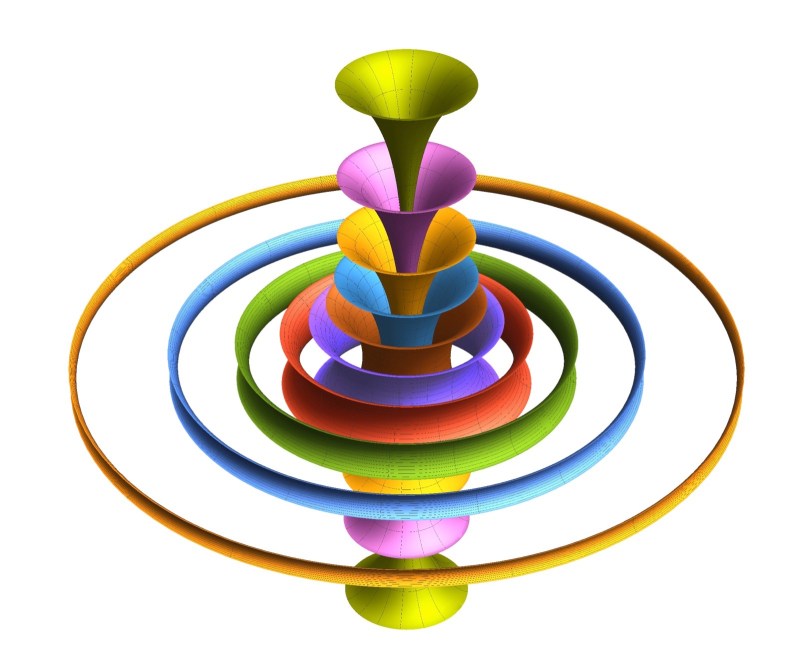
From here on, things get tricky. Other such surfaces of revolution require elliptic integrals. Here is the entire zoo (more or less):

Collage

Common to all examples is that they necessarily produce singularities. More precisely, there is no complete surface of constant negative curvature in Euclidean space. This is a famous theorem of Hilbert. At the core of the proofs I know is the behavior of the asymptotic lines

Pseudoribbon

Above is the pseudosphere with one family of these asymptotic lines, drawn as ribbons. At the equator, they become horizontal. As the second family is the mirror image of this family, at the equator their tangent vectors become linearly dependent. This shows that while the asymptotic curves exist in the northern and southern hemipseudospheres, the surface itself is singular at the equator, because, alas, on negatively curved surfaces the asymptotic directions are linearly dependent. For the general surfaces of revolution, the asymptotic lines touch both singular latitudes. The image above looks odd because our brain wants to believe that curves on a surface meet at right angles. They don’t.

Pseudoasl2One of the key features of the asymptotic lines is that they form a Chebyshev net: Opposite edges of the net quadrilaterals have the same length. Thus you can stretch a loosely knitted square mesh over this surface to keep it warm. The standard proof of Hilbert’s theorem continues to show that any net parallelogram has area bounded above by some constant. However, a simply connected complete surface of constant negative curvature has necessarily infinite area, which leads to a contradiction. This was one of the earliest global results in differential geometry.

Proof by Example (Push & Pop I)

Here is Push & Pop, a puzzle with a very simple mechanics. It is played on a single strip with a fixed number of fields, occupied by tokens that are stacked on top of each other (as in checkers)


Position 01

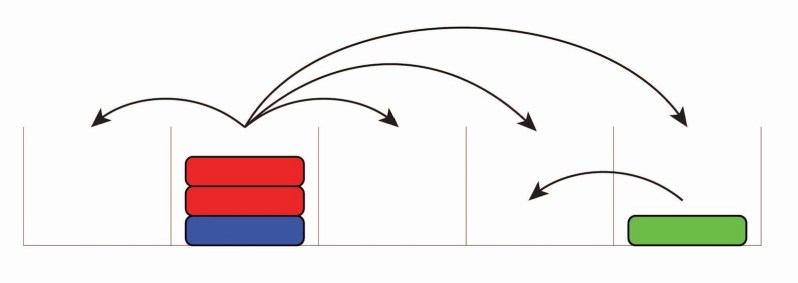
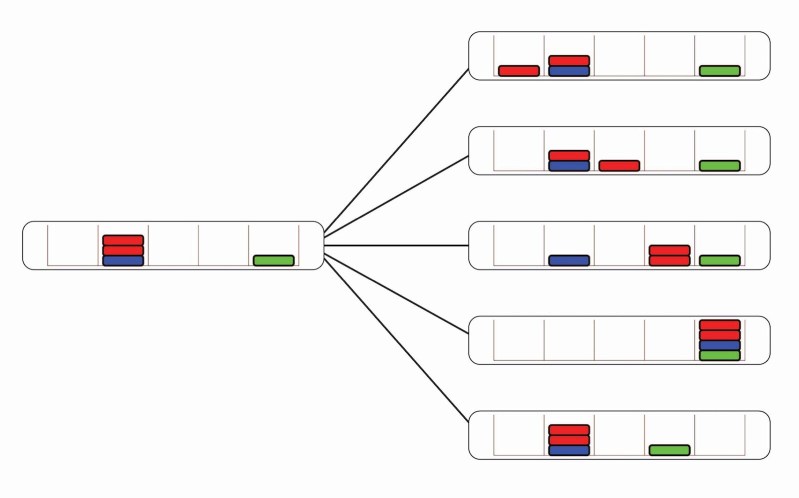
A move consists of taking some of the top tokens of a tower, and moving them onto a field that is as many steps away as you are taking tokens, within the limits of the game board. If the target field is occupied, just place your tokens on top. Note that you can take only pieces from the top, and are not allowed to change their order. In the position above, the possible moves are indicated by the arrows, and you can see the possible new positions below. 

Moves 01

You will gladly notice that the color of the tokens does not matter at all at this point. You will also notice that moves are reversible, because undoing a move is also a legal move. Games are in so many ways better than reality. 

A typical puzzle using this mechanic is given by two position, and the task is to transform the first into the second using only legal moves. Here is a simple example, played on a board of size three with two tokens of different color, placed on top of each other at the leftmost field. The task is to swap the position of the two tokens:

Puzzle0 01

This is not possible on a board of size 2 (why?), and requires five moves on a board of size 3 like so:

Solution0 01

Why should we care? Particular examples can often be used to gain universal insights. In this case, for instance, we have just essentially proven that any puzzle on a board of size at least three can be solved. How so?

We have shown that two adjacent tokens in a single tower can be swapped, if there are two fields available to the right. It does not matter if these fields are occupied or not, because we can just play on top of any existing pieces. It does also not matter if there are tokens below the two we want to swap, and not even if there are tokens on top, because we can move them temporarily out of the way (remembering that moves are reversible).

As the group of all permutations is generated by transpositions (use bubble sort), we can in fact permute the tokens in any single tower to our liking. Finally, to solve an arbitrary puzzle, we first move all tokens (piece by piece, if needed) onto a single tower on the leftmost field, then permute them into the order we need, and then move them into the desired target position.

Here is a puzzle on a board of size 5 with four tokens in 3 colors. You know now that there is a solution. But what is the shortest solution?

Puzzle5 01

To be continued…


Golf Balls (Beach Balls Revisited)

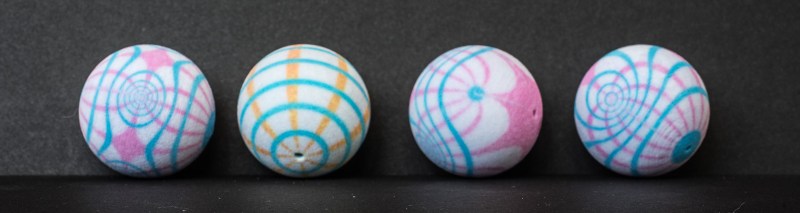
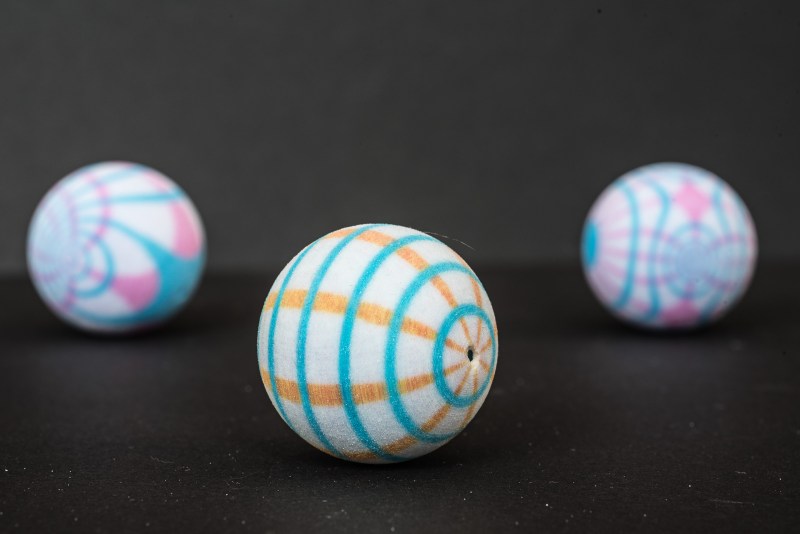
A while ago, I showed how to visualize holomorphic self-maps of the sphere by drawing the pre-image of the standard polar coordinate system of the sphere (aka latitudes and longitudes). I mentioned that it should be possible to have these 3D printed, and here they are.

DSC 8058


They are printed with a gypsum printer, which is the only one have access to that can do color. That means that they are definitely neither suitable for golf or table tennis, nor for the bath tub. But I could use these for an exam in a Complex Analysis class. Each student gets one of these balls, and has to find out what rational function it represents. 


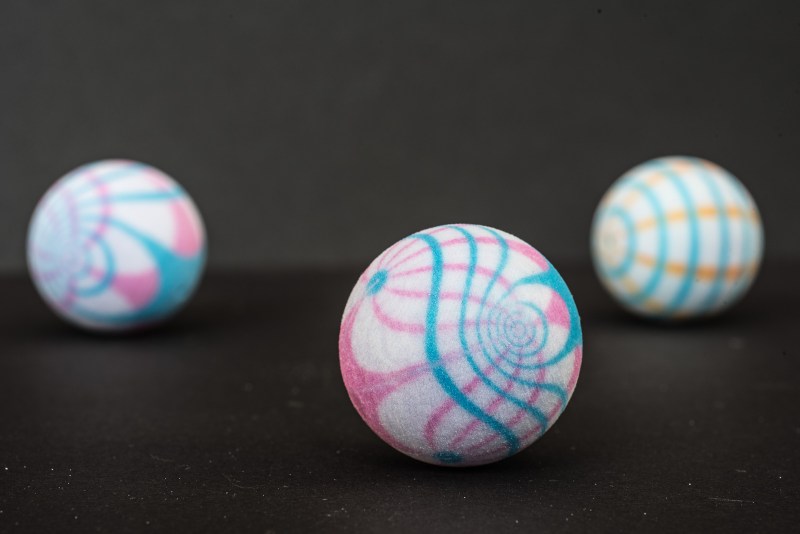
DSC 8053


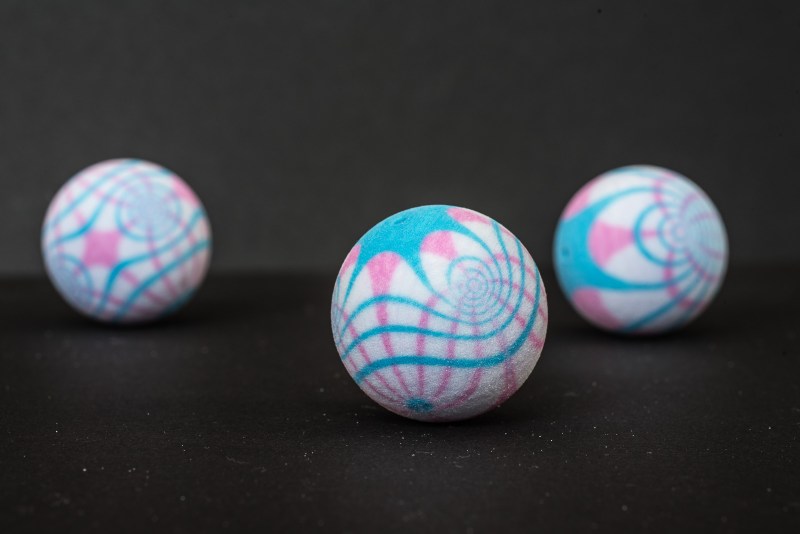
The red lines (being the preimages of the longitudes) come together in the preimages of the two poles. Hence we can locate the zeroes and poles of the function. The only problem is that these pictures don’t distinguish between zero and infinity, nor tell they anything about scaling.

DSC 8056


They do tell about branching, i.e. the location of the zeroes of the derivative. For instance, in the blurry ball to left up above, we see a branched point where four of the red lines meet (instead of the expected 8 of the polar grid).


DSC 8054

Daumenkino

When I was little, friends gave me as a birthday present a home made flip book that would show the deformation of the catenoid to the helicoid. That was a lot of work back then when you had to program all the 3D-graphics by hand, including hidden line algorithms. But I liked it to a have a physical object that would allow me to run my own little movie.

Bryant kusner 0

Daumenkinos – Thumb Theaters, are they called in German. Today we see some snapshots from a high tec version of such a Daumenkino, attempting to get to the core of Boy’s surface (an immersion of the projective plane), about which I have written briefly before.

Bryant kusner 3

The goal is to put a lid on a Möbius strip. The one we start with you will note is not just once twisted, but three times. I don’t know how essential this is to get an immersed projective plane at the end. I suppose it’s not, but makes things easier. Note that the strip has a single boundary curve, as expected.

The first two images show that Möbius strip, growing slowly. Below the first crucial step has happened: The growing strip has created a triple point, and intersection like that of three planes. But there still is only one boundary curve…

Bryant kusner 4

We keep growing


Bryant kusner 7

and growing:

Bryant kusner 8

Another critical event: The boundary curve emerges completely into free air, i.e. doesn’t pierce through the surface anymore. Now it’s easy to close the lid:

Bryant kusner 99


Incidences

Why do we still teach geometry?  The constructions with ruler and compass were essential for the Egyptians and Greeks in order to accurately lay out large scale buildings with the only tool available (the rope). But today we have many other tools available, so there is no reason to confine ourselves to ruler and compass, unless we want to use them as a vehicle to teach the concept of proofs. That, however, is also in low demand, to the extent that graduating majors in mathematics are neither able to prove Pythagoras’ theorem nor to compute the distance of a point from a line.

Central

I have been teaching a Geometry class twice now, and I am releasing the notes I wrote for the first part of the class into the wild. For this first part, I had set myself a few goals: I wanted to use only the most fundamental notions of geometry,  I wanted a plethora of interesting examples, and I wanted to be able to prove a substantial theorem. Finally, I needed to be able to give homework problems. 

Parallel

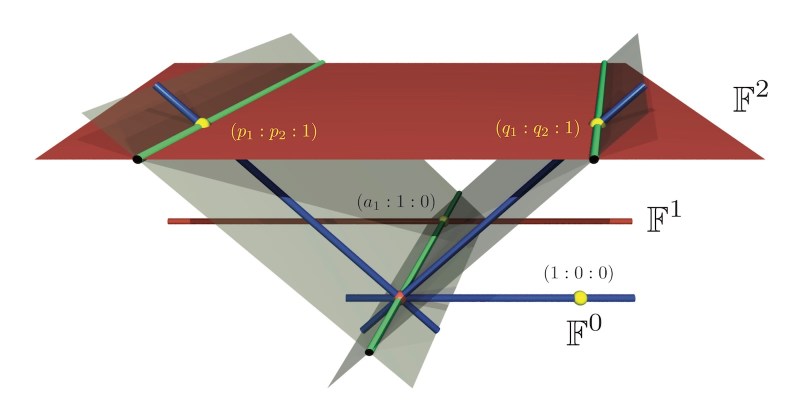
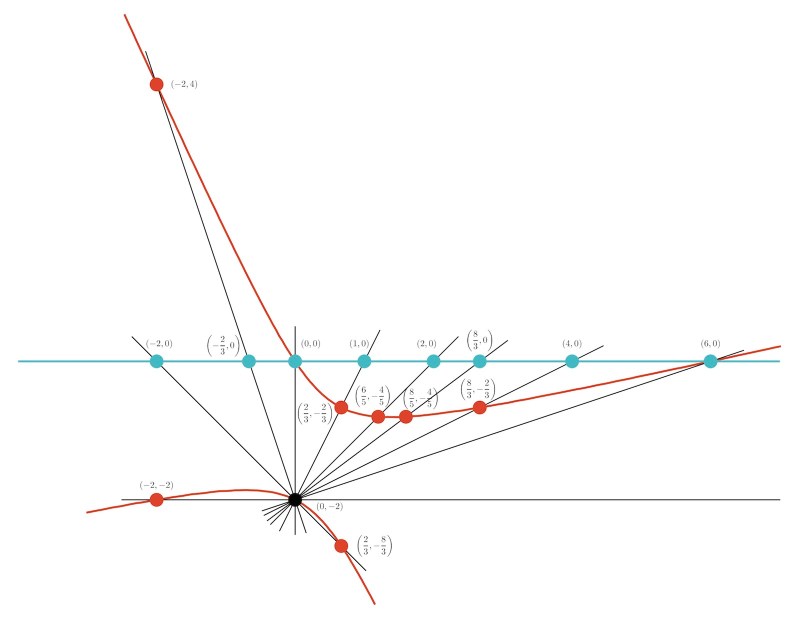
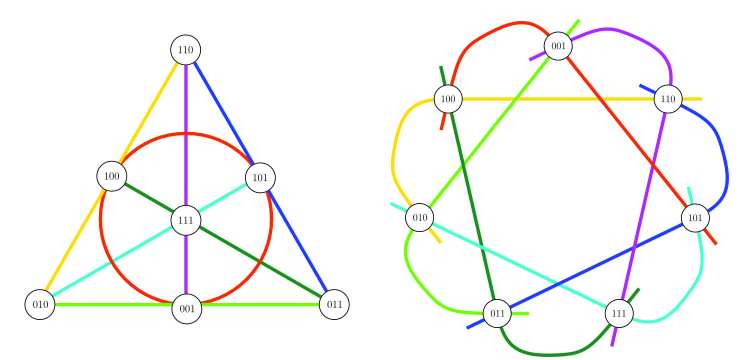
The solution was to study incidence geometries, specializing pretty quickly to affine and projective spaces over arbitrary fields. So I did not develop axiomatic projective geometry, but rather taught the computational skills needed to quickly get to the geometry of conics in projective planes. This provided plenty of  exercises. Affine and projective transformations are intensely used in order to prove theorems or to simplify computations. The big theorem I prove at the end is Poncelet’s theorem.

Hyperrat

The second half of the course? This deals with the two-dimensional geometries where we have circles: Möbius, Euclidean, spherical, hyperbolic. Emphasis is again on groups, and here in particular on reflection groups, proving Dyck’s theorem at the end. But I am not quite happy with the notes yet, so this part will have to wait.

Fano3

So here is part I. Enjoy.

Notes on Geometry – Part I: Incidences


Ends and Handles

Mathematics gets most exciting when new connections between different areas are discovered. In the theory of minimal surfaces, maybe the most fruitful discovery of this sort was Robert Osserman’s theorem from 1964 that a complete minimal surface of finite total curvature has the conformal type of a compact Riemann surface punctured at finitely many points, with the Weierstrass data extending meromorphically to the compact surface. This was a giant step from the much earlier discovery of the Weierstrass representation, that provided a first link between minimal surfaces and complex analysis.

Symfinite

However, at that time, the only known examples where of genus 0, i.e., punctured spheres, and of those only the catenoid (and the plane) were embedded. In fact, it is pretty easy to make examples like the one above: punctured spheres with many ends that will intersect.

This changed dramatically in 1982 when Celso José da Costa constructed a minimal torus with three ends that was proven to be embedded by David Hoffman and Bill Meeks in 1985. Examples with more ends and of higher genus followed rapidly, all nicely embedded. But there was a pattern: It looked like that if you wanted n ends, you needed to have genus at least n-2. This is the Hoffman-Meeks conjecture. For n=2 this follows from a theorem of Rick Schoen. But why can’t we have (say) a torus with four ends?

Fourends

All attempts to produce such an example have failed. In the image above, the ends will intersect, eventually. On the other hand, there is a fair amount of evidence that there are examples of genus g with precisely g+2 ends. Below is such a surface of genus 3 with 5 ends.

Dh11

That such examples should exist for any genus is supported by the Callahan-Hoffman-Meeks surface, a periodic version of the Costa surface. One just needs to chop it into pieces and put catenoidal ends at the top and bottom…

Chm

By recent work of Bill Meeks, Joaquin Perez, and Antonio Ros, the number of ends of a complete, embedded minimal surface of finite total curvature is bounded above by some constant (which is not explicit).

But even the case of tori remains very much open.

Eraserhead (Games on Circles I)

This is not about the film by David Lynch. Eraserhead is played by two players on finite graph with some vertices occupied by erasers. At each turn, the player chooses one eraser, moves it to an unoccupied adjacent edge, thereby erasing the connecting edge. The player who moves last wins.

Let’s analyze this for cycle graphs.
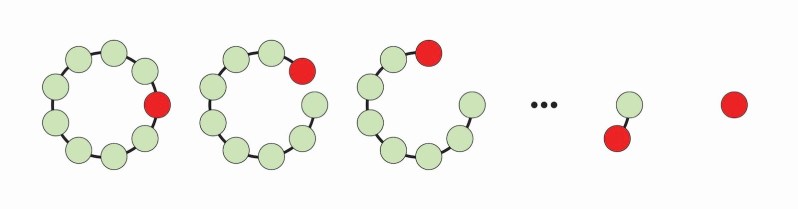
Eraserhead1 01

If played with just one eraser, the first player chooses the direction, and all other moves are forced, until the eraser has erased all edges. So the first player wins if the cycle graph has an odd number of vertices. That was boring.

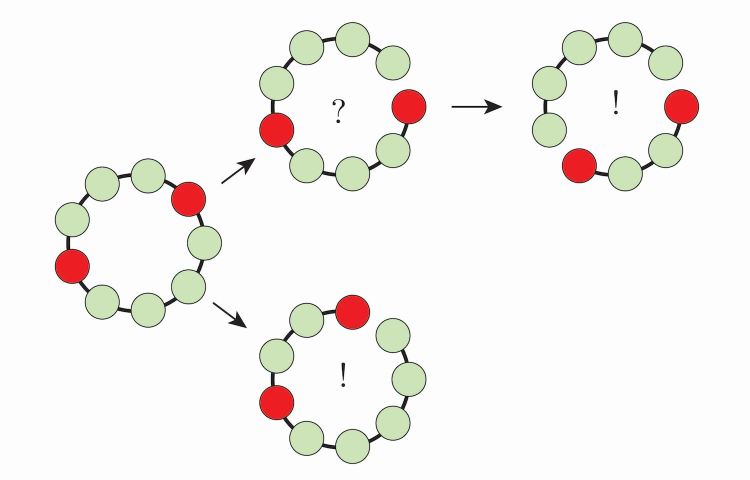
For two erasers, it gets slightly more interesting, but the outcome is the same: The first player can win if the number of vertices is odd. The two erasers divide the graph into two components whose number of vertices have different parity (3 and 4 in the example below).
Moving an eraser into the even component would be a mistake, as the second player will then move into the same component with the other eraser. This leaves an even number of moves for both players, and the second player will win.

But a winning move for the first player consists of moving one eraser into the odd component. This leaves the second player with two choices: Moving the other eraser either way leaves an odd number of moves for both players, and the first player wins. If the second player moves the first eraser again, the first player can move either way and will win.
Eraserhead2 01

So while a little harder, this was still easy. Does this even/odd pattern for winning and losing persist with more erasers? At first, it seems so. For any number of erasers (except the cases of no erasers and erasers everywhere, which leave no moves to begin with), the first (resp. second) player can always win with if the cycle graph has an odd (resp. even) number of vertices — up to cycle graphs with 8 vertices. For the following position with three erasers, the first player has no winning move. There are three essentially different moves, and the diagram give winning responses for the second player.

Eraserhead3 01

The first line is interesting. With the first player to move again, there are still 8 edges to delete (possibly). If the first player moves with the topmost eraser right, this will actually happen, and the first player will loose. To prevent this, s(he) must move that eraser to the left. This leaves all erasers in one component with a total of four edges left. This looks like a good thing, but no matter how they play, only three edges will be deleted, and the second player must win.

So the game does get complicated. What helps is to know the nimbers for simple subpositions, like chains with or without erasers at the end. For instance, the line graph with n vertices and one eraser at the end has nimber 1 for odd even n and 0 for odd n. Similarly, the line graph with n vertices and erasers at both end has nimber 0 for odd even n and 1 for odd n. This is quite trivial, of course, as all moves are forced. More surprisingly, for the line graph with two erasers at the end and a third eraser in between, the nimbers are again 1 for n odd, and 0 for n even, except when n=3 or n=4. Then the nimbers are 0 and 2, respectively. So things start off with promising simple patterns, but then deviate. Below I have, for line graphs of length 12 and 13, respectively a unit cube at coordinate (x,y,z) if the position with erasers at x, y, and z is a lost position for the first player.
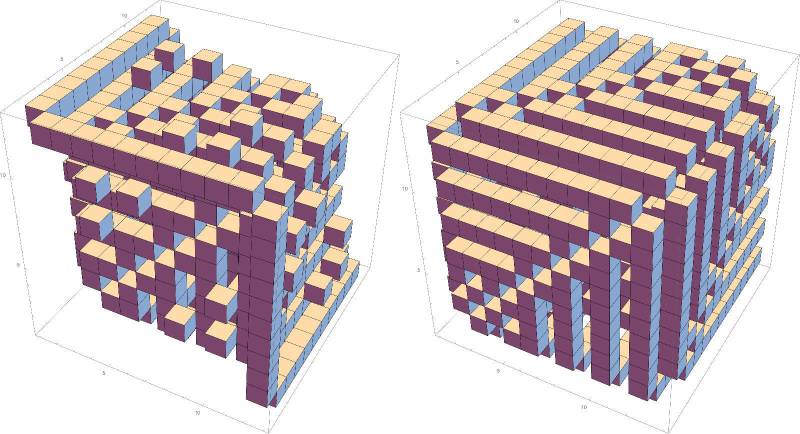
Lost12 13

Finally, below, the corresponding images for cycle graphs, viewed diagonally to emphasize the symmetry. The discrepancy is baffling.
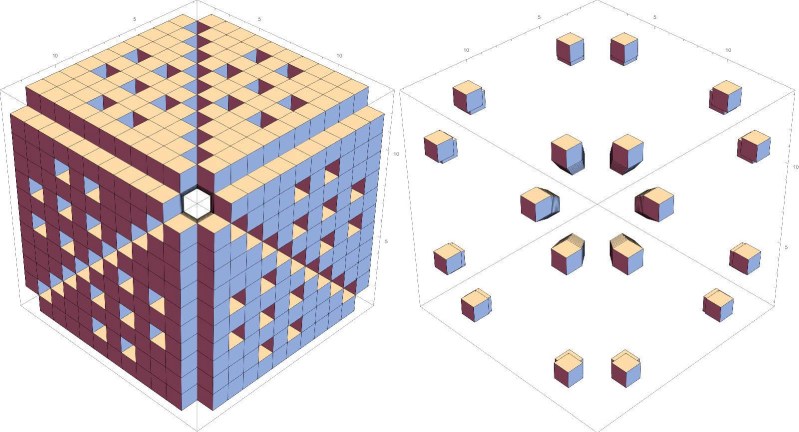
Lostcycle3 12

Stellating the Icosidodecahedron in Black and White

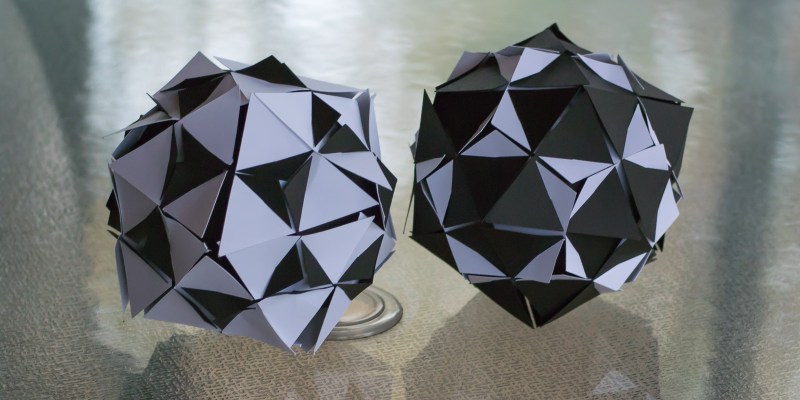
DSC 1737

It is also this time of the year to chase away the dark hours by making presents. As in previous years,
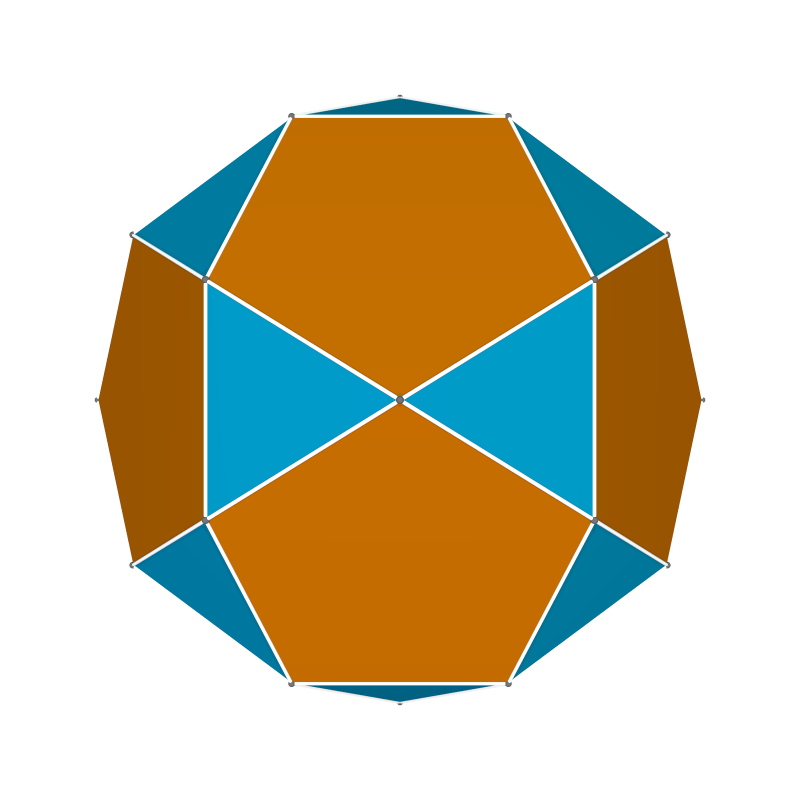
we will make a stellation out of paper without glue. This year, we are going to stellate the Icosidodecahedron, one of the fancier Archimedean solids.

Icosidodecahedron

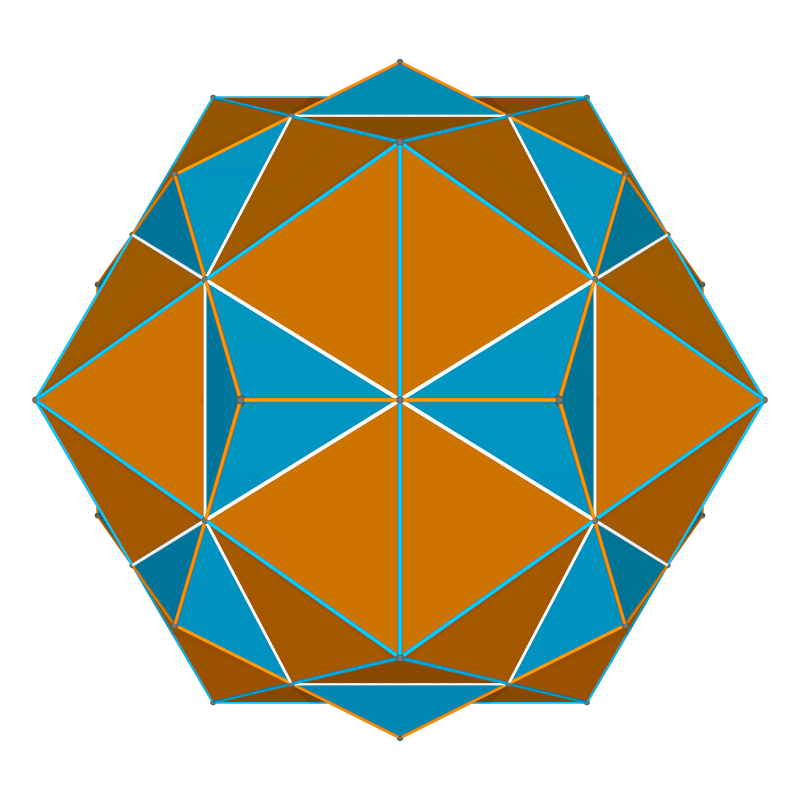
The stellation is quite simple, it is also a compound of the dodecahedron and icosahedron. The simpler compounds of a Platonic solid with its dual are also doable, see the post from two years ago.

Compound

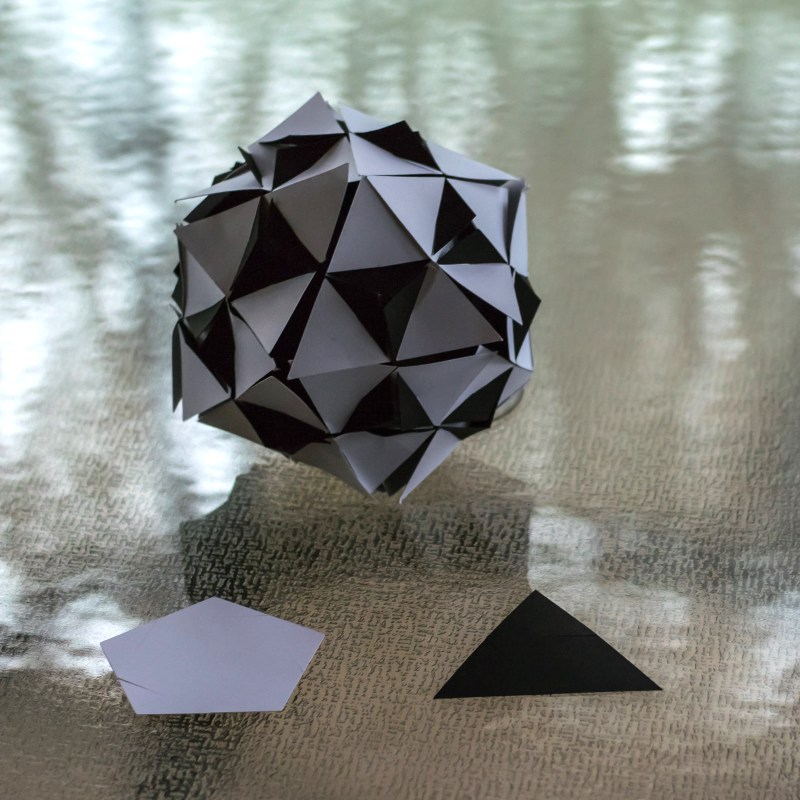
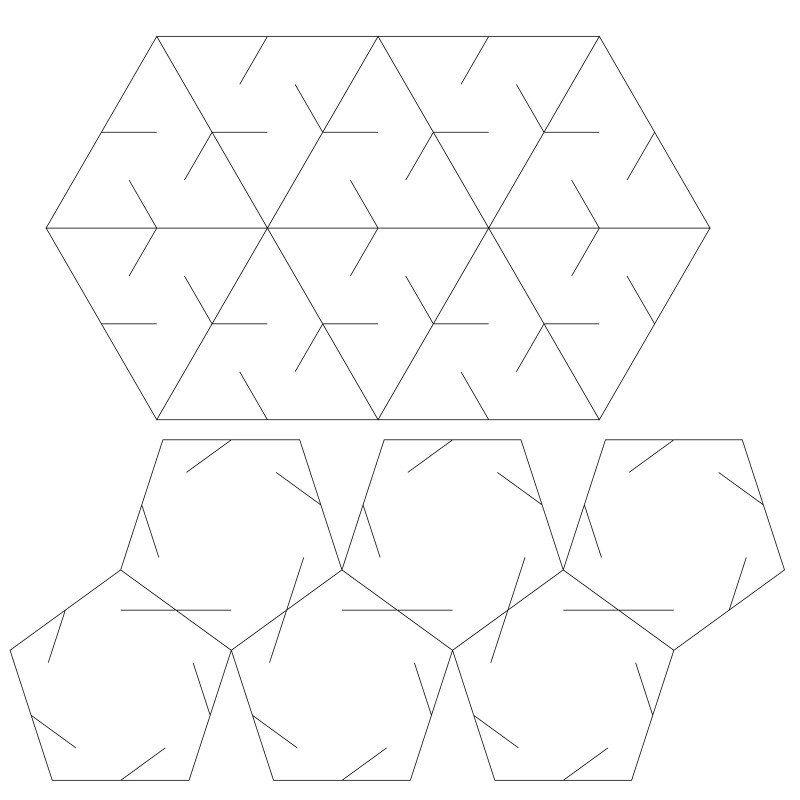
To make it, we will need 20 triangles and 12 pentagons, so printing and cutting two of the templates below will do. I suggest to print four templates in two different colors and to make two models.

StellaDodecaIcosa

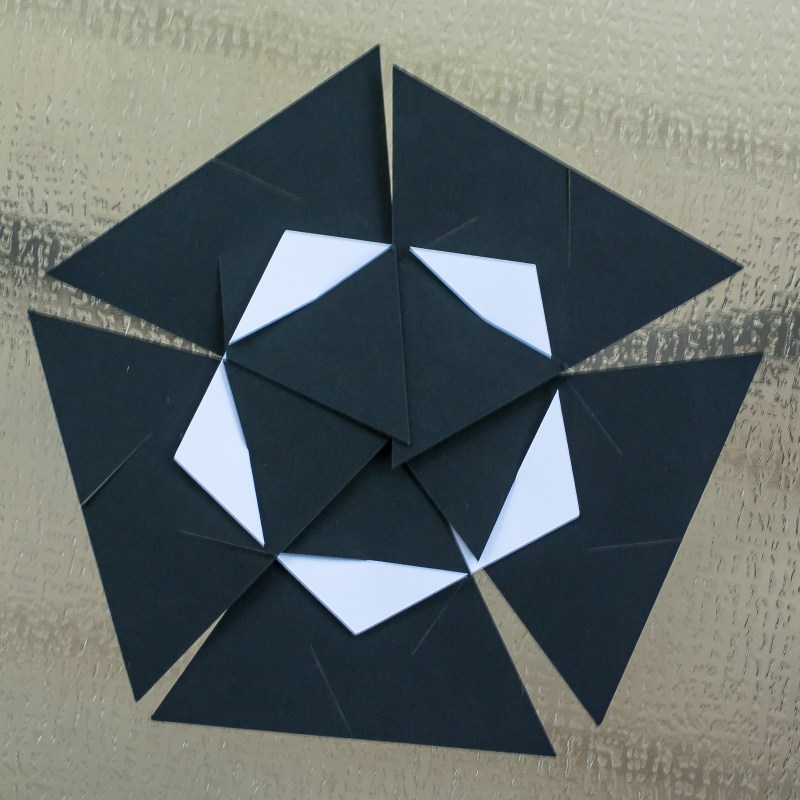
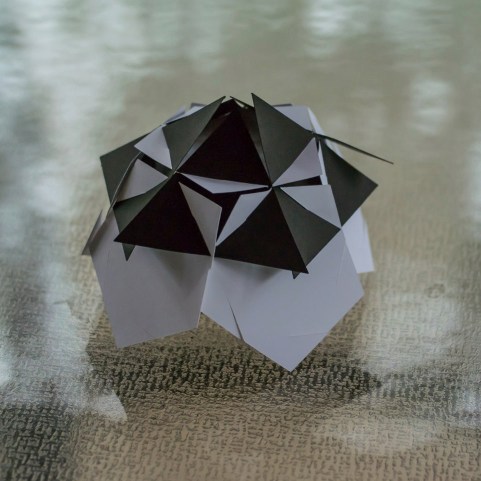
Then we start by sliding five triangles into one pentagon like so:

DSC 1739

Then we add five pentagons between two adjacent triangles.

DSC 1740

Next another five triangles:

DSC 1742

Now we have finished one half of the model. This already would make a nice dome for the backyard.

You can make another half and try to attach them, but I think it is easier to just keep going.
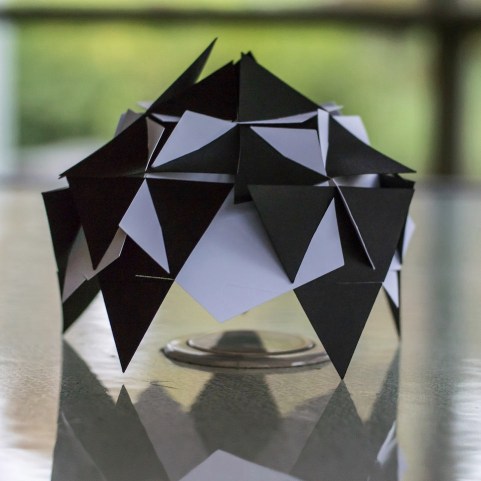
This next step is a little tricky, because to prevent the polygons from falling out, it is best to add a ring of alternating pentagons and triangles. When done, it looks like this:

DSC 1746

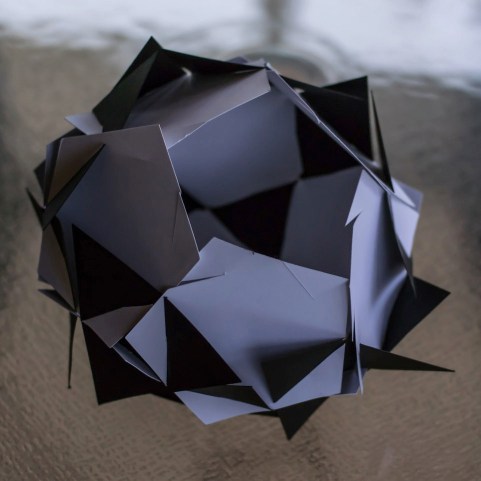
The last two steps (add five more triangles and one more pentagon) are then pretty clear, but still tricky because you have to insert the new polygons in four or five slits essentially at once.

DSC 1750