Inside or Outside?

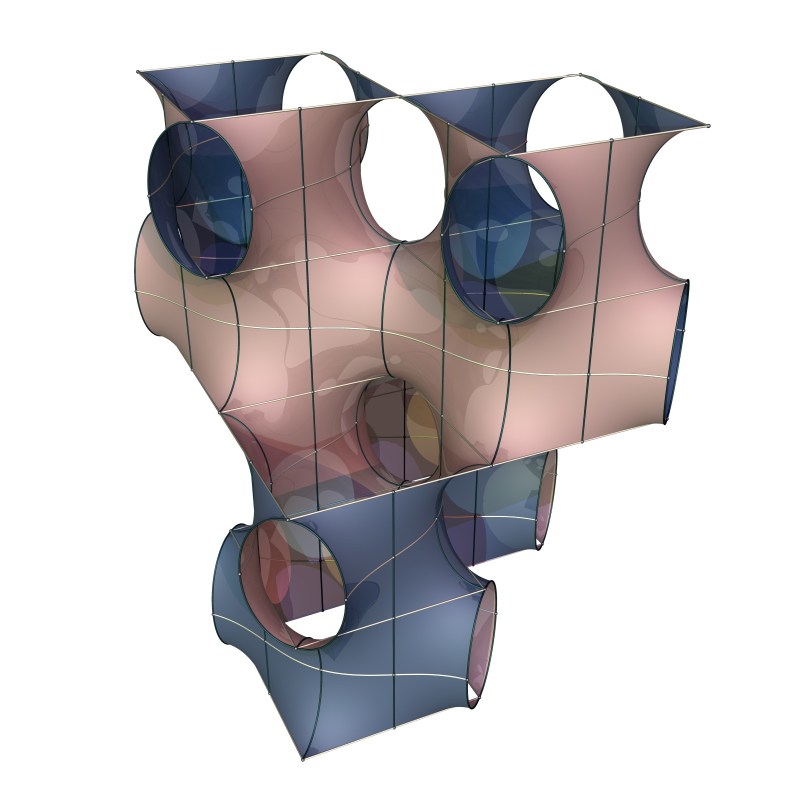
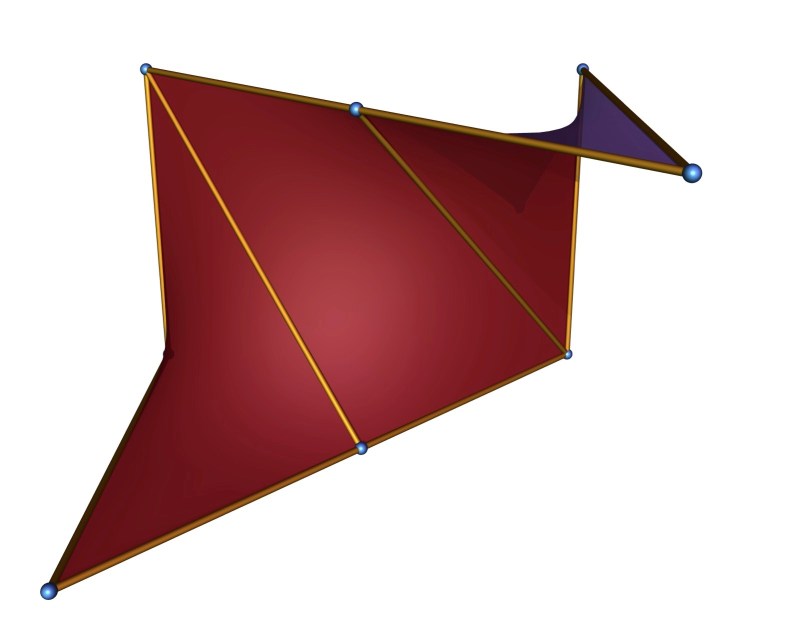
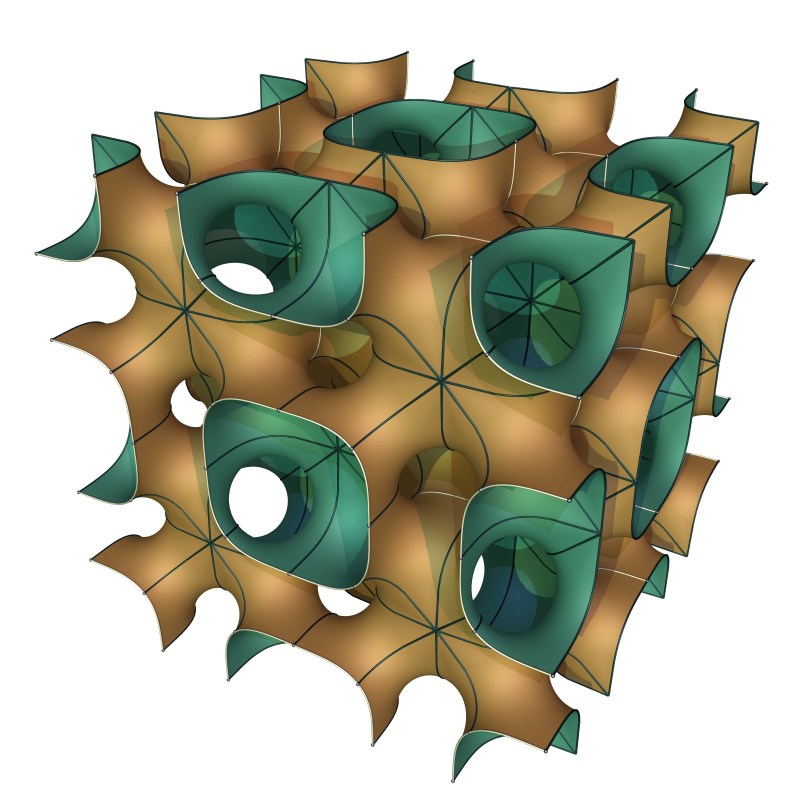
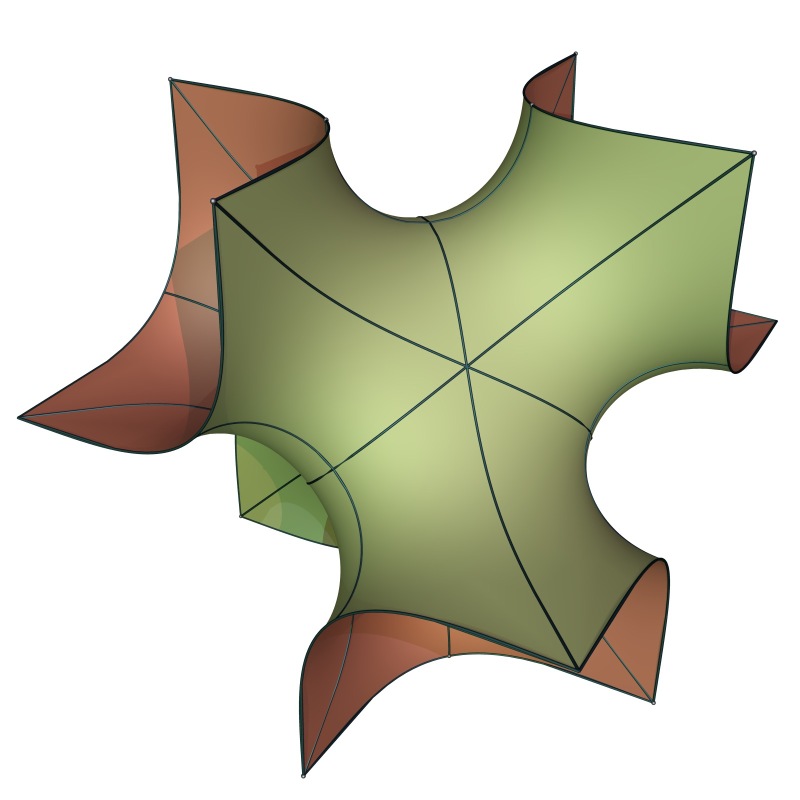
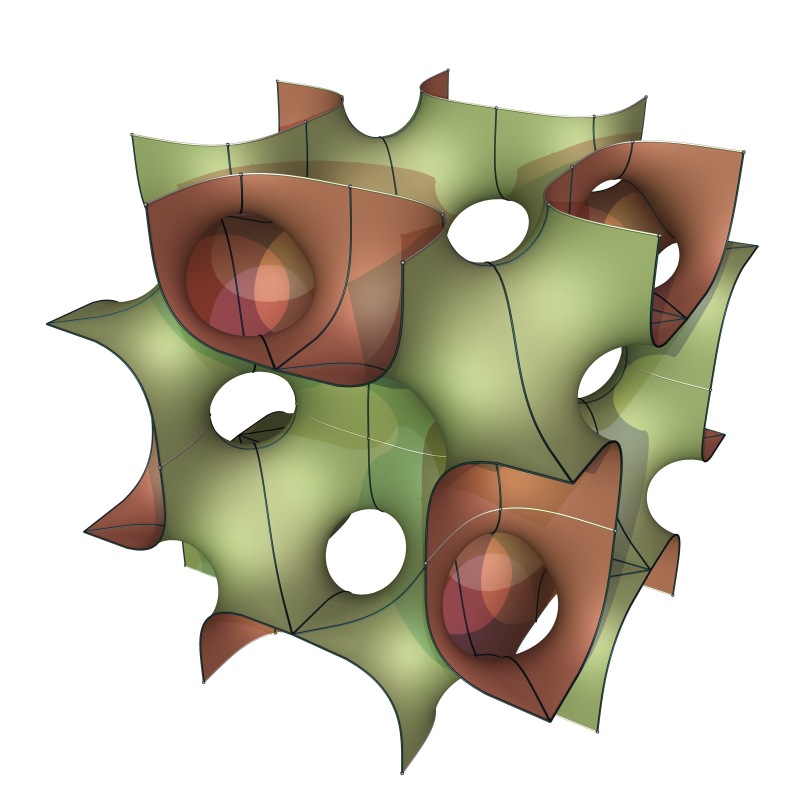
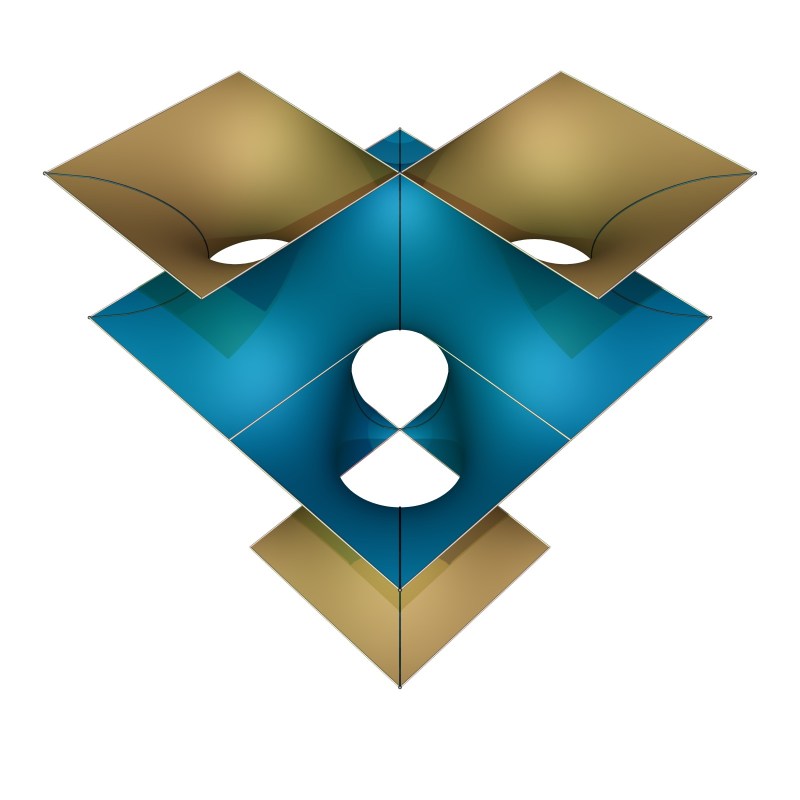
The last minimal surface that made it into Alan Schoen’s NASA report is the F-RD surface. It has genus 6 and looks fairly simple.
Tetra

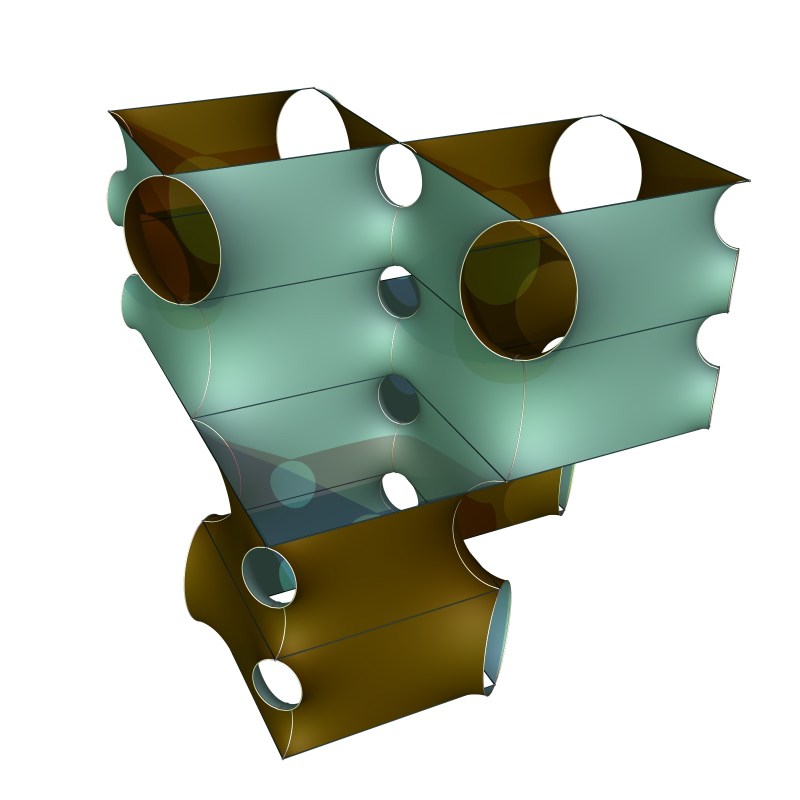
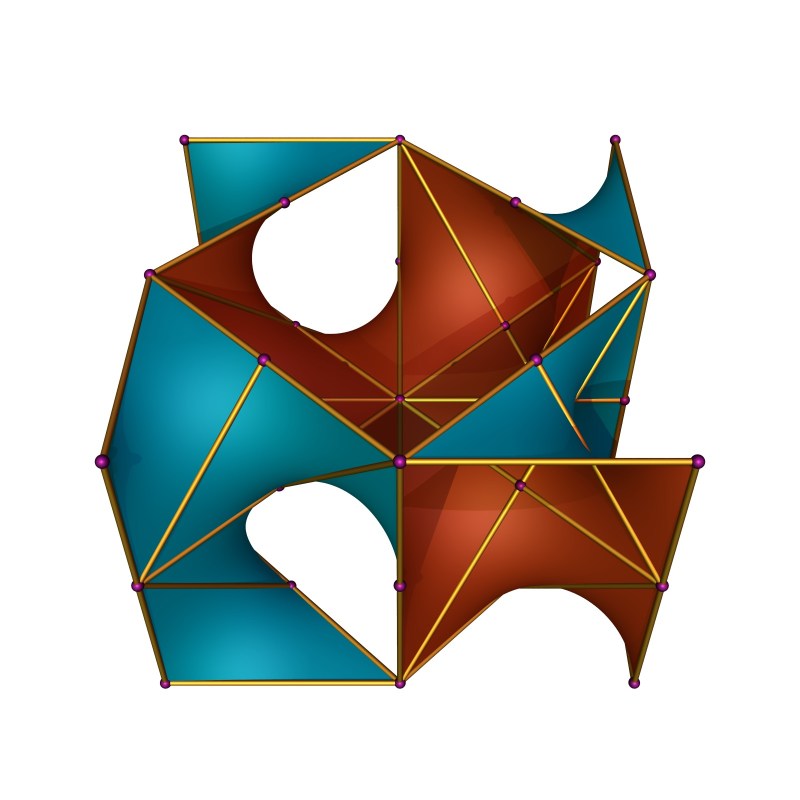
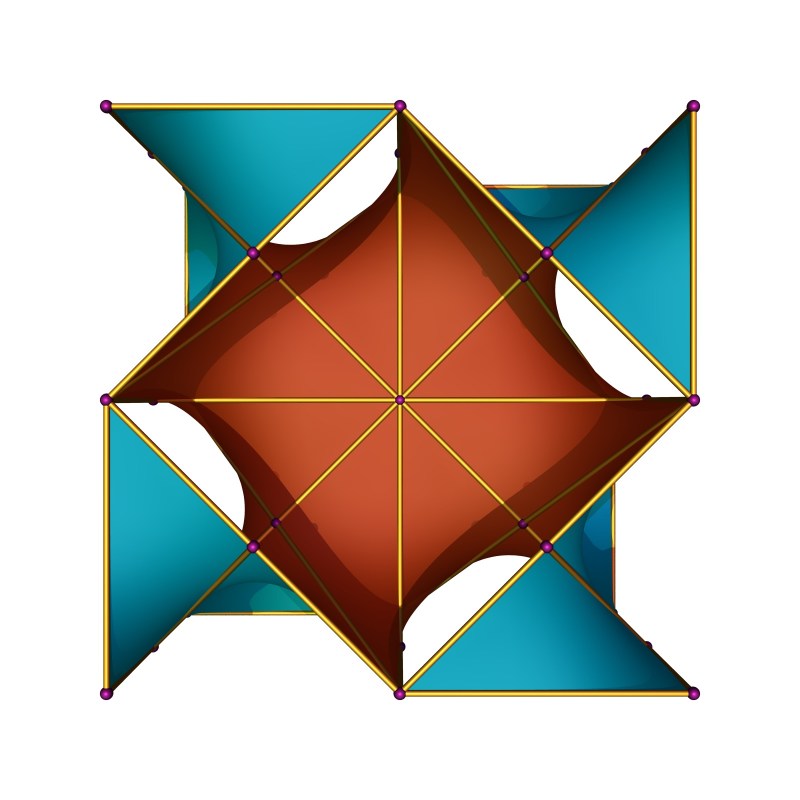
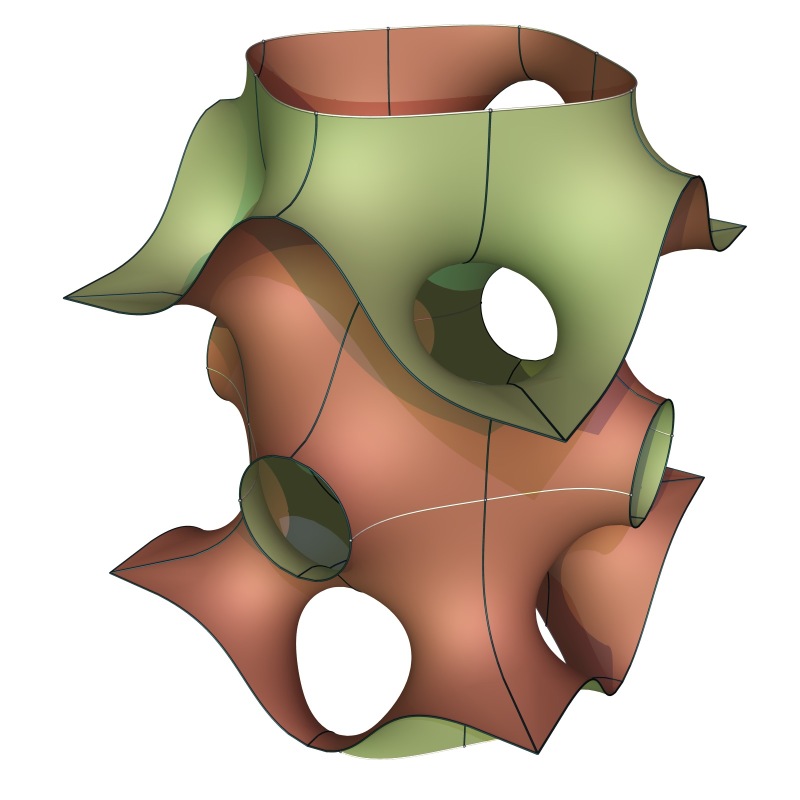
A fundamental decision one has to make these days is to choose the side one wants to live on. If, for instance, we decide on the orange side, we will have the impression to live in a network of tetrahedrally or cubically shaped rooms with connecting tunnels at the vertices of each. Not too bad, but, as things stand, we will never know what life on the other side looks like.
Cubical

Luckily, our imagination is still free, and we can think about the other, green side. What we can hopefully see from the pictures above and below is that the rooms of the green world are all cubical, with tunnels towards the edges of each cube. Alternatively, we can also think of the rooms as rhombic dodecahedra, with tunnels towards the faces. That’s where F-RD got its name from: Faces – Rhombic Dodecahedron.
Double

Incidentally, the conjugate of the F-RD surface is again one of those discussed by Berthold Steßmann, with the polygonal contours having been classified by Arthur Moritz Schoenfließ

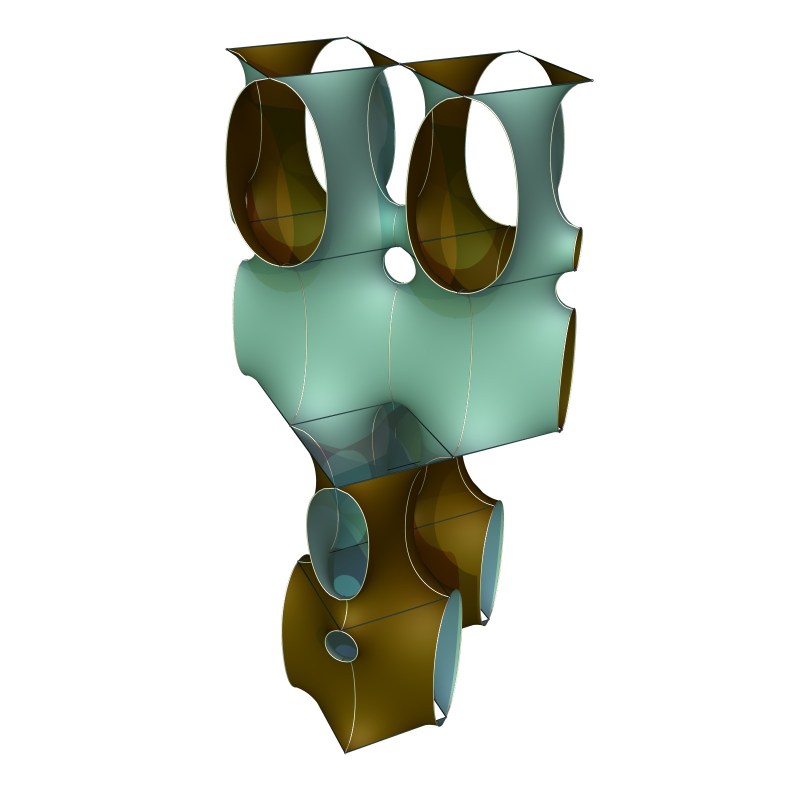
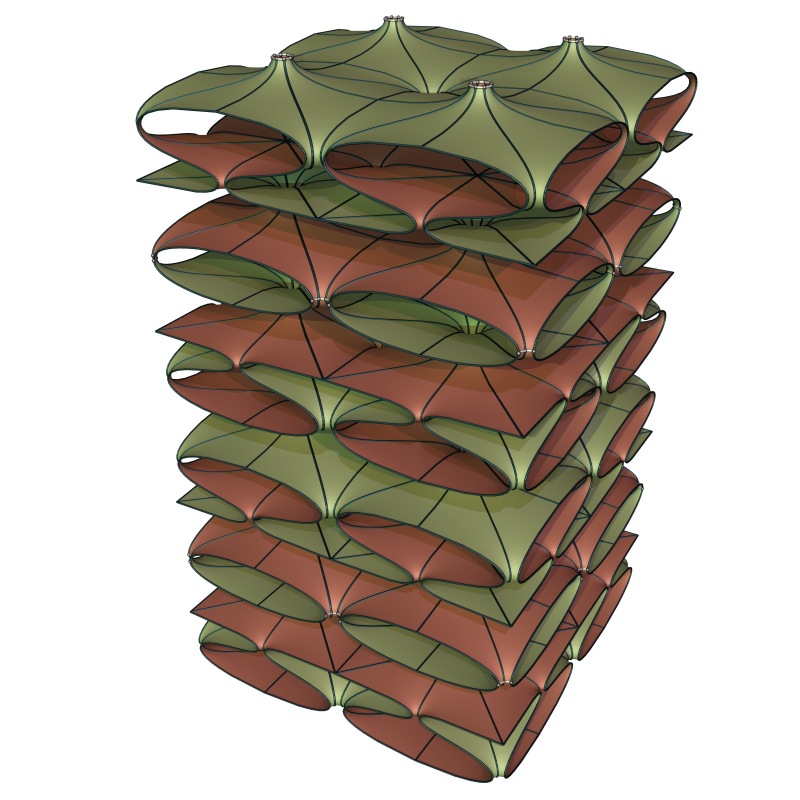
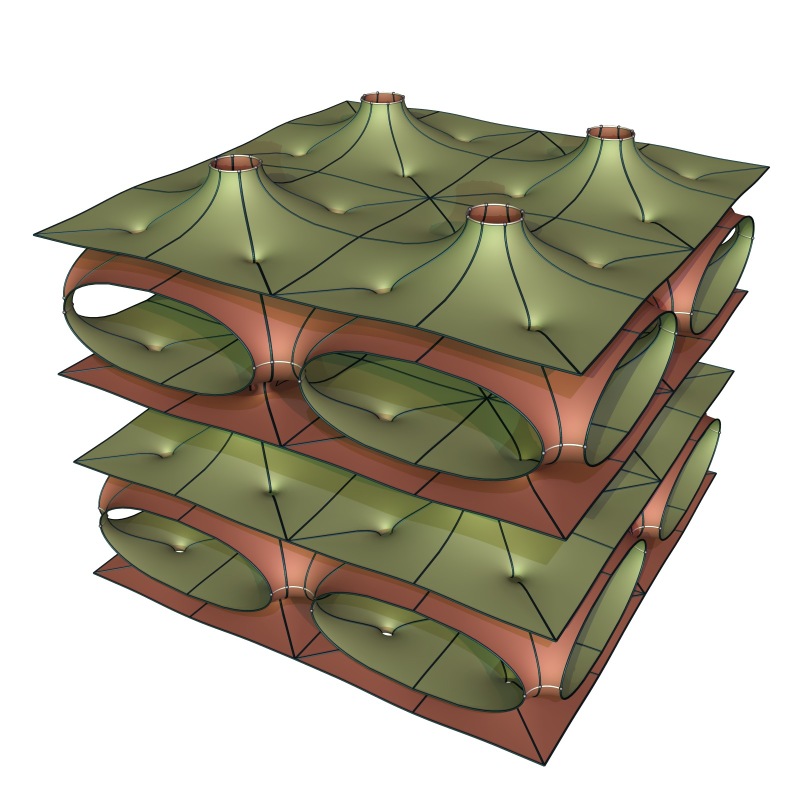
A simple deformation of F-RD maintains the reflectional symmetries of a box over a square, but allows to change the height of the box. It turns out that there are two ways to squeeze the box together.
Limit1

In both cases we get horizontal planes joined by catenoidal necks, but differently placed in each case.
Limit2

Alan Schoen’s I6-Surface

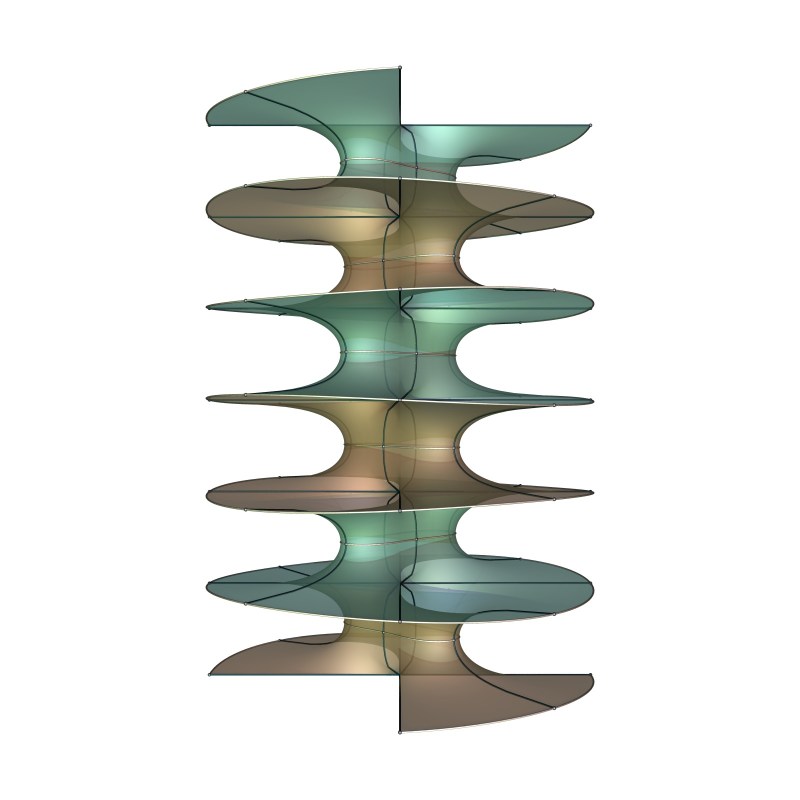
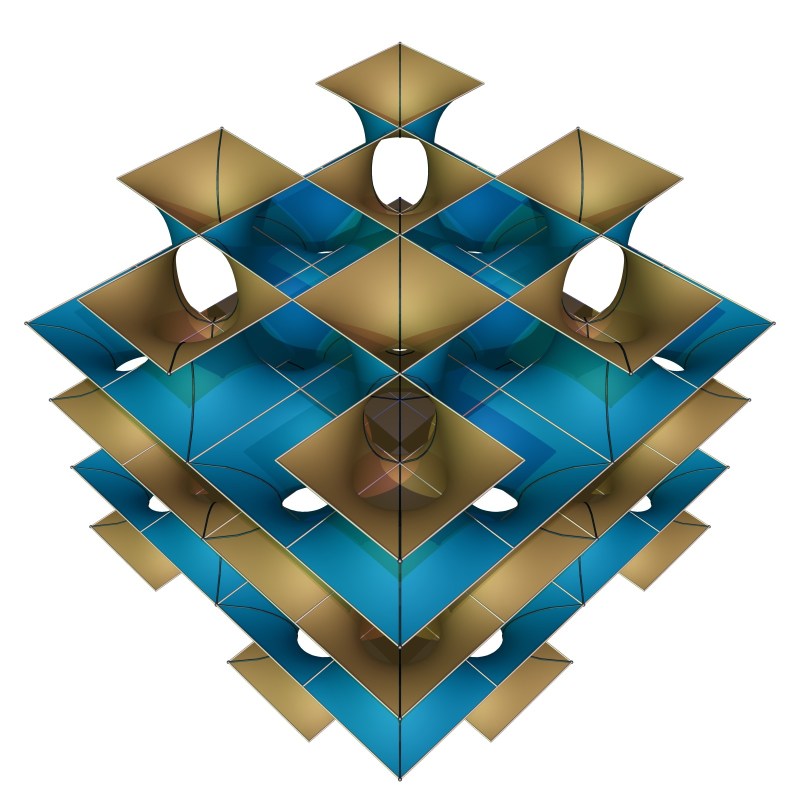
Wp1After Alan Schoen was fired from NASA at the end of 1969, he moved back to California and continued to experiment with soap film. In October 1970, he used two identical wireframes bent into figure 8 curves consisting of two squares meeting at a vertex. When he dipped them into soapy water at a small distance from each other and pulled them out, he could poke the flat disks between the two figure 8s and create a minimal surface that looks like the top half in the picture above. It extends triply periodically to a surface of genus 5.
Wp2

Several pages of notes with descriptions of successful experiments made it to Ken Brakke, who used his marvelous Surface Evolver to make 3D models of the surface. It was named I6, because it happened to be the 6th surface on page I of the notes. Hermann Karcher later called it Figure 8 surface. When you move the two figure 8s close to each other, you will get a surface that looks like a periodic arrangement of single periodic Scherk surfaces:

Wp3

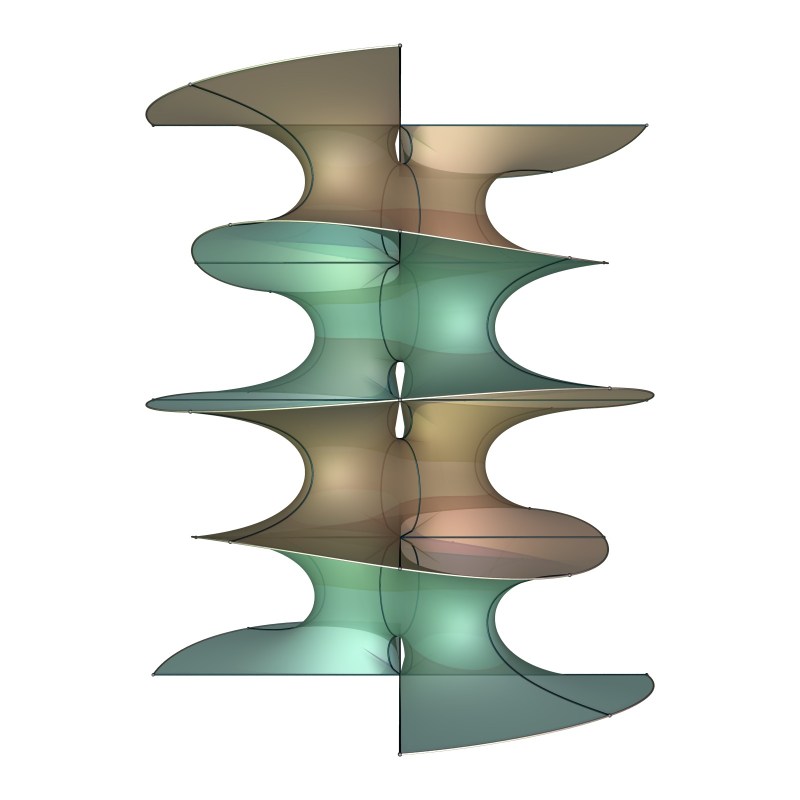
Note that these Scherk surfaces are vertically shifted in a subtle pattern. More interestingly, there is a second, unstable surface you won’t get as a soap film:

Wp5

What you see here are Translation Invariant Costa Surfaces (or Callahan-Hoffman-Meeks surfaces) we looked at last time. So Alan Schoen’s I6 surface can be considered as a triply periodic version of the Costa surface, which Celso José da Costa discovered  about 10 years later.

Of course you can poke more handles into I6, as you can with the translation invariant Costa surface. Below is an example of genus 7:

Wp6


The Translation Invariant Costa Surface

Out of the flurry of minimal surfaces that was inspired by the Costa surface, a particularly fundamental new surface is the Translation Invariant Costa Surface, discovered by Michael Callahan, David Hoffman, and Bill Meeks around 1989.Chm11

Like Riemann’s minimal surface, its ends are asymptotic to horizontal planes, but it is invariant under a purely vertical translation, and the connections between consecutive planes are  borrowed from the Costa surface. Surprisingly, in a few ways this surface is even simpler than Costa’s surface. To see this, let’s look at a quarter of a translational fundamental piece from the top:

Quarter

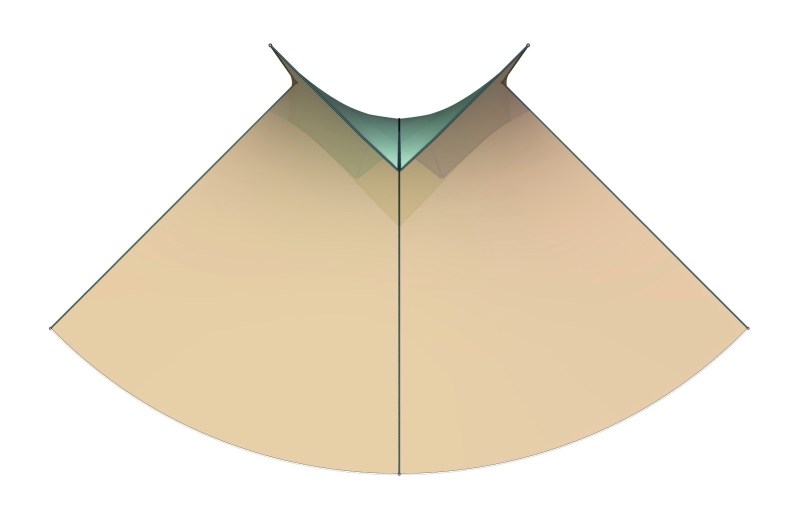
It is bounded by curves that lie in reflectional symmetry planes, and cut off with an almost perfect quarter circular arc. Hence the conjugate minimal surface will have an infinite polygonal contour, like so:

Conjugate

It is not too hard to solve the Plateau problem for such contours, and adjust the edge length parameter so that the conjugate piece is the one used for the Translation Invariant Costa Surface. It is also possible to argue that the Plateau solution is embedded, and conclude the same for the Translation Invariant Costa Surface. All this is not so easy for the Costa surface itself.

Chm12

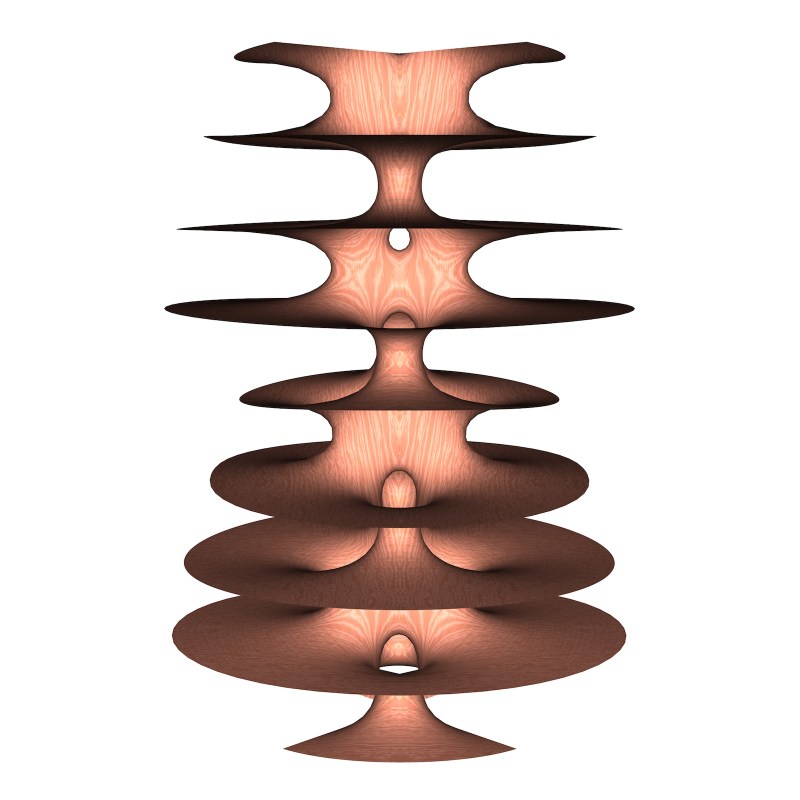
Above is a variation with one handle added at each layer. Surprisingly, the corresponding finite surface does not exist. One can add deliberately more handles. Below is a rather complicated version that I called CHM(2,3), with a wood texture rendered in PoVRay in 1999, when I had figured out how to export Mathematica generated surface data to PoVRay.

Chm23 wood

Boundary Considerations, Part II

As promised, today we will look at a close cousin of last week’s surface. A good starting point is the CLP surface of Hermann Amandus Schwarz, about which I have written before.


Clp

Up above are four copies of a translational fundamental piece. There are horizontal straight lines meeting in a square pattern, vertical symmetry planes intersecting the squares diagonally, vertical lines through edge midpoints of the squares and horizontal symmetry planes half way between squares at different heights. What more could one want? Well, CLP has genus 3, and we wouldn’t mind another handle.


Nearsingly


There are various ways of doing that, and one of them leads to today’s surface, shown above. For adding a handle we had to sacrifice the vertical straight lines, but all other symmetries are retained. These are, in fact,  essentially the same symmetries we had in last week’s surface, except that there, the squares in consecutive layers were shifted against each other. The similarities go further.

Neardoubly

Again we can ask how things look at the boundary. Pushing the one free parameter the the other limit, gives us again doubly  periodic Scherk surfaces and Karcher-Scherk surfaces. There is a subtle difference (called a Dehn twist), however, how the two types of Scherk surfaces are attached to each other in both cases.

Flat

Finally, as usual, the cryptic rainbow polygons that encode everything. Today, the two fit together along their fractured edges, which has to do with the period condition these surfaces have to satisfy.


How Does This Look Like At The Boundary?

A common recommendation to the layperson who is stranded among a group of mathematicians and doesn’t know what to say is to ask the question above. It will almost always trigger a lengthy and incomprehensible response.


Single


For example, let’s look at the surface below. It constitutes a building block that can be translated around to make larger pieces of the surface. That this works has to do with the small and large horizontal squares. It is similar to Alan Schoen’s Figure 8 surface, but a bit simpler (it only has genus 4)


Pyramid

This surface belongs to a 5-dimensional family about which little is known. The only simple thing I can do with it is to move the squares closer or farther apart. So, how does this look at the boundary? On one hand, when the squares get close, we see little Costa surfaces emerging, as one might expect:

Nearcosta

At the other end of infinity, things look complicated, but depending what we focus on, there is a doubly periodic Scherk surface or a doubly periodic Karcher-Scherk surface:

Nearscherk

Below are, for the sake of their beauty, the two translation structures associated to two of the Weierstrass 1-forms defining this surface. Next week we will study a close cousin of this surface.


Flat


Steßmann’s Surface (Wrapped Packages II)

In the paper Periodische Minimalflächen, published by the Mathematische Zeitschrift in 1934, Berthold Steßmann discusses the minimal surfaces that solve the Plateau problem for those spatial quadrilaterals for which rotations about the edges generate a discrete group. 


Contour

Arthur Moritz Schoenflies had classified these quadrilaterals, there are precisely six of them, up to similarity. For the three most symmetric cases, Hermann Amandus Schwarz had found the solutions to the Plateau problem in terms of elliptic integrals, and Steßmann treats the remaining cases. One of them is shown above. It is easier to describe the contour for three copies: Take a cubical box. Then the contour above consists of two (non-parallel) diagonals of top and bottom face, to vertical edges of the box, and two horizontal edges that lie diametrically across.

Piece


Extending the surface further produces the appealing triply periodic surface above. Below is a top view. This would make a nice design for a jungle gym. Unfortunately, this surface will not stay embedded; you see this at the corners where three pairwise orthogonal edges meet. 


Top

However, the conjugate surface is embedded, and concludes the story from a few weeks back. The surface introduced there is the I-WP surface of Alan Schoen, and he mentions in the appendix of his NASA report on triply periodic minimal surfaces, that the conjugate of his I-WP surface had been discussed by Steßmann. Below is a more traditional view of the I-WP surface.

I WP cube

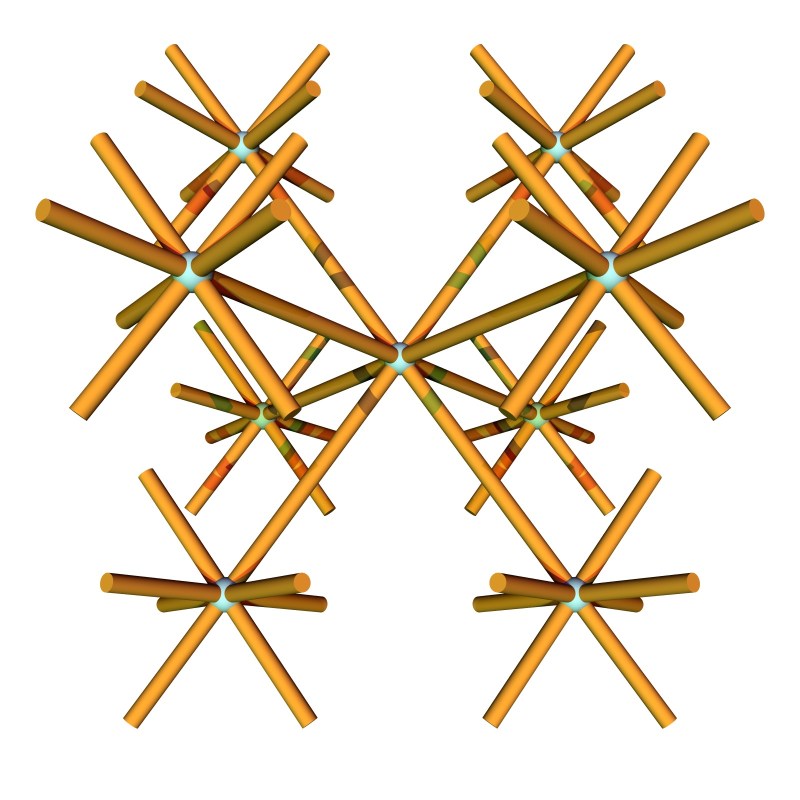
Its name (explains Schoen), stands for Wrapped Package, because a translational fundamental piece of its skeletal graph looks like four sticks wrapped together into a package:

Wrappedpackage


The internet knows little about Berthold Steßmann. There is a short biographical note by the German Mathematical Society, telling that he was born on August 4, 1906 in Hüllenberg, Germany, studied in Göttingen and Frankfurt to become a high school teacher, which he completed in 1933. Then, a year later, he received his PhD about periodic minimal surfaces, with Carl Ludwig Siegel as advisor. The same year, the Mathematische Zeitschrift published a paper of Steßmann, covering the same topic. The note also mentions that Steßmann was Jewish. This leaves little hope.

One, Two, Four

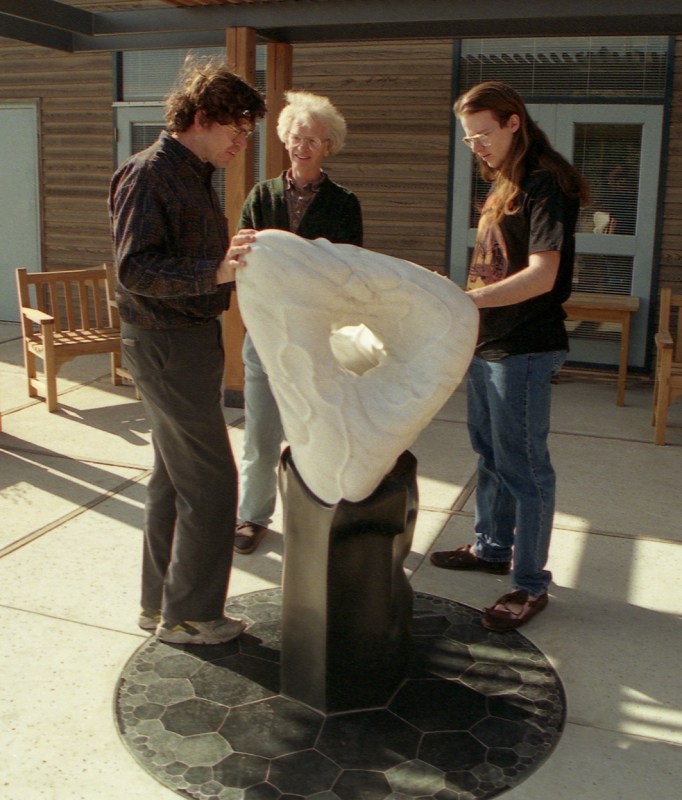
At the MSRI in Berkeley, there is a marble sculpture by Helaman Ferguson showing Klein’s quartic surface.Kleinquartic1

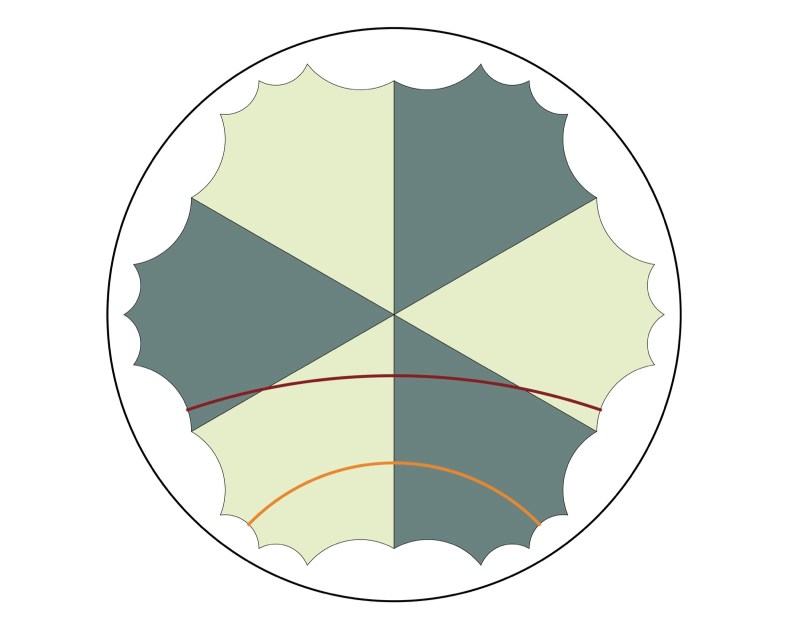
This is a Riemann surface of genus 3 with 168 automorphisms. Our Euclidean brains have a hard time seeing all these. Let’s start with an automorphism of order 7, and a tiling of the plane by π/7 triangles:

Heptatile

Fourteen of them fit around a common vertex (at the center of our hyperbolic universe), and the black geodesic indicates how to identify edges of the green-yellow 14-gon (repeat the pattern by 2π/7 rotations). Euler will tell you that the identification space has genus 3. A little miracle is that these π/3 triangles fit nicely into a tiling by π/3 heptagons. This becomes evident like so:

Klein237

The geodesic we used to indicate the 14-gon identification pattern becomes a geodesic in the heptagon tiling that passes through edge midpoints of eight consecutive heptagons, and all such geodesics will be closed on the identification space. This allows to define this surface also as an identification space of 24 heptagons (using the same geodesics). As this description is intrinsic to the heptagon tiling, it is invariant under all symmetries of that tiling, which include rotations of order 2 and order 3, in addition to the order 7 rotation.

Kleinflat 01

Why is this surface called a quartic? Replacing the hyperbolic π/7 triangles with Euclidean (1,2,4)π/7 triangles in three different ways and keeping the identifications, we obtain three different translation structures on the Klein quartic, which define a basis of holomorphic 1-forms. Playing with their divisors show that these 1-forms satisfy the equation x³y+y³z+z³x, showing that the canonical curve of Klein’s surface is a quartic curve in the complex projective plane.

Hyperbolic Architecture

In high school I usually loathed art class. But once we started an architecture project that got me excited: We were tasked to design our own house, with all bells and whistles. I decided on the rooms being regular hexagons, arranged in an annulus of six, with a center hexagon without windows.Hexa annulus

This is the motivation behind today’s surface. Six hexagons, arranged as above, with the additional stipulation that when you exit a hexagon you re-enter another hexagon as indicated by the arrows (and extended by rotational symmetry). You can easily check that when you travers the rooms by always leaving through opposite walls, you will pass alternatingly through two rooms and return. Moreover, there are a total of six rooms around each corner, which suggest that Euclidean geometry is not suitable for this architecture.

Hexa5 Hyperbolocb

In the hyperbolic plane, one can arrange six 60 degree hexagons around a vertex as above. The geodesics indicate which edges are to be identified, again implying silently that everything is rotationally symmetric.

Now in the above Euclidean model the identifications are done by Euclidean translations, defining what is called a translation structure. One can accomplish the same with other Euclidean polygons (that are still conformal images of a regular hexagon) like so:

Hexaflat2b

or so:

Hexaflat4b

In the above image we have a very short inner edge connecting the 240 degree vertices. There are a few more one can use, but they are not quite as pretty. In any case, they provide us with plenty of holomorphic 1-forms on the surface of genus 4 given by the algebraic equation w⁶=z⁶-1: This is, after all, a sixfold cover over the sphere, branched over the sixth roots of unity. The first model realized this geometrically by replacing the sphere by the double of a Euclidean hexagon. 


A Double Figure 8

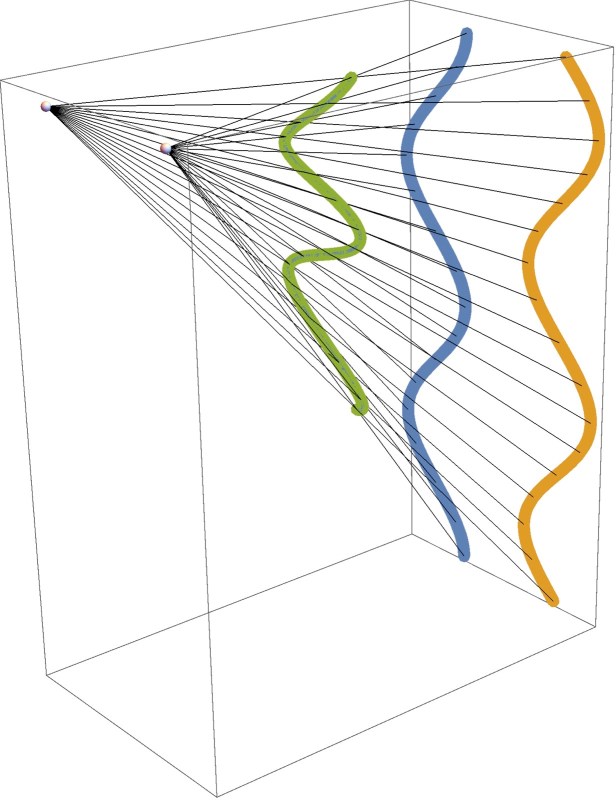
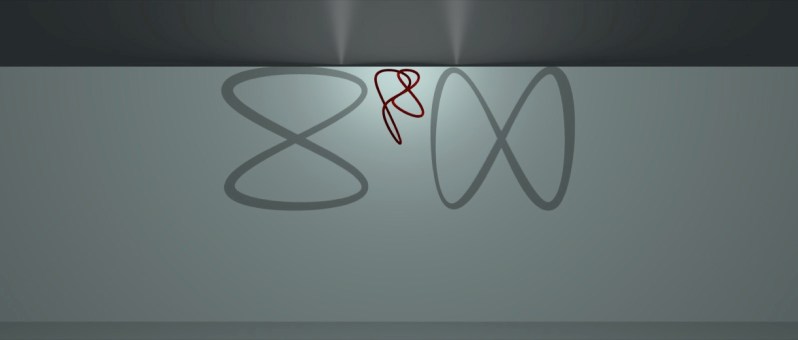
Recently, a local artist had an intriguing question. Suppose you have a hook in the ceiling (who hasn’t?), and  two spot lights in front of the hook, slightly to the left and to the right. Suppose also that you have drawn two curves on the back wall. Can you bend a wire and suspend it from the hook so that the two projections match the drawings?


Sketch

I first thought: Yes, this means we just have to determine the intersection of two cones, so this is possible but maybe tricky.

Figure8001

After playing around with it a little I realized that this is simpler than I thought: Of both curves have the same height, this is essentially always possible, and even completely explicit. In fact, this is almost as simple as using two perpendicular parallel projections.

For instance, below you see a single red wire that has two figure 8 curves as projections.

Figure8010

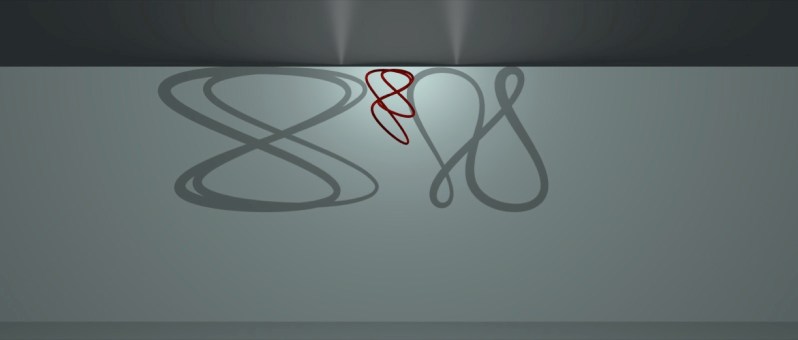
Then of course one wants to play with it and rotate the wire.

Figure8032

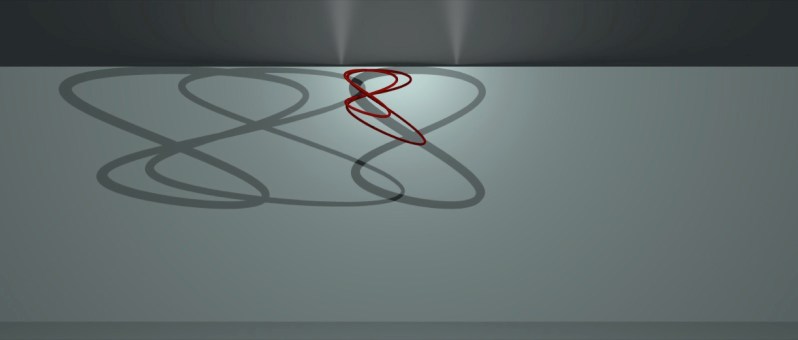
Clearly, there are two more rotational positions where one of the projections is again a figure 8, the one above and the one below.

Figure8329

Now we need to find somebody who can accurately bend wires for us.

Fake Diamonds

Below is something rare. You see two minimal surfaces in an (invisible) box that share many properties, but also couldn’t be more different.Dd4

Let’s first talk about what they have in common: They share lines at the top and bottom of the box, and they meet the vertical faces of the same box orthogonally. This means you can extend both surfaces indefinitely by translating the boxed surfaces around, in which they become triply periodic surface of genus 3.Dd1

How are the different? The red one is a little bit more symmetric and belongs to a 2-dimensional deformation family of the Diamond surface that has been known for about 150 years. You can see how these surfaces deform in an earlier post.

Dd2

The other one belongs to a different deformation family that is only a few weeks old, discovered by Hao Chen, and of which you can see here some wide angle pictures, with clearly different behavior.

Dd3

These surfaces existed right under our nose, but nobody expected them to exist, because minimal surfaces are usually content with a single symmetric solution. Chances are that these surface hold the key in understanding the entire 5-dimensional space of all triply periodic minimal surfaces of genus 3. 

Dd5