Trivalency (Solitaire VIII – Pillowbook XIII)

Triv 0

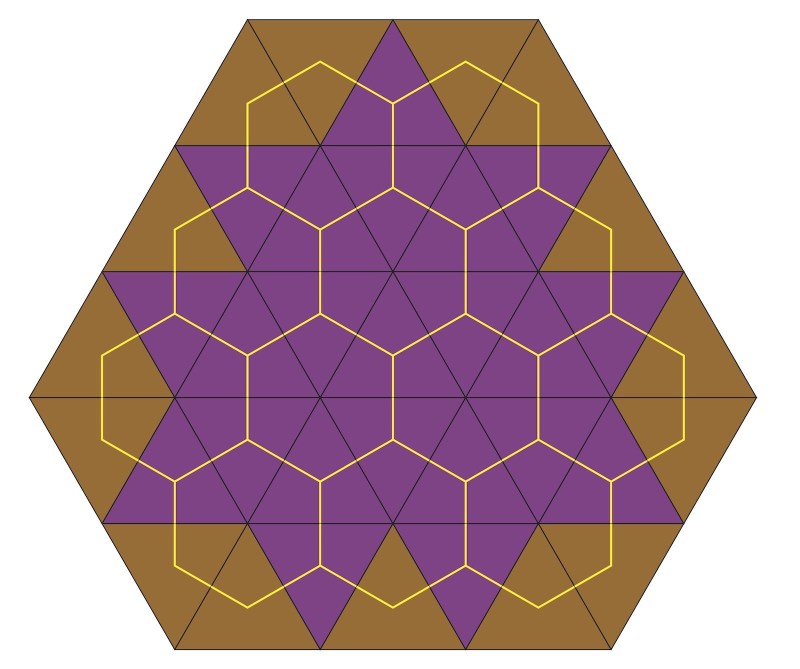
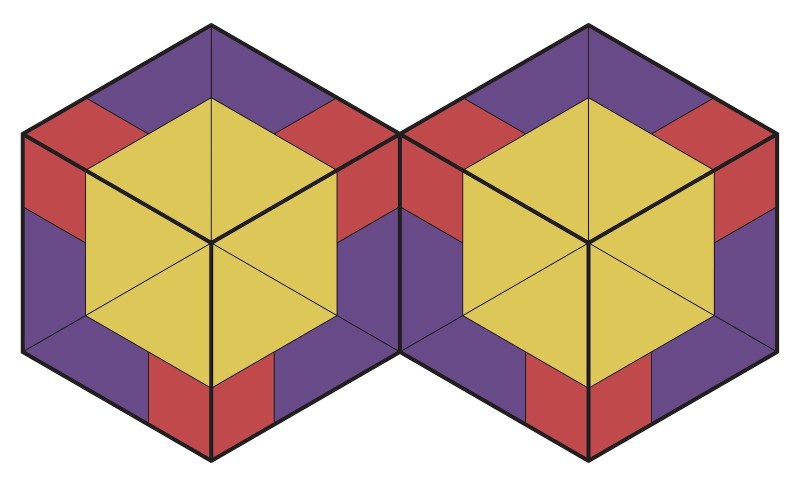
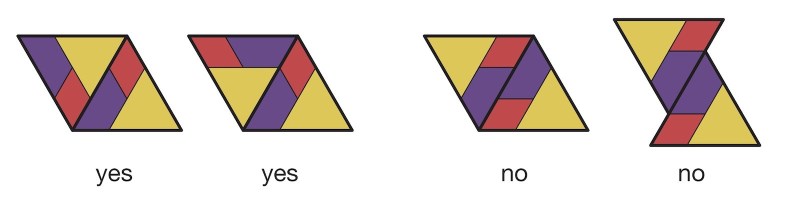
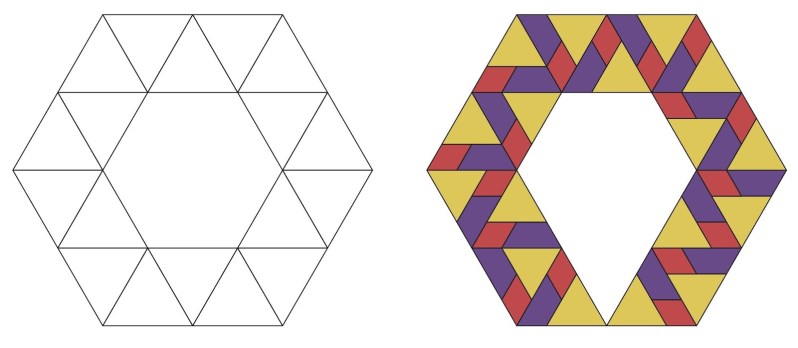
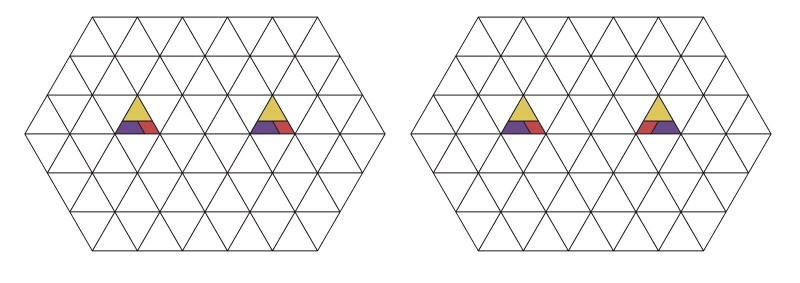
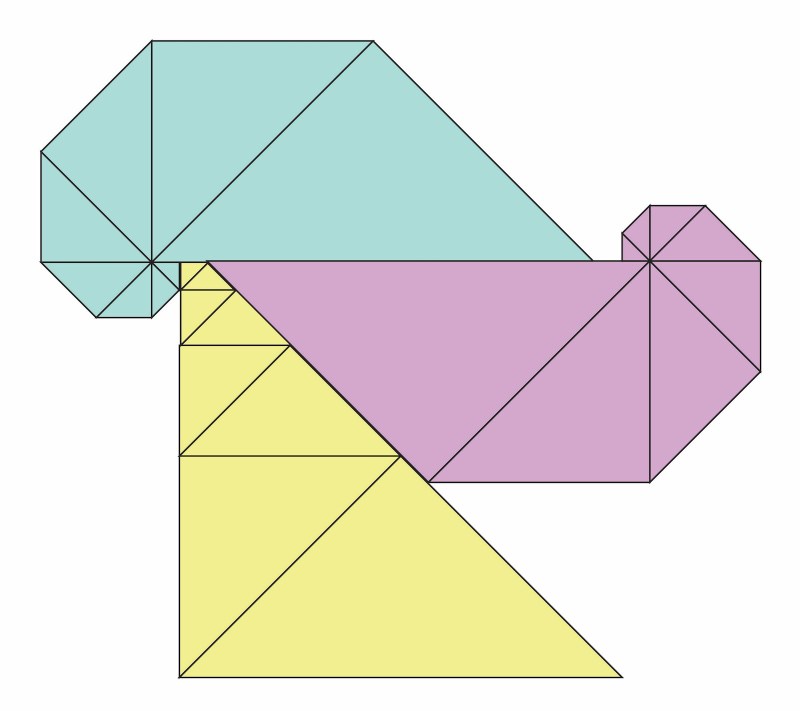
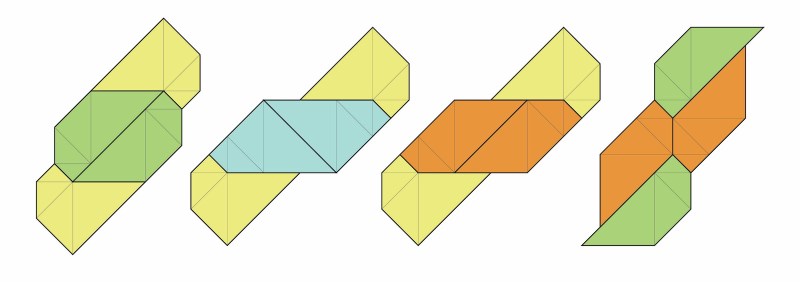
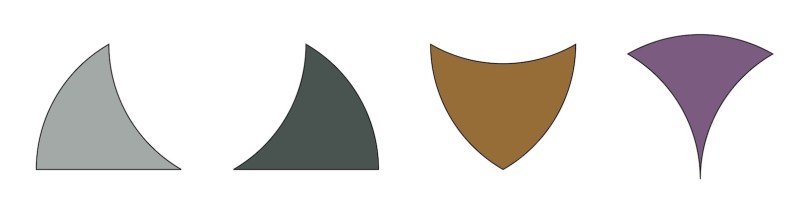
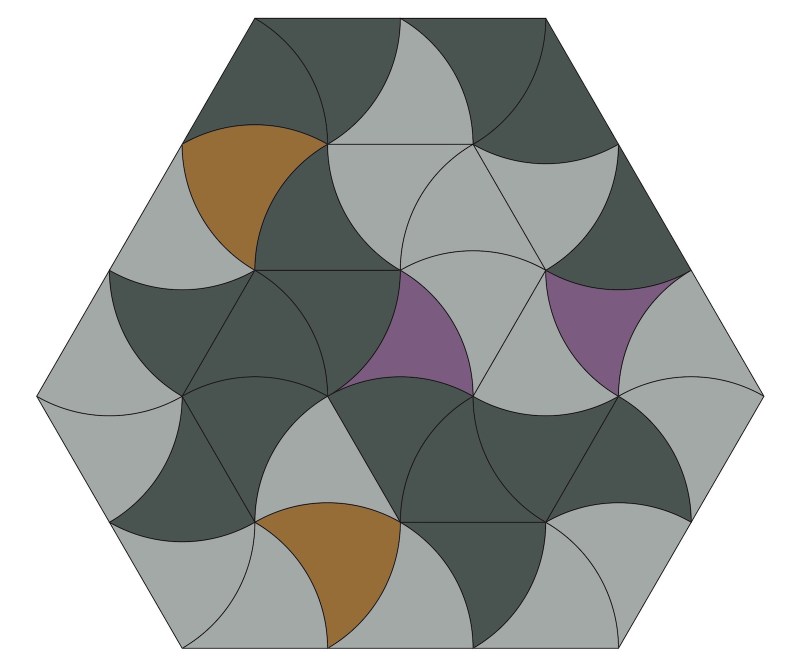
Today we will use the special trillows above to tile the region(or similar ones) below:

Triv 2

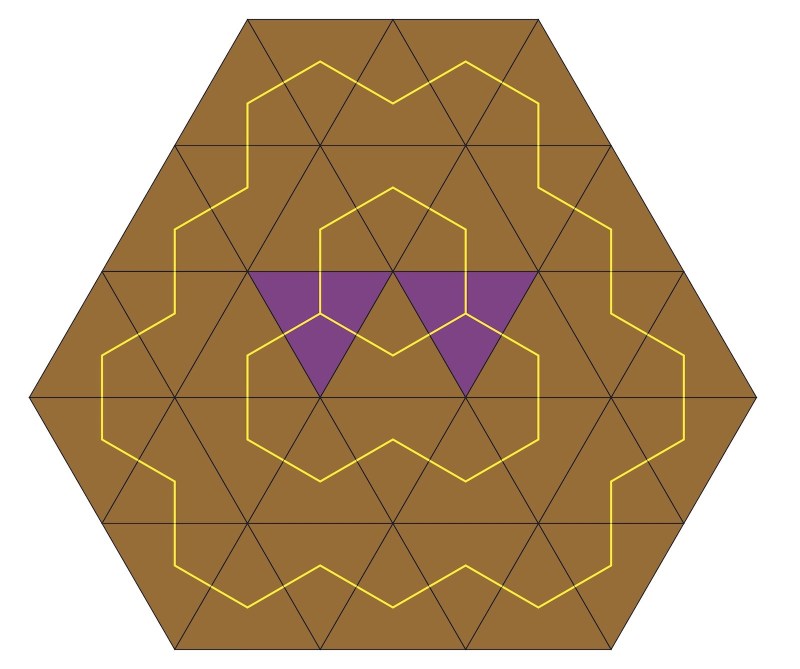
Let’s call for the moment the grayish and greenish trillows simple, and the brown and purple ones special. Here are two puzzles as starters: Can you tile the same region just with the simple trillows? Can you do it using just one special trillow?Triv 3

As an outline what is involved in creating and solving puzzles, let’s overlay the region we want to tile with a graph as above. The purple tiles will later correspond to special trillows, the brown ones to simple trillows. Let’s get rid of most of the purple tiles. We do so by deleting a yellow bridge between two adjacent purple tiles, and replacing them with brown tiles, keeping the remaining yellow edges. This amounts to partially tiling the purple region with diamonds. By now you should have solved the two puzzles at the beginning.

Triv 4

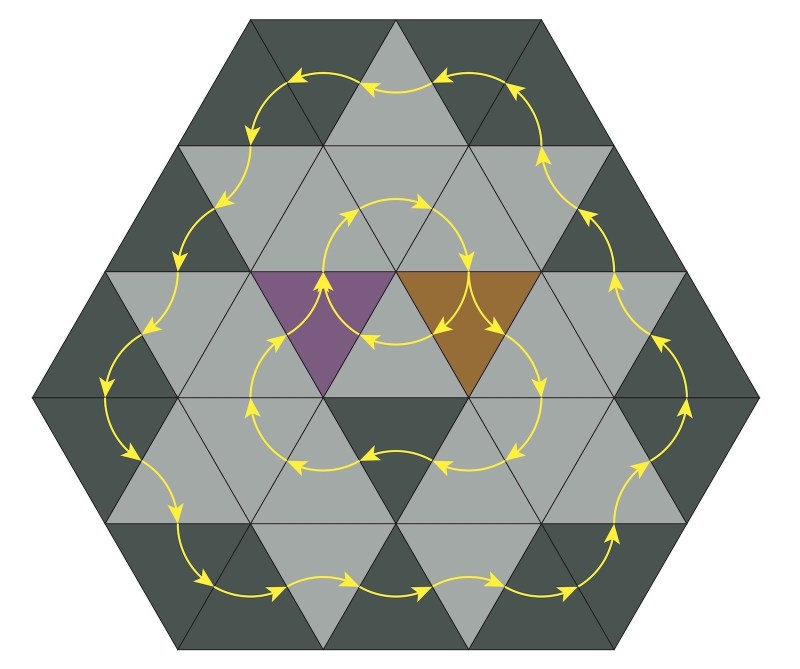
Now we orient the edges of the yellow graph. This is a bit deliberate. The outer loop we orient counterclockwise, and for the inner graph we make sure that at the two trivalent vertices the not all three edges point in the same direction.

Triv 5

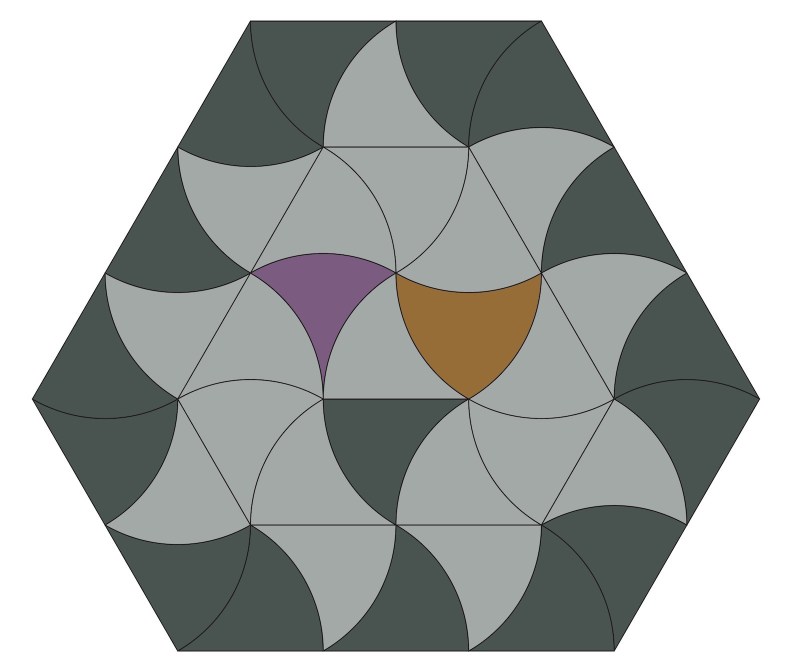
Now we inflate/deflate all triangles according to the direction of the arrows, and obtain a tiling with just two special trillows.

Triv 6

We have used three more gray trillows than green trillows. Can you do it with just one more gray trillow? Or with no green trillows a all? More about this next time.

Trillows (Solitaire VII – Pillowbook XII)

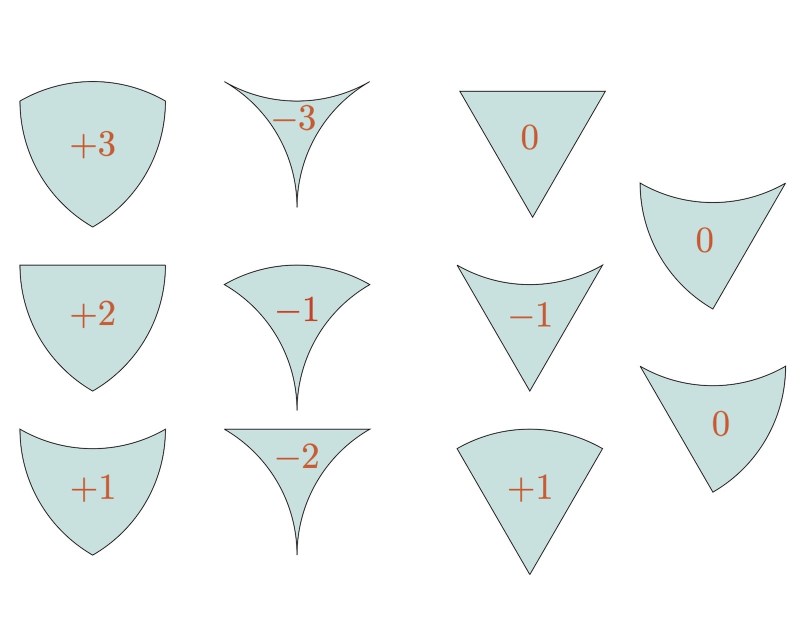
Below are the 11 possible triangular pillows, or short trillows (up to motions).

Trillows

They are obtained by replacing in an equilateral triangle some edges by circular arcs curving either inwards or outwards, The numbers indicate their defect, which is the difference between the number of convex and concave edges. This defect is additive when you tile larger regions. This means that the sum of the defects of the tiles will be equal to the defect of the entire region.

Triangles 01

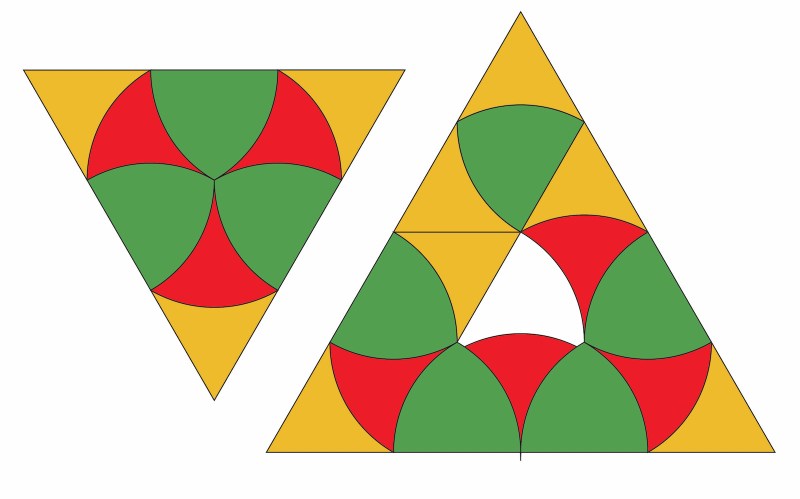
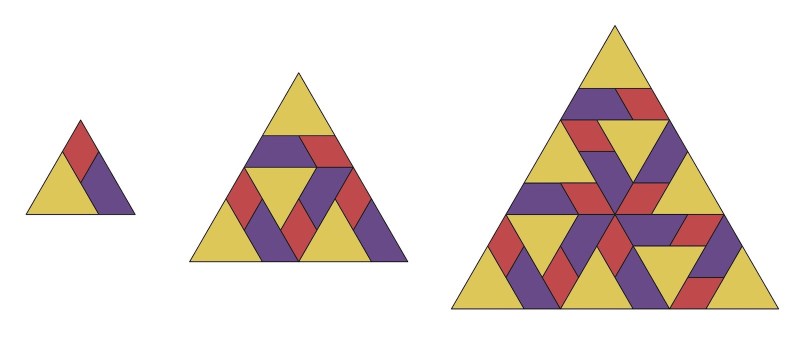
For instance, suppose we want to tile a straight triangle with the three trillows above. The green one has defect +2, while the red and yellow ones have defect -1.  To see how this becomes useful, let’s suppose in such a tiling there are just  trillows with defect +2 (A many)  and  trillows with defect -1 (B many).

A triangle of edge length 3 requires 9 trillows, so A+B=9. On the other hand, the total defect gives the equation 2A-B=0, because a straight edged triangle has defect 0. Solving this shows that A=3 and B=6, as is indeed the case in the left figure. Now go ahead and try to tile a triangle of edge length 4 with the same type of tiles…

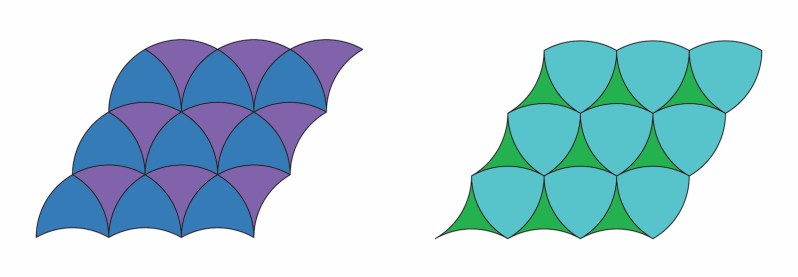
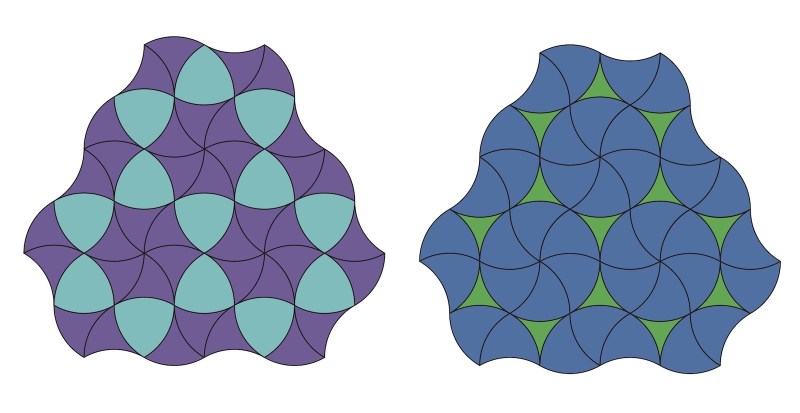
Periodic 2 01I have written about the four purely circular version briefly before. If you want to use them for a periodic tiling of the plane, the total defect of a fundamental piece must be 0. Above and below are examples that use just two trillows.

Periodic

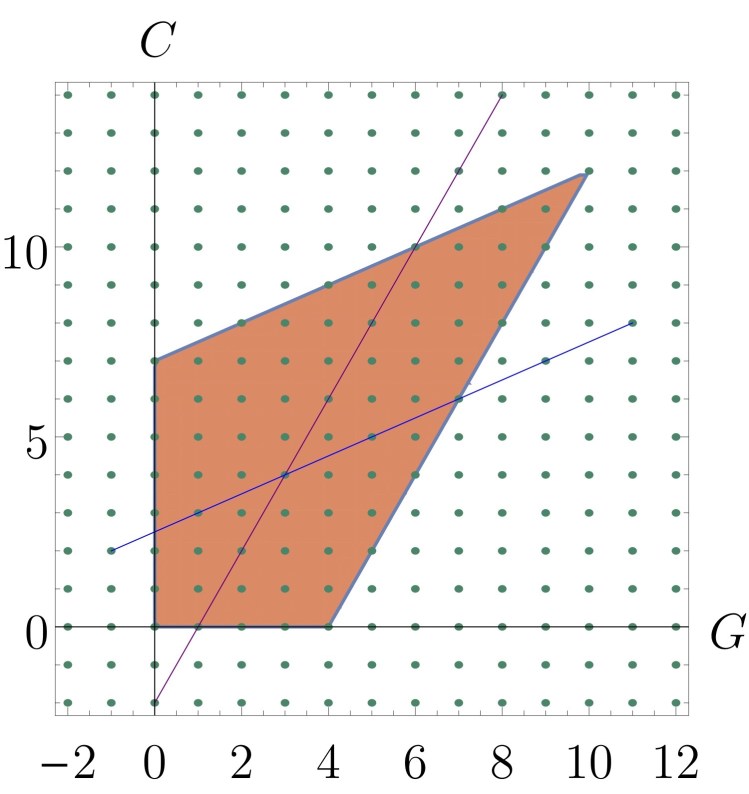
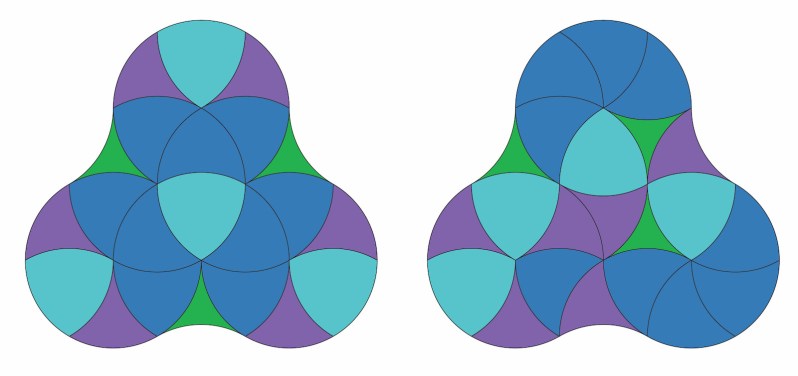
Every purely circular simply connected region has total defect +6, so if we want to tile a large circular triangle with C cyan, B blue, P purple and G green circular pillows, we have two equations to satisfy: C+B+P+G=22 for the total number of tiles, and3C+B-P-3G=6 for the total defect. Solving this for B and P gives B=14-2C+G and P=8+C-2G. Below you can see the region of values of C and G for which C,B,P,G to be nonnegative. Each dots in this regions represents a pair of integers (G,C) for which there is maybe a solution.

Curvedtriregion


The edges correspond to solutions where only three of the tiles are used, and the vertices to those with only two tiles. The blue and purple lines are examples for which G and C are constant. At their intersection we have G=3 and C=4, which determines P=6 and B=9. Below are two different solutions with these numbers.

SolIntersect 01

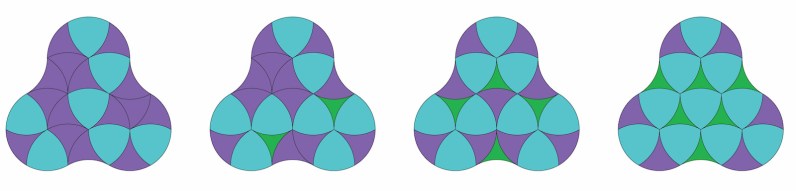
For instance, if we wanted to tile this triangle without blue, the potential solutions are on the top edge. Below are actual solutions for G=0,2,4,6. Is there one for G=8 or even for G=10?

Tri0246 01

It would be interesting to find further simple obstructions to the possibility of tiling such shapes.

Hexons (Solitaire VI – Pillowbook XI)

Hexons template 01

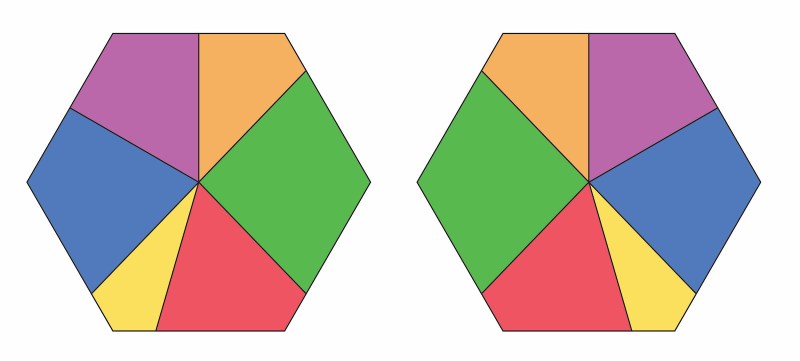
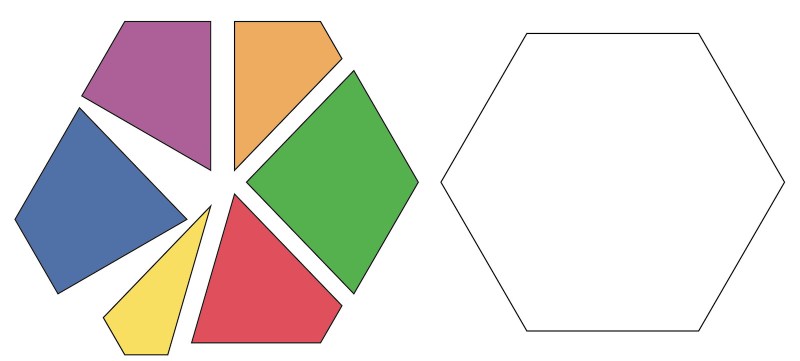
Take a regular hexagon, and mark points on each edge. Connect these points with the center of the hexagon to obtain six quadrilaterals. If we choose the marked points so that they divide an edge in one of the proportions 1:3, 2:2, or 3:1, there are exactly six such quadrilaterals (not counting mirror symmetric copies), and as you can see, they can tile a hexagon. I will call these hexons, in analogy of a puzzle by Alan Schoen that I will discuss in the near future. Above are mirror images of this solution, print & cut them out, then glue them together back to back.

Flipme 01

Here is a first puzzle: Suppose you flip one of the three pieces over (like here the blue one) that is not mirror symmetric, can you still tile the hexagon?

7Hexons 01

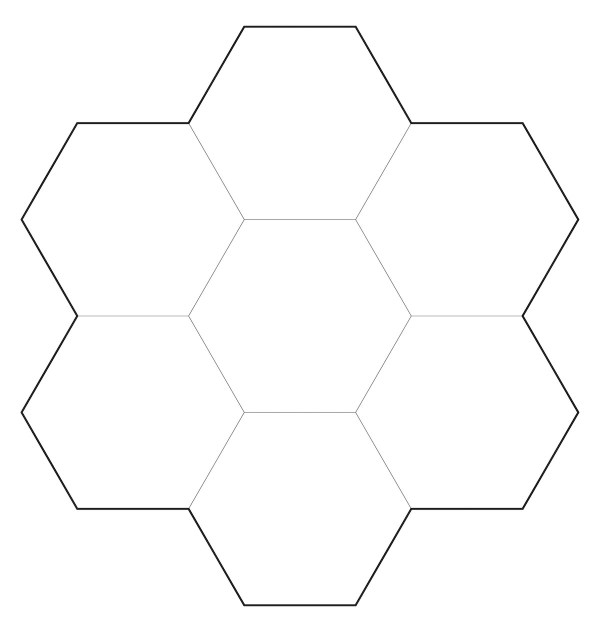
More complicated is the challenge to use seven hexons of each type to tile the seven hexagons above so that corners only meet corners, not just edges of neighboring hexons.


Triangle 01

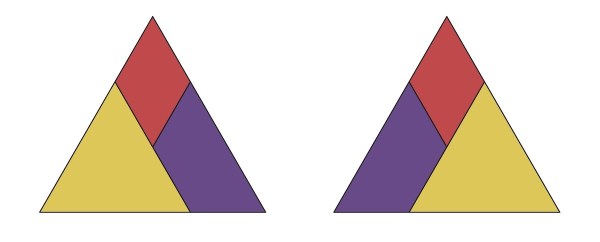
Likewise, can you properly tile the above shape, so that the vertices of the tiles only meet at other vertices?

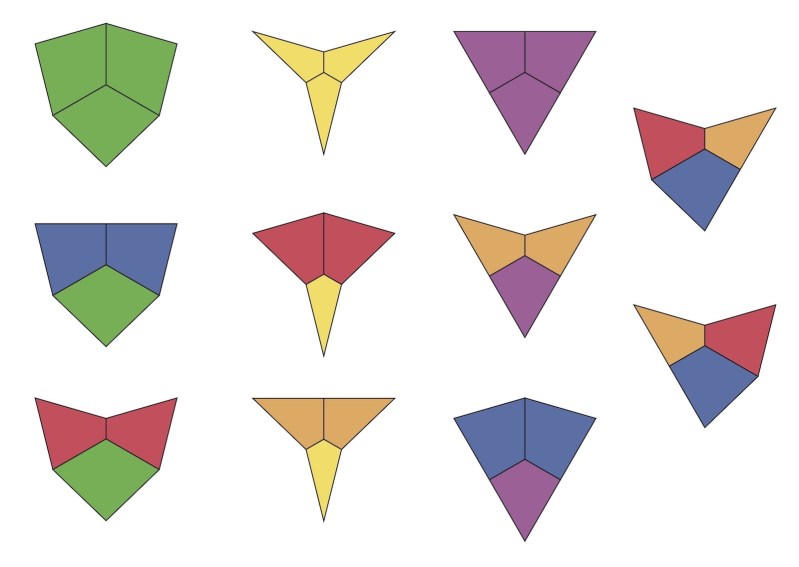
After playing with these hexons for a while, you will find it tempting and useful to group three of them together along so that they meet at their 120º-vertex. This can be done in 11 possible ways:


Triangles

You will get inflated equilateral triangles, where an edge is either straight, or has a kink inside or outside. I have discussed some of these triangles before, and the square shaped analogies (which I called pillows) in a long sequence of blog posts. Understanding how these 11 triangles can fit together will help to create and solve many more puzzles for the hexons. We will begin this next week.

In Memoriam (Solitaire V)

I just learned with sadness that John Conway has died two days ago, on April 11, of Covid-19. I am in no position to write an obituary. His playful creativity led to a synthesis of simplicity and depth that I will always gratefully admire. 

I like puzzles with few pieces, as the readers of this blog know.Pieces

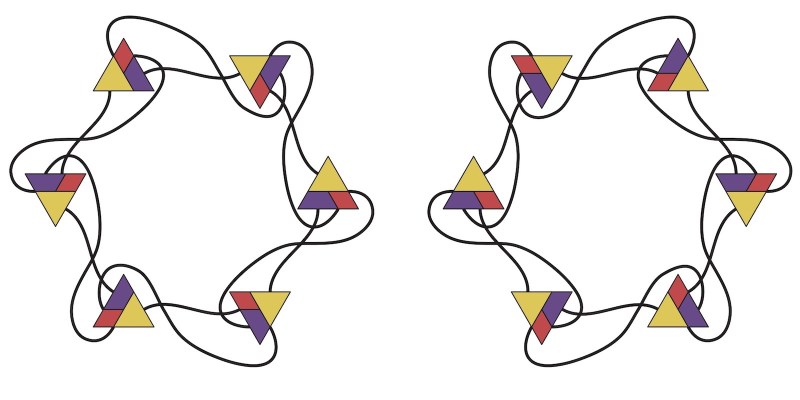
Here is such a puzzle with just one puzzle piece, which comes with its mirror image. I suggest to print the template below, cut along the fat lines, and fold & glue the diamonds into triangles. This will give you six identical triangles that you can flip over to get the mirror symmetric version. I will explain later how this puzzle piece came into existence.


Template

We are going to use this tile according to timely rules: We may put two triangles together along an entire edge if the colors nowhere match along the edge:Rules

This is a strong limitation, but we can still use this puzzle piece to tile larger triangles, like so:

Triangles

Do you think you can tile even larger triangles? Try it!

Below is a more interesting puzzle. I have been trying to tile the hexagonal ring, but failed, as there is no way to place the puzzle piece into the remaining gap. Can you find a solution that closes up and doesn’t violate the rules?

Hexring


Then you can make your own challenges: Print a game board with triangles as below, and place randomly two of the puzzle pieces onto it. Can you form a chain that (legally and ethically) connects the two triangles? Below is a very simple example with solution.

Pathpuzzle1

Here are two more puzzles. At least one of them is harder than you probably like. But who knows.

Pathpuzzle2

A slightly cryptic hint about what is going on here is below. Stay safe.

Connected

Poly-Worms (Solitaire III)

I have occasionally written about polyforms before. These are shapes obtained by putting simple shapes (like squares) together to form more complicated shapes. In the case of two squares, you ged dominoes, and more generally polyominoes. If you use other shapes, you get general polyforms.

Tiles


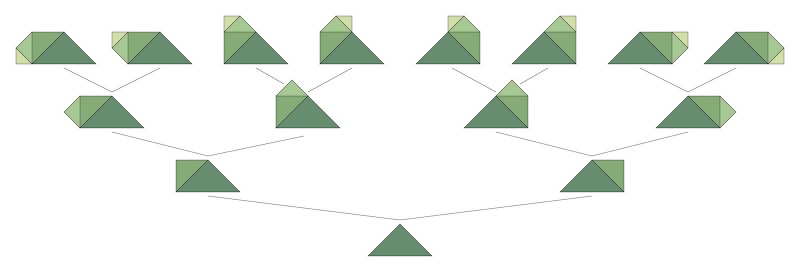
If we, in the insatiable desire for more, allow the shapes to change size, we get even more general polyforms. The ones we study today I will call poly-worms. We start with an isosceles right triangle, halve it, and attach the smaller copy to the larger, edge-to-edge. Then we keep going, halving and attaching restlessly. Above you see the first four generations, giving us eight 4-worms, which come in mirror symmetric pairs.Template 01

Above is a template that allows you to print all eight 4-worms at once. Growing the polyworms further leads to problems with self-overlapping, but also to the tantalizing possibility of having polyworms with infinitely many sides. Maybe more about this in the finite future.

Polyworms 01

Let’s practice tiling with 4-worms. Below are combinations of 4-worms that can be used to tile the plane periodically by translating them. There are also two 4-worms that tile the plane by themselves. It should be amusing to study this for general polyworms.

TwoTiles 01

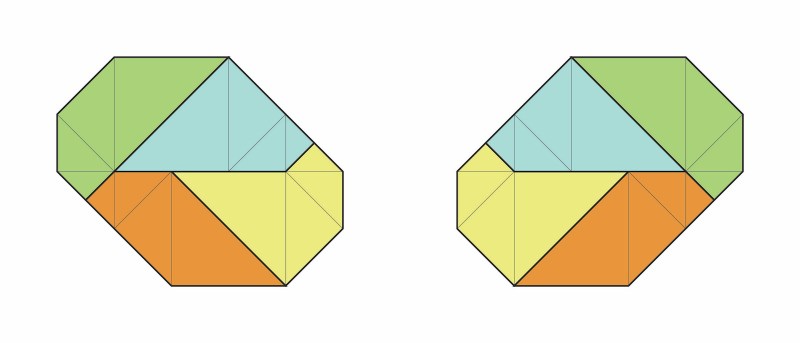
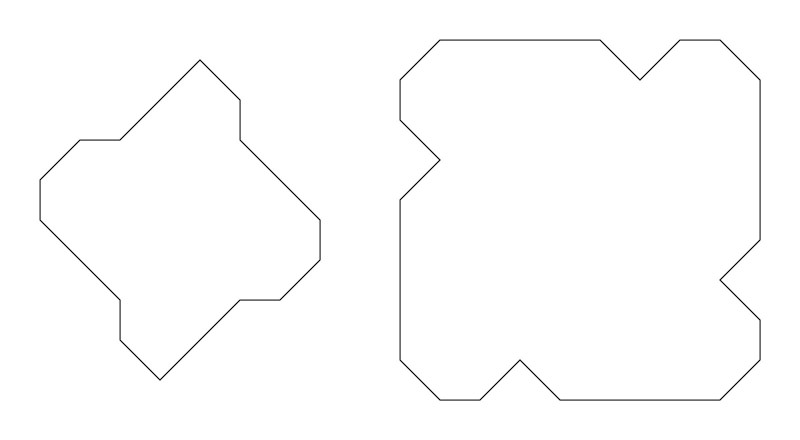
Here are two puzzles, hopefully not too easy. The goal is to tile the left one with 8 and the right one with 16 4-worms.  You will need the same number of each kind.

Puzzles0 01

Pairs of Pants

Hextiling


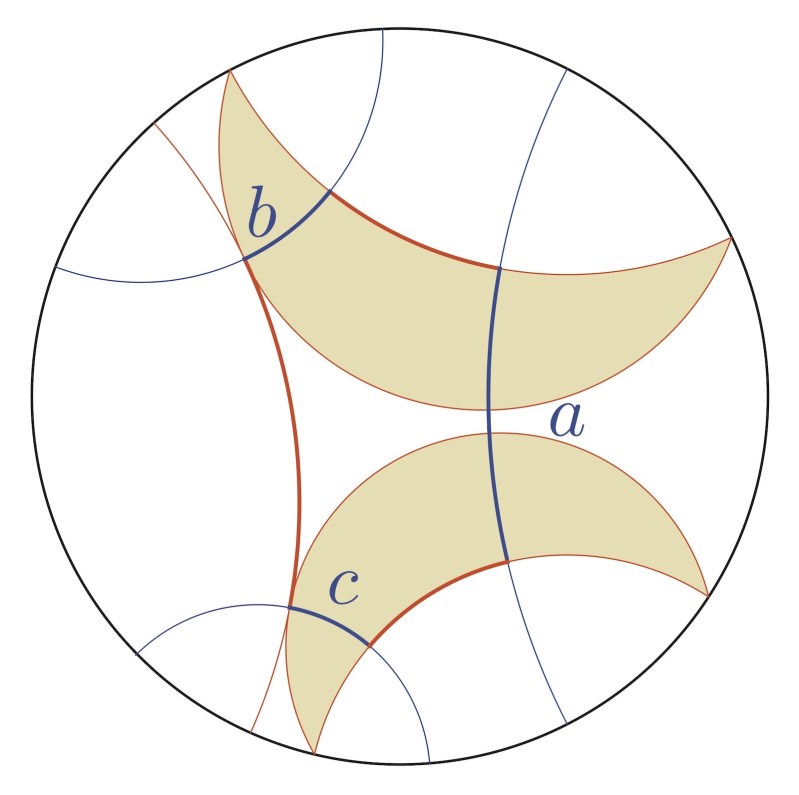
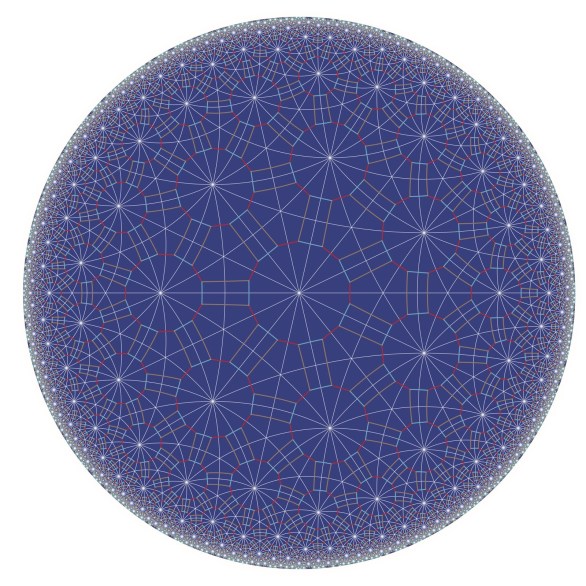
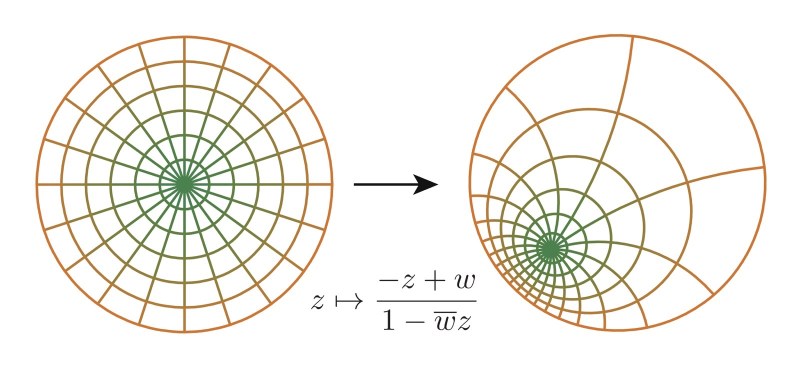
One of the striking features of hyperbolic geometry is the possibility to construct shapes that are impossible in Euclidean geometry, and one of the most important such shapes is the right angled hyperbolic hexagon. Above is a tiling of the hyperbolic disk by copies of one of them.

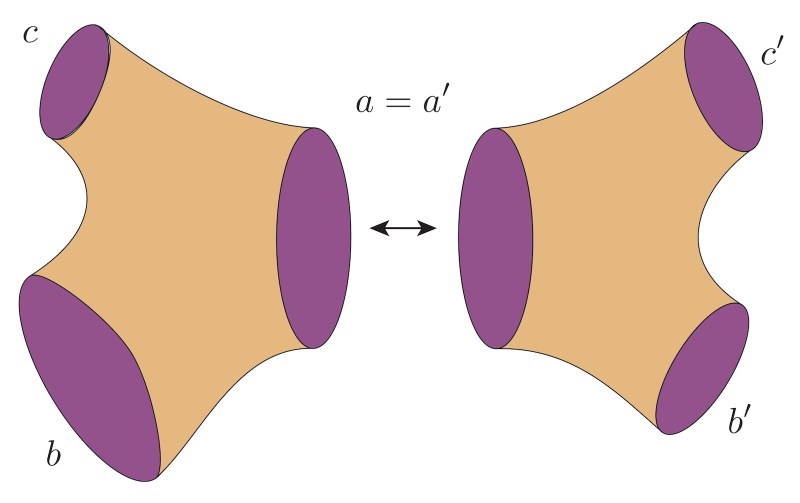
Gluepants

They are useful to make pairs of pants by sewing two congruent such hexagons together to a single pair of pants, and then to continue sewing several such pants to eventually create coordinates of Teichmüller space. For that and other things, one needs to know that they actually exist, and the basic theorem here is that for any a,b,c>0 there is a unique right angled hyperbolic hexagon that has these numbers as the lengths of its odd edges.

RightHexagon0

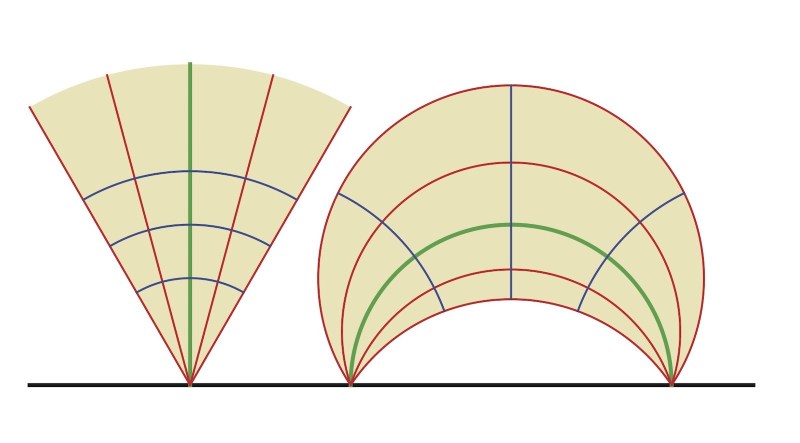
Above is a short version of a proof of that theorem which I learned from Hermann Karcher. It employs parallel curves to geodesics in the hyperbolic plane. To see what they are, let’s switch to the upper half plane model. Geodesics (green) are vertical lines or circles orthogonal to the real axis (black).

Parallel

A parallel curve (red) at distance d to such a geodesic is obtained by taking a point distance d away from it and applying hyperbolic translations along that geodesic to this point. These hyperbolic translations are simplest for the vertical geodesics, where they are just scalings with center at the end point of the geodesic. Therefore these orbits are also lines, or, in the case of circular geodesics, other circles ending at the same points as the geodesic (as follows using Möbius transformations)


RightHexagon

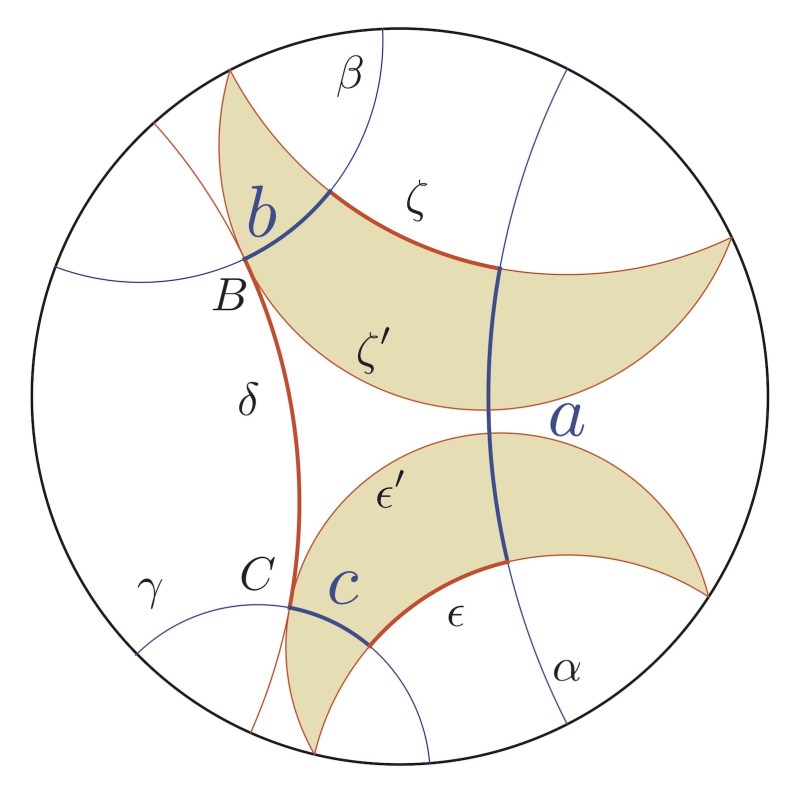
Now let’s come back to the existence of right angled hexagons. Let’s start with a (blue) geodesic segment 𝛂 of length a. Two adjacent edges 𝛆 and 𝛇 begin at the end points of that segment and are orthogonal to it, but we don’t know yet how long they are. We construct parallel curves 𝛆’ and 𝛇’ to these geodesics, distance c and b away from them. Now take a geodesic 𝛅 that touches 𝛆’ and 𝛇’ in points B and C. The geodesic segment together with the perpendiculars from B to 𝛇 and C to 𝛆 completes the right angled hexagon with the prescribed edge lengths.

Exist 1

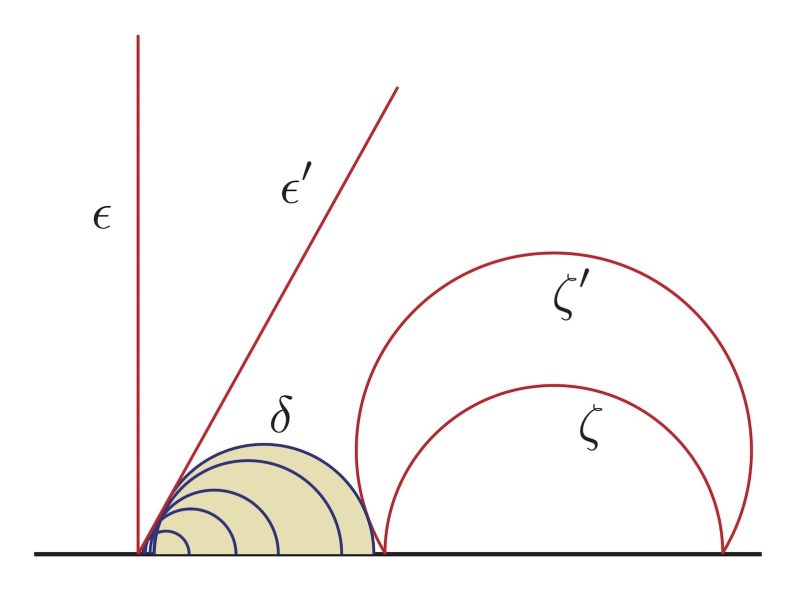
To see the existence of the touching geodesic 𝛅, it is useful to switch again to the upper half plane, where we can assume that 𝛆 and 𝛆’ are straight lines. Then the existence of 𝛅 can be seen by looking at geodesic half circles 𝛅 near the end point and touching 𝛆’ and away from  𝛇’. Increasing their radius , monotonicity implies that there is a unique such half circle that also touches 𝛇’ (from the correct side). This then also establishes the uniqueness of the right angled hexagon, up to a hyperbolic isometry.

Mirrors and Diamants

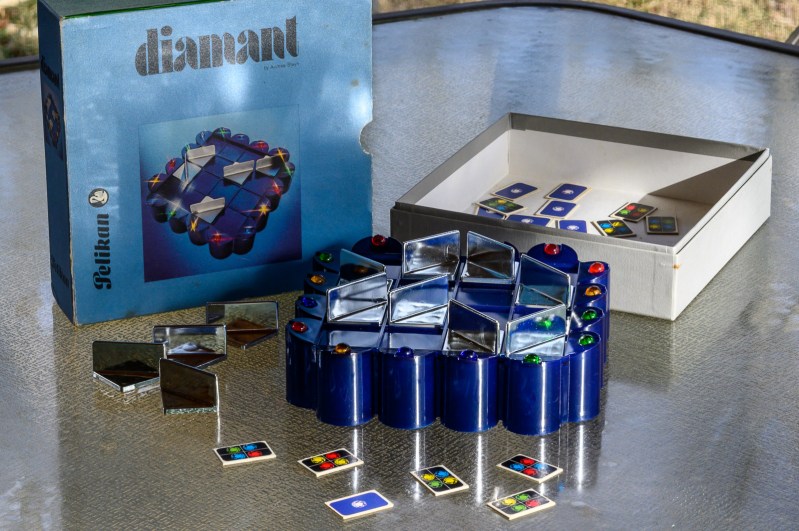
In the 1970s, the German fountain pen manufacturer Pelikan ventured into the budding market of authored board games with a series of games in a well designed format. The market wasn’t ready, and some of the games had serious issues with their rules. I bought three of them, and only one was a keeper: Diamant, by Andrea Steyn.

DSC 2485

You got a game board (advertised as 40mm thick…) to hold 12 silvery plastic mirrors and 16 small diamonds in 4 colors, as well as a set of goal cards. Players would take turns placing mirrors on the board, or later moving them. Then they could send (virtual) light beams from their side of the board, having them reflect on the mirrors to eventually hit one of the diamonds, which the player could then take in order to work towards completion of their personal goal card. 

Ex4 1

Above is a top view of the board, showing mirrors and color coded light beams. The numbers at the border indicate how many mirrors are hit by the light beam, starting/ending at that number.

Ex4 4p

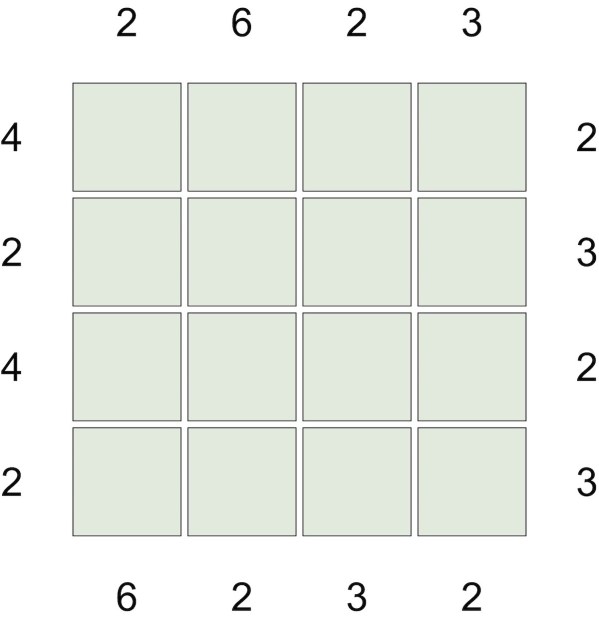
By discarding the colors and the mirrors, you can turn any mirror configuration into a puzzle, like the one above. A good strategy is to place mirrors that give the correct small numbers. While not forced, a first step towards a solution might look like this, dealing with the 2s:Ex4 4a

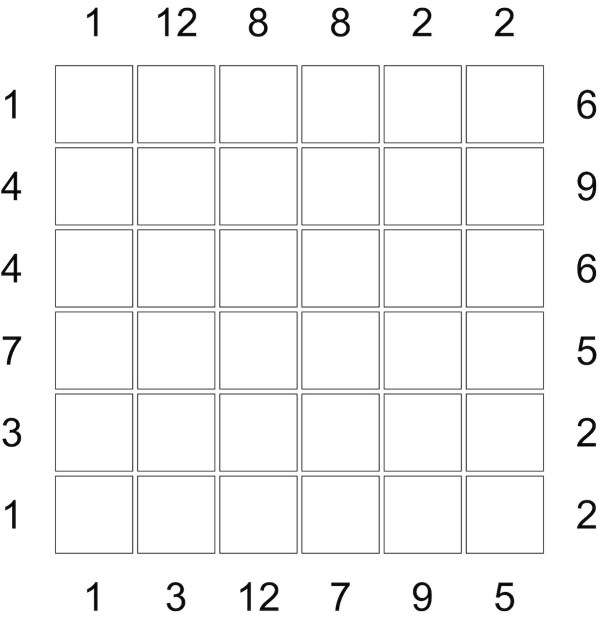
Now you can see which of the 3s have to connect, and from there the solution is easy to find. Below is a much harder puzzle on a 6×6 board. My solution uses 15 mirrors of each kind.

Mirror6x6

I don’t know how (computationally) hard these problems are, but they are obviously NP (non-deterministically polynomial): It is trivial to check whether a solution is correct. There are many variations of this simple puzzle (building in refraction, for instance…), and cute little math problems one can ask about the numbers that can show up at the border. Maybe I’ll come back to this in the future.


Hyperbolic Geodesics (Geometry and Numbers II)

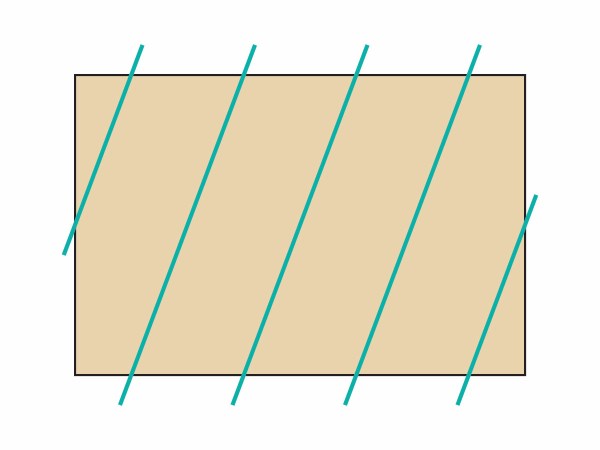
One of Euclid’s axioms states that lines can be extended indefinitely. If we have to be content with a finite canvas, like the rectangle below, we have to resort to a trick to keep lines going when they hit the boundary of the canvas. One such trick is to allow the line to re-enter the canvas at the corresponding position on the opposite side of the canvas. Those of us who have been exposed to asteroids in their dark past are familiar with this. Lines with rational slope will thus look like this:
Torus 01

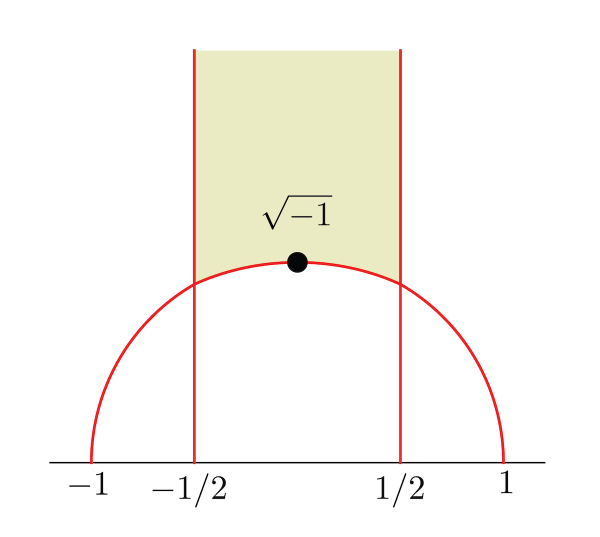
If the slope is irrational, they will become dense, i.e. come arbitrarily close to any given point on the canvas. In either case, all segments of a given line are parallel. This changes when we switch to hyperbolic geometry, represented by the upper half plane, where lines (now called geodesics) are half circles perpendicular to the boundary, or vertical lines.
Modular 01

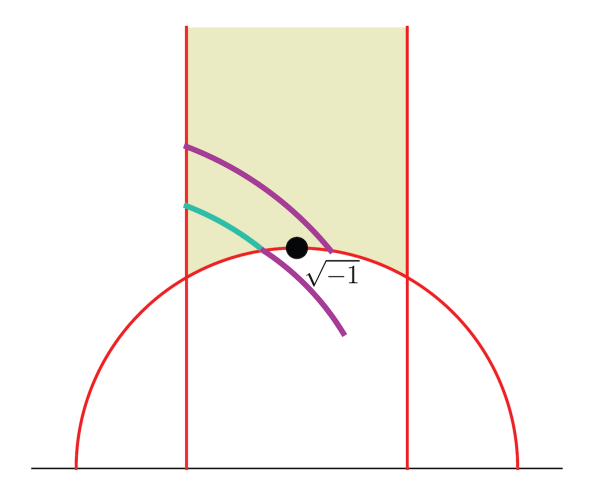
Above you see three such geodesics, forming the boundary of the shaded region, which will be our canvas. This canvas is the classical fundamental domain of the modular group. If we want to follow hyperbolic geodesics in this canvas, we have to explain what to do when a geodesics hits one of the sides of this infinite triangle. This is easy for the left and right vertical edges: If the green geodesics exits at the right hand side and becomes purple (due to lack of oxygen), it is translated back to the left. This translation by -1 is in fact not only a Euclidean congruence, but also a hyperbolic one.Artintrans2 01
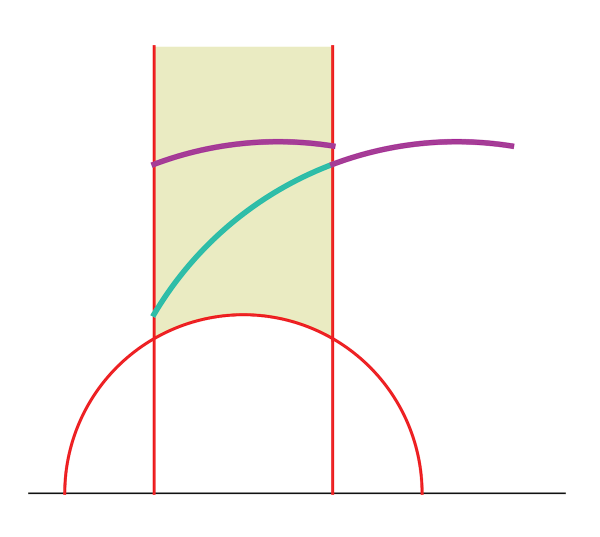
When a geodesic tries to exit at the circular bottom, it is rotated back, using a hyperbolic rotation by 180º about the point √-1, which is in complex numbers given by z↦-1/z. That’s a bit harder to visualize for our Euclidean eyes. One way to think about it is to find the point where the green geodesic becomes purple, take the corresponding point on the other side of the black dot on the bottom red half circle, and continue with a purple geodesic up into the shaded region by making the same angle as the one you made when exiting.
Artinrot2 01

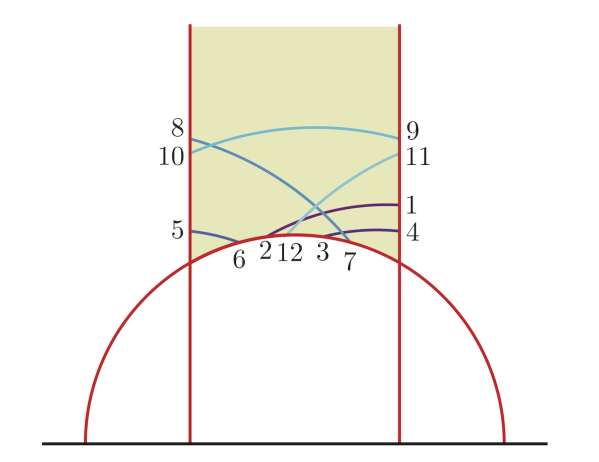
This allows to draw hyperbolic geodesics just like we did in the rectangle with Euclidean lines. Below is a more complete picture that shows how much more complicated or chaotic this is becoming when we keep extending the geodesic. The numbers help to identify end points of segments. How complicated can this get?
Artingeodesic

The two operations that allow us to continue a geodesic, namely z ↦z±1 and z↦-1/z are exactly the operations that we used last week to find the continued fraction expansion of a real number. This seemingly far fetched connection points to a deep link between number theory and geometry: Take a geodesic in the upper half plane, and look at its left and right end points a<b on the real axis. We will limit our attention to the case that -1<a<0 and 1<b. Write both -a and b as continued fractions, this gives two sequences of positive integers  a₁, a₂,… and b₀, b₁, b₂. We combine these into a single bi-infinite sequence …b₋₂,b₋₁,b₀,a₁, a₂,… which we denote by cᵢ.

Now it turns out that continuing the geodesic across the edges changes the sequence cᵢ either into c₋ᵢ₋₁ or into cᵢ₊₂. Either operation represents a mere shift or flip of this sequence. This leads to a remarkable theorem of Emil Artin from 1929: There is a hyperbolic geodesic on this canvas that comes any given hyperbolic segment on the canvas arbitrarily close. So this geodesic is not only dense, but dense in all directions simultaneously.

To see this (a little bit), it suffices to find a suitable bi-infinite sequence cᵢ of integers encoding that geodesic. Take as cᵢ a sequence that contains every finite positive sequence of positive integers as a subsequence. Then, for a given geodesic segment, find its bi-infinite sequence, and truncate it at both ends to get a finite sequence. By truncating further out, we obtain better and ebtter approximations of the given geodesic. As every finite sequence of positive integers is contained in our sequence  cᵢ, we will (by continuation) eventually find a segment of the encoded geodesic that is as close to the given segment as we desire.

This theorem of Artin is at the beginning of the study of both geometrical dynamical systems (the geodesic flow) and symbolic ones that are related to number theory and exhibit a chaotic behavior that is not apparent in Euclidean geometry.


What is a Number? (Geometry and Numbers I)

The moment when humans made the abstraction from a set of objects to its cardinality and thus discovered counting is lost in history. There are other moments of similar impact that we know more about. Today, we are so familiar with numbers that we often forget that they are used to measure quantities and even ignore units, confusing distances and durations.

1234

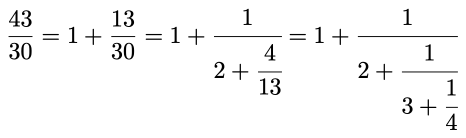
For the early pre-Aristotle Greek mathematicians, lengths were not numbers at all. Numbers occurred as proportions, as ratios of lengths (or durations). One segment could be say twice as long as another segment. More generally, the Greeks called two lengths commensurable if their ratio is, in modern terms, a rational number. They would detect this by fitting one number, like 30, as often as possible (once) into another number (43), take the remainder (13), fit that in the second number (30) as often as possible (twice), take the remainder (4) etc. etc. What emerges is the continued fraction above, terminating eventually, because the denominators get smaller and smaller.
Phi

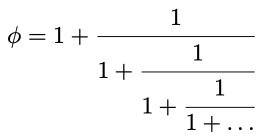
If the lengths are not commensurable, the continued fraction becomes infinite, like the one above. For the Greeks, this expression was essentially an algorithm. An infinite fraction is a mind boggling thing. How does one even compute it?

Pentagram

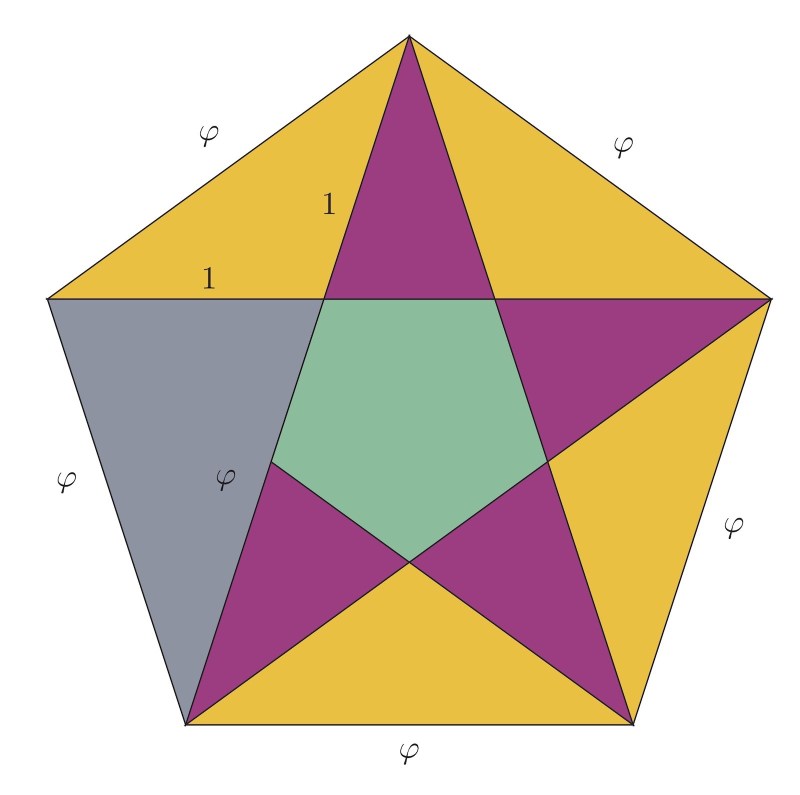
Geometrically, this can infinite continued fraction arises by comparing the side length 𝝋 of a regular pentagon to a segment of length 1 of its diagonals. Simple similarity of triangles tells us that 𝝋=1+1/𝝋. Rewriting this once leads to 𝝋=1+1/(1+1/𝝋), and if we keep going a little while longer, we arrive at the infinite continued fraction above. This reproduces how the Greeks proved that the Golden ratio 𝝋 is irrational (if it was rational, the continued fraction would be finite).

Root2b

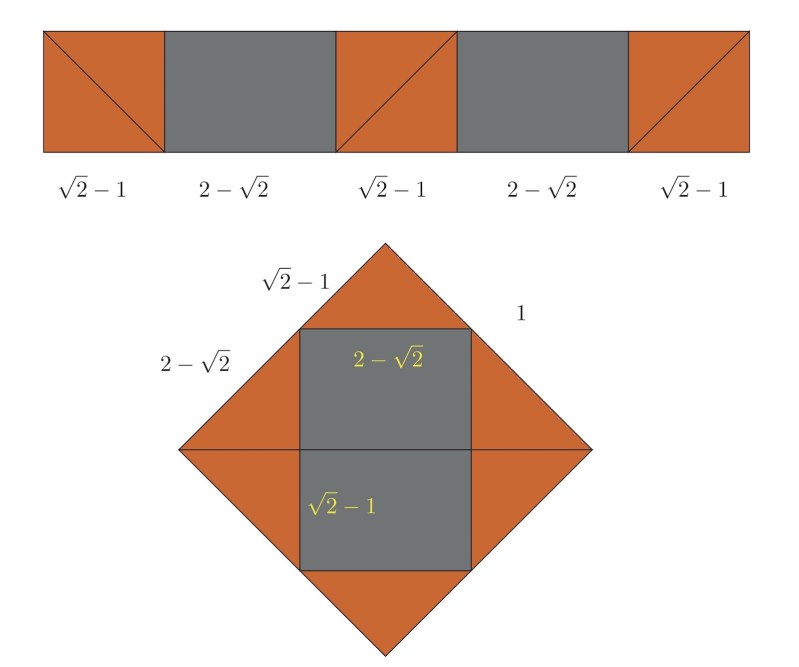
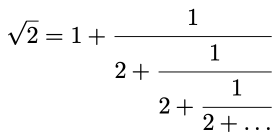
Similarly, the above dissection of a unit square into a rectangle shows that (√2-1)(√2+1)=1. This is arithmetically easy, but the concept of a root of a number didn’t make sense to the Greeks in the early days. This equation is the essential ingredient to prove the continued fraction expansion of √2 (and thus its irrationality).

Sqrt2

Of course, the standard proof by contradiction that is taught today (and which probably goes back to Aristotle) makes the cumbersome process of finding continued fractions cumbersome. We will see next week that they still serve higher purposes.

Hyperbolic Geometry

One of the most valuable human capabilities is doubt. Education seems to contradict this, early on we are encouraged to take certain things for granted. The trust in Euclid’s axioms for geometry was certainly universal and contributed to Immanuel Kant’s confidence that time and space are given to us as a priori.

Parallel 01

The ability to draw parallel lines, for instance, seems to be a given, and that this possibility is to a great deal responsible for being able to create realistic looking perspective drawings. What we can see with our own eyes must be true.

Parallelp

The discovery of hyperbolic geometry by Bolyai, Gauß, and Lobachevsky  is credited with overthrowing all this. If we are willing to accept that lines are not what they appear, but only have to obey all the other axioms of Euclid, then the parallel axiom does not need to hold. As mind boggling as this entire business is for the mathematician and philosopher, as irrelevant does it seem to be to the everyday person. After all, what we see is still true, isn’t it?

Cayley

That there is a hard to explain esthetic appeal to that disk with its crazily symmetric patterns doesn’t quite justify the importance of hyperbolic geometry in contemporary mathematics either. Calculus at least is useful. That hyperbolic geometry makes its inevitable appearance whenever we study very simple things like the geometry of the circle or multiplication of 2×2 matrices, doesn’t really force us to talk about it, does it?

Diskauto

As flawed as our universal trust in the nature of space is our trust in the linearity of things. Double the income, double the happiness? Double the pain, halve the crime rate? It sounds too easy not to be true, and is often evidenced by the linearity of Euclidean geometry. Hyperbolic geometry is the simplest geometry where linearity fails and allows for dynamical systems with chaotic behavior. We have known this for over 100 years. We experience the effects on a daily basis, but prefer to ignore it.

Below are my class notes about hyperbolic geometry and incidence geometry, taught to undergraduates. Enjoy.

Notes on Hyperbolic Geometry (letter)

Notes on Hyperbolic Geometry (screen)

Notes on Incidence Geometry (letter)


Notes on Incidence Geometry (screen)