Hic Sunt Dracones

Take a long strip of paper, and fold it left over right, then left over right again, and so on, a couple of times.
Even if your strip is very thin and long, you probably won’t be able to do that more than six or seven times.

Then carefully unfold the paper so that each bent makes a right angle. What you get will look like this:
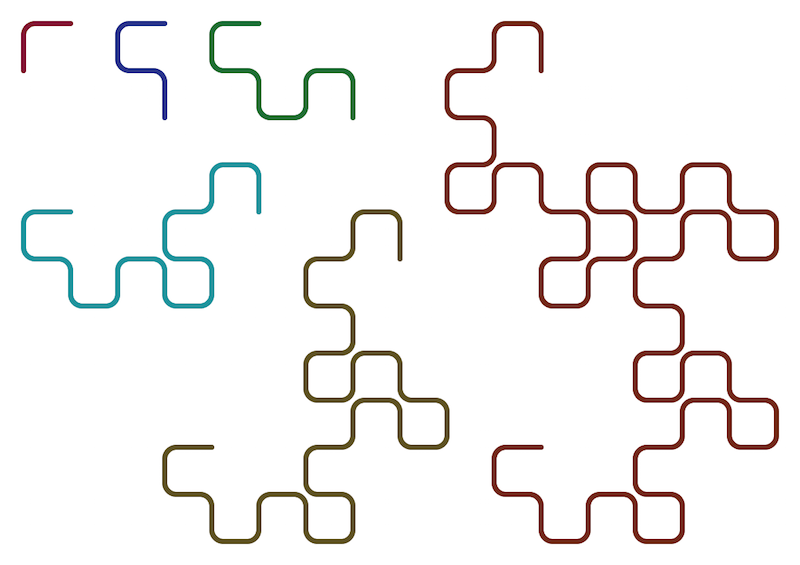
Samples 01

Another method leads to the same curves. Start with a curve consisting of two segments, making a right angle. Think of it as being a track you want to walk along. Things being difficult, you happen to swerve slightly to the right on the first segment, and on the second slightly to the left, meaning that instead of following the blue path, you walk the red path:
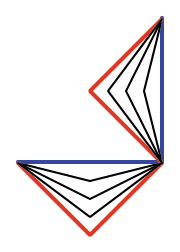
Drunk1 01

Now try again, this time starting with the red path that is four segments long (and colored blue below). The same happens, you alternatingly swerve right and left, creating the next (red) path. The curves will be the same ones as above.
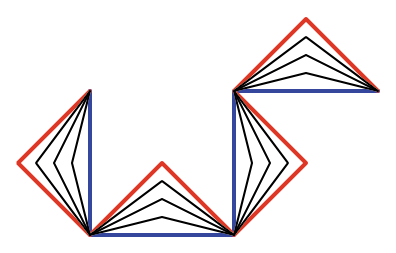
Drunk 01

Is there any sense to it? Things get more amusing if you replace each segment by a square that has that segment as a diagonal. This turns the curves into polyominoes, as you can see for the first few cases below.
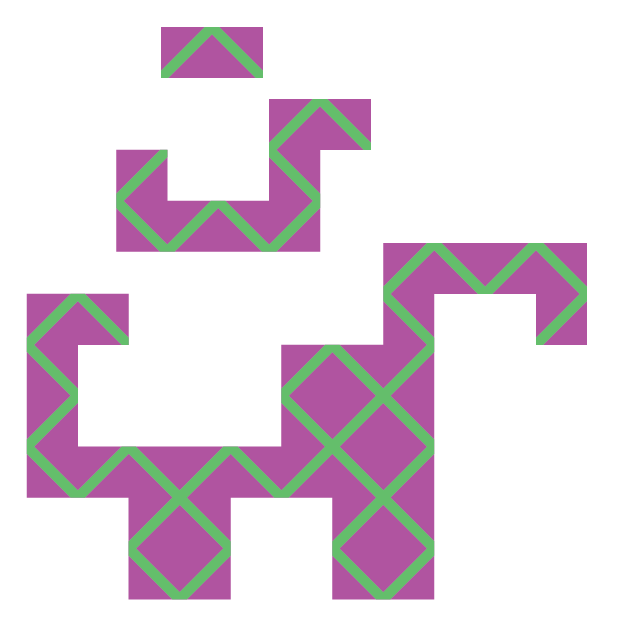
Polyominization 01

You will also see that these shapes start resembling a common dragon. If you keep folding a little while, more details emerge.
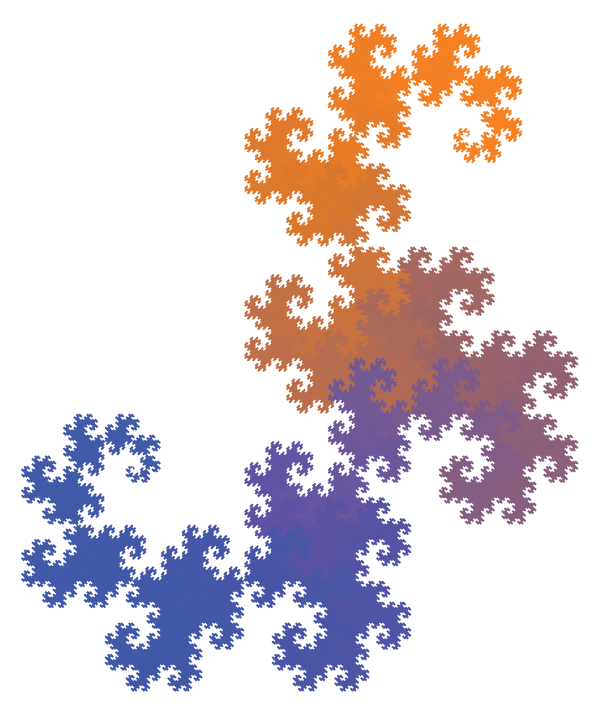
Reddragon 01

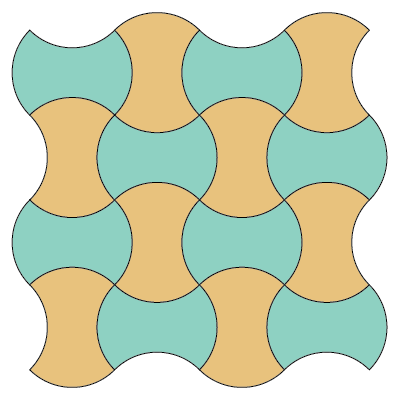
But it gets better. All these polyomino-dragons tile the plane, interlocking perfectly. Both the young dragonlings
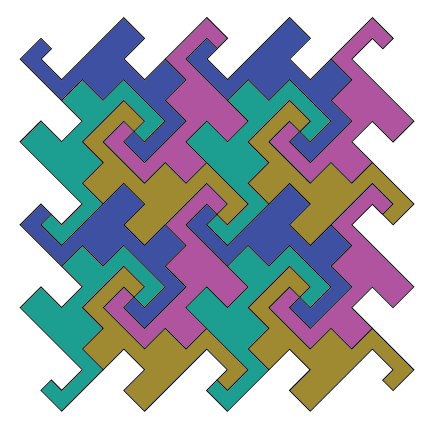
Dragontile1c 01
and also the older, wrinkly ones:

Dragontile2 01

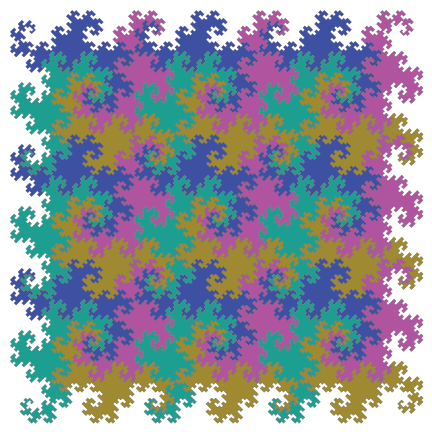
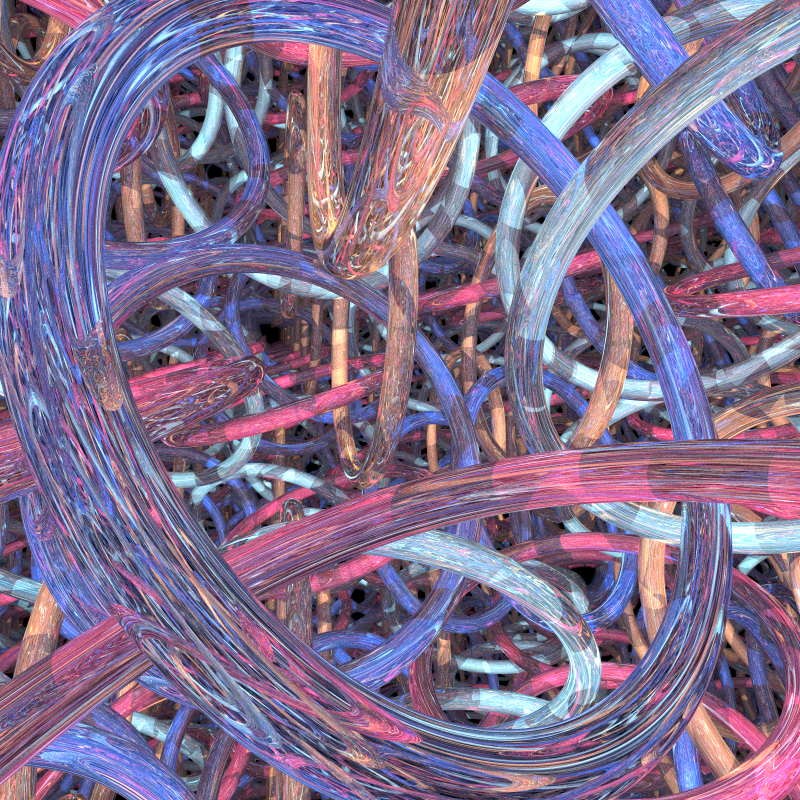
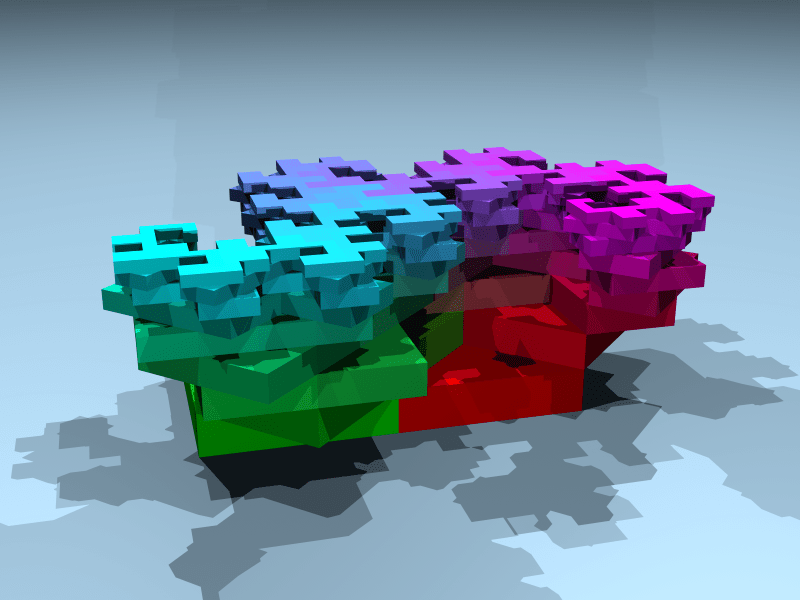
Now imagine stacking these dragons on top of each other, generation by generation. If I had the money, my mansion would look like that.
Dragonhouse

Touching Inside and Outside (Spheres XII)

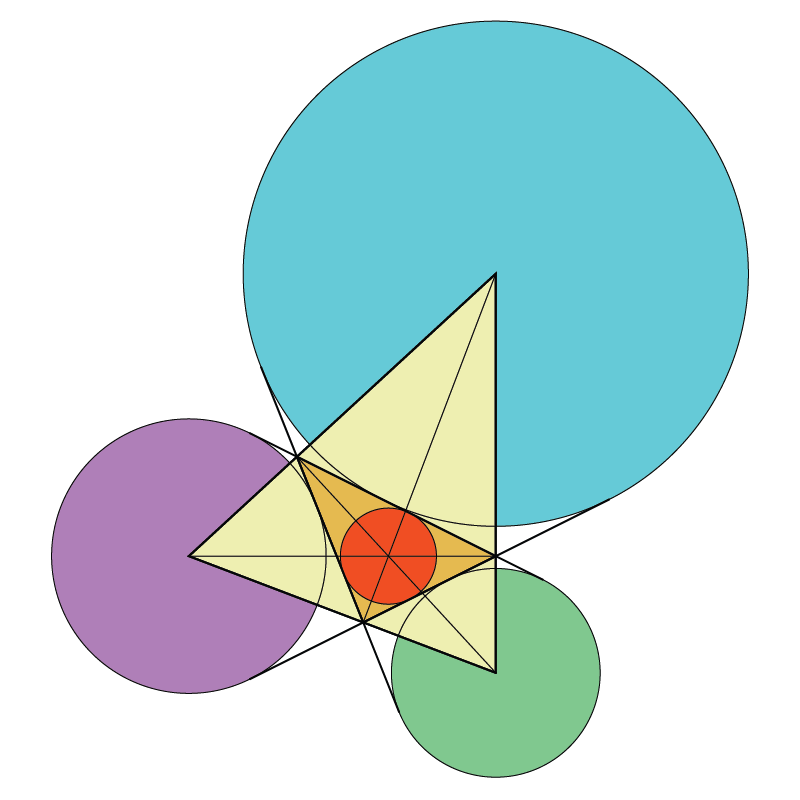
High school students taking geometry are until this day tasked to locate the incircle of a triangle: The circle that touches all sides. One learns that its center is where the three angle bisectors meet, and that’s that.
Inexcircles 01

It’s less often taught that there are three more circles (the excircles), touching two sides of the triangle from the inside, but one form the outside. Their three centers are the corners of a triangle in which the former angle bisectors become the altitudes.

Tetra 1

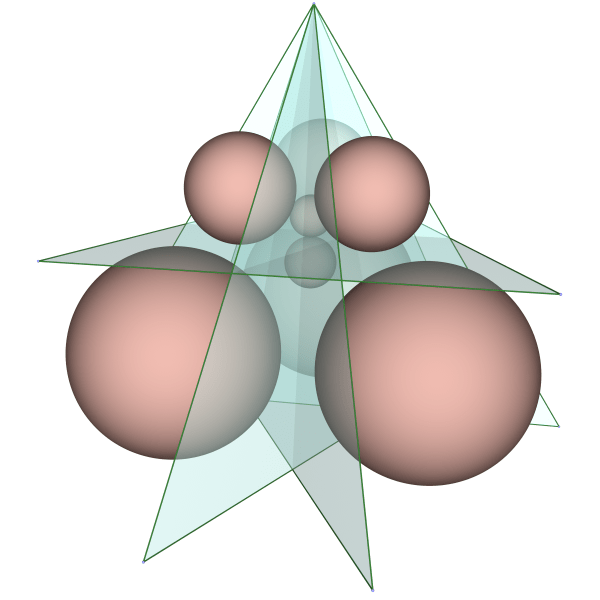
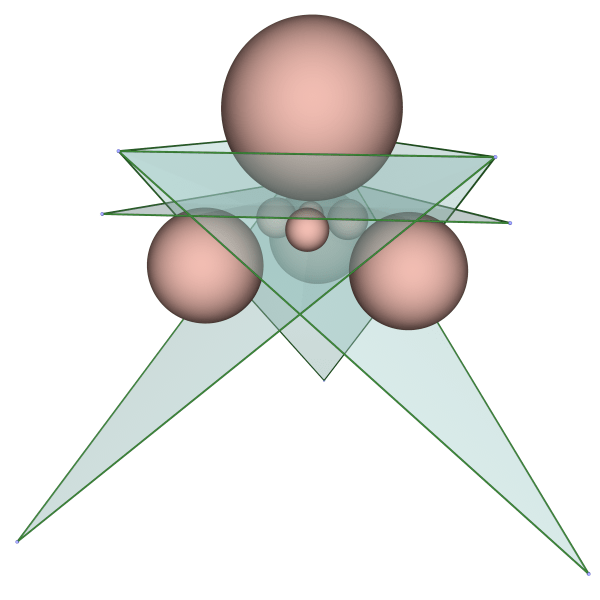
Of course things get really interesting when we move into space. Here the four planes of a tetrahedron can be touched by as many as eight spheres. In the simplest case, it looks like the picture above.

Tetra 2

Curiously, this does not work with the regular tetrahedron, it needs to be either more or less elongated.

Tetra small

How to Cut a Bagel (Annuli II)

Annulus 1

A torus is obtained by rotating a circle around a axis in the same plane. As such, it has two families of circles on it: the ones coming from the generating circle, and the orbits of the rotation. This allows you to slice the torus open using vertical or horizontal cuts, with the cross sections being perfectly round circles,

Torus3a

Of course, when you do this to your bagel, you do not really expect circles. But neither would you expect the bagel to be hollow.

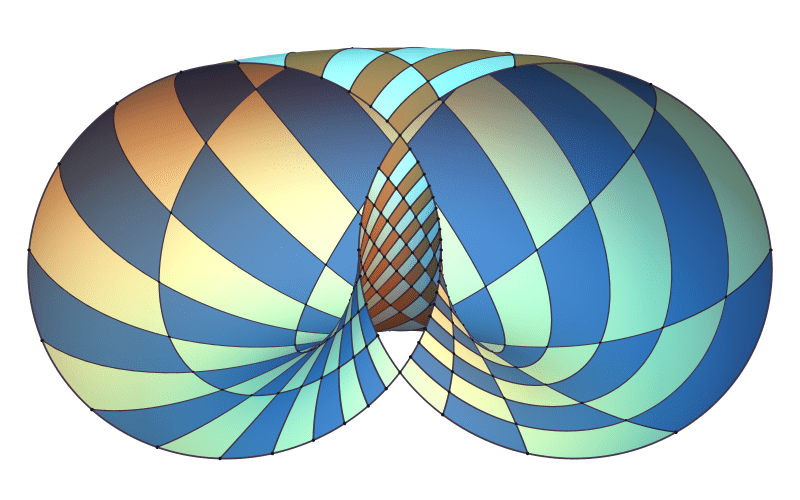
The surprise, however, is that there is yet another way to slice a torus, still with perfectly circular cross sections. These are the Villarceau circles.

Torus2a

Here is how to do it. Looking at a vertical cross section, cut along a plane that’s perpendicular to your cross section and touches the two circles just above and below. The deeper reason for their existence lies in the Hopf fibration of the 3-dimensional sphere; these curves are stereographic images of Hopf circles.

Toruscut

Even more surprising is that there are certain cyclides that have six circle families on them.

Cyclideb

Showing and Hiding (Spheres XI)

Steiner5e

A long time ago, we have looked at Soddy’s Hexlet, where a chain of six spheres is interlinked with a chain of three spheres.

Steiner3 6

There are variations of this. For instance, you can have two interlinked chains of four spheres each.

Steiner4 4

The alert visitor will have noticed that I am only displaying halves of spheres. This is because it is easier to add the other halves on one’s mind instead of thinking them away in order to see what’s behind.

There is more. If you take a suitable chain of five spheres, you can fit 10 around and through, but you will need to make three turns until the chain closes. This means that the spheres will touch their immediate successors, but intersect the ones after one and two turns, respectively.

Steiner5

There still is more, of course, which we leave to the reader to explore. Finding these chains is not difficult, provided you do this in the 3-dimensional sphere, and place the spheres inside complementary tori with suitable radii.

In Chains (Annuli I)

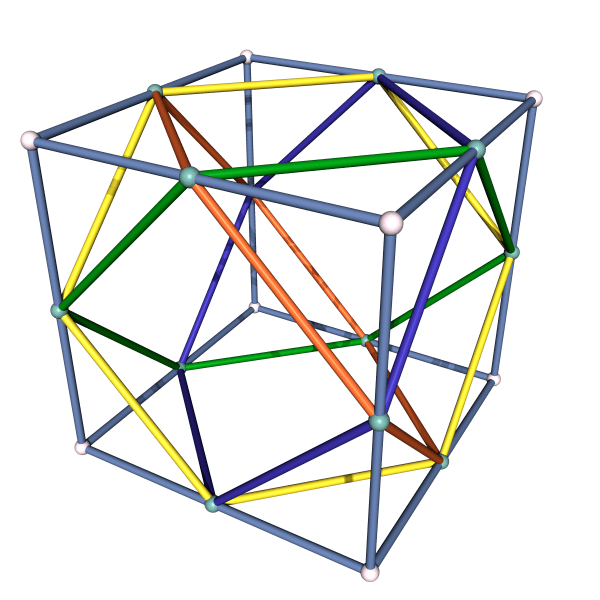
A cube can be sliced half so that the cross section is a regular hexagon, and this even in four different ways.

Hexacut

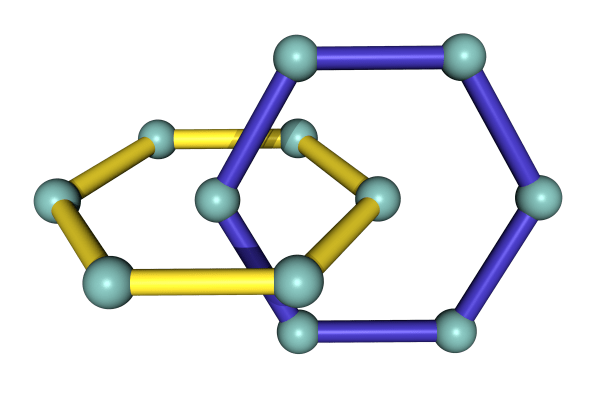
In particular, we can place regular hexagons into space so that the corners all have integer coordinates, and the hexagons face four different directions. This suggests to interlink the hexagons, for instance like so:

Minihex

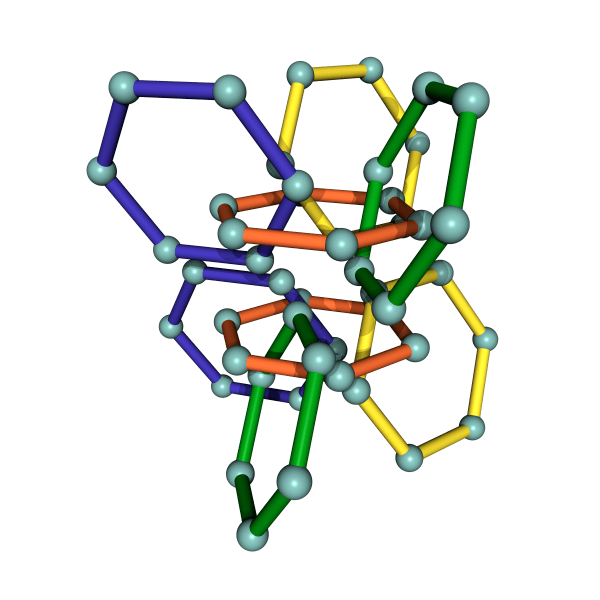
The mathematician immediately will ask to put as many of such linked hexagons into space, and this automatically drives the discovery of new structures or leads to connections with the already known.

In this case, it turns out that feeding one hexagon through the center of another is not so smart.

Smallhex

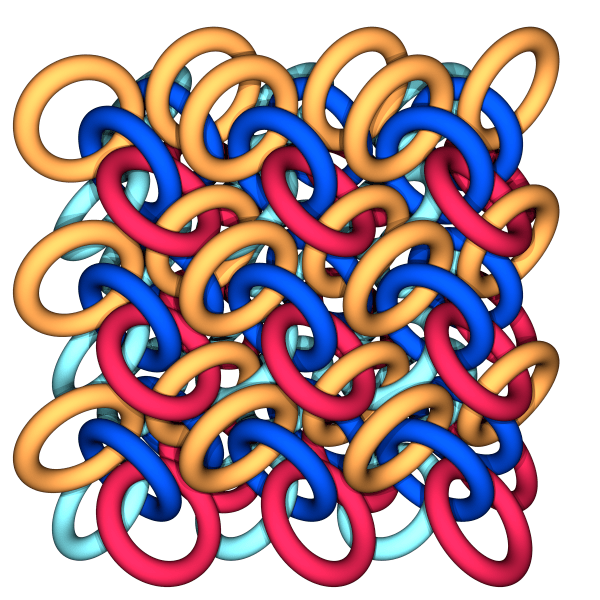
When the center spot is taken, any further hexagon through either of the first two must be placed by breaking the symmetry. Above we have threaded three hexagons through a horizontal red hexagons in a rotationally symmetric way, and placed a mirror image of this tetrad below. While these two pieces are not yet interlinked, they can together be translated as to create a very tight interlinked system of annuli (replacing the hexagons with smooth annuli).

Hexasphinx1

This works in all directions, and being stuck somewhere within this tangle will look like this:

Hexasphinx2

Hyperbolic Cubes (Spheres X)

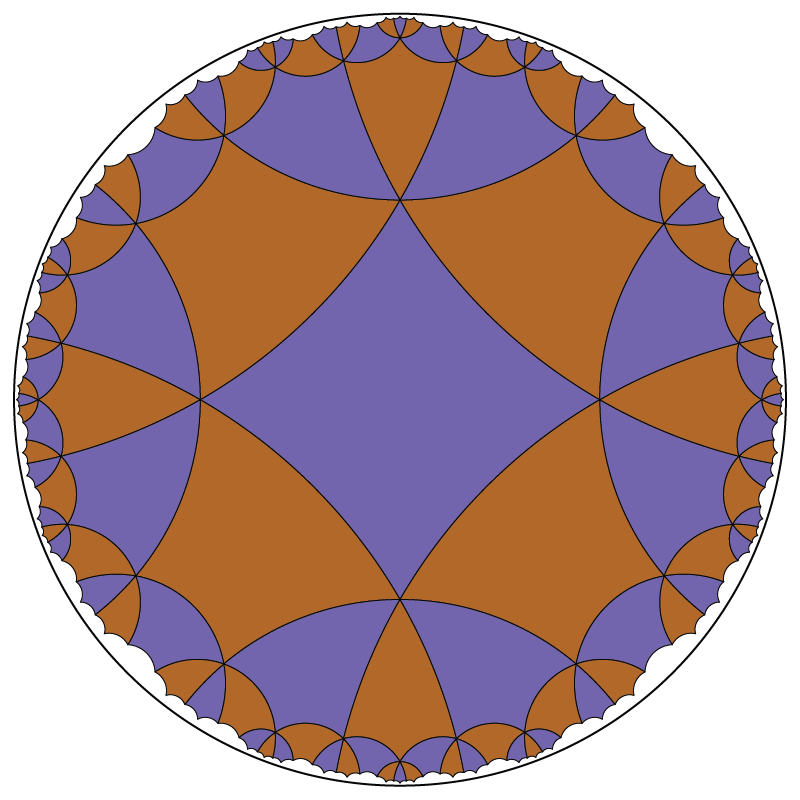
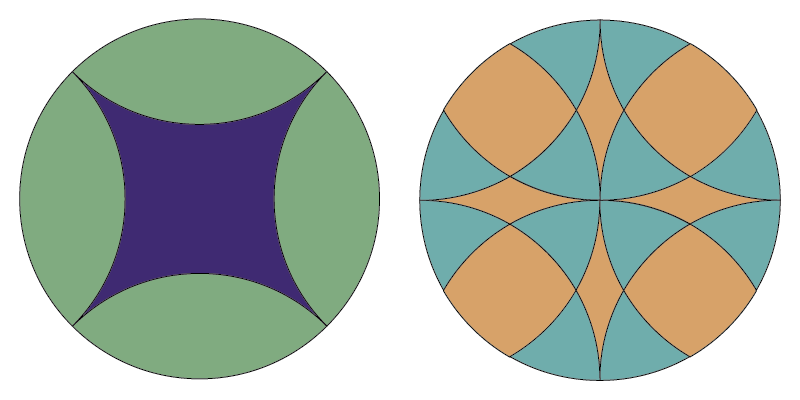
The hyperbolic plane is a geometry whose points are those of a disk, and the lines are circular arcs that meet the boundary circle of the disk at a right angle. Like so:

Squares60 01

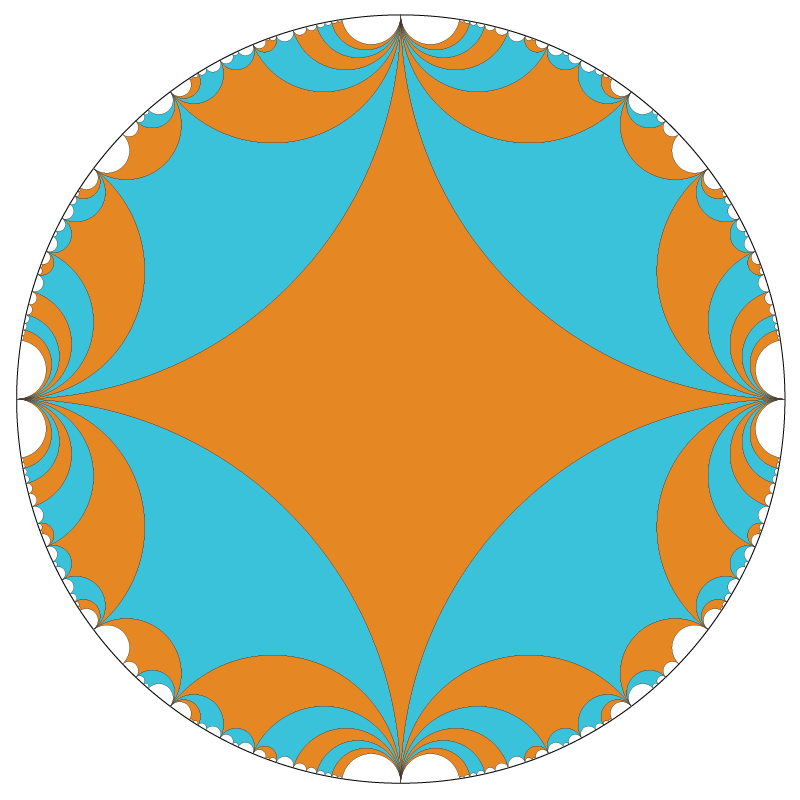
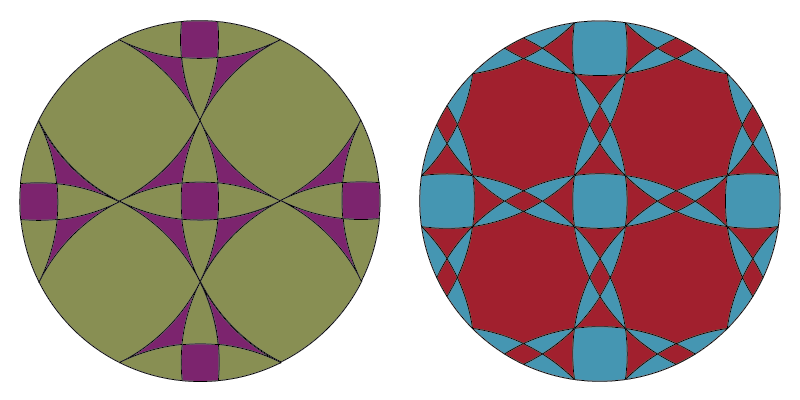
We see that the arcs in this figure cut out regions, and the central one looks like a deflated square. However, to the hyperbolic eyes the circles are actually straight, and all regions would be considered congruent squares. There is yet another difference to Euclidean geometry: These squares have corners with 60 degree angles, instead of the traditional 90 degrees. In fact, hyperbolic people can make squares with any angle less than 90 degrees at the corners, all the way down to 0 degrees. Then the vertices lie on the boundary of the disk, and we are getting what is called an ideal square.

Ideal4 01

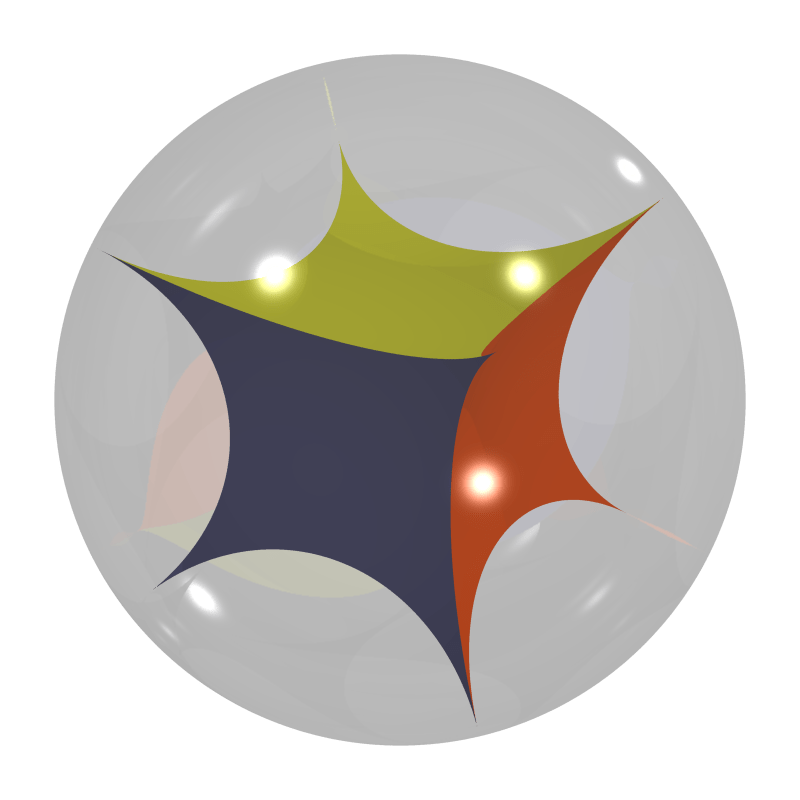
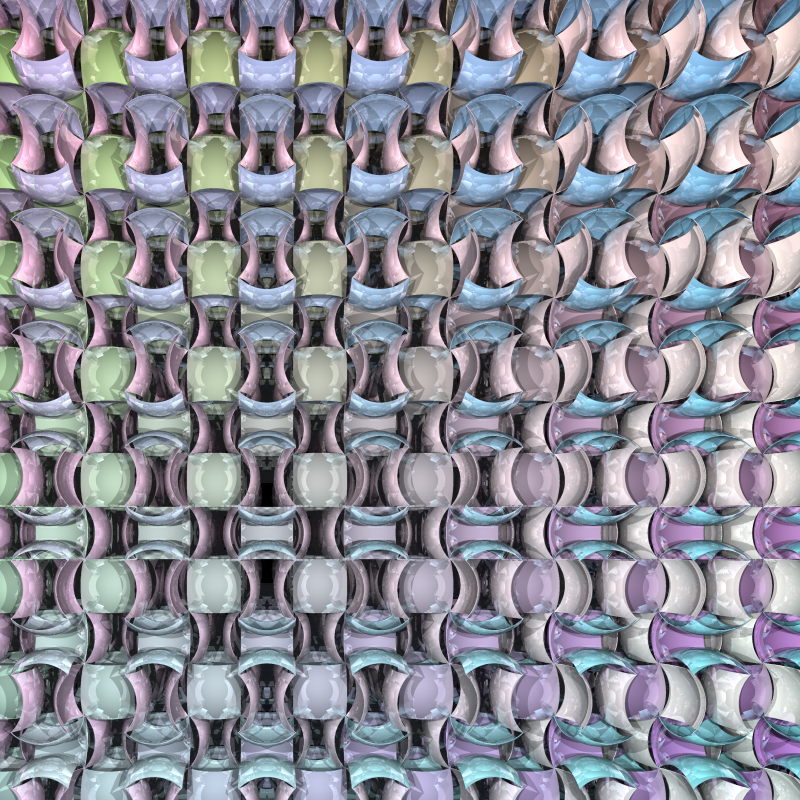
Of course there is also hyperbolic space, represented by a round ball. The planes are spherical shells meeting the boundary of the ball at a right angle. We can make cubes in hyperbolic space, with dihedral angles less than the traditional 90 degrees. This time, when the cube becomes ideal (i.e. when the corners lie on the boundary of the ball), the dihedral angles of the hyperbolic cube have shrunk down to 60 degrees.

Cube60

Because six such cubes will fit around an edge very much like six hyperbolic 60 degree squares fir around a corner, we are able to tile all of hyperbolic space with ideal cubes. Visualizing this is a challenge, as if we just draw all the cubes, we will just see a ball, and all the effort was in vain.

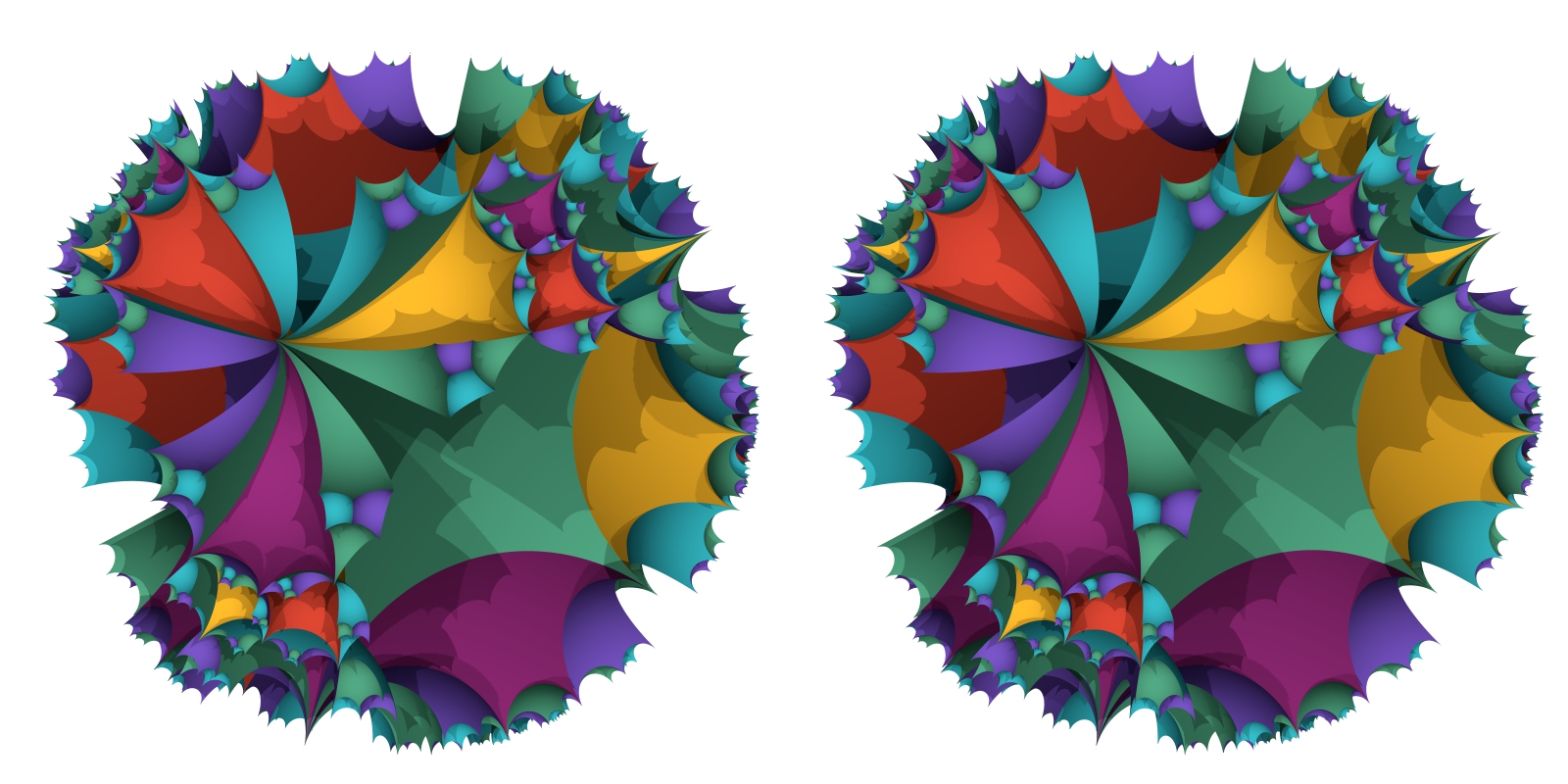
But we can leave out some of the cubes. If we start with the central ideal cube, and just take those cubes that can be obtained by rotating about the edges by 180 degrees, we get after a few steps the following object, shown as a stereo pair for cross-eyed viewing.

Simplestereo

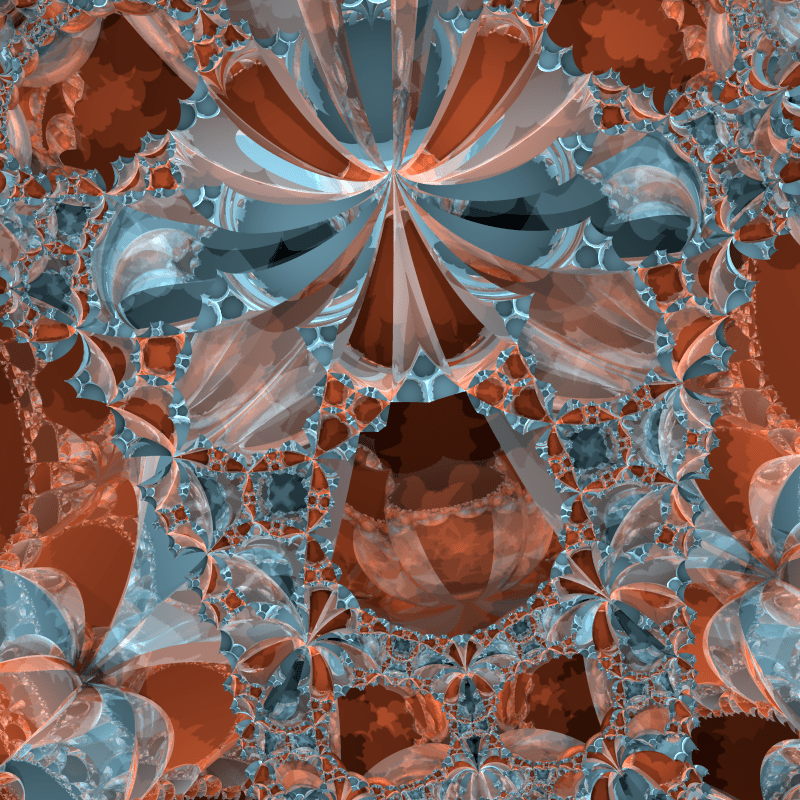
The final image is obtained by applying more such rotations, and making the material relective.

Cubes2d left

Minimal Graphics (Spheres IX)

This post in the Sphere Series is motivated by the recent Circles post. It’s easy enough to conceive a generalization where we place spheres with centers at the points with integer coordinates in space, and set the radius so that something interesting happens.

There is a problem, though. We could visualize the 2-dimensional circle case because we could look onto the plane from our privileged position in 3-space. To do the same with spheres, we would need to step outside 3-space into 4-space. Let’s not do that.

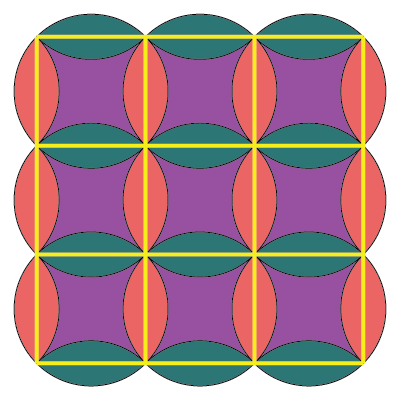
Instead, let’s look at the simplest case of circle intersections. We can think of the quarter arcs as deformed straight edges of squares.

Quarters 01

To make things visible, we have to remove some of them, and a natural choice is to remove every other arc, like so:

Quarters wiggle 01

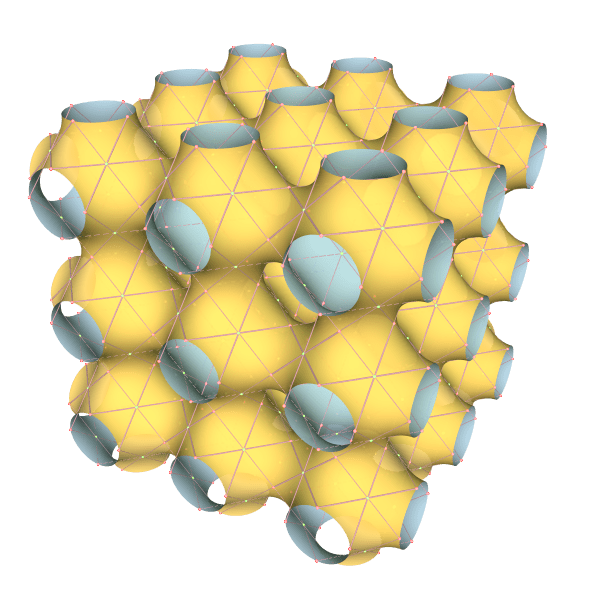
A similar approach works in three dimensions. Here, the spheres are arranged in a cubical lattice, and we can think of this as tiling by cubes where each cube has been replaced by an inflated sphere.

Cubespherical

This would still be too busy, so I have removed some of the spherical shards. The choice for that is suggested by a minimal surface, the P-surface of Hermann Amandus Schwarz.

600b

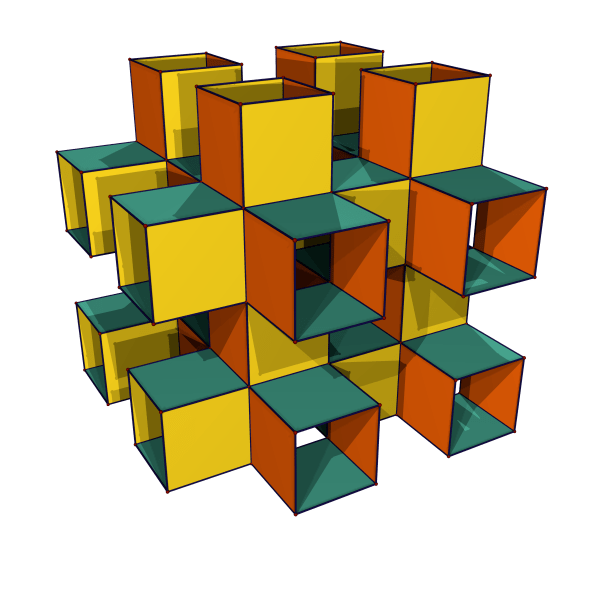
You can think of it as consisting of plumbing pieces that have connectors in six directions: up, down, left, right, front, back. There is a coarse polygonal approximation by it, using squares. Both the original minimal surface and its polygonal approximation divide space into two identical parts. A rat could not tell whether it lived on the insid or outside of the plumbing system.

Morton4

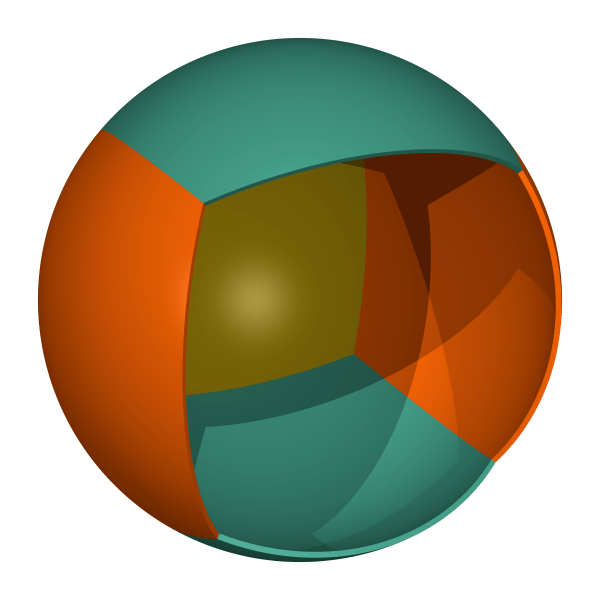
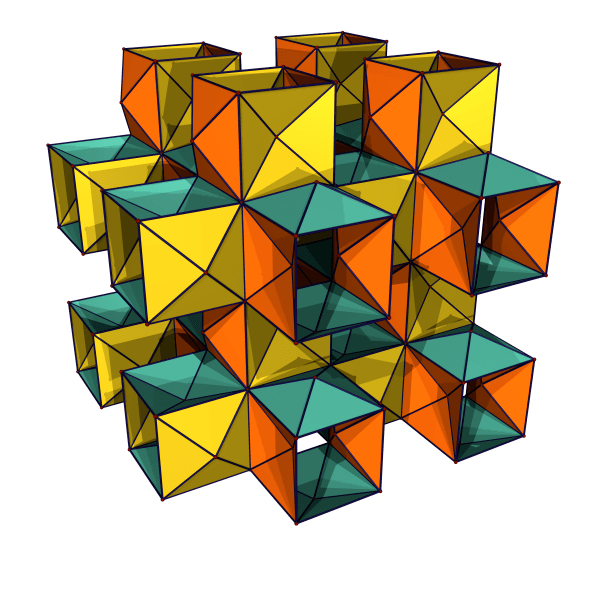
If we push the squares a little as to create four-sided pyramids, alternating the direction, we get the prototype of the model of sphere shards. In the spherical version, the shards meet just at the corners, leaving enough space so that light can get through.

Morton3

To make the sculpture more interesting, I have varied the colors, and moved it (sort of) off center. I feel it is a a visual representation of minimal music. Granted, there are many kinds of minimal music, and I do like many of them, but not all. The one I have in mind here would have to be composed by Steve Reich.

Shards3b

This would make a nice pendant sculpture. As material, I would prefer ceramics, not glass.

Circles, Intersected

Lets look at circles with centers at points with integer coordinates and equal radii. When the radii are small, the circles will be disjoint. Something interesting first happens when the radius becomes 1/2, because then the circles touch.
Circles

When the radii grow, the circles will intersect, and interesting patterns emerge. These patterns change continuously,
but when a special intersection occurs, the complexity of the intersection pattern increases. The next special intersection after r=0.5 occurs at r=0.7071, when circles that are diagonally across touch, and then again at r=1.

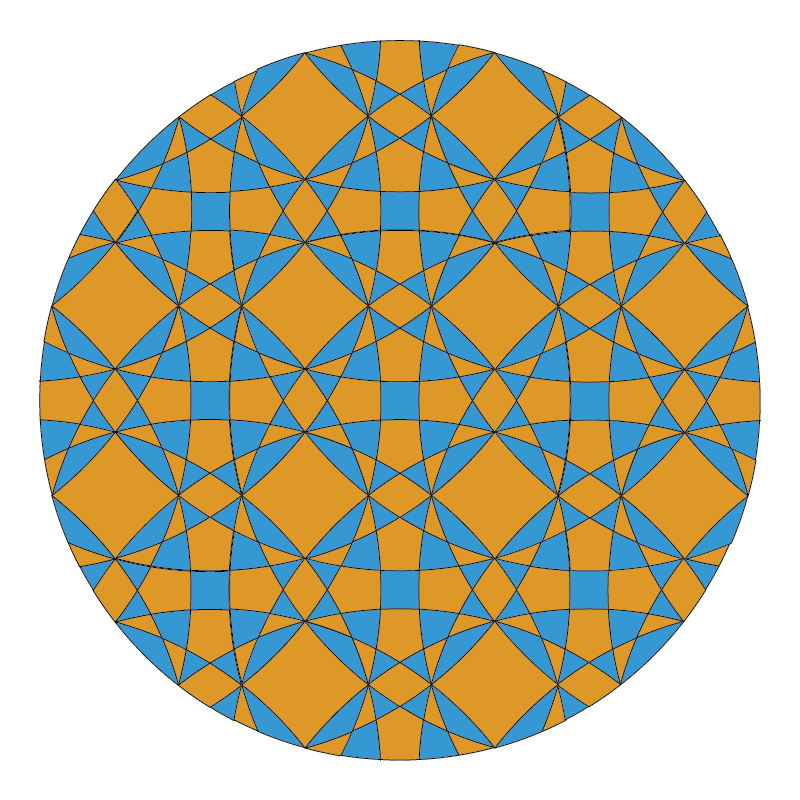
Circles01 01

Often, and due to the symmetry of things, whenever two of our circles touch, a second pair of circles must touch at the same point.
Then, at r=1.17851, we have true intersections of three circles at a single point (no touching!).

Circles23 01

Mathematicians find this interesting because the special intersections (touch or triple cross) mark singular points in the space of all such circle configurations. Understanding them means understanding the whole space.

Circles4 5 01

It is of course very satisfying that these singularities are also esthetically pleasing, as if they knew they are special and have dressed up for the occasion.

Cicles 6 01

Keep Going (Spheres VIII)

Apollo small3

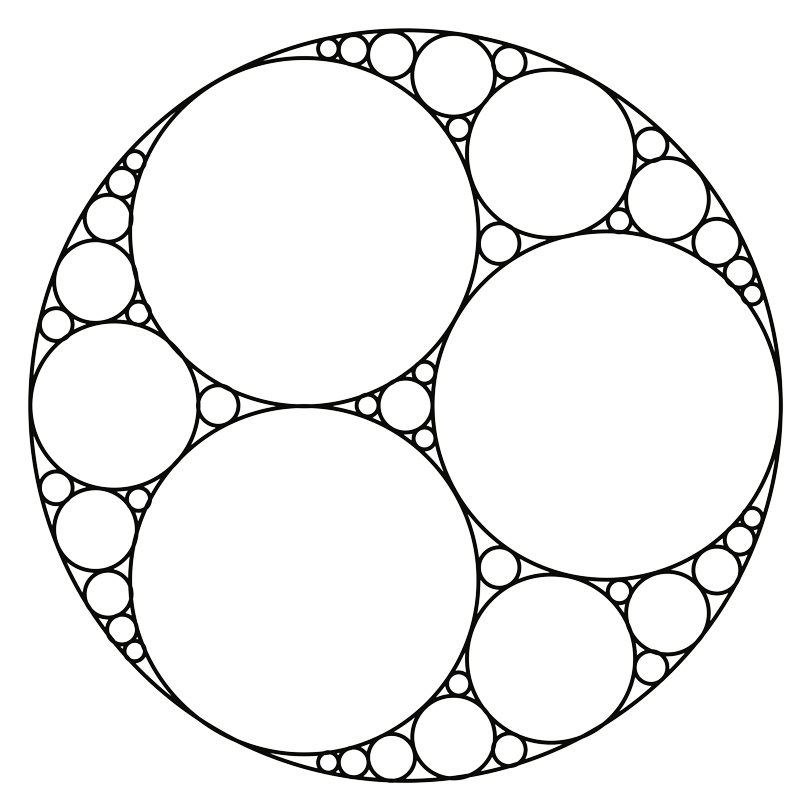
This, like most of my images from the Sphere series, has its origin in a 2-dimensional picture. Below you see (parts of) the Apollonian Gasket. Descartes and Princess Elisabeth of the Palatinate discussed formulas for a fourth circle tangent to four other circles, more than 300 years circle packings became fashionable.

Descartes3a

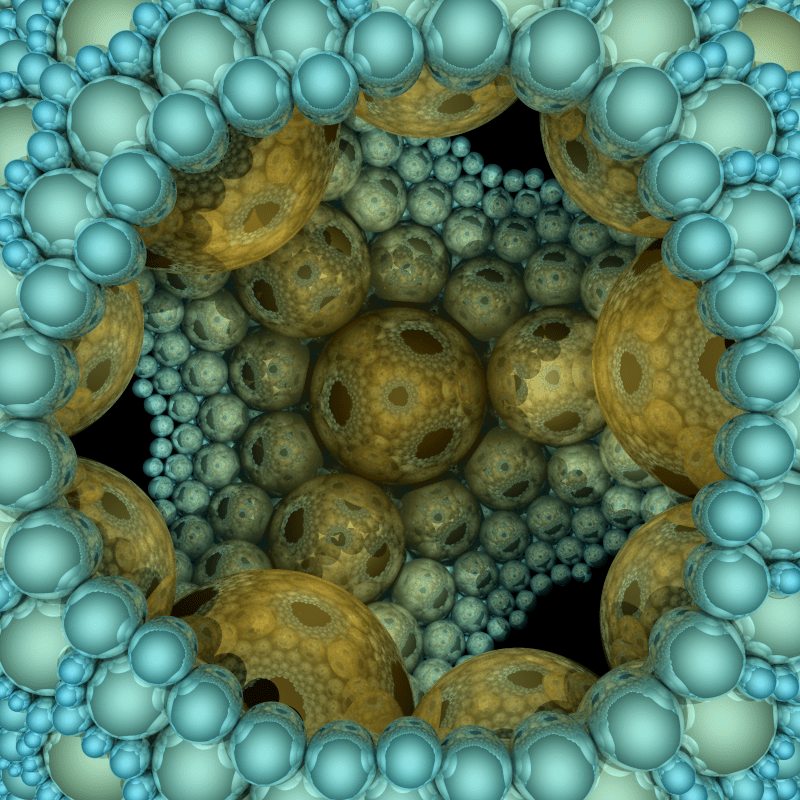
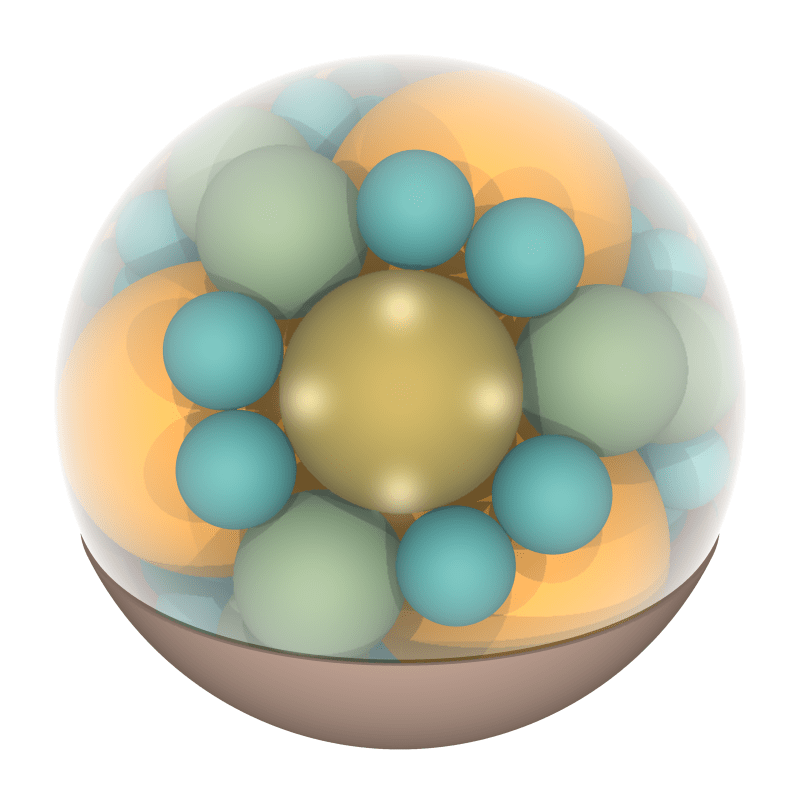
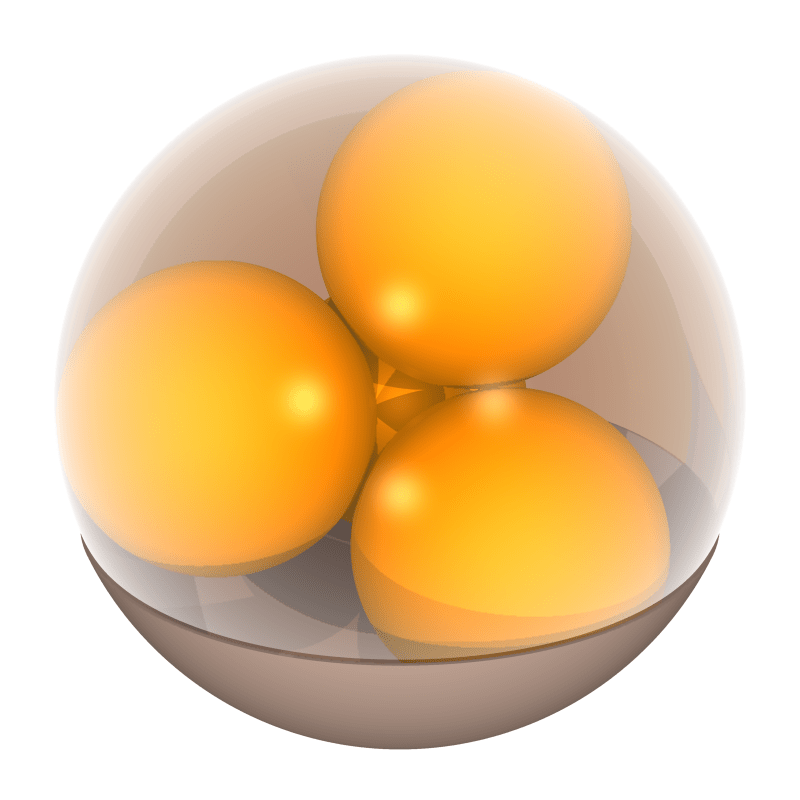
Now, in three dimensions, begin by placing four equally sized spheres into a larger sphere, like so:

Master 00

Start filling the empty space with more spheres, each as large as possible to touch four other spheres.

Master 0

Keep going.

Master 1

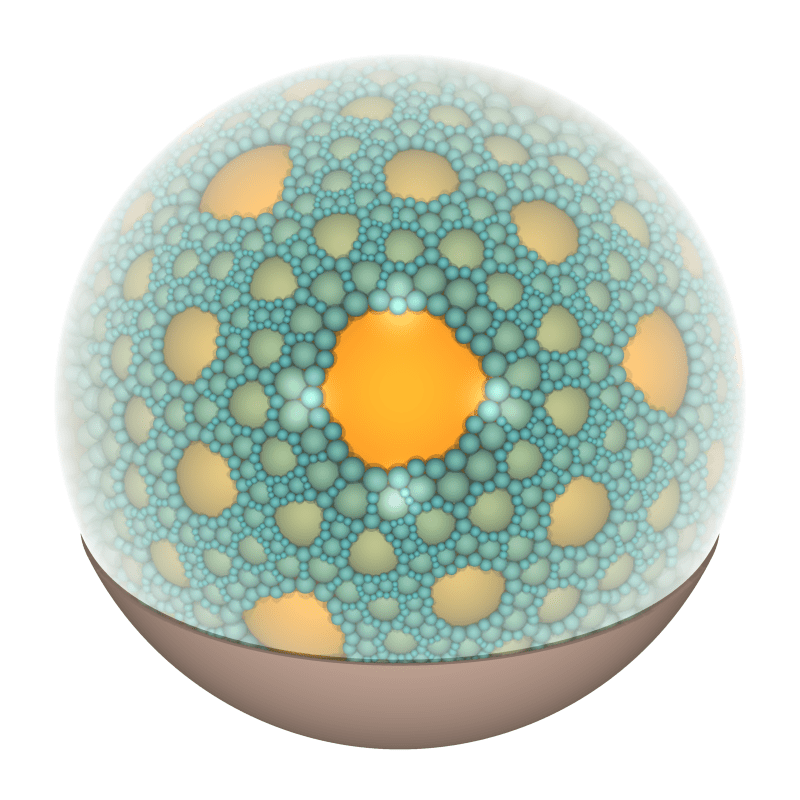
and going, and going.

Master 9

Finally, when you are tired and done, remove the first four largest spheres to create an empty space, and have a peek inside. What you see might look like the image at the top.

Density (Spheres VII)

There are essentially two very symmetric ways to tile the plane with circles. One can use the square tiling, of the more efficient hexagonal tiling.

Circles

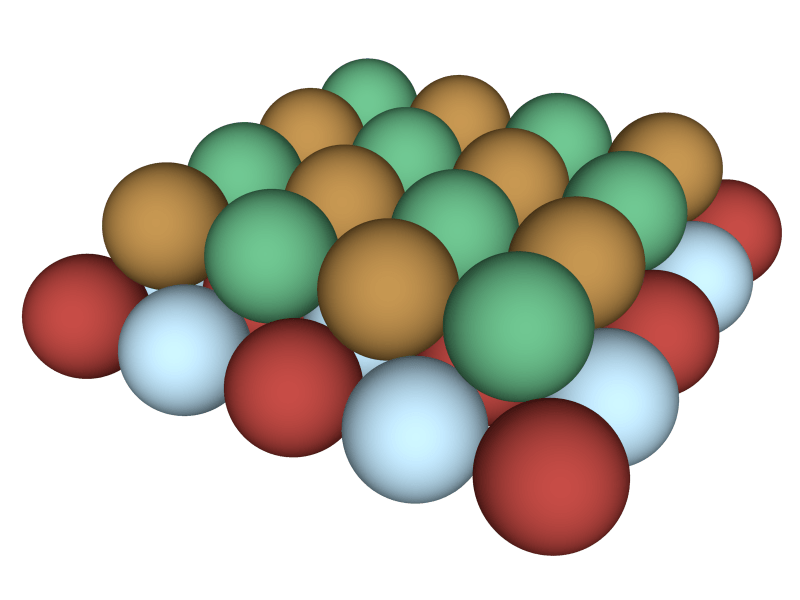
In space, we can use the cubical tiling to generalize the square tiling, as I did in Spheres V. But one can do better. On one hand, one can put down one layer of spheres in the square tiling pattern, but shift the next layer diagonally to save space:

Squaremain

Or, one can put down one layer of spheres using the hexagonal pattern, and again shift the next layer so that its spheres fit snugly into the gaps left by the spheres of the first layer, like so:

Hexmain
I hope it surprises you like it did surprise me that these two approaches lead, in fact, to the same packing of spheres:

Truncmain

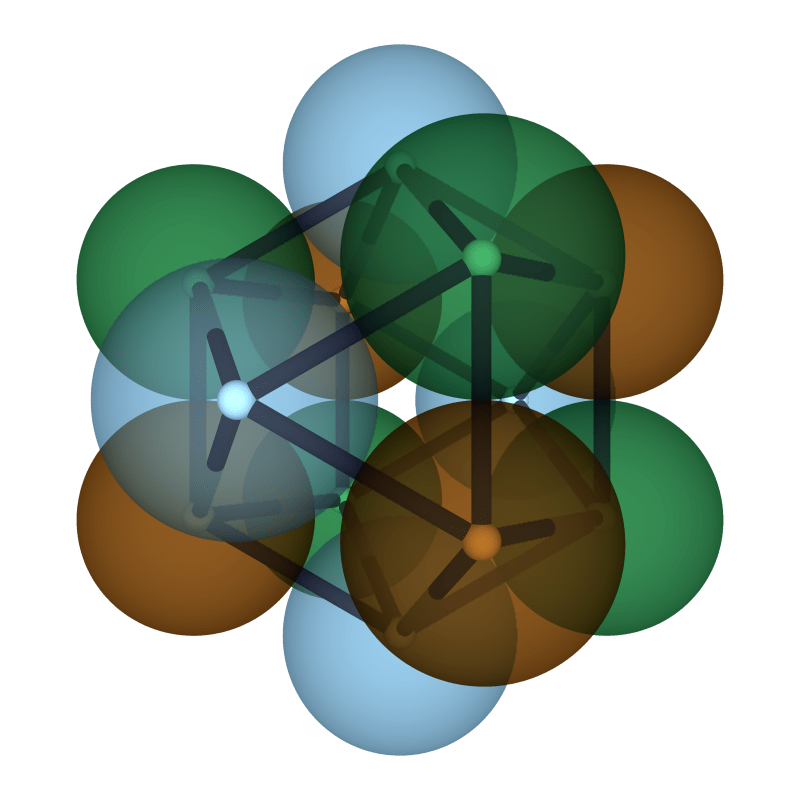
The mystery behind this is the geometry of the cuboctahedron, an Archimedean solid with both triangular and square faces:

Cuboctamain

Putting highly reflective dark blue spheres in such an arrangement within an off white cage cuboctahedral shell results in today’s sphere theme image:

Dense small