Walking the Path

In Edwin Abbott’s Flatland, the struggles of a square in a 2-dimensional world to grasp the concept of a third dimension are a parable for our own struggles to grasp uncommon concepts. This is pushed to its extreme when the square tells the parable of linelanders struggling with the concept of two dimensions.

The obvious limitations of lineland make us quickly forget our own limitations.

Hamiltonstrip

Here is a little puzzle. Cut out the eight pieces up above, and arrange them into a circle, following the Rule of Change: You can only place two pieces next to each other if they differ in just one line:

Pathrules

This not being particularly difficult, you will want to try your hands on the 16 pieces below with four lines.

Hamilton4line

These puzzles are essentially 1-dimensional and thus force us to think like linelanders. But hidden underneath are are higher dimensions.

Let’s return to the three line puzzle. Because there are three lines, each piece has only three potential neighbors it can be connected to, and we can visualize the possibilities in 2 dimensions as follows

Ichingcubeh

We recognize this as the edge graph of a 3-dimensional cube. This is not accidental: Think of the unbroken lines as zeroes, the broken lines as 1, and each entire symbol as coordinates of a point in 3-space (or 4-space, for the puzzle with four lines).
Two puzzle pieces can only be neighbors if the points differ only in one coordinate, i.e. are joined by an edge of the cube.

The puzzle asks us to find a Hamiltonian path on this cube (or hypercube), i.e. a closed path that visits each vertex just once.
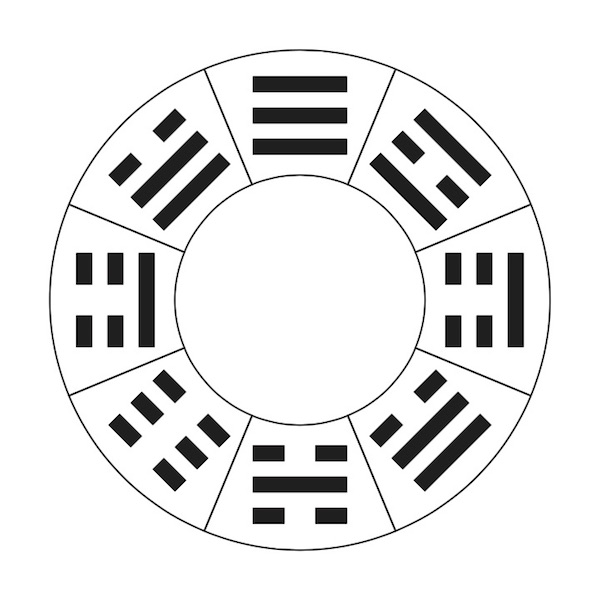
Ichingsol3

We can now see a solution easily enough. But understanding the underlying structure allows us also to inductively find solutions for the general case of a puzzle with an arbitrary number of lines. For instance, the hypercube can be obtained from the cube by connecting corresponding vertices of two cubes. To find a Hamiltonian path in the hypercube, we can take two identical Hamiltonian paths in the two cube, remove a pair of corresponding edges, and connect the free vertices by edges that connect the two cubes.
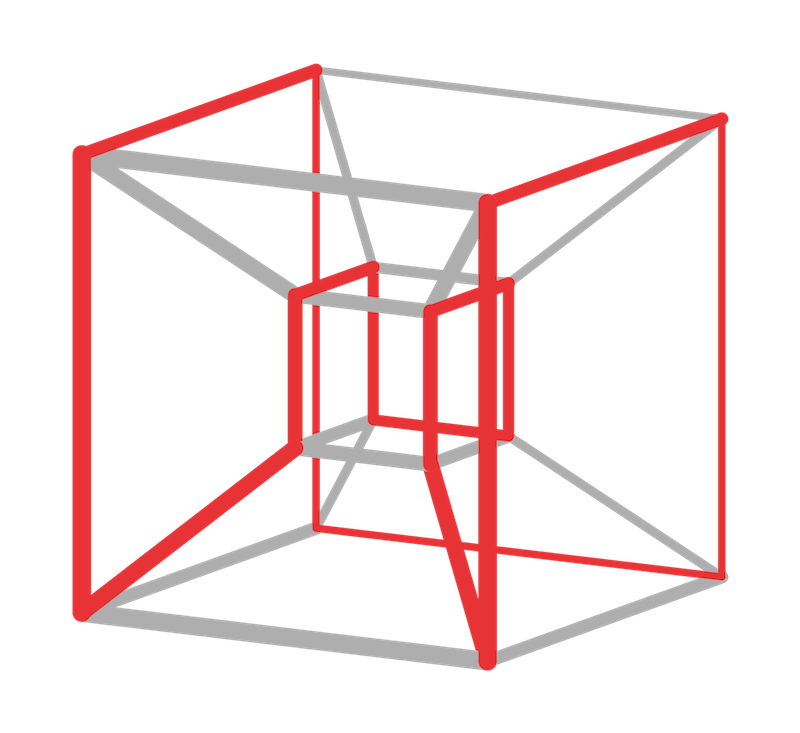
Inductivehamilton
You can now even go ahead and make a puzzle for the complete set of 64 symbols of the I Ching, and find a path
through all of them.

Costaesque (Algorithmic Geometry V)

Costatop

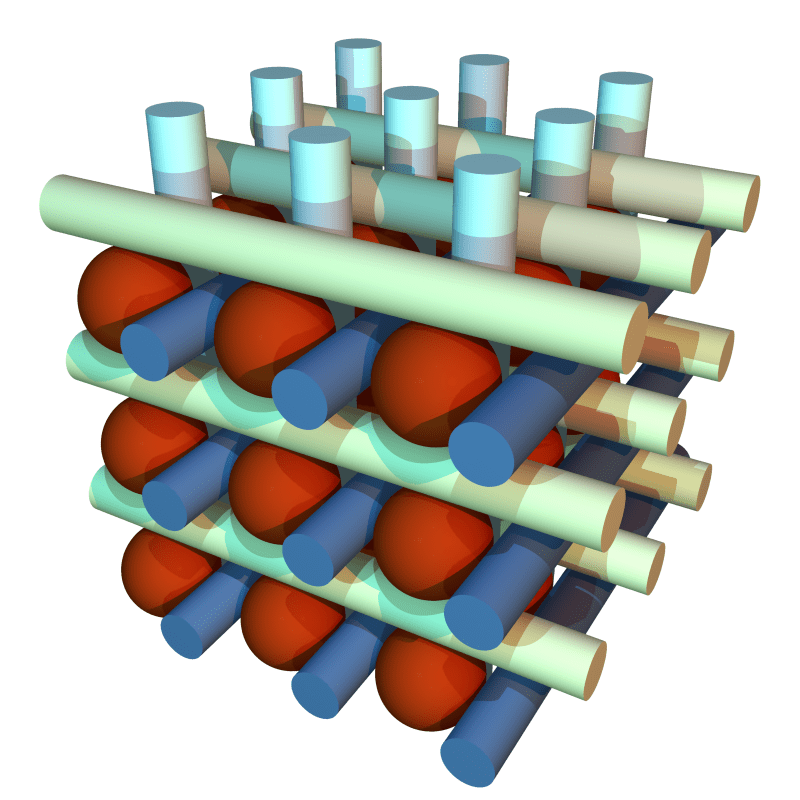
In 1982, Celso José da Costa wrote down the equations of a minimal surface that most mathematicians at that time thought shouldn’t exist. It shares properties with the plane and catenoid that were supposed to be unique to them. Nothing could be more wrong. Since Costa, many more minimal surfaces in that same elite class have been found.
Costa
The curiously complicated way in which the Costa surfaces merges a horizontal plane with a catenoid by avoiding any intersections has become a pattern for similar constructions that is quite aptly called Costaesque.

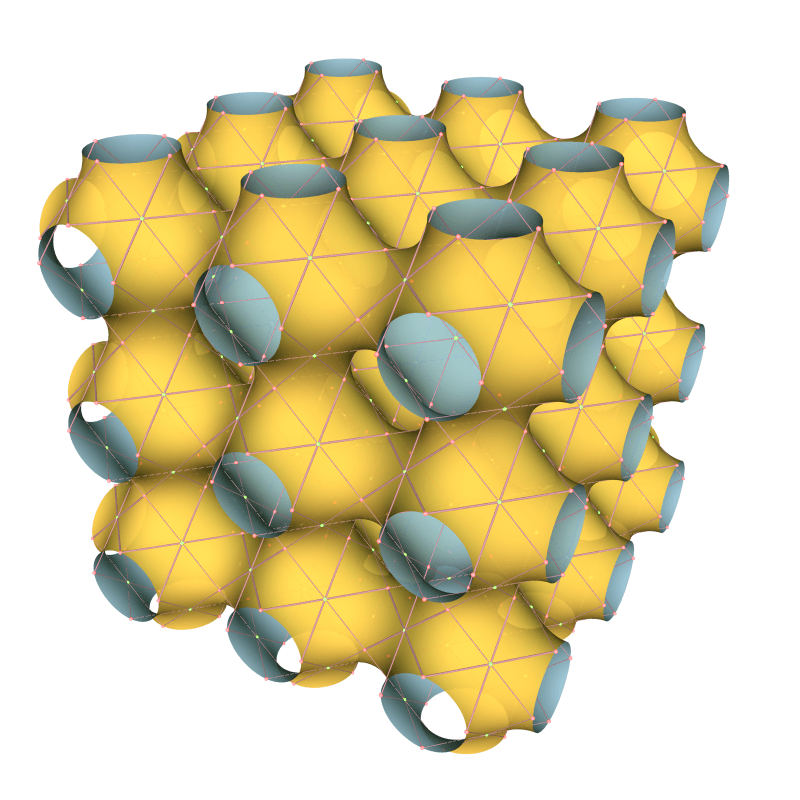
Amusingly, the same pattern occurs in Alan Schoen’s I6 or Figure Eight surface from 1970.

SchoenI6

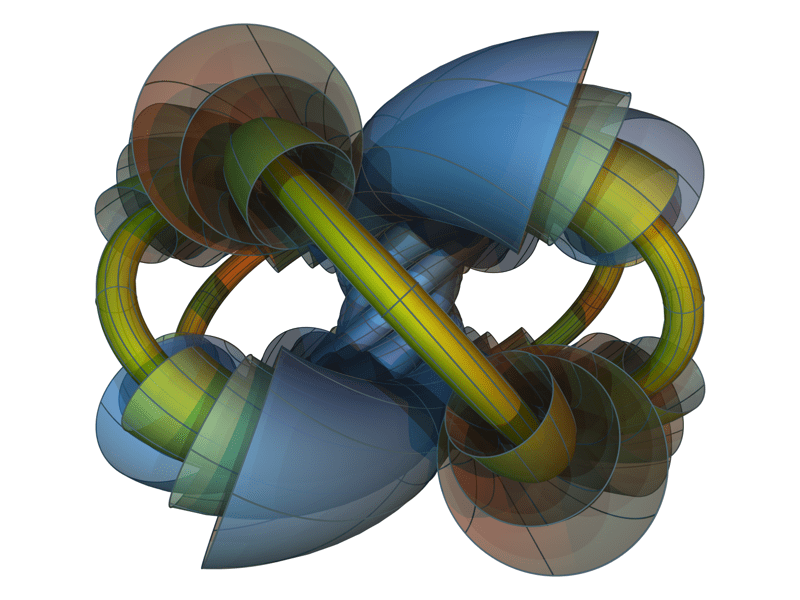
It can be viewed as a triply periodic aunt of the Costa surface but was conceived as a Plateau solution for two pairs of squares in parallel planes, each of which meet a corner to form a figure eight.

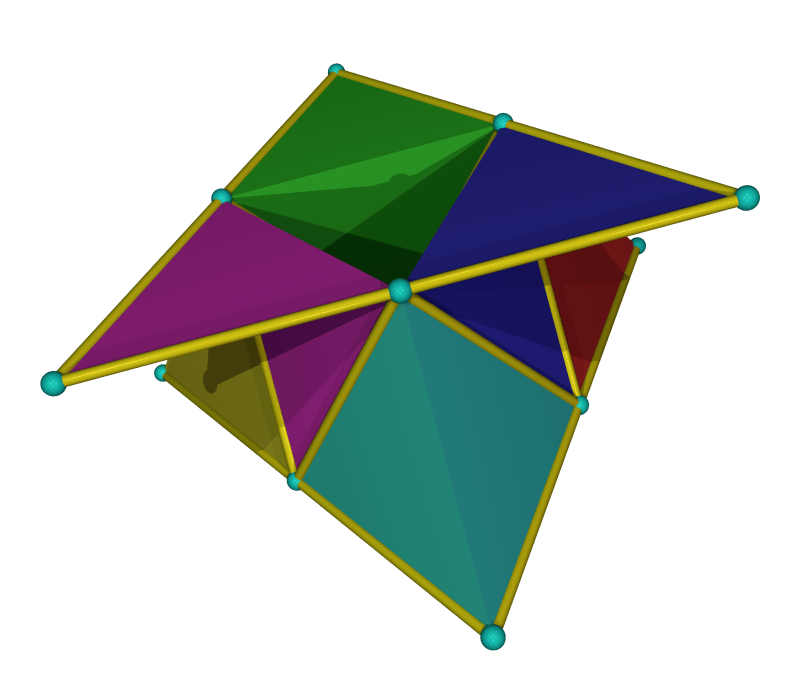
This surface has a particularly simple polygonal approximation by the bent 60 degree rhombi that we have encountered before.

I6b

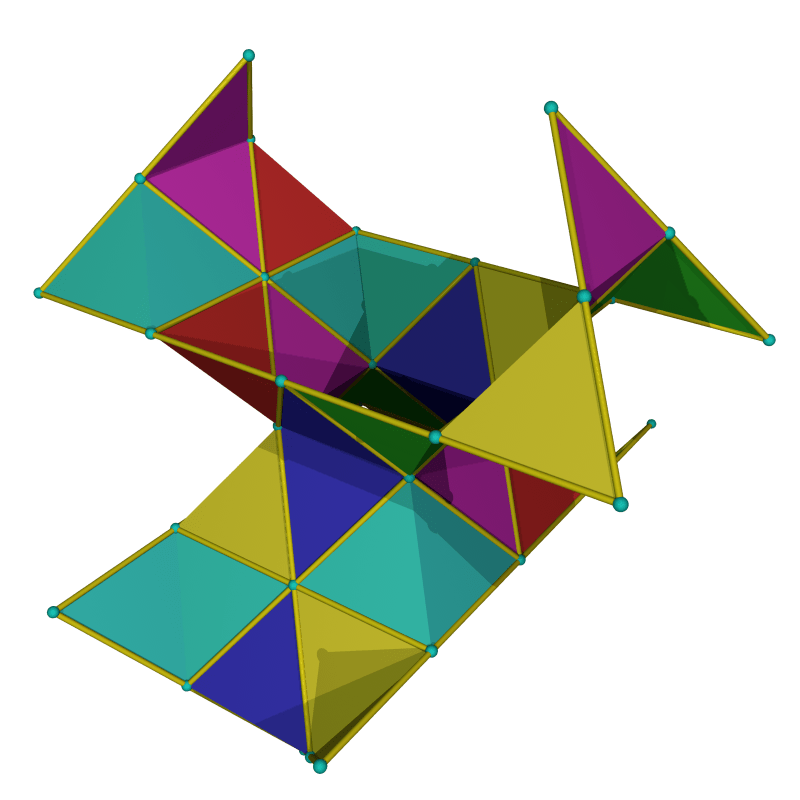
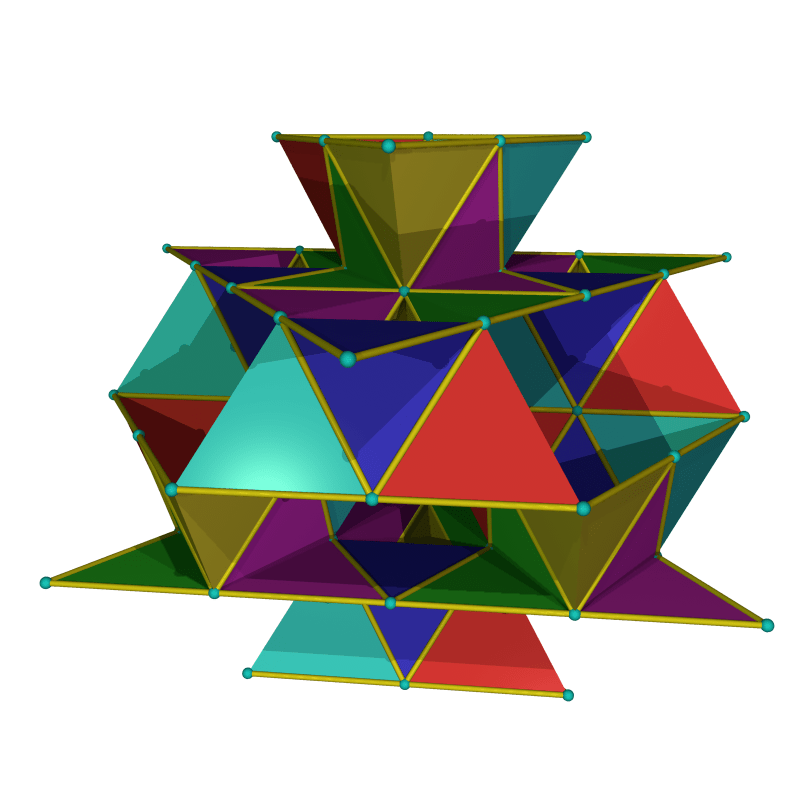
Let’s take 12 such bent rhombi and assemble them into an X-piece that has the two figure 8 squarical holes. A second such X-piece is rotated by 90 degrees and attached to the top to form the polygonal version of Schoen’s I6 fundamental piece.

I6a

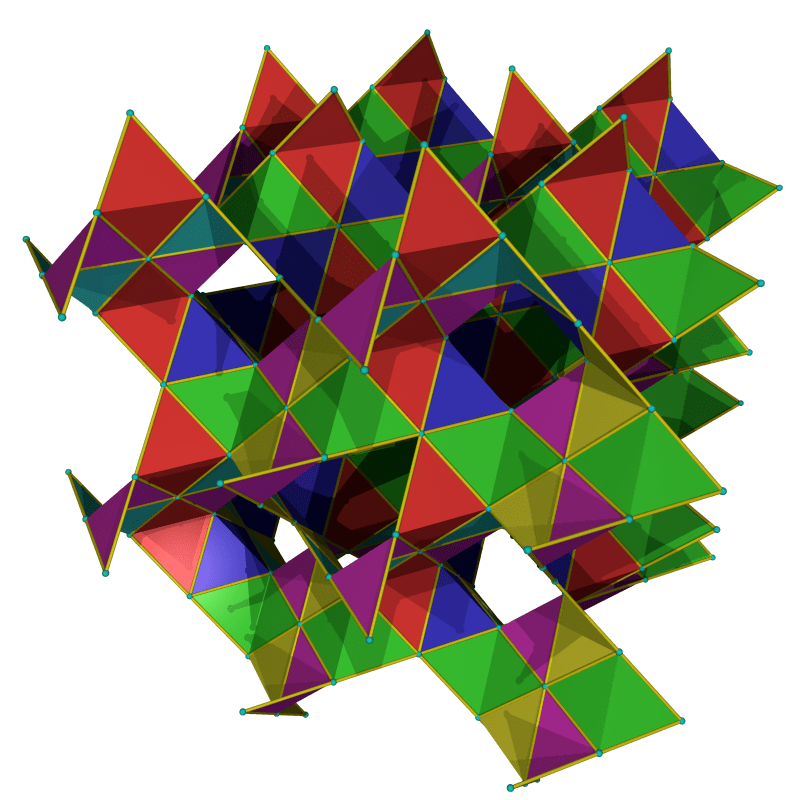
Alternatively, one can also tile the surface with straight 60 degree rhombi so that it becomes a triply periodic zonohedron.

I6c

Neovius surface (Algorithmic Geometry IV)

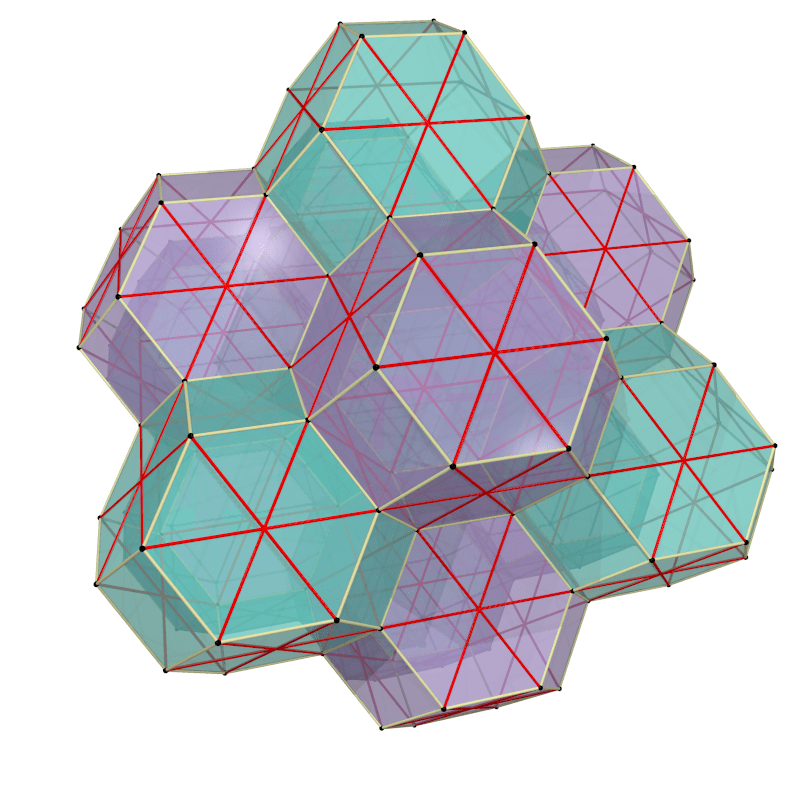
When the truncated octahedron tiles space, the diagonals of the hexagonal faces become part of a line configuration.

TruncatedOctahedronTiling

Following these lines we can build the bent rhombi that we encountered in Schwarz’ P-surface, but here we will focus on the more complicated bent octagons that weave around the square faces of the truncated octahedra. These serve as Plateau contours for another minimal surface, the Neovius surface, named after the Finnish mathematician Edvard Rudolf Neovius, a student of Hermann Amandus Schwarz.

Neoviusminimal

One can also fill each octagon with four copies of said bent rhombus to obtain an interesting polygonal version of the Neovius surface. Here are two such filled octagons aligned. Note that we have broken a rule: The four bent rhombi that fill the octagon are not rotated about their edges to fit together, but reflected.

Neoviuspiece

Rotating about the edges by 180 degrees will create larger portions of the infinite surface.

Neoviuscube

Temporarily breaking a rule can sometimes be a good thing.

Neoviuspoly

The Gyroids (Algorithmic Geometry III)

Bisquare
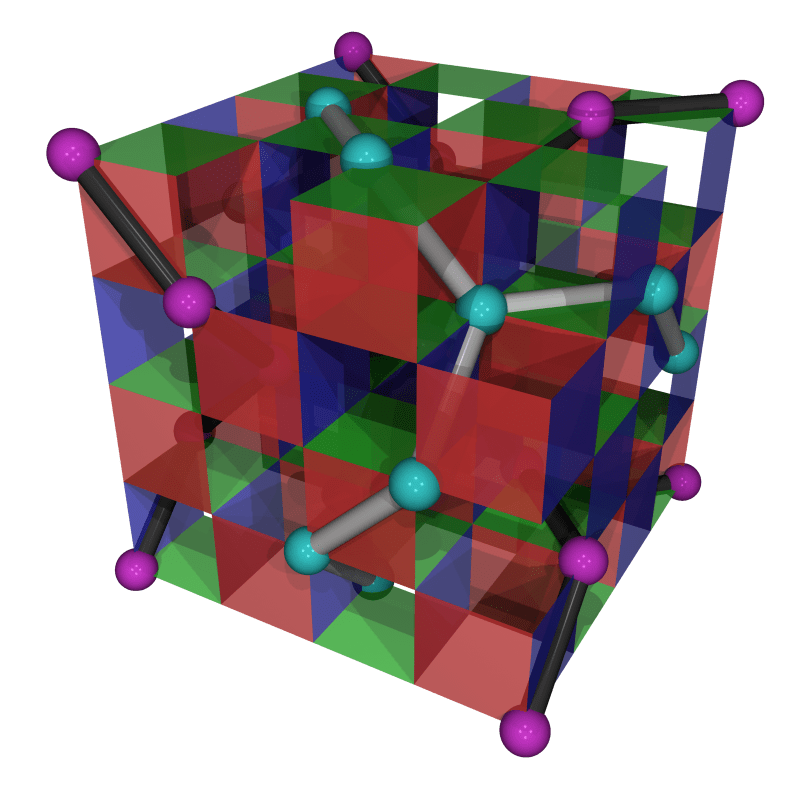
When we use squares bent by 90 degrees about one diagonal and extend by the rotate-about-edges rule, we get Petrie’s triply periodic skew polyhedron {4,6|4} which has six squares about each vertex. The two tunnel systems it divides space into are another crude approximation of the primitive surface of Schwarz.

Cubeblock

Coxeter observed that this polyhedron can be used to construct Laves’ remarkable chiral triply periodic graph as follows. Choose any diagonal of any of the squares of {4,6|4}. Take an end point of the diagonal, adjacent to which are six squares. Look at the six diagonals of the squares that share the end point as a vertex, and take every other of them, starting with the already chosen diagonal. Keep extending the emerging graph like this.

Laves

You obtain the 3-valent Laves graph. At each vertex, the edges meet 120 degree angles. It turns out a mirror symmetric copy fits onto the {4,6|4} without intersections. These two graphs are the skeletons of the two components of the Gyroid, a triply periodic minimal surface discovered by Alan Schoen. You can read all about the discovery at his Geometry Garret.

Mingyroid

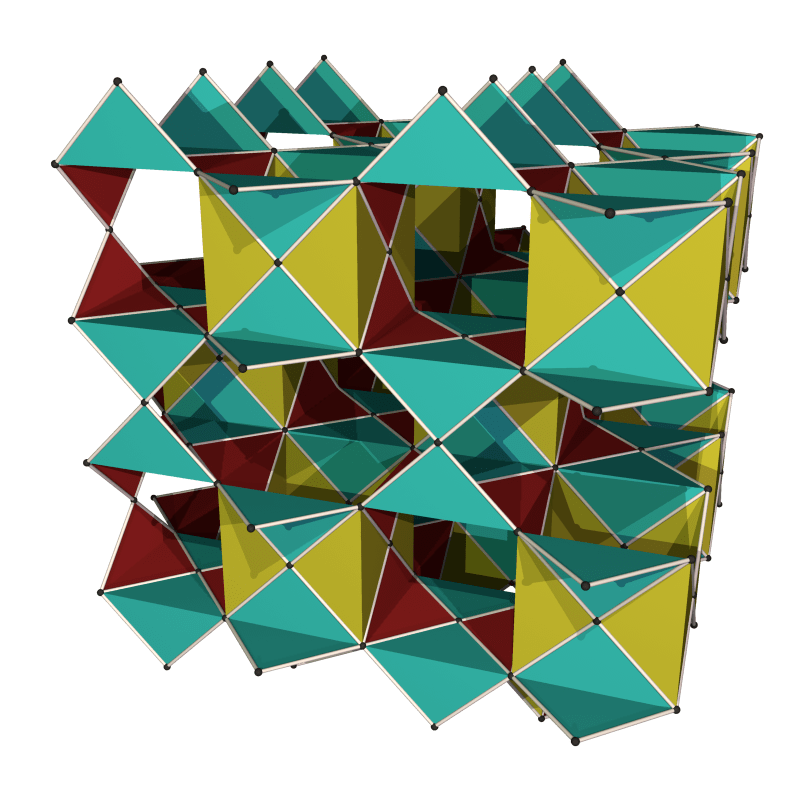
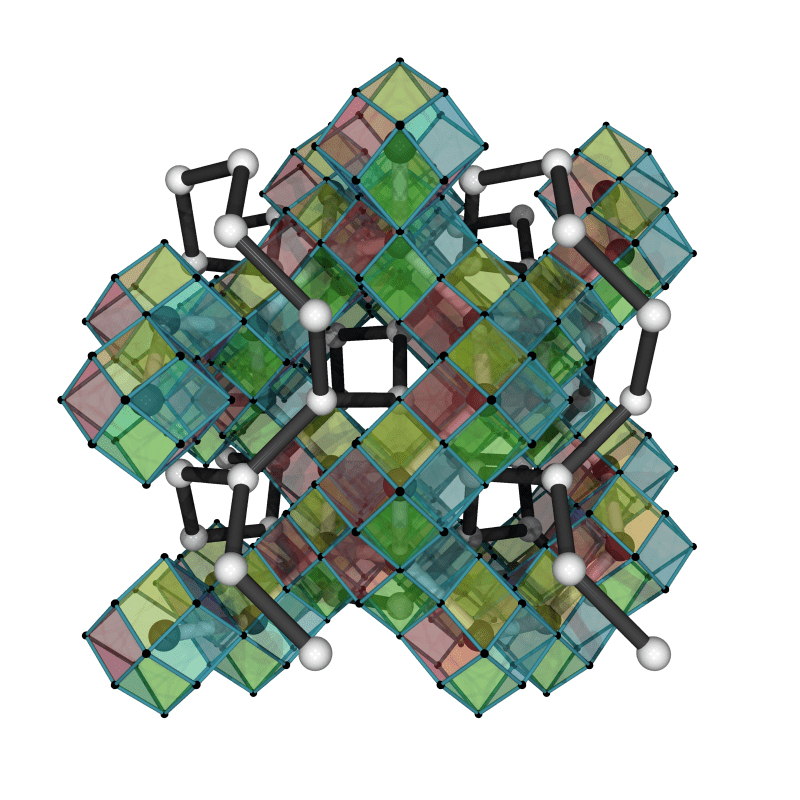
The Laves graph also lies on the dual skeleton of the tiling of space of rhombic dodecahedra. That means that you can get a solid neighborhood of the Laves graph consisting of rhombic dodecahedra:

Rhombic

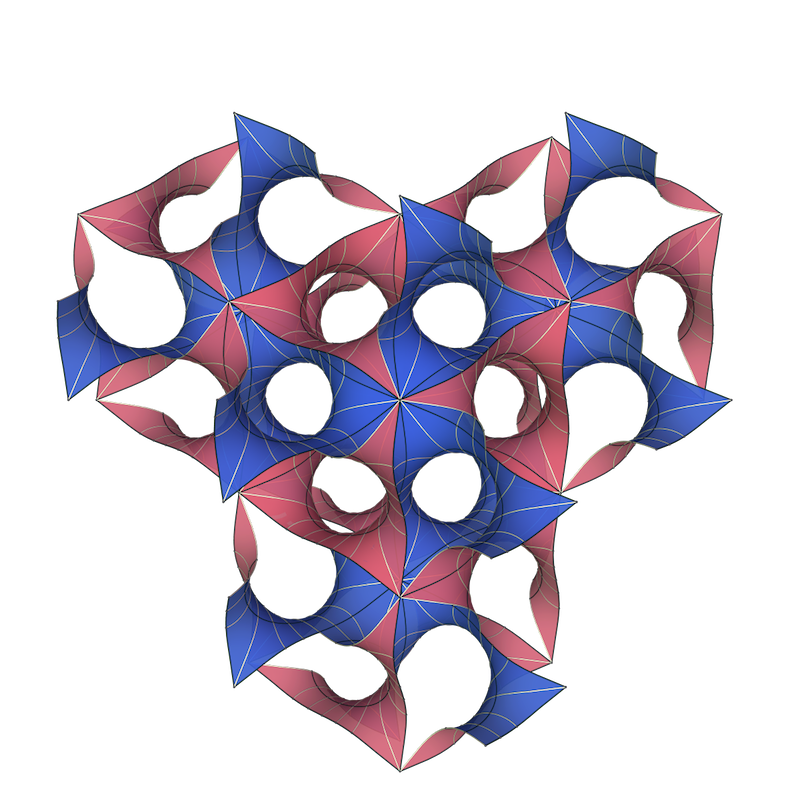
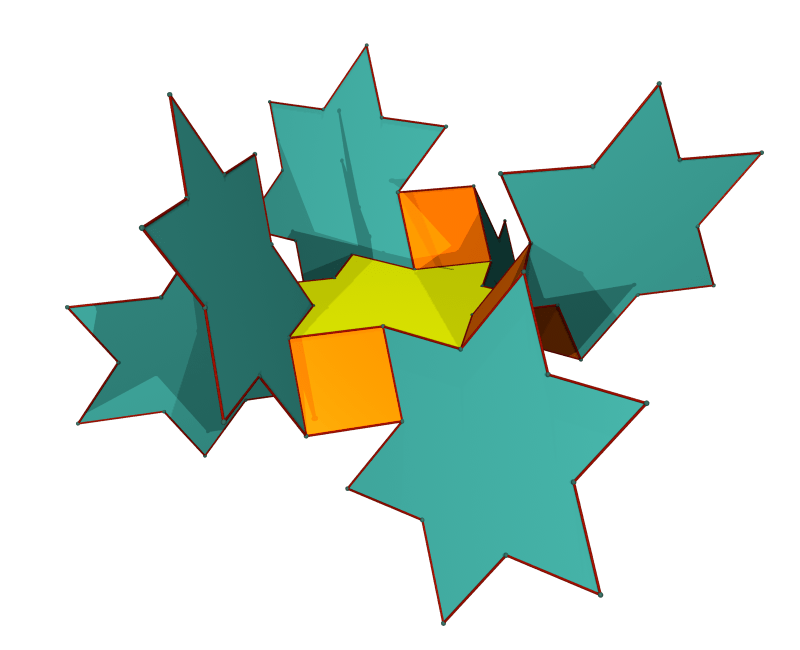
This can be done both for the Laves graph and its mirror still leaving a gap in which one can fit the gyroid. Alan Schoen also discovered a uniform polyhedral approximation of the gyroid, consisting of squares and star hexagons. To build it, take a star, attach a square to every other edge, bending the squares alternatingly up and down. Then attach six more stars to the free edges of the first star, fitting them to one free edge of one of the squares each:

Polygyroid

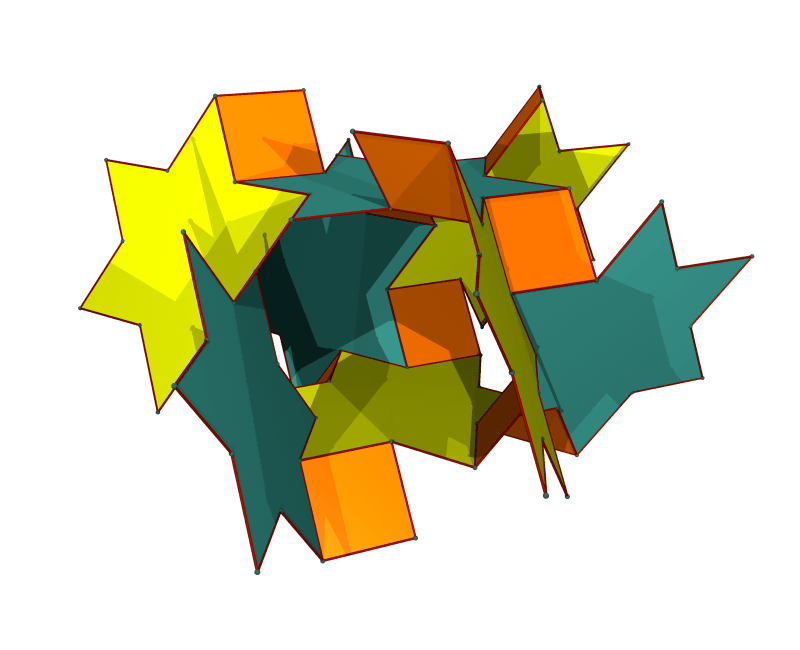
Two copies of this piece (without the downward pointing stars and and squares) make a translational fundamental piece of the uniform gyroid.

Polygyroid2

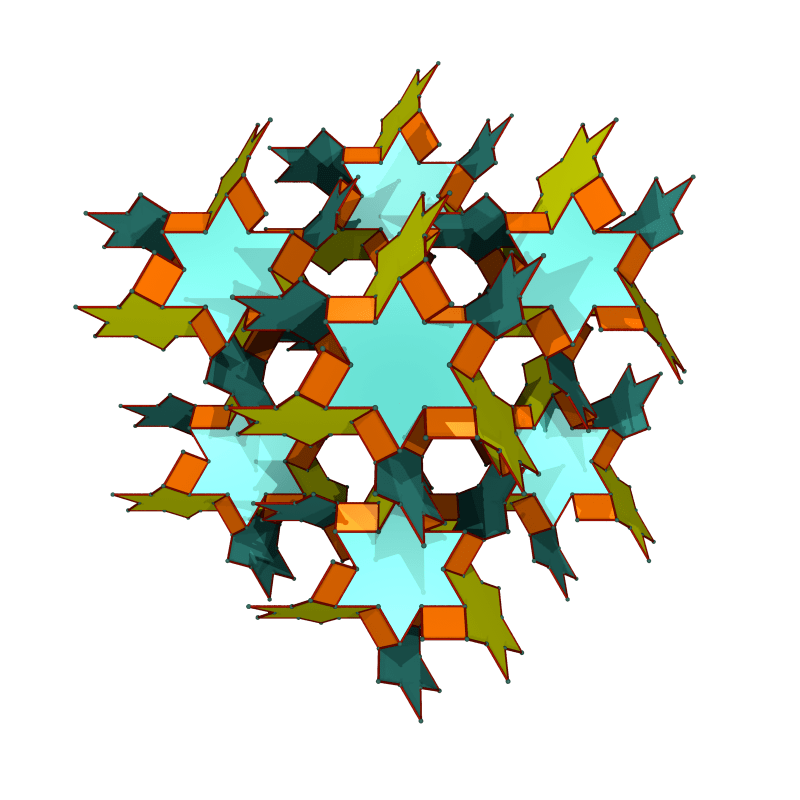
Images of larger portions are hard to parse, but it makes a wonderful model.

Polygyroid3

Primitivity? (Algorithmic Geometry II)

The construction of the polygonal diamond surface via bent rhombi can be varied. If we take as the bent rhombus two adjacent faces of the regular octahedron instead of the tetrahedron and follow the same rule to extend the surface by 180 degree rotations of rhombi about edges, we first get a less crooked hexagon,

HexP

four of which can be assembled to a translational fundamental piece

Quad

of a triply periodic polyhedral surface

Multi

that approximates Schwarz’ so-called primitive surface.

MinimalP

In this case, the ribbon representation has a much simpler appearance than the rhombic image.

Ribbon

After all, apparent complexity is often only a matter of the presentation.

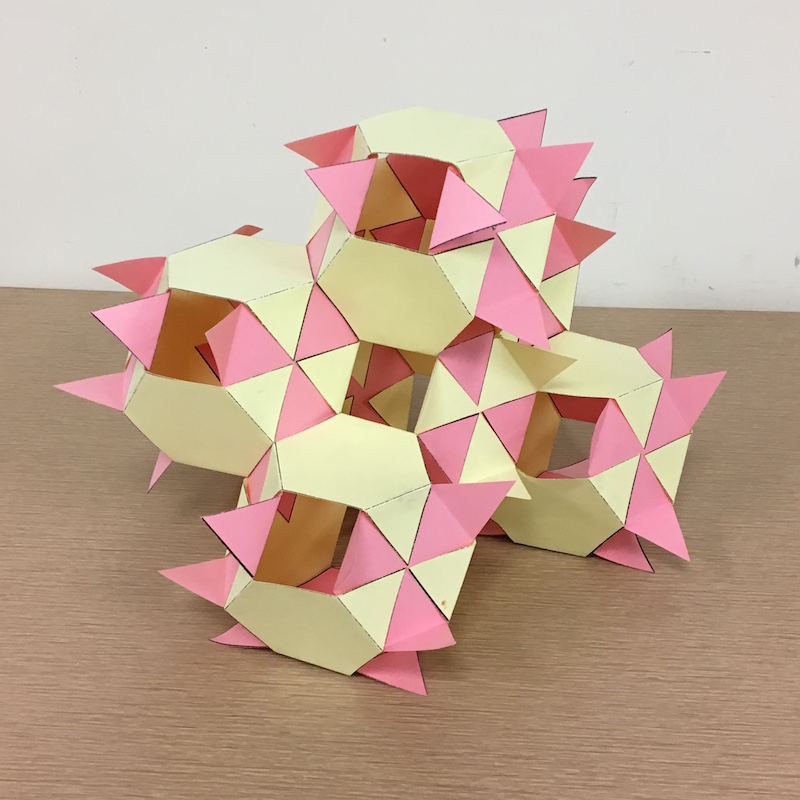
If you want to make quick paper models of either the diamond or the primitive surface, cut out lots of equilateral triangles, divide the edges into thirds, and bend the three triangles at the corners upwards. These smaller triangles serve as flaps that you glue to the front sides of the central hexagons inside the original triangles.

Model

Diamonds are Forever (Algorithmic Geometry I)

When you dip a closed wire frame into soapy water and pull it out, the soap film you see is a minimal surface. Finding a formula for this surface is generally a very difficult problem, and one of the earliest successes was achieved by Hermann Amandus Schwarz, using four edges of a regular tetrahedron as the contour.

Single

One feature of minimal surfaces is that they can be extended across a straight line by means of a 180 degree rotation about that line. Doing so for the tetrahedral patch above generates the diamond surface, named so because it has the symmetries of the diamond cubic crystal structure.

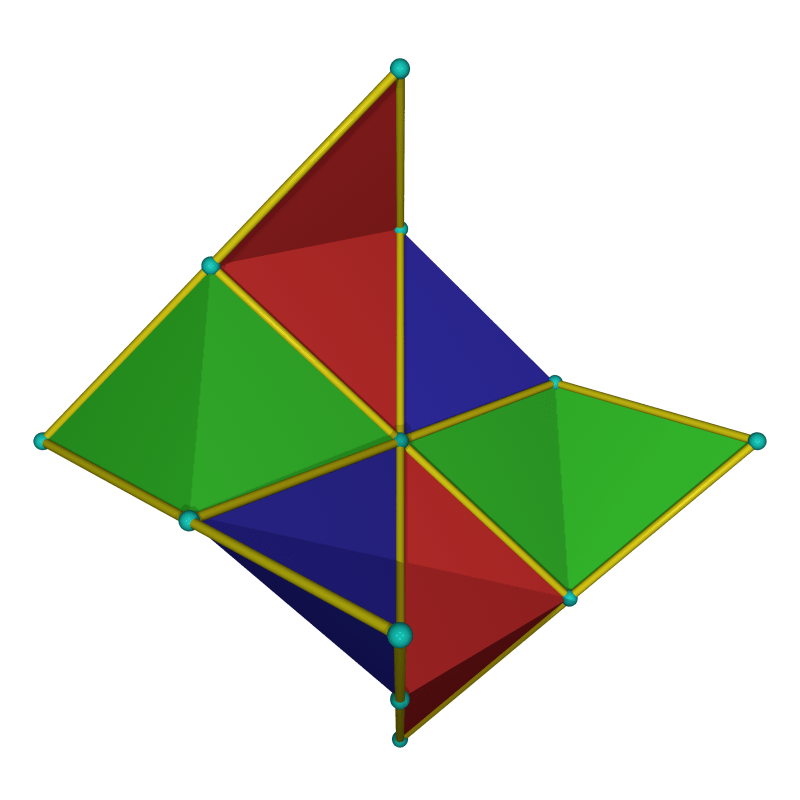
Pair

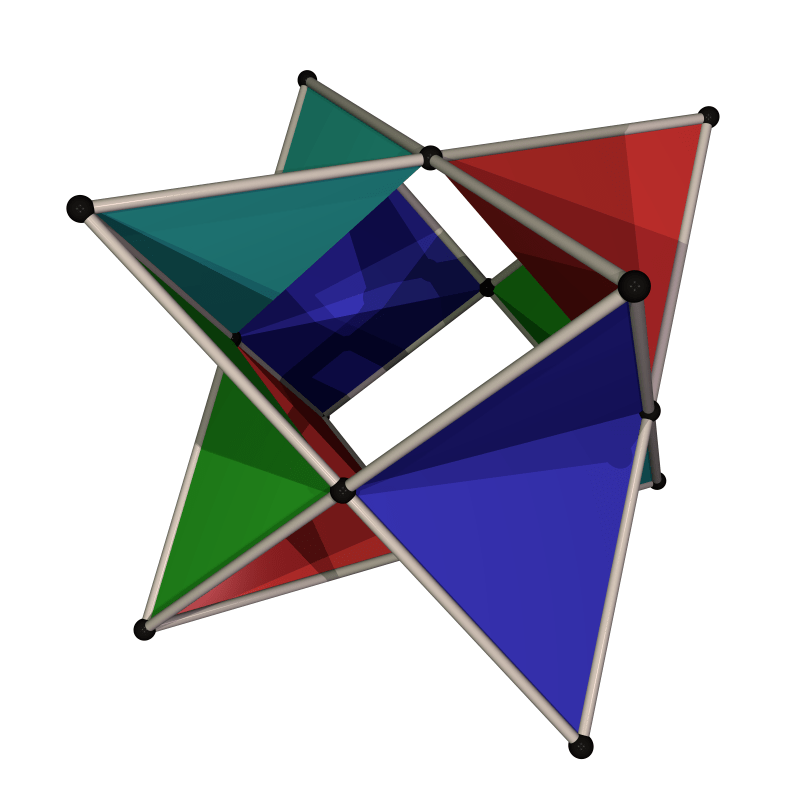
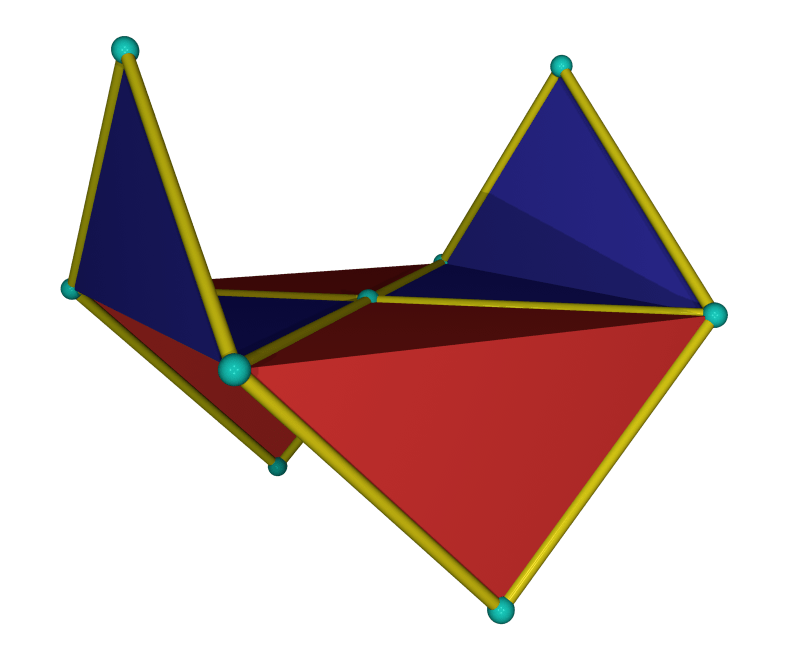
One can explore this crystal structure together with the diamond surface at a much more elementary level. Start with two sides of a regular tetrahedron. They constitute a blue rhombus that has been folded along the shorter diagonal. Rotate this blue rhombus by 180 degrees about any of its four edges to obtain a second (red) rhombus that is attached to it, like in the image above.

Hex

Keep extending this surface, always by rotating a bent rhombus about a boundary edge by 180 degrees. Above you see how you can obtain a hexagonal shape, and below an annulus.

Annulus

Again the surface will extend indefinitely. The following piece is a fundamental piece in the sense that mere translations of it will produce the whole infinite surface.

Cube

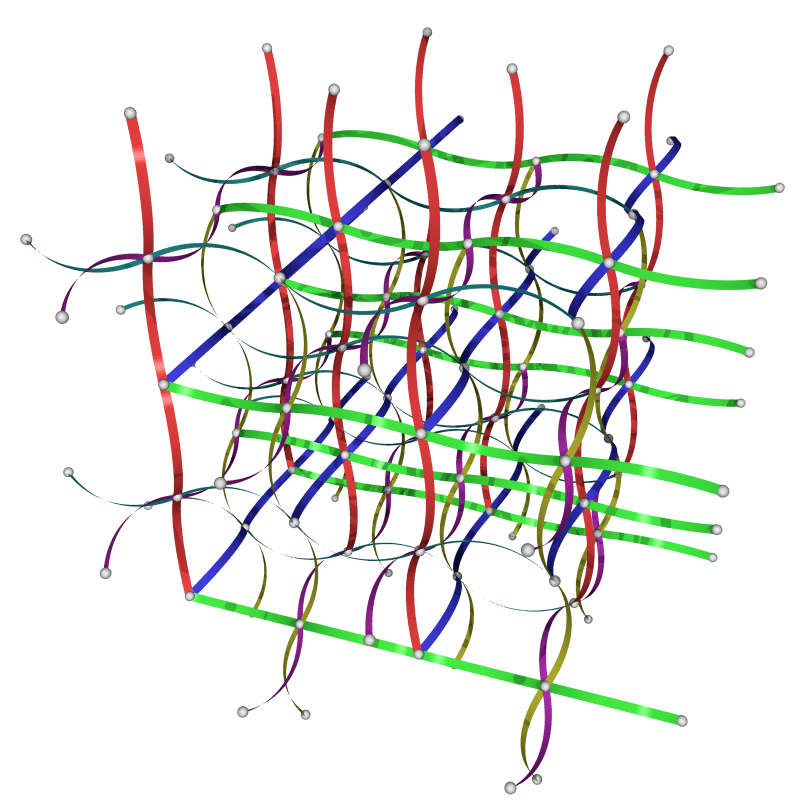
There is another way to render the bent rhombi by replacing each rhombus by a circular ribbon which ends at the far corners of the rhombus. I learned about this from Alison Martin at the Shape-Up conference in Berlin, 2015.

Cubestrips

So what we are trying here is to visualize an abstract algorithm (extend by rotating about an edge) that can reapplied to varying geometric contexts.

Copies

Avoiding Collisions (Helices I)

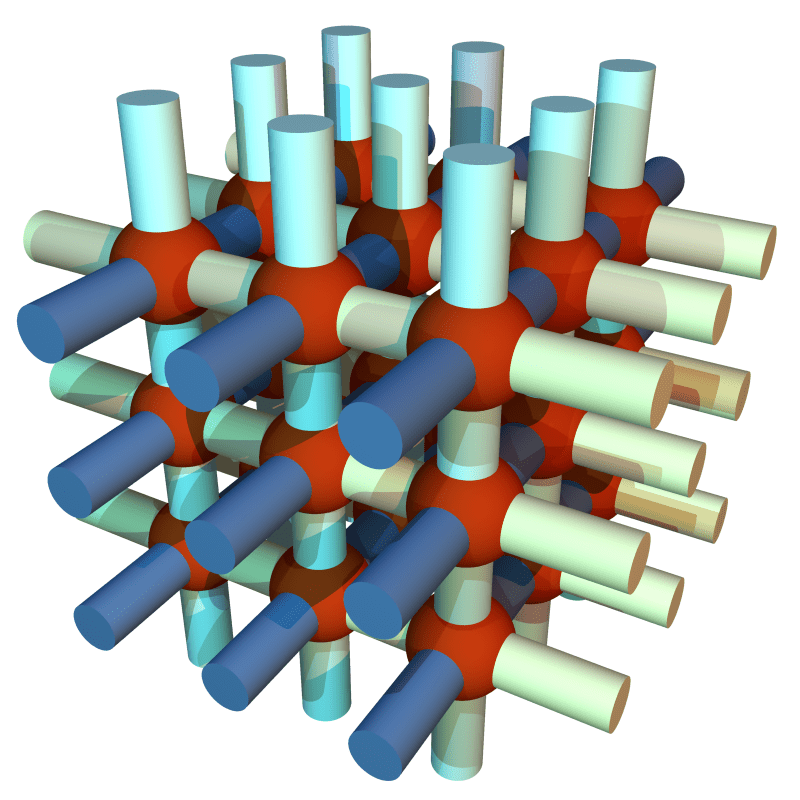
One of the simplest line configurations in space just utilizes the parallels to the coordinate axes that pass through the (red) points with integer coordinates.

Linepack

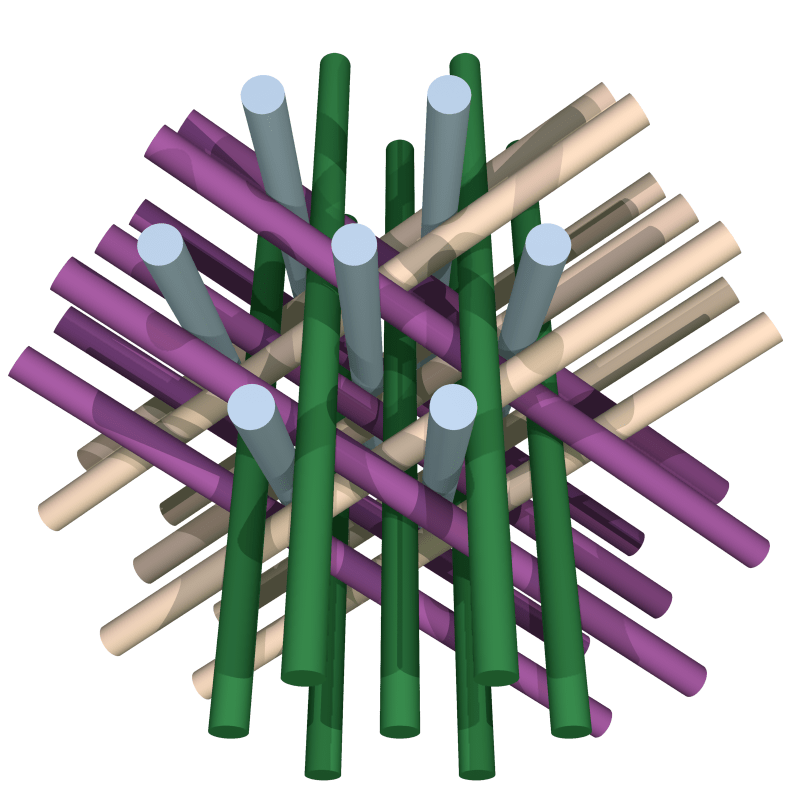
If we want to avoid the triple collisions at all these points, we can shift the lines one half unit each, like so:

Linepack2

This results in a dense packing of cylinders. Another possibility to avoid the collision is to let the lines spiral around the red points. I haven’t found a nice way to do this because the three helices would need to pass through the eight cubes surrounding a red point, meaning this is impossible in a symmetric way.

Linepack3

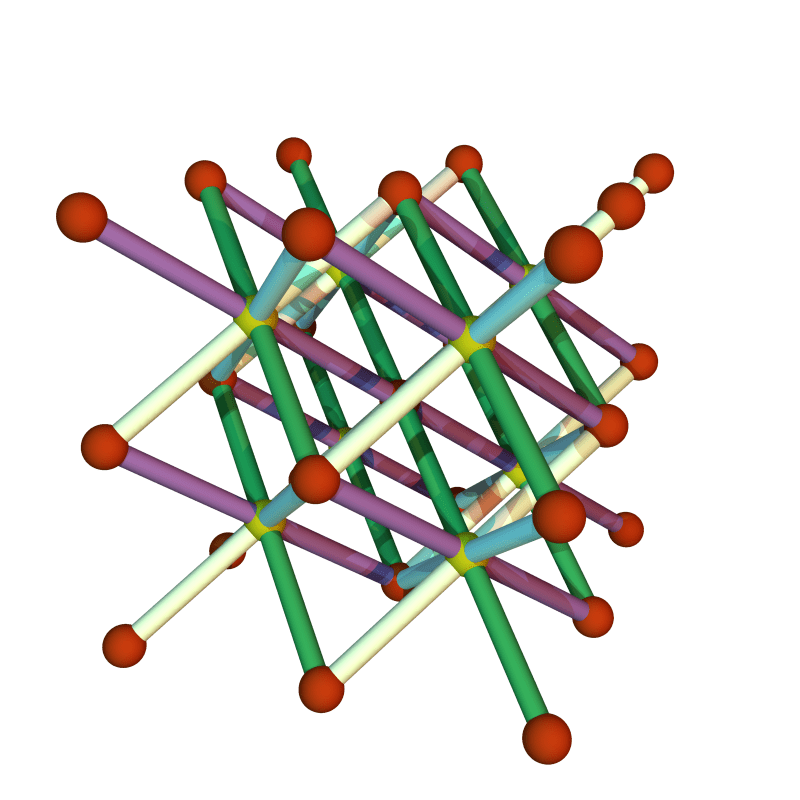
However, there is another line configuration where the lines pass through all the main diagonals. This is more complicated, because we have now four sets of parallel lines. Again we can shift the lines to avoid collisions.

Linepack6

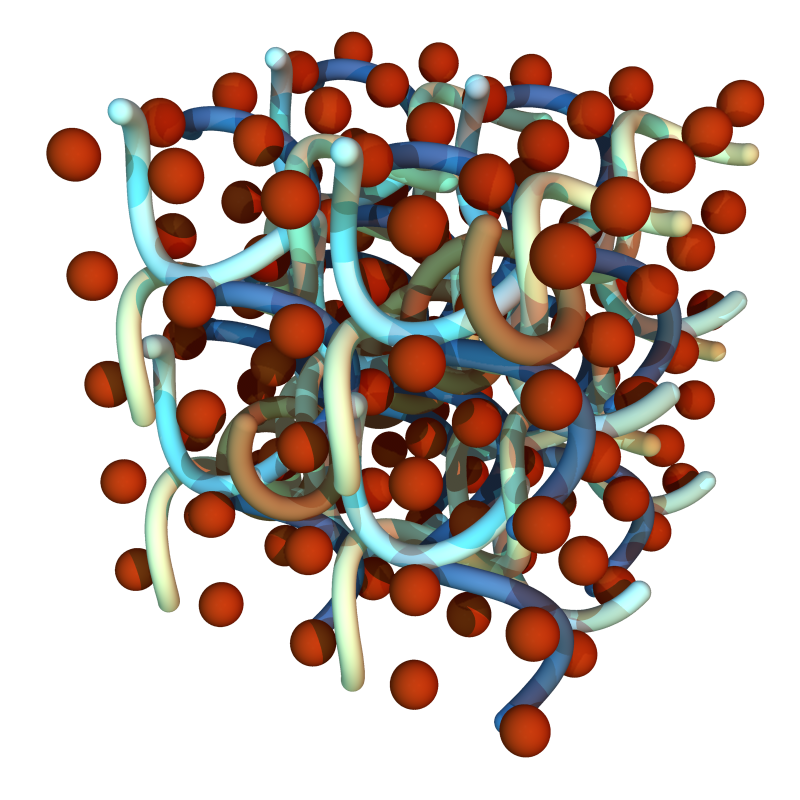
Now, with four lines through each intersection, we can replace them by helices in a pretty symmetric fashion.

Spiralpack2

Hopf Fibration (Annuli III)

Hopf 8 right

When talking about tori, at some point the Hopf fibration will make its appearance.
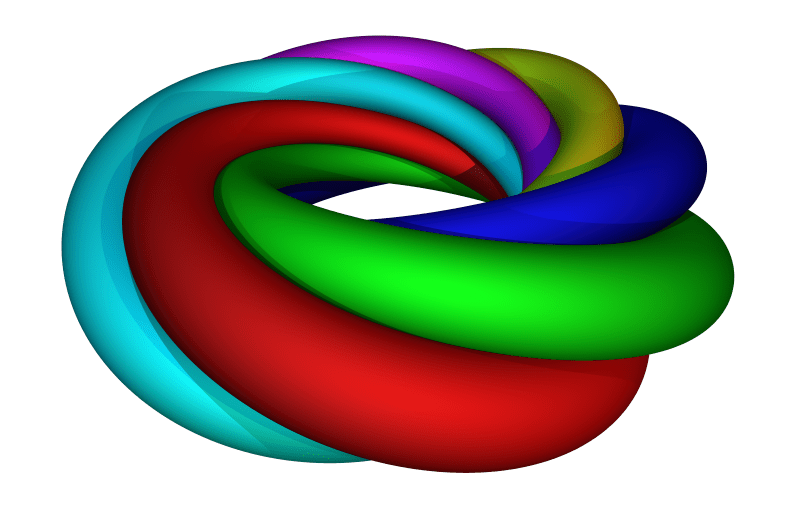
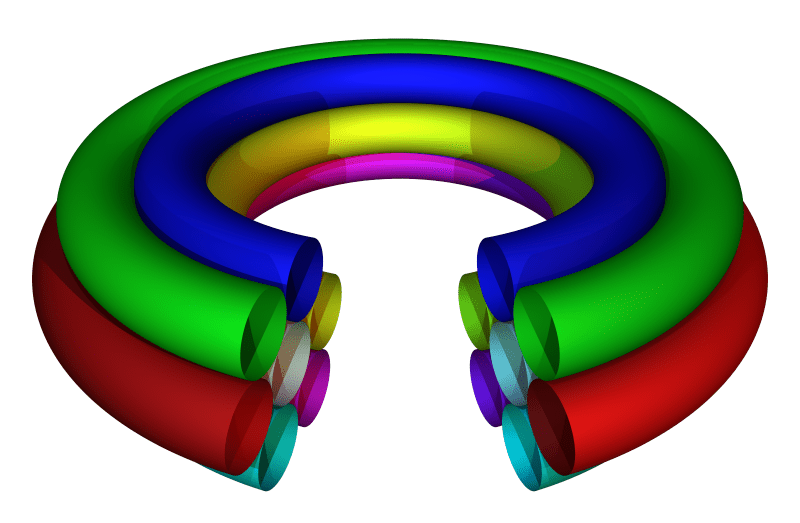
It all begins with a few tori of revolution packed together. Think about circular wires
bundled into one thick cable.

Simple

Cut through all the wires, twist the cable by 360 degrees, and reconnect wires of equal color.

Twist

Now all wires are interlinked, and this has the advantage that you can extend all this wiring to all of space (except for the vertical axis) in an even way to het what mathematicians call a fibre bundle.

Side

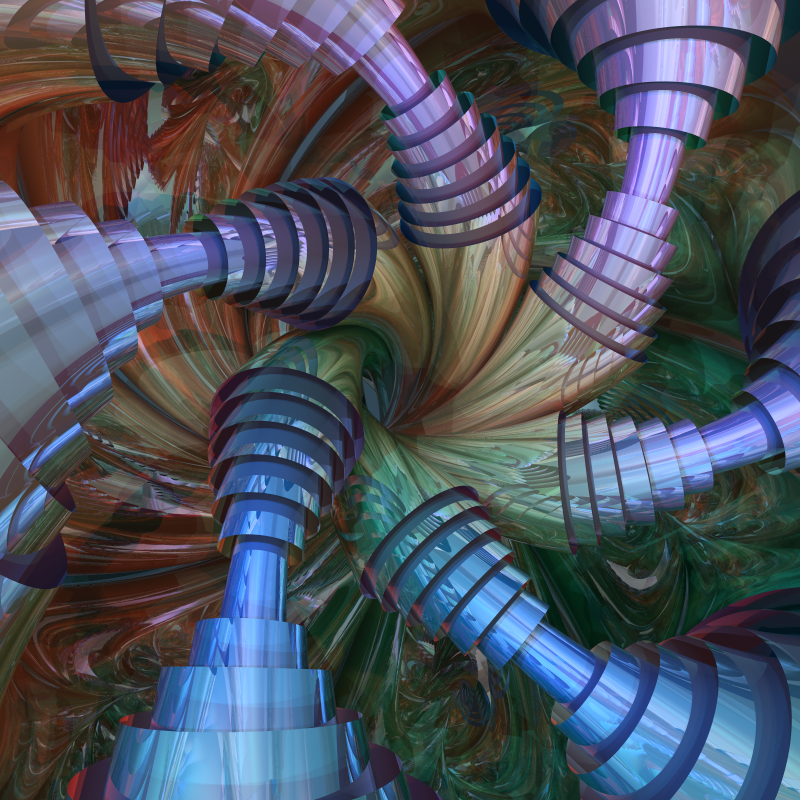
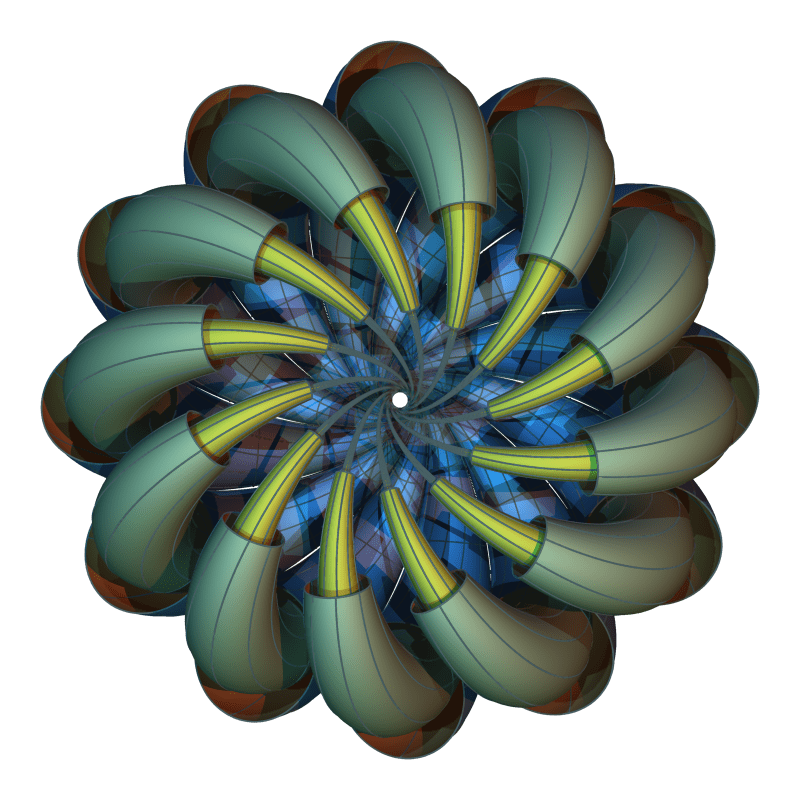
One can increase the complexity by showing nested wires by removing parts of then. The top view below is a simplified version of the picture at the top.

Top

The 120-Cell (Spheres XIII)

Dodeca right

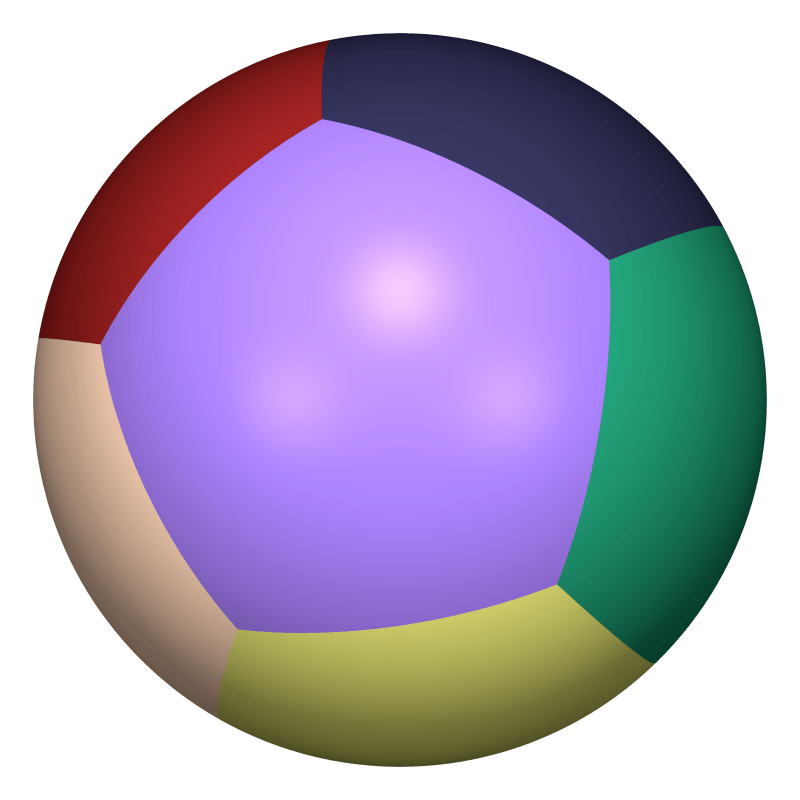
Pentagons do not tile the plane. If you fit three of them around a corner, there will be a gap of 36 degrees.
But, on a sphere, the pentagons can be inflated so that their angles become 120 degrees, and then twelve of them can be used to tile the sphere, creating a spherical version of the dodecahedron.

Dodeca spherical

Likewise, dodecahedra do not tile space. When you fit three around an edge, they leave a gap of about 10.3 degrees.
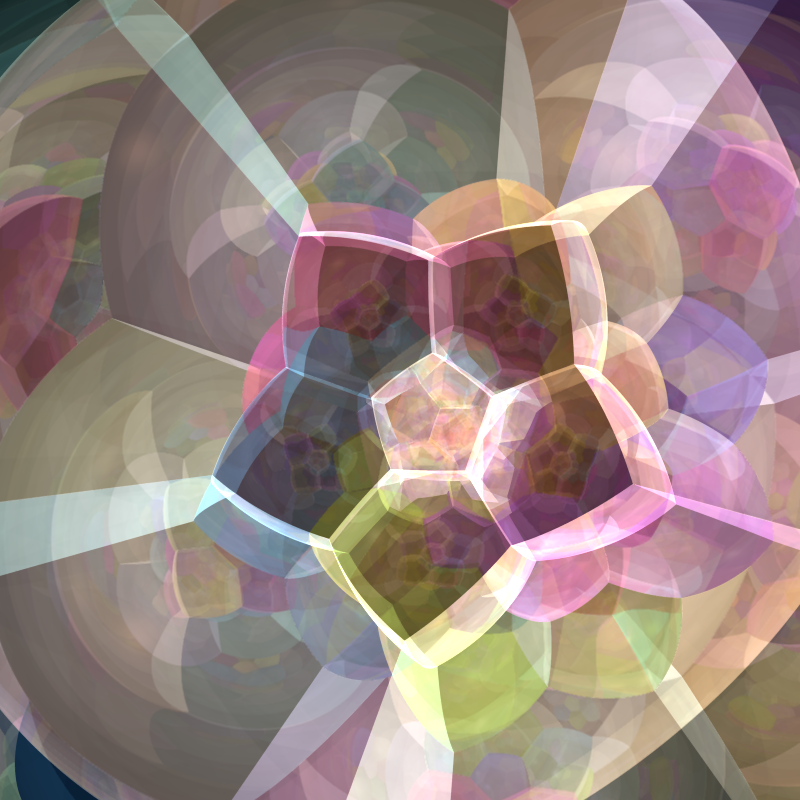
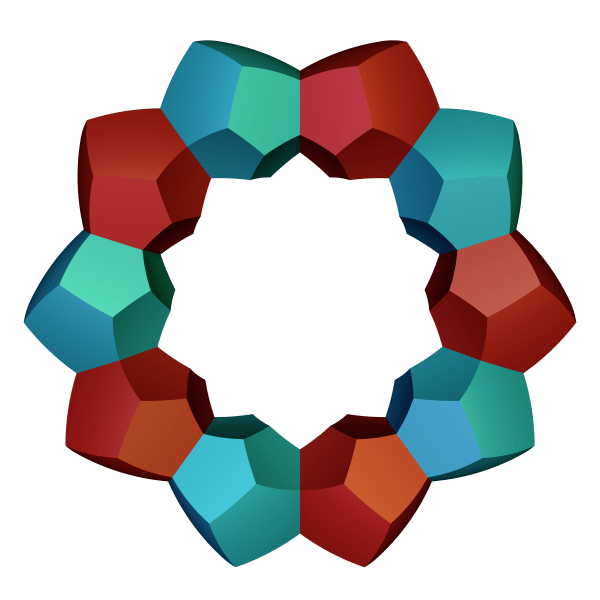
But again, they can be inflated in the 3-dimensional sphere. This time you will need 120 of them to tile the entire sphere. To visualize this, we start with one dodecahedron, and attach copies at opposite faces. After 10 copies, you will obtain an annulus of dodecahedra, which looks like this, after stereographic projection:

Dodeca

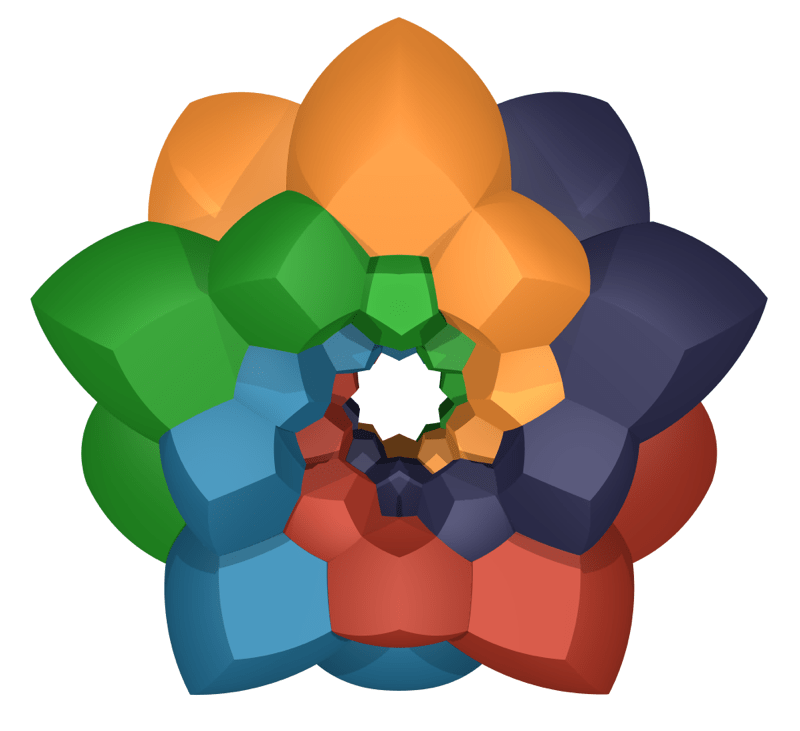
Repeat this with all immediately neighboring dodecahedra to get five more intertwined annuli of dodecahedra. They hide the original annulus from view. All six annuli together form one half of the 120 cell, the rest just being the complement in the 3-sphere of what we already have.

Dodeca 2

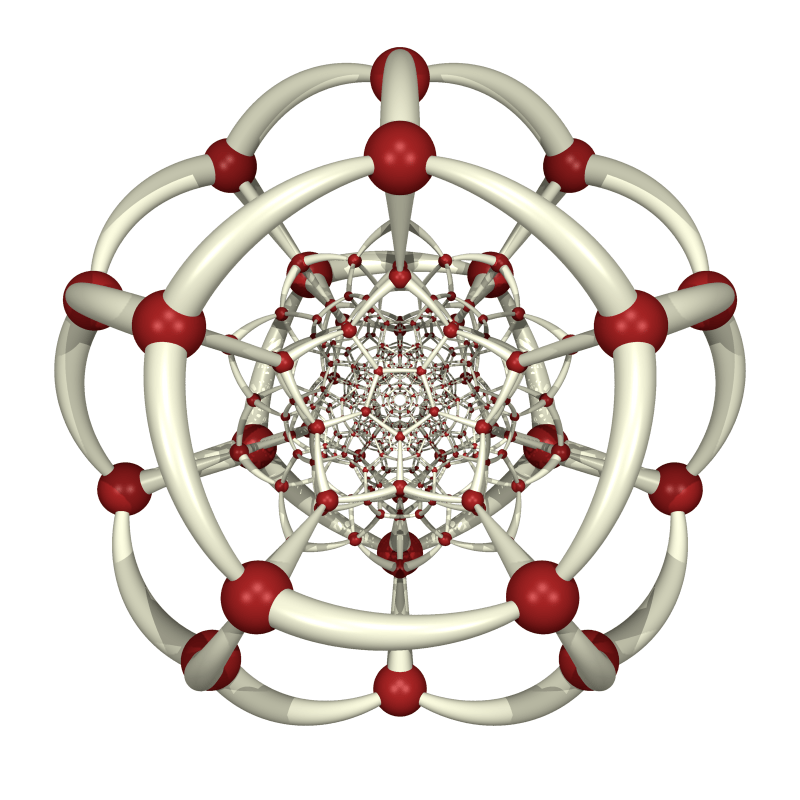
Here is an image of just the vertices and edges of the 120-cell. No elephants were harmed in making the 1200 ivory edges.

120cell

Reflections on Simplicity

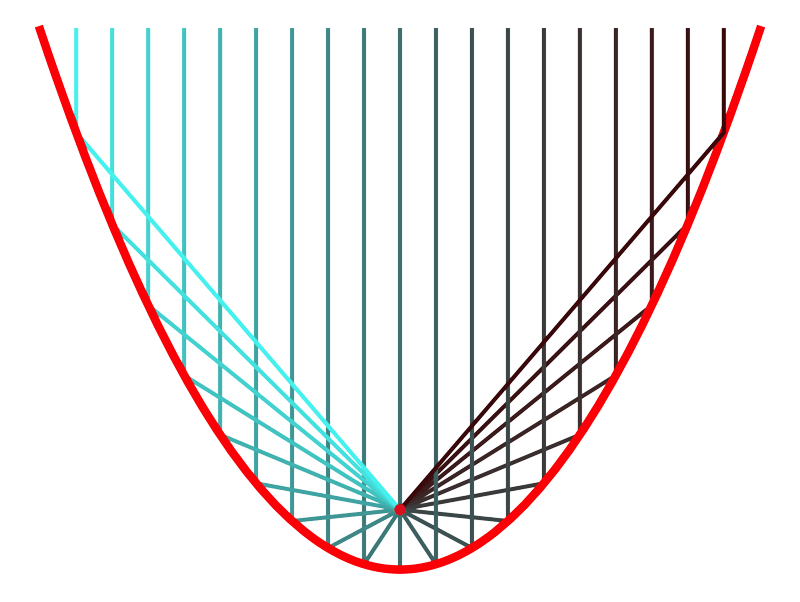
If a parabolic mirror has a light bulb in its focal point, the light rays are reflected at the mirror into parallel light beams, evenly illuminating whatever lies ahead.

Parabola

In optics, reflections are well studied. The basic question is what happens when parallel light hits a reflective surface.

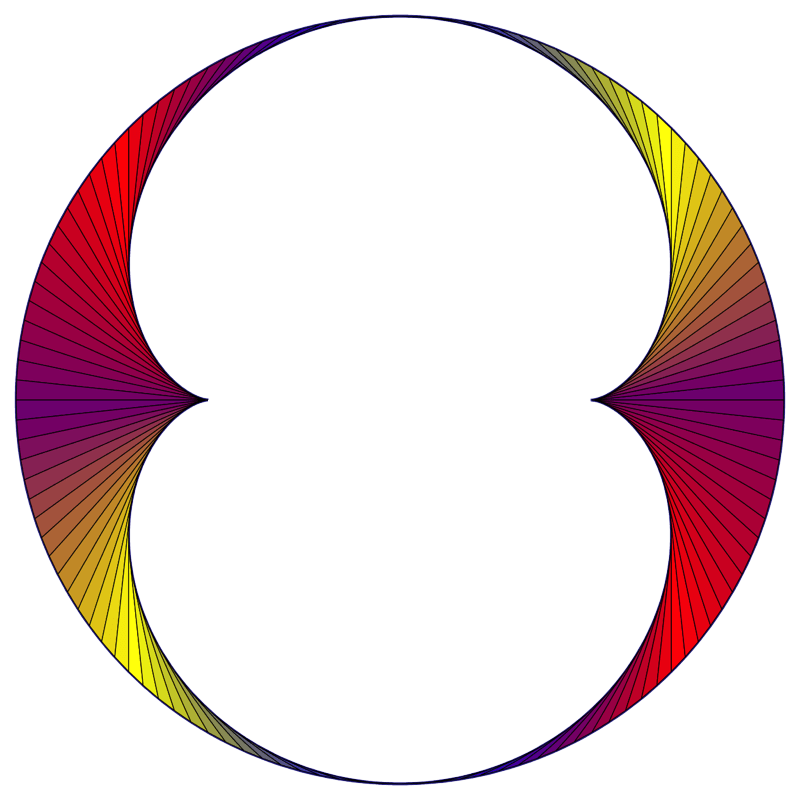
The case of the parabola is the rare exception. Typically, the reflected light rays will produce another curve of heightened brightness, called its caustic.
For instance, you might have observed a strangely formed curve in a cup of good black tea when horizontal light hits the rim of your circular cup. This curve is actually a nephroid, well studied since antiquity.

Circlecaustic

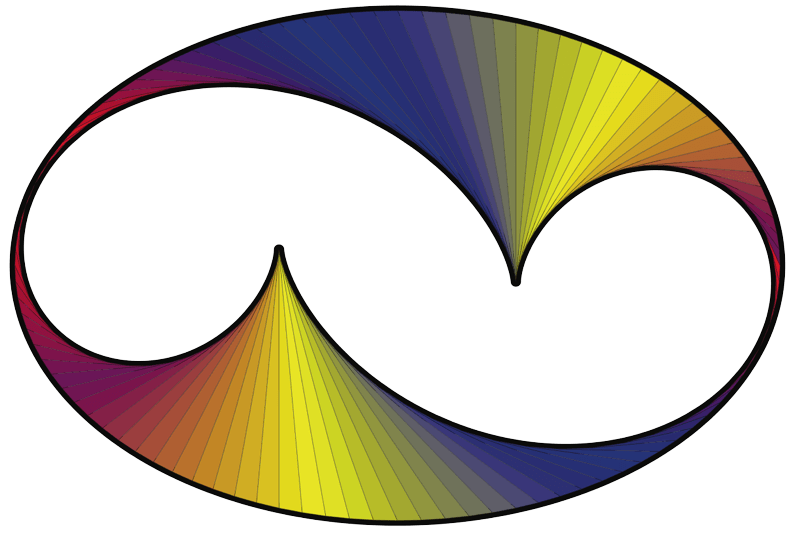
Doing the same to an ellipse gives a deformed picture.

Ellipsecaustic

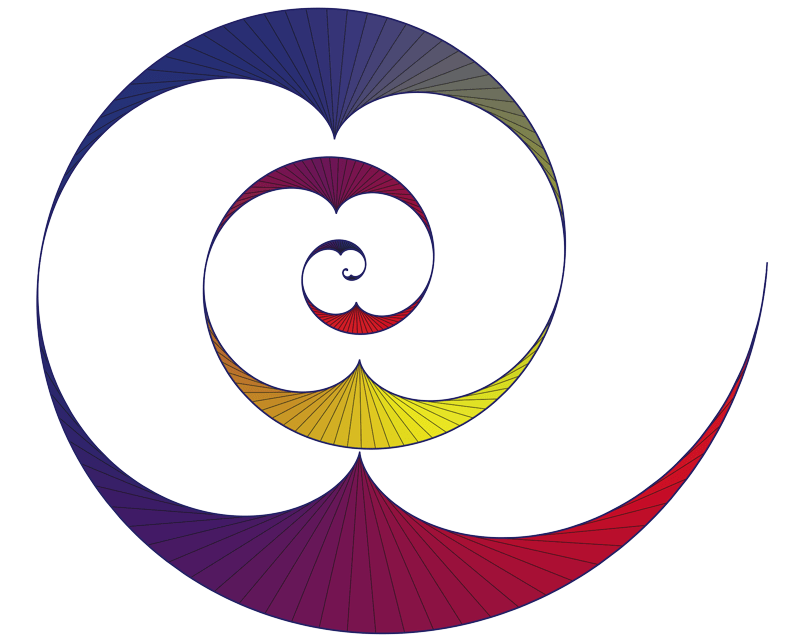
Still other curves like the spiral below have elegantly ornamental curves as their caustics.

Spiralcaustic