Minimal Surfaces, At Their Limit

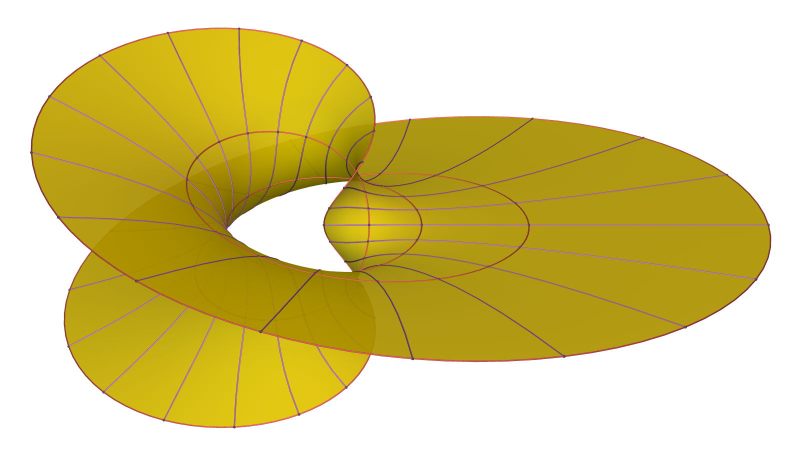
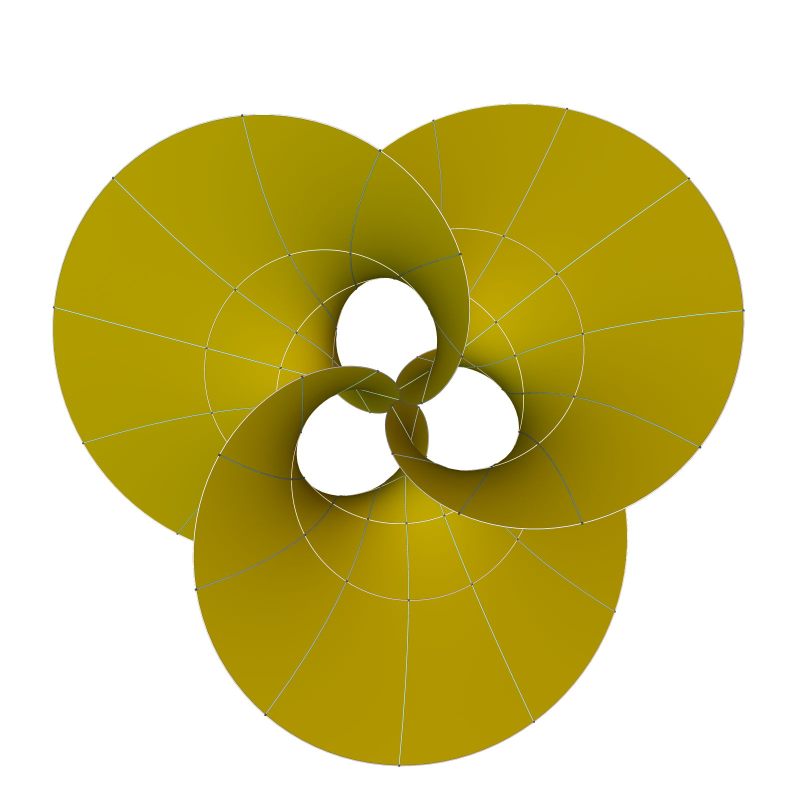
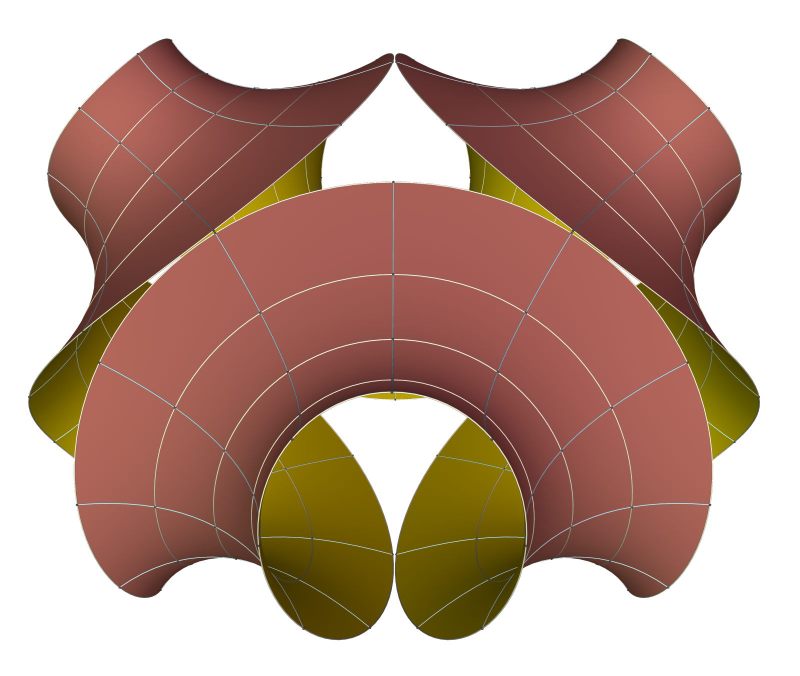
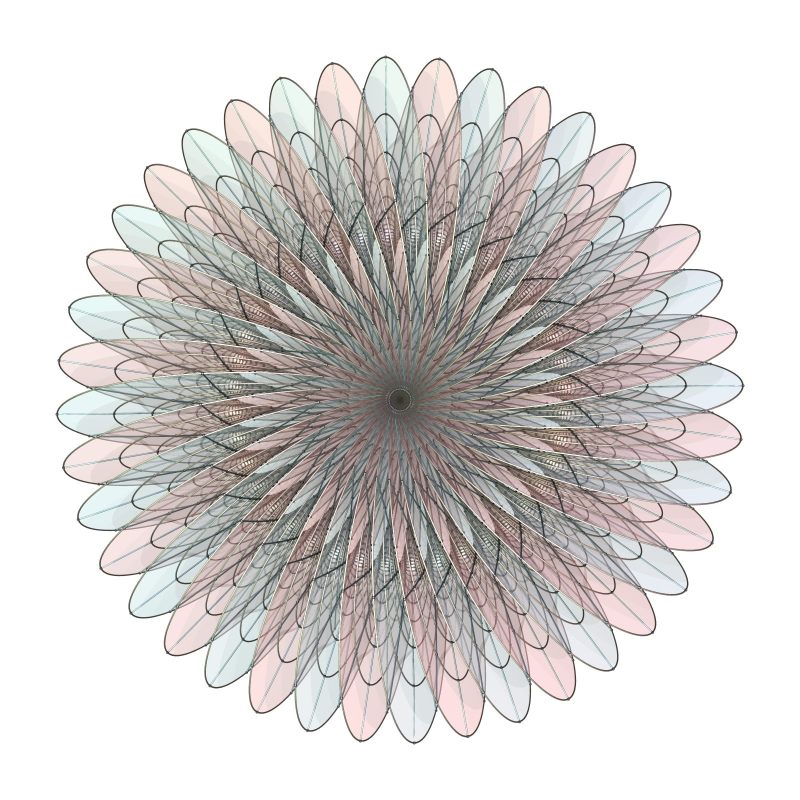
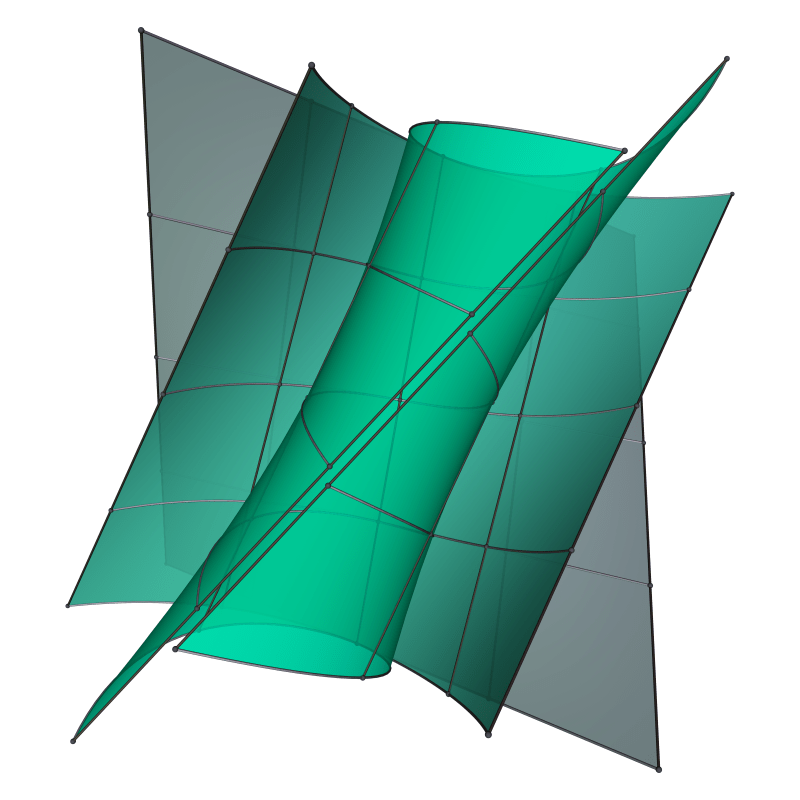
The minimal surfaces in the post about Möbius strips were made using a formula by Emmanuel Gabriel Björling, a Swedish Mathematician from the 19th century. For a given curve in space, this formula allows you to write down a parametrization for a minimal surface that not only contains the given curve, but is also tangent to the curve in any way you wish to prescribe. For instance, the multiple times twisted Möbius strips all contain a circle, and touch the circle by spinning around it more or less often.
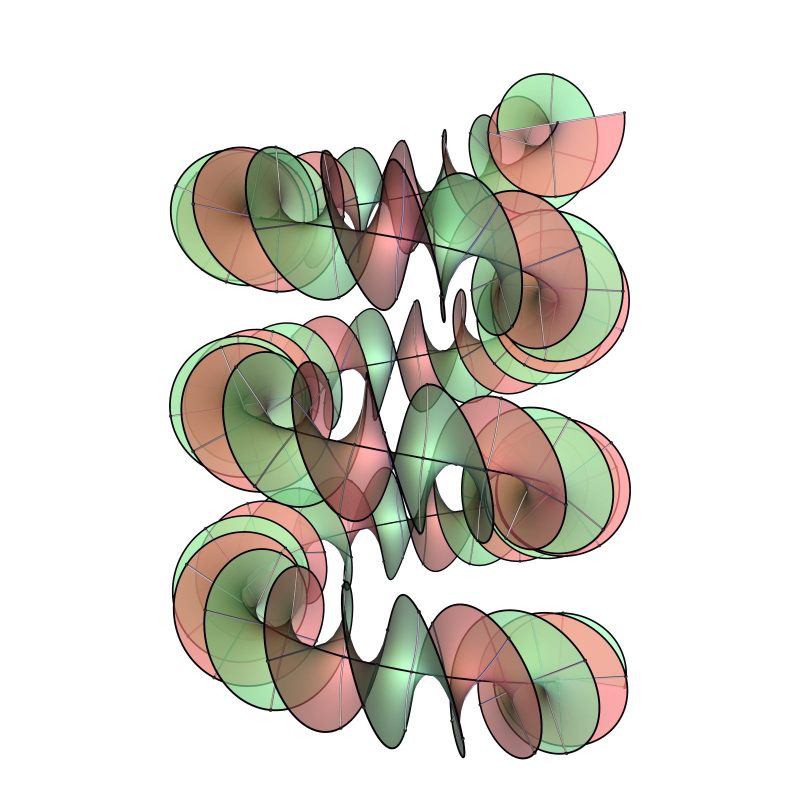
Helix

This formula works not only for circles but also for other curves, like the helix above. The difficulty is that in most cases, the equations are so complicated that they become meaningless. There are some pretty exceptions, like this knotted minimal strip:
Knots

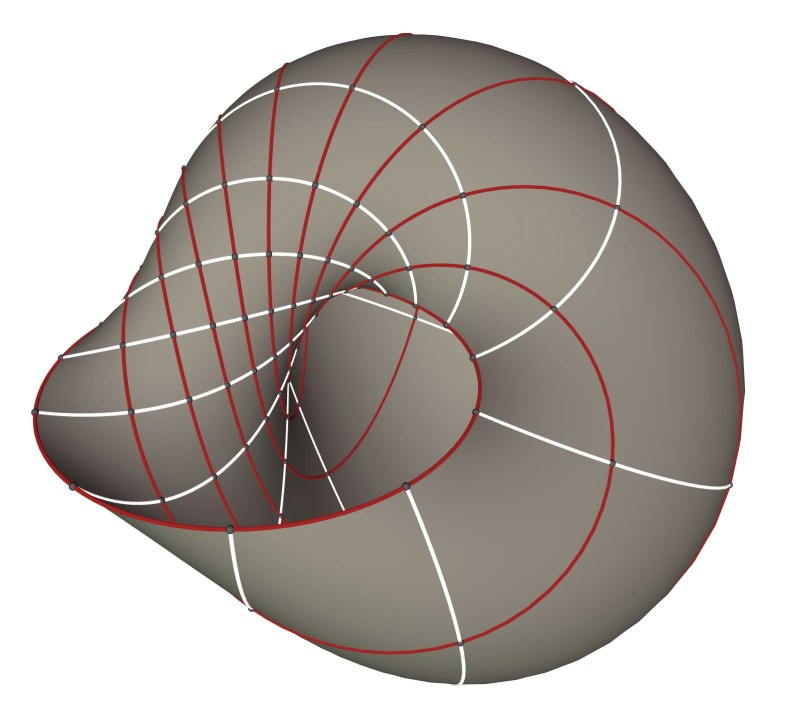
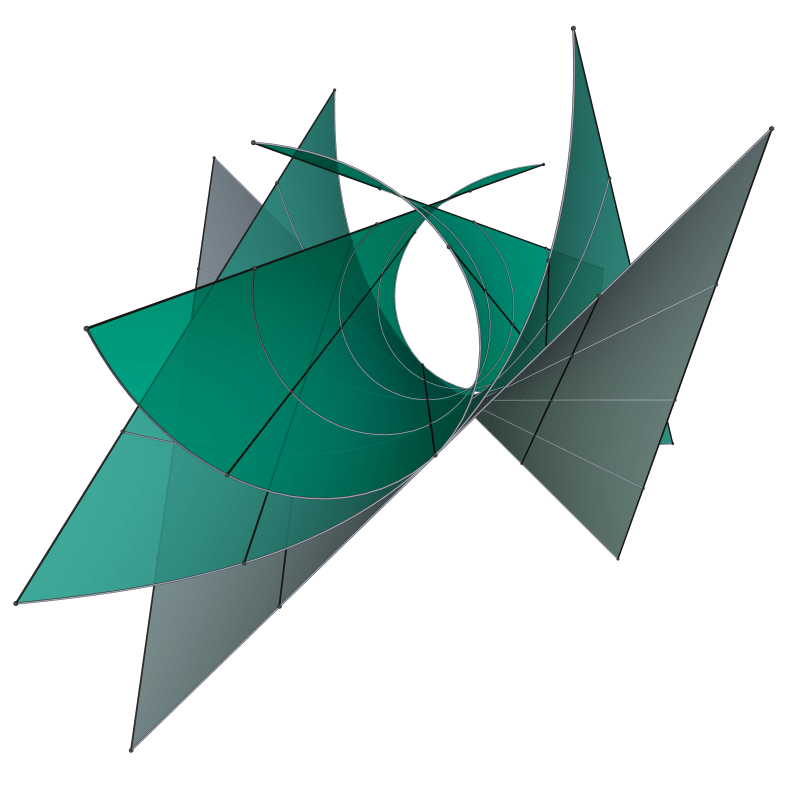
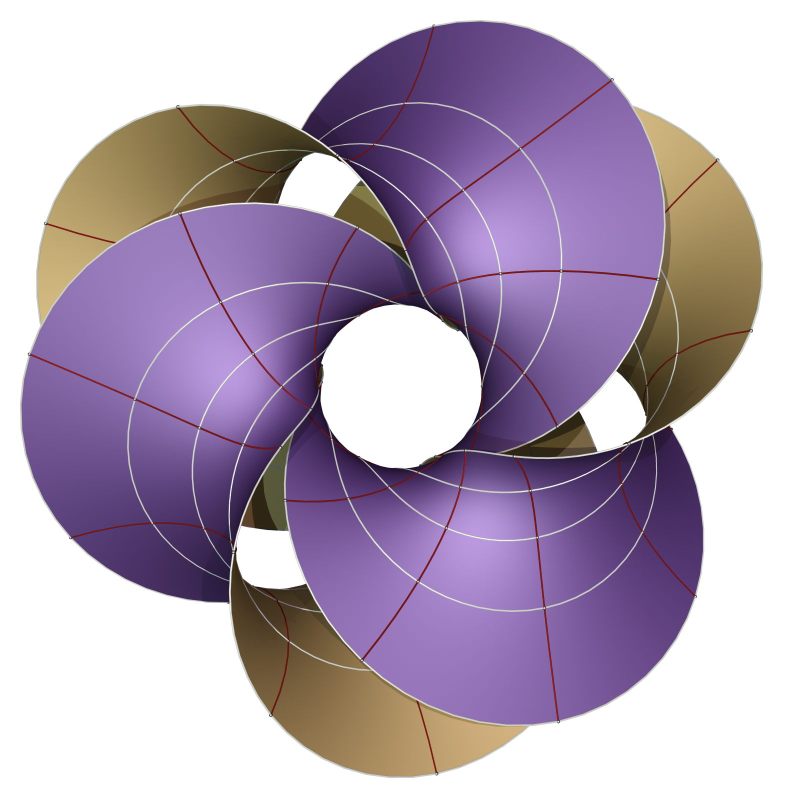
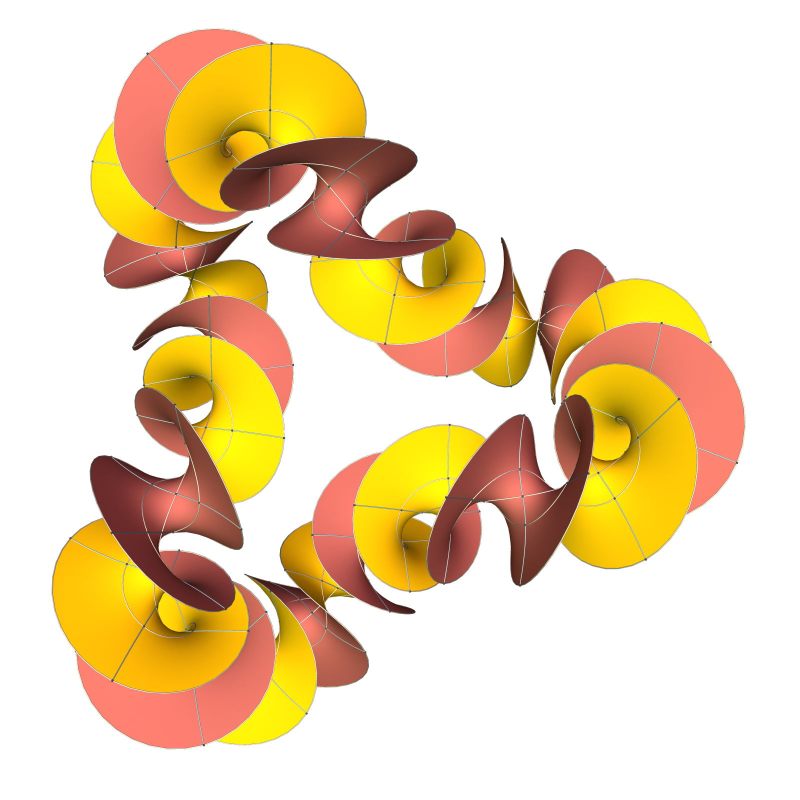
In the search for interesting and simple curves where Björling’s formula gives manageable results, the multiply twisted minimal strips are particularly useful. We saw that the surfaces in their associate family are also closed strips, but their core curves are not just circles anymore. Using these as new core curves can be used to compute surprisingly simple formulas for surfaces like this one:
DoubleMobius3 15

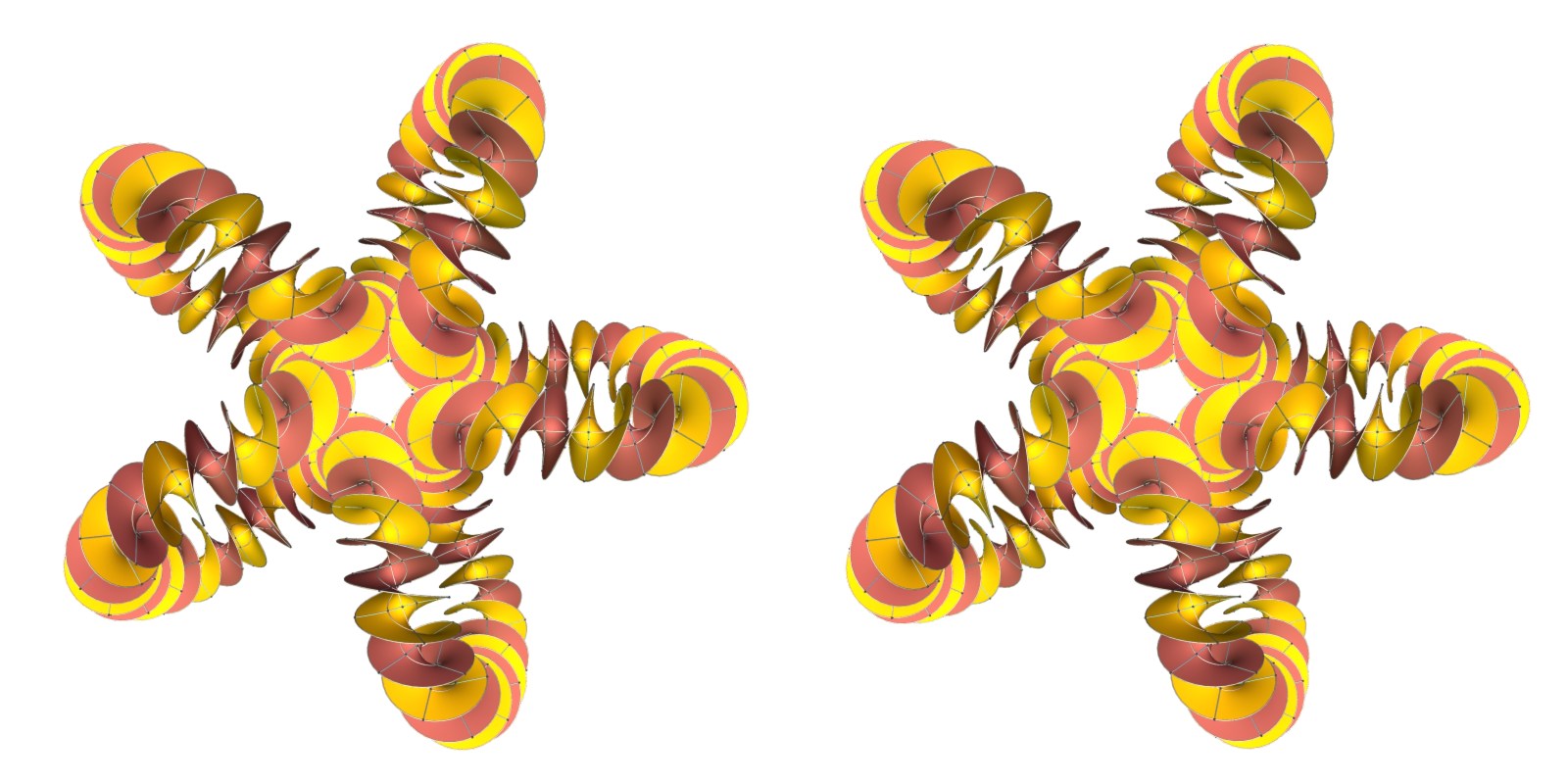
This can get quite complicated. Try to view this stereo pair cross-eyed or with a stereo viewer.
Bjorling stereo

These shapes appear to contradict what we think should be a minimal surfaces. But that’s what we do: Seek what goes against the convention.
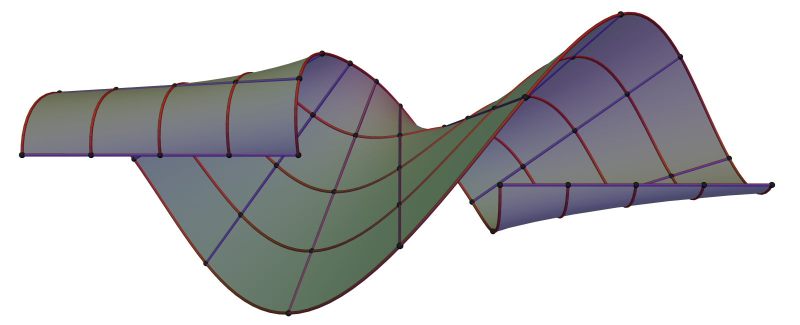
Möbius and Friends (Scrolls V)

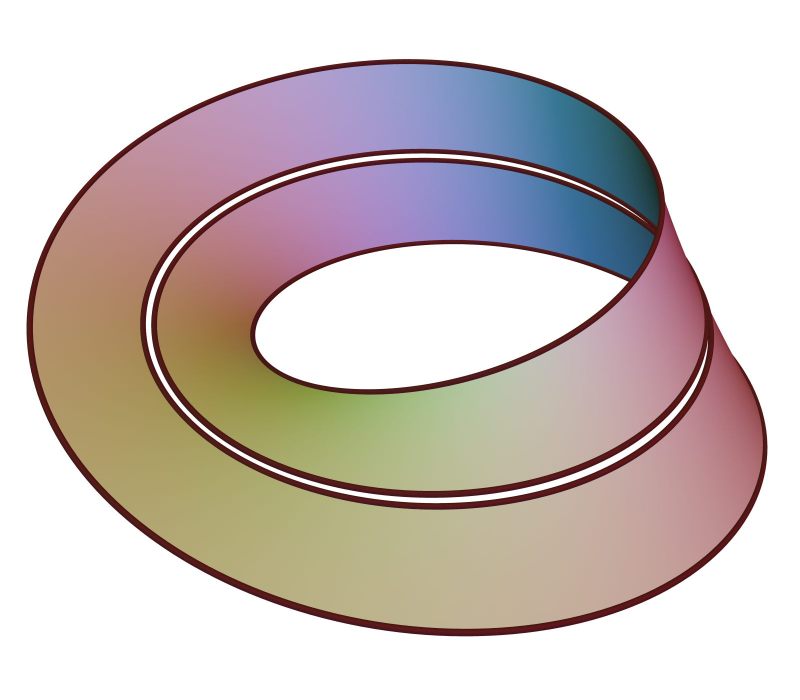
I am sure we all have cut a Möbius strip in half, and been irritated by not getting two pieces but instead a doubly twisted strip.

Moebiuscut

The quickest way to parametrize a Möbius strip is as a ruled surface, letting line segments rotate by 180 degrees while moving them around the same circle where we usually cut. This raises the tantalizing question whether we could possible make a book whose pages are Möbius strips. For the moment I don’t know, I haven’t been able to find many explicit bendings of the ruled Möbius strip, except for its Doppelgänger:

MobiusDual0

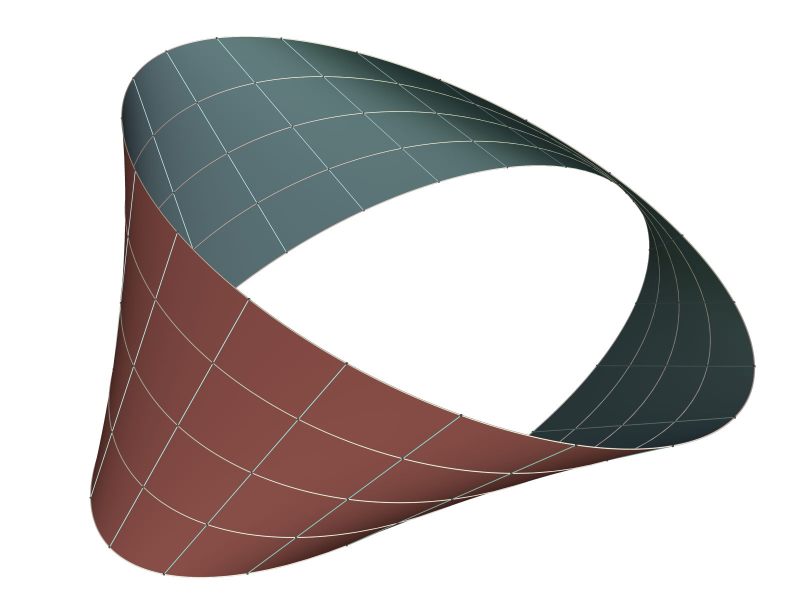
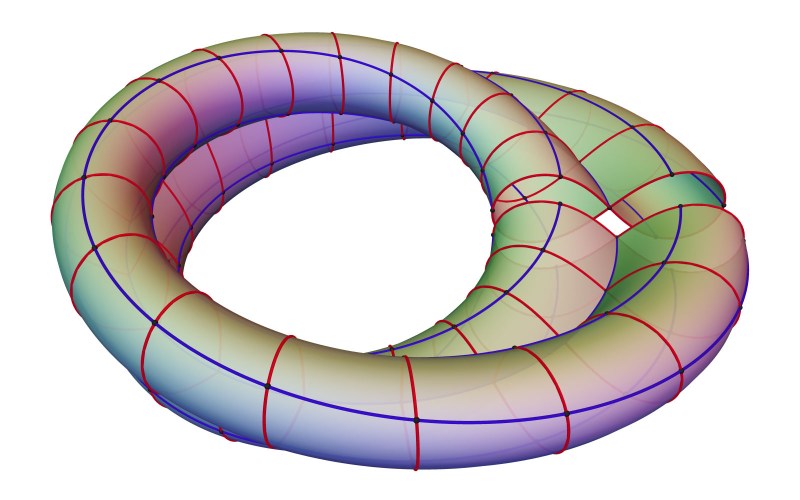
This, however, is not a closed band but instead continues on periodically. There is a version of the Möbius strip as a minimal surface that also has a circle as a core curve.

Mobius12

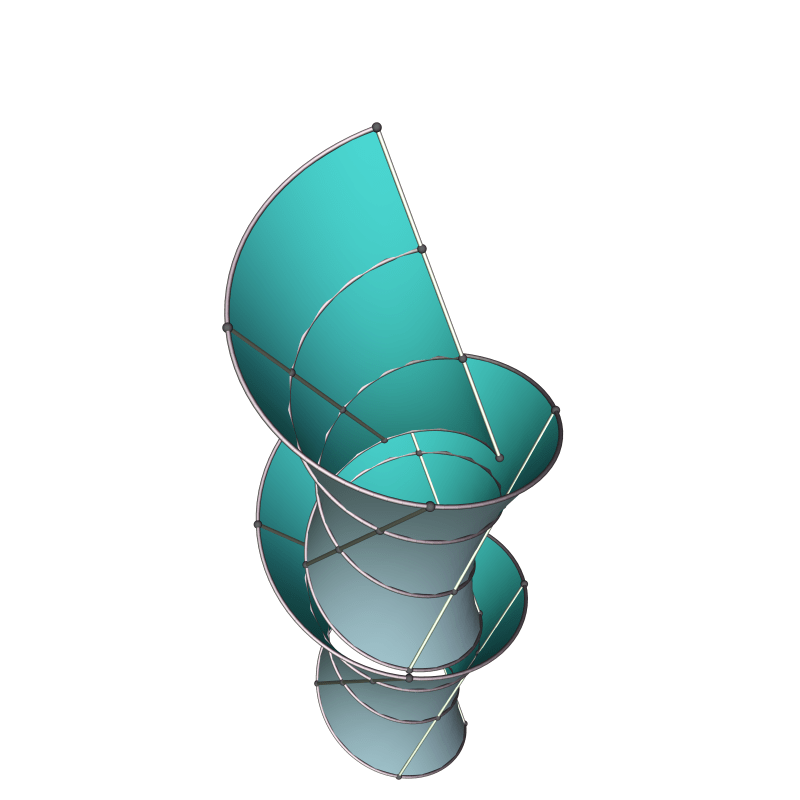
As with ruled surfaces, you can twist these minimal surfaces more or less often around the circle. Here for instance is the triply twisted version.

Mobius32

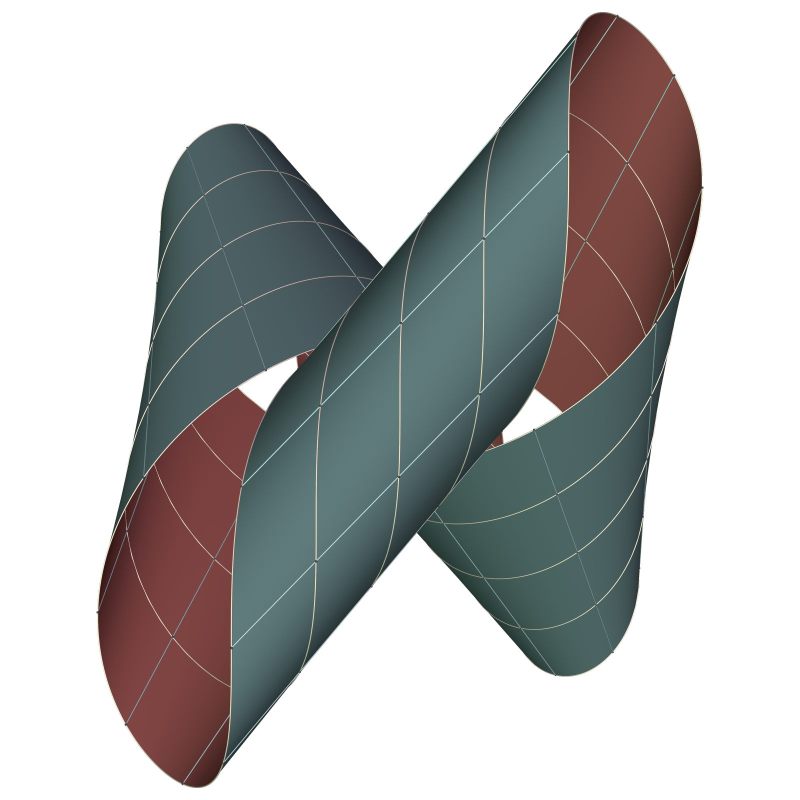
All these minimal surfaces can be bent in their associate family. They stay minimal, and, surprisingly, also closed bands (after two turns), except for the case of a doubly twisted band. The conjugate of the triply twisted band looks like this.

Mobius32conj

Of course three is never enough, so here is the 40 fold twisted version. Amazingly enough, all these surfaces have explicit formulas.

Mobius20b

This would be another possibility for a book project: One long twisted sheet of paper, bent into disk like pages…

The Anti-Cone and its Doppelgänger (Scrolls IV)

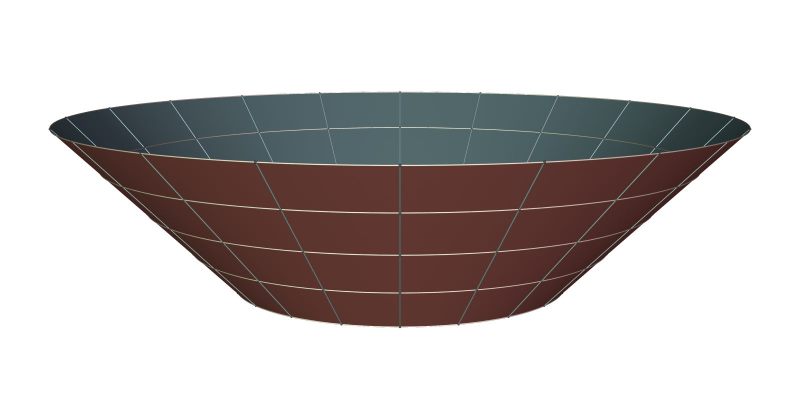
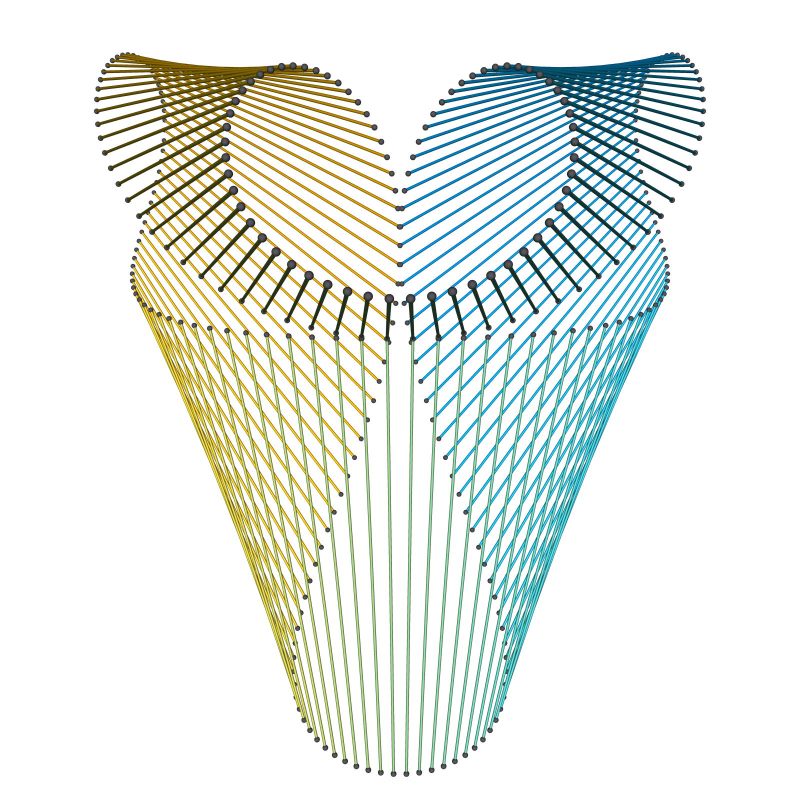
The literature has not many interesting examples of ruled surfaces in Euclidean space besides cylinders, cones, hyperboloids, and the helicoid. Let’s fix that. A cone, or more precisely a frustum (latin for piece), can be described by following a horizontal circle (as a directrix) counterclockwise and rotating the generators also counterclockwise, horizontally pointing in the same direction as the point on the directrix, and with a fixed vertical component.

Cone

The result is a flat surface and thus not interesting for making a curved book. But we can also follow the circle and let the generators rotate the other way. I will call the resulting surface an anti-cone. It is certainly not flat anymore.

Anticone

Take for a ruled surface all of its generators (the straight lines) and shift them so that they pass through the origin.
Their intersections with a sphere centered at the origin is called the spherical indicatrix of the ruled surface.

In this case, the spherical indicatrix is a pair of horizontal circles, both for cone and anti-cone, but differently orientated.

An old theorem about ruled surfaces states that you can deform any ruled surface by changing its spherical indicatrix pretty much arbitrarily. It turns out that there are typically two different solutions to do this, even if we trace the indicatrix in the same direction.
In other words, for a given ruled surface, there is a second ruled surface along a different directrix but with pairwise parallel generators. Let’s call this the doppelgänger of the ruled surface. For the anti-cone, it looks like this:

Anticonedual

One can visualize the relationship between the two surfaces by putting them together and coloring corresponding (i.e. parallel) lines with the same color.

Anticone3

If we had paper ribbons shaped this way, we could bend one into the other.

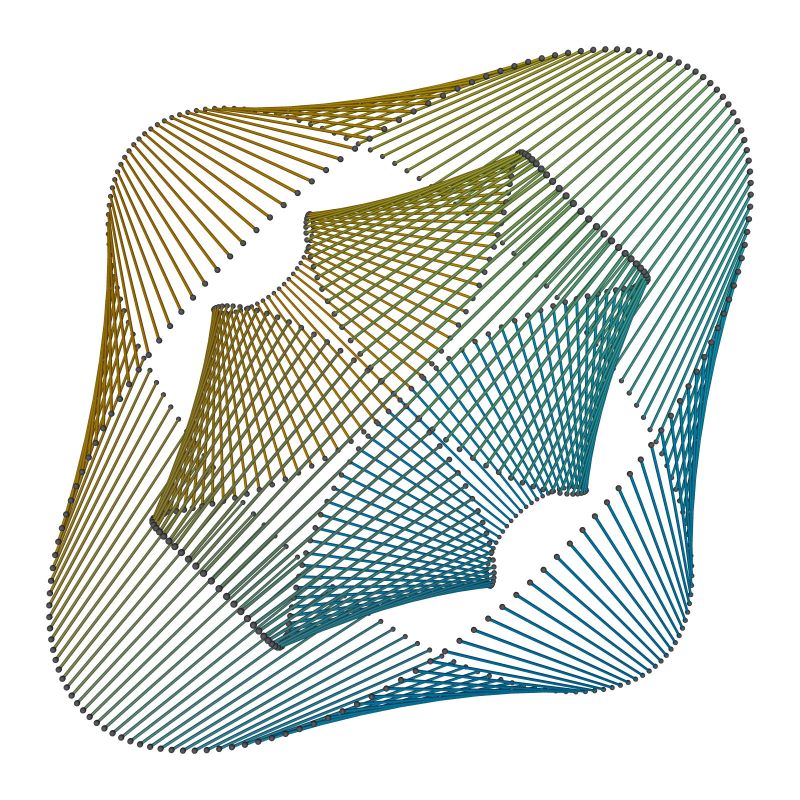
Here is another image of the generators of the anti-cone doppelgänger. Giving up on clarity can increase the esthetical appeal when we add ambiguity.

Anticone1

Lawson’s Klein Bottle (Annuli IV)

Lawson bottle b
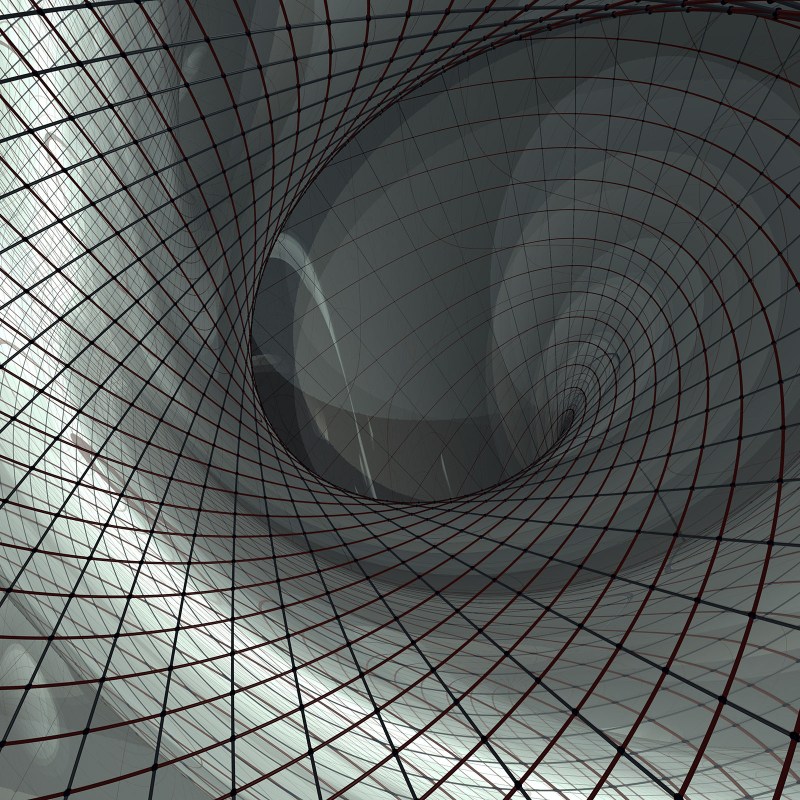
This is what it might look like if you got stuck inside a highly reflective Klein Bottle. Wait – Klein Bottles don’t have an inside.
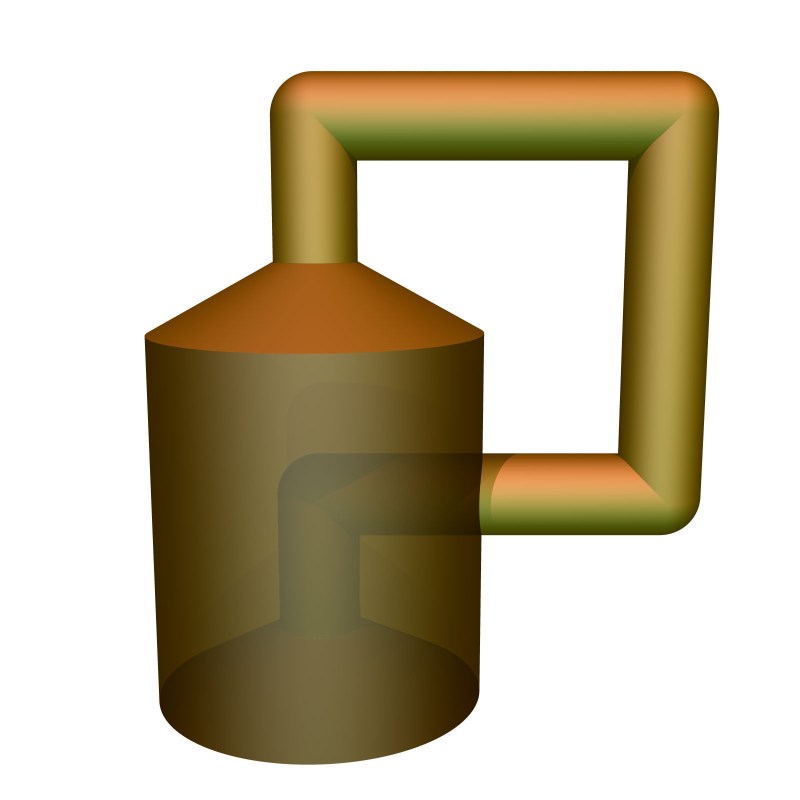
From the outside they can look like this:

Kleinbottle

Crawling through into the pipe at the bottom gets you from outside to inside. This is spooky, and responsible for this odd behavior is a Möbius strip. There are other versions of the Klein Bottle. Here is the figure eight version, obtained by rotating a figure 8 bout the vertical axis, and giving thereby the 8 a half twist.

Figureeightbottle

Note that in both versions, the bottle cuts itself along a circular closed curve. That the two versions above are really quite different can be seen by looking at the bottles near these circles. In the first case, it looks like an annulus intersected with a cylinder, while in the second case we see two intersecting Möbius strips. The latter description helps to understand the geometry of the next version better.

Lawson 2b

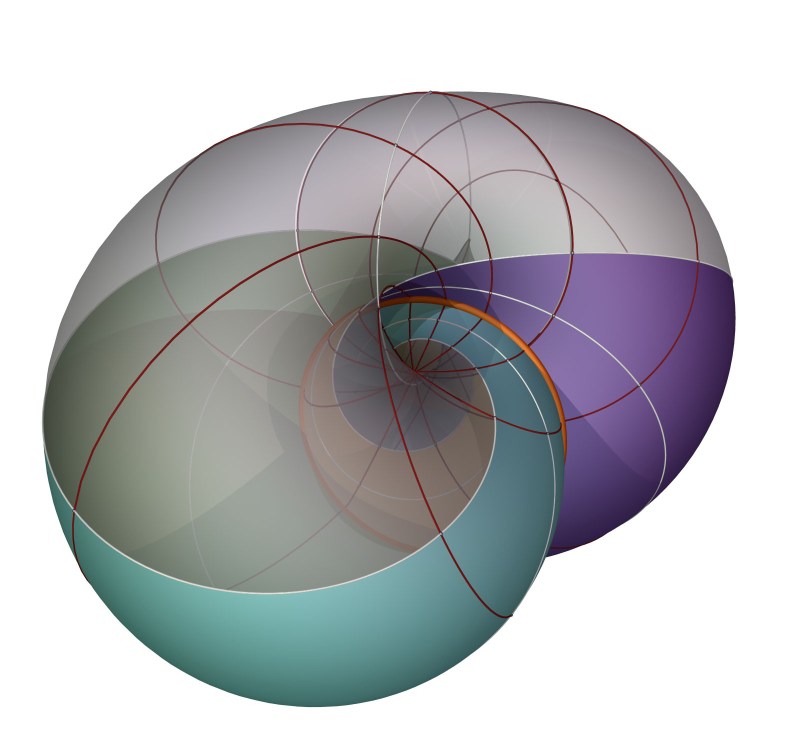
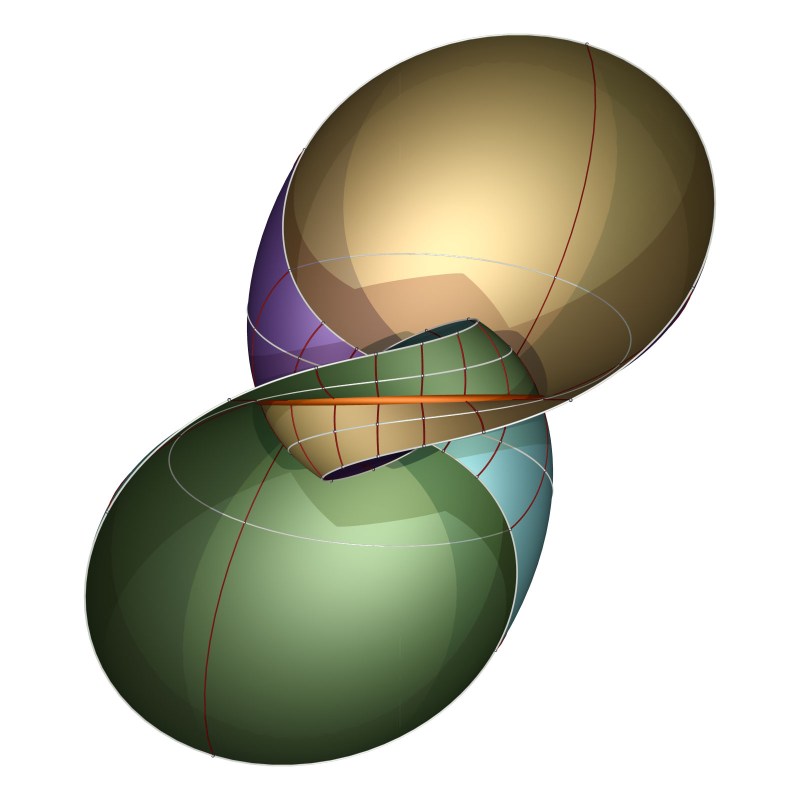
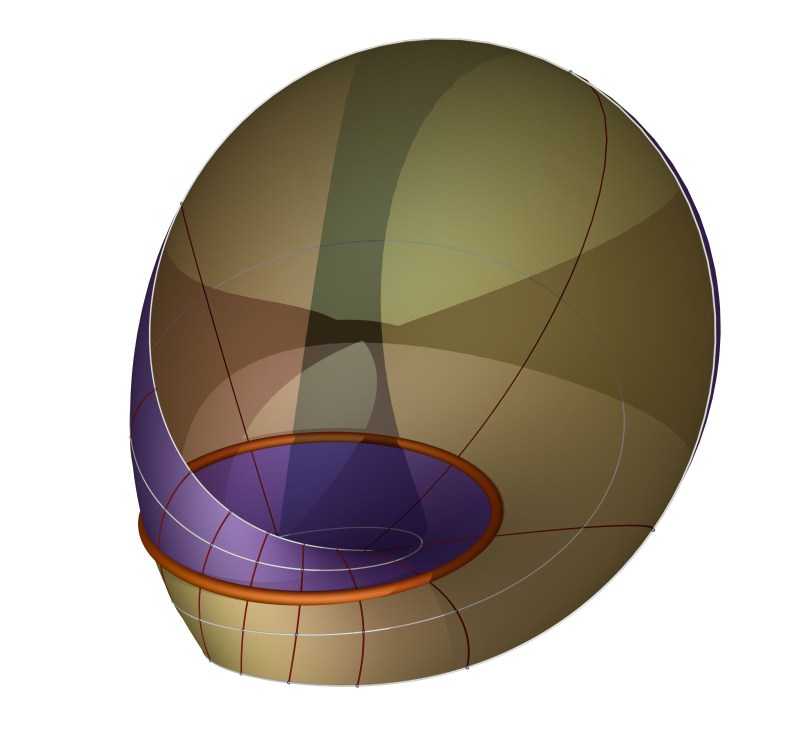
As we know, a Möbius strip has just one boundary curve. The image above shows a Möbius strip where the boundary curve is a perfectly round circle. Taking a second copy of this Möbius strip and attaching it to the first along the boundary circles produces the stereographic projection of Lawson’s Klein Bottle, a minimal surface in the 3-dimensional sphere.

Lawson 7

This is really complicated, so let’s look at the anatomy of this beast. The top translucent part, when turned around and after a paint job, reveals himself as a doubly twisted cylinder.

Lawson 4

The other (bottom) part is still rather complicated. It consists of two pieces of the Klein Bottle that intersect along the orange circle.

Lawson 6

One of them without its distracting sibling is once again a Möbius strip.

Lawson 5

So Lawson’s Klein bottle is anatomically just a union of two intersecting Möbius strips and a doubly twisted cylinder.

The Hyperbolic Paraboloid (Scrolls III)

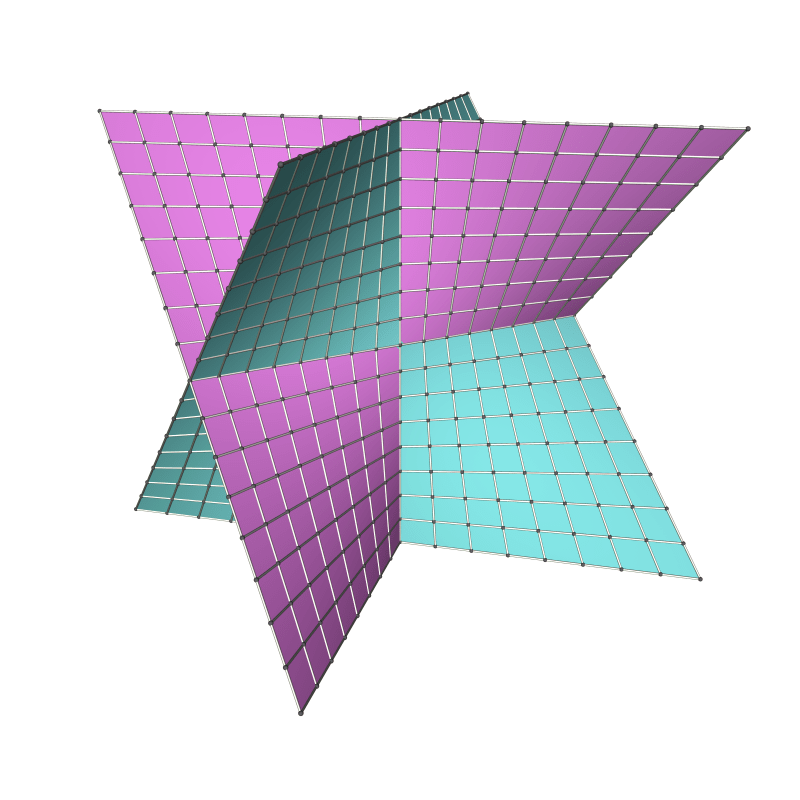
If you build a wire frame into the shape of four consecutive edges of a regular tetrahedron, dip it into soap water, and carefully pull it out again, you get a piece of the Diamond surface. If you cheat and just span wires between corresponding points of opposite edges, you get a doubly ruled surface, the hyperbolic paraboloid. Here is one such surface, together with a mirror image. The eight corners coincide now with the eight corners of a cube.

StellaOctanguloid 1

As a digression, we can fit a total of six such paraboloids into the same cube, creating a curved version of Kepler’s Stella Octangula.

StellaOctanguloid

But let’s return to paper making. The home recipes include the usage of a mold, which is a wireframe that is used to get the right amount of paper pulp into shape and, most importantly, dry. For flat paper one can just use a flat wire frame, like a window mesh screen, which is purchasable. The hope is that, using modest force, such a screen can be stretched into tetrahedral shape. We’ll work on that later.

For the moment let’s delight in previewing how the paper would bend.

Mathematica a

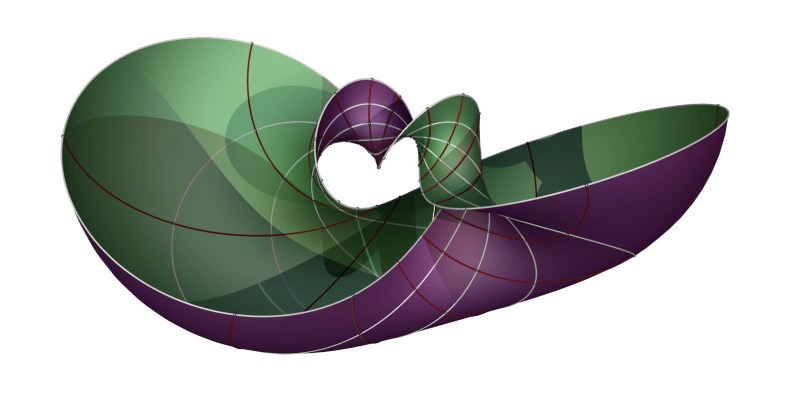
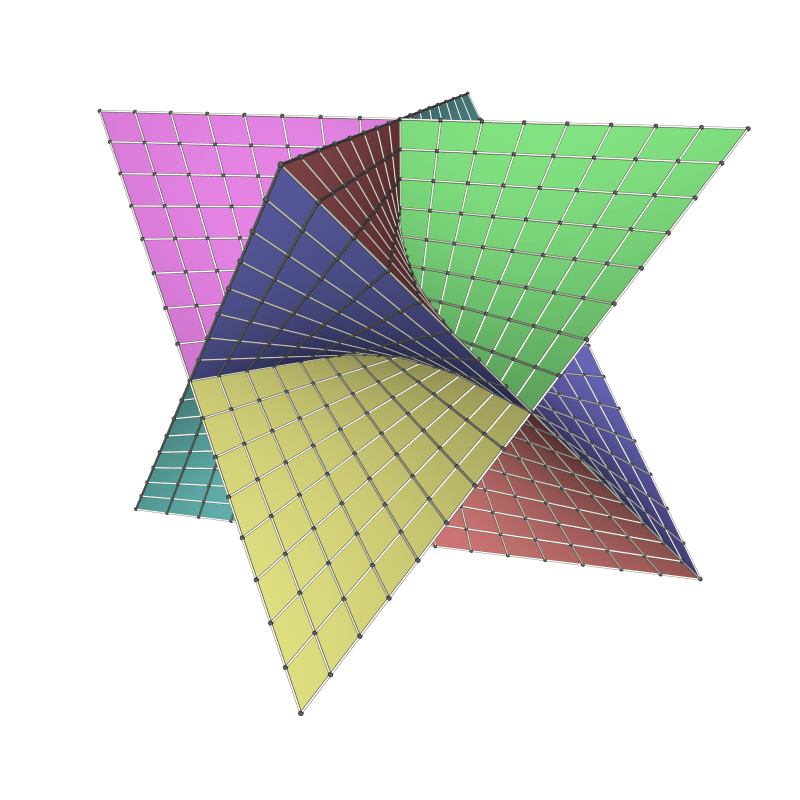
Up above you can see three sheets. The darker bottom one is the actual hyperbolic paraboloid, while the two lighter and greener ones are bent versions that are still attached to each other along the middle straight line that is pointing towards us. This will be our spine. Here is a top view:

Mathematica b

The Real Helicoid (Scrolls II)

After talking about the other helicoid first, it would be impolite to ignore the real helicoid, which is of course much more famous,
mainly because it also is a minimal surface.

AssociateCatenoid2

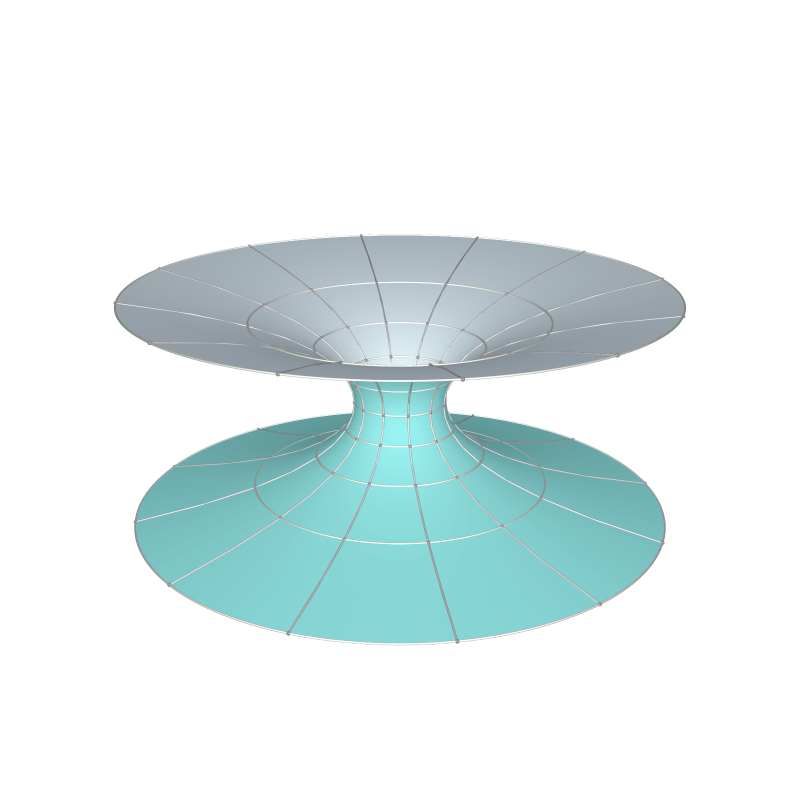
A such, it possesses a deformation into the catenoid
AssociateCatenoid3

which every textbook on the geometry of surfaces mentions at least as an exercise. Half way the helicoid will look like this:

AssociateCatenoid1

I have chosen the size of the helicoidal paper so that the two spiral edges almost touch. This deformation is, however, problematic for book making, because no curve could serve as a spine.

HeliocoidScroll2

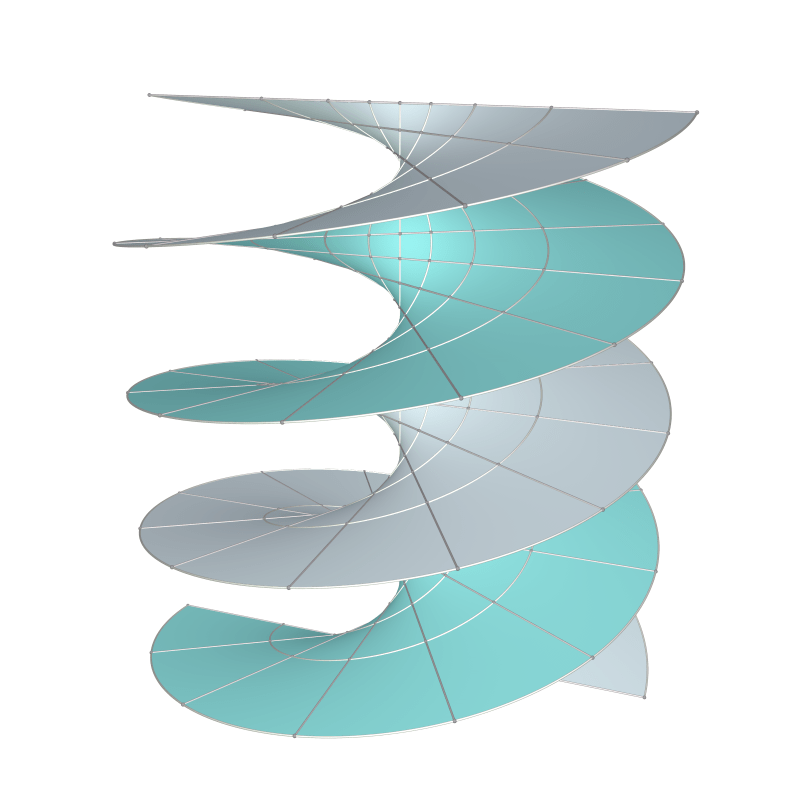
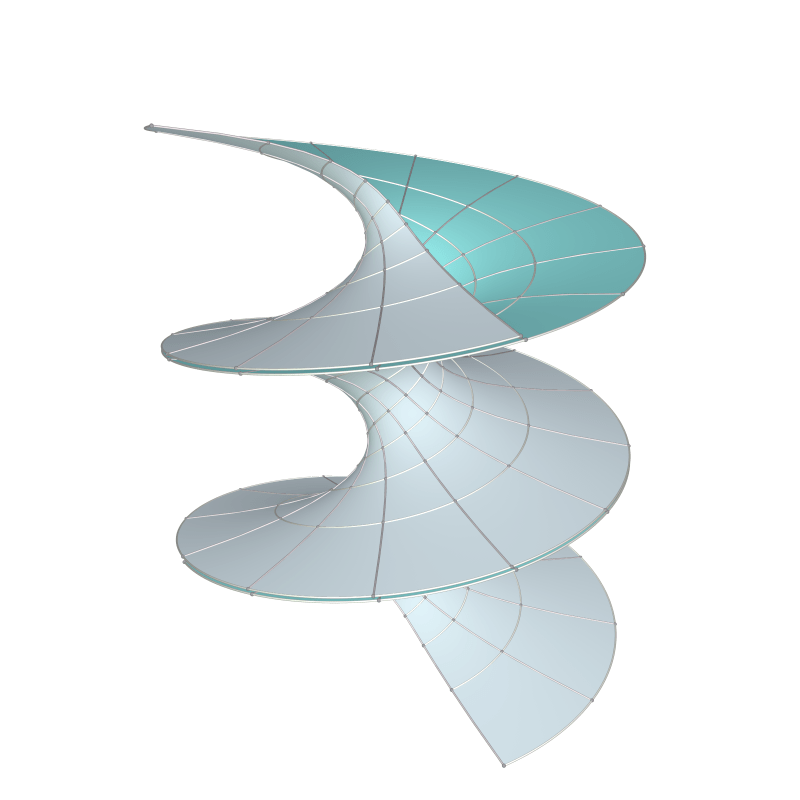
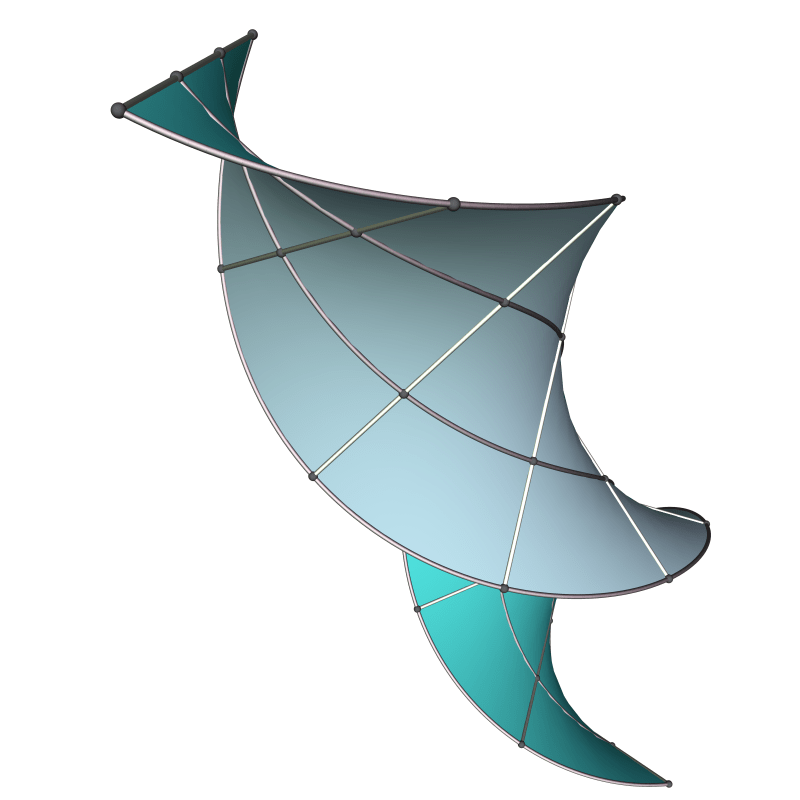
But there are other ways to bend the helicoid, that are not anymore discussed in text books. We can keep the horizontal generators of the helicoid as straight lines, but let them slope upwards a little, like above,
or like below, with steeper lines.

HeliocoidScroll

The Other Helicoid (Scrolls I)

I have been thinking for a while to make a book out of curved paper, and my new year resolution for 2016 is to make this happen.

Usually, a book consists of a few rectangular pieces of paper that are attached to each other along one side of the rectangles to form the spine of the book. The fact that we can turn a page nicely uses the fact that flat sheets of paper can be bent into cylindrical or conical shapes without the need to bend the spine as well. A good choice of a shape for curved paper that behaves similarly is that of a ruled surface or scroll. The latter name is not in common use anymore, but I like it better.

HyperboloidalScroll0

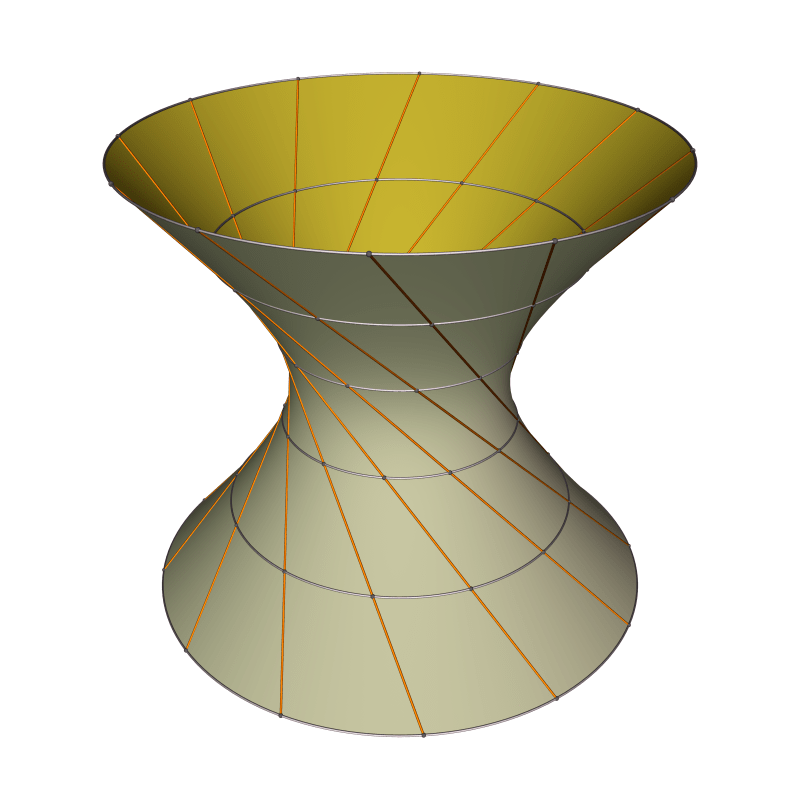
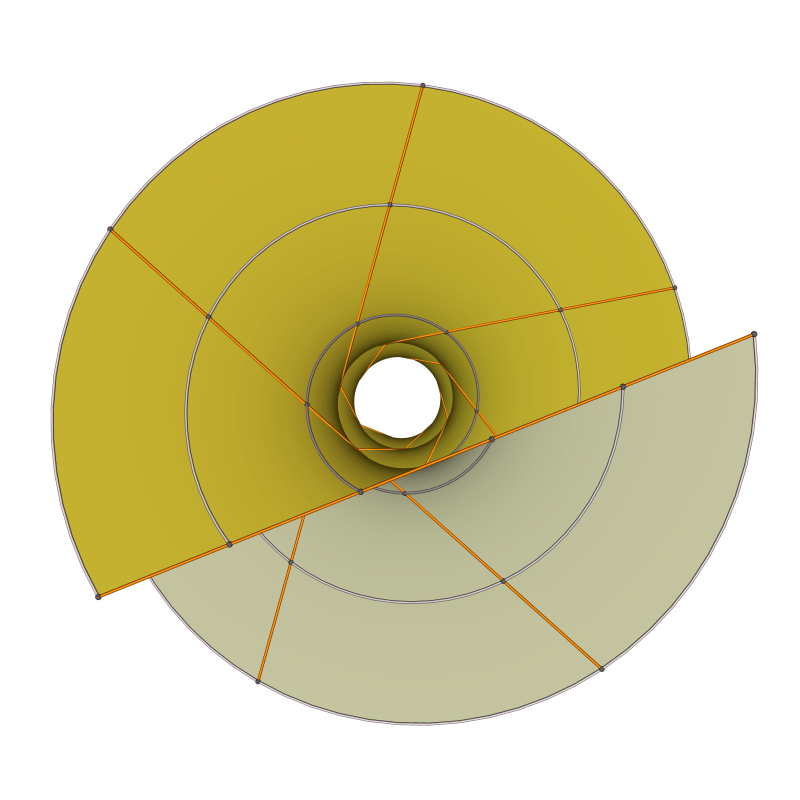
For instance, we could take paper in the shape of a hyperboloid of revolution. This consists of a family of generators (the orange straight lines) that are attached to a directrix (the waist circle, for instance). We will now cut open this hyperboloid along one of the generators and bend it a little along all generators simultaneously, thus making them more horizontal.
HyperboloidalScroll2

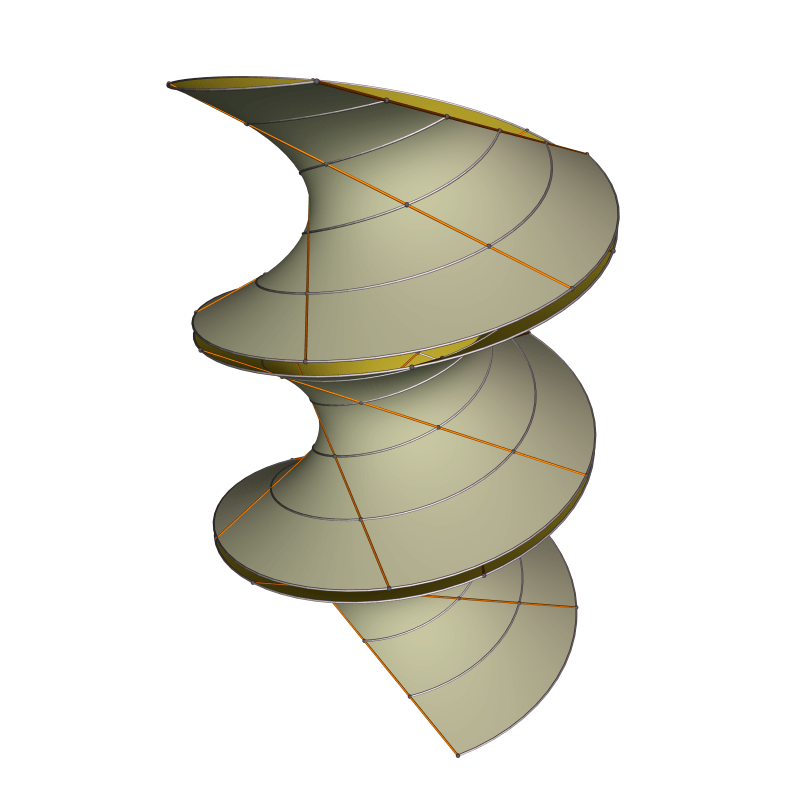
We can bend further, making the generators truly horizontal. This gets us to the other helicoid:

HyperboloidalScroll

That it is not the standard helicoid that you get by lifting and rotating a horizontal straight line along a vertical axis becomes evident in the top view.

HyperboloidalScroll top

Cross sections of this helicoid with vertical planes are graphs of the reciprocal of the sine function, in case you have wondered.
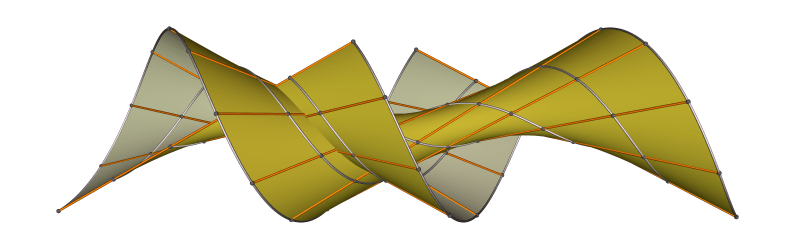
We can deform further, arriving at more scroll like images.

HyperboloidalScroll3

Here the idealized paper is slicing through itself, which looks interesting, but will, like most ideals, require some trimming in reality.

Minimal Surfaces in the Wild (k-Noids I)

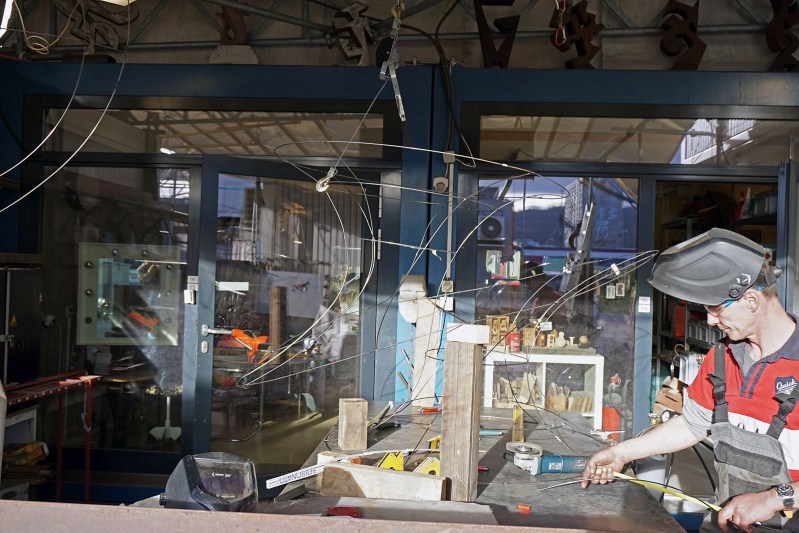
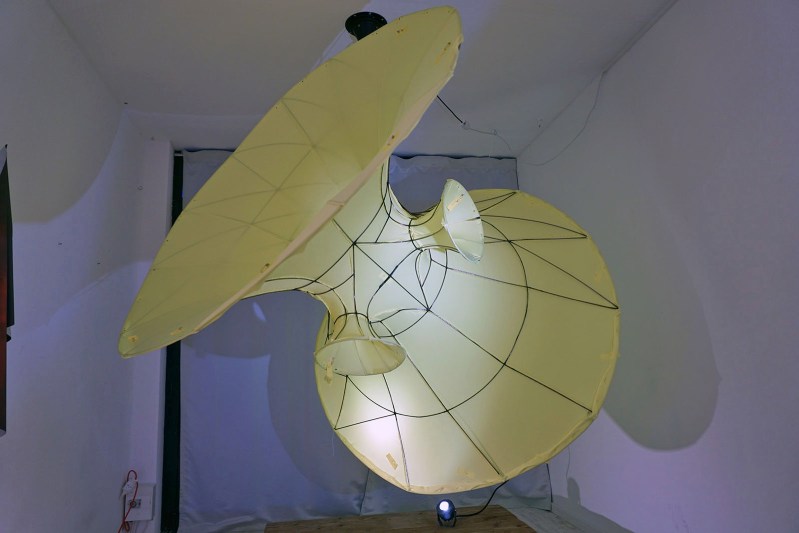
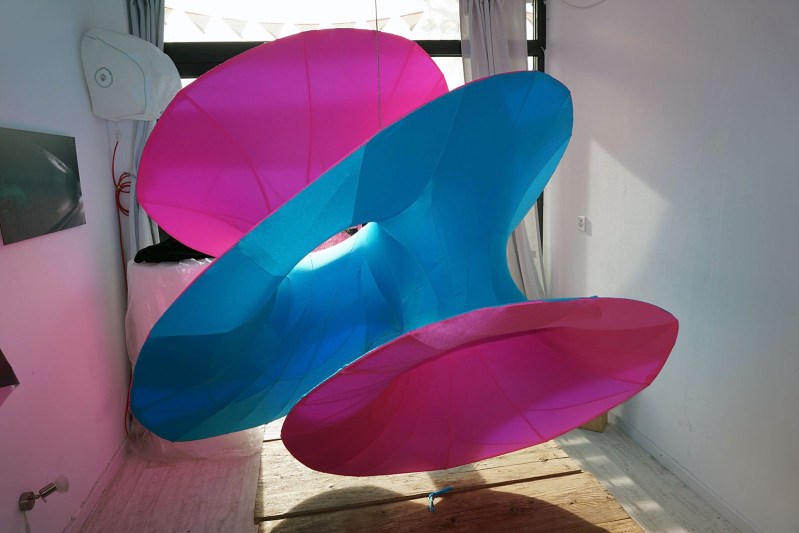
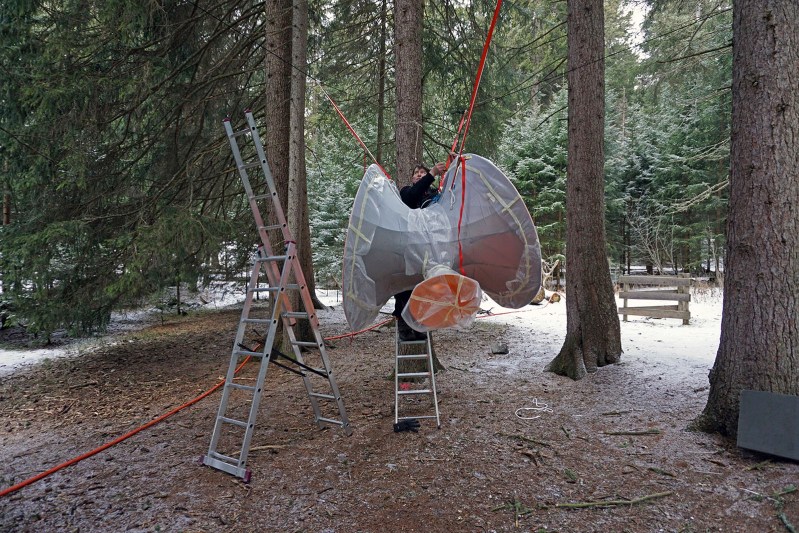
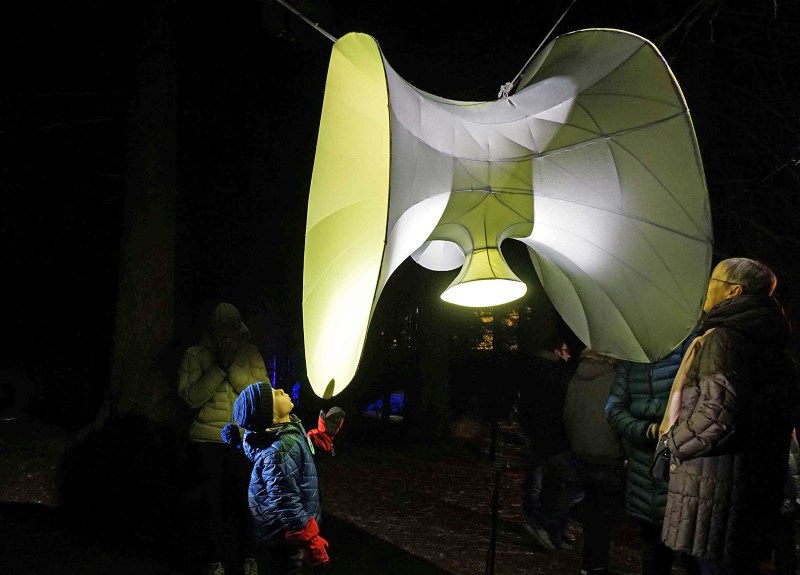
Making photorealistic images of minimal surfaces is one thing, but making real models of minimal surfaces and putting them into the landscape is quite something else. In July 2015 I was contacted by the Swiss artist Shireen Caroline von Schulthess who planned to do exactly that. She needed 3D models in order to build large wire frames that would then be wrapped in thin, colorful fabric. These sculptures would serve as loud speakers for recorded voices from local interviews with the topic “wishes”, to be played as an installation at the Lenzerheide Zauberwald festival.

Shireen 1b

Here is the wireframe model of the Finite Riemann minimal surface. Given that I already have difficulties bending a single metal coat hanger into a given shape, I can only admire the skills of Shireen and sculptor Adrian Humbel to accomplish this at this scale.
Below is the partially clothed 4-Noid.

Shireen 2

And this is the Finite Riemann surface, fully clothed.

Shireen 3

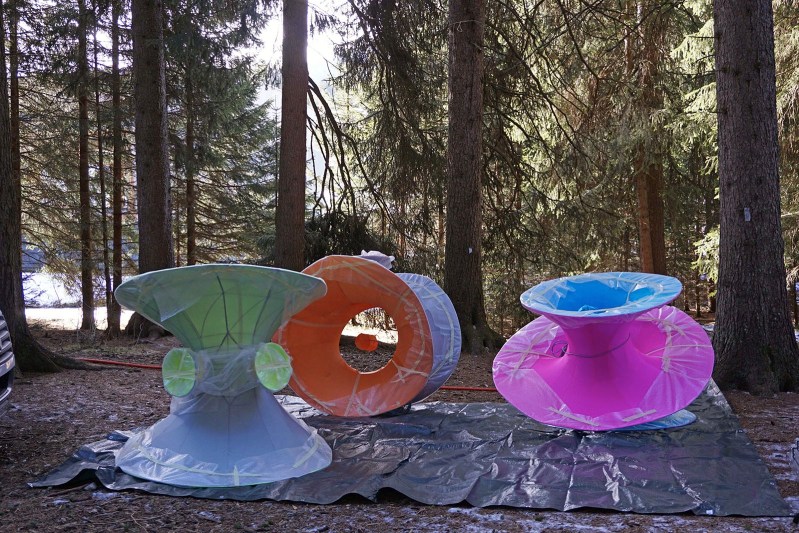
All three of them, ready to be released into the wild, and weather proof.

Shireen 4

Not even the installation is easy:

Shireen 5

To bad I can’t be there. This must be quite an experience.

Shireen 6

All pictures in this post were taken by Shireen.

Brianchon’s Theorem

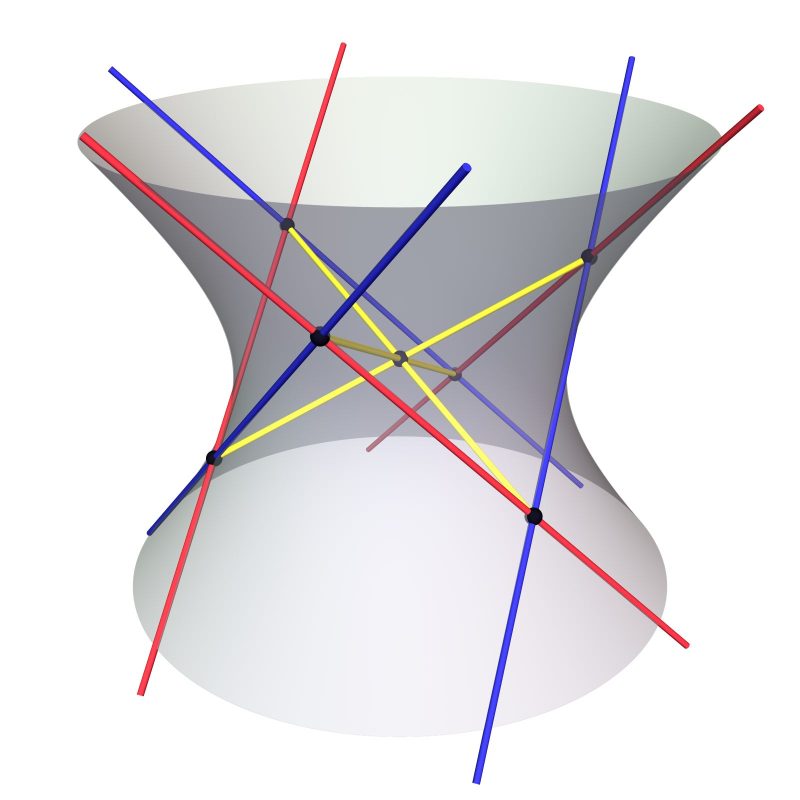
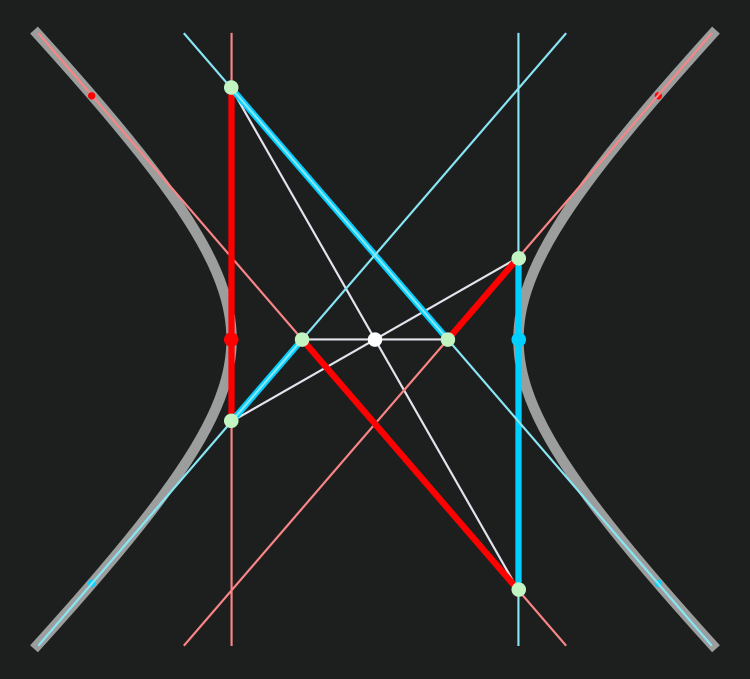
When you rotate a straight line about the vertical axis, you will generally get a hyperboloid of revolution. By construction, this is a ruled surface, and by symmetry, there is a second set of lines on the surface. We call these two sets of lines the A-lines and B-lines.
Sor

These lines dissect the hyperboloid into lots of skew quadrilaterals, reminding us that any quadrilateral can be doubly ruled, and opening up more possibilities for our previously discussed bent rhombi.

Patches

Let’s form a hexagon, following the A- and B-lines alternatingly once around the hyperboloid. Then a theorem by Charles Julien Brianchon states that the three main diagonals (i.e. those connecting opposite vertices) of this hexagon will meet in one point.

Sor2

One reason why this is curious is that it quite unexpected: In space, we don’t even expect two lines to meet in a point, let alone three. The other reason is that it has such a simple proof, due to Germinal Pierre Dandelin: Any pair of A- and B-lines will lie in a common plane, because they either intersect or are parallel. So the pairs of opposite edges give us three planes, which will meet in a common point. Because the diagonals of the hexagon are also the intersections of any pair of the three planes, we are done.

Sor3

If we project the hyperboloid with all its decorations into the plane, like done so in the images above, the outline of the hyperboloid becomes a common hyperbola, and the six lines of the hexagon tangential to it. This leads to Brianchon’s theorem in the plane: The main diagonals of a hexagon circumscribed in a conic section meet in a point.

Brianchon Hyperbola2 01

This theorem becomes easier to parse if the conic is just an ellipse:

Brianchon ellptic 01

We also have enough room here to see that there is a second dual conic on which the A-lines and B-lines, respectively, meet.

Slidables

A while ago I tried to start a blog about games and puzzles, which failed, mainly due to time constraints.
I will recycle some of the posts here.

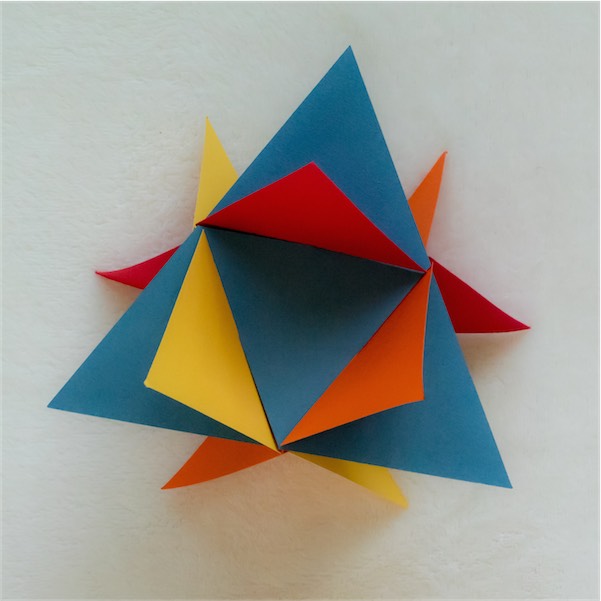
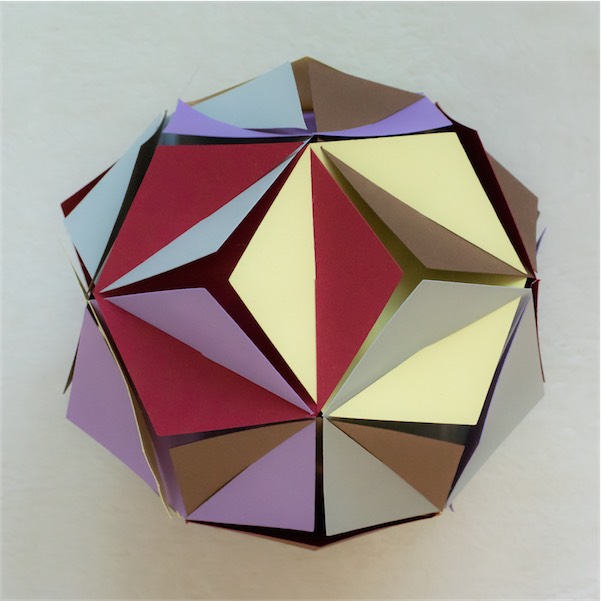
Here are a few crafts of varying difficulty that you can do just with card stock and scissors. The idea is always the same: Use several copies of a simple shape with slits to build paper sculptures. They all make nice holiday ornaments.

Triangles

The simplest such shape is an equilateral triangle that has been slit as shown below.

Triangle

Using four such triangles, you can build the following star.

Folds 2

With eight triangles and a bit more patience, you get the following shape, which is Kepler’s Stella Octangula, a stellation of the octahedron, or the compound of two tetrahedra.

Folds 6

I like to curl the tips of the triangles to make them look like flower petals.

You can of course also build other objects.

Pentagonal Stars

Folds 1

Using 12 copies of the slit pentagrams below, one can build Kepler’s Small Stellated Dodecahedron.
Pentagram

This requires a bit patience. Start with one pentagram, and insert five pentagrams successively in all of its slits, thereby also linking the inserted pentagrams together as well. Then insert another five pentagrams into neighboring pairs of the first ring of pentagrams, again linking the pentagrams from the new ring together. Finally, insert the twelfth pentagram into the free slits of the pentagrams from the second ring.
The last steps require some heavy bending of the pentagrams, and careful adjustment at the end.

Triangles and Squares

Folds 7

Using properly slit triangles and squares, one can build a stellation of the cuboctahedron.

Trisquare

The slits in the squares and triangles must have the same length.

This is a bit easier than the previous example. During assembly, the model falls easily apart, but it is quite sturdy when done.

Irregular Hexagons

Folds 4

Twenty of the regular hexagons below can be used to create one of the stellations of the Icosahedron, the Small Triambic Icosahedron.

Icosahedron

Escher’s Solid

Folds 3

This is the first stellation of the rhombic dodecahedron, also called Escher’s Solid. It tiles space. You need 12 of the non-convex hexagons below.

Escher

A simpler version is a stellation of a rhomboid, using 6 hexagons.

Folds 5

Final Comments

The strategy to design these models is to look for regular polyhedral shapes with few kinds of faces that intersect in a relatively simple way. Then, each intersection of two faces leads to slits on both faces half way along the intersection, so that the two faces can be slid into each other.

There are of course limits to this, but I am sure there are many more models one can assemble.