Ragged Rectangles (From the Pillowbook II)

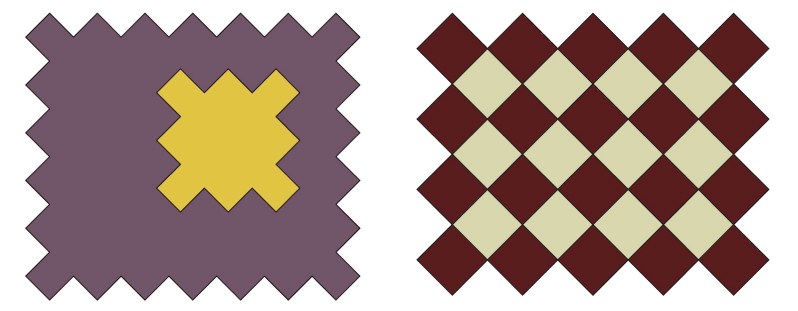
In a ragged rectangle, the sides zigzag diagonally as in the left figure below, which shows a ragged rectangle of dimensions 6⨉7, and within a ragged 3⨉3 square. Note that the boundary changes directions at every unit step. These shapes make interesting candidates for regions to be tiled with polyominoes. The example in this post illustrates nicely how the interplay between making examples and generalization leads to a miniature theory.
Raggedex 01

To tile a shape like this with polyominoes, it will help to know its area in terms of unit squares. This is easy: If you color the squares in a ragged a⨉b rectangle beige and brown, you will get a⨉b squares of one color, and (a-1)⨉(b-1) squares of the other color.

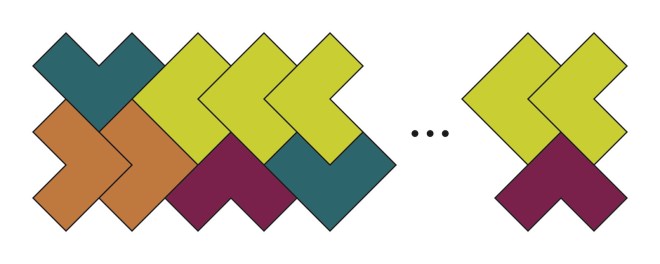
This right away shows that it is hopeless to tile a ragged rectangle with dominoes. The first really interesting case is to use L-trominoes. The area formula implies that we need one dimension of the rectangle to be divisible by 3, and the other to leave remainder 1 after division by 3. Thus the shortest edge that can occur has length 3, and the other them must have length 3n+1. The figure below shows how to tile any ragged rectangle of dimensions 3x(3n+1) with L-trominoes:
ragged3-01.jpg

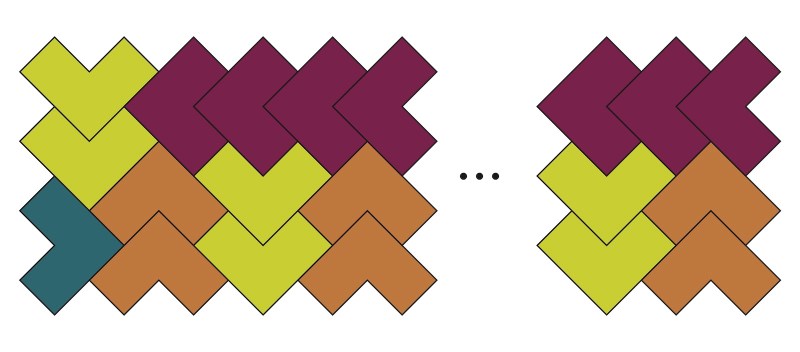
The next shortest edge possible has length 4, and then the other edge must have length 3n. Again, a few experiments lead to a general pattern which shows that any 4x(3n) ragged rectangle can be tiled with L-trominoes:
Ragged4

This covers the two basic kinds of thin and arbitrarily long rectangles. What about larger dimensions? If we already have a ragged rectangle tiled with L-trominoes, we can put a frame around it that is also tiled with L-trominoes:
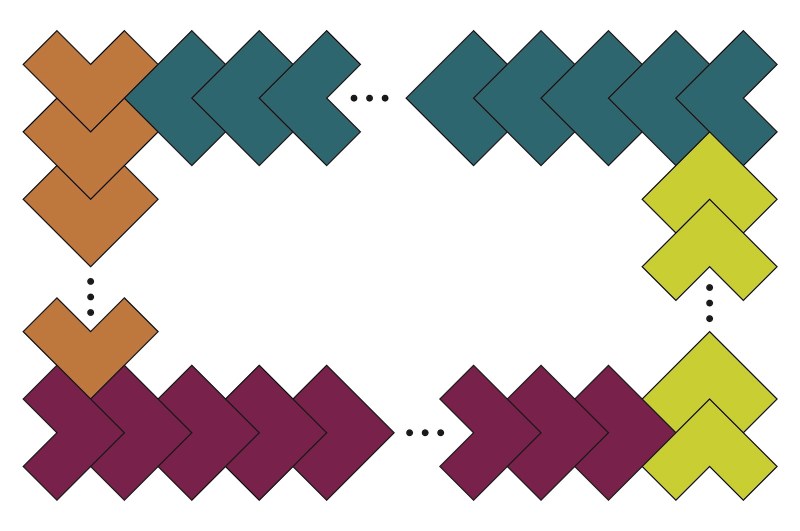
Raggedframe

These three constructions together show that a ragged rectangle can be tiled with L-trominoes if and only if its area is divisible by 3. Next time we will see how this helps us to tile curvy rectangles with pillows.
Taming the Snakes

Computer scientists, dog owners, parents, and most other generic humans are happy when their trained subjects behave as expected. Mathematicians are happy when things develop other then expected.

For instance, Rafael and I have built a machine that takes an explicit planar curve, lifts it to a space curve, and twirls an explicit minimal surface around it. The emphasis here is on explicit, because that allows to do all kinds of things to the minimal surface that would be hard to do otherwise.

So we started feeding curves to the machine that we hadn’t built it for.

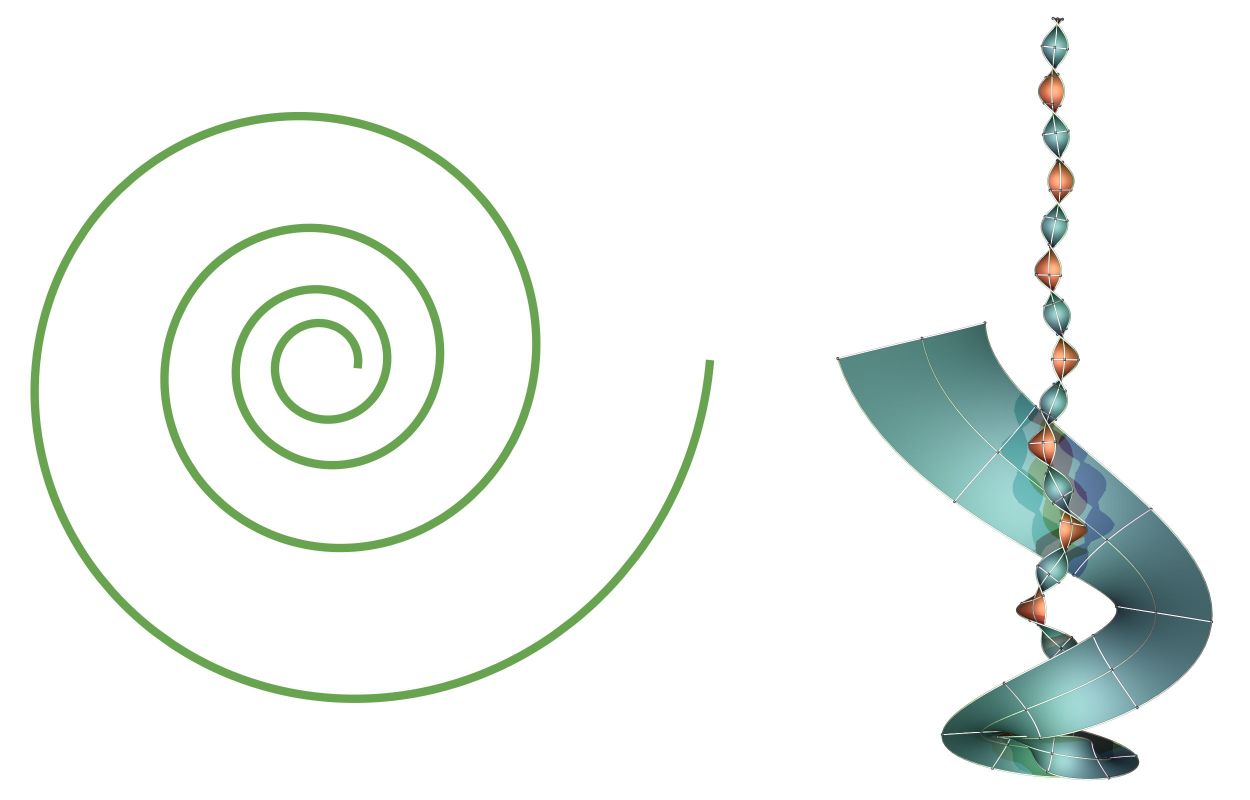
Logspiral

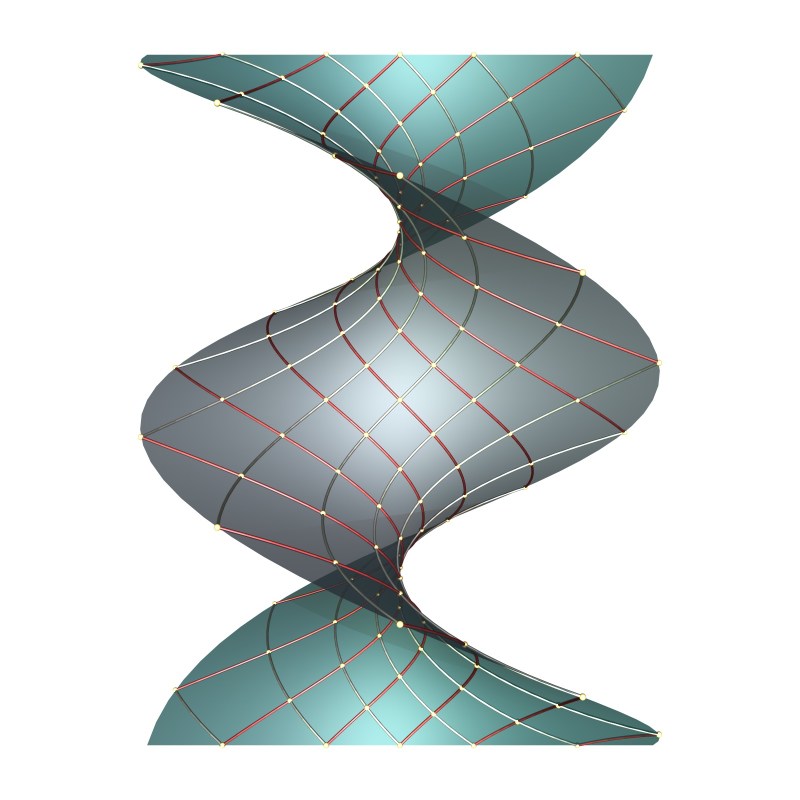
As a first example, the logarithmic spiral is lifted to a space curve such that both ends of the spiral move up, and the speed with which the surface twists is much faster at the inner piece. We call this the cobra surface.

A few years after David, Mike, and I had shown that the genus one helicoid is embedded, I was contacted by a science freelance writer. She said that this helicoid with the handle had been pretty cool, whether we had maybe some new examples that looked very different and cool, too. We hadn’t. But here they come. The Archimedean spiral is next. Again, the surface spirals faster when the curve is more strongly curved.

Archimedes

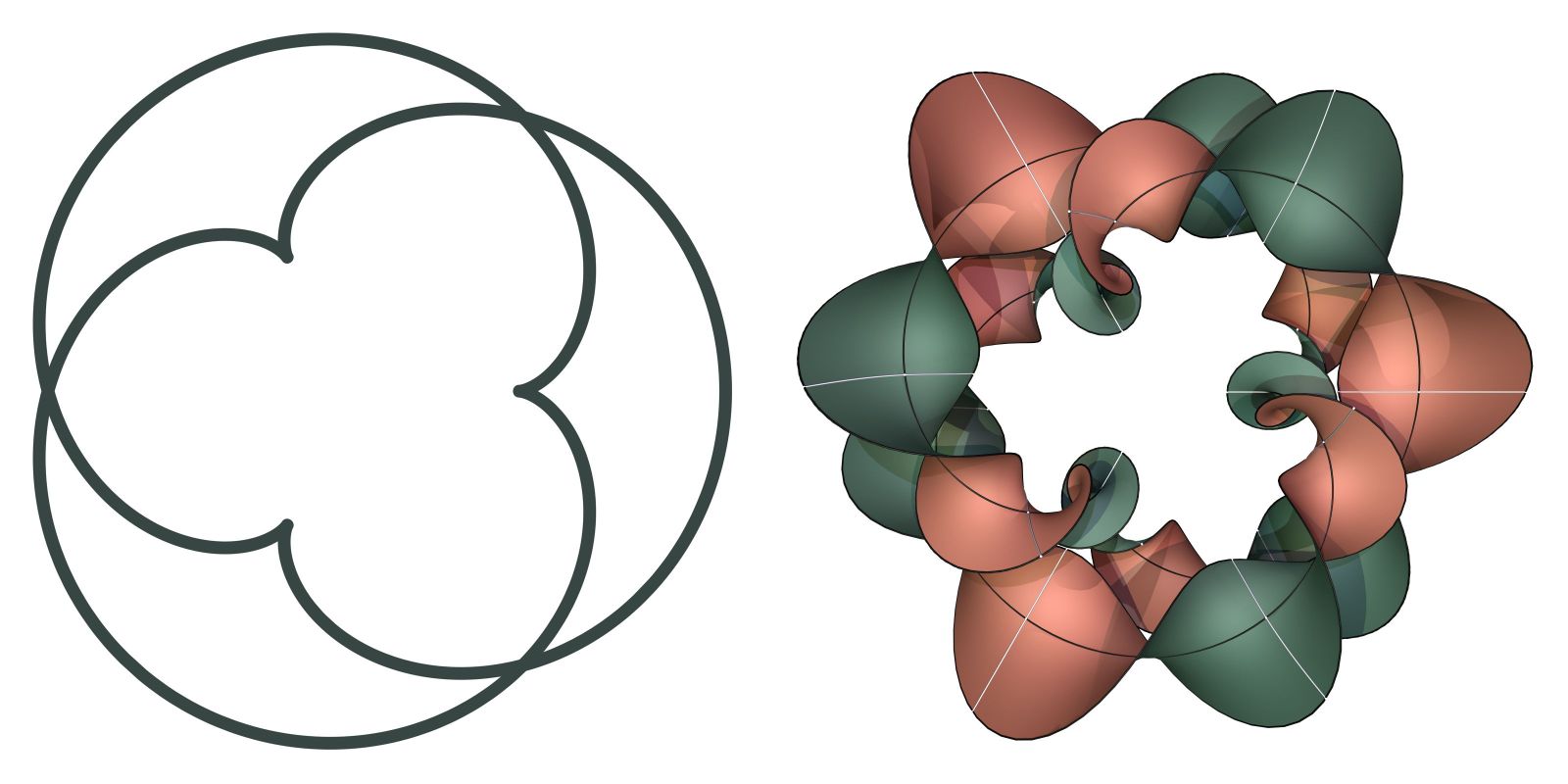
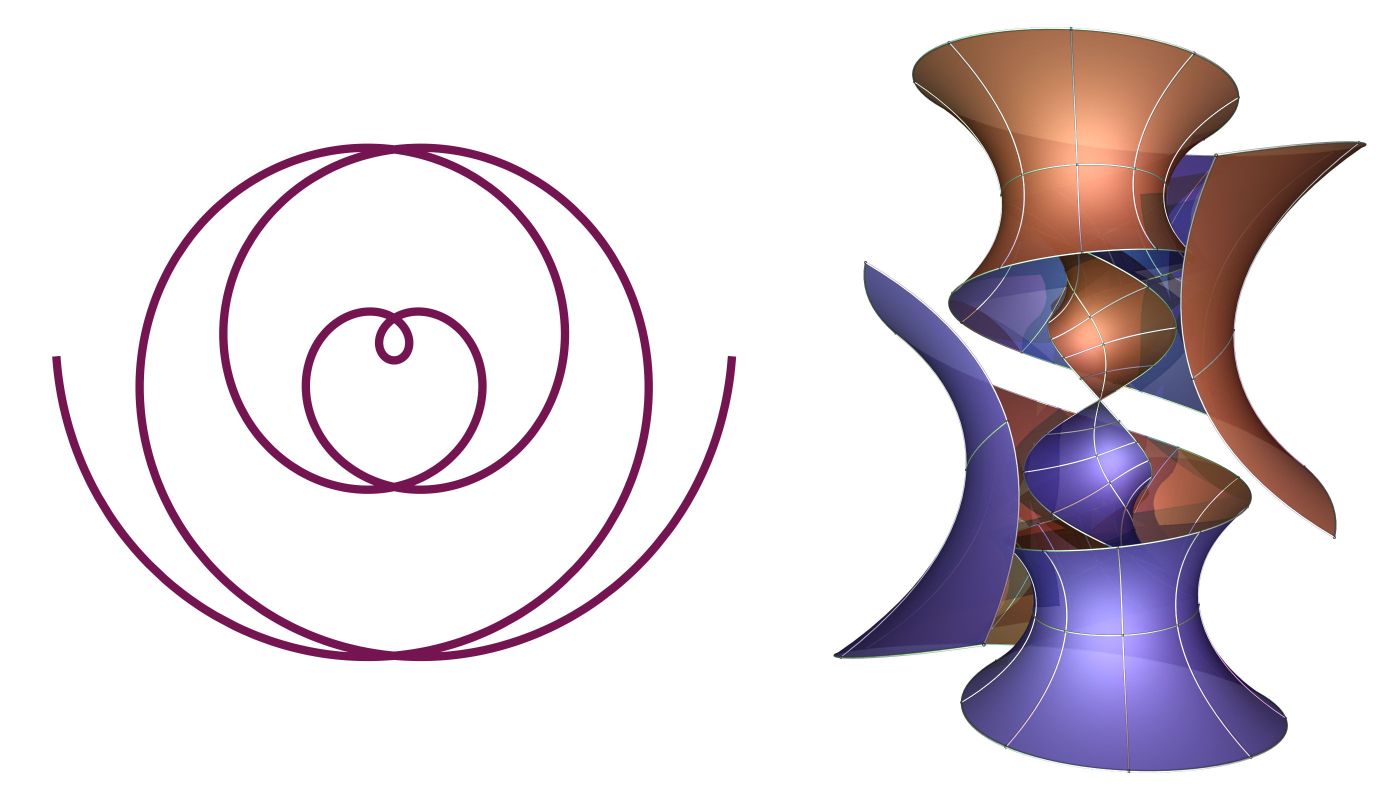
If you liked the trefoil surfaces, you will like the next one, too: Here we start with a common cycloid, and the lifted curve becomes another trefoil knot.

Cycloid3b

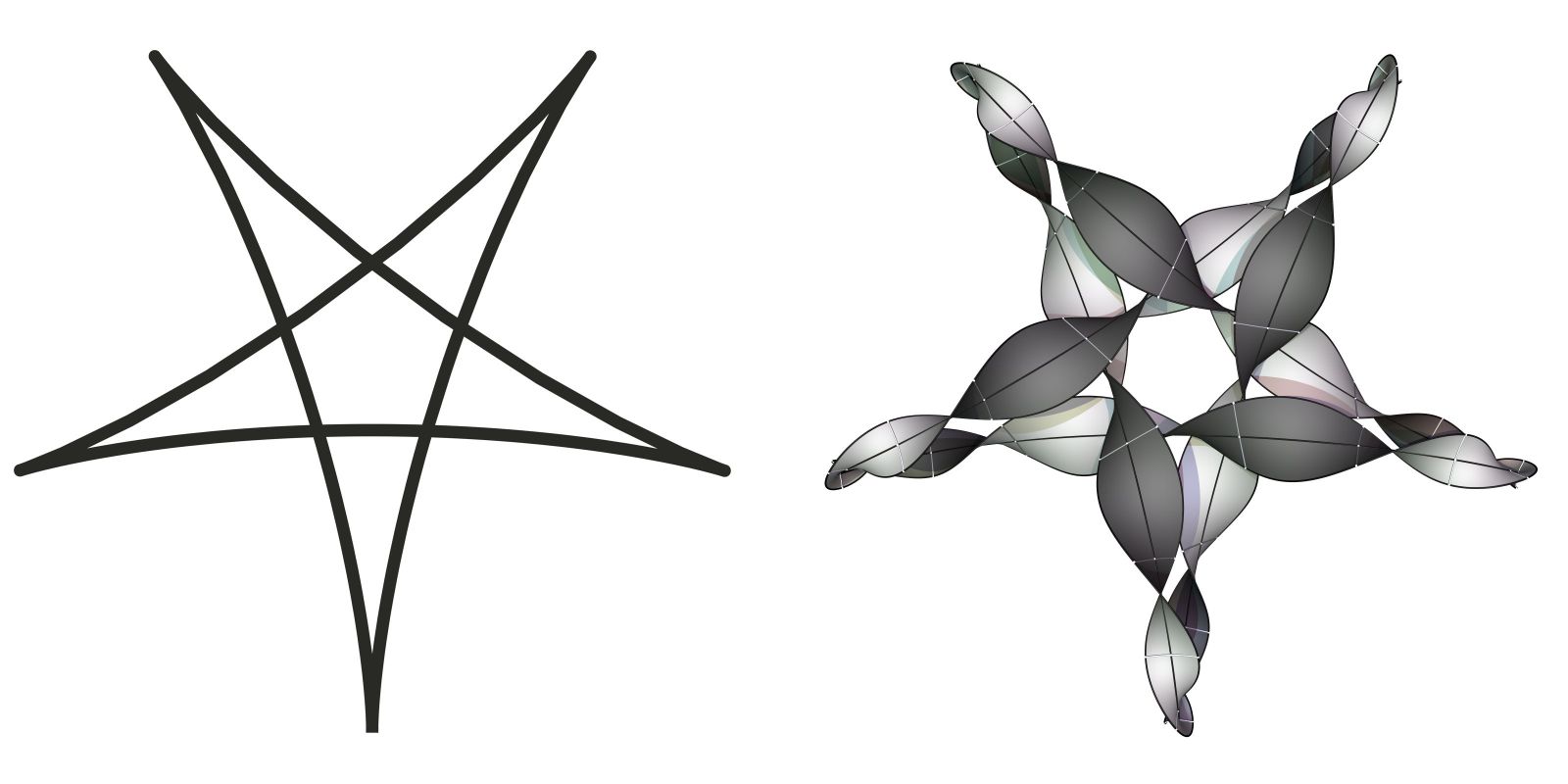
Finally, the pentagram cycloid lifts to a knotted curve without cusps, and we can make another prettily knotted minimal surface.

Pentagram

The Trefoil Knot

In mathematics, even the simplest things can have an astounding depth. Let’s for instance take the trefoil knot, the simplest knot there is:

Trefoiltube

One can replace the tube by a ribbon, like so:

Trefoil2

This could be done with a simple ruled surface, but I like a challenge. To make this a minimal surface, one can use Björling’s formula. The game becomes tricky if one wants the surface to be of finite total curvature, but this can be done as well. Then it is not difficult to let the normal of the surface rotate once to get a knotted minimal Möbius strip.

Trefoilmobius

Faster spinning normals create knotted helicoids.

Trefoil30

Extending the surface beyond a small neighborhood of the trefoil knot makes things appear really complicated.

Trefoilbig

Of course the same can be done with more complicated knots.

Quatrefoil

Deltoids in Clay

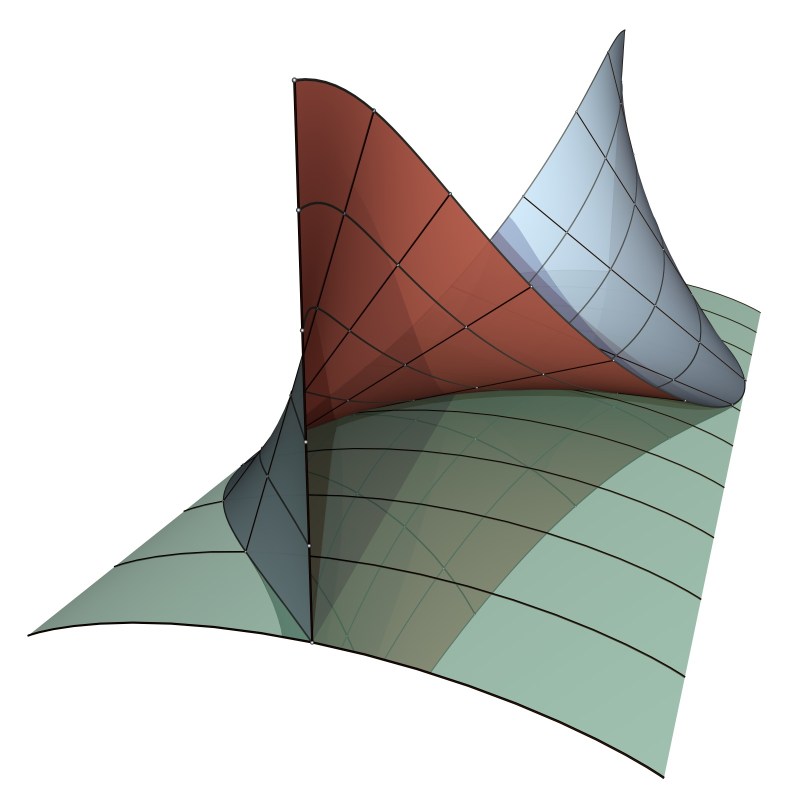
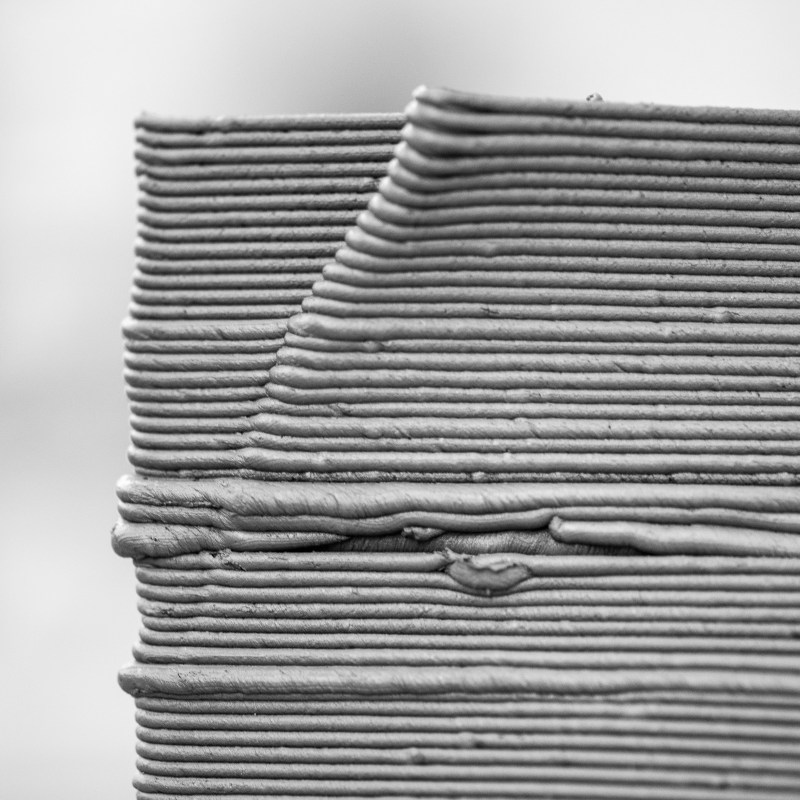
Clay printing currently works best for objects that change slowly from one horizontal layer to the next. This suggests to create 3-dimensional objects that realize a changing 2-dimensional configuration in one piece. An example of that is the rotating segment within the deltoid that at every stage foots on two sides of the deltoid and is tangent to the third.

Deltoid

As the deltoid itself doesn’t change shape, it will become a cylinder over the deltoid. On the other hand, the rotating segment will become a ruled, helocoid-like surface. If we printed the entire model like this, the interesting part, namely the rotating secant, would be mostly hidden. Therefore we will only use one edge of the deltoid, while the other two are implied only by the rotating endpoints of the line.

DSC 4827

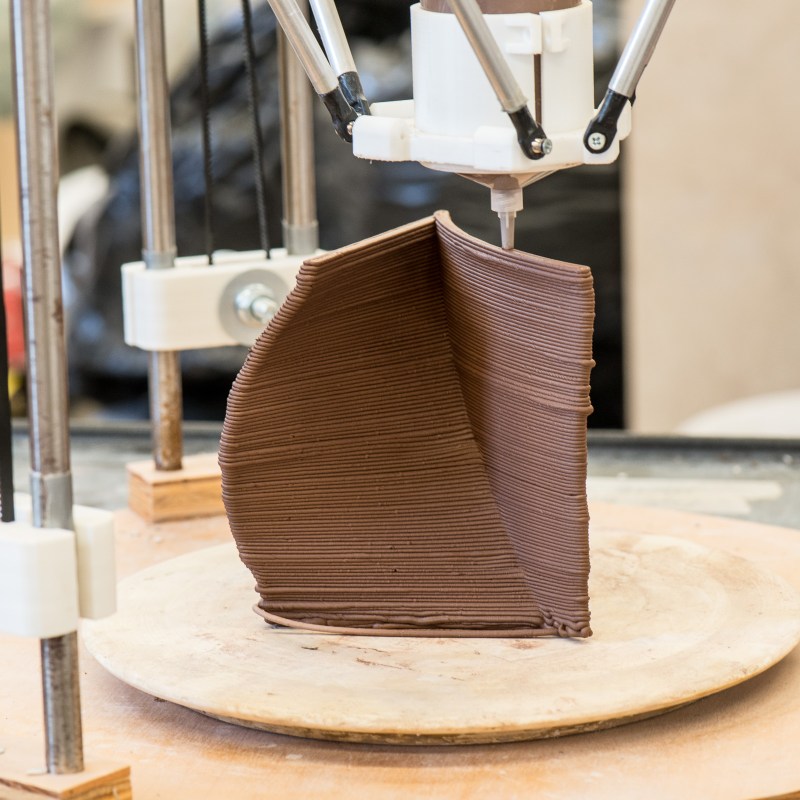
Doing this in clay is not easy. First of all, we print it so that time is vertical. This allows to use the deltoid wall as a solid support. Each layer of the rotating secant then becomes a cantilever, supporting subsequent higher layers.

DSC 4843

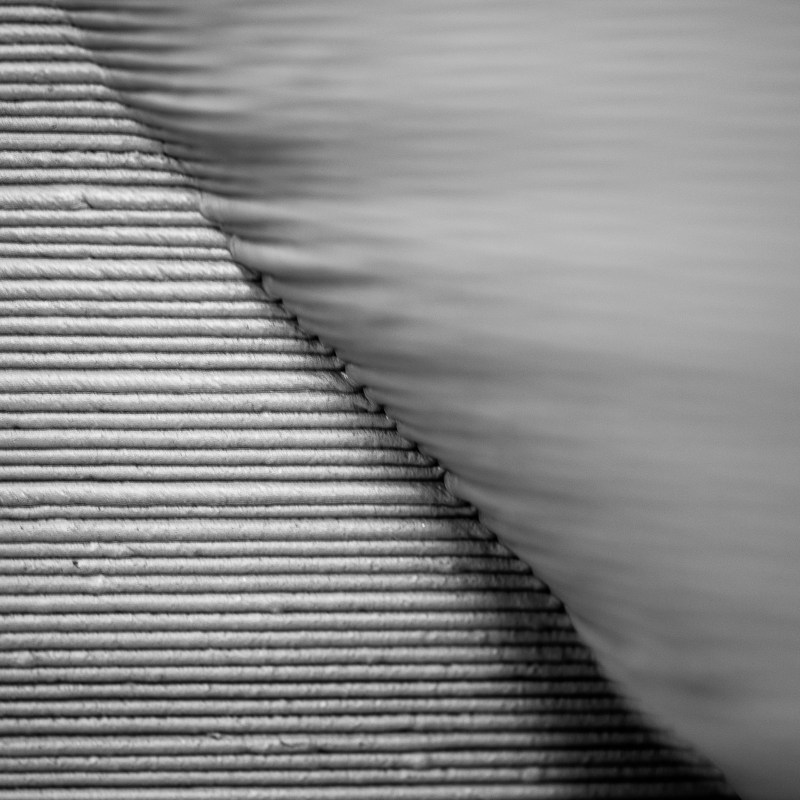
The point when the secant turns into a tangent is particularly interesting. One can see the gravitational pull on the emerging new layer that bends towards us in the image above. The contrast between the static, cylindrical deltoid arc and the dynamic, rotating secant is compelling and hard to convey in a single image. But that’s a fair enough reason to make 3D sculptures.

DSC 4822

Squares and Circles (From the Pillowbook I)

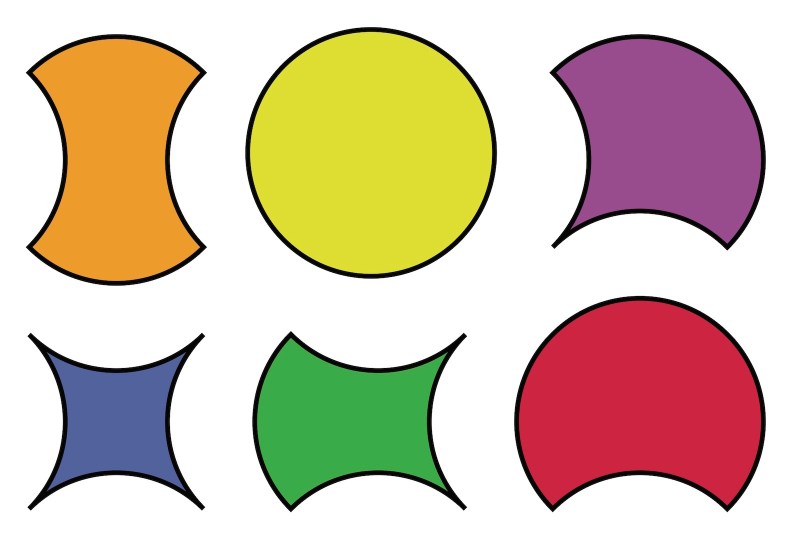
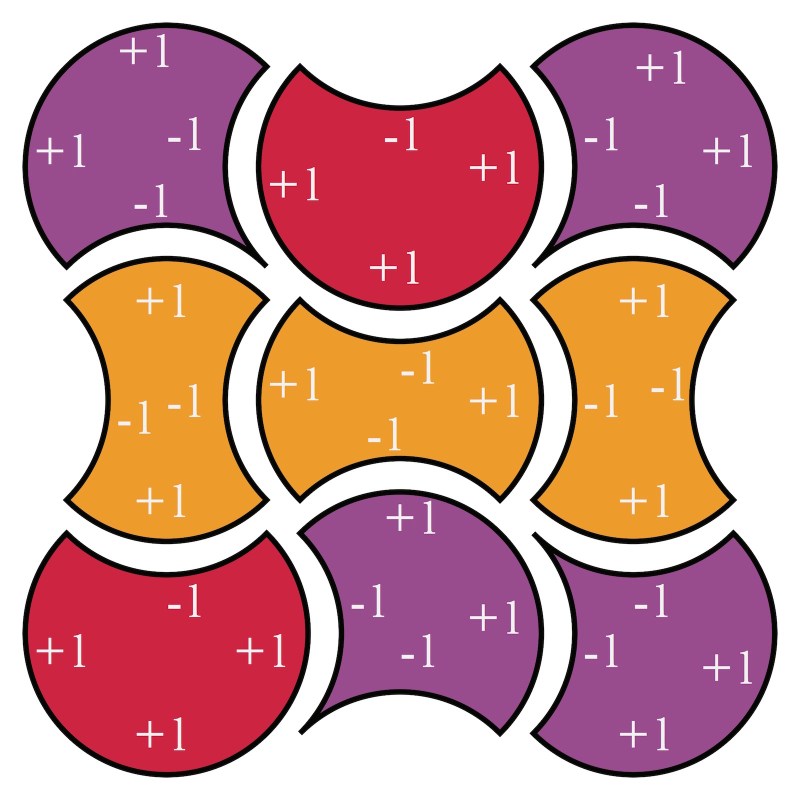
In a previous post, I have discussed triangles with curved edges and what they can tile. One can do the same with squares, only that things get more interesting, because there are six different shapes:

Curvies

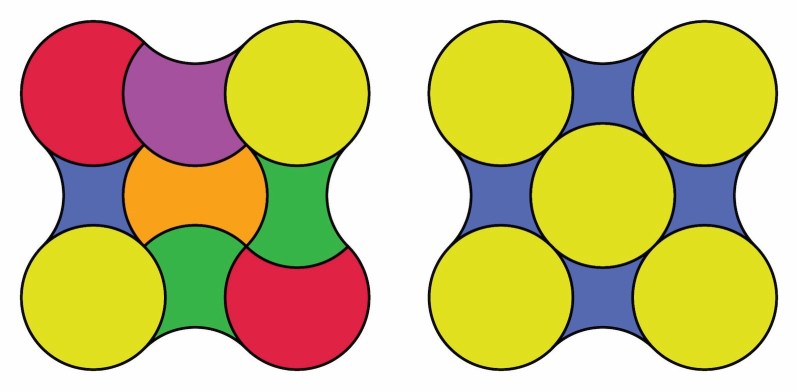
I have called them pillows, mainly because I want them as nice, big, colorful pillows. Hmm. The first problem I’d like to discuss is to tile curvy rectangles with them, like this curvy 3×3 square:
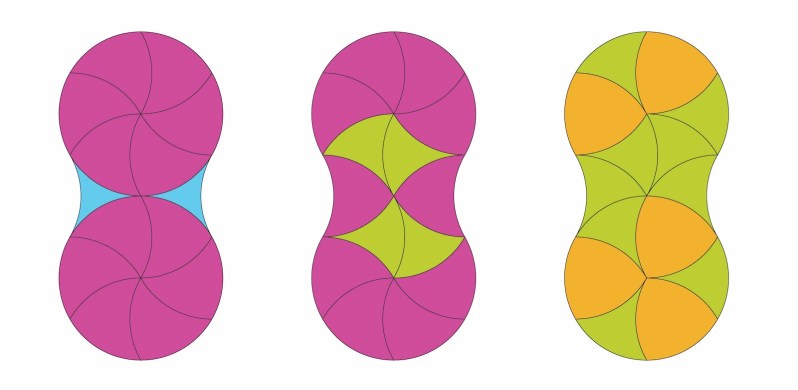
Curvysquares 01

It is pretty clear that all curvy rectangles have odd dimensions. The left example uses all six pillow types, the right only two, blue and yellow. To see what combinations of colors are possible, the following observation is useful: Each pillow has a number of edges that are convex (curve outwards) and other that are concave (curve inwards). For instance, orange and purple both have two convex and two concave edges. Yellow has just four convex edges. With that, we have a little

Theorem: In any curvy rectangle, there are four more convex then concave edges in all pillows together.

A picture should make this clear:

Edgecount

This helps to predict how many pillows of each color we need.
For instance, suppose we want to tile a curvy 3×3 square with y yellow, r red, and b blue pillows. We then need y+r+b=9, and, by the theorem, 4y+2r-4b =4. It’s easy to see that this forces y=2, r=4, b=3. Similarly, if we are only allowed to use yellow, purple, and green, the only possibilities are y=2, p=5, g=2 or y=3, p=2, g=4. Here they are:

Curvysquare2 01

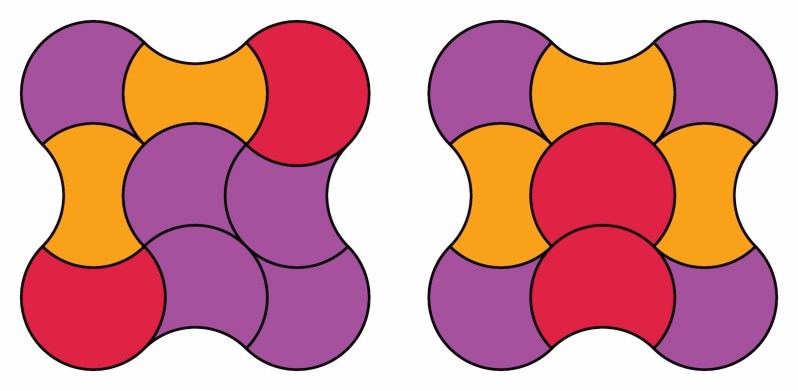
That we found a solution in positive integers does not mean that there is a tiling that realizes this solution. For instance, suppose we want to use red, orange, and purple, then we need to have r=2, but for o and p  we can have any pair of positive integers that sum up to 7. However, only o=2, p=5 and o=3, p=4 can be realized. The solutions are not unique, here are two symmetric ones:

Curvysquare3 01

There are about a dozen little exercises like these. To be able to say something interesting about larger curvy rectangles, we will need to study ragged rectangles in a few weeks.

The Helicoid (again!)

In 1760, Leonhard Euler studied the curvature of intersections of a surface with planes perpendicular to the surface, and showed that the maximal and minimal values of their curvature are attained along orthogonal curves. In 1776, Jean Baptiste Marie Charles Meusnier de la Place showed that for minimal surfaces these principal curvatures are equal with opposite sign. He went on to show that both the catenoid and the helicoid satisfy this condition, thus exhibiting the first two non-trivial examples of minimal surfaces. Euler had discussed the catenoid as a minimal surface before, but only in the context of surfaces of revolution.
In its standard representation as a ruled surface, the parameter lines are the asymptotic lines of the helicoid. For a change, here is the helicoid parametrized by its curvature lines:

Helicurvature

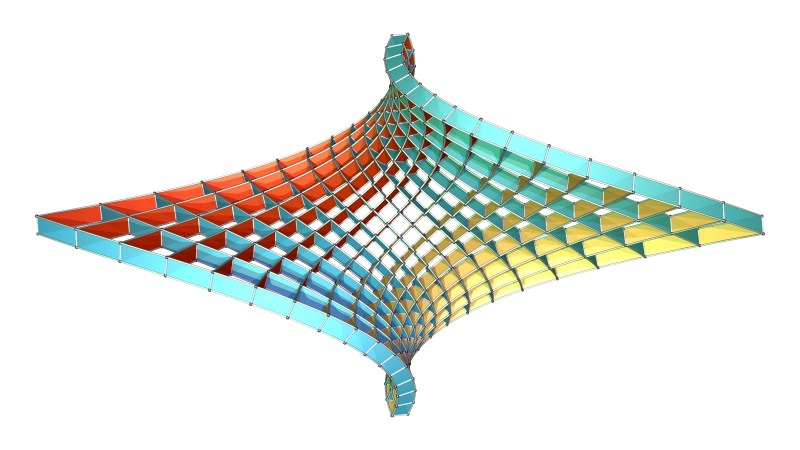
The purpose of this note is a little craft, similar to what I explained earlier using Enneper’s surface: A ruled surface that has as directrix a curvature line of a given surface, and as generators the surface normals, will be flat and can thus be constructed by bending a strip of paper. Doing this for an entire rectangular grid of curvature lines results (for the helicoid) in an attractive object like this one:

Helicoid

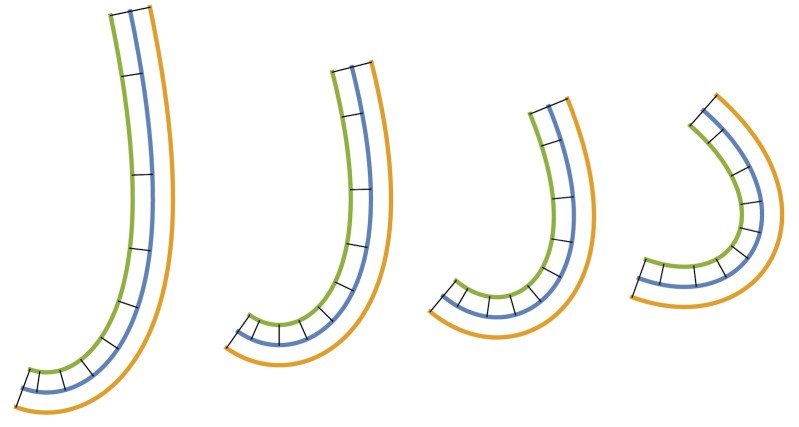
To make a paper model, one first needs to find planar isometric copies of the ribbons. This is done by computing the geodesic curvature of the curvature lines of the helicoid, and, using the fundamental theorem of plane curves, then finding a planar curve with the same curvature. The (planar) ribbon is then bounded by parallel curves of this plane curve:

Js 01

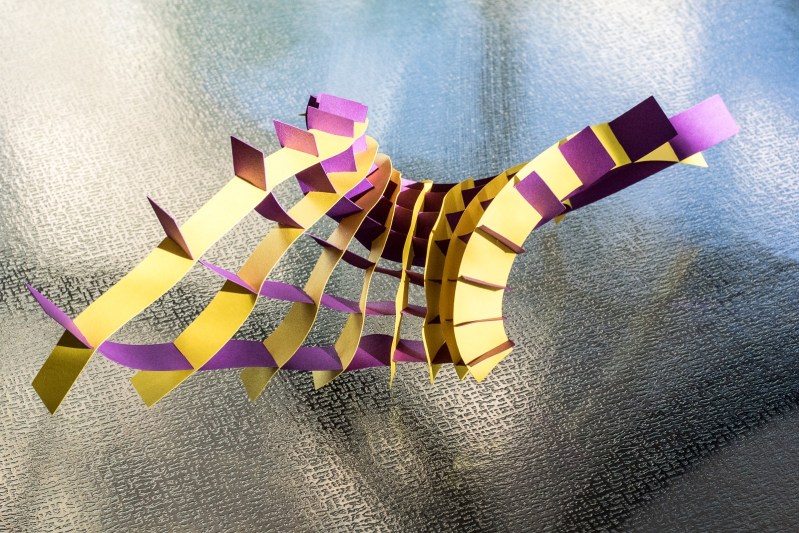
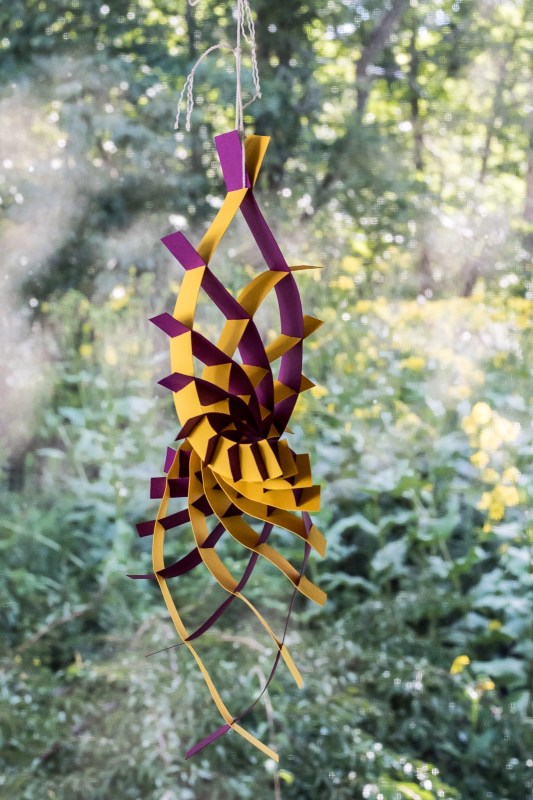
Using four (due to the inevitable symmetry of things) copies of the template above, carefully cut out & slit, allows you to easily build the model below, which also makes a nice pendant. Print out the template so that the smallest distance between two slits is not much wider then your fingers, otherwise assembling the pieces will be tricky.

DSC 1166

Begin with the largest J-piece and use the four copies to build a frame, by sliding the hook into hook and non-hook into non-hook. Then continue inwards, adding four copies of the second largest J, by placing the hook of a new J next to a hook of the old J.

DSC 1169

Quadrics

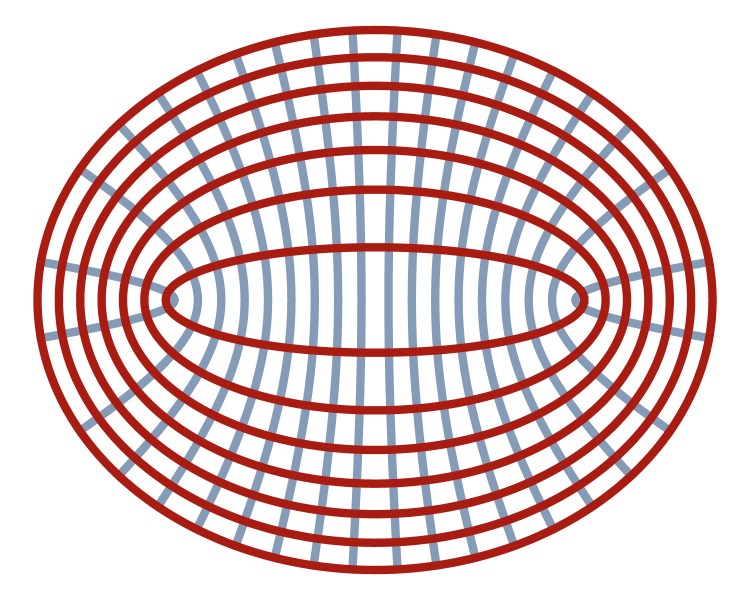
I have written about triply orthogonal surfaces twice before here, in the case of spheres and of cyclides, thus omitting the best known examples, namely that of quadrics. A quadric is for space what a conic is for the plane, and, to warm up, here are some conics ⎯ ellipses and hyperbolas ⎯⎯, all with the same focal points.

Confocal 01

That they all meet orthogonally is not difficult to see, one can either use the geometric definition of these conics as curves whose points have constant distance sum/difference to their focal points, or an algebraic description as level sets of quadratic polynomials.

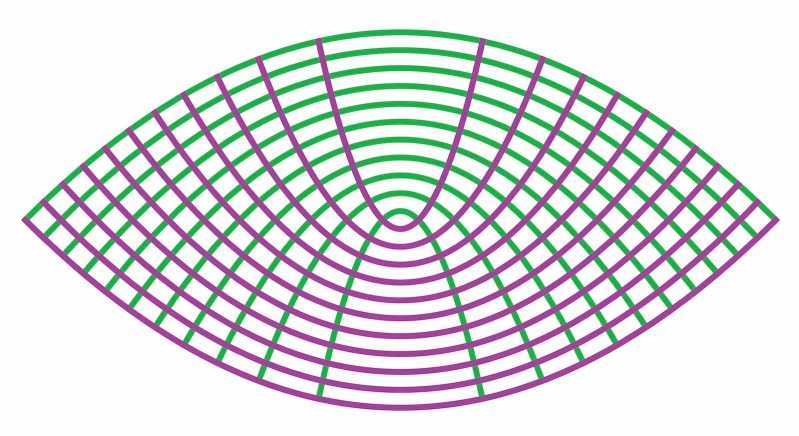
In the plane, there is one other kind of conic, namely the parabola, and here a single family of confocal parabolas provides us already with a doubly orthogonal system of curves:

Parabolas 01

While the images are pretty, there is nothing astonishing happening here: Any reasonable curve family will allow you to find orthogonal trajectories, and the pigeonhole principle or one’s belief in the pre-established harmony of the universe will force cases where both curve families are simple.

Not so in dimension 3: A surface family in space only belongs to a triply orthogonal system of three surface families if it satisfies a rather complicated partial differential equation, which I believe was first found & used by Jean Gaston Darboux.

But again there are simple cases, and the algebraic argument that establishes the orthogonal hyperbolas and ellipses above also establishes that their 3-dimensional analogues form a triply orthogonal system of surfaces.

Quadrics

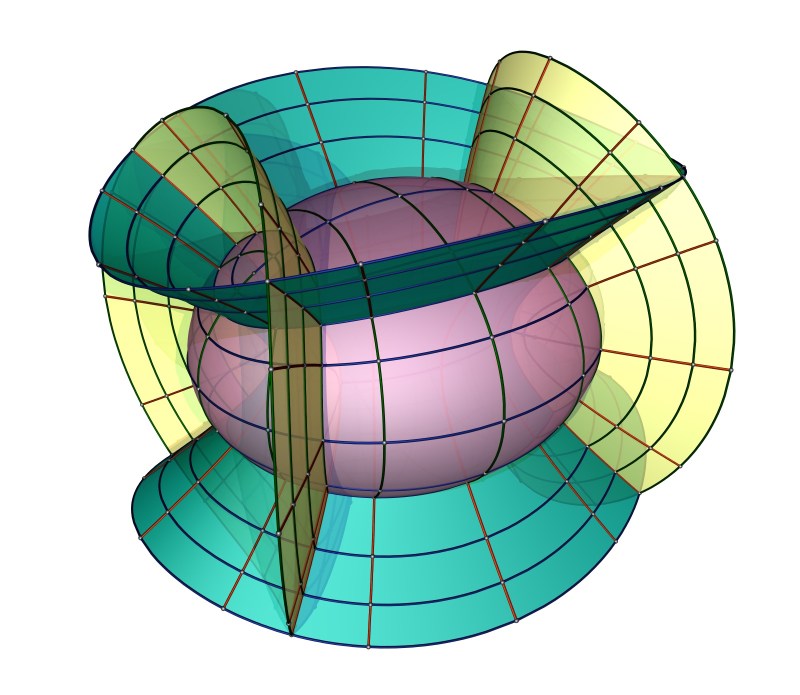
Here you can see all three general kinds of quadric surfaces: An ellipsoid, and the two different hyperboloids. The green one is the so-called single hyperboloid: it continues through the ellipsoid and has only one component. The yellow one is the double hyperboloid and has two components. I have mentioned the single hyperboloid before in connection with Brianchon’s theorem.

One reward for all these efforts to have them meet orthogonally is that one can see immediately the curvature lines of them, because a theorem of Pierre Charles François Dupin (not to be confused with Edgar Allan Poe’s detective C. Auguste Dupin) says that in triply orthogonal systems, two of the surfaces always meet in a curvature line of the third surface. The following image illustrates this for the ellipsoid: I have clipped the hyperboloids using a slightly larger (invisible) ellipsoid. This looks like it is complicated to make, but in fact requires only a few lines of code in PoVRay, a text based ray tracer that allows you to do constructive solid geometry and simple math, besides many other things.

Curvaturelines

Just Triangles (Polyforms III)

In a former, more optimistic life, I wanted to write a book for elementary school children that would get them excited about math and proofs. This would of course go against the grain. Proofs have essentially been eliminated from all education until the beginning of graduate school. With good & evil reason: Not because they are too difficult or not important enough, but because it could possibly induce the children to come to their own conclusions.

I also was ignorant about who controls public education: Neither the students, nor their parents, nor the teachers, and not even the text book authors. It is solely those people who are making money with it.

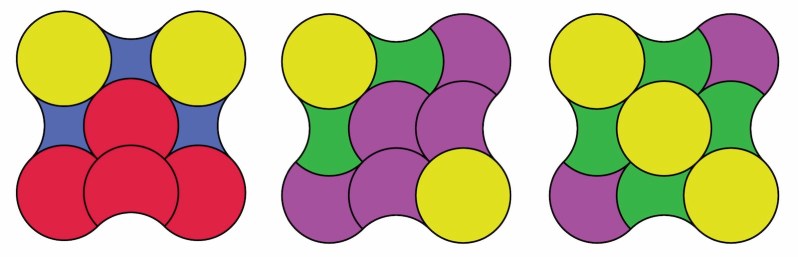
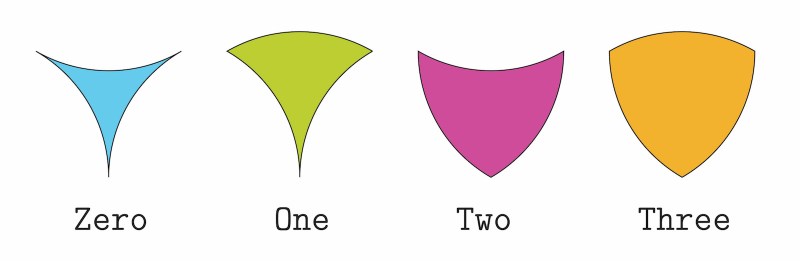
Before I get the reputation to be yet another hopeless conspirationist, here is another message in a bottle, in multiple parts. It is once again about polyforms. I need to say what the shapes are that we are allowed to use, and what we want to do with them. In the simplest, we are using four shapes, which are deflated/inflated triangles like so:

Triangles 01

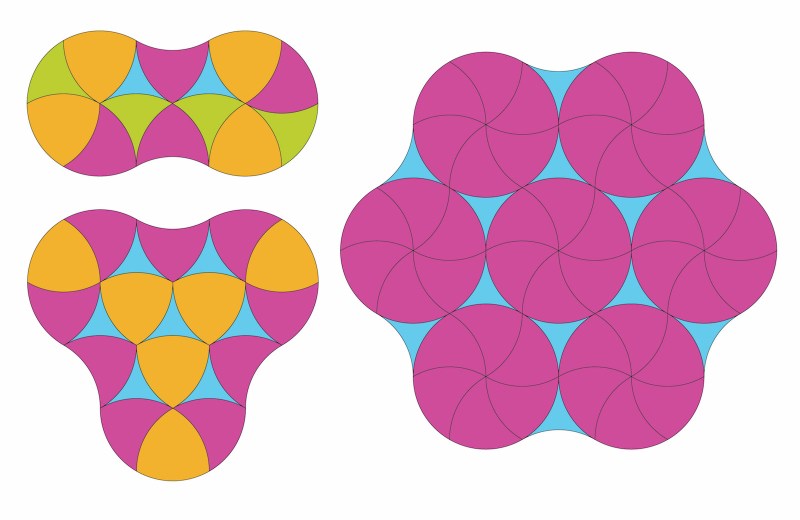
They already have received names, which count the number of edges that have been inflated. We (you) are going to tile shapes like these that have no corners:

Regions 01

We call these circular regions, because they consist essentially of a few touching circles with a bit of filling to avoid holes or corners. The circular regions above consist of two, three, and seven circles, respectively, and they already have been tiled. We can start asking questions: What shapes without corners can you come up with? Are they all circular regions?

Then there is time for exploration: Find all ways to tile a circle (the circular region with just one circle) with the curved triangles. Find all ways to tile the bone (the circular region with just two circles) using only two different kinds of triangles:

Di bones 01

Now, upon experimenting, the number of curved triangles to be used to tile a circular region is not quite arbitrary.
The first, not so trivial, observation is that for a circular with N circles, we will need 8N-2 triangles. That is because each circle contributes 6 triangles, and for adding a circle we have to use 2 more triangles. This is not quite a proof yet, but at least an argument. There are also interesting problems when the domain is allowed to contain holes…

Circles3 01

Because the different curved triangles contribute a different amount of area each, there is a second formula.
Let’s denote by N(0), N(1), N(2), and N(3) the number of curved triangles of each type (zero, one, two, three) that appear in a tiling of a circular region with N circles. Then N(1)+2N(2)+3N(3) = 12N. This formula counts on the left hand side how many triangle edges are inflated and hence contribute extra area. On the right hand side, we count the same, using say the pattern we see in the tiling of the circular region with 7 circles in the second image above.

The two formulas together allow you to determine how many triangles of each kind you need in an N-circle region, if you are only using two different triangles.

To be continued?

Copycat (Election Games II)

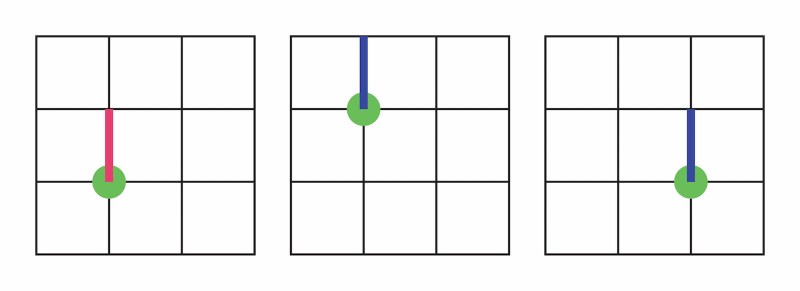
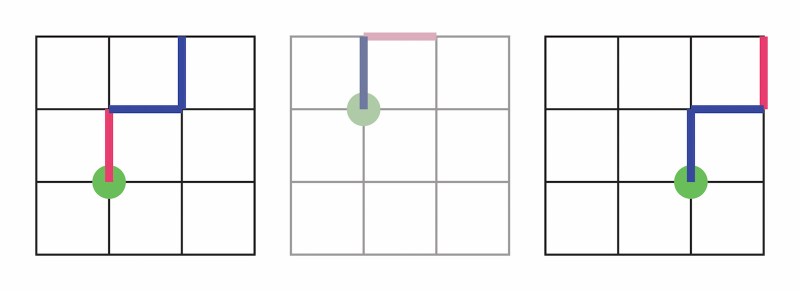
My popular series of election games continues with a paper and pencil game for any number of player. It’s called Copycat. Let’s play the multiplayer version first. Each player grabs a sheet of paper and a pen, draws a rectangular grid of agreed size (I use 4×4 below, 6×6 to 8×8 is better for actual play), and marks an agreed number (I use 1 below, two or three is much better) of intersections with a nice, fat dot.

Move1 01

One player decides to go first and announces one of the four main compass directions. Now all players have to mark a segment beginning at any one of their dots and heading that way one unit. Above, the first player (left) decided NORTH (where else?), and all players had to follow. A player who can’t follow is out.

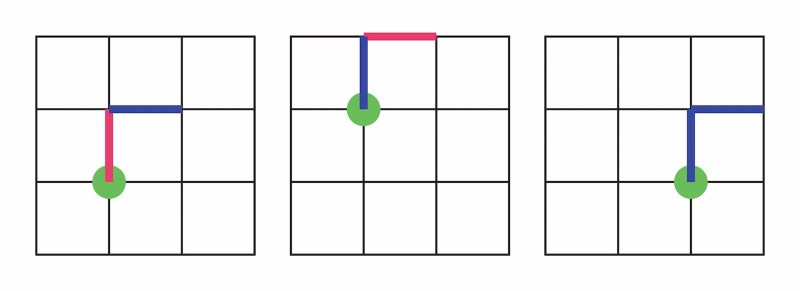
Move2 01

Now it’s the second player’s turn (middle), and she decides EAST. All players have to mark a segment that begins at the endpoint of any one of their paths and moves east one unit, thereby neither retracing steps, nor leaving the grid, nor ending on intersections that have already been visited by any path. The third player (right) has now only two options left (NORTH or SOUTH), and decides NORTH. This eliminates the middle player, who is out of moves.

Move3 01

Left takes revenge and moves EAST, which is impossible for the right player. This leaves left as the winner. In an (unrealistic) cooperative play, left and right could instead have continued on for eight more moves. The game becomes more interesting when the players begin with more than one dot, because then they can choose which path they extend at each turn.

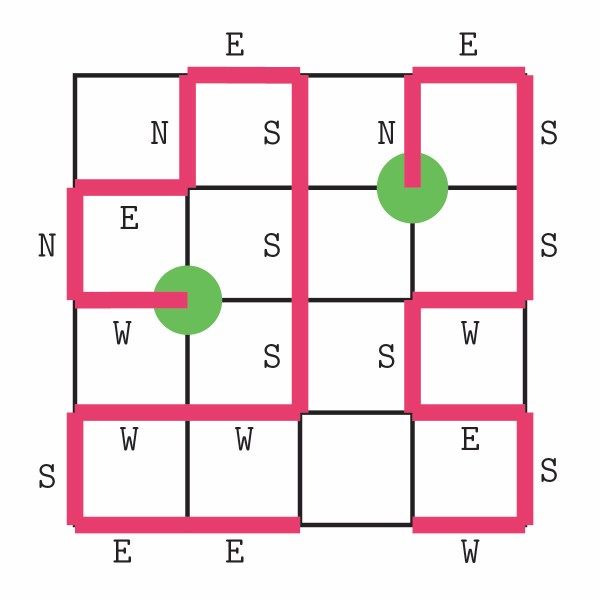
To make puzzles for single players, start with a board, place a couple of dots, and draw legal paths like so:

Puzzle 01

Record the directions along each path as a sequence of letters, namely WNENESSSWWSEE and NESSWSESW in the case above.
Randomly splice the sequences into one, for instance into WNNEENESSSSWSSWWESSEWE. Then draw a new board that just includes the dots, and hand it together with the letter sequence to your best friend. She then needs to trace non-intersecting paths, following the letters as compass directions. Her only choice at each step is which path she wants to extend. This is an excellent example of an easy to make puzzle that is ridiculously hard to solve.

There are many variations: For single players, you can use an eight sided compass die or a spinner to determine the direction at each step.

Several players can also share boards, as long as they can agree on where north is. They would then use pens in different colors and could only extend their own paths, avoiding any crossings of paths.

Just a Circle …

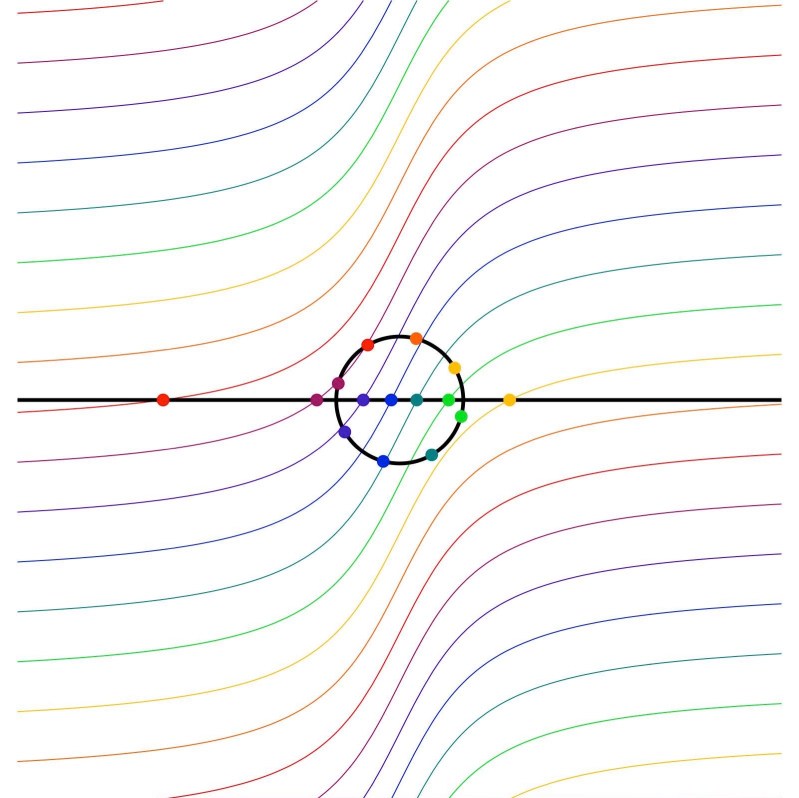
Imagine eight points, nicely spaced and colored, on a circle. Project them stereographically onto a line, keeping their color. In the image below, the projection center is at the top of the circle. You expect to get eight points on the line. One of them is hiding off the screen in the figure below.

Rotate

Now let’s move the points counterclockwise, with constant speed, around the circle. Their stereographic images will slide along the line. To visualize that motion, we trace the position by using the x-coordiante for the position and the y-coordinate as time. This way we get the colored curves above, each representing two full turns of the point around the circle.

A simple rotation of an 8-gon has become quite tricky. It will get worse. Let’s place two circles (blue and red) onto a sphere, by taking the 45 degree latitudes. When we stereographically project these into the plane, we get two concentric circles. Now rotate the sphere about the y-axis. After 90 degrees, the two circles have become vertical (yellow and green), and their stereographic images are two disjoint circles. How did that happen?

Stereocircles
Let’s visualize the process the same way as before, by tracing the position of the circles using the z-coordinate for the angle of rotation.

Trails2

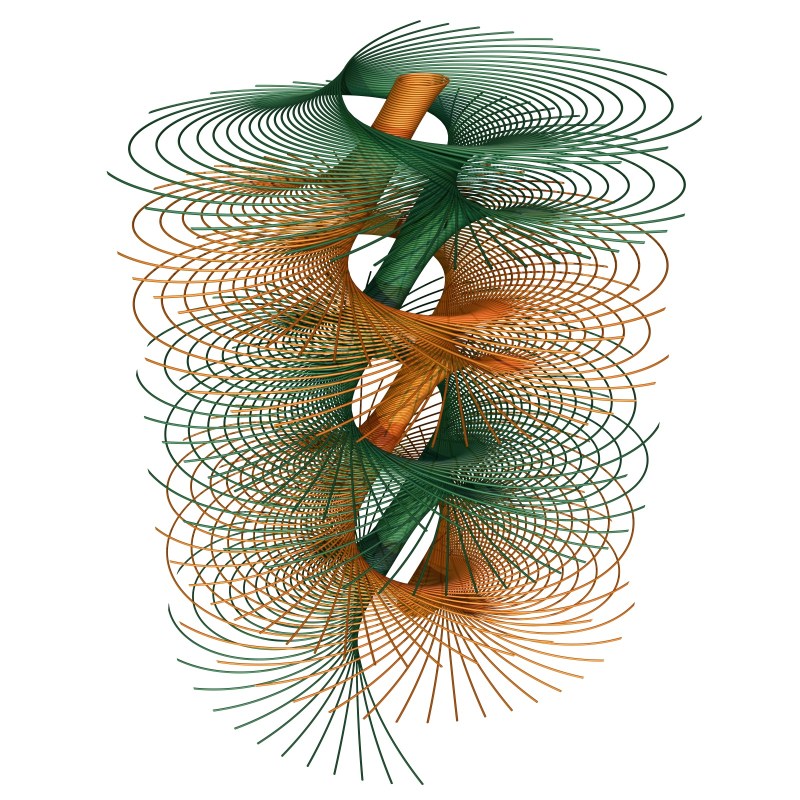
We obtain two interlocking identical surfaces, both of which have circular horizontal slices. This is reminiscent of Riemann’s minimal surface, but it is not the same surface. Riemann’s surface is several magnitudes more complicated. After all, we are only rotating a sphere.

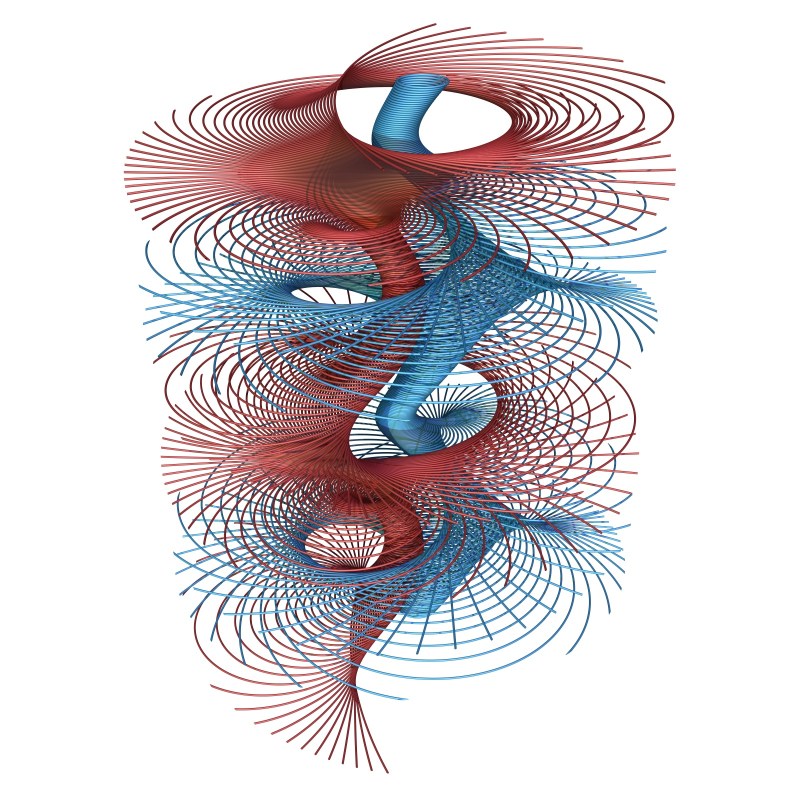
We can make this a bit more complicated by simultaneously rotating the sphere about the z axis. In other words, we rotate the image circles about the z-axis depending on their height.

Trails2twistb

Finally, here is the same construction with three circles. This gets quite crowded.

Trails3twista