The Advantages of Different Viewpoints (From the Pillowbook IX)

It all started with a question about polysticks: I wanted to see how to tile parts of the square grid with 3-sticks so that there are always three 3-sticks touching. A 3-stick is nothing but a T with all segments the same length: it has 3 arms that end at the hands, and are joined together at a head. By tiling I mean that the arms align with the edges of the standard square grid and don’t overlap. And, as I said, I want always three of them to hold hands. Here is an example (that you should imagine continued periodically):
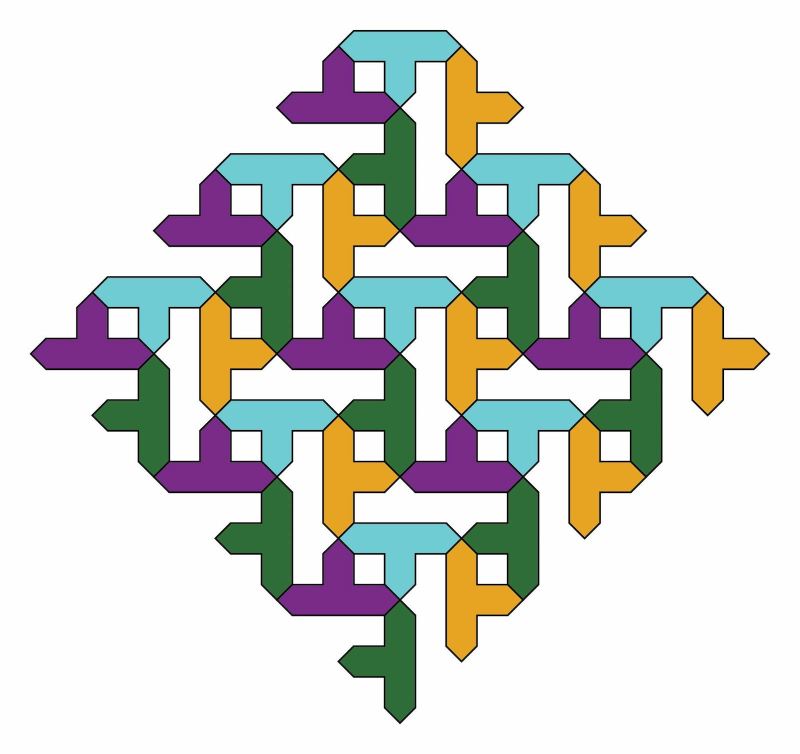
Right3 01

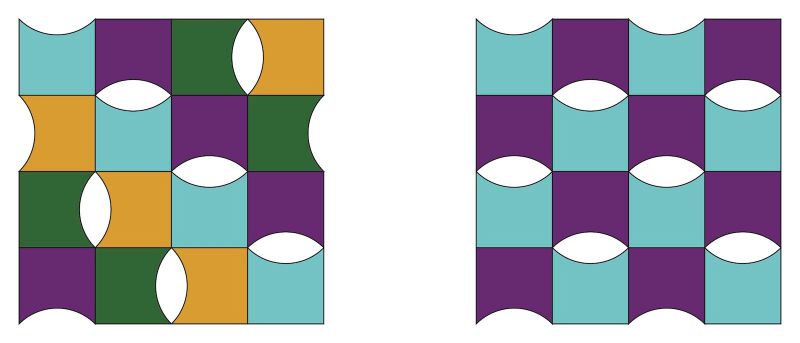
The condition about holding hands in threes means that each such tiling has a dual tiling where the new 3-sticks have their heads wherever three hands come together, the same arms, and the previous heads are replaced by three hands. This also implies that a tiling and its dual will tile the same portion of the square grid, as below to the left and right.
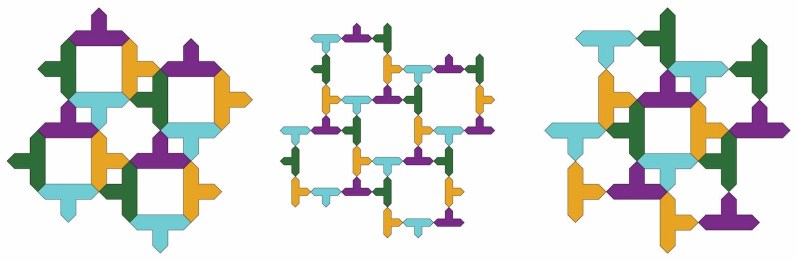
Merge 01

We can also combine a tiling and its dual into a single figure by centrally scaling each 3-stick by 50%, and taking the union: The gaps created by the scaling makes room for the 3-sticks from the other tiling. You can examine the result up above in the middle. The new skeleton will have all 3-sticks hold hands in pairs instead of in triples. Here is another, more complicated example. The original periodic 3-stick tiling:
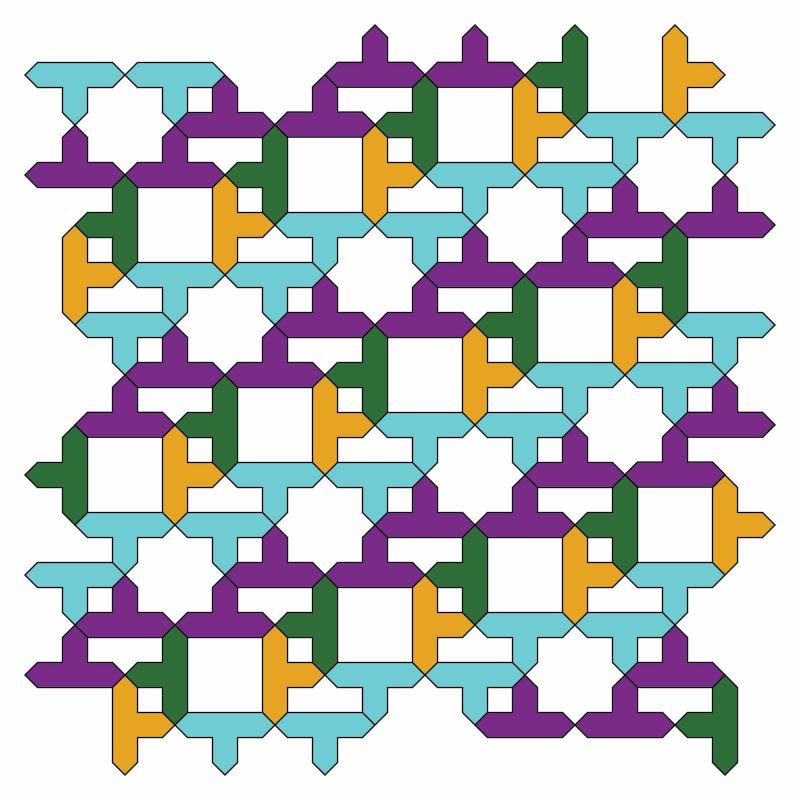
Right7 01

The inflated version that combines the original with its dual:
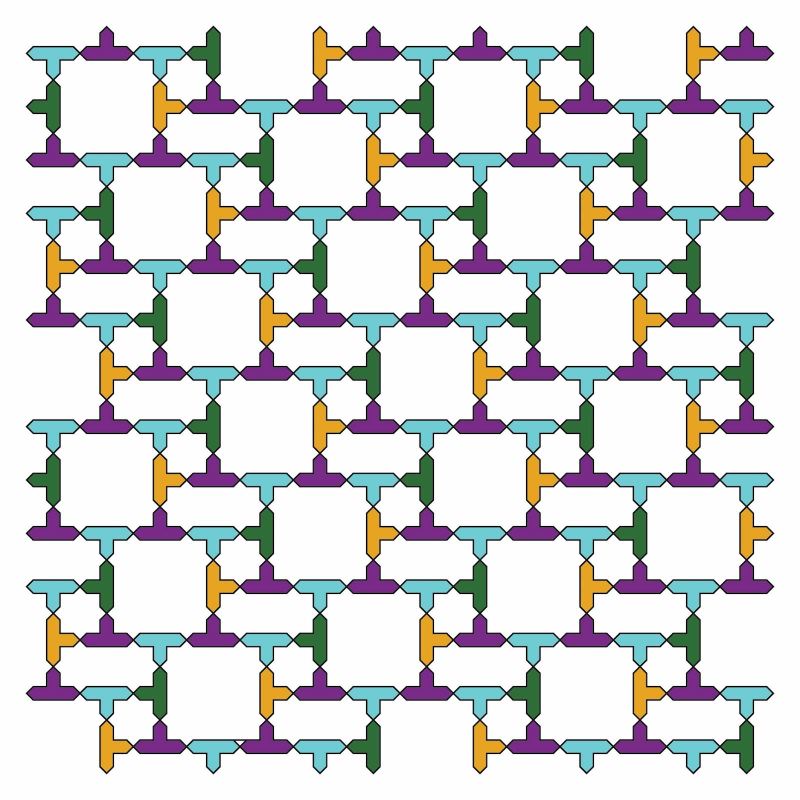
Right7 inf 01

In the inflated version we can replace each 3-stick by a square so that the sides touch when the 3-sticks hold hands. The unused edge of the square is pushed inwards, turning the square into the familiar 3/4 pillow we admired the last time (the next image shows only a quarter of the previous piece. It repeats itself using horizontal and vertical translations).
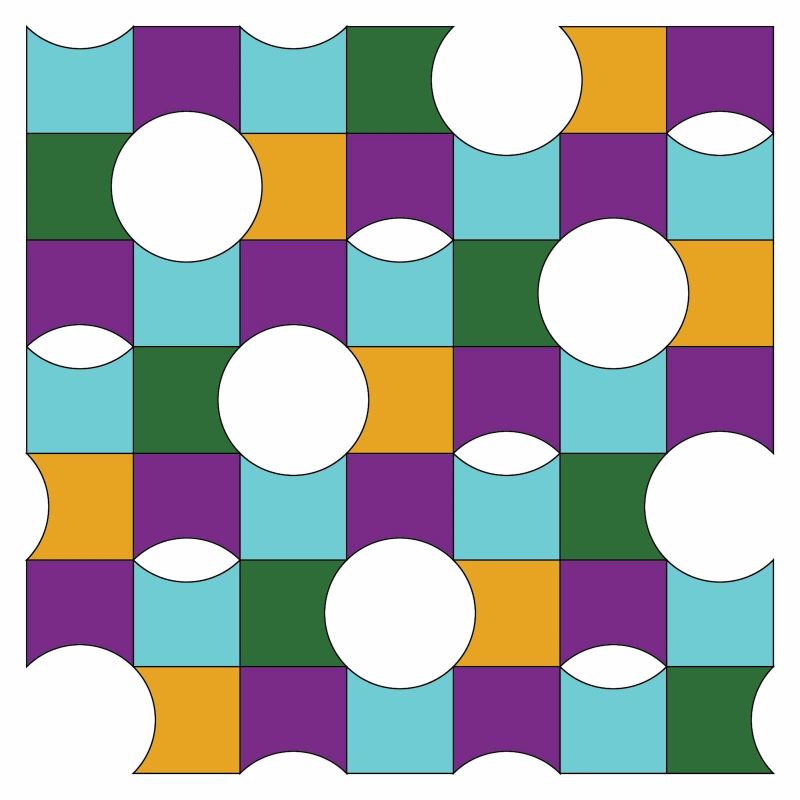
Right7 p 01

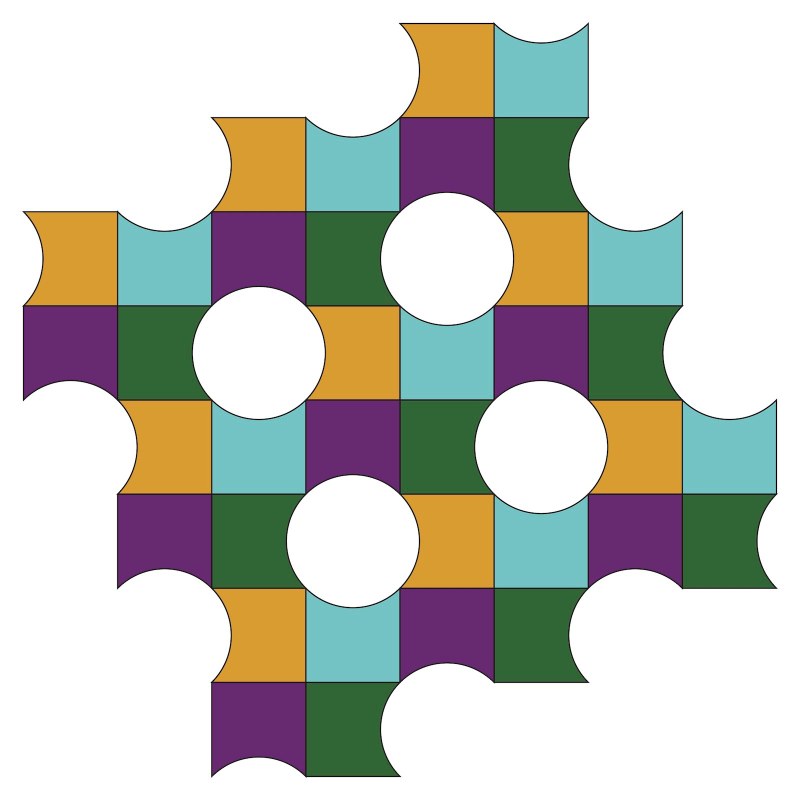
As a final simplification, we can fill in the holes as follows: We replace the 3/4 pillows that border a hole by the polyomino they cover  (thereby filling in the hole). Below are the two simplest polyominoes that surround a hole:
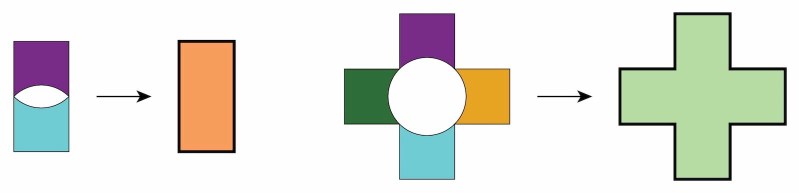
Polyrule 01

These polyominoes will tile the plane as before, because each 3/4 pillow must belong to exactly one hole. Our 3/4-pillow tiling now becomes a very simple polyomino tiling:
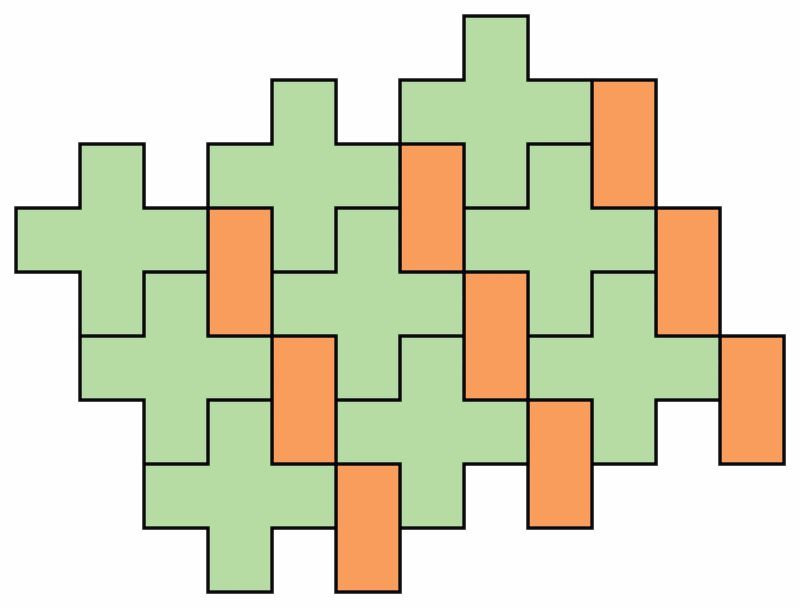
Polyominoes 01

Thus periodic 3-stick-tilings with triple hand holding, 3-stick tilings with hand holding in pairs, 3/4-pillow tilings with holes, and  tilings by polyominoes that surround holes are all the same thing.

You can use this to design  much more intricate patterns, with holes of any size, for instance.
Intersecting Cylinders

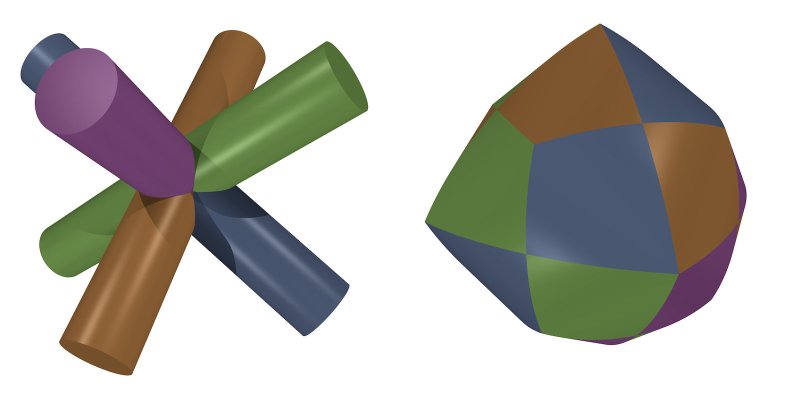
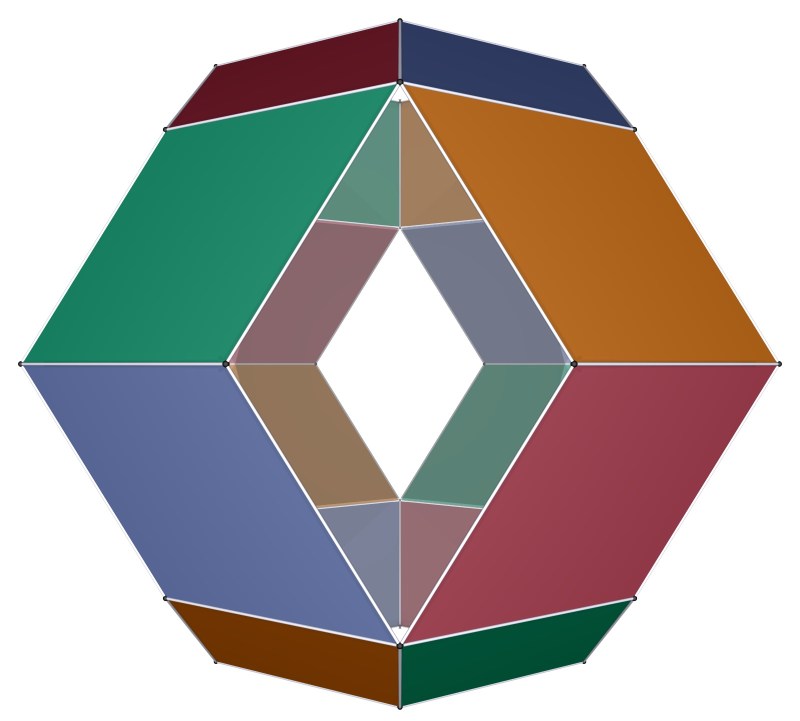
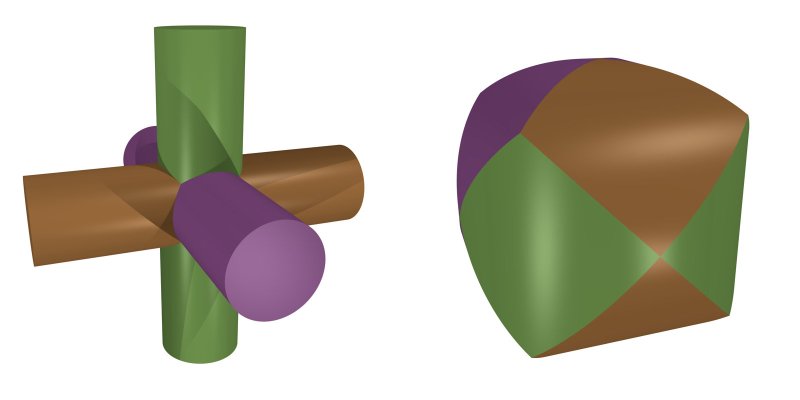
After learning how to intersect two cylinders, let’s try it with more. The next simple case are three cylinders, and the most symmetric case has them aligned along the coordinate axes. The union is on the left, and the (rescaled) intersection on the right.

Combi 3

We obtain an inflated cube that has twelve cylindrical rhombi as faces, one for each edge of the cube. This is therefore a version of the rhombic dodecahedron. Using four cylinders, the most symmetric way is to align them with the diagonals of a cube. We see here (again) that each cylinder contributes a chain of cylindrical faces that touch at opposite vertices.

Combi 4

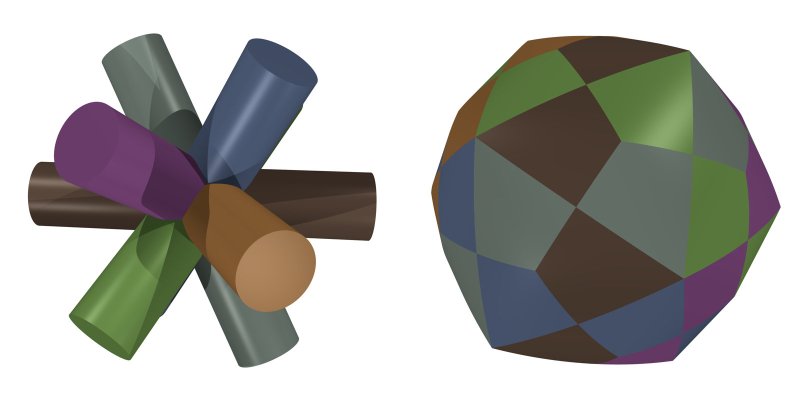
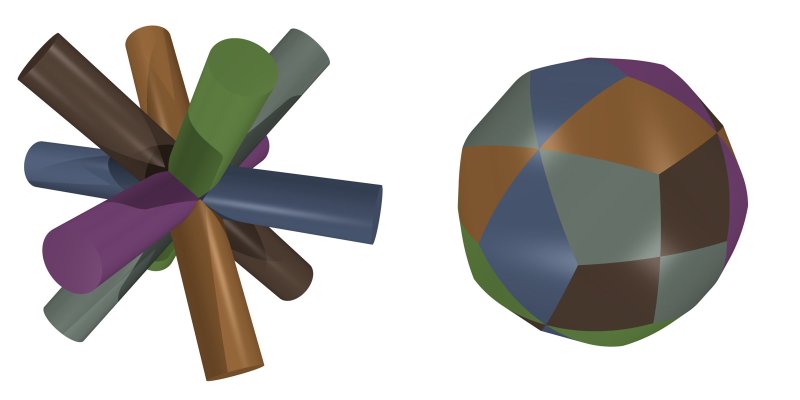
For six cylinders, there are two notable choices for the axes. The first is to use the six edges of a tetrahedron, recentered so that they all pass through the origin. Alternatively, we could use lines that connect midpoints of opposite edges of a cube.

Combi 6b

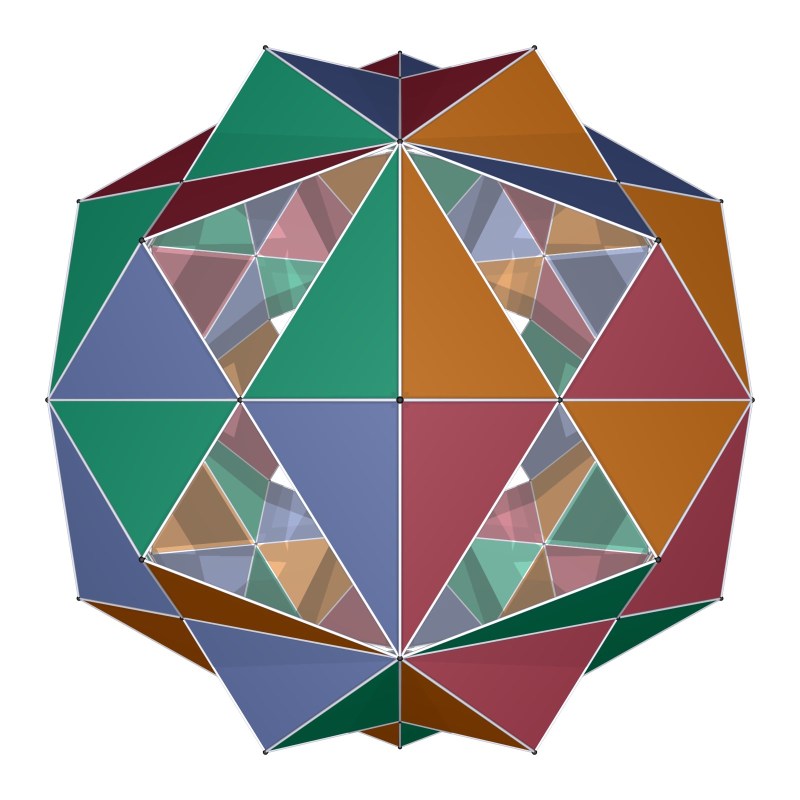
The other, even more symmetric choice is to use the diagonals of an icosahedron. Using axes related to the platonic solids creates simple patterns that can all be understood in terms of finite reflection groups acting on the sphere.

Combi 6

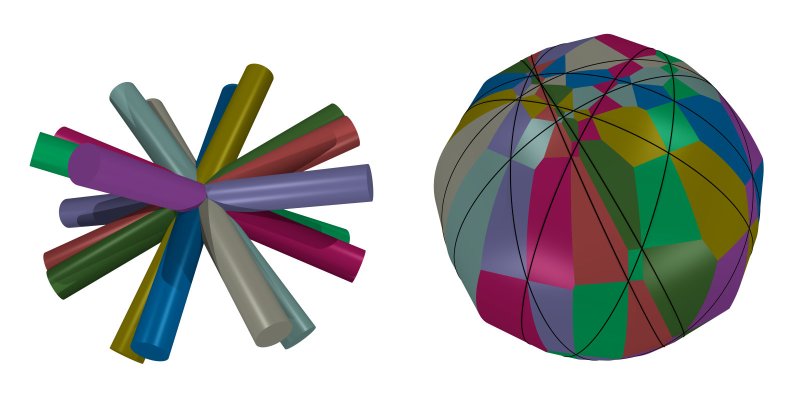
By now, I have probably created the impression that the appearance of the chains of equally colored cylindrical faces has something to do with the symmetry of the chosen axes. Not so. The next image shows a random choice of 10 cylinders of equal radius through the origin, and their intersection to the right.

Combirr 10

The black curves are the waists of the cylinders, i.e. their intersections with the sphere of equal radius centered at the origin. The waist of a cylinder must belong to the intersection, because any other cylinder will properly contain it. Thus our chains appear along these waists, and they are pinched whenever to waists meet.

Constructive Solid Geometry

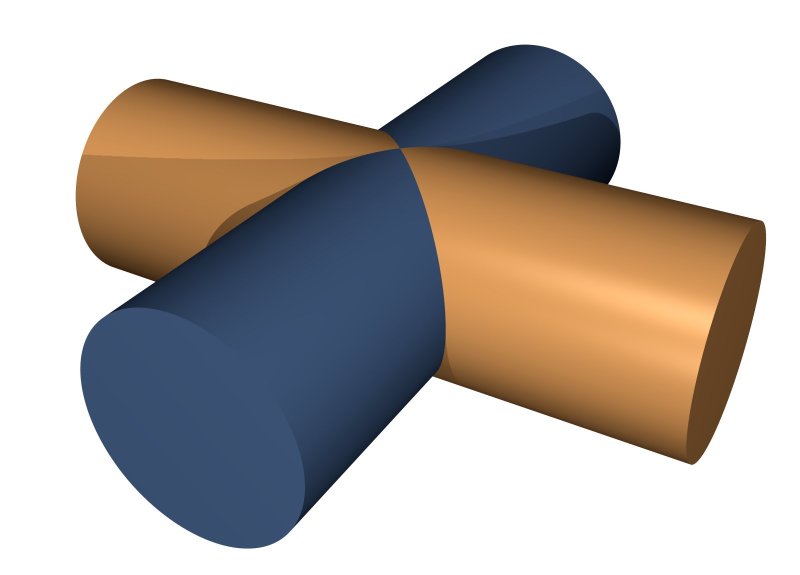
I will post about intersections in the near future, and I think it is instructive to explain how easy it is these days to visualize intersections of sets. For instance, an infamous Calculus problem asks to compute the volume of the intersection of two cylinders of equal radius whose axes intersect at a right angle:

Cylinder 2

This image shows the union of the two cylinders. It can be rendered in PoVRay using the following code:

#declare color1 = rgb <0.824802, 0.572810, 0.332621>;
#declare color2 = rgb <0.288963, 0.391247, 0.546639>;

union {
	object {
		cylinder {<3,0,0>,-<3,0,0>, 1}
		pigment {color color1}
	}
	object {
		cylinder {<0,3,0>,-<0,3,0>, 1}
		pigment {color color2}
	}
	scale .4
	rotate <90,30,0>
	rotate <-30,0,0>
}

To make this a complete scene file, you need to add before this camera and light source settings, for instance:

global_settings { assumed_gamma 2.2 }

#include "colors.inc"

camera {
	location <0,0,-4>
	angle 40
	right x*image_width/image_height    
	up y
	look_at <0,0,0>
}

#default {
	finish {
		ambient .1
		diffuse .3
		specular .2 
	}
}

light_source {
	<3,3,-8> color White
}
light_source {
	<3,-3,-8> color White
}
light_source {
	<-3,3,-8> color White
}
light_source {
	<-3,-3,-8> color White
}

background {color White}

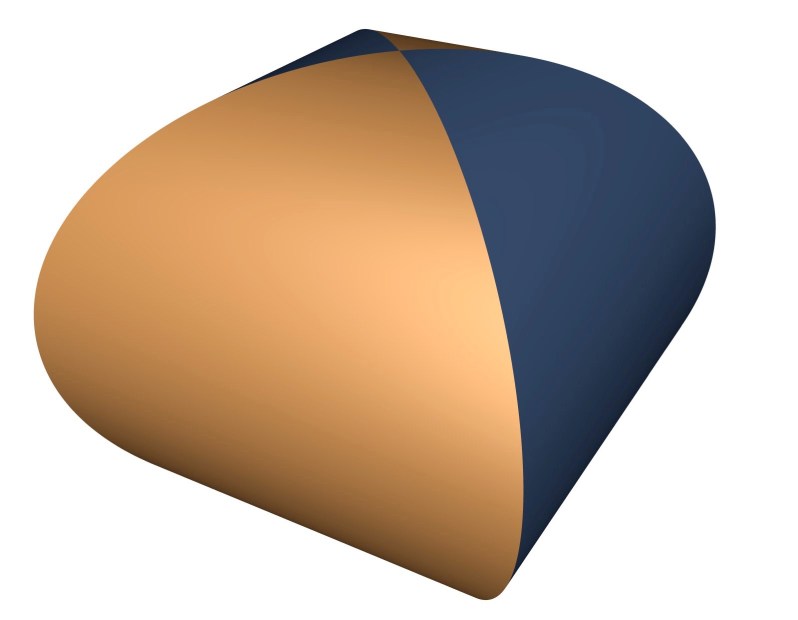
Cylinder 2i

To render the intersection above, you just need to replace union by intersection.
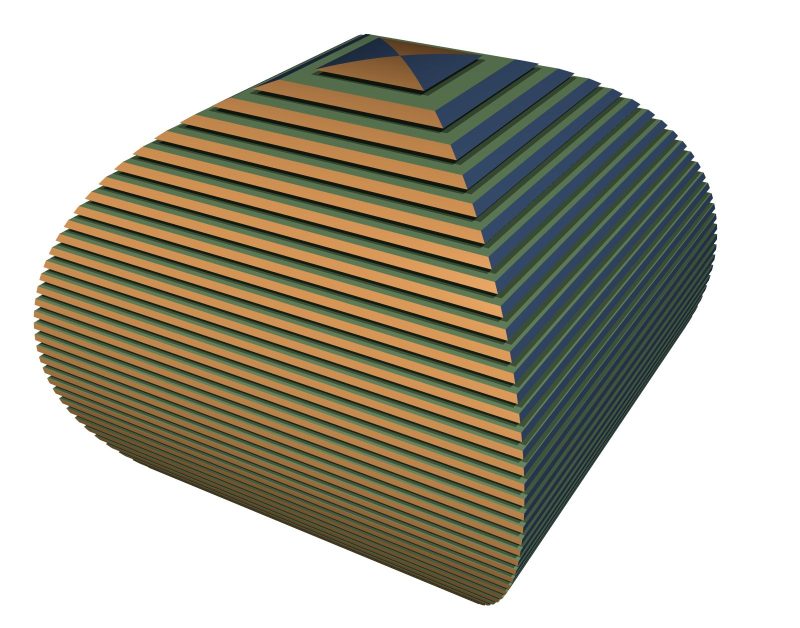
While amusing, this doesn’t help to solve the problem. The main idea is to slice the two cylinders with planes parallel to the two axes of the cylinders, and to realize that you will get squares, because both cylinders are cut into parallel strips. One way to visualize that is by slicing the two cylinders with thin slabs, and throwing away every other slab, like so:

Cylinder 2b

The PoVRay code for this uses a simple loop and intersects the two cylinders with a union of slabs. Note that the plane primitive represents a half space, given by normal vector and distance to the origin. So a slab is nothing but the difference of two half planes:

intersection {
	object {
		cylinder {<3,0,0>,-<3,0,0>, 1}
		pigment {color color1}
	}
	object {
		cylinder {<0,3,0>,-<0,3,0>, 1}
		pigment {color color2}
	}
	union {
		#declare height = -1;
		#declare step=.05;
		#while (height <1)
			difference {
				plane {<0,0,1>,height+step/2}
				plane {<0,0,1>,height}
				pigment {color color3}
			}
			#declare height = height+step;
		#end
	}
}

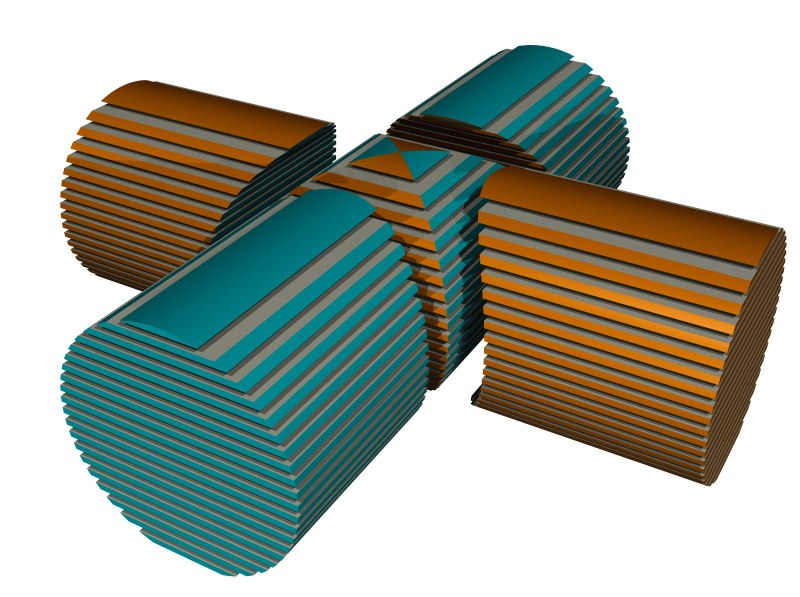
Finally, let’s try to incorporate more of the two cylinders so that it becomes clear in a single image that we are intersecting cylinders. We do this by adding the differences between one cylinder and a slightly larger copy of the other cylinder as follows:

intersection {
	union {
		intersection {
			object {
				cylinder {<3,0,0>,-<3,0,0>, 1}
				pigment {color color1}
			}
			object {
				cylinder {<0,3,0>,-<0,3,0>, 1}
				pigment {color color2}
			}
		}	
		intersection {
			object {
				cylinder {<3,0,0>,-<3,0,0>, 1+.3}
				pigment {color color1}
				inverse
			}
			object {
				cylinder {<0,3,0>,-<0,3,0>, 1}
				pigment {color color2}
			}
		} 
	 	intersection {
			object {
				cylinder {<3,0,0>,-<3,0,0>, 1}
				pigment {color color1}			
			}
			object {
				cylinder {<0,3,0>,-<0,3,0>, 1+.3}
				pigment {color color2}
				inverse
			}
		}
	}
	union {
		#declare height = -1;
		#declare step=.1;
		#while (height <1)
			difference {
				plane {<0,0,1>,height+step/2}
				plane {<0,0,1>,height}
				pigment {color color3}
			}
			#declare height = height+step;
		#end
	}
}

Cylinder 2c

I imagine Archimedes would have been pleased.

Three Quarters (From the Pillowbook VIII)

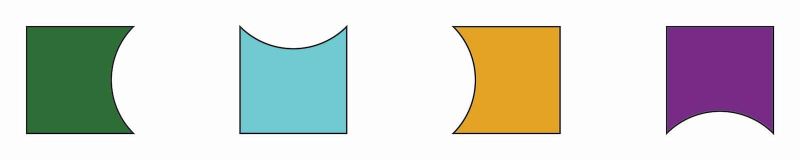
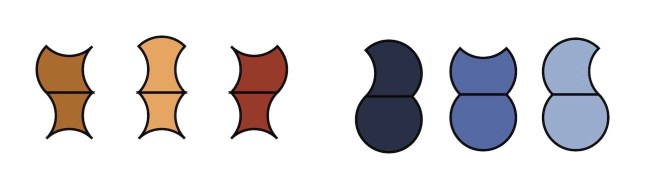
Today we will talk about a single, very neglected pillow, which I will call 3/4. To make things look pretty, we will color it depending on its orientation, as follows.

Single 01

Discriminated for centuries by the other, more curvy pillows, 3/4 only likes to hang out with other 3/4s and hide its straight edges as much as possible. Like so:

Right1 p

These two examples are portions of periodic tilings of the entire plane. This way, all straight edges are hidden, and we have periodically placed holes. This quickly becomes more interesting. Here, for instance, is the only tiling that has just circular holes (up to symmetries, of course):

Right2 p

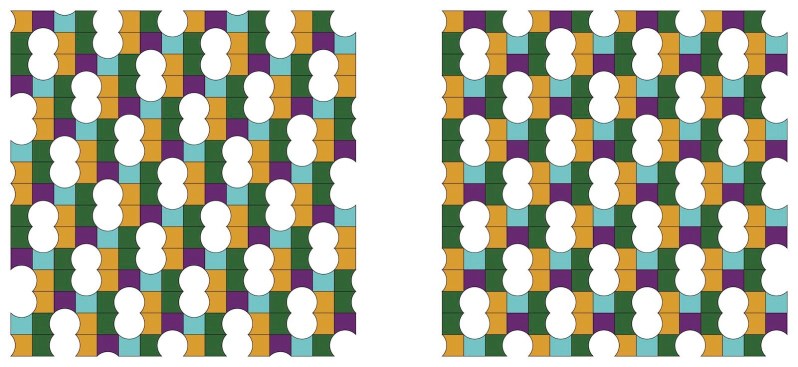
The holes can be more complicated, like these double holes in subtly different periodic tilings.

Right5 p

Next month, we will analyze these patterns a bit. For today, we end with an example that indicates that the holes can become really big (as we will learn).

Right6 p

For today it’s enough to have learned that also the seemingly uninteresting can do pretty things.

Fermat’s Quartic Curve

Today we look at the Fermat equation x^4+y^4+z^4=0 as a subset of the complex projective plane, where it becomes an algebraic curve, or Riemann surface Q of genus 3. This has many advantages: For instance, we see that there are many automorphisms (96 in total) coming from permuting the coordinates or multiplying them with powers of i.
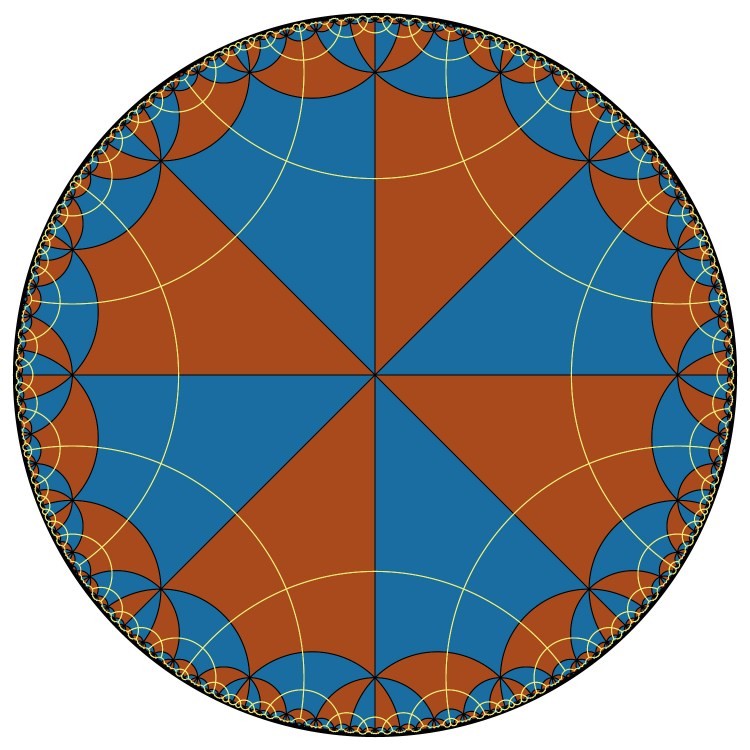
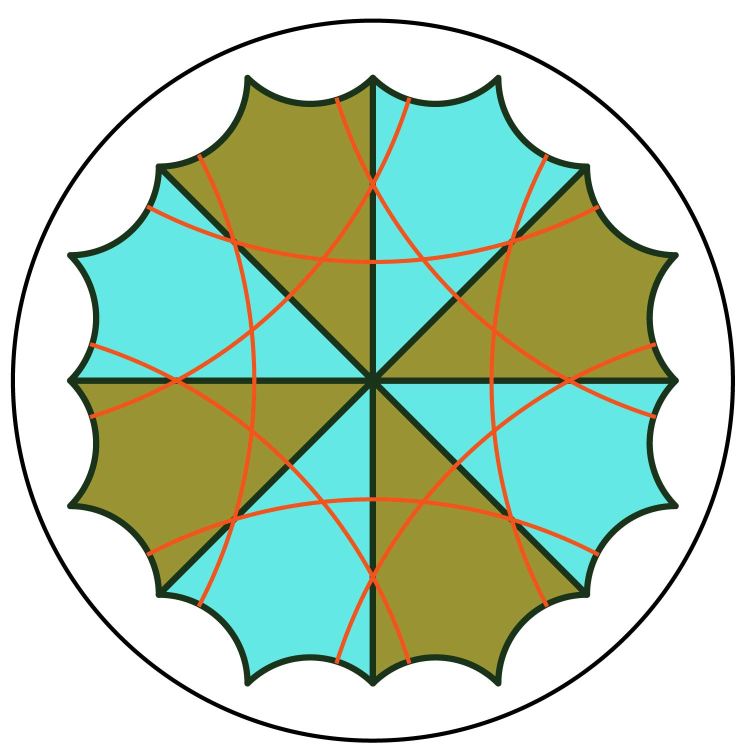
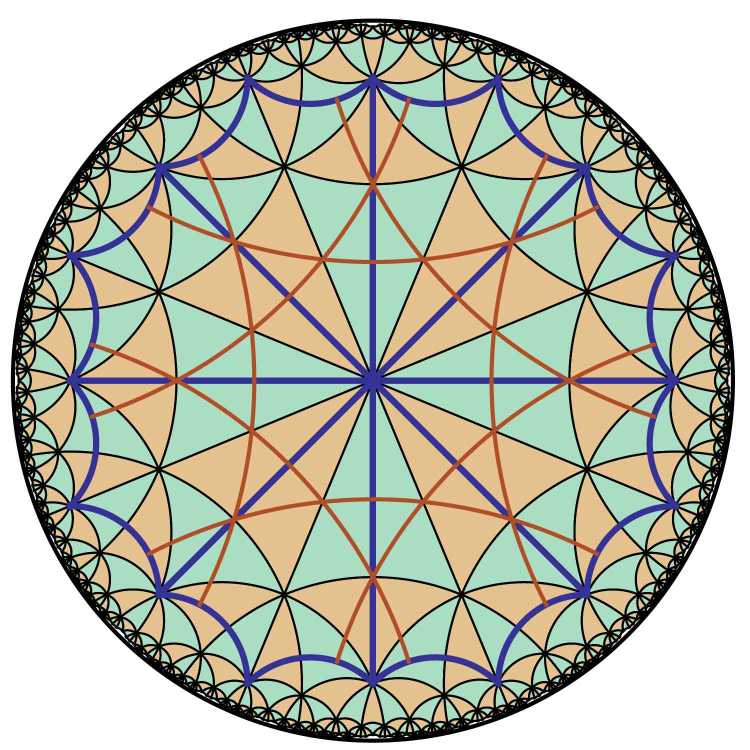
8gons 01

Our first goal is to visualize Q so that we retain as many symmetries as possible. A standard approach is through uniformization: Any compact Riemann surface of genus > 1 has a unique hyperbolic structure, and the holomorphic automorphisms of the Riemann surface fully survive as hyperbolic isometries.

Fdomain 01

To find this hyperbolic structure, note that the defining equation implies that the function y/x represents the surface as a 4-fold branched cover over the Riemann sphere, branched over four points that can be chosen as the fourth roots of unity. Such a sphere can be represented by taking two squares and gluing them together along their edges. This means that Q will be tiled by 8 squares, so that they all fit round any of the four vertices. While Euclidean squares don’t like this, we can use hyperbolic 45 degree squares.

3gons 01

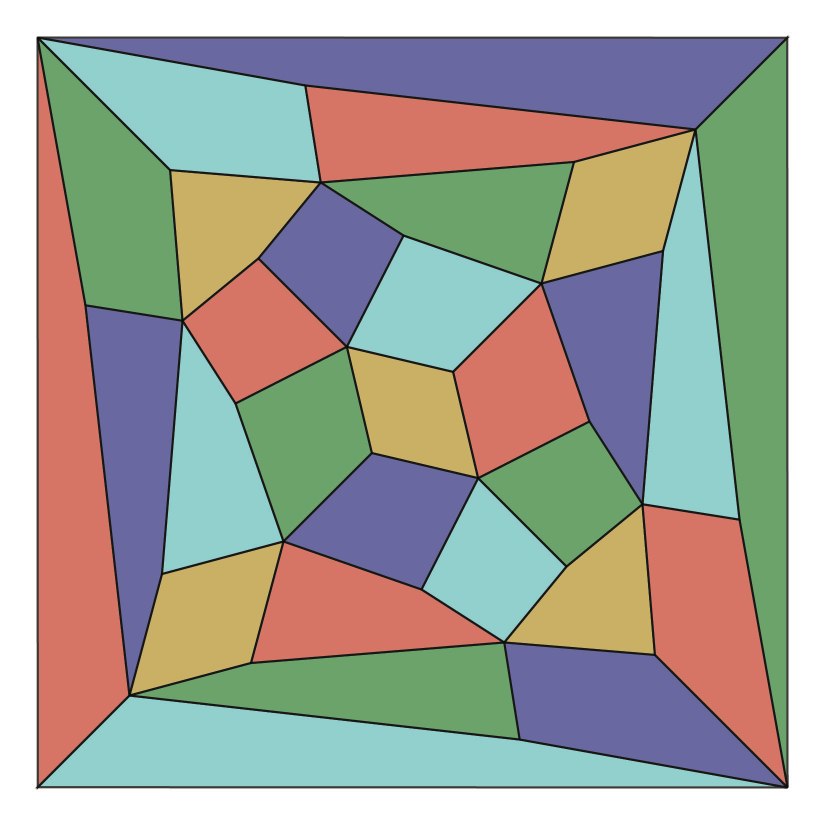
The top image shows the tiling of the hyperbolic plane by such squares, together with the dual tiling by right angled regular octagons outlined in yellow. The second image shows just the eight squares that constitute the surface, and the red geodesics indicate the identifications needed to get the closed surface Q.

Petrie 01

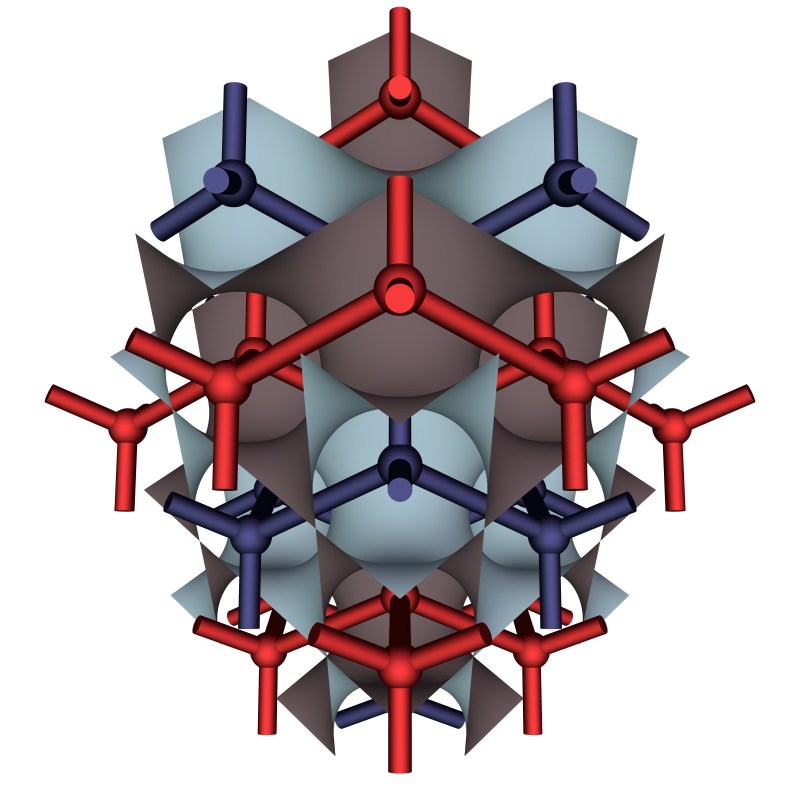
This tiling by eight squares (as well as the dual tiling by four octagons) is platonic in the same way that a cube is platonically tiled by six squares: The symmetries of the surface act transitively on flags (i.e. point-edge-face chains). This is already pretty but not the end. The octagons of the dual tiling can be each subdivided into eight 45 degree equilateral triangles that also tile the surface platonically. The 12 vertices of these 32 triangles happen to be the Weierstrass points of Q (3rd figure).

OctahedralQ

The identifying geodesic zigzag through these smaller triangles as Petrie polygons, and close on Q always after passing through six triangles. Moreover, one can decompose the tiled hyperbolic plane into ribbons (4th figure) consisting of such triangle chains. What is left are triangles that only meet at vertices. On Q, one has fours such ribbons and eight isolated triangles. Because the ribbons close after six triangles, it is tempting to represent them by the six equatorial triangles of an octahedron in Euclidean space. Doing this while gluing in the isolated triangles results in exactly the same triply periodic polyhedral surface we constructed last time. That means that the Fermat quartic Q is conformally isomorphic to the quotient of that triply periodic polyhedron divided by its lattice translations. This was dense today. More details are in Dami’s paper.

Golem (Fattend Skeletons)

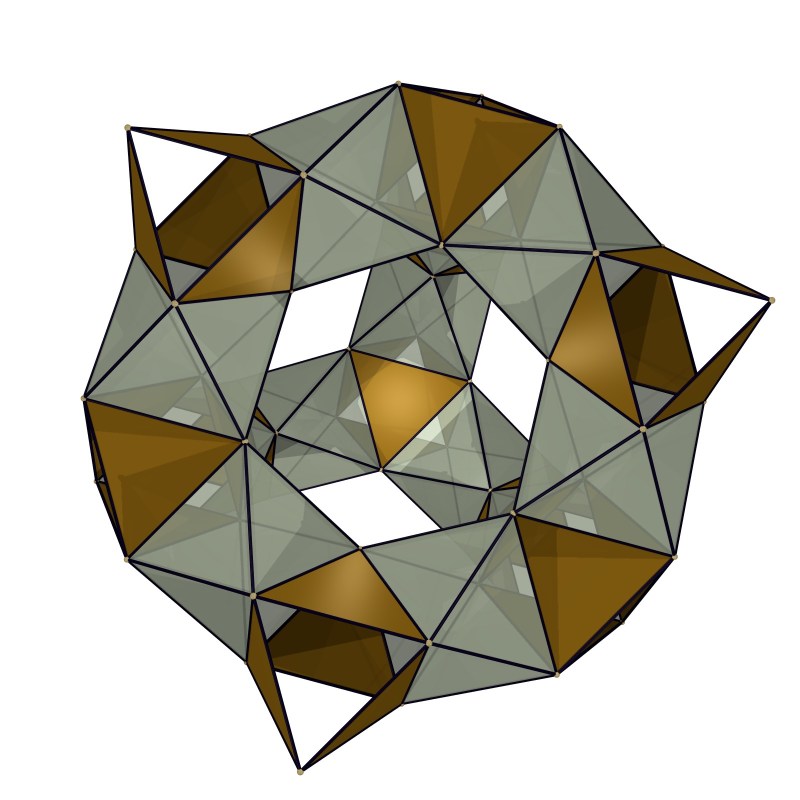
Today I want to look at decorations of simplicial graphs. As an example, here is a decoration of last week‘s skeleton:

CI3

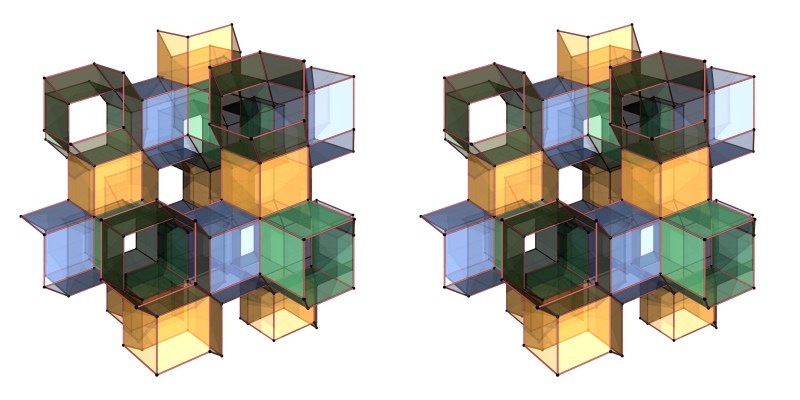
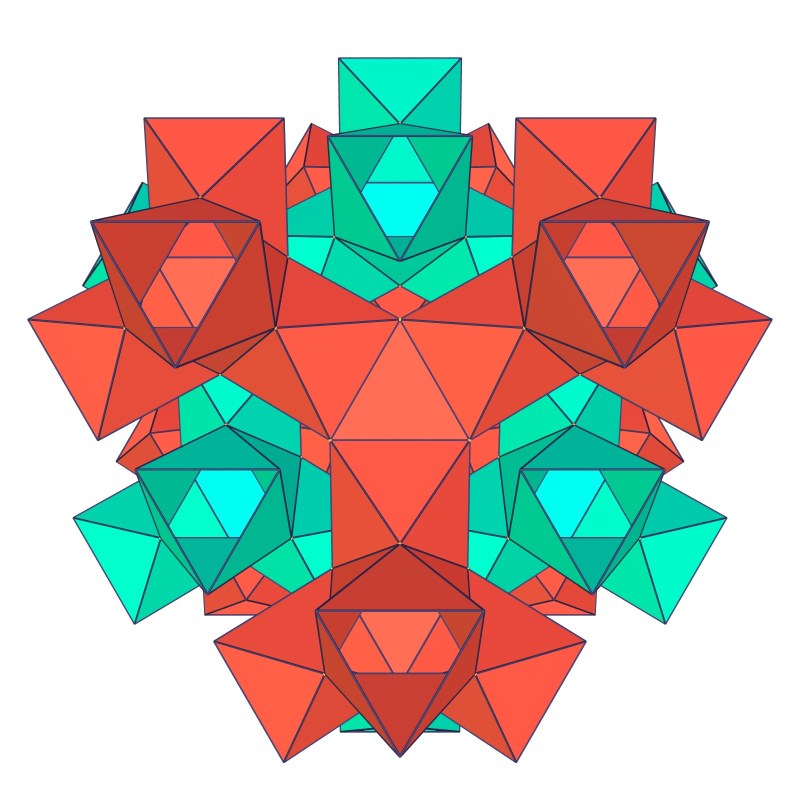
The vertices of the two skeletons have been replaced by tetrahedra, oriented and scaled so that vertices of neighbors touch. This should explain what I mean by a decoration: A geometric construction that consistently modifies the graph, in order to obtain something with similar symmetries (many) and possibly other desired properties. Another simple and well known decoration is that by Voronoi cells: We replace each vertex by the set of all points that are closer to that vertex than to any other vertex. In this case, the Voronoi cells are truncated octahedra, as shown in another post. Instead of replicating it here, one can also pass to the dual tiling, which is by rhombic dodecahedra. Try viewing it cross eyed.

StereoD

This is another polyhedral version of the Diamond surface of Schwarz. Like the one obtained from the truncated dodecahedra, the polyhedral approximation shares the conformal structure (by sheer symmetry).

There is another decoration that is quite remarkable:

CI4

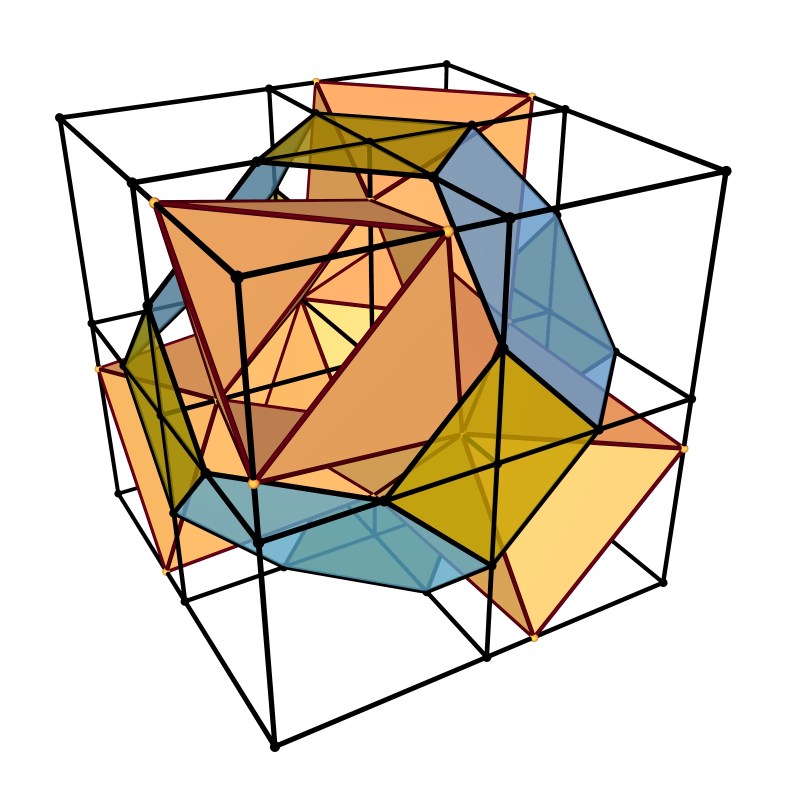
Here, we have replaced each vertex and each edge of the original graph by an octahedron, properly scaled an oriented. We thus get two fattened skeletons that are congruent and disjoint. All faces are equilateral triangles, and all vertices have valency 6. There even is enough room between them to fit in the truncated octahedra, as one can see in the last image.

CI5

This image also shows how to position each octahedron within the cubical lattice: The central octahedron has its vertices along the edges of the lattice, dividing each edge in the ratio 1:3. That ratio ensures that the other three octahedra in the image become in fact regular. More about this next week.

Walls and Connections

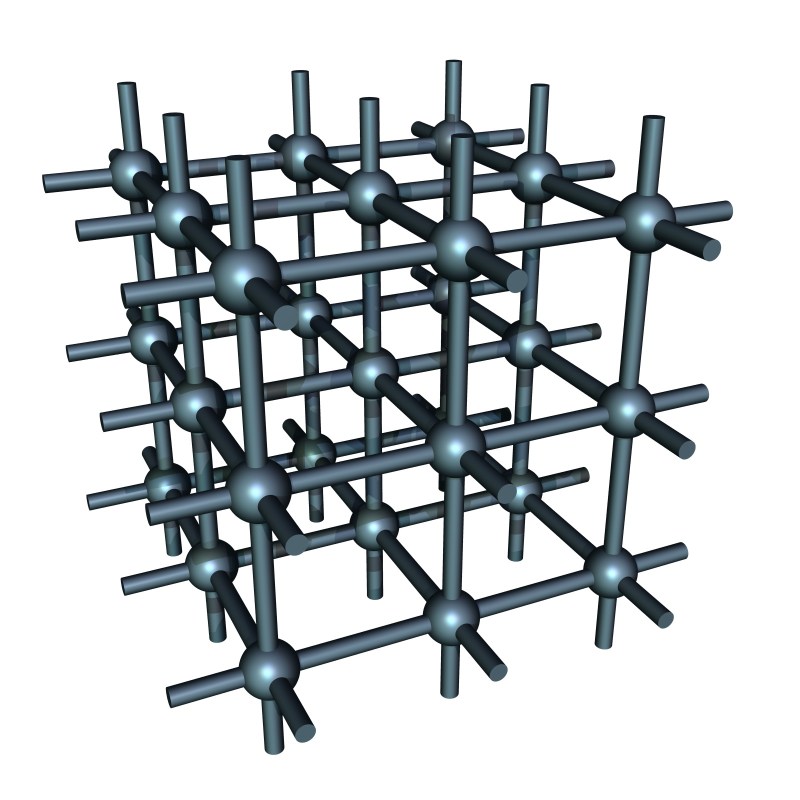
The cubical lattice is a seemingly simple way to arrange spheres in space. By connecting spheres that are closest to each other, we get a line configuration I have also written about before.

c

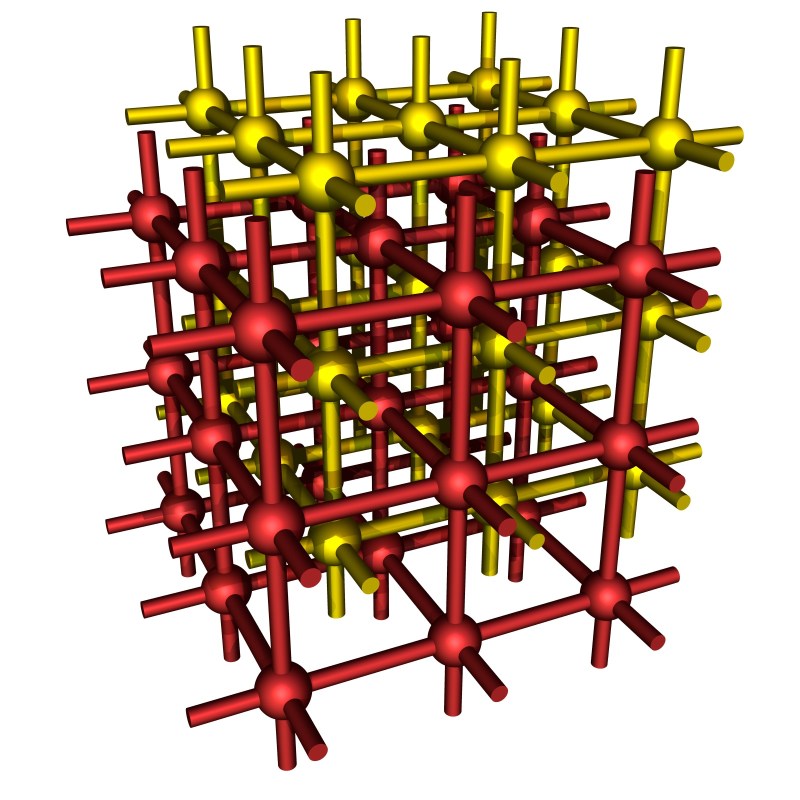
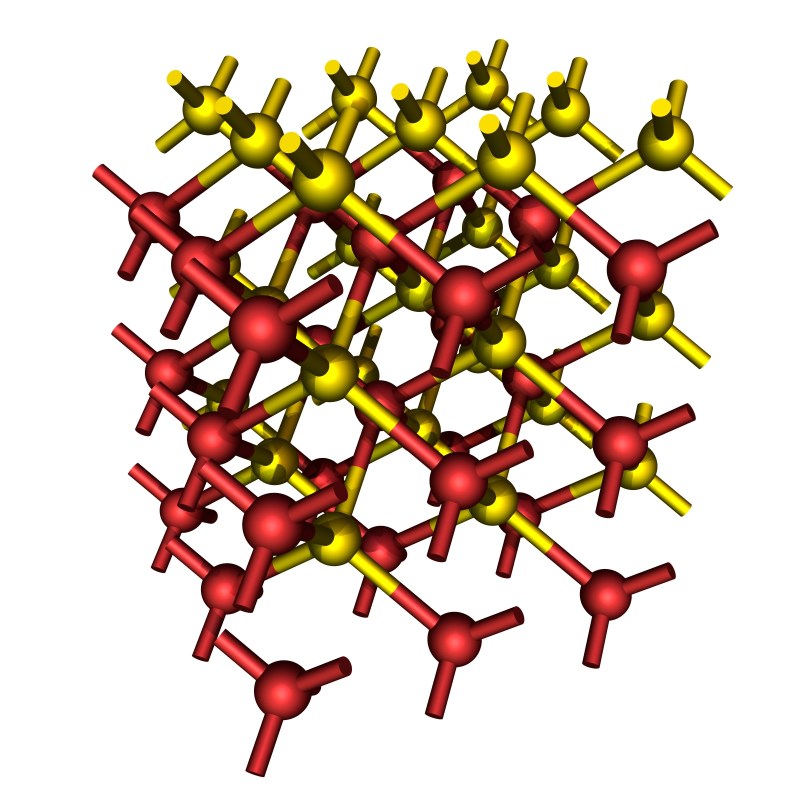
Let’s increase the complexity by adding another copy of the same configuration, shifted by 1/2 of a unit step in all coordinate directions. This is sometimes called the body-centered cubical Bravais lattice.

CI

We can also recognize here the two skeletal graphs of the two components of the complement of the Schwarz P minimal surface. This means that the P surface will separate the yellow and the red lattices.

Now we would like to connect the two separate systems of spheres with each other. Note that each yellow sphere is surrounded by 8 red spheres (and vice vera), at the vertices of a cube centered at the yellow sphere. This suggests to connect the yellow center to just four of these red neighbors, by choosing the vertices of a tetrahedron, as to obtain a 4-valent graph. Like so:

CI2

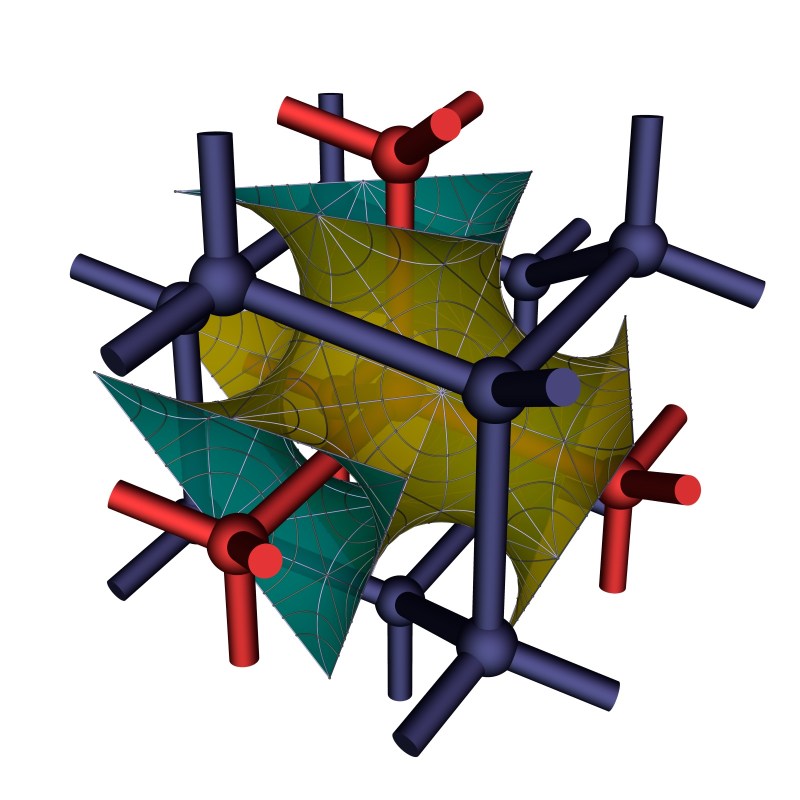
While this is still simple, it starts to look confusing. The new skeleton has again two components, and again they can be separated by a classical minimal surface, the Diamond surface of Hermann Amandus Schwarz.

All this should remind us of the Laves graphs, which are skeletal graphs of the gyroid.

Tetra D

You can see that these skeletal graphs have girth 6. Below is a larger piece of the D-surface. Everything here is triply periodic and very symmetric. In contrast to the Laves graph, these here have no chirality.

D skeleton

Next week, we will decorate these skeletons a little.

Double Parity (From the Pillowbook VII)

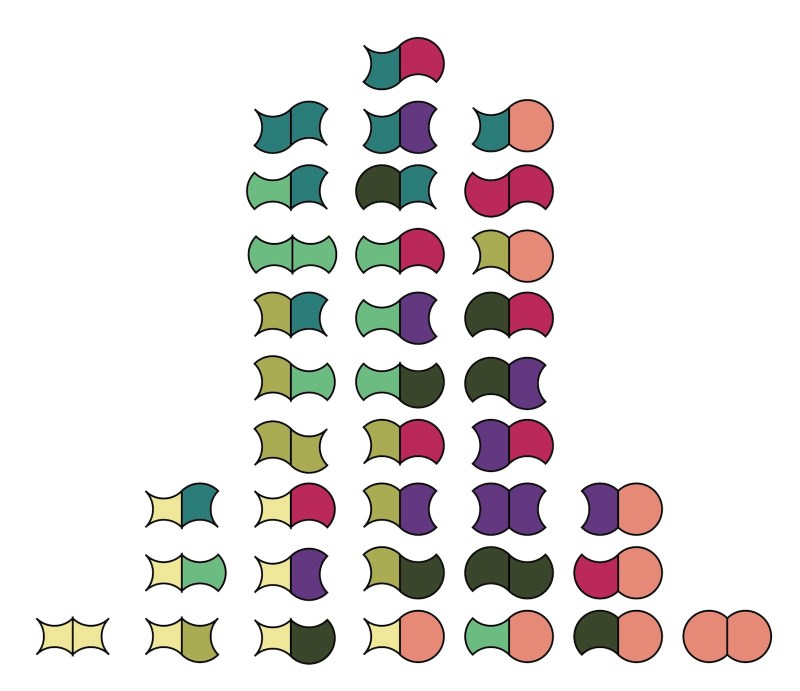
Here are the 36 pillowminoes introduced last time, arranged by their imbalance, i.e. according to how many more convex than concave edges they have. Isn’t that a pretty bell curve?

Pillowminoes weight

This time we will focus on the pillowminoes near the border of existence, namely the six ones that have all but one edge either bulging in or out. They have an imbalance of +4 or -4. Gathered and recolored, here are the marginal pillowminoes:

Margin

Let’s tile some curvy shapes with these. A curvy rectangle has odd dimensions, so cannot be entirely tiled by pillowminoes. If we decide to leave a round hole in order to fix that, the entire curvy shape will be balanced. This means that we will need the same number of brownish pillowminoes (with imbalance +4) as bluish ones (with imbalance -4). In particular, we will need an even number of these pillowminoes, so the total area of our shape needs to be divisible by 4. That’s our double parity argument.

The simplest example is that of a 5×5 square with a center hole (it’s easy to see that skinny rectangles with one edge of length 3 are not tilable with marginal pillowminoes).

5x5

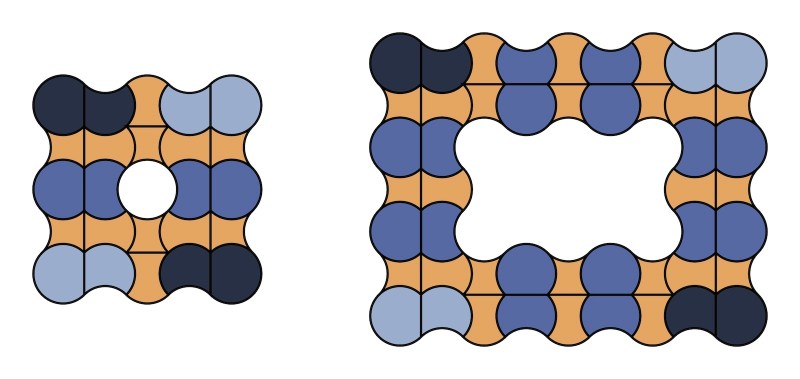
The example to the left is the only one I could find, up to the obvious symmetries. To the right you see how one can inflate it to make frames, proving:

Theorem: If you can tile an axb holy rectangle with marginal pillows, then you can also tile a holy (a+4)x(b+4) rectangle with marginal pillows.

We have seen this trick before, talking about ragged rectangles.

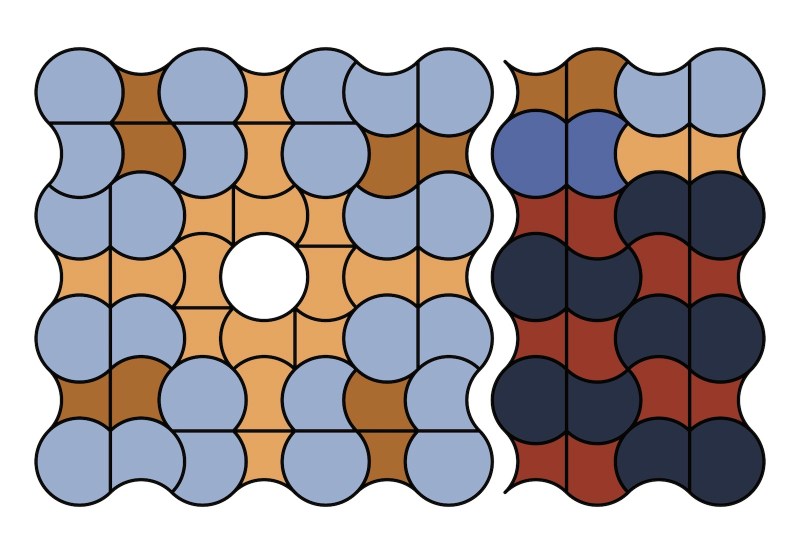
The next interesting case are 7×7 squares. Here is one example that also teaches us another trick:

Theorem: If you can tile an axb holy rectangle with marginal pillows, then you can also tile a holy ax(b+4) rectangle with marginal pillows.

Add4

This second trick decenters the holes, however.

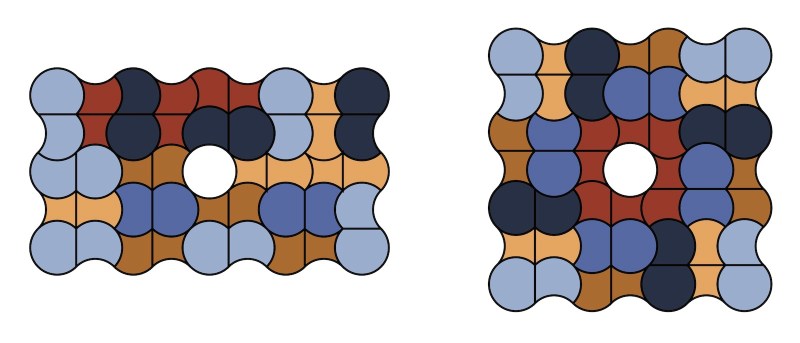
Finally, two examples that employ all six different marginals. First a 5×7 rectangle with center hole, then another 7×7 square that uses four marginals of each kind, nice and symmetrically.

Allsix

Durissima est hodie conditio scribendi

The regular pentagon is a curious thing. It doesn’t tile the plane, but we can use twelve of them, three around each vertex, to tile the sphere, obtaining the dodecahedron.

Dodecahedron

This is one of the five Platonic solids. Their symmetries have intrigued mankind back way before Plato and any written history, but today’s story is contemporary. Johannes Kepler needed more than five regular shapes, because he had set his mind to explain the universe. In his Harmonice Mundi, he analyzed regular polygons, star polygons, polyhedra, and (re-)discovered star polyhedra, two of which I will look at today.

SmallStellatedDodecahedron

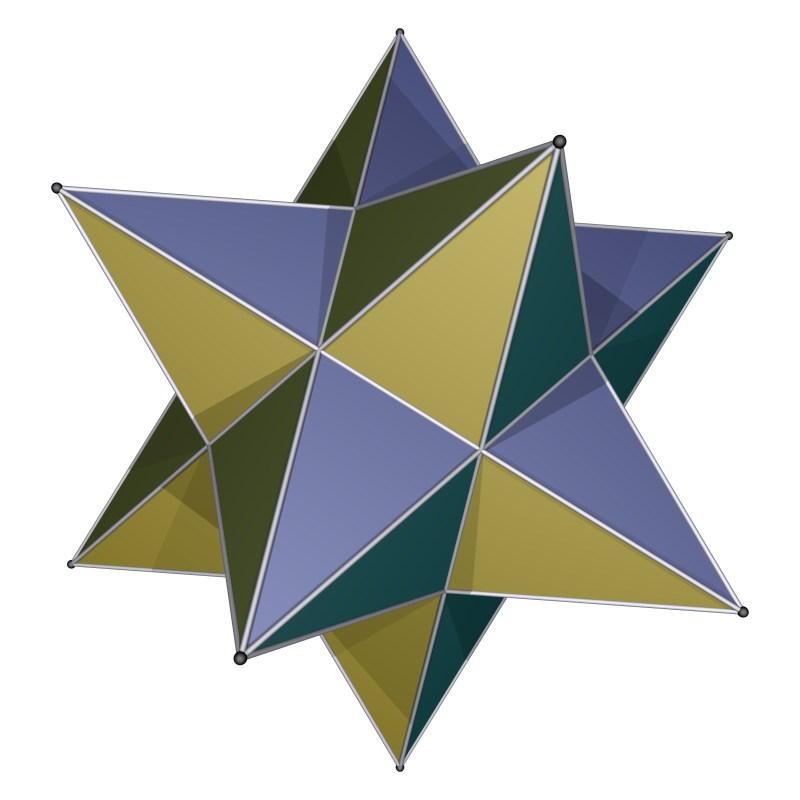
The Small Stellated Dodecahedron as conceived by Kepler does not have 60 triangles but rather 12 star pentagons as faces. It also has only 12 vertices and 30 edges. This leads to the annoying observation that this polyhedron has Euler characteristic -6, meaning it is topologically not a sphere, but a surface of genus 4. Similarly, his Great Stellated Dodecahedron

GreatDodecahedron

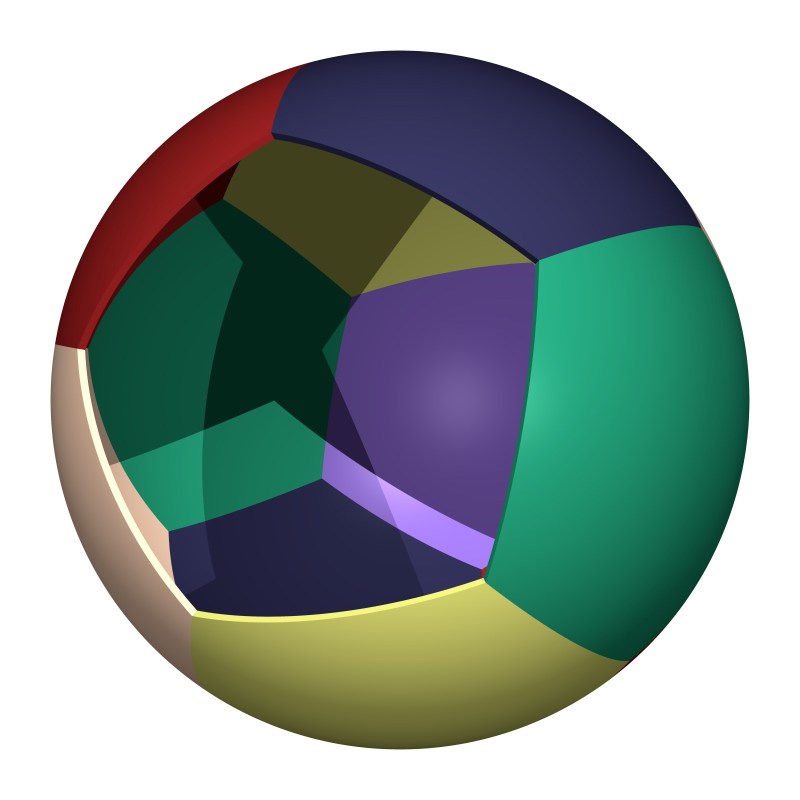
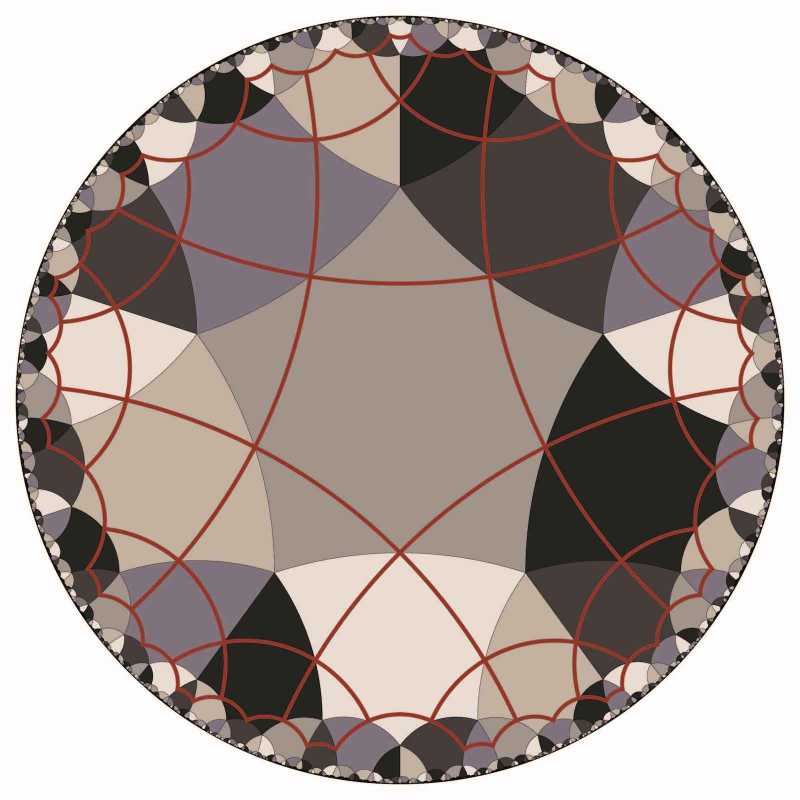
has 12 usual regular pentagons as faces, but is only immersed. To unwrap these, we need the hyperbolic plane, tiles by regular hyperbolic pentagons whose interior angle is 72 degrees so that five of them fit around a corner.

Kepler4shadyt 01

That is not part of Kepler’s story but that of William Richard Maximilian Hugo Threlfall, who was probably the first who understood the hyperbolic nature of Kepler’s polyhedra, and their group theoretic implications. So we can tile the hyperbolic plane with regular pentagons, five around each vertex. One of the surprising features of the hyperbolic plane is that shapes do not scale as in the Euclidean plane. Pentagons half the area have actually right angles, so that four of them fit around a vertex, as indicated by the reddish grid in the picture above.

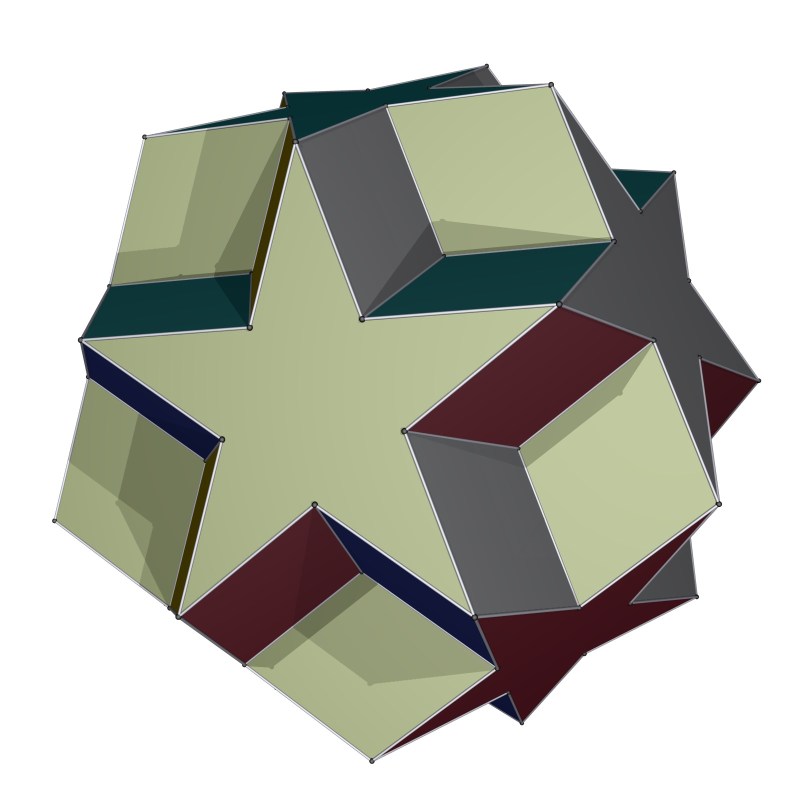
Curiously, there also is a uniform polyhedron where four pentagons fit around each vertex, the so-called Dodecadodecahedron (yes, these names are odd).

DodecaDodecahedron

It has as faces both pentagons and star pentagons.

There is another connection between Kepler and Threfall. Kepler begins the introduction of his Astronomia Nova from 1609 with the sentence Durissima est hodie conditio scribendi libros Mathematicos, praecipue Astronomicos. In 1938, Seiffert and Threlfall published a book (Variationsrechnung im Großen) that has as its motto the shortened quote Durissima est hodie conditio scribendi libros Mathematicos.

That was a risky thing to do back then.

Kepler was an interesting personality. It must have been maddening for him to believe himself on the verge of unraveling the universe and be constrained by earthly powers that threatened to burn his mother as a witch. There is a biographical novel about him by John Banville (whom I generally like for his affinity to bizarre characters). In this case, I am afraid, he falls short. Maybe only a scientist can truly understand scientific obsession.

Stellated Triacontahedron

If you have mastered the Slidables from last year and had enough of the past gloomy posts, you are ready for this one.

Let’s begin with the rhombic triacontahedron, a zonohedron with 30 golden rhombi as faces. There are two types of vertices, 12 with valency 5, and 20 with valency 3. In the image below, the faces are colored with five colors, one of which is transparent.

Triacontahedron

The coloring is made a bit more explicit in the map of this polyhedron below.

Triagraph 01

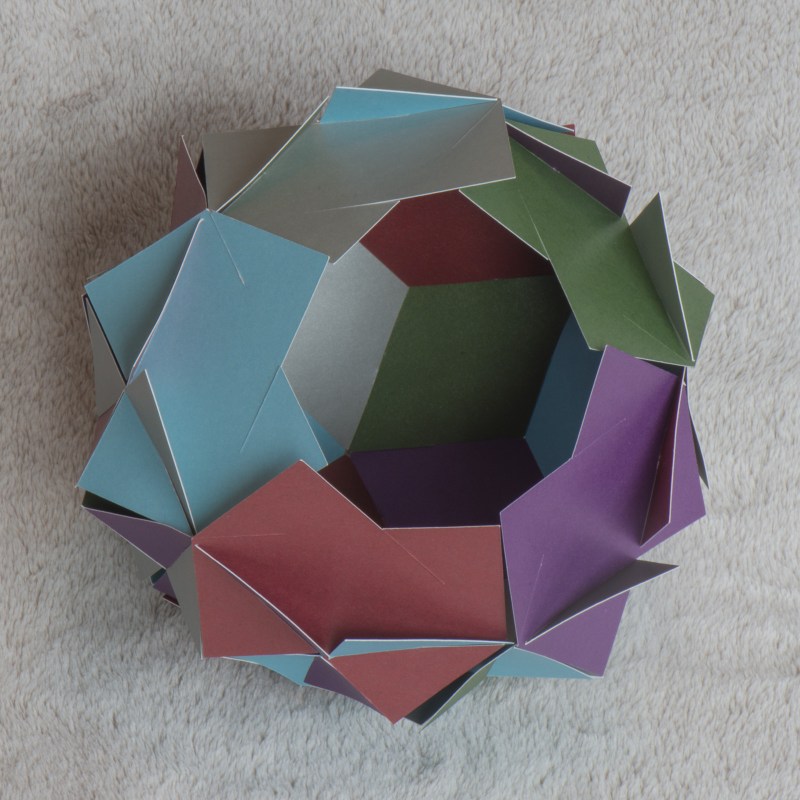
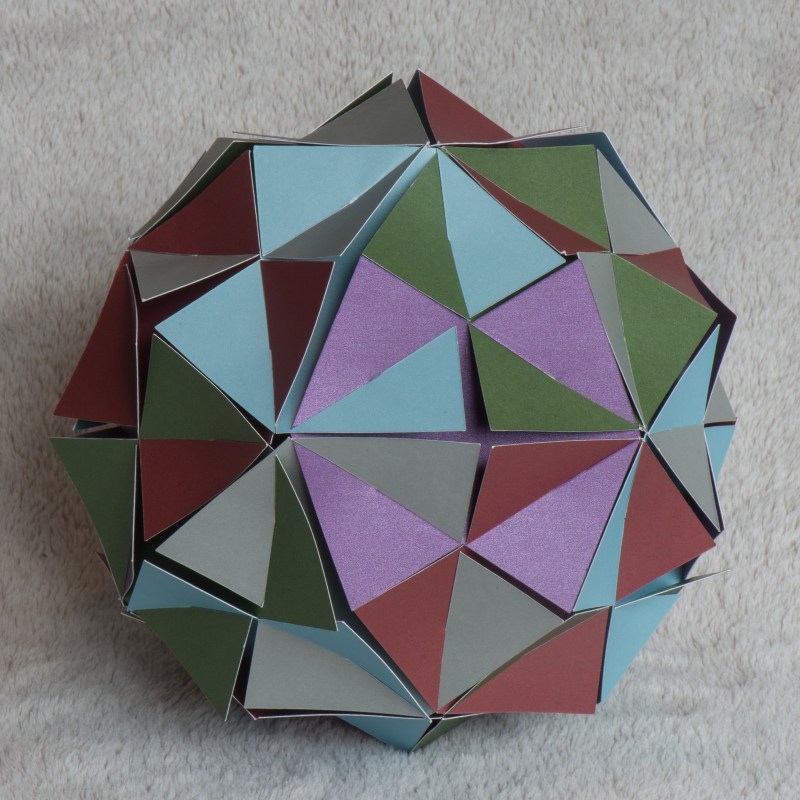
We are going to make a paper model of one of the 358,833,072 stellations of it. This number comes from George Hart’s highly inspiring Virtual Polyhedra.

Stellatriacontahedron

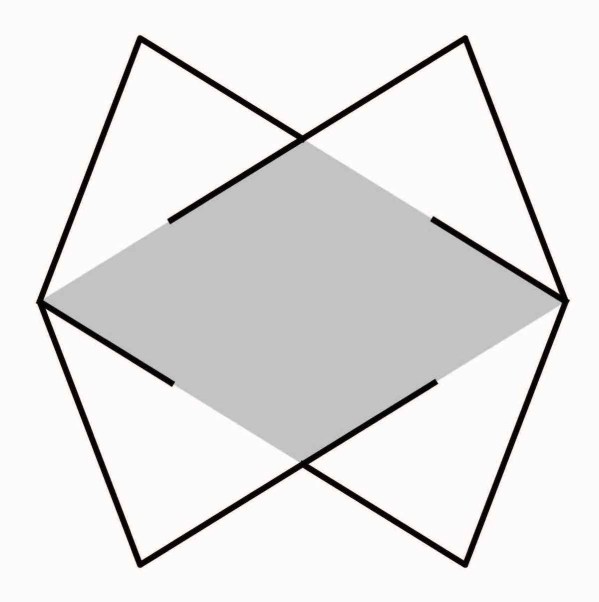
In a stellation, one replaces each face of the original polyhedron by another polygon in the same plane, making sure that the result is still a polyhedron, possibly with self intersections.

Newface 01

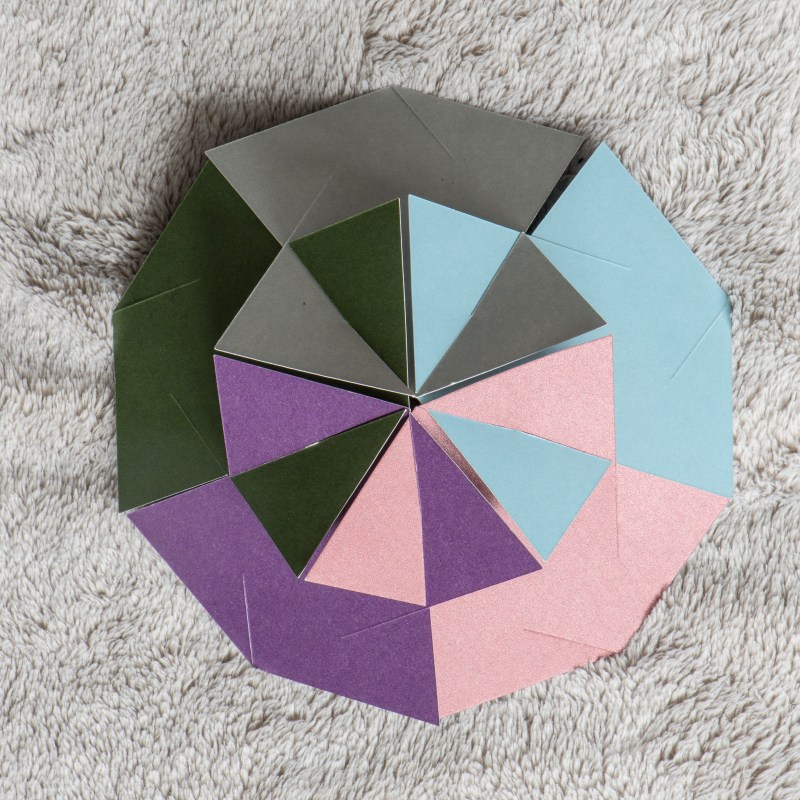
In our case, each golden (or rather, gray) rhombus becomes a non convex 8-gon. The picture above serves as a template. You will need 30 of them, cut along the dark black edges. The slits will allow you to assemble the stellation without glue. Print 6 of each of the five colors:

DSC 8159

Now assemble five of them, one of each color, around a vertex. Note that there are different ways to put two together, make sure that the original golden rhombi always have acute vertices meeting acute vertices. This produces the first layer.

DSC 8161

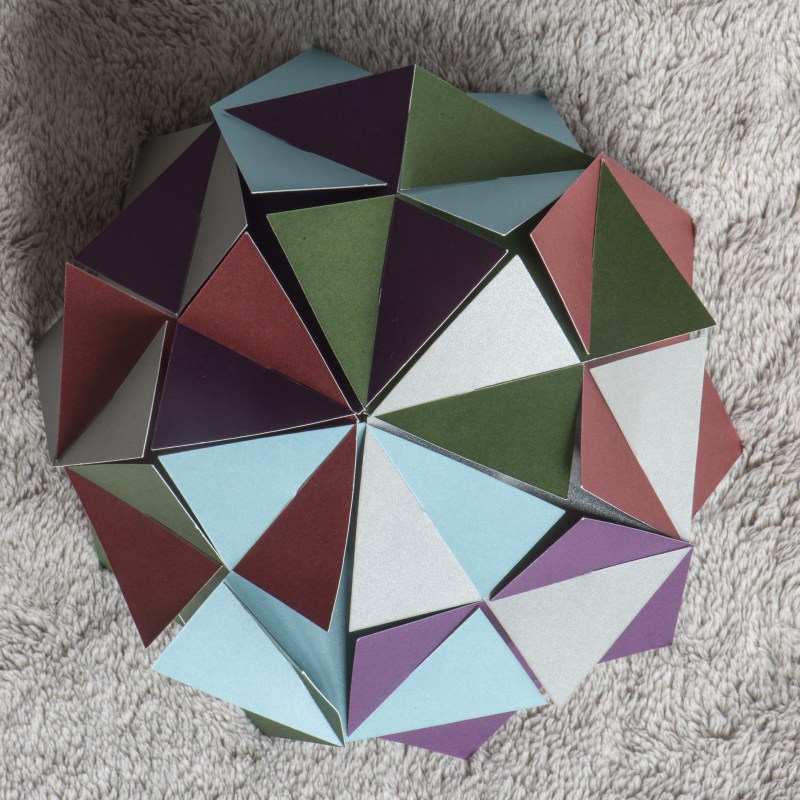
The next layer of five templates takes care of the 3-valent vertices of the first layer. Here the coloring starts to play a role.

DSC 8162

The third layer is the trickiest, because you have to add 10 templates, making vertices of valency 5 again. The next image shows how to pick the colors to maintain consistency.

DSC 8166

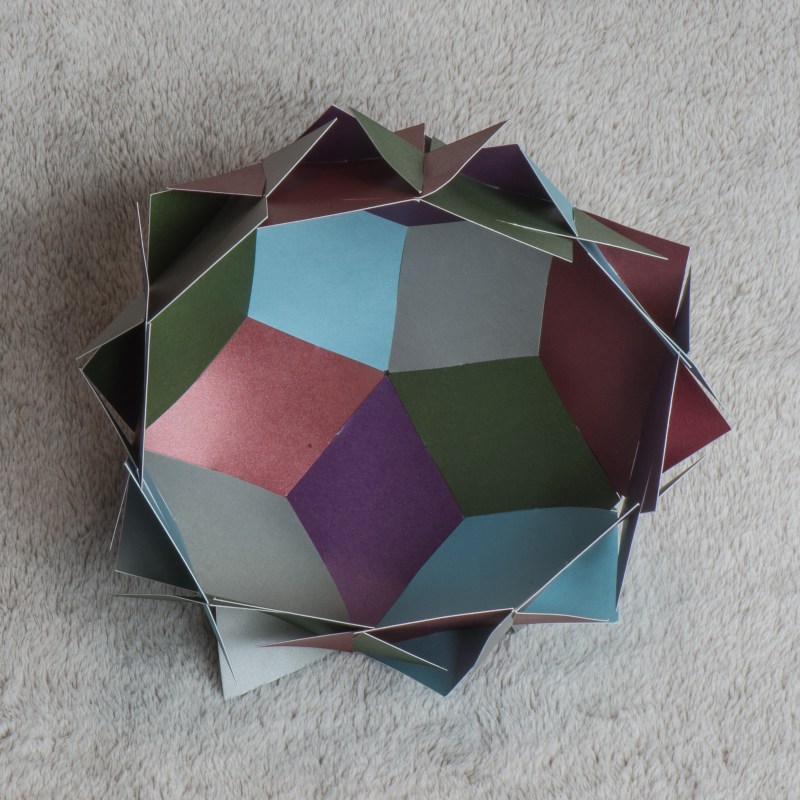
Below is the inside of the completed third layer.

DSC 8168

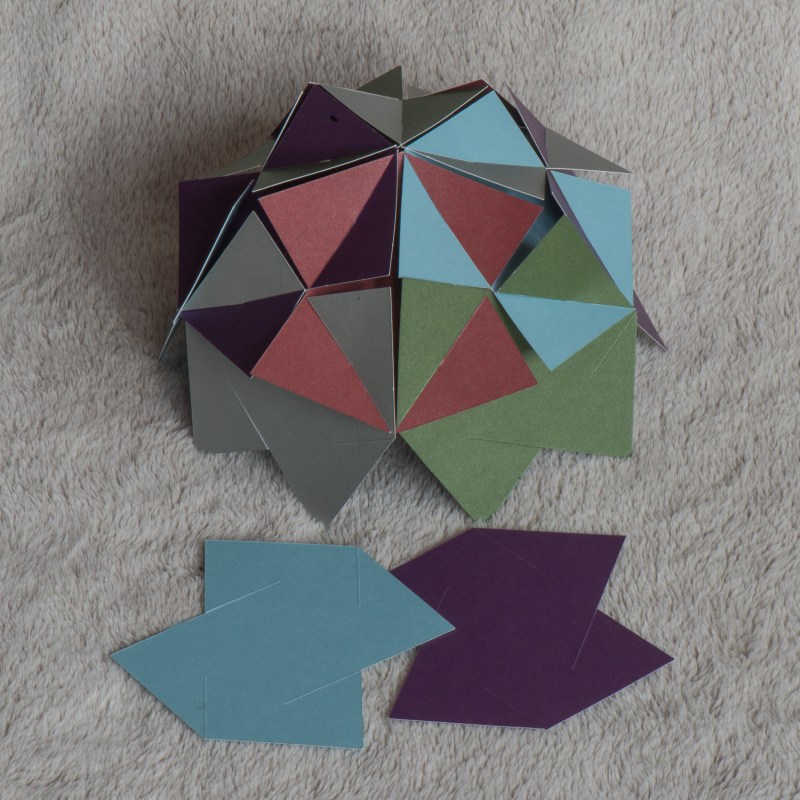
Two more to go. Layer 4 is easy:

DSC 8170

The last layer is again a bit tricky again, but just because it gets tight. Here is my finished model. It is quite stable.

DSC 8174