The New Petzval Lens

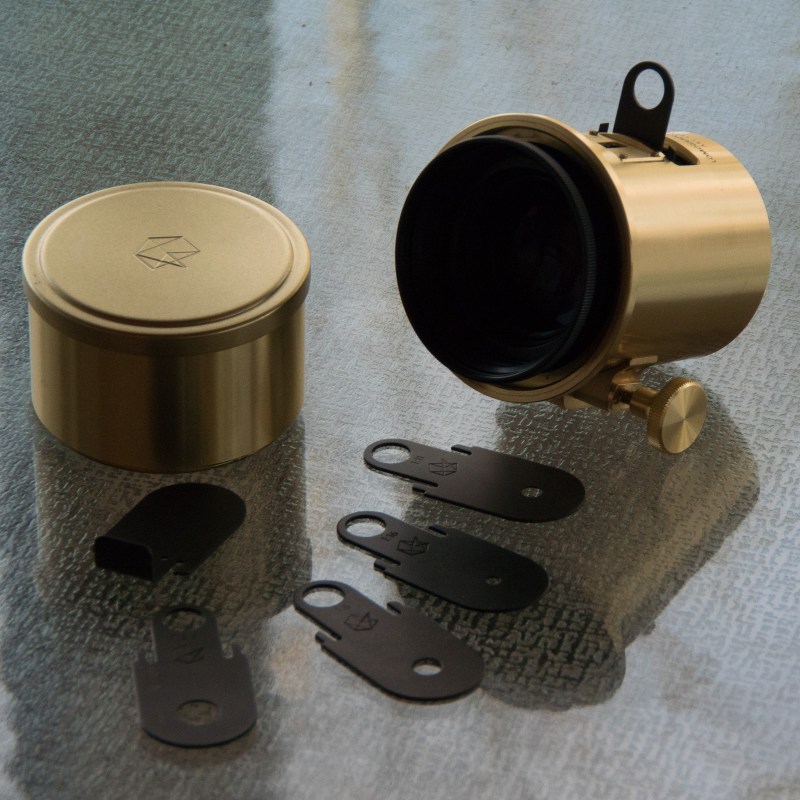
Let me introduce you to one of my Christmas presents:
DSC 0983

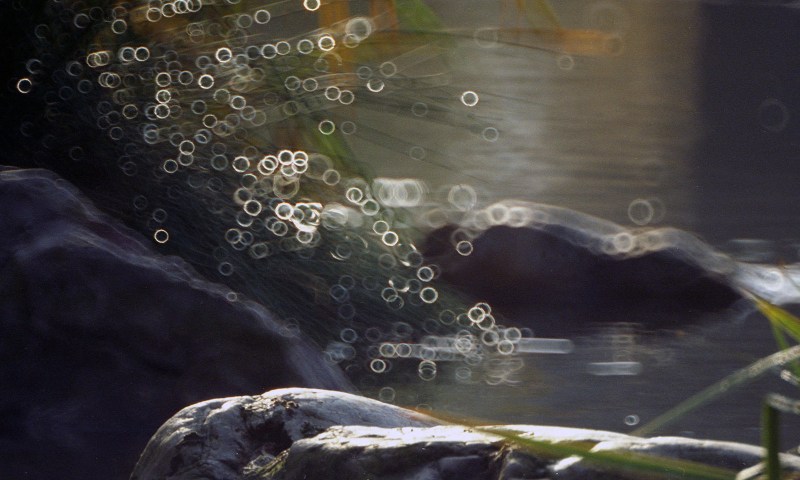
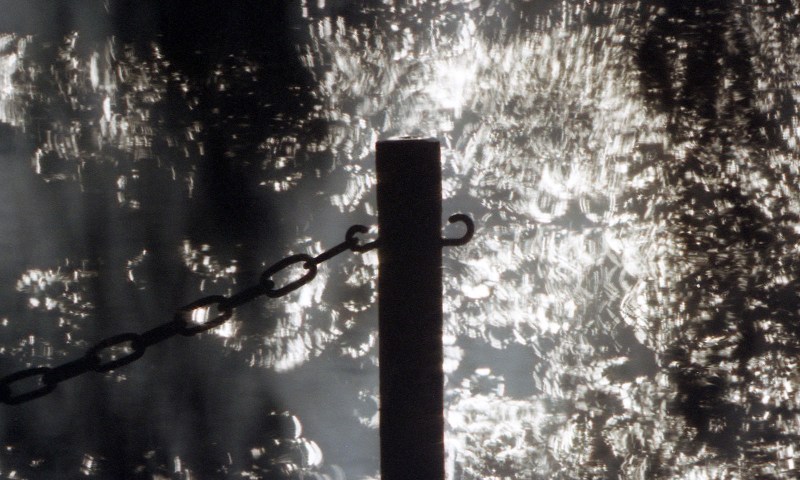
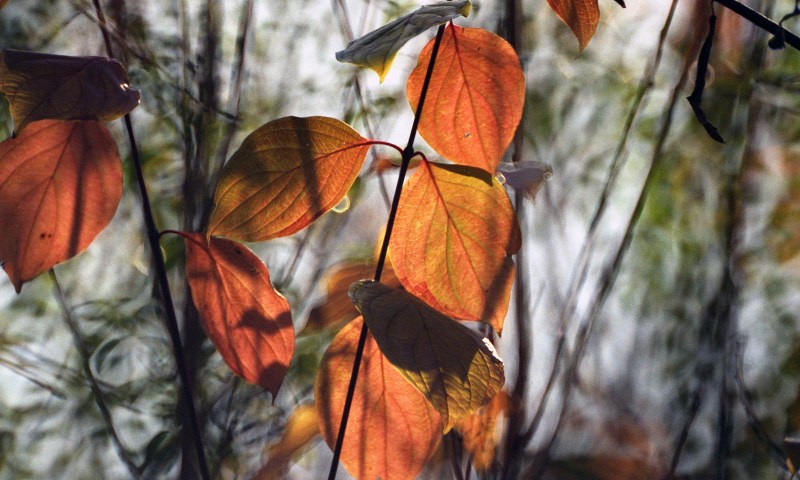
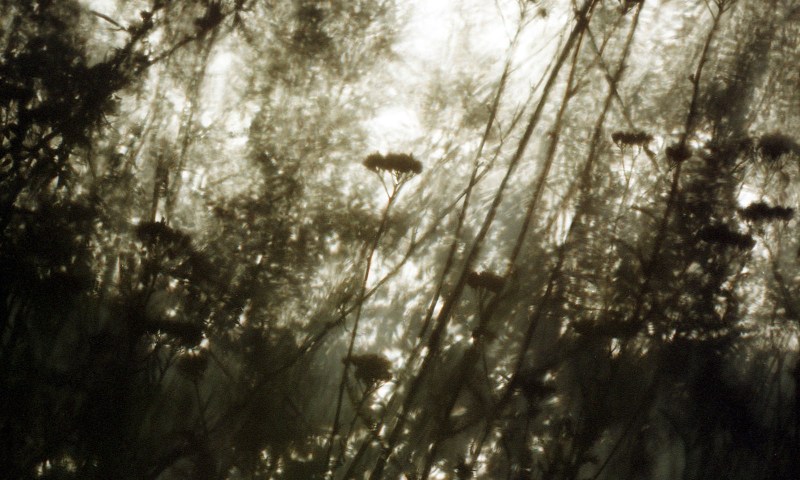
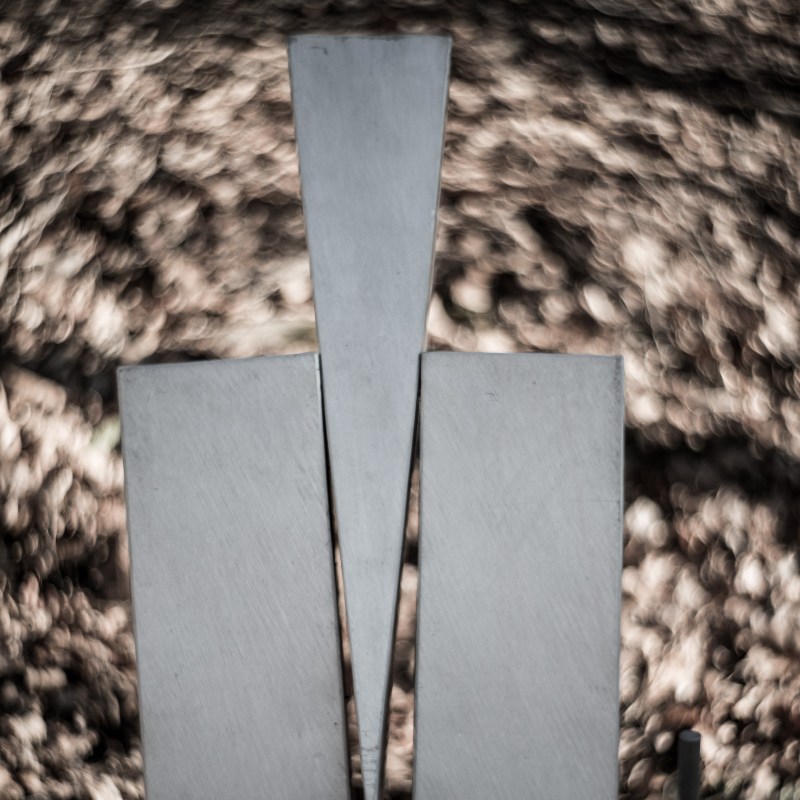
This is a remake of a lens design from 1840 by Joseph Petzval, then one of the leading physicists working in optics. For its time, this lens was very fast and very sharp at the center. Today, we have faster glass, and good lenses maintain sharpness across the entire frame, so why would one bother? One reason is that the progressive vignetting that occurs towards the boundary of the frame creates a radial blur unlike anything else.
DSC 0372

This effect can be controlled by choosing appropriately sized aperture blades. Yes, this lens is so not automatic that you have to manually insert blades with aperture holes. You see them in the top picture scattered around near the lens. The lens comes with a set that have circular holes as one would expect, but nothing prevents you (or me) to use plates with holes in different shapes.

The effect is simple: A small point-like object (like a light source) that is out of focus is usually rendered as a slightly blurred small disk. This is what makes up the bokeh of the lens, and it is one of the most important characteristics of fast lenses (where you will have a lot of the frame out of focus, usually). If the hole in the aperture blade is not a disk but (say) a square, then the small dot that is out of focus will become a small square. Likewise, you can have star shaped blurs or even multiple blurs if the aperture plates has several holes.
Aperture Plates

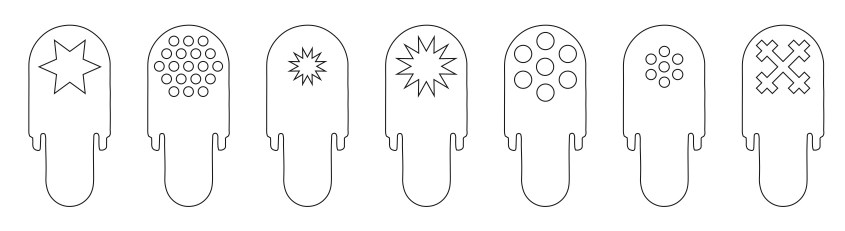
Above is my first set of self-designed blades for the Petzval lens. I created this by first scanning in the actual plates for size and shape, vectorizing them in Adobe Illustrator, adding my own design, exporting them as an AutoCAD DXF file, and importing them into the software that drives my Cameo Silhouette die cutter. The result are little pieces of card stock paper.
DSC 0414

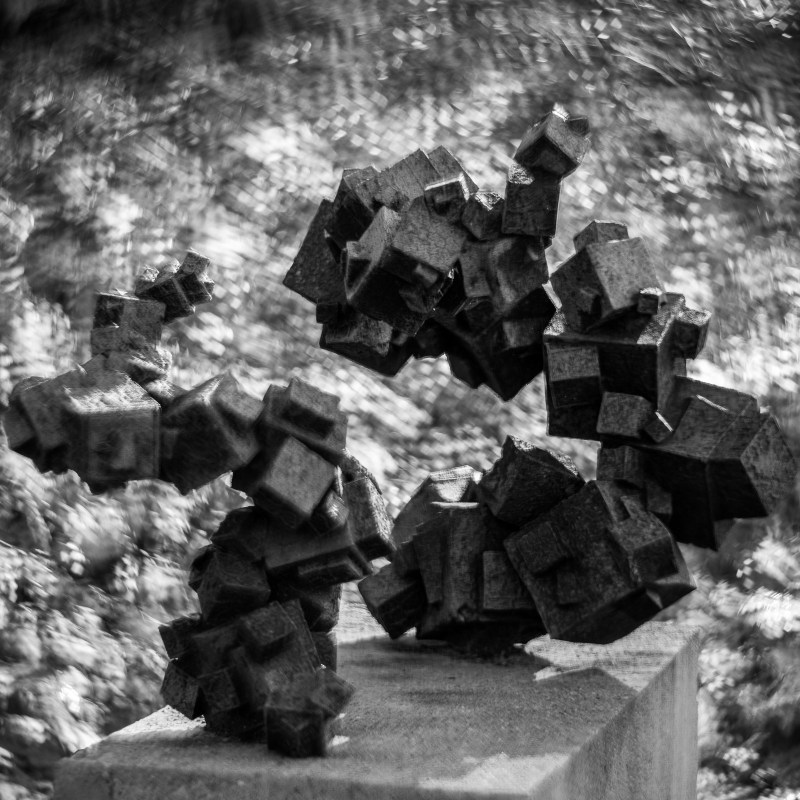
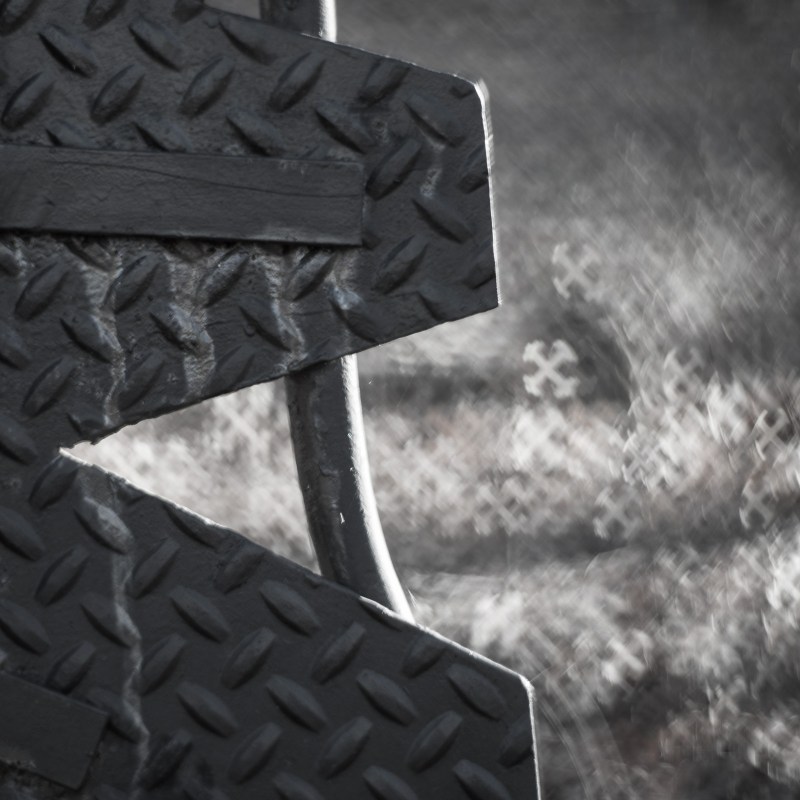
Here, for instance, is a neocubistic sculpture (from the Sculpture Trails Outdoor Museum near Solsberry, like all portraits in this post), using an aperture plate with several square shaped holes. Below is an image using a plate with a fractal cross.
DSC 0346

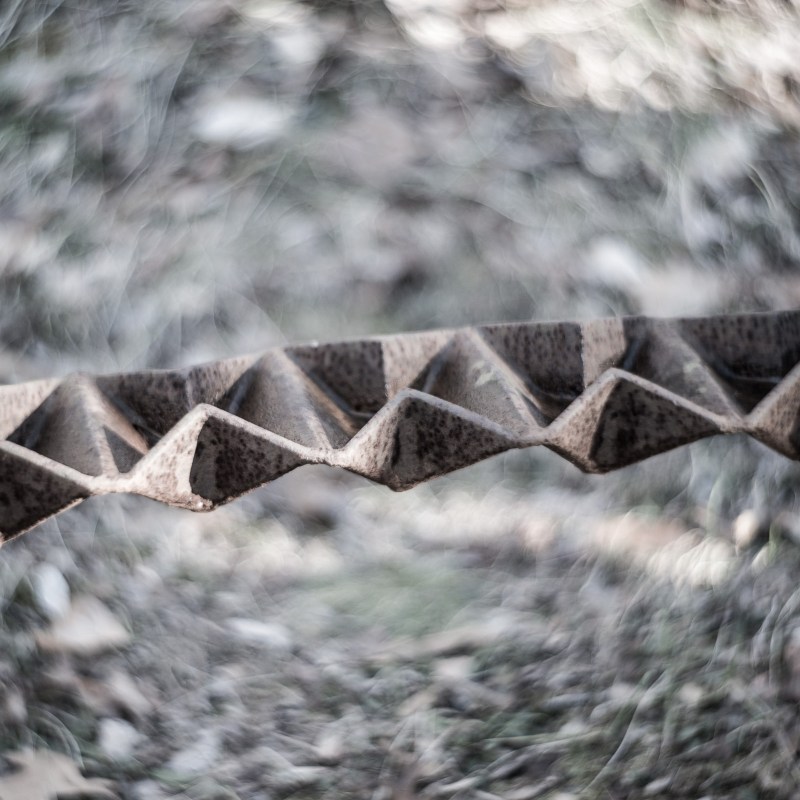
This opens up many possibilities. One can design aperture plates to complement the motive by enhancing the background, or one can distort an otherwise distractive background beyond recognition.
DSC 0378

Imagine a technology where a modern lens contains instead of regular aperture blades an electronically controlled screen that, somewhat like liquid ink, can be used to create aperture holes of any shape. In a film camera this would make it possible to continuously modify the out of focus area. Alfred Hitchcock would have used this to make the famous tower scene in Vertigo even more vertiginous.
Minimal Surfaces in the Wild (k-Noids I)

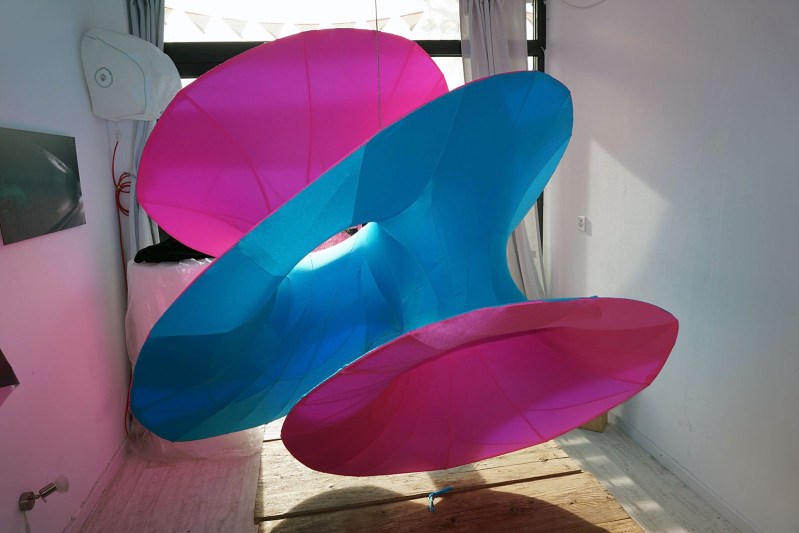
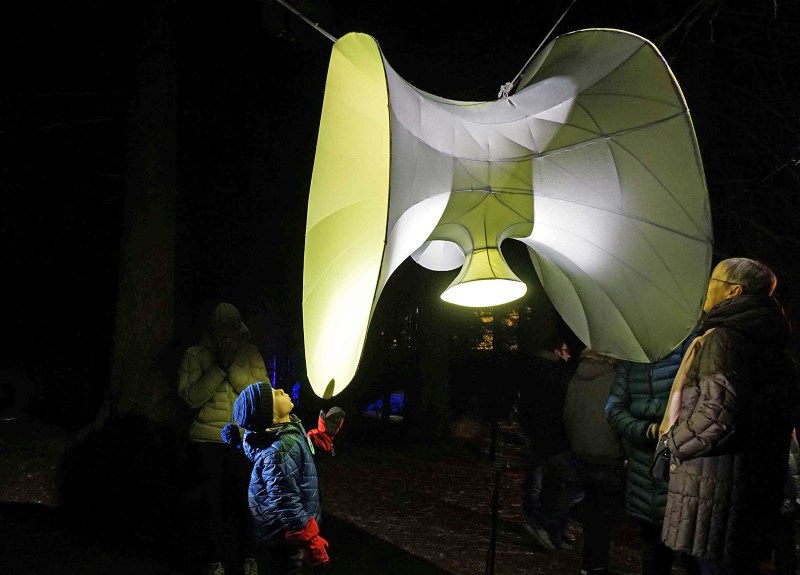
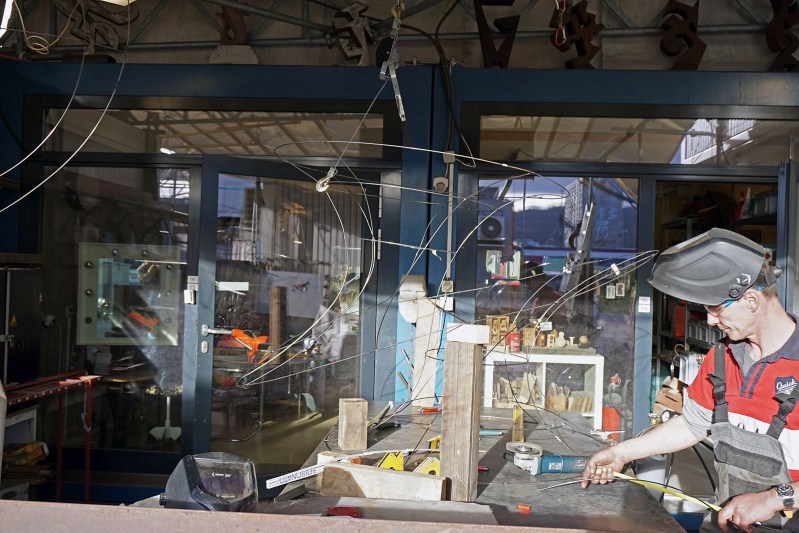
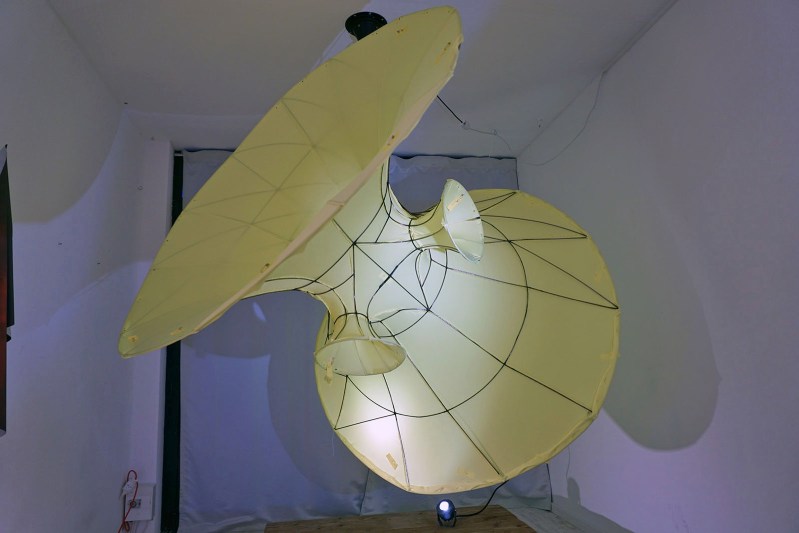
Making photorealistic images of minimal surfaces is one thing, but making real models of minimal surfaces and putting them into the landscape is quite something else. In July 2015 I was contacted by the Swiss artist Shireen Caroline von Schulthess who planned to do exactly that. She needed 3D models in order to build large wire frames that would then be wrapped in thin, colorful fabric. These sculptures would serve as loud speakers for recorded voices from local interviews with the topic “wishes”, to be played as an installation at the Lenzerheide Zauberwald festival.

Shireen 1b

Here is the wireframe model of the Finite Riemann minimal surface. Given that I already have difficulties bending a single metal coat hanger into a given shape, I can only admire the skills of Shireen and sculptor Adrian Humbel to accomplish this at this scale.
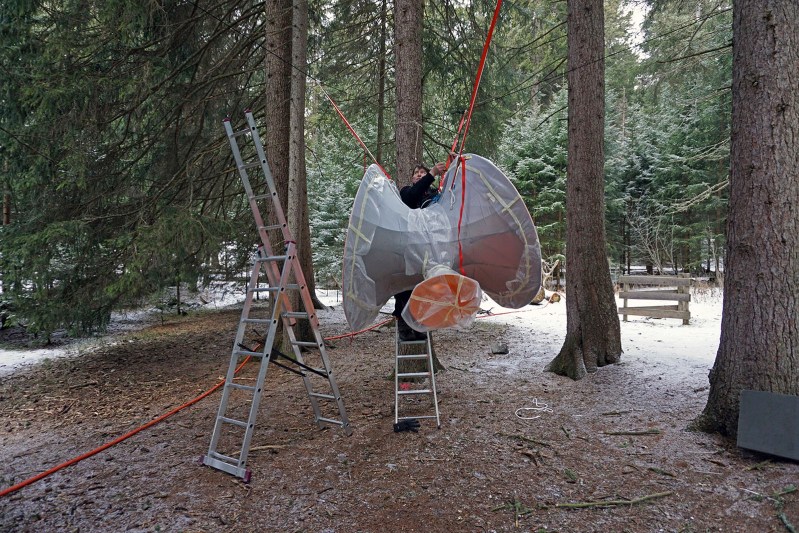
Below is the partially clothed 4-Noid.

Shireen 2

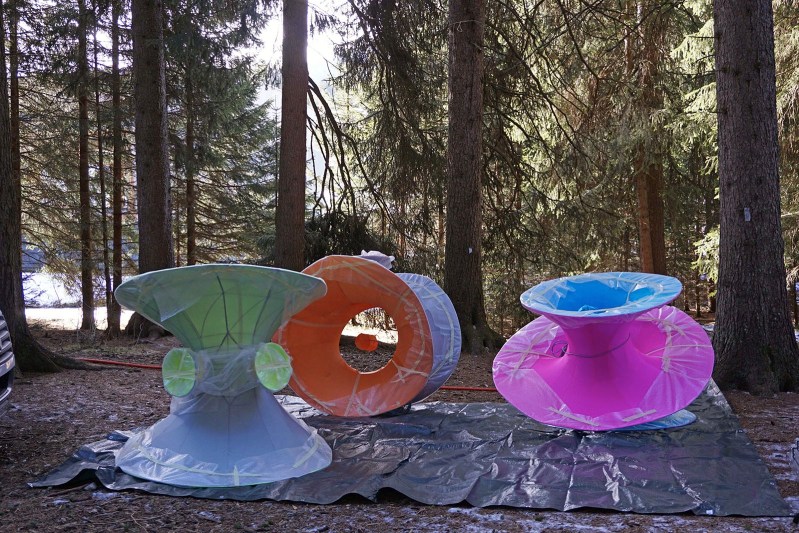
And this is the Finite Riemann surface, fully clothed.

Shireen 3

All three of them, ready to be released into the wild, and weather proof.

Shireen 4

Not even the installation is easy:

Shireen 5

To bad I can’t be there. This must be quite an experience.

Shireen 6

All pictures in this post were taken by Shireen.

In Praise of the Mirror

In 1992, I gave in to curiosity and lens lust and purchased the 600mm mirror lens from Sigma. The front element has a mirror (in reverse) at its center, forcing the light to travel three times through the lens and thereby allowing for a compact and relatively inexpensive design. This has some side effects, for instance the notorious donut shaped bokeh.

Mirror 007

Then it’s manual, fixed aperture at f8, and not that sharp. I have maybe used this lens on four film rolls, which is very little.

Mirror 525

When looking at the old negatives, the keepers from back then also show benefits.
Mirror 376

The unruly bokeh can be used to separate foreground and background. Instead of the silky smooth blur caused by rounded aperture blades that has become the gold standard of every fast lens, here we can simultaneously blur and shake up the background.
Mirror 524

This dramatic difference between foreground and background is hard to achieve (and maybe not desired) with modern glass. I used to experiment more.

Mirror 534

La Condition Humaine

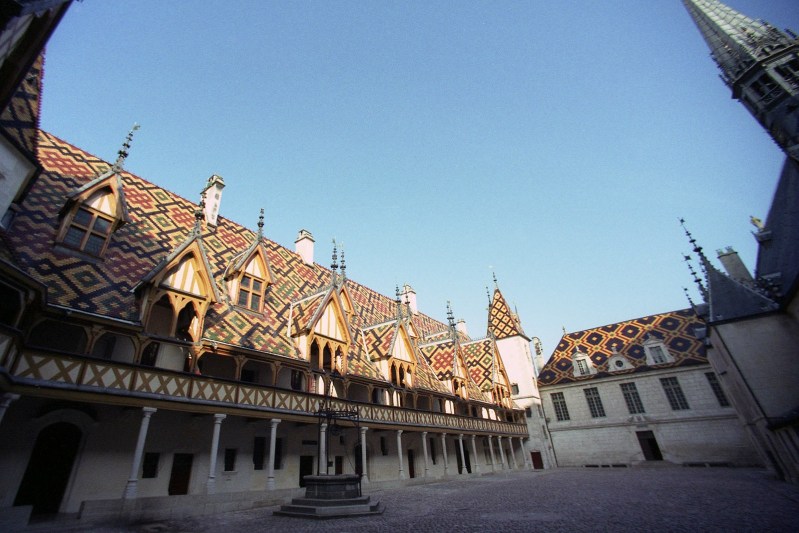
In 1992, I visited Lyons to talk some math. On the way back home I wanted to explore Burgundy, and asked for advice. I was sent to Emmanuel Giroux, who grew up in Burgundy, and is blind. My mastery of the french language was never satisfactory, but I understood that I had to see the hospital in Beaune. Here it is, l’Hôtel-Dieu de Beaune:

Burgundy 10

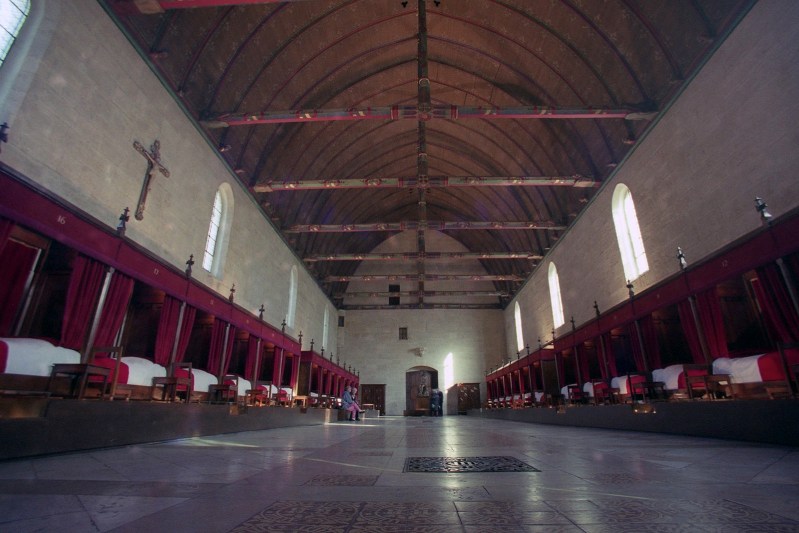
I walked around, admired the roof tiles, appreciated it as an early example of a real hospital, but didn’t quite understand why this was most essential, until, on my second walk through the halls, I noticed stairs leading downstairs into darkness.

Burgundy 9

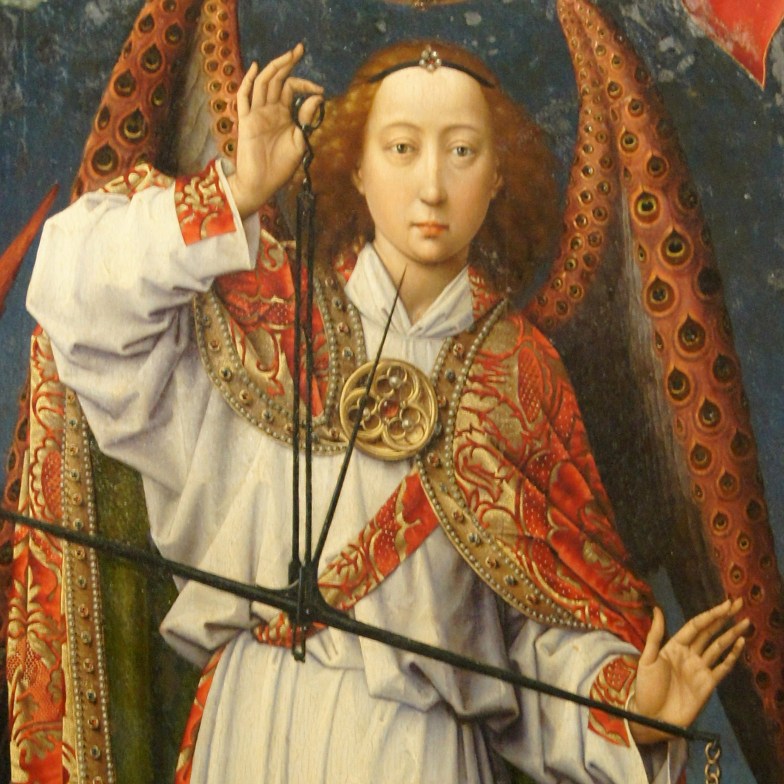
Nothing could have possibly prepared me for Rogier van der Weyden’s enormous triptych with a Last Judgment from about 1450. There is of course the usual awakening and suffering, but above all, there is the hypnotic stare of archangel Michael.

Jjugementdernier

(That I post this image here is an exception; I usually only post my own. Thanks to Wikipedia France, this one is in the public domain.)

Could it be that the artists had finally realized that cause and effect were exchanged in their famous Last Judgments:
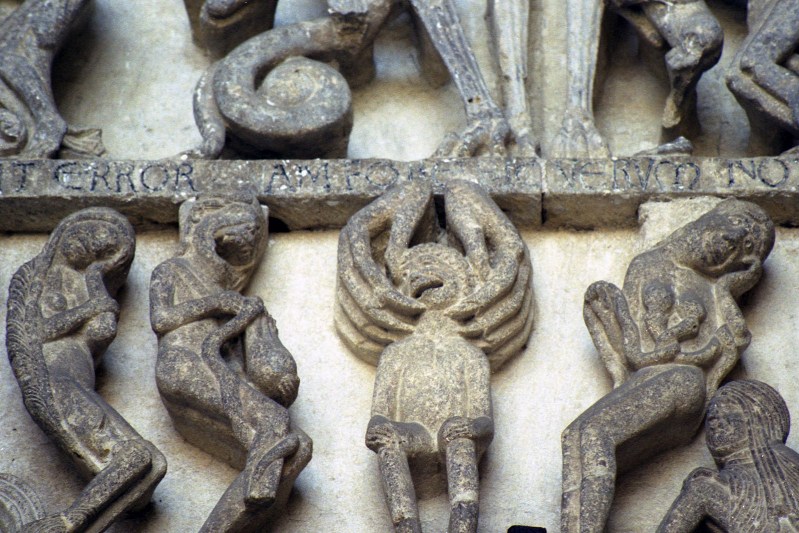
The imagined atrocities they depicted were not distant punishments for a life wasted in sin and inflicted by a superior power, as suggested by Gislebertus’ nighmarish version from the 12th century in the nearby Cathedral of Saint Lazare at Autun.

Burgundy 8

Michael’s intense presence tells us that all this is happening right now and here: it is us who are committing those atrocities ourselves, and the weighing of our corrupted souls has always been under way.

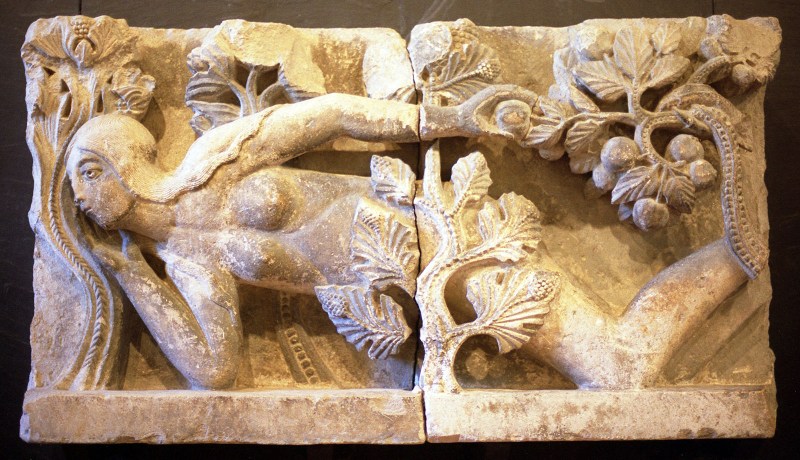
It might well be that the human race can’t exist without sin. Gislebertus knew that we have choices, though. The first European nude since the Fall of Rome must have raised some eyebrows.

Burgundy 4

Neovius surface (Algorithmic Geometry IV)

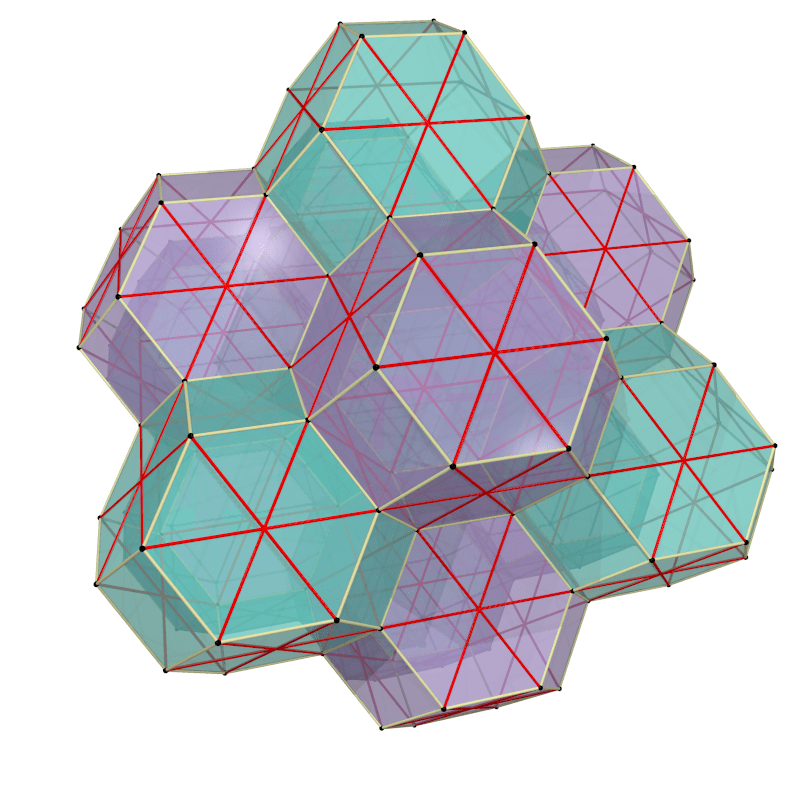
When the truncated octahedron tiles space, the diagonals of the hexagonal faces become part of a line configuration.

TruncatedOctahedronTiling

Following these lines we can build the bent rhombi that we encountered in Schwarz’ P-surface, but here we will focus on the more complicated bent octagons that weave around the square faces of the truncated octahedra. These serve as Plateau contours for another minimal surface, the Neovius surface, named after the Finnish mathematician Edvard Rudolf Neovius, a student of Hermann Amandus Schwarz.

Neoviusminimal

One can also fill each octagon with four copies of said bent rhombus to obtain an interesting polygonal version of the Neovius surface. Here are two such filled octagons aligned. Note that we have broken a rule: The four bent rhombi that fill the octagon are not rotated about their edges to fit together, but reflected.

Neoviuspiece

Rotating about the edges by 180 degrees will create larger portions of the infinite surface.

Neoviuscube

Temporarily breaking a rule can sometimes be a good thing.

Neoviuspoly

Hopf Fibration (Annuli III)

Hopf 8 right

When talking about tori, at some point the Hopf fibration will make its appearance.
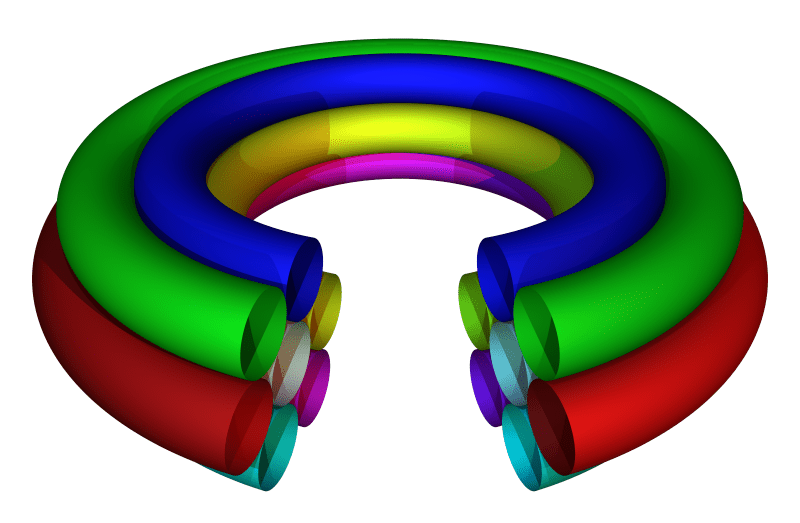
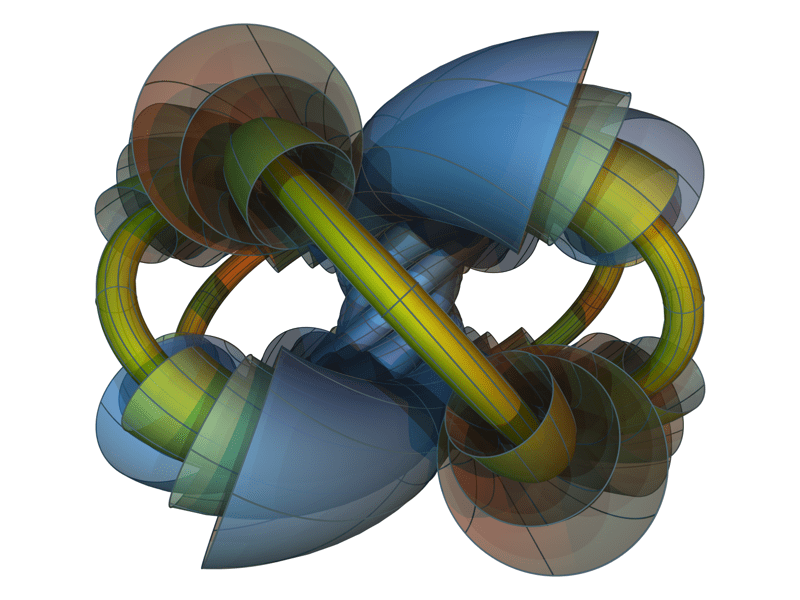
It all begins with a few tori of revolution packed together. Think about circular wires
bundled into one thick cable.

Simple

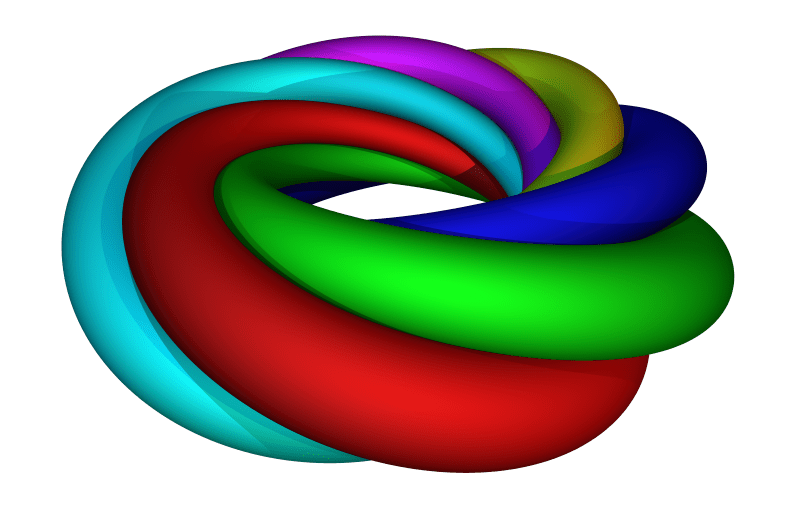
Cut through all the wires, twist the cable by 360 degrees, and reconnect wires of equal color.

Twist

Now all wires are interlinked, and this has the advantage that you can extend all this wiring to all of space (except for the vertical axis) in an even way to het what mathematicians call a fibre bundle.

Side

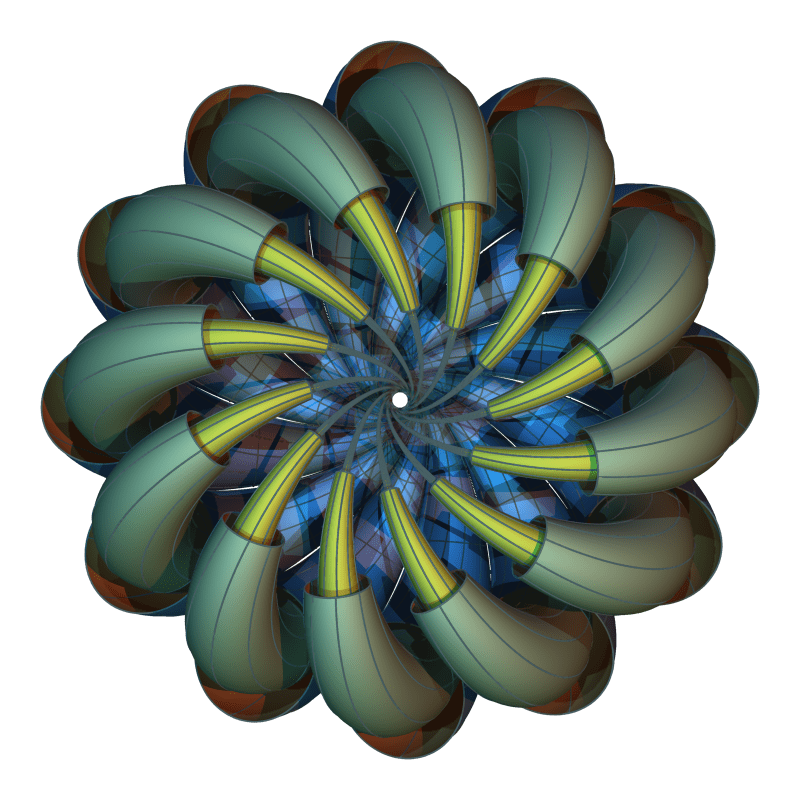
One can increase the complexity by showing nested wires by removing parts of then. The top view below is a simplified version of the picture at the top.

Top

The 120-Cell (Spheres XIII)

Dodeca right

Pentagons do not tile the plane. If you fit three of them around a corner, there will be a gap of 36 degrees.
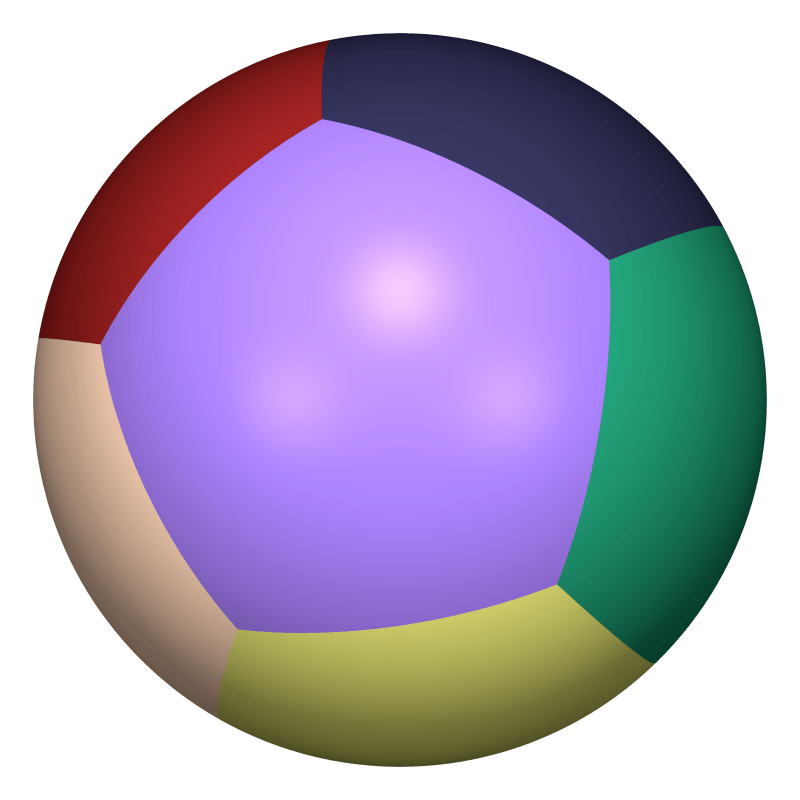
But, on a sphere, the pentagons can be inflated so that their angles become 120 degrees, and then twelve of them can be used to tile the sphere, creating a spherical version of the dodecahedron.

Dodeca spherical

Likewise, dodecahedra do not tile space. When you fit three around an edge, they leave a gap of about 10.3 degrees.
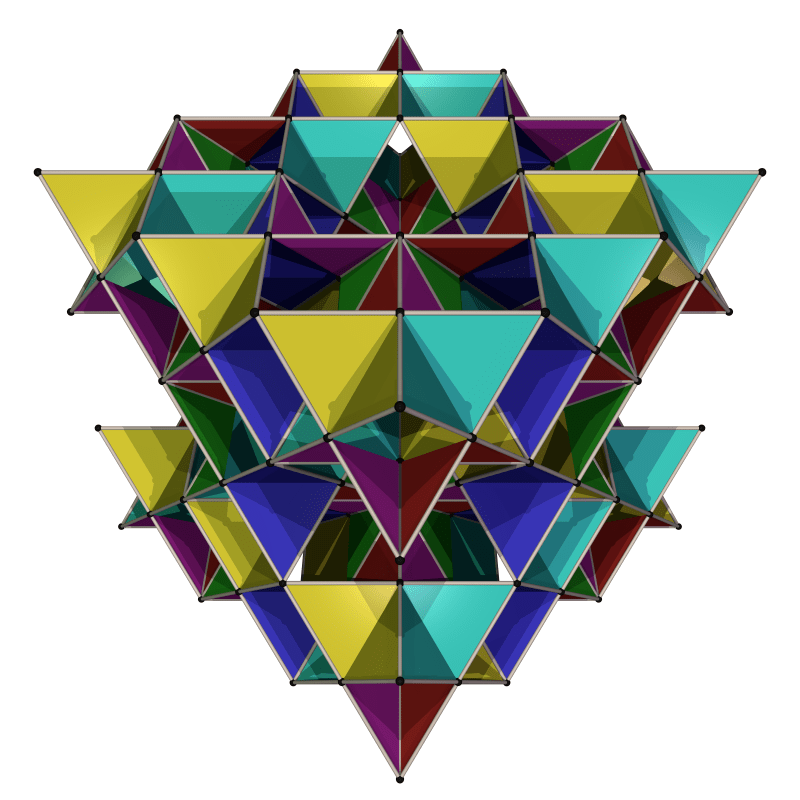
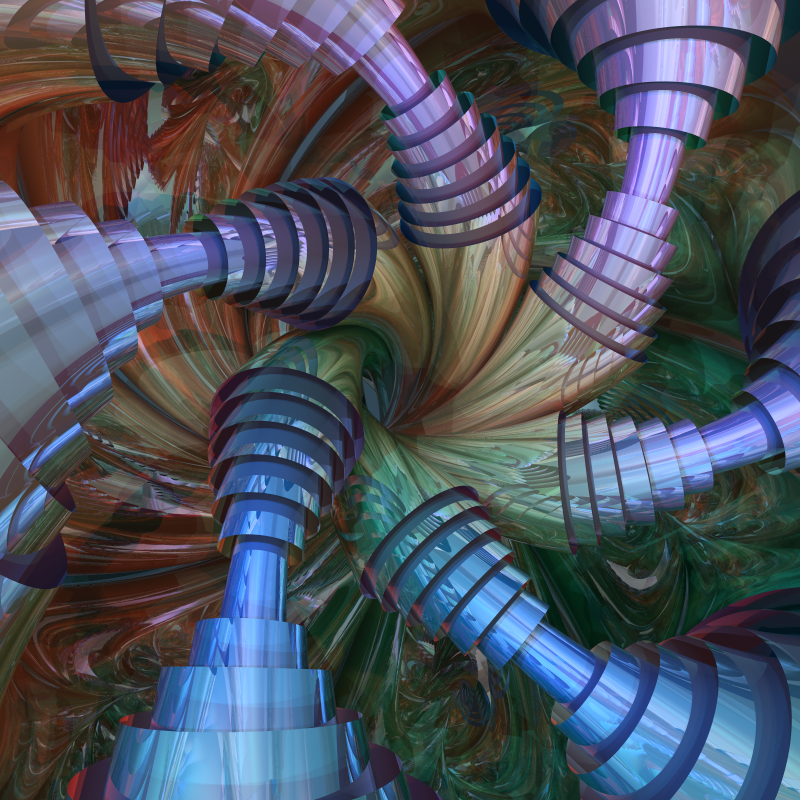
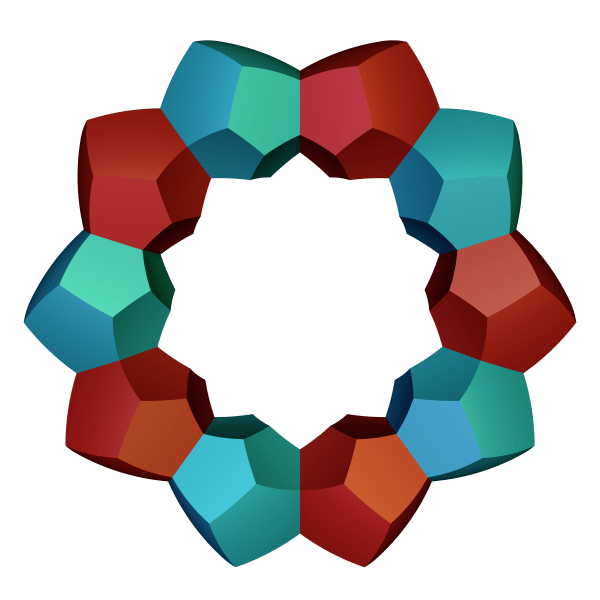
But again, they can be inflated in the 3-dimensional sphere. This time you will need 120 of them to tile the entire sphere. To visualize this, we start with one dodecahedron, and attach copies at opposite faces. After 10 copies, you will obtain an annulus of dodecahedra, which looks like this, after stereographic projection:

Dodeca

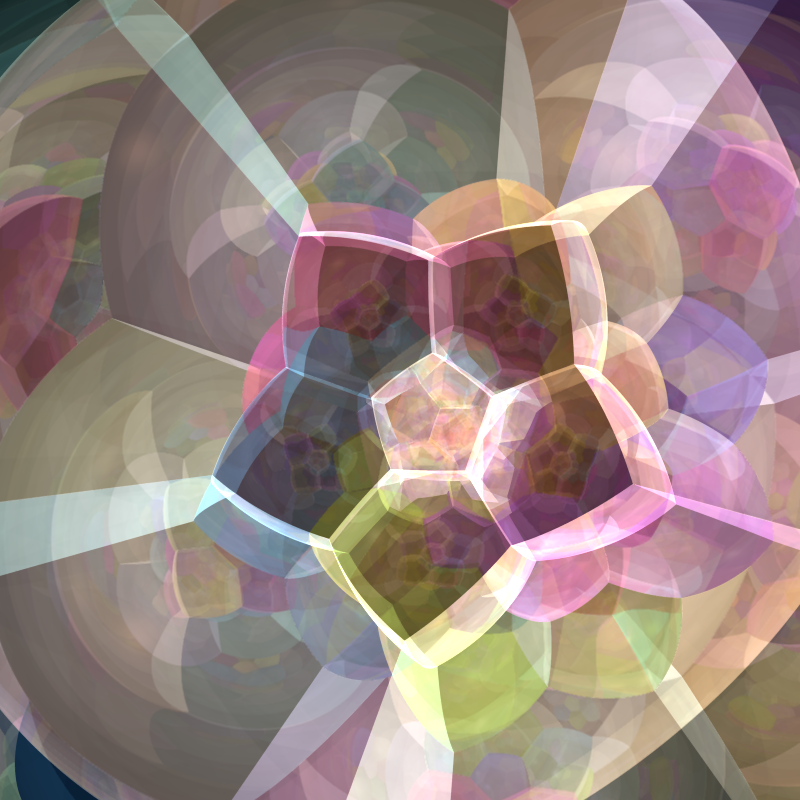
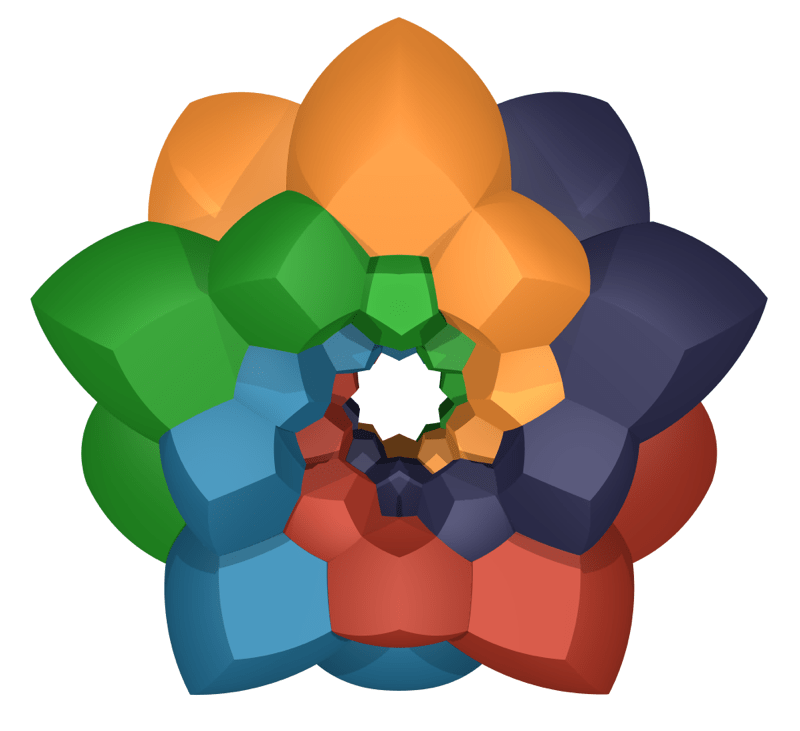
Repeat this with all immediately neighboring dodecahedra to get five more intertwined annuli of dodecahedra. They hide the original annulus from view. All six annuli together form one half of the 120 cell, the rest just being the complement in the 3-sphere of what we already have.

Dodeca 2

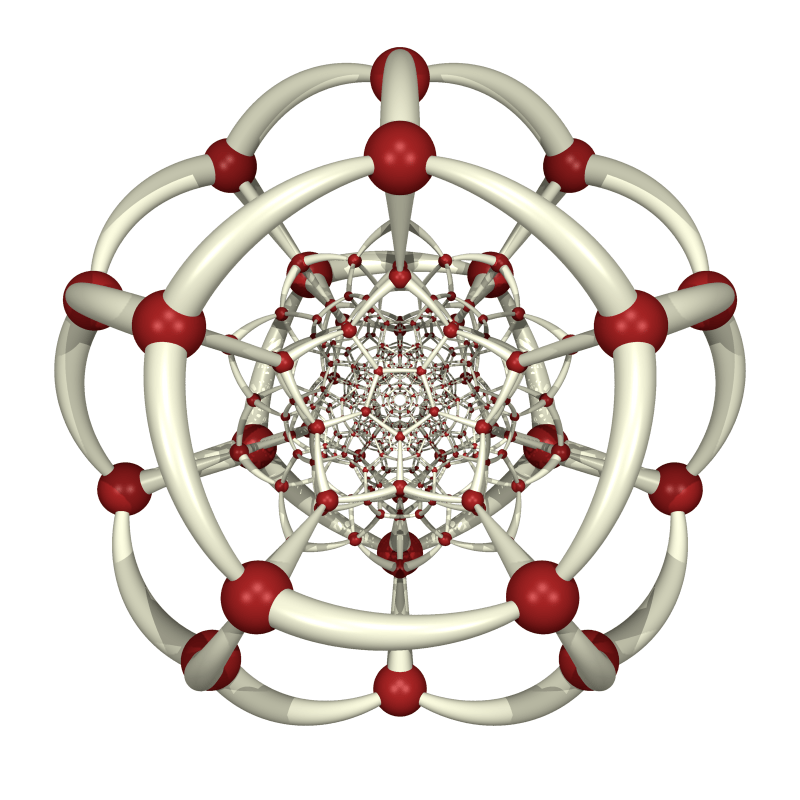
Here is an image of just the vertices and edges of the 120-cell. No elephants were harmed in making the 1200 ivory edges.

120cell

Reflections on Simplicity

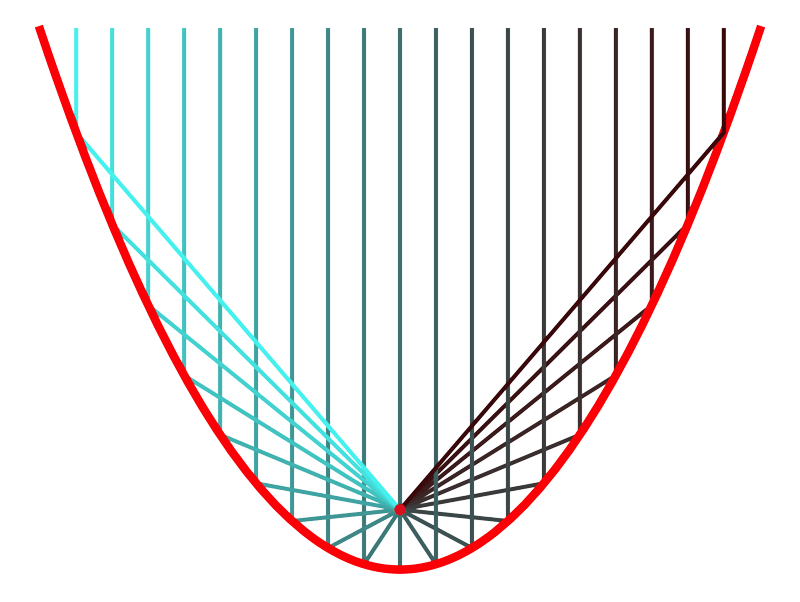
If a parabolic mirror has a light bulb in its focal point, the light rays are reflected at the mirror into parallel light beams, evenly illuminating whatever lies ahead.

Parabola

In optics, reflections are well studied. The basic question is what happens when parallel light hits a reflective surface.

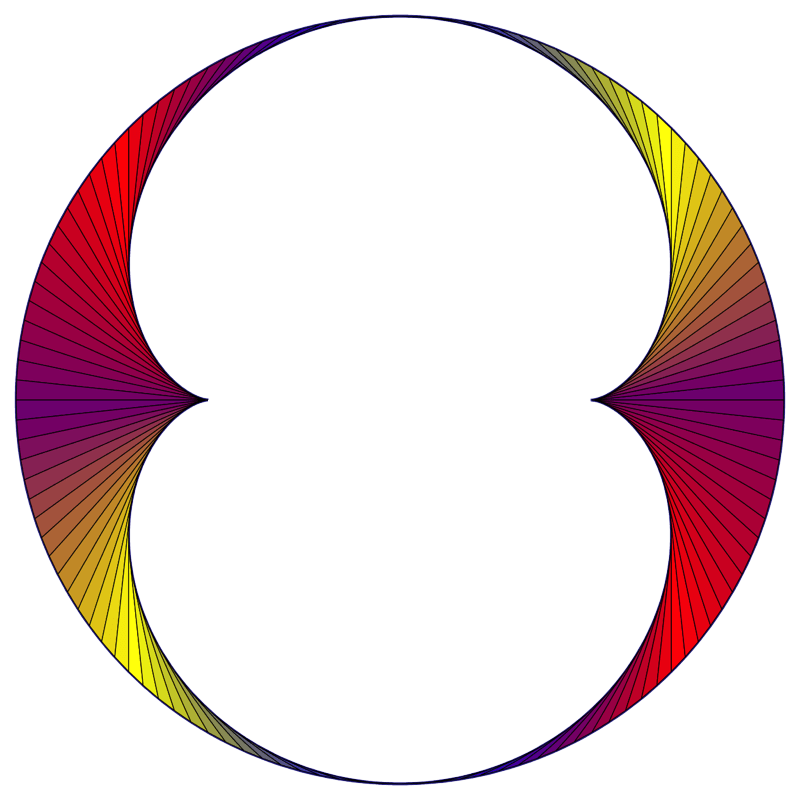
The case of the parabola is the rare exception. Typically, the reflected light rays will produce another curve of heightened brightness, called its caustic.
For instance, you might have observed a strangely formed curve in a cup of good black tea when horizontal light hits the rim of your circular cup. This curve is actually a nephroid, well studied since antiquity.

Circlecaustic

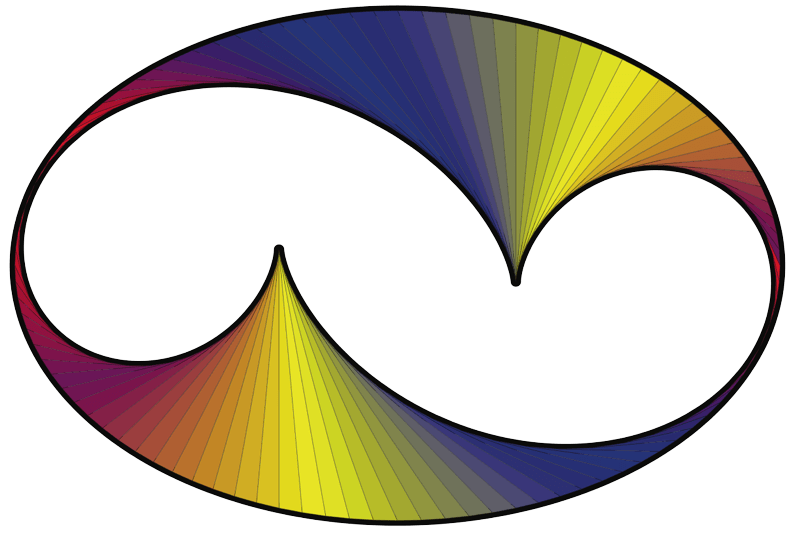
Doing the same to an ellipse gives a deformed picture.

Ellipsecaustic

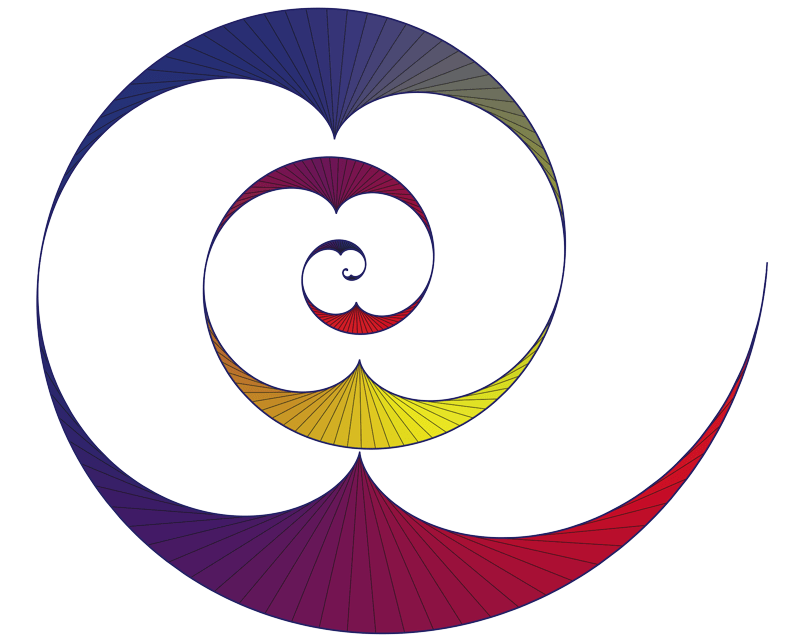
Still other curves like the spiral below have elegantly ornamental curves as their caustics.

Spiralcaustic

Rock Art (Iceland IV)

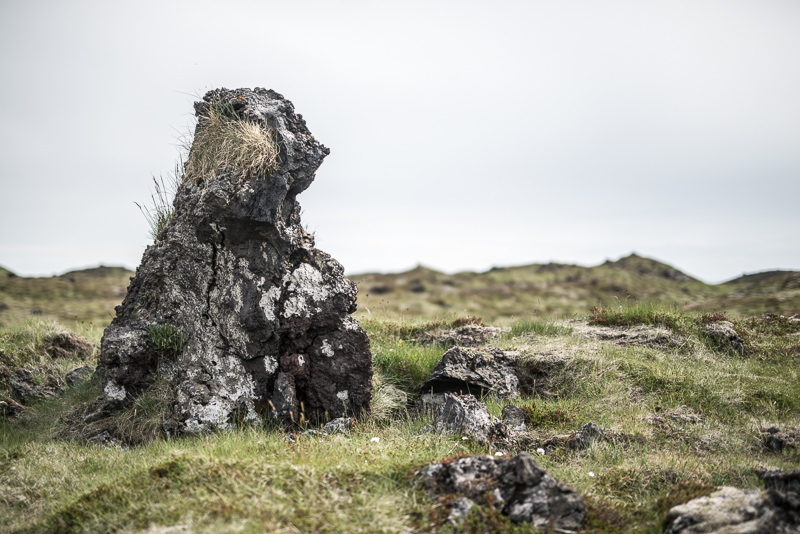
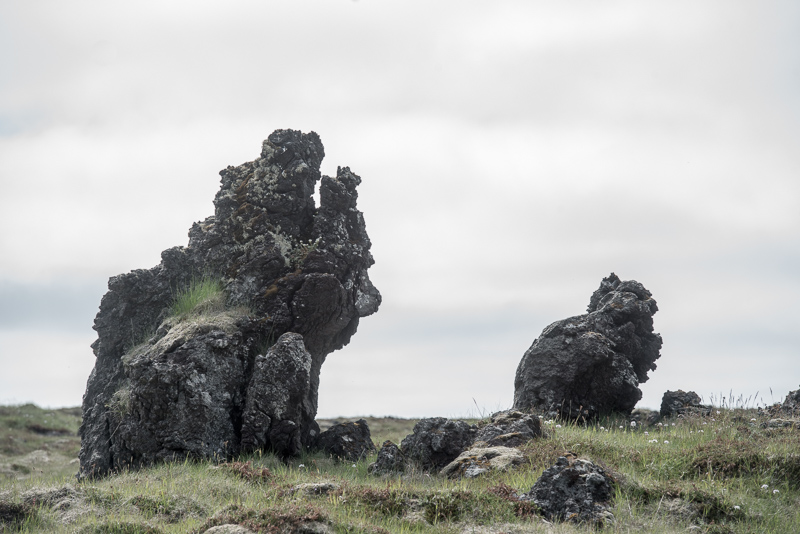
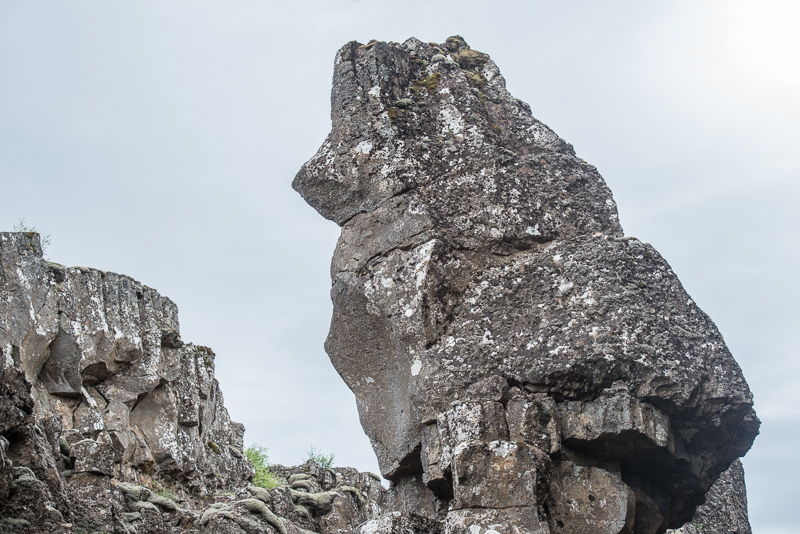
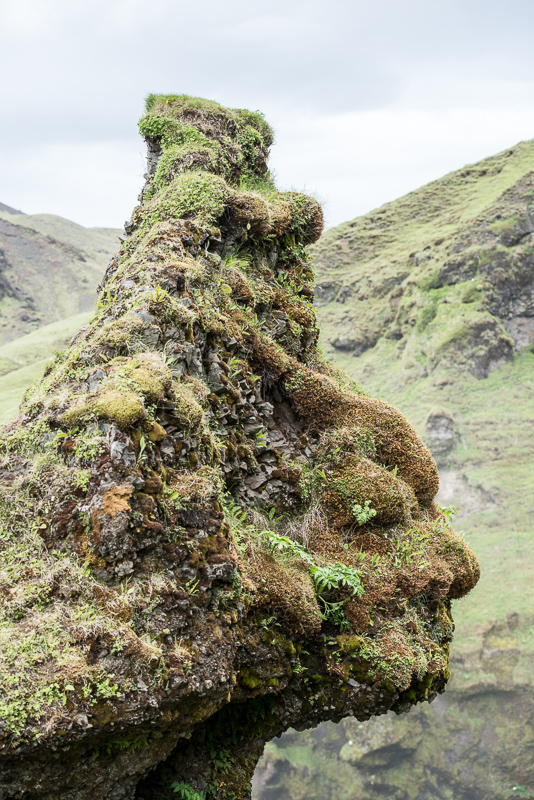
This image of an expecting woman should make it clear that trolls are not as close to extinction as some try to make us believe.

DSC 8873

Of course they are hard to find. Not only are they well camouflaged by all the lava rocks, they are also in constant migration, like here a small family, with the child being carried piggyback.

DSC 9147

But not only trolls roam Iceland. This large bird should rewrite a chapter of the theory of evolution.

DSC 7767

Then there are the giants, always watching.

DSC 7652

Touching Inside and Outside (Spheres XII)

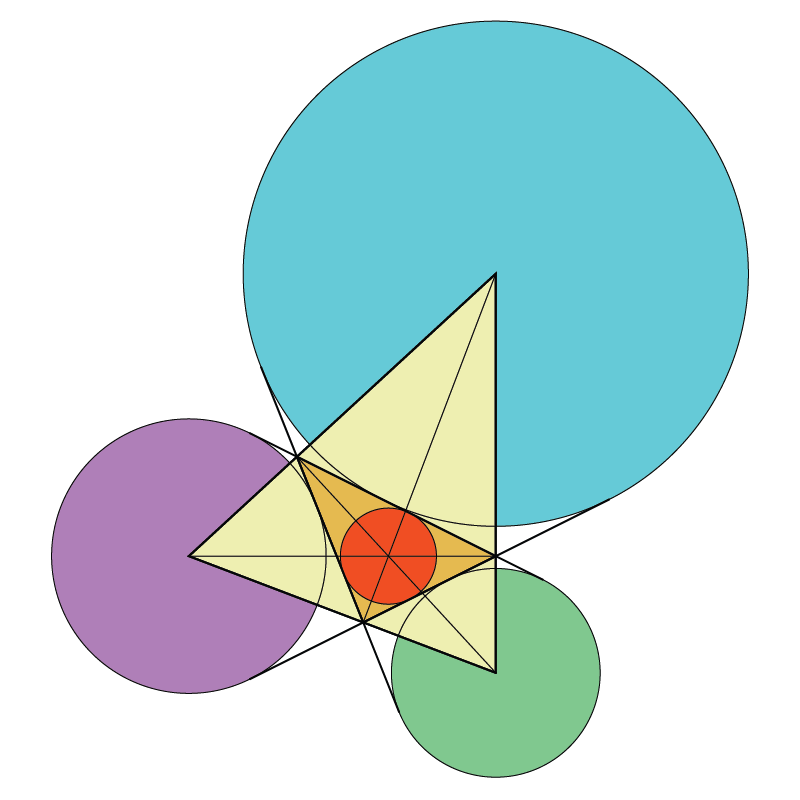
High school students taking geometry are until this day tasked to locate the incircle of a triangle: The circle that touches all sides. One learns that its center is where the three angle bisectors meet, and that’s that.

Inexcircles 01

It’s less often taught that there are three more circles (the excircles), touching two sides of the triangle from the inside, but one form the outside. Their three centers are the corners of a triangle in which the former angle bisectors become the altitudes.

Tetra 1

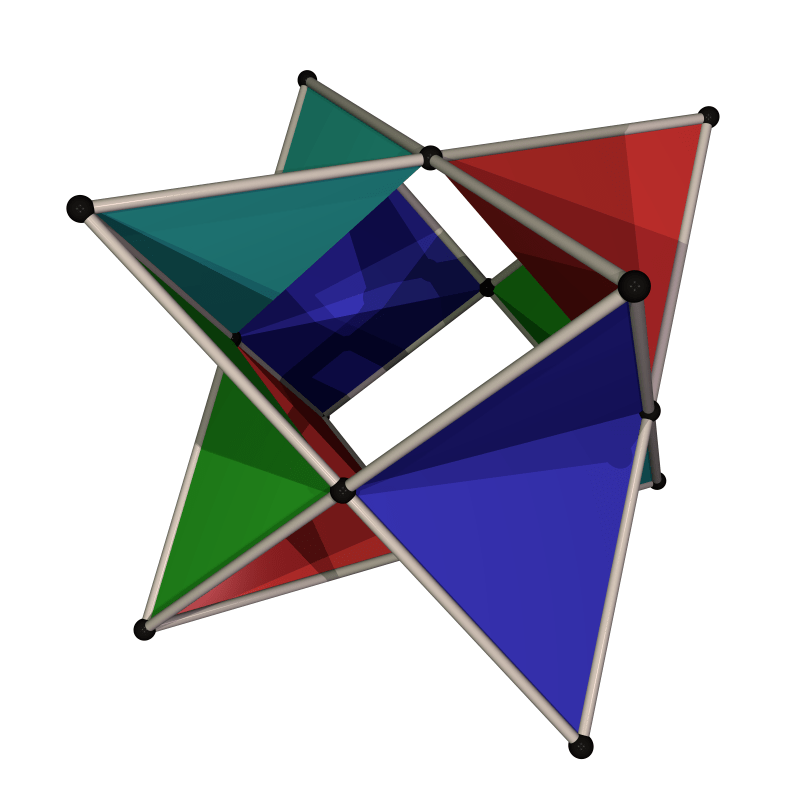
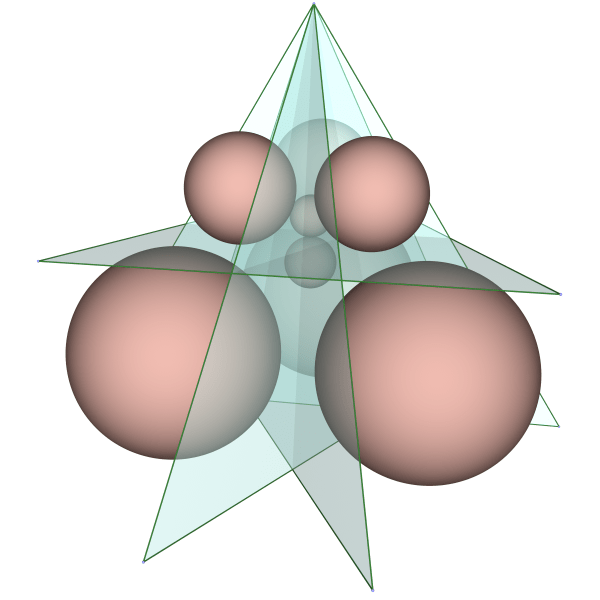
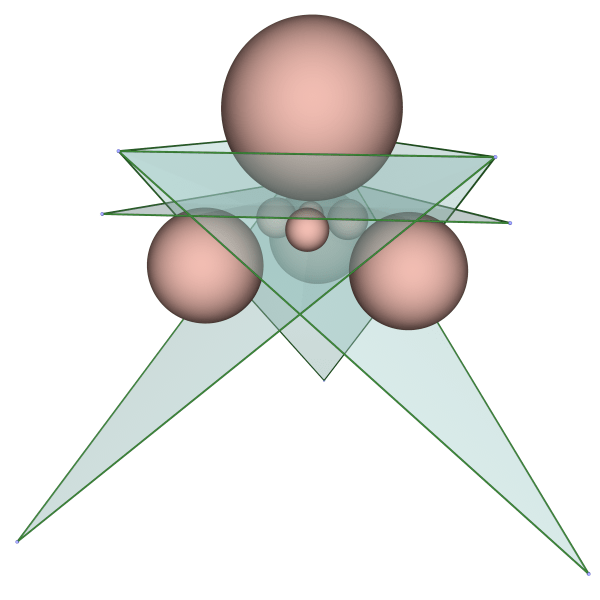
Of course things get really interesting when we move into space. Here the four planes of a tetrahedron can be touched by as many as eight spheres. In the simplest case, it looks like the picture above.

Tetra 2

Curiously, this does not work with the regular tetrahedron, it needs to be either more or less elongated.

Tetra small