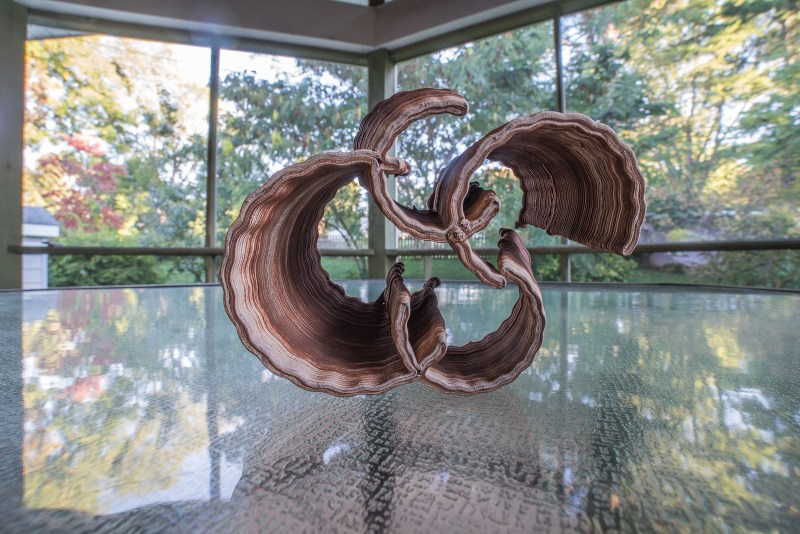
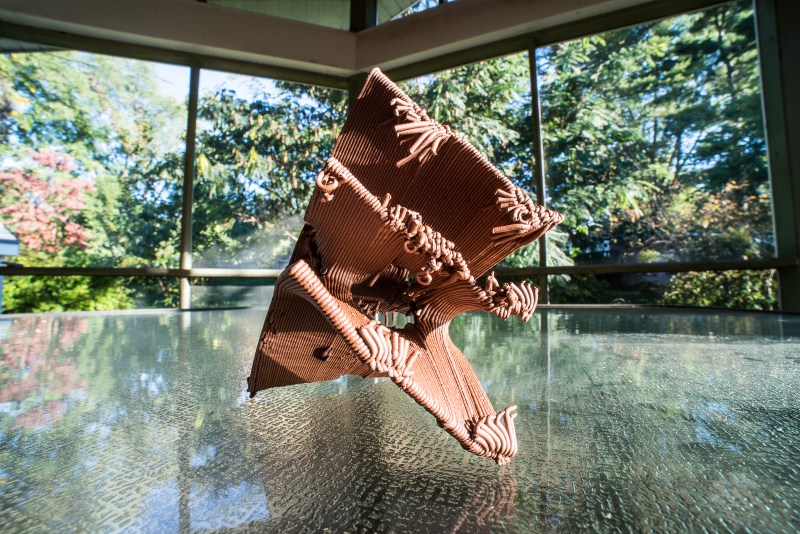
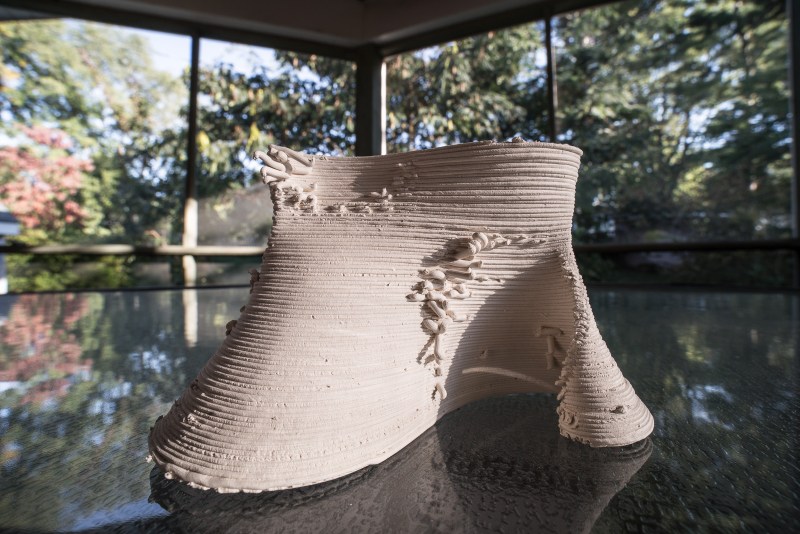
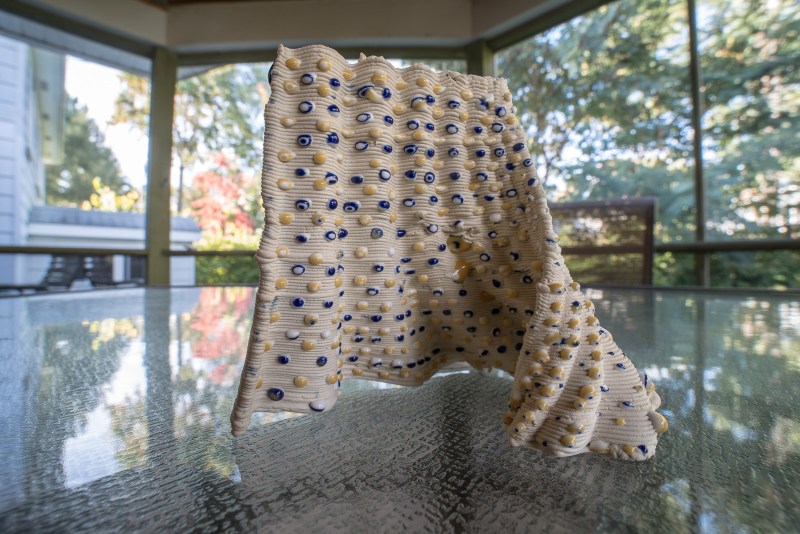
More Choices

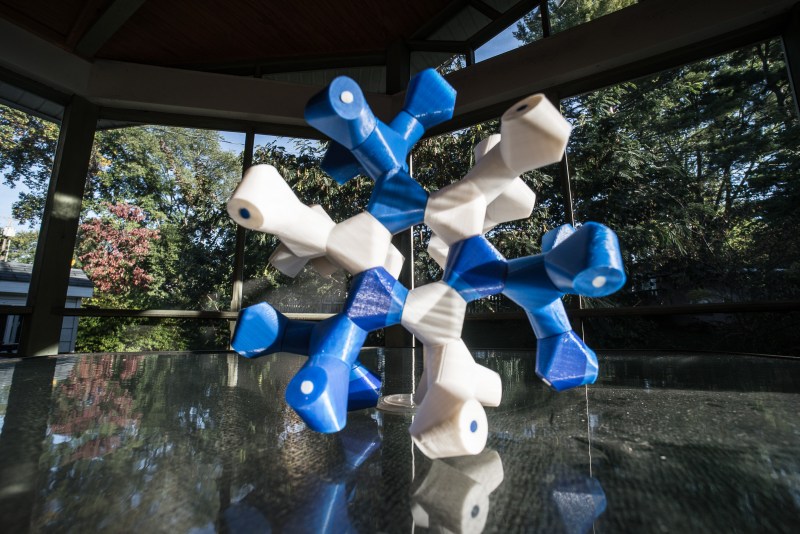
Last week we saw that using just the left handed of the two bricks that I based on the rhombic dodecahedron produces nothing but the Laves graph. Using the right handed brick makes the mirror image of the Laves graph, and one can see

Prestartwin

that they intertwine nicely. Of course it would be better to have real bricks, and with help from Martha and the friendly people at MadLab of our Fine Arts School, I could play with a few dozen left and right bricks.

DSC 6390

In the above picture left and right bricks are color coded, and the sculpture starts with a hexagonal ring and then grows tentacles in a single color. These will come together and close, but leaving gaps looked more interesting.

DSC 5896

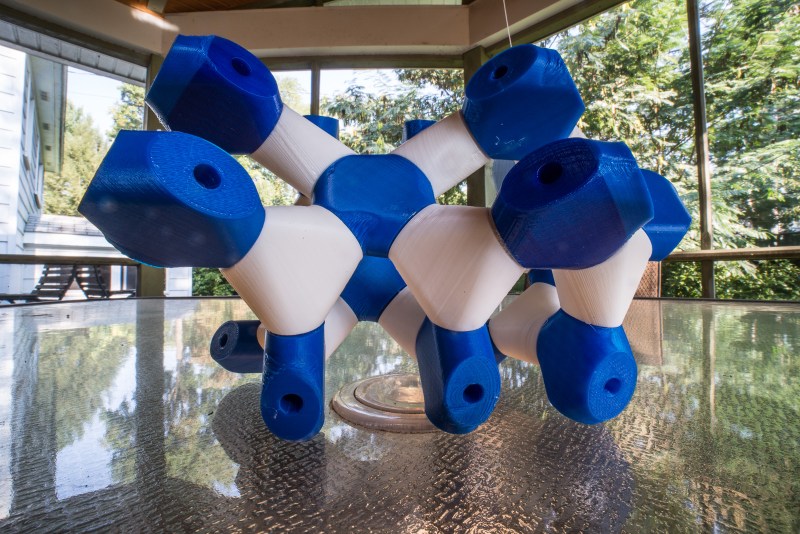
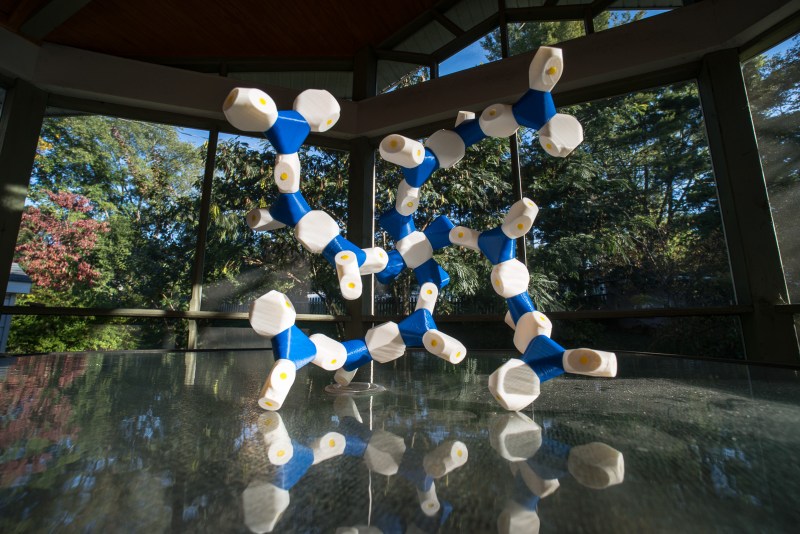
Here (above and below) you can see that I cheated, because I am also using a brick with four sides. It is geometrically much simpler, but of course still based on the rhombic dodecahedron, replacing four of its sided by their inscribed ellipses, and then taking their convex hull. This allows for tighter loops as in the image above, and allows for more design options.

DSC 6395

Another Brick in the Wall

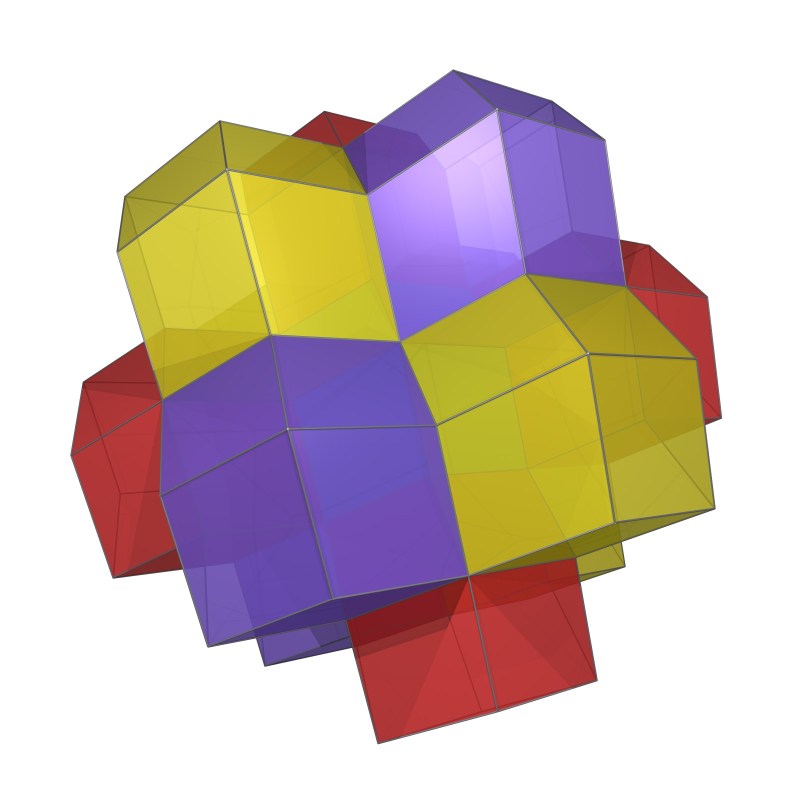
When Apple announced in July this year they had sold 1 billion iPhones, I started wondering about another brick maker: How many blocks has Lego made? Their friendly customer service couldn’t tell me how many elements they have made in total, but the yearly production is 19 billion. Scary. Unfortunately, the shape of the standard lego brick is too limited for my needs. For a long time, I had wanted a lego brick in the shape of a rhombic dodecahedron (better would be a four dimensional lego hypercube of which the rhombic dodecahedron is a mere shadow, but let’s not be delusional). As you can see, this polyhedron tiles space as well if not better than the cube.
RhombicDodecahedronTiling

Various companies have produced shapes with more or less cleverly embedded magnets, but keeping track of the polarity on all faces of a 12 sided object is tricky. And this would be a lot of magnets. The actual problem, however, is the enormous amount of choices one has: 12 faces to attach to is just too much. I strongly believe that Lego’s success stems from the fact that they have reduced the number of possible ways how you can attach two lego pieces dramatically. No choice means dictatorship, two choices US capitalism, but more choices sounds like European liberalism or even anarchism, and we see where that leads.

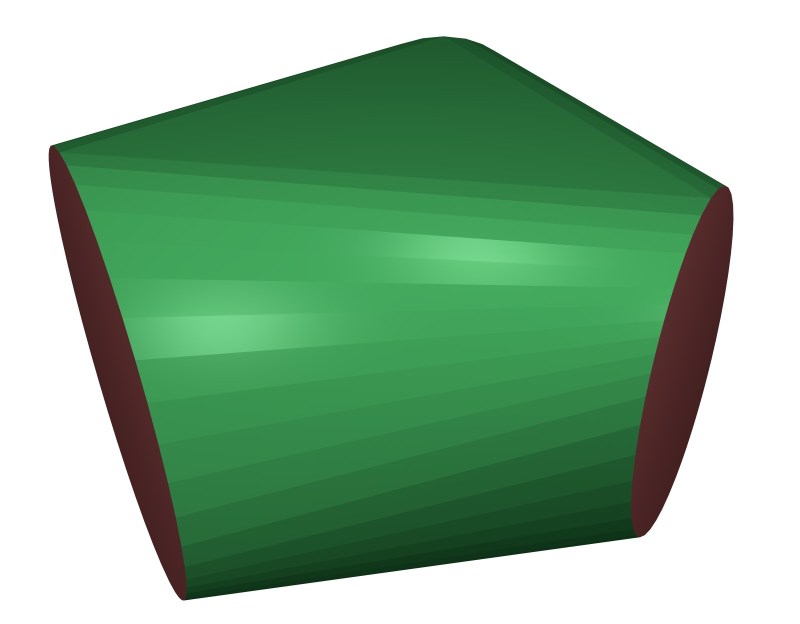
This gave me the idea to replace the complicated rhombic dodecahedron by a simple object that is less attachable. Here is the new brick.
Brick

To make it, take three faces of the rhombic dodecahedron that are symmetrically positioned, and replace each of the three rhombi by its inscribed ellipse. Then take the convex hull of the ellipses. The resulting shape consists of the ellipses, two equilateral triangles in parallel planes, and three intrinsically flat mantel pieces.

You will notice that there are two versions of this brick, a left and a right handed one. This leaves just the right amount of choices.
Hexring

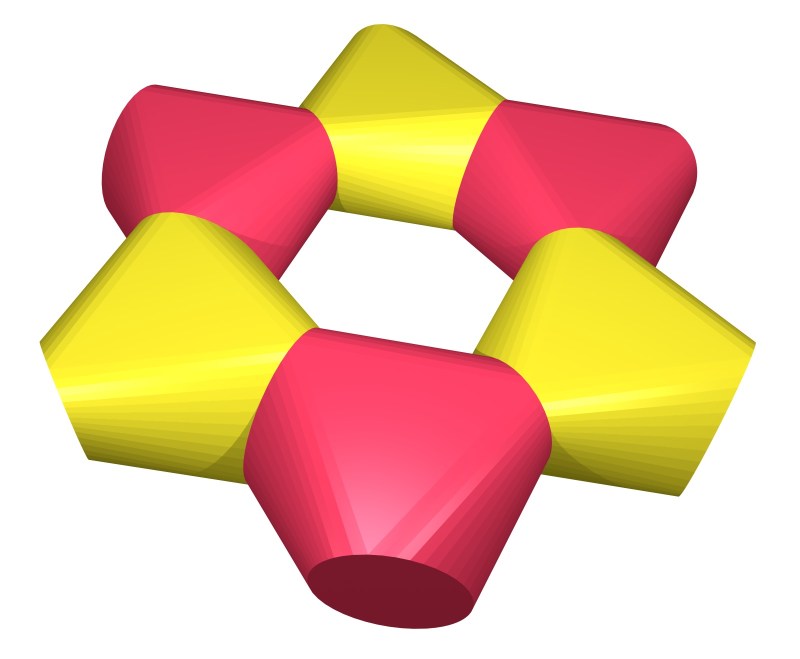
If you alternatingly attach a left to a right brick, you get a hexagonal annulus. Remember that we are still tiling space using slimmed down versions of the rhombic dodecahedron. Due to our imposed limitation of choice, nor every place can be reached anymore. The hexagonal annulus is a little simplistic. What do we get if we just use the left handed brick?
Prestar2

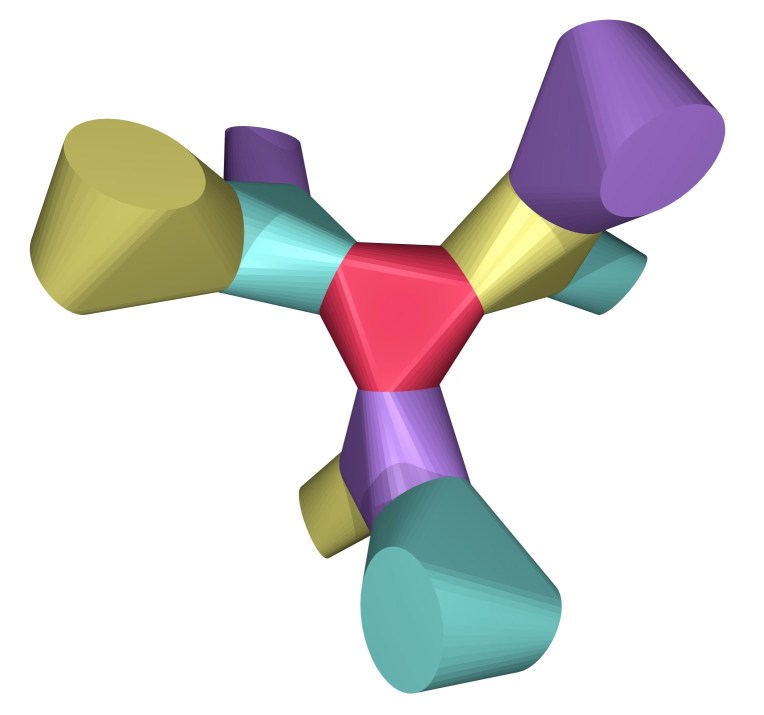
Let’s start with a red central brick, attach a brick on all three sides, and another six at the free faces of the new bricks. We notice that the bricks can occur in four different rotated positions. I have distinguished them by color. Add another 12 bricks:
Prestar

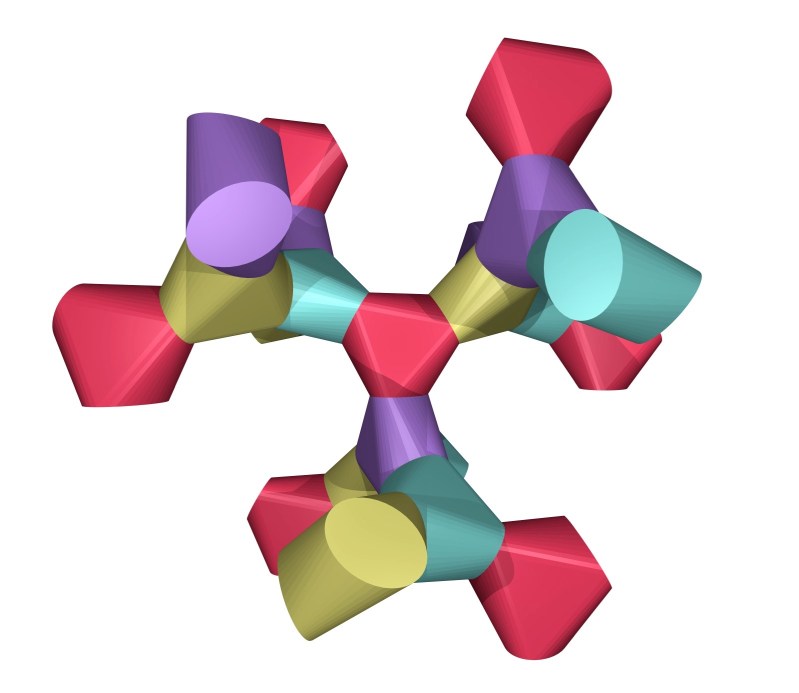
And another 24. No worry, no intersections can occur, because, I insist, we just tile a portion of space with rhombic dodecahedra.
Star

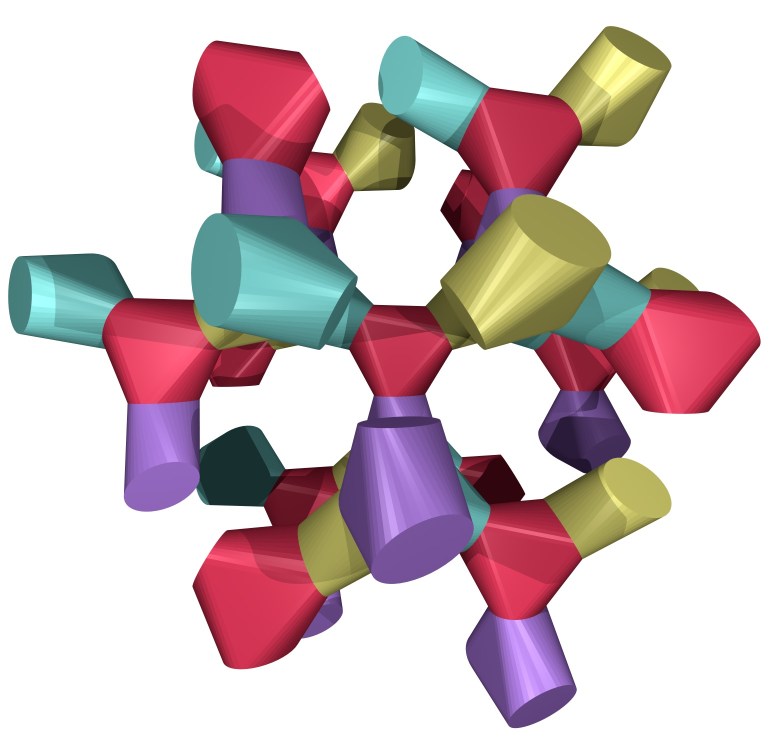
Now we see that the tree like structure we have produced so far does not persist. In the next generation, we obtain closed cycles of length 10, and we finally recognize the Laves graph.
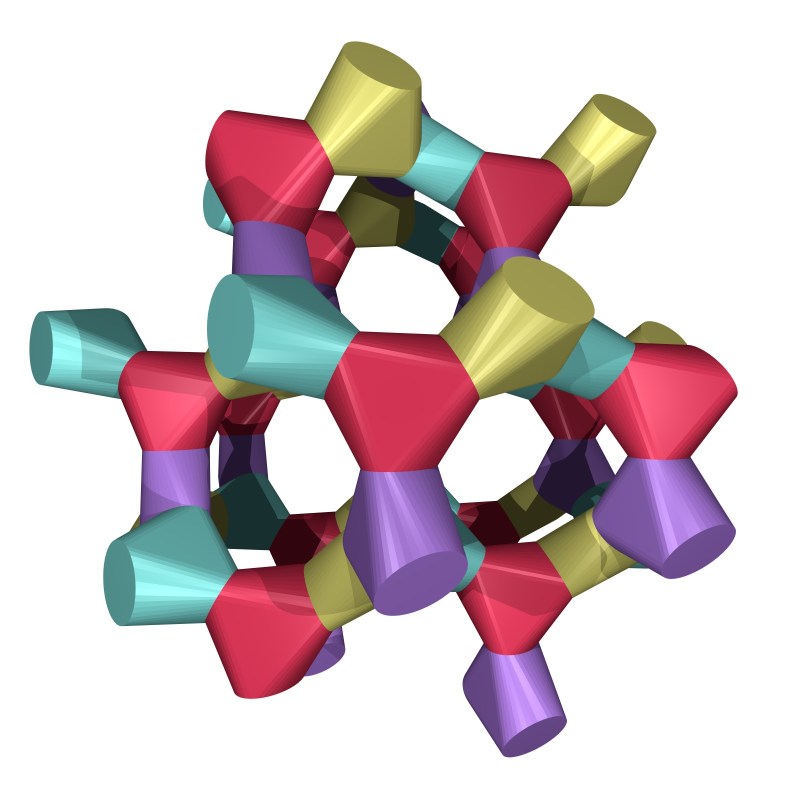
Ball

In the very near future you will see what else one can make with these bricks.
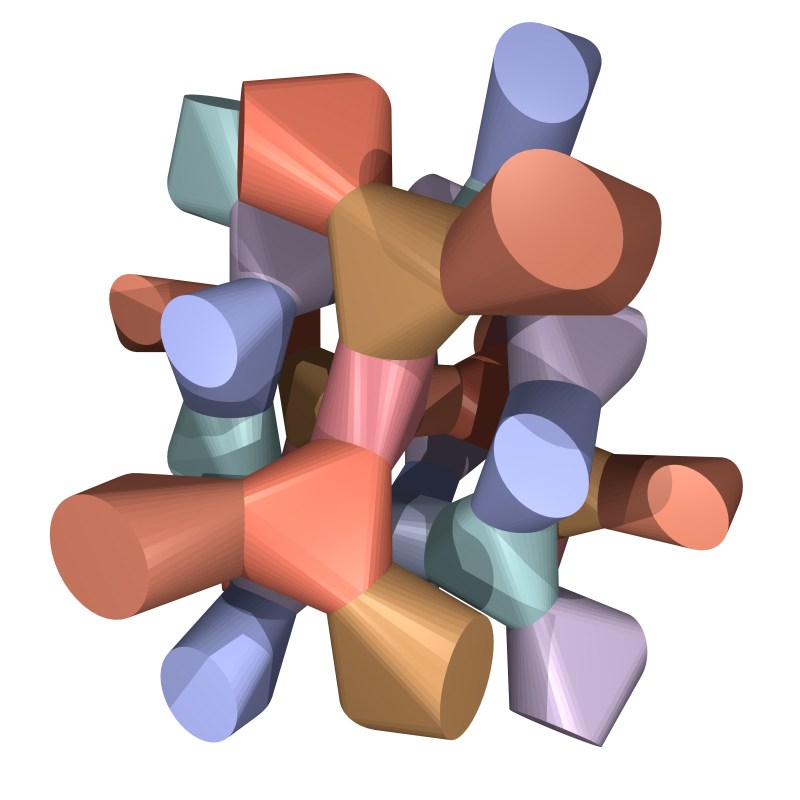
Scherk in Clay

Scherk6

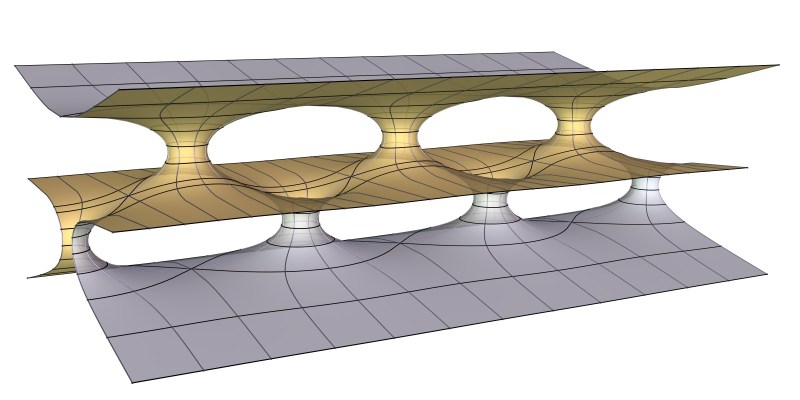
This innocent minimal surface, which can be obtained from Heinrich Scherk’s traditional surface by adding two wings and bending them towards each other, poses interesting challenges when printed (vertically, i.e. rotated by 90 degrees) in clay. First of all, there are three horizontal cross sections which look like branches of hyperbolas (but aren’t, not even for the original Scherk surface, in contrast what Wikipedia currently claims).

DSC 6210

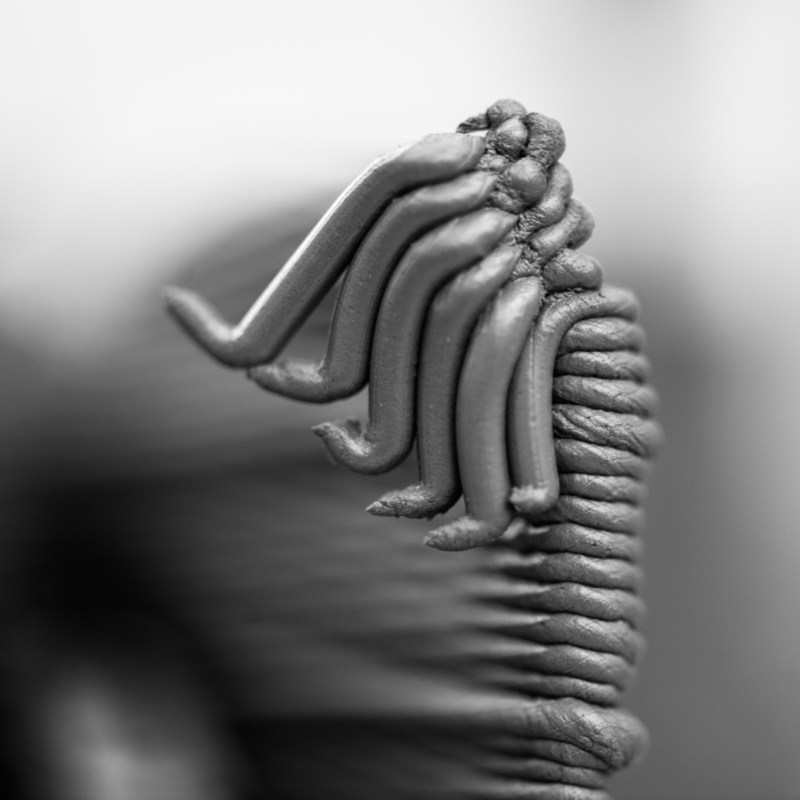
When printing this layer by layer, the nozzle has to move from branch to branch, and as the printer can’t stop printing while it skips across, it leaves hairy artifacts.
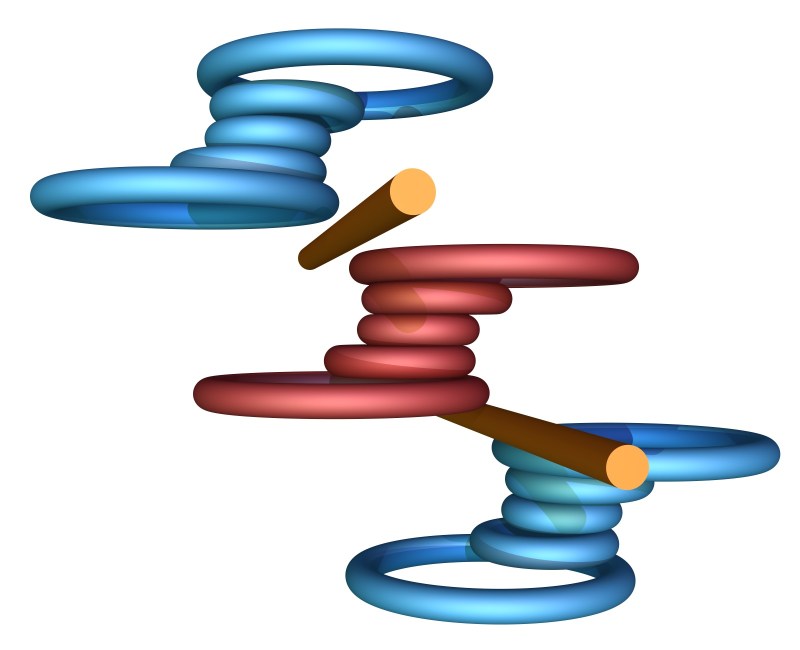
DSC 6207

They clearly have their own charme.
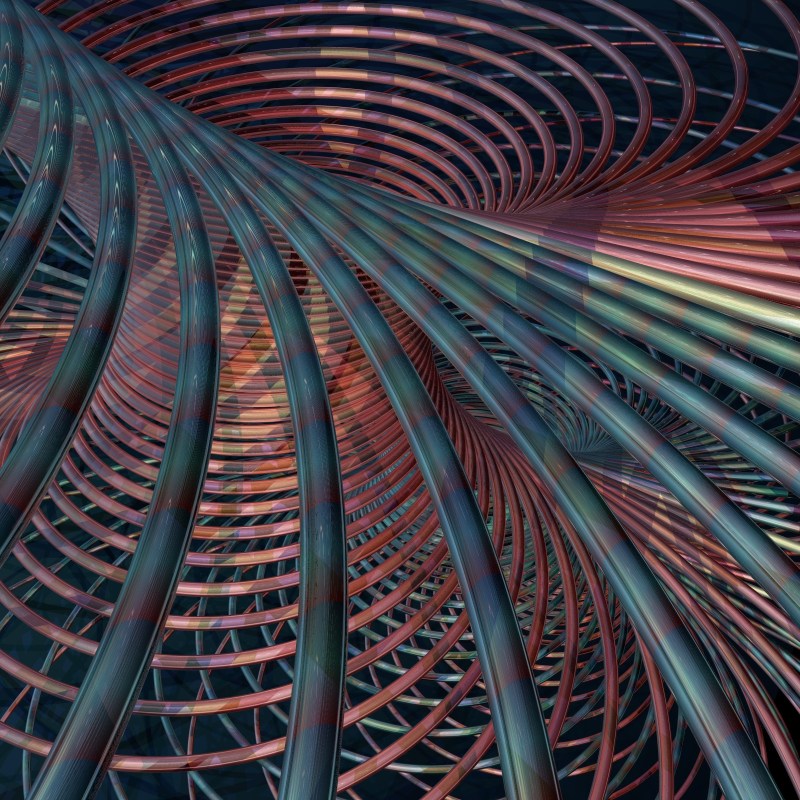
DSC 6299

Another problem arises from the saddle points that are printed without support. This leads to other imperfections and sometimes structural complications that might take away from the elegance of the original surface but contribute to wild interior landscapes.

DSC 6269

Watching the printer work for two hours is dramatic, because failure in the form of collapsing walls can happen any minute.

DSC 6276

The Economy Bender

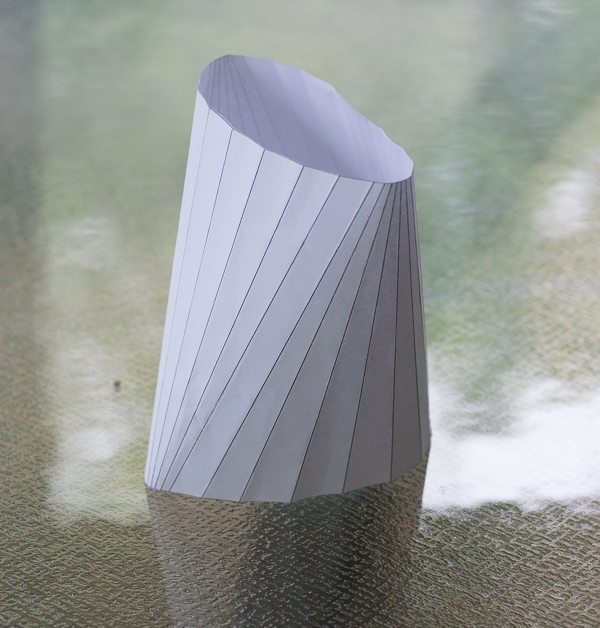
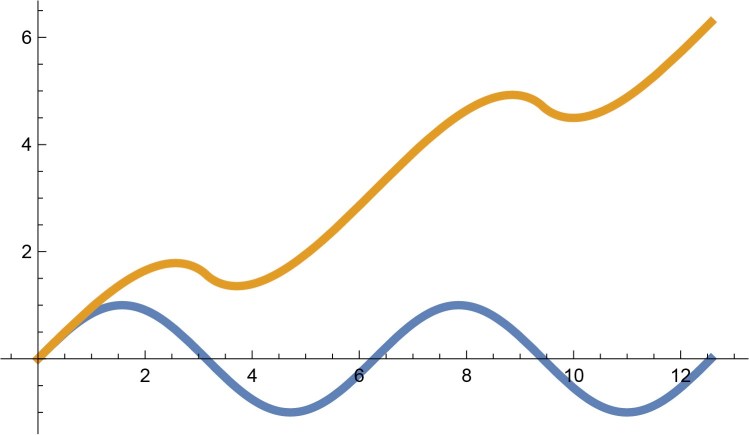
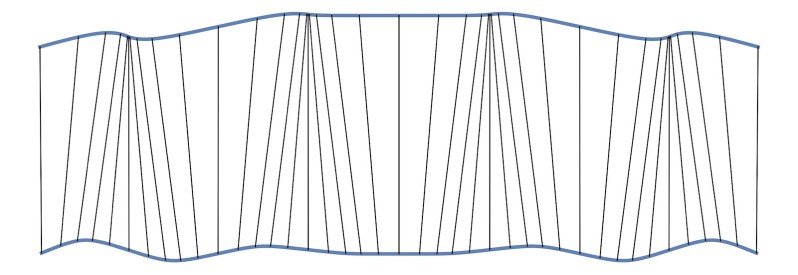
If you want to build a column that has two elliptical cross sections at the top and bottom with different major and minor axis and that can roll, you can just take the ruled surface whose lines connect points with parallel tangents on the two ellipses.

Column

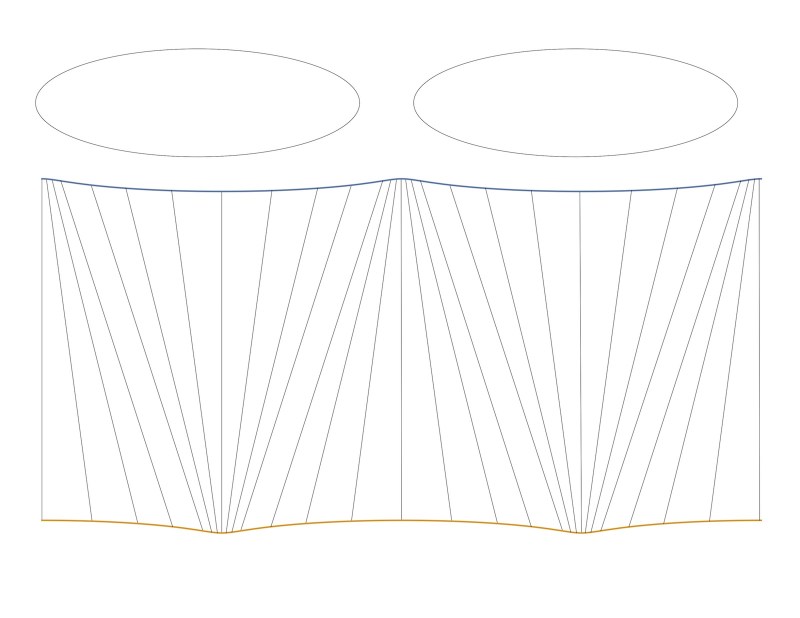
When placed horizontally on a sheet of paper, the column will touch the paper in these lines, and you can wrap the paper around the column, making evident that this is a developable (or flat) surface. You can try it out yourself with the template below.

Template
This simple trick has dramatic economic applications. Suppose you want to transform a boring, stagnating economy into a vibrant, growing economy:

Economies 01

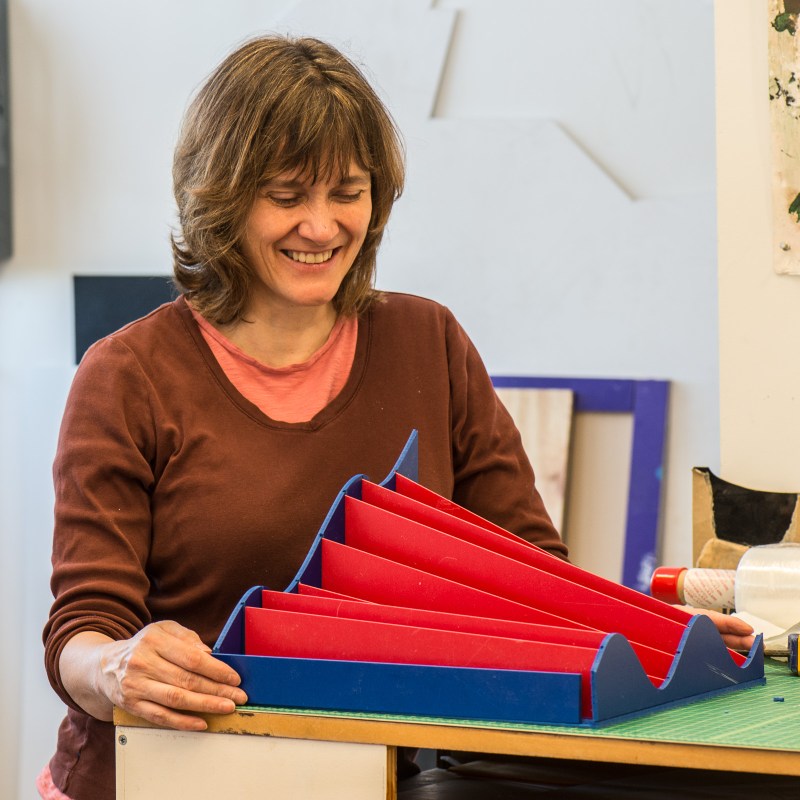
To do so, you just need to join points with parallel tangents on the two economy graphs by straight lines. Here is Martha with a wooden prototype of the Economy Bender.

DSC 3596

You can now wrap some expensive looking material over it. To explain to your CEO how you will be able to transform your failing company into a successful one, just take a printout of last year’s dire company report, put it onto the lower part of the bender next to the stagnating economy curve, and slowly move it upward towards the growing economy curve. You can do this by keeping the report tight on the surface, neither tearing not stretching it. This should convince anybody that a smooth transition into a brave new world is always possible. Here is the template:

Economy
Anybody buying it?

Deltoids in Clay

Clay printing currently works best for objects that change slowly from one horizontal layer to the next. This suggests to create 3-dimensional objects that realize a changing 2-dimensional configuration in one piece. An example of that is the rotating segment within the deltoid that at every stage foots on two sides of the deltoid and is tangent to the third.

Deltoid

As the deltoid itself doesn’t change shape, it will become a cylinder over the deltoid. On the other hand, the rotating segment will become a ruled, helocoid-like surface. If we printed the entire model like this, the interesting part, namely the rotating secant, would be mostly hidden. Therefore we will only use one edge of the deltoid, while the other two are implied only by the rotating endpoints of the line.

DSC 4827

Doing this in clay is not easy. First of all, we print it so that time is vertical. This allows to use the deltoid wall as a solid support. Each layer of the rotating secant then becomes a cantilever, supporting subsequent higher layers.

DSC 4843

The point when the secant turns into a tangent is particularly interesting. One can see the gravitational pull on the emerging new layer that bends towards us in the image above. The contrast between the static, cylindrical deltoid arc and the dynamic, rotating secant is compelling and hard to convey in a single image. But that’s a fair enough reason to make 3D sculptures.

DSC 4822

Quadrics in Clay

To get the orthogonal quadrics from Monday into clay using a clay printer, one needs to know about the limitations of Malcolm’s clay printer. It does nothing else but move a vertical tube full of clay horizontally around and vertically up, layer by layer. Simultaneously, it squeezes a continuous stream of clay, with no pause.

DSC 4646

The first few layers are pretty easy, clearly showing the elliptical and hyperbolic cross sections. We only print one half of the whole model, to have a solid foundation (the central cross section), and because it’s cool to be able to look inside.

DSC 4663

Things get interesting when the two branches of the hyperbola come together to connect to the single hyperboloid. We reach a critical point of the height function, and the clay printer clearly has problems with the Morse theory.

DSC 4694

Above you can see the nozzle in action, and more has happened: We have passed a second critical point when the two components of the hyperbola have separated from the ellipse. This is more complicated then the standard Morse theory of manifolds. The printer has do (quickly) move from one component to another at each layer, randomly dropping little chunks of clay on its way.

DSC 4710

This gets a bit messy when we reach the peak of the ellipsoid. Below is the completed print. It needs to dry and be fired. You will notice that we have only used two of the three surfaces. This is a pity, but the missing piece is one sheet of the double hyperboloid, and it is almost horizontal, and impossible to print.

DSC 4741

February

DSC 3971

I am one of those people who are often oblivious of their surroundings, which gives me the advantage to discover things even after years at the same place.

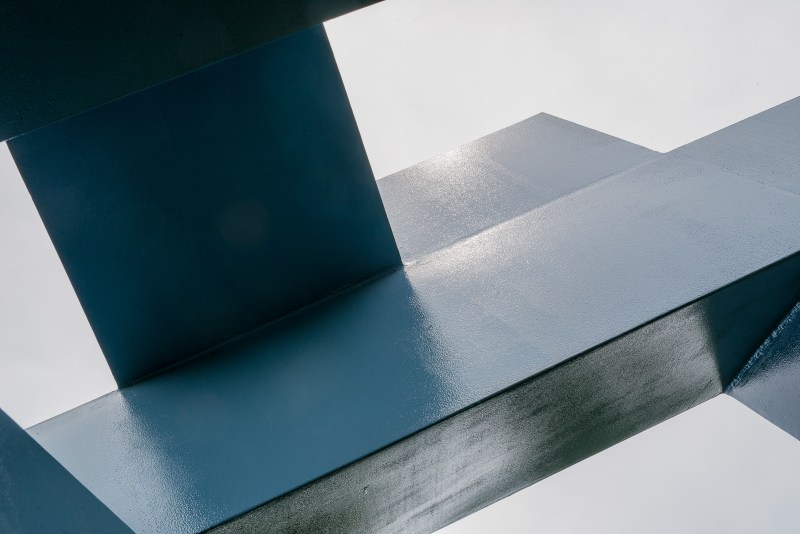
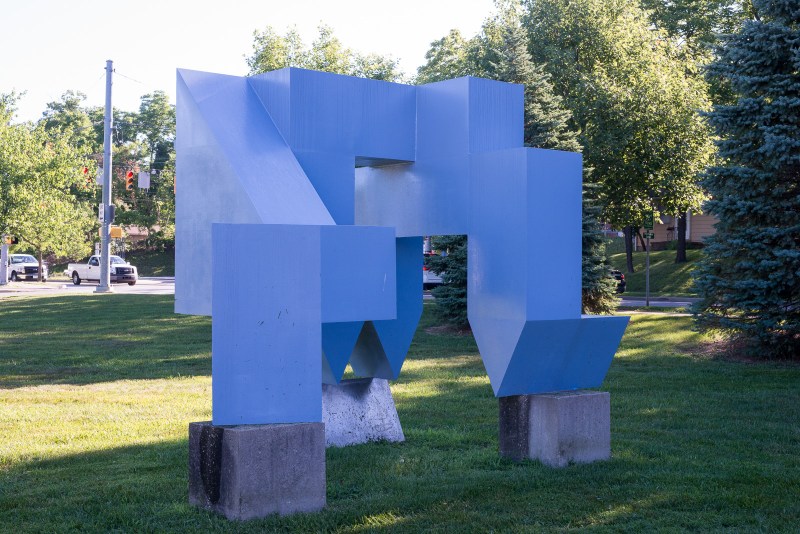
One of these things is Jerald Jacquard’s steel sculpture February, in front of the McCalla School in Bloomington.

DSC 3953

It first caught my attention through the sound it makes: Put one ear next to one of the three “legs” of the sculpture, and gently hit another part. Some ambient musician should explore this.

Jacquard4

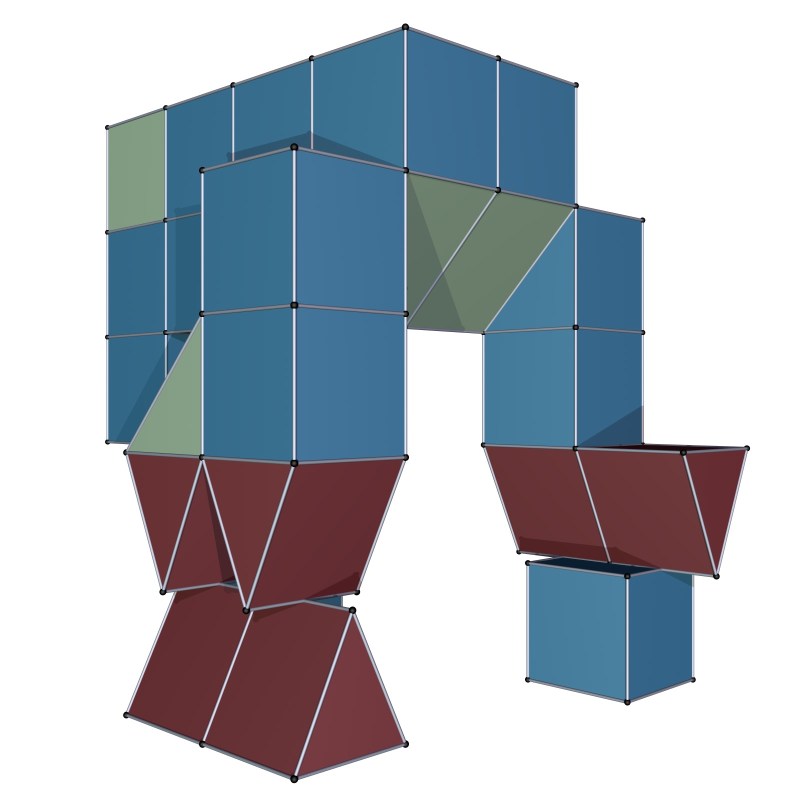
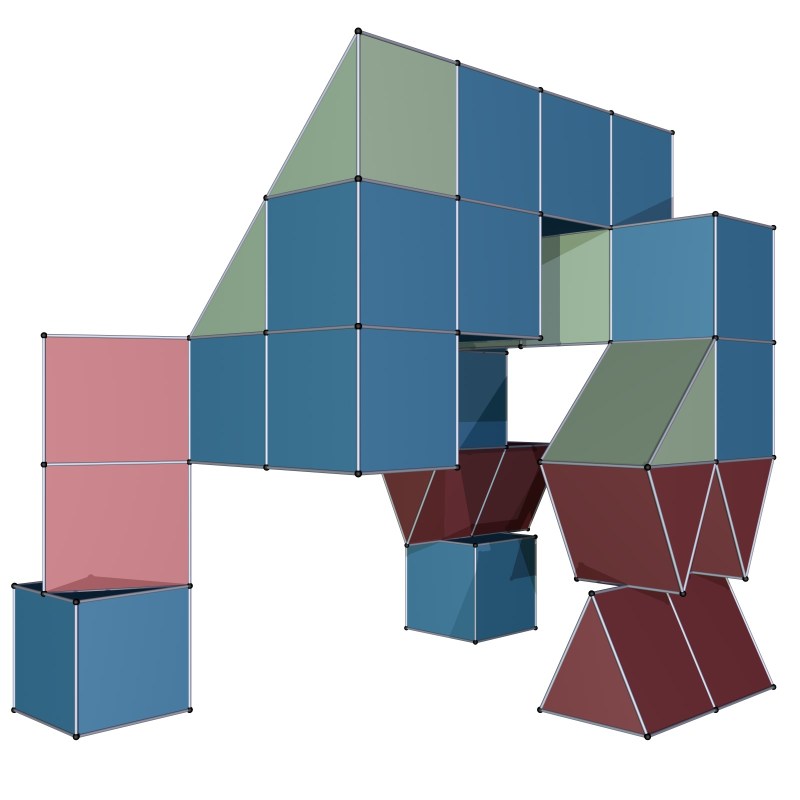
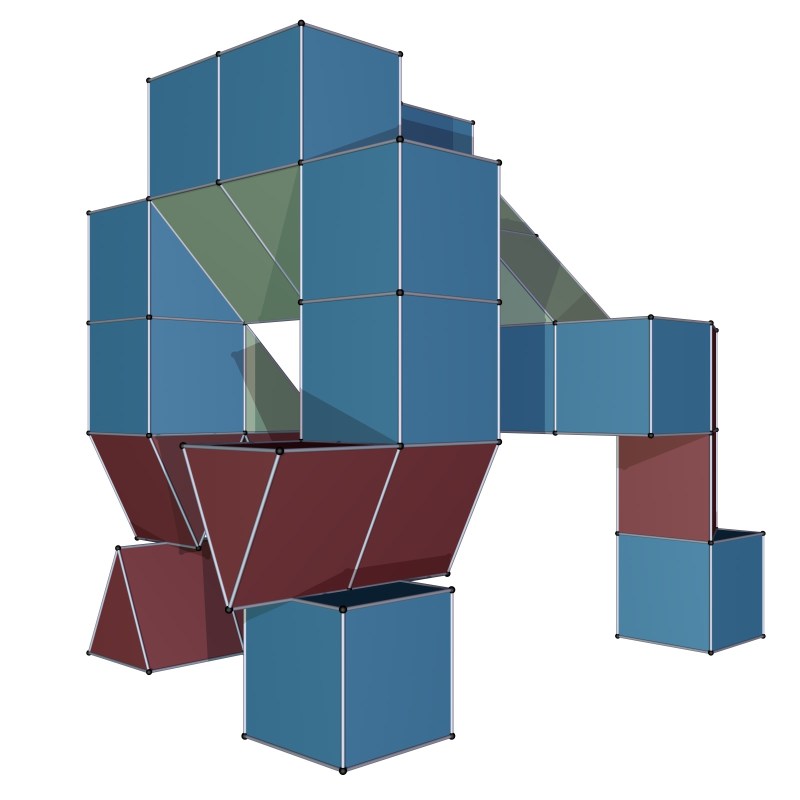
But the sculpture has more to offer. It is made of 28 blocks (one for each day of February). Each block is either a cube, or a halved cube. For halving a cube Jacquard uses two possibilities, both prisms over isosceles triangles, and both exactly half the volume of the cube. The usage of the (in my re-rendering, red) prisms is strictly limited to the lower part of the sculpture, making it to appear more open at the bottom than at the top.

Jacquard3

The other (green) prisms are used to create roof-like slopes. Almost all blocks are placed in a cubical grid, but there is one exception.

Jacquard

The front-bottom cube in the image above is moved to be able to support the two prisms above. Maybe, in leap years, one should add another cube?

Deceiving Simplicity (Annuli VI)

Circles

Just three months before his death on July 20, 1866 (150 years ago), Bernhard Riemann handed a few sheets of paper with formulas to Karl Hattendorff, one of his colleagues in Göttingen.
Hattendorff did better than Riemann’s house keeper who discarded the papers and notes she found.

He instead worked out the details, and published this as a posthumous paper of Riemann. It contains his work on minimal surfaces. Riemann was possibly the first person who realized that the Gauss map of a minimal surface is conformal, and that its inverse is well suited to find explicit parametrizations. He used this insight to construct the minimal surface family that bears his name, as well as a few others that were later rediscovered by Hermann Schwarz.

Riemann

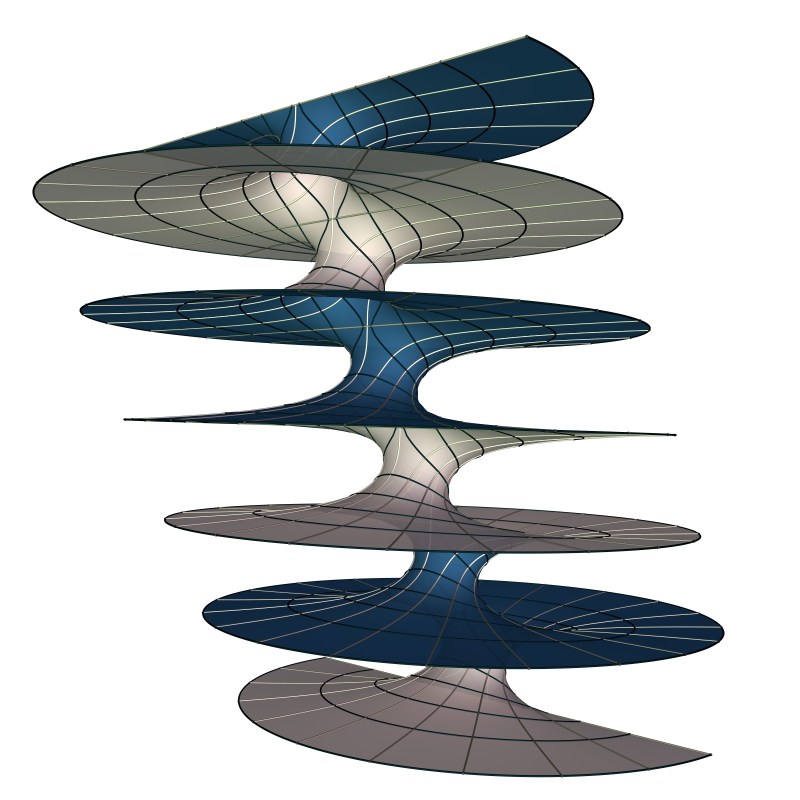
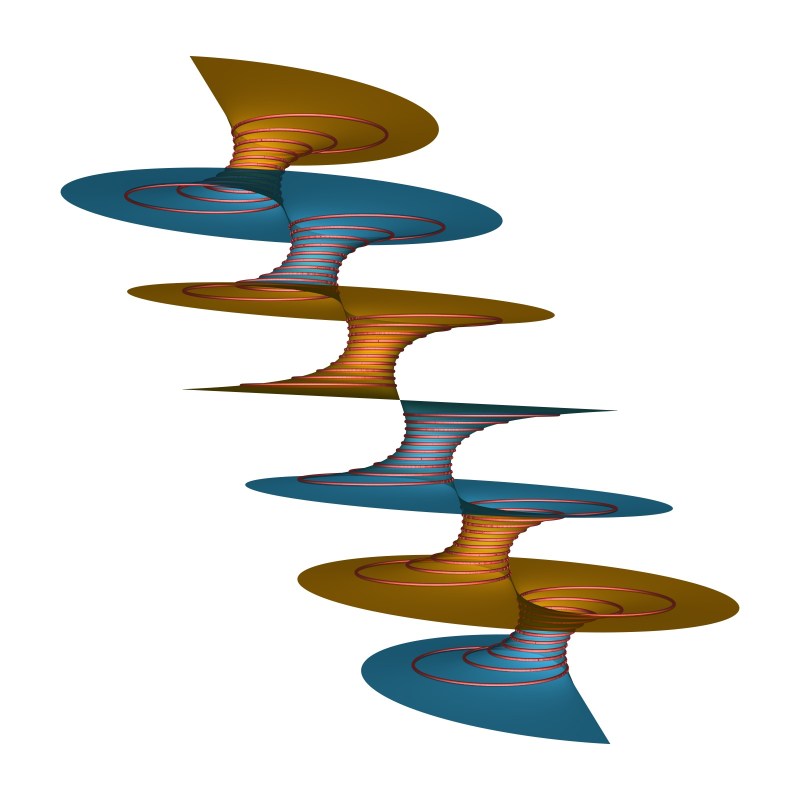
Above is one of Riemann’s minimal surfaces, parametrized by the inverse of the Gauss map. This means in particular that the surface normal along the parameter lines traces out great circles on the sphere. Riemann discovered these surfaces by classifying all minimal surfaces whose intersections with horizontal planes are lines or circles. These are the catenoid, the helicoid, or Riemann’s new 1-parameter family.

Riemanncircles

The proof utilizes elliptic functions, which is not surprising: Riemann’s minimal surfaces are translation invariant, and their quotient by this translation is a torus, on which the Gauss map is a meromorphic function of degree 2. It is in fact one of the simplest elliptic functions, and one can use it to parametrize Riemann’s surfaces quite elegantly. What is not simple is the proof that these surfaces have indeed circles as horizontal slices. All arguments I know involve some more or less heavy computation. We are clearly lacking some insight here.

Simple

The longer one studies these surfaces, the more perplexing they become. There is, for instance, Max Shiffman’s theorem from 1956. It states that if a minimal cylinder has just two horizontal circular slices, all its horizontal slices are circles. The proof is elegant, magical, and still mysterious, just like Riemann’s minimal surfaces.

Inside riemann

Arbeit und Struktur

DSC 4006

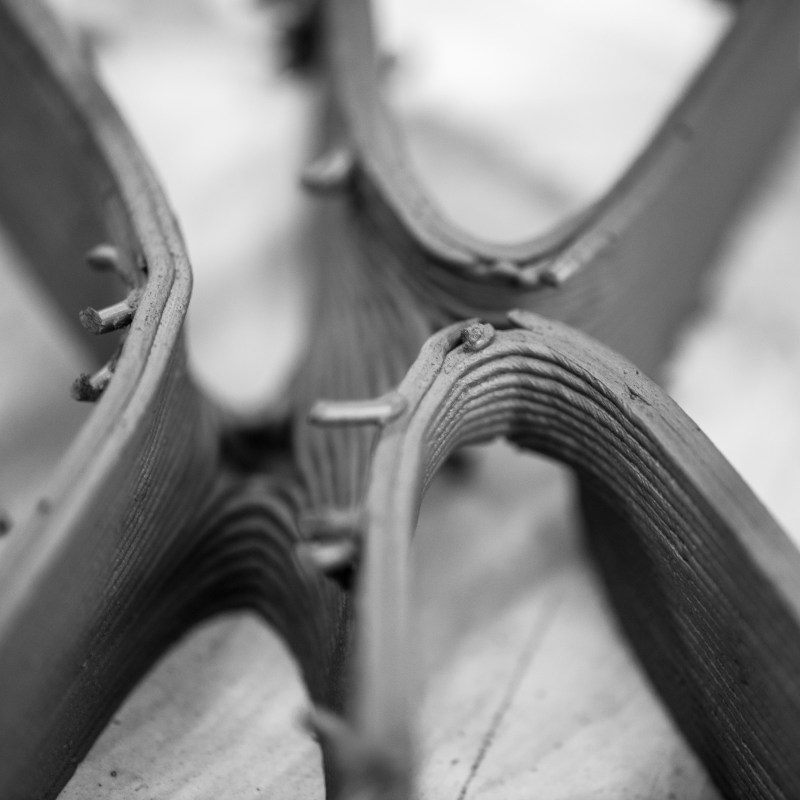
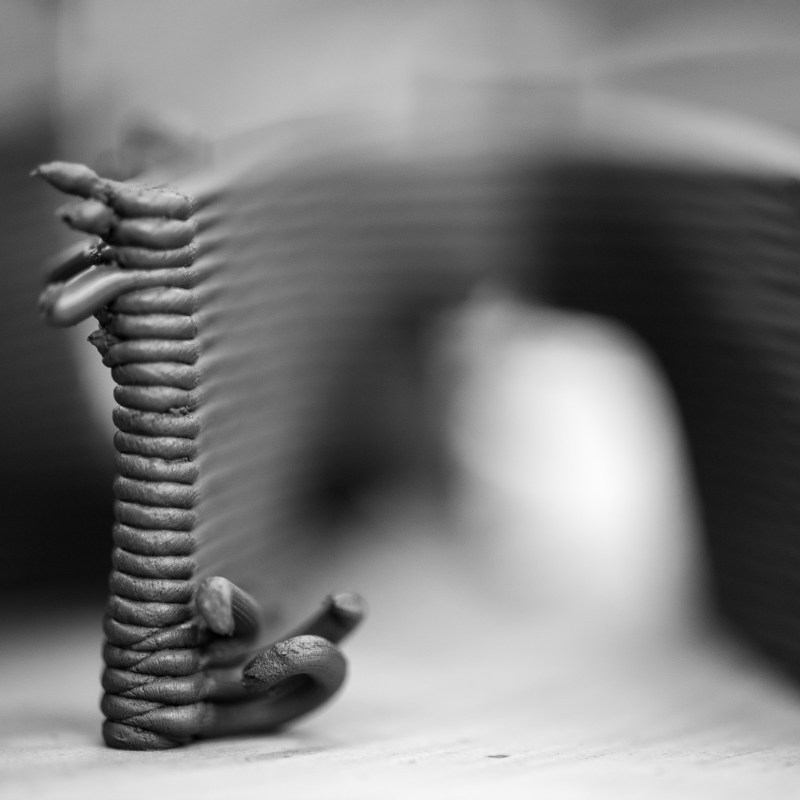
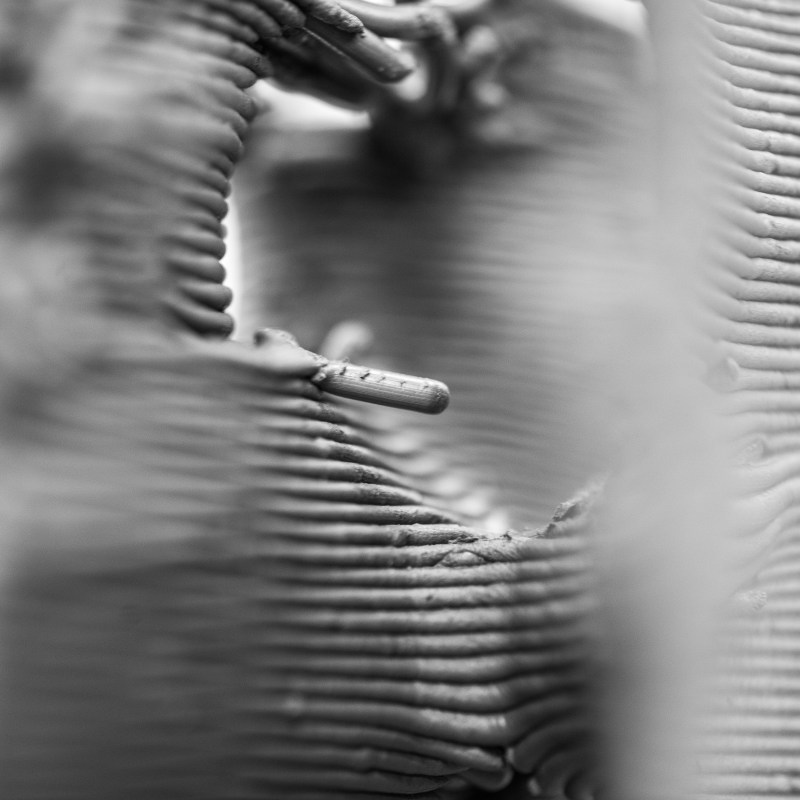
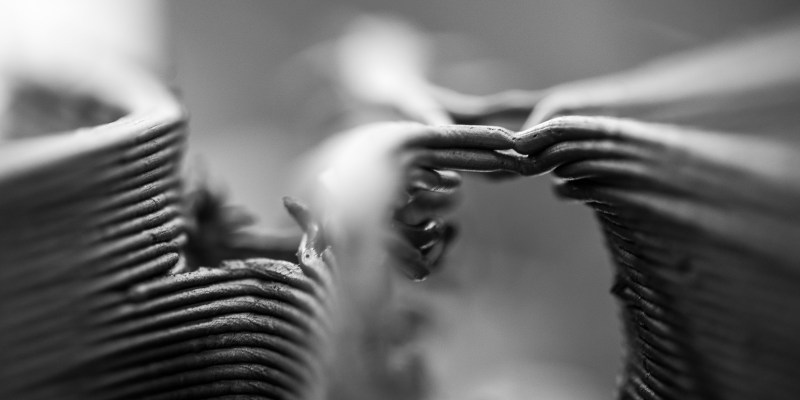
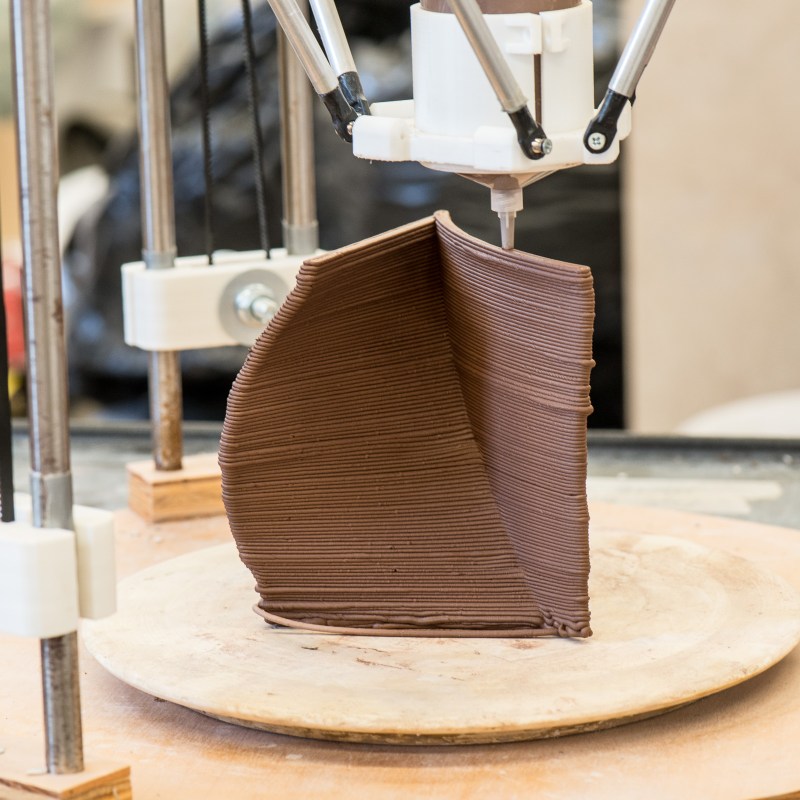
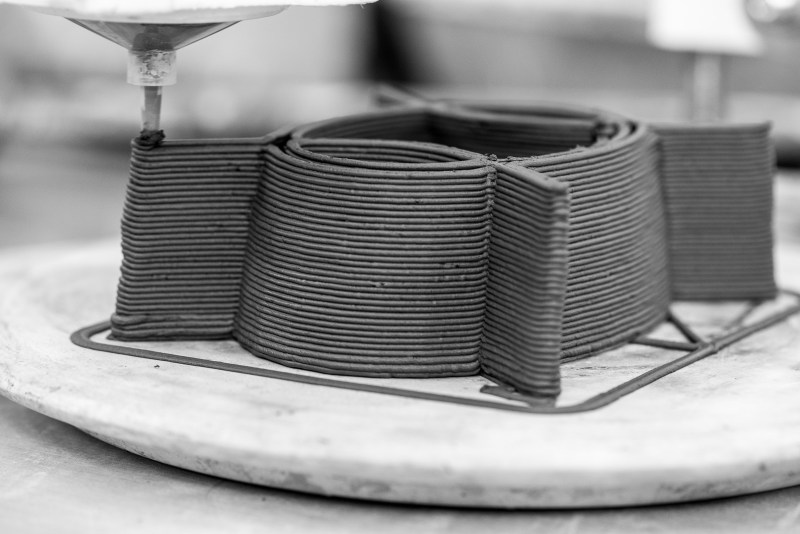
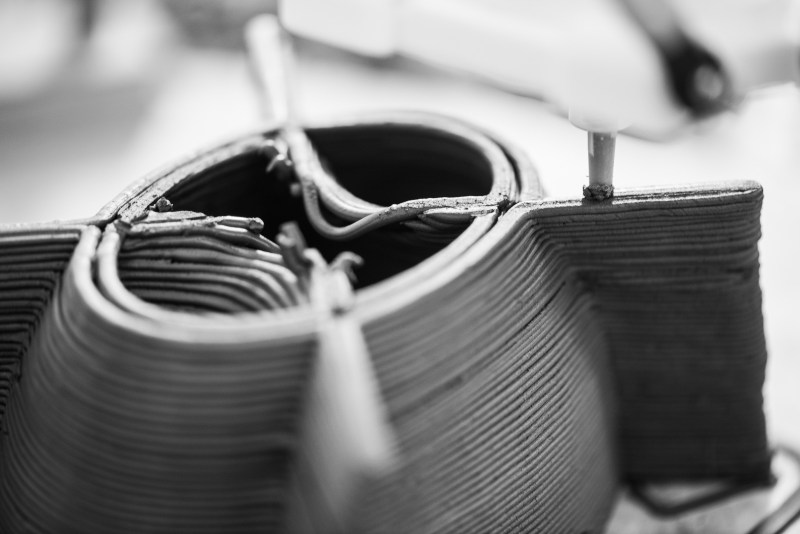
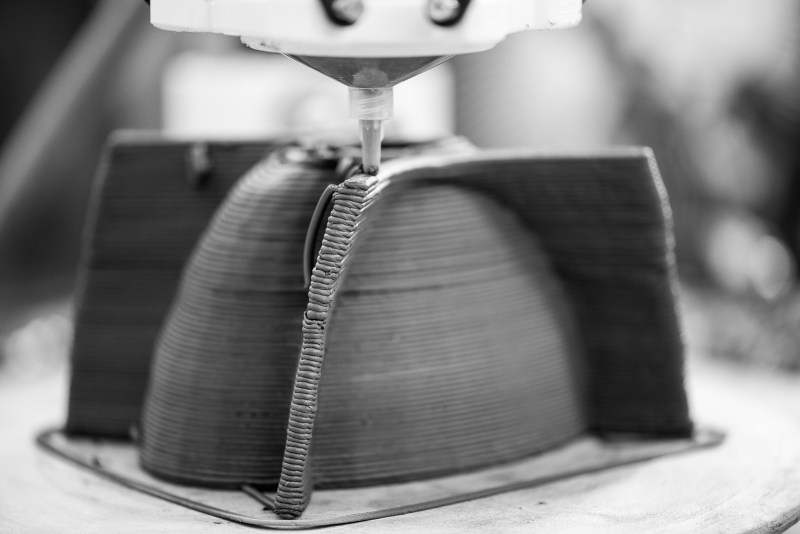
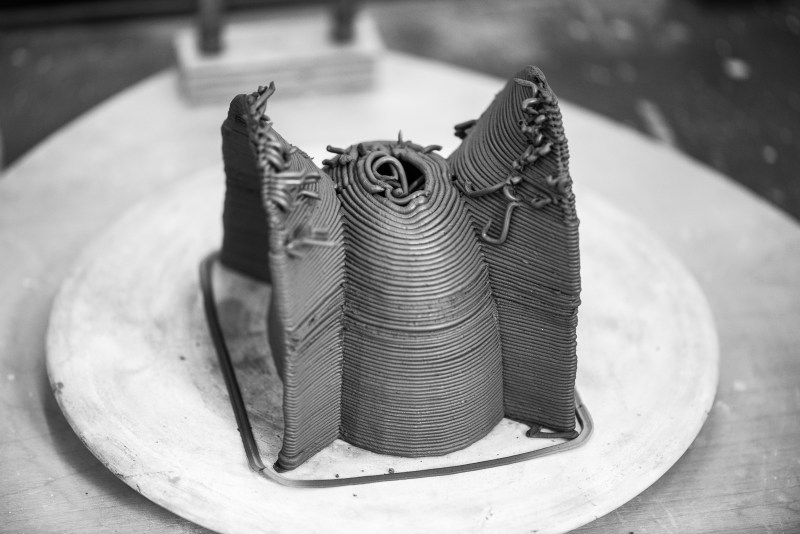
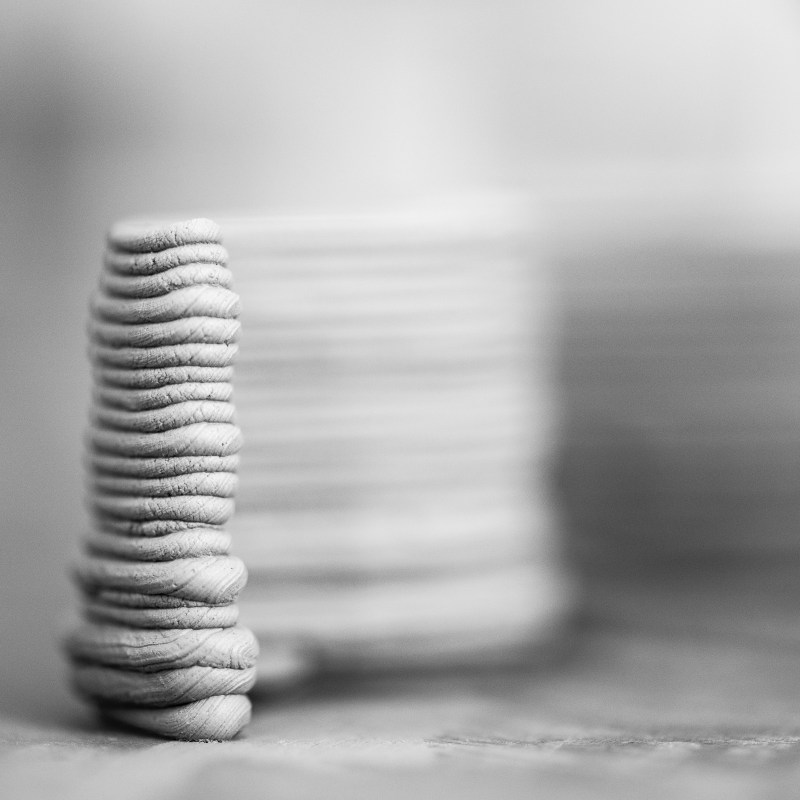
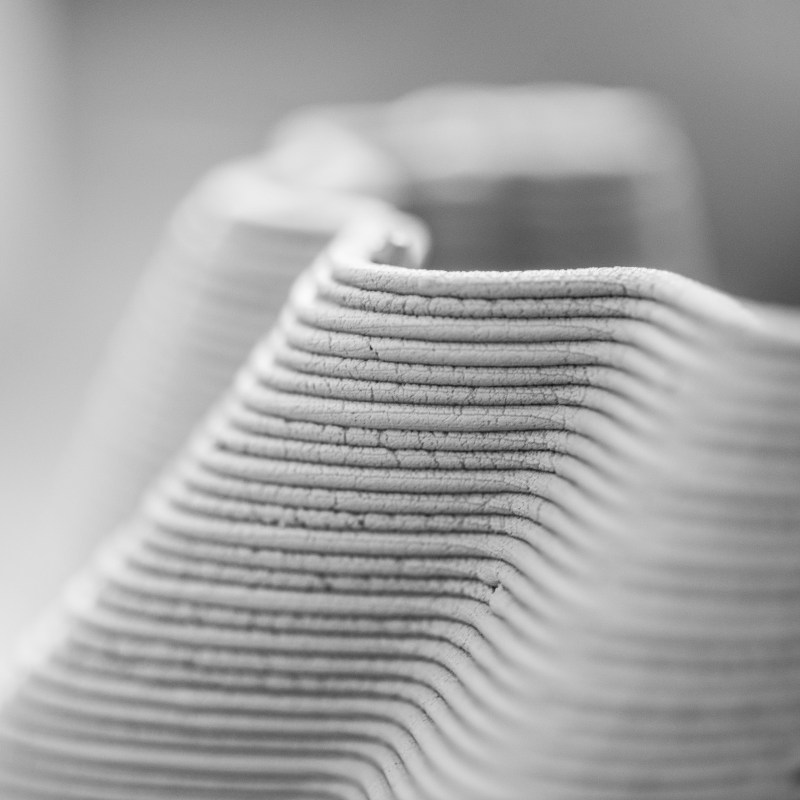
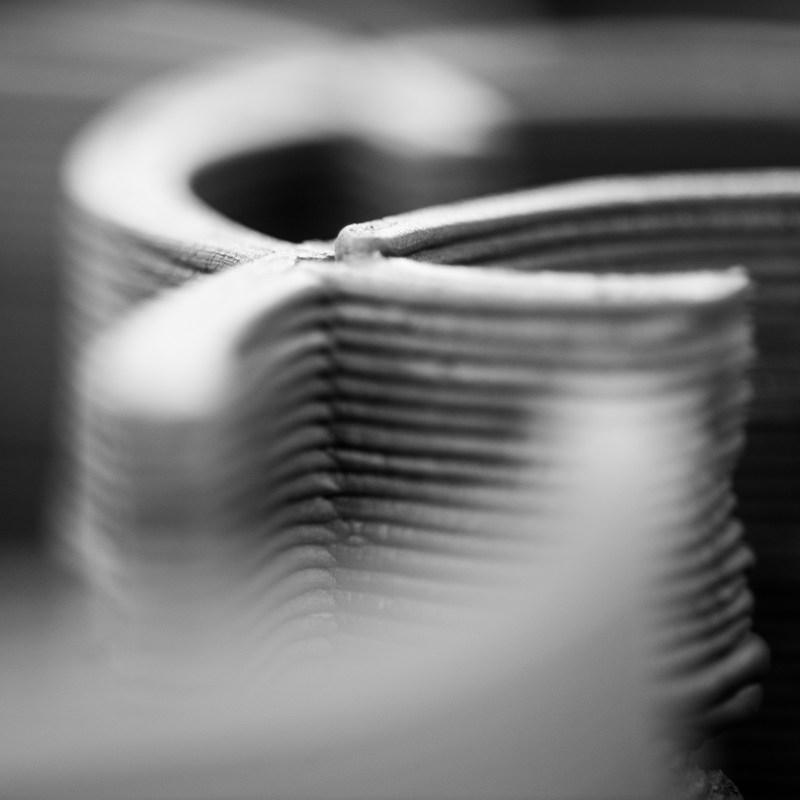
As hinted at in a previous post, I have been spending a fair amount of time this summer preparing 3D models for clay printing. I will talk about the models and the results at a later point. Today, we focus (or de-focus?) on watching the process. Printing a model takes time (say two hours for a model 20 cm in width) and requires almost permanent attention.

DSC 4140

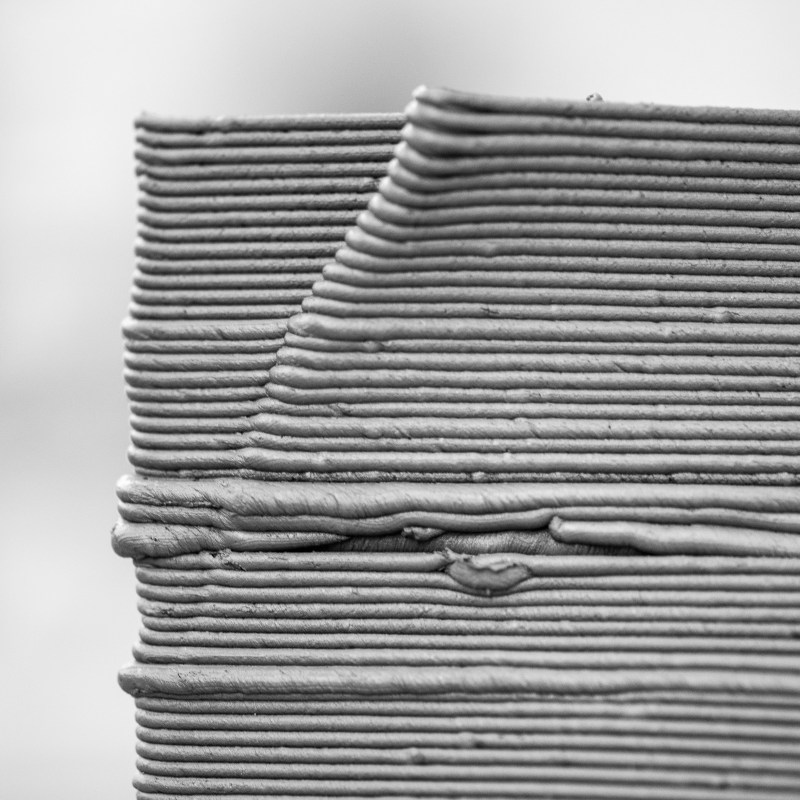
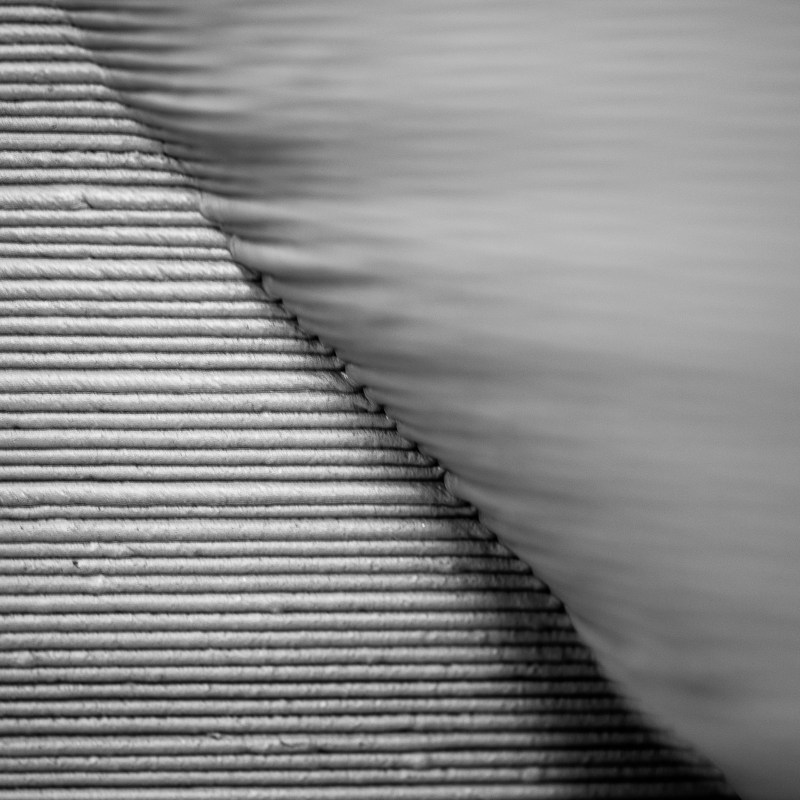
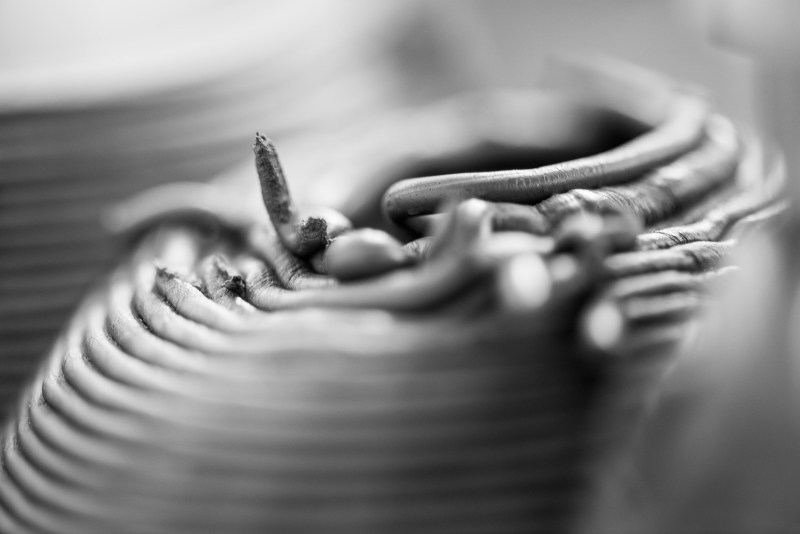
So one naturally begins to pay attention to details. The shallow focus of a macro lens not only allows to pinpoint these details, it also blurs everything else into pleasant abstraction.

DSC 4309

Color is almost irrelevant, unless one wants to bring out the gradual change of clay type from layer to layer. Everything is reduced to utter simplicity, to the extent that the all too human question for meaning is becoming meaningless.

DSC 4367

What matters is structure, and the work to be done to maintain it.

DSC 3863

Arbeit und Struktur (Work and Structure) is the title of Wolfgang Herrndorf’s Blog-Diary that he wrote in the last three years of his life.
This diary distills much of what mattered to him while facing death, and the title is a further reduction of this to just two words.