Alan Schoen’s 24 cubons possess a lot of structure. To get an idea why, let’s encode a cubon by a triple (abc) of numbers between 1 and 4 that indicate on which edge subdivision points its vertices are. For instance, the cubon below on the left would be encoded by (243).
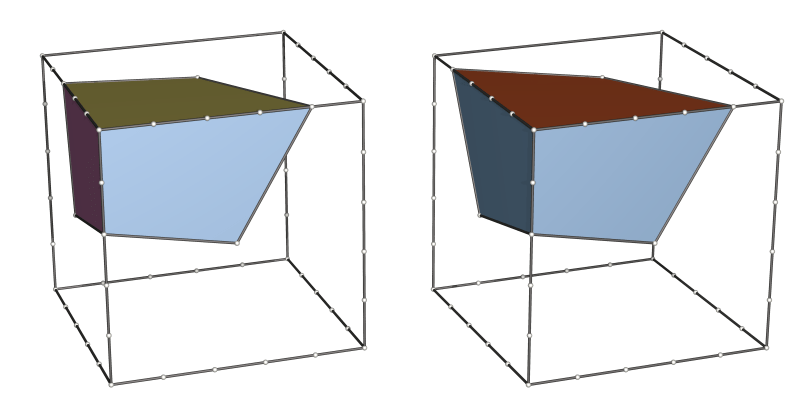
Cyclic permutations (432) and (324) encode the same cubon, but (342) is chirally different. The cubon in the right is achiral, as can be seen from its encoding (244). This makes it easy to count: there are 8 chiral and 16 achiral cubons, suggesting that one might be able to assemble a single cube just with the chiral cubons.

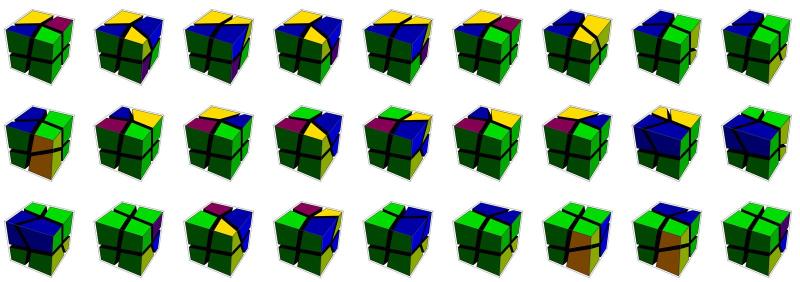
This is indeed possible, in exactly 32 essentially different ways, i.e. up to rotations. Below is a representation of the same solution set as nets:

Similarly, the 16 achiral cubons can be divided in 50 different ways into two groups of 8, each of which can be assembled in (several) different ways into cubes. Most of these have only few ways to be assembled but one of them has 27 essentially different ways to accomplish this for each of the two cubes. Here is one set

and here the second one. Notice the striking color separation.
There is more structure on the set of solutions. For instance, there is a polar “inversion” that changes the subdivision point of each edge from a to 5-a. This turns any cubon (a,b,c) into the cubon (n-a,n-b,n-c). Following Schoen, we’ll call a decomposition of a cube obtained this way from another decomposition its polar. A decomposition is self-polar if it is congruent to its polar.
Can you assemble the 24 cubons into three cubes that are self-polar, or so that one is self-polar and the second is the polar of the third?







 The Inner Frame