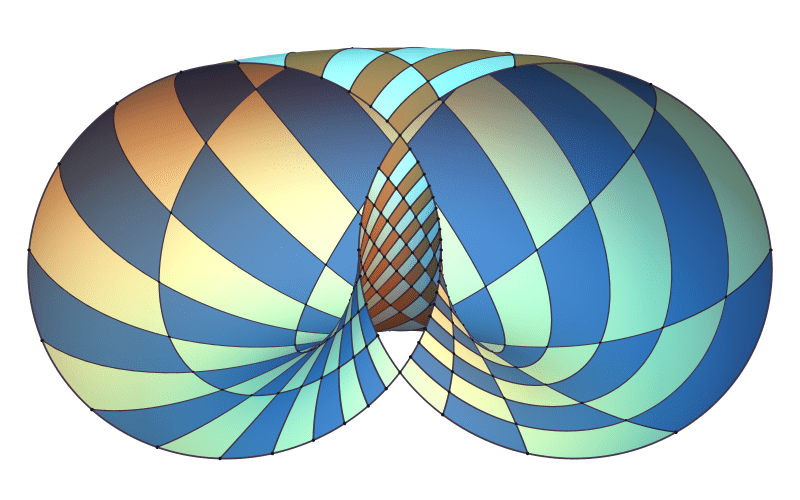
Cracks (Iceland II)

We usually think of a crack as a blemish. A cracked window needs to be replaced. The cracked patina of old paintings is reluctantly accepted as a proof of age. In The Fall of the House of Usher, Edgar Allan Poe has turned the crack in a wall into a bad omen of the worst kind. Roman Polanski did likewise with cracks in concrete in his film Repulsion. Are cracks really that bad?

In geologically active regions like Iceland, cracks happen more often than elsewhere, and on a much larger scale.

DSC 8181

The cracked wall above is from a house on the Westman islands that was half covered by the lave flow from 1973 and is kept as is as a monument.

Cracks appear everywhere. In individual rocks,

DSC 7776

in the ground like here near a lava tube,

DSC 9008

vertically, splitting entire mountains,

DSC 8630

or here, where the crack is literally between the American and European continent.

DSC 7741

How to Cut a Bagel (Annuli II)

Annulus 1

A torus is obtained by rotating a circle around a axis in the same plane. As such, it has two families of circles on it: the ones coming from the generating circle, and the orbits of the rotation. This allows you to slice the torus open using vertical or horizontal cuts, with the cross sections being perfectly round circles,

Torus3a

Of course, when you do this to your bagel, you do not really expect circles. But neither would you expect the bagel to be hollow.

The surprise, however, is that there is yet another way to slice a torus, still with perfectly circular cross sections. These are the Villarceau circles.

Torus2a

Here is how to do it. Looking at a vertical cross section, cut along a plane that’s perpendicular to your cross section and touches the two circles just above and below. The deeper reason for their existence lies in the Hopf fibration of the 3-dimensional sphere; these curves are stereographic images of Hopf circles.

Toruscut

Even more surprising is that there are certain cyclides that have six circle families on them.

Cyclideb