Arrows (From the Pillowbook IV)

So far, we have looked only at pillows with concave and convex edges. Today, we begin also to allow straight edges. To keep it simple, let’s look at the three different pillows that have two straight edges, one concave, and one convex edge. Here they are. I call them the arrow pillows.
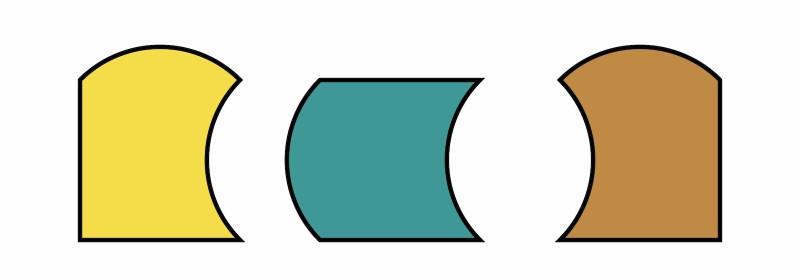
Arrows 01

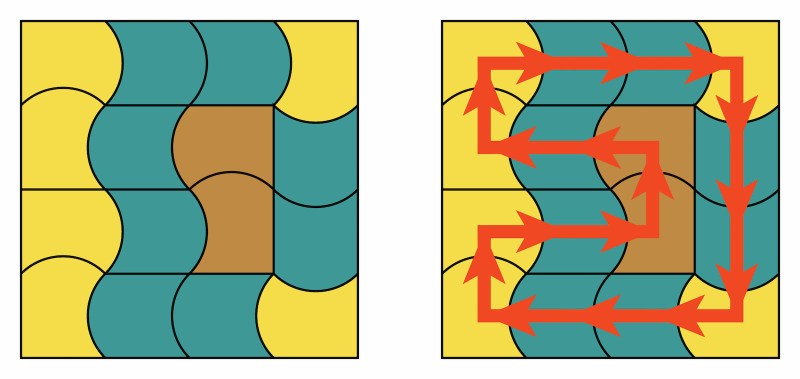
Because they have straight edges, we can finally tile rectangles that have straight edges, too, like so:
Sq4x4 01

There are a few immediate questions: Is this always possible? Can we say something about the number of arrows of each type we need? The key to the answers is indicated in the right image. The convex edge of one arrow pillow (the predecessor) fits snugly into the concave edge of a second arrow pillow (the successor), thus providing us with a recipe to move from one pillow to a neighbor. If we have a tiling of a rectangle just by arrow pillows, this sequence of consecutive successors must form a closed cycle. Therefore, the entire rectangle will be covered by possibly several such closed cycles, so we have what is called a Hamiltonian circuit. Readers of my blog have seen these before.

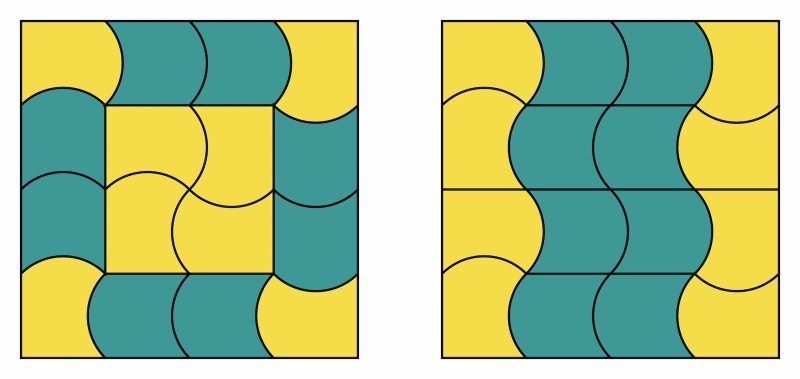
Vice versa, given any Hamiltonian circuit and a direction for each component, we can lay out the arrow pillows along each path to obtain a tiling. Below are two more examples with two components each that use only right and straight arrow pillows.
Sq4x4b 01

Can you tile a 5×5 square with arrow pillows? If you checkerboard color the rectangle black and white, any path alternates between black and white squares, so a closed path will cover the same number of white and black squares. Thus in particular Hamiltonian circuits must have an even length on rectangles.

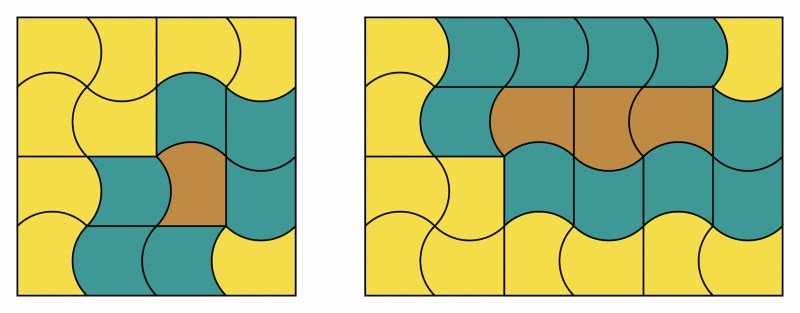
Let’s look at a single closed cycle, and let’s assume we follow it clockwise. Then there must be four more right turns than left turns. We have seen examples with no left turn arrow pillow, and with two left turns. Below are examples with just one and just three left turns.
Arrow13 01

These little insights not only help to show that some tiling is impossible, they also give hints to design tilings. For instance, suppose you want to tile a square using the same number of straight, right, and left arrow pillows. Then the smallest square for which this could work is the 6×6 square. We also see that we need an even number of cycles in our Hamiltonian circuit in order to balance the left and right arrow pillows. The simple solution below uses two mirror symmetric tilings of 3×6 rectangles.
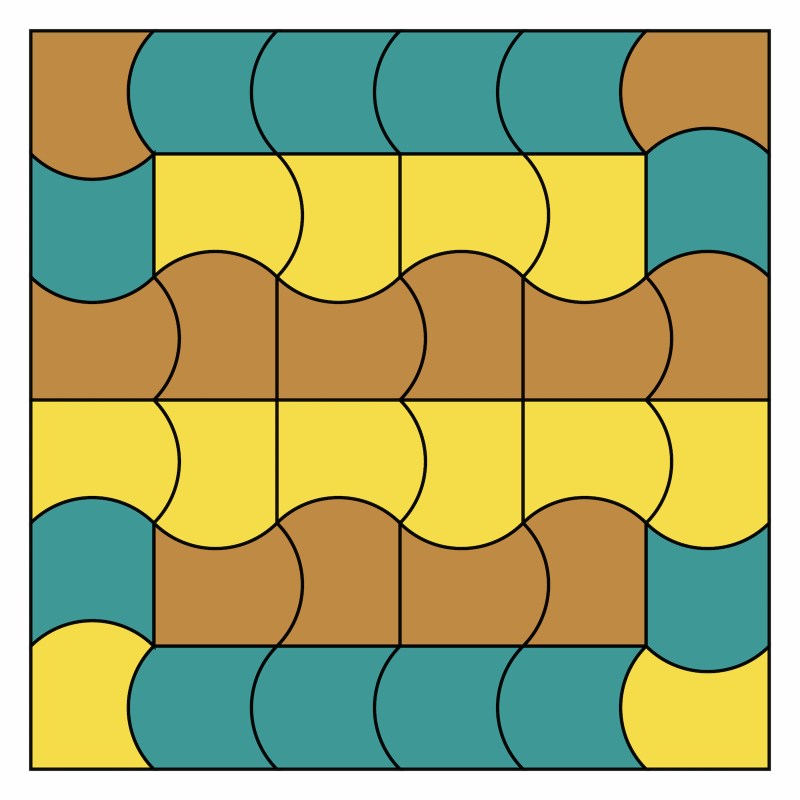
Sq6x6balance 01

Just Two (From the Pillowbook III)

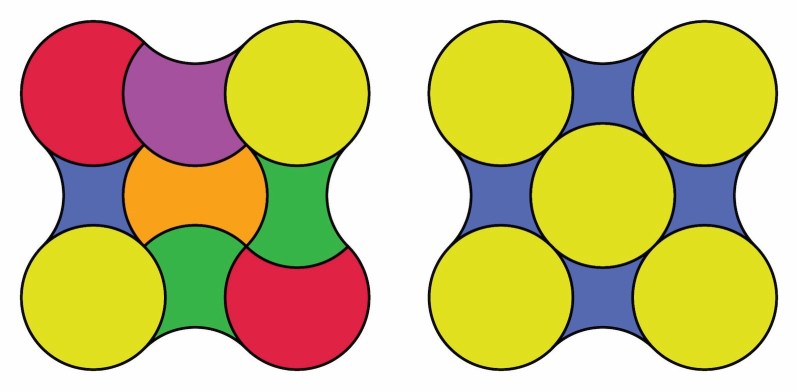
A while ago we learned how to tile curvy 3×3 squares with pillows. Most of the possible tilings need at least three different kinds of pillows. The only way to tile a curvy 3×3 square was using the Blue and Yellow. This changes when we look at tilings of larger curvy rectangles. For instance, below is a tiling of a 5×7 rectangle with Red and Blue:

Rb 7x5 rag

I have overlaid the curvy rectangle with a 3×4 ragged rectangle, tiled by L-trominoes. Each L-tromino is replaced with a cluster of 3 Reds, and the T-junctions of the L-tromino tiling are filled with Blues. As we have seen that every ragged rectangle whose area is divisible by 3 can be tiled with L-trominos. This gives plenty of examples. In fact, every
tiling of a curvy rectangle with just Blue and Red comes from an L-tromino tiling of a ragged rectangle.

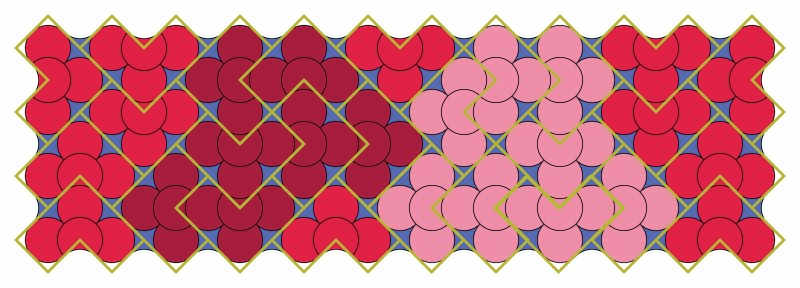
To see this, one can look at the possible ways a red pillow can be surrounded by blue and red pillows, and one almost finds that each red pillow belongs to a unique L-tromino. There is one exception that causes a little bit of headache that leads to circular clusters as in the example below (dark red and pink).

Rb 4x12 rag

But one can show anyway that such clusters can be tiled (in multiple ways) with L-trominoes.

Another challenge is to find a curvy square that can be tiled with just Blue and Red. That this is impossible follows from the deficit formula: We need to have the area r+b to be a square and r-2b =2 for r Reds and b Blues. But this implies that -1 is a square modulo 3, which is false.

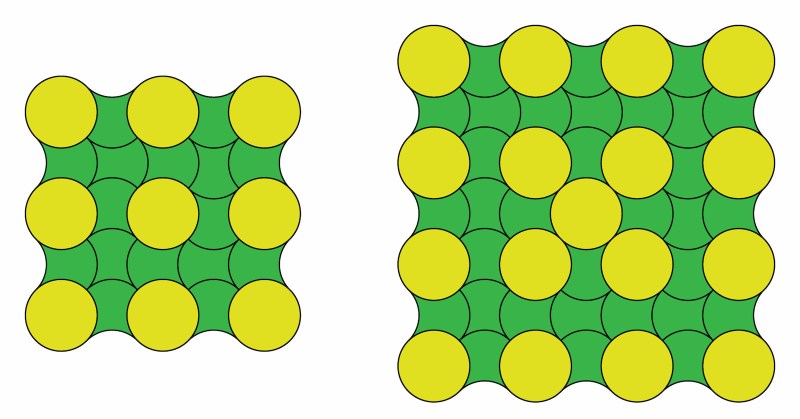
Tiled squares are possible with other two color combinations. The example of a tiling of curvy 5×5 square tiled by Yellow and Green is deceivingly simple. The next case of the 7×7 square below is more complicated. Can you find a pattern?

Gyex 01

The only really simple case is tilings by Yellow and Blue. All curvy rectangles can be tiled, and in only just one way.

By 5x5

A mean little exercise is to ask somebody to tile any curvy rectangle with Green and Red. There is no solution, because the deficit formula tells us that r-g=2, but r+g needs to be odd, because curvy rectangles have odd area.

There are a few more color combinations to consider. For instance using either orange or purple pillows together with a second color is impossible. By the deficit formula, this would require to be either a single yellow pillow or precisely two red pillows. For purple this means that there would be a line of purple pillows through the rectangle. But such lines always end at one concave and one convex segment, which can’t be. For orange this would require al least two orange corner pillows, which also doesn’t work.

Squares and Circles (From the Pillowbook I)

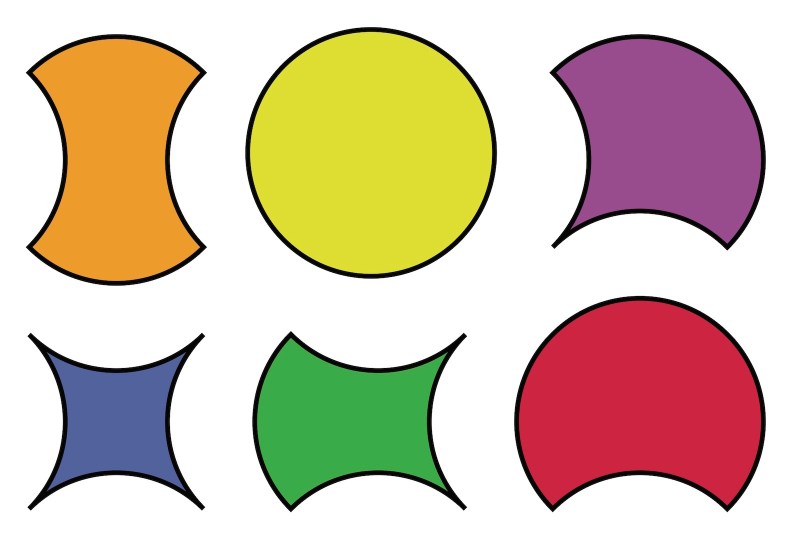
In a previous post, I have discussed triangles with curved edges and what they can tile. One can do the same with squares, only that things get more interesting, because there are six different shapes:

Curvies

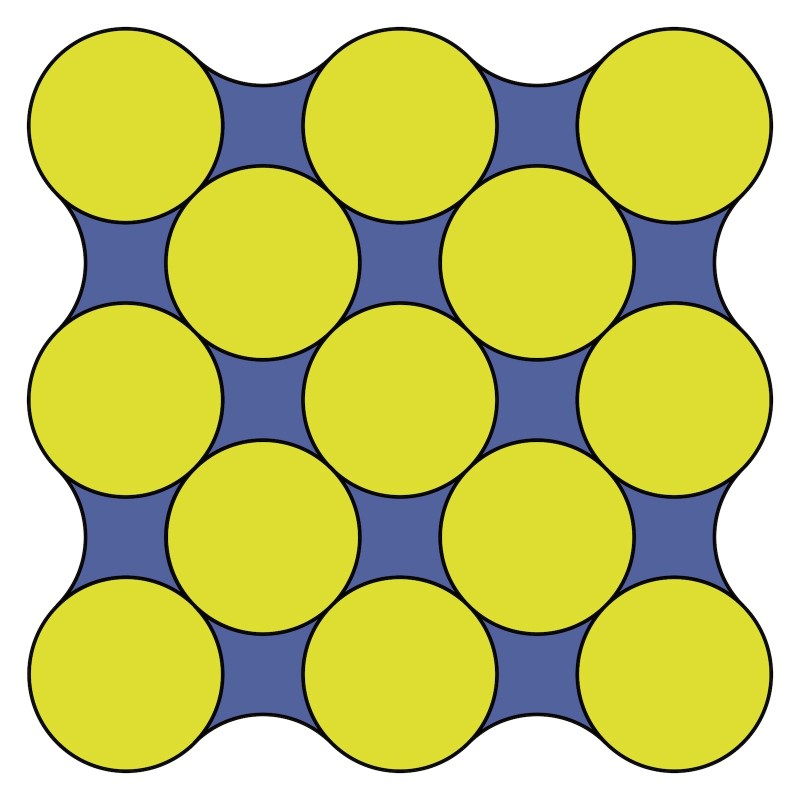
I have called them pillows, mainly because I want them as nice, big, colorful pillows. Hmm. The first problem I’d like to discuss is to tile curvy rectangles with them, like this curvy 3×3 square:

Curvysquares 01

It is pretty clear that all curvy rectangles have odd dimensions. The left example uses all six pillow types, the right only two, blue and yellow. To see what combinations of colors are possible, the following observation is useful: Each pillow has a number of edges that are convex (curve outwards) and other that are concave (curve inwards). For instance, orange and purple both have two convex and two concave edges. Yellow has just four convex edges. With that, we have a little

Theorem: In any curvy rectangle, there are four more convex then concave edges in all pillows together.

A picture should make this clear:

Edgecount

This helps to predict how many pillows of each color we need.
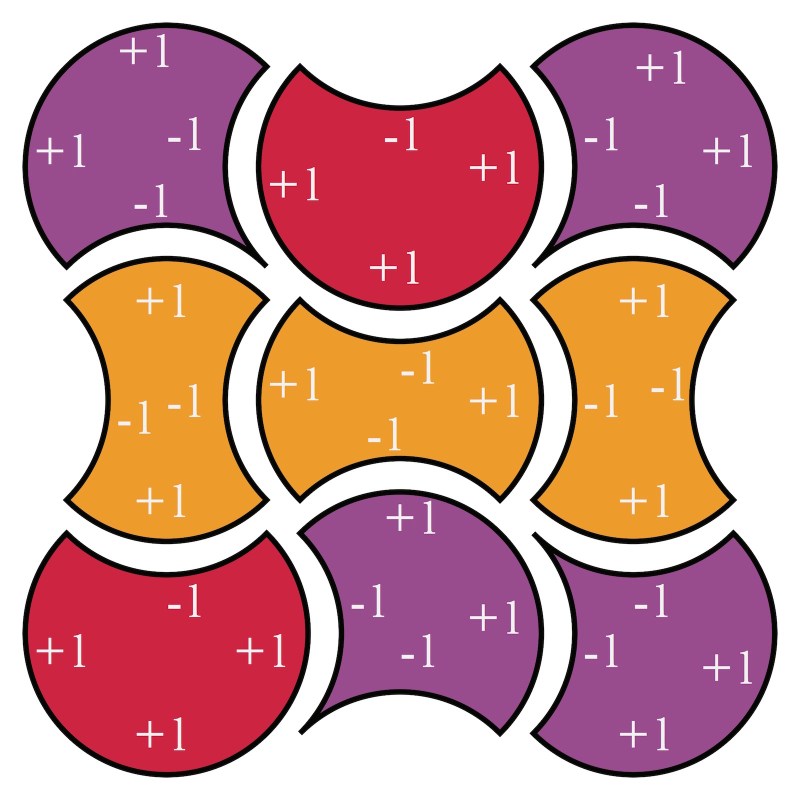
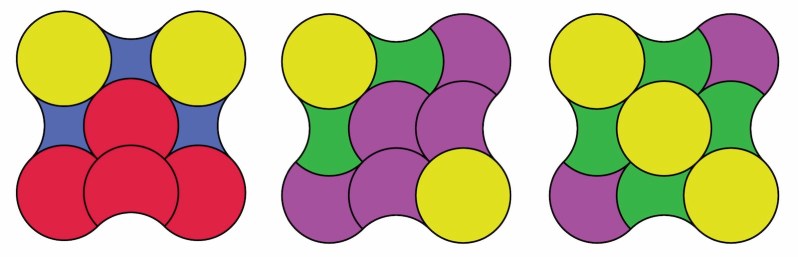
For instance, suppose we want to tile a curvy 3×3 square with y yellow, r red, and b blue pillows. We then need y+r+b=9, and, by the theorem, 4y+2r-4b =4. It’s easy to see that this forces y=2, r=4, b=3. Similarly, if we are only allowed to use yellow, purple, and green, the only possibilities are y=2, p=5, g=2 or y=3, p=2, g=4. Here they are:

Curvysquare2 01

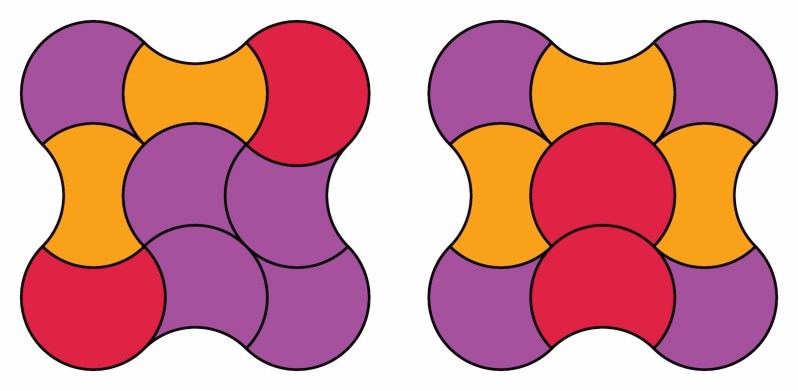
That we found a solution in positive integers does not mean that there is a tiling that realizes this solution. For instance, suppose we want to use red, orange, and purple, then we need to have r=2, but for o and p  we can have any pair of positive integers that sum up to 7. However, only o=2, p=5 and o=3, p=4 can be realized. The solutions are not unique, here are two symmetric ones:

Curvysquare3 01

There are about a dozen little exercises like these. To be able to say something interesting about larger curvy rectangles, we will need to study ragged rectangles in a few weeks.

Just Triangles (Polyforms III)

In a former, more optimistic life, I wanted to write a book for elementary school children that would get them excited about math and proofs. This would of course go against the grain. Proofs have essentially been eliminated from all education until the beginning of graduate school. With good & evil reason: Not because they are too difficult or not important enough, but because it could possibly induce the children to come to their own conclusions.

I also was ignorant about who controls public education: Neither the students, nor their parents, nor the teachers, and not even the text book authors. It is solely those people who are making money with it.

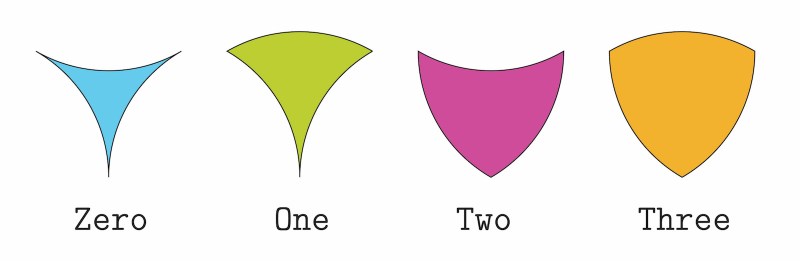
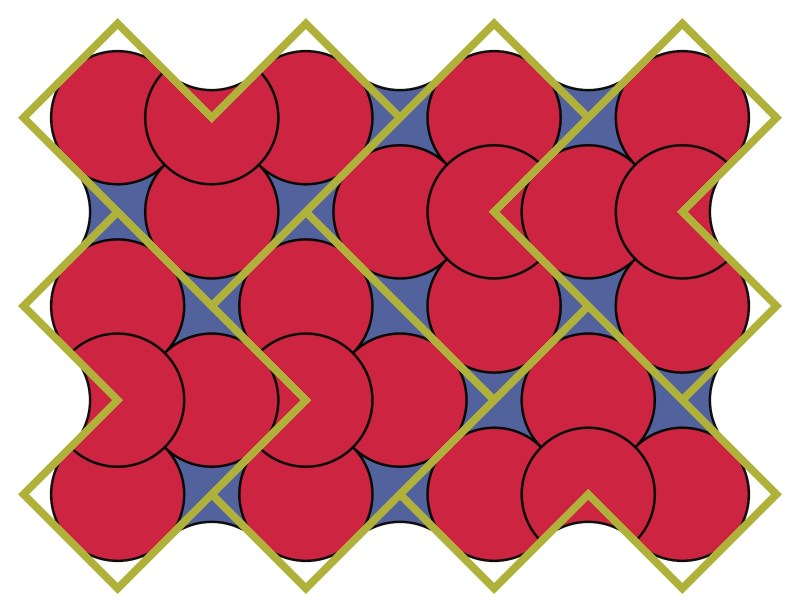
Before I get the reputation to be yet another hopeless conspirationist, here is another message in a bottle, in multiple parts. It is once again about polyforms. I need to say what the shapes are that we are allowed to use, and what we want to do with them. In the simplest, we are using four shapes, which are deflated/inflated triangles like so:

Triangles 01

They already have received names, which count the number of edges that have been inflated. We (you) are going to tile shapes like these that have no corners:

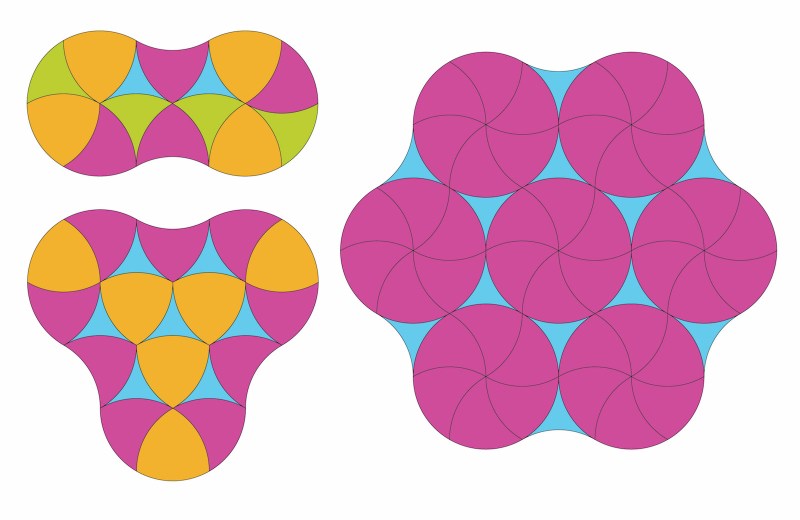
Regions 01

We call these circular regions, because they consist essentially of a few touching circles with a bit of filling to avoid holes or corners. The circular regions above consist of two, three, and seven circles, respectively, and they already have been tiled. We can start asking questions: What shapes without corners can you come up with? Are they all circular regions?

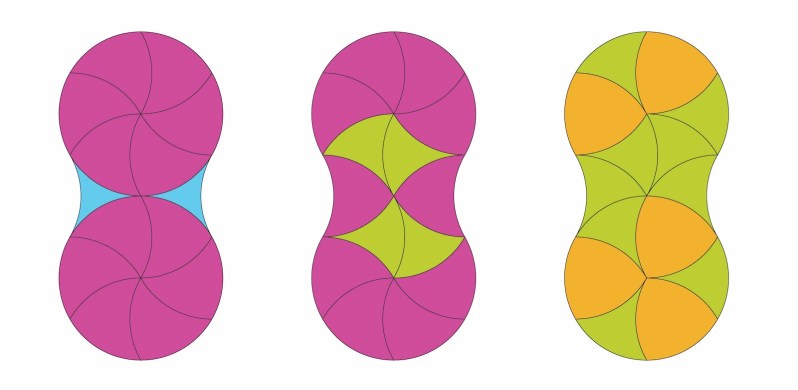
Then there is time for exploration: Find all ways to tile a circle (the circular region with just one circle) with the curved triangles. Find all ways to tile the bone (the circular region with just two circles) using only two different kinds of triangles:

Di bones 01

Now, upon experimenting, the number of curved triangles to be used to tile a circular region is not quite arbitrary.
The first, not so trivial, observation is that for a circular with N circles, we will need 8N-2 triangles. That is because each circle contributes 6 triangles, and for adding a circle we have to use 2 more triangles. This is not quite a proof yet, but at least an argument. There are also interesting problems when the domain is allowed to contain holes…

Circles3 01

Because the different curved triangles contribute a different amount of area each, there is a second formula.
Let’s denote by N(0), N(1), N(2), and N(3) the number of curved triangles of each type (zero, one, two, three) that appear in a tiling of a circular region with N circles. Then N(1)+2N(2)+3N(3) = 12N. This formula counts on the left hand side how many triangle edges are inflated and hence contribute extra area. On the right hand side, we count the same, using say the pattern we see in the tiling of the circular region with 7 circles in the second image above.

The two formulas together allow you to determine how many triangles of each kind you need in an N-circle region, if you are only using two different triangles.

To be continued?

Polysticks (Polyforms II)

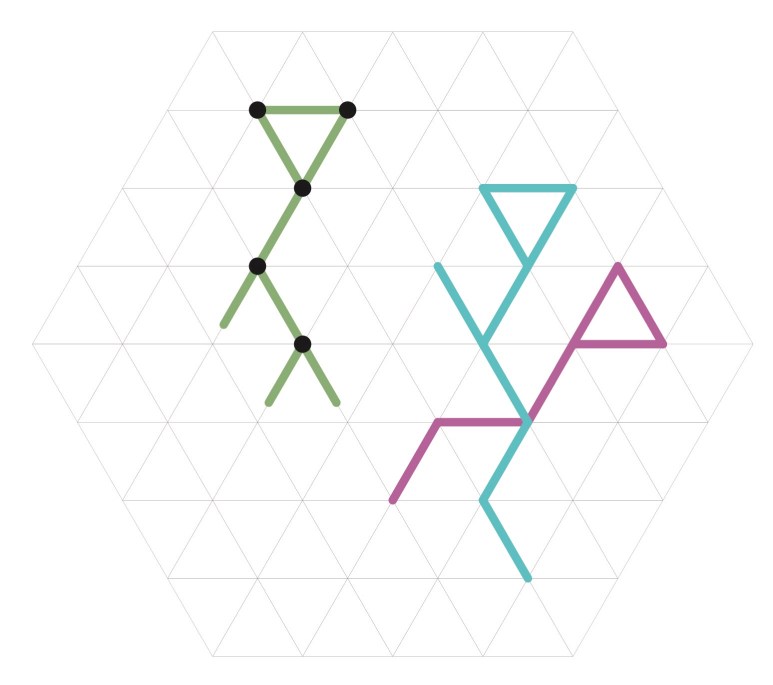
One of my favorite polyforms are polysticks on a hexagonal grid. These critters consist of connected collections of grid edges.
I stipulate that whenever two edges of a polystick meet, we add a a joint to the figure. This is in order to avoid indecent intermingling of legs as shown by the two polysticks in the figure below. Blush. The properly decorated green polystick can only watch in dismay.

Example 01

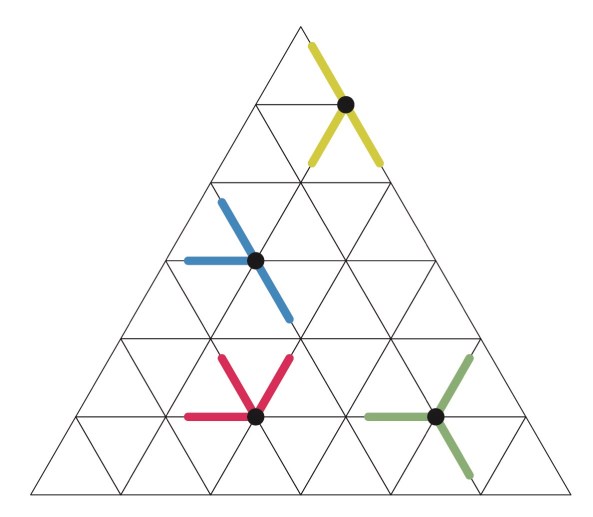
We want to use the polysticks as puzzle pieces, and we want to keep things simple. So here are all four hexagonal polysticks with three legs and just one joint. I like to call them triffids.

FourTriffids 01

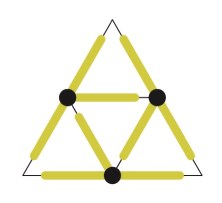
Two of them are symmetric by reflection, so I leave it up to you to count them as one or two. We can us three of them to tile a small triangle easily like so:

Mini triangle 01

By tiling I mean that we want to cover all the edges of the given shape, do not allow that two polysticks share a leg or joint (what a thought!), and do not require all vertices to be covered. We could do so, limiting the possibilities dramatically.

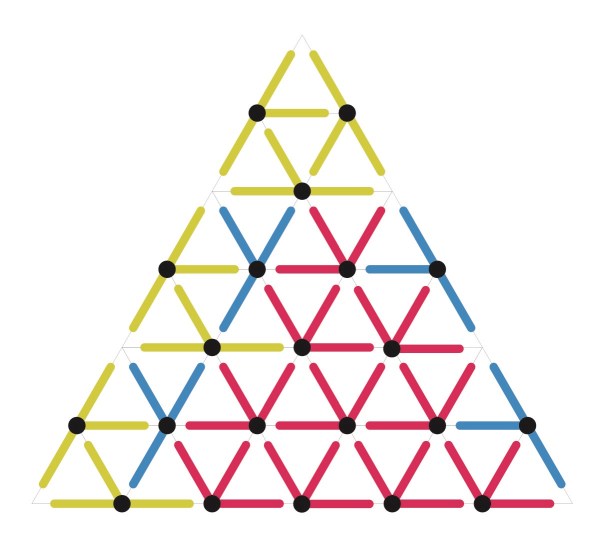
Below are two more examples. First a larger triangle, tiled using three kinds of triffids.

Triangletile 01

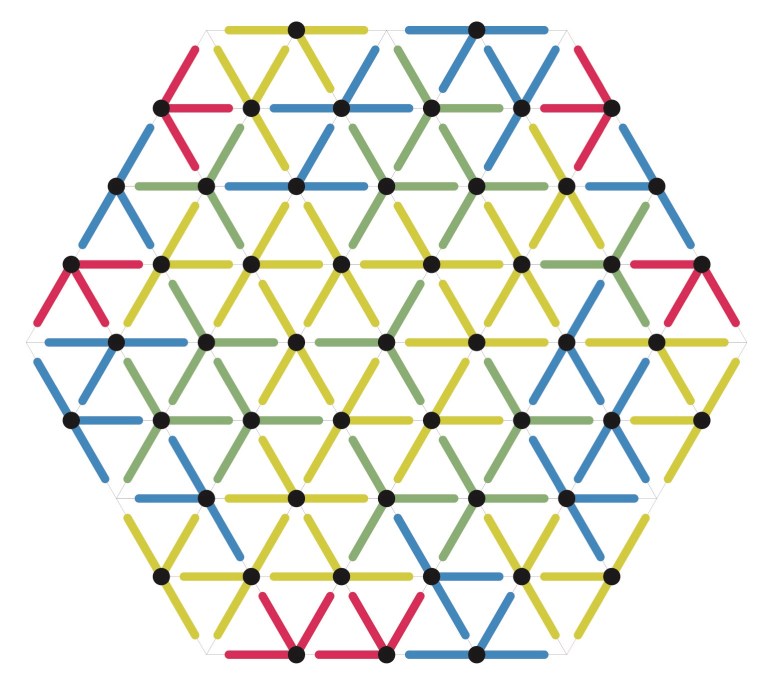
I have not found a way to tile this triangle (or a larger one) with just one kind of triffid. And here is a hexagon that uese all four triffids to be tiled:

Hexatile 01

Now go and make your own. If you want to use triffids, make sure that the number of edges of your shape is divisible by 3.