This post in the Sphere Series is motivated by the recent Circles post. It’s easy enough to conceive a generalization where we place spheres with centers at the points with integer coordinates in space, and set the radius so that something interesting happens.
There is a problem, though. We could visualize the 2-dimensional circle case because we could look onto the plane from our privileged position in 3-space. To do the same with spheres, we would need to step outside 3-space into 4-space. Let’s not do that.
Instead, let’s look at the simplest case of circle intersections. We can think of the quarter arcs as deformed straight edges of squares.
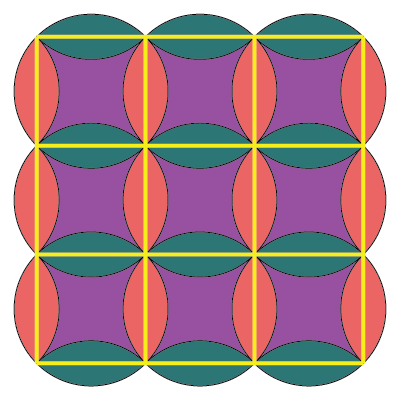
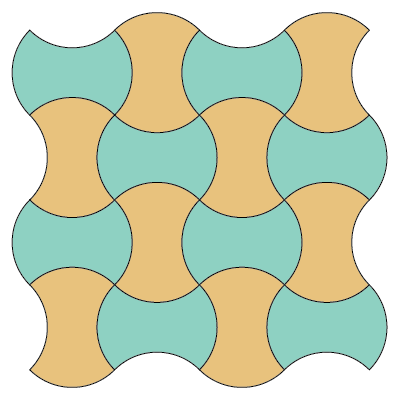
To make things visible, we have to remove some of them, and a natural choice is to remove every other arc, like so:
A similar approach works in three dimensions. Here, the spheres are arranged in a cubical lattice, and we can think of this as tiling by cubes where each cube has been replaced by an inflated sphere.
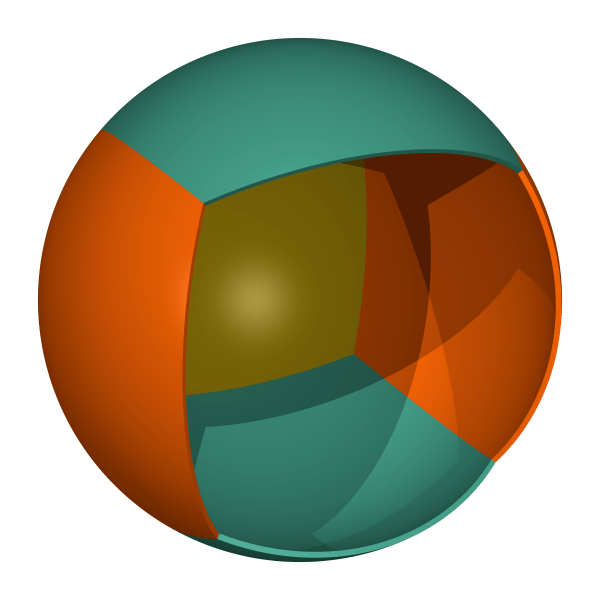
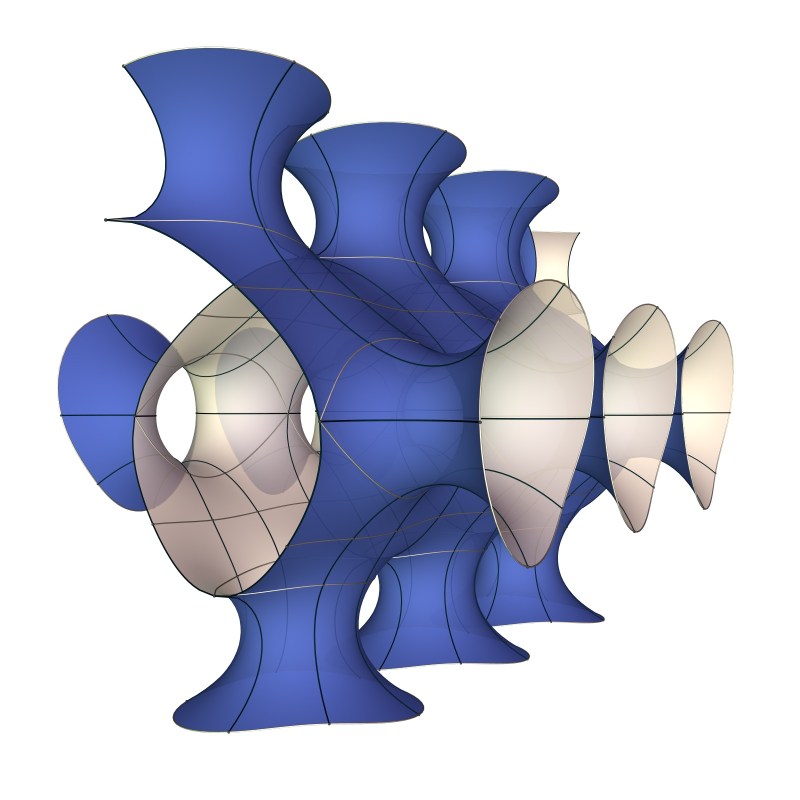
This would still be too busy, so I have removed some of the spherical shards. The choice for that is suggested by a minimal surface, the P-surface of Hermann Amandus Schwarz.
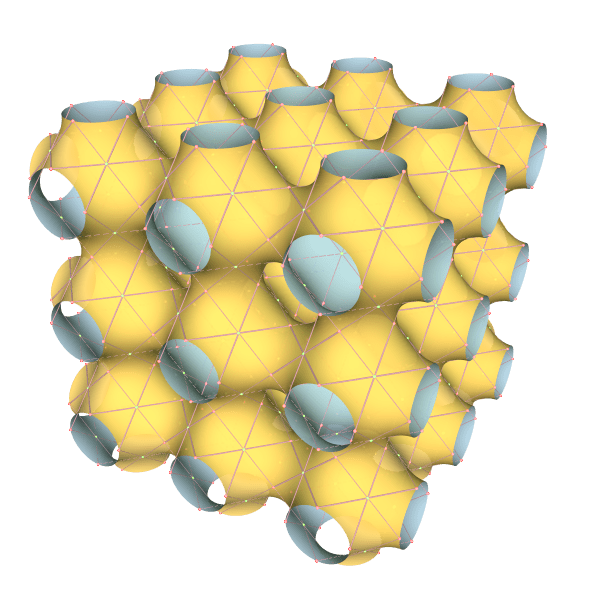
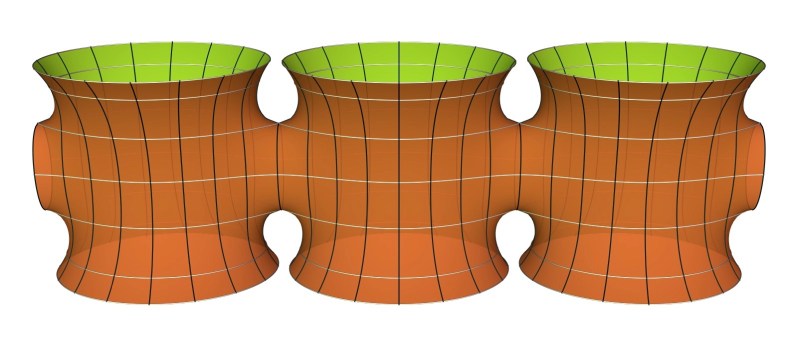
You can think of it as consisting of plumbing pieces that have connectors in six directions: up, down, left, right, front, back. There is a coarse polygonal approximation by it, using squares. Both the original minimal surface and its polygonal approximation divide space into two identical parts. A rat could not tell whether it lived on the insid or outside of the plumbing system.
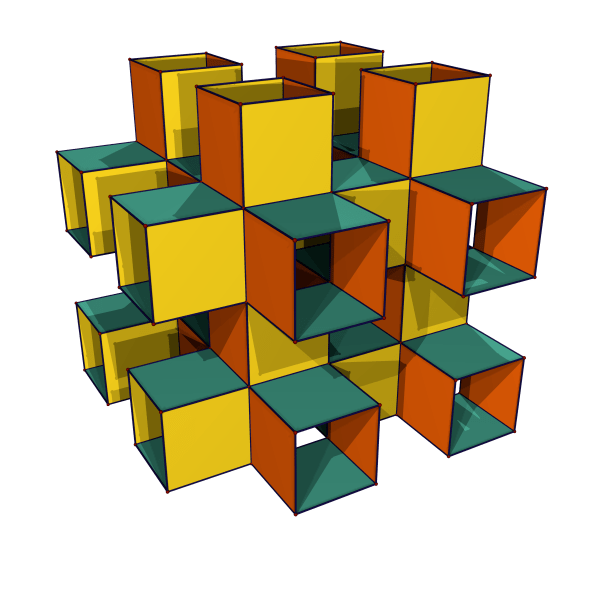
If we push the squares a little as to create four-sided pyramids, alternating the direction, we get the prototype of the model of sphere shards. In the spherical version, the shards meet just at the corners, leaving enough space so that light can get through.
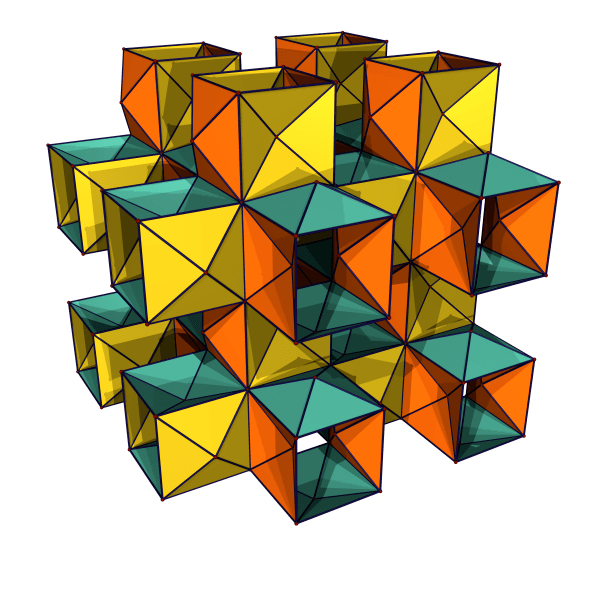
To make the sculpture more interesting, I have varied the colors, and moved it (sort of) off center. I feel it is a a visual representation of minimal music. Granted, there are many kinds of minimal music, and I do like many of them, but not all. The one I have in mind here would have to be composed by Steve Reich.
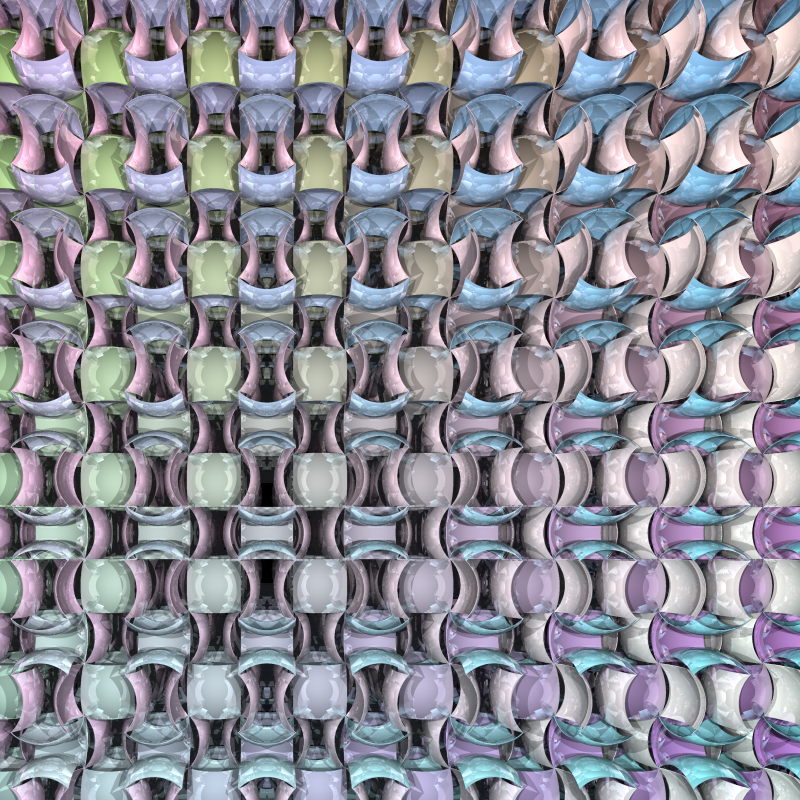
This would make a nice pendant sculpture. As material, I would prefer ceramics, not glass.
 The Inner Frame