The deltoid is an intriguing curve. You start with a blackish circle of radius 3, within which rolls a bluish circle of radius 1, and a point on its perimeter traces out an orangish curve ⎯ the deltoid.
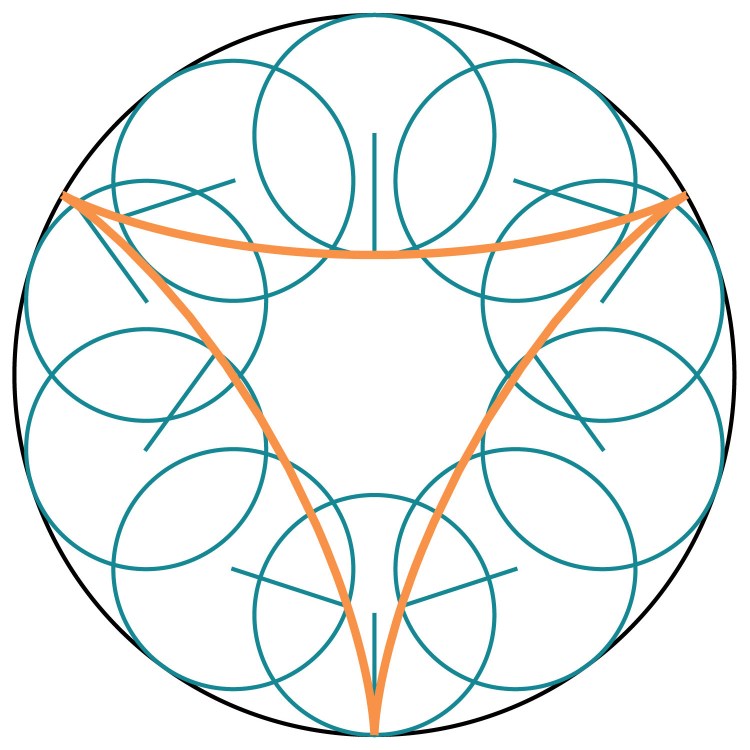
One of its remarkable features is that if you draw the tangent-secants, i.e. the line segments that touch the deltoid at one point and foot on the two other sides of the deltoid, you get segments of always the same length 4, no matter where you start. This means that you can rotate a segment of length 4 within the deltoid by 360 degrees. The deltoid being smaller then a circle of radius 2, this almost immediately triggers the Kakeya problem: How much area do you need to rotate a segment by 360 degrees? The surprising answer is that you can make the area as small as you like. The deltoid won’t like it. But it opens up all kinds of design possibilities…
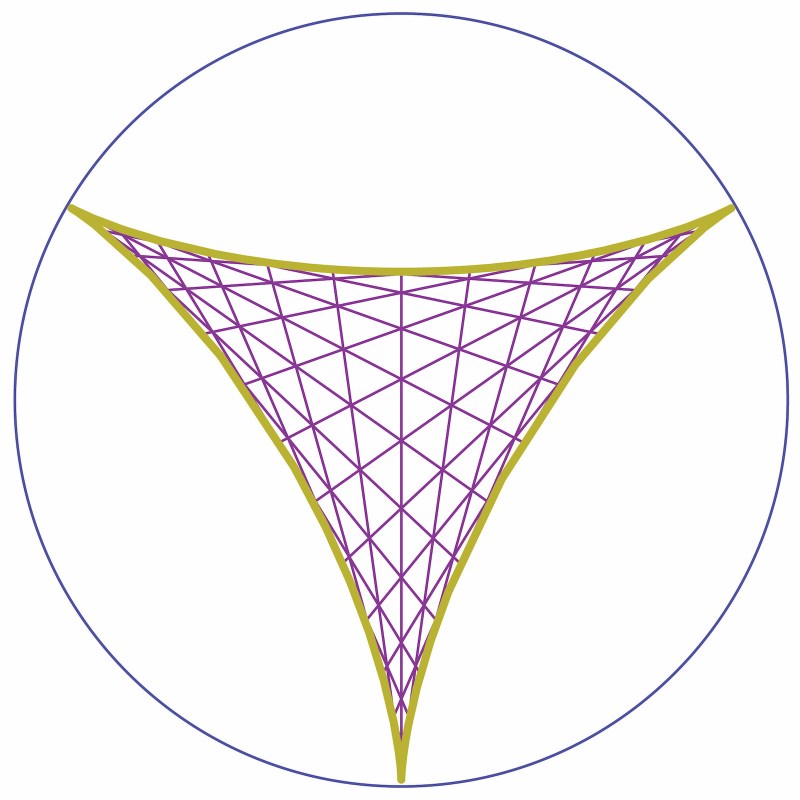
Somewhat surprisingly, in the image above, these famous secant-tangents meet at triple intersections. Lines don’t do that, generally. In this case, this allows for a seductive design, tiling the curvy deltoid triangle with hexagons. Whenever there is a tiling by hexagons around, there is usually a hexagonal torus and a group structure around the corner. Let’s unravel that.
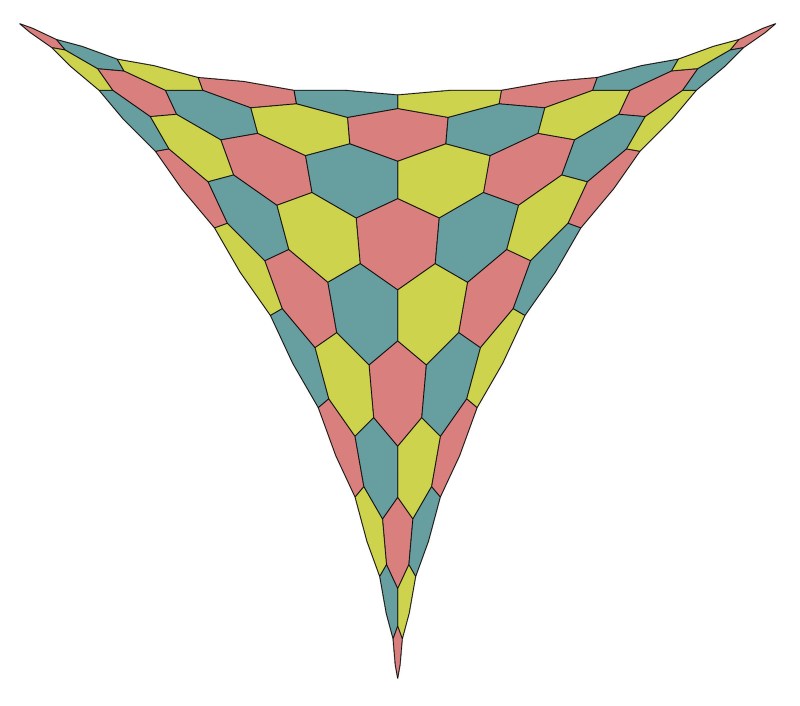
This situation also reminds us of the theorems high school students have (still!!!) to suffer through about lines in a triangle that happen meet at a single point. Well. One of the more intriguing facts here is Ceva’s theorem that tells us precisely when three lines through the vertices will meet at a single point.
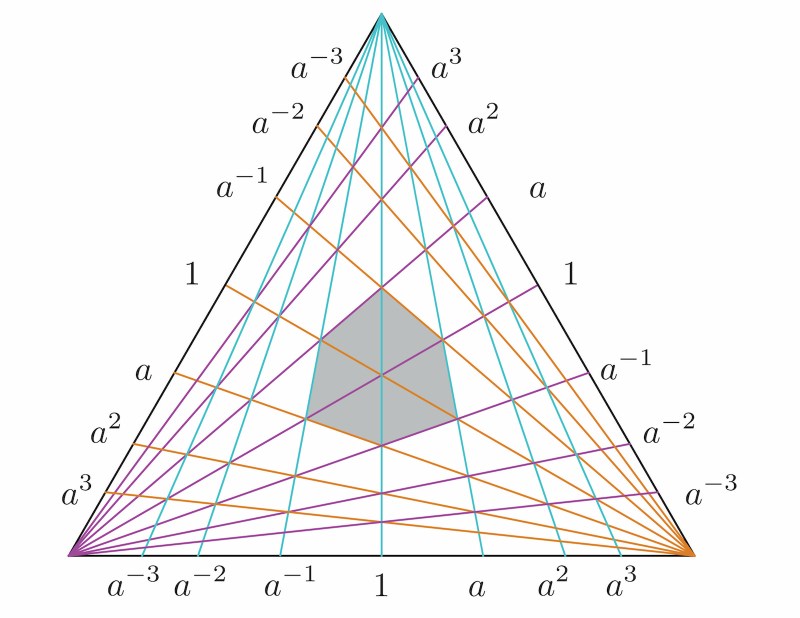
Think about it like this: A perspective drawing of a single cube projecting along one of its diagonals will give us a (gray) hexagon. It requires 3 vanishing points (chosen arbitrarily) where opposite sides of the hexagon will intersect. I have picked them at the corners of an equilateral triangle, but everything will work for other body types, too…
Parallel edges of the cube have to meet at these vanishing points, which determines the drawing. If you project several cubes of a cubical lattice simultaneously, you will get an image like the one above.
As expected for projections of cubes, three lines meet at a point. Ceva’s theorem states that this is the case if and only if these lines divide the triangle edges in proportions whose product equals 1. Check it out! The points along the edges are already labeled with a proportion depending on an arbitrary parameter a. Turning this around, one can create a tiling of a triangle by hexagons using a geometric progression of proportions. So the group here is on each edge of the triangle the multiplicative group of positive real numbers, interpreted as proportions.
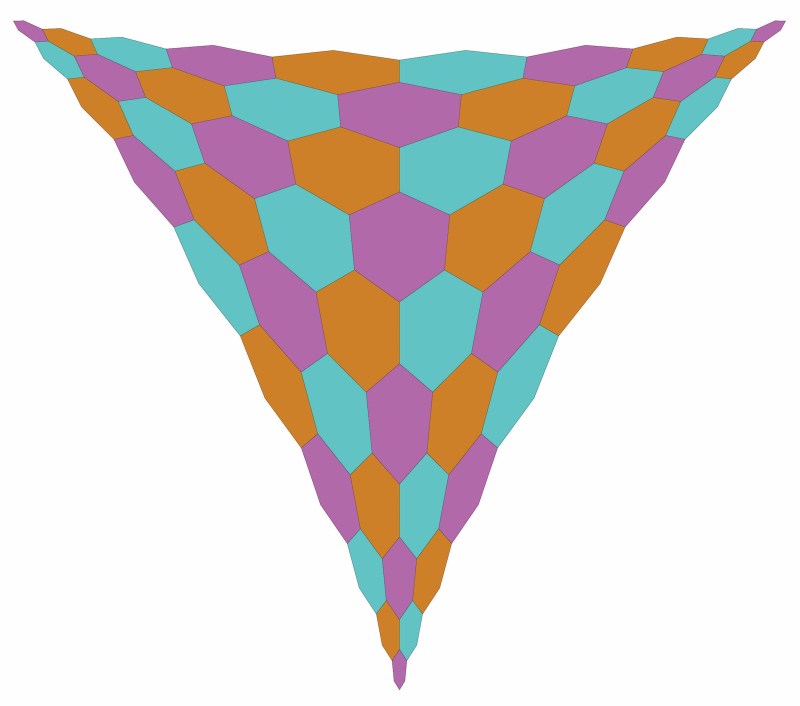
The analogue of Ceva’s theorem for the deltoid states that the sum of the angles (using the angle of the rotating circle as a parameter) for the points where three tangent-secant touch the deltoid adds up to 360 degrees if and only if the three tangent-secant meet at a single point. So, in a sense, the deltoid is the additive version of the good old (multiplicative) triangle.
Let’s just hope the pretty designs help to cover up all the math underneath…
 The Inner Frame