The Quarry

The quarry is an interesting design pattern. Our daily lives need nurture, and while some of the nutrients are free or at least easily available, there are some that require hard work: Seek out the sources, mine them with skills and stamina, and transport and transform the goods into desired place and shape.

DSC 4881

We all should have our own personal quarries (which is why I declared them a design pattern, not for computer science but for the architecture of our own lives). My personal quarries, in a pre-internet life, used to be bookstores. They had their own personality that you needed to get acquainted with, invited into, so to speak. There were unforgettable moments, for instance, when I went into one of these quarries in Marseille, found Marcel Béalu’s L’Expérience de la nuit, and was told by the wise person at the cash register c’est une très beau livre. Indeed it is.

DSC 4897

Another key experience was my visit to a museum book store in a city I hadn’t been before. I was instantly struck by a déjà vu experience next to none: I had been in this bookstore before. To prove this to myself, I went straight to a shelf in a particular aisle and retrieved the book I knew was there. I don’t believe in these things, and they don’t happen to me.
DSC 4877

It took me a few hours to remember that I had been to a another museum a few years back, and visited their museum store, which had the exact same layout as the one that caused my déjà vu. This was long ago, and in Europe, and I was not familiar with the fact that store owners had discovered design patterns and used them for cheap and successful replication.

DSC 4896

Since then, times have changed again. Not only are my book quarries mostly gone, but even the chains of near identical book stores have largely disappeared, replaced by electronic online retailers. I don’t object the internet (how could I). But I believe that we need to resist the total commercialization of our lives. We can do so by creating little quarries for others. Maybe.

DSC 4880

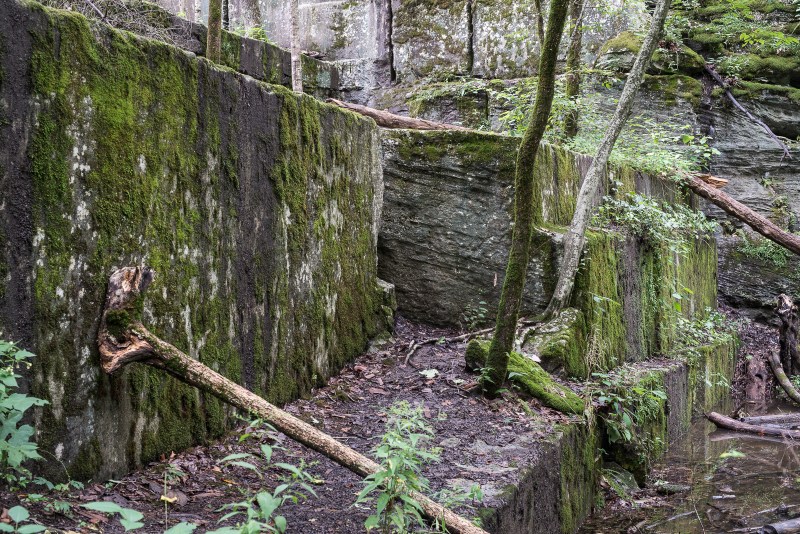
The pictures here are from the Old State House Quarry in McCormick’s Creek State Park. Southern Indiana is limestone country, and the lime stone from this particular quarry was quarried in the late 19th century.

The Trefoil Knot

In mathematics, even the simplest things can have an astounding depth. Let’s for instance take the trefoil knot, the simplest knot there is:

Trefoiltube

One can replace the tube by a ribbon, like so:

Trefoil2

This could be done with a simple ruled surface, but I like a challenge. To make this a minimal surface, one can use Björling’s formula. The game becomes tricky if one wants the surface to be of finite total curvature, but this can be done as well. Then it is not difficult to let the normal of the surface rotate once to get a knotted minimal Möbius strip.

Trefoilmobius

Faster spinning normals create knotted helicoids.

Trefoil30

Extending the surface beyond a small neighborhood of the trefoil knot makes things appear really complicated.

Trefoilbig

Of course the same can be done with more complicated knots.

Quatrefoil

Deltoids in Clay

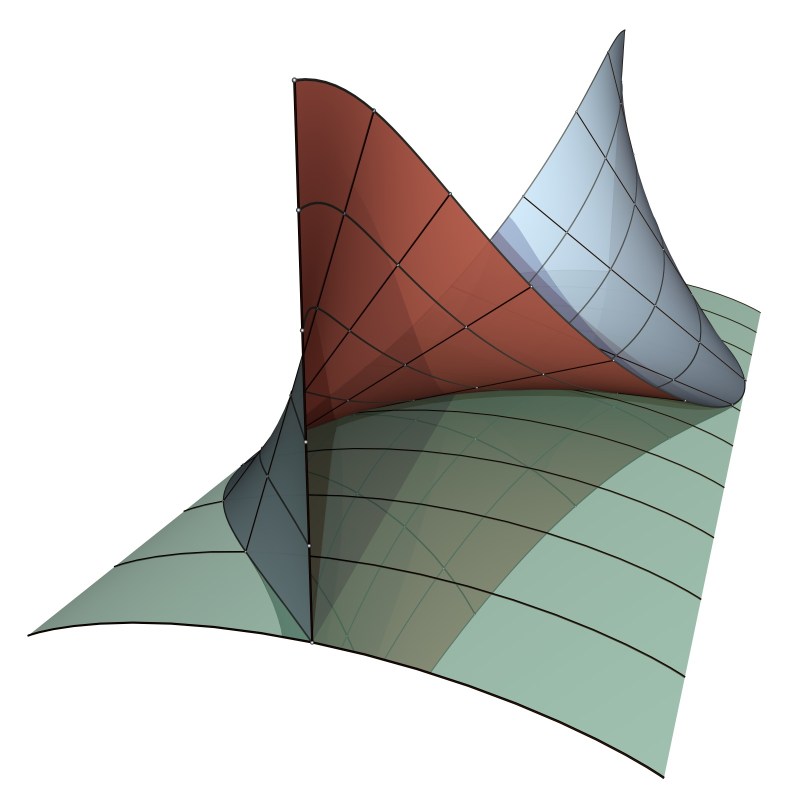
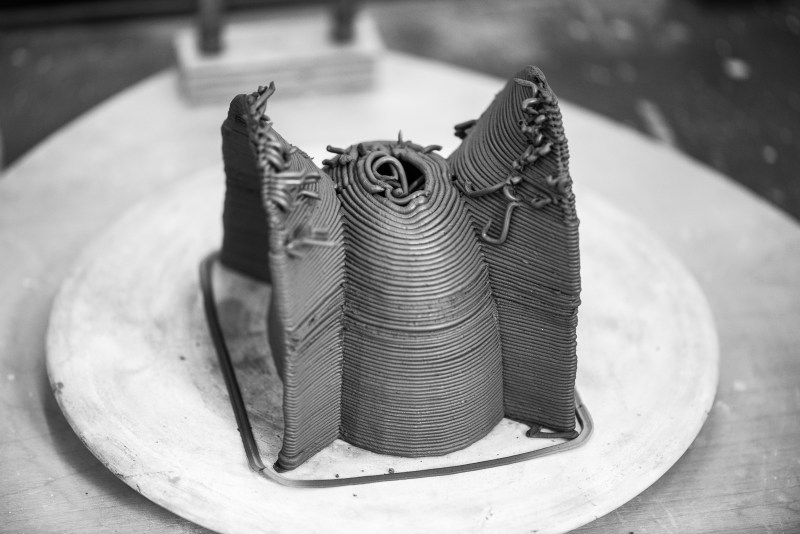
Clay printing currently works best for objects that change slowly from one horizontal layer to the next. This suggests to create 3-dimensional objects that realize a changing 2-dimensional configuration in one piece. An example of that is the rotating segment within the deltoid that at every stage foots on two sides of the deltoid and is tangent to the third.

Deltoid

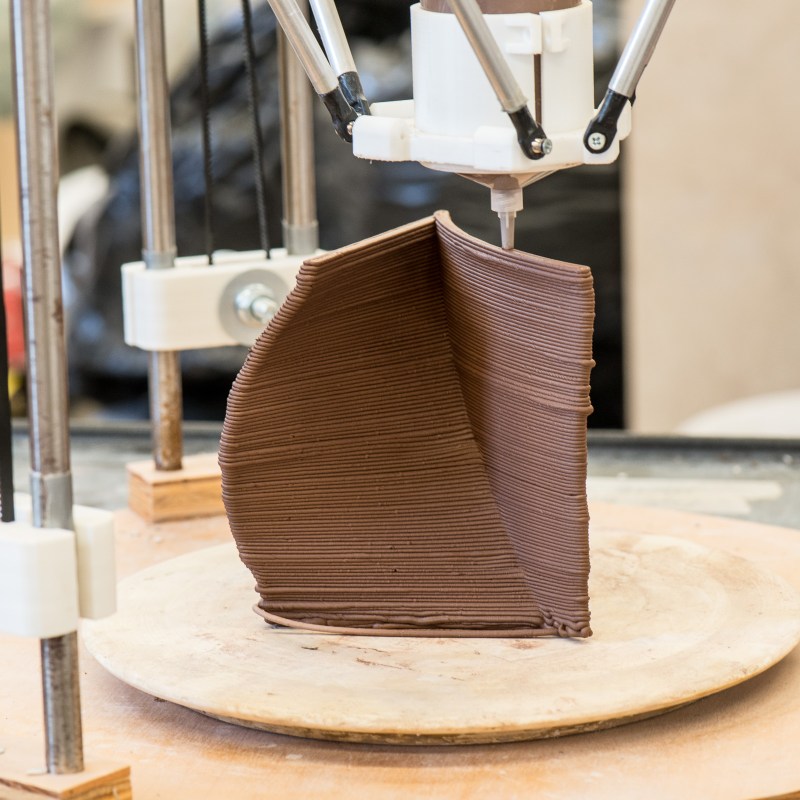
As the deltoid itself doesn’t change shape, it will become a cylinder over the deltoid. On the other hand, the rotating segment will become a ruled, helocoid-like surface. If we printed the entire model like this, the interesting part, namely the rotating secant, would be mostly hidden. Therefore we will only use one edge of the deltoid, while the other two are implied only by the rotating endpoints of the line.

DSC 4827

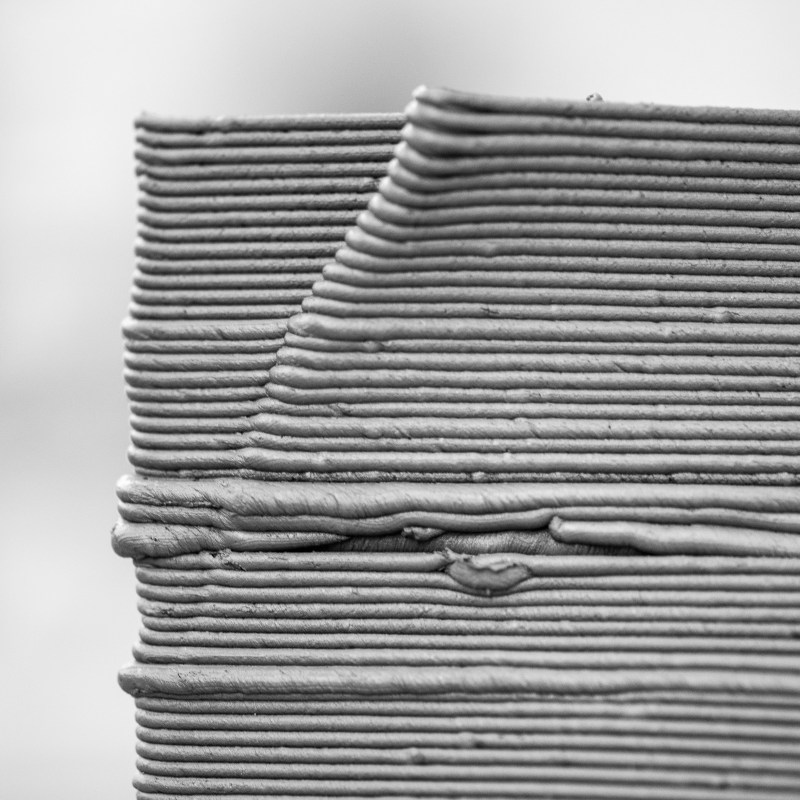
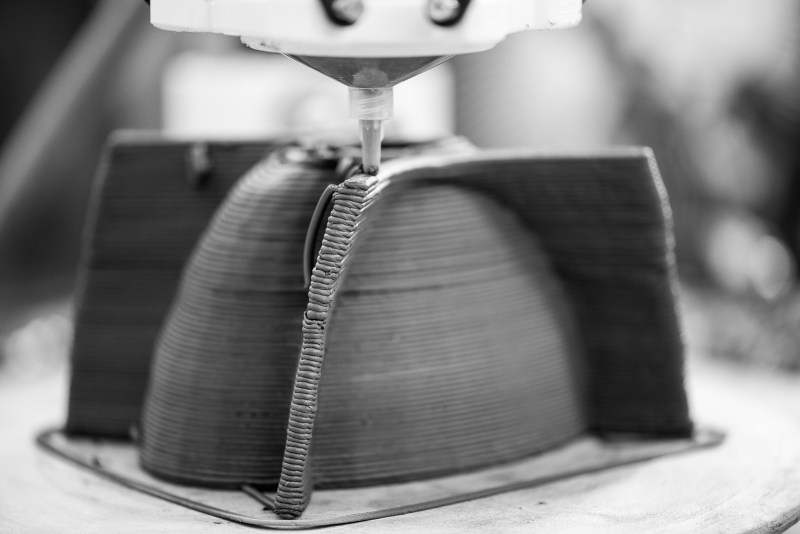
Doing this in clay is not easy. First of all, we print it so that time is vertical. This allows to use the deltoid wall as a solid support. Each layer of the rotating secant then becomes a cantilever, supporting subsequent higher layers.

DSC 4843

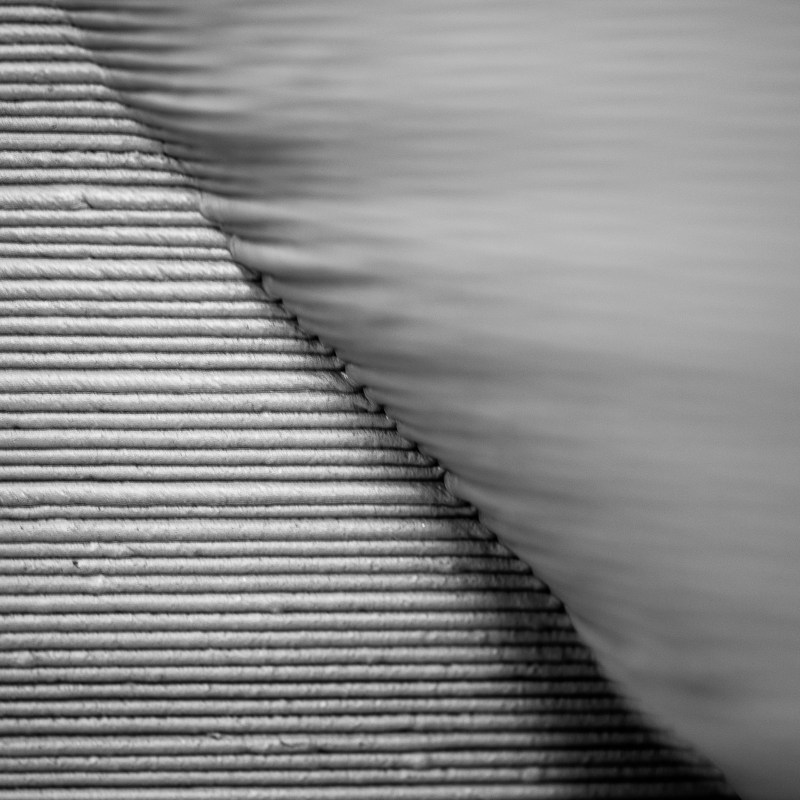
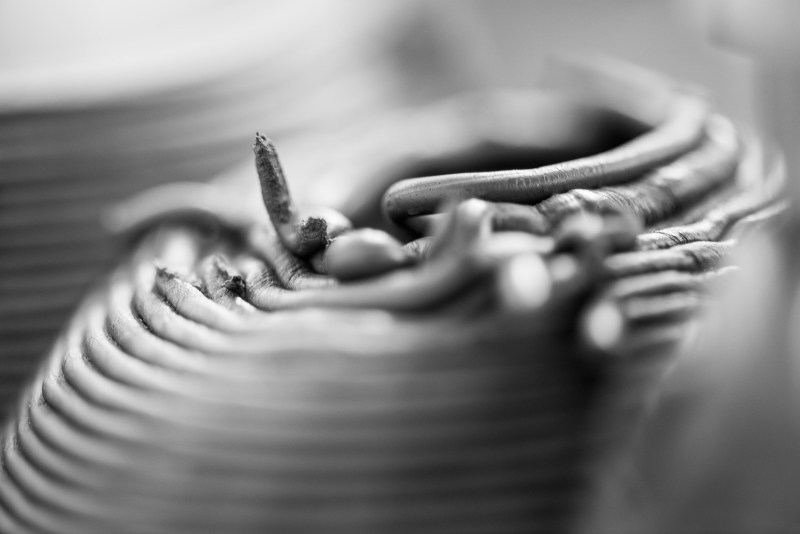
The point when the secant turns into a tangent is particularly interesting. One can see the gravitational pull on the emerging new layer that bends towards us in the image above. The contrast between the static, cylindrical deltoid arc and the dynamic, rotating secant is compelling and hard to convey in a single image. But that’s a fair enough reason to make 3D sculptures.

DSC 4822

Ceva’s Theorem, the Deltoid and the Design of Underwear

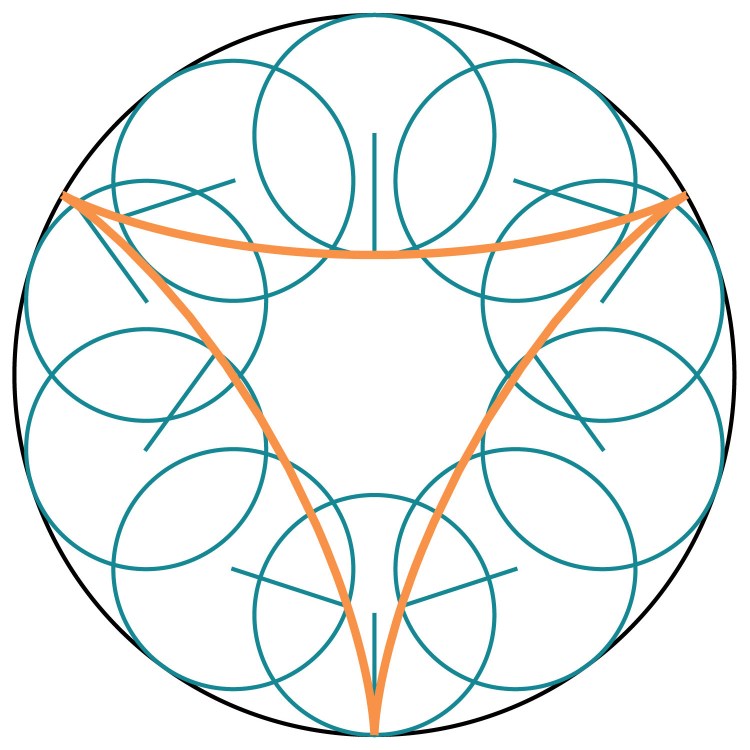
The deltoid is an intriguing curve. You start with a blackish circle of radius 3, within which rolls a bluish circle of radius 1, and a point on its perimeter traces out an orangish curve ⎯ the deltoid.

Deltoiddef 01

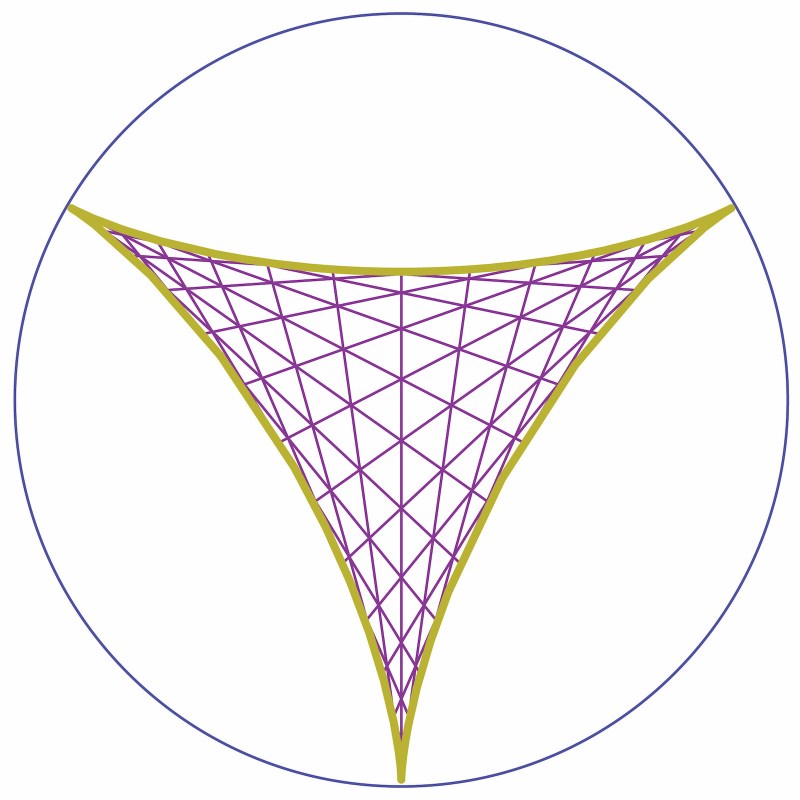
One of its remarkable features is that if you draw the tangent-secants, i.e. the line segments that touch the deltoid at one point and foot on the two other sides of the deltoid, you get segments of always the same length 4, no matter where you start. This means that you can rotate a segment of length 4 within the deltoid by 360 degrees. The deltoid being smaller then a circle of radius 2, this almost immediately triggers the Kakeya problem: How much area do you need to rotate a segment by 360 degrees? The surprising answer is that you can make the area as small as you like. The deltoid won’t like it. But it opens up all kinds of design possibilities…

Deltoiddiams 01

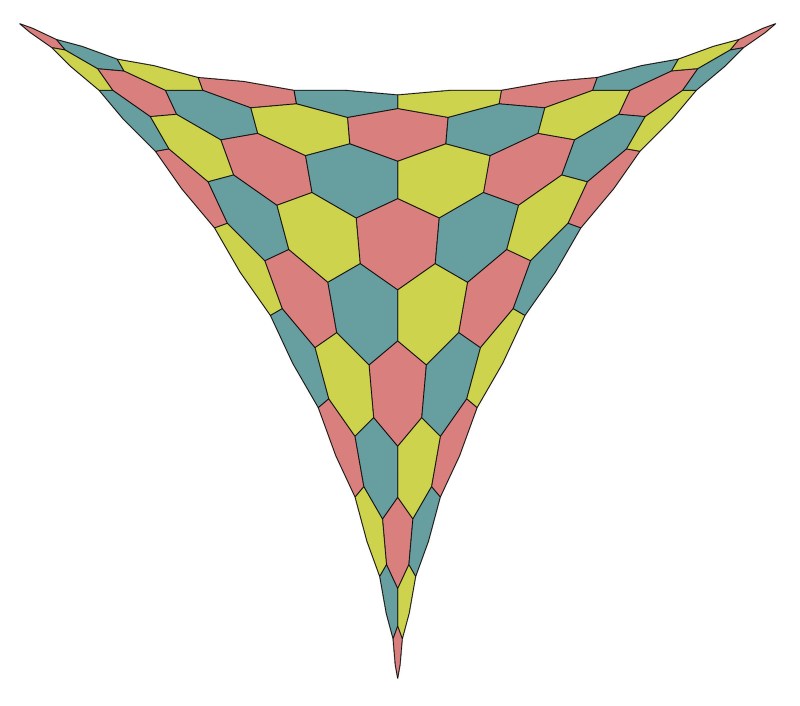
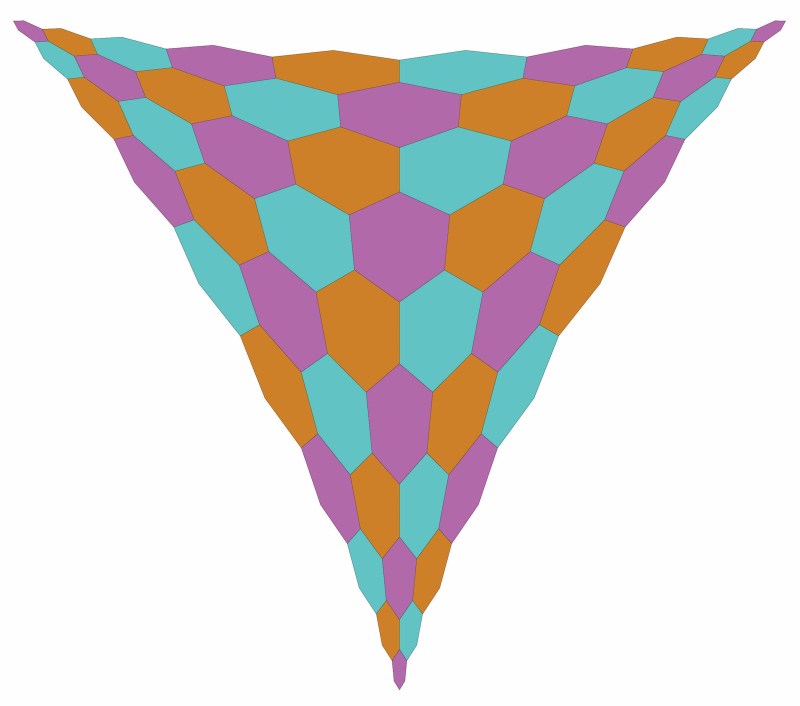
Somewhat surprisingly, in the image above, these famous secant-tangents meet at triple intersections. Lines don’t do that, generally. In this case, this allows for a seductive design, tiling the curvy deltoid triangle with hexagons. Whenever there is a tiling by hexagons around, there is usually a hexagonal torus and a group structure around the corner. Let’s unravel that.

Deltoid dessous 01

This situation also reminds us of the theorems high school students have  (still!!!)  to suffer through about lines in a triangle that happen meet at a single point. Well. One of the more intriguing facts here is Ceva’s theorem that tells us precisely when three lines through the vertices will meet at a single point.

Stereoceva 01

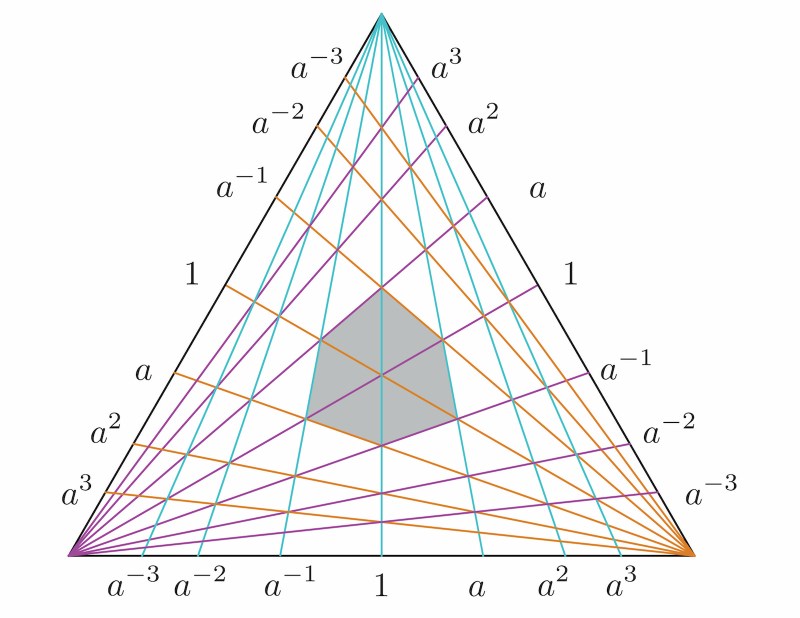
Think about it like this: A perspective drawing of a single cube projecting along one of its diagonals will give us a (gray) hexagon. It requires 3 vanishing points (chosen arbitrarily) where opposite sides of the hexagon will intersect. I have picked them at the corners of an equilateral triangle, but everything will work for other body types, too…

Parallel edges of the cube have to meet at these vanishing points, which determines the drawing. If you project several cubes of a cubical lattice simultaneously, you will get an image like the one above.

As expected for projections of cubes, three lines meet at a point. Ceva’s theorem states that this is the case if and only if these lines divide the triangle edges in proportions whose product equals 1. Check it out! The points along the edges are already labeled with a proportion depending on an arbitrary parameter a. Turning this around, one can create a tiling of a triangle by hexagons using a geometric progression of proportions. So the group here is on each edge of the triangle the multiplicative group of positive real numbers, interpreted as proportions.

Ceva dessous 01

The analogue of Ceva’s theorem for the deltoid states that the sum of the angles (using the angle of the rotating circle as a parameter) for the points where three tangent-secant touch the deltoid adds up to 360 degrees if and only if the three tangent-secant meet at a single point. So, in a sense, the deltoid is the additive version of the good old (multiplicative) triangle.

Let’s just hope the pretty designs help to cover up all the math underneath…

Squares and Circles (From the Pillowbook I)

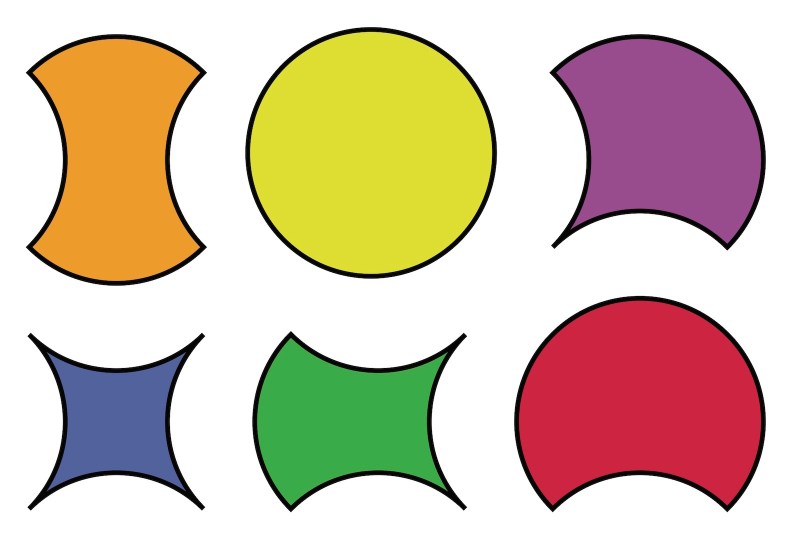
In a previous post, I have discussed triangles with curved edges and what they can tile. One can do the same with squares, only that things get more interesting, because there are six different shapes:

Curvies

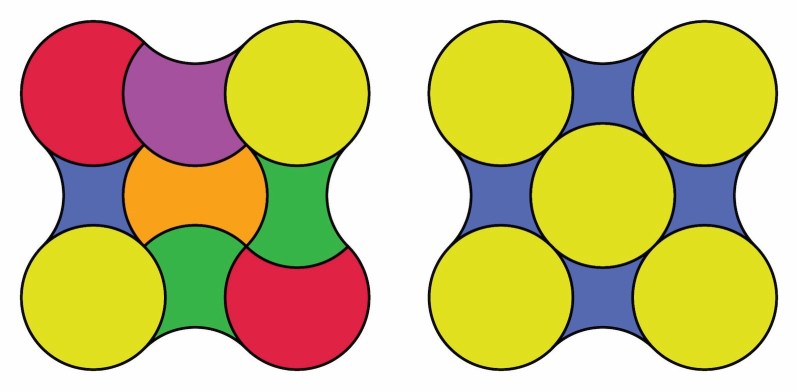
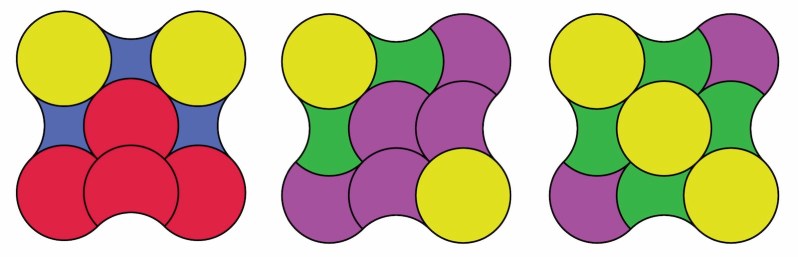
I have called them pillows, mainly because I want them as nice, big, colorful pillows. Hmm. The first problem I’d like to discuss is to tile curvy rectangles with them, like this curvy 3×3 square:

Curvysquares 01

It is pretty clear that all curvy rectangles have odd dimensions. The left example uses all six pillow types, the right only two, blue and yellow. To see what combinations of colors are possible, the following observation is useful: Each pillow has a number of edges that are convex (curve outwards) and other that are concave (curve inwards). For instance, orange and purple both have two convex and two concave edges. Yellow has just four convex edges. With that, we have a little

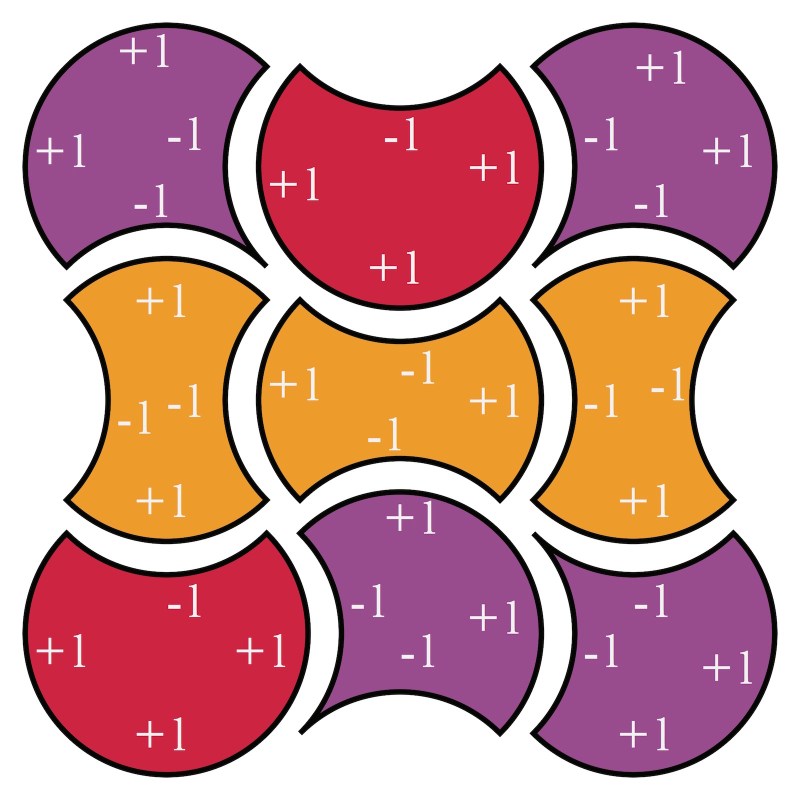
Theorem: In any curvy rectangle, there are four more convex then concave edges in all pillows together.

A picture should make this clear:

Edgecount

This helps to predict how many pillows of each color we need.
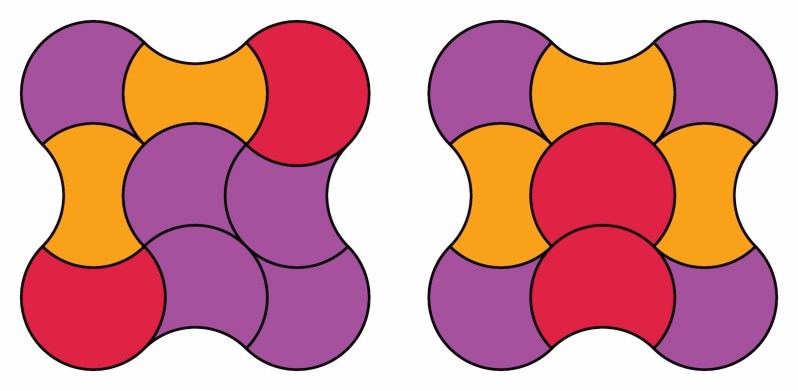
For instance, suppose we want to tile a curvy 3×3 square with y yellow, r red, and b blue pillows. We then need y+r+b=9, and, by the theorem, 4y+2r-4b =4. It’s easy to see that this forces y=2, r=4, b=3. Similarly, if we are only allowed to use yellow, purple, and green, the only possibilities are y=2, p=5, g=2 or y=3, p=2, g=4. Here they are:

Curvysquare2 01

That we found a solution in positive integers does not mean that there is a tiling that realizes this solution. For instance, suppose we want to use red, orange, and purple, then we need to have r=2, but for o and p  we can have any pair of positive integers that sum up to 7. However, only o=2, p=5 and o=3, p=4 can be realized. The solutions are not unique, here are two symmetric ones:

Curvysquare3 01

There are about a dozen little exercises like these. To be able to say something interesting about larger curvy rectangles, we will need to study ragged rectangles in a few weeks.

The Helicoid (again!)

In 1760, Leonhard Euler studied the curvature of intersections of a surface with planes perpendicular to the surface, and showed that the maximal and minimal values of their curvature are attained along orthogonal curves. In 1776, Jean Baptiste Marie Charles Meusnier de la Place showed that for minimal surfaces these principal curvatures are equal with opposite sign. He went on to show that both the catenoid and the helicoid satisfy this condition, thus exhibiting the first two non-trivial examples of minimal surfaces. Euler had discussed the catenoid as a minimal surface before, but only in the context of surfaces of revolution.

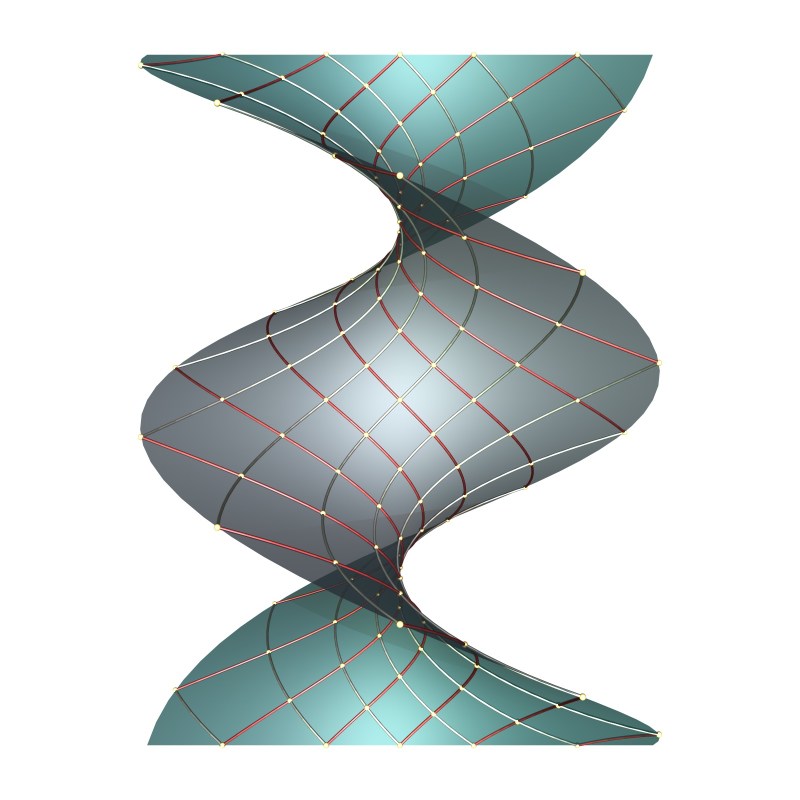
In its standard representation as a ruled surface, the parameter lines are the asymptotic lines of the helicoid. For a change, here is the helicoid parametrized by its curvature lines:

Helicurvature

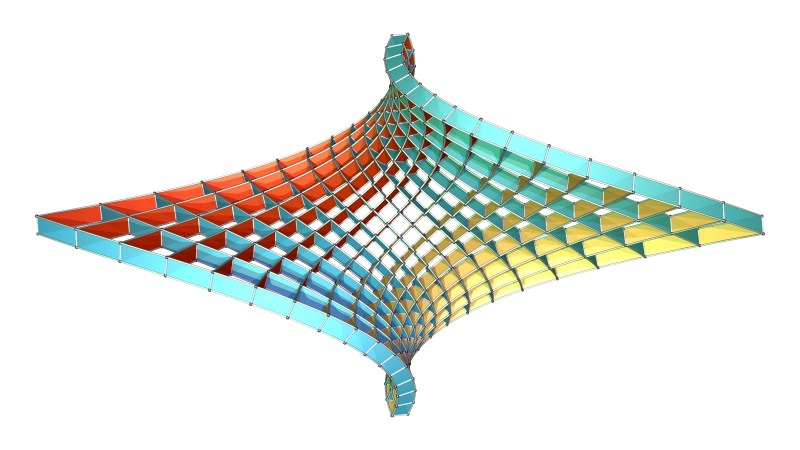
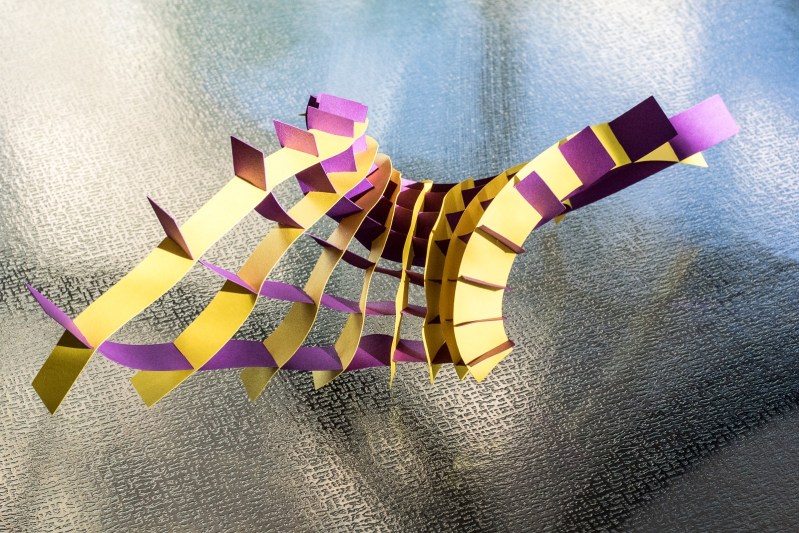
The purpose of this note is a little craft, similar to what I explained earlier using Enneper’s surface: A ruled surface that has as directrix a curvature line of a given surface, and as generators the surface normals, will be flat and can thus be constructed by bending a strip of paper. Doing this for an entire rectangular grid of curvature lines results (for the helicoid) in an attractive object like this one:

Helicoid

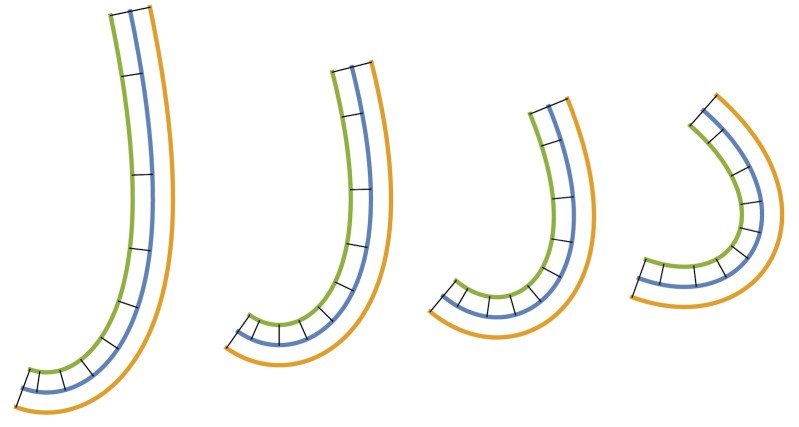
To make a paper model, one first needs to find planar isometric copies of the ribbons. This is done by computing the geodesic curvature of the curvature lines of the helicoid, and, using the fundamental theorem of plane curves, then finding a planar curve with the same curvature. The (planar) ribbon is then bounded by parallel curves of this plane curve:

Js 01

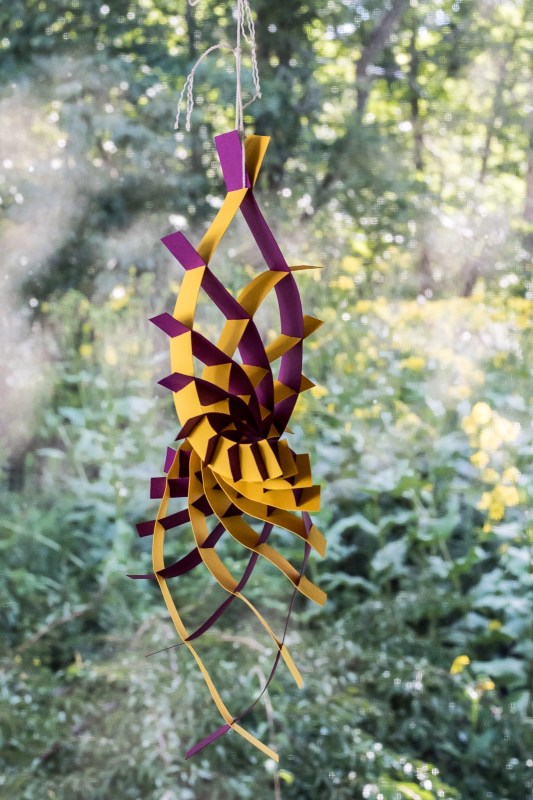
Using four (due to the inevitable symmetry of things) copies of the template above, carefully cut out & slit, allows you to easily build the model below, which also makes a nice pendant. Print out the template so that the smallest distance between two slits is not much wider then your fingers, otherwise assembling the pieces will be tricky.

DSC 1166

Begin with the largest J-piece and use the four copies to build a frame, by sliding the hook into hook and non-hook into non-hook. Then continue inwards, adding four copies of the second largest J, by placing the hook of a new J next to a hook of the old J.

DSC 1169

Quadrics in Clay

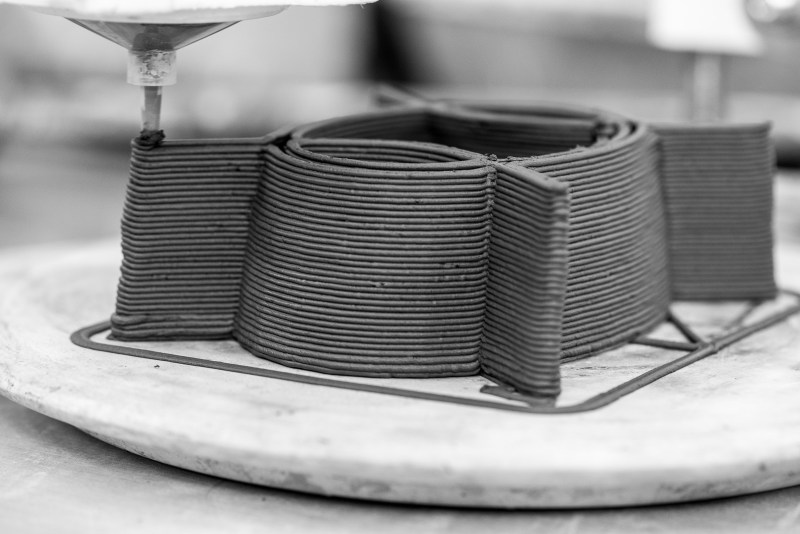
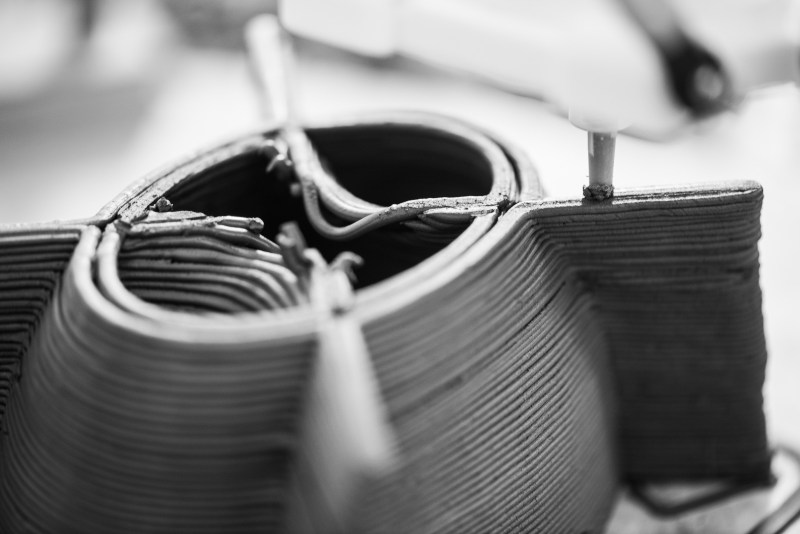
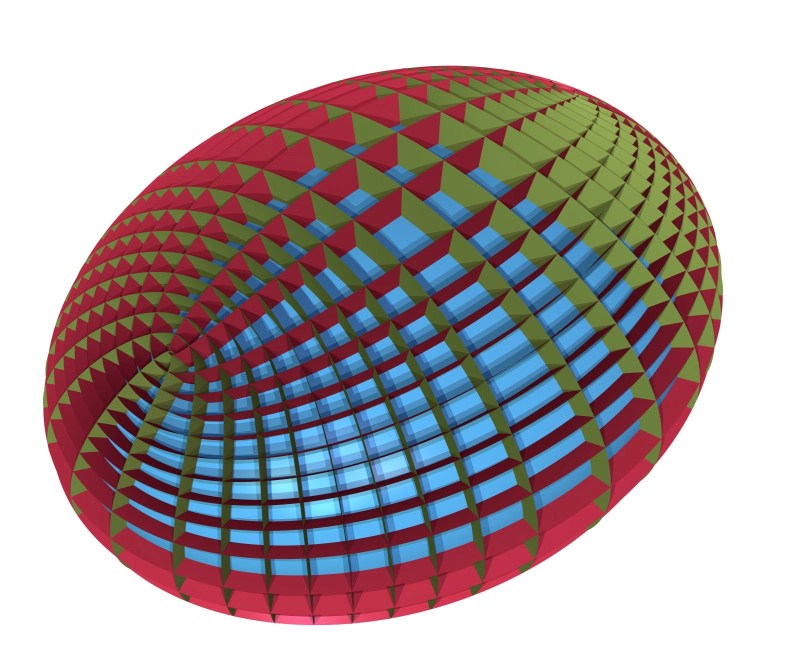
To get the orthogonal quadrics from Monday into clay using a clay printer, one needs to know about the limitations of Malcolm’s clay printer. It does nothing else but move a vertical tube full of clay horizontally around and vertically up, layer by layer. Simultaneously, it squeezes a continuous stream of clay, with no pause.

DSC 4646

The first few layers are pretty easy, clearly showing the elliptical and hyperbolic cross sections. We only print one half of the whole model, to have a solid foundation (the central cross section), and because it’s cool to be able to look inside.

DSC 4663

Things get interesting when the two branches of the hyperbola come together to connect to the single hyperboloid. We reach a critical point of the height function, and the clay printer clearly has problems with the Morse theory.
DSC 4694

Above you can see the nozzle in action, and more has happened: We have passed a second critical point when the two components of the hyperbola have separated from the ellipse. This is more complicated then the standard Morse theory of manifolds. The printer has do (quickly) move from one component to another at each layer, randomly dropping little chunks of clay on its way.
DSC 4710

This gets a bit messy when we reach the peak of the ellipsoid. Below is the completed print. It needs to dry and be fired. You will notice that we have only used two of the three surfaces. This is a pity, but the missing piece is one sheet of the double hyperboloid, and it is almost horizontal, and impossible to print.
DSC 4741

Quadrics

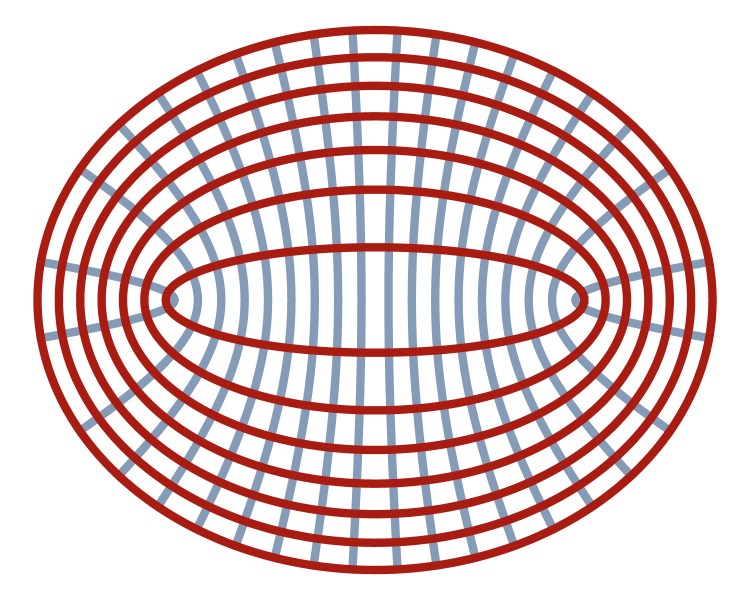
I have written about triply orthogonal surfaces twice before here, in the case of spheres and of cyclides, thus omitting the best known examples, namely that of quadrics. A quadric is for space what a conic is for the plane, and, to warm up, here are some conics ⎯ ellipses and hyperbolas ⎯⎯, all with the same focal points.

Confocal 01

That they all meet orthogonally is not difficult to see, one can either use the geometric definition of these conics as curves whose points have constant distance sum/difference to their focal points, or an algebraic description as level sets of quadratic polynomials.

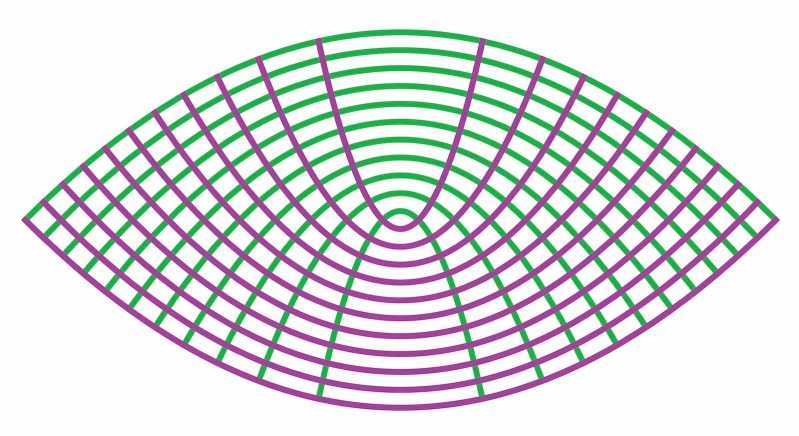
In the plane, there is one other kind of conic, namely the parabola, and here a single family of confocal parabolas provides us already with a doubly orthogonal system of curves:

Parabolas 01

While the images are pretty, there is nothing astonishing happening here: Any reasonable curve family will allow you to find orthogonal trajectories, and the pigeonhole principle or one’s belief in the pre-established harmony of the universe will force cases where both curve families are simple.

Not so in dimension 3: A surface family in space only belongs to a triply orthogonal system of three surface families if it satisfies a rather complicated partial differential equation, which I believe was first found & used by Jean Gaston Darboux.

But again there are simple cases, and the algebraic argument that establishes the orthogonal hyperbolas and ellipses above also establishes that their 3-dimensional analogues form a triply orthogonal system of surfaces.

Quadrics

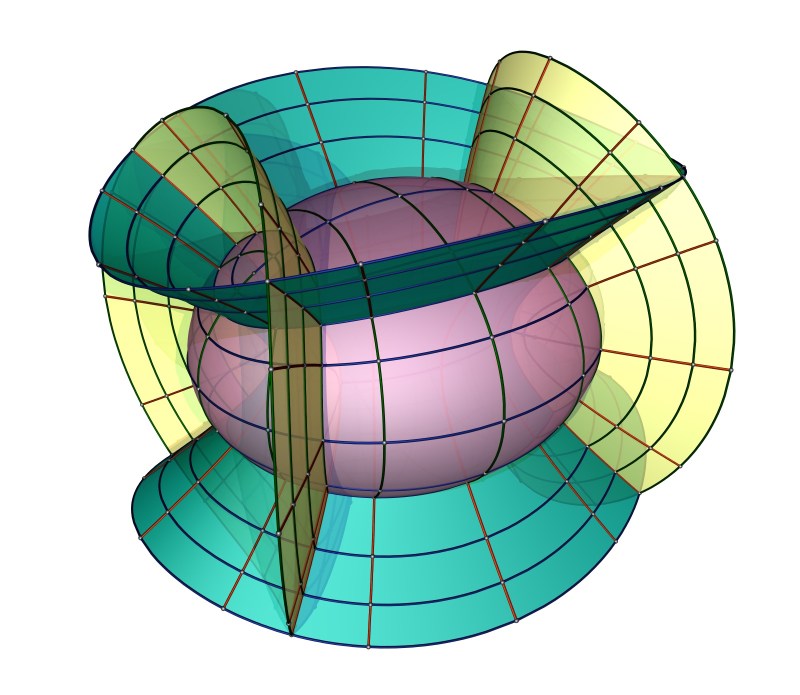
Here you can see all three general kinds of quadric surfaces: An ellipsoid, and the two different hyperboloids. The green one is the so-called single hyperboloid: it continues through the ellipsoid and has only one component. The yellow one is the double hyperboloid and has two components. I have mentioned the single hyperboloid before in connection with Brianchon’s theorem.

One reward for all these efforts to have them meet orthogonally is that one can see immediately the curvature lines of them, because a theorem of Pierre Charles François Dupin (not to be confused with Edgar Allan Poe’s detective C. Auguste Dupin) says that in triply orthogonal systems, two of the surfaces always meet in a curvature line of the third surface. The following image illustrates this for the ellipsoid: I have clipped the hyperboloids using a slightly larger (invisible) ellipsoid. This looks like it is complicated to make, but in fact requires only a few lines of code in PoVRay, a text based ray tracer that allows you to do constructive solid geometry and simple math, besides many other things.

Curvaturelines

Zoppo Trump

In 1969, almost 50 years ago, Zoppo Trump wanted to become the new ruler of the Little People. To avoid the three contests required to challenge the current ruler, he resorted to all sorts of trickery, including kidnapping and attempted murder.
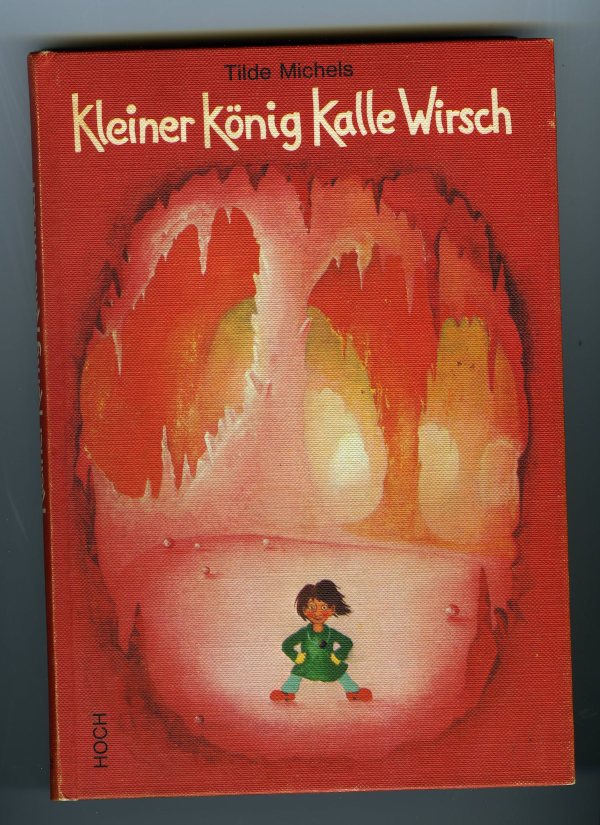
I am making this up? No, this is all written down here, in Tilde Michels’ fabulous book:

Kalle001

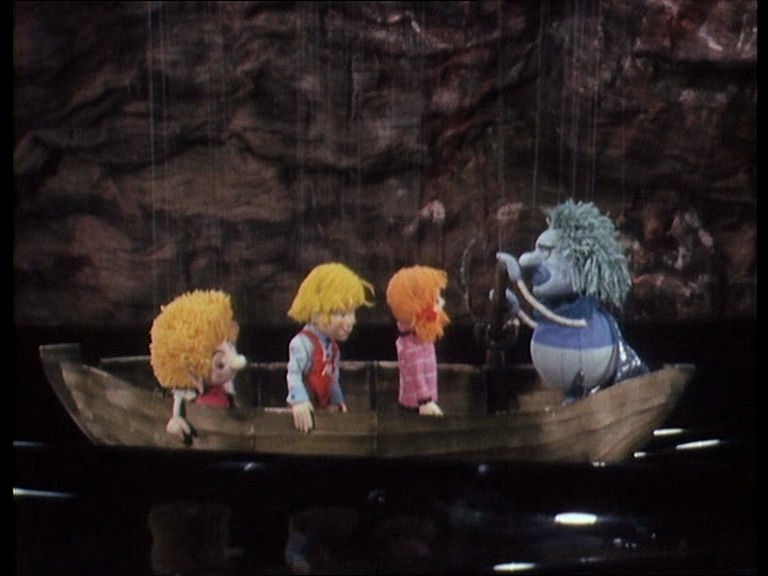
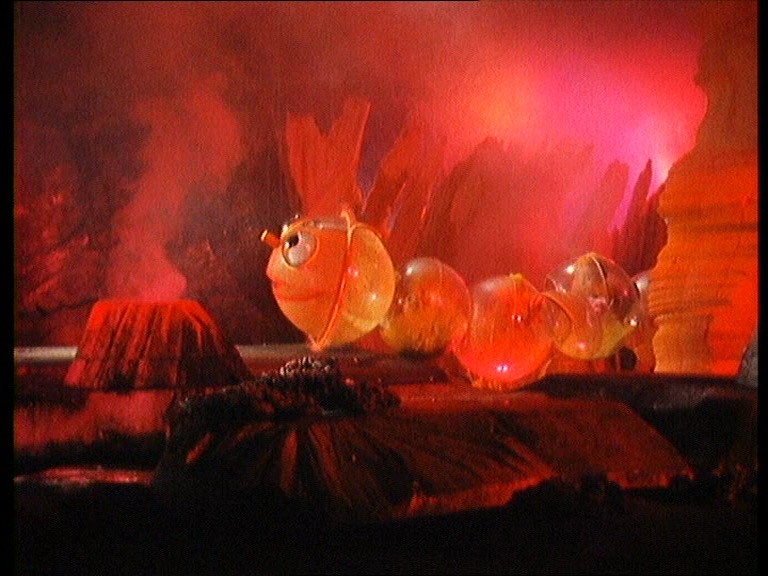
This was one of my favorite childhood books. I tells how Jenny and Max discover the King Kalle Wirsch inside a garden gnome, and go on a journey into the realm of the Erdmännchen (Little People), after conveniently being shrunk to proper size by eating raxel root. The meet endearing characters like the ferryman

Vlcsnap 2016 07 21 19h24m07s649

and travel inside a fire worm through lava fields

Vlcsnap 2016 07 21 19h27m00s991

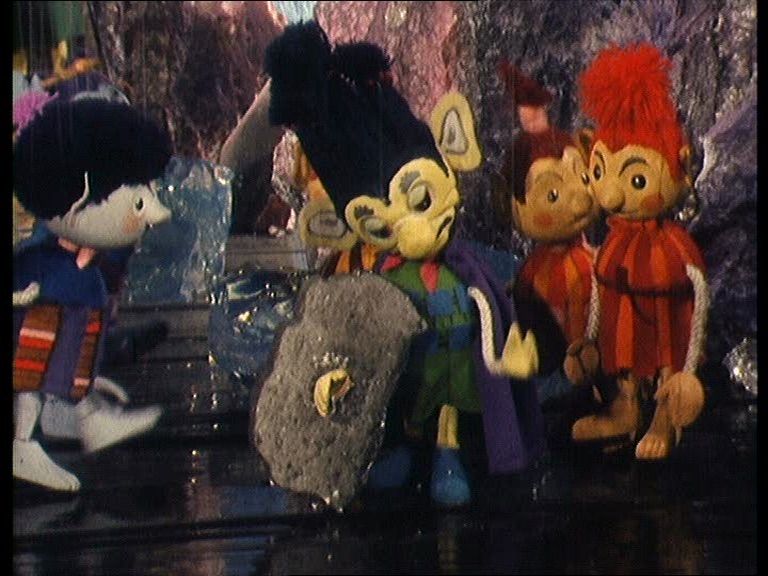
in order to reach the convention of the Little People just in time to prevent Zoppo Trump to seize power. Here is the bad guy after winning the first contest:

Vlcsnap 2016 07 21 19h17m02s001

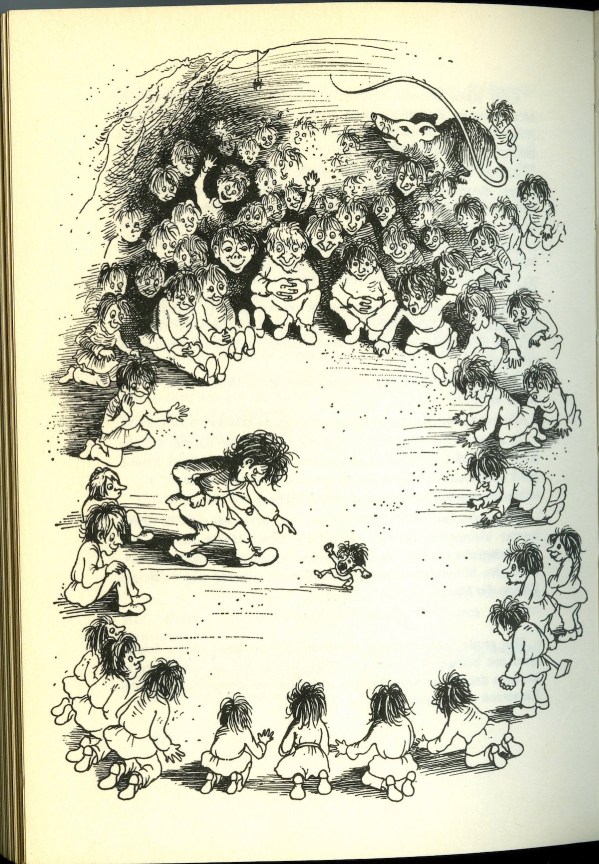
The story ends dramatically. Maybe you can guess what happens from the last image:

Kalle002

The three middle images are screen grabs from the DVD, made by the famous Augsburger Puppenkiste. As a kid I was glued to the screen whenever this was broadcast. The top image is the front cover of the first edition, and the last image is from within the book, one of the many illustrations by Rüdiger Stoye.

This book has, to my knowledge, not been translated into English. Anyone? Now is the time!

Just Triangles (Polyforms III)

In a former, more optimistic life, I wanted to write a book for elementary school children that would get them excited about math and proofs. This would of course go against the grain. Proofs have essentially been eliminated from all education until the beginning of graduate school. With good & evil reason: Not because they are too difficult or not important enough, but because it could possibly induce the children to come to their own conclusions.

I also was ignorant about who controls public education: Neither the students, nor their parents, nor the teachers, and not even the text book authors. It is solely those people who are making money with it.

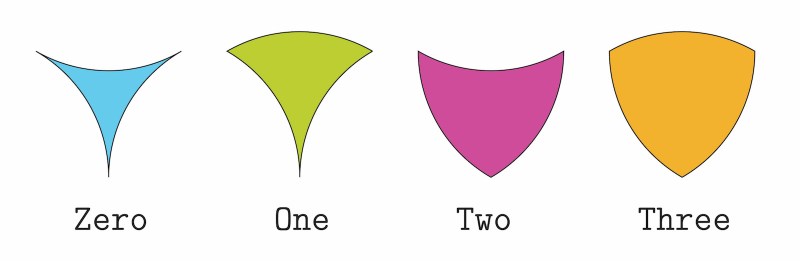
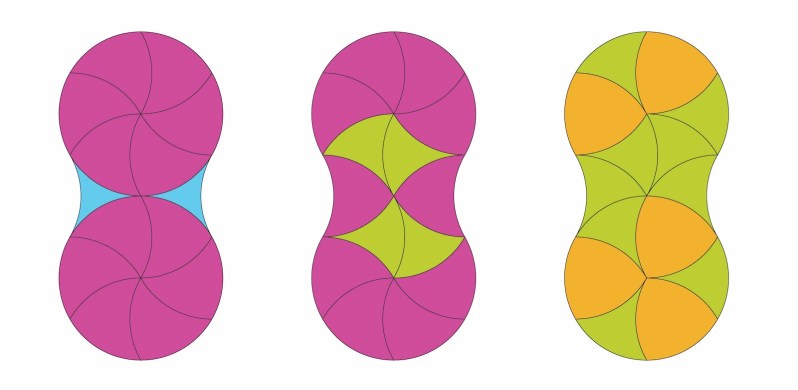
Before I get the reputation to be yet another hopeless conspirationist, here is another message in a bottle, in multiple parts. It is once again about polyforms. I need to say what the shapes are that we are allowed to use, and what we want to do with them. In the simplest, we are using four shapes, which are deflated/inflated triangles like so:

Triangles 01

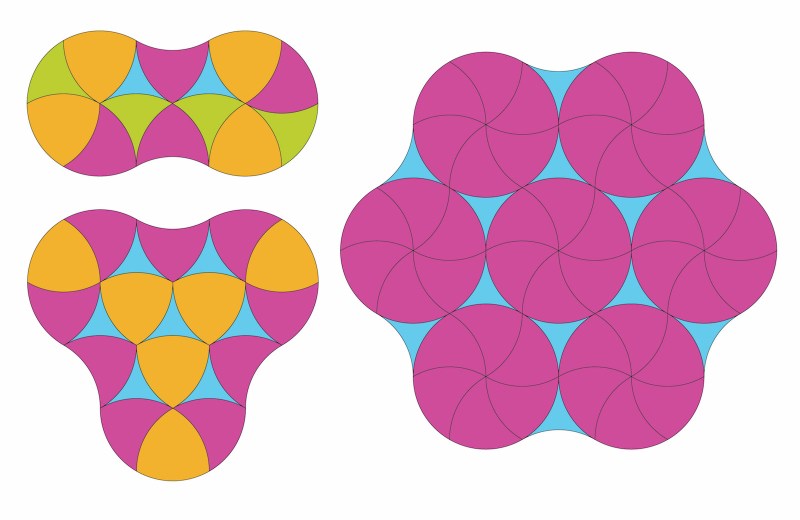
They already have received names, which count the number of edges that have been inflated. We (you) are going to tile shapes like these that have no corners:

Regions 01

We call these circular regions, because they consist essentially of a few touching circles with a bit of filling to avoid holes or corners. The circular regions above consist of two, three, and seven circles, respectively, and they already have been tiled. We can start asking questions: What shapes without corners can you come up with? Are they all circular regions?

Then there is time for exploration: Find all ways to tile a circle (the circular region with just one circle) with the curved triangles. Find all ways to tile the bone (the circular region with just two circles) using only two different kinds of triangles:

Di bones 01

Now, upon experimenting, the number of curved triangles to be used to tile a circular region is not quite arbitrary.
The first, not so trivial, observation is that for a circular with N circles, we will need 8N-2 triangles. That is because each circle contributes 6 triangles, and for adding a circle we have to use 2 more triangles. This is not quite a proof yet, but at least an argument. There are also interesting problems when the domain is allowed to contain holes…

Circles3 01

Because the different curved triangles contribute a different amount of area each, there is a second formula.
Let’s denote by N(0), N(1), N(2), and N(3) the number of curved triangles of each type (zero, one, two, three) that appear in a tiling of a circular region with N circles. Then N(1)+2N(2)+3N(3) = 12N. This formula counts on the left hand side how many triangle edges are inflated and hence contribute extra area. On the right hand side, we count the same, using say the pattern we see in the tiling of the circular region with 7 circles in the second image above.

The two formulas together allow you to determine how many triangles of each kind you need in an N-circle region, if you are only using two different triangles.

To be continued?