Gyokuro Omelet

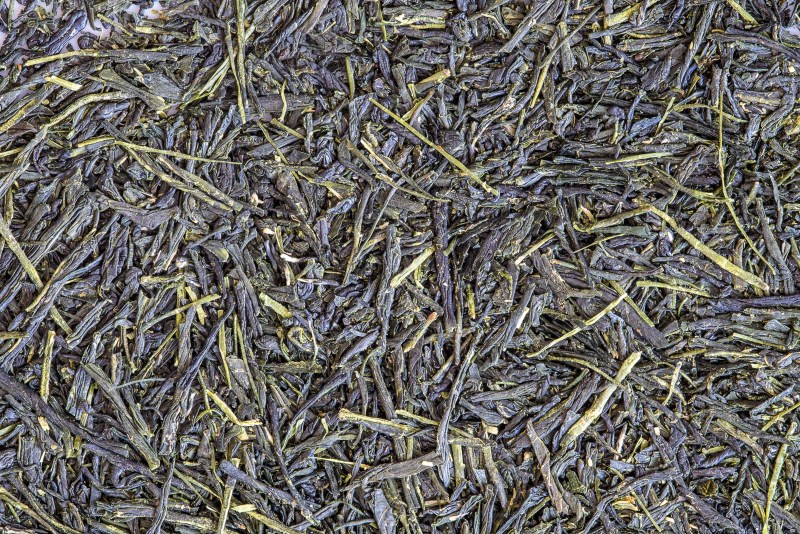
One of most spectacular green teas from Japan is the Gyokuro (jade dew), grown in the shade.

DSC 8116

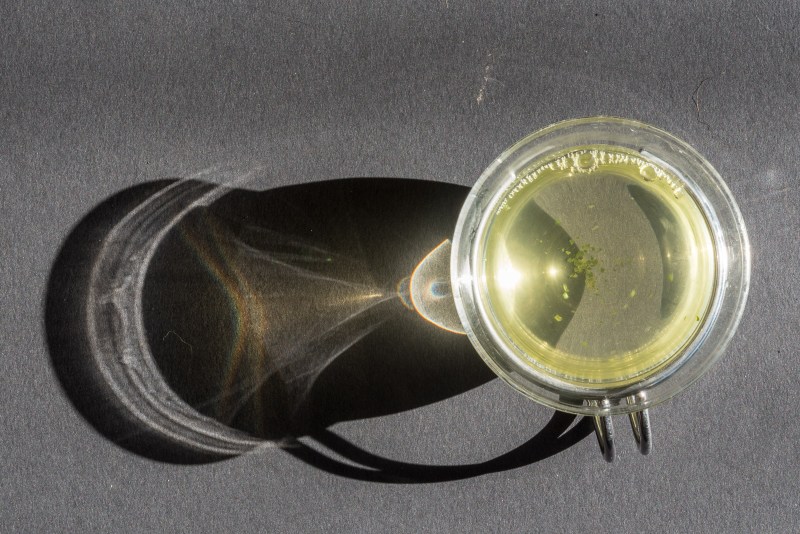
It needs to steep for 1-2 minutes in low temperature (at most 50ºC).

DSC 8117

The cup is pale yellow and tastes a little like sea weed. 

DSC 8127

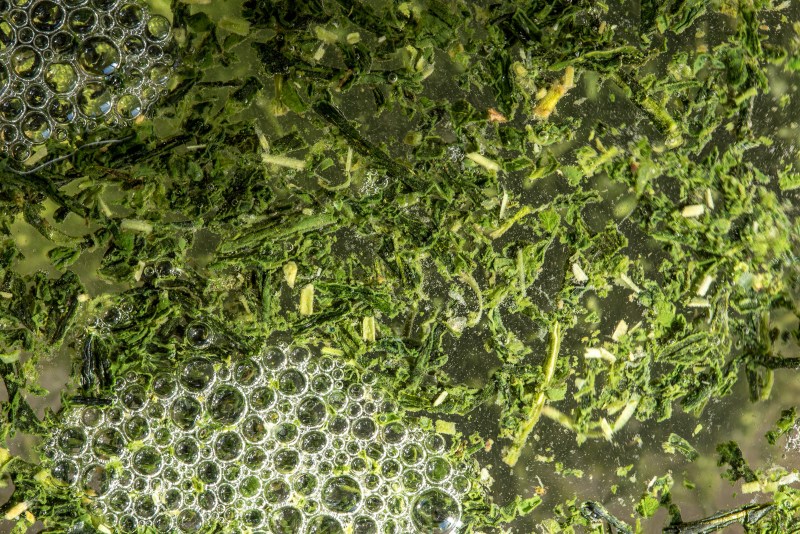
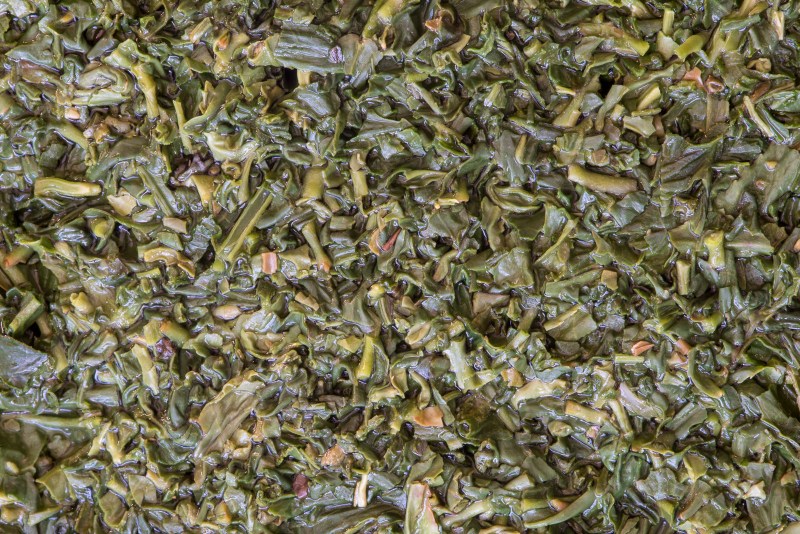
The steeped leaves are very soft. 

DSC 8122

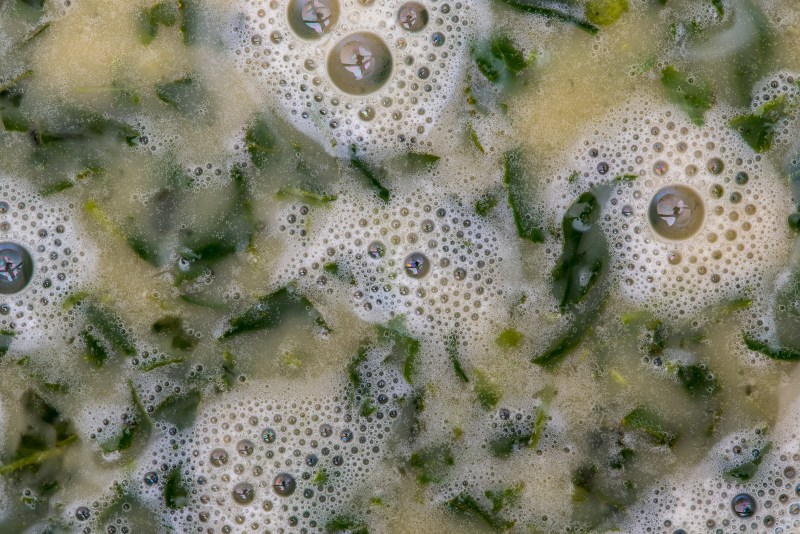
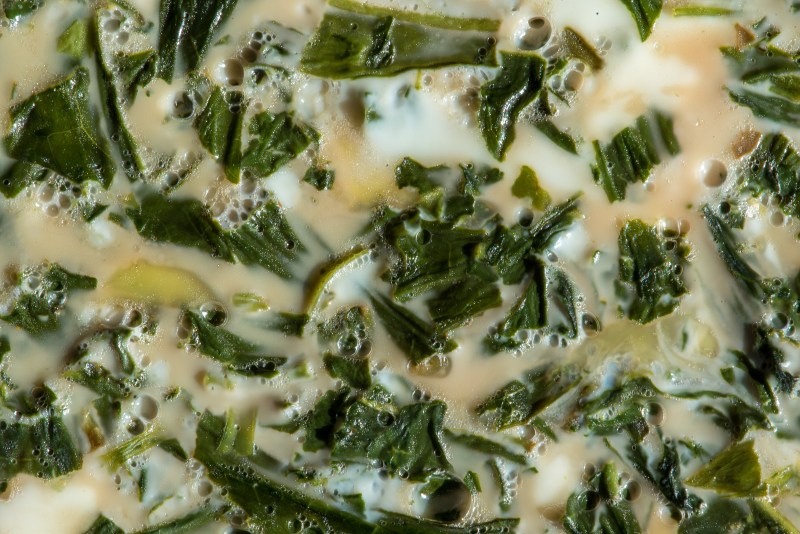
Instead of throwing them away, one can use them as a spread. I suggest a simple omelet.

DSC 8124

Here is the recipe haiku:


Prepare Gyokuro. Save the leaves.

Beat eggs with Ponzu sauce until smooth.

Add leaves, stir and fry.


DSC 8129

Line Congruences (Constant Curvature II)

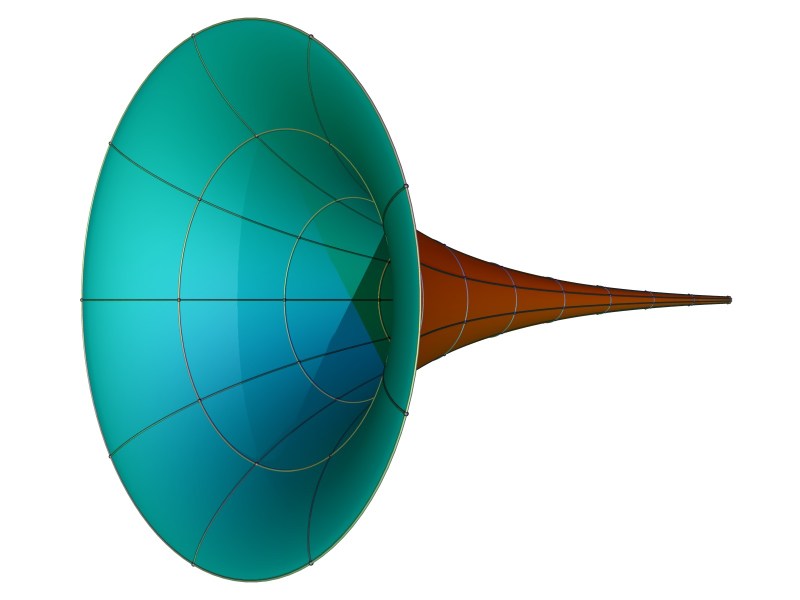
That revolving a simple, mechanically generated curve, the tractrix, about an axis generates the pseudosphere, a surface of constant negative curvature, seems like one of these unavoidable accidents.Tractrix 01

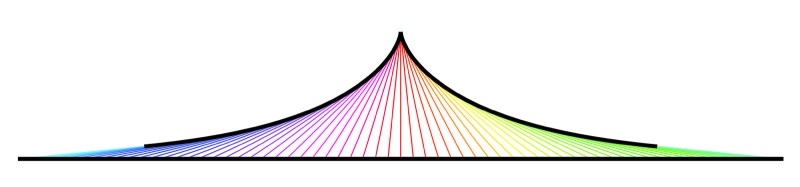
The tractrix has the feature that the endpoints of its unit tangent vectors lie on a line. Thus  dragging one endpoint of a rod of length 1 will have the other endpoint trace a tractrix. More generally, whenever you have a 1-parameter family of lines in the plane, they are typically tangent to a single special curve, the caustic of the line family. Below is the caustic of the normal lines to a parabola. Paracaustic 01

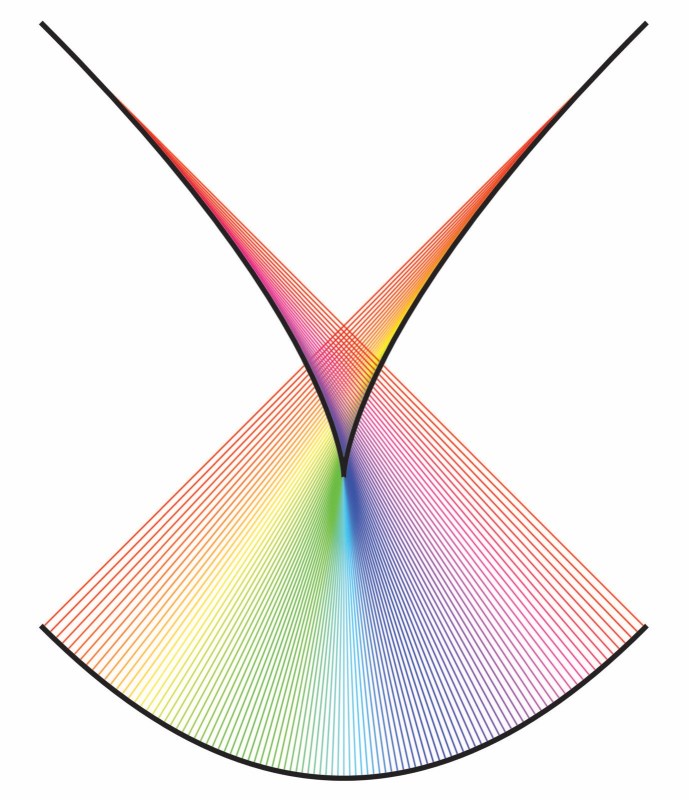
In space, things get tricky. A 2-dimensional family of lines in space is called a line congruence. They also have caustics or focal sets, i.e. surfaces that are tangent to all the lines, but finding them involves a quadratic equation, so we can expect two of them. Below are the two focal sets for a hyperbolic paraboloid. It is pretty clear that line congruences are hard to visualize.

Paraboloid

Note that some of the lines are tangent to the focal sets at some point but intersect it transversally at other points.

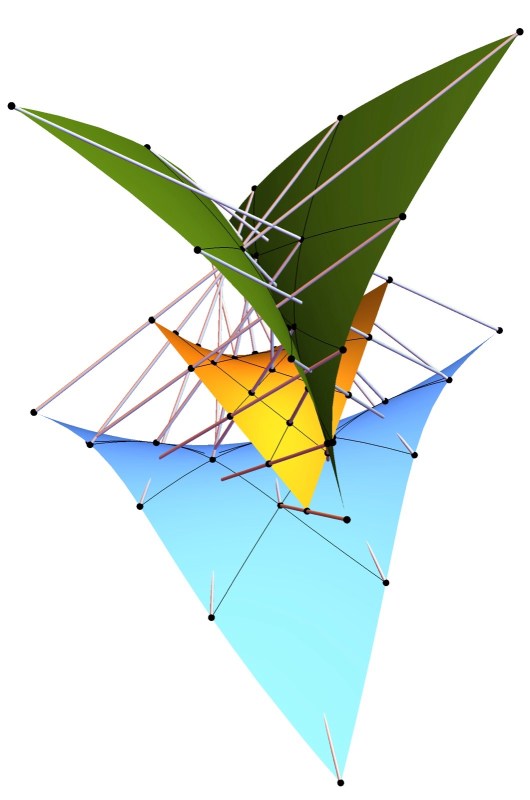
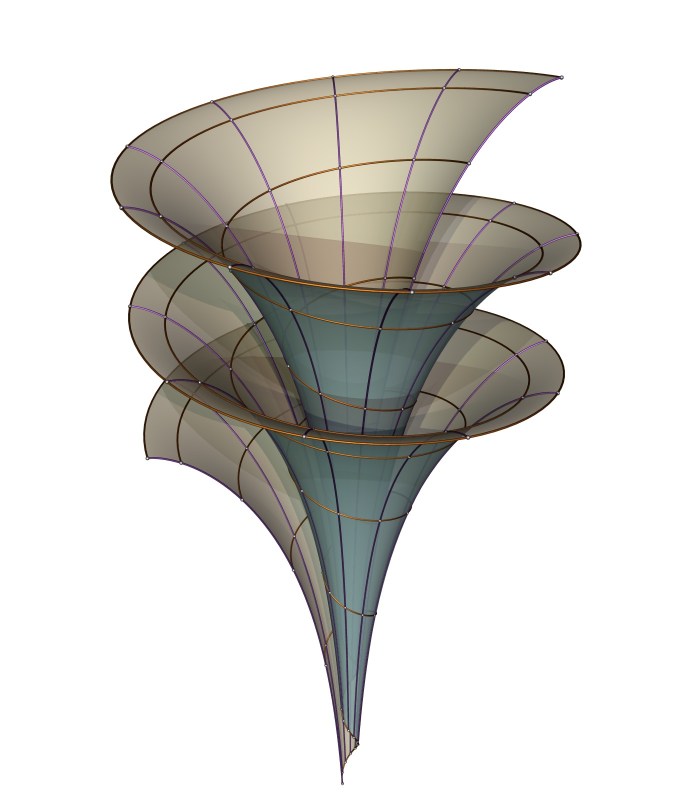
By rotating the lines generating the tractix, we obtain a  line congruence whose two focal sets are the pseudosphere and its rotational axis. Note that the segments of the line congruence between the two focal sets have length 1. More generally, a line congruence is called pseudospherical if the segments between the focal sets have constant length, and the surface normals at corresponding points make a constant angle. Remarkably, the focal surfaces of a pseudospherical line congruence are pseudospherical, i.e. have constant negative curvature. Even better, one can start with any pseudospherical surface, pick a point and a tangent vector at that point, and extend this vector to a pseudospherical line congruence whose first focal set is the surface one starts with. This provides a recipe to produce (essentially algebraically) new pseudospherical surfaces.


Kuen3

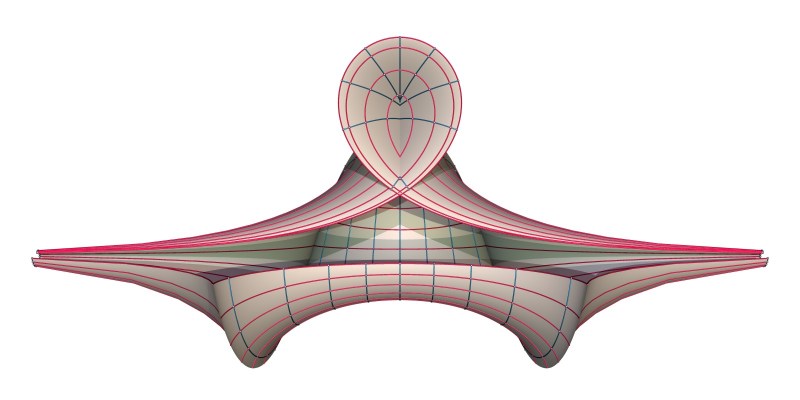
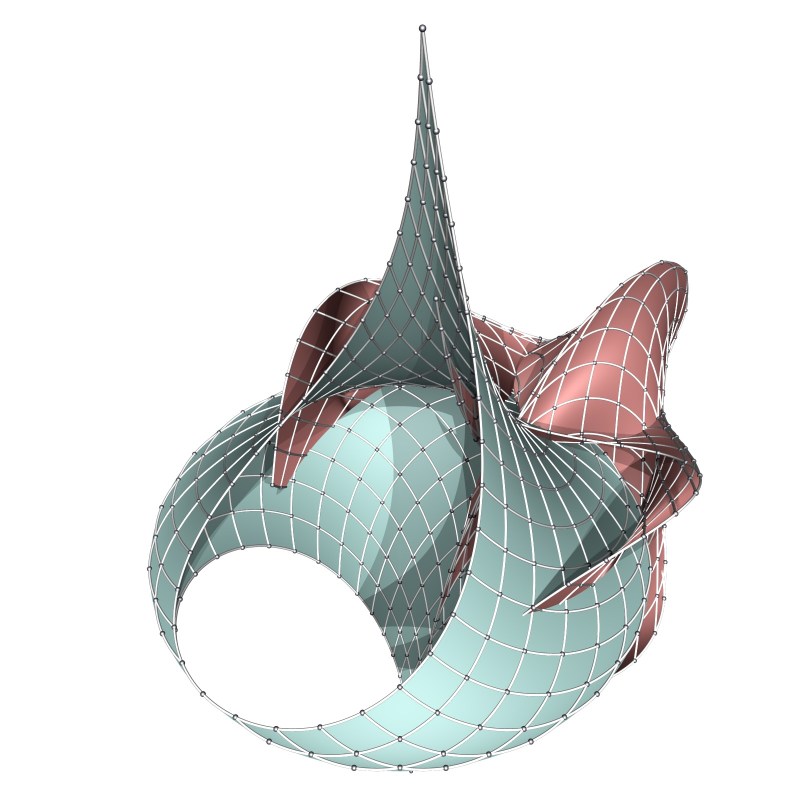
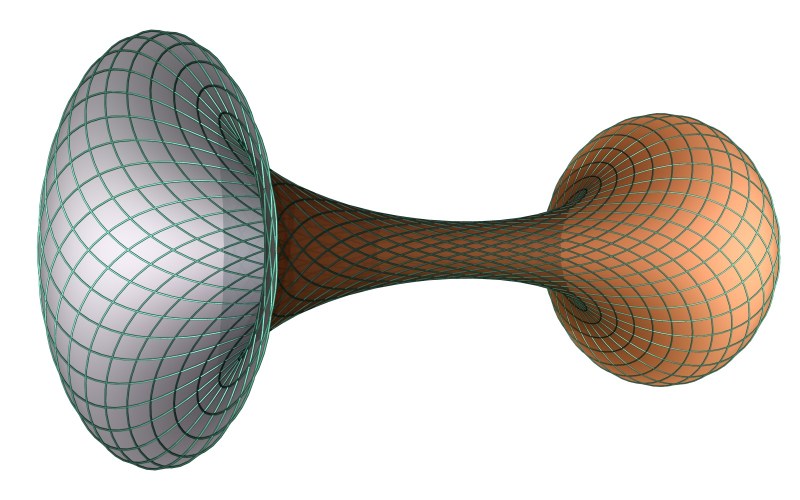
The bathtub up above is Theodor Kuehn’s pseudospherical surface from 1884. It can be obtained by a line congruence from the standard pseudosphere. Below you see a portion of the pseudosphere with asymptotic lines, and hiding behind, the corresponding portion of Kuehn’s surface.

Kuen

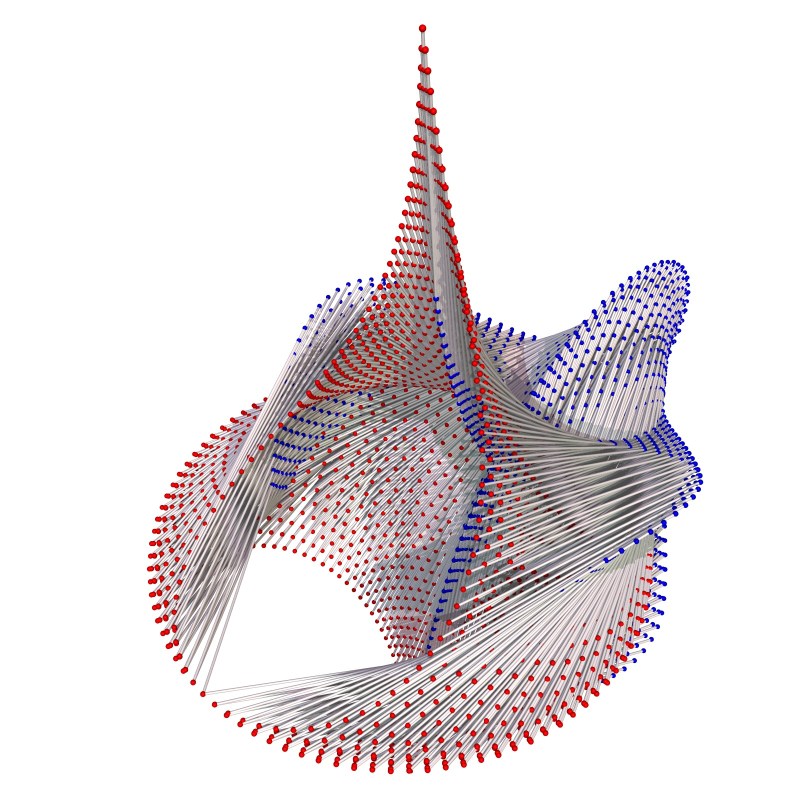
The last image shows just the lines of the line congruence that has these two surfaces as focal sets.

Kuen congruence2

Did I say this was hard to visualize?


Patterns of Ice

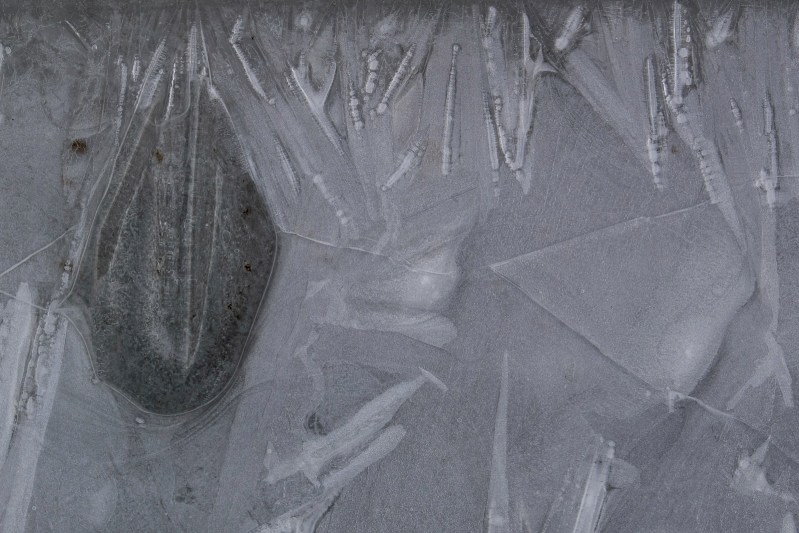
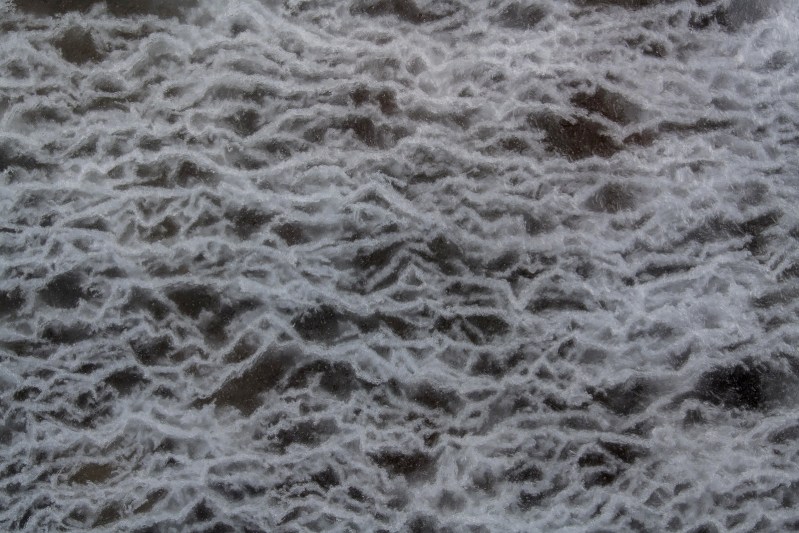
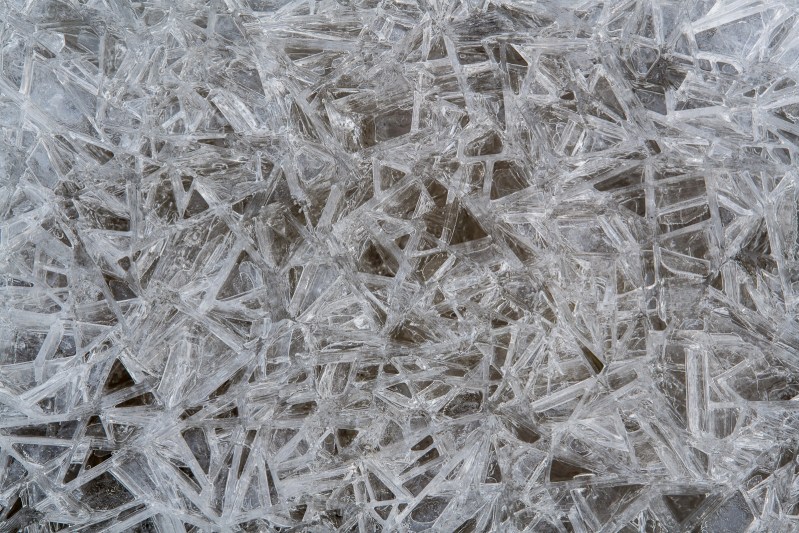
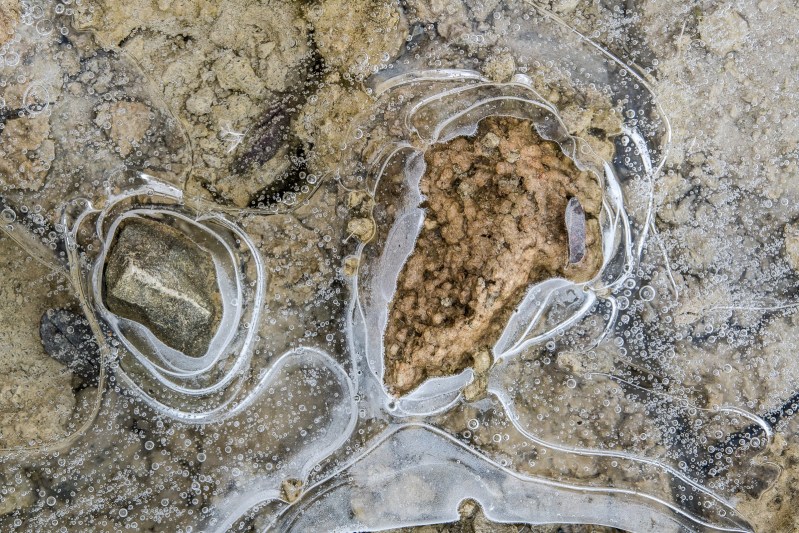
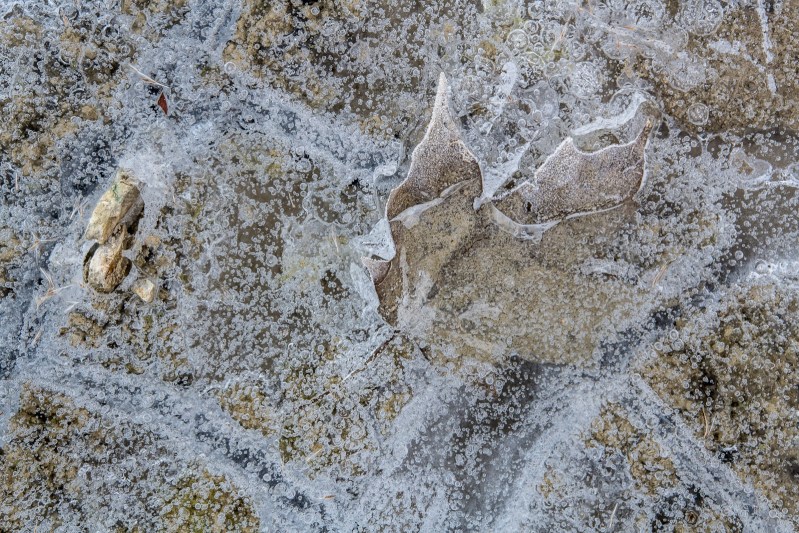
After almost two weeks of deep freeze, the ice at the local creeks is making feeble attempts to melt.DSC 0248

This has resulted in patterns that are, of course completely useless.

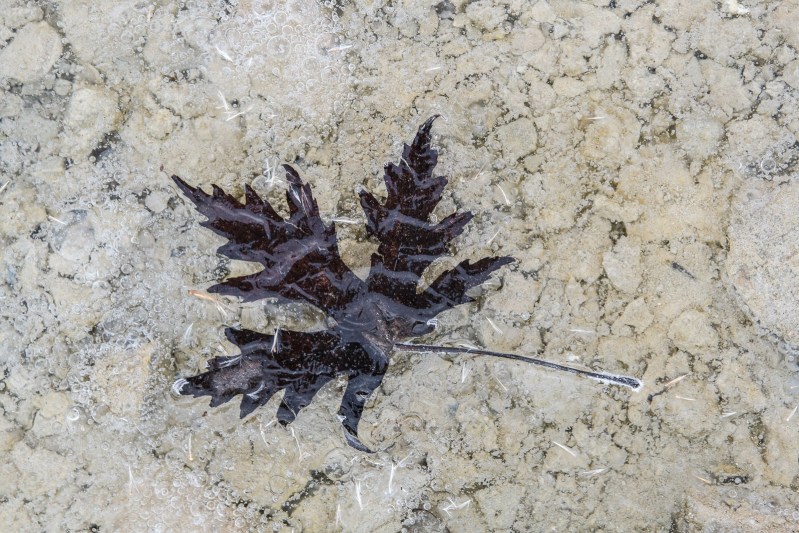
DSC 0261

They don’t reduce unemployment, make people smarter, or cure insanity.

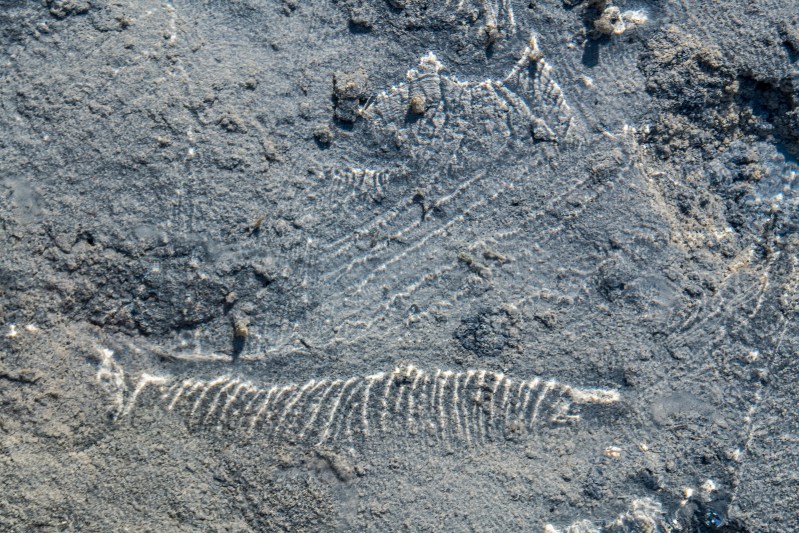
DSC 0266

But they don’t cause damage, and that is already something these days.

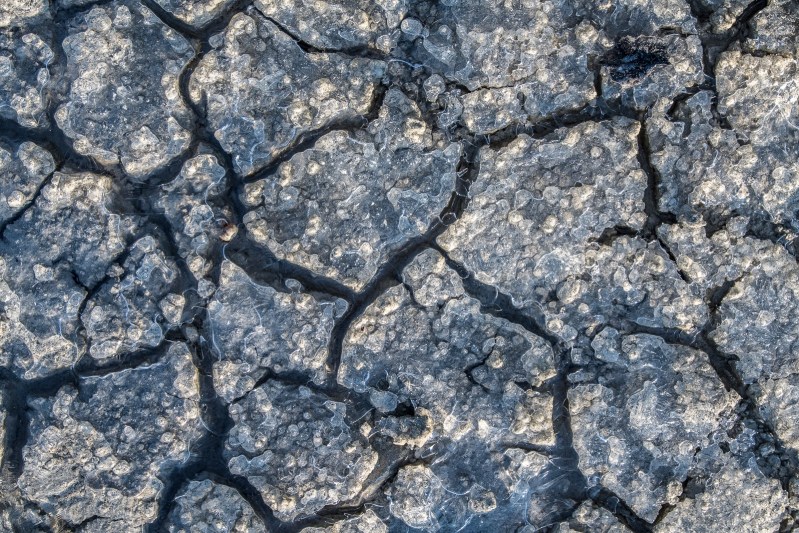
DSC 0330

Unbelievable that all this is just water.

DSC 0269

Revolution (Constant Curvature I)

One of the standard elementary surfaces is the Pseudosphere, a surface of revolution of constant negative curvature.


Pseudosphere

It can be parametrized using elementary function, and the profile curve is the so-called tractrix. Another elementary surface of constant negative curvature is Dini’s surface, where the tractrix is used to produce a helicoidal surface.

Dini


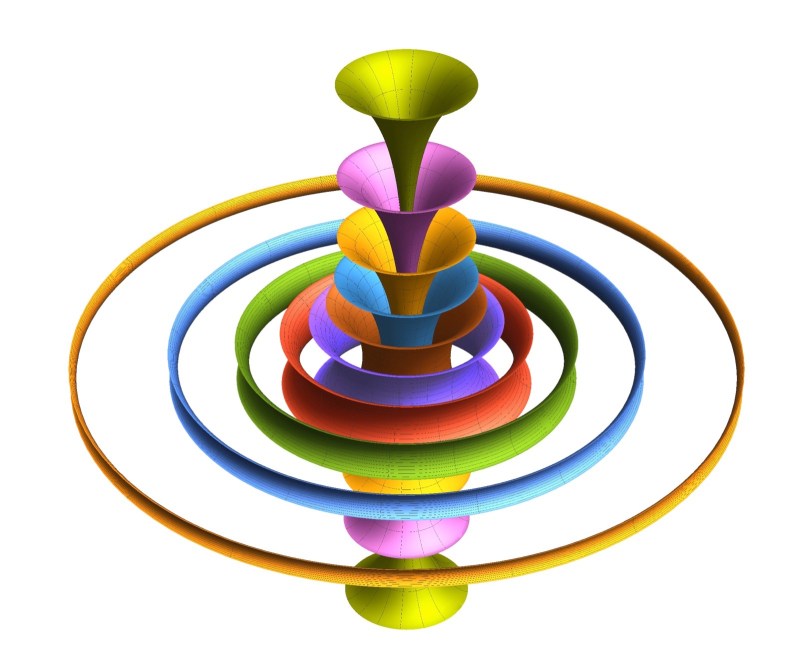
From here on, things get tricky. Other such surfaces of revolution require elliptic integrals. Here is the entire zoo (more or less):

Collage

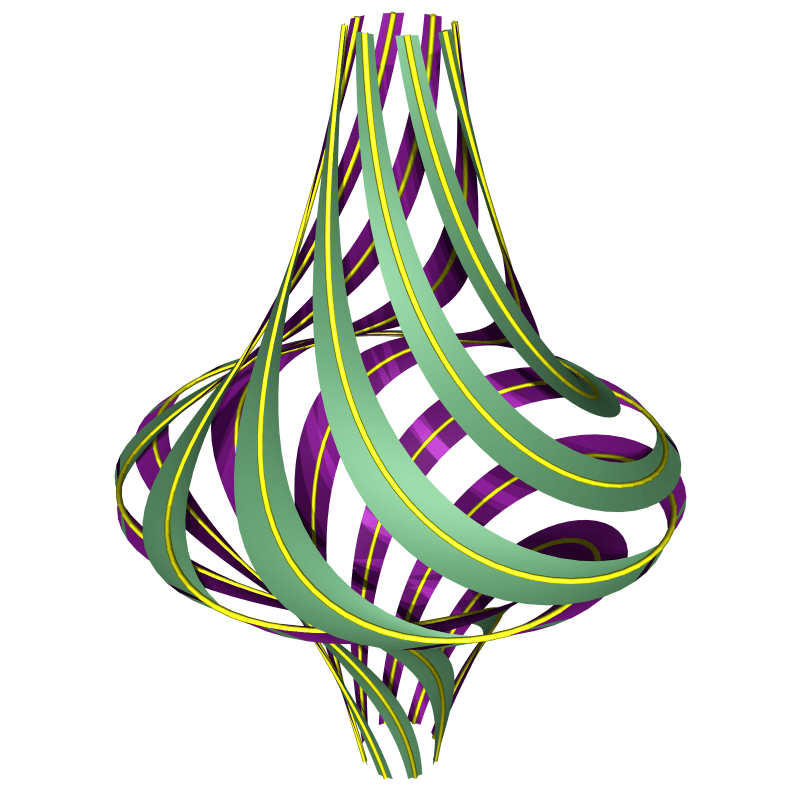
Common to all examples is that they necessarily produce singularities. More precisely, there is no complete surface of constant negative curvature in Euclidean space. This is a famous theorem of Hilbert. At the core of the proofs I know is the behavior of the asymptotic lines

Pseudoribbon

Above is the pseudosphere with one family of these asymptotic lines, drawn as ribbons. At the equator, they become horizontal. As the second family is the mirror image of this family, at the equator their tangent vectors become linearly dependent. This shows that while the asymptotic curves exist in the northern and southern hemipseudospheres, the surface itself is singular at the equator, because, alas, on negatively curved surfaces the asymptotic directions are linearly dependent. For the general surfaces of revolution, the asymptotic lines touch both singular latitudes. The image above looks odd because our brain wants to believe that curves on a surface meet at right angles. They don’t.

Pseudoasl2One of the key features of the asymptotic lines is that they form a Chebyshev net: Opposite edges of the net quadrilaterals have the same length. Thus you can stretch a loosely knitted square mesh over this surface to keep it warm. The standard proof of Hilbert’s theorem continues to show that any net parallelogram has area bounded above by some constant. However, a simply connected complete surface of constant negative curvature has necessarily infinite area, which leads to a contradiction. This was one of the earliest global results in differential geometry.

Winter

After a mild frost transformed the ground at De Pauw Nature Park into still lives, recent snow fall and deep frost has changed all of that again.

DSC 0227

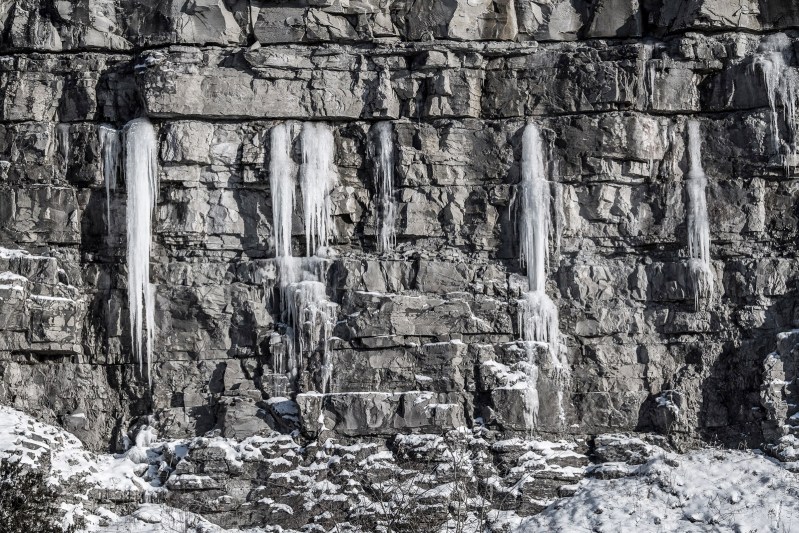
The walls of the former quarry are adorned with icicles, and the ground is a uniform white with occasional bits of vegetation sticking out,

DSC 0206 2

creating patterns of light and dark.

DSC 0216

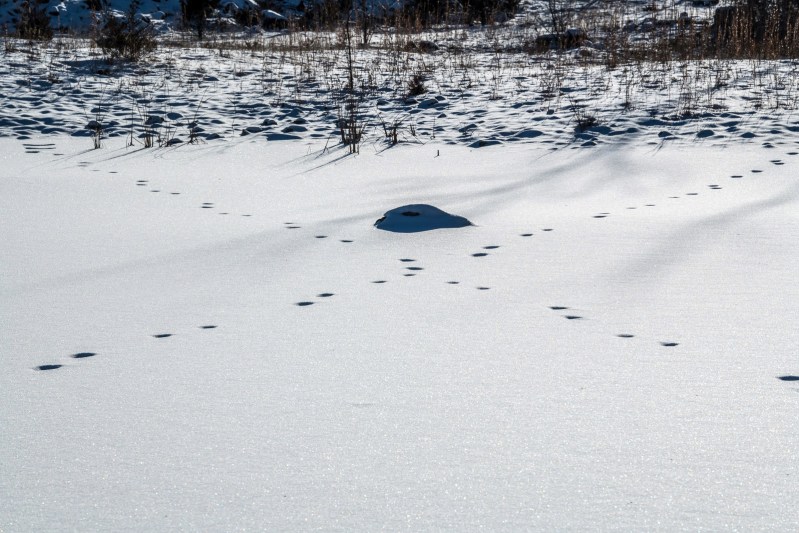
Usually, the little lake is teeming with birds. Now only spare footprints tell me that I am not alone.

DSC 0200 2

It is cold.

DSC 0223

Proof by Example (Push & Pop I)

Here is Push & Pop, a puzzle with a very simple mechanics. It is played on a single strip with a fixed number of fields, occupied by tokens that are stacked on top of each other (as in checkers)
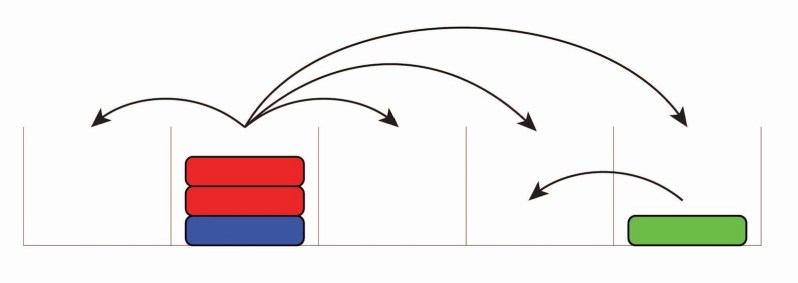
 

Position 01

A move consists of taking some of the top tokens of a tower, and moving them onto a field that is as many steps away as you are taking tokens, within the limits of the game board. If the target field is occupied, just place your tokens on top. Note that you can take only pieces from the top, and are not allowed to change their order. In the position above, the possible moves are indicated by the arrows, and you can see the possible new positions below. 
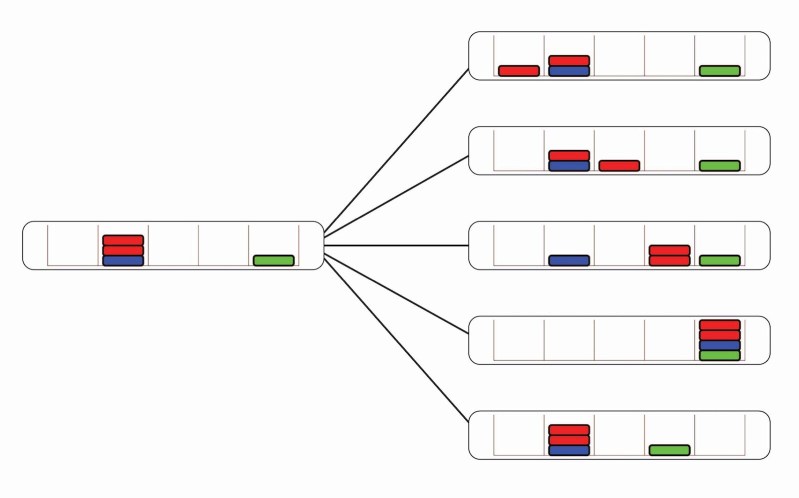
Moves 01

You will gladly notice that the color of the tokens does not matter at all at this point. You will also notice that moves are reversible, because undoing a move is also a legal move. Games are in so many ways better than reality. 

A typical puzzle using this mechanic is given by two position, and the task is to transform the first into the second using only legal moves. Here is a simple example, played on a board of size three with two tokens of different color, placed on top of each other at the leftmost field. The task is to swap the position of the two tokens:

Puzzle0 01

This is not possible on a board of size 2 (why?), and requires five moves on a board of size 3 like so:

Solution0 01

Why should we care? Particular examples can often be used to gain universal insights. In this case, for instance, we have just essentially proven that any puzzle on a board of size at least three can be solved. How so?

We have shown that two adjacent tokens in a single tower can be swapped, if there are two fields available to the right. It does not matter if these fields are occupied or not, because we can just play on top of any existing pieces. It does also not matter if there are tokens below the two we want to swap, and not even if there are tokens on top, because we can move them temporarily out of the way (remembering that moves are reversible).

As the group of all permutations is generated by transpositions (use bubble sort), we can in fact permute the tokens in any single tower to our liking. Finally, to solve an arbitrary puzzle, we first move all tokens (piece by piece, if needed) onto a single tower on the leftmost field, then permute them into the order we need, and then move them into the desired target position.

Here is a puzzle on a board of size 5 with four tokens in 3 colors. You know now that there is a solution. But what is the shortest solution?

Puzzle5 01

To be continued…


What to keep…

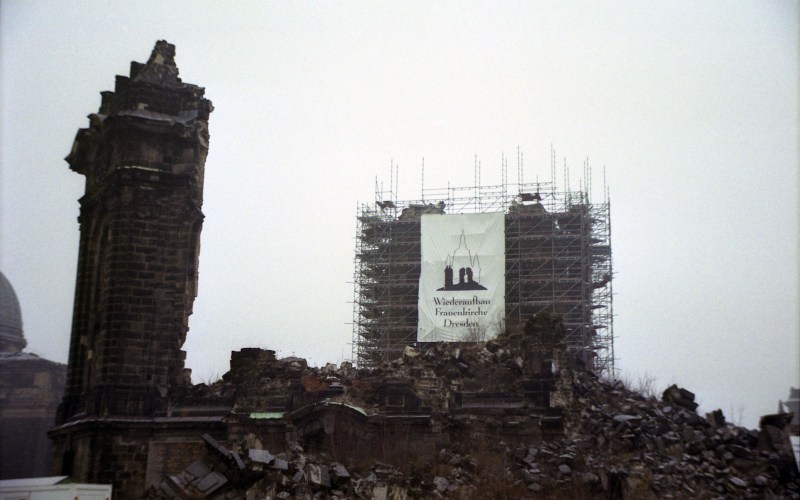
My first visit to Dresden took place in the early 1990s. It was a foggy day in December, and one of my lasting memories is the enormous pile of rubble in the city center. Dresden331

The ruins of the Frauenkirche hadn’t been touched since the bombing at the end of the Second World War, but after the reunification of Germany, a decision to rebuild was made quickly. This summer I became curious how things looked like today, so I visited Dresden a second time.

DSC 6162

What may we forget, and how should we remember? Some of the temples and monuments that have been destroyed in the Middle East in the past few years were intended to last until the end of time by their creators. Arrogance, or trust in a protective higher power?

DSC 6151

We live in volatile times. A carelessly written email can haunt us for the rest of our live, while a mouse simple click can erase decades of work stored on a hard drive.

DSC 6202

If only we could attach an expiration date to everything we do, it would be easier to decide what to keep and what to let go.

DSC 6204

Golf Balls (Beach Balls Revisited)

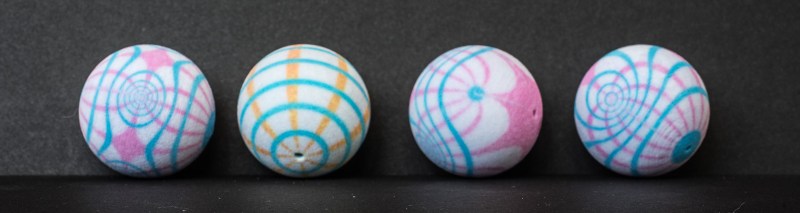
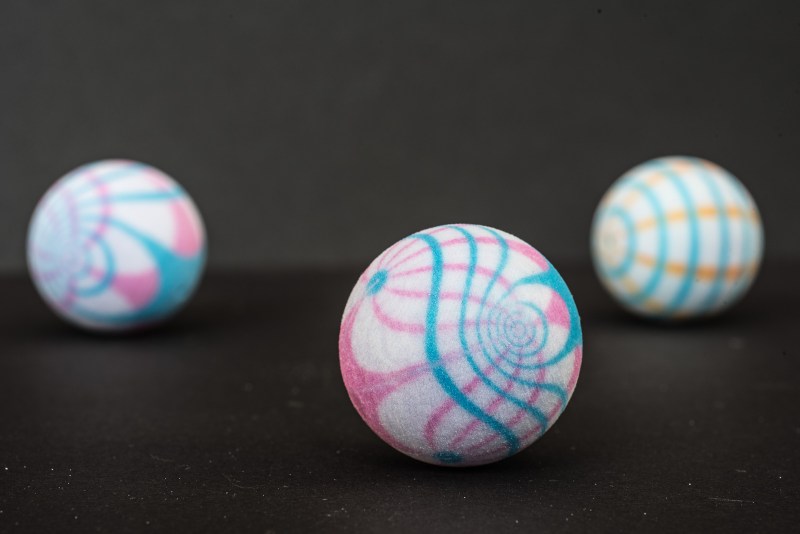
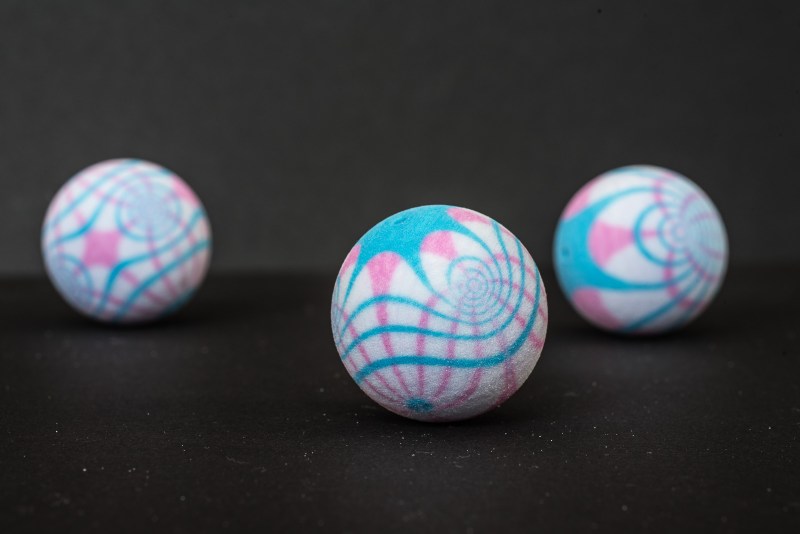
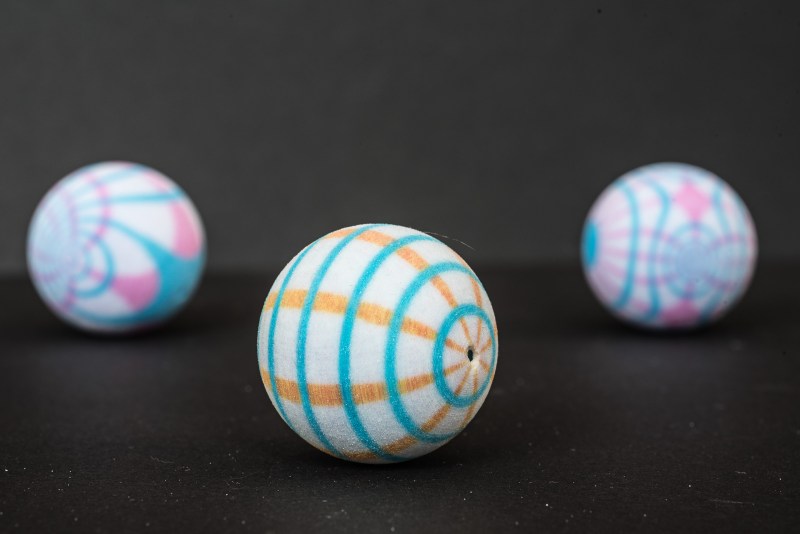
A while ago, I showed how to visualize holomorphic self-maps of the sphere by drawing the pre-image of the standard polar coordinate system of the sphere (aka latitudes and longitudes). I mentioned that it should be possible to have these 3D printed, and here they are.

DSC 8058


They are printed with a gypsum printer, which is the only one have access to that can do color. That means that they are definitely neither suitable for golf or table tennis, nor for the bath tub. But I could use these for an exam in a Complex Analysis class. Each student gets one of these balls, and has to find out what rational function it represents. 


DSC 8053


The red lines (being the preimages of the longitudes) come together in the preimages of the two poles. Hence we can locate the zeroes and poles of the function. The only problem is that these pictures don’t distinguish between zero and infinity, nor tell they anything about scaling.

DSC 8056


They do tell about branching, i.e. the location of the zeroes of the derivative. For instance, in the blurry ball to left up above, we see a branched point where four of the red lines meet (instead of the expected 8 of the polar grid).


DSC 8054

Toxic City

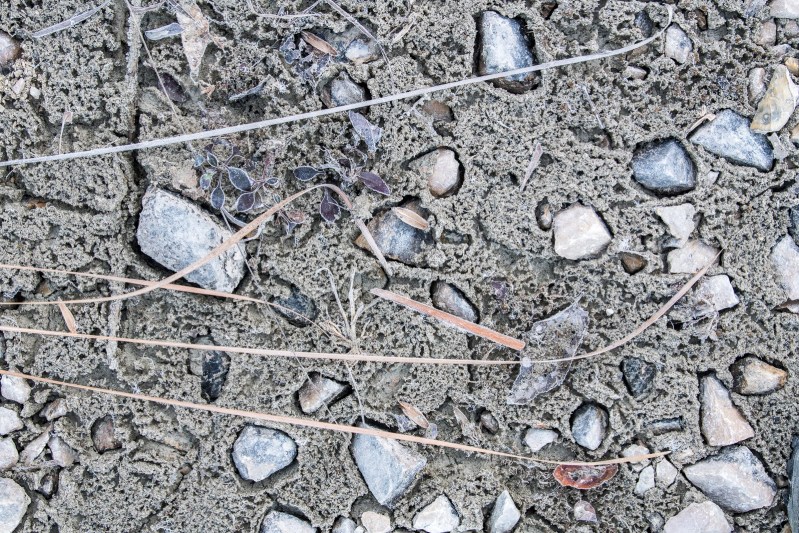
There are (at least) two aspects of the DePauw Nature Park that I haven’t written about that make this place fascinating to me. One is the structure of the ground. 

DSC 0071

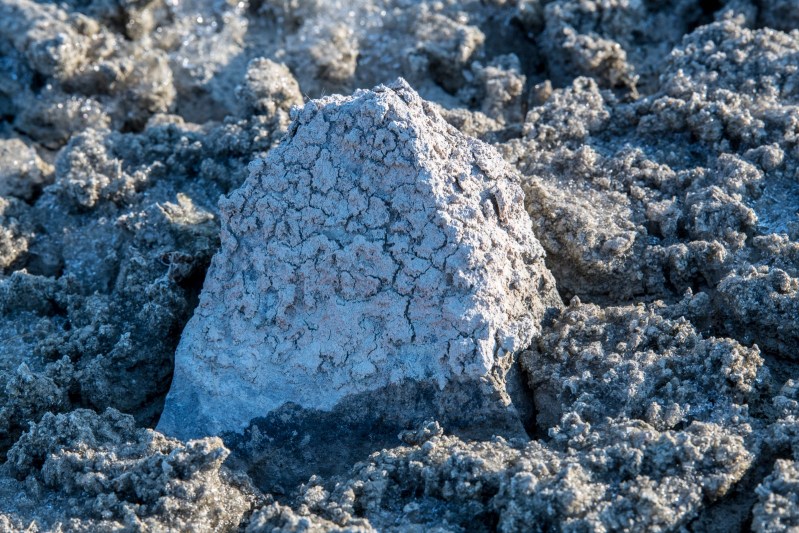
There is some weird flaky stuff that I haven’t seen elsewhere, but besides that, the ground is just more complex than what you typically would call Indiana Dirt

DSC 0099

I have waited to show this until now because, with early frost, everything gets even better. 

DSC 0081

The other aspect is the sound. In principle, this should be a quiet place (there rarely is anybody, at least not at my favorite hours). But there are birds, of course, and other noises, from factories and railroad tracks just not far enough away to be inaudible. Somebody should record this.

DSC 0084

Which brings me to another theme, that of ambiance in general. I have been listening to what is called ambient music for a while now, with increasing pleasure. Ambient music is not a well defined thing. It can just mean the incorporation of everyday sounds, or the questionable pleasure of background music. I like ambient music best when it distills everyday noise into something exceptional. Examples of that are Richard Skelton’s compositions (that are, in a good sense, very much down to earth), or, a recent discovery for me, Evan Caminiti’s recent music, including his new album Toxic City

DSC 0102

In photography (or even in art in general) there is the “classical” way to idealize the object — remove it from its context, isolate it, and even alienate it, in order to show a possibly artificially construed intrinsic beauty.

DSC 0164

Ambient art, in contrast, tries to show you how much there is without interference. We just have to look.

DSC 0165

That is a lie, of course. Whenever we show, we select. But selecting what we feel is worth seeing (or hearing) is very different from imposing a verdict on how things are on the viewer (or listener).

DSC 0090

Daumenkino

When I was little, friends gave me as a birthday present a home made flip book that would show the deformation of the catenoid to the helicoid. That was a lot of work back then when you had to program all the 3D-graphics by hand, including hidden line algorithms. But I liked it to a have a physical object that would allow me to run my own little movie.

Bryant kusner 0

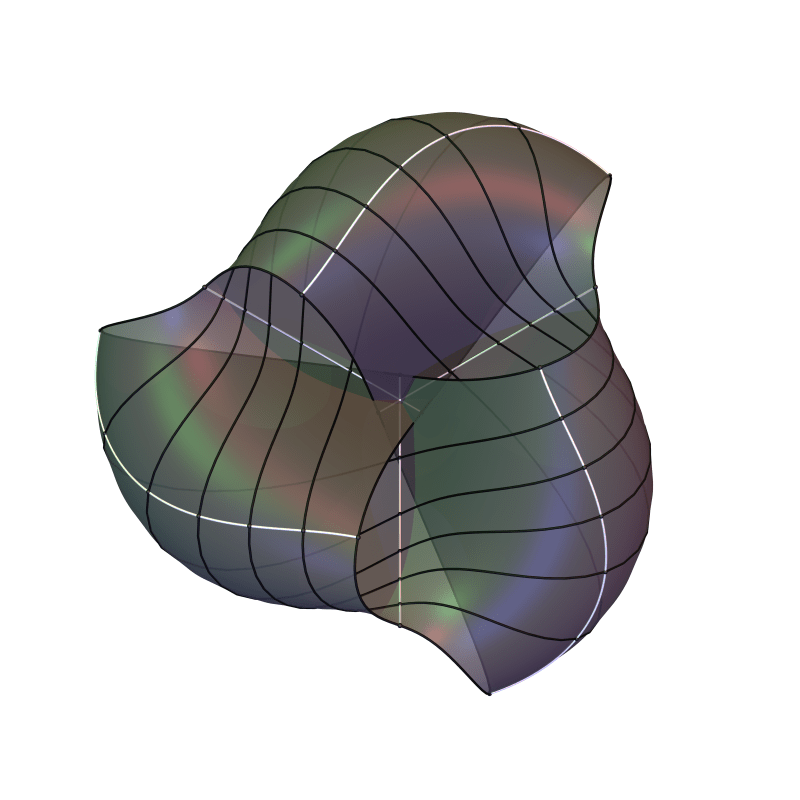
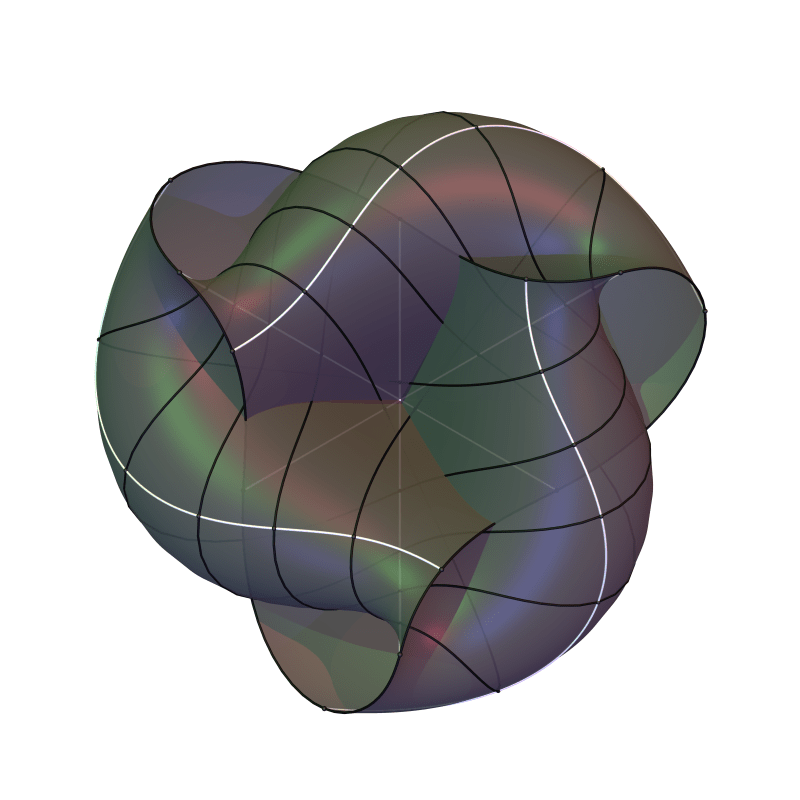
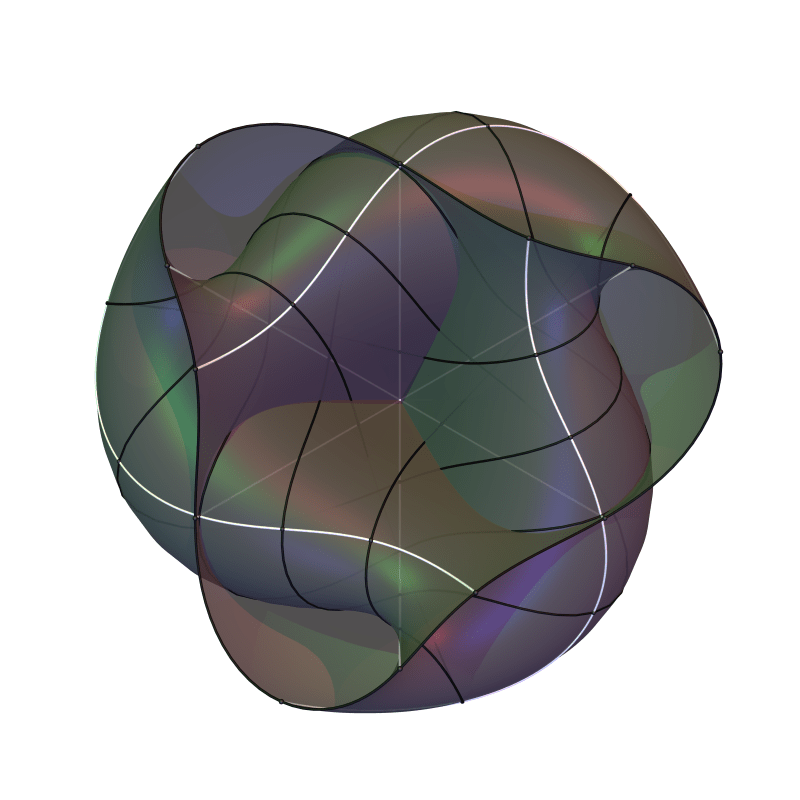
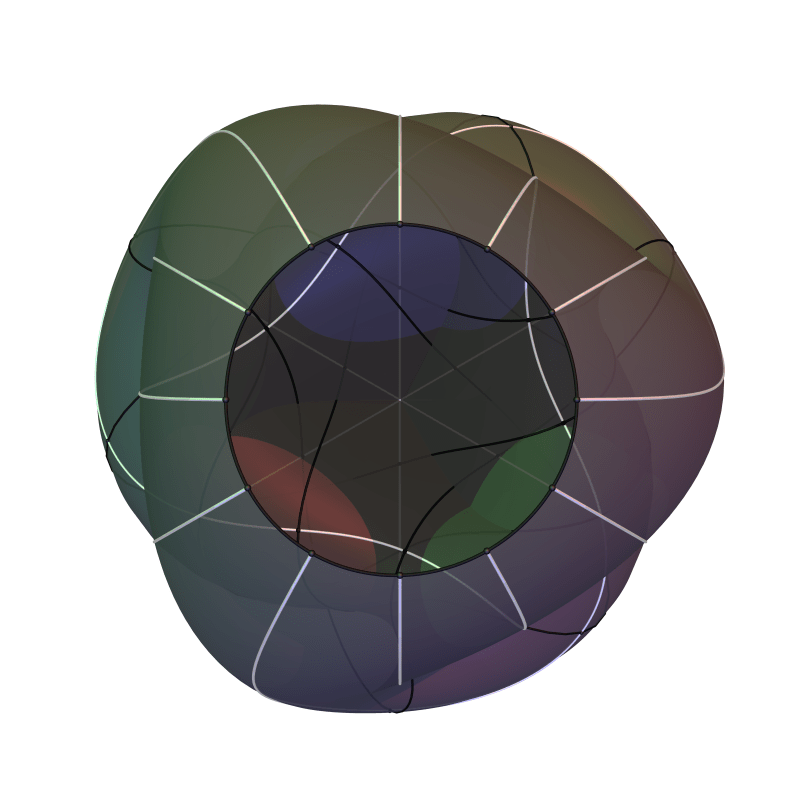
Daumenkinos – Thumb Theaters, are they called in German. Today we see some snapshots from a high tec version of such a Daumenkino, attempting to get to the core of Boy’s surface (an immersion of the projective plane), about which I have written briefly before.

Bryant kusner 3

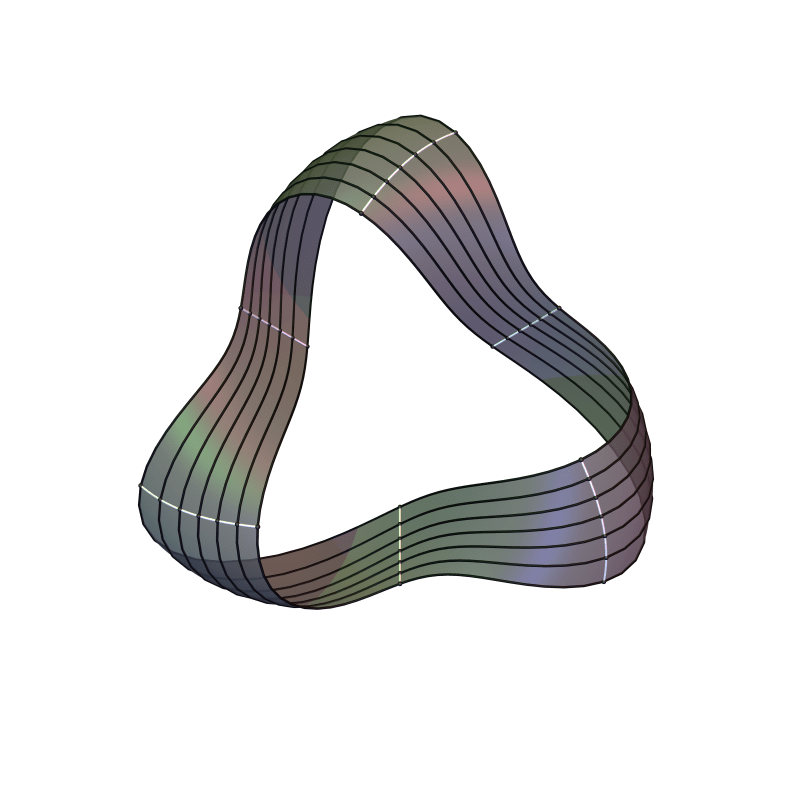
The goal is to put a lid on a Möbius strip. The one we start with you will note is not just once twisted, but three times. I don’t know how essential this is to get an immersed projective plane at the end. I suppose it’s not, but makes things easier. Note that the strip has a single boundary curve, as expected.

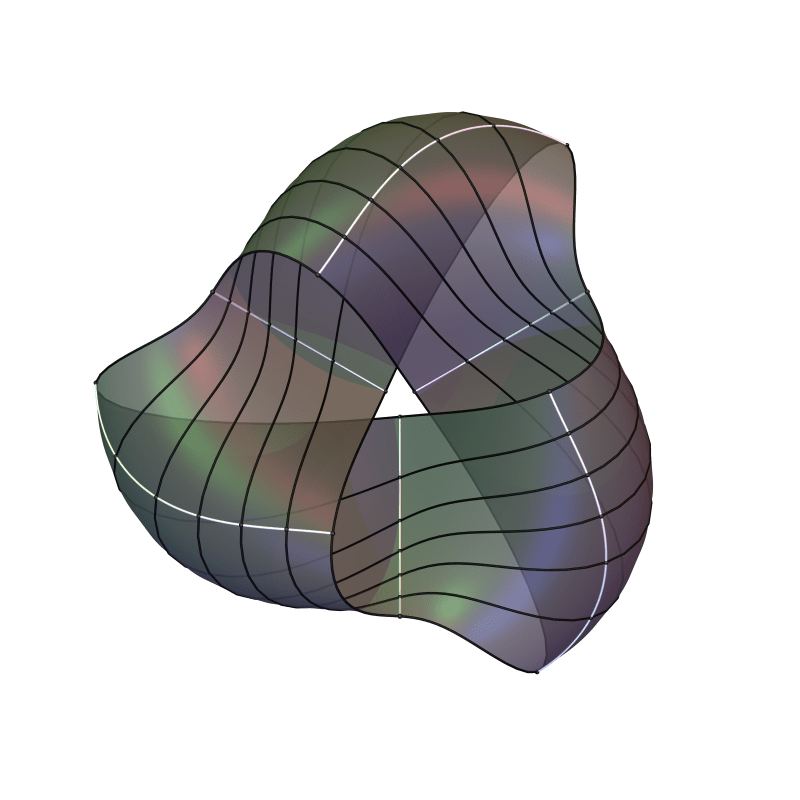
The first two images show that Möbius strip, growing slowly. Below the first crucial step has happened: The growing strip has created a triple point, and intersection like that of three planes. But there still is only one boundary curve…

Bryant kusner 4

We keep growing


Bryant kusner 7

and growing:

Bryant kusner 8

Another critical event: The boundary curve emerges completely into free air, i.e. doesn’t pierce through the surface anymore. Now it’s easy to close the lid:

Bryant kusner 99