Dos Equis (Foldables 3)

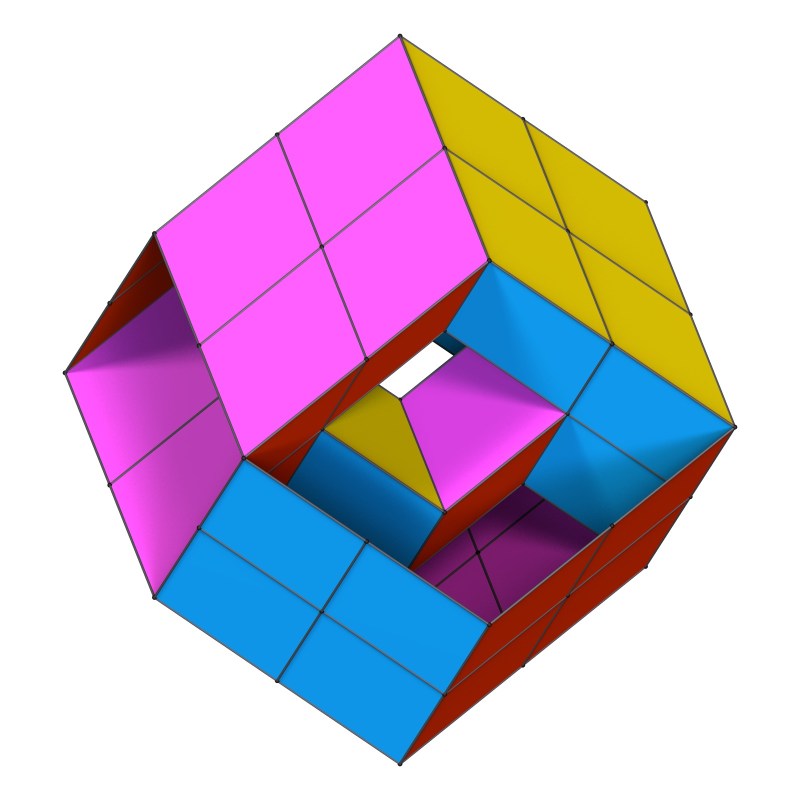
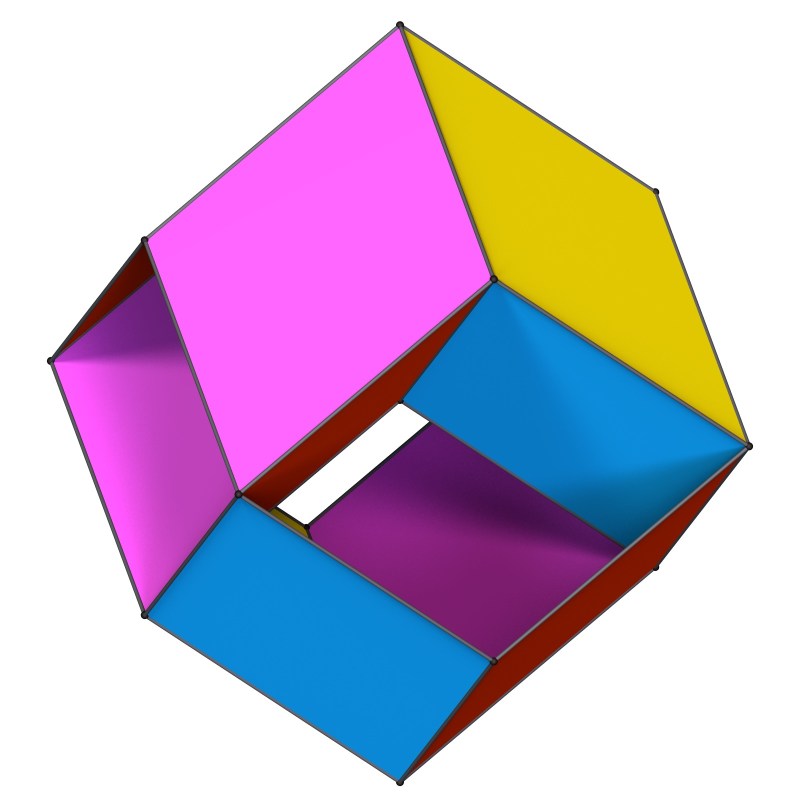
Whenever you show a mathematician two examples, s(he) wants to know them all. So, after the introductory examples of Butterfly and Fractal it’s time to make something more complicated. Jiangmei and I started by classifying all possible vertex types that can occur when you build polyhedra using only translations of four of the six types of faces of the rhombic dodecahedron (and make sure they attach to each other as they do it there). We found 14 different ones, and a particularly intriguing one is what we called the X:
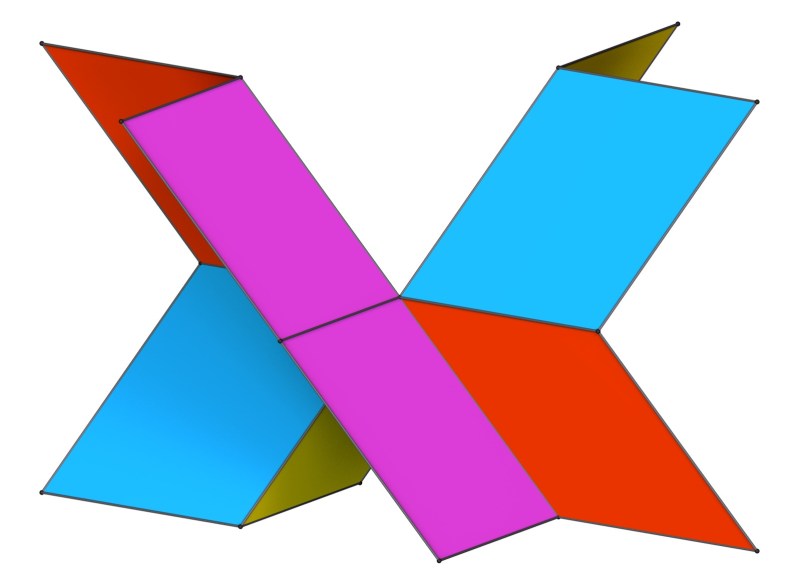
TripleX1The central vertex has valency 8, and we were wondering whether we could use it to build a triply periodic bifoldable polyhedron. It is easy to combine two such Xs to a Double X:

TripleX2

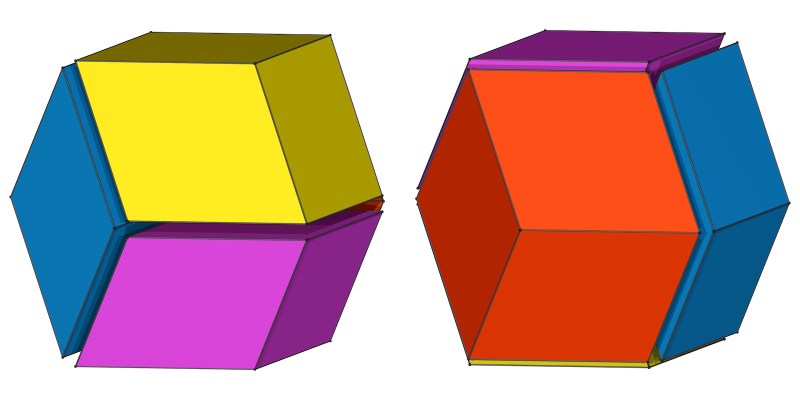
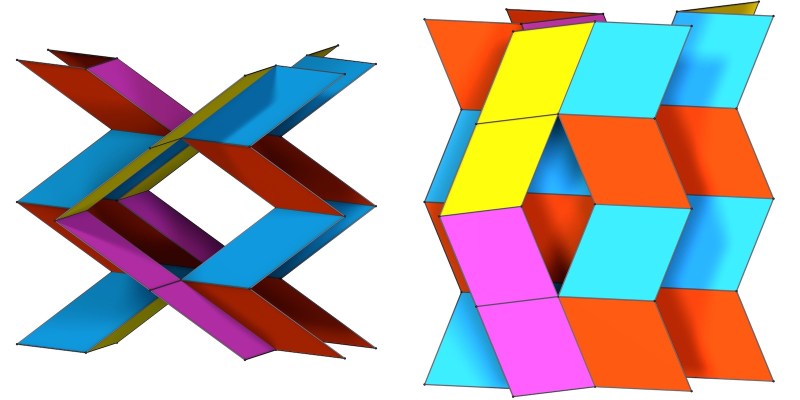
One can then put a second such Double X (with the order of the Xs switched) in front. Note that these are still polyhedra. Below are two deformation states of these quadruple Xs. We see that they are quite different.
Xdef

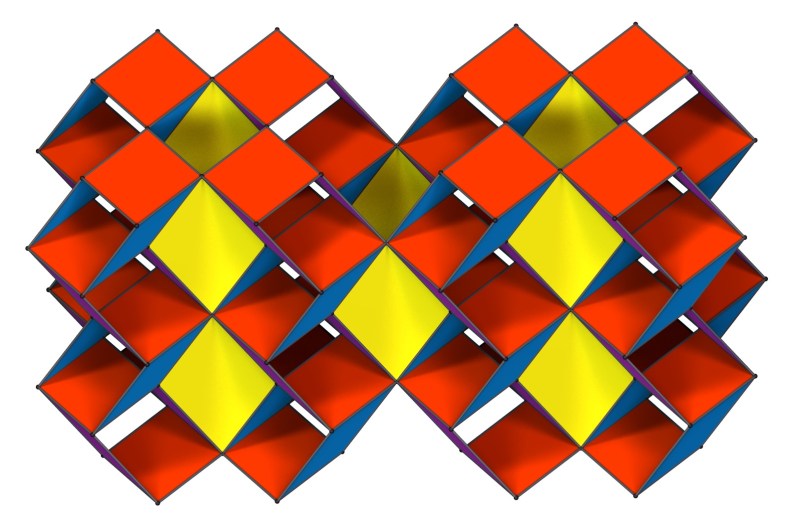
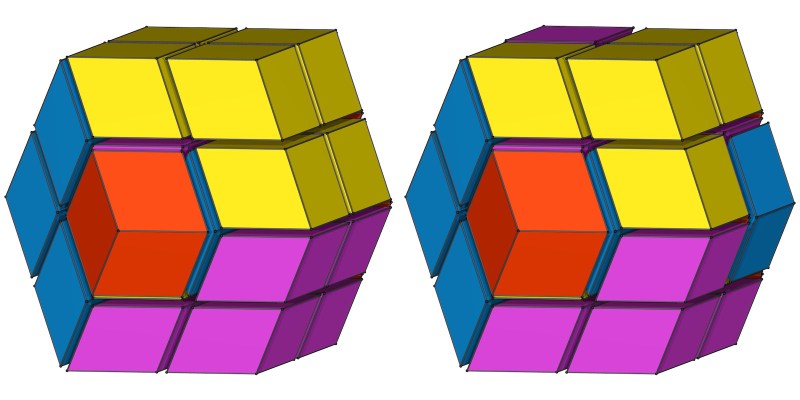
So far, the construction can be periodically continued up/down and forward/backward. It is also possible to extend to the left/right, and there are in fact two such possibilities, allowing for infinite variations, because one has this choice for every left/right extension. They are indicated by the arrays below. 

TripleX3carrowIf you don’t have the time to build your own model, here again is a movie showing the unfolding/folding of a rotating Dos Equis.


Fern Canyon 2 (Not Ferns 4)

2018 06 11 11 03 49 NIKON CORPORATION NIKON D750

The canyonesque nature of the Fern Canyon State Park makes one forget that this place is next to the coast, which empasizes the contrast between the complexity of the ferns and the simplicity of the beachscape.

2018 06 11 10 54 16 NIKON CORPORATION NIKON D750

This is a place to enjoy the lack of presence, which has dissolved into a beautiful grainy gray.

2018 06 11 11 05 17 NIKON CORPORATION NIKON D750

Time passes gently,2018 06 11 11 01 29 NIKON CORPORATION NIKON D750

and allows for modest reflection.

2018 06 11 10 59 23 NIKON CORPORATION NIKON D750


The Fractal (Foldables 2)

The second bifoldable object Jiangmei showed me was this:

Fractal 1

You can find a movie showing how this folds together in two ways here. To understand how and why this works, let’s first look at a simple saddle:

Saddle

This is a polyhedron with a non-planar 8-gon as boundary. Its faces are precisely the four types of faces that are allowed in our polyhedra: All others have to be parallel to these four. The four edges that meet at the center of this saddle constitute the star I talked about the last time. Again, all edges that can occur must be parallel to one of these four. One can fold the saddle by moving the upwards pointing star edges further up (or down), and the downwards pointing edges further down (or up), thereby keeping the faces congruent. This works locally everywhere and therefore allows a global folding of anything built that way. Fractal 0

For instance, the hollow rhombic dodecahedron above can be bi-folded. Now note that this piece is also a polyhedron with boundary. In fact, its boundary is exactly the same octagon as the boundary of the saddle. 

Observe also that at the center of this piece we have a vertex in saddle form. This suggests to subdivide all rhombi into four smaller rhombi, remove the saddle an the middle vertex of the doubled hollow dodecahedron, and replace it by a copy of the standard hollow dodecahedron. This gives you Jiangmei’s fractal. Repeating this is now easy. Below is the generation 2 fractal (animation):

Fractal 2

And, just for fun, the generation 10 fractal:

 Fractal 10 colorgradient

You can see it being bifolded here. So far, the two completely folded states of our polyhedra looked very much the same. We will see next week that this doesn’t need to be the case.

Fern Cliff Nature Preserve (Ferns 3)

After the brief excursion to Northern California, we are back to Indiana. This state also has a Fern dedicated nature preserve, the Fern Cliff Nature Preserve, located a little west of Greencastle. Things are a little different, though.

DSC 3277

We do have a lot spooky cliff and very little path, mostly dead ends. DSC 3314

But this means one can explore, and the patient visitor will find ferns that mingle with liverworts.

DSC 3287

I took these pictures 9 years ago, but I don’t expect that much has changed.

DSC 3321

A little bit off the (beaten) path are some views of the sandstone cliffs I really liked:

DSC 3326

I will pay this place another visit as soon as the eternal heat wave ends.

DSC 3331

The Butterfly (Foldables 1)

We all know that cardboard cubes are rigid, which is why we get our packages in boxes. We also all know that if we remove two opposite faces from a cube, we can fold it together. This started to interest me when I noticed that the polyhedral approximation of the Schwarz P surface is surprisingly flexible. This summer, I showed this to our local Origami and Paper Folding expert, Jiangmei Wu from our School of Art and Design, and she became interested. A few days later she came with a paper model that looked like this:

ButterflyTriply

She called it a simple variation of the polyhedral P-surface. Hmm. This is a triply periodic polyhedral surfaces tiled with rhombi. To understand it, we build it out of smaller units (which we called butterflies):

Butterbuild

The really cool thing about it is that it can be folded together in two different ways, like so:

Butterdeform

You can find an animation showing the continuous deformation here. We stared at this for a (long) while, until we realized that this has to do with rhombic dodecahedra. The structures up above are composed of the rhomboids from last week that tile a rhombic dodecahedron. The latter has, as the name hints, 12 faces, which occur in opposite pairs. Like the cube, it is rigid per se, but becomes foldable if we remove two pairs of parallel faces, leaving us with four faces to use, which are distinguished by color up above.Fractal0b

Above you can see the four hollow parallelepipeds (which we called hollowpeds). The almost trivial but nevertheless mind bending realization is that everything you build out of these hollowpeds becomes a structure foldable in two different ways. Next week I’ll show Jiangmei’s second model, a foldable fractal… If you can’t wait, check out this.


Fern Canyon (Ferns 2)

After the modest ferns from last week, let’s indulge. One of the places to be is the Fern Canyon in the Prairie Creek Redwoods State Park, which lies, alas, in Northern California.

2018 06 11 10 17 08 NIKON CORPORATION NIKON D750

Most people who make it into the coastal redwoods that far north don’t bother to take the windy detour to that state park and trail head. Here is what they miss.2018 06 11 10 22 12 NIKON CORPORATION NIKON D750

The vertical walls of the short canyon are packed with ferns.
2018 06 11 10 10 01 NIKON CORPORATION NIKON D750

Their gentle motion is impossible to capture in a photograph.
2018 06 11 10 22 49 NIKON CORPORATION NIKON D750

At some places, they appear to float before a darker background.

 2018 06 11 10 12 03 NIKON CORPORATION NIKON D750

After seeing this, you will keep dreaming of a house with walls like this.

Unpacking the Hypercube

Last week we learned how Rototiler moves can unpack a cube.  As a warmup, below are the moves for a 2x2x2 cube projected parallel along a cube diagonal onto hexagons:

HexaSwap2

We start at the left, remove the frontmost cube, and keep going. The solution is far from being unique, but not too complicated. Today, we do the same with a  hypercube. The projection of a 1x1x1x1 into 3-space along a main diagonal is a rhombic dodecahedron, tiled by four rhomboids. These rhombic dodecahedra have 8 obtuse, 3-valent vertices at the corners of a cube, and 6 acute, 4-valent vertices at the corners of an octahedron.

Rhomb1

There are two ways to tile the rhombic dodecahedron with these rhomboids, and changing one to the other corresponds to a rototiler move in space. Let’s do this with the 2x2x2x2 hypercube, whose projection is a rhombic dodecahedron tiled by 32 rhomboids.

Rhomb2

At first it seems as if there is no swappable rhombic dodecahedron available, but if we remove three rhomboids and  look inside (which is the direction of the fourth dimension, after all), we can see it. After swapping it, we also remove the frontmost rhomboid of the  swapped dodecahedron.

Rhomb3


We then see that the four removed rhomboids together make up another swappable dodecahedron. We replace it by its swap. The same can be done at three other places.

Rhomb4

The next thing to do is to swap 6 more dodecahedra. One of them is the one which shows yellow and purple rhomboids in the right figure above, sitting between the red and blue “vertex”. All these dodecahedra correspond to the edges of the tetrahedron whose vertices are the already swapped four peripheral dodecahedra. Doing these six swaps leads to a tiling very much like the one above to the right, where now the other four obtuse vertices mark swappable dodecahedra. Swapping these and finally the hidden central dodecahedron  completely unpacks the hypercube. It took us 1+4+6+4+6+1 = 32 swaps, as expected.


Next week we’ll see what this is good for…


Green’s Bluff (Ferns 1)

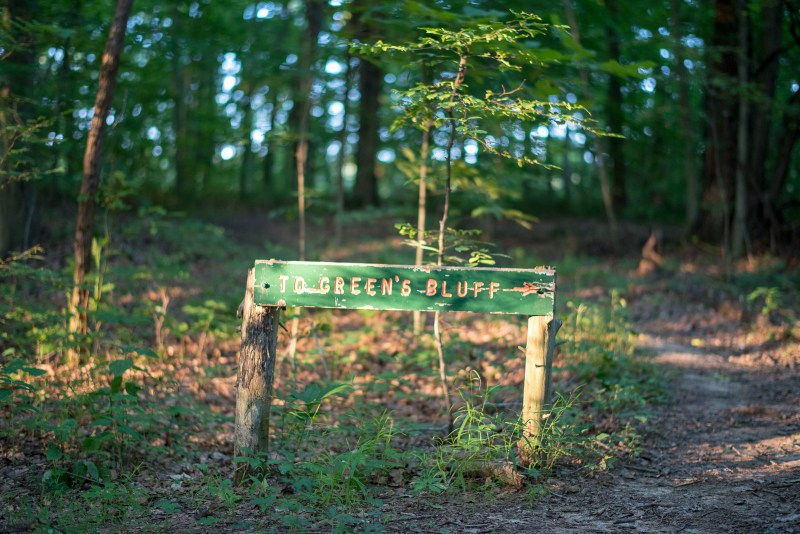
Green’s Bluff is a small Nature Preserve near McCormick’s Creek State Park.

DSC 9721

The trail leads through woodland to a cliff above Raccoon Creek. 

DSC 9723

On-site information is a little vague.

DSC 9736

Not many people visit, in particular not during the hot summer days, when one of the attractions is in full growth.

DSC 9735

Ferns are not unusual in Indiana, but the Hay Scented Fern is pretty and not common here.

DSC 9733

Roto-Tiler

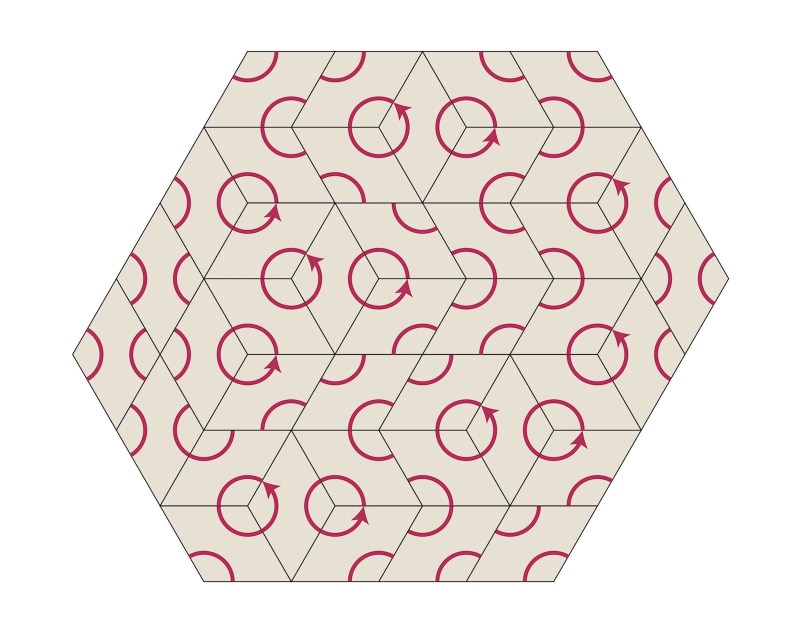
Today we look at a puzzle invented by Alan Schoen that he calls Roto-Tiler. He explained this to me a few years ago, and when I showed him notes I made for a class, he denied that this is the puzzle he described. I insist it is, and it is quite certainly not mine.

Roto0

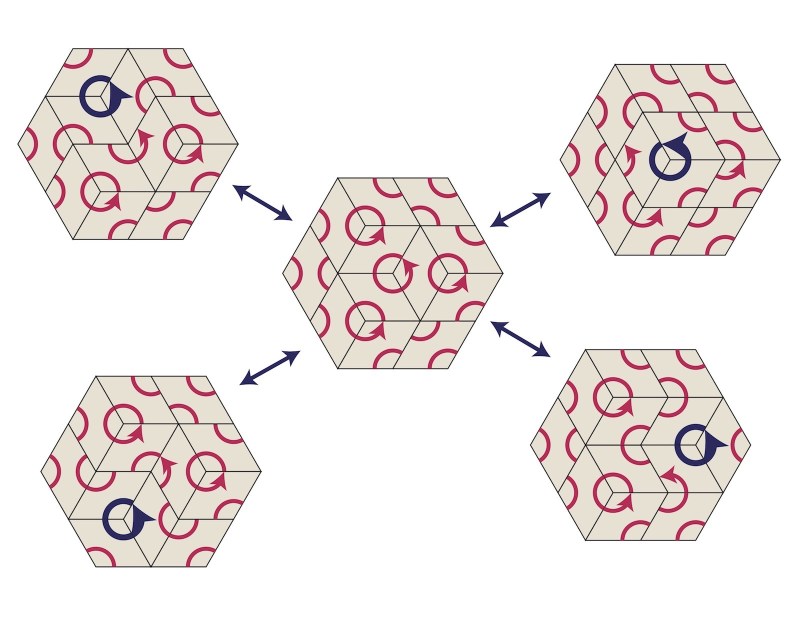
Things happen on a hexagonal board like the one above (it can but doesn’t need to be regular), tiled by hexagonal rhombi of equal size. The acute angles are marked by 1/3-circles, which occasionally happen to close up when three acute angles meet. In that case, a move consists of rotating the three involved rhombi by 120º either way.

Roto3

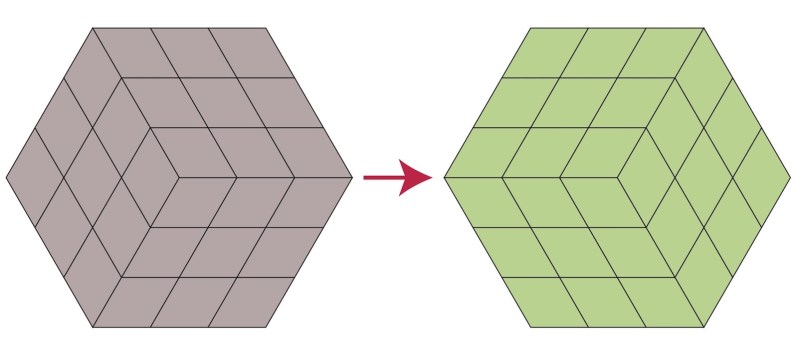
Above you can see the possible four moves from the central position. At this point it is not clear at all that a move is always possible. The puzzle consists of transforming one given tiling by rhombi to another given tiling of the same hexagon. For instance, a simple example asks to find the smallest number of moves that takes the left tiling to the right tiling.

Roto2

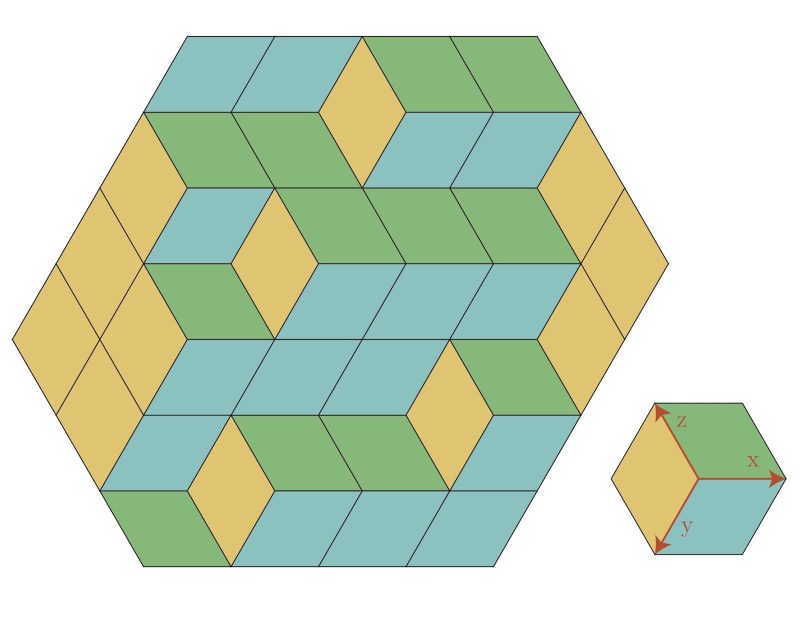
The clue to solve this puzzle is to view the hexagons as the parallel projection of a box subdivided into smaller cubes, and the rhombi as the projections of the faces of the smaller cubes. This becomes visually more intuitive if we color the rhombi by their orientation so that parallel cube faces have the same color:

Roto1

Then the hexagon above becomes the projection of a box partially filled with cubes, and a move consists of adding or removing a frontmost cube. This step into the third dimension explains everything: We see that we can solve every Roto-Tiler puzzle by emptying and filling boxes with cubes. Last week’s first example was a 1-dimensional version of this, next week we will try to grasp a 3-dimensional version and practice our 4-dimensional intuition.

The Last Days of Green

DSC 9965

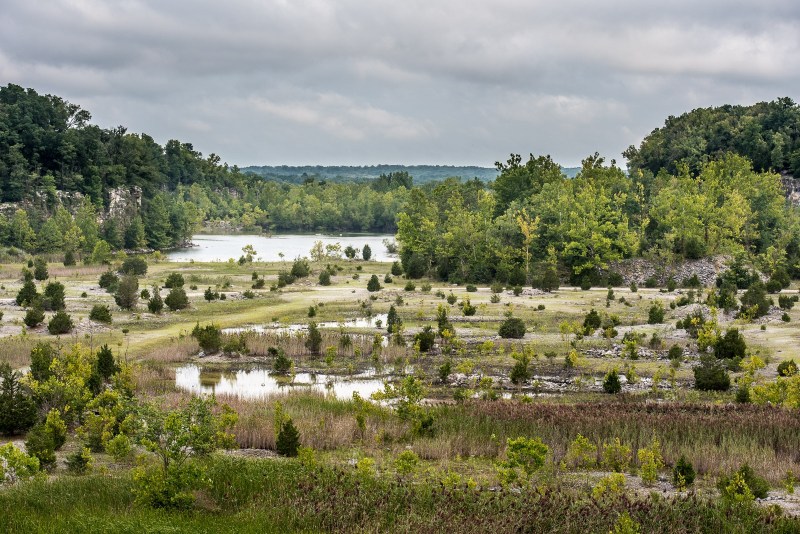
Last November I mused whether the Sycamore trees would, over the years, take over the quarry in DePauw Nature Park. My recent visit made me skeptical.

DSC 9986

There are still lots of little sproutlings, but what I thought looks like early fall coloring in the top picture and below,

DSC 0006

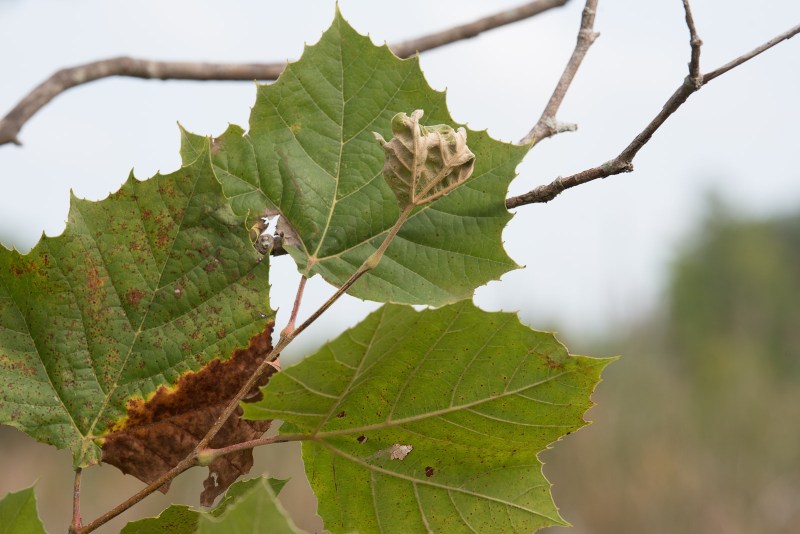
turns out to be something else up close.

DSC 9992

At least one half of the younger trees are affected by leaf loss and dead branches, and the brown color look rather unhealthy.

DSC 9990

It might be that these trees are affected by Anthracnose, or that just the generally problematic ground cover of the quarry causes malnutrition, as Bryan from DePauw University suggested. We will have to wait.

DSC 9986