Praising the Underrated (Enneper I)

In 1760 Joseph Lagrange writes, after establishing the minimal surface equation of a graph and observing that planar graphs do indeed satisfy his equation, that “la solution générale doit ètre telle, que le périmètre de la surface puisse ètre détermine a volonté” — the general solution ought to be such that the perimeter of the surface can be prescribed arbitrarily.

For a hundred years, little progress was made to support Lagrange’s optimism. Few examples of minimal surfaces were found, and most of them with considerable effort. Then it the second half of the 18th century, it took the combined efforts of Pierre Ossian Bonnet, Karl Theodor Wilhelm Weierstraß, Alfred Enneper, and Hermann Amandus Schwarz to unravel a connection between complex analysis and minimal surfaces that would become the Weierstrass representation and revolutionize the theory.

EnneperStandard

One piece in this story is Enneper’s minimal surface. Enneper was not so much after minimal surfaces but after examples of surfaces where all curvature lines are planar. This was immensely popular back then, and the long and technical papers are mostly forgotten.

Planarcurvature

Above is an attempt to visualize the planes that intersect the Enneper surface in its curvature lines.

Enneperruled
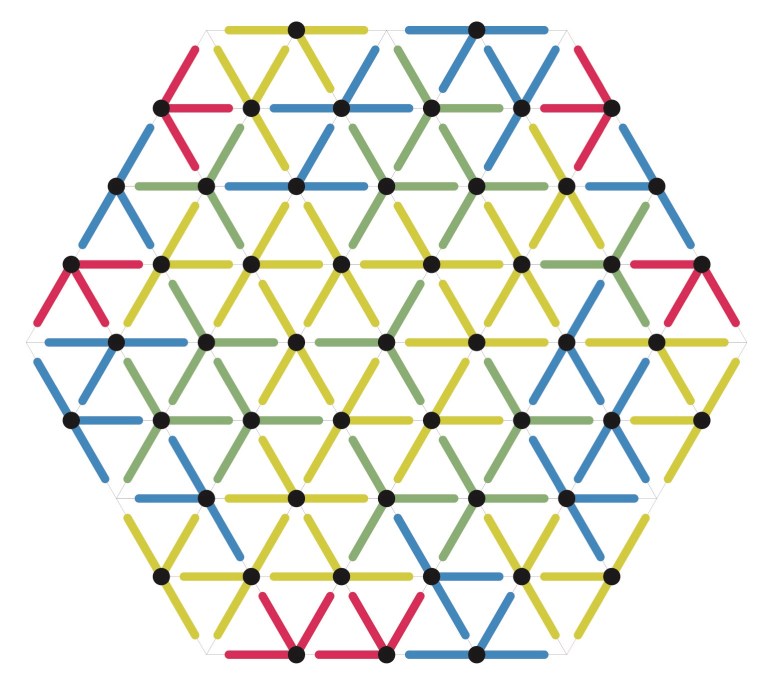
Visually easier to digest are the ruled surfaces that are generated by the surface normals along the curvature lines, because here the ruled surfaces and the Enneper surface meet orthogonally. While not planar, they are still flat, and invite therefore a paper model construction (that one can do for the curvature liens of any surface):
EnneperModel

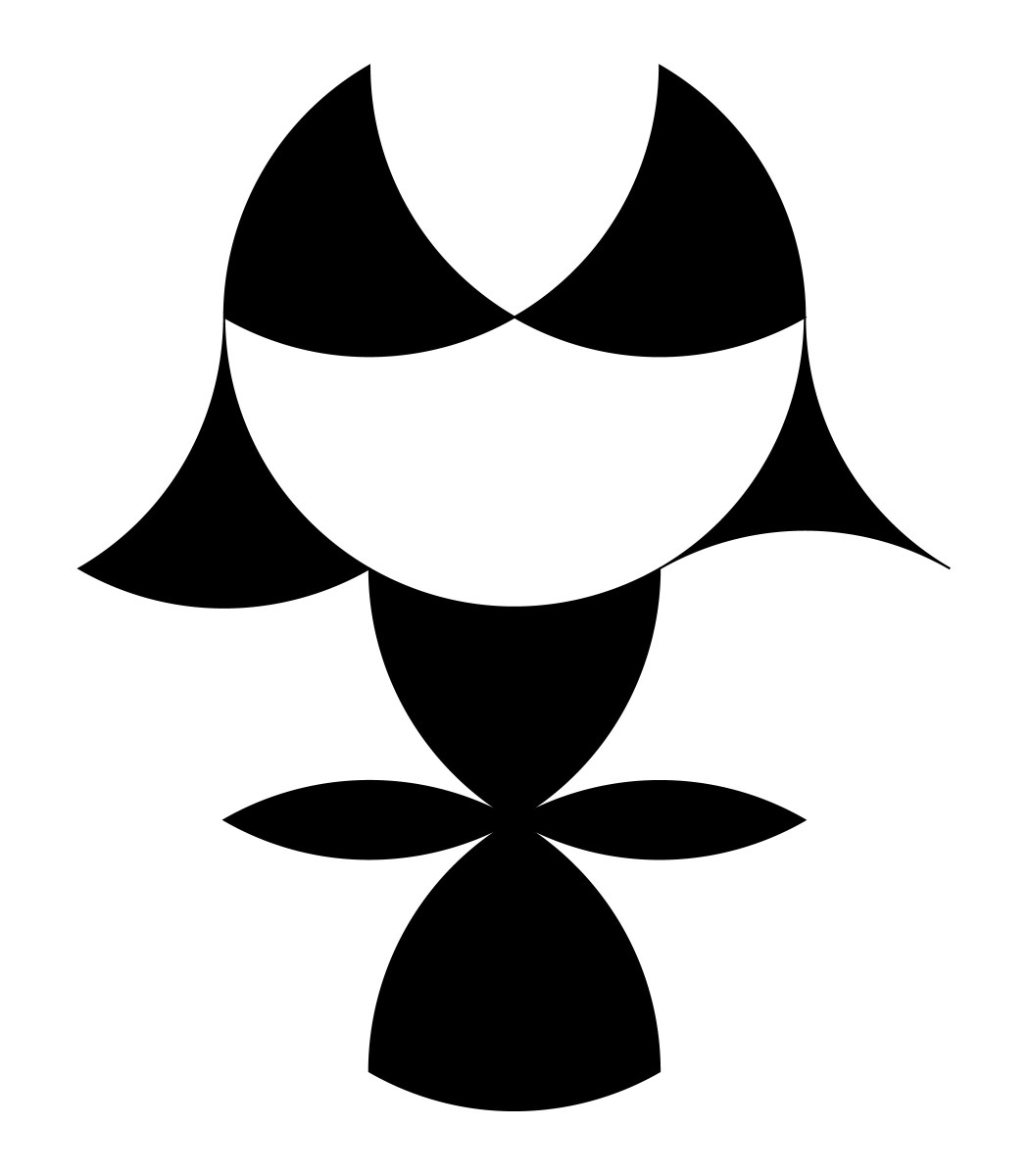
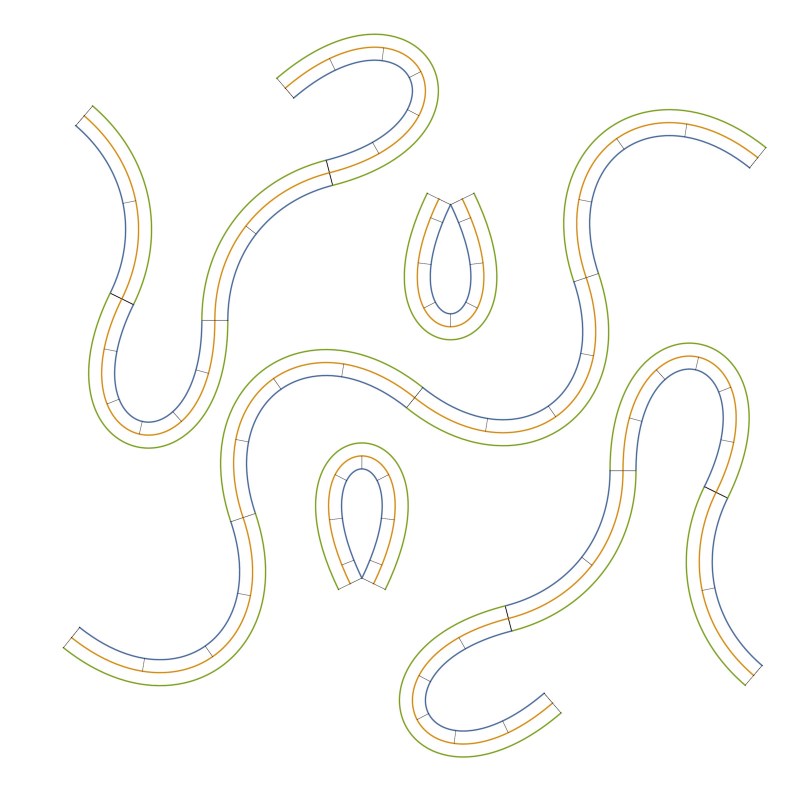
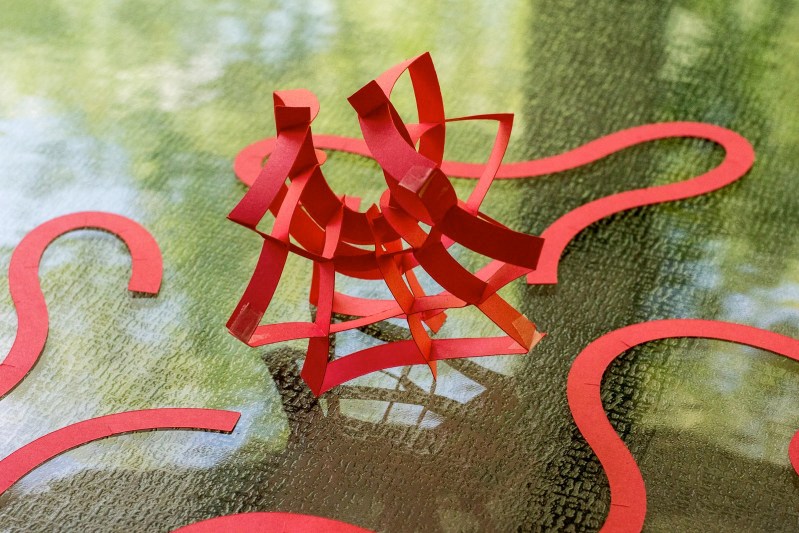
Print and cut out the five snakes. The orange centers are the curvature lines. Also cut all segments that go half through a snake, and fold along all segments that go all the way through a snake, by about 90 degrees, always in the same way. Then assemble by sliding the snakes into each other along the cuts, like so:
DSC 0999

The three long snakes close up in space and need some tape to help them with that. Here is a retraced version of the same model which might help.

Enneper2

Compass

Here is another game (like Demon) that utilizes the contemporary game mechanics of a game board that is being destructed during play.

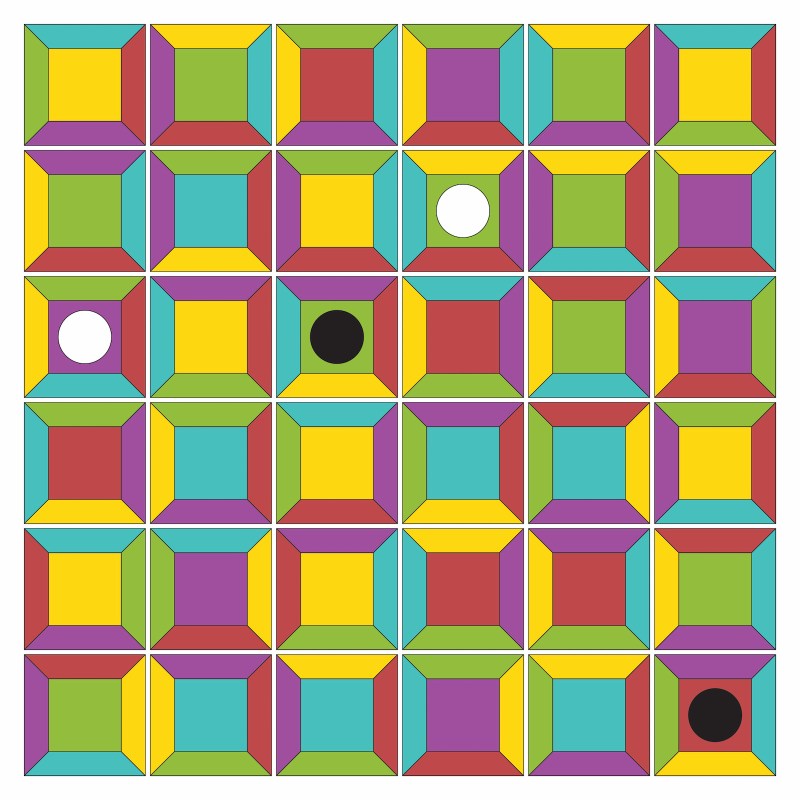
To prepare, download the pdf file and print the five pages on heavy card stock, using a color printer. Then cut out the squares. This should give you sixty playing cards like these:

Singlecard 01

They each use all of the five different colors, so there are 30 different cards, and you get each card twice, which is what you want.

As preparation, the cards are shuffled and laid out in a 6×6 square.
The players choose colors and take two checkers in their color. Then they take turns placing their checkers in the middle square of a card. No two checkers may be on the same card at the same time. Like so:

Board1 01

Now the players take turns moving one of their checkers. A checker can move north, east, south, or west on any unoccupied card whose middle square has the same color as the border of the card the checker is moving away through.
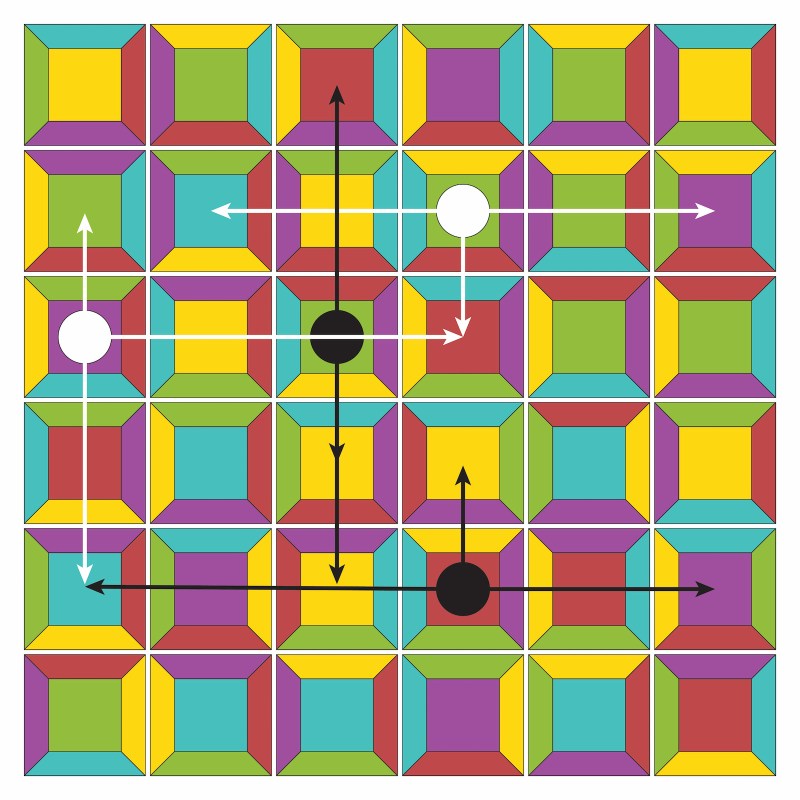
For instance, to determine where the left white checker can move, we pick a direction (say east), look at the color of the border of the square the checker is on in that direction (red), and locate all cards in that direction (east) whose middle square has that color (red).

The next image shows all possible moves for all four checkers. Note that the top white checker can move one but not three squares south, because the latter square is occupied.

Moves1 01

After moving a checker, the player collects the card the checker moved away from. If a player cannot move anymore, (s)he can either call the phase of the game over, or place one her/his collected cards on an empty square, in any orientation. Her/His move is then over, without moving a checker.

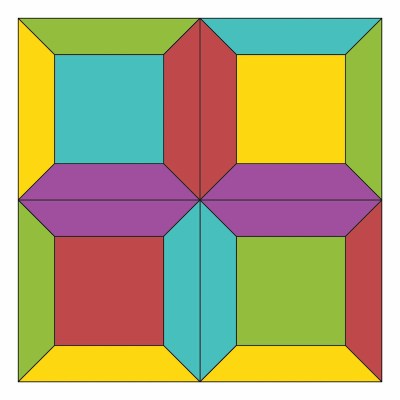
When the first phase of the game is over, the second phase begins. Here, the two players use the cards they have collected to create jewels: These are 2×2 squares where common edges have the same color:

Jewel 01

The jewels score differently, depending on the number of different colors in their shared borders.
If all are colors of the common borders are different, the jewel is worth 1 point,
if three different colors occur as shared borders, the jewel is worth 2 points, and
if three different colors occur as shared borders, the jewel is worth 3 points.

So the jewel above scores 2 points. The player with the most points wins.

A Sense of Space

My first encounter with Virtual Reality was in the 1980s, when text adventures became popular on the new affordable desktop computers.
We spent countless hours trying to figure out what to do with the pocket fluff in the text adventure version of Douglas Adams’ The Hitchhiker’s Guide to the Galaxy, made by Infocom.

Many of these games shamelessly exploited the limitations of their virtual realities: Because all interactions are verbal, there is always the possibility that what reads like a visual description of a place can in no way represent a real place. This gives plenty of opportunity for devious puzzles and mazes. A few years ago, I came up with my own little nightmarish maze, called the Un-Maze. You can play it here in a web browser. It is very bare bones, but it will tell you when you have found the exit.

Maze0 01

The rest of this post will explain this puzzle, so don’t read on yet of you like a challenge. Let’s make it simple, let’s imagine a maze where every room has only two exits, called left and right. We might think of this maze as an infinite sequence of rooms. If it happens so that all the rooms look alike, and we have no means of altering the appearance of a room, we could also be just in a single room whose right exit leads through a twisting passage to the right exit.

Maze1 01

My Un-Maze up above lets you decorate the rooms a little bit, because you can pick up and drop three different pebbles, and when you type “look”, the game will tell you whether there is a pebble in your current room. A basic unjustified assumption we make about such mazes is that when we exit a room to the right, we should be able to get back to that room by exiting the next room to the left. Many mazes in text adventures warn you about this, by telling you that you are entering a long winding passage.

The simple idea behind the Un-Maze is that your location in space is solely determined by your previous actions. For instance, if you decided to walk left-right-right, then you are in the room left-right-right.

Unmaze0 01

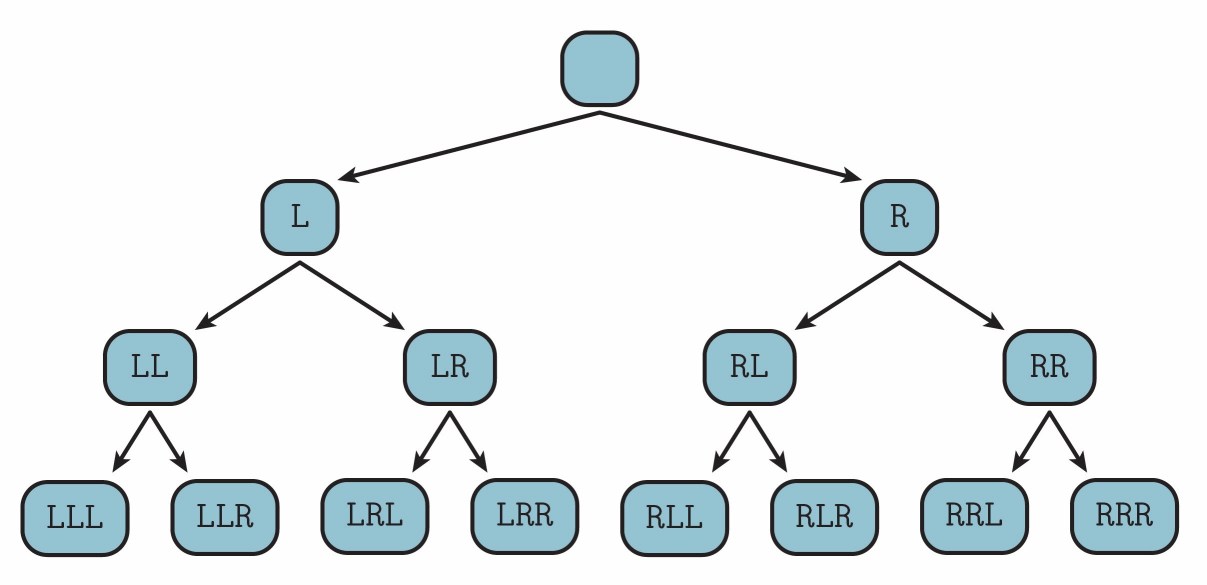
This is yet another model of a strange universe where in every room we can only move left or right. This infinite tree assumes that we have unlimited memory. What happens if we can only remember our previous three actions? Our universe would look like this:

Unmaze1 01

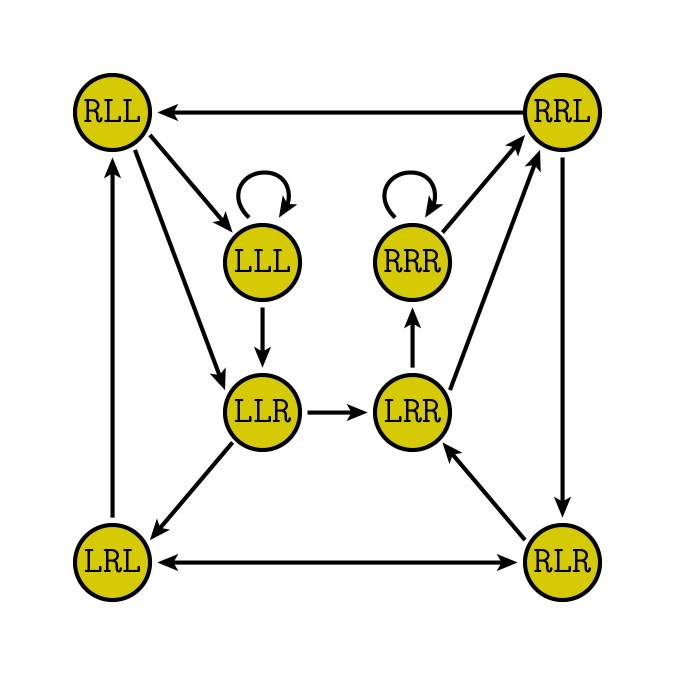
We change the name of a room by forgetting its first letter and appending the first letter of the action we took to get there (Left or Right) to its end.

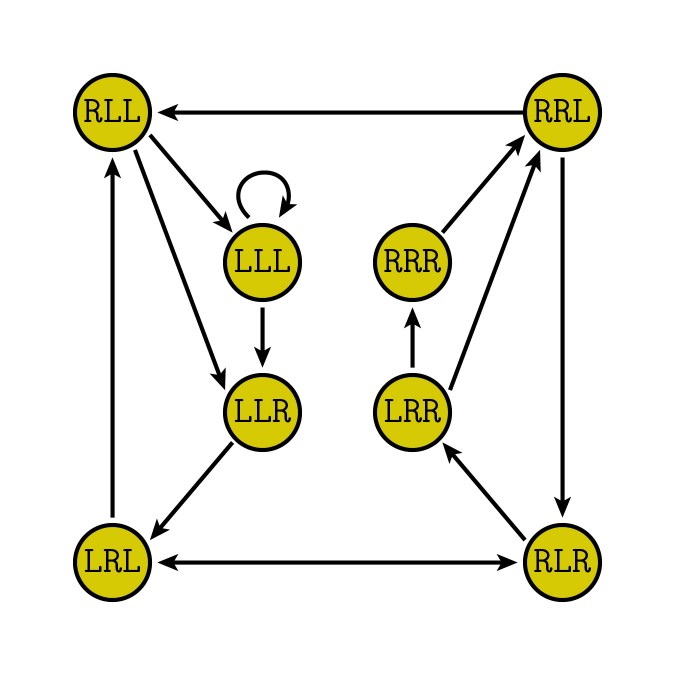
If, for instance, you knew that the exit to the maze was at room LLL, you could reach the exit from any room my going three times left. This is still a maze were all rooms look exactly the same. To change this, we can remove some exits. In the following maze, we have removed the possibility to turn right from some rooms, and now it takes five turns to get from LLL to RRR:

Unmaze2 01

The text adventure maze features four directions and the rooms are given by the memory of the last two turns. You found the exit if you manage to first go east and then north. Good luck.

Demon

Much more than playing games I like to invent games. In one of my other lives when I had more time, I then used to write a computer program for my Atari ST that could play the game better then me. This usually took three days: On day one, I would teach the program play, on day two, I would create a user interface, and on day three, implement a strategy.

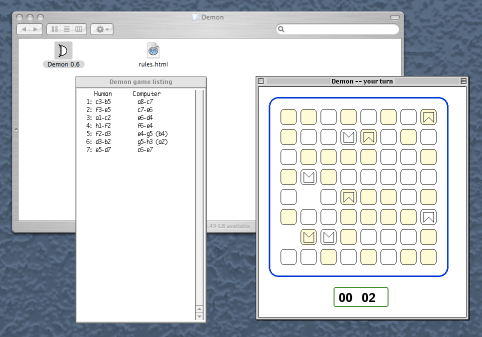
Demon1

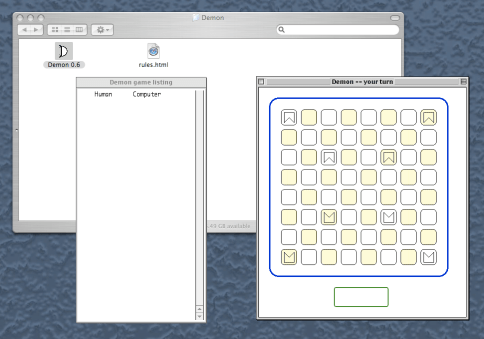
My favorite creation back then from 1987 was Demon, that I liked so much that I ported it to a PPC Mac. Because I still have a 10 year old G4 PowerBook that can run Classic, I can still play this game, but its days are counted. I have misplaced the source code, and don’t see myself to port it from MacOS 9 to MacOS X (or anything else). Maybe in a later life.

The rules are simple:

Demon is played on a 8×8 board on which initially lie 64 tiles. These tiles are white on one side and yellow on the other. They are placed on the board such that it looks like a chessboard.

Each player owns 4 knights which are put on the fields a1, c3, f3, h1 (first player) and a8, c6, f6, h8 (second player) in chess notation. In the screen shot above, the knights are represented by stylized (??) crowns.

These knights move the same way as knights in chess, but only from a white to a yellow tile or vice versa. The tile from which the knight has just moved away is turned over and hence changes color.

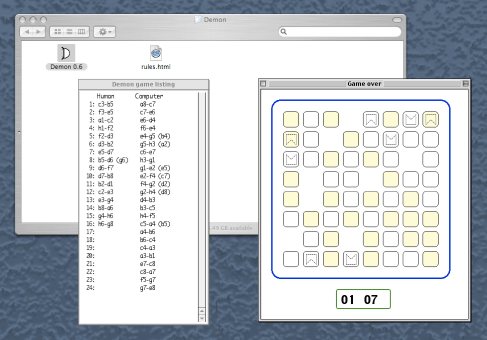
Demon2

Usually the players take turns, and each player moves only one of their own knights.

If a move creates a 2×2 square of unoccupied tiles that all have the same color (outlined below), the moving player must remove one unoccupied tile of his or her choosing from the board. This empty field can not be entered anymore. The players collect the tiles they remove for scoring.

Demon5

If a player is not able to move, he or she has to skip a turn. The game is over if both player cannot move anymore or one of them dies.

The player who has collected the most tiles wins the game.

The first version on the Atari ST used a simple alpha-beta strategy, which I still could beat on the highest level (with some effort). For the Mac version, I added tree pruning. This and the faster hardware made the game essentially unbeatable for me.

In about the same time period, chess programs advanced from being beatable by mediocre amateurs (like me) to being able to beat the chess world champion. Still, I would not have expected to see Go being played at a champion level, let alone beat the world champion.

Domino meets Towers of Hanoi

When a neighbor and colleague of mine told me he has a blog about abstract comics, that concept fascinated me to the extent that I had to make one myself. Here it is:

Comic

This, by the way, makes a nice poster. I called it Migration, and didn’t give a clue where it came from. There are very smart people who have figured it out by just looking at it, but you can’t compete, because you have already read the title of this post.

Let’s begin with the Towers of Hanoi. This puzzle is so famous that I will not explain it here, mainly because I was traumatized as a high school student when I was forced to solve the puzzle with four disks on TV, in the German TV series Die sechs Siebeng’scheiten. I just pray that no recording has survived.

Hanoimonocards

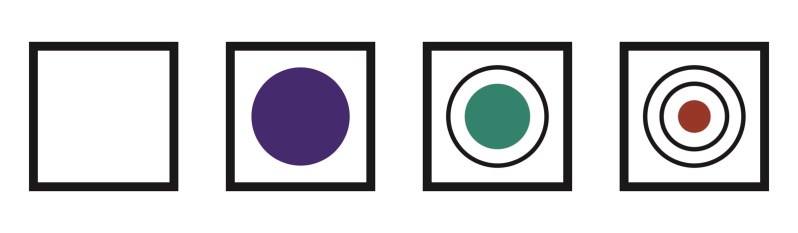
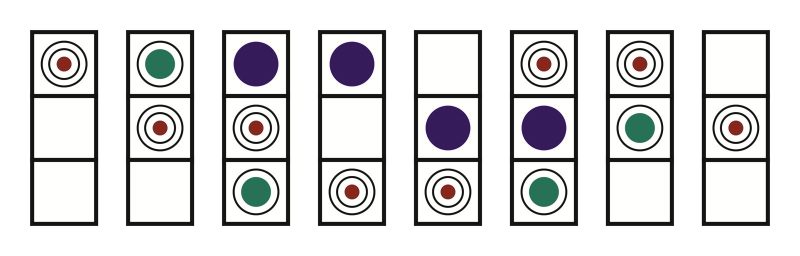
In any case, after a healthy dose of abstraction, let’s look at the Towers of Hanoi from above, and treat it as a card game.
The disks are replaced with cards that have a disk symbol on it. For the three disk game, there are three different cards, showing a small, medium, or large disk. To make everything visually more appealing, we color the disks, and to emphasize size, we show empty annuli around the smaller disks, as above. Then the solution of the three disk puzzle would look like this:

Hanoi

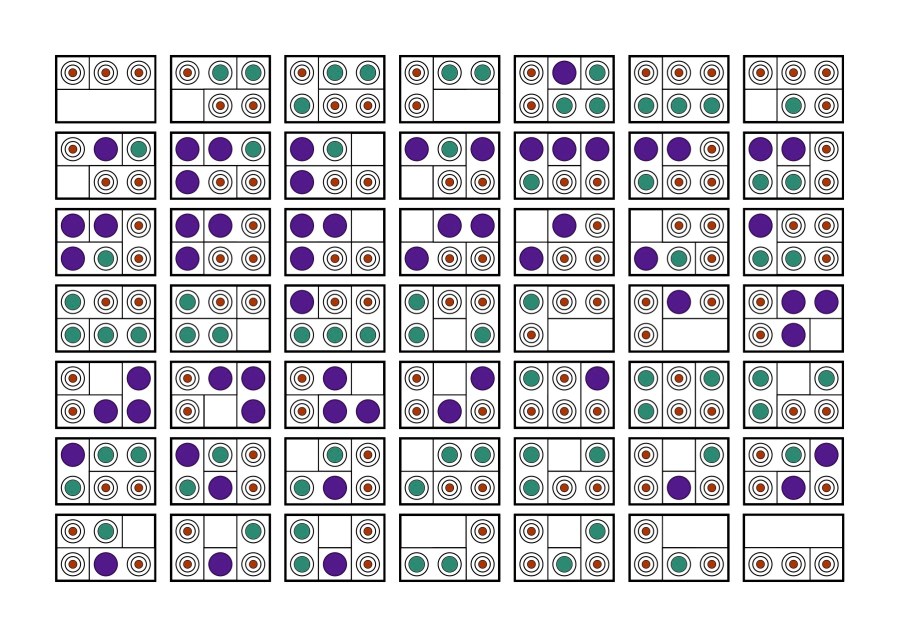
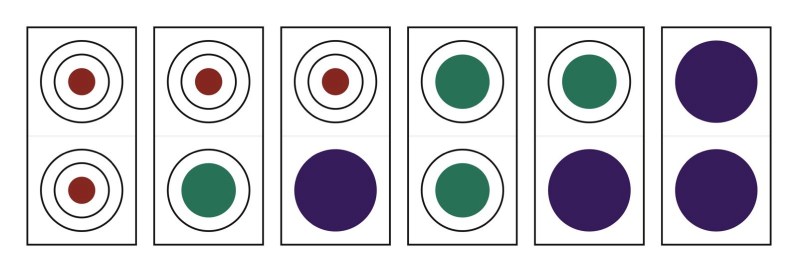
Because a card hides what is possibly underneath, a position requires context. This is one of the two ways the puzzle is mutating into a story. In the next step, we use domino shaped cards consisting of two squares instead of square cards. Here are the six hanoiomino cards:

Hanoidominocards

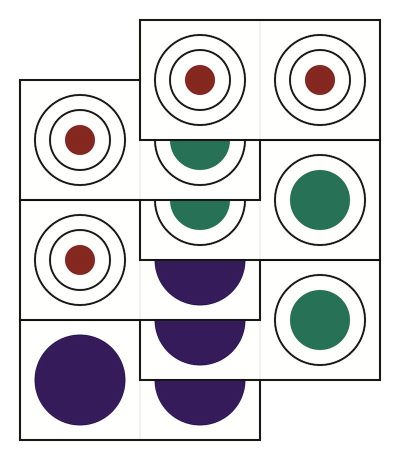
The puzzle is played on a 2 x 3 rectangle, with all six cards stacked like this in the top row:

Startdeck

Note that we have modified the Hanoi-rule: In the original version, a card can only be placed on an empty field or on a card with a larger disk. A hanoiomino must be placed so that each of the squares either covers an empty square or a square with a disk of at larger or equal size. This allows for more choice, which causes the second mutation of puzzle into story.

The migration story now tells how to move all the hanoiominos to the bottom row, to the same position, albeit reversed. It is the shortest solution, and unique as such, unless you want to count the backwards migration as a second solution.

Not Tangram

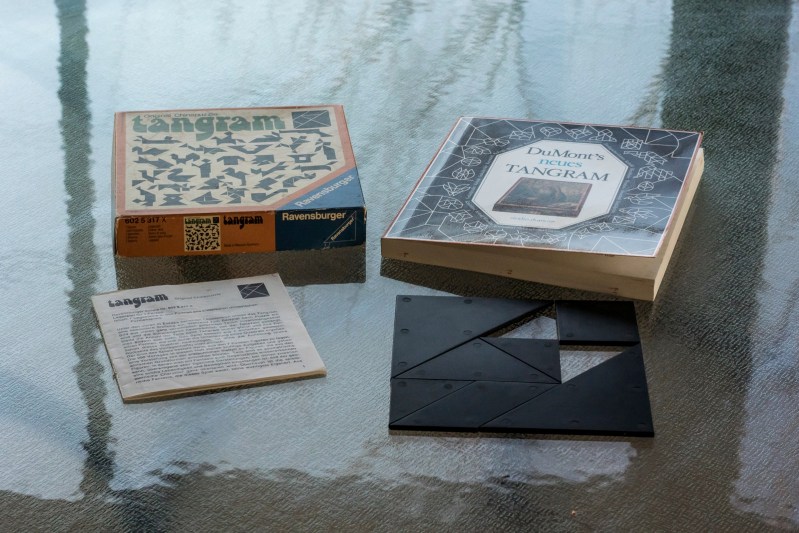
As a kid, I did like puzzles, at least until I discovered Tangram. Few things can be enjoyed on so many levels: It’s simple, reusable, facilitates abstraction and meditation. I don’t know where to stop. I have printed photos onto a tangram square and used it as a miniature puzzle. I have written two Tangram stories, i.e. picture books with few words where each illustration consist of two or three tangram puzzles.

DSC 0993

I even saved money and bought Dumont’s New Tangram, which has eight new tangram shapes and comes with beautifully designed puzzles. It was not a success with me, maybe because the pieces were cheaply made, maybe because the design of the pieces felt too arbitrary.

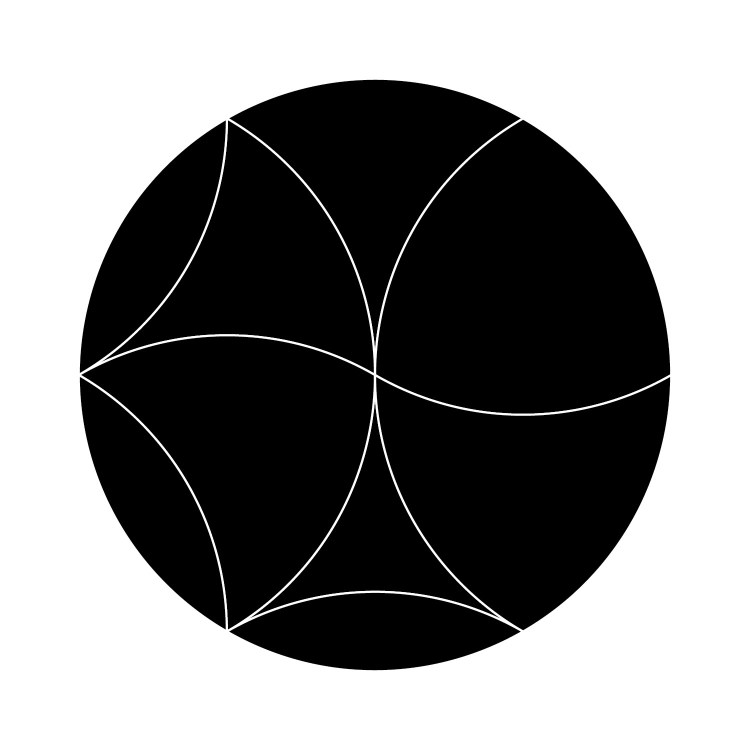
Here now is my own take on a tangram variation. There are five different pieces, for a total of eight, that fit together as a circle.

Nottangram 01

The curved pieces allow organic puzzles. Here is an easy one:

Ex1 01

Compact puzzles are a little harder, but nothing is really difficult:

Ex5 01

I think of these pieces more as of means for designs that for puzzles. Here is my favorite so far:

Ex3 01

So, go ahead, make your own designs, and write Not Tangram stories. I am done with that. For now.

Ex2 01

Polysticks (Polyforms II)

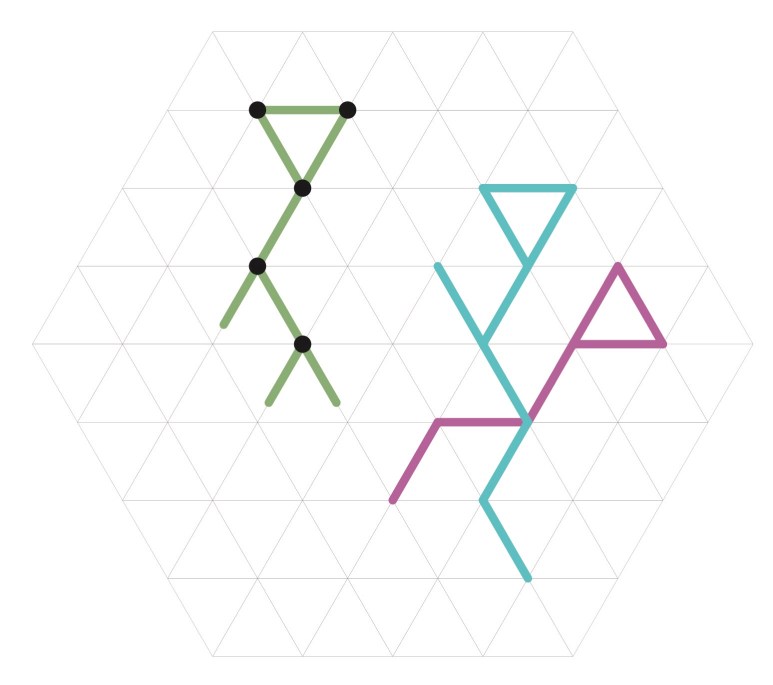
One of my favorite polyforms are polysticks on a hexagonal grid. These critters consist of connected collections of grid edges.
I stipulate that whenever two edges of a polystick meet, we add a a joint to the figure. This is in order to avoid indecent intermingling of legs as shown by the two polysticks in the figure below. Blush. The properly decorated green polystick can only watch in dismay.

Example 01

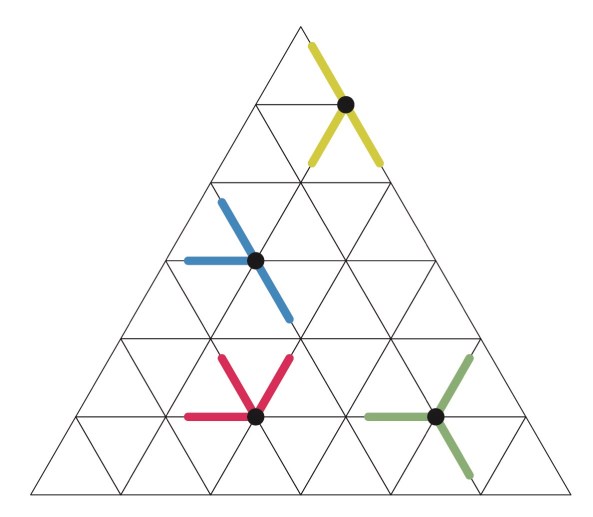
We want to use the polysticks as puzzle pieces, and we want to keep things simple. So here are all four hexagonal polysticks with three legs and just one joint. I like to call them triffids.

FourTriffids 01

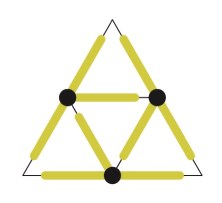
Two of them are symmetric by reflection, so I leave it up to you to count them as one or two. We can us three of them to tile a small triangle easily like so:

Mini triangle 01

By tiling I mean that we want to cover all the edges of the given shape, do not allow that two polysticks share a leg or joint (what a thought!), and do not require all vertices to be covered. We could do so, limiting the possibilities dramatically.

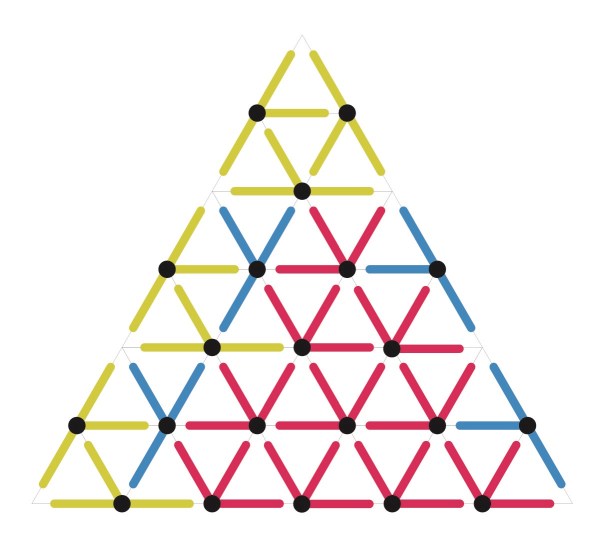
Below are two more examples. First a larger triangle, tiled using three kinds of triffids.

Triangletile 01

I have not found a way to tile this triangle (or a larger one) with just one kind of triffid. And here is a hexagon that uese all four triffids to be tiled:

Hexatile 01

Now go and make your own. If you want to use triffids, make sure that the number of edges of your shape is divisible by 3.

Unbalance

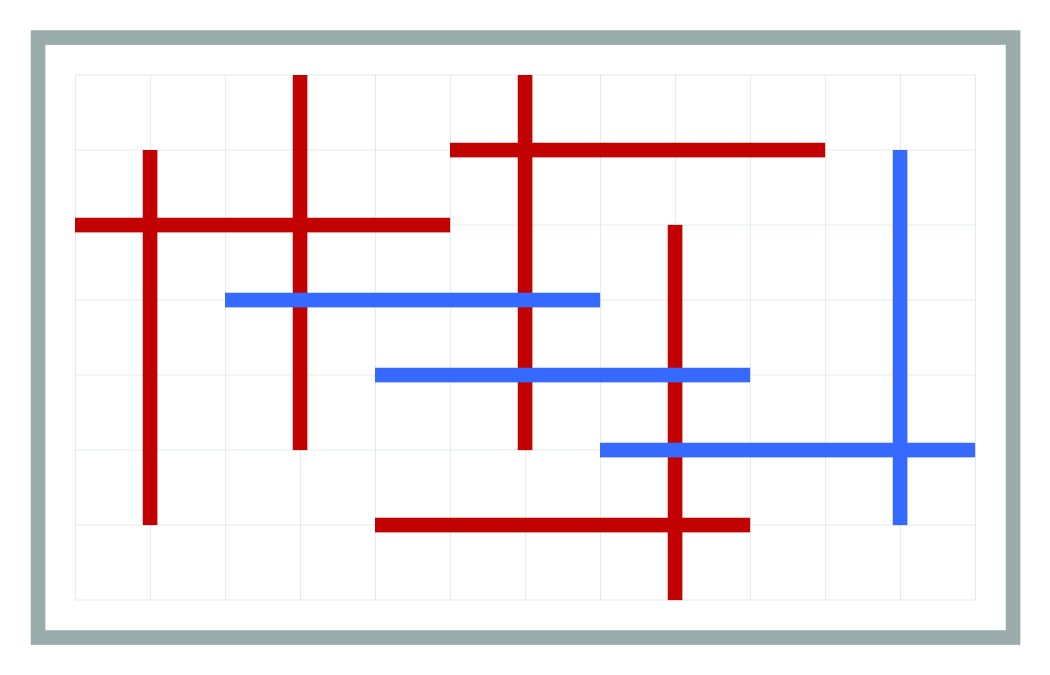
I like games or puzzles that create something while being played. Here is a simple example which I call Unbalance. The single player version is played on a rectangular grid, like this one:

Board 01
A move consists of drawing a horizontal or vertical line segment of length 5 on the grid and within the box.

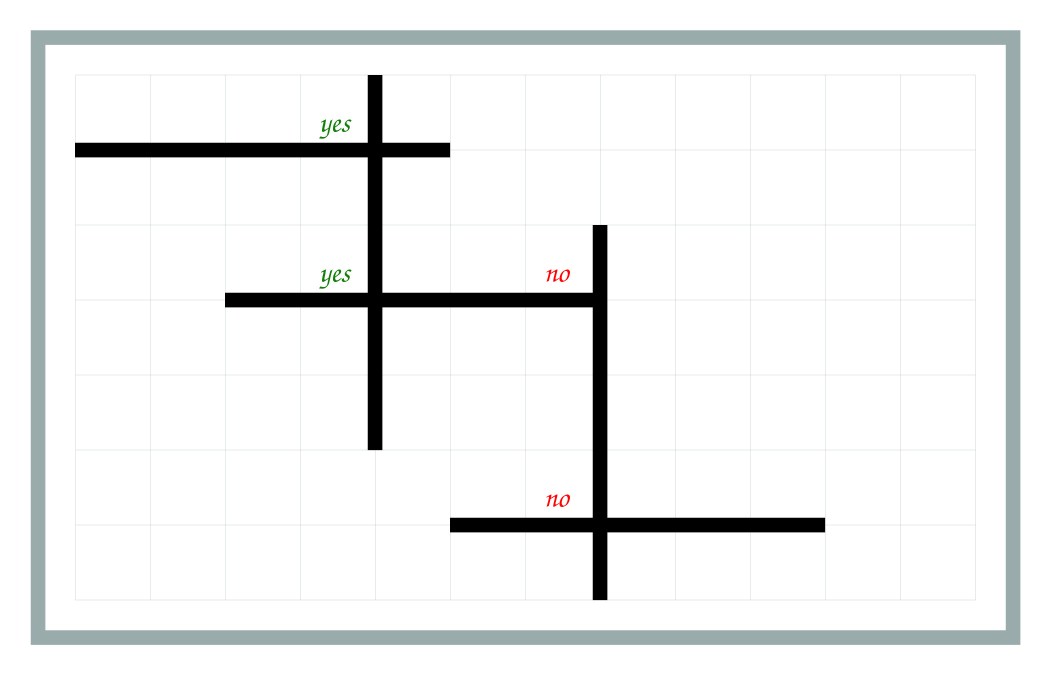
The first line segment can be placed arbitarily. All subsequent segments must cross exactly one already
drawn segment. Only two types of intersections between two segments allowed: They either
both divide each other both in the proportion 1:4 or both in the proportion 2:3. Contacts at an end point are
not allowed.

Legal 01

The last intersection not allowed because the vertical segment divides the horizontal segment in the proportion 2:3, while the horizontal segment divides the vertical segment in the proportion 1:4.

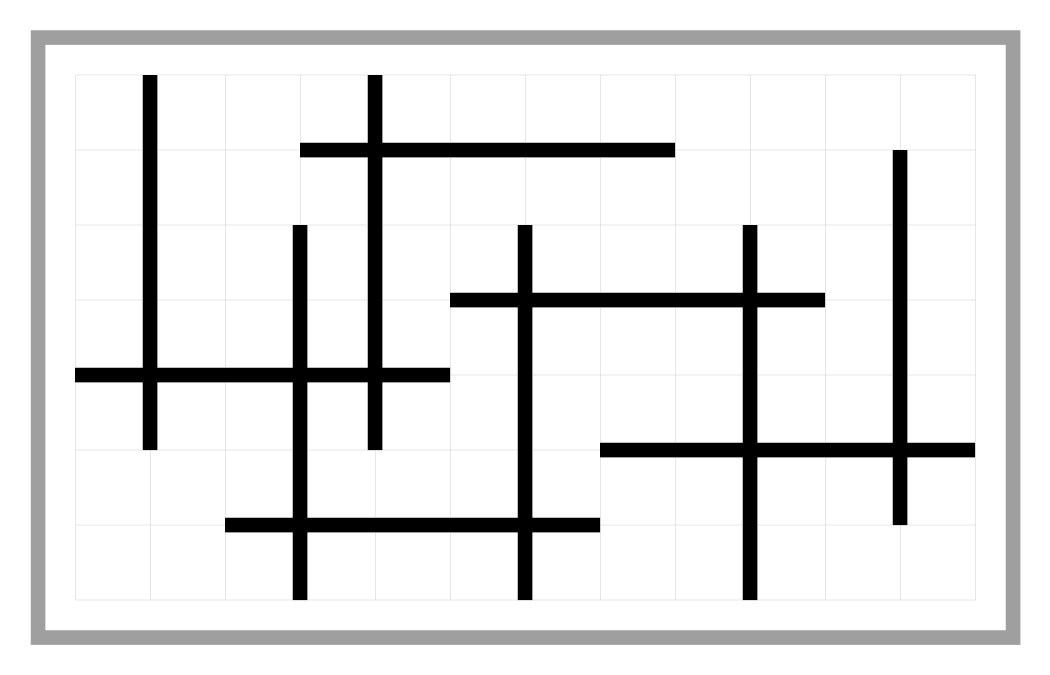
The goal is to place as many segments as possible without violating the rules. Here is an example with 11 segments.

Attempt 01

The are many variations. For instance, you can play with red and blue segments. Here it is required that segments of the same color divide each other in the same proportion, while segments of different color divide each other in different proportions.

Twocolor 01

For several players, you can start on a larger board, and each player uses their own color. The last player who can still make a move wins the game, following the rules with different colors otherwise.

Grain (Polyforms I)

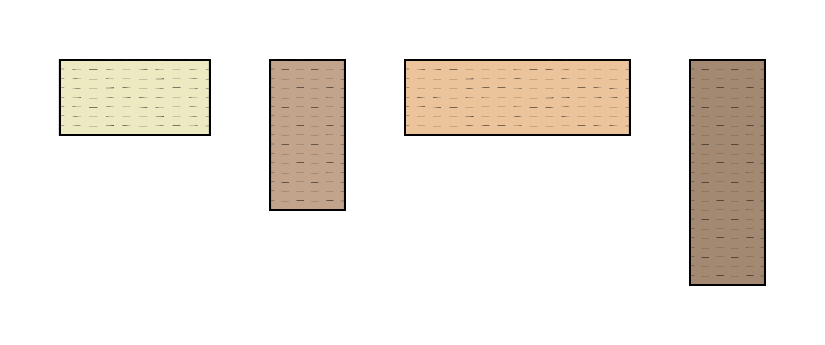
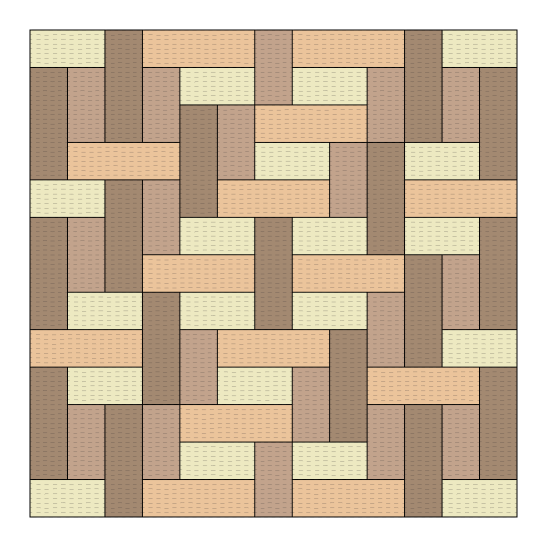
Go and purchase four types of wood, in different colors, with distinctive grain. Cut it into four different sizes, 2×1, 1×2, 3×1, and 1×3 inches long and tall, of the same thickness, and so that pieces of the same wood type all have the same dimensions and orientation of the grain. Here is my humble illustration of what will look much more beautiful in reality:

Tiles 01

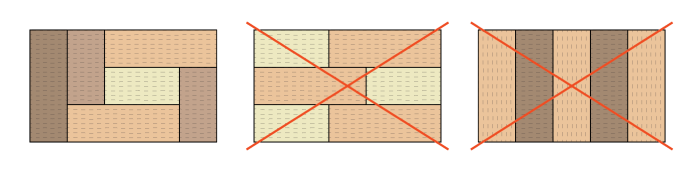
These are grained dominoes and polyominoes, a special case of more general grained polyominoes. In puzzles with polyominoes, you are typically tasked with tiling a certain shape with certain types of polyominoes. The presence of grain allows for variations of the rules. For instance, guided by esthetically considerations, we might demand that the grain needs to be horizontal, and that no two tiles of equal type touch along an edge or part of an edge.

Rules 01

Here, for instance, only the first tiling of the 5×3 rectangle follows the rules: The second has two tiles of the same kind meeting at a part of their edge, while the third does not preserve the grain.

8x7sol 01

Now for the puzzles: Above is one of the four different ways to tile the 8×7 rectangle, not counting symmetries. At this point, solving such puzzles involves mainly trial and error. The divide-and-conquer strategy that works for the ungrained case, namely using small, already tiled, rectangles to tile larger rectangles, does not work here, because lining up tiled rectangles will usually violate the rules.

Bands 01

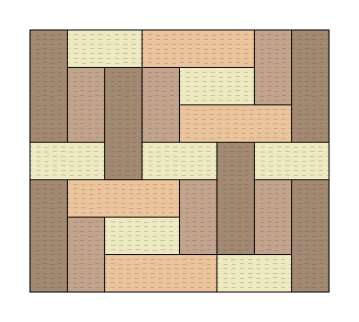
There is, however, some interesting structure emerging, that one can see better in a coloring that distinguishes more clearly between horizontal and vertical tiles. In the solution of the 11×9 rectangle (one of two), one can see bands of horizontal (blue) tiles and of vertical (red) tiles that extend from the top to the bottom edge.

Finally, below is the only solution for tiling the 13×13 square, ignoring symmetries of course:

13x13sol 01

Walking the Path

In Edwin Abbott’s Flatland, the struggles of a square in a 2-dimensional world to grasp the concept of a third dimension are a parable for our own struggles to grasp uncommon concepts. This is pushed to its extreme when the square tells the parable of linelanders struggling with the concept of two dimensions.

The obvious limitations of lineland make us quickly forget our own limitations.

Hamiltonstrip

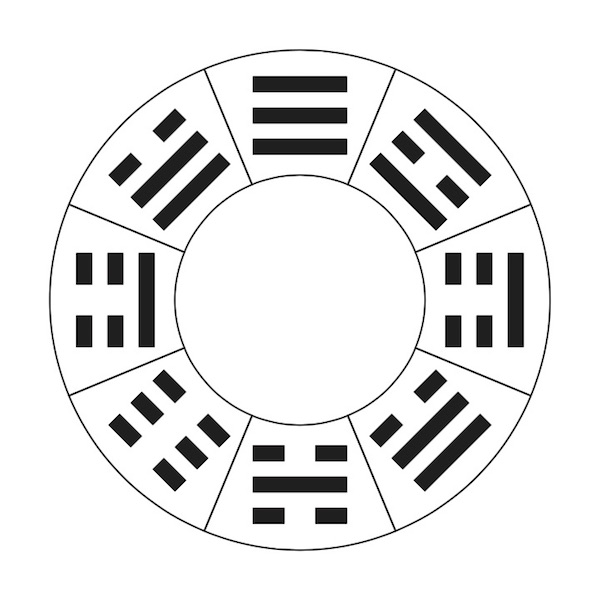
Here is a little puzzle. Cut out the eight pieces up above, and arrange them into a circle, following the Rule of Change: You can only place two pieces next to each other if they differ in just one line:

Pathrules

This not being particularly difficult, you will want to try your hands on the 16 pieces below with four lines.

Hamilton4line

These puzzles are essentially 1-dimensional and thus force us to think like linelanders. But hidden underneath are are higher dimensions.

Let’s return to the three line puzzle. Because there are three lines, each piece has only three potential neighbors it can be connected to, and we can visualize the possibilities in 2 dimensions as follows

Ichingcubeh

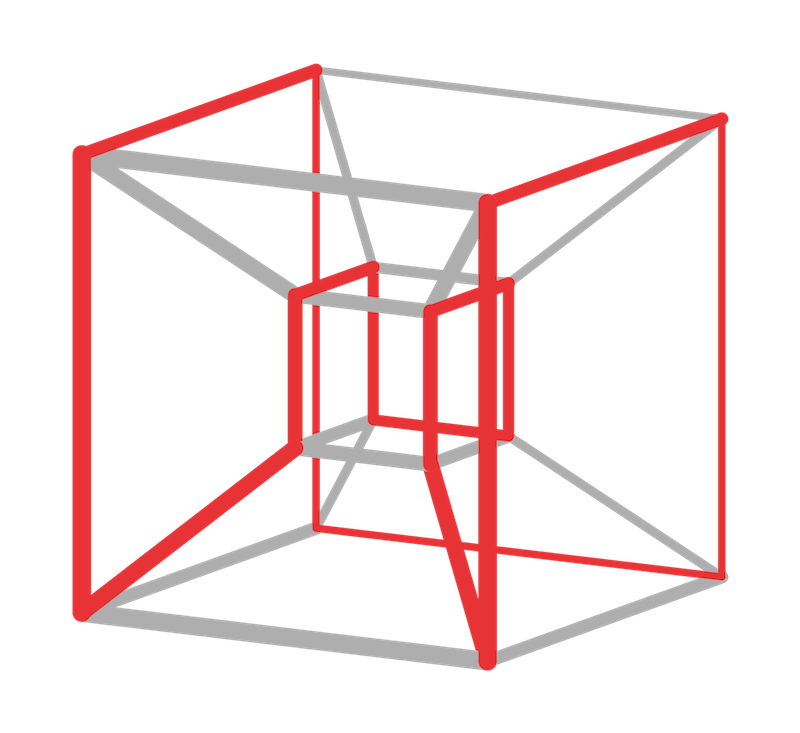
We recognize this as the edge graph of a 3-dimensional cube. This is not accidental: Think of the unbroken lines as zeroes, the broken lines as 1, and each entire symbol as coordinates of a point in 3-space (or 4-space, for the puzzle with four lines).
Two puzzle pieces can only be neighbors if the points differ only in one coordinate, i.e. are joined by an edge of the cube.

The puzzle asks us to find a Hamiltonian path on this cube (or hypercube), i.e. a closed path that visits each vertex just once.

Ichingsol3

We can now see a solution easily enough. But understanding the underlying structure allows us also to inductively find solutions for the general case of a puzzle with an arbitrary number of lines. For instance, the hypercube can be obtained from the cube by connecting corresponding vertices of two cubes. To find a Hamiltonian path in the hypercube, we can take two identical Hamiltonian paths in the two cube, remove a pair of corresponding edges, and connect the free vertices by edges that connect the two cubes.

Inductivehamilton
You can now even go ahead and make a puzzle for the complete set of 64 symbols of the I Ching, and find a path
through all of them.