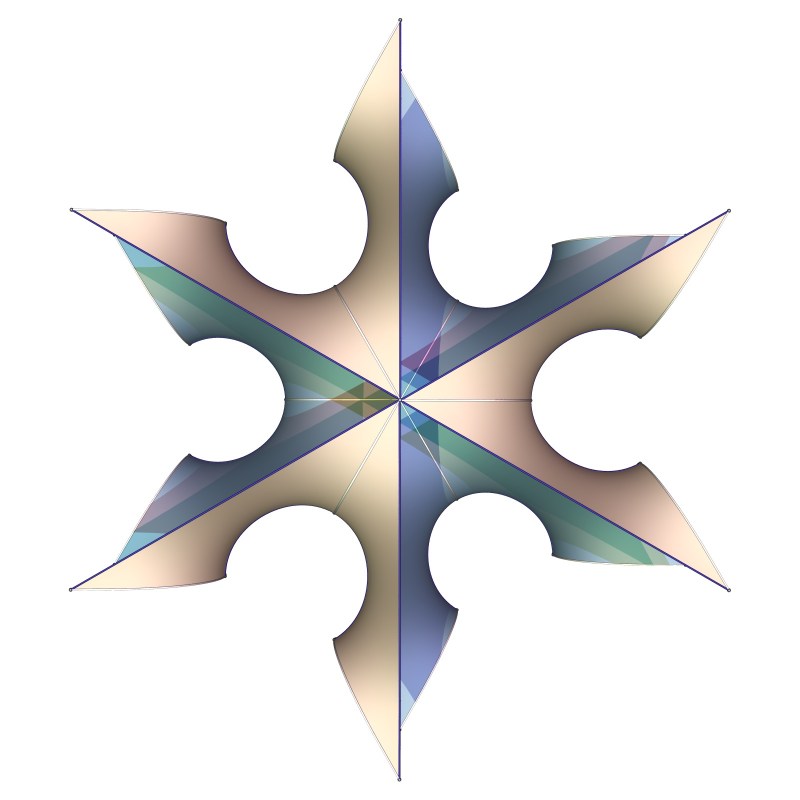
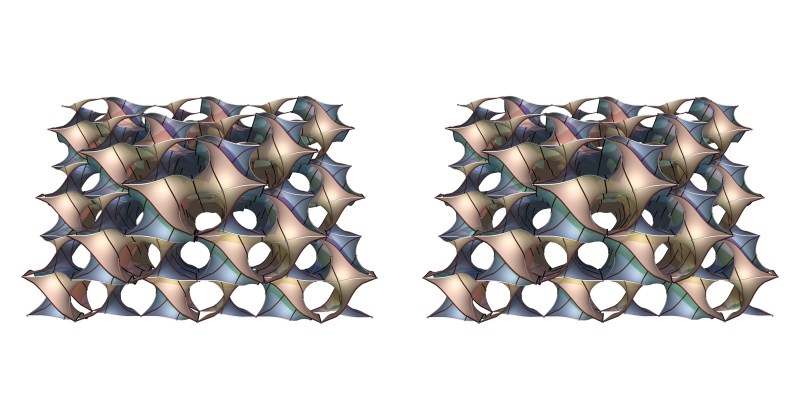
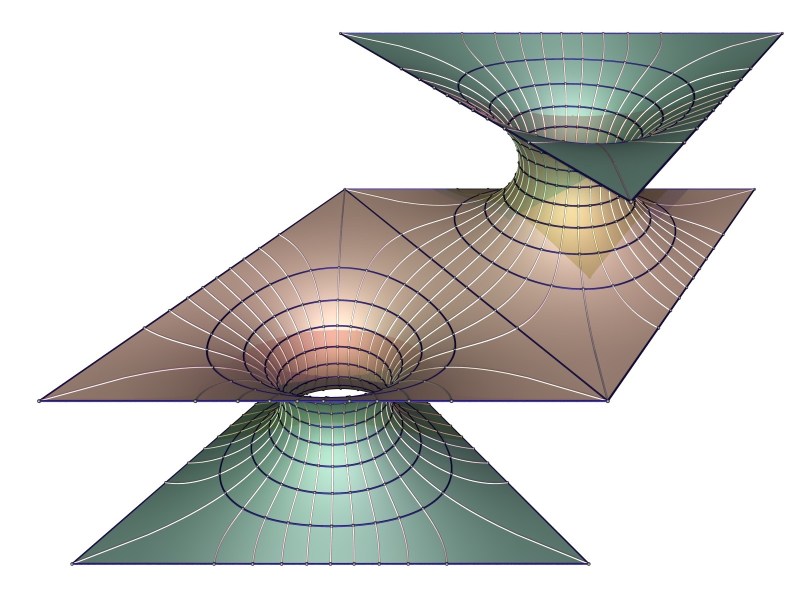
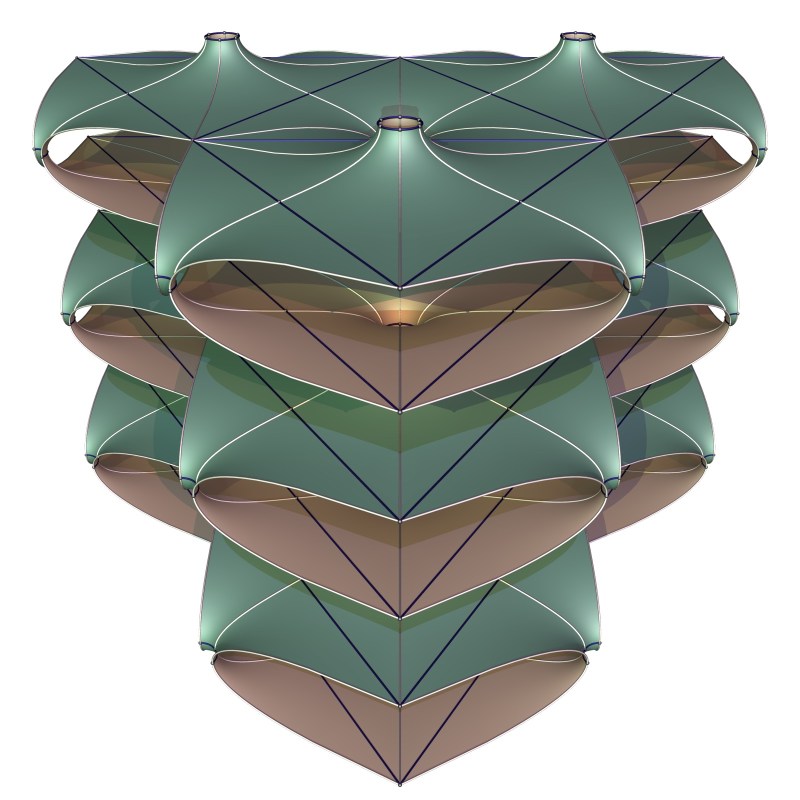
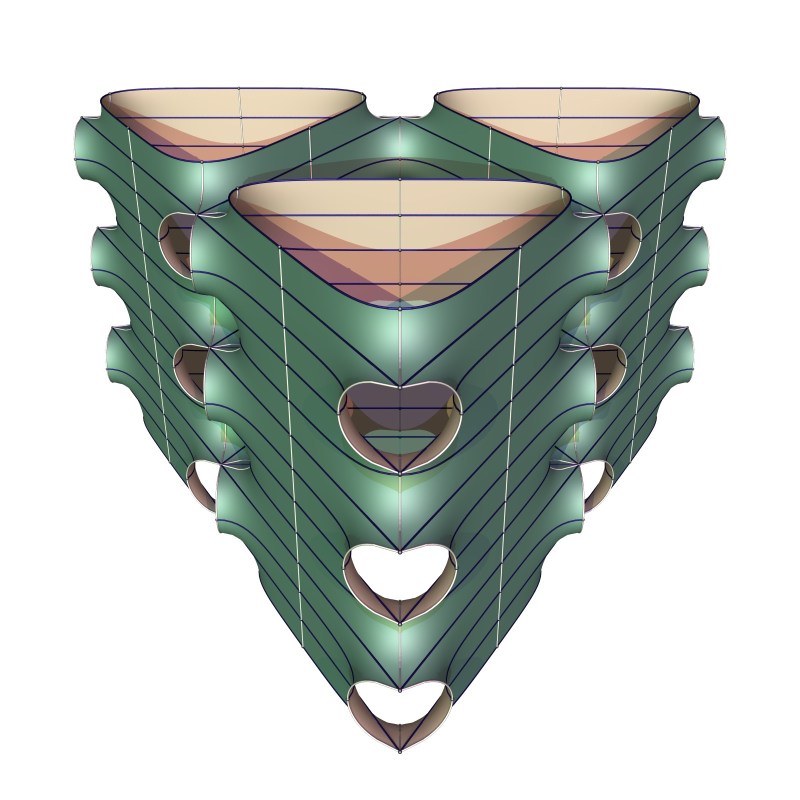
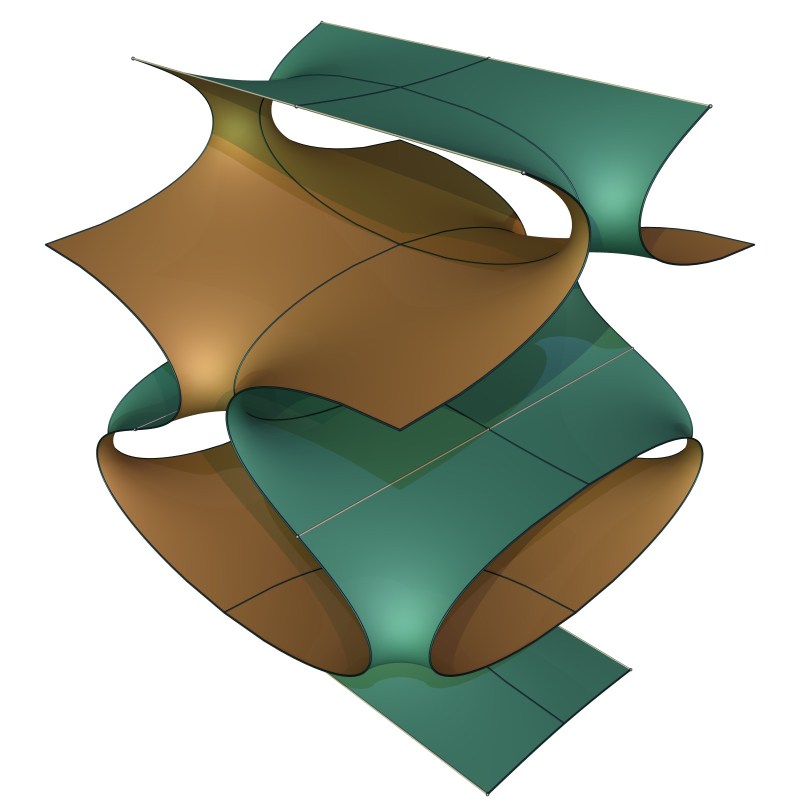
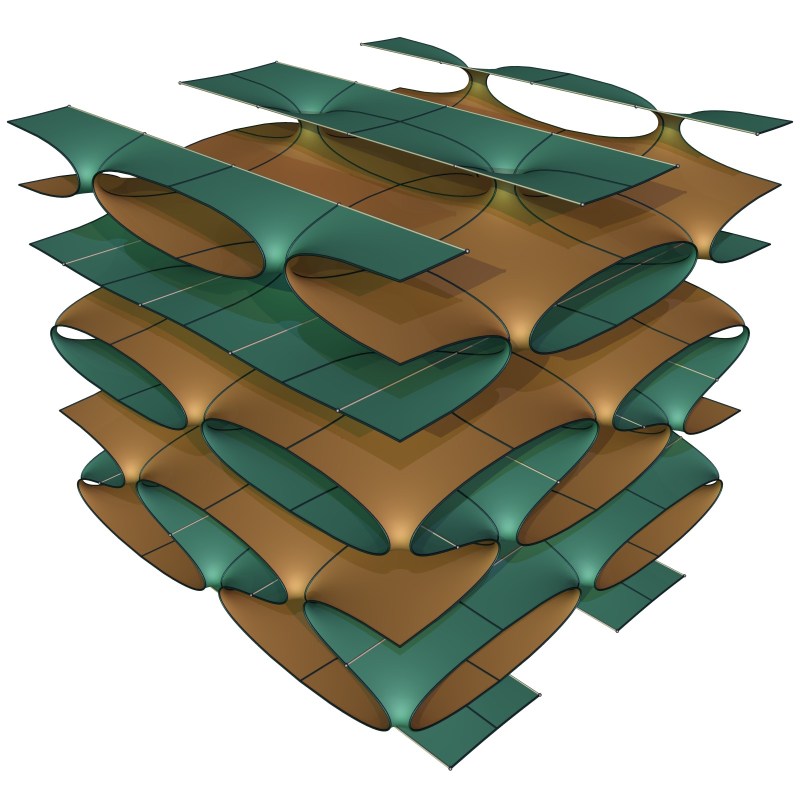
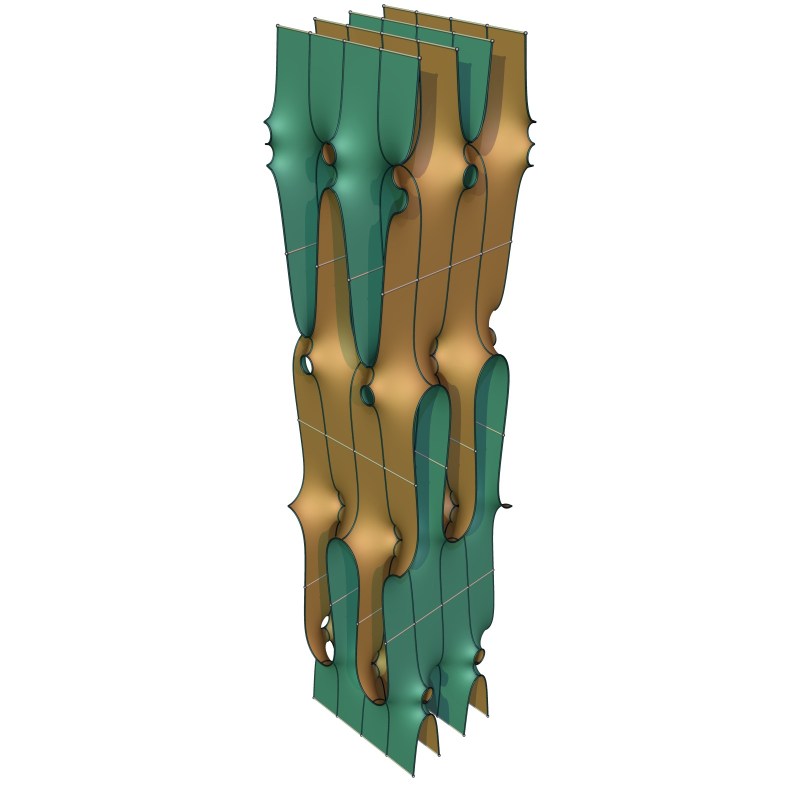
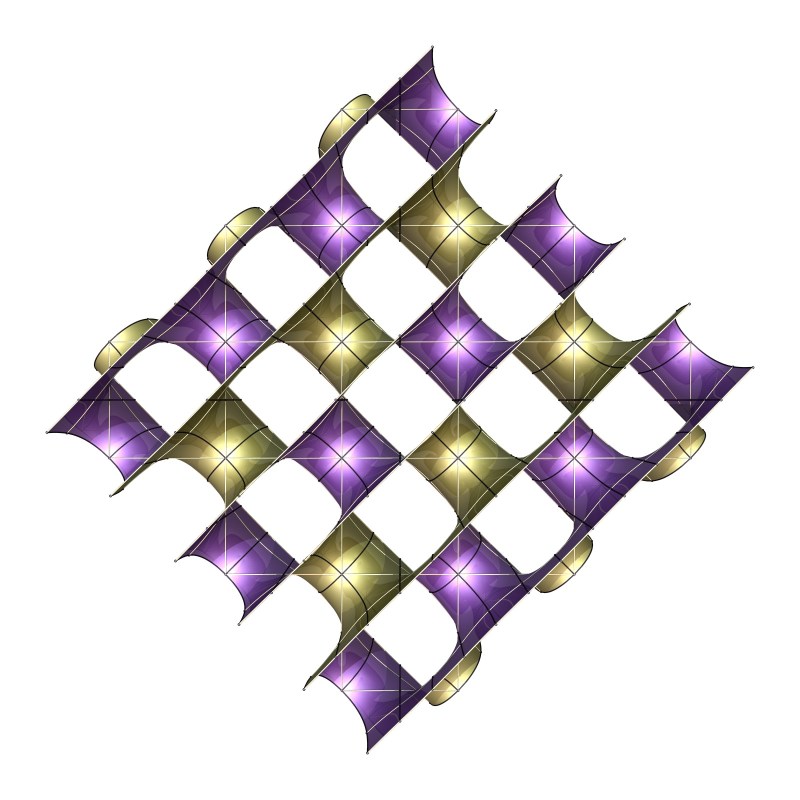
Wrapped Packages

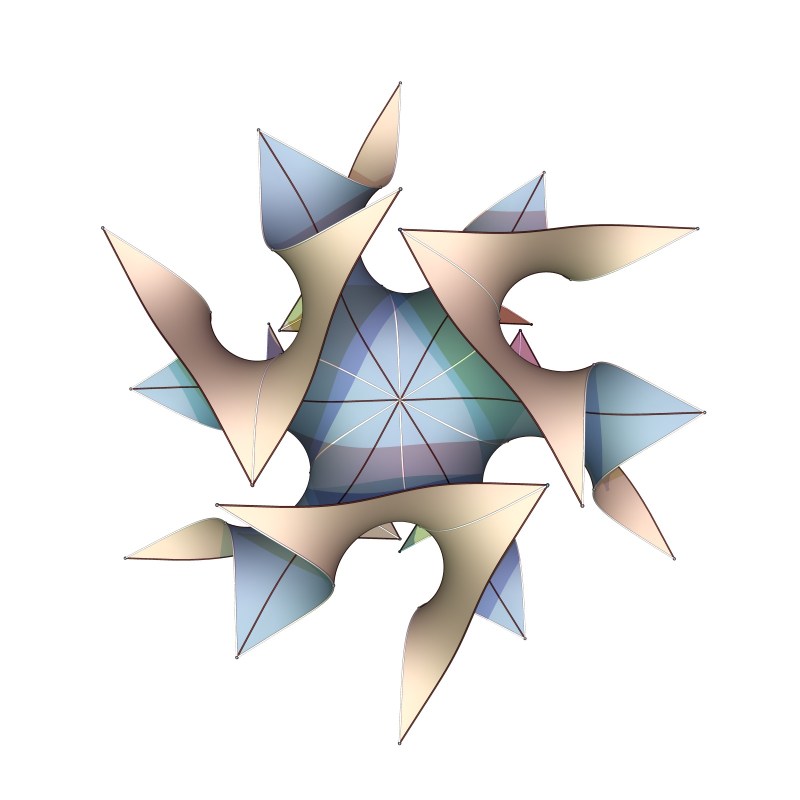
In the overwhelming book The Symmetries of Things  by John Horton Conway, Heidi Burgiel and Chaim Goodman-Strauss there is an image of an object called Octahedral 3¹². You get an essential part of it by placing eight antiprisms over a triangle (or octahedral annuli) inside eight cubes like so:Octa3 12

The precise placement of the octahedra is so that the yellow dots divide the cube edges 1:3. Then you can repeat this periodically to get a triply periodic polyhedron where at each vertex exactly 12 triangles meet. This object is already invariant under the translations along the cube diagonals, so the quotient surface is an polyhedral surface of genus 4 (Euler!), tiled with 24 equilateral triangles, still 12 at each vertex. We can unwrap this package into the hyperbolic plane by replacing each Euclidean triangle with a hyperbolic 30º triangle:

Hyperbolic3 12 01

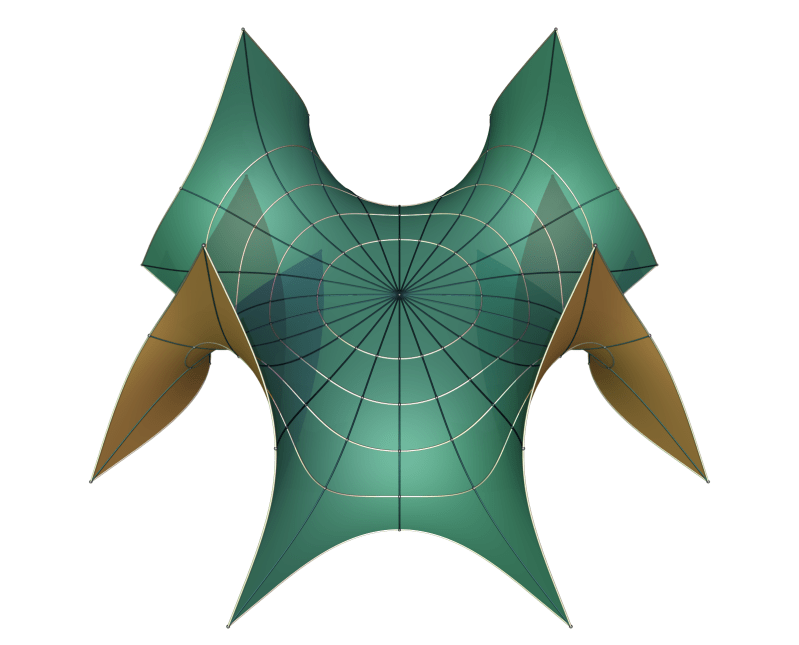
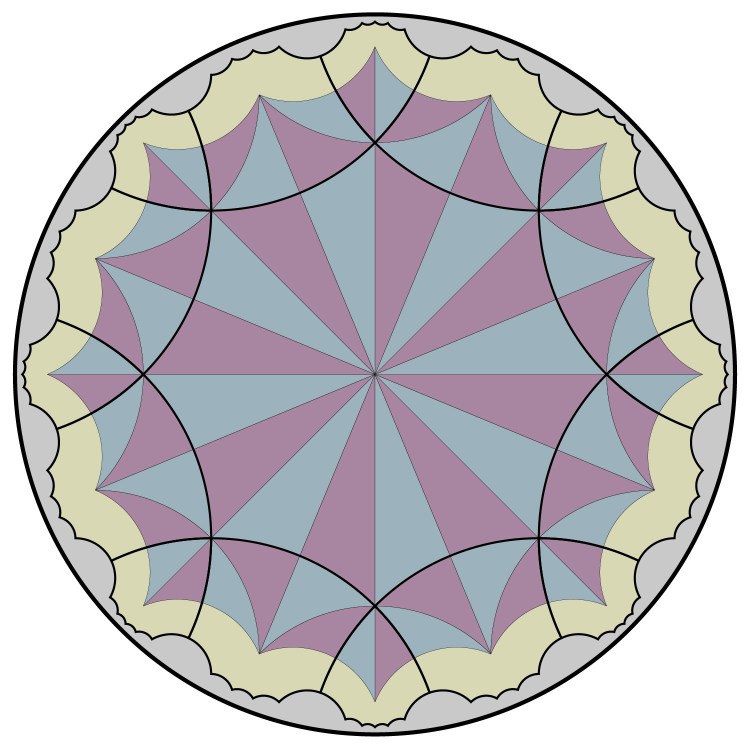
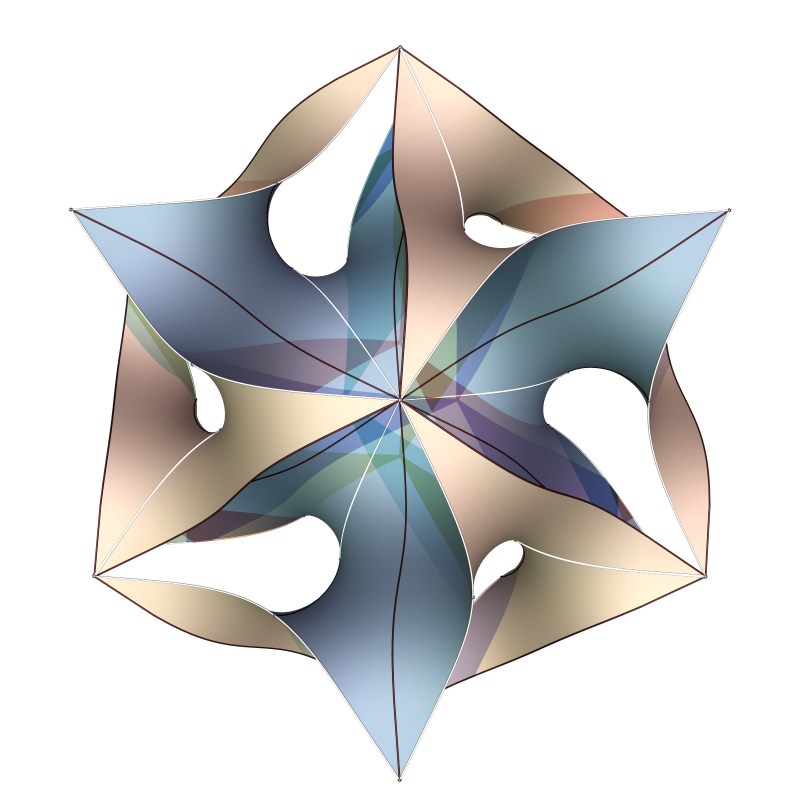
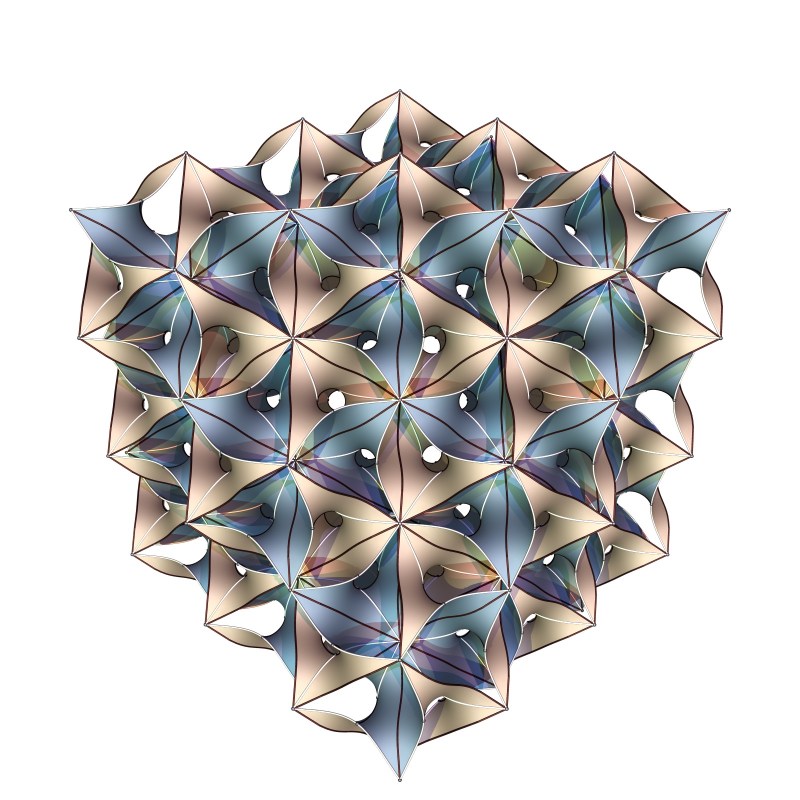
The triangles corresponding to individual anti-prisms are colored with the same color, and the waist polygons of the anti-prisms become the shaded geodesics. That they close on the antiprism after passing through six triangles enforces the identification pattern of this 24-gon, indicated by letters. If you continue this, you can check that this hyperbolic version is in fact invariant not only under the 90º rotation about the center, but under the 30º rotation. In particular, we have also a 120º rotation, and the quotient of the surface by the generated cyclic group is a sphere tiled with 8 triangles — an octahedron, as is not hard to see. The same surface is also the basis for a famous triply periodic minimal surface. The inner 12-gon corresponds to the following minimal piece:Piece

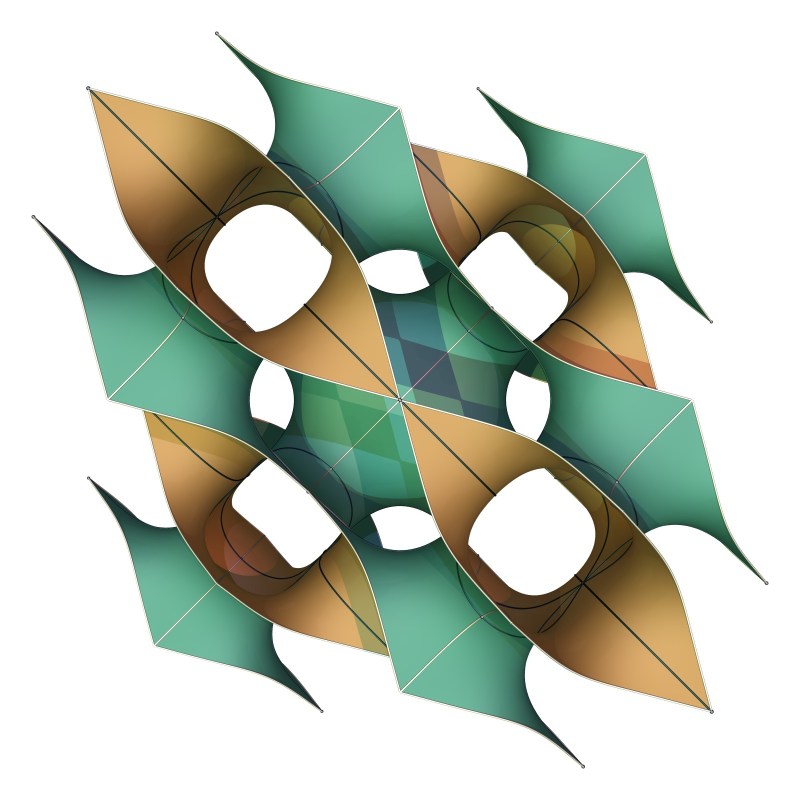
Copies of it can be assembled to larger portions, like so

IWP 2

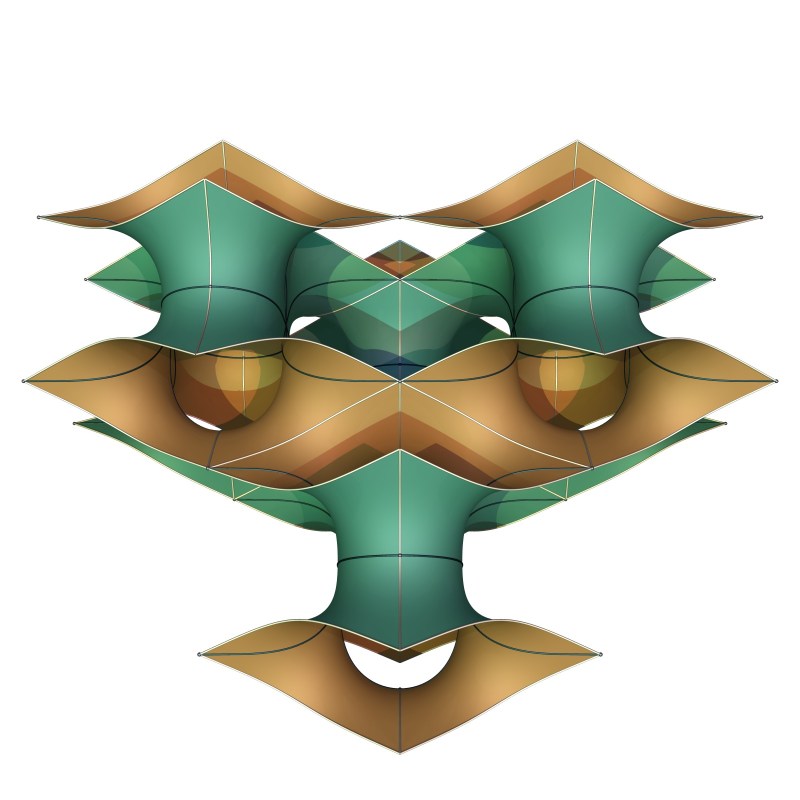
or so:

IWP 3


Who am I?


Transdissections

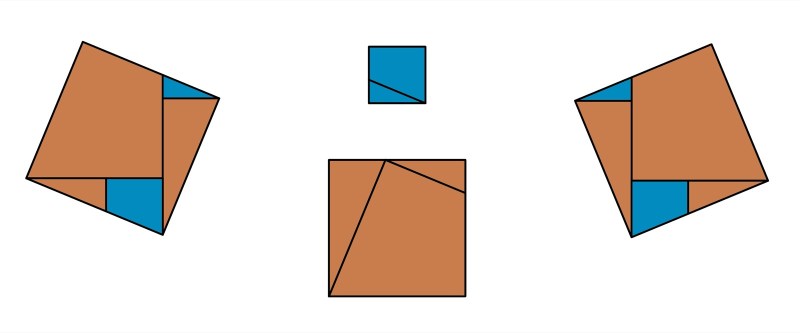
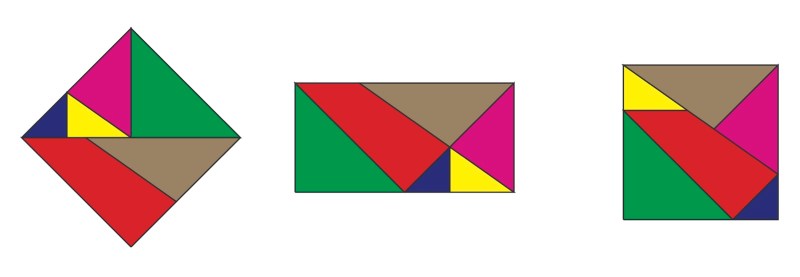
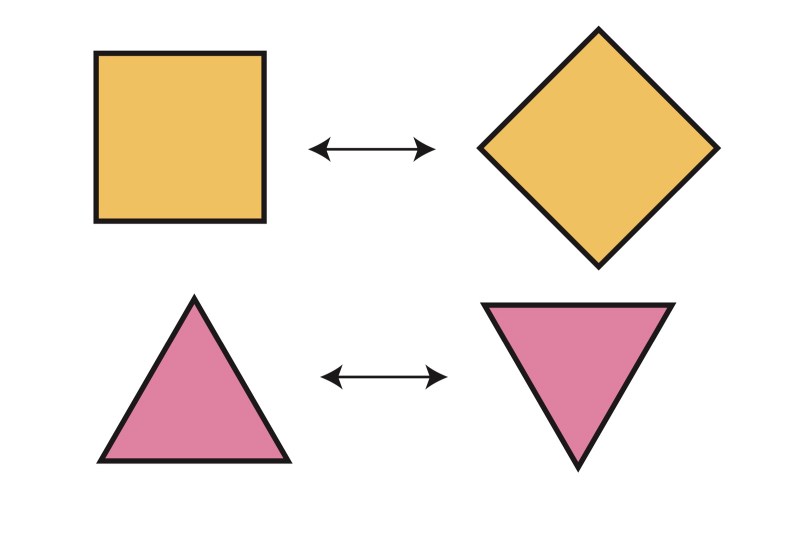
A few weeks ago, I explained that two Euclidean polygons are scissor congruent if and only of they have the same area. A scissor congruence is a dissection of the two polygons into smaller polygons (“pieces”) so that the pieces of the first polygon can be translated and rotated into the pieces of the second polygon. Then I asked whether we really need to rotate the pieces, or whether translating them is enough. For instance, can one dissect a square into pieces that can be translated into a second square that is rotated by say 45º?


 Mahlo 01

That this is possible is a consequence of a famous dissection of a square into two squares, shown above, which uses translations only, but tilts the square by an angle which we can make 22.5º. Then we need to repeat this process, tilting the other way, using a mirrored dissection.  This increases the number of pieces needed, and the question arises with how few pieces one can do this. A few years back I ran a contest about this in our department. The best solution with six pieces was found by Seth, one of our (then) undergraduates:

SolpuzzleSince then, I learned that there are solutions with only five pieces. Check them out!

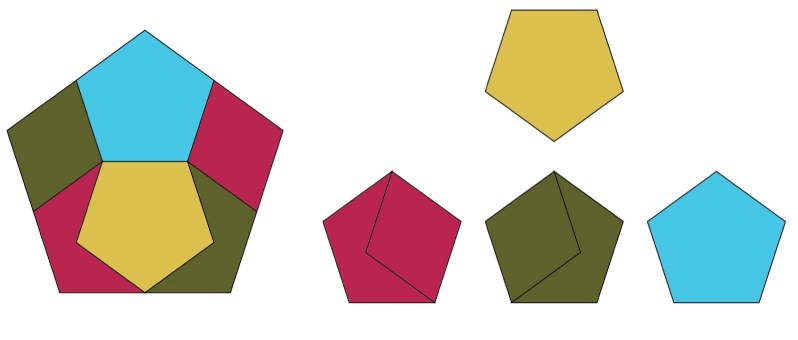
Another cool example is the trans-dissection of a single pentagon into four smaller ones, by Harry Lindgren:

Fourpentagons 01

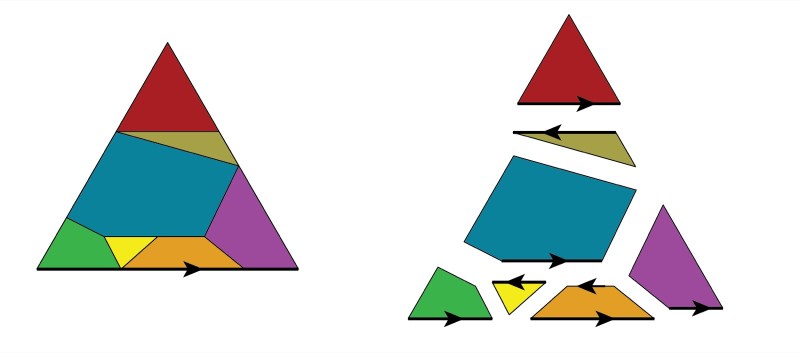
So, do trans-dissections always exist? Not at all. Let’s try to trans-dissect an equilateral triangle into a copy of it that is rotated by 180º. Suppose we found such a dissection, like the one above. Look at its horizontal edges. There are two types, the ones at the bottom of the pieces, (pointing right), and the ones at the top of the pieces, pointing left. When we add these together (taking the direction into account) for the dissected pieces, the edges in the interior cancel, while the boundary edges add up to the length of the bottom edge of the initial triangle.


Transdiss 01


Thus the oriented length of all horizontal edges of the two tiles that we want to dissect into each other need to be equal. This eliminates the possibility to rotate a triangle at all. The same argument works of course for all directions.

Therefore, in order for two polygons to be trans-scissor-congruent, they not only need to have the same area, but also have the same oriented edge lengths for all edge directions. Remarkably, these conditions are also sufficient, as was proven in 1951 by Paul Glur and Hugo Hadwiger. The argument is a little tricker than the one for general dissections, but not too bad. Maybe I’ll come back to it later.

The Octagon (CLP-1)

Let’s start with an equation: y²=x⁸-1. Solving for y is easy, because for each x we appear to have just two choices for the sign, good and evil. If we do this in the complex plane, the set of solutions therefore looks like two copies of the x-plane. There is a little problem at the eighth roots of unity, because there, good and evil coalesce. 


Octagon 01

A good way to imagine this is to think about the (extended) complex plane as two disks, and of each disk as a regular octagon, with vertices at these eighth roots of unity. Then it takes four such octagons to build the solution space of the equation y²=x⁸-1, and we need to have four octagons at each vertex coming together, alternating between good and evil. Luckily, this can be done in the hyperbolic plane, using a tiling by regular right-angled hexagons.To get an idea how these are glued together, it helps to think about the equation in the form x⁸=y²+1. This represents the same solution space as 16 copies of a single triangle, with vertices at the octagon centers as shown above. Thus the entire solution space can also be obtained by gluing together the edges of the 16-gon above, where the identifications are indicated by the (extended) edges of the central octagon.

Wouldn’t it be nice if we could visualize this in ℝ³? This is indeed possible if we are willing to conformally bend our octagon a little so that every other edge becomes a straight segment, and the other edges lie in planes that meet the octagon orthogonally along that edge.

Octagon clp

This allows to extend the octagon by rotating and reflecting about its edges like above, which shows four such hexagons, i.e. the entire solution space. If you do this right, you get one of the many views of the CLP surface of Hermann Amandus Schwarz. CLP stands for crossed layers of parallels. This is once again a triply periodic minimal surface. Here is another translational fundamental piece that corresponds to the 16-gon:

Clp 0

Let’s begin to rotate through the associate family. For angle π/16, we see how the touching vertices are being separated.

Clp 16

At π/4, we get a nice symmetric piece, but translational copies will intersect so that the surface will not remain embedded.

Clp 4

At π/2 we meet the conjugate surface of the CLP surface. The amusing point here is that it is congruent to the CLP surface, a feature it shares with the Enneper surface and one surface in the family of Riemann’s minimal surfaces.Clp 2


The Lidinoid (H 2)

All minimal surfaces can be locally bent in a 1-parameter family of associate minimal surfaces. In the right context this is just a rotation. The best known example is the deformation of the catenoid into the helicoid. 

H pieceRemarkably, the triply periodic Meeks surfaces, rotated in this sense by 90 degrees, are again in the Meeks family. Very curiously, there are two more known cases where an associate surface of a triply periodic minimal surface is again triply periodic and embedded. One of them is Alan Schoen’s Gyroid, the other is Sven Lidin’s Lidinoid. While the Gyroid occurs in the associate family of the P/D surface, the Lidinoid arises in the associate family of one particular H-surface. To see how this happens, let’s start with a top view of that H surface. When we start rotating in the associate family, the vertices of the three triangles that meet at the center of the image move apart:

Apart

But the other vertices then move towards each other, so that, after about 64.2°, they come together:

 Lidinoid small

Not only the vertices fit, but again the surface can be extended by translations in space. Here is a view of a much larger piece.

Lidinoid big

If you are good at cross-eyed viewing, here is a stereo pair of a side view:

Both2

Schwarz Hexagonal Surface (H-1)

One of the early minimal surfaces I have neglected so far is the H-surface of Hermann Amandus Schwarz.H double

Think about it as the triangular catenoids. Two copies make a translational fundamental domain, i.e. the 10 boundary edges can be identified in pairs by Euclidean translations, thus making the surface triply periodic. As a quotient surface it has genus 3, which implies that the Gauss map has 8 branched points. They occur at the triangle vertices and midpoints of triangle edges. Thus the branched values lie at the north and south pole of the sphere, and at the vertices of two horizontal equilateral triangles in parallel planes. In particular, they are not antipodal, making these surfaces the earliest examples of triply periodic minimal surfaces that lie not in the 5-dimensional Meeks family.

H catenoid

Above is a larger portion of the H-surface with the triangle planes close to each other. In the limit we get parallel planes joined by tiny catenoidal necks. When we pull the planes apart, we get Scherk surfaces:


H Scherk

The spiderweb for this surface looks also pretty:

H spider

Among the crude polyhedral approximations, there is one that tiles the surface with regular hexagons. The valencies are 4 and 6, so the tiling is not platonic.

H poly

Next week we will look at one of its more surprising features.


Dissections and Area

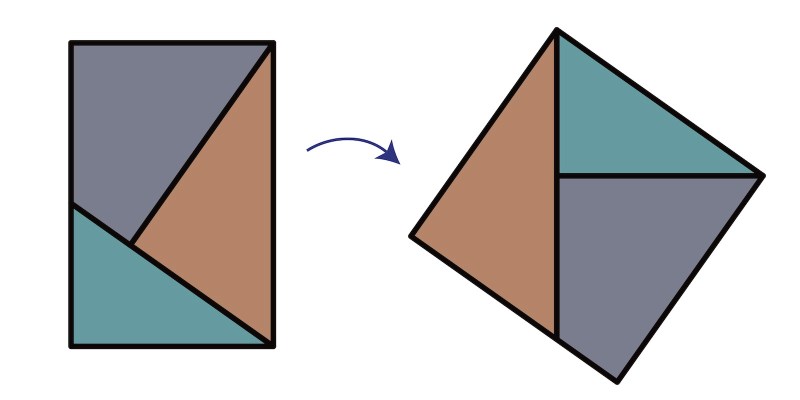
Whenever need to explain what Mathematics is about, one of my favorite examples is the concept of area. The existence of an elementary notion of area hinges on the fact that any two Euclidean polygons have the same area if and only if they are scissor congruent, meaning that they can be cut into congruent pieces using straight cuts. To see this, it suffices to show that any polygon can be dissected into a square. Rect2square

The example above shows how to dissect a well-proportioned rectangle into a square. Here, well-proportioned means that the rectangle is not more than twice as tall than wide. If a rectangle is not well-proportioned, a few cuts parallel to the edges will make it so. Thus any two rectangles of the same area can be dissected int each other. We will use this later.

Triangul

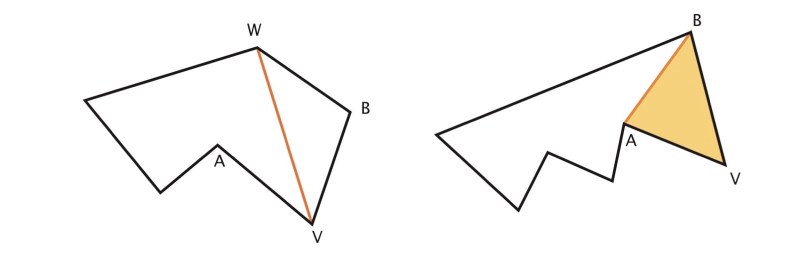
Next we show that any polygon can be dissected into triangles. By induction, it suffices to find a secant inside the polygon. To find this secant, pretend that the polygon is actually the floor plan of a room, and we are standing at one vertex V . The two adjacent walls lead to two vertices A and B which we can see. If we can see yet another vertex W from our position, we have found our secant VW. If we can’t see another vertex, nothing obstructs our view in the triangular region formed by A, B and V , and thus A and B can be joined by a secant.

As a further simplification, we cut all triangles into two pieces along one of their heights so that all triangles become right triangles.

Now we have a collection of right triangles, which will need to be dissected into a single square.

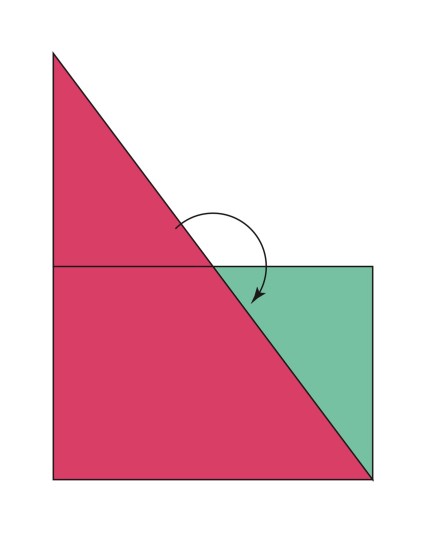
Triangle2squareTo do so, we dissect each right triangle into a rectangle. This can be done as shown above by dissecting the triangle into two pieces along a segment parallel to one of the legs and dividing the other leg into equal parts.

This leaves us with a collection of rectangles that most likely have different dimensions. So we dissect them into new rectangles that all have all height 1, using the example at the beginning. 

Then, the new rectangles can be lined up edge to edge along their sides of length 1 to form one very wide rectangle that finally can be dissected into a square.

Transdiss

As this was nice and easy, here a challenge: In our dissections, we were allowed to translate and rotate the pieces arbitrarily. What about if we forbid rotations? Can you dissect an equilateral triangle into finitely many pieces and translate them so that the result is the same triangle upside down? Or, can you cut a square, translate the pieces, and thereby achieve a 45 degree rotation of the square? 


President (Impeachment Games I)

Time for another little game. It’s called President, and it is also about democracy and taxes. Good for 4-12 players.

Material:

  • Paper money (any currency will do)
  • sets of six tokens in as many different colors as there are players,
  • a tax board for each player, i.e. a sheet of paper with the numbers from 0 to 60 in a row,
  • an extra counter to mark the current tax rate, 
  • 2-4 game figures representing political parties.
Money4 2a

Setup: 

Each player gets $100 in small bills, picks a color and gets three tokens of that color,
sets the tax rate counter on her or his tax board to $10.
The political parties are placed in the center of the board.

The game proceeds in years. Each year consists of an election phase and and ruling phase.

Before the game begins, the players decide for how many years they want to play. 
Money4 2b

Voting:

First, all players pay their taxes.
For the first year, these are $10, and each player places them into the center of the table.
If in a later round a player cannot pay the taxes, that’s ok. The poor are tax exempt. But see the variation below.

Next, each player votes for political parties by placing their tokens next to the party figures. Votes can be split, and not all votes need to be used. In the first round, a player is selected randomly to begin the voting, and then it continues clockwise.

After all votes have been cast, the winning party is determined by counting all votes. If more than one party  has the same highest number of votes, the winning party is determined randomly. You can place the tied parties in a bag and draw one, for instance.

The player who cast the most votes for the winning party is declared president. If there are more than one player with the same highest number of votes, the president is determined randomly among all players with the highest number of votes for the leading party.

All used voting tokens are returned to the players, which ends the voting phase.

Variation: If a player cannot pay taxes, he/she loses one voting counter.
Money4 2c

Ruling:

In the ruling phase, the elected president must make a few decisions:

  • Adjust taxes: The president can adjust how much taxes each player pays. He or she does so by moving the tax counter on each player’s tax board up or down by at most $2. The taxes cannot exceed $60 and must be at least $10. The total amount of taxes paid must remain equal to $10 times the number of players. This means that if the president lowers taxes somewhere, he/she must increase them somewhere else.
  • Adjust the number of votes: For each player, the president can increase or decrease the number of voting tokens the player has by at most one. The number of voting tokens cannot exceed 6, and must be at least 1.
  • Distribute tax income: Finally, the president distributes all of this year’s tax income to all players as he or she desires, including him or herself.

The game ends when the number of years the players agreed on has passed. Then the plaeyrs vote on one of the following three winning conditions:

  • The richest player wins
  • The player who was most often president wins
  • The player who has the most voting tokens wins
Money4 2d

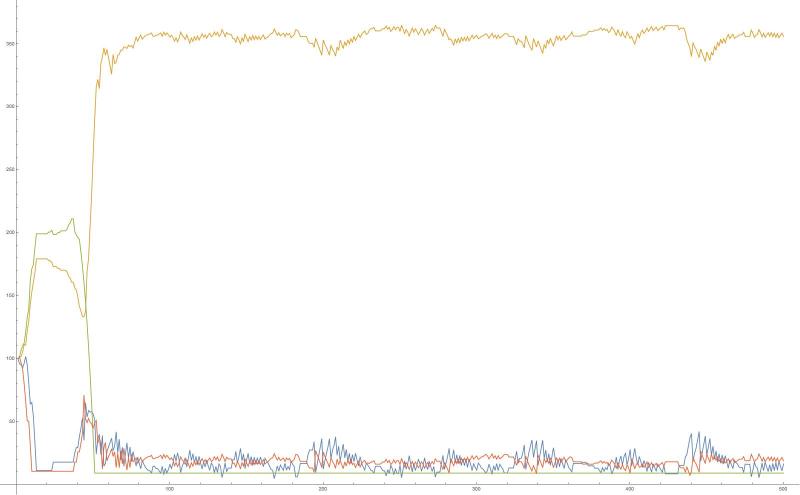
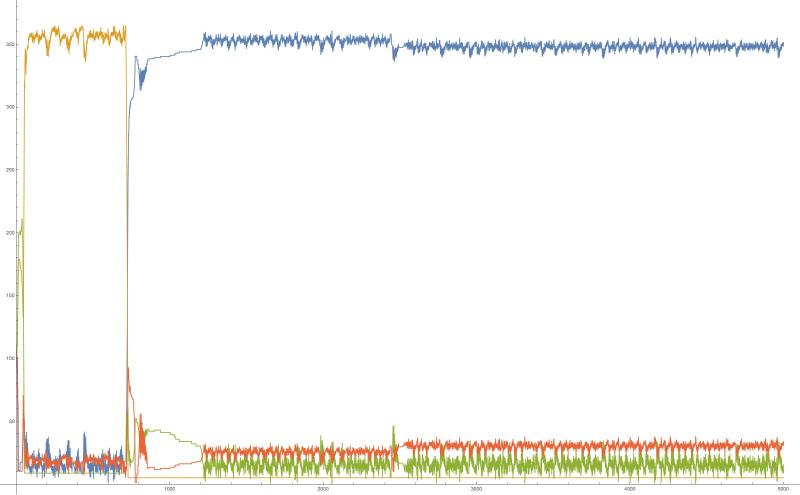
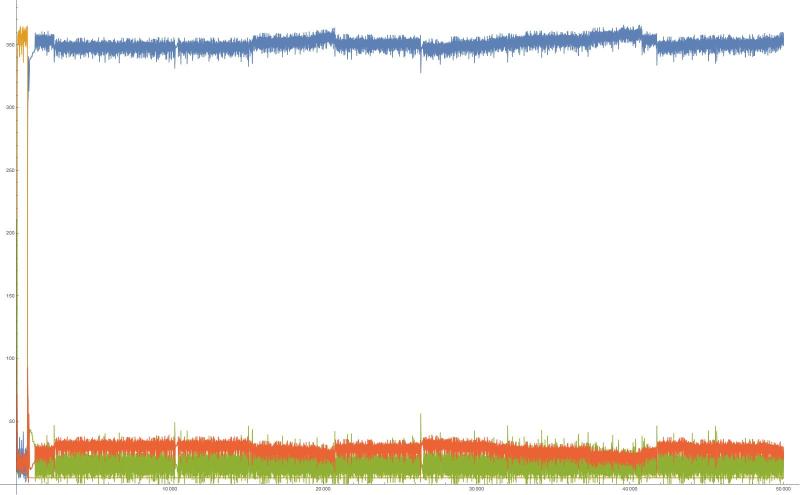
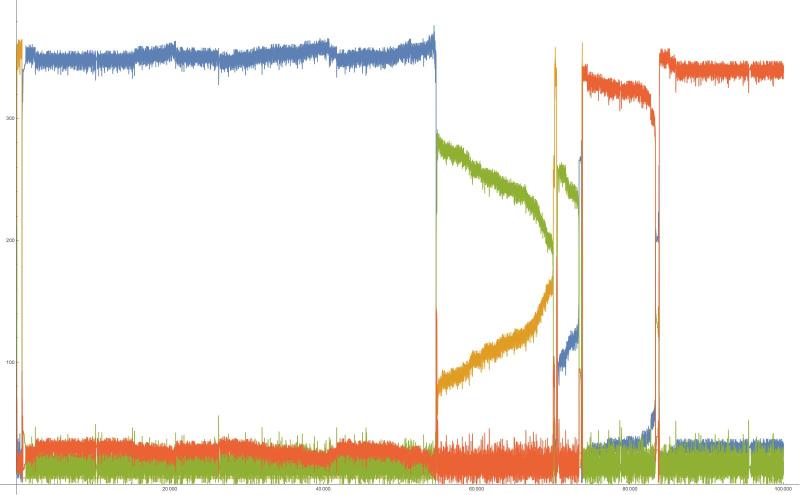
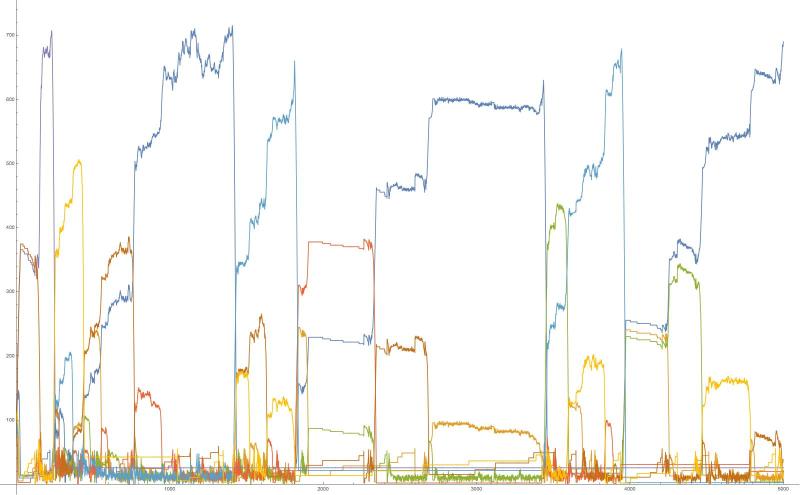
That was a lot of text. I like to invent games, and I like to watch how people play games. So I programmed a little simulation to see how this game would perform while tweaking the parameters. All players in my simulation behave opportunistic. They begin with equal preferences for the political parties. When somebody’s income increases, they start favoring the ruling party in the next vote. The president uses his/her power to give more votes and more money to those who voted for his/her party.

In contrast to humans, the computer was willing to play for an extended period of time. I was expecting that the game would quickly stabilize to a single rich dictator with the rest of the population living in poverty. The pictures above show the wealth/time graph of a 4-person game with just two parties. While presidents often rule for long periods of time (50,000 years for the blue president…), the situations is all but stable. That it can take so long is only because the underlings in my simulation do not cooperate. Below are mere 5,000 years with eight players and four parties. I have run several such simulations, and it appears that change happens more often when there are more parties involved.
Money8 4a


Deceptive Similarities

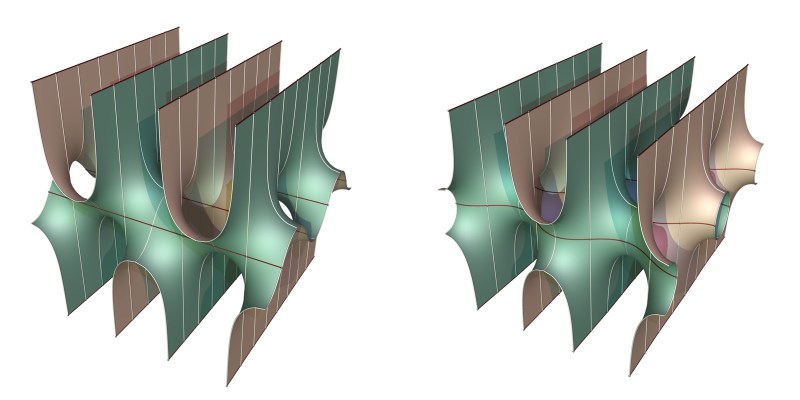
This story begins in 1988 with the first examples of doubly periodic embedded minimal surfaces where the top and bottom ends are parallel and asymptotic to vertical half planes. They were found by Karcher and Meeks-Rosenberg in two independent papers and look like these:


Kmr


I like it how confusingly similar they are. The main distinction is that that the one on the left has horizontal straight lines on it about which you can rotate the surface unto itself, while the one on the right has a reflectional plane of symmetry instead.

These surfaces actually come in a 3-parameter family; what you see above are the most symmetric cases. The translational periods are horizontal, and there are vertical straight lines. If you divide by the translations, you get a torus as a quotient surface. Remarkably, this 3-dimensional family is all there is for genus 1, by work of Pérez, Rodriguez, and Traizet from 2005. In particular this means that the two surfaces above can be deformed into each other through minimal surfaces. This is not too hard to see.


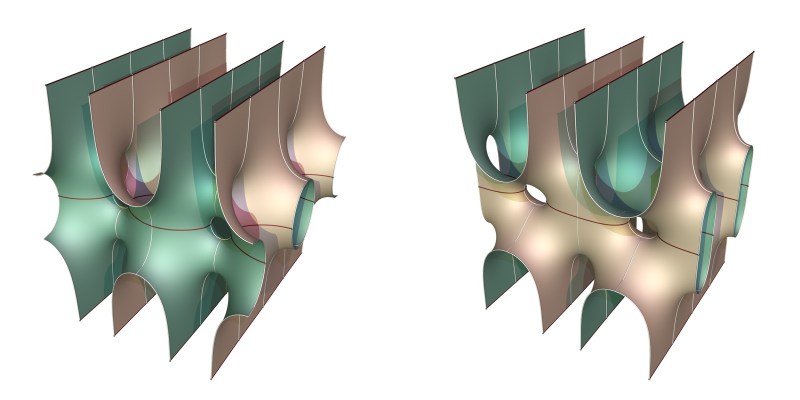
Things get more interesting already at genus 2: At 1992, Wei found a 1-parameter family of examples of genus 2.
A specimen is below to the left. 


Genus2

A variation of it was constructed by Rossman, Thayer and Wohlgemuth in 2000 (above to he right). Again they look dazzlingly similar. I suspect that they cannot even be deformed into each other through embedded minimal surfaces, but I have no idea how to prove this.

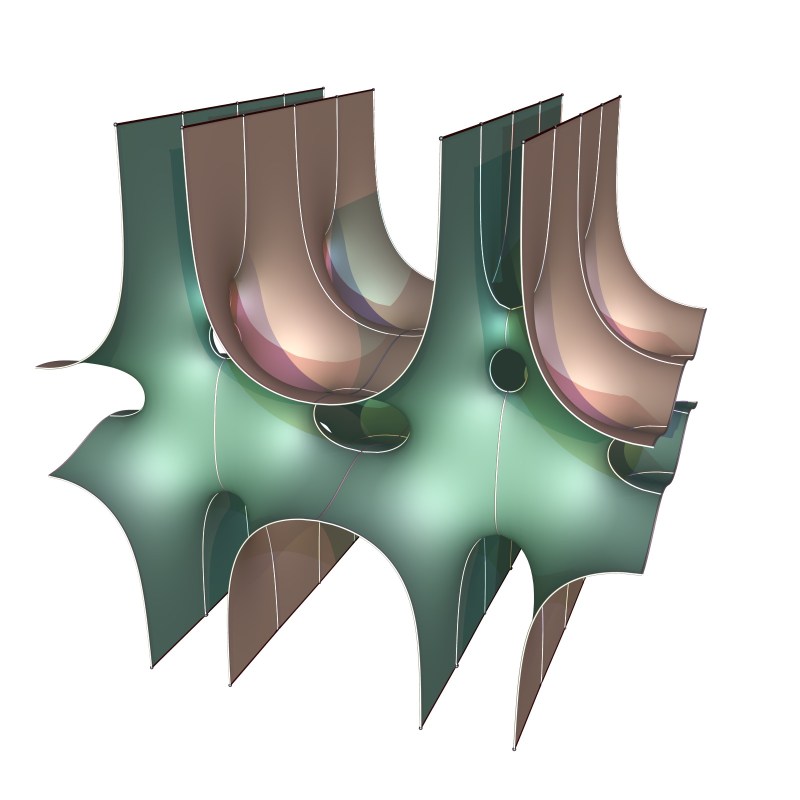
Even better, Connor has numerically found another genus 2 example that looks significantly different from the ones above. One of the holes has is not symmetrically positioned anymore, and there is no way to get it back there…

Showing the existence of these surfaces would be good, and even better would be to find a way to distinguish it from the others.

Connor

Cutting Corners

Domains

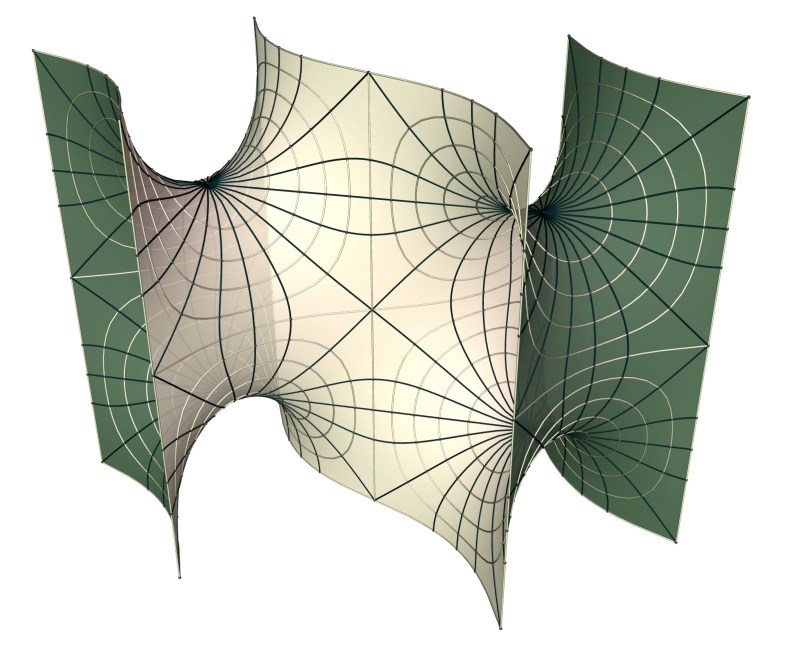
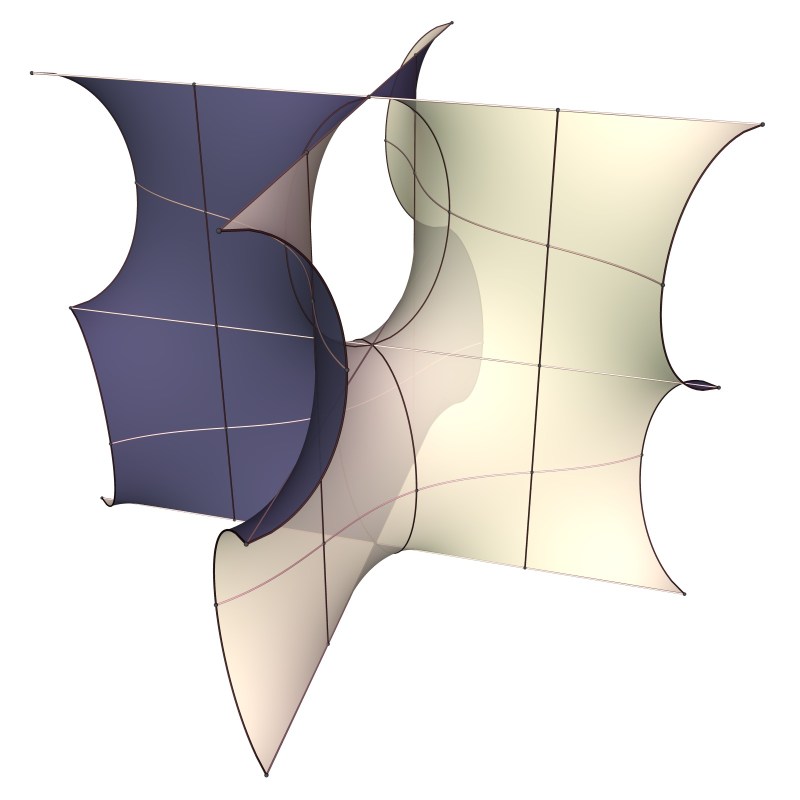
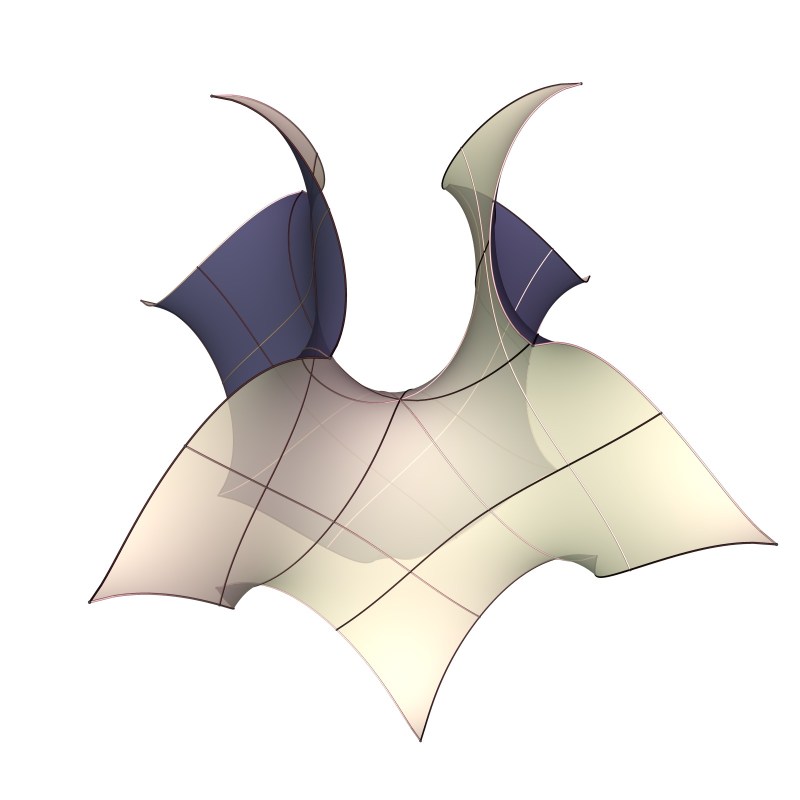
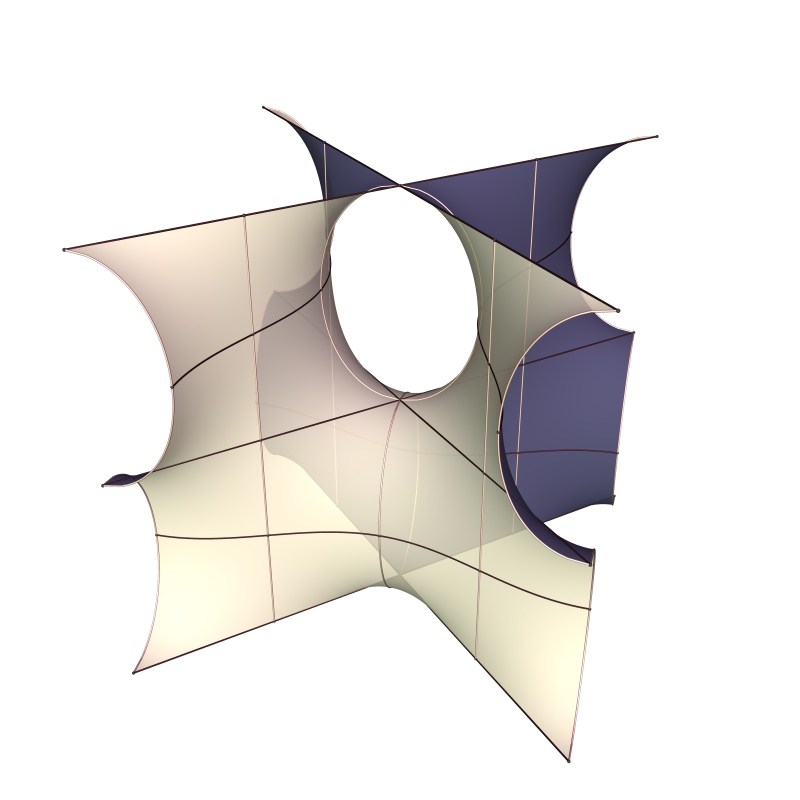
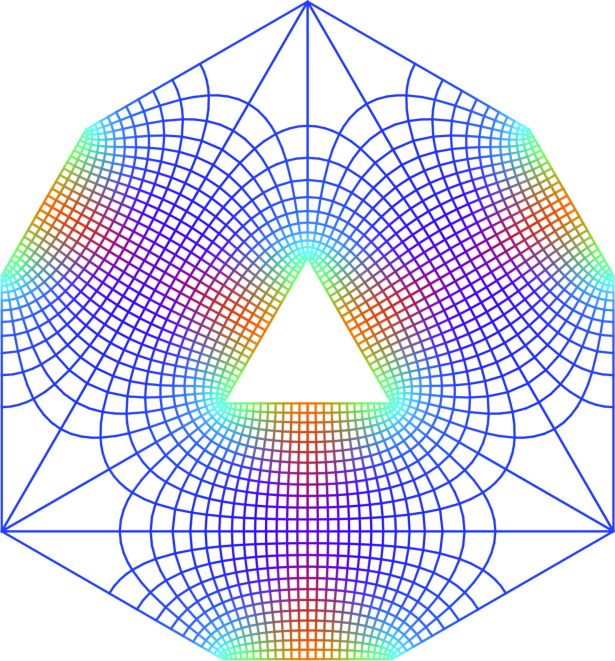
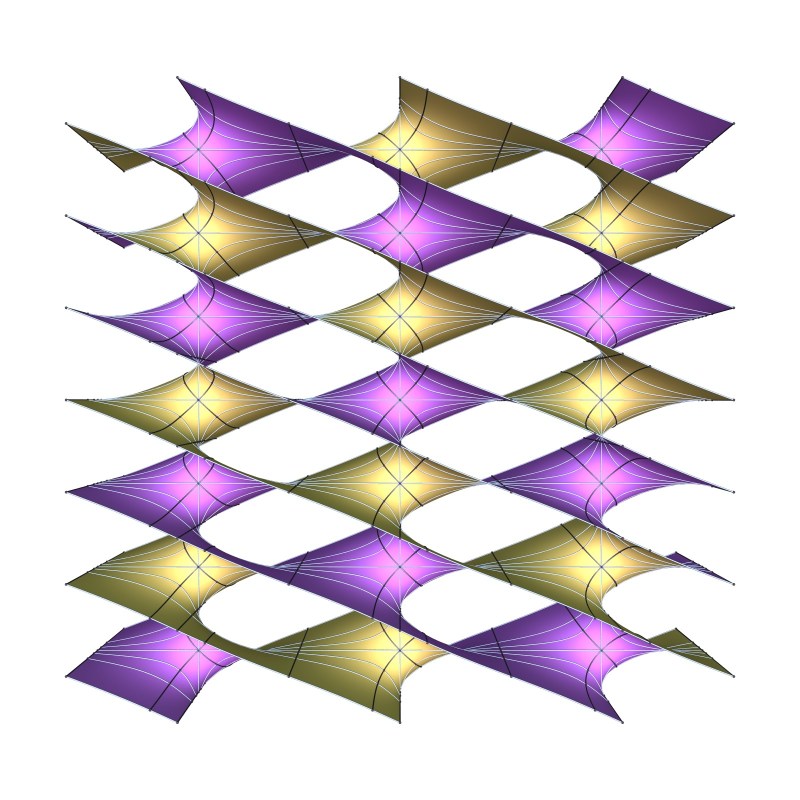
The two psychedelic designs up above arise from their simplistic ancestors we looked at last time by cutting off corners. These are still two conformal annuli that also satisfy a slightly complicated condition on the lengths of their edges, which makes them responsible for a variation of the Diamond surface:


Mathematica

If you cut either of the psychedelic shapes into quarters, using a vertical and a horizontal cut, you get four right angled octagons, with some right angles being exterior angles. Similarly, the marked symmetry lines on the surface up above cut the surface into eight right angled curved octagons, that correspond to the psychedelic octagons via a conformal and harmonic map.  


D5 deg1

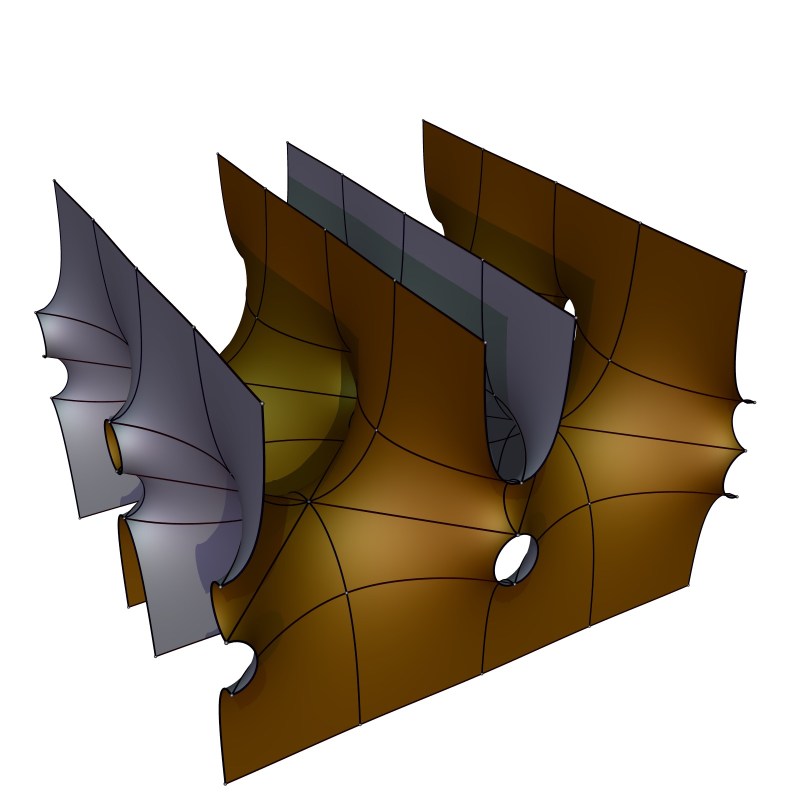
There is a 1-parameter family of such critters. Above and below are larger portions of extreme cases that also show how the surface repeats.

D5 deg2

You can see in the image above pieces of the doubly periodic Karcher-Scherk surface reappearing. No surprise, its psychedelic polygons also arise by cutting corners in the polygons corresponding to the original Scherk surface.

Everything simple reappears.

Double Periodicity

Doublyscherk

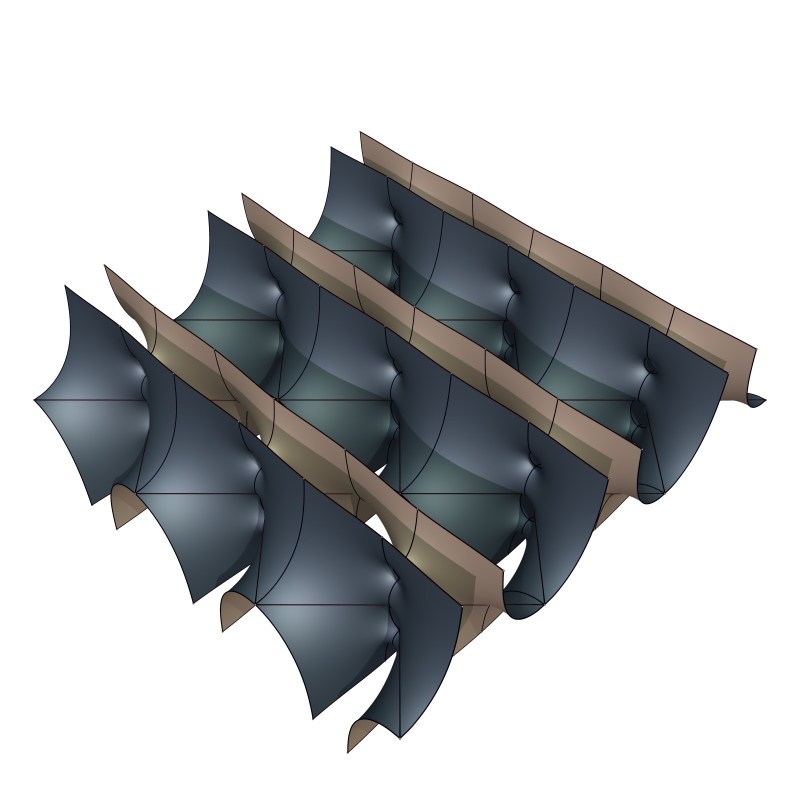
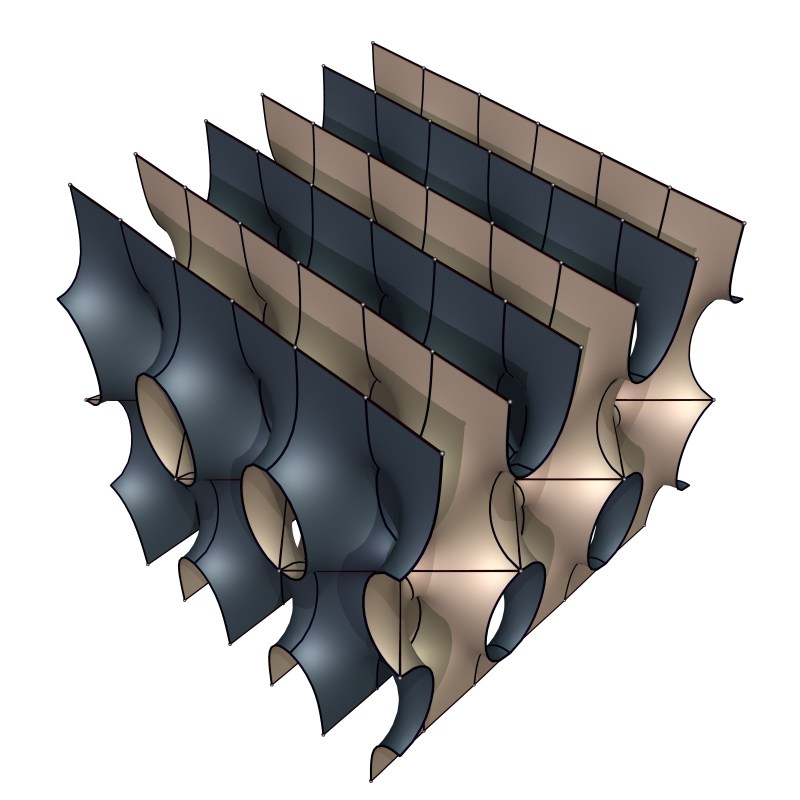
Last week I explained a really complicated way to get from Scherk’s doubly periodic minimal surface to the helicoid, through a family of Schwarz Diamond surfaces. As was known already to Scherk, this can be done much easier, namely by “shearing” the standard Scherk surface above. I put apostrophes because a simple Euclidean shearing isn’t enough to keep the surface minimal.

Doublyscherkshear

Bill Meeks and Hippolyte Lazard-Holly have shown that these are the only embedded doubly periodic minimal surfaces of genus 0 (after taking the quotient by their translational periods). Things get tricky for larger genus. 

Scherk g=1


First of all one needs to distinguish whether the parallel half planes “on top” are parallel to the ones “at the bottom” or not. Today we stick with the case that they are not parallel, and are in fact orthogonal. Then there is just one such surface of genus 1 (I am pretty sure, but I think nobody has written a proof). This was first constructed by Hermann Karcher. It’s pretty clear (and provable) that one can continue like this, creating doubly periodic surfaces with more handles, like the genus 2 example below.

Scherk g=2

It would be a nice theorem if they all would be unique. But I don’t think so. Below is a picture of a genus 3 surface where the handles are arranged differently.

Scherk g=3 exotic

Proving that this really exists won’t be easy, but interesting, because it would allow one to speculate what will happen if one can shear this surface like the original Scherk surface.