This Year in Marienbad

Cartoon

Alain Resnais’ film L’Année dernière à Marienbad is generally praised as visually breathtaking and intellectually incomprehensible. Since this year, this film might also be called visionary.

A game is being played multiple times and one of the unnamed participants (called M in the script), states “Je peux perdre, mais je gagne toujours”. This sounds eerily familiar. And M does always win, making moves that don’t seem to follow any logic.

The similarities go much deeper. Both the actors as the viewers are not only left in doubt what is true or false (as in any good mystery), but also about what is real and unreal. The film takes place in a state of mind that has been dubbed hypernormality, a concept that Adam Curtis is using in his brilliant recent documentary HyperNormalisation to explain how our traditional perception of reality has been dismantled, with devastating consequences.

The game that is being played is called Nim, and it is at the center of the film for a reason. It is an impartial game, which means that both players have complete information (no hidden cards) and the same moves available (no black and white pieces owned by the players). Impartial games also must end with one player winning and the other player losing. This means in particular that either the first or the second player must have a strategy, proving M almost a lier, because he cannot have a strategy both as first and second player. He is, however, not claiming that he can always win, just that he does always win, thereby claiming access to a powers beyond those of reason.

Let’s have a closer look at Nim. It is played with a several heaps of tokens (matches in the film). At each turn, the player is allowed to take any positive number of tokens from a single pile. The player who takes the last token wins.

The simplest case is that of a single pile: The first player will win by taking the entire pile.

The second simplest case is that of two piles. Here, symmetry plays a fundamental role. If both piles have the same size, the player must necessarily take away from one pile, thus leaving two piles of different size. On the other hand, if the piles have different sizes, the player can take away tokens from the larger pile to make them equal.
This proves that there is a simple winning strategy that consists of making both piles equal in size.

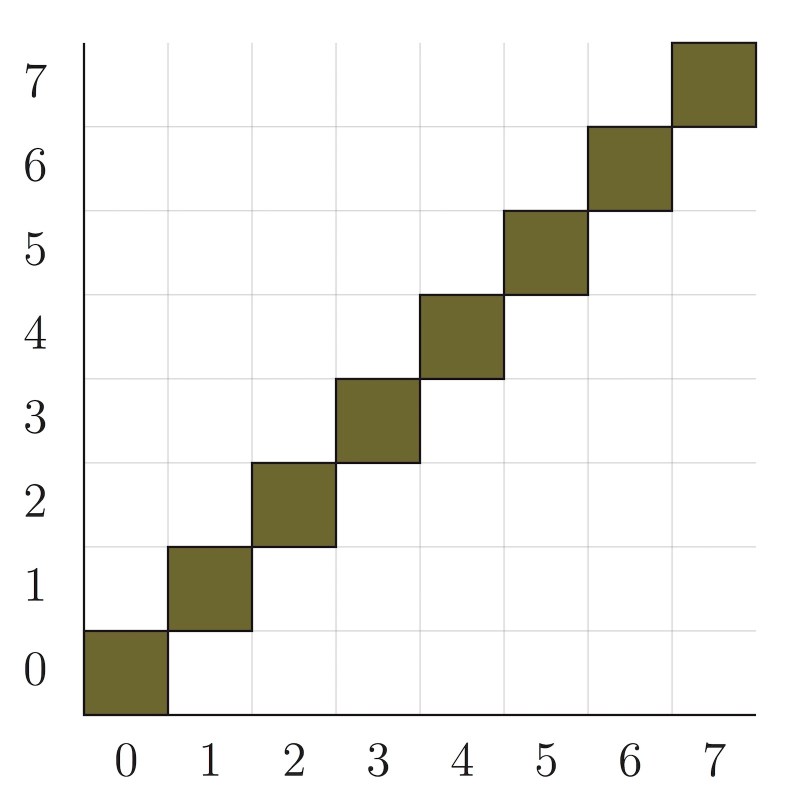
We can visualize this using coordinates in the first quadrant: A game position with pile sizes x and y determines a square at coordinates (x,y).
TwoHeapNim

The olive green squares mark the positions where both heaps have the same size. To move means to decrease either the x or the y coordinate. We can clearly see that we can move from any white square to an olive square (winning move), and that we are forced to move from an olive square to a white square.

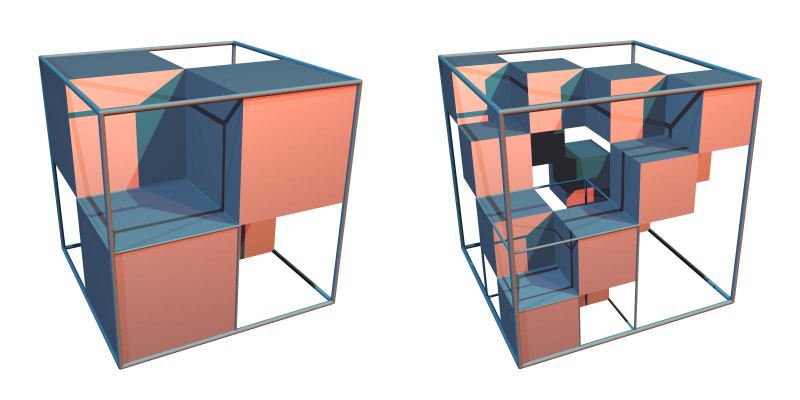
This is all very simple. However, as soon as the game is played with at least three heaps (the film uses four), things get much more complicated. Let’s see how the space of positions looks like. We can again use the first octant of space to indicate heap sizes x, y, z of three heaps by a little box at the point with coordinates (x,y,z). Below you see the boxes that indicate the losing positions for heap sizes 0 or 1 (left image) and heap sizes up to 3 (right image). A move again decreases precisely one of the three coordinates. Convince yourself that from one of the reddish boxes you have to move to a non-box, while from a non-box you can always move to a reddish box.
Nim 1 2

You can also see that you get from the left image to the right image by substituting a box by the entire left image. This persists, and what emerges with increasing heap sizes is a fractal called the Sierpinski Pyramid.

Nim 5

It is the full intention that this looks chaotic and complicated, because this is what a hypernormalised mind perceives. But behind this apparent chaos, there is a simple rule, except that its simplicity is not intuitively useful.

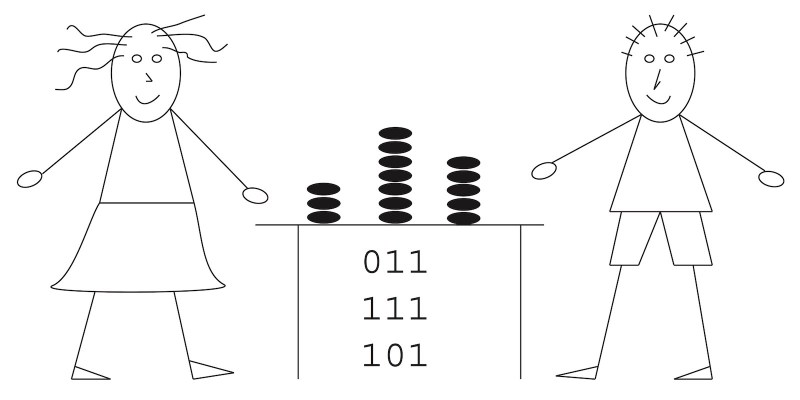
A position (x,y,z) is a losing position (and hence marked by a cube) precisely when the either-or sum of the binary representations of x, y, and z are zero. For instance, if the pile sizes are 1, 4, and 7, these decimal numbers have binary representation 001, 100, and 111. We obtain their either-or sum by adding these numbers in the binary system without carry, this gives 010. Because this is not 000, we are in winning position. The winning move takes 2 token from the third pile, changing its binary representation to 101.

This is computational very simple (and works for any number of piles), but there is no apparent way to make this intuitive. We humans do not feel that we are in a losing position in Nim. In this sense Nim becomes a perfect symbol for a world that appears detached from common sense, but can be controlled by algorithms.
Pillowminoes (From the Pillowbook VI)

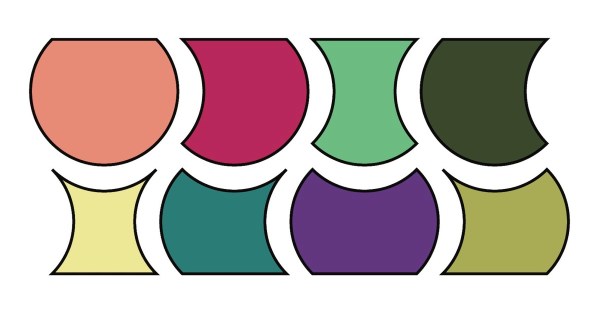
The admission of an abundance of pillows with straight edges to the zoo raises the question whether these new citizens are any good. We have employed the ones with two straight edges to form arrows and combine to Hamiltonian circuits. Today we will look at those eight pillows with a single straight edge (let’s call them the singles)
Eight 01

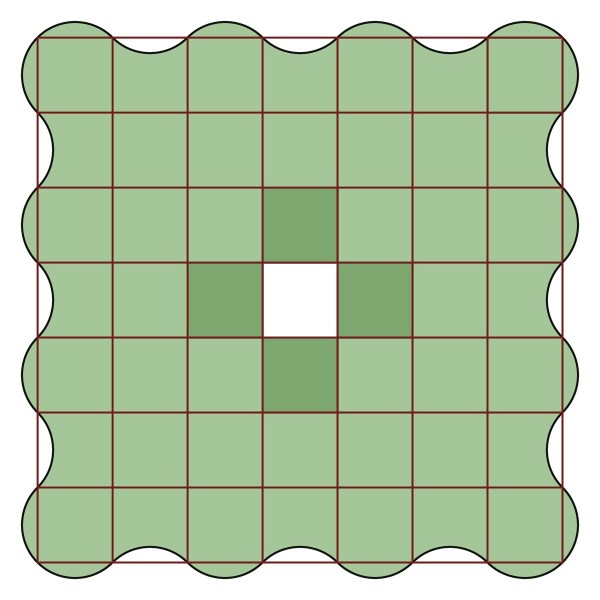
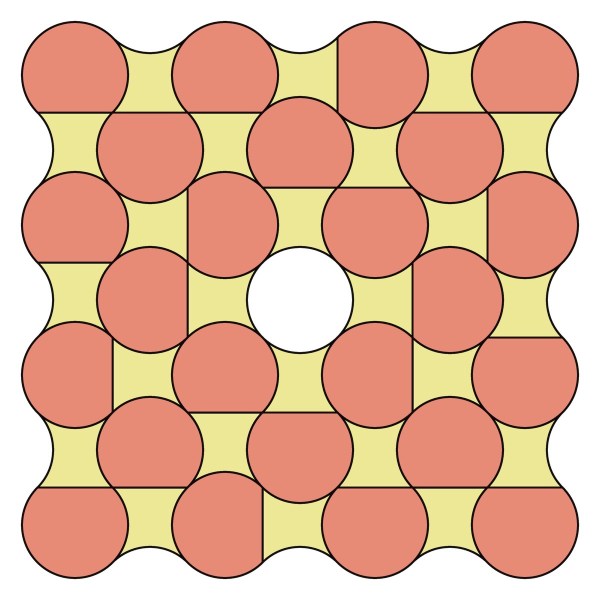
Can we use them to tile a curvy 7×7 square, say? The answer is clearly no, because the singles have to hide their straight edges by combining in pairs to pillowminoes. This means we can only tile curvy shapes with an even number of singles. Here, for instance, is a simple solution that shows how to tile a 7×7 curvy square with a gap at the center. It also shows how to tile this shape with a single pillowmino.
7x7 01

This looks too easy? Can we also tile the same curvy 7×7 square so that the missing square at the center has four straight edges?

7x7no 01

A little trial and error shows that this is not possible, but we would like to have a reason for this. We need for singles to neighbor the missing square at the center with their straight edges. I have indicated their position by a slightly darker shade of green. Thus the remaining lighter green squares will be entirely curvy, so needs to be tiled with singles that have combined into pillowminoes. That, however, is impossible: Color the squares alternatingly yellow and pink, as in the solution above. Each pillowmino will cover a pink and a yellow square, but the light green shape that needs to be tiled consists 24 pink and 20 yellow squares. This argument also shows that the missing square needs to have all edges curved.

What else can we do with the pillowminoes? There are 36 of them, and not all of them tile by themselves. If we want to tile the curvy 7×7 square with a circular gap in the middle, we will also need to balance the convex and concave edges, as explained earlier.

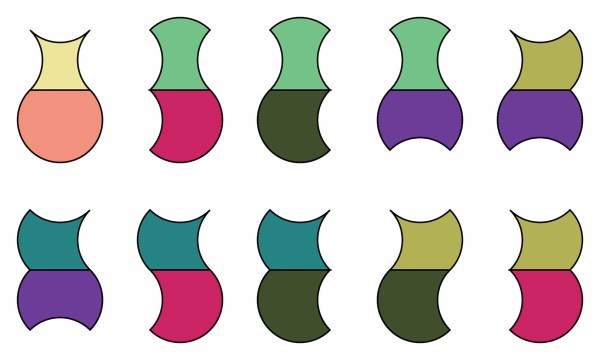
Here are the ten balanced pillowminoes:

Balanced 01

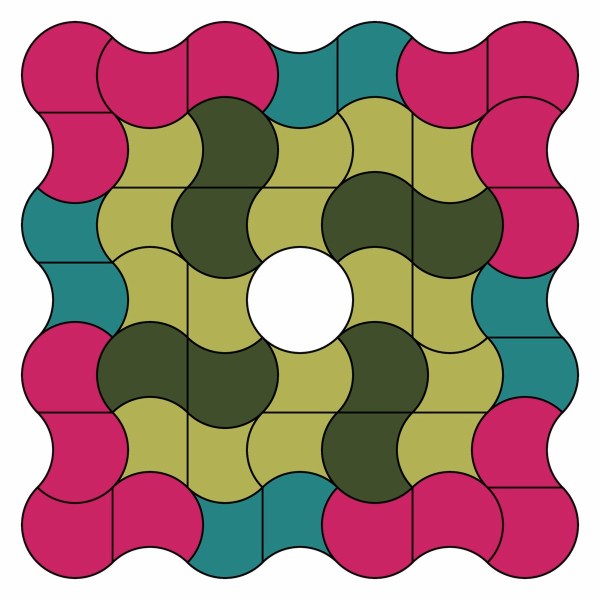
Surprisingly, only the top left will tile the 7×7 (or any larger) curvy square with a central gap.
Below is an example that tiles with four individually unbalanced but centrally symmetric pillowminoes.

7x7b 01

More to follow!

Cubes, Cylinders and Triangles

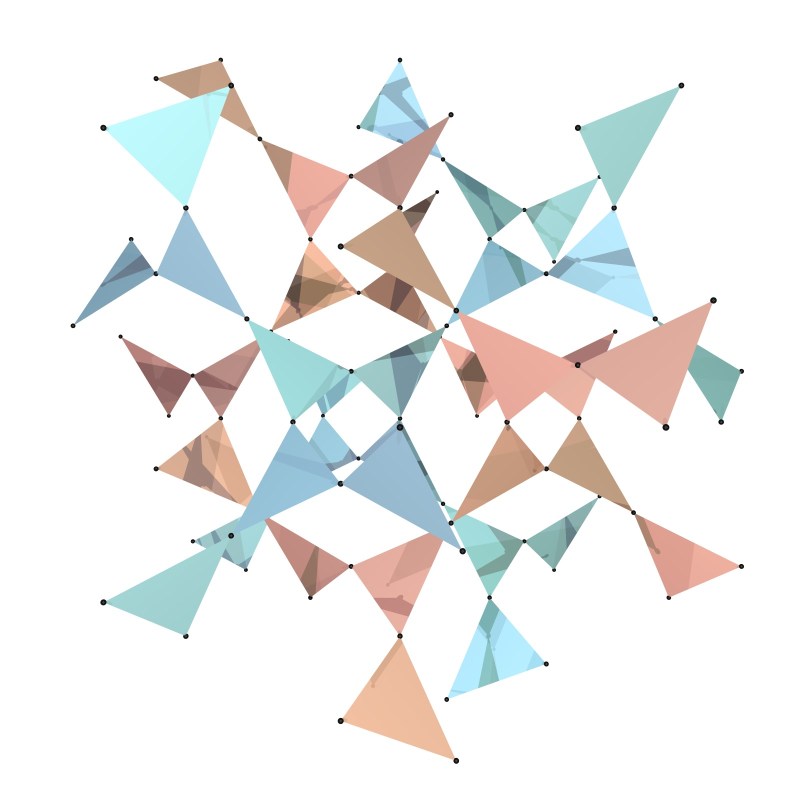
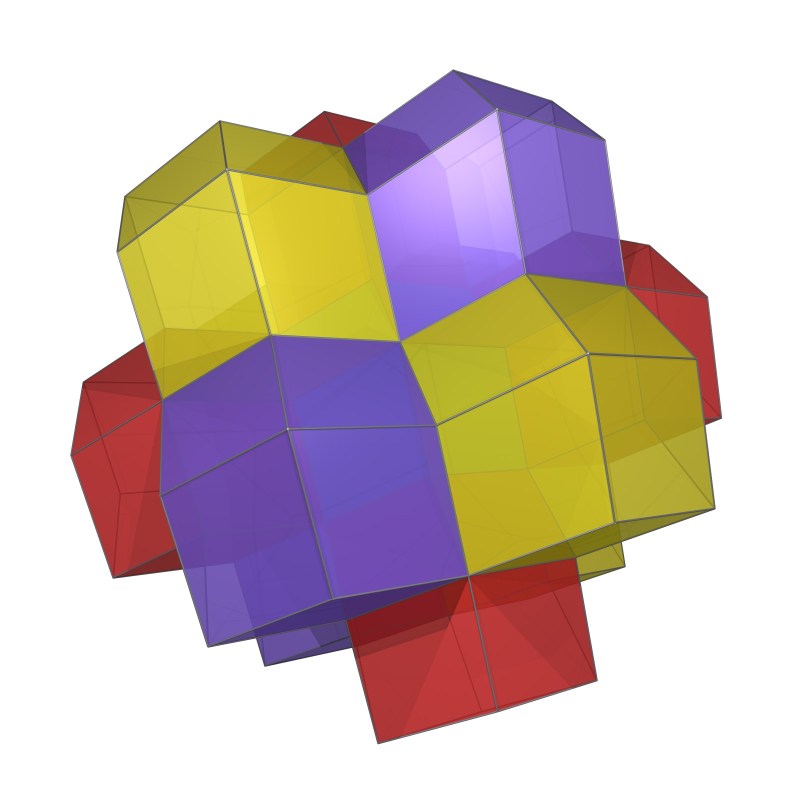
If you don’t have the bricks available that I used as substitutes for a rhombic dodecahedron, you can still make simple models jut using cubes: Take an ordinary cube, and choose three edges, one in each coordinate direction, and so that they don’t share a vertex. There are, up to rotations, two ways of doing so. Let’s call them blue and red. Make a few dozen of the blue cubes.

Bluecube

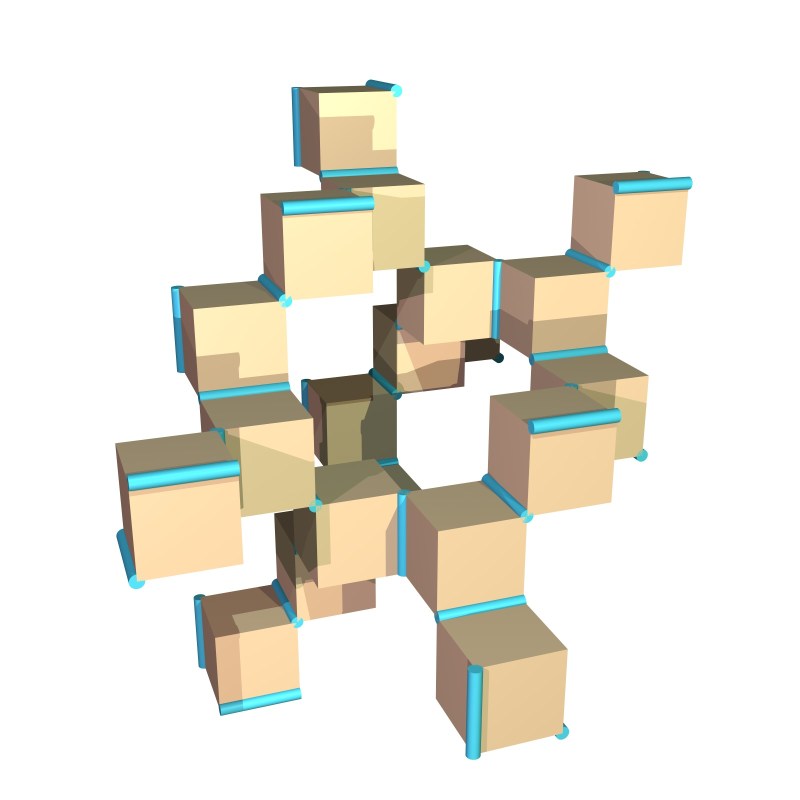
Now comes the tricky part: You are only allowed to attach two cubes so that they share one of their blue edges. This is fairly easy in zero gravity, or in your favorite computer software, like Minecraft. The structure you get this way is yet another version of the Laves graph. This looks clumsy, but it is useful for prototyping things. It also gave me the idea of a further reduction that is even harder to hold together but much more elegant: Replace each marked cube by the equilateral triangle that has its vertices at the midpoints of the marked edges.

Triangles

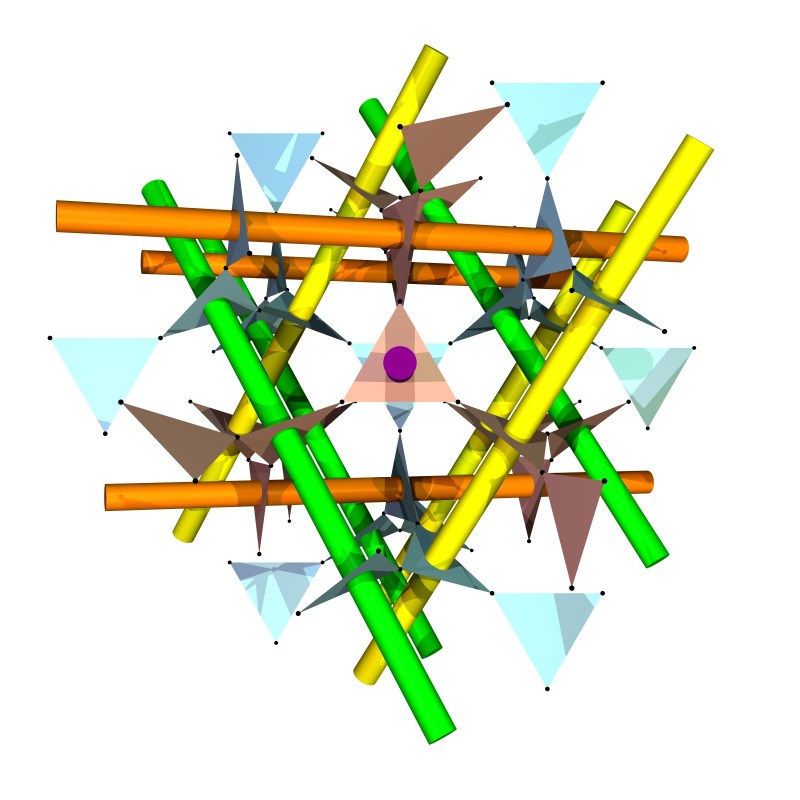
Now one even has plenty of room to show the two intertwining Laves graphs simultaneously. What one cannot see very well in the above ethereal image is that if one orthogonally pierces a cylinder through the midpoint of any triangle, the cylinder will periodically hit other triangles in the same way, without interfering with any other triangles or cylinders.

Cylinders

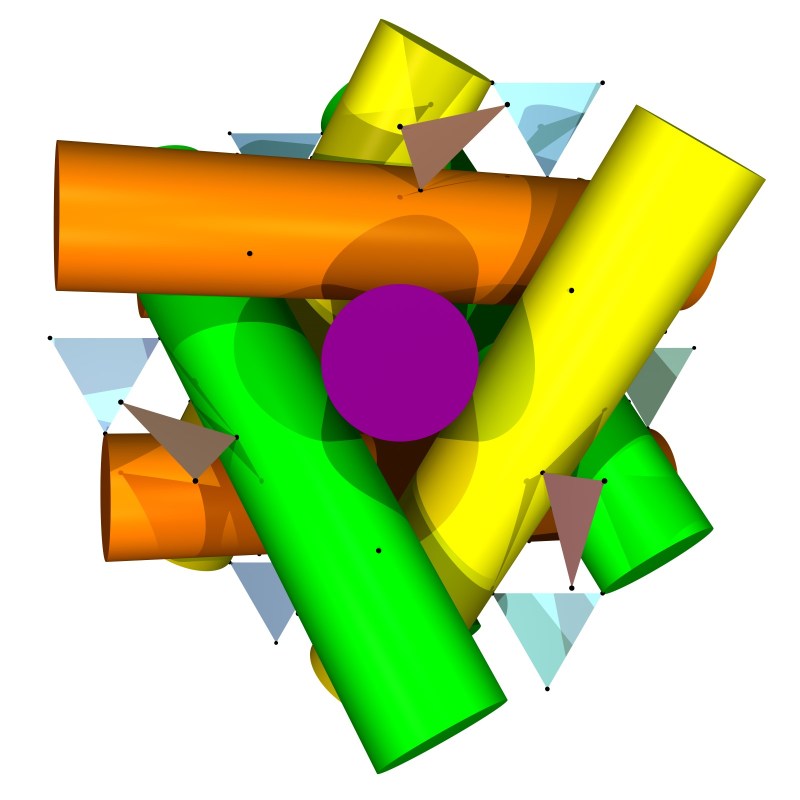
Out of the sudden, there is structure. And it gets better: Because the cylinders don’t interfere, we can make their radii so big that they reach the vertices of the triangles. This way the cylinders will touch precisely at the vertices of the triangles. This means that the cylinder packing that uses cylinders in all four directions of the diagonals of a cube can be used to construct the Laves graphs: Determine where the cylinders touch. Each of these points belongs to two equilateral triangles equitorially inscribed in the two touching cylinders. Use the triangles centers as vertices of the Laves graph, and connect them by an edge if the triangles meet at a vertex.

Cylindersbig

More Choices

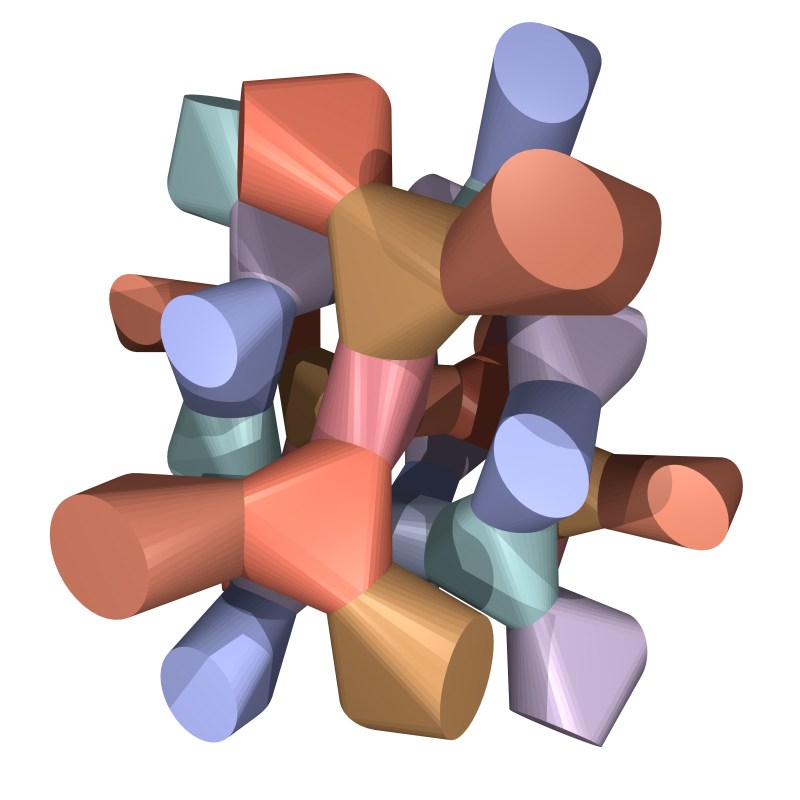
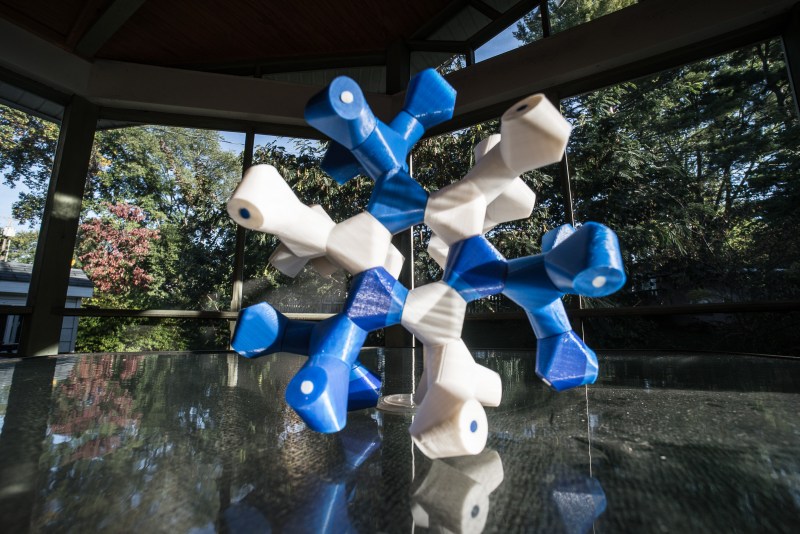
Last week we saw that using just the left handed of the two bricks that I based on the rhombic dodecahedron produces nothing but the Laves graph. Using the right handed brick makes the mirror image of the Laves graph, and one can see

Prestartwin

that they intertwine nicely. Of course it would be better to have real bricks, and with help from Martha and the friendly people at MadLab of our Fine Arts School, I could play with a few dozen left and right bricks.

DSC 6390

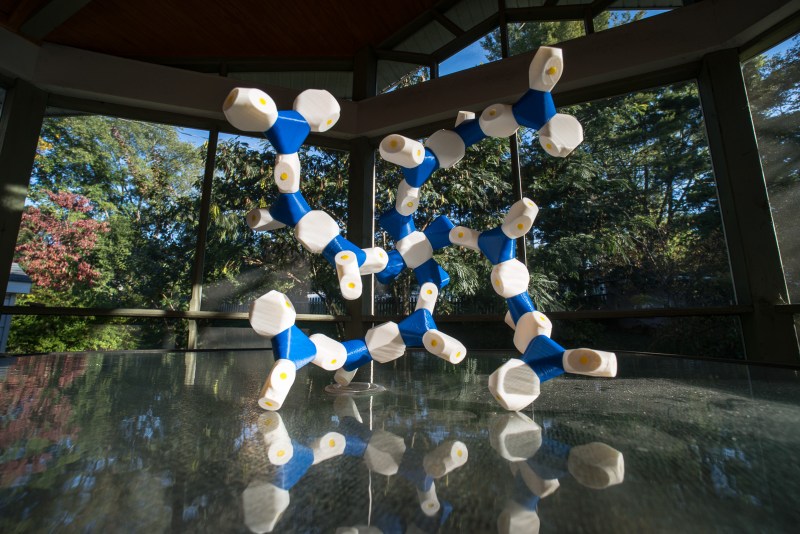
In the above picture left and right bricks are color coded, and the sculpture starts with a hexagonal ring and then grows tentacles in a single color. These will come together and close, but leaving gaps looked more interesting.

DSC 5896

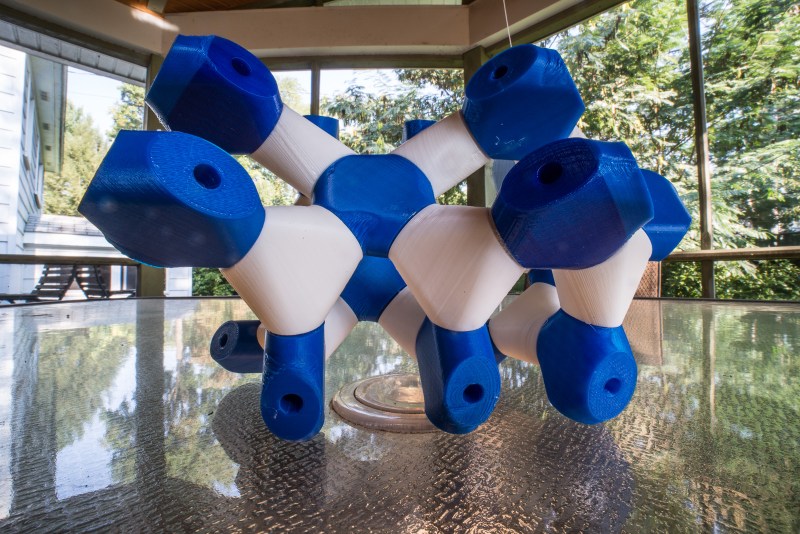
Here (above and below) you can see that I cheated, because I am also using a brick with four sides. It is geometrically much simpler, but of course still based on the rhombic dodecahedron, replacing four of its sided by their inscribed ellipses, and then taking their convex hull. This allows for tighter loops as in the image above, and allows for more design options.

DSC 6395

Another Brick in the Wall

When Apple announced in July this year they had sold 1 billion iPhones, I started wondering about another brick maker: How many blocks has Lego made? Their friendly customer service couldn’t tell me how many elements they have made in total, but the yearly production is 19 billion. Scary. Unfortunately, the shape of the standard lego brick is too limited for my needs. For a long time, I had wanted a lego brick in the shape of a rhombic dodecahedron (better would be a four dimensional lego hypercube of which the rhombic dodecahedron is a mere shadow, but let’s not be delusional). As you can see, this polyhedron tiles space as well if not better than the cube.

RhombicDodecahedronTiling

Various companies have produced shapes with more or less cleverly embedded magnets, but keeping track of the polarity on all faces of a 12 sided object is tricky. And this would be a lot of magnets. The actual problem, however, is the enormous amount of choices one has: 12 faces to attach to is just too much. I strongly believe that Lego’s success stems from the fact that they have reduced the number of possible ways how you can attach two lego pieces dramatically. No choice means dictatorship, two choices US capitalism, but more choices sounds like European liberalism or even anarchism, and we see where that leads.

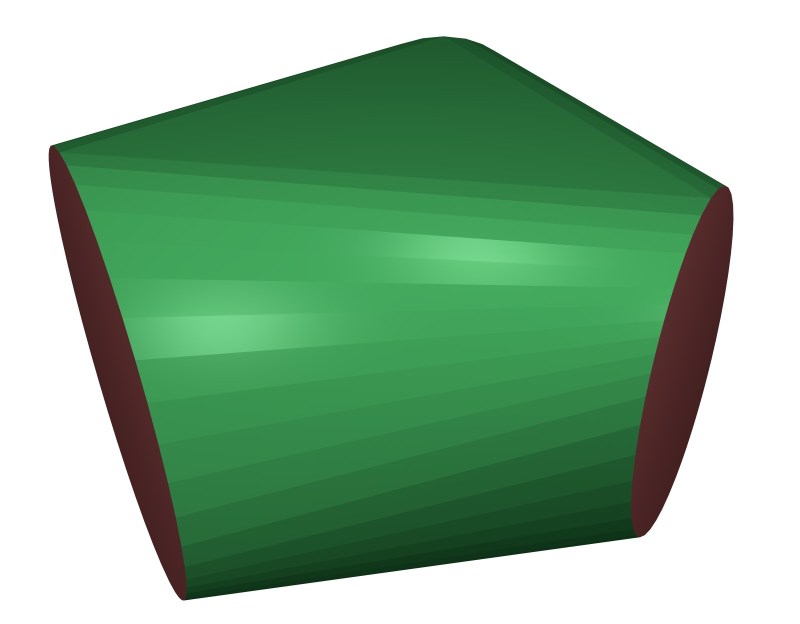
This gave me the idea to replace the complicated rhombic dodecahedron by a simple object that is less attachable. Here is the new brick.

Brick

To make it, take three faces of the rhombic dodecahedron that are symmetrically positioned, and replace each of the three rhombi by its inscribed ellipse. Then take the convex hull of the ellipses. The resulting shape consists of the ellipses, two equilateral triangles in parallel planes, and three intrinsically flat mantel pieces.

You will notice that there are two versions of this brick, a left and a right handed one. This leaves just the right amount of choices.

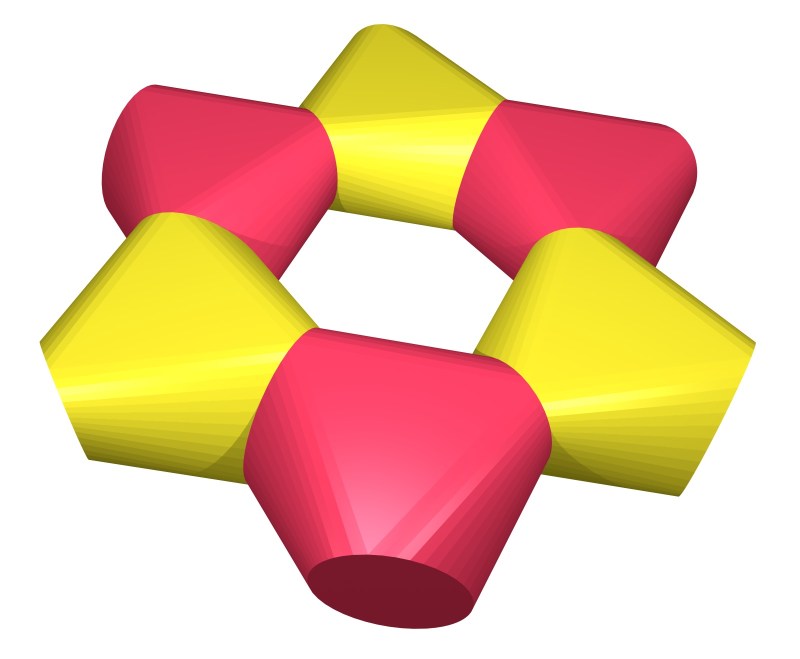
Hexring

If you alternatingly attach a left to a right brick, you get a hexagonal annulus. Remember that we are still tiling space using slimmed down versions of the rhombic dodecahedron. Due to our imposed limitation of choice, nor every place can be reached anymore. The hexagonal annulus is a little simplistic. What do we get if we just use the left handed brick?

Prestar2

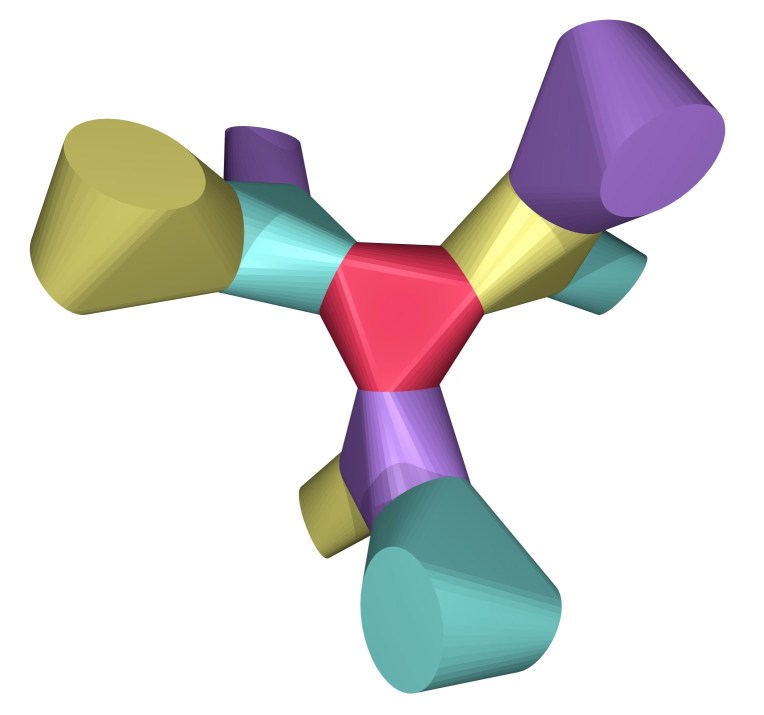
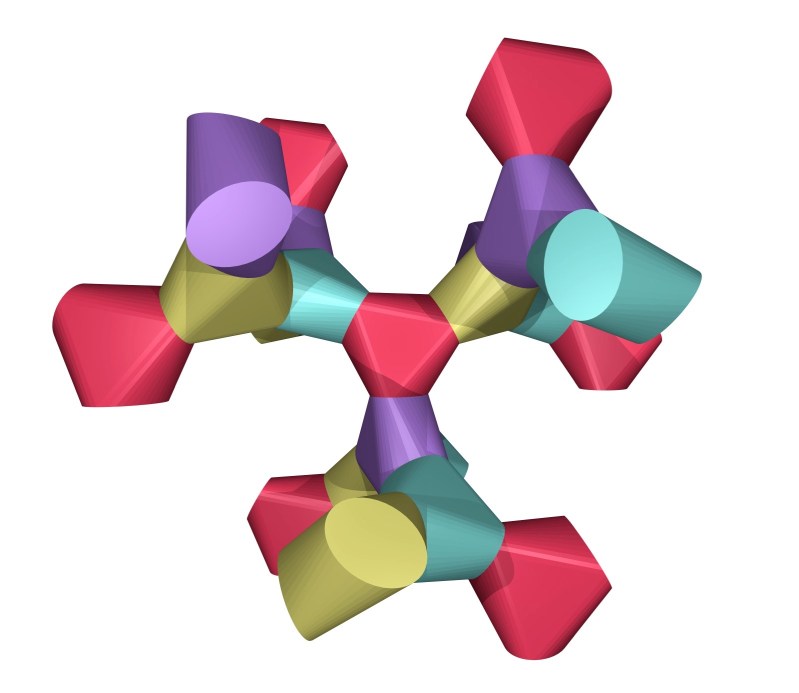
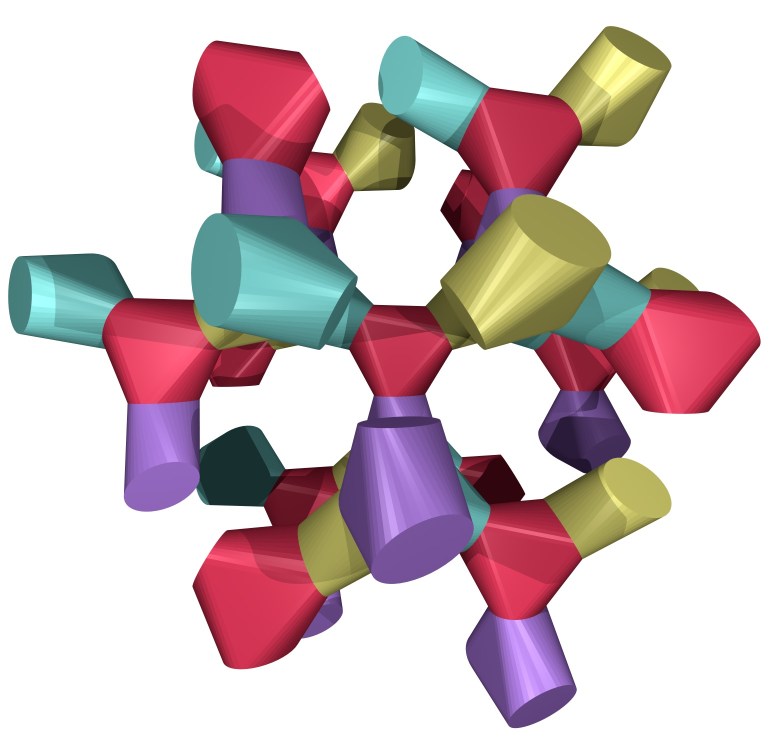
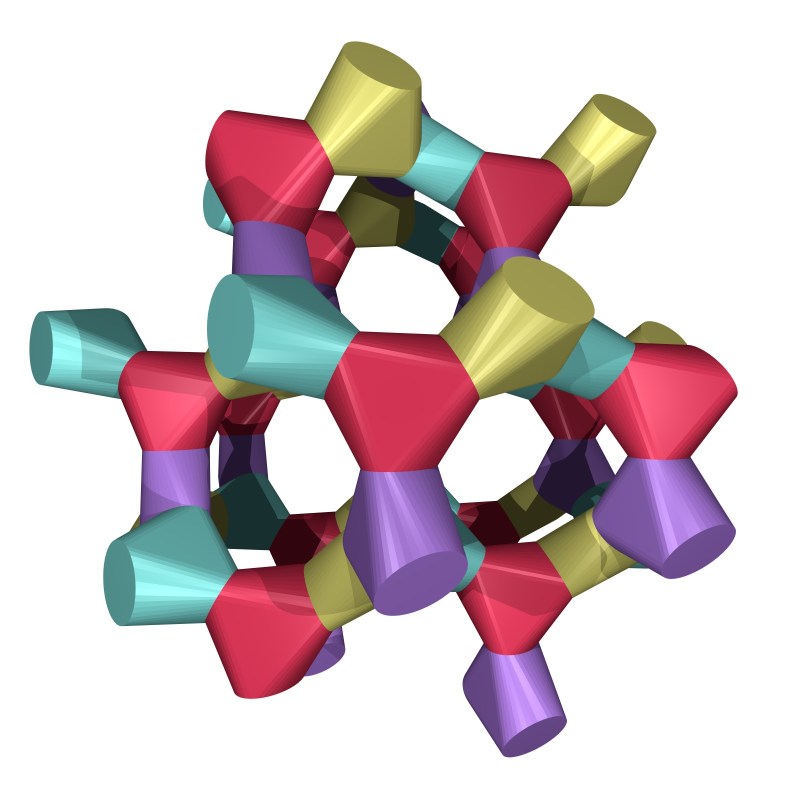
Let’s start with a red central brick, attach a brick on all three sides, and another six at the free faces of the new bricks. We notice that the bricks can occur in four different rotated positions. I have distinguished them by color. Add another 12 bricks:

Prestar

And another 24. No worry, no intersections can occur, because, I insist, we just tile a portion of space with rhombic dodecahedra.

Star

Now we see that the tree like structure we have produced so far does not persist. In the next generation, we obtain closed cycles of length 10, and we finally recognize the Laves graph.

Ball

In the very near future you will see what else one can make with these bricks.

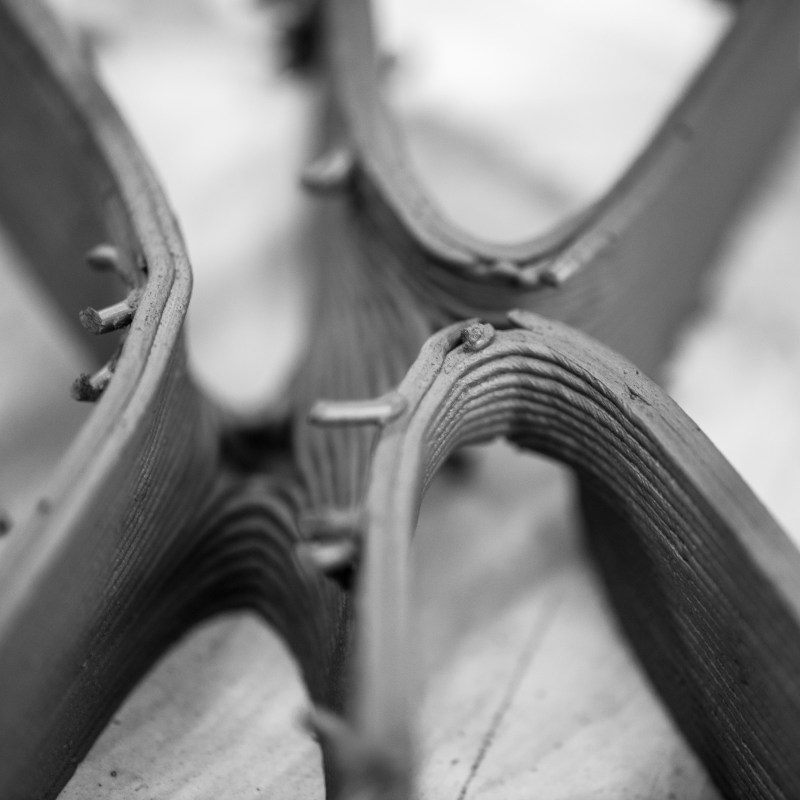
Scherk in Clay

Scherk6

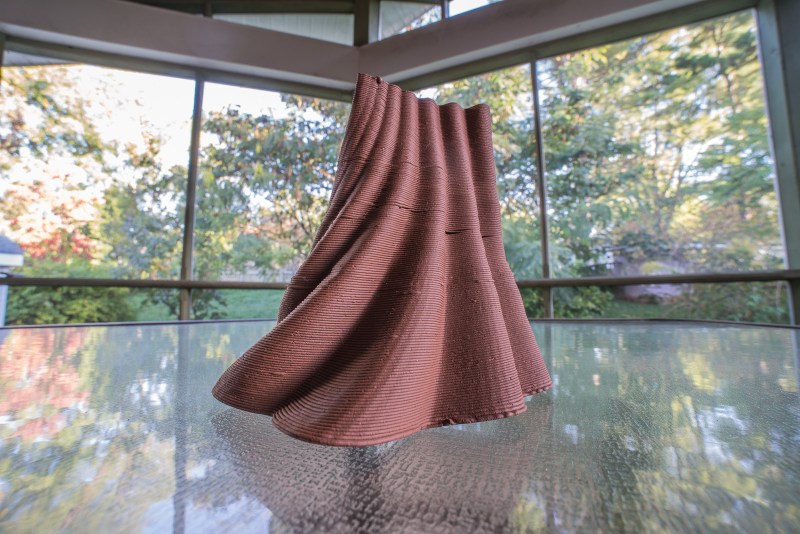
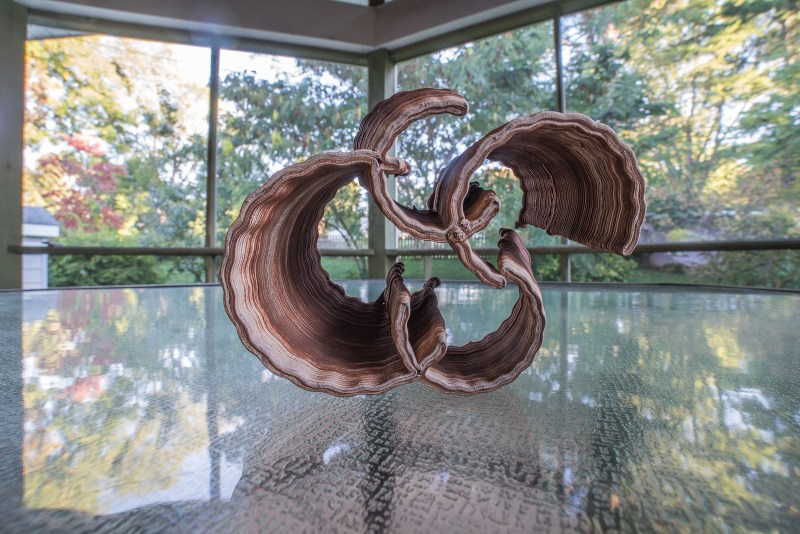
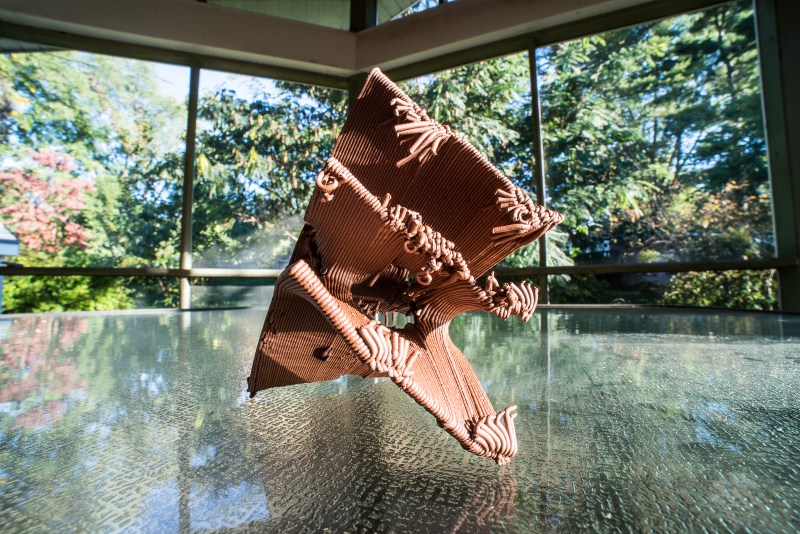
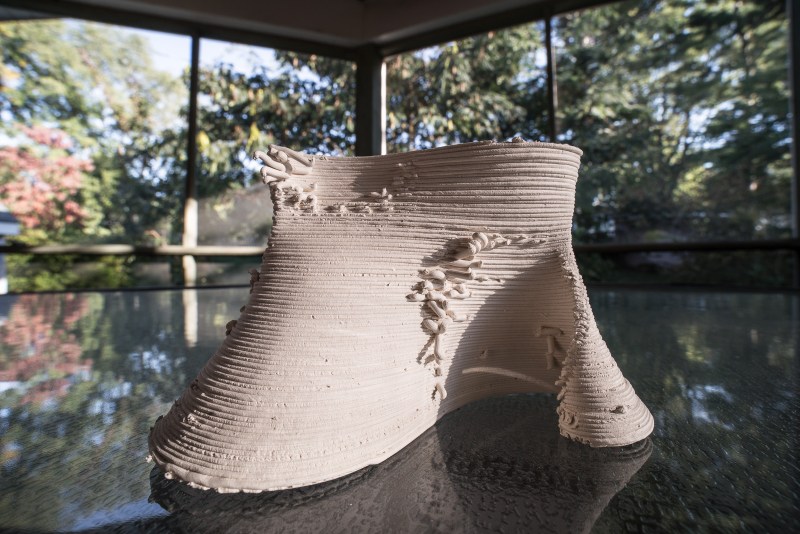
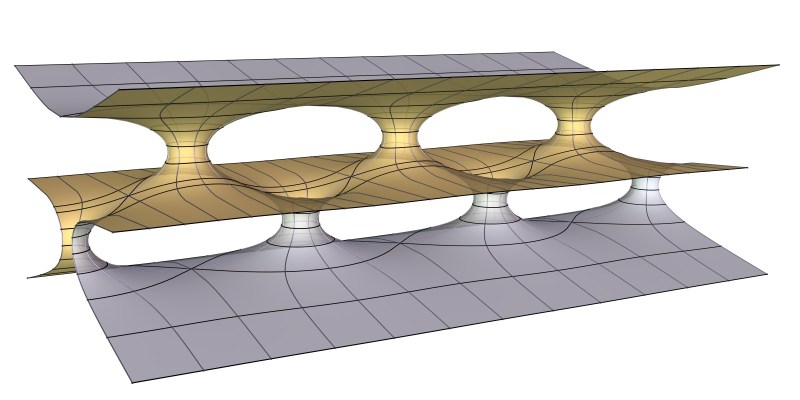
This innocent minimal surface, which can be obtained from Heinrich Scherk’s traditional surface by adding two wings and bending them towards each other, poses interesting challenges when printed (vertically, i.e. rotated by 90 degrees) in clay. First of all, there are three horizontal cross sections which look like branches of hyperbolas (but aren’t, not even for the original Scherk surface, in contrast what Wikipedia currently claims).

DSC 6210

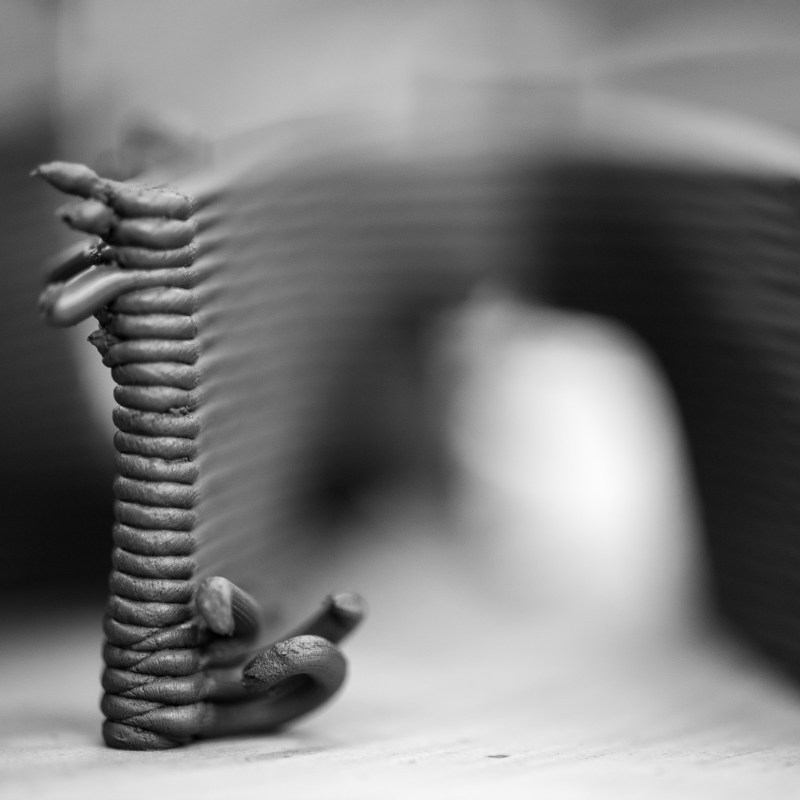
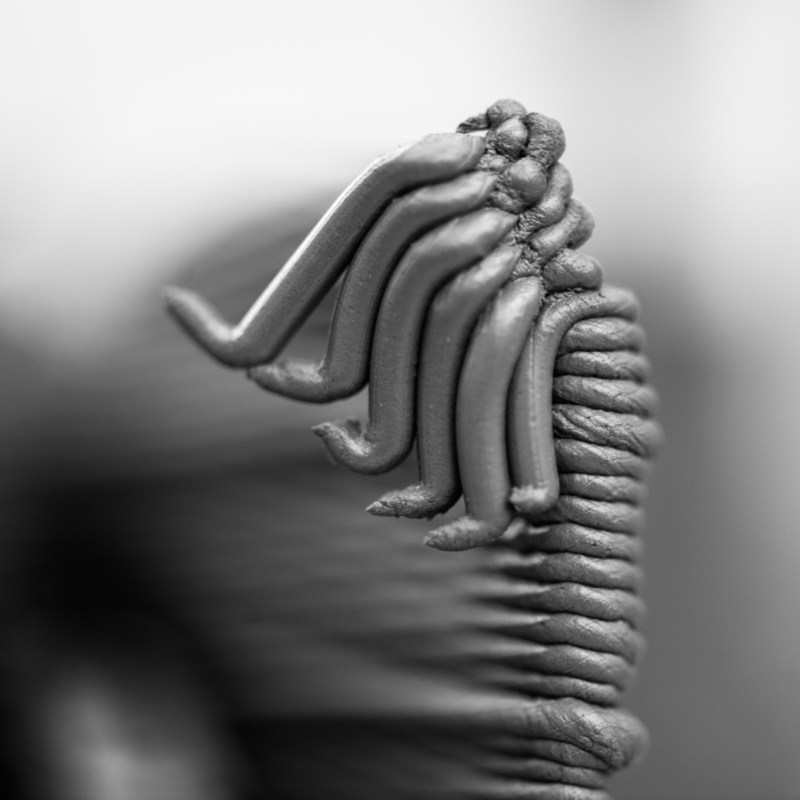
When printing this layer by layer, the nozzle has to move from branch to branch, and as the printer can’t stop printing while it skips across, it leaves hairy artifacts.

DSC 6207

They clearly have their own charme.

DSC 6299

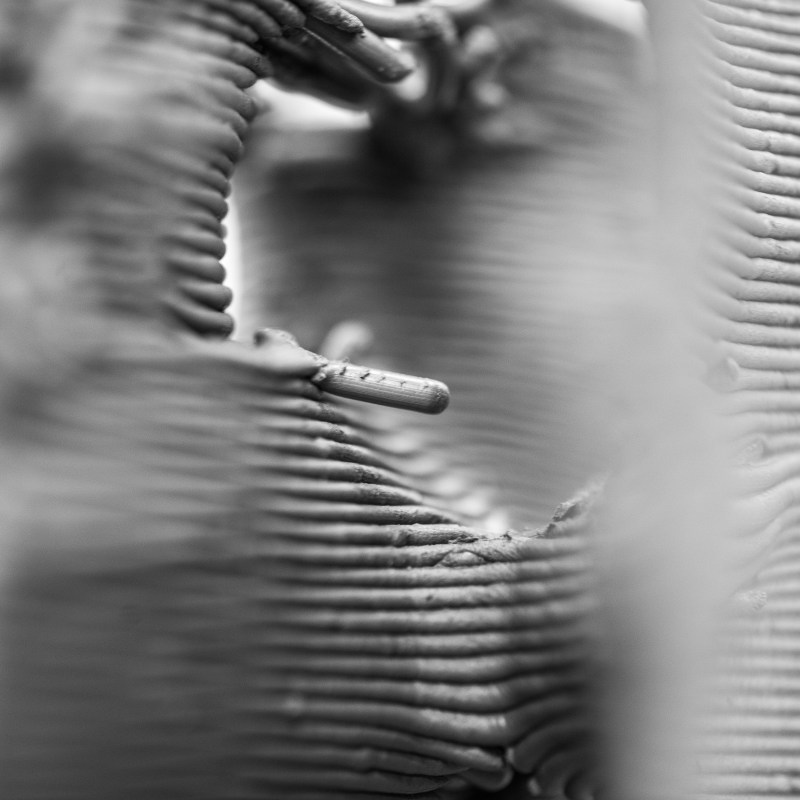
Another problem arises from the saddle points that are printed without support. This leads to other imperfections and sometimes structural complications that might take away from the elegance of the original surface but contribute to wild interior landscapes.

DSC 6269

Watching the printer work for two hours is dramatic, because failure in the form of collapsing walls can happen any minute.

DSC 6276

Triangles and Squares

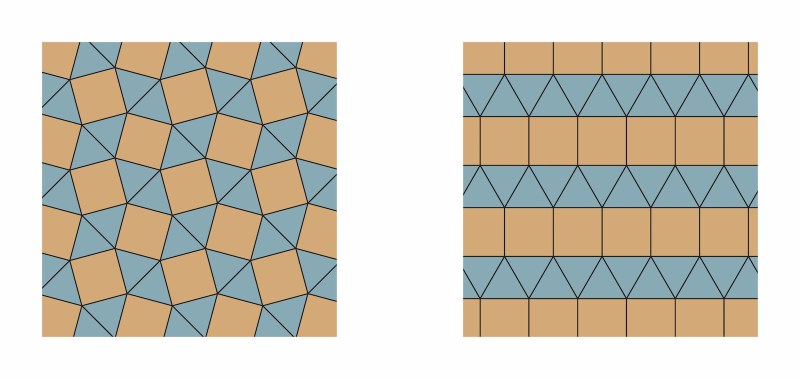
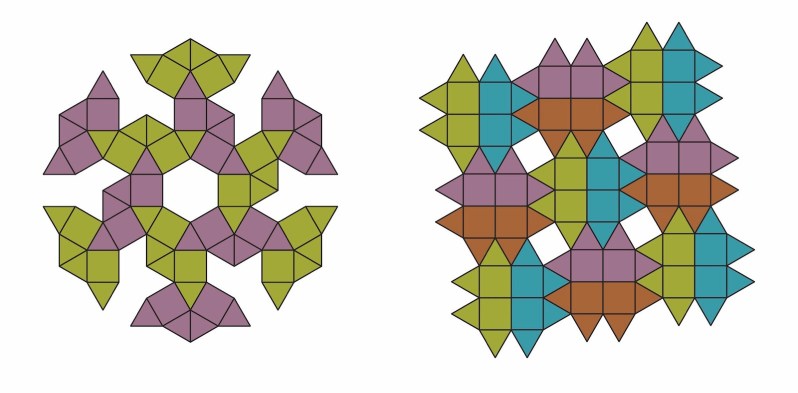
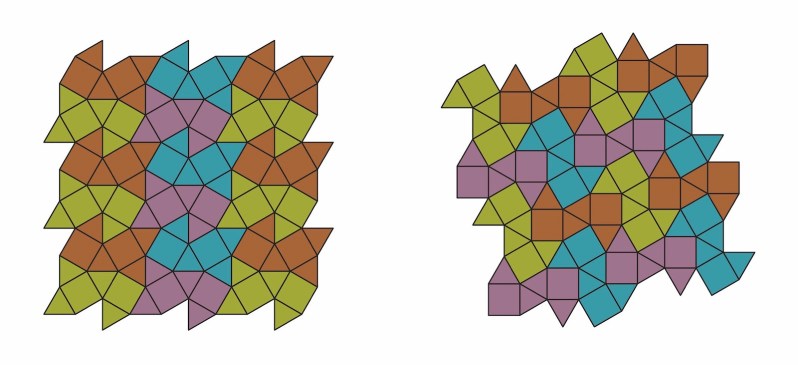
There are two Archimedean tiling using triangles and squares.

Archi34 01

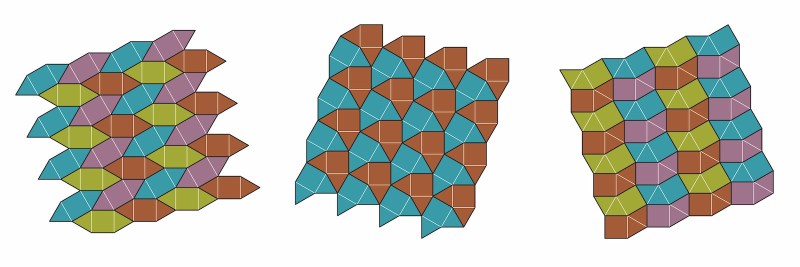
Both of them use twice as many triangles than squares. I find the first one is more interesting, maybe because it is chiral. There are still many other ways to tile the plane say periodically with just triangles and squares. There are three different ways to assemble two triangles and a square, and all of them give polyforms that can be used as a single subtile for the first Archimedean tiling:

Architile 01

Among these three polyforms I like the middle one best, maybe because it cannot be used to subtile the second Archimedean tiling. It is an amusing exercise to doodle around and find other tilings of the plane with this tile. Here, for instance, are two small turtles and a giant caterpillar, all part of a big creation.

TrisqueArt 01

I find it amusing how this simple polyform lends it self easily to organic shapes and abstract designs.

Order4 01

There are (I think) 10 ways to combine two of them into a single polyform, not counting mirror images. At least two look like cats.

Duos 01

Confusing as they look, almost all of them tile the plane. The two exceptions are shown below. It is not difficult to find an argument why these two do not tile.

Nottileduo 01

More interestingly the other eight tile, even though they look much more complicated. Typically one needs for each tile its mirror, suitably rotated. Here are two pretty examples. Homework is to find the others.

Duotileex 01

Dissect and Conquer

Many basic mathematical concepts are easy to convey to the layperson. For instance, most people are ok with numbers, distances, and right angles. An example of a concept that I found very hard to explain is that of a group action, and the related concept of a fundamental domain. Equivalence classes in general seem to be completely out of this world.

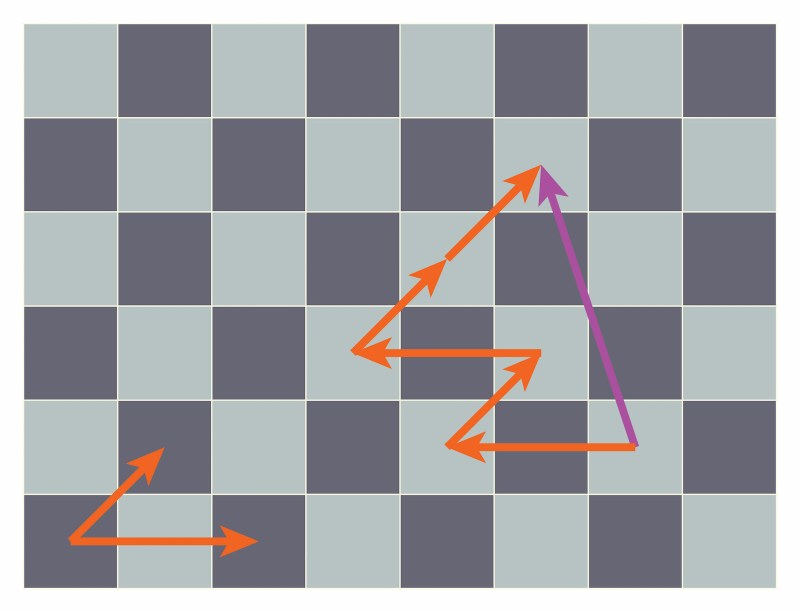
Lattice 01

Periodic tilings give many examples. The colored square tiling above for instance is periodic with respect to a group of (color respecting) translations, all of which can be written as a combination of the two orange arrows at the bottom left, or their reversed arrows. The collection of all these translations is called the lattice of the tiling.

More complicated looking tilings can have simpler lattices. For instance, the tiling by the differently sized yellow and blue squares below has the same lattice as the tiling by the outlined orange squares.

2squares 01

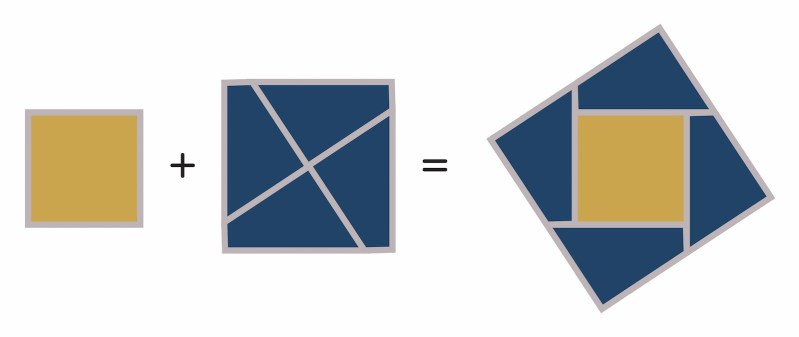
The not so simple consequence of this simple observation is the following dissection of a large square into two smaller squares:

2squaressol 01

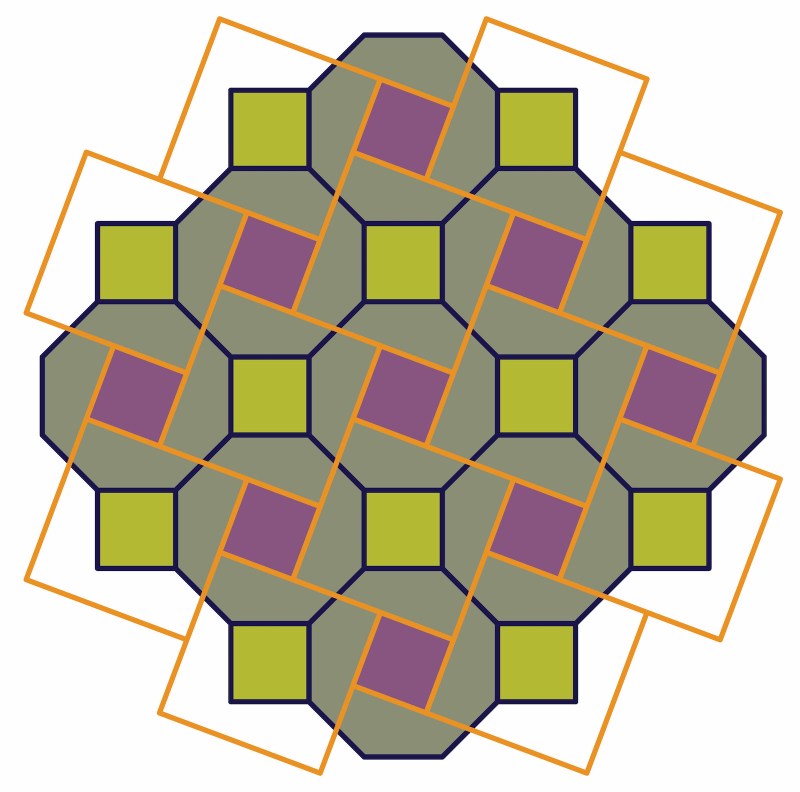
The reason why this works is that both the large square and the union of the two smaller squares are a fundamental domain for the common lattice of the two tilings. You can think about the orange grille as a cookie cutter, and the yellow and blue squares as periodic dough. Cutting a blue and a yellow dough square with that cutter gives you five pieces that just fill one larger square of the cutter. There are many different ways to place the cutter over the dough, and all are allowed, as long as cutter and dough have the same lattice. This means that you can translate the cutter, but not rotate.

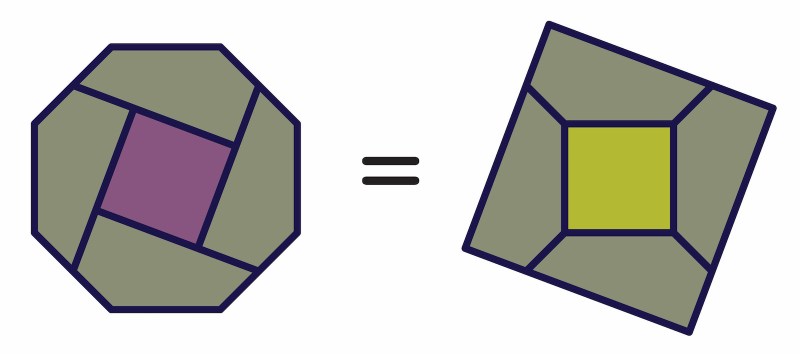
This method is well known among dissectionists. My favorite example is the dissection of a regular octagon into a square.

Octagonsol 01

To explain how to find it, we tile the plane with octagons and yellow squares. This tiling has the same lattice as a tiling by two unequal squares, where we choose the smaller purple squares to be exactly the same size as the yellow squares.

Octagon 01

The Economy Bender

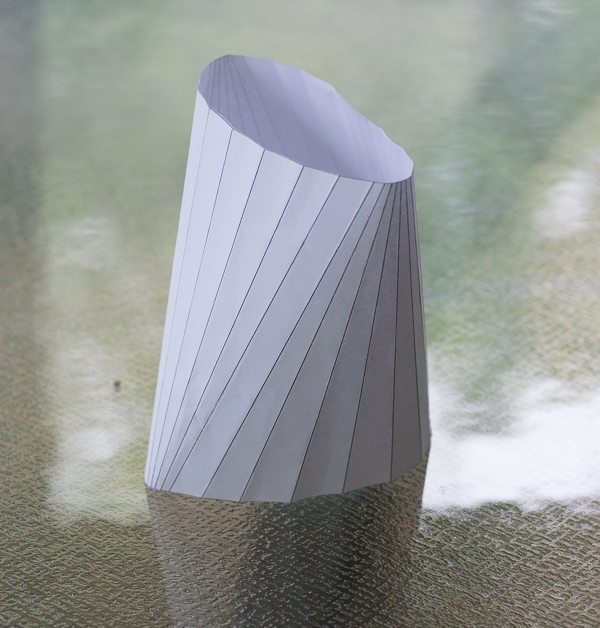
If you want to build a column that has two elliptical cross sections at the top and bottom with different major and minor axis and that can roll, you can just take the ruled surface whose lines connect points with parallel tangents on the two ellipses.

Column

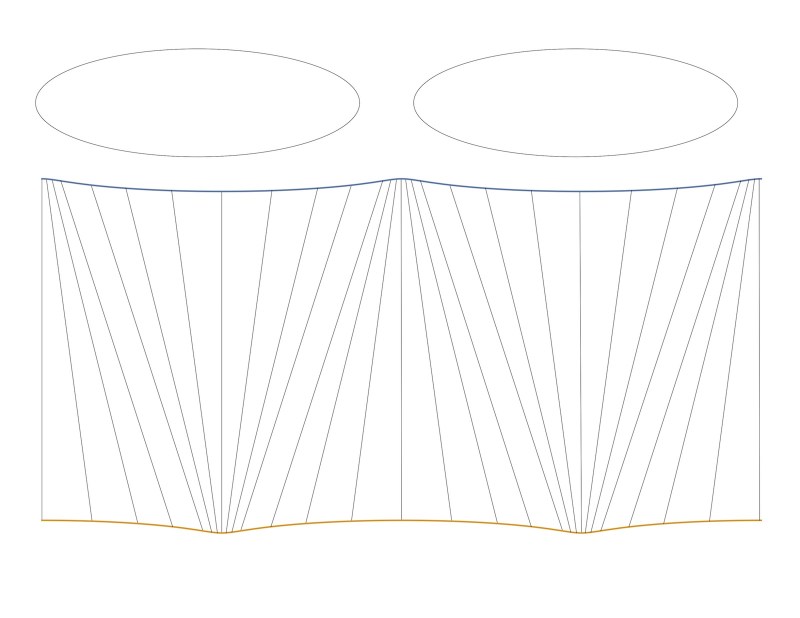
When placed horizontally on a sheet of paper, the column will touch the paper in these lines, and you can wrap the paper around the column, making evident that this is a developable (or flat) surface. You can try it out yourself with the template below.

Template
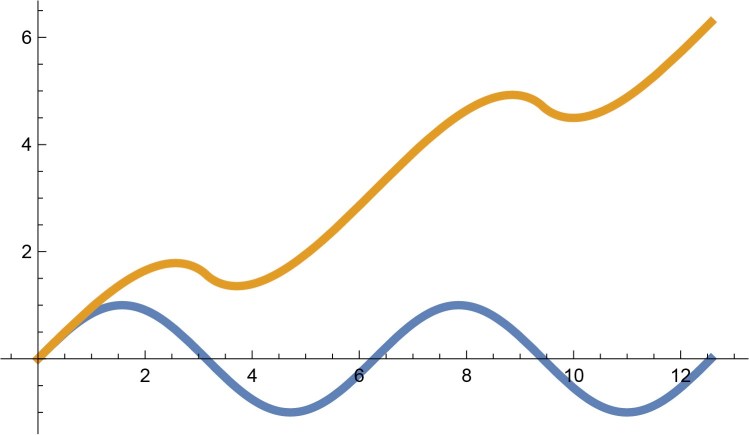
This simple trick has dramatic economic applications. Suppose you want to transform a boring, stagnating economy into a vibrant, growing economy:

Economies 01

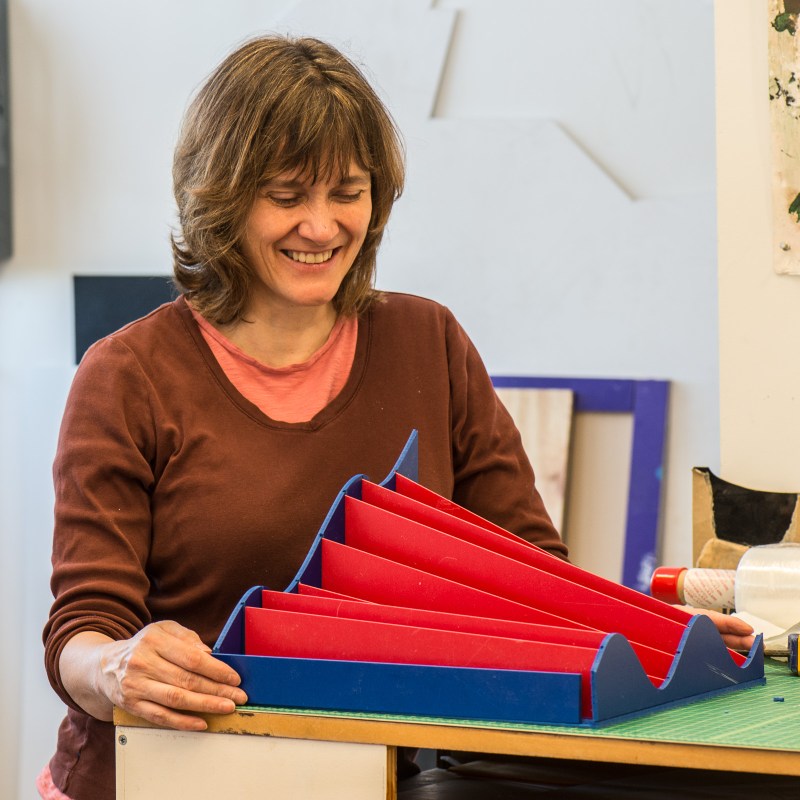
To do so, you just need to join points with parallel tangents on the two economy graphs by straight lines. Here is Martha with a wooden prototype of the Economy Bender.

DSC 3596

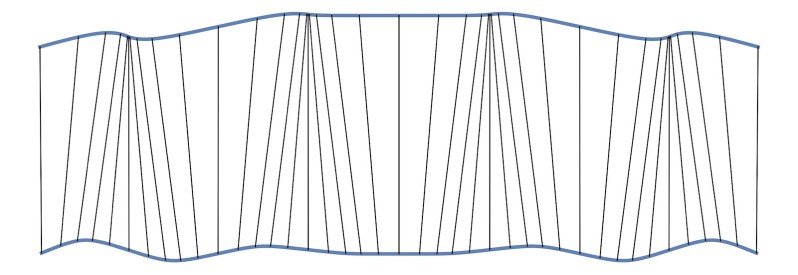
You can now wrap some expensive looking material over it. To explain to your CEO how you will be able to transform your failing company into a successful one, just take a printout of last year’s dire company report, put it onto the lower part of the bender next to the stagnating economy curve, and slowly move it upward towards the growing economy curve. You can do this by keeping the report tight on the surface, neither tearing not stretching it. This should convince anybody that a smooth transition into a brave new world is always possible. Here is the template:

Economy
Anybody buying it?