Brianchon’s Theorem

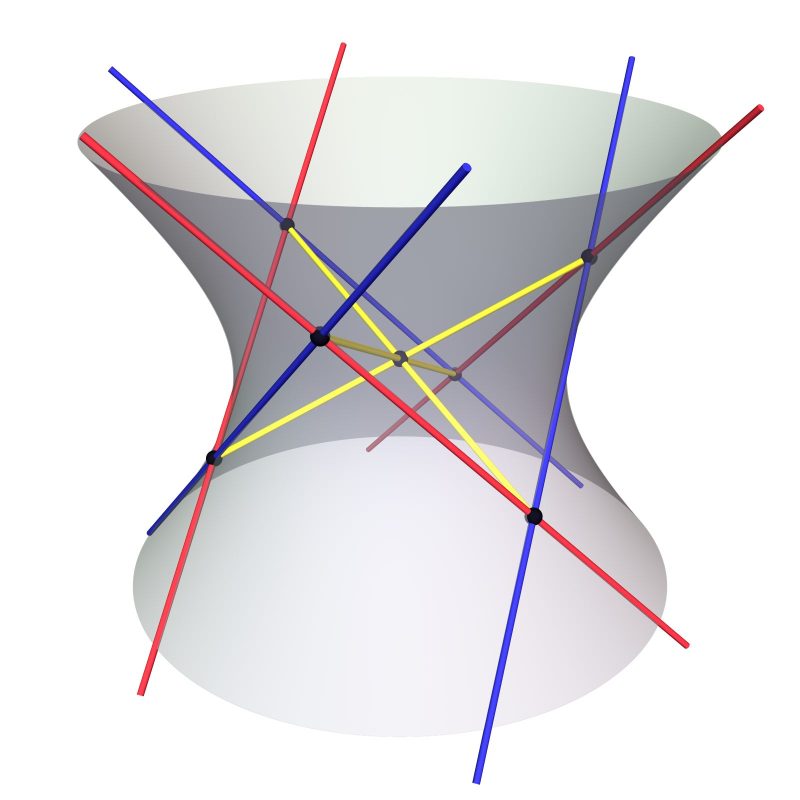
When you rotate a straight line about the vertical axis, you will generally get a hyperboloid of revolution. By construction, this is a ruled surface, and by symmetry, there is a second set of lines on the surface. We call these two sets of lines the A-lines and B-lines.

Sor

These lines dissect the hyperboloid into lots of skew quadrilaterals, reminding us that any quadrilateral can be doubly ruled, and opening up more possibilities for our previously discussed bent rhombi.

Patches

Let’s form a hexagon, following the A- and B-lines alternatingly once around the hyperboloid. Then a theorem by Charles Julien Brianchon states that the three main diagonals (i.e. those connecting opposite vertices) of this hexagon will meet in one point.
Sor2

One reason why this is curious is that it quite unexpected: In space, we don’t even expect two lines to meet in a point, let alone three. The other reason is that it has such a simple proof, due to Germinal Pierre Dandelin: Any pair of A- and B-lines will lie in a common plane, because they either intersect or are parallel. So the pairs of opposite edges give us three planes, which will meet in a common point. Because the diagonals of the hexagon are also the intersections of any pair of the three planes, we are done.

Sor3

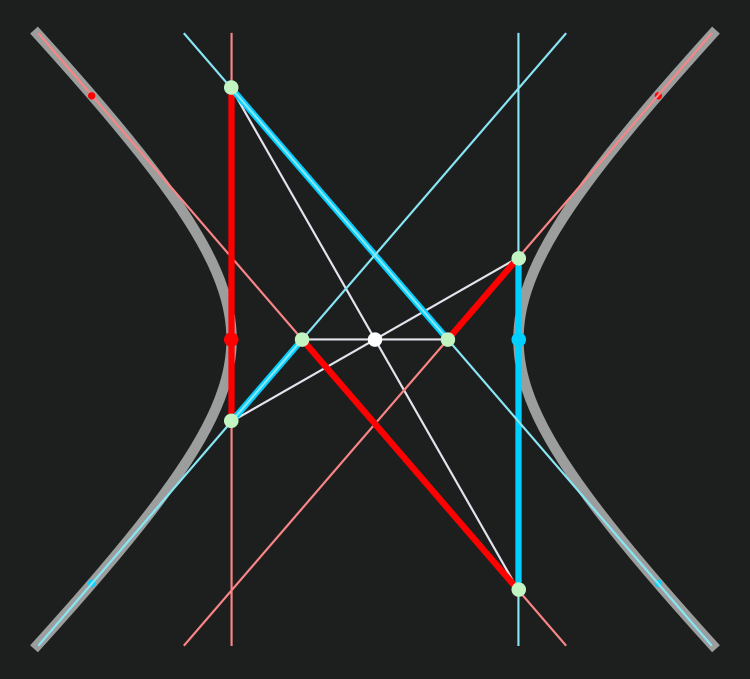
If we project the hyperboloid with all its decorations into the plane, like done so in the images above, the outline of the hyperboloid becomes a common hyperbola, and the six lines of the hexagon tangential to it. This leads to Brianchon’s theorem in the plane: The main diagonals of a hexagon circumscribed in a conic section meet in a point.
Brianchon Hyperbola2 01

This theorem becomes easier to parse if the conic is just an ellipse:

Brianchon ellptic 01

We also have enough room here to see that there is a second dual conic on which the A-lines and B-lines, respectively, meet.

Slidables

A while ago I tried to start a blog about games and puzzles, which failed, mainly due to time constraints.
I will recycle some of the posts here.

Here are a few crafts of varying difficulty that you can do just with card stock and scissors. The idea is always the same: Use several copies of a simple shape with slits to build paper sculptures. They all make nice holiday ornaments.

Triangles

The simplest such shape is an equilateral triangle that has been slit as shown below.

Triangle

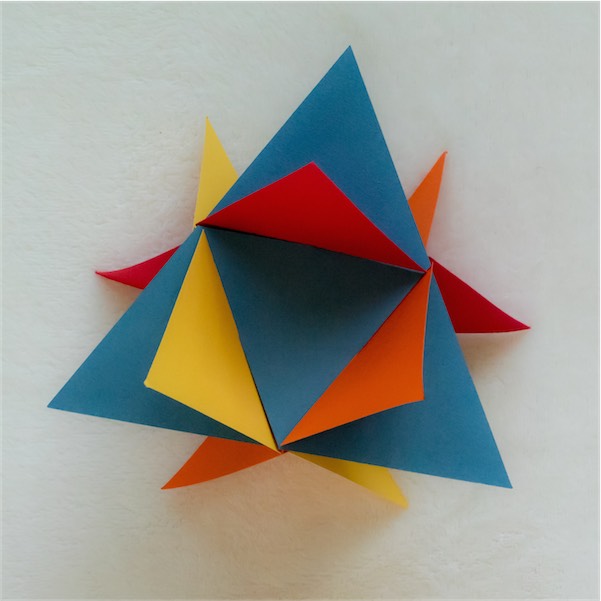
Using four such triangles, you can build the following star.

Folds 2

With eight triangles and a bit more patience, you get the following shape, which is Kepler’s Stella Octangula, a stellation of the octahedron, or the compound of two tetrahedra.

Folds 6

I like to curl the tips of the triangles to make them look like flower petals.

You can of course also build other objects.

Pentagonal Stars

Folds 1

Using 12 copies of the slit pentagrams below, one can build Kepler’s Small Stellated Dodecahedron.

Pentagram

This requires a bit patience. Start with one pentagram, and insert five pentagrams successively in all of its slits, thereby also linking the inserted pentagrams together as well. Then insert another five pentagrams into neighboring pairs of the first ring of pentagrams, again linking the pentagrams from the new ring together. Finally, insert the twelfth pentagram into the free slits of the pentagrams from the second ring.

The last steps require some heavy bending of the pentagrams, and careful adjustment at the end.

Triangles and Squares

Folds 7

Using properly slit triangles and squares, one can build a stellation of the cuboctahedron.

Trisquare

The slits in the squares and triangles must have the same length.

This is a bit easier than the previous example. During assembly, the model falls easily apart, but it is quite sturdy when done.

Irregular Hexagons

Folds 4

Twenty of the regular hexagons below can be used to create one of the stellations of the Icosahedron, the Small Triambic Icosahedron.

Icosahedron

Escher’s Solid

Folds 3

This is the first stellation of the rhombic dodecahedron, also called Escher’s Solid. It tiles space. You need 12 of the non-convex hexagons below.

Escher

A simpler version is a stellation of a rhomboid, using 6 hexagons.

Folds 5

Final Comments

The strategy to design these models is to look for regular polyhedral shapes with few kinds of faces that intersect in a relatively simple way. Then, each intersection of two faces leads to slits on both faces half way along the intersection, so that the two faces can be slid into each other.

There are of course limits to this, but I am sure there are many more models one can assemble.